A $1,000 budget puts you in an interesting spot. You’re no longer stuck on whether you can buy a good watch. You’re deciding which good watch deserves to be your only one. At this price, there are excellent divers, field watches, GMTs, and solar-powered options, each bringing something different to the table. The difficult part is finding the watch that still feels like the right choice after months of daily wear, not just the one that makes the strongest first impression. That’s exactly what this list is designed to help you figure out.
After more than a decade of wearing, reviewing, and testing affordable watches hands-on, we’ve found that the best one-watch collection has very little to do with chasing the biggest specifications. The watches that last are the ones that quietly fit into everyday life: they’re comfortable from morning to night, easy to read without thinking, versatile enough to move between different settings, and interesting enough that you still enjoy catching them on your wrist long after the honeymoon phase has passed. Every recommendation here comes from a watch we’ve personally reviewed and spent meaningful time with, so these aren’t hypothetical picks or catalog favorites. They’re the watches we’d genuinely be comfortable wearing as our only watch under $1,000, each with honest strengths and real compromises.
Casio G-Shock CasiOak
| Price: | $100 – $210 |
| Water Resistance: | 200m |
| Case Dimensions: | 45.4mm (diameter) x 48mm (lug-to-lug) x 11.9mm (thickness) |
| Lug Width: | 20mm |
| Movement: | G-Shock Quartz 5611 Module |
| Amazon: | See Today’s Price |
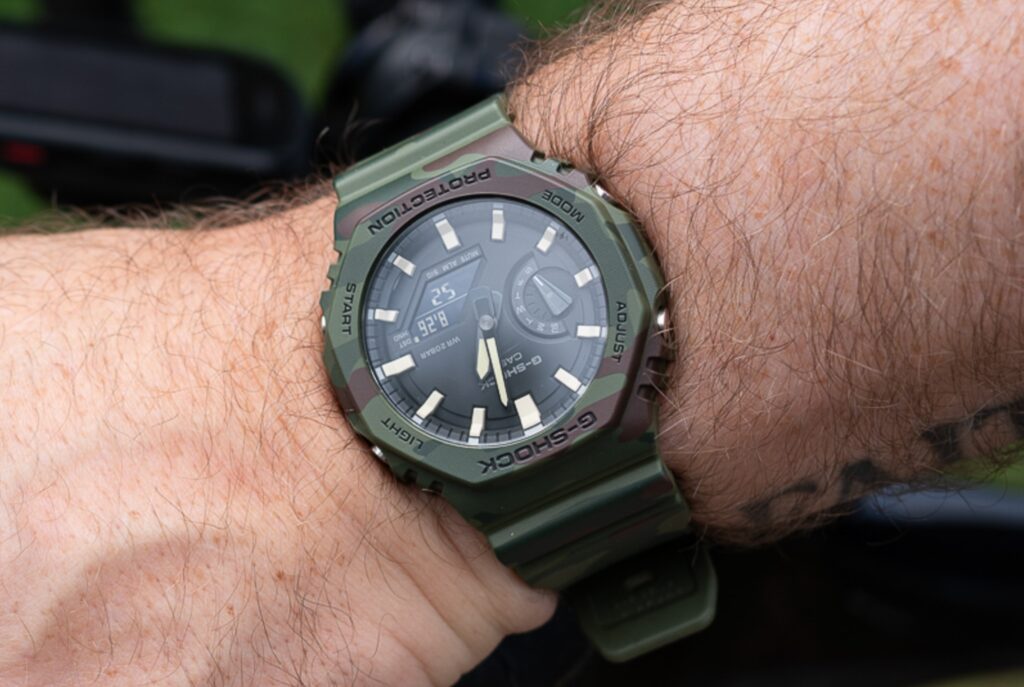
Not every G-Shock makes sense as your only watch. Most lean so heavily into the “tool” side of the equation that they never feel at home outside casual settings. The CasiOak is different. It keeps the carefree attitude that makes G-Shocks so easy to own, but the analog-digital layout and slimmer profile make it wearable with almost anything. We found ourselves reaching for it on days when we wanted something tougher than a typical everyday watch without looking like we were heading to a construction site.
The numbers don’t do it many favors. At 45.4 mm across, it sounds enormous, yet it never wore that way during our hands-on time with it. The square-inspired case spreads its size well, and the downward strap connection keeps it planted rather than wobbling on the wrist. The Carbon Core Guard construction helps, too. It feels lighter than older G-Shocks we’ve spent time with, but never flimsy. The familiar 5611 module is exactly what you’d hope for in a one-watch digital companion. World time, alarms, countdown timer, and stopwatch are all here, and after a few days of use, jumping between functions becomes muscle memory rather than something you have to think about.
The biggest surprise was how much personality you can give it. The included OEM adaptors let you fit standard 20 mm straps, so you’re not locked into the usual resin-only look. We liked the stock camo strap the most because it feels secure and suits the watch, while the orange Cordura option is comfortable, but its sliding keepers quickly became a minor annoyance. Low-light legibility is another compromise. The raised tan indices add depth to the dial, but the lume on the sword hands and markers is fairly modest, so you’ll be reaching for the LED after dark.
Still, if your version of a one-watch collection is something you can wear, knock around, and never overthink, the CasiOak makes a more flexible case than most G-Shocks.
Pros
- More versatile than the average G-Shock without giving up the toughness that defines the line.
- Carbon Core Guard keeps the watch light and comfortable despite its substantial size.
- 20 mm strap compatibility makes it easy to change the look instead of being stuck with resin.
- The 5611 module packs useful everyday functions without feeling complicated.
Cons
- Lume is underwhelming, so the LED does most of the work after dark.
- The analog-digital display isn’t as instantly readable as a traditional digital G-Shock.
- The Cordura strap’s keepers tend to slide around during wear.
Casio G-Shock GW6900-1
| Price: | $140 |
| Water Resistance: | 200m |
| Case Dimensions: | 53.2mm (diameter) x 50mm (lug-to-lug) x 17.7mm (thickness) |
| Lug Width: | 16mm |
| Movement: | Solar Quartz Module 3179 |
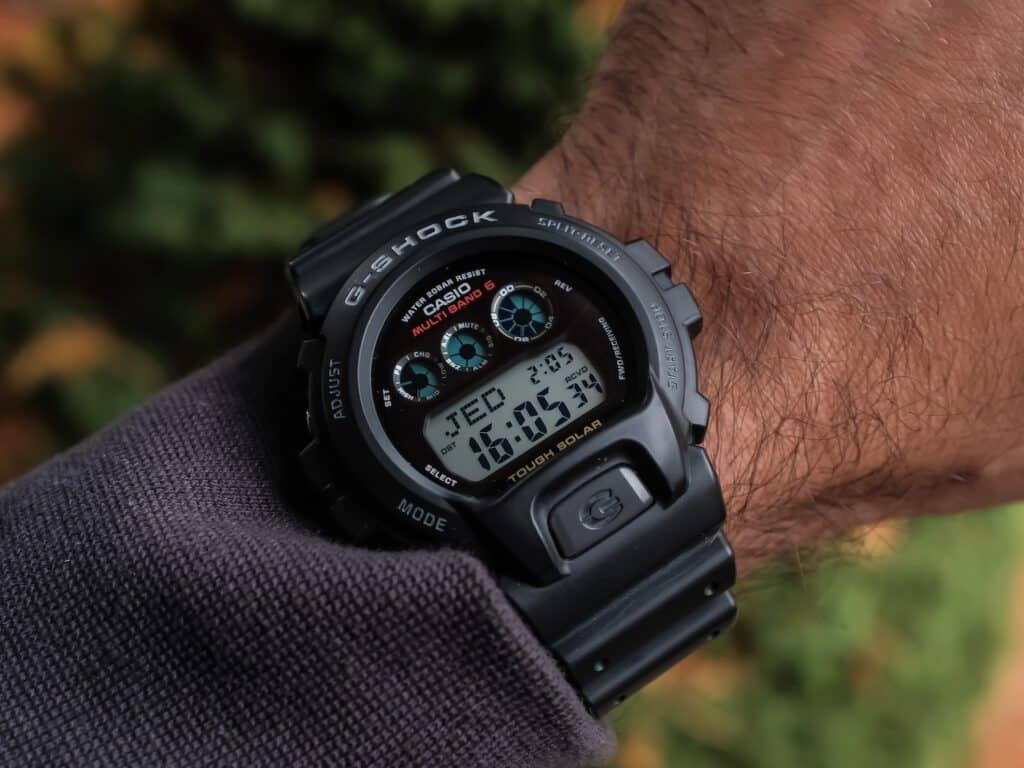
If your definition of a one-watch collection under 1,000 bucks is “the watch I never have to think about,” the GW6900 deserves a serious look. It isn’t trying to dress up as a dive watch or borrow charm from a mechanical movement. It simply gets on with the job. This is the watch we reach for when the day looks unpredictable, and we don’t feel like negotiating with our gear: yard work, rushed mornings, unexpected rain, or the kind of knocks that make you instinctively glance at your wrist. More often than not, the watch comes away looking better than whatever it hit, which is why it earns a place in a one-watch collection built around utility rather than on-paper versatility.
The long-term appeal isn’t just the toughness. Tough Solar means regular exposure to light keeps it running, so battery changes practically disappear from the ownership experience. Multi-Band 6 quietly syncs with atomic time signals across the U.S., UK, Germany, Japan, and China, and ours corrected itself overnight often enough that we stopped thinking about accuracy.
As covered in our hands-on testing, the digital display feels busy for the first couple of days, and the triple-eye layout can look more like an instrument panel than a watch face. Stick with it. Before long, navigating the stopwatch, countdown timer, five alarms, and dual-time display becomes second nature. We ended up using those features far more often than we expected, and the oversized front button for the green EL backlight is one of those small details that’s genuinely satisfying when you need it after dark.
Then there’s the part the specifications don’t explain very well. Yes, it’s over 50 mm wide and almost 18 mm thick, but the lightweight resin case and steel caseback keep it from wearing as much as the numbers indicate. It feels more like a protective shell strapped to your wrist than a heavy lump of resin, which is probably why we forgot about its size until it bounced off a doorframe. The stock resin strap follows a similar pattern. Fresh out of the box, it’s stiff, a little squeaky, and unmistakably G-Shock, but it softens quickly, dries fast after getting wet, and wraps the wrist well enough that shopping for an aftermarket strap never felt necessary.
In short, this won’t be the one-watch answer for someone who needs a watch under a shirt cuff every day. But if your goal is owning one watch that asks almost nothing of you while handling almost everything you throw at it, the GW6900 makes a compelling case.
Pros
- Tough Solar keeps ownership almost maintenance-free.
- Multi-Band 6 automatically keeps the watch remarkably accurate.
- Lightweight resin construction makes the oversized case easier to wear than expected.
- Stopwatch, countdown timer, dual time, and five alarms add everyday utility.
- Bright green EL backlight is simple, effective, and easy to activate.
Cons
- The large case won’t disappear on smaller wrists.
- The triple-eye display takes a little time to feel intuitive.
- The resin strap starts stiff before breaking in.
Timex Expedition Field Post Solar
| Price: | $199 |
| Water Resistance: | 100m |
| Case Dimensions: | 36mm (diameter) x 44mm (lug-to-lug) x 12mm (thickness) |
| Lug Width: | 18mm |
| Movement: | Solar Quartz |
| Amazon: | See Today’s Price |
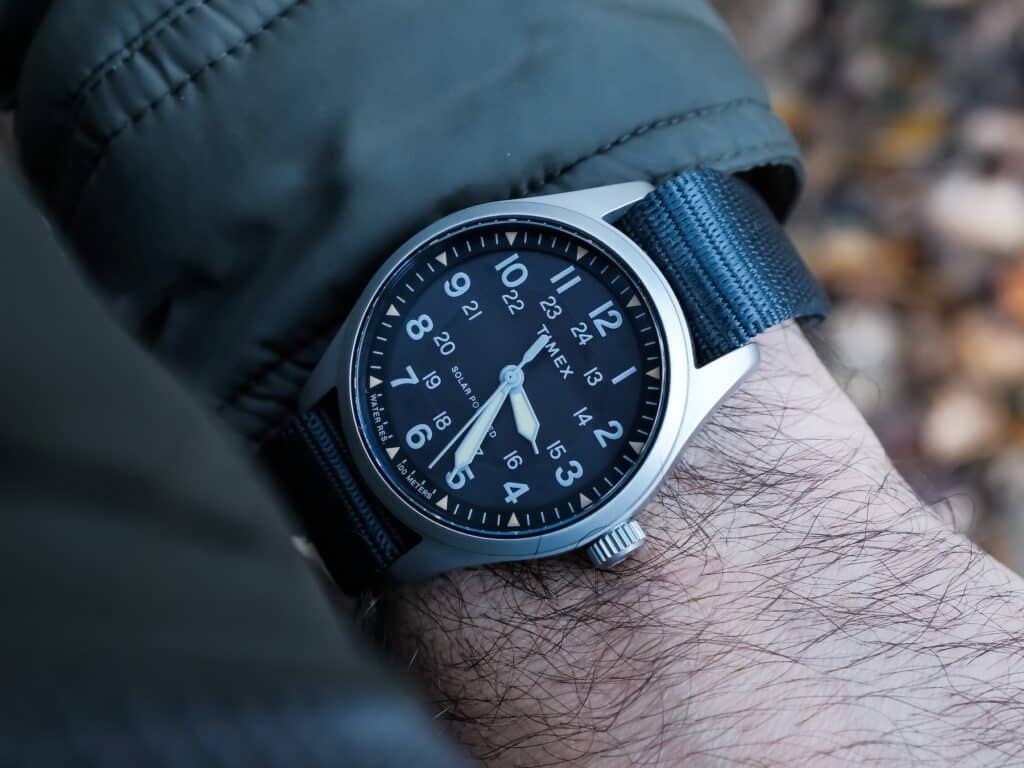
If your one-watch budget sits comfortably below the four-figure mark, the Expedition Field Post Solar is one of the easiest watches to recommend. It doesn’t win you over with clever complications or flashy finishing. It wins because it’s quite easy to live with. This is the watch we found ourselves grabbing when we didn’t want to think about winding, setting, or whether what was on our wrist matched the rest of the day. For a one-watch collection, that’s a bigger compliment than it sounds.
That low-maintenance personality starts with the solar quartz movement. Once fully charged, Timex rates it for roughly four months of power reserve, and throughout our time wearing it, accuracy stayed consistent enough that touching the crown became a rare event. The screw-down crown adds a little extra confidence for everyday wear, even if its action feels more functional than refined.
The 36 mm stainless steel case reinforces the same philosophy. It sits low, stays balanced, and disappears on the wrist in a way many larger field watches don’t. We also grew to appreciate the bead-blasted finish the longer we wore it. Instead of obsessing over the first scratch, we simply stopped noticing them. Up front, the full-numeral field dial remains legible, while the slightly domed sapphire crystal adds just enough warmth without feeling too vintage. Pair that with the anti-reflective coating, and glare outdoors becomes much less of an issue than you’d expect at this price.
The compromises are exactly where you’d expect them on an ultra-affordable watch. Lume never became a strength. Even after a full charge, the hands glow only briefly, the dial contributes very little, and you’ll lose that brightness sooner than you’d like. We also think the supplied leather strap is trying a little too hard. It’s comfortably soft, but it’s thick enough to make the compact case feel a bit out of proportion. Swapping it onto a simple MIL-style strap immediately made the whole watch feel more cohesive and much closer to the straightforward field watch it wants to be. If you’re building a one-watch collection on a tighter budget, few watches make everyday ownership feel this uncomplicated.
Pros
- Solar quartz movement makes day-to-day ownership almost effortless.
- The bead-blasted finish hides everyday wear better than polished surfaces.
- Compact 36 mm case wears comfortably and stays out of the way.
- Sapphire crystal with anti-reflective coating improves durability and cuts glare outdoors.
- Clean field dial stays easy to read in virtually any setting.
Cons
- Lume fades quickly and offers minimal dial illumination.
- The leather strap feels too thick for the compact case.
- The screw-down crown doesn’t offer a refined action.
Citizen Promaster Diver BN0151
| Price: | $250 – $300 |
| Water Resistance: | 200m |
| Case Dimensions: | 43mm (diameter) x 48mm (lug-to-lug) x 11.5mm (thickness) |
| Lug Width: | 20mm |
| Movement: | Citizen Eco-Drive E168 (solar quartz) |
| Amazon: | See Today’s Price |
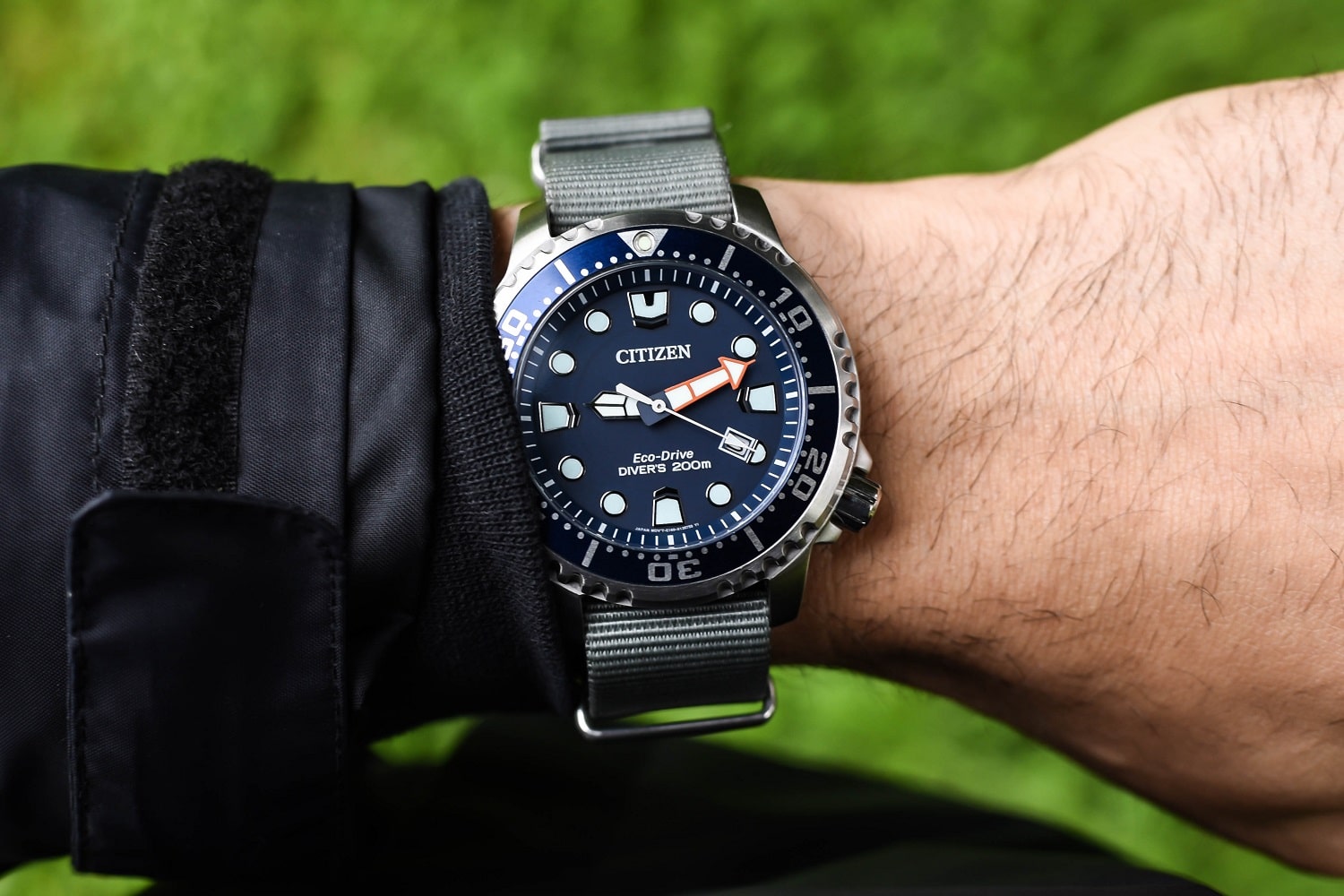
If your one-watch collection revolves around everyday practicality rather than dressing up, we’d have a hard time leaving the BN0151 off the list. This is the watch we kept reaching for because ownership became almost invisible. It was always running, always accurate enough, and never needed us to think about it. The Eco-Drive movement hovered around ±15 seconds per month during our dedicated wrist time, ran for roughly six months on a full charge, and recovered quickly after we intentionally drained it to the low-power indicator. That’s the kind of reliability we want from a watch that’s expected to handle nearly every day on its own.
The BN0151 also avoids feeling like the oversized diver its specifications suggest. At 43 mm, we expected more wrist presence, but the short lug-to-lug distance and curved case pull it in nicely, making it comfortable through long workdays and weekends alike. Citizen’s decision to place the crown at 4 o’clock pays off every time you bend your wrist, because it simply stays out of the way.
The dial reinforces that same no-fuss attitude. Large hands and applied markers make quick time checks effortless. At the same time, the blue dial develops a subtle purple hue depending on the light, lending it more personality than product photos ever capture. We also came away impressed by the aqua-toned lume, which remained visible for hours, and by the luminous pip on the second hand, which made it easy to confirm the watch was still running in darker conditions. Add 200 meters of water resistance, and it became the watch we packed without giving it a second thought.
It’s not pretending to be everything. The mineral crystal isn’t as reassuring as sapphire, the 60-click bezel becomes a little slippery with wet hands, and the polyurethane strap takes longer than we’d like to soften up. We eventually preferred ours on a NATO. It’s also never going to pass as a dress watch, and that’s the trade-off. But if your daily life involves more commuting, travel, weekends outdoors, and the occasional swim than formal occasions, the BN0151 is one of the easiest one-watch collections to live with because it quietly solves problems instead of creating them.
Pros
- 200 meters of water resistance encourages carefree everyday wear.
- Eco-Drive delivers roughly six months of runtime with dependable accuracy.
- The 4 o’clock crown and compact case proportions make the watch more comfortable than most 43 mm divers.
- Aqua-toned lume lasts for hours, and the luminous second-hand pip is useful in the dark.
- The blue dial reveals subtle purple tones that add character in changing light.
Cons
- The polyurethane strap takes time to break in.
- The bezel grip loses confidence with wet hands.
- The mineral crystal isn’t as scratch-resistant as sapphire.
Casio Oceanus T200
| Price: | $300 – $500 |
| Water Resistance: | 100m |
| Case Dimensions: | 41.4mm (diameter) x 49mm (lug-to-lug) x 10.7mm (thickness) |
| Lug Width: | 20mm |
| Movement: | Tough Solar movement (Module 5596) |
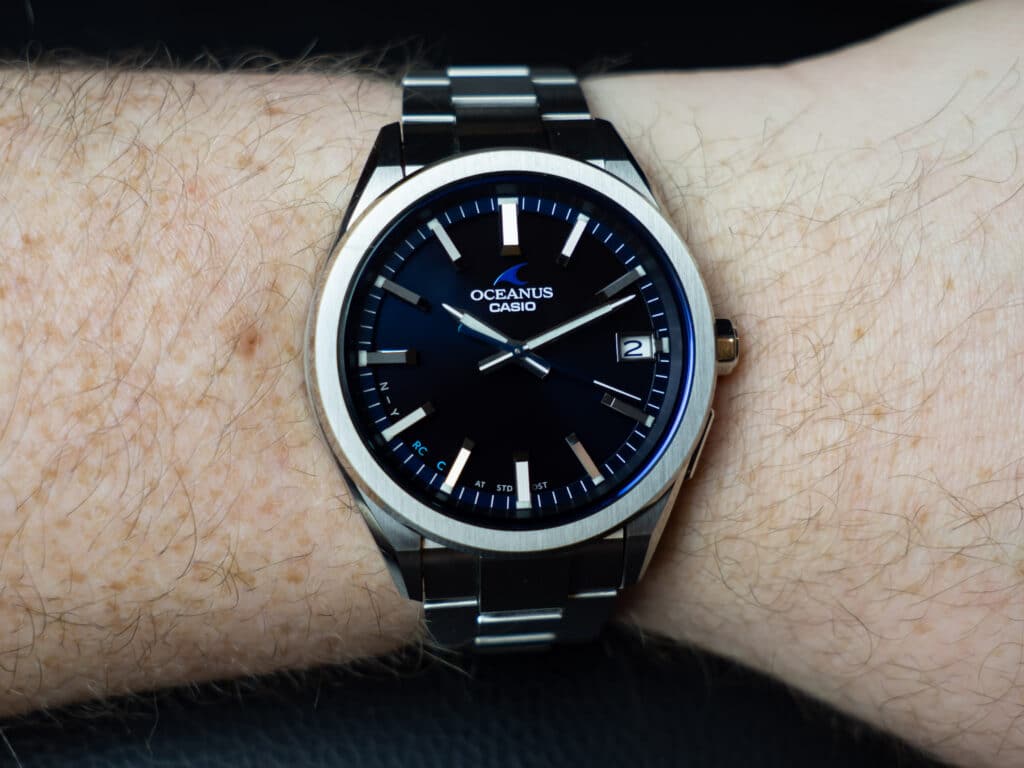
The Oceanus T200 makes the strongest case for someone who wants one watch that quietly handles everything without feeling like a compromise. It has enough refinement to slip under a cuff, enough everyday practicality that you won’t hesitate to wear it the rest of the week, and almost none of the maintenance that usually comes with relying on a single watch. During our testing and wear period, we never found ourselves thinking about whether it needed to be set or charged. We simply put it on, saw the correct time, and got on with the day. That’s a small luxury you only start to appreciate when one watch is expected to do all the work.
Most of that experience comes from the technology you barely notice. The Tough Solar-powered 5596 module stayed charged through normal wear, while Bluetooth syncing through the Oceanus app quietly kept the watch accurate in the background without asking anything of us. Thankfully, none of that makes the T200 feel like a gadget.
The brushed and polished case has a level of finishing that’s hard to expect at this price, and the deep blue dial rewards closer inspection. The floating hour markers create genuine depth through the cutouts in the chapter ring, while the blue-tinted sapphire crystal catches natural light in a way that gives the watch just enough character without becoming showy. Daytime legibility never gave us a reason to complain.
The compromises are minor. The lume does its job but fades into the background compared to the rest of the watch, so don’t expect it to be a standout feature at night. The bracelet also develops a noticeable rattle once it’s off the wrist, and Casio’s pin-and-collar sizing system remains every bit as fiddly as its reputation suggests. The connectivity text on the dial won’t appeal to minimalists, either. Even so, if your idea of a one-watch collection leans more toward understated refinement than pure tool-watch toughness, the T200 is one of the few watches under $1,000 that demand consideration.
Pros
- Tough Solar and Bluetooth syncing make day-to-day ownership almost hands-off.
- Floating hour markers and the blue-tinted sapphire crystal lend the dial impressive depth.
- Balances everyday practicality with enough refinement for most dressier occasions.
- Brushed and polished finishing feels far more refined than the price implies.
- Excellent daytime legibility makes it easy to live with.
Cons
- Pin-and-collar bracelet sizing is more tedious than it should be.
- Lume is adequate but never becomes a standout feature.
- The bracelet develops a noticeable rattle once it’s off the wrist.
- Connectivity text on the dial won’t suit cleaner, more minimalist tastes.
Seiko SRPE51
| Price: | $315 |
| Water Resistance: | 100m |
| Case Dimensions: | 40mm (diameter) x 44mm (lug-to-lug) x 12mm (thickness) |
| Lug Width: | 20mm |
| Movement: | Seiko 4R36 |
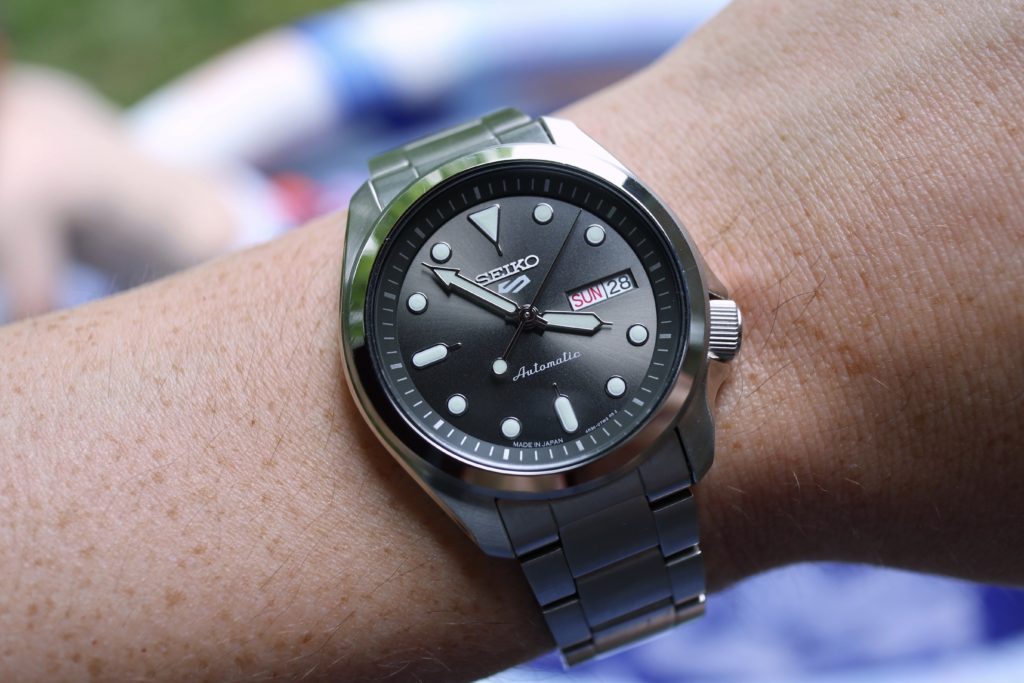
The SRPE51 feels like Seiko finally admitting that most of us aren’t spending our days diving or attending black-tie dinners. We just need one watch that can handle normal life without looking out of place. That’s exactly where this one shines. By ditching the SKX’s dive bezel in favor of a polished fixed bezel, Seiko landed in a sweet spot that few watches at this price manage. We wore it with T-shirts, button-downs, and everything in between, and it never felt like we were asking it to be something it wasn’t. If your one-watch collection needs to cover more office days than ocean dives, the SRPE51 makes a lot of sense.
The best part is how naturally it pulls that off. The 40 mm case wears compact without feeling small, while the grey dial quietly steals the show. It changes personality as the light shifts, revealing subtle shades that keep you glancing back at your wrist without becoming flashy. Applied markers, the revised Seiko 5 branding, and the modern handset give the dial a clean, balanced look, while LumiBrite remains every bit as dependable as we’d expect from Seiko. We still couldn’t help but wish for a second-hand lollipop when checking the time in the dark, but that’s more of an enthusiast complaint than a practical one.
The flat Hardlex crystal ensures minimal distortion, and on the back, the familiar 4R36 automatic—with hacking, hand-winding, and an exhibition caseback—reminds you why mechanical watches still have a charm that quartz simply can’t replicate. As we spent more time with it, we definitely caught ourselves flipping it over more often than necessary just to watch the movement ticking away.
The bracelet is where Seiko reminds you this is still an affordable watch. The hollow end links feel lighter and a little janglier than the otherwise solid case, and chapter ring alignment can still be a bit of a lottery depending on the example you get. Thankfully, neither issue defines the ownership experience. The drilled 20 mm lugs make strap changes almost effortless, and the SRPE51 responds better to a new strap than most watches in this price range. Leather gives it a dressier personality, a NATO brings back some field-watch attitude, and the bracelet keeps it squarely in everyday territory. That’s ultimately why it belongs here. It doesn’t try to be everything; it adapts to dressy and sporty situations better than you’d expect.
Pros
- The grey dial develops subtle depth and changes character as the light moves.
- Drilled 20 mm lugs make swapping straps quick and worthwhile.
- LumiBrite provides excellent visibility once the lights go down.
- The 4R36 automatic offers hacking, hand-winding, and the simple pleasure of an exhibition caseback.
Cons
- Chapter ring alignment can vary from one example to another.
- Hollow end links make the bracelet feel lighter and slightly rattly.
- The Hardlex crystal isn’t as confidence-inspiring as sapphire.
Seiko Turtle
| Price: | $370 – $525 |
| Water Resistance: | 200m |
| Case Dimensions: | 44.3mm (diameter) x 48mm (lug-to-lug) x 14mm (thickness) |
| Lug Width: | 22mm |
| Movement: | Seiko 4R36 |
| Amazon: | See Today’s Price |
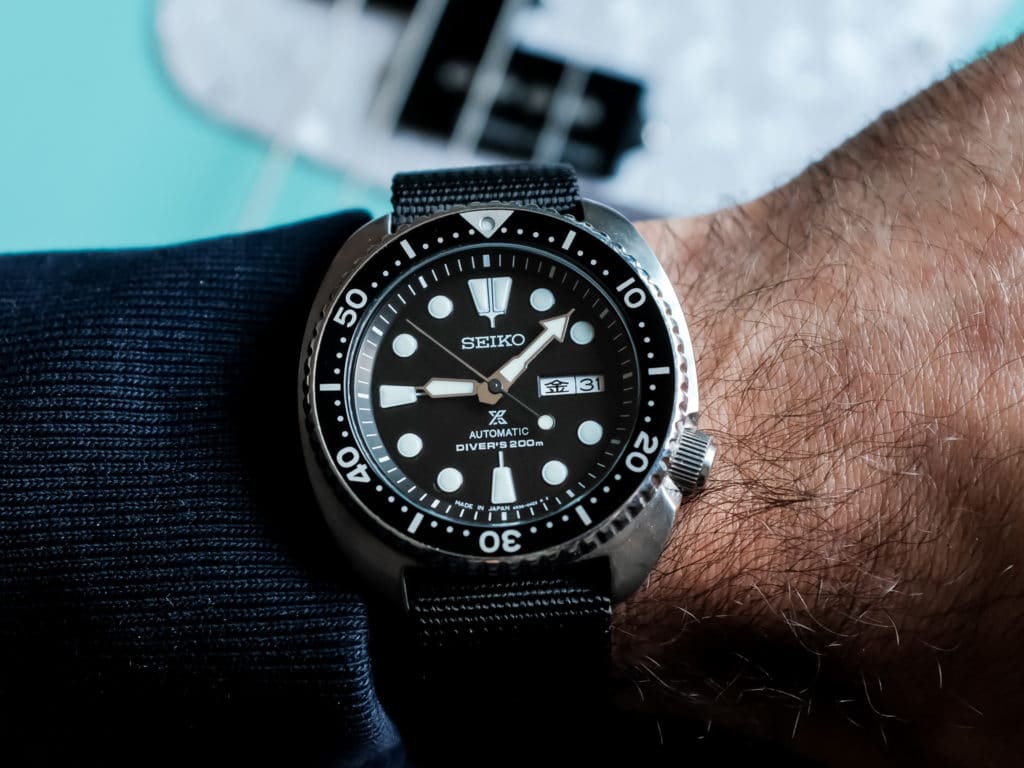
The Turtle probably isn’t the most sensible one-watch collection pick on this list, and that’s partly why it’s here. Plenty of modern watches offer sapphire crystals, tighter manufacturing tolerances, and movements that keep better time. On paper, they should make the Turtle feel outdated. Then we spend a few weeks wearing one again and remember why it refuses to disappear from the conversation. It has a personality that’s hard to measure on a specification sheet. If your idea of a one-watch collection includes owning something with genuine collector appeal rather than simply checking every practical box, the Turtle still earns its place.
It also wears unlike almost anything else in its class. The 44 mm-plus case sounds intimidating until it’s actually on the wrist, where the rounded cushion shape spreads its weight so naturally that it feels more settled than plenty of smaller dive watches we’ve worn. The offset crown is another detail that quietly proves its worth over time, never digging into the back of the hand during a full day of wear. Seiko applies that same no-nonsense thinking to the dial. The matte black surface stays clean and uncluttered, while the oversized hands and Lumibrite-filled markers make reading the time effortless in virtually any lighting. The lume remains among the best in the business, and even the Prospex “X” eventually disappears into the background. The optional Kanji day wheel, on the other hand, never quite did. It’s undeniably charming, but there were more than a few mornings when we wished the standard English wheel had shown up first instead.
Living with the Turtle also means accepting a few long-standing Seiko quirks. The 4R36 automatic offers hacking and hand-winding, but the particular model we reviewed ran about +35 to +45 seconds per day, so don’t expect chronometer-like precision. We’d also still inspect bezel alignment before buying because consistency varies from watch to watch. The Hardlex crystal has proven tougher in everyday wear than the internet sometimes gives it credit for, even if we’d still choose sapphire when given the option. And while the supplied silicone strap is a noticeable improvement over Seiko’s older rubber straps, we think the Turtle comes alive on a NATO. It simply feels more at home there.
No, it won’t be the best fit if your only watch needs to spend as much time under a shirt cuff as it does in the water. But if you’re willing to trade a little versatility for a lot more personality, the Turtle remains one of the most satisfying one-watch divers you can buy.
Pros
- The cushion case wears far smaller and more comfortably than its 44 mm-plus dimensions suggest.
- The offset crown stays comfortably out of the way during extended wear.
- Oversized hands, matte dial, and outstanding Lumibrite make legibility excellent day or night.
- The 4R36 movement includes hacking and hand-winding for an easier ownership experience.
- The stock silicone strap is comfortable, and the watch feels even better on a NATO.
Cons
- Bezel alignment is still worth checking before purchase, and accuracy varies between examples.
- The broad case won’t appeal to collectors who prefer compact divers.
- Hardlex crystal doesn’t offer the scratch resistance of sapphire.
- The Kanji day wheel can be slower to read at a glance than the standard English version.
Vaer G2 Meridian GMT

| Price: | $399 |
| Water Resistance: | 150m |
| Case Size: | 39mm (diameter) x 46mm (lug-to-lug) x 10mm (thickness) |
| Lug Width: | 20mm |
| Movement: | Swiss-made Ronda 515.24H |
Not everyone needs a GMT in their one-watch collection, but if you do, the G2 Meridian makes a sensible case for skipping mechanical altogether. One of the first things we noticed during our time with it was how little attention it demanded. The Swiss Ronda 515.24H quartz movement meant it was always running when we picked it up, the quick-set date made it easy to reset after sitting for a while, and the multi-year battery life suited the kind of ownership where convenience usually wins over winding a movement. Yes, it’s a caller GMT rather than a flyer. Hence, the independently adjustable 24-hour hand isn’t ideal for frequent international travel, but that’s a compromise we found easier to live with than constantly resetting a mechanical GMT we hadn’t worn for a few days.
According to our review team’s insights, the rest of the watch follows that same practical mindset. At 39 mm across, 46 mm lug-to-lug, and a touch over 10 mm thick, it’s one of those watches that settles onto your wrist and stays there without constantly reminding you it’s on. We rarely thought about its size. The 150 meters of water resistance and screw-down crown also remove the temptation to treat it delicately.
The brushed and polished case has enough refinement for the office without losing its tool-watch character, while the engraved caseback feels like one of those details that’s there because Vaer wanted owners to appreciate it, not because it would look good in an advertisement. Up front, the applied markers, balanced six o’clock date, and uncluttered handset make the dial easy to live with, and while the lume won’t win any competitions, it stays useful long enough to matter.
The bidirectional Pepsi bezel is quick to adjust and has reassuringly positive clicks, but the play and occasional alignment issues are hard to ignore if you’re particular about those things. We also ended up preferring the rubber strap to the included NATO strap. It feels more substantial than Vaer’s older straps, tapers naturally, and suits the lightweight case far better, while the NATO never quite lost its stiffness. If your one-watch collection needs to track another time zone without adding mechanical maintenance to your routine, the G2 Meridian gets the priorities right, even if it isn’t chasing enthusiast bragging rights.
Pros
- The compact, thin case is comfortable enough to disappear during all-day wear.
- Swiss Ronda quartz GMT keeps ownership low-maintenance.
- The rubber strap complements the lightweight case better than the included NATO strap.
- 150 meters of water resistance, paired with a screw-down crown, encourage everyday use without hesitation.
Cons
- The Pepsi bezel has noticeable play.
- Bezel alignment isn’t always perfectly centered if you’re paying close attention.
Seiko SSK025 Field GMT
| Price: | $435 |
| Water Resistance: | 100m |
| Case Size: | 39.4mm (diameter) x 47.9mm (lug-to-lug) x 13.6mm (thickness) |
| Lug Width: | 20mm |
| Movement: | Seiko 4R34 (Mechanical) |
| Amazon: | See Today’s Price |
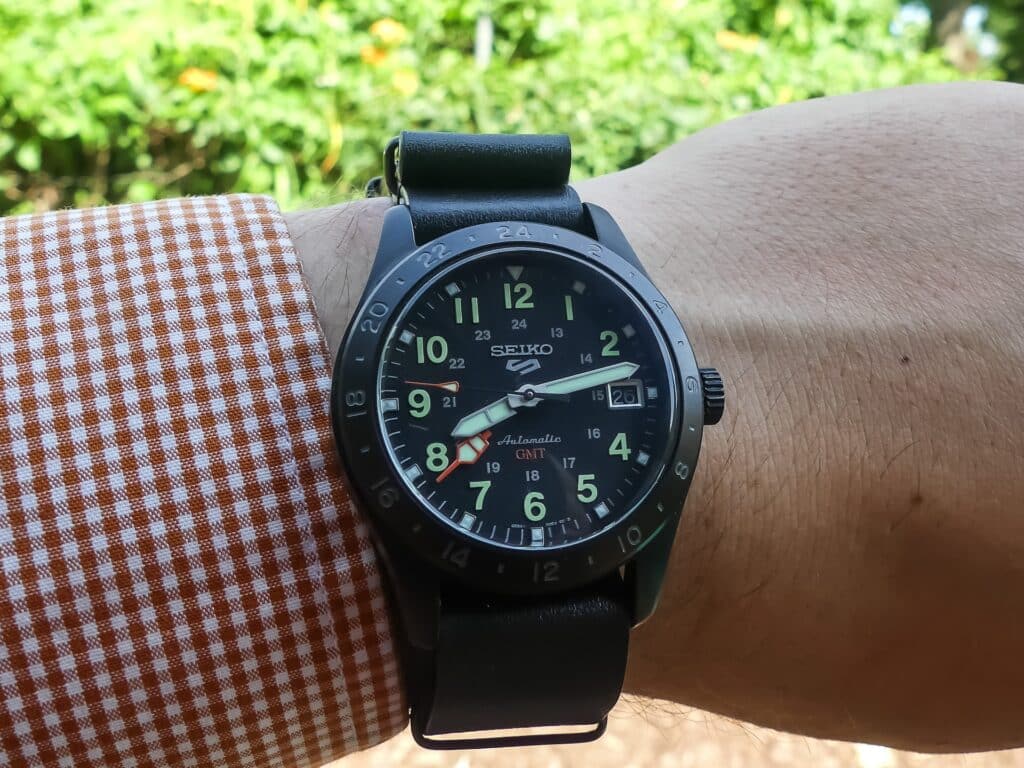
If your one-watch collection includes regular travel, or you simply prefer the cleaner look of a field watch over a dive watch, the SSK025 makes a stronger case than the standard Seiko 5 GMT. It surprised us for reasons we didn’t expect. We assumed the GMT hand would be the headline feature, but after spending significant wrist time, what stood out most was how easy the watch was to read. The field-style layout feels like a natural fit for a GMT. Full Arabic numerals, generous LumiBrite, a bright orange GMT hand, and a neatly integrated date display all coexist without the dial ever feeling crowded. Even the lightly textured black dial, with its subtle sandy finish, adds enough depth to keep things interesting, while the matching orange accents and black date wheel make the whole design feel intentionally put together rather than borrowed from different parts bins.
The case tells a slightly more complicated story. At 39.4 mm across, it sounds like an effortless everyday wearer, but the 13.6 mm thickness makes itself known. We first wore it on the supplied single-pass leather strap and never quite forgot it was there, because the extra material underneath made the watch rock from side to side unless we secured it down more tightly than we’d have liked. Nylon straps behaved much the same way. Everything clicked once we switched to rubber. Without the added bulk beneath the case, the watch settled naturally on the wrist and finally felt as balanced as the dial had promised from the start. The black IP-coated case finish also deserves credit. It gives the SSK025 a more distinctive personality than its steel sibling and suits the field-watch aesthetic well.
The trade-offs are familiar if you’ve owned modern Seikos. The 100 meters of water resistance is perfectly usable, but the push-pull crown and Hardlex crystal leave you wondering why Seiko stopped just short of making this an obvious recommendation. A screw-down crown, sapphire crystal, or even a slightly slimmer case would have elevated the entire experience. Even so, we kept coming back to the SSK025 because it simply works. If you want a one-watch collection that leans toward field-watch practicality while adding genuinely useful travel functionality, we’d reach for this.
Pros
- Black IP-coated case gives the watch a more pronounced personality than the standard steel model.
- Highly legible field dial keeps the GMT display, date, and time easy to read at a glance.
- Textured dial, black date wheel, and orange accents add more depth than first impressions suggest.
Cons
- The 13.6 mm case wears taller than the diameter implies.
- Push-pull crown feels like a missed opportunity on a travel-ready field watch.
- Hardlex crystal is the compromise that’s hardest to overlook at this price.
Seiko 5 GMT
| Price: | $475 |
| Water Resistance: | 100m |
| Case Dimensions: | 42.5mm (diameter) x 46mm (lug-to-lug) x 13.6mm (thickness) |
| Lug Width: | 22mm |
| Movement: | Seiko 4R34 (Mechanical Movement) |
| Amazon: | See Today’s Price |
The Seiko 5 GMT is the watch we’d hand to someone who wants their one-watch collection to do a little more than tell the time. Even if you aren’t crossing time zones every week, there’s something useful about always having another city a glance away. More importantly, it never feels like you’re wearing a complicated watch. During our time with it, the GMT function slipped into the background until we needed it, which is probably the best compliment we can give it. The 4R34 is a caller GMT rather than a flyer, so frequent international travelers will still find limitations, but for tracking family overseas, work hours in another country, or planning the occasional trip, it fits everyday life well. The rotating 24-hour bezel even lets you keep tabs on a third time zone, which proved more useful than we’d expected during our review period.
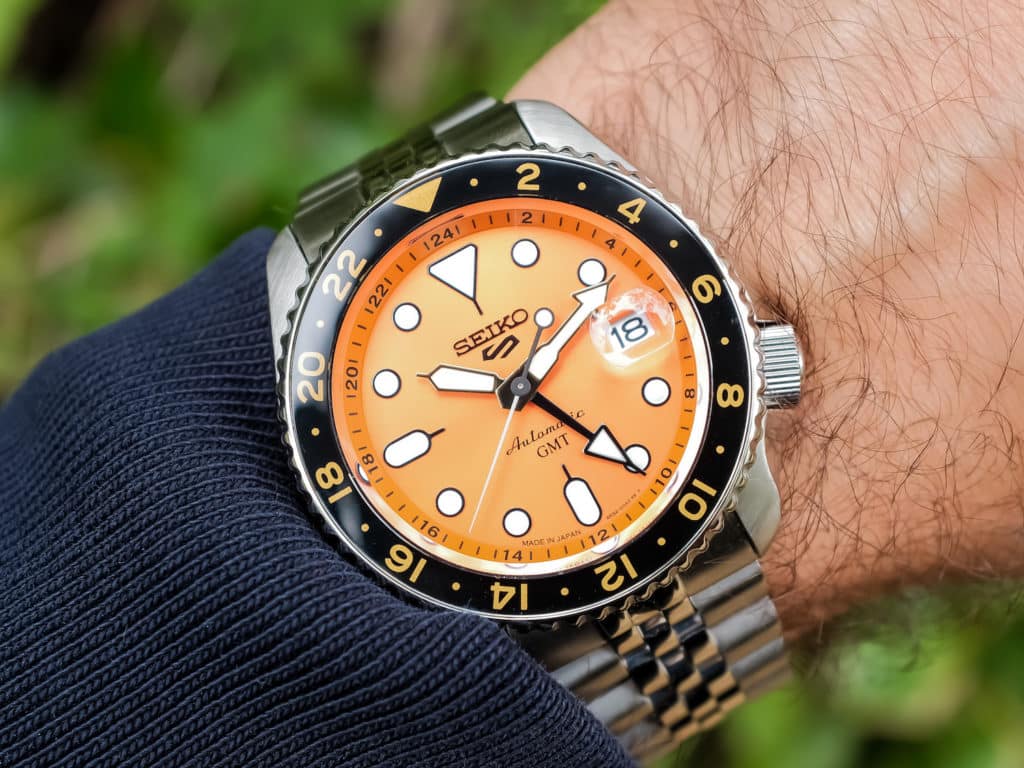
The dial convinced us this could carry a one-watch collection. The orange sunray finish has far more depth than product photos suggest, shifting dramatically as the light changes without becoming loud. The glossy black GMT hand, black surrounds around the applied markers, gilt hands, and generous Lumibrite all work together rather than fighting for attention. All of these make the watch easy to read despite the amount of information it displays. We also found ourselves forgetting about the cyclops after a few days, which says something considering how divided collectors usually are on the subject.
The familiar Seiko sports case deserves similar praise. Although the 42.5 mm diameter looks substantial on paper, the rounded profile, softened lugs, and 46 mm lug-to-lug measurement keep it from wearing like a large watch. It feels solid without ever becoming tiring over the course of a full day.
Like most Seikos in this price range, it asks you to accept a few familiar compromises. The push-pull crown and 100 meters of water resistance don’t quite live up to the expectations set by the old SKX, even though the watch never felt fragile during our time with it and independent pressure testing suggests it’s tougher than the specifications imply. The jubilee-style bracelet also feels as longtime Seiko owners would expect: light, a little jangly, and more comfortable than it has any right to be once you’ve wrestled through the pin-and-collar sizing system. The stamped clasp won’t impress anyone, and some people will never warm to the polished center links, but that’s missing the bigger picture. If your one-watch collection spends more time navigating airports, road trips, and everyday life than dive boats, the Seiko 5 GMT feels like one of the most casual yet natural places to start.
Pros
- GMT complication adds useful travel functionality without feeling complicated.
- Orange sunray dial develops impressive depth while remaining very legible.
- Familiar Seiko case wears smaller than its dimensions suggest.
- Rotating 24-hour bezel lets you monitor a third time zone when needed.
- The Jubilee bracelet stays comfortable throughout long days despite its lightweight construction.
- Lumibrite and the contrasting handset make quick time checks effortless.
Cons
- The smooth bezel lacks the crisp click action some enthusiasts expect.
- The stamped clasp feels basic for the price.
- Pin-and-collar bracelet sizing remains unnecessarily fiddly.
Citizen Promaster Navihawk 40

| Price: | $476 |
| Water Resistance: | 200m |
| Case Dimensions: | 40mm (diameter) x 44.3mm (lug-to-lug) x 13.4mm (thickness) |
| Lug Width: | 20mm |
| Movement: | Eco-Drive caliber B620 |
The Promaster Navihawk 40 challenged one of our assumptions about one-watch collections. We’d normally steer people toward something simpler. A clean field watch. Maybe a GMT. A pilot’s chronograph loaded with complications sounds like the sort of watch you’d enjoy occasionally rather than every day. Then we spent a week wearing the Navihawk and barely reached for anything else. Citizen somehow managed to shrink everything we liked about the older Navihawk into a watch that finally feels comfortable enough to live on your wrist instead of waiting for the right occasion. At 40mm across with a compact 44.3mm lug-to-lug, it wears like an everyday sports watch despite carrying a slide rule, chronograph, 24-hour display, and enough aviation DNA to keep the watch nerd in all of us entertained.
What surprised us most wasn’t how much information the watch displays. It was how quickly all of it stopped feeling complicated. The three textured black subdials naturally separate themselves from the silver-white sunburst dial, the red accents quietly guide your eye around the display, and the white subdial hands never get lost against the main handset. Even the slide rule settles into the background after a few days, becoming part of the watch’s personality rather than something that keeps demanding attention.
The case strikes a similar balance. Broad brushing keeps it firmly in tool-watch territory, polished accents stop it feeling utilitarian, and the familiar coin-edge bezel gives it the unmistakable Promaster identity without making the smaller case feel like a watered-down version of the originals. We also appreciated the sapphire crystal and 200 meters of water resistance, as they let us wear the watch without worrying about what the day might bring. The only detail that never completely won us over was the deeply recessed date window, which takes a little more effort to read than it should.
The Eco-Drive B620 quietly ties the whole experience together. Citizen rates it at roughly ±15 seconds per month with around six months of runtime from a full charge, but the real benefit is that you simply stop thinking about the movement altogether. We found ourselves using the chronograph for everyday tasks far more often than usual because it always felt ready. Timing coffee, cooking, workouts, or parking meters became second nature instead of something reserved for mechanical novelty.
The bracelet surprised us almost as much. We fully expected to swap it for nylon or rubber after a couple of days, yet we kept coming back because it balances the watch so well. The clasp feels secure, although an on-the-fly adjustment system would make an already excellent bracelet even better. We also noticed a slight amount of vertical bezel play on our review sample, but it never affected daily use. If your one-watch collection needs more personality than a straightforward field watch, yet is far easier to own than most mechanical chronographs, the Navihawk 40 makes a convincing case. For a deeper look, read our full review.
Pros
- Eco-Drive movement delivers months of worry-free ownership with excellent long-term accuracy.
- Compact case transforms the Navihawk into a watch that’s comfortable every day.
- The dense dial stays intuitive after only a short time on the wrist.
- Sapphire crystal and 200m water resistance encourage carefree daily wear.
- The bracelet pairs well with the watch and feels secure throughout the day.
Cons
- Date window sits deeper than ideal and can be difficult to read from an angle.
- Bracelet lacks on-the-fly adjustment.
- Slight vertical bezel play was noticeable on our review sample.
- Buyers specifically chasing a mechanical chronograph experience may prefer something more traditional.
RZE Resolute Type A
| Price: | $499 (TecTuff strap); $699 (matching titanium HexLink bracelet) |
| Water Resistance: | 100m |
| Case Dimensions: | 39.5mm (diameter) x 46mm (lug-to-lug) x 11.5mm (thickness) |
| Lug Width: | 20mm |
| Movement: | Miyota 82S0 |
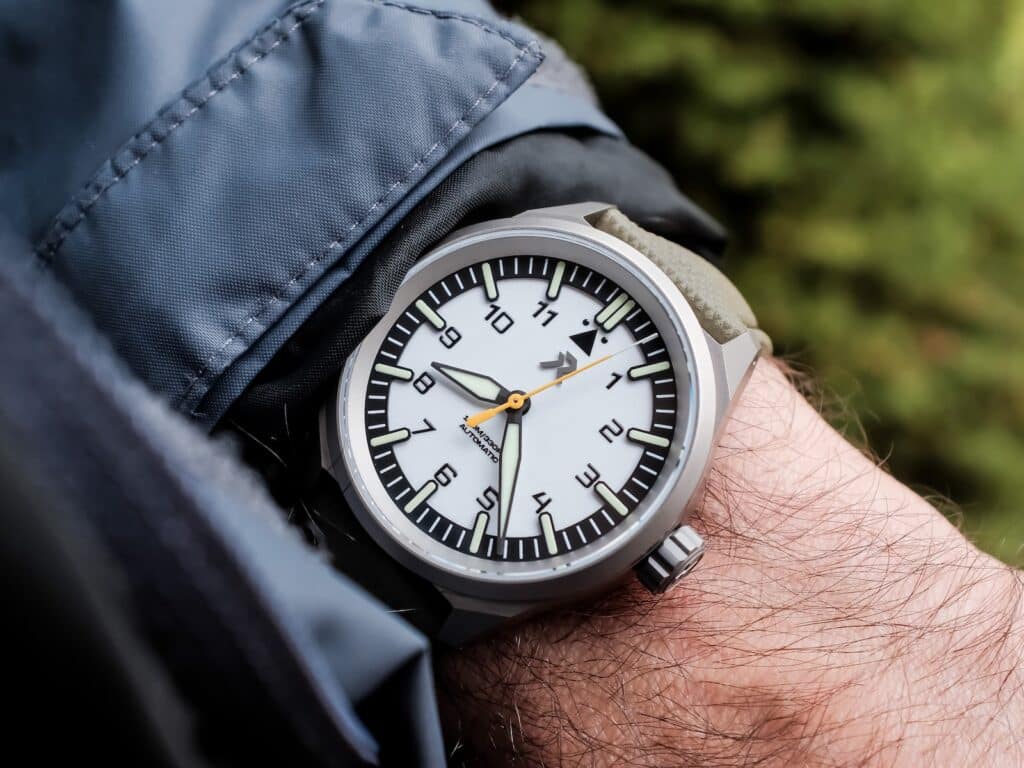
A flieger probably isn’t where most people start when building a one-watch collection. Ours wouldn’t either. They’re often so committed to looking like cockpit instruments that they can feel oddly specific in every other way. The Resolute Type A avoids that trap. It keeps the parts of a classic Type A dial we’d actually miss: the triangle at 12, oversized minute track, sword hands, inner hour ring, and effortless legibility, but leaves behind the historical cosplay. That’s what kept drawing us back to it.
That easygoing attitude carries through the rest of the watch. The 39.5 mm titanium case feels almost misleading after a full day on the wrist because you keep expecting to notice it more than you do. Grade 2 titanium already keeps the weight down, and RZE’s UltraHex hardening, rated at roughly 1200 HV, reduces the hesitation we’d normally have about wearing titanium every day. We never found ourselves babying it. The screw-down crown, proper gasket construction, and 100-meter water resistance further reinforce that feeling.
Then there’s the dial. The raised chapter ring and applied markers give it just enough depth to avoid looking flat. At the same time, the white version became our favorite because the sapphire crystal and two-tone full-lume treatment give it a subtle instrument-panel feel after dark without becoming a gimmick.
The rest of the watch is free of weak links. The TecTuff strap felt broken in almost immediately, the water-resistant calf leather lining stayed comfortable through long days, and the quick-release spring bars, tapered profile, and UltraHex-coated titanium buckle meant we never felt the need to replace it. Inside, the Miyota 82S0 quietly does its job with hacking, hand-winding, automatic winding, and around 42 hours of power reserve. The engraved aircraft on the caseback is something you’ll admire once, and collectors chasing a historically faithful flieger may find RZE’s modern interpretation a little restrained. That’s also why we’d choose it as an only watch. It borrows the best ideas from traditional pilot watches without forcing you to live like you’re heading to an airfield every morning. Read our full review for the smaller on-wrist details.
Pros
- UltraHex-hardened titanium keeps the watch very light while resisting everyday scratches.
- Type A layout remains instantly legible without leaning too heavily on vintage aviation styling.
- The TecTuff strap breaks in quickly and is complemented by thoughtful details like quick-release spring bars and a titanium buckle.
- The screw-down crown, equipped with 100 meters of water resistance, makes it far more capable than most fliegers.
- Miyota 82S0 provides hacking, hand-winding, automatic winding, and a practical 42-hour reserve.
Cons
- Purists looking for a historically faithful pilot watch may find the modern interpretation a little restrained.
- Two-tone full-lume treatment won’t appeal to every traditional flieger enthusiast.
Citizen Nighthawk
| Price: | $500 |
| Water Resistance: | 200m |
| Case Size: | 42.5mm (diameter) x 47mm (lug-to-lug) x 12.6mm (thickness) |
| Lug Width: | 22mm |
| Movement: | Citizen B877 Eco-Drive caliber (solar-powered quartz) |
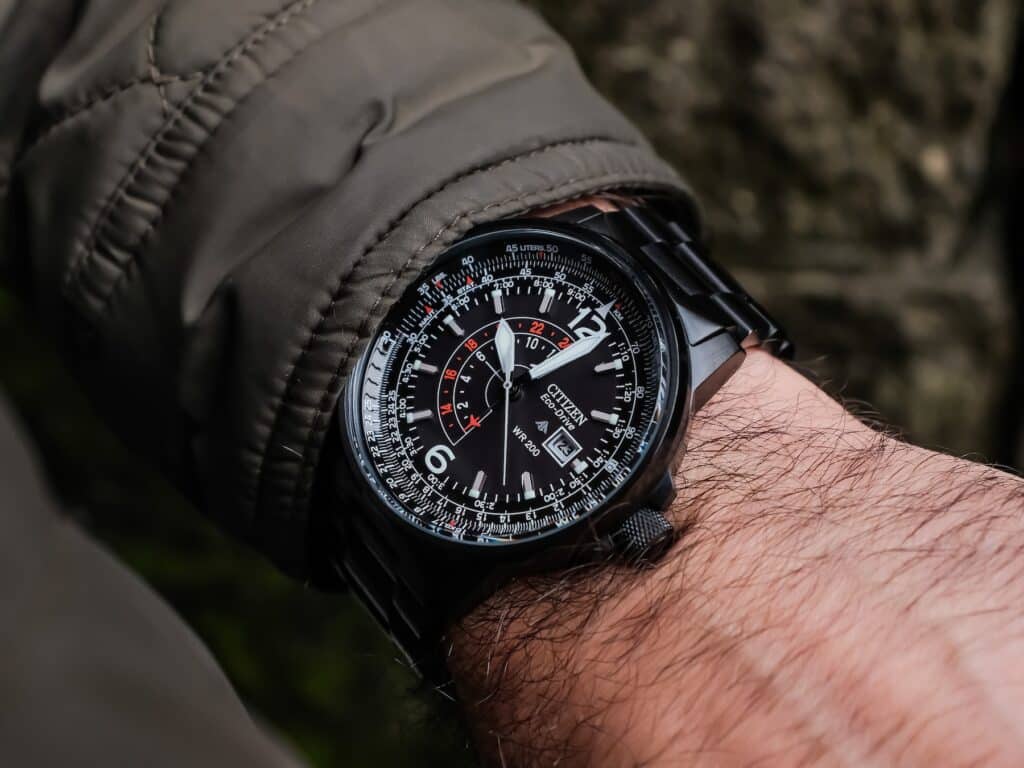
Some one-watch collections are built around versatility. Others are built around capability. If you’re the type who’d rather have a watch that can do more than you ask of it, the Nighthawk belongs near the top of your list. It doesn’t disappear into the background the way a simple field watch does, and it isn’t trying to. The aviation styling gives it plenty of personality, but after living with it, we found ourselves appreciating something much simpler: it made everyday life easy. Whether we were keeping track of another time zone, heading out for the weekend, or just grabbing a watch on a busy morning, it always felt ready before we were.
Citizen’s Eco-Drive B877 is a huge part of that experience. Solar charging means battery changes simply aren’t part of the ownership experience. The movement stayed around ±15 seconds per month during our testing, and a full charge lasted roughly six months. The independently jumping local hour hand also makes changing time zones painless, which feels much more useful in the real world than a GMT you’ll only appreciate on international trips. At first glance, the dial looks like it has far too much going on, thanks to the internal E6B slide rule, but we stopped noticing the complexity after a couple of days. Citizen’s layout naturally draws your eyes to the bold sword hands, applied lume-filled markers, and the red-and-white airplane GMT hand, while the finer scales wait quietly until you actually need them. Even after dark, the familiar blue lume remains one of the better performers in this category.
That said, the Nighthawk does ask you to accept a few things. The 42.5 mm black ion-plated case has noticeable weight, and it’s never going to slip unnoticed under every cuff. We’d also prefer sapphire to the exposed mineral crystal. Even the main hands occasionally hide part of the second time-zone scale, and a hard knock can eventually reveal bare steel beneath the coating. But none of those became deal-breakers because the fundamentals are so well sorted.
The screw-down crown, engraved screw-down caseback, 200 meters of water resistance, and locking secondary crown make it feel ready for whatever the week throws at it. If your one-watch collection is less about dressing up and more about owning one watch that’s always prepared, the Nighthawk is yet another strong practical choice under $1,000.
Pros
- Eco-Drive B877 combines solar charging, excellent accuracy, and a jumping local hour hand with almost no maintenance.
- 200 m WR, screw-down crown, and screw-down caseback encourage worry-free everyday wear.
- The dial becomes intuitive after a short adjustment period, backed by excellent blue lume.
- The bracelet feels solid and secure thanks to the deployant clasp, safety lock, and micro-adjustment.
- Six-month power reserve means it’s always ready when you need it.
Cons
- The 42.5 mm case has noticeable heft.
- Mineral crystal feels like the biggest compromise.
- Main hands occasionally cover the secondary time-zone scale.
- Deep scratches can reveal the steel beneath the black ion plating.
Nodus Sector Deep
| Price: | $599 |
| Water Resistance: | 500m |
| Case Dimensions: | 38mm (diameter) x 47mm (lug-to-lug) x 13.6mm (thickness) |
| Lug Width: | 20mm |
| Movement: | Seiko NH35 (Mechanical Movement) |
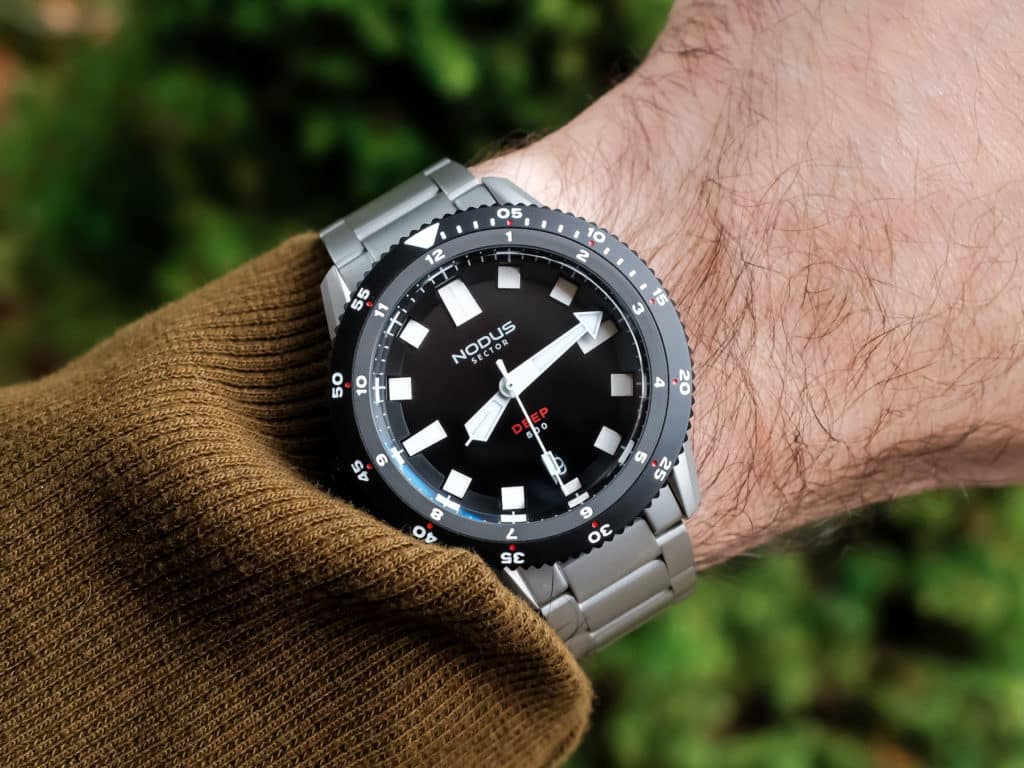
If your one-watch collection is going to spend more time outdoors than under a shirt cuff, the Sector Deep deserves a serious look. It isn’t trying to be a do-everything watch in the traditional sense. It’s unapologetically a tool watch. What surprised us during our review was how many everyday frustrations Nodus had already solved before we even noticed they existed. We’ve worn plenty of dive watches that cost considerably more yet still left us fighting with bracelet sizing, wishing for on-the-fly adjustment, or wondering why the crown kept digging into the back of the wrist. The Sector Deep simply gets those details right, and that’s a big reason it stayed on our wrist longer than expected.
The comfort starts with the compact 38 mm case and left-side crown. On paper, neither sounds revolutionary. After a full day of wear, though, it’s hard to overstate how nice it is not to have the crown press into your wrist. The bracelet deserves just as much credit. Screw links make sizing simple, the 20 mm-to-18 mm taper keeps everything feeling balanced, and the NodeX micro-adjustment clasp quickly became one of those features we adjusted almost absentmindedly as temperatures changed.
Underneath it all, the in-house-regulated Seiko NH35 quietly went about its job, keeping time to within ±10 seconds per day during our testing while offering roughly 41 hours of power reserve. It’s not an exciting movement on paper, but we’d rather have a well-regulated NH35 in a watch we wear every day than a more exotic movement that asks for extra attention.
The dial follows the same practical philosophy. White PVD marker surrounds catch the light without becoming flashy, the lume plots taper toward the cardinal markers to add subtle depth, and BGW9 Super-LumiNova remains easy to read well into the night. Around the outside, the matte DLC bezel offers excellent grip, keeps reflections under control, and somehow fits a dual-scale insert into the design without making it feel busy. The asymmetrical case won’t be everyone’s idea of a good-looking diver, and the clasp loses some polish once it’s fully extended, exposing more hardware than we’d like.
Those are fair criticisms, but they were never enough to outweigh the ownership experience. If your one-watch collection leans more toward hiking trails, weekend adventures, and everyday practicality than business meetings, the Sector Deep feels like the kind of sports diver designed by people who actually wear sports watches.
Pros
- The NodeX micro-adjustment clasp, screw links, and tapered bracelet make everyday wear comfortable.
- Left-side crown and compact 38 mm case eliminate the usual wrist bite associated with dive watches.
- In-house-regulated NH35 delivered ±10 seconds per day during our testing.
- Matte DLC bezel offers excellent grip while keeping glare to a minimum.
- The thoughtful dial design and BGW9 Super-LumiNova ensure excellent legibility in any light.
Cons
- Asymmetrical case won’t appeal to collectors who prefer a more traditional dive-watch shape.
- The clasp looks less refined when fully extended because of the exposed hardware.
Vaer Automatic
| Price: | $599 |
| Water Resistance: | 100m |
| Case Dimensions: | 40mm (diameter) x 48mm (lug-to-lug) x 10.5mm (thickness) |
| Lug Width: | 20mm |
| Movement: | Miyota 9015 |
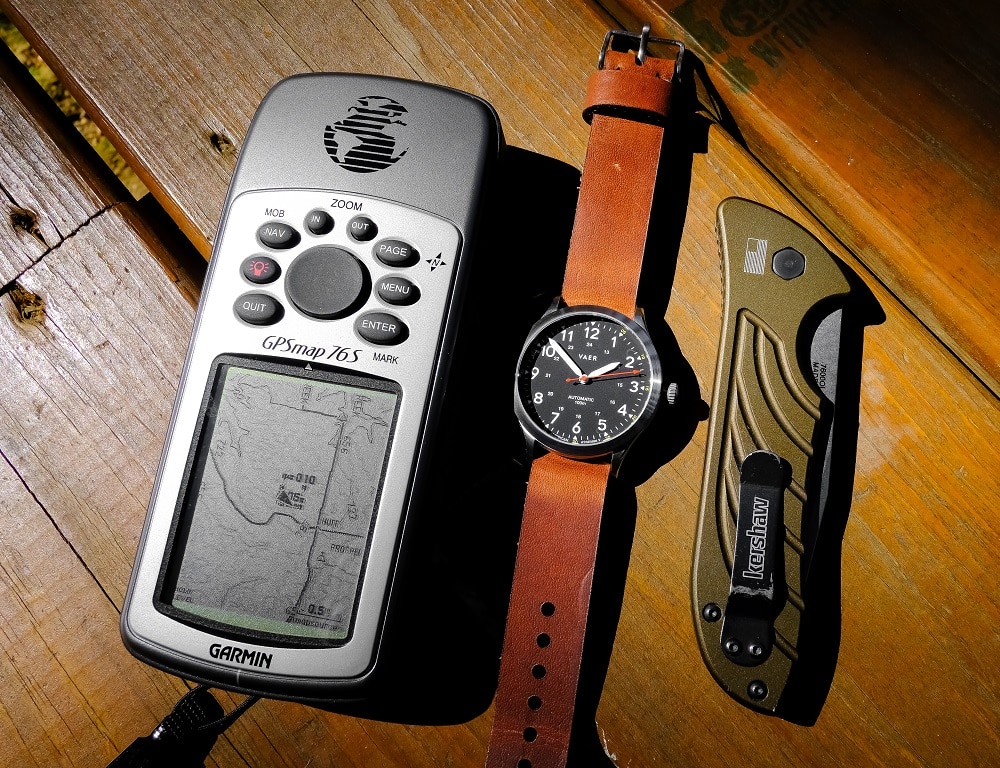
Field watches are supposed to be easy to live with, but not all of them are. We’ve worn plenty that looked the part yet always seemed to be fighting their straps, wearing taller than they should, or leaning so heavily into military styling that they felt oddly specific outside the weekend. The Vaer Field Black Automatic avoids all of that. It’s the kind of watch we’d recommend to someone who wants the straightforward practicality of a field watch without looking like they borrowed it from a surplus store.
What kept us wearing it was a collection of thoughtful decisions. Vaer pushed the spring bars toward the outer edge of the lugs, which sounds like a tiny detail until you start swapping straps. NATO and single-pass leather straps sit flatter rather than stacking underneath the case, making the watch noticeably more stable throughout the day. Both included straps also feel broken in much sooner than expected, so the ownership experience starts on the right foot.
The 316L stainless steel case mixes soft brushing with polished chamfers, avoiding the slab-sided look that can make affordable field watches feel bulkier than they really are. Up front, the dial stays true to the same philosophy. The high-contrast layout is instantly readable, while the yellow outer numerals and red second hand stop it from feeling too tactical. Add the sapphire crystal and anti-reflective coating, and glare outdoors becomes one less thing to think about.
The Miyota 9015 quietly reinforces the watch’s everyday character. It kept time reliably in real-world use throughout our testing, though it also carries the familiar audible rotor spin that tends to divide Miyota owners. We don’t mind hearing a movement get on with its job, but some collectors prefer their automatics to keep those thoughts to themselves. The lume follows a similar pattern. It isn’t especially dramatic when first charged, yet it stayed readable later into the evening than we expected. Our biggest complaint remains the small screw-down crown, which asks for a little more patience than it should when setting the time. None of that changed the bigger picture, though. If your one-watch collection is built around comfort, simplicity, and wearing the same watch every day without growing tired of it, the Vaer feels as if it were designed with that in mind.
Pros
- Lug geometry makes NATOs and single-pass straps wear better than on most field watches.
- Sapphire crystal and anti-reflective coating keep the dial easy to read outdoors.
- The included straps feel comfortable almost immediately, rather than needing weeks of break-in.
- Balanced military-inspired dial stays legible without becoming overly tactical.
- Miyota 9015 delivers dependable everyday performance.
Cons
- The screw-down crown is smaller than we’d like for regular setting.
- Audible rotor spin won’t appeal to every mechanical-watch owner.
- The lume lacks a dramatic initial glow.
Imperial Oceanguard GMT
| Price: | $600 |
| Water Resistance: | 200m |
| Case Dimensions: | 38mm (diameter) x 47mm (lug-to-lug) x 14mm (thickness) |
| Lug Width: | 20mm |
| Movement: | Seiko NH34 |
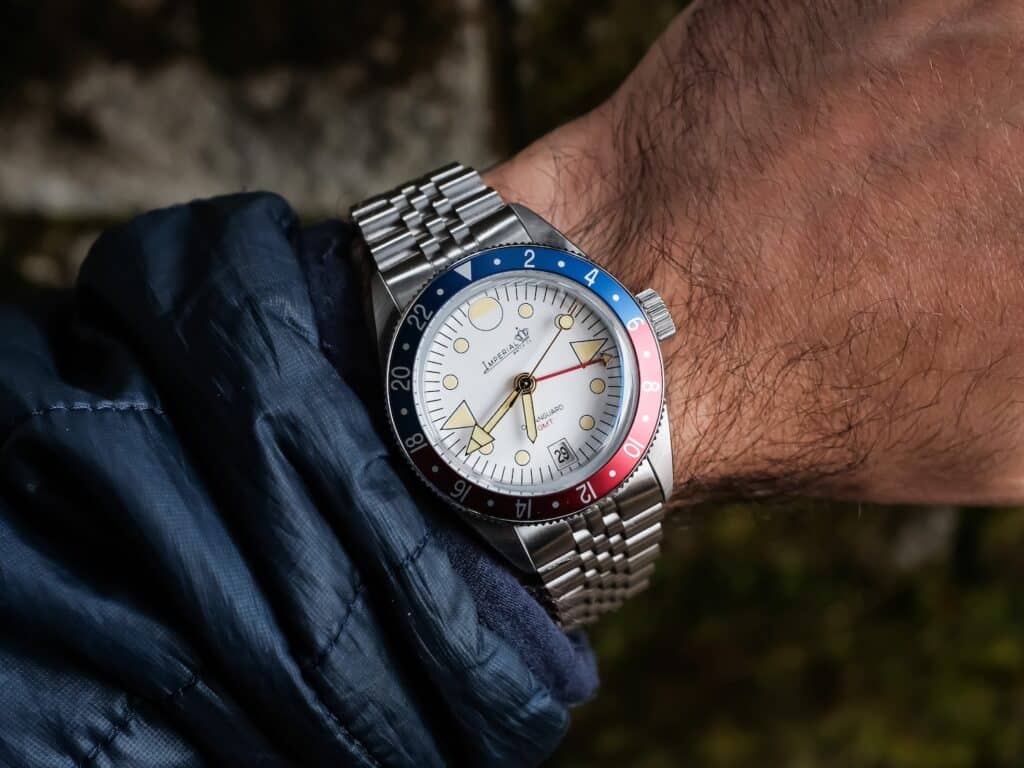
If the obvious choice for your one-watch collection is another Seiko GMT, the Oceanguard is worth slowing down for. It has the familiar ingredients: a Seiko NH34 caller GMT, a dive-inspired case, and a bi-color bezel—but it comes together with a little more personality than we expected. We found ourselves reaching for it because it never felt like it was trying to imitate something more expensive. Instead, it carved out its own identity, landing somewhere between a compact skin diver and a practical travel watch. For someone who wants a one-watch collection with a bit more enthusiast character, that’s a pretty compelling combination.
The biggest surprise is its size. Modern GMTs tend to grow every year, yet the Oceanguard sticks to a 38 mm case that immediately feels refreshing on the wrist. It doesn’t come across as a vintage tribute, either. The proportions simply make sense. Even though the thickness looks a little more substantial on paper, the watch never felt top-heavy during our time with it, giving it an easygoing character that’s quite difficult to find in this category. Imperial also paid attention to the details that make a watch enjoyable to use. The oversized crown initially looks like it’s there for the sake of it, but once you’re setting the watch or adjusting another time zone, it feels completely justified. The bi-color bezel works naturally alongside it, and we ended up using both more often than we expected.
The dial quietly ties everything together. The combination of circular, triangular, and dot hour markers makes reading the watch instinctive. At the same time, the softly aged lume adds warmth to the white dial without wandering into heavy-handed faux-vintage territory. The jubilee-style bracelet also deserves a mention. It wraps comfortably around the wrist, articulates well, and the tool-less micro-adjustment quickly becomes one of those features you miss the moment it’s gone. Sure, the clasp is bulkier than the rest of the watch, and if you’re chasing the thinnest possible vintage-inspired profile, the case may still feel a little chunkier than you’d like.
However, after living with it beyond the first impression, those compromises never overshadowed the ownership experience. If you want your one-watch collection under $1,000 to combine GMT practicality with the charm of a compact diver, and you’d rather wear something a little less predictable than the usual suspects, the Oceanguard makes a very convincing argument.
Pros
- Compact 38 mm proportions make it one of the most comfortable GMTs in this price range.
- Tool-less micro-adjustment makes fine bracelet adjustments quick and useful.
- Bi-color bezel and oversized crown make tracking another time zone feel intuitive.
- The dial layout stays easy to read, thanks to the varied hour-marker shapes.
- Jubilee bracelet articulates well and remains comfortable throughout long days.
Cons
- Clasp feels bulkier than the rest of the watch.
- The case may still seem slightly thick if you prefer slimmer vintage-style proportions.
Baltic Hermétique Tourer
| Price: | $620 – $690 |
| Water Resistance: | 150m |
| Case Dimensions: | 37mm (diameter) x 46mm (lug-to-lug) x 10.8mm (thickness) |
| Lug Width: | 20mm |
| Movement: | Miyota 9039 Automatic |
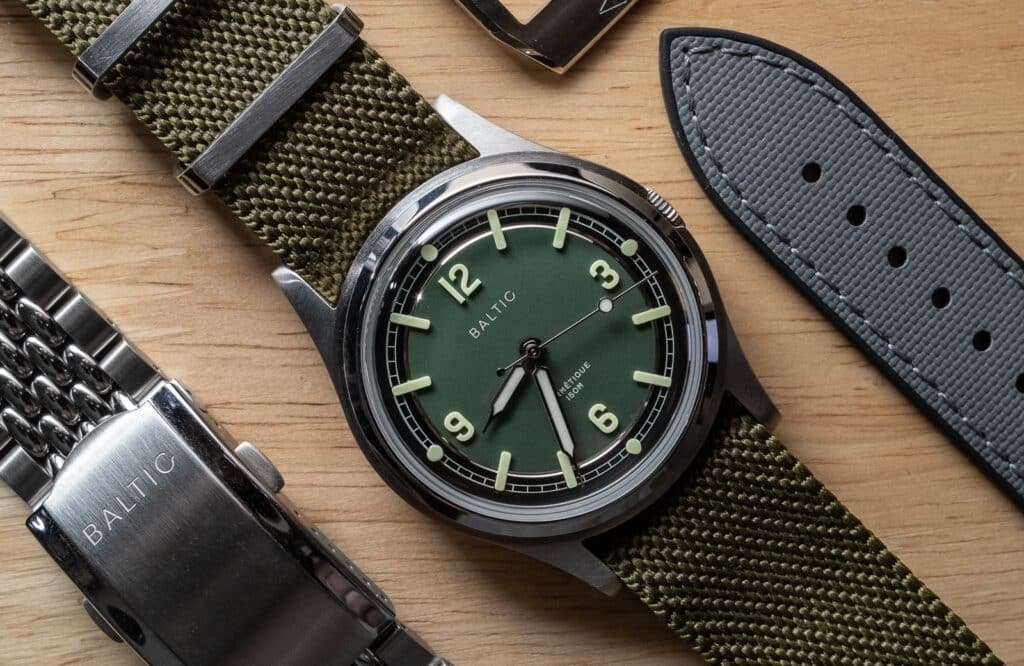
The Hermétique Tourer grew on us in a way very few watches do. It wasn’t the one we reached for because of a standout feature or an impressive specification. It was the one that kept making sense. Some mornings it went on a beads-of-rice bracelet, other days it ended up on rubber, and neither choice felt like we were forcing the watch into a role it wasn’t meant to play. That’s a surprisingly rare quality for a watch under $1,000, and it’s what you want from one that’s expected to carry an entire collection.
Baltic got the proportions right before anything else. At 37 mm across, 46 mm lug-to-lug, and only 10.8 mm thick, it disappears on the wrist without ever feeling small. The brushed case keeps the watch grounded, while the slim polished bezel and boxed double-domed sapphire crystal add enough refinement that it never feels underdressed. The dial follows the same philosophy. Large applied markers, syringe hands, and C3 X1 Super-LumiNova make reading the time effortless, and the lume stayed bright far longer than we’d expected.
As mentioned in our dedicated review, the Miyota 9039 quietly gets on with its job in the background, leaving the proportions and finishing to do the talking. We also appreciated how little effort Baltic asks from the owner. Between the beads-of-rice bracelet, flat-link option, tropic rubber strap, quick-release spring bars, and useful micro-adjustment, changing the watch to suit the day takes less time than deciding which strap to pick.
Its shortcomings are the sort that only appear after you’ve lived with it for a while. The crown sits so close to the case that manual winding requires a little more fingernail than we’d like, the anti-reflective coating is so light that the crystal catches reflections in certain conditions, and the bracelet clasps don’t quite match the quality of everything around them. Still, none of those issues ever stopped us from putting it back on the next morning. If your one-watch collection contender needs to handle weekdays, weekends, and the occasional dinner without ever feeling like the wrong watch, the Hermétique Tourer quietly earns that role instead of announcing it.
Pros
- 37 mm case and slim profile make it disappear on the wrist.
- Quick-release spring bars and multiple bracelet options make adapting it to the day effortless.
- C3 X1 Super-LumiNova and the clean dial remain legible.
- Boxed sapphire crystal and restrained finishing give it lasting character.
- 150 meters of water resistance adds genuine everyday confidence.
Cons
- Crown sits almost flush with the case, making manual winding less convenient.
- The bracelet clasps feel plainer than the rest of the watch.
- The light anti-reflective coating allows more reflections than usual.
Baltic Aquascaphe
| Price: | $650 – $750 |
| Water Resistance: | 200m |
| Case Dimensions: | 39mm (diameter) x 47mm (lug-to-lug) x 12mm (thickness) |
| Lug Width: | 20mm |
| Movement: | Miyota 9039 (Mechanical Movement) |
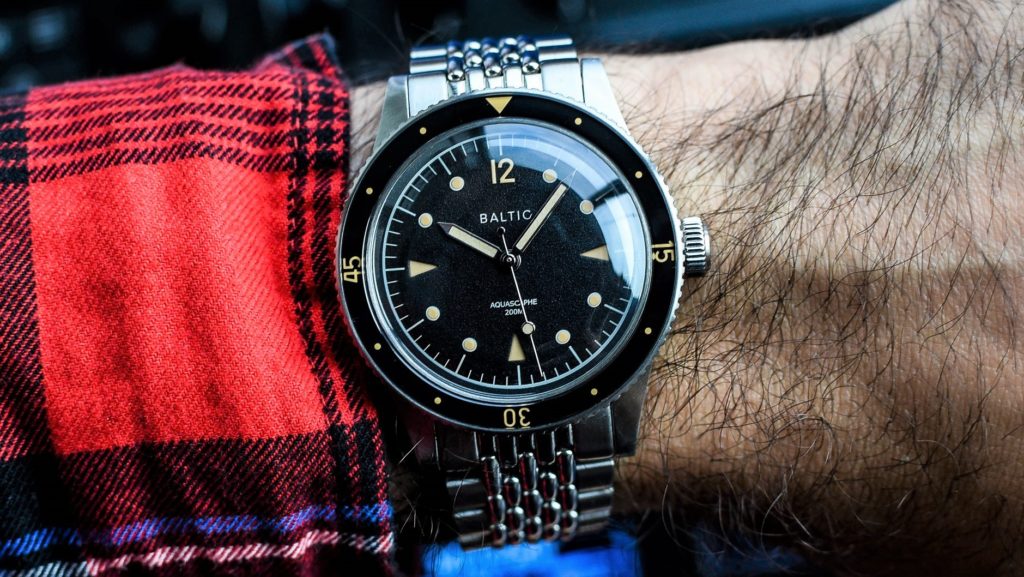
One-watch collections usually reward versatility over specialization, which is why dive watches can be tricky. Some feel too bulky, too sporty, or too committed to looking like professional tools. The Aquascaphe lands in a sweeter spot. It’s still a diver, but after spending hands-on time with it, we found it slipping just as naturally into everyday life as it did weekends near the water. If your wardrobe is mostly casual, there aren’t many watches under $1,000 that feel this complete.
A lot of that comes down to restraint. Baltic resisted the temptation to throw every vintage cue onto one dial. Instead, the hybrid sandwich construction adds real depth without making the watch busy, while the matte finish and restrained gilt accents keep it interesting as the light changes. The pencil hands, balanced lollipop second hand, sapphire bezel insert, and minimal dial text all work together instead of competing for attention. At night, the fully lumed lower dial produces a broad, even glow that stays readable long after many brighter-first lume applications have faded. The case deserves equal appreciation, too. At just over 12 mm thick with a 47 mm lug-to-lug, it wears slimmer than many modern divers, and the brushed finish hides the inevitable scratches that come with wearing one watch for almost everything. Even the lightly textured crown proved easier to grip than it first appears.
Living with the Aquascaphe is uncomplicated. The no-date Miyota 9039 keeps operation simple with its two-position crown, a smooth 28,800 vph beat rate, and around 42 hours of power reserve. We found ourselves regularly swapping between the beads-of-rice bracelet and the included Tropic-style rubber strap, not because either needed replacing, but because Baltic made the process so painless with quick-release spring bars. The bracelet articulates beautifully and tapers naturally around the wrist, while the rubber strap gives the watch an even more relaxed personality.
Admittedly, skipping the date won’t suit everyone, and collectors who enjoy bold polishing may find the predominantly brushed case a little too restrained. However, those feel more like design decisions than compromises. If your ideal one-watch collection revolves around relaxed everyday wear rather than dressing up, the Aquascaphe feels like the kind of diver that’s happy to stay on your wrist all week instead of waiting for the next beach trip.
Pros
- Slim proportions wear more comfortably than many modern dive watches.
- Hybrid sandwich dial creates genuine depth while remaining legible.
- The beads-of-rice bracelet is quite comfortable, and the quick-release spring bars make strap changes effortless.
- The fully lumed dial remains readable for hours after dark.
- Vintage-inspired styling feels restrained and cohesive rather than too nostalgic.
Cons
- The mostly brushed finishing may feel too subtle if you prefer stronger contrast.
- No-date layout won’t suit buyers who rely on a date display.
Hamilton Khaki Field Mechanical
| Price: | $695 |
| Water Resistance: | 50m |
| Case Dimensions: | 38mm (diameter) x 47mm (lug-to-lug) x 9.5mm (thickness) |
| Lug Width: | 20mm |
| Movement: | Caliber H-50 (ETA 2801-2 on previous models) |
| Amazon: | See Today’s Price |
Not every one-watch collection has to be built around convenience. Some are built around the simple pleasure of wearing a mechanical watch every day, and that’s where the Khaki Field Mechanical still earns its place. It asks a little more from you than most of the watches on this list. For instance, you’ll be winding it every morning, and you won’t get the carefree ownership that comes with a solar quartz or a screw-down crown. But that’s also the point. If part of owning one watch is enjoying the small ritual that comes with it, few watches under $1,000 capture that feeling as naturally as this one.
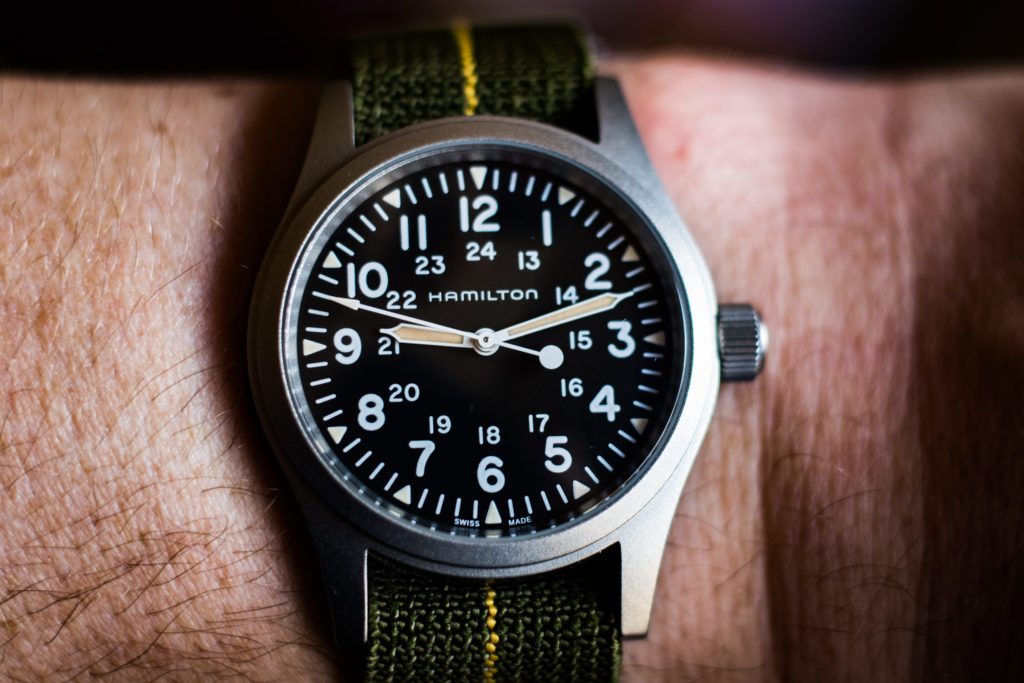
The H-50 hand-wound movement defines the experience. We found ourselves looking forward to winding it each morning, helped by a generously sized crown that made the process smooth rather than fiddly. Better still, the movement rewarded that routine with accuracy that hovered around +0.8 seconds per day during our testing (better than we’d normally expect at this price). Around it sits a case that feels equally well judged. The 38 mm diameter, 47 mm lug-to-lug, and slim 9.5 mm profile give the watch more presence than the numbers indicate while remaining comfortable enough to disappear over the course of a full day.
Drilled 20 mm lugs also encourage experimentation. We alternated between NATO and leather straps regularly, and the watch never looked out of place. Up front, the familiar Khaki Field dial remains busy in the way a proper field watch should be, yet the absence of a date keeps everything balanced. The restrained faux-patina lume avoids drifting into costume territory. Although it glows better than its vintage-inspired color suggests, we repeatedly wished for a more obvious 12 o’clock marker during late-night time checks.
The Khaki isn’t trying to be the watch you wear without thinking. It’s the watch you wear because you enjoy thinking about it a little. That also means accepting a few compromises. With 50 meters of water resistance and a non-screw-down crown, we were more cautious around water than we would be with many of the other picks here. The supplied green NATO looks appropriately military, but the leather keepers became irritating during extended wear, and we ultimately preferred the softer gray pashmina strap. Those are small trade-offs for a watch with this much charm. If your one-watch collection is about slowing down and enjoying the mechanical side of the hobby instead of chasing maximum convenience, the Khaki Field Mechanical remains one of the easiest watches to fall for. Our hands-on review goes into that in more depth.
Pros
- H-50 hand-wound movement delivers excellent real-world accuracy while adding genuine mechanical charm.
- Compact case and slim profile wear comfortably without feeling undersized.
- Drilled lugs make strap changes quick, and the watch looks equally at home on leather or NATO straps.
- Classic field-watch dial feels authentic, while the restrained faux-patina lume avoids looking gimmicky.
Cons
- 50 meters of water resistance and a non-screw-down crown make it less carefree around water.
- Low-light orientation could be better with a more distinct 12 o’clock marker.
- Green NATO strap won’t suit everyone, particularly because of the leather keepers.
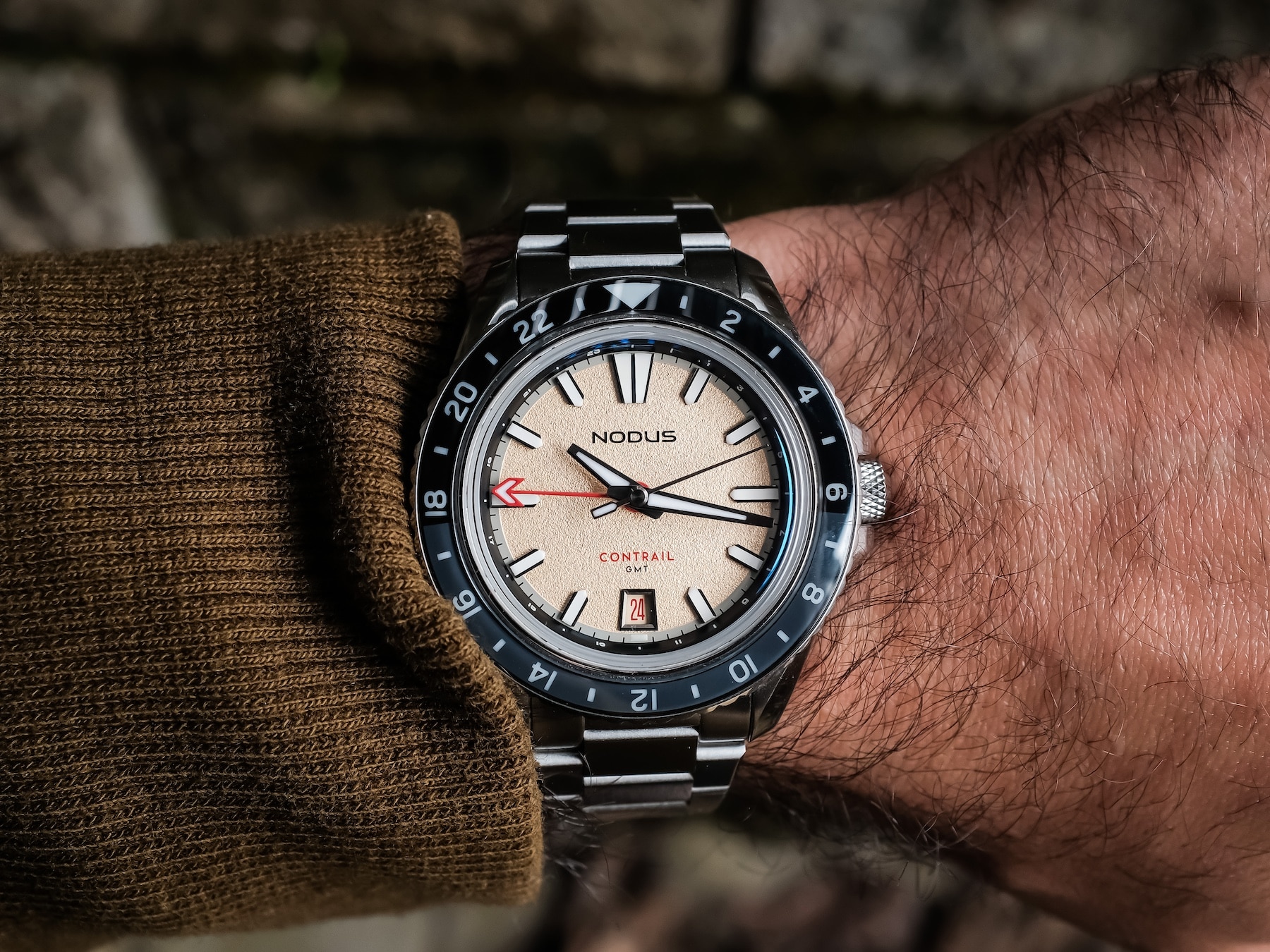
Nodus Contrail GMT
| Price: | $825 |
| Water Resistance: | 200m |
| Case Dimensions: | 40.5mm (diameter) x 46.6mm (lug-to-lug) x 11.8mm (thickness) |
| Lug Width: | 20mm |
| Movement: | Miyota 9075 |
The Contrail GMT Laguna is what happens when a microbrand stops asking, “How do we compete with Seiko?” and starts asking, “How do we make a better travel watch?” That’s what makes it such an interesting one-watch candidate. It doesn’t rely on vintage nostalgia or luxury lookalike styling to justify its place. Instead, it feels like a watch designed by people who spend as much time wearing GMTs as they do discussing them.
The headline feature is the Miyota 9075, and unlike many movement upgrades, this one genuinely changes how the watch fits into everyday life. Being able to jump the local hour hand independently means landing in a new time zone takes seconds instead of resetting the entire watch. After using it, going back to a caller GMT feels clumsy. Nodus matched that movement with a generously sized screw-down crown that offers plenty of grip, making adjustments feel deliberate rather than fiddly.
The case deserves just as much credit. At 40.5 mm across, 46.6 mm lug-to-lug, and only 11.8 mm thick, it wears slimmer than many GMTs using the same movement. The twisted lugs help the watch hug the wrist. At the same time, the mix of brushed and polished finishing, box sapphire crystal, sapphire bezel insert, and 200 meters of water resistance give it the confidence to handle everything from flights to weekends at the beach without feeling overbuilt.
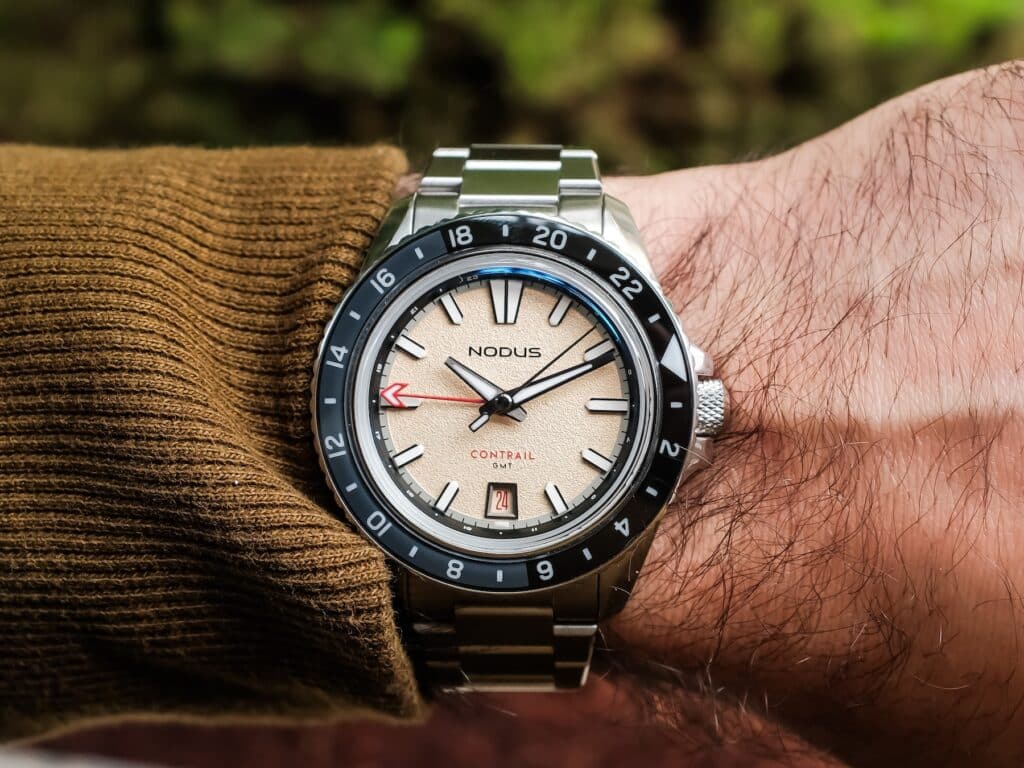
The Laguna dial is where the watch develops its own personality. The sandy finish shifts subtly depending on the light, breaking away from the predictable black-dial GMT formula, while the roulette date wheel adds just enough character without making the layout busy. Once we settled into the design, tracking multiple time zones felt intuitive, thanks to the smooth 48-click bidirectional bezel, internal 24-hour scale, and clearly separated handset. BGW9 lume across the markers, bezel numerals, and GMT hand also proved truly useful after dark, rather than simply checking a specification box.
The bracelet continues the same thoughtful approach with screw links and a NodeX clasp that makes on-the-fly adjustment almost second nature, even if the clasp itself feels chunkier than the rest of the watch. We’d also welcome a stronger bracelet taper and slightly larger internal 24-hour numerals for quicker reading, but those feel like refinements rather than flaws. If you’re building a one-watch collection and want something that delivers premium GMT functionality without following the same path as everyone else, the Contrail GMT Laguna makes a convincing case.
Pros
- Miyota 9075 flyer GMT makes changing time zones effortless.
- Slim 11.8 mm case wears closer to the wrist than many GMTs with the same movement.
- BGW9 lume across the dial, bezel, and GMT hand provides excellent nighttime legibility.
- NodeX clasp allows quick on-the-fly adjustments throughout the day.
- Sandy Laguna dial and roulette date wheel give the watch a distinctive personality without sacrificing readability.
Cons
- NodeX clasp feels bulkier than the rest of the bracelet.
- The bracelet taper is quite limited.
- Internal 24-hour numerals could be larger for faster at-a-glance reading.
Nodus x Raven TrailTrekker
| Price: | $875 |
| Water Resistance: | 200m |
| Case Dimensions: | 39.5mm (diameter) x 46.6mm (lug-to-lug) x 11.8mm (thickness) |
| Lug Width: | 20mm |
| Movement: | Miyota 9075 |
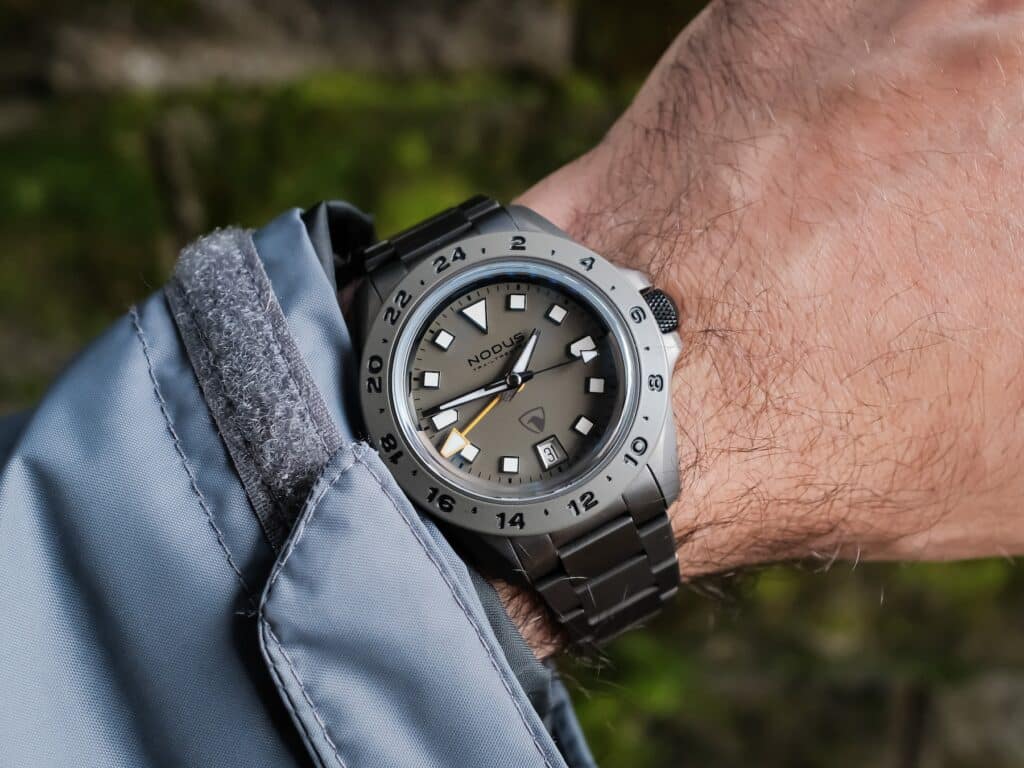
Some one-watch collections are expected to handle meetings. Others are expected to handle bad weather, unfamiliar roads, and the kind of trips where your watch is likely to come home with a few new scratches. That’s where the TrailTrekker makes the most sense. It doesn’t have the polished, travel-lounge personality that many GMTs chase. Instead, it feels like a watch built for people more likely to follow a trail than to read an airport departure board. After handling and wearing the watch ourselves, we appreciated that honesty. It never tries to disguise what it is.
The design leans into that idea without overdoing it. The 39.5 mm DLC-coated case has enough presence to feel reassuring without becoming cumbersome, and the muted grey finish avoids the “all-black tactical watch” cliché. The sand-colored Cerakote bezel was one of the first details that won us over. Its dry, textured finish suits the watch far better than glossy ceramic ever could, while the bold 24-hour scale makes another time zone easy to reference at a glance.
The sand-textured dial carries the same theme through the rest of the watch, pairing applied indices with gunmetal hands and a neatly balanced six o’clock date. The bright yellow GMT hand is the only part that really shouts. It won’t appeal to everyone, but after living with the watch, we’d rather have that instant visibility than a more subtle hand that disappears into the dial.
The TrailTrekker also backs up the rugged styling with substance. The Miyota 9075 flyer GMT makes changing local time straightforward, and during our testing, the jumping hour hand felt precise, with accuracy remaining within a few seconds of our reference time. The deeply knurled screw-down crown gives plenty of purchase, the sapphire crystal and 200 meters of water resistance encourage you to stop worrying about the watch, and the flat-link bracelet proved to be the better everyday option over the included nylon strap. Its 20 mm-to-16 mm taper keeps the watch balanced, while the NodeX clasp offers around 10 mm of tool-free adjustment, which proved useful whenever our wrist size changed throughout the day. The engraved caravan caseback is a nice touch without feeling forced.
That said, we’d still like stronger lume, and the bold GMT hand won’t suit someone chasing a more understated look. But if your idea of a one-watch collection revolves around travel, weekend outdoor adventures, and everyday abuse rather than dressing up, the TrailTrekker feels like it was built for that lifestyle.
Pros
- Miyota 9075 flyer GMT makes changing time zones practical.
- The NodeX clasp provides around 10 mm of quick on-the-fly adjustment.
- 39.5 mm DLC-coated case feels rugged without becoming oversized or too tactical.
- Sand-colored Cerakote bezel and high-contrast GMT scale make tracking another time zone intuitive.
- Flat-link bracelet stays comfortable while maintaining excellent balance on the wrist.
Cons
- Lume is usable but doesn’t stand out against the strongest performers in this category.
- The yellow GMT hand may feel too bold if you prefer a more subdued design.
Christopher Ward C63 Valour
| Price: | $945 |
| Water Resistance: | 150m |
| Case Dimensions: | 39mm (diameter) x 46mm (lug-to-lug) x 11.55mm (thickness) |
| Lug Width: | 20mm |
| Movement: | ETA G10.212 AD COSC quartz |
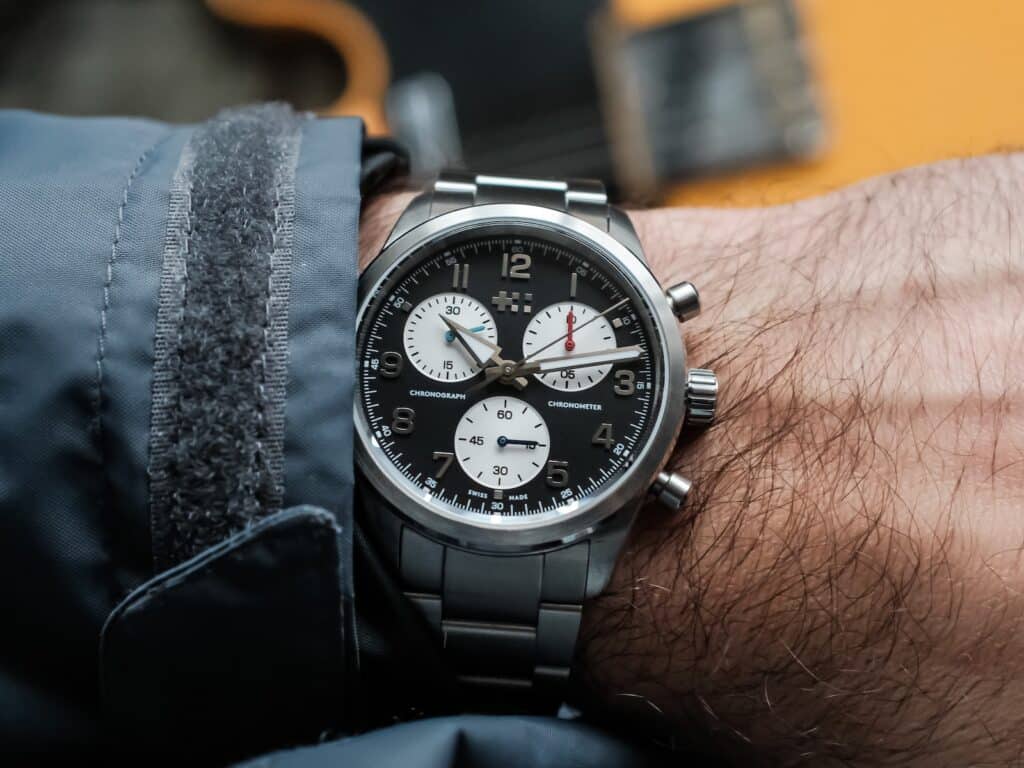
Choosing a chronograph as your only watch usually means accepting a few compromises before you’ve even strapped it on. They’re often thicker than they need to be, harder to live with, and often packed with mechanical romance that doesn’t always translate into everyday practicality. The C63 Valour flips that idea on its head. After wearing it for review, we stopped treating it like a chronograph and started treating it like an everyday watch that just happened to have a built-in stopwatch. That’s an important distinction, and it’s why this one earns a place on the list.
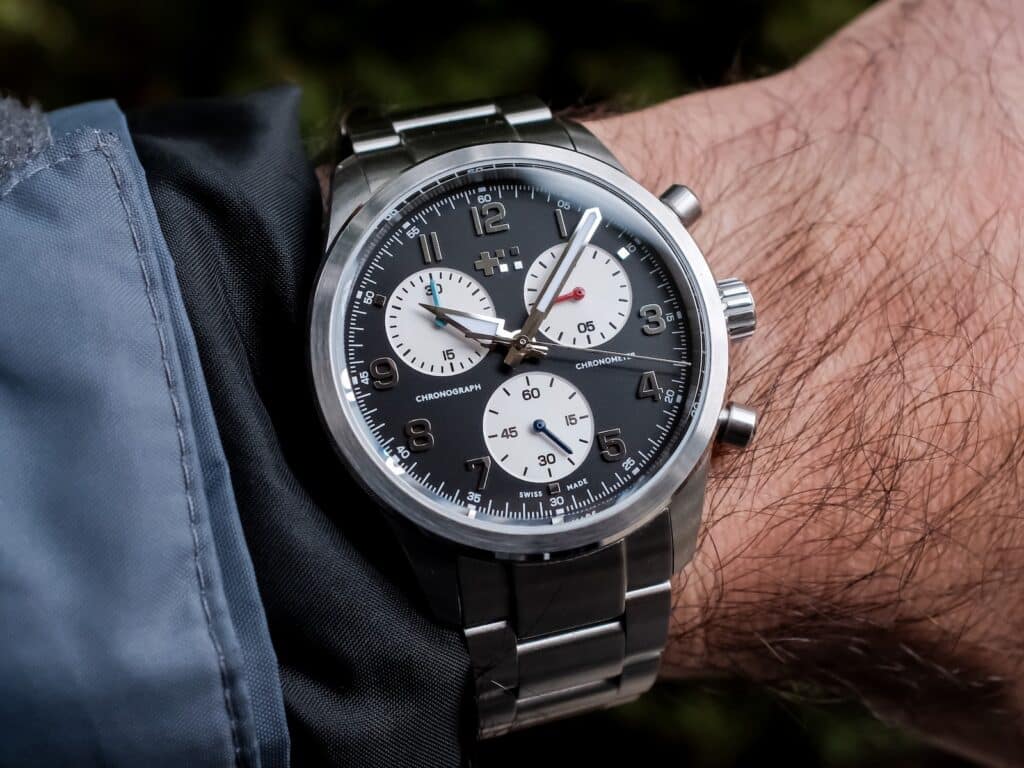
The biggest surprise wasn’t the movement; it was the proportions. At 39 mm across with a lug-to-lug just shy of 46 mm, it avoids the top-heavy feel that usually comes with the category. The Bader bracelet deserves a fair share of the credit too. Its taper from 20 mm to roughly 16 mm, straightforward on-the-fly extension, and quick-release spring bars made it one of those bracelets we stopped thinking about after a few days.
Christopher Ward may have had a little too much fun naming the Light-catcher case, but the alternating brushed and polished finishing gives the watch a different personality as the light changes. The reverse panda dial follows that same balanced approach. Applied Arabic numerals add depth, the chronograph registers remain easy to distinguish at a glance, and the subtle military-inspired color accents never distract from the job of telling time. Even the pushers are crisp, positive, and satisfying every time you use them.
The ETA quartz movement quietly ties the whole package together. Being COSC certified and rated at roughly ±10 seconds per year, it became the sort of movement we simply stopped thinking about because it never gave us a reason not to trust it. If the goal of a one-watch collection is owning something that removes friction from daily life, that’s difficult to argue against.
The bracelet did develop a faint squeak early on before settling down, and anyone who enjoys the ritual of winding and living with a mechanical chronograph will probably never be convinced by quartz, no matter how good this one is. That’s perfectly fair. But if you like the look and usefulness of a chronograph without wanting the ownership experience to revolve around it, the C63 Valour makes a great one-watch choice.
Pros
- COSC-certified ETA quartz movement delivers outstanding long-term accuracy with virtually no upkeep.
- Compact proportions avoid the bulky feel associated with many chronographs.
- Bader bracelet combines excellent comfort with practical on-the-fly adjustment.
- The reverse panda dial remains very legible while adding subtle visual character.
- Crisp pusher action makes the chronograph enjoyable to use.
Cons
- The bracelet can develop a slight squeak early in ownership.
- Military-inspired dial details are restrained enough that some buyers may want a little more personality.
- Quartz movement won’t win over committed mechanical chronograph enthusiasts.
A $1,000 budget offers more good choices than most people expect, which is why building a one-watch collection is harder than it sounds. The “right” answer depends on how you actually spend your time, not what looks best in a watch box. So, if there’s a watch under $1,000 you’d happily wear every day for the next five years, we’d love to hear what made it earn that spot. There’s a decent chance you’ll give us another reason to spend too much time tracking down our next review sample.

Co-Founder and Senior Editor
Kaz has been collecting watches since 2015, but he’s been fascinated by product design, the Collector’s psychology, and brand marketing his whole life. While sharing the same strong fondness for all things horologically-affordable as Mike (his TBWS partner in crime), Kaz’s collection niche is also focused on vintage Soviet watches as well as watches that feature a unique, but well-designed quirk or visual hook.
I had my first assignment a present in the early 1960’s when it was brought back from Japan on the Ark Royal s came back from sea trials and have owned many Seikos since then. Two are still in my ownership now, one a S1 Monster which is still the most accurate Seiko I have owned, and I have owned several Breitlings and IWC’s since. The case is scratched as is the Hardlex and the emailel markers but it is still the one I take on holiday. The other is a Prospex Dawn Grey which I bought on a whim in Paris and spends most of its life in the drawer because the chapter ring has a mind of its own and the accuracy is one of the worst of the many Seikos I have owned – and I reckon that that totals over 20 ove the 50 years of Seiko ownership
Ah, the chapter ring issue on the Prospex is frustrating. That’s the QC inconsistency that keeps coming up with modern Seiko. Thanks for sharing that history.
Where is Tissot in this comparison?
Standard PRX would be a great addition.