
In July, I rounded up the five best GMT watches of 2026 so far, and four cost less than $850. Affordable GMTs kept coming after that from Timex, Luminox, and Orient, and most share a limitation. Only one of the eight picks below lets you jump the local hour hand on its own, which is the setup frequent travelers (and us watch nerds) want. The rest are “caller-style” or quartz GMTs, where you set the second time zone independently and move the main hands when you land. Here are our favorite affordable GMT watches of 2026.

Citizen Promaster Land GMT BJ7150-50W
Citizen’s Promaster Land line has always leaned toward hiking and outdoor use, and the Land GMT BJ7150-50W carries the white markers of earlier Promaster Tough models into a travel watch. The 39.5mm steel case has a fixed 24-hour bezel, curved anti-reflective sapphire, and ISO-rated 200 meters of water resistance. Inside is the solar Eco-Drive B878, with an orange GMT hand and a date at three. It’s $595 on a steel bracelet, and it ships in a Promaster tackle box. The B878 is the only movement on this list that lets you jump the local hour. I’m not a fan of the textured red dial, and Citizen has since added more colors, which helps.

Seiko 5 Sports SSK059
The white-dial Seiko 5 GMT used to be a Japan-only watch called the SBSC009, and the SSK059 brings it to the US. The 39.4mm steel case is 13.6mm thick and 47.9mm lug-to-lug, with a fixed steel 24-hour bezel, an orange GMT hand, and 100 meters of water resistance. The comparison to Rolex’s Explorer II is obvious, at a small fraction of the price. It’s $450. The 4R34 runs about 41 hours with a stated accuracy of +45/-35 seconds per day, though owners report closer to +10 to +15 once it settles. I own a Seiko 5 GMT, and the caller-style setup works fine for checking home time, though it’s slower to adjust after a flight.

Timex Waterbury Heritage Automatic GMT
Every earlier Waterbury Heritage watch ran on quartz, and the Waterbury Heritage Automatic GMT is the first in the line with an automatic movement. Press images suggest a Seiko NH34A, visible through the exhibition caseback. The black-and-red and black-and-green bezels borrow from the Rolex GMT-Master, and each has a matching GMT hand. It’s $569 on a steel bracelet with a butterfly deployant clasp. Water resistance is just 50 meters, which is my biggest disappointment with the watch. I also haven’t tested the bezel action or the bracelet, so I can’t say yet how the build compares with similarly priced microbrand GMTs.

Seiko Presage Cocktail Time GMT SSK049
Seiko’s Cocktail Time dials have carried the Presage line for years, and the SSK049 “Silver Bullet” puts that radial texture on a GMT. The result looks closer to a Grand Seiko SBGM221 than most Presage models, which is why it caught my attention. The 40.5mm steel case is 12.8mm thick and runs the same 4R34 caller GMT as the Seiko 5, with about 41 hours of reserve. It’s $625. On a dress-leaning GMT, I think a caller movement matters less, since the 24-hour hand mostly keeps track of home. The reserve is short next to Seiko’s newer 6R calibers, and I’m not sure yet whether this is the start of more Cocktail Time GMTs or a one-off.

Unimatic Modello Quattro Ultratool GMT
Unimatic’s Modello Quattro has always been a blunt, angular tool watch, and the Ultratool GMT rebuilds it in Grade 2 titanium. The 40mm case is 12mm thick and weighs about 65 grams, with a thermoplastic polyurethane shell suspending the Ronda quartz movement for shock protection. There’s no fourth hand. Instead, a rotating 24-hour disc under 12 o’clock shows the second time zone, marked by an orange triangle. It’s $840, limited to 99 pieces, so it may already be gone. The disc looks odd at first, and I came around to it once I understood how it reads. Collectors who want a mechanical GMT, or who find Unimatic’s design a little too severe, should look elsewhere.
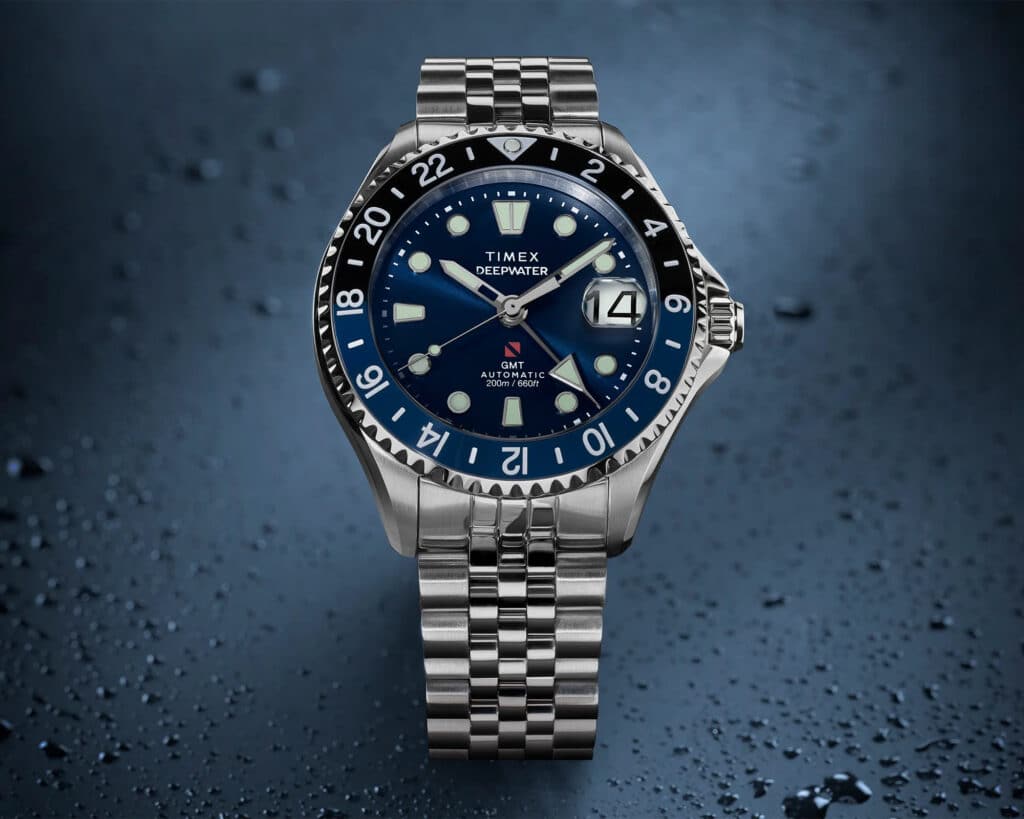
Timex Deepwater Meridian 200 Automatic GMT
The Deepwater Meridian launched a little over a year before this GMT version, and the Deepwater Meridian 200 Automatic GMT swaps its quartz movement for a 21-jewel automatic. A two-tone ceramic 24-hour bezel replaces the dive timer, available in green, blue, or black, with matching dials. The 42mm case is 14.5mm thick and 48.8mm lug-to-lug, with sapphire, a guarded screw-down crown, 200 meters of water resistance, and a quick-release jubilee-style bracelet. It’s $549. Timex hasn’t named the caliber, so I’m guessing it’s a caller-style GMT at this price. The case is also tall for its width, and microbrands sell mechanical GMTs in the same price range.
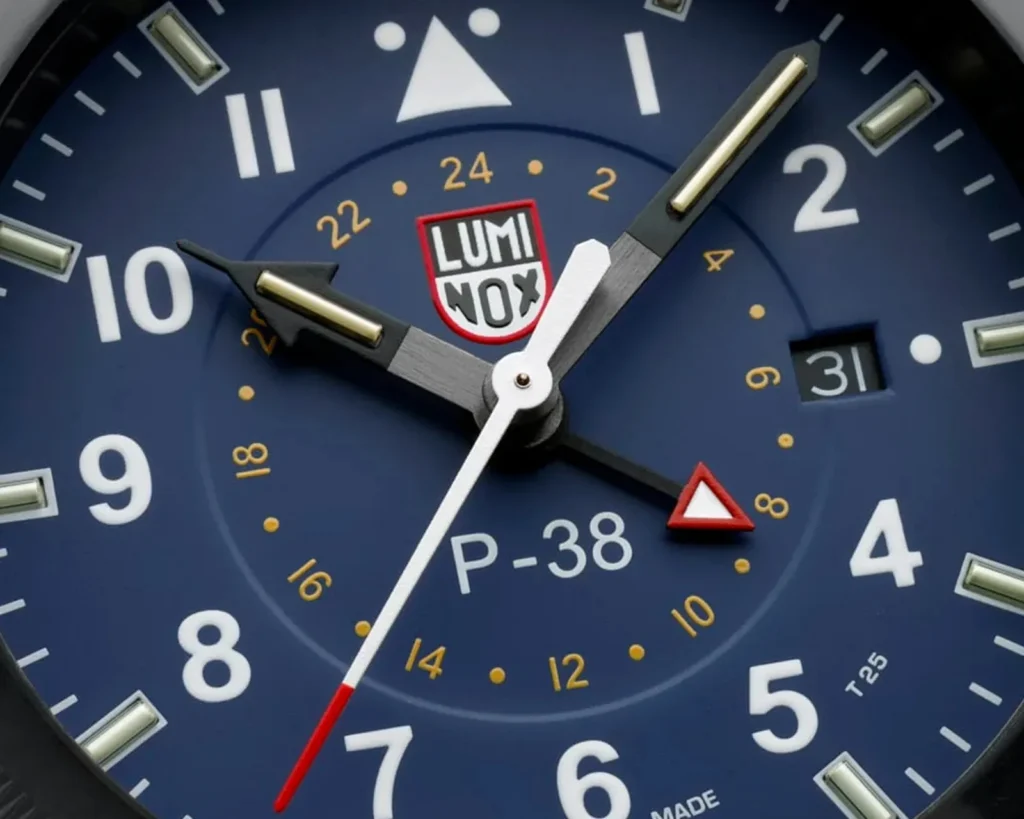
Luminox P-38 Lightning 9520
Luminox named the P-38 Lightning 9520 after Lockheed’s twin-engine World War II fighter, borrowing observation-watch cues like the triangle at 12 and a 24-hour scale. The 42mm black IP steel case is about 12mm thick, with sapphire, 100 meters of water resistance, and tritium tubes on the hands and markers. A Swiss Ronda 515.24H quartz movement handles the GMT function. It’s $675 in all three configurations. The design is restrained, and the tritium makes it the most legible watch here at night. Price is my hang-up, since this quartz GMT can’t jump the local hour and costs more than several mechanical GMTs on this list.
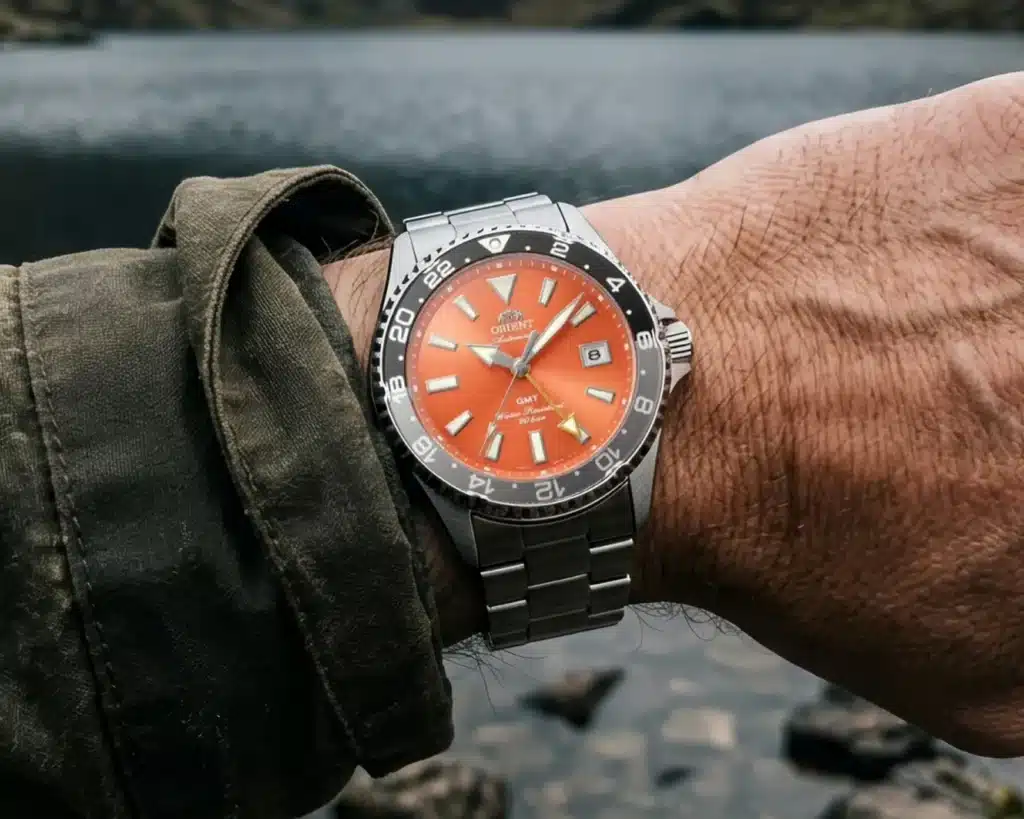
Orient Kamasu GMT
Orient’s Kamasu diver dates to 2019, and the Kamasu GMT adds a 24-hour hand and a unidirectional 24-hour bezel. The steel case grows from 41.8mm to 42.8mm, at 13.4mm thick and 49.5mm lug-to-lug, with sapphire and 200 meters of water resistance. The F6P22 automatic hacks and hand-winds, with more than 40 hours of reserve. Orient USA lists it at $495, down from a $625 MSRP. The 24-hour hand is slaved to local time, so you track a second zone with the bezel alone. A one-way bezel makes that slower to set than it should be.
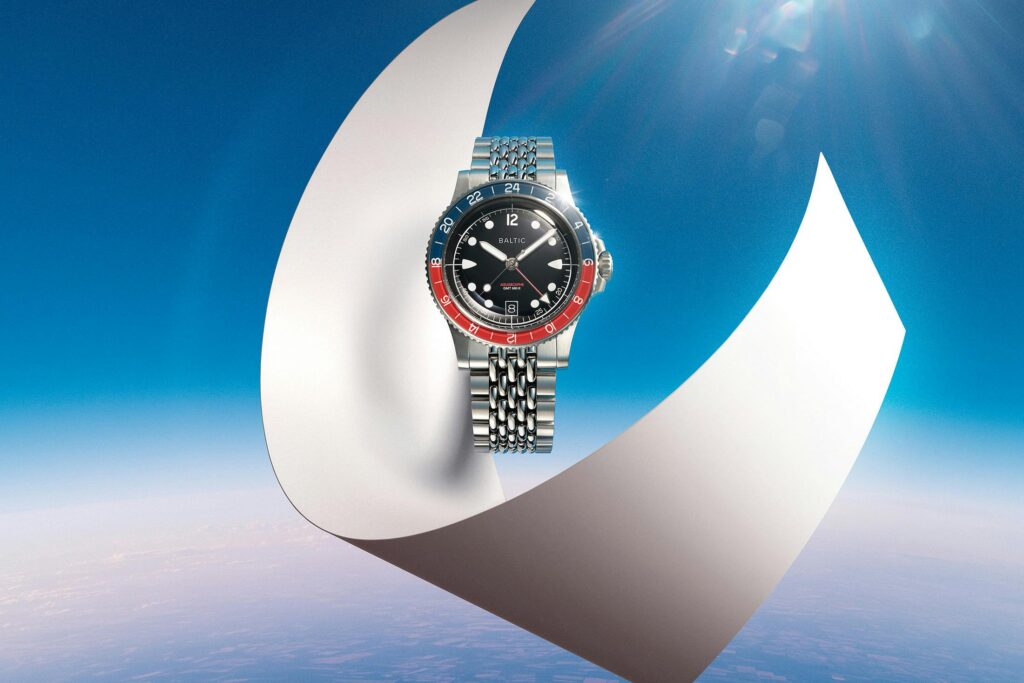
A few more worth a look
Three GMTs we liked this year didn’t fit the rules. Baltic’s Aquascaphe GMT MK-II moves to a Miyota 9075 flyer movement in a 39.5mm case with 200 meters of water resistance. It’s €850 on rubber or €915 on a bracelet. HTD’s Aquatic GMT uses the same Miyota 9075 in a 39mm case with a bidirectional 24-click bezel, but it costs about $1,118. If you want a quartz GMT with wrist time behind it, I reviewed the Vaer G2 Meridian in May. It launched in 2025 and costs $399.

Where this leaves us
Of the eight GMTs here, only the Citizen lets you jump the local hour without touching the second time zone. Seiko, Timex, Luminox, and Orient all went with caller-style or quartz setups at these prices, while microbrands like Baltic and Nodus supply most of the Miyota 9075 flyers near $1,000. A caller GMT works fine for keeping track of home, and the Seiko pair is where I’d start. If you fly often, the Citizen is the safer buy.
If you’re still shopping, we’ve also rounded up GMT watches under $1,000 that don’t feel like compromises and our favorite affordable chronograph watches of 2026.

Co-Founder & Senior Editor
Michael Peñate is an American writer, photographer, and podcaster based in Seattle, Washington. His work typically focuses on the passage of time and the tools we use to connect with that very journey. From aviation to music and travel, his interests span a multitude of disciplines that often intersect with the world of watches – and the obsessive culture behind collecting them.