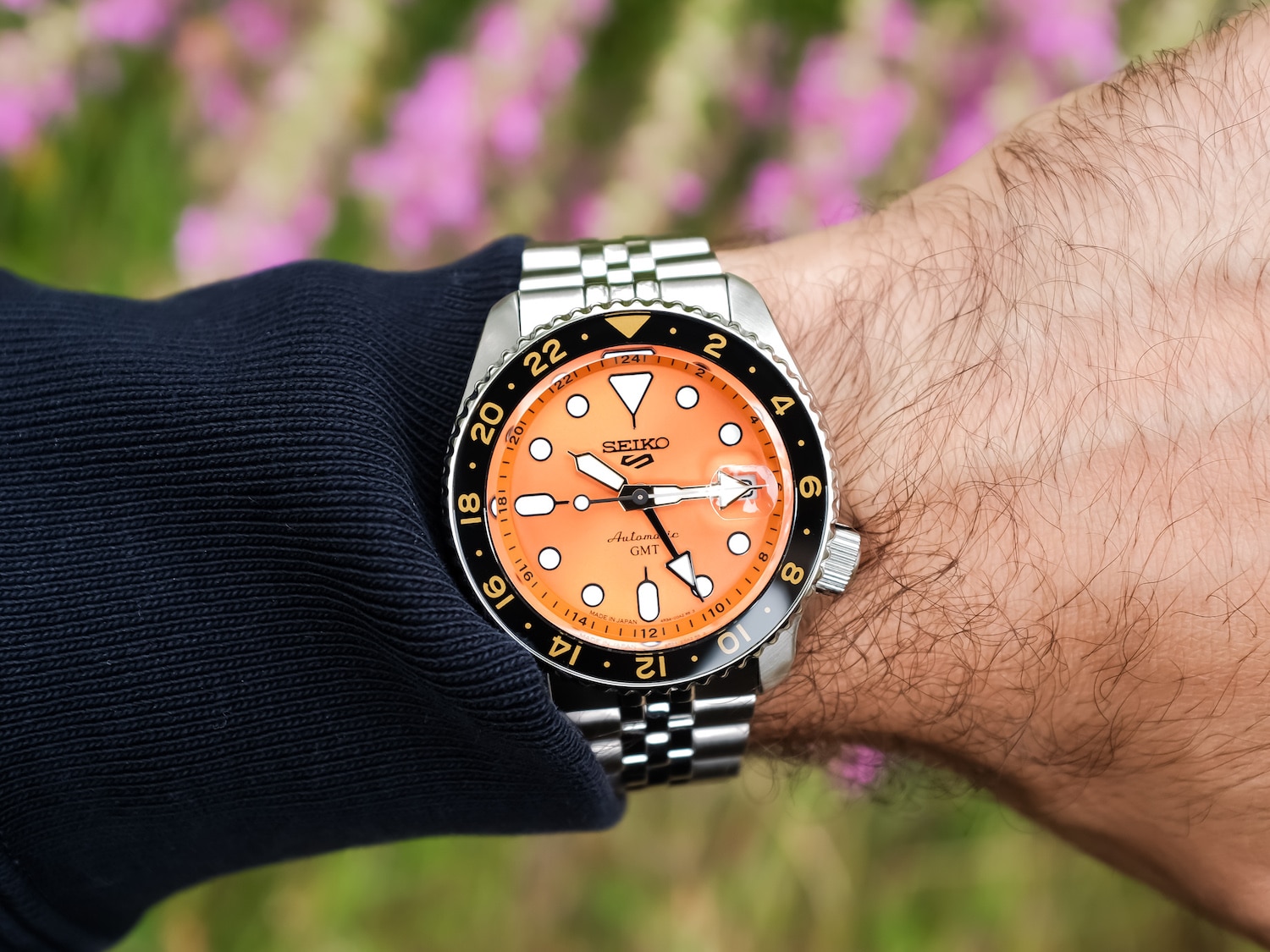
GMT watches used to feel like the part of the hobby you admired from a distance, usually while pretending not to care about Pepsi bezels, waitlists, or whatever “travel watch” fantasy the industry was selling that week. Then affordable GMT watches started showing up everywhere, and suddenly the problem changed. It wasn’t whether we could find one under budget. It was figuring out which ones were worth wearing after the new-watch buzz wore off. That’s the goal of this list: to sort through the best GMT watches under $1000 and focus on the pieces that make sense in real life, whether you’re crossing time zones, tracking family overseas, or letting the fourth hand quietly feed the daydream.
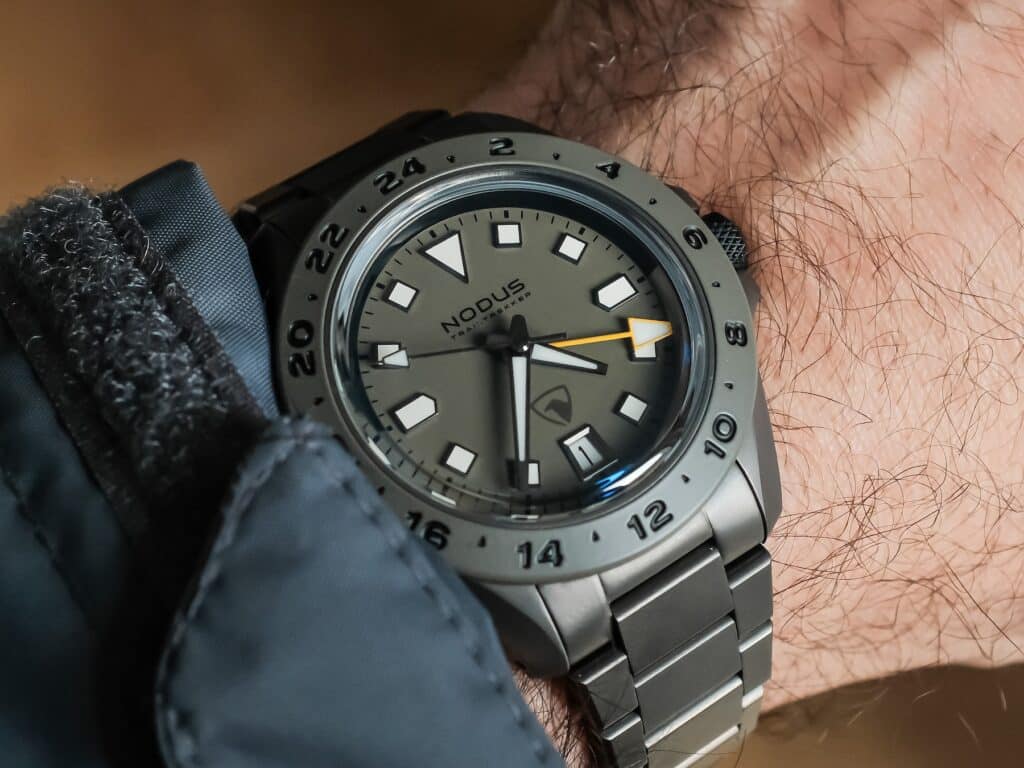
We’re coming at this from the same place as most TBWS readers: curious, budget-conscious, and allergic to watches that only work in product photos. These picks come from watches we’ve handled, reviewed, worn, compared, and occasionally argued with across years of reviews and podcast conversations. So this isn’t a generic watch-buying guide for people chasing status. It’s a grounded look at GMT watches that don’t look cheap, don’t ask for luxury money, and still have enough personality to earn wrist time.
Vaer G2 Meridian GMT

| Price: | $399 |
| Water Resistance: | 150m |
| Case Size: | 39mm (diameter) x 46mm (lug-to-lug) x 10mm (thickness) |
| Lug Width: | 20mm |
| Movement: | Swiss-made Ronda 515.24H |
The Vaer G2 Meridian GMT makes sense on this list because it treats the GMT less like a luxury flex and more like a practical everyday tool. At $399, it falls within a price range where we expect compromises, but the overall experience feels more deliberate than that of a “cheap travel watch with a Pepsi bezel.” Vaer already has a reputation for building straightforward, wearable tool watches, and the G2 Meridian follows that lane well. It borrows the familiar red-and-blue GMT language, sure, but it does not feel like it is trying to compete with Vaer’s more expensive GMTs. It feels like the easier, lower-maintenance version.
The case is where the watch starts to win wrist time. At 39mm with a 46mm lug-to-lug and a thickness just over 10mm, it wears flat, light, and easy in a way many mechanical GMTs under $1,000 do not. That matters if you are buying this as a travel watch, a daily watch, or the thing you throw on before a long airport day when comfort beats romance. The 150 meters of water resistance also helps it feel less fussy. The brushed and polished case surfaces keep it from looking too plain, the screw-down crown is easy to grip, and the engraved caseback gives it a little personality without trying too hard.
The bezel is the one area that kept pulling our attention back during testing, and not always in a good way. The bidirectional action has clear clicks and is easy to use when setting a different time zone, making the GMT function feel practical rather than decorative. But there is some play, and the alignment does not always land perfectly on the markers. For some buyers, that will fade into the background after a week. For others, it may be hard to unsee. The dial is much more settled. Applied markers add depth, the date at 6 o’clock keeps the layout balanced, and the handset stays legible in daylight without getting swallowed by the dial. The lume also does more than just give you a quick party trick when you walk inside. It has enough coverage on the hands and markers to be useful in lower light.
The quartz movement is not a consolation prize here. The Swiss Ronda 515.24H fits the G2 Meridian’s personality because it keeps the watch ready to go. It is a GMT-style caller, so you adjust the 24-hour hand rather than jump the local hour hand. The quick-set date helps, and the multi-year battery life fits the whole grab-and-go idea. The rubber strap also feels like the right match. It tapers well, has more substance than some older entry-level Vaer straps, and works with the lightweight case. The included NATO is useful to have, but it felt stiff enough that we would keep coming back to the rubber. As an accessible GMT under $1,000, the G2 Meridian works best for someone who values ease, comfort, and low maintenance over mechanical theater. Read our full review for the deeper wrist-time notes.
Pros
- The thin, light 39mm case wears comfortably and is flat for everyday use.
- Ronda 515.24H quartz GMT movement keeps the watch simple, accurate, and low-maintenance.
- 150 meters of water resistance, along with a screw-down crown, make it easy to wear without babying it.
Cons
- Bezel alignment is not always perfect, a detail that some collectors may notice.
- The bidirectional bezel has some play despite its defined clicks.
Seiko 5 SSK025 GMT
| Price: | $435 |
| Water Resistance: | 100m |
| Case Size: | 39.4mm (diameter) x 47.9mm (lug-to-lug) x 13.6mm (thickness) |
| Lug Width: | 20mm |
| Movement: | Seiko 4R34 (Mechanical) |
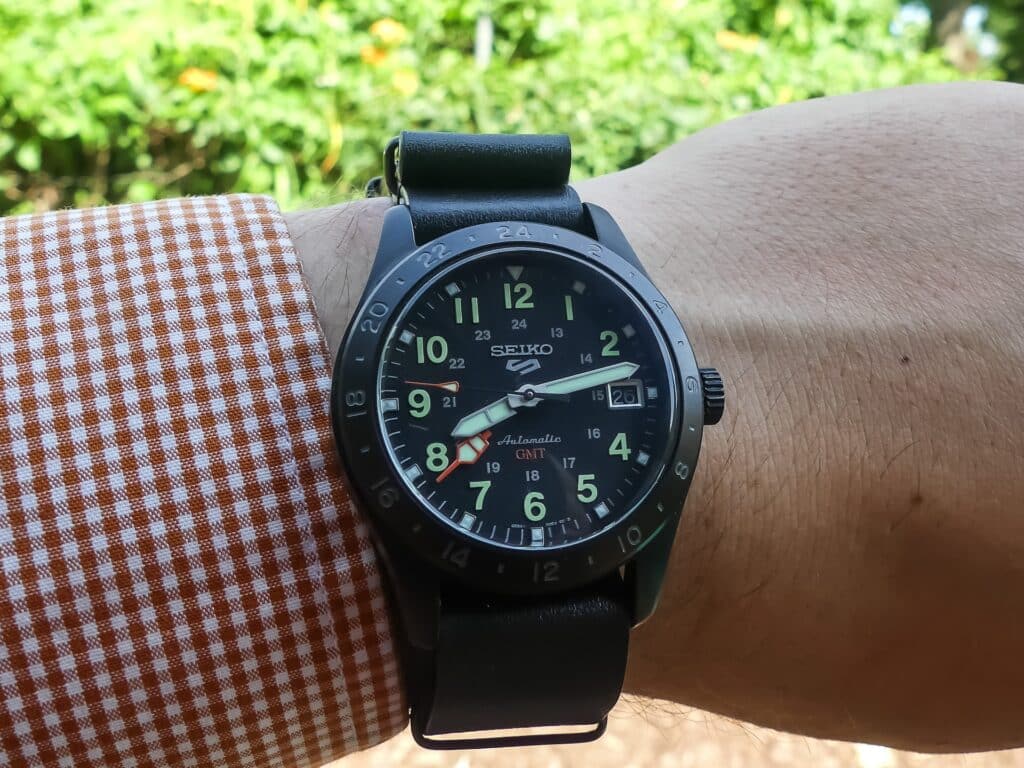
The Seiko 5 SSK025 GMT is one of the more natural fits here because it gives you an automatic travel-watch experience without immediately sending you into four-figure territory. It has obvious Rolex Explorer II energy thanks to the fixed 24-hour bezel, but the field-watch dial keeps it from feeling like a straight homage. This one was more of a slow burn for us. At first glance, it looks like another modern Seiko 5 GMT variant. After wearing it, the appeal becomes clearer: this thing is built around fast, practical reading.
The dial is easily the strongest part of the watch. Full Arabic numerals, a date, strong lume, and a bright orange GMT hand make the SSK025 feel useful rather than decorative. The slightly textured black dial has a subtle sandy finish, which gives the surface more character than a plain matte dial would. Seiko also did a good job tying the colors together. The orange GMT hand lines up visually with the second-hand accent and dial text, while the black date wheel with white numerals keeps the date from feeling pasted on. For travel, office work across time zones, or the kind of person who likes functional dials but still wants them to look considered, this layout works.
The case is where the enthusiasm cools off. At 39.4mm wide, the SSK025 sounds like it should wear easily, but the 13.6mm thickness changes the whole experience. On the supplied single-pass leather strap, the watch felt top-heavy and floppy unless worn tighter than we’d like. During hands-on testing, we ran into a similar issue with nylon straps. Rubber helped a lot. Without extra strap material sitting under the case, and with the added grip against the wrist, the watch finally felt more stable and enjoyable. So while this looks like a field-ready GMT on paper, the wearing experience makes it feel more like an office GMT with outdoor styling.
The specs reinforce that split personality. You get 100 meters of water resistance, which is useful, but the push-pull crown and Hardlex crystal make it feel less adventure-ready than the dial suggests. A screw-down crown and sapphire crystal would make the SSK025 feel more complete, and slimming the watch by removing the exhibition caseback or the Hardlex crystal would greatly improve the wearing experience. The stealthy black IP coating does save some of the case’s personality, though. It gives the watch a tougher, more distinctive look than the standard steel SSK023, and in our view, that darker finish helps the design overcome some of the case’s shortcomings.
The SSK025 is not perfect, and it probably is not the strongest value if you compare it directly against some NH34-powered microbrand GMT watches. Seiko put most of the magic into the dial and left the case feeling like a compromise. Still, we kept enjoying it. There is something satisfying about having this much information, lume, GMT functionality, and stealthy Seiko weirdness packed into one watch. For someone who wants an affordable automatic GMT that feels practical, legible, and a little different from the usual polished travel-watch formula, the SSK025 earns its spot.
Pros
- The full Arabic-numeral dial makes the watch quick and easy to read.
- Orange GMT hand is very legible and ties neatly into the dial accents.
- Textured black dial adds depth without making the layout feel cluttered.
- Black IP coating gives the watch a stealthy look not often found on affordable GMTs.
Cons
- 13.6mm thickness makes the watch wear top-heavy for its 39.4mm diameter.
- The push-pull crown feels underwhelming for a field-style travel watch.
- Hardlex crystal is a compromise when sapphire would better suit the use case.
Seiko 5 GMT (SKX Series)
| Price: | $475 |
| Water Resistance: | 100m |
| Case Dimensions: | 42.5mm (diameter) x 46mm (lug-to-lug) x 13.6mm (thickness) |
| Lug Width: | 22mm |
| Movement: | Seiko 4R34 (Mechanical Movement) |
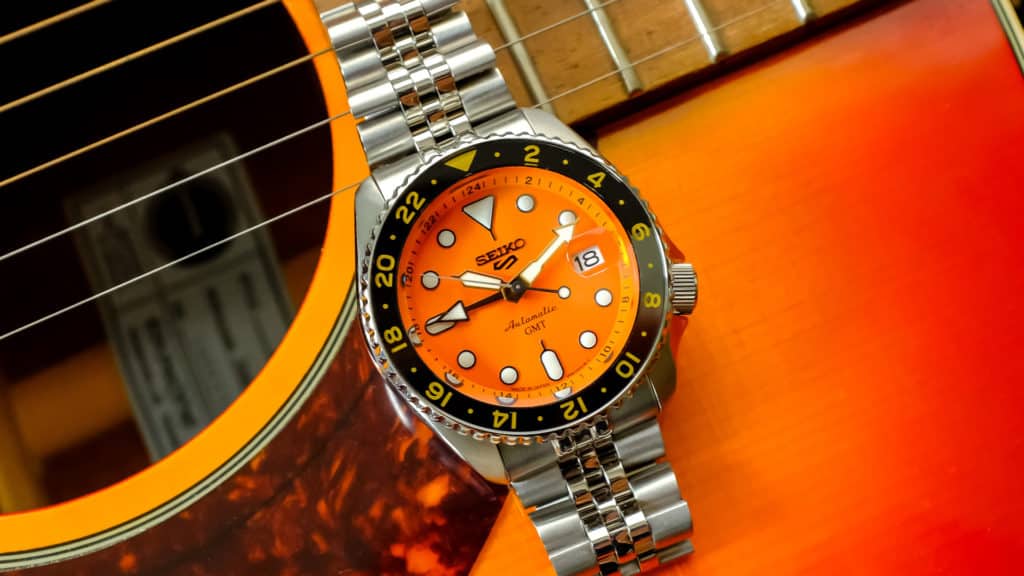
The Seiko 5 GMT earns its spot here because it is one of the clearest ways into an automatic GMT under $1,000 without feeling like you bought the complication and forgot to buy a watch to go with it. The 4R34 movement is a caller-style GMT, so the local hour hand does not jump independently, as it would on a more travel-focused movement. That matters if you are constantly landing in new time zones. But for tracking family overseas, keeping an eye on work in another region, or adding a useful fourth hand to daily wear, it does the job without drama. The 40-hour power reserve is familiar Seiko territory, and with the rotating bezel, you can track a third time zone.
The case is where anyone with old SKX muscle memory will settle in fast. At 42.5mm wide, 13.6mm thick, and 46mm lug-to-lug, it sounds larger than it feels, thanks to those rounded, almost softened lugs and the way Seiko mixes brushed and polished surfaces across the case. It has the broad-shouldered stance of a Seiko sports watch, helped along by the asymmetrical crown guards and crown position, but it avoids feeling like a flat chunk of steel. The obvious trade-off is the push-pull crown and 100 meters of water resistance. We would have preferred a screw-down crown and the old 200-meter confidence of the SKX era, especially on a watch that looks this ready for abuse. Still, on the wrist, it never came across as delicate, and outside pressure testing has suggested the case is tougher than the printed rating implies.
Visually, the Seiko 5 GMT does more than the price point asks. The bi-directional bezel is smooth and free-floating, with no clicks, which will be a dealbreaker for anyone who wants a more tactile, tool-watch feel. For us, the bigger story is the 24-hour insert itself. The daylight half has a finish that shifts under changing light, making the black-to-grey split feel less static than most product photos show. Under the Hardlex crystal, the cyclops remains a matter of personal taste, but the orange sunray dial adds enough depth to keep the watch from feeling flat. Black marker surrounds help the lume stay clean and readable, the glossy black GMT hand ties into the inner 24-hour scale, and the gilt hour and minute hands add warmth without pushing the whole thing into costume-vintage territory.
The bracelet is pure modern Seiko in the way that inspires both affection and mild complaint. The jubilee-style construction is light, a little jangly, and comfortable over longer days, helped by the taper from 22mm down to around 20mm at the clasp. The stamped clasp and pin-and-collar sizing system are not glamorous, and the polished center links will annoy some people faster than the movement accuracy ever will. But the lighter bracelet suits the watch, and if it gets on your nerves, the case looks natural on a NATO.
That is the Seiko 5 GMT in a nutshell: not the most advanced GMT, not the toughest sports watch, and not pretending otherwise. It is useful, approachable, and slightly quirky. Our hands-on review dives deeper into where those quirks help and where they start to wear thin.
Pros
- Familiar SKX-style case wears smaller than its 42.5mm width suggests.
- 4R34 caller GMT movement is practical for tracking another time zone.
- Rotating 24-hour bezel allows for a third time zone.
- The orange sunray dial has a strong sense of depth without compromising legibility.
- Lumibrite, black marker surrounds, and the handset make the dial easy to read.
- Jubilee-style bracelet is light, comfortable, and well-suited to daily wear.
Cons
- The smooth bidirectional bezel has no clicks, which removes some tool-watch tactility.
- Cyclops over the date will divide people.
- The stamped clasp feels basic at this price.
- Pin-and-collar bracelet sizing can be irritating.
Citizen Nighthawk
| Price: | $500 |
| Water Resistance: | 200m |
| Case Size: | 42.5mm (diameter) x 47mm (lug-to-lug) x 12.6mm (thickness) |
| Lug Width: | 22mm |
| Movement: | Citizen B877 Eco-Drive caliber (solar-powered quartz) |
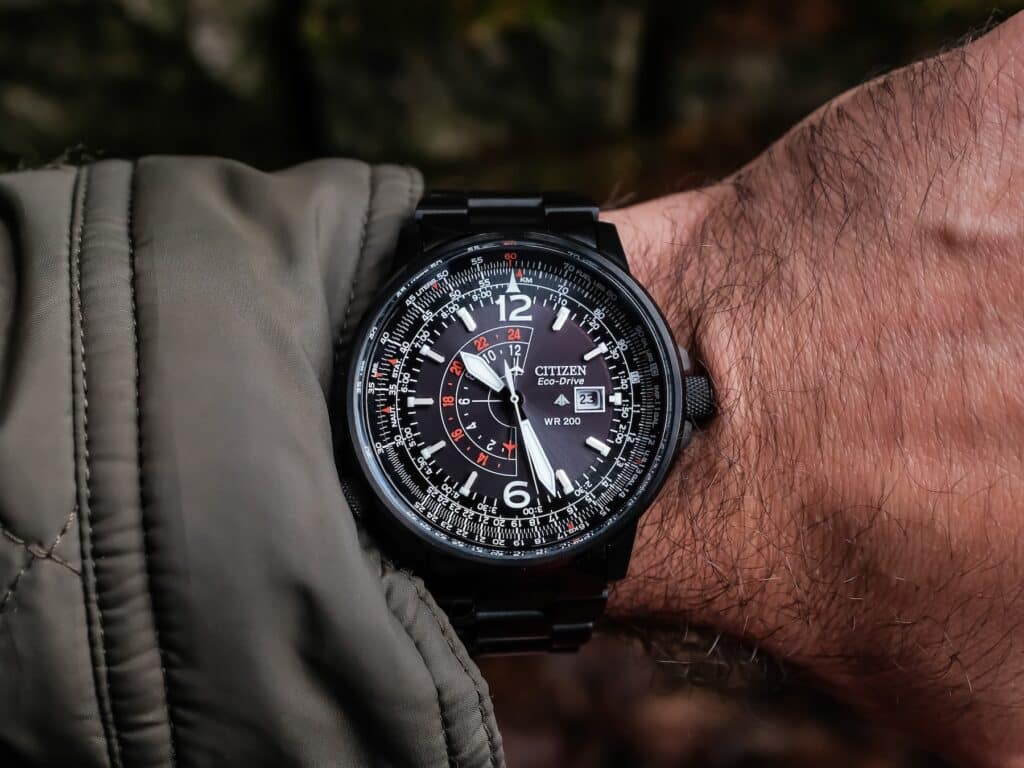
The Citizen Nighthawk earns its place among the best GMT watches under $1000 because it gives travelers a practical second-time-zone tool without the cost, servicing, or general fuss of a mechanical GMT. Citizen may not officially use the Nighthawk name outside the U.S. market. Still, once this Japanese- and European-market version is on the wrist, the difference feels more technical than meaningful. The black ion-plated case and bracelet change the personality, though. It feels more assertive than the standard aviation-tool version, but it still avoids the overbuilt cockpit cosplay that can make some pilot watches exhausting to wear.
This is not a small, disappearing daily watch. At 42.5mm wide and 12.6mm thick, the Nighthawk has real wrist presence, and its stainless steel construction adds noticeable heft. That can be a positive if you like a watch that feels substantial during travel days or long commutes, but it is probably not the piece we would wear for weeks straight if smaller watches are your comfort zone. The case feels solid, and the black ion plating gives the whole thing a uniform, industrial look, with the usual warning that deeper scratches can expose the steel underneath. The screw-down crown, 200 meters of water resistance, and engraved screw-down caseback make it feel more durable than its price suggests. The secondary crown at eight controls the internal E6B slide rule bezel, and because it is not easy to turn accidentally, the whole setup feels secure rather than gimmicky.
The dial is busy up close, but Citizen manages the information better than expected. The slide rule scale is usable if you want to engage with it, but during normal time checks, the finer markings fall back, and the bold indices and sword hands take over. That is what saves the watch from becoming a cluttered mess. The applied markers sit slightly proud of the dial, with polished edges and lume-filled outer sections, while the GMT hand adds the fun with small red-and-white airplane motifs that indicate which side of the scale you are reading. It adds personality without making the watch feel childish, which is a harder balance than it sounds. The secondary time zone scale can be blocked by the main hands at certain points, so reading GMT is not as immediate as using a 24-hour bezel. You get used to it, but it takes more patience.
The B877 Eco-Drive caliber is the real reason this watch makes sense under $1000. It is solar-powered quartz, accurate to within 15 seconds per month, and can run for roughly six months on a full charge without light. That makes it ideal for people who rotate watches or need a travel piece that can sit in the box and still be ready when a flight pops up. The setting feels precise, with crisp hand movement, minimal play, a date, and a jumping local hour feature that makes timezone changes less annoying. The lume is also solid, charging quickly and giving off Citizen’s familiar blue glow across the markers and numerals after brief daylight exposure.
The bracelet fits the watch’s character. It is black ion-plated to match the case, feels very solid, and avoids the loose rattle that can ruin an otherwise capable watch. The push-button deployant clasp with fold-over safety is straightforward, and the micro-adjustment gives enough room to tune the fit. That said, the Nighthawk becomes easier to live with on rubber or nylon, especially if the weight of the bracelet starts to wear on you. The flat mineral crystal is the most obvious compromise. It stays clear in use thanks to internal anti-reflective treatment, but sapphire would have been better, especially since the crystal sits exposed. Still, for an affordable GMT-adjacent travel watch with Eco-Drive convenience, real durability, and a dial that rewards a little curiosity, the Nighthawk remains one of Citizen’s most convincing overachievers. For deeper insights, check out our dedicated review.
Pros
- The Eco-Drive B877 movement provides second-time-zone functionality without battery changes or mechanical GMT servicing.
- Accuracy rated to within 15 seconds per month beats what most mechanical GMTs deliver in daily use.
- Six-month power reserve on a full charge makes it easy to leave it off your wrist and trust it later.
- Solid black ion-plated bracelet feels secure, with a useful fold-over safety clasp and micro-adjustment.
Cons
- 42.5mm case and steel construction make it large and heavy on the wrist.
- Flat mineral crystal feels like the clearest compromise at this price.
- The main hands can obscure the secondary time zone scale at certain times of day.
- Black ion plating may show steel underneath if deeply scratched.
Imperial Oceanguard GMT
| Price: | $600 |
| Water Resistance: | 200m |
| Case Dimensions: | 38mm (diameter) x 47mm (lug-to-lug) x 14mm (thickness) |
| Lug Width: | 20mm |
| Movement: | Seiko NH34 |
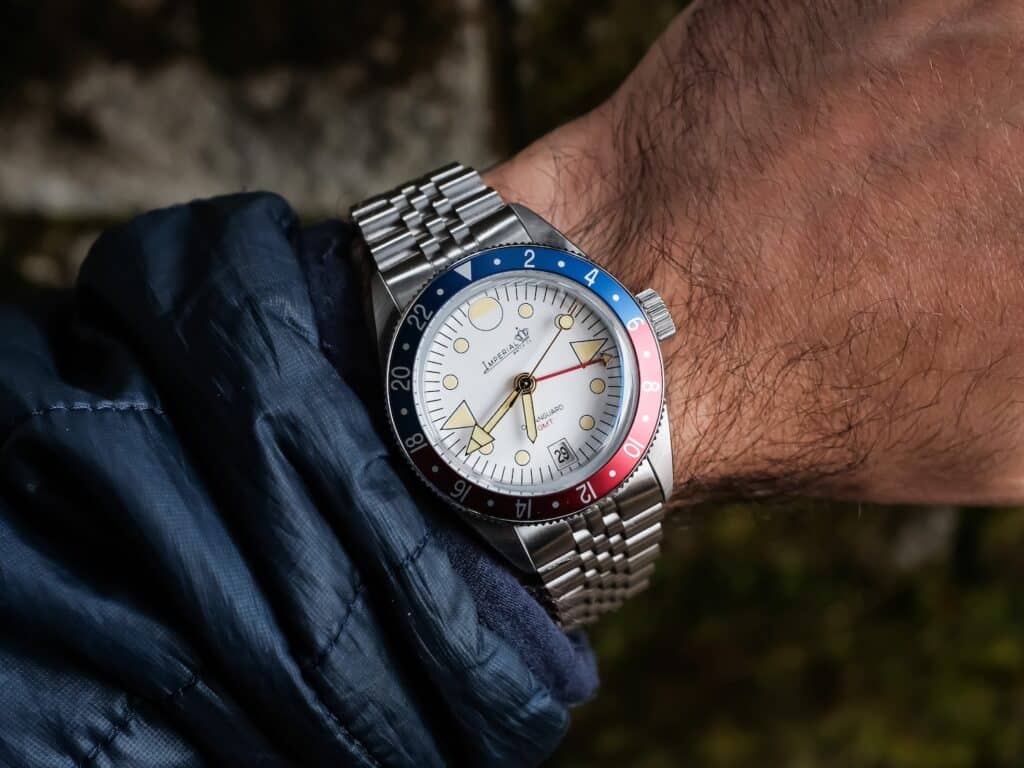
The Imperial Oceanguard GMT belongs on this list because it gives you a route away from the usual Seiko conversation without drifting into weird, over-designed territory. The Seiko NH34 powers the watch, so the GMT function is the familiar caller-style setup rather than a flyer GMT with an independently jumping local hour hand. That may disappoint people who are constantly changing time zones, but for most of us, using GMT to track another place during the day keeps things simple and dependable. In practice, the bezel ended up doing a lot of the work anyway, which made the whole flyer-versus-caller debate feel less important than it tends to be online.
The case is the real reason the Oceanguard GMT stands out under $1,000. At 38mm, it lands in a size range that many modern GMT watches ignore, and that makes a meaningful difference on the wrist. It wears compact, feels friendly to smaller wrists, and carries more of a skin-diver personality than the broader, heavier travel-watch designs that dominate this space. The thickness looks more noticeable on paper than it feels during wear. It never came across as top-heavy, which is important because a smaller GMT can fall apart quickly if the proportions are off. Here, the size feels intentional rather than vintage cosplay.
Imperial also gets the handling right. The oversized crown looks a touch dramatic at first, but once you use it, the decision makes sense. It is easy to grip, easy to operate, and works naturally with the bi-color bezel when you are adjusting or referencing another time zone. The dial is another part of the watch that works better on the wrist than in photos. The mix of dots, triangles, and the circular marker at twelve gives the dial a clear sense of orientation, so you do not have to pause to decode it. During our in-depth testing, legibility remained strong both outdoors and indoors, and the lightly aged lume paired well with the white dial without leaning too hard into fake-patina theater.
The bracelet is where the Oceanguard GMT makes its strongest value argument. The jubilee-style bracelet wraps around the wrist with good articulation, and the tool-less microadjustment makes small fit changes easy during the day. That sounds minor until your wrist swells in warm weather or after travel, and then it becomes the kind of detail you miss on more expensive watches. The clasp is chunkier than we would like, especially compared with the otherwise tidy proportions of the watch, but comfort stayed high through full-day wear. For someone who wants a value-focused microbrand GMT, the Oceanguard GMT feels familiar where it should and more complete where it counts.
Pros
- Skin-diver-style proportions give it a different personality from broader modern GMTs.
- The bi-color bezel works well for quick second-time-zone tracking.
- Dial layout is easy to orient at a glance thanks to the varied marker shapes.
- Jubilee-style bracelet articulates well and remains comfortable during extended wear.
- Tool-less microadjustment makes on-the-fly fit changes painless.
Cons
- The clasp is thicker than the rest of the watch deserves.
- The case can still read a little thick if you are chasing strict vintage proportions.
Steinhart Ocean 39 GMT
| Price: | $650 |
| Water Resistance: | 300m |
| Case Dimensions: | 39mm (diameter) x 47mm (lug-to-lug) x 13mm (thickness) |
| Lug Width: | 20mm but tapers down to 16mm |
| Movement: | ETA 2893-2 |
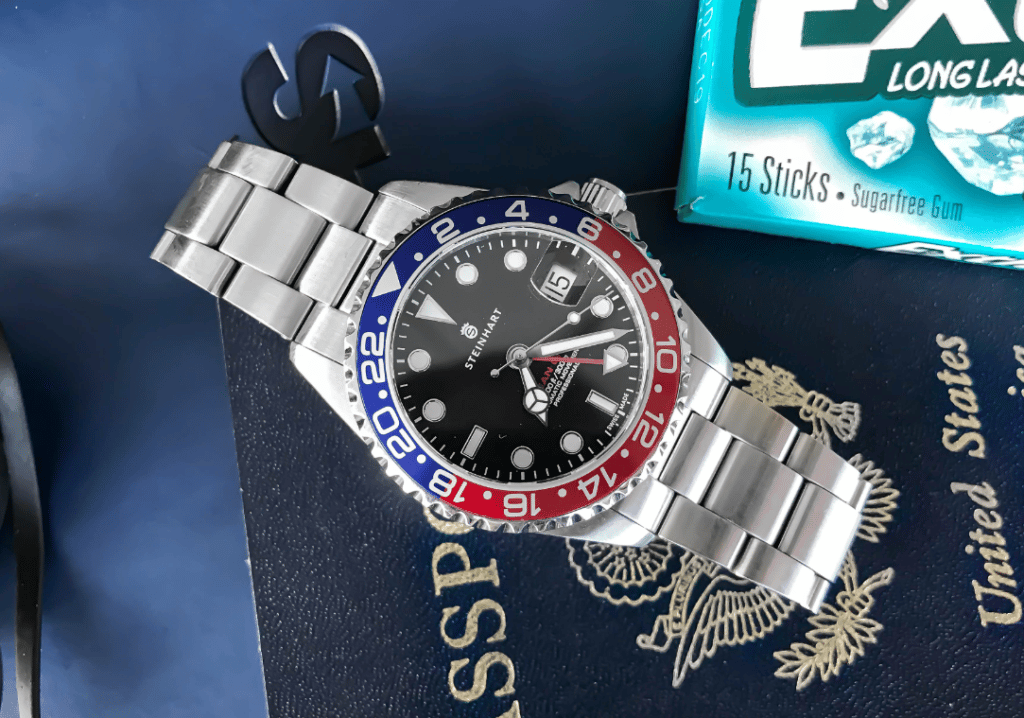
The Steinhart Ocean 39 GMT sits on this list with a bit of baggage because, yes, the design language is clearly Rolex GMT-Master II-adjacent. But that is also part of why it has remained such a common, affordable route into this watch style. Under $1,000, it gives you the general feel of a classic travel-bezel GMT without asking you to pretend you are buying something original in the high-concept sense. The better way to look at it is as a value-focused GMT-style sports watch that gets the size, finishing, and everyday wearability right enough to justify the attention it gets.
The 39mm case is the first thing working in its favor. It is compact enough for smaller wrists but still has enough athletic presence to avoid feeling undersized. The listed 13mm thickness sounds a little chunky, though in wear, it came across slimmer than expected during testing. Clean brushing across the case keeps the watch grounded, while the polished sides catch light without turning the whole thing into a wrist mirror. The engraved Neptune caseback gives it a bit of Steinhart personality, which helps because this watch needs those details to keep it from feeling like it is only borrowing someone else’s homework.
The Pepsi bezel is where the Ocean 39 GMT makes its strongest visual argument. The red and blue are vivid without looking cheap or toy-like, and paired with the matte black dial, the whole thing stays legible and familiar in a good way. The bezel itself is less convenient than the color execution, though. It uses a stiff 120-click unidirectional action, which feels secure and almost diver-like, but it is not ideal if you are regularly adjusting a second time zone. The red-tipped GMT hand lines up cleanly with the minute track, and the BGW9 lume glows evenly and lasts longer than we expected. The hands and markers do not have the depth you would see on a luxury GMT, but they are crisp, functional, and easy to read. The Cyclops helps with quick date checks, even if the magnification could be stronger.
Inside, the ETA 2893-2 keeps the watch in reliable Swiss-movement territory without pushing the price into fantasy. It is a caller-style GMT, so the GMT hand jumps rather than the local hour hand. For constant travelers, that limits the convenience. For someone who wants to track another time zone from home or on occasional trips, it is a reasonable trade-off. The bracelet feels solid, with screwed links and a secure safety clasp, though the flip lock can be annoying when you are trying to dial in the fit. Scratches started showing after several days of wear, especially around the more polished areas and bezel teeth, but the watch took them better than expected. They made it feel worn in rather than ruined, which is probably the right mindset for a GMT under $1,000 that wants to be used, not admired from a safe distance.
Pros
- ETA 2893-2 movement brings reliable Swiss GMT functionality at a reasonable price.
- The 39mm case feels balanced and wearable across a wide range of wrist sizes.
- Pepsi bezel colors are bright and well-executed without looking cheap.
- BGW9 lume is strong, and the red-tipped GMT hand keeps time-zone reading clear.
- The bracelet feels solid, with screwed links and a secure clasp.
Cons
- Stiff bezel action makes frequent GMT adjustments less convenient.
- The GMT layout in the caller limits its usefulness for frequent travelers.
- Highly polished bezel teeth make scratches more noticeable.
- The flip-lock clasp can be finicky when it comes to getting the fit right.
Nodus Contrail GMT Laguna
| Price: | $825 |
| Water Resistance: | 200m |
| Case Dimensions: | 40.5mm (diameter) x 46.6mm (lug-to-lug) x 11.8mm (thickness) |
| Lug Width: | 20mm |
| Movement: | Miyota 9075 |
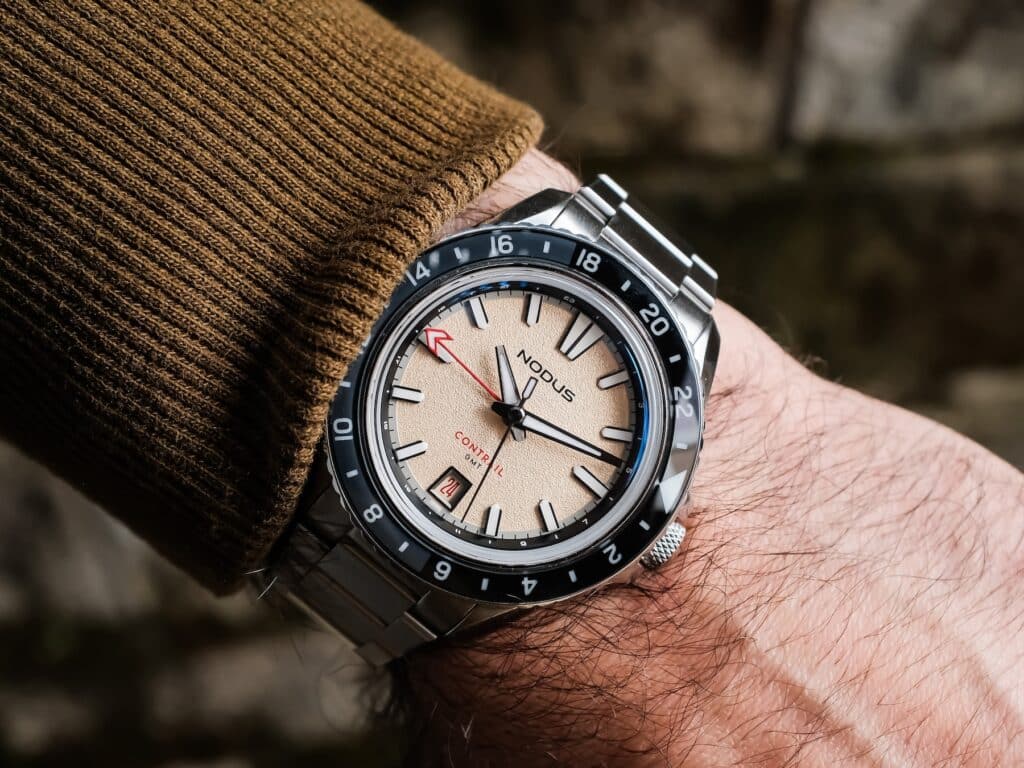
The Nodus Contrail GMT is the kind of under-$1,000 GMT that starts making more sense the longer you wear it. The appeal comes from the way the smaller choices stack up: a thin case profile, a usable bezel, a true flyer-style movement, strong lume, and a bracelet clasp that makes daily fit changes easy. For buyers who want something more enthusiast-driven than the obvious big-brand picks, this is one of the stronger microbrand GMT options in the price range.
The movement is a big part of that. Nodus uses the Miyota 9075, which gives you a flyer GMT setup with an independently jumping local hour hand. That is more useful for actual travel than a caller-style GMT because you can adjust the local time without disturbing the rest of the display. In our hands-on time with it, the local hour jump felt clean and precise, accuracy stayed steady, and the roughly 42-hour power reserve worked well in a normal rotation. The large, screw-down crown helps the experience, too. It has enough texture to grip easily, so setting the watch feels deliberate rather than fiddly, which matters more than people admit when a GMT is supposed to be adjusted often.
The case also does a lot of quiet heavy lifting. At 40.5mm wide, it sits in familiar modern sports-watch territory, but the 11.8mm thickness is what makes it stand out. Many GMTs using this movement wear thicker than expected; the Contrail GMT stays close to the wrist and avoids that top-heavy feeling that can make a travel watch annoying by mid-afternoon. The 46.6mm lug-to-lug keeps the footprint manageable, while the twisted lugs help the case settle down cleanly. Brushed and polished finishing gives the case shape more definition, and the box sapphire crystal and sapphire bezel insert catch light in a way that makes the watch feel more dimensional than the measurements suggest. With 200 meters of water resistance, it also has enough practical toughness that we would not feel the need to baby it through a normal travel day.
The actual time-zone tracking is where the Contrail GMT feels properly sorted. The bi-directional 24-hour bezel uses a smooth 48-click action, making quick adjustments easy without feeling loose or vague. Between the bezel, the internal 24-hour scale, the main handset, and the GMT hand, tracking multiple time zones becomes natural after a short adjustment period. The bold handset is easy to separate at a glance, and the BGW9 lume is strong across the markers, bezel numerals, and GMT hand, so low-light reading does not require wrist gymnastics. The Laguna dial adds warmth with a soft, sandy tone that shifts with the light, while the roulette date wheel lends the watch character without crowding the layout. That said, we would still prefer slightly larger internal 24-hour numerals for quicker reading.
The H-link bracelet keeps things solid and easy to wear, tapering from 20mm to 16mm, though a stronger taper would have made it feel a little more refined. Screw links make sizing painless, and while the NodeX clasp adds some chunk, the quick on-the-fly adjustment is useful enough that we would take the trade-off.
Pros
- The slim 11.8mm case profile helps it wear closer and cleaner than many GMTs that use the same movement.
- Flyer-style Miyota 9075 movement feels precise in use, especially with the large, easy-to-grip screw-down crown.
- The smooth 48-click bidirectional bezel makes tracking multiple time zones feel intuitive after a short learning curve.
- Strong BGW9 lume across the markers, bezel numerals, and GMT hand gives it real low-light usefulness.
- NodeX clasp makes quick fit changes easy throughout the day.
Cons
- NodeX clasp wears chunkier than the rest of the watch.
- Internal 24-hour numerals could be larger for faster readability.
- Bracelet taper feels a little conservative if you prefer a more dramatic narrowing toward the clasp.
Nodus x Raven TrailTrekker
| Price: | $875 |
| Water Resistance: | 200m |
| Case Dimensions: | 39.5mm (diameter) x 46.6mm (lug-to-lug) x 11.8mm (thickness) |
| Lug Width: | 20mm |
| Movement: | Miyota 9075 |
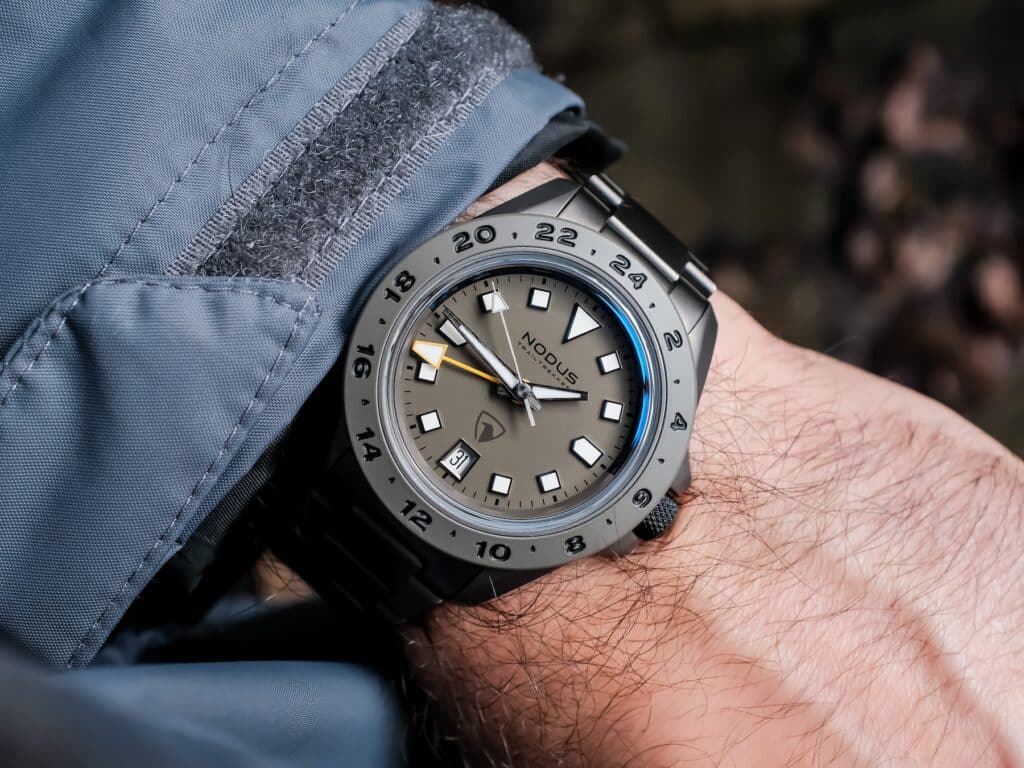
The Nodus x Raven TrailTrekker gives this list a more rugged, adventure-leaning GMT option, and it does so without feeling like a standard travel watch in different clothes. The whole thing is built around a tool-first practicality. The 39.5mm case is finished in muted grey DLC, which avoids the overly glossy black-coated look that can make watches feel more tactical costume than usable daily gear. No polished surfaces are fighting for attention, and on the wrist, it stays low-profile, purposeful, and wearable across a pretty broad range of wrist sizes. Add the sapphire crystal, 200 meters of water resistance, and a deeply knurled screw-down crown, and it feels like the kind of GMT we would grab for active days without having to think too hard about what might happen to it.
The bezel and dial are what separate the TrailTrekker from the more conventional GMT picks under $1,000. The sand-colored Cerakote bezel has a texture that gives the watch a dry, utilitarian feel, and the high-contrast 24-hour scale keeps second-time-zone tracking straightforward. It has that slightly used-equipment energy, which suits the watch better than a shiny ceramic insert would. The dial follows the same sand-toned approach, with matching texture, gunmetal hands, and applied indices that keep the design cohesive. The yellow GMT hand is the loudest choice here. It may be too bright for someone who wants everything subdued, but in actual use, it makes quick GMT checks easier. The 6 o’clock date helps keep the layout balanced, and the dual branding is restrained enough not to interfere with legibility.
As mentioned in our dedicated review, comfort was better than the TrailTrekker’s rugged appearance might suggest. The flat-link bracelet sits close to the wrist and tapers from 20mm down to 16mm, which helps keep the clasp area from feeling bulky. It feels solid without becoming heavy, and during testing, the bracelet proved to be the preferred setup over the included nylon strap. The NodeX clasp is a major part of that. Its on-the-fly adjustment gives about 10mm of range across multiple positions. Once that kind of mechanism becomes part of your routine, going back to a basic clasp feels like a small punishment.
Inside, the Miyota 9075 flyer GMT movement gives the TrailTrekker real travel-watch functionality rather than only second-time-zone styling. The independently jumping local hour hand makes time-zone changes cleaner, and during our testing period, the hour adjustment felt smooth and precise. Accuracy stayed within a few seconds of the reference time, and the jumping hour hand also made date changes more intuitive while traveling. Since the 9075 is still a relatively new movement, long-term performance is something worth watching, but early impressions were strong. The engraved caseback adds a final bit of character with its caravan motif, tying the whole travel-and-resilience theme together without turning the watch into a gimmick.
Pros
- Miyota 9075 flyer GMT movement makes time-zone changes practical and easy to use.
- The screw-down crown with 200m water resistance makes it feel ready for active use.
- DLC case and sand-colored Cerakote bezel give it a cohesive, rugged tool-watch feel.
- Flat-link bracelet taper and NodeX clasp improve daily comfort and on-the-fly fit.
- Dial stays clean and legible despite the co-branding and added GMT information.
Cons
- Lume is usable, but not as bright as the strongest performers in this category.
- The yellow GMT hand may be too bold if you prefer a more muted design.
Please let us know what you think of these GMT picks in the comments below. If there’s an affordable sub-$1,000 GMT watch that you think deserves a spot here, share it with us as well. We’ll do our best to get one in for hands-on review and consider it for a future update to this list.

Co-Founder and Senior Editor
Kaz has been collecting watches since 2015, but he’s been fascinated by product design, the Collector’s psychology, and brand marketing his whole life. While sharing the same strong fondness for all things horologically-affordable as Mike (his TBWS partner in crime), Kaz’s collection niche is also focused on vintage Soviet watches as well as watches that feature a unique, but well-designed quirk or visual hook.