Most collecting regrets don’t stem from buying a bad watch. They often come from buying a watch for the wrong reasons. Maybe it was the piece every forum recommended, the diver that looked perfect in photos but rarely left the watch box, or the bargain that somehow turned into three more “cheap” purchases. Those lessons usually arrive after the return window closes. So if you’re looking for the best watches for new collectors who want to avoid regret, this list is designed to help. Rather than chasing trending pieces, we’re focusing on watches that keep earning wrist time long after the excitement of a new purchase fades and your taste evolves.
We’re writing this from the perspective of collectors who’ve made those mistakes ourselves. Across more than a decade of hands-on reviews, we’ve lived with these watches beyond the first impression—wearing them through workdays, weekends, travel, strap changes, and the inevitable comparisons that come with collecting. One thing has become clear: the watches we regret buying are rarely the ones with the weakest specs, and the ones we keep reaching for aren’t always the most expensive or talked about. That’s why this isn’t another generic beginner watch guide. It’s a collection of watches we’ve genuinely enjoyed owning, complete with the trade-offs that only show up after real wrist time, so your budget goes toward watches that become the foundation of a collection, not the ones you move on from a few months later.
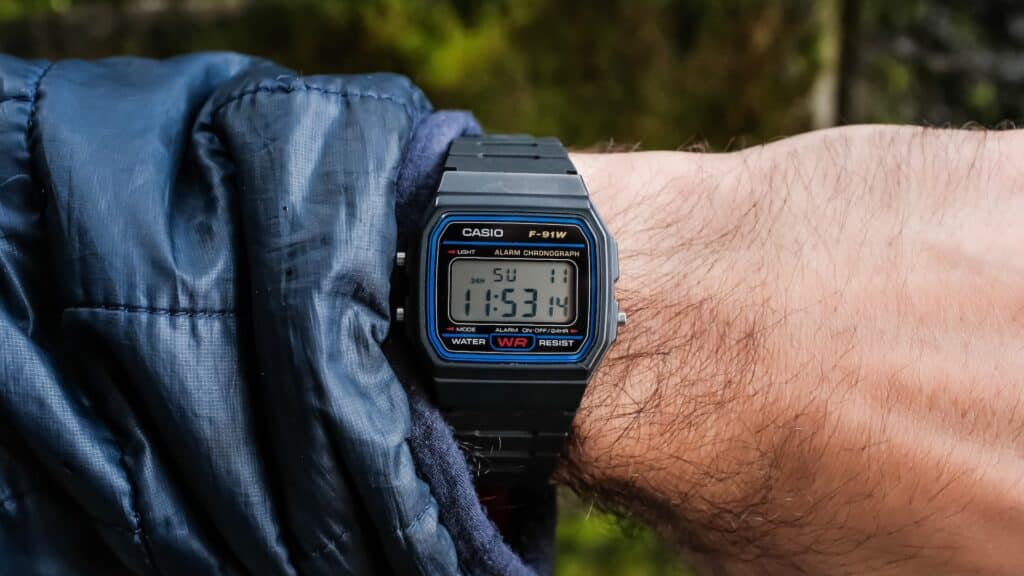
Casio F-91W
| Price: | $15 – $20 |
| Water Resistance: | 30m |
| Case Dimensions: | 34mm (diameter) x 38mm (lug-to-lug) x 8.5mm (thickness) |
| Lug Width: | 18mm |
| Movement: | Casio Quartz Module 593 |
One of the easiest methods to avoid regret as a new watch collector is to buy something you’ll wear constantly rather than treating it as a special-occasion piece. That’s exactly where the Casio F-91W shines. It isn’t trying to impress anyone, and that’s part of its appeal. During our hands-on time with it, the slim resin case disappeared on the wrist whether we were traveling, running errands, or squeezing in a workout. The simple construction looks almost disposable at first glance, but it handles everyday knocks better than its appearance suggests. For someone still figuring out what they enjoy wearing, that kind of low-risk, high-use experience is hard to argue with.
Its digital display keeps everything straightforward. Time, date, alarm, stopwatch, and both 12- and 24-hour formats are all easy to access, and the button layout remains intuitive even after the watch has been sitting in a drawer for months. The quartz module stayed within Casio’s expected accuracy of around ±30 seconds per month during our testing, while the CR2016 battery should keep it running for years with little attention. Flip the watch over, and the no-nonsense design continues with a simple four-screw stainless steel caseback. Despite the compact dimensions, the small corner guards add a bit more substance to the case and make the pushers easier to locate by feel.
That said, the F-91W isn’t perfect. The integrated resin strap, though soft and flexible, limits your options if you enjoy swapping straps; the 30m water resistance is better suited to daily splashes than deep water activities, and the green LED backlight is just functional rather than bright. Even then, those compromises feel reasonable at this price. It’s the kind of watch that helps new collectors learn what they value before spending more money, making it far less likely to be an early purchase they’ll regret.
Pros
- Simple digital interface with genuinely useful everyday functions.
- Very lightweight and comfortable enough to forget it’s on your wrist.
- Dependable quartz accuracy with a battery that typically lasts for years.
- Resin case and strap shrug off everyday bumps quite well.
Cons
- The green LED backlight is noticeably dim by modern digital watch standards.
- The integrated resin strap leaves little room for customization.
- 30m water resistance isn’t very well suited for deep swimming or extended water use.
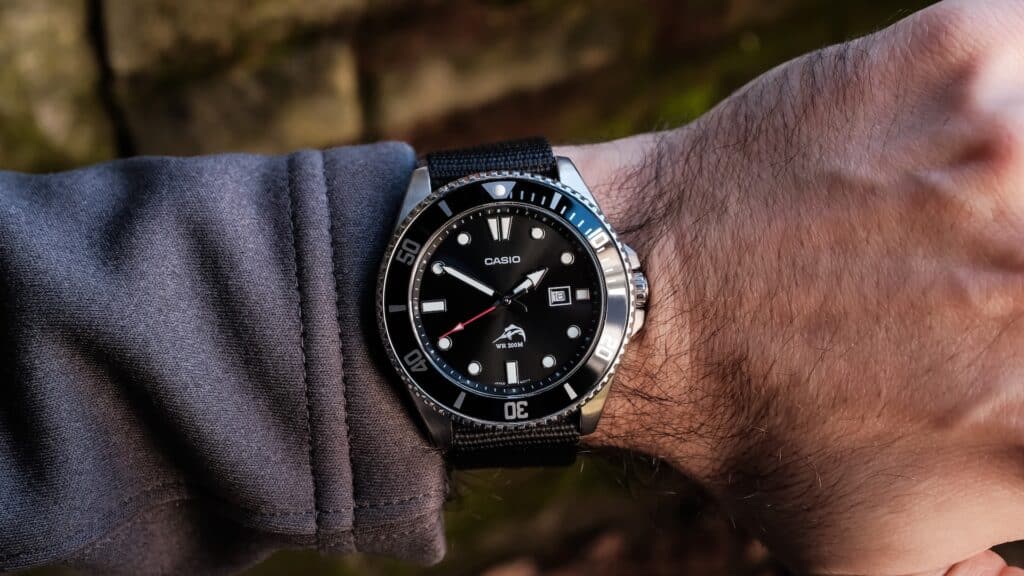
Casio Duro
| Price: | $85 |
| Water Resistance: | 200m |
| Case Dimensions: | 44.2mm (diameter) x 48.5mm (lug-to-lug) x 12.1mm (thickness) |
| Lug Width: | 22mm |
| Movement: | Casio 2784 Quartz |
One mistake many new collectors make is assuming they need something complicated to stay interested. The Casio Duro proves the opposite. It earns its place by getting the fundamentals right and asking very little in return. While we had it in for review, the quartz movement made daily ownership simple. It hacks, has a quickset date, and stayed within roughly ±20 seconds per month in our testing. That means you can leave it untouched for a few days, strap it back on, and get on with your day instead of resetting the time. If you’re still figuring out what you enjoy wearing, that kind of convenience goes a long way toward avoiding buyer’s remorse.
Despite the 44mm case size, the Duro wears more comfortably. The relatively short lug-to-lug distance and downward-curving lugs help it sit securely rather than feel unwieldy, though smaller wrists may still find it substantial. The dial keeps distractions to a minimum, with applied indices, arrow-shaped hands, and a neatly framed date window that remained easy to read throughout our testing period. It avoids unnecessary clutter, with only the Casio logo at 12 and the 200m water resistance text near 6 breaking up the clean layout.
The lume is perfectly usable for checking the time after dark, even if it doesn’t hold its brightness as long as we’d like. Around the case, the brushed and polished finish with a separating bevel adds a little character without looking flashy. At the same time, the aluminum bezel delivers a firm, reassuring action with no loose or rattly feel during use.
The Duro also leaves room to grow with your collection. Standard 22mm lugs make strap changes effortless, and we’ve worn it on everything from rubber and nylon straps to aftermarket bracelets without issue. Add in the screw-down crown and solid caseback backing up the 200m water resistance, and it feels like a watch you can wear confidently rather than baby. The mineral crystal is easier to scratch than sapphire, but that’s one of the few compromises in an otherwise dependable watch that teaches new collectors an important lesson: reliability and everyday usability tend to outlast novelty.
Pros
- Quartz movement is accurate, low-maintenance, and easy to live with.
- Standard 22mm lugs make strap changes quick and inexpensive.
- 200m water resistance with a screw-down crown adds real everyday durability.
- Crisp dial layout with applied indices stays easy to read.
- Bezel action feels solid with no noticeable play.
Cons
- Lume starts strong but fades sooner than we’d prefer.
- The 44mm case can feel large on smaller wrists.
- The mineral crystal won’t resist scratches as well as sapphire.
Casio G-Shock GW6900-1
| Price: | $140 |
| Water Resistance: | 200m |
| Case Dimensions: | 53.2mm (diameter) x 50mm (lug-to-lug) x 17.7mm (thickness) |
| Lug Width: | 16mm |
| Movement: | Solar Quartz Module 3179 |
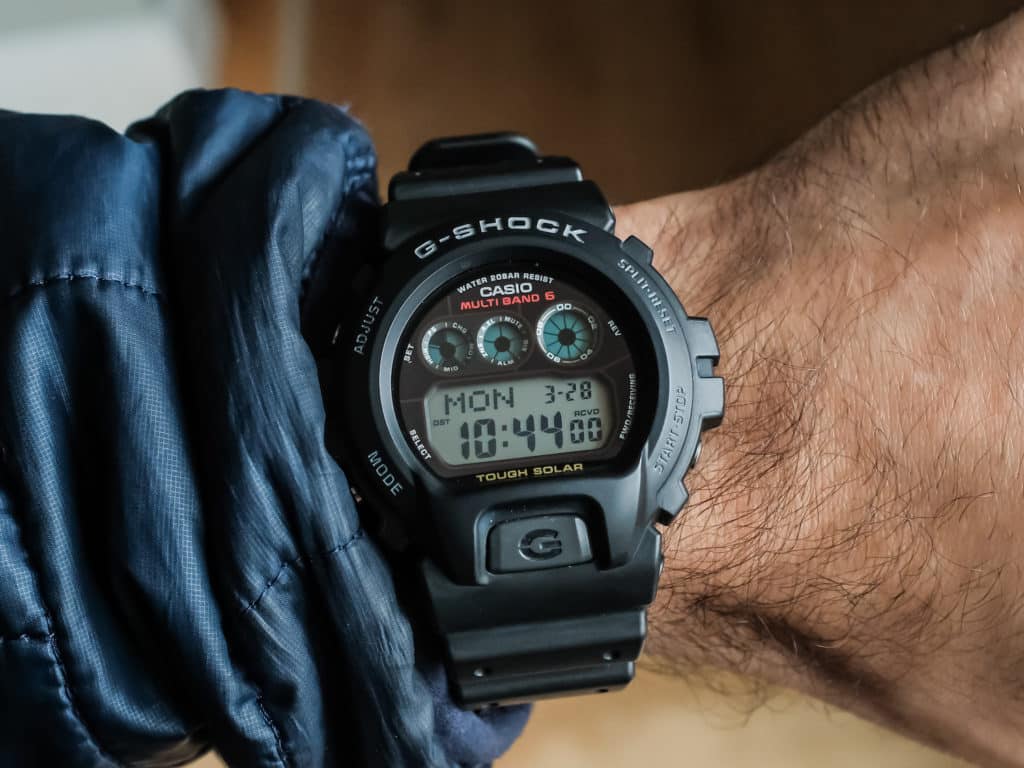
New collectors often worry about scratching or babying their first “good” watch. The GW6900 solves that problem by encouraging the opposite. It’s the watch we’ve reached for on rushed mornings, airport runs, yard work, and any day when thinking about which watch to wear felt unnecessary. That kind of reliability is difficult to appreciate until you’ve owned a few watches that demand more attention than they deserve. Despite measuring over 50mm across and nearly 18mm thick, the resin case keeps the weight low. During our hands-on review we found that it wears lighter than the dimensions suggest.
The triple-eye digital display looks busy at first, but it becomes second nature after a few days. The large lower screen keeps the time easy to read, while the three upper indicators quietly handle stopwatch status, radio reception, and other functions. While reviewing it, we found ourselves using the 1/100-second stopwatch and countdown timer more often than expected, and the five alarms add useful flexibility without getting in the way. A nice touch is the discreet second time zone tucked into the display, offering the convenience of dual-time tracking without an extra hand or rotating bezel. At night, the large front button activates a bright green EL backlight that evenly illuminates the screen. We’d still welcome Casio’s newer LED system here, but the existing setup never left us struggling to read the time.
Living with the GW6900 is quite hands-off. Tough Solar charging keeps the battery topped up through normal light exposure. Multi-Band 6 automatically syncs with atomic clocks overnight across supported regions, so accuracy is rarely something you have to think about. The resin strap feels a little stiff and squeaky straight out of the box, but it softens quickly, dries quickly after sweat or rain, and remains comfortable during long days on the wrist. For new collectors, it’s the kind of watch that quietly proves dependable ownership often matters more than chasing the latest release.
Pros
- Lightweight resin construction stays comfortable despite the oversized case.
- Bright EL backlight makes the display easy to read after dark.
- Multi-Band 6 automatically keeps the watch synced to atomic time where supported.
- Tough Solar charging means you rarely have to think about battery life.
- Useful everyday functions, including world time, stopwatch, countdown timer, and five alarms.
Cons
- The resin strap feels a bit stiff and squeaky at first, but it breaks in.
- The large case can overwhelm smaller wrists.
- The triple-display layout has a learning curve if you’re coming from simpler digital watches.
Orient Bambino
| Price: | $150 – $250 |
| Water Resistance: | 30m – 50m |
| Case Dimensions: | 40.5mm diameter x 44.3mm lug-to-lug x 11.8mm thickness |
| Lug Width: | 21mm |
| Movement: | Orient Caliber F6724 Automatic |
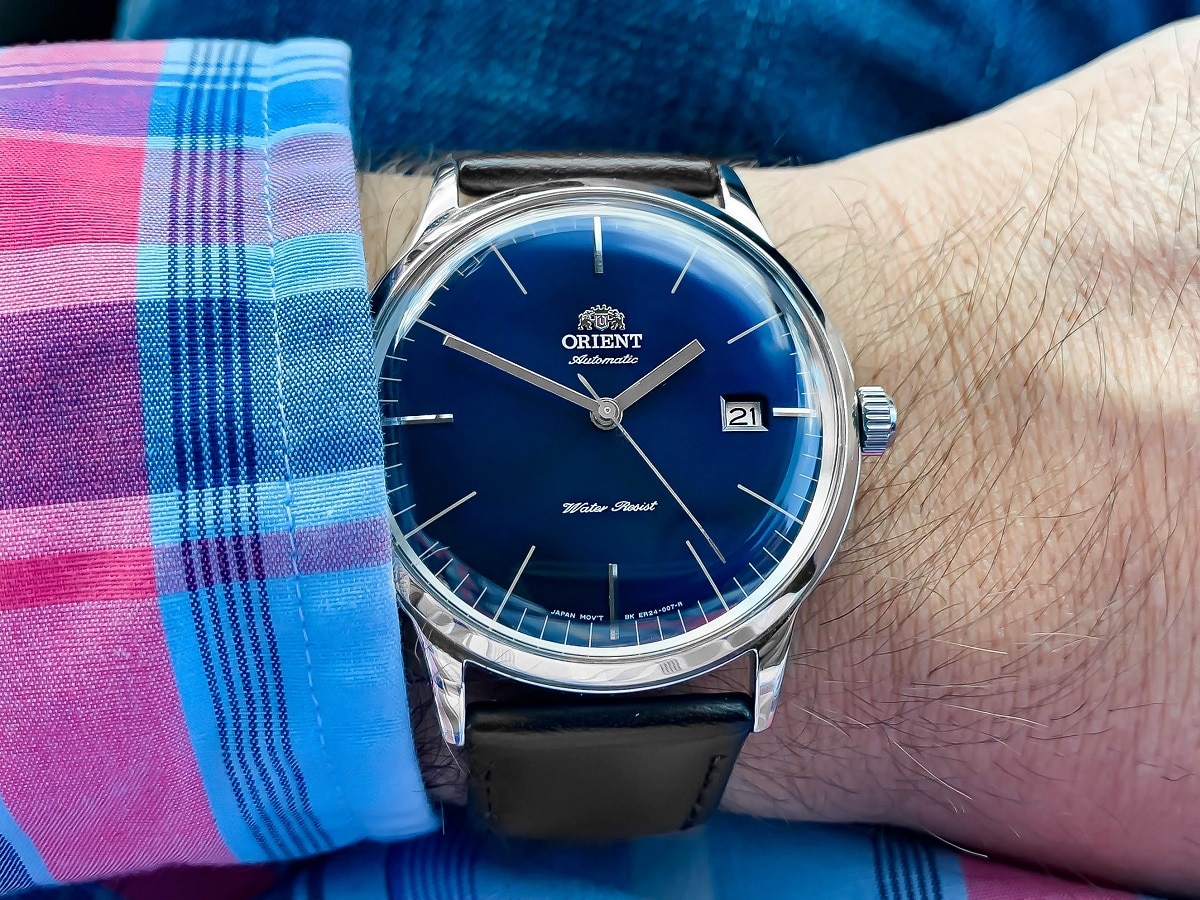
Many new collectors eventually realize they need something that works just as comfortably with a blazer as with a polo. The Orient Bambino remains one of the safest ways to figure that out without overspending. It delivers the feel of a traditional mechanical dress watch, making it easy to see whether this style deserves a permanent place in your collection rather than becoming a watch you wear only once a year. That alone makes it a purchase you’re less likely to regret as your collection grows.
The in-house F6724 automatic movement enhances that experience with hacking and hand-winding, letting new collectors enjoy the little rituals of owning a mechanical watch. There are a few compromises, though. The rotor is louder than we’d like, the power reserve falls short of 30 hours, and the small crown isn’t the easiest to wind. On the wrist, however, the 40.5mm case feels friendlier than the specifications imply. The short lug-to-lug distance and downward-sloping lugs help it sit comfortably, while the slim profile slips under a shirt cuff without much effort.
The dial is what keeps drawing us back. It has a richness and depth that punches above its price, giving the watch a more refined look than many affordable dress pieces. Its slightly sharper design language also avoids feeling too vintage. The domed mineral crystal adds plenty of character but also introduces noticeable glare, and the polished hands and markers can disappear into the dial in certain lighting conditions. With no lume, nighttime legibility isn’t its strength, while the stock leather strap serves as a reminder that this is still an affordable watch.
Even then, it’s comfortable enough for daily wear and offers a strong introduction to mechanical dress watches without demanding a luxury-sized budget. Our hands-on review goes into that in more depth.
Pros
- Dial finishing has a depth and refinement that’s uncommon at this price.
- In-house automatic movement offers both hacking and hand-winding.
- The 40.5mm case wears smaller thanks to its short lug-to-lug and sloping lugs.
Cons
- Rotor noise is easy to notice during everyday wear.
- The power reserve is under 30 hours.
- Domed mineral crystal produces visible glare, while the polished hands and markers can blend into the dial.
- The lack of lume limits low-light legibility.
Seiko Tank SUP880 / SUP250
| Price Range: | $180 – $200 |
| Water Resistance: | 30m |
| Case Dimensions: | SUP880: 38.4mm (length) x 28mm (width) x 6.3mm (thickness) SUP250: 31mm (length) x 24.4mm (width) x 6.1mm (thickness) |
| Lug Width: | SUP880: 23mm SUP250: 14mm |
| Movement: | V115 solar quartz |
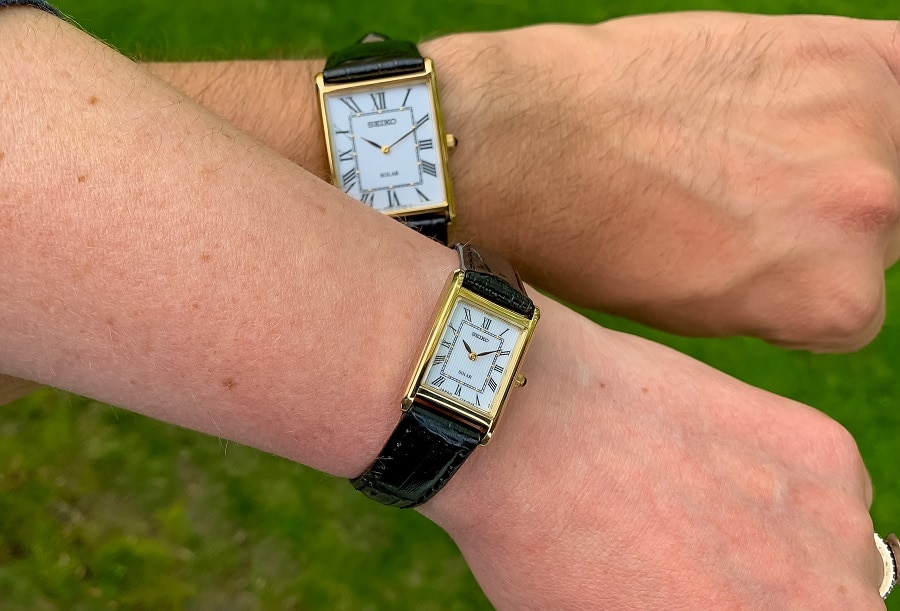
Many new collectors are curious about rectangular dress watches but hesitate because vintage options can be expensive to maintain and luxury alternatives can quickly become expensive. The Seiko Tank SUP880 and SUP250 remove much of that hesitation. They deliver the classic dress-watch aesthetic without adding much ownership hassle, making them easy watches to live with while you figure out whether this style belongs in your long-term collection. The larger SUP880 has a bit more wrist presence thanks to its straight lugs, while the SUP250 feels especially well proportioned for smaller wrists and anyone after a more understated look.
The biggest advantage is the V115 solar quartz movement. Hidden beneath the dial, the solar cell keeps the watch running for up to six months on only a few minutes of direct sunlight, so routine battery changes rarely come up. It isn’t flawless, though. The watch ticks audibly as each minute passes, and without a second hand, setting the time precisely isn’t really feasible. Comfort is another highlight. Both watches are thin and lightweight, and they sit naturally against the wrist thanks to their flat casebacks, while the soft calfskin strap feels broken in almost immediately.
As covered in our in-depth review, Seiko also gives the dial more personality than its clean layout first indicates. Fine vertical pinstriping, crisp Roman numerals, and leaf-shaped hands add texture without making the watch feel busy. The black tip on the crown is a nice visual detail, even if it isn’t actually blue. There are a few trade-offs to consider: the raised gold hour markers can look a little flashy in brighter light, the gold plating may show wear, and the unusual 23mm and 14mm lug widths make replacing the strap more frustrating than it should be. Nonetheless, they’re thoughtful entry points into dress watches that won’t leave most new collectors second-guessing the purchase.
Pros
- Solar quartz movement minimizes maintenance and avoids frequent battery changes.
- The thin, lightweight case wears comfortably on a wide range of wrist sizes.
- Pinstriped dial, Roman numerals, and leaf hands create a refined look without feeling busy.
- Soft calfskin strap is comfortable straight out of the box.
Cons
- Unusual lug widths limit strap replacement options.
- No second hand means precise time-setting isn’t possible.
- Raised gold markers can appear flashy in some lighting, and the gold plating may show wear with time.
Timex Expedition Field Post Solar
| Price: | $199 |
| Water Resistance: | 100m |
| Case Dimensions: | 36mm (diameter) x 44mm (lug-to-lug) x 12mm (thickness) |
| Lug Width: | 18mm |
| Movement: | Solar Quartz |
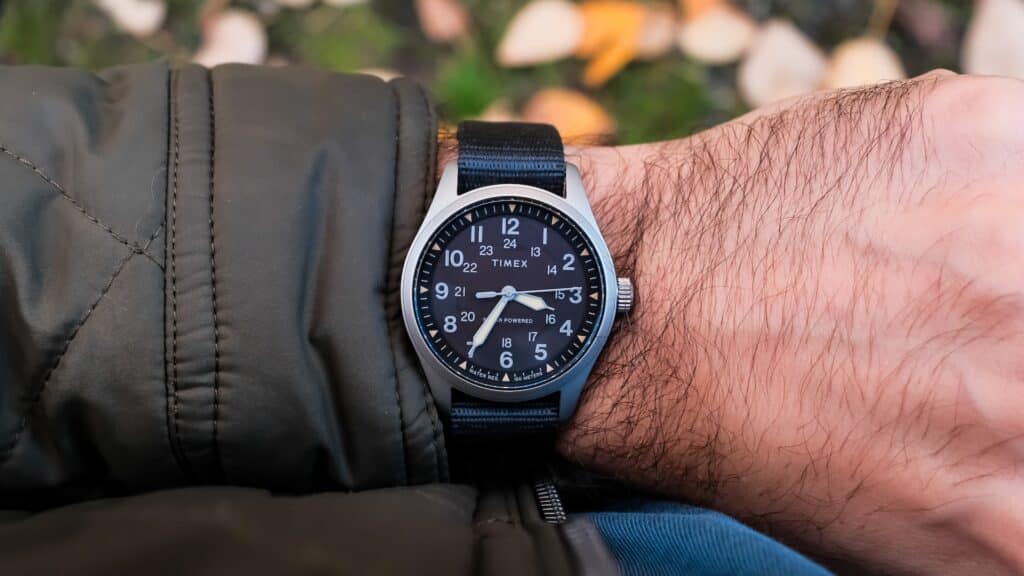
One of the easiest ways for a new collector to avoid regret is to buy a watch that fits seamlessly into everyday life instead of waiting for the “right occasion.” The Timex Expedition Field Post Solar does exactly that. Its compact 36mm case sits low and comfortably on the wrist. That makes it easy to forget you’re wearing it through commutes, errands, and long days. We also appreciated the bead-blasted finish during our hands-on testing, as it hides the inevitable scratches and scuffs far better than polished steel. That means you’re more likely to wear it without worrying about keeping it pristine.
The solar quartz movement reinforces that carefree ownership. Once fully charged, Timex rates it for around four months of runtime, and throughout our testing, accuracy stayed consistent enough that adjusting the time became a rare task. The screw-down crown adds confidence for everyday use, although its threading feels more utilitarian than refined. Up front, the familiar full-numeral field dial remains highly legible, while the slightly domed sapphire crystal gives the watch a touch of warmth without sacrificing clarity. Better still, the anti-reflective coating noticeably cuts glare outdoors, and sapphire scratch resistance is a welcome bonus at this price.
The biggest compromise is the lume. Even after a full charge, the hands don’t stay bright for very long, and the dial itself receives only minimal illumination. We also found the supplied leather strap comfortable from the start, but a little too thick for such a compact case. Swapping it onto a simple MIL-style strap made the whole package feel more balanced and better suited to its field-watch character. For new collectors, though, those are relatively small compromises on a watch that’s easy to wear, easy to maintain, and unlikely to spend much time sitting in the watch box.
Pros
- The domed sapphire crystal with anti-reflective coating improves durability and reduces outdoor glare.
- Solar quartz movement delivers months of dependable, low-maintenance operation.
- The compact 36mm case wears comfortably throughout the day.
- The clean full-numeral dial is quick to read at a glance.
- Bead-blasted finish hides everyday scratches and reinforces the tool-watch aesthetic.
Cons
- The leather strap feels thicker than the compact case really needs.
- Lume fades quickly, with limited illumination from both the hands and dial.
- The screw-down crown lacks a particularly refined feel.
Citizen Promaster Diver BN0151
| Price: | $250 – $300 |
| Water Resistance: | 200m |
| Case Dimensions: | 43mm (diameter) x 48mm (lug-to-lug) x 11.5mm (thickness) |
| Lug Width: | 20mm |
| Movement: | Citizen Eco-Drive E168 (solar quartz) |
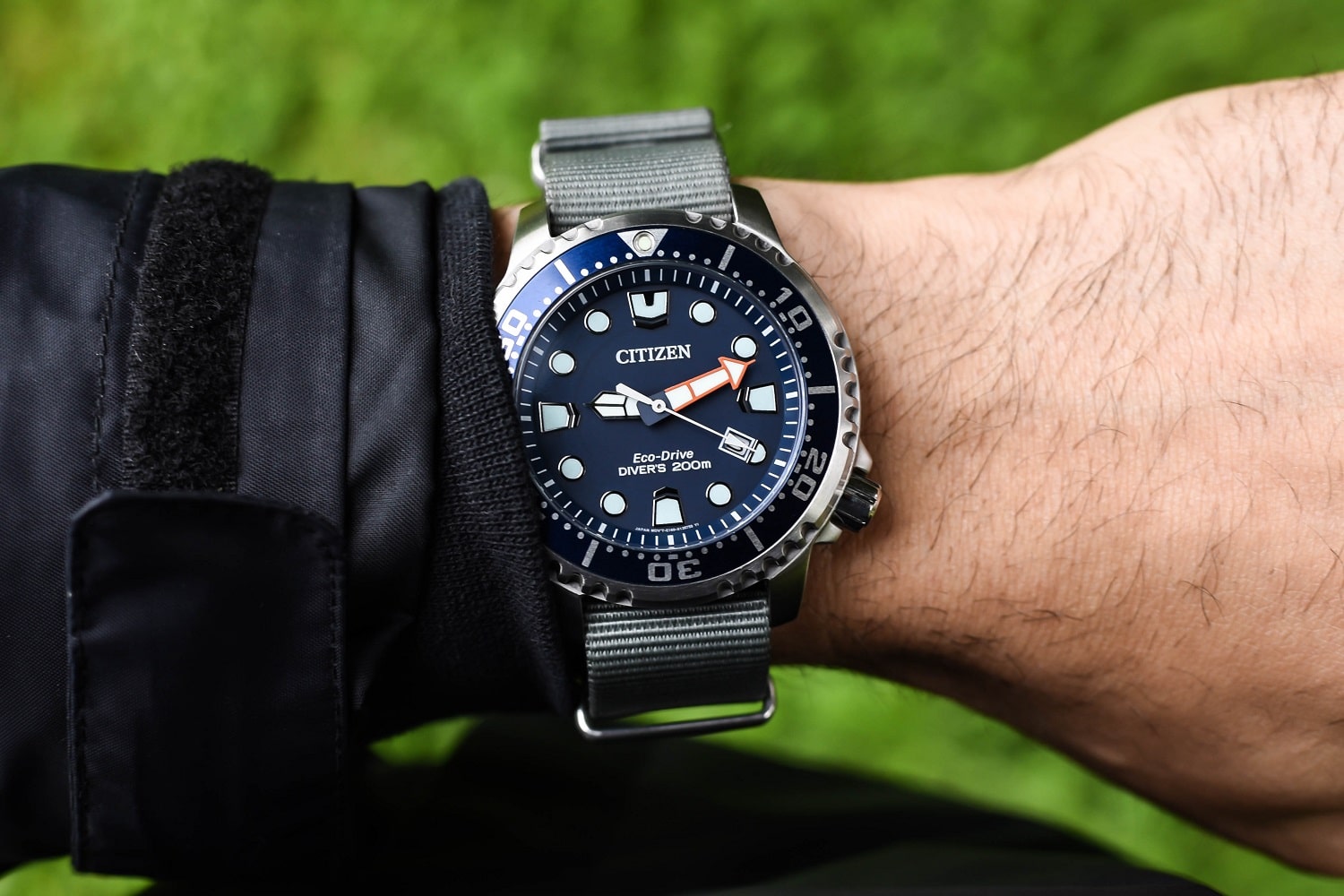
Every collection benefits from having one watch you never hesitate to wear. For many new collectors, the Citizen Promaster Diver BN0151 naturally fills that role. It isn’t precious, it doesn’t demand much attention, and during our time with it, it handled everything from hikes to everyday errands and time around the water without ever feeling out of place. The 43mm case looks like it should wear much larger than it does, but the lightweight construction and curved profile keep it quite manageable. Once it was on the wrist, we stopped thinking about the size and started treating it like the watch we’d grab whenever we didn’t feel like babying one.
The Eco-Drive movement is a big part of why it’s so easy to live with. Regular light keeps it running, so there’s no winding routine or battery-change calendar hanging over your head. In our in-depth testing, it remained within ±15 seconds per month and delivered nearly 6 months of runtime from a full charge. That’s the sort of ownership experience we like recommending to new collectors. You spend more time wearing the watch than thinking about keeping it running.
The rest of the package follows the same philosophy. The blue dial picks up subtle purple tones in certain light without hurting legibility, while the bold hands, markers, and aqua BGW9-style lume remain easy to read long after sunset. We also appreciated the lumed seconds hand—a small diver detail that quickly becomes something you miss on watches that don’t have it.
The 60-click bezel stayed well aligned throughout our review, though it became a bit slippery when wet. The mineral crystal offers some scratch resistance compared to sapphire, and the stock polyurethane strap starts stiffer than we’d like, but a NATO strap transformed the wearing experience almost immediately. They’re the sort of compromises you notice during a review but rarely think about once the watch becomes part of your regular rotation.
Pros
- The lightweight case wears far better than the 43mm dimensions suggest.
- Eco-Drive movement delivers roughly six months of runtime with minimal upkeep.
- Strong legibility thanks to bold hands, generous lume, and a lumed second hand.
- 200m water resistance, along with a screw-down crown, makes it easy to wear without worry.
Cons
- The stock polyurethane strap feels stiff until it’s broken in.
- The bezel grip gets a little slippery when wet.
- The mineral crystal isn’t as scratch-resistant as sapphire.
Orient Kamasu
| Price: | $250 – $375 |
| Water Resistance: | 200m |
| Case Dimensions: | 41.5mm (diameter) x 47mm (lug-to-lug) x 13mm (thickness) |
| Lug Width: | 22mm |
| Movement: | Orient F6922 (automatic movement) |
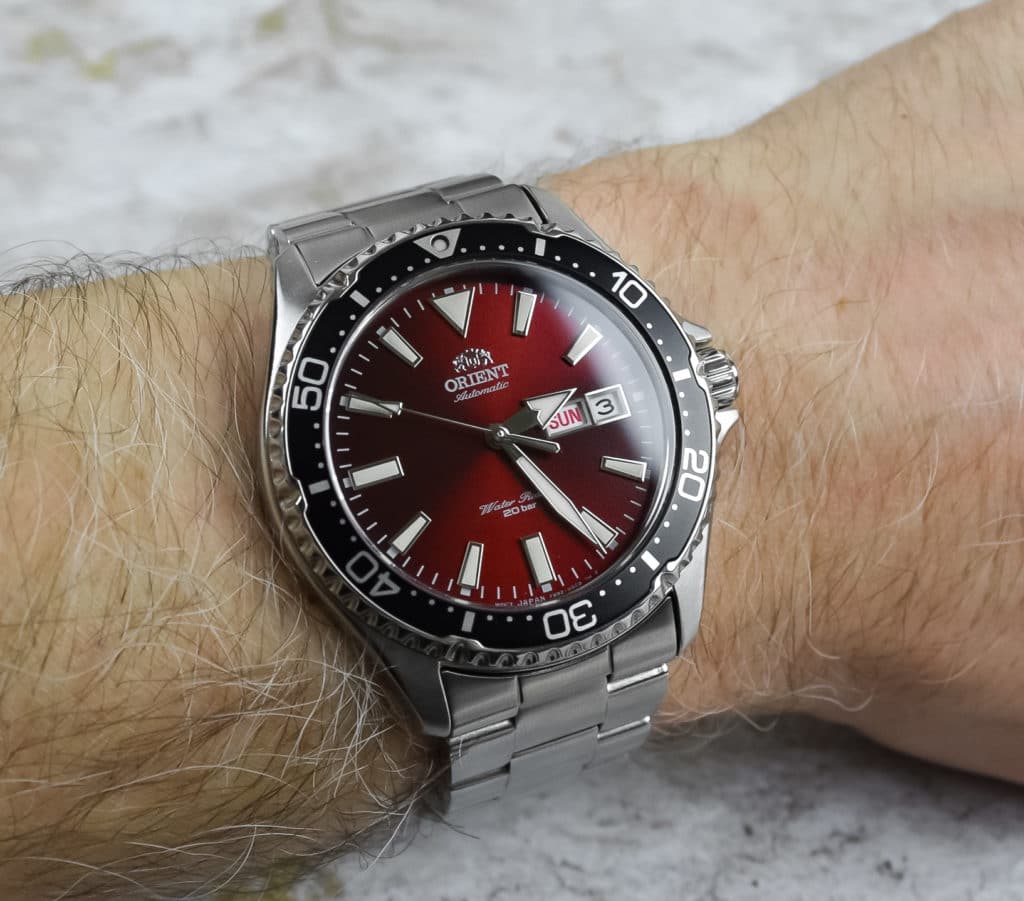
The Orient Kamasu is the kind of watch many collectors wish they’d bought first. Instead of chasing trendy features, it focuses on improving the little things that become more important the longer you own a watch. For someone building a first collection, that’s a big reason it’s easy to recommend. You get a diver that feels complete from the outset, rather than one that immediately has you thinking about the next upgrade. The 41.5mm case, curved lugs, and sensible 13mm thickness strike a comfortable balance on the wrist, avoiding the top-heavy feel that can plague affordable dive watches.
The dial is where the Kamasu begins to separate itself from many rivals. The wine-red sunburst finish adds real character without compromising readability, while the applied markers and properly proportioned hands make quick time checks feel effortless. We also appreciated that the minute and second hands actually reach their respective tracks—a small detail that many watches miss. The framed day-date window and restrained branding keep the layout clean, and the lume charged quickly, stayed bright, and comfortably held its own against several Seiko divers we’ve tested. Underneath the dial, the F6922 movement brings hacking and hand-winding, making the jump into mechanical watches feel approachable rather than intimidating.
According to our review team, the rest of the watch carries that sense of thoughtful ownership. Sapphire crystal and 200m water resistance are upgrades many collectors eventually want, so it’s nice to have them from the beginning instead of wishing you’d stretched your budget. The fully brushed bracelet also wears comfortably thanks to four micro-adjustment positions, although the clasp and end links don’t quite match the case’s quality. The guarded crown can be fiddly to grip, and the aluminum bezel insert will pick up scratches sooner than a ceramic one, even though the bezel action itself remained tight during our review.
That said, none of those shortcomings distract from what the Kamasu gets right. It’s a watch that helps new collectors settle into the hobby rather than immediately wondering what to buy next.
Pros
- Sapphire crystal, along with 200m water resistance, makes it reliable for everyday wear.
- Bright, long-lasting lume outperforms many affordable competitors.
- The F6922 movement, with hacking and hand-winding, is a great introduction to mechanical watch ownership.
- Comfortable proportions and a bracelet with four micro-adjustment positions wear quite well.
- Wine-red sunburst dial adds personality while remaining highly legible.
Cons
- Clasp and end links feel less refined than the rest of the watch.
- The guarded crown isn’t the easiest to grip.
- The aluminum bezel insert will show wear sooner than a ceramic or steel bezel insert.
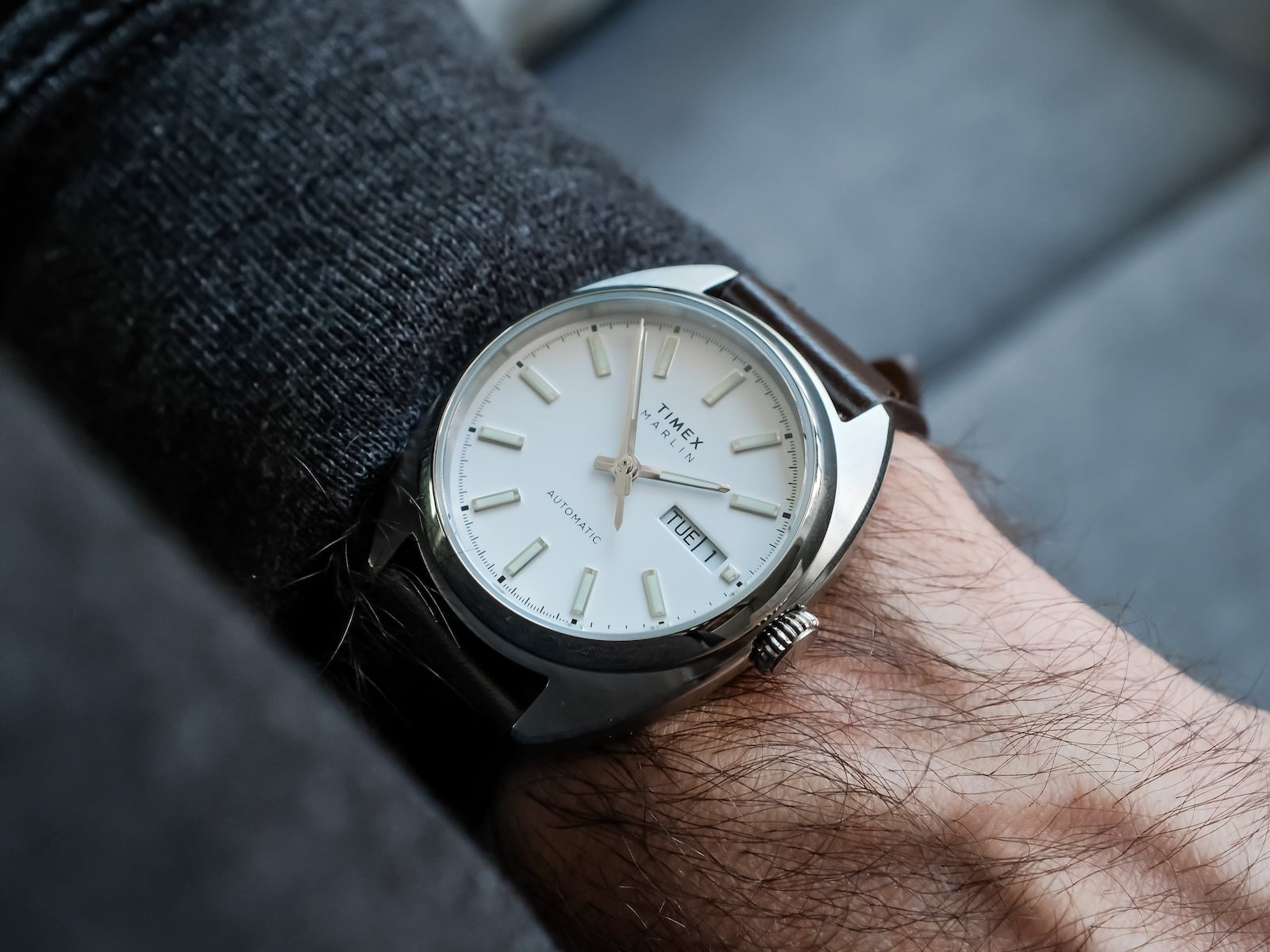
Timex Marlin Draper Automatic
| Price: | $279 |
| Water Resistance: | 50m |
| Case Dimensions: | 37mm (diameter) x 43.5mm (lug-to-lug) x 12.5mm (thickness) |
| Lug Width: | 18mm |
| Movement: | Miyota 8-series automatic |
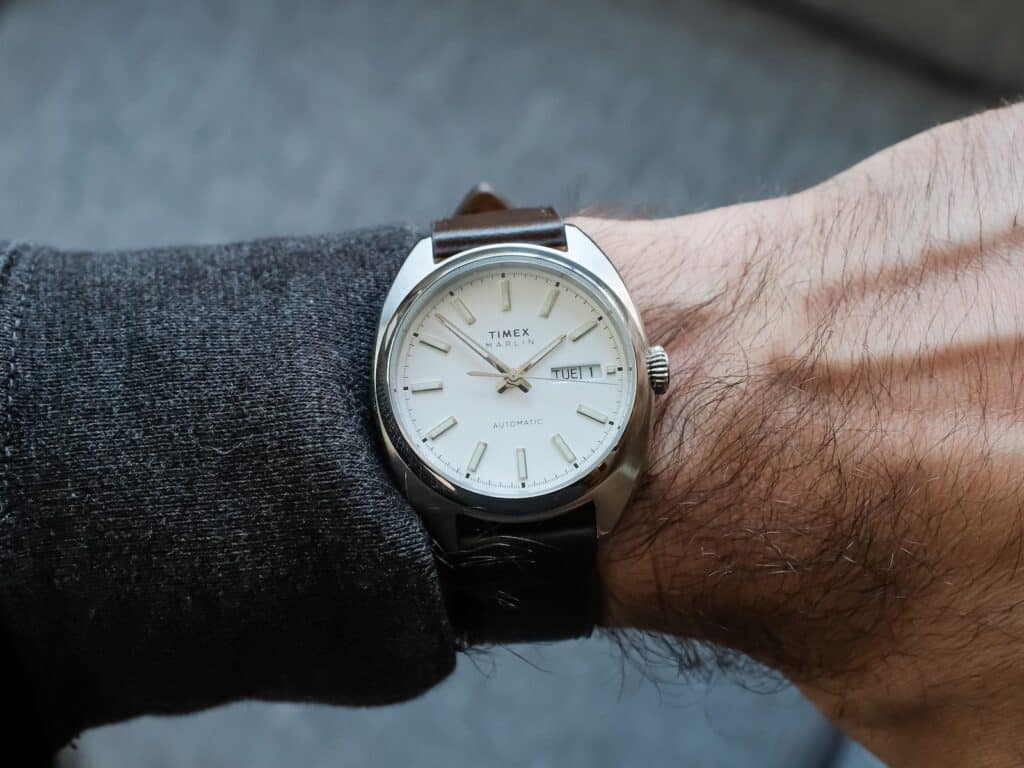
Vintage-inspired watches can be a gamble for new collectors. Some feel more like costumes than everyday watches, and that novelty tends to wear off quickly. The Timex Marlin Draper Automatic avoids that trap. Its 37mm cushion-shaped case borrows plenty from mid-century design without feeling like it’s trying too hard. The compact 43.5mm lug-to-lug keeps it comfortable across a range of wrist sizes, while the barrel-shaped case gives it a little more presence than a similarly sized round watch. After spending significant time testing it, the design felt genuinely timeless rather than dependent on nostalgia. The more time we spent with it, the less the Don Draper association mattered. The watch proved strong enough to establish its own identity instead of borrowing one from television.
That balance carries through the rest of the watch. A polished bezel and slim chamfer break up the brushed case, adding enough contrast without becoming flashy. We were also pleasantly surprised by the stock leather strap. Its thinner, tapered profile lets the 12.5mm case sit closer to the wrist than expected, and even after trying a few quick-release strap swaps, we kept coming back to the original because it simply suited the watch best. The silver dial follows the same restrained approach, with applied markers, a neatly integrated day-date display, and subtle tonal variation that adds depth while maintaining high legibility. Even the modest lume feels appropriate instead of overdone.
Behind the exhibition caseback, the Miyota 8-series automatic proved quietly dependable. Timekeeping remained consistent, the roughly 40-hour power reserve fit naturally into a weekend rotation, and the rotor stayed unobtrusive rather than constantly reminding us it was there. The mineral crystal is the biggest compromise and makes you wish Timex had gone with sapphire, while the 50m water resistance limits how versatile the watch can be outside everyday wear. However, those trade-offs never overshadow what makes the Marlin Draper appealing: it’s a watch that grows on you because of its thoughtful proportions and understated design, not because it’s trying to recreate someone else’s idea of the past.
Pros
- Miyota automatic movement runs consistently with a quiet, unobtrusive rotor.
- The thin, tapered leather strap makes the watch wear comfortably despite its thickness.
- The 37mm cushion case captures vintage proportions without feeling dated.
- The clean silver dial balances legibility with subtle visual texture.
- Brushed and polished case finishing adds character without looking busy.
Cons
- The mineral crystal feels like the biggest omission at this price.
- 50m water resistance limits its versatility beyond everyday wear.
Casio Oceanus T200
| Price: | $300 – $500 |
| Water Resistance: | 100m |
| Case Dimensions: | 41.4mm (diameter) x 49mm (lug-to-lug) x 10.7mm (thickness) |
| Lug Width: | 20mm |
| Movement: | Tough Solar movement (Module 5596) |
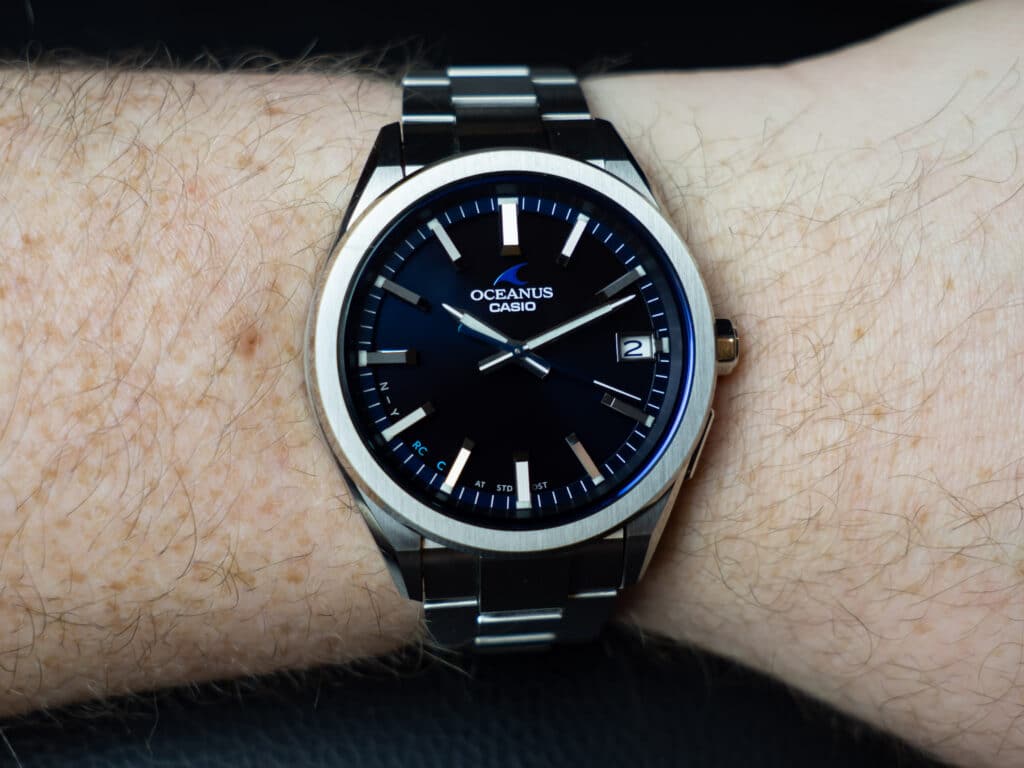
Not every new collector needs to start with a mechanical dress watch. In fact, plenty of people discover they enjoy wearing a watch far more than they enjoy winding it or resetting the time after it sits for a few days. That’s where the Oceanus T200 makes a convincing case for itself. It looks polished enough to cover office days, dinners, and formal occasions, but the ownership experience is quite uncomplicated. If you’re still discovering what kind of collector you’ll become, there’s something reassuring about a watch that quietly handles the practical side for you.
That ease starts with Casio’s Tough Solar 5596 module. Throughout our review, normal daylight kept it fully charged, while Bluetooth syncing via the Oceanus app updated the time automatically with no connection drama. Once it was set up, we rarely thought about it again, and that’s exactly the point. The case finishing also punches above its price, mixing brushed and polished surfaces without looking too flashy. The deep blue dial has more depth than photos show, thanks to the floating hour markers made through cutouts in the chapter ring. The blue-tinted sapphire crystal gives it a subtle glow outdoors, adding character without distracting from legibility. Lume is present, although it isn’t particularly memorable after dark.
The bracelet does remind you that this isn’t a luxury watch. It rattles a little when it’s off the wrist, and sizing the pin-and-collar links takes more patience than we’d like. The connectivity text on the dial won’t appeal to everyone either. Still, none of those details changed how much we enjoyed wearing it. If anything, the T200 teaches new collectors an important lesson early: sometimes the watch you wear the most isn’t the one with the most romantic movement; it’s the one that fits effortlessly into your life.
Pros
- Tough Solar movement and Bluetooth syncing make ownership almost effortless.
- Blue-tinted sapphire crystal and floating hour markers add genuine depth to the dial.
- Strong balance of finishing, technology, and everyday versatility.
- Clean, refined case design feels dressy without becoming flashy.
- Accurate timekeeping happens quietly in the background.
Cons
- The bracelet rattles when it’s off the wrist.
- Pin-and-collar sizing is more fiddly than it should be.
- Lume is just modest in the dark.
Seiko SRPE51
| Price: | $315 |
| Water Resistance: | 100m |
| Case Dimensions: | 40mm (diameter) x 44mm (lug-to-lug) x 12mm (thickness) |
| Lug Width: | 20mm |
| Movement: | Seiko 4R36 |
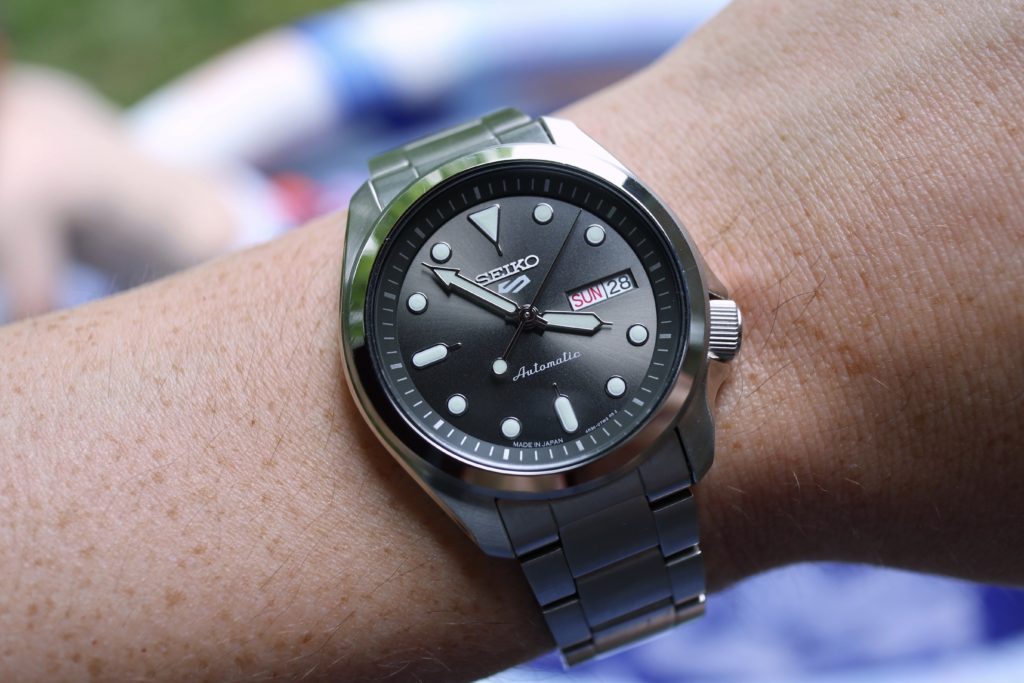
It’s easy to underestimate the SRPE51 because it doesn’t fit neatly into one category. It isn’t a dedicated dive watch, and it isn’t trying to be a dress watch either. However, that turns out to be one of its biggest strengths, especially for someone who’s still figuring out what they enjoy wearing. The familiar SKX-inspired case has been cleaned up with a polished fixed bezel, giving it a more versatile personality that rarely feels out of place. At 40mm, it wears comfortably on a wide range of wrists, and while testing it hands-on, it was the sort of watch that quietly worked with almost everything rather than forcing us to dress around it.
That versatility carries through to the ownership experience. The 4R36 automatic movement includes hacking and hand-winding, making the transition into mechanical watches feel approachable, while the exhibition caseback offers an enjoyable glimpse of the movement at work. We weren’t especially attached to the bracelet, though. The hollow end links leave it feeling a little rattly compared to the case, but the drilled 20mm lugs make strap swaps so easy that we found ourselves experimenting with leather, NATO, and other options throughout our review. Each one gave the watch a different personality, which is the kind of flexibility many new collectors appreciate.
The radiant grey dial is another reason the SRPE51 stays interesting over time. It catches the light in subtle ways without becoming flashy, while the applied indices, clean Seiko 5 branding, updated handset, and generous LumiBrite make it easy to live with day and night. We did notice a slight chapter ring mismatch on our review piece, although it’s the sort of thing you’ll only spot if you’re deliberately looking for it.
The flat Hardlex crystal won’t resist scratches like sapphire, and the 100m water resistance and push-pull crown mean it isn’t pretending to be a hard-use diver. Those are fair compromises for a watch that’s more interested in versatility than specialization. The SRPE51 won’t tell you what kind of collector to become, and that’s why it’s such a smart place to start. It leaves enough doors open that your next purchase feels like a choice rather than a correction.
Pros
- Drilled 20mm lugs make strap changes quick and encourage experimentation.
- The 4R36 movement includes hacking and hand-winding.
- The radiant grey dial adds subtle depth while remaining highly legible.
- LumiBrite delivers excellent nighttime visibility.
Cons
- The bracelet feels light and slightly rattly because of the hollow end links.
- 100m water resistance and a push-pull crown limit its sporting ambitions.
- Hardlex crystal is more susceptible to scratches than sapphire.
- Minor chapter ring misalignment may be visible on close inspection.
Seiko 5 GMT

| Price: | $475 |
| Water Resistance: | 100m |
| Case Dimensions: | 42.5mm (diameter) x 46mm (lug-to-lug) x 13.6mm (thickness) |
| Lug Width: | 22mm |
| Movement: | Seiko 4R34 (Mechanical Movement) |
A GMT can feel like an unnecessary complication when you’re still figuring out what you enjoy wearing. The Seiko 5 GMT avoids that by making the extra hand truly useful without making the watch itself feel complicated. Whether you’re tracking family overseas, keeping an eye on another time zone, or simply enjoying the added functionality, the fourth hand quickly becomes something you use rather than something that’s just there for its own sake. More importantly, it still feels like a well-rounded everyday watch instead of a GMT built around a single feature.
The familiar SKX-inspired case is a big reason why. Although the dimensions sound substantial at 42.5mm wide and 13.6mm thick, the rounded lugs and 46mm lug-to-lug help it wear more comfortably. It still has the broad-shouldered stance you’d expect from a Seiko sports watch, with the asymmetrical crown guards and recessed crown reinforcing that familiar look, but it never comes across as a flat chunk of steel on the wrist. The brushed and polished finishing adds enough contrast without feeling overdone, while the orange sunray dial brings more depth than product photos usually capture.
We also liked how the black marker surrounds, gilt hands, and glossy black GMT hand worked together to keep the dial easy to read, with LumiBrite remaining dependable after dark. The rotating 24-hour bezel also lets you track a third time zone, although its smooth, click-free action won’t satisfy anyone expecting a traditional tool-watch bezel. The cyclops over the date is another detail that’s likely to divide opinion.
Underneath, the 4R34 caller GMT movement keeps things approachable. It won’t let you independently jump the local hour hand like a flyer GMT watch, but for most first-time owners, that’s rarely a dealbreaker. The familiar 40-hour power reserve, hacking, and hand-winding make it easy to live with, while the push-pull crown and 100m water resistance are reasonable compromises, even if we’d still prefer the screw-down crown and extra confidence of the old SKX formula.
The jubilee-style bracelet is equally familiar: light, comfortable (with a taper from 22mm down to 20mm), and a little jangly, with polished center links, a stamped clasp, and probably Casio’s least favorite feature—pin-and-collar sizing. Fortunately, it also looks completely at home in NATO. In short, the Seiko 5 GMT won’t teach you everything about GMT watches. Still, it will help you decide whether the complication belongs in your collection before regretting spending significantly more on one. Read our dedicated full review for the smaller on-wrist details.
Pros
- The 4R34 GMT movement makes tracking another time zone simple and approachable.
- The rotating 24-hour bezel lets you track a third time zone.
- Orange sunray dial adds depth while remaining highly legible.
- The familiar SKX-inspired case wears smaller than the dimensions suggest.
- The Jubilee-style bracelet stays comfortable through long days.
- LumiBrite, well-proportioned hands, and black marker surrounds make the dial easy to read.
Cons
- Smooth bidirectional bezel lacks the tactile feel of a clicking bezel.
- The stamped clasp feels basic.
- Pin-and-collar bracelet sizing requires patience.
- Cyclops date magnifier won’t appeal to everyone.
Vaer C4 Tactical Field Solar
| Price: | $479 |
| Water Resistance: | 200m |
| Case Dimensions: | 41.5mm (diameter) x 48mm (lug-to-lug) x 12.8mm (thickness) |
| Lug Width: | 20mm |
| Movement: | Epson VS-42 solar |
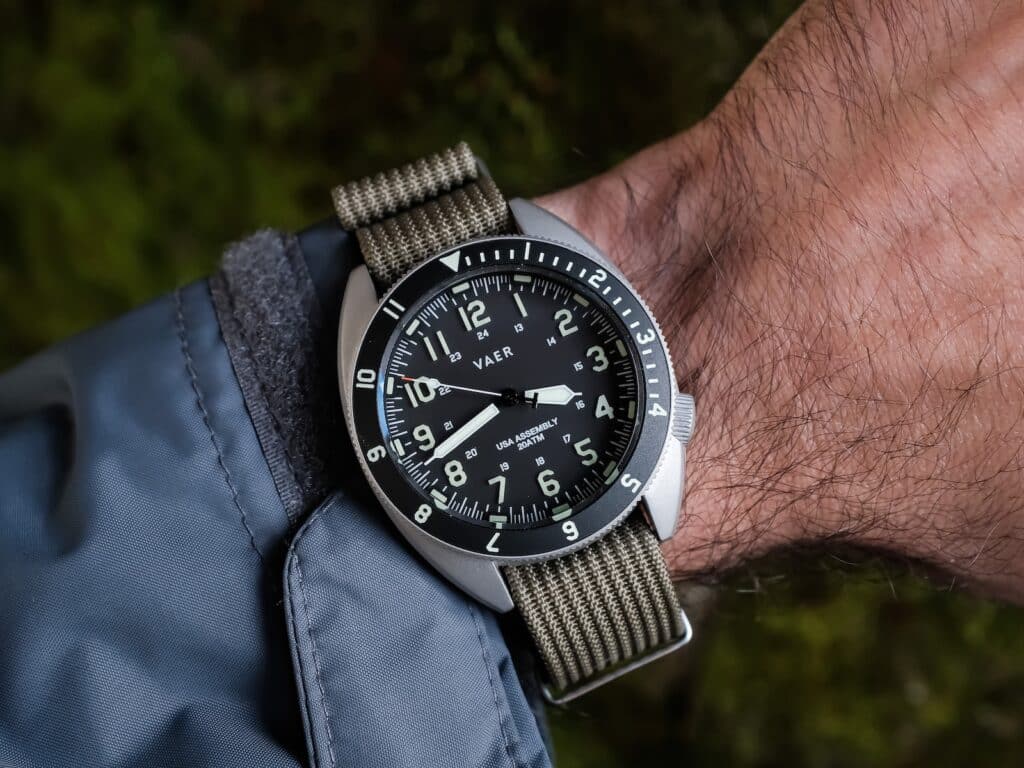
A lot of new collectors end up buying multiple field watches before realizing they only needed one versatile one. The Vaer C4 Tactical Field Solar makes a strong case for skipping that detour. It keeps everything people like about the field-watch formula: clear legibility, straightforward design, and all-day comfort—but layers in enough capability that it rarely feels limited. We found ourselves wearing it for hikes, rainy weekends, and everyday office wear without ever feeling like we had chosen the “wrong” watch. That’s truly a harder balance to strike than it sounds.
Much of that confidence comes from the hardware. The Epson VS-42 solar movement quietly does its job, storing around six months of power from roughly six hours of light, so it slips in and out of a collection without demanding attention. The 200m water resistance, along with the screw-down caseback and crown, makes it feel more substantial than most field watches, while the 120-click bezel with a coin-edge grip adds real utility instead of decoration. We ended up using it just as often for timing short tasks as casually tracking a second time zone. Even the crown stood out during our testing period, threading smoothly without the gritty feeling that often gives away cheaper tool watch vibes.
The rest of the watch feels built around the same idea. Despite its 41.5mm diameter, the restrained mid-case and compact lug-to-lug kept it sitting flatter than expected on the wrist. The bead-blasted finish hides everyday wear well, while the matte dial, oversized numerals, syringe hands, smaller 24-hour track, raised lume blocks, rectangular minute markers, and beveled sapphire crystal all contribute to outstanding legibility without making the watch feel overdesigned. The black waffle-pattern FKM strap quickly became our favorite pairing, although it also looked right at home on an admiralty grey CWC-style strap.
The second hand missed a few markers on our review piece, and collectors who prefer traditional 36-38mm military watches may find the case a little larger than expected. Even then, the C4 avoids one of the most common early regrets in collecting: buying a watch that only works in one situation. It covers enough ground that you can focus on experiencing it.
Pros
- 200m water resistance and a screw-down crown make it far more capable than a typical field watch.
- Solar movement is virtually maintenance-free and easy to keep in rotation.
- Raised lume markers provide excellent nighttime visibility.
- Case wears flatter than the dimensions indicate.
- The comfortable FKM strap and a versatile bezel add genuine everyday usability.
Cons
- The larger case won’t suit collectors who prefer vintage-sized field watches.
- The second-hand alignment isn’t perfect.
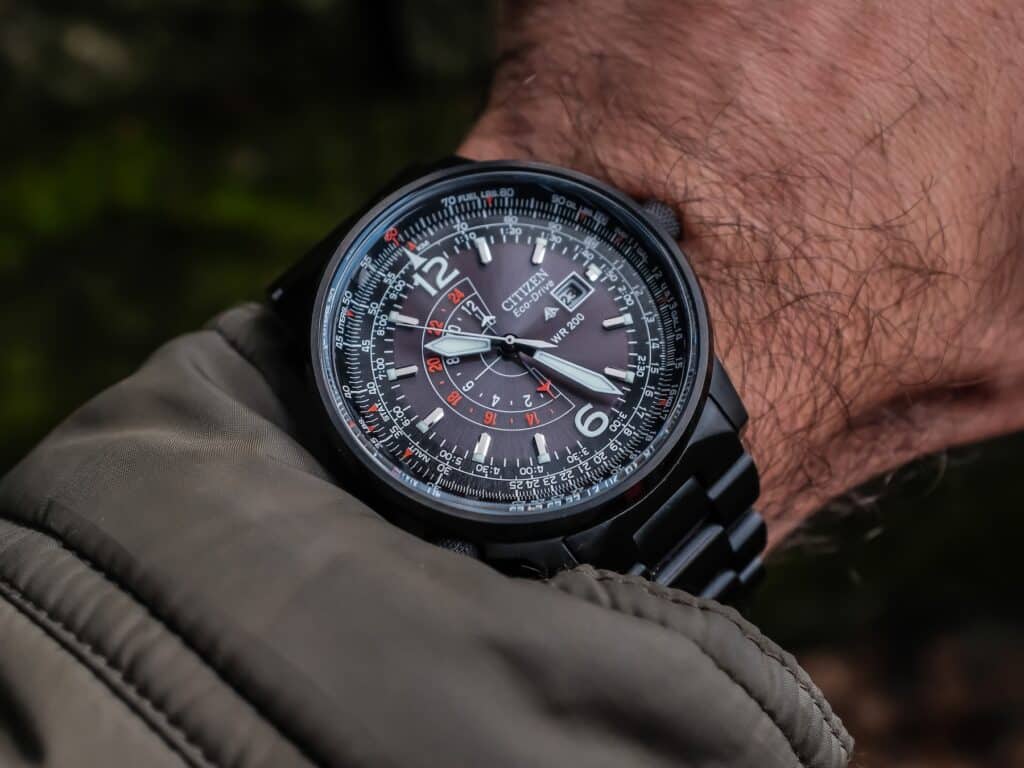
Citizen Nighthawk
| Price: | $500 |
| Water Resistance: | 200m |
| Case Size: | 42.5mm (diameter) x 47mm (lug-to-lug) x 12.6mm (thickness) |
| Lug Width: | 22mm |
| Movement: | Citizen B877 Eco-Drive caliber (solar-powered quartz) |
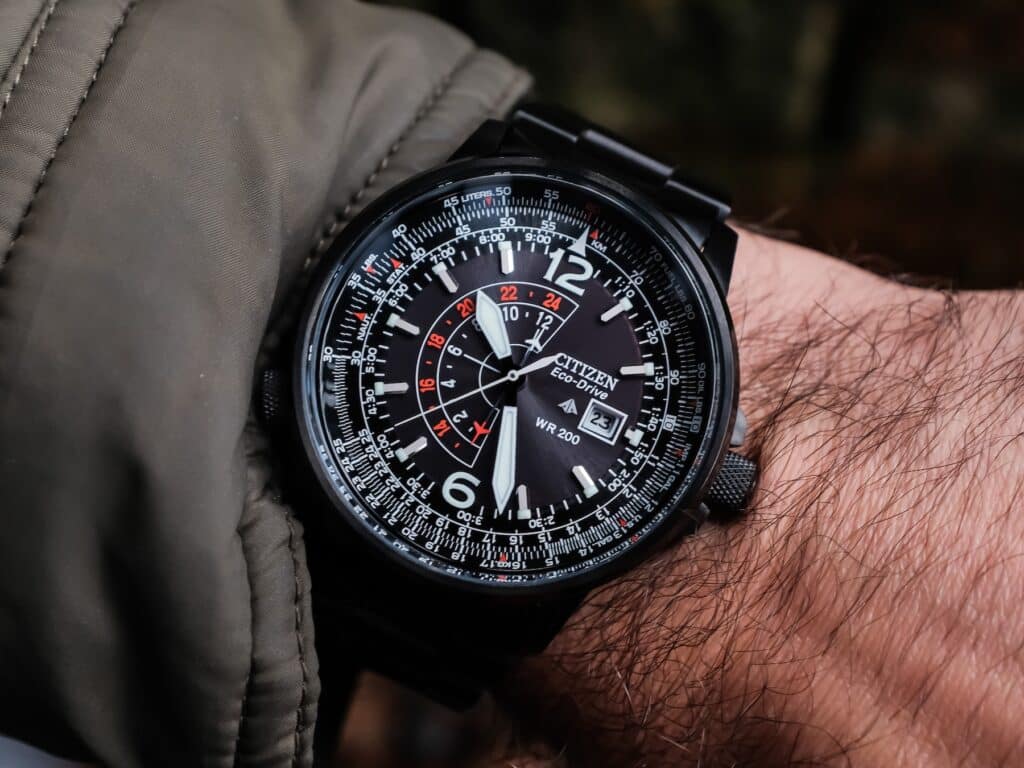
The Citizen Nighthawk makes the strongest case for itself when you stop thinking of it as just another pilot’s watch. For a new collector, it’s a chance to experience several useful complications without stepping into the cost or maintenance of a mechanical GMT. If you’re curious about features beyond a simple three-hander but aren’t sure which ones you’ll genuinely use, the Nighthawk lets you find out without feeling like an expensive experiment. That’s a purchase that’s much easier to live with than one driven purely by aesthetics.
The Eco-Drive B877 movement is a big part of that appeal. It combines solar charging, a second time zone, a jumping local-hour function, and a date display into a package that stayed within roughly ±15 seconds per month while reviewing it. A full charge delivers around six months of runtime, so leaving it in the watch box for a while isn’t a problem. The setting action also deserves mention: it has very little hand play despite offering more functionality than most everyday watches. On the dial, Citizen does a good job managing the busy layout. The internal E6B slide rule stays tucked into the background until you need it, while the bold hands and raised applied markers keep everyday time checks straightforward. We also liked the small red-and-white airplane details on the GMT hand, although the main hands can occasionally obscure the secondary time zone scale, making it a little slower to read than a conventional GMT bezel.
The black ion-plated case gives the watch a more industrial personality than the standard version, and while the 42.5mm case carries noticeable weight, it also feels solid. The screw-down crown, engraved caseback, and 200m water resistance reinforce that impression, making it a watch you won’t hesitate to take on trips or wear every day. The matching bracelet with a push-button deployant clasp feels secure, avoids the loose rattle found on many watches at this price, and offers useful micro-adjustment. However, we found the watch even more comfortable on rubber or nylon during longer stretches.
Citizen’s blue lume remained easy to read after a quick charge, while the mineral crystal, despite its internal anti-reflective coating, still feels like the biggest compromise compared to sapphire. The black ion plating can also reveal steel underneath after deeper scratches. Still, the Nighthawk answers an important question early in a collector’s journey: which complications will you actually use? Finding that out on a dependable, solar-powered watch is far easier to justify than discovering it after spending considerably more.
Pros
- Eco-Drive movement combines solar power, dual-time functionality, and minimal maintenance.
- Around six months of runtime and excellent quartz accuracy make it easy to rotate.
- Secure bracelet with micro-adjustment wears well for everyday use.
- Screw-down crown, 200m water resistance, and solid construction inspire confidence.
Cons
- Main hands can obscure the secondary time zone scale.
- The mineral crystal is the most obvious compromise.
- Black ion plating may reveal steel underneath after deeper scratches.
Hamilton Khaki Field Mechanical
| Price: | $695 |
| Water Resistance: | 50m |
| Case Dimensions: | 38mm (diameter) x 47mm (lug-to-lug) x 9.5mm (thickness) |
| Lug Width: | 20mm |
| Movement: | Caliber H-50 (ETA 2801-2 on previous models) |
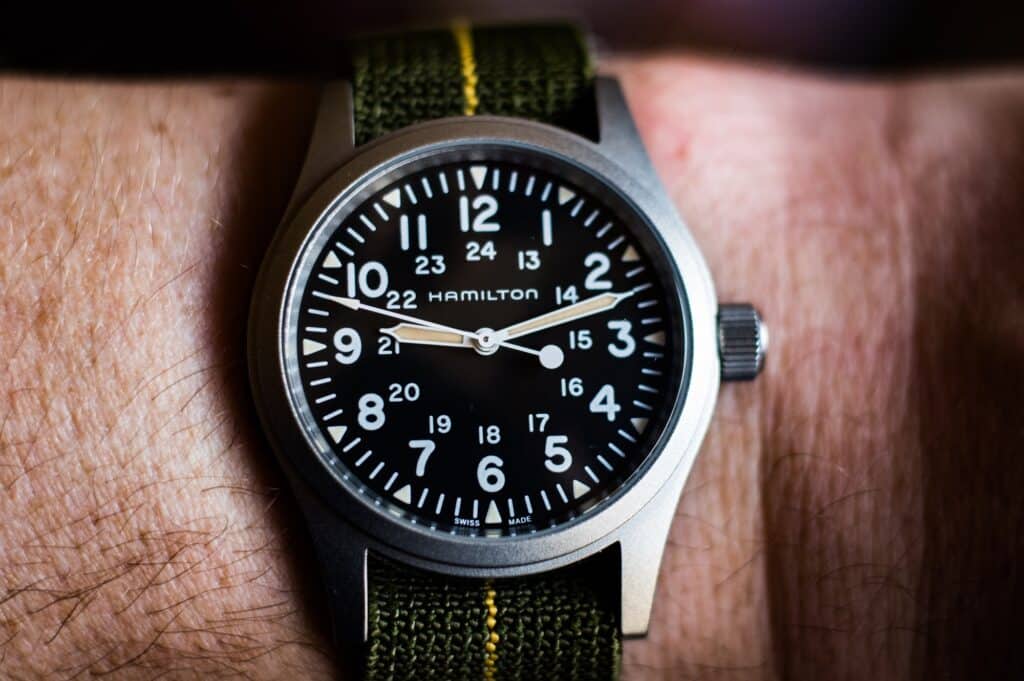
We know plenty of collectors who eventually circled back to the Hamilton Khaki Field Mechanical after trying other field watches first. Spending time with it, it’s easy to understand why. It doesn’t rely on an unusual complication or eye-catching design to stay interesting. Instead, it introduces the parts of mechanical watch ownership that tend to keep people in the hobby: winding the watch each morning, experimenting with different straps, and appreciating a design that feels just as natural months later as it does on day one.
The H-50 hand-wound movement is central to that experience. The oversized crown makes winding smooth rather than fiddly. The H-50 averaged around +0.8 seconds per day, comfortably outperforming what many first-time buyers expect from a hand-wound watch. The 38mm case also deserves more credit. Its 47mm lug-to-lug and slightly elongated lugs give it enough wrist presence without feeling oversized, while the slim 9.5mm thickness keeps it comfortable under a cuff throughout the day. Hamilton also made experimentation easy with drilled 20mm lugs, and we found the watch just as convincing on leather and fabric straps as it was on the included NATO.
The dial captures the familiar Khaki Field look without overplaying the vintage angle. The dense mix of Arabic numerals and minute markings initially looks busy, but the absence of a date window keeps everything balanced. We also appreciated Hamilton’s restrained approach to the faux-patina lume. It provides warmth without turning the watch into a vintage tribute. Nighttime brightness was better than the aged color implies, although the lack of a clearly defined 12 o’clock marker slowed orientation in the dark.
Water resistance is another compromise. With 50m of water resistance and a non-screw-down crown, this isn’t the field watch we’d prefer around water. Moreover, the leather keepers on the supplied NATO became uncomfortable during longer wear, prompting us to switch to a softer grey pashmina strap. But those trade-offs never distracted from the watch’s biggest strength: it teaches the habits and pleasures of mechanical ownership without overwhelming new collectors, making it far less likely to become a watch they quickly outgrow. We covered the ownership quirks in our dedicated review.
Pros
- H-50 hand-wound movement offers an engaging ownership experience and excellent accuracy.
- Drilled 20mm lugs make strap changes quick and encourage experimentation.
- Slim case wears comfortably while maintaining good wrist presence.
- No-date dial keeps the busy field-watch layout clean.
- The large crown makes daily winding easy.
Cons
- Non-screw-down crown and 50m water resistance limit carefree use around water.
- The 12 o’clock marker doesn’t stand out enough during nighttime checks.
- Leather keepers on the included NATO can become uncomfortable over extended wear.
If you’ve owned any of these watches, we’d love to hear which one earned a permanent spot in your collection and which one surprised you the most after the initial phase. And if there’s another watch that helped you avoid an expensive collecting detour (or taught you one the hard way), let us know in the comments and we’ll see about getting it in for review.

Co-Founder and Senior Editor
Kaz has been collecting watches since 2015, but he’s been fascinated by product design, the Collector’s psychology, and brand marketing his whole life. While sharing the same strong fondness for all things horologically-affordable as Mike (his TBWS partner in crime), Kaz’s collection niche is also focused on vintage Soviet watches as well as watches that feature a unique, but well-designed quirk or visual hook.
I can certainly agree with your inclusion of the Vaer C4 Tactical Solar as I am a proud owner. It is as tough of a grab and go option anyone could find. Everything you could want in a field watch with the added security of 200m of water resistance. It is basically a Field/Diver hybrid. And the lume is crazy good.
Hi, Eric:
Thanks for checking out the piece and sharing your experience with the Vaer C4 – it truly is an insanely impressive piece for the price.
Best,
-Kaz