Smartwatches were supposed to make life easier. But somewhere along the way, we ended up checking the time on our wrist and getting pulled into a notification, a fitness reminder, a work message, or some other tiny demand on our attention. We still like having useful information on the wrist, though. An alarm, a stopwatch, a second time zone, accurate timekeeping, or a watch you can grab on the way out the door can all earn their place. The trick is getting those functions without bringing another screen, charging anxiety, or app ecosystem into the day. That’s the idea behind this list: watches that do useful things quietly, without constantly asking us to interact with them.
We’ve spent more than a decade handling, wearing, testing, and measuring watches, and some of the most satisfying ones have been the pieces that do a small number of things well and then leave us alone. That experience has also taught us that stepping away from a smartwatch doesn’t have to mean giving up useful functionality or settling for a watch that only tells time. Digital watches with alarms and timing functions, travel watches built around extra time zones, and purpose-built instruments offer specific information without turning the wrist into another phone. This list brings together watches we’ve actually reviewed or handled and looks at what each one gives you, what it leaves out, and whether that trade-off makes sense when the goal is to wear a watch instead of another connected device.
Casio F-91W
| Price: | $30 (Check current price) |
| Water Resistance: | 30m |
| Case Dimensions: | 34mm (diameter) x 38mm (lug-to-lug) x 8.5mm (thickness) |
| Lug Width: | 18mm |
| Movement: | Casio Quartz Module 593 |
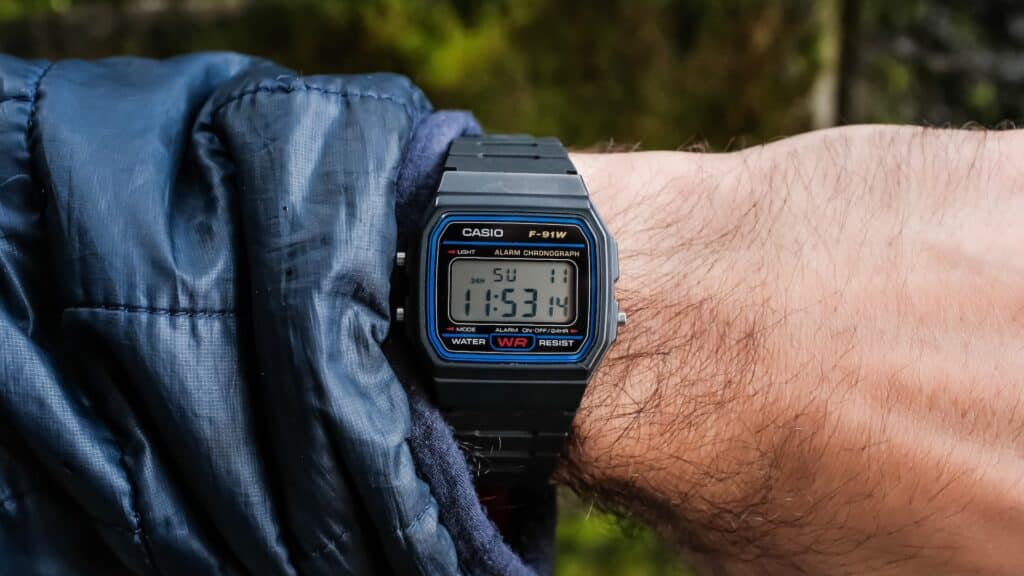
The F-91W might be the most convincing argument for leaving a smartwatch behind without spending much money. During our hands-on time with it, the slim resin case was so light that it largely vanished on the wrist, whether we were traveling, running errands, or working out. It doesn’t offer much wrist presence or finishing, and that is part of the point. There’s no distracting screen demanding attention beyond the information we asked for, no app ecosystem waiting for us to check in, and nothing to charge every night. After wearing more complicated smartwatches, putting on the F-91W can feel like clearing a bunch of browser tabs and finally getting some peace.
Casio kept the useful stuff and stopped there. You get the time and date, an alarm, a stopwatch, and 12- or 24-hour formats, with buttons that remain intuitive even after the watch has spent months sitting in a drawer. Our example stayed within Casio’s stated ±30 seconds per month accuracy, and the CR2016 battery lasts years.
Even the case details serve a purpose. The four-screw stainless steel caseback keeps things simple, while the small corner guards give the otherwise tiny case some extra substance and make the pushers easier to locate by feel. The green LED backlight is basic, but it gets the display visible when you need it. This is about as stripped-down as digital watch utility gets: cheap, useful, and completely uninterested in becoming another device.
However, that simplicity comes with a few trade-offs. The integrated resin strap is comfortable, but it leaves little room for strap experimentation, so anyone hoping to disappear into the watch-strap rabbit hole will have to look elsewhere. The 30m water resistance is enough for splashes and routine daily wear, but not ideal for deep swimming. Still, that’s a remarkably short list of compromises at this price. For anyone trying to break the habit of wearing a notification machine, the F-91W makes a strong case for keeping only the functions we use and leaving everything else alone.
Pros
- Extremely light and compact, making it easy to forget you’re wearing it.
- Alarm, stopwatch, date, and 12/24-hour formats cover the useful everyday functions without distractions.
- Quartz accuracy and a CR2016 battery measured in years make it pretty low-maintenance.
- The resin case and corner guards handle ordinary knocks while keeping the pushers easy to operate by touch.
Cons
- 30m water resistance isn’t ideally suited for deep swimming.
- The integrated resin strap limits the fun of swapping it out.
- The green LED backlight is functional rather than impressive.
Casio A168WA
| Price: | $40 (Check current price) |
| Water Resistance: | 30m |
| Case Dimensions: | 37.5mm (diameter) x 33.5mm (lug-to-lug) x 9.6mm (thickness) |
| Lug Width: | 18mm |
| Movement: | Quartz Module 3298 |
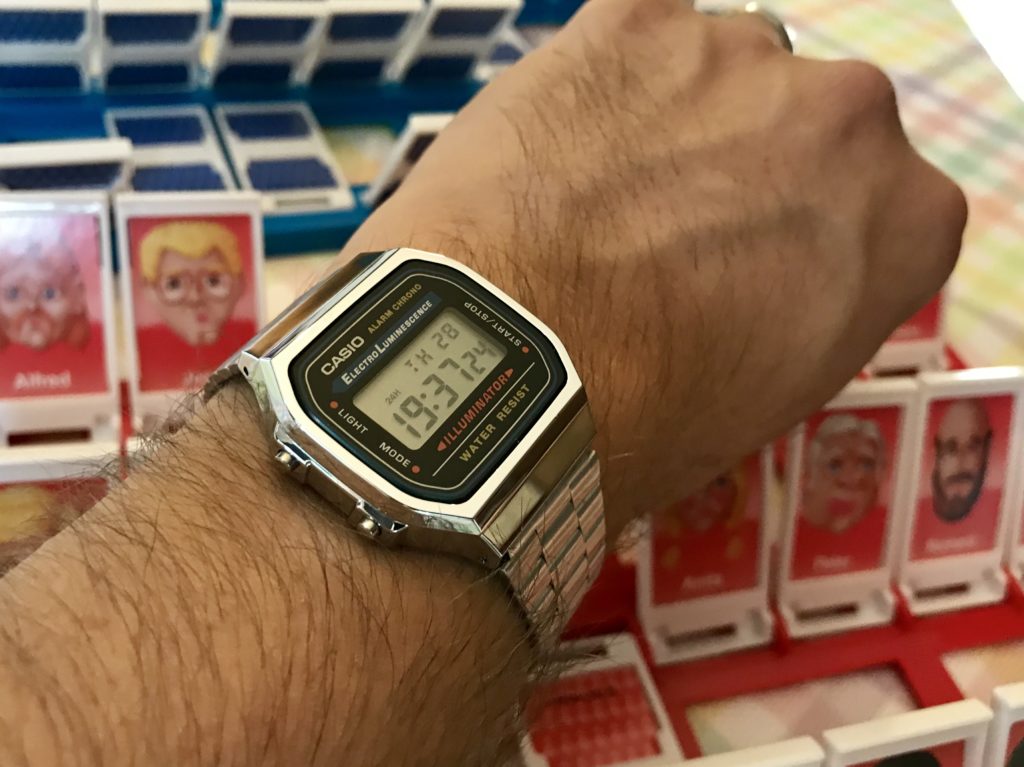
The A168WA has essentially the same anti-smartwatch credentials as the F-91W, but it makes a little more effort to look like you chose it on purpose. Throughout our testing time, the 37.5mm × 33.5mm case felt almost comically easy to wear, staying low enough to slide under a cuff and light enough that we could forget about it until we needed the time. Yes, it’s plastic, and nobody will mistake it for machined steel after about three seconds in the hand. The metallic finish does give it enough texture to avoid looking like something dispensed from a claw machine, though. With jeans, sneakers, and a hoodie, it works without turning the weekend into a theme party.
More importantly, the A168WA never starts trying to manage our lives. The quartz movement quietly takes care of the time while the display handles the useful bits: alarm, stopwatch, hourly chime, and a blue electroluminescent backlight. There’s no notification menu to wander into accidentally and no phone involved in operating any of it.
The display is easy enough to read in normal light, although sharper angles and harsher lighting expose its limitations. The backlight is similarly old-school: it comes on briefly, gives us enough time to read the display, and disappears. It’s functional, not interested in putting on a light show.
The stainless steel bracelet is where the A168WA becomes a little less forgettable. It gives the watch its retro character, but on smaller wrists, it didn’t always settle as neatly as the featherweight case. During longer wear, it could ride a bit high and remind us that yes, there is a bracelet attached to this thing. That’s hardly a deal-breaker. For people who want the F-91W’s useful simplicity but find it a little too utilitarian, the A168WA adds personality without adding extra digital baggage to the wrist.
Pros
- Gives basic digital watch functionality a lot more retro personality.
- The 37.5mm × 33.5mm case is compact enough to stay out of the way during everyday wear.
- Alarm, stopwatch, hourly chime, and backlight cover the functions most people will actually use.
- Quartz accuracy and simple controls keep ownership firmly in the “put it on and forget about it” category.
Cons
- The bracelet can sit high and become more noticeable on smaller wrists.
- The plastic case feels every bit as humble as its price suggests.
- The small display loses some legibility at sharp angles or in bright light.
- The brief backlight works for a glance, not prolonged nighttime viewing.
Casio Wave Ceptor WV-59DJ-1AJF
| Price: | $55 – $60 (Check current price) |
| Water Resistance: | 50m |
| Case Dimensions: | 39mm (diameter) x 48mm (lug-to-lug) x 12.75mm (thickness) |
| Lug Width: | 20mm, tapers down to 18mm at the clasp |
| Movement: | Quartz Module 3054 |
The Wave Ceptor is what happens when “just give us the time” evolves into “okay, maybe give us a little more than that.” It keeps the low-drama appeal of a Casio digital watch. Still, radio-controlled timekeeping adds a layer of convenience that makes sense for anyone trying to leave the smartwatch behind without giving up precision. The rectangular case looks a little strange on its own, with its narrow proportions and longer lug-to-lug making the dimensions feel mismatched on paper. Once we got it onto a sub-7-inch wrist, though, it settled in better than expected. It has some presence without becoming cumbersome, and the low weight quickly stopped feeling unusual.
According to our review team’s insights, the display is where the extra functionality earns its keep. The main time is immediately readable, with the day and date arranged logically and the signal indicator quietly showing that the watch is handling its atomic timekeeping in the background. Straight-on legibility is good in everyday lighting, though contrast drops at sharper angles.
Plenty is happening inside the module, so the first encounter can feel a little like meeting a new car with too many buttons, but the important functions become easy to use once we’ve spent some time with them. That suits the low-distraction approach idea nicely: the watch can be more capable than a basic three-hander without turning into another screen that wants our attention.
The folded metal bracelet is less convincing if you want solid, weighty hardware. It feels light and somewhat hollow, though it suits the watch and sits comfortably once adjusted. Getting the sizing right takes some patience the first time, and the integrated design means strap-swapping isn’t really part of the equation. We don’t mind that here. Compared with something more refined like the Oceanus T200, the Wave Ceptor is less elegant but far more practical. It gives us accurate time without notifications, charging schedules, or another app to babysit, which is precisely why it works so well for someone trying to get a little less digital about daily life.
Pros
- Radio-controlled accuracy gives it a genuine practical advantage without introducing more digital noise.
- Despite the unusual rectangular proportions, the light case wears comfortably on smaller wrists.
- The layout keeps time, day, date, and signal information easy to understand.
- The buttons are straightforward once the module becomes familiar.
Cons
- The integrated bracelet leaves little room for strap experimentation.
- LCD contrast suffers noticeably from sharper viewing angles.
- The folded bracelet feels more utilitarian than substantial.
- Initial sizing takes a bit of patience, especially if we’re doing it for the first time.
Casio G-Shock DW9052-1V
| Price: | $65 – $90 (Check current price) |
| Water Resistance: | 200m |
| Case Dimensions: | 47mm (diameter) x 48mm (lug-to-lug) x 15mm (thickness) |
| Lug Width: | 24mm; tapers to 20mm at the buckle |
| Movement: | Casio 3232 digital module |
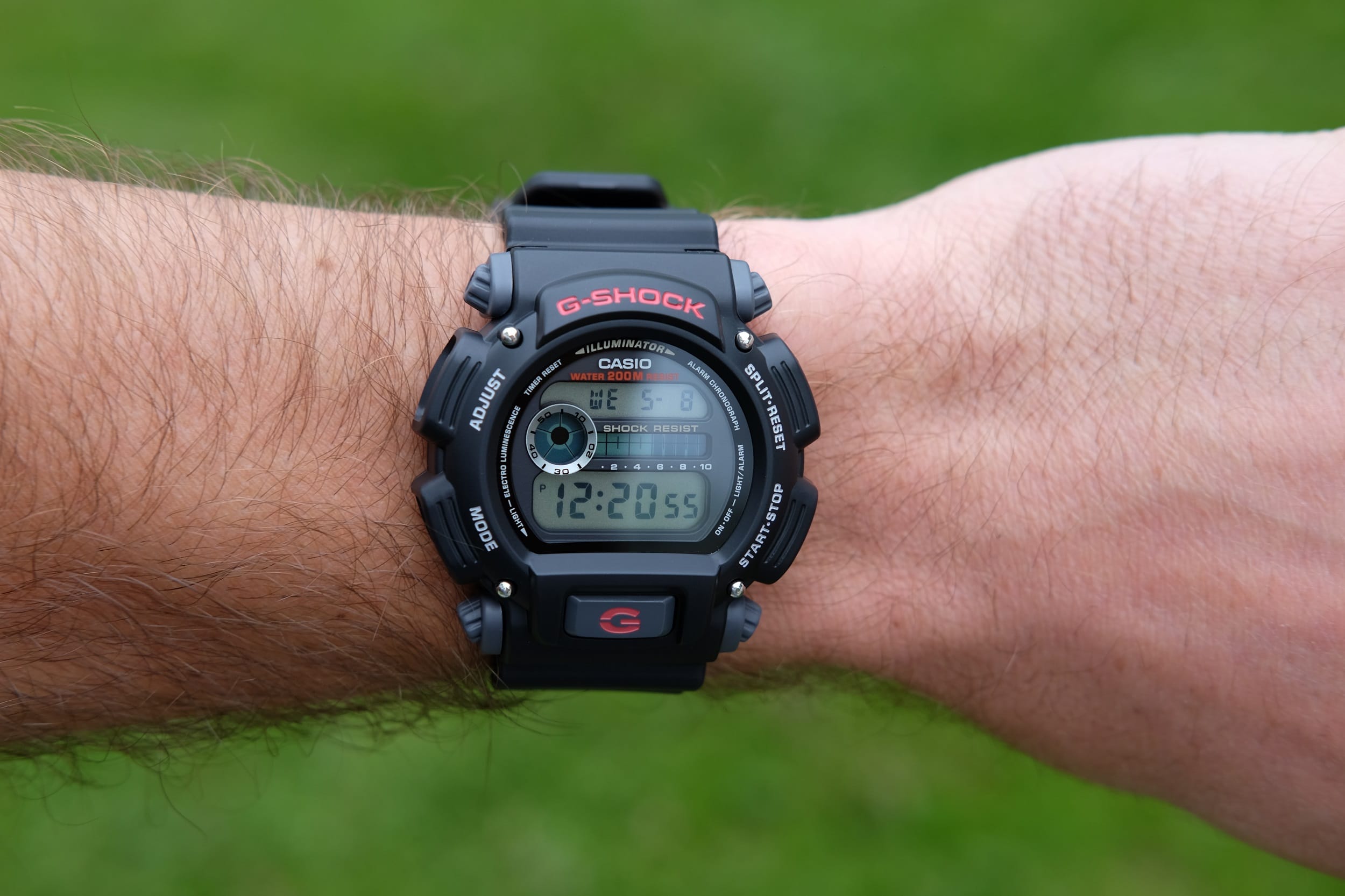
The DW9052-1V is for anyone who likes a reduced-tech approach but treats their watch like protective equipment. This thing shows up with considerably more resin, more height, and absolutely no interest in disappearing under a shirt cuff. The urethane bumper wraps around the crystal and pushers, and that extra bulk proved useful during yard work, workouts, and the sort of door-frame collisions we’d prefer not to document. After months on the wrist, ours had gathered its share of scratches and scuffs, but the stuff that mattered kept working. That’s a pretty good definition of a watch that can get on with the day without asking us to handle it carefully.
Despite the bulk, the case settles better than expected because the lugs can move with the wrist rather than forcing everything into one rigid position. The vented strap also earns its keep when things get sweaty, and the stainless steel buckle feels built to be used repeatedly, not just admired.
Inside, the display initially looks like Casio gave every piece of information its own apartment, but we got familiar with the layout quickly. The electroluminescent backlight is particularly useful here because it illuminates the whole display evenly, making nighttime checks much easier. The recessed buttons stay protected from impacts but remain usable with wet hands or gloves, which is the kind of boring competence we want from a beater.
The quartz performance is similarly unexciting in the best possible way. Our example stayed around ±15 seconds per month, the auto calendar behaved itself, and the battery life stretches into multi-year territory. The decorative metal pins in the bumper are the one bit where the watch gets unnecessarily cute; they can loosen over time, and once one goes missing, the resulting gap has a talent for collecting dirt. Still, the DW9052 makes sense for the smartwatch rebel who wants alarms, timing functions, and dependable digital information without paying much or worrying about another expensive piece of electronics on the wrist.
Pros
- The resin bumper gives the crystal and pushers useful protection when the day gets rough.
- The full-display electroluminescent backlight is excellent for quick checks in the dark.
- Free-moving lugs make the bulky case sit quite naturally.
- The vented strap helps when workouts or outdoor work turn the wrist into a small sauna.
- Around ±15 seconds per month and multi-year battery life keep maintenance pretty simple.
Cons
- The tall, chunky case has enough wrist presence to interfere with some sleeves.
- The decorative bumper pins can loosen and leave small dirt-collecting gaps.
- The busy display takes time to learn before everything becomes instinctive.
Casio G-Shock CasiOak
| Price: | $120 – $210 (Check current price) |
| Water Resistance: | 200m |
| Case Dimensions: | 45.4mm (diameter) x 48mm (lug-to-lug) x 11.9mm (thickness) |
| Lug Width: | 20mm |
| Movement: | G-Shock Quartz 5611 Module |
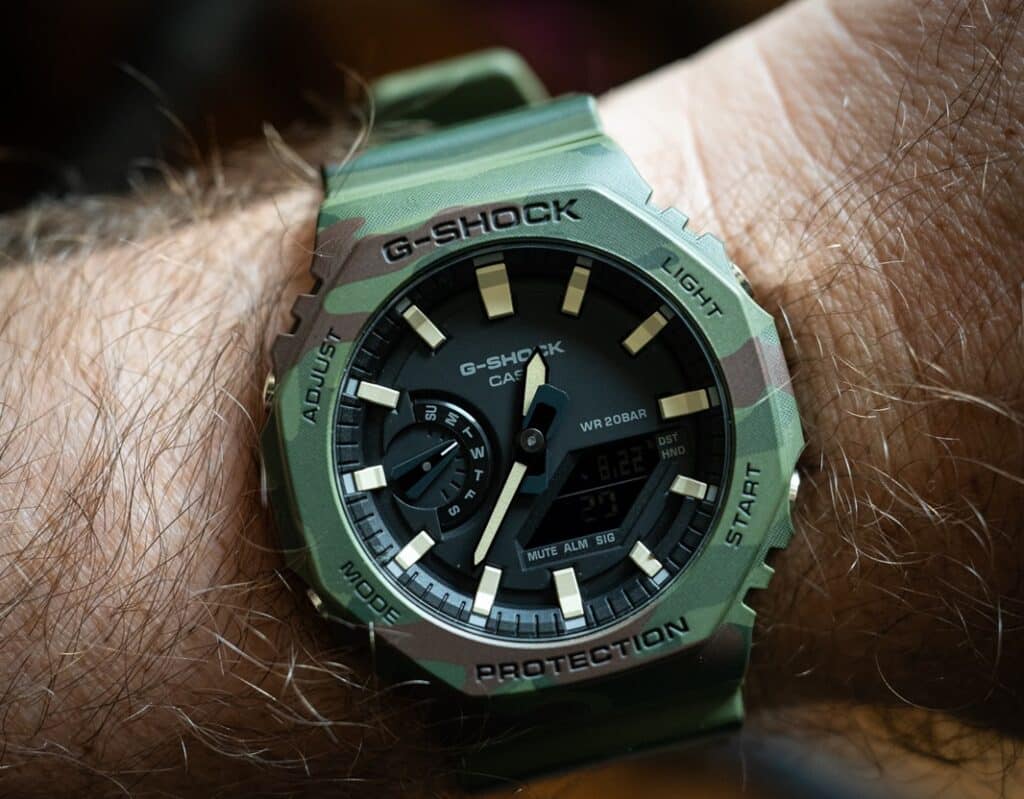
The CasiOak makes a good case for a deliberately low-tech setup without pretending that simplicity has to mean wearing the horological equivalent of a calculator. Its 5611 module gives us world time, stopwatch, timer, and alarms, but the package feels more like a watch than a tiny device looking for something to do. The camo version we reviewed hands-on also came with multiple straps and OEM adapters, adding a welcome bit of mischief to what could otherwise be a straightforward tool watch.
The 45.4mm width sounds like trouble before the watch ever reaches the wrist. Thankfully, the case spreads that footprint evenly, while the downward-angled strap connection helps it sit flatter than the dimensions imply. During commutes, hikes, and ordinary errands, it stayed planted rather than constantly reminding us we were wearing a large G-Shock. The Carbon Core Guard structure keeps the weight under control while giving the case a more solid, structured feel.
Visually, the analog-digital layout is the bigger departure: raised tan indices and sword-shaped hands add depth and make the watch feel more contemporary. However, we needed a little time for the display to become second nature. The LED handles darkness, because the lume on the hands and indices is weak enough to be more of a polite suggestion.
The strap options help sell the CasiOak as an everyday watch rather than a one-look novelty. The stock camo rubber strap felt secure and suited the case, while the orange Cordura option was comfortable but had loose nylon keepers that liked wandering off on their own. The adapters also let us use standard 20mm straps, which opens up more experimentation. For someone who wants G-Shock toughness and useful digital functions but finds a conventional digital display a little too utilitarian, the CasiOak hits a modern middle ground. It still asks you to learn a few button combinations, but once that happens, it gets out of the way and lets you get on with the day.
Pros
- World time, stopwatch, timer, and alarms provide plenty of useful functionality without a connected ecosystem.
- Carbon Core Guard construction keeps the watch relatively light while adding reassuring structure.
- The large case sits more comfortably and evenly than its 45.4mm dimensions suggest.
- OEM adapters and included straps make it easy to try standard 20mm replacements.
Cons
- The analog-digital layout takes some adjustment if you’re accustomed to straightforward digital displays.
- Weak lume means the LED does most of the work after dark.
- The Cordura strap’s loose keepers can shift around during wear.
Casio G-Shock GW6900-1
| Price: | $155 (Check current price) |
| Water Resistance: | 200m |
| Case Dimensions: | 53.2mm (diameter) x 50mm (lug-to-lug) x 17.7mm (thickness) |
| Lug Width: | 16mm |
| Movement: | Solar Quartz Module 3179 |
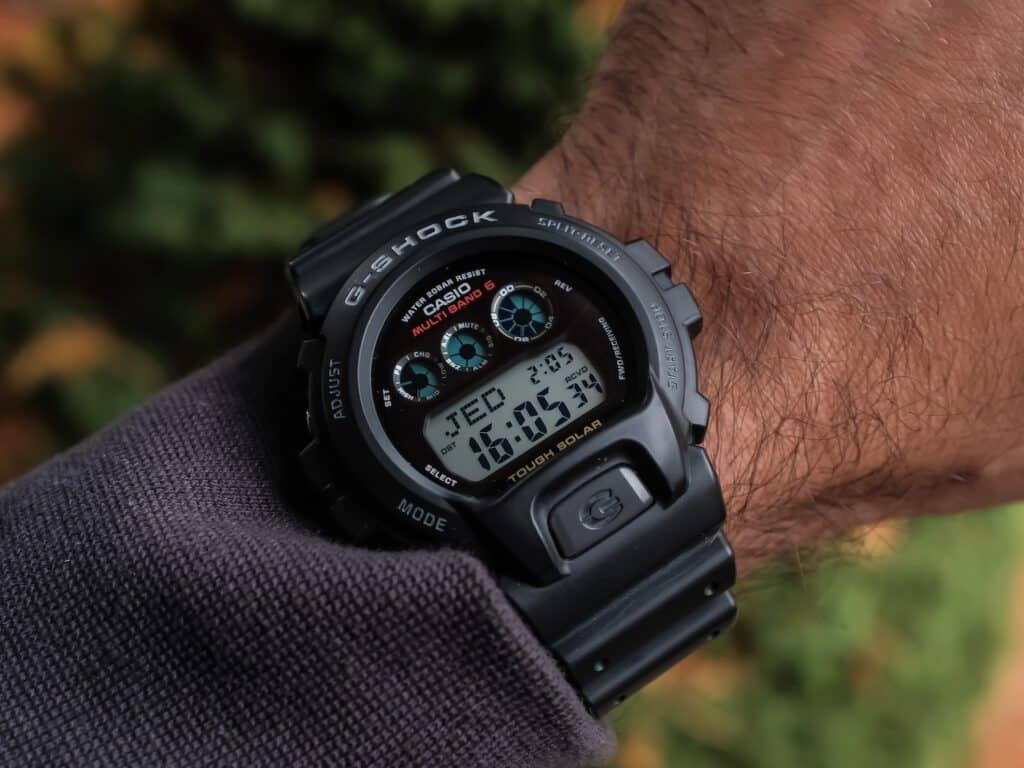
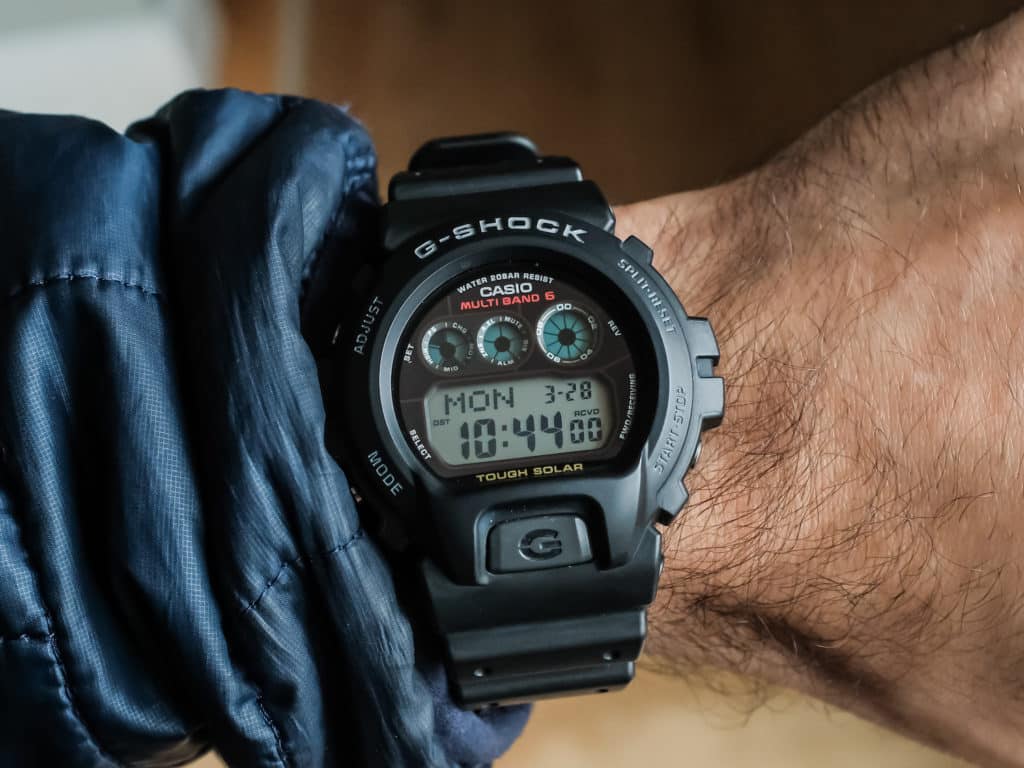
The GW6900-1 solves one of the most annoying problems with modern gadgets: remembering to look after them. Once it’s on your wrist, it requires surprisingly little housekeeping. Tough Solar uses regular light exposure to keep the battery charged, while Multi-Band 6 handles time correction by syncing with radio signals in the U.S., UK, Japan, Germany, and China. During our in-depth testing, it did that quietly in the background most nights, without phone pairing, app setup, or any of the little rituals that come with connected gear. We’ve left ours sitting untouched for weeks, picked it up again, and found it ready to work. For someone escaping smartwatch fatigue, that kind of “nothing happened, and everything is fine” reliability is the whole appeal.
What the GW6900 lacks in discretion, it makes up for in utility. The case is more than 50mm across and nearly 18mm thick, so smaller wrists will notice it. The resin construction keeps the weight under control, though, and the steel caseback gives it enough substance without turning it into a lump. We’ve worn it through yard work, rain, water, workouts, rushed mornings, and enough accidental impacts to make a more delicate watch reconsider its career choices.
The triple-eye display takes a little settling-in time, but the layout becomes logical once we stop trying to read it all at once. The main time and date are straightforward, and the smaller displays cover things like radio-sync status and dual time. A 1/100-second stopwatch, countdown timer, five alarms, and dual-time function give it plenty to do without creating another source of digital noise.
The big front button triggers a bright green EL backlight that evenly fills the display, making nighttime checks painless. However, the stock resin strap takes longer to win us over. It starts stiff and slightly squeaky, but breaks in with wear, wraps the wrist better, and dries quickly after getting wet. There’s little reason to change it unless strap swapping is part of the fun for you. That leaves the GW6900-1 in an interesting place: it contains more technology than many modern watches, yet none of it is interested in sending us a notification.
Pros
- Multi-Band 6 automatically corrects time across its supported regions without phone connectivity.
- Tough Solar keeps battery maintenance largely off the to-do list.
- Five alarms, dual time, a countdown timer, and a 1/100-second stopwatch give it practical range.
- The front-mounted EL light evenly illuminates the display for nighttime checks.
- Despite its size, the resin construction keeps the watch lighter and less cumbersome than expected.
Cons
- The 50mm-plus footprint and nearly 18mm thickness make it a poor fit for anyone wanting a discreet watch.
- The original resin strap is stiff and a little squeaky until it breaks in.
- The triple-eye display takes time to become second nature.
Citizen Ana-Digi Temp
| Price: | $250 – $425 (Check current price) |
| Water Resistance: | 30m |
| Case Dimensions: | 31.5mm (diameter) x 40mm (lug-to-lug) x 8.4mm (thickness) |
| Lug Width: | 18mm |
| Movement: | Citizen caliber 8980 |
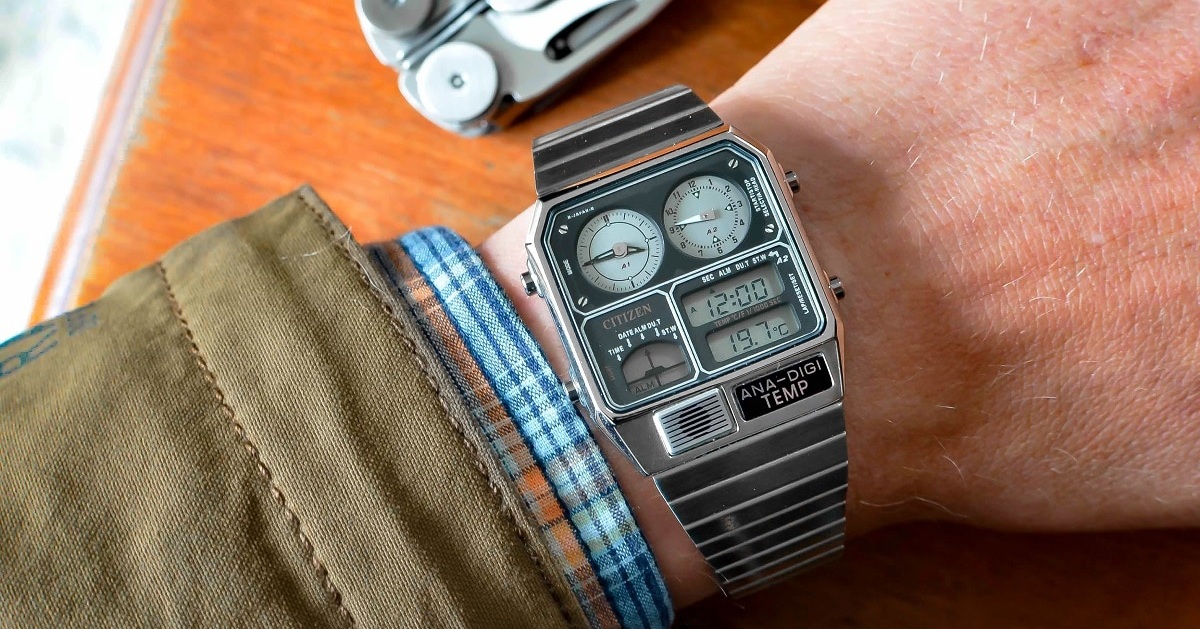
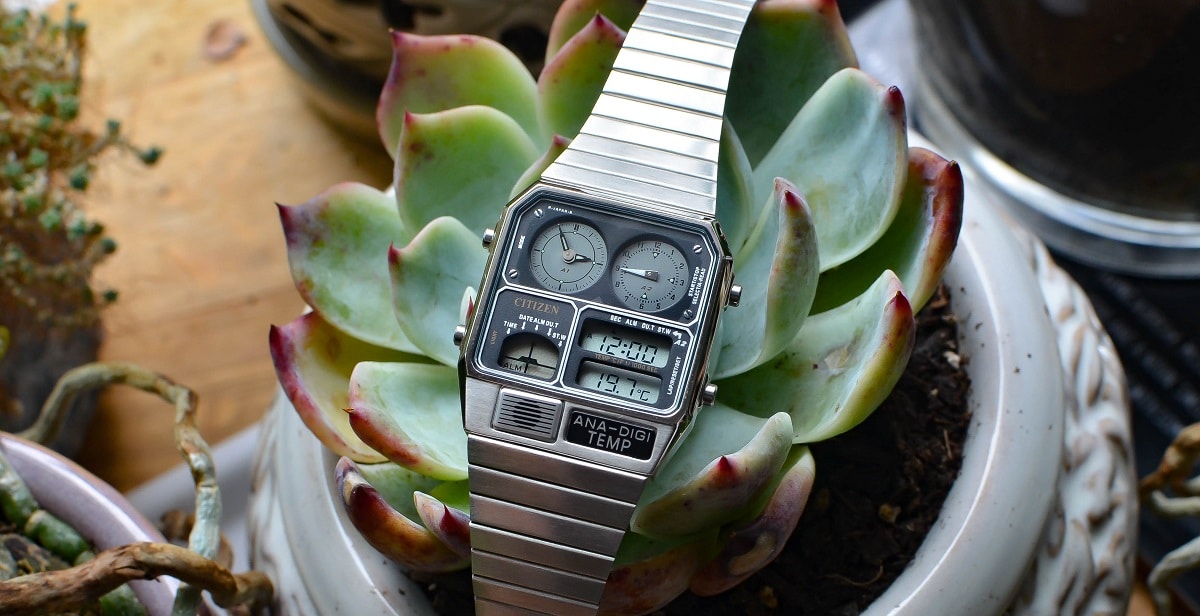
The Citizen Ana-Digi Temp is a funny choice for digital minimalism because it looks like the exact opposite of simplifying anything. The boxy stainless-steel case and eighties-tech styling make it look like a miniature control panel, complete with analog hands, LCD windows, and enough information to make a traditional three-hander look positively unemployed. Yet that is what makes it work. Instead of using the wrist to pull us toward messages, apps, and notifications, the Ana-Digi Temp confines its ambitions to telling us useful things.
During our time with it, the different display zones proved easier to understand than the first glance suggests. Bright white information gets priority against the black background, while the darker secondary markings stay relatively quiet. The restrained branding helps, too. It is busy, but it is busy about watch stuff. The physical design has more going on than its first impression lets on, too. The short lug-to-lug and slim profile keep the watch wearable, including on smaller wrists, while details like the needle-thin lumed hands on one side, the larger regulator-style hand on the other, polished hand bases, and exposed screws give the case some character.
The dual-time function is the feature we’d actually miss after taking it off. An analog reference and digital readout together make checking another time zone quick, while the temperature function sits somewhere between useful instrument and excellent conversation starter. There is a catch: for a more accurate temperature reading, the watch needs to come off the wrist, so it’s less “instant weather station” and more “tiny thermometer we occasionally demonstrate.”
The integrated bracelet suits the angular case, although the flared end links are the bit we’d keep an eye on because they can bend with time. That aside, the Ana-Digi Temp fits this list precisely because it offers information without demanding interaction. It isn’t the watch for someone who wants the fastest possible glance or the cleanest possible dial. It is for someone done with notification-heavy watches but who still likes a second time zone, a temperature reading, and a little mechanical-looking weirdness on the wrist. We covered that strange-but-useful combination in our hands-on review of the watch.
Pros
- Short lug-to-lug and slim proportions make the unusual case easier to wear than it looks.
- The display separates primary and secondary information well once you learn the layout.
- Dual-time information is truly useful, especially when you need to check another time zone at a glance.
- Small design details, from the lumed hands to exposed screws, give it far more personality than a conventional three-hander.
Cons
- The flared bracelet end links can bend with long-term use.
- More accurate temperature readings mean taking the watch off the wrist.
- The dial is information-dense enough that it takes some adjustment.
Casio Oceanus T200
| Price: | $300 – $500 (Check current price) |
| Water Resistance: | 100m |
| Case Dimensions: | 41.4mm (diameter) x 49mm (lug-to-lug) x 10.7mm (thickness) |
| Lug Width: | 20mm |
| Movement: | Tough Solar movement (Module 5596) |
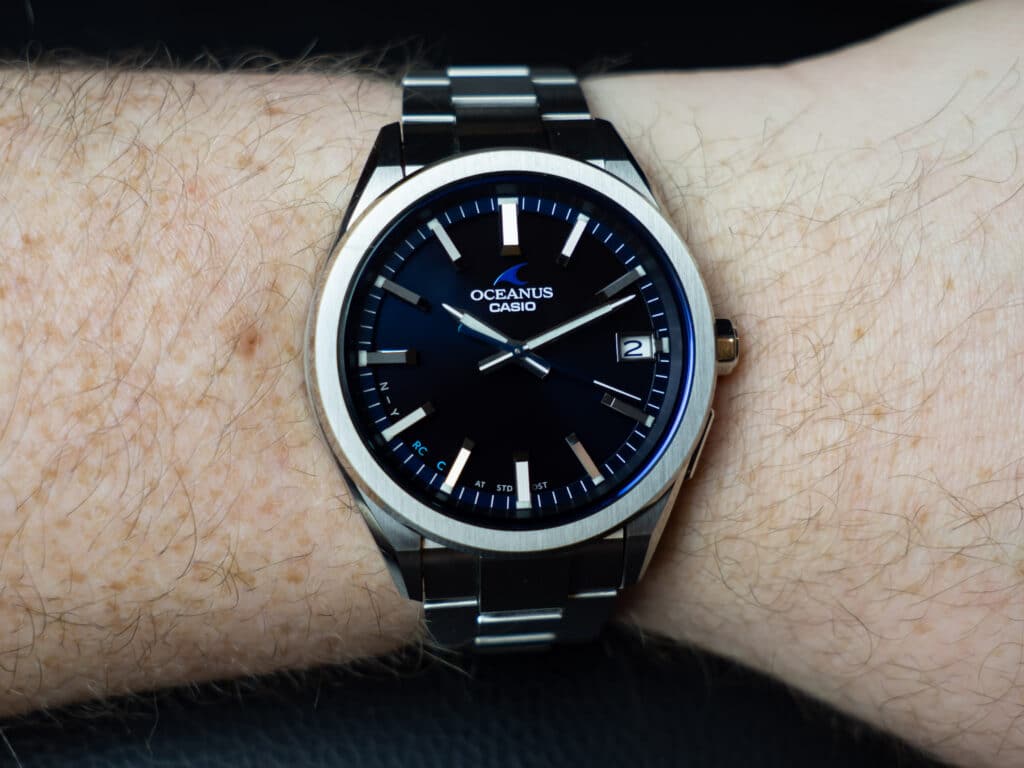
The Oceanus T200 is an interesting option for a notification-free wearer because it gives us some of the convenience we’d miss from a smartwatch without turning the wrist into a second phone. Tough Solar and Bluetooth syncing keep it accurate, so after the initial setup, there’s very little routine maintenance to think about. During our testing and wear period, that was the real attraction. We weren’t checking a battery percentage, resetting the time, or wondering whether it had drifted since the last time we wore it. We put it on, got the correct time, and carried on.
What makes the T200 work is that the smart part stays mostly backstage. The 5596 module gets its power from Tough Solar, and Bluetooth lets the Oceanus app keep things synchronized without turning the watch itself into a gadget. On the wrist, it still behaves like a proper watch. The brushed-and-polished case slips comfortably into more formal territory, and the deep blue dial has more going on once we stop treating it like a flat surface. The floating hour markers create actual depth through the cutouts in the chapter ring, while the blue-tinted sapphire crystal catches changing light without becoming flashy. Daytime legibility was never an issue, which matters more here than any spec-sheet flex.
However, a few reminders show this is still a connected watch trying to pass as a traditional one. The connectivity wording on the dial isn’t exactly a minimalist’s dream, the lume is competent rather than memorable, and the bracelet has its own small annoyances: it develops a noticeable rattle off the wrist, while the pin-and-collar sizing system turns adjustment into a patience exercise.
None of those issues changed how easy the T200 was to live with, though. For someone who wants accurate, synced timekeeping and a bit of refinement without carrying a screen-heavy gadget on the wrist, this is one of the more convincing ways to make that switch.
Pros
- The brushed-and-polished finish adds enough refinement for dressier wear without making everyday use feel precious.
- Floating hour markers and the blue-tinted sapphire crystal give the dial noticeable depth in changing light.
- Tough Solar and Bluetooth syncing keep routine timekeeping and charging concerns to a minimum.
- Strong daytime legibility makes the watch easy to wear all week.
Cons
- The connectivity text on the dial works against the cleaner aesthetic some screen-averse wearers will prefer.
- Bracelet sizing with the pin-and-collar system is unnecessarily fiddly.
- The bracelet develops a noticeable rattle when it’s off the wrist.
- Lume is serviceable but doesn’t leave much of an impression.
Seiko SSK025 Field GMT
| Price: | $435 (Check current price) |
| Water Resistance: | 100m |
| Case Size: | 39.4mm (diameter) x 47.9mm (lug-to-lug) x 13.6mm (thickness) |
| Lug Width: | 20mm |
| Movement: | Seiko 4R34 (Mechanical) |
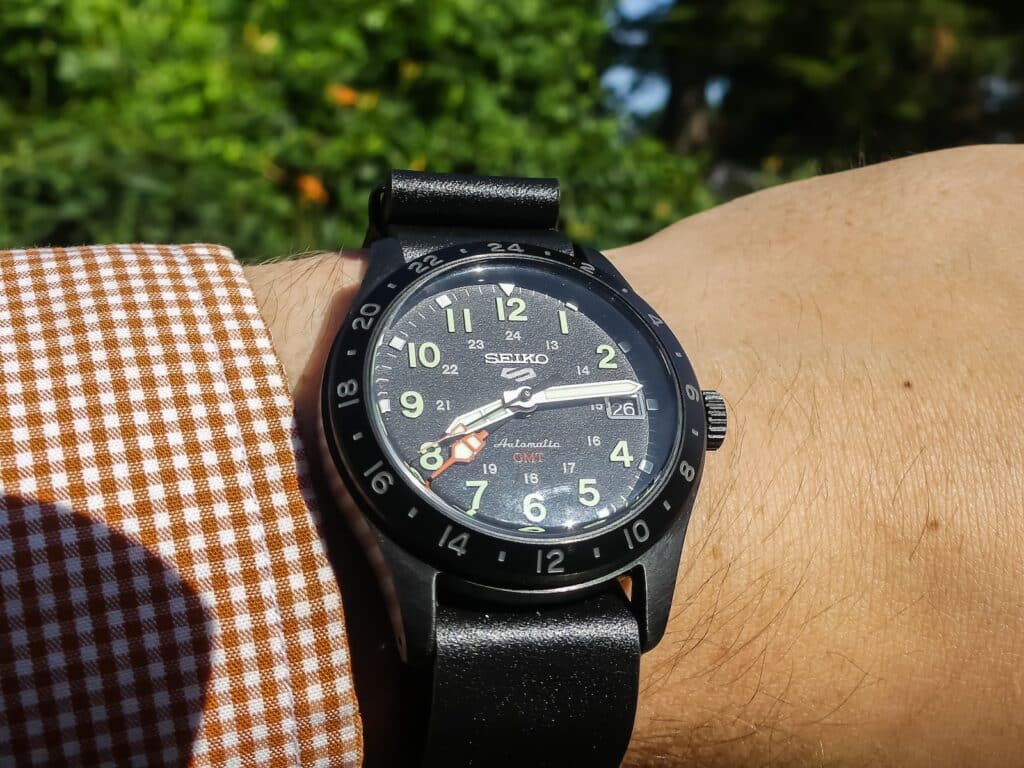
For someone trying to simplify the wrist without giving up travel functionality, the SSK025 gets a lot right before we even start messing with the details. The 39.4mm case is an easy size to wear, and the black IP coating gives it a more purposeful field-watch character than the usual polished steel treatment. More importantly, the dial makes the GMT function feel useful, not decorative. Full Arabic numerals, generous LumiBrite, the bright orange GMT hand, and the neatly integrated date all stay easy to read. At the same time, the lightly textured black surface adds just enough grain to keep the dial from looking flat. We expected the extra hand to dominate the experience, but during our wrist time, legibility ended up being the thing we appreciated most.
The catch is sitting underneath the dial. At 13.6mm thick, the SSK025 wears taller than its diameter suggests, and our first strap choice made that more obvious. The supplied single-pass leather strap added extra material beneath the case, which let the watch rock from side to side unless we tightened it more than was comfortable. Nylon didn’t completely solve the problem. Rubber did. Once the excess bulk underneath disappeared, the case finally settled properly on the wrist. That made a noticeable difference for a watch intended to be worn frequently and potentially serve as the only watch in the rotation.
Seiko also leaves a few things on the table. As covered in our dedicated review, the 100m water resistance is useful for everyday wear. Still, the push-pull crown feels pretty modest for a GMT built around travel, and the Hardlex crystal is another concession we’d happily trade for sapphire. A slimmer case would have helped, too.
Still, the SSK025 makes sense for the digital minimalist who wants a second time zone without returning to another electronic device. It gives us travel information in a format we can read at a glance, then goes back to being a watch. That quiet utility earns it a place here.
Pros
- The bright orange GMT hand and full Arabic numerals make second-time-zone reading straightforward.
- Black IP coating gives the case a distinct field-watch identity.
- Generous LumiBrite keeps the dial practical and easy to read at a glance.
- Light dial texture, orange accents, and black date wheel make the design feel cohesive rather than assembled.
Cons
- The supplied leather and nylon straps can make the case rock unless worn tighter than ideal.
- The push-pull crown feels under-specced for a travel-oriented GMT.
- The 13.6mm thickness makes the watch wear taller than its 39.4mm width implies.
- Hardlex is a noticeable compromise where a sapphire crystal would have made more sense.
Citizen Nighthawk
| Price: | $440 – $500 (Check current price) |
| Water Resistance: | 200m |
| Case Size: | 42.5mm (diameter) x 47mm (lug-to-lug) x 12.6mm (thickness) |
| Lug Width: | 22mm |
| Movement: | Citizen B877 Eco-Drive caliber (solar-powered quartz) |
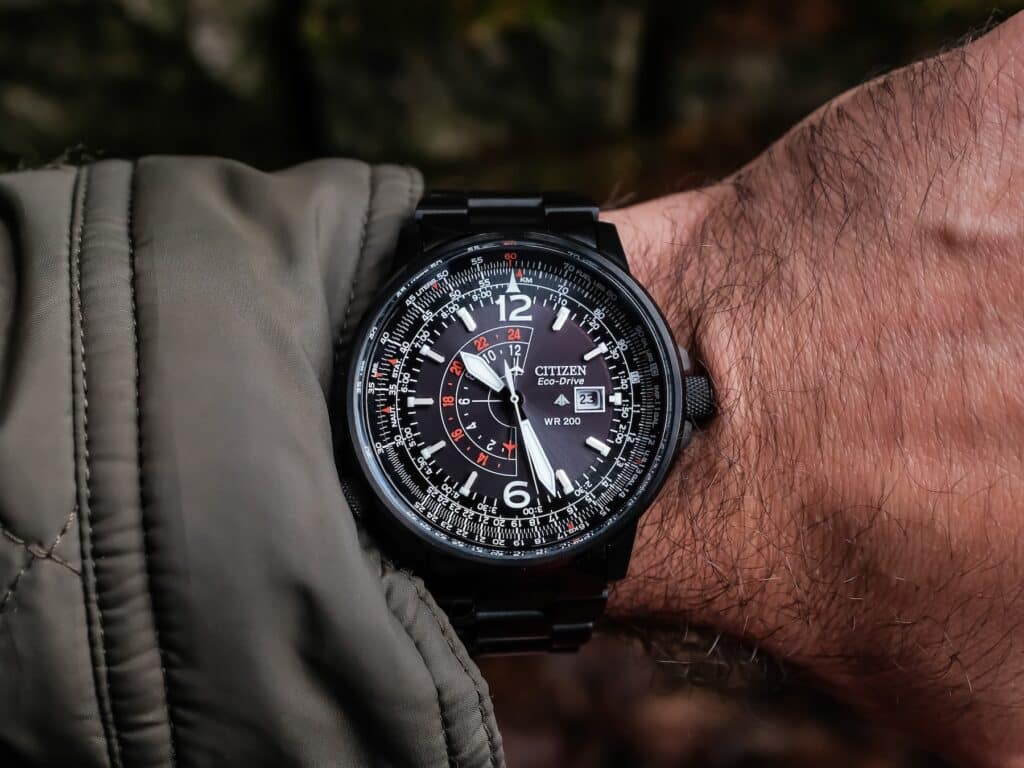
Some watches are useful because they disappear into the routine. The Nighthawk takes the opposite route and simply adds more information to that routine. The aviation-style dial looks like it has been preparing for a flight for a long time. Still, after spending significant wrist time with it, we stopped treating the E6B scale as visual clutter and started appreciating how Citizen organizes the important stuff. The bold sword hands and lume-filled markers handle the basic time check, and the red-and-white airplane GMT hand makes the second time zone easy to pick out. The finer scales can sit in the background until we actually need them. That makes a difference for digital restraint: there’s plenty of information here, but none of it is trying to interrupt us.
The watch’s best trick is that it handles a lot of the practical housekeeping itself. The Eco-Drive B877 stayed around ±15 seconds per month during our testing, a full charge held roughly six months, and the independently jumping local hour hand made changing time zones less annoying than resetting the whole watch. We found that far more useful than we expected. The 200m water resistance, screw-down crown, locking secondary crown, and engraved screw-down caseback give it the carefree robustness that suits a watch meant to stay in rotation. The bracelet is equally serious, with a deployant clasp, safety lock, and micro-adjustment keeping the relatively substantial watch secure. And when the light goes away, the blue lume remains one of the package’s better parts.
The trade-offs are harder to hide. At 42.5mm, the black ion-plated case has enough heft that smaller wrists will notice it, and the exposed mineral crystal feels underwhelming next to everything else. The coating can also show bare steel after a deep enough scratch, while the main hands occasionally wander across part of the second-time-zone scale.
That said, the Nighthawk makes sense for anyone trying to leave the smartwatch habit without giving up the feeling that the wrist can handle useful information on demand. It’s a little like replacing a phone full of notifications with a very competent instrument panel: busy, yes, but only busy when we choose to look.
Pros
- The independently jumping local hour hand makes changing time zones quick and painless.
- Eco-Drive, with roughly ±15 seconds per month accuracy and a six-month full-charge reserve, keeps ownership remarkably low-maintenance.
- The 200m water resistance and screw-down components make it comfortable to wear without treating it delicately.
- The bracelet feels secure thanks to the deployant clasp, safety lock, and micro-adjustment.
- Blue lume gives the watch useful after-dark legibility.
Cons
- The 42.5mm case has noticeable weight and wrist presence.
- The main hands can occasionally obscure part of the second-time-zone scale.
- Deep scratches can cut through the black ion plating and expose the steel underneath.
- The mineral crystal is an obvious compromise given the rest of the package.
Vaer G2 Meridian GMT

| Price: | $459 (Check current price) |
| Water Resistance: | 150m |
| Case Size: | 39mm (diameter) x 46mm (lug-to-lug) x 10mm (thickness) |
| Lug Width: | 20mm |
| Movement: | Swiss-made Ronda 515.24H |
A second time zone is one of those smartwatch functions that’s genuinely useful right up until it becomes an excuse to bring another screen into the conversation. The Vaer G2 Meridian takes the quieter route. Its Swiss-made Ronda 515.24H quartz movement is always ticking when we pick it up; the quick-set date makes those stretches in the drawer painless, and the battery lasts several years. That sounds almost boring until we remember how pleasant “always ready” can be. There’s no winding ritual, no charging reminder, and no need to reach for a phone just to figure out whether someone overseas is already asleep. For a low-distraction wearer who still wants GMT functionality, that is a pretty good trade.
The 39mm case helps the argument because the G2 Meridian never feels like equipment we have to accommodate. Its 46mm lug-to-lug and just-over-10mm thickness keep it relatively flat, while the low weight lets it settle into all-day wear without much fuss. The brushed and polished surfaces add enough refinement for the office without making the watch feel precious. The screw-down crown is easy to grip when you need to adjust it. The 150m water resistance also means we didn’t have to worry about where we could or couldn’t wear it. On the rubber strap, the whole package makes the most sense: it tapers nicely, feels more substantial than Vaer’s older offerings, and works naturally with the lightweight case. We kept coming back to it over the included NATO, which stayed stubbornly stiff.
The caller-GMT setup is the important catch. The independently adjustable 24-hour hand works quite well for tracking a second time zone. Still, it isn’t the convenient flyer-GMT arrangement for frequent international travel where jumping the local hour is the priority. The bidirectional Pepsi bezel is also better in isolation than it is under close inspection: the clicks are positive and easy to use, but there is some play. Alignment can occasionally fall short of perfect. We noticed it.
Nevertheless, the G2 Meridian is for someone who wants a second time zone, solid everyday water resistance, and grab-and-go quartz reliability without dragging another connected device into the equation. Check out our hands-on impressions for the finer in-hand details.
Pros
- Several years of battery life and a dependable Swiss quartz movement make it an easy grab-and-go GMT.
- The proportions keep it comfortable and unobtrusive for all-day wear.
- 150m water resistance and a screw-down crown make it practical beyond travel.
- The rubber strap tapers naturally, feels substantial, and suits the lightweight case well.
- Applied markers, the six o’clock date, and the straightforward handset keep the dial easy to read in daylight and low light.
Cons
- The caller-GMT layout means the 24-hour hand adjusts independently, which is less convenient for frequent international travel.
- The bidirectional bezel has noticeable play.
- Bezel alignment can occasionally miss the markers.
- The included NATO remains quite stiff.
Seiko 5 GMT
| Price: | $475 (Check current price) |
| Water Resistance: | 100m |
| Case Dimensions: | 42.5mm (diameter) x 46mm (lug-to-lug) x 13.6mm (thickness) |
| Lug Width: | 22mm |
| Movement: | Seiko 4R34 (Mechanical Movement) |
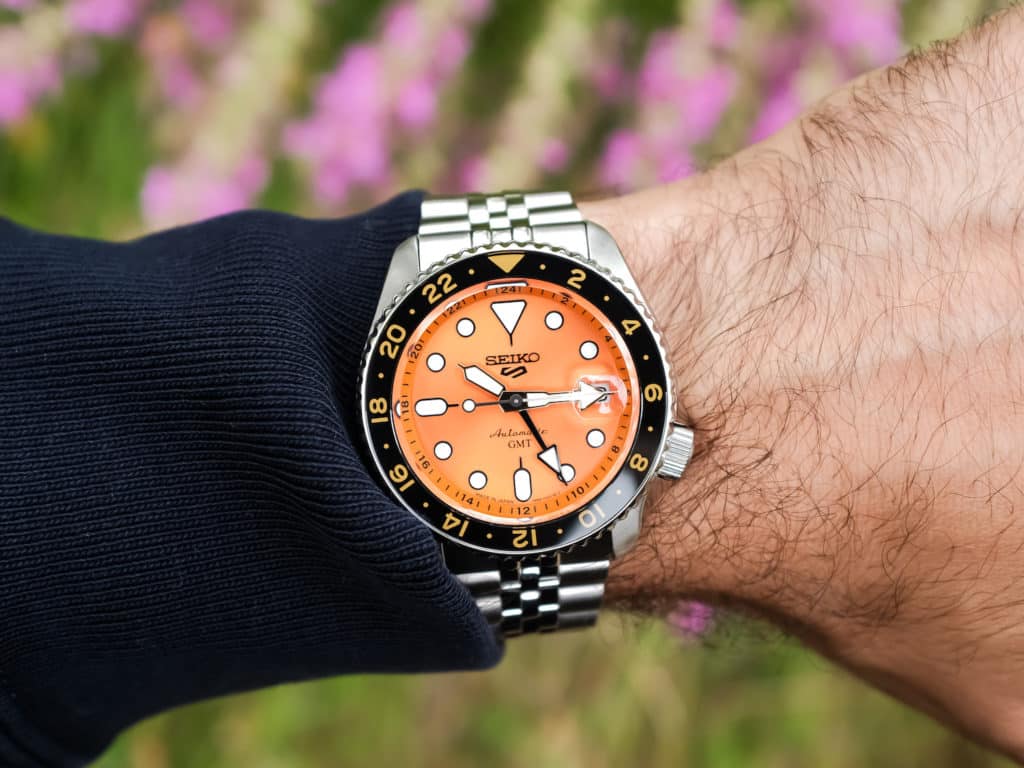
There’s a particular appeal to a mechanical GMT when the goal is to put some distance between yourself and your phone. The Seiko 5 GMT gives us a second time zone without making it feel like we’ve strapped a cockpit instrument to the wrist. During our review period, the 4R34’s caller-GMT setup proved useful for keeping an eye on family overseas, checking work hours in another country, or having a rough idea of what time it is before making a questionable international phone call. Frequent travelers will still notice the limitation of having to adjust the GMT hand rather than the local hour hand, but the rotating 24-hour bezel adds a third time zone when we need it. More importantly, the complication fades into the background when we don’t need it.
The orange sunray dial does a lot of the heavy lifting. It shifts noticeably as the light changes, giving the watch more depth than the photographs suggest, but never becomes so flashy that it gets in the way of a glance. The glossy black GMT hand, gilt hands, black surrounds around the applied markers, and generous Lumibrite give each element its own visual lane. We even stopped noticing the cyclops after a few days, which may be the highest compliment possible for a piece of magnifying glass that tends to divide watch enthusiasts into opposing camps. The 42.5mm case also behaves better than its dimensions indicate. Its rounded profile, softened lugs, and 46mm lug-to-lug keep it feeling more compact on the wrist, while the Jubilee-style bracelet stays comfortable through long days despite its lightweight, slightly jangly construction.
The compromises are familiar Seiko territory. The push-pull crown and 100m water resistance look modest beside the expectations set by older Seiko divers, although our testing never left us feeling the watch was fragile, and independent pressure testing suggests more real-world resilience than the specification alone implies. The rotating bezel is smooth rather than crisply indexed, and the stamped clasp feels basic for the money. Bracelet sizing with the pin-and-collar system is another small ceremony we could have lived without, while some wrists will never forgive those polished center links.
Still, the Seiko 5 GMT makes sense for someone who wants the mechanical experience of a traditional watch and the practical benefit of another time zone, without turning the wrist into another source of digital noise. Our Seiko 5 GMT review goes deeper into how those choices played out on the wrist.
Pros
- The 4R34 GMT complication adds travel utility without making the watch cumbersome day-to-day.
- The rotating 24-hour bezel adds a useful third-time-zone option.
- The orange sunray dial, gilt hands, and black GMT hand create plenty of visual depth while keeping the display readable.
- Lumibrite and the contrasting handset make quick checks easy.
- The lightweight Jubilee remains comfortable over long stretches despite its rattly, budget-friendly feel.
Cons
- The smooth bezel lacks the firm, indexed action some enthusiasts expect.
- The stamped clasp feels basic.
- Pin-and-collar sizing makes bracelet adjustment more tedious than normal.
- Polished center links will not appeal to everyone.
- The caller-GMT setup is less convenient for frequent international travel than a flyer GMT.
Citizen Promaster Aqualand JP2007-17W
| Price: | $550 – $595 (Check current price) |
| Water Resistance: | 200m |
| Case Dimensions: | 50.7mm (diameter) x 51mm (lug-to-lug) x 14.8mm (thickness) |
| Lug Width: | 24mm |
| Movement: | Citizen C520 Quartz |
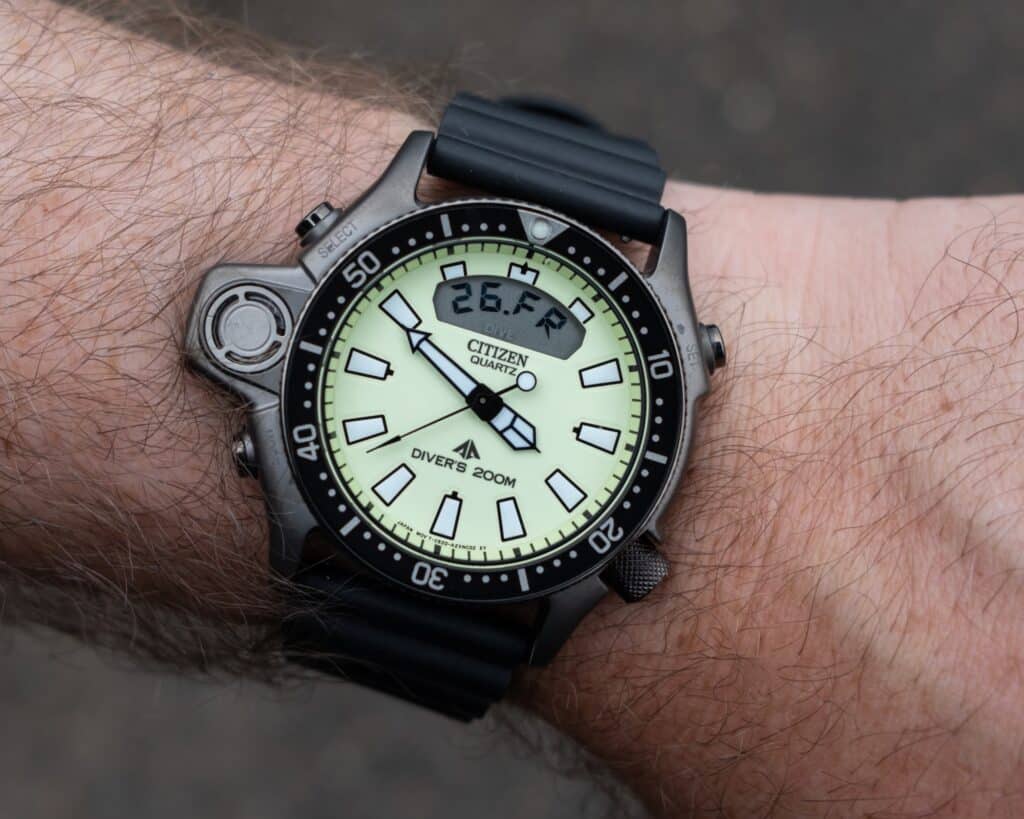
The Aqualand is probably the easiest watch on this list to explain to someone who thinks digital minimalism means owning a beige three-hander and becoming suspicious of buttons. It has a depth sensor sticking out of the case, dive logging, ascent alarms, depth warnings, an analog display, and a digital module doing plenty of its own work. None of it is trying to be clever for the sake of being clever. After living with it beyond the first impression, the ridiculous-looking bits gradually became the reason we liked it. The oversized case, broad 24mm strap, and external sensor all feel appropriate once you start treating the watch as an instrument rather than jewelry with a scuba-themed dial. It is a lot of watch, but at least it has the decency to have a job.
That job doesn’t end when we climb out of the water. The digital side handles alarms, timing, and calendar functions, giving the watch useful everyday duties. The quartz movement also feels completely right here. A mechanical movement might make the collector part of our brain happier, but the Aqualand is built around dependable information, not romantic notions about winding something because we can. We had the same experience with the controls. The first session involved enough button pressing to suggest we might have accidentally volunteered for a Citizen engineering internship, but the layout quickly became easier to navigate. The oversized crown was easy to use with wet hands, and the bezel stayed firm and aligned throughout our wear.
The fully lumed dial is another piece of the Aqualand puzzle. It stayed visible for hours, though lighting the entire dial naturally reduces contrast compared with watches that only light the hands and markers. The ventilated rubber strap was one of the nicer surprises: soft, secure, and comfortable despite the watch’s size. The 24mm lug width puts a fairly strict ceiling on strap experimentation, and smaller wrists may find the overall footprint too much. That’s fair.
The Aqualand isn’t trying to be universally wearable. For someone leaving behind a smartwatch because they want information with a purpose rather than a stream of interruptions, this is the extreme end of the argument: one very focused dive instrument, a handful of useful functions, and absolutely no interest in becoming another glowing rectangle.
Pros
- The depth sensor, dive logs, ascent alarms, and depth warnings make the digital functionality purposeful.
- The analog and digital displays divide underwater and everyday duties without needing a connected device.
- Quartz suits the Aqualand’s instrument-first personality and keeps operation dependable.
- Firm bezel action and an oversized crown make the physical controls practical when things get wet.
- The ventilated rubber strap is more comfortable and secure than the watch’s enormous footprint might suggest.
Cons
- The overall size can overwhelm smaller wrists, and there is no disguising how much watch is here.
- Full-dial illumination reduces contrast compared with conventional hand-and-marker lume.
- A 24mm lug width severely limits strap-swapping options.
Citizen Promaster Navihawk 40

| Price: | $595 (Check current price) |
| Water Resistance: | 200m |
| Case Dimensions: | 40mm (diameter) x 44.3mm (lug-to-lug) x 13.4mm (thickness) |
| Lug Width: | 20mm |
| Movement: | Eco-Drive caliber B620 |
The Navihawk 40 is a good answer to the part of smartwatch ownership we actually like: having useful functions on the wrist. It gives us a chronograph, slide rule, and plenty of aviation-inspired information without a touchscreen, notifications, or an app waiting to steal five minutes of our lives. Over the course of our review, we used the chronograph for coffee, workouts, parking meters, and other small jobs that usually go to a phone. The 40mm case helps, too. With a 44.3mm lug-to-lug, it keeps the unmistakable Promaster personality without wearing like airport equipment strapped to your wrist.
The dial looks busy until we spend some time with it. Textured black subdials break up the silver-white sunburst surface, while restrained red accents help direct the eye. Even the slide rule eventually stops looking like a punishment from math class. Citizen gets the case treatment right as well, pairing broad brushing with polished accents, a sapphire crystal, and 200m water resistance. But the recessed date window is the frustrating exception; it takes far too much effort to read.
The Eco-Drive B620 keeps the rest of the experience simple, with roughly ±15 seconds per month accuracy and about six months of runtime from a full charge. The bracelet also earned more wrist time than expected, balancing the case nicely, although the lack of on-the-fly adjustment is a missed opportunity. Our review sample had some vertical bezel play, but it never affected everyday use.
And that sums up the Navihawk 40 nicely. It gives us plenty to do when we want to interact with the watch, then goes quiet when we don’t. For anyone escaping smartwatch burnout but unwilling to give up multifunction convenience, that makes far more sense than replacing one attention-hungry gadget with a watch that does nothing.
Pros
- 40mm sizing and 44.3mm lug-to-lug make it easy to wear all day.
- Chronograph and slide-rule functions offer useful functionality without a connected screen.
- Eco-Drive delivers roughly ±15 seconds per month accuracy and around six months of power reserve.
- The sapphire crystal and 200m water resistance ensure you don’t have to baby it.
- The bracelet balances the case well and proves comfortable.
Cons
- No on-the-fly bracelet adjustment.
- Some vertical bezel play on our sample.
- The deeply recessed date is unnecessarily awkward to read.
Farer World Timer Roché II
| Price: | $1,775 (leather strap); $1,795 (stainless steel bracelet) (Check current price) |
| Water Resistance: | 100m |
| Case Dimensions: | 39mm (diameter) x 45mm (lug-to-lug) x 11mm (thickness) |
| Lug Width: | 20mm |
| Movement: | Sellita SW330-1 Elaboré |
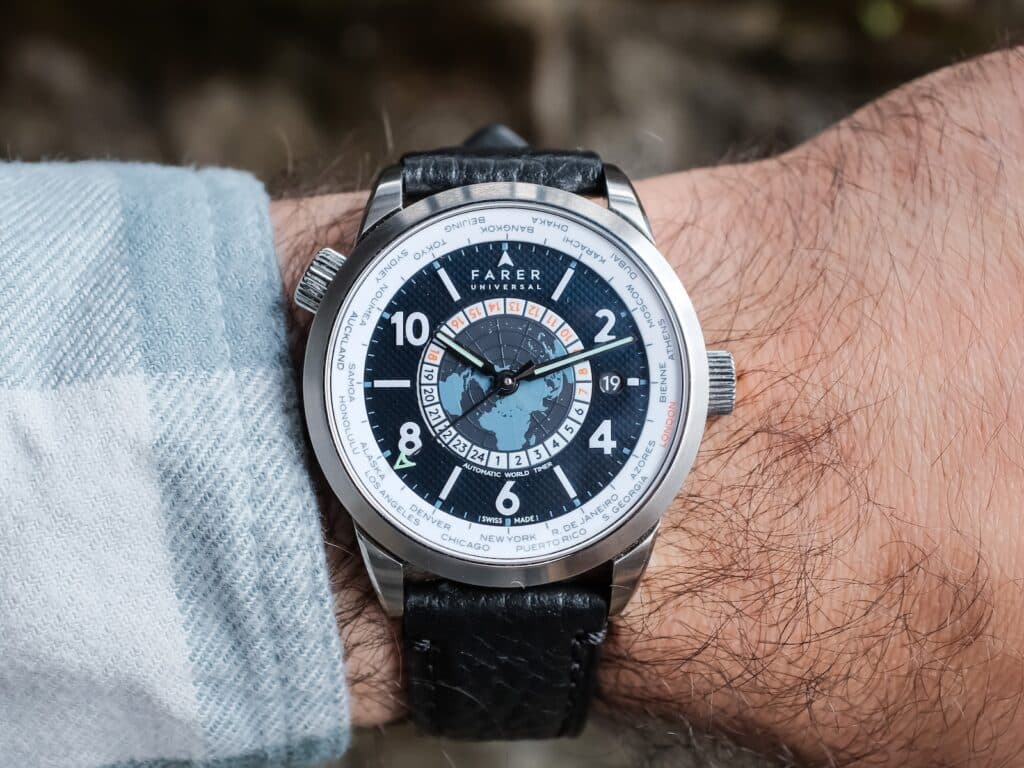
The Farer Roché II is for the tech-light wearer who has figured out that world time is the one smartwatch function they actually miss. Rather than replacing that functionality with a simpler watch, Farer leans into it and somehow keeps the result wearable. The 39mm case sits flatter than expected, slips under a cuff, and feels sturdy enough for normal life without becoming something we’re afraid to put down on a café table. With 100m of water resistance, it doesn’t need kid-glove treatment either.
The midnight-blue dial is doing a lot, but Farer gives each part its own territory. The textured surface separates the rotating 24-city ring from the rest of the display, while raised markers and redesigned alpha hands keep the important information readable. We needed a few days before the rotating 24-hour disc and inner bezel stopped feeling like something we had to decode consciously. Once that happened, the system became natural.
The lume also deserves credit: hands, markers, and inner bezel all stay useful after dark, which is exactly what we want when a travel complication has to function somewhere other than a well-lit desk. The modified Sellita SW330 adds mechanical romance along with a 50-hour power reserve, so leaving the watch off for a couple of days doesn’t immediately turn the next wear into a reset session.
The St. Venere leather strap is another reason the Roché II feels like a watch we’d keep wearing rather than merely admire. It softens quickly, stays comfortable on smaller wrists, and the quick-release setup makes moving to the bracelet painless. The bigger compromise is the price, followed by the dial itself. A lot is happening here, and anyone committed to visual restraint may look at the 24-city ring and quietly ask for a simpler life. For the rest of us, though, it offers something a smartwatch does very well—instant access to global time—without bringing notifications, charging cables, or a glowing screen along for the ride. Our dedicated review of the Farer World Timer Roché II gets deeper into the details.
Pros
- The 39mm case wears flatter and more comfortably than the amount of information suggests.
- World-time functionality gives you a reason to look at the watch beyond checking the hour.
- Lume across the hands, markers, and inner bezel remains effective after dark.
- The modified Sellita SW330 offers a useful 50-hour power reserve.
- The St. Venere leather breaks in quickly and works well on smaller wrists.
- Quick-release hardware makes switching between the leather strap and bracelet straightforward.
Cons
- The 24-city ring and inner bezel remain visually busy even after you’ve learned the layout.
- The world-time system has a short learning curve before it becomes intuitive.
- It costs more than many simpler mechanical travel watches.
Nomos Zürich World Time
| Price: | $6,870 (Check current price) |
| Water Resistance: | 30m |
| Case Dimensions: | 40mm (diameter) x 50mm (lug-to-lug) x 11mm (thickness) |
| Lug Width: | 20mm |
| Movement: | DUW 5201 |
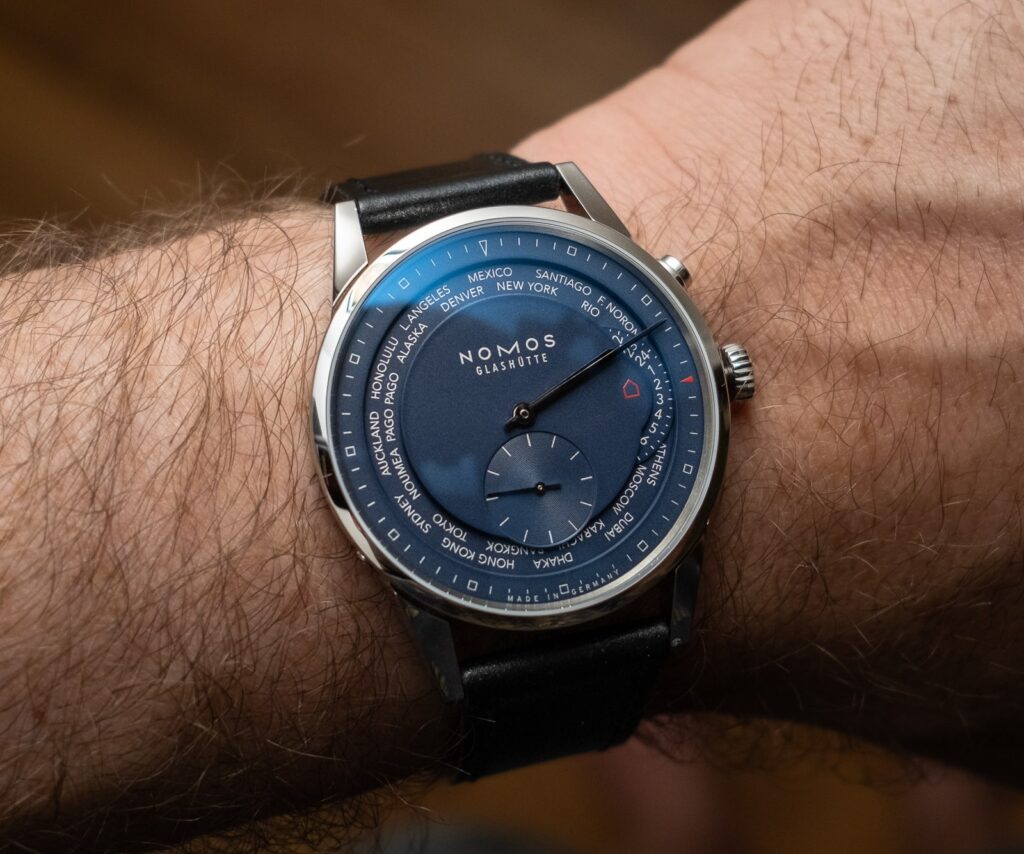
The clever bit about the Zürich World Time is that we don’t have to think very hard about using it. The pusher at 2 o’clock advances local time in one-hour jumps while home time stays put on the 24-hour subdial. While we had it in for review, that turned changing time zones into a thumb press instead of a small ritual involving the crown, mental arithmetic, and the inevitable second-guessing. Nomos calls it a world timer, although we found ourselves treating it more like a well-mannered GMT. For anyone stepping away from a smartwatch but still missing the instant convenience of changing time zones, that distinction matters less than the fact that it simply works.
The rest of the watch is equally disciplined and premium. The midnight-blue dial moves between navy and cooler steel tones as the light changes, while the city ring has enough breathing room that we never felt like we were reading a subway map on our wrist. Rhodium-plated hands stay easy to follow, and the little red home-time indicator is the sort of detail we appreciated more after using it than we expected to. It remained easy to spot under bright office lighting and in the murky conditions of an aircraft cabin. Nomos’ in-house DUW 5201 powers it, delivering steady performance and a claimed 42-hour reserve. Leaving it off for a day didn’t send us straight for the crown, which suited the whole low-fuss experience.
The 40mm case is slim enough to keep things balanced, although those long lugs give it more reach than the number indicates. Medium wrists should be fine; smaller ones may find the footprint a little optimistic. The fully polished surfaces also tend to collect hairline scratches, so this isn’t the watch we’d choose for wrestling with furniture. On the flipside, the shell cordovan strap is much easier to get along with. It broke in quickly, stayed comfortable for long stretches, and didn’t spend the day demanding adjustment.
Overall, the Nomos Zürich World Time isn’t trying to mimic a smartwatch’s information overload. It makes one genuinely useful function easy to use, and leaves the rest of the wrist alone.
Pros
- The 2 o’clock pusher makes local-time changes fast and intuitive when traveling.
- The red home-time indicator stays easy to spot in bright offices and dim cabins.
- The shell cordovan strap breaks in quickly and stays comfortable through long days.
- The DUW 5201 offers steady performance with a claimed 42-hour power reserve.
- The midnight-blue dial changes character in different light without losing its composure.
Cons
- The extended lugs make the 40mm case wear larger than expected on smaller wrists.
- Fully polished surfaces pick up fine scratches with relatively little effort.
Smartwatch burnout doesn’t have to mean giving up useful things on the wrist. After spending time with these watches, we kept coming back to the same conclusion: an alarm, a second time zone, a stopwatch, a temperature reading, or even serious dive data can be genuinely handy when the watch gives us that information and then leaves us alone.

Co-Founder and Senior Editor
Kaz has been collecting watches since 2015, but he’s been fascinated by product design, the Collector’s psychology, and brand marketing his whole life. While sharing the same strong fondness for all things horologically-affordable as Mike (his TBWS partner in crime), Kaz’s collection niche is also focused on vintage Soviet watches as well as watches that feature a unique, but well-designed quirk or visual hook.