Dive watches have a way of pretending legibility is a given. Big bezel, chunky hands, some lume, done. Then you wear enough of them in bad lighting, under glare, on rubber that never sits right, or during the kind of lazy weekend timing job no ISO standard was written for, and the weak ones start making themselves known. This list exists to sort out the best dive watches for collectors who actually care about legibility — not the loudest divers, not the most expensive ones, and not the ones that look toughest in a product photo.
Ten years of reviewing watches has taught us that legibility is rarely one single feature. It’s the way the hands separate from the dial, how much visual clutter the bezel adds, whether the case shape helps the watch sit where your eyes expect it to, and whether the whole thing still makes sense after the honeymoon week is over. The watches here come from reviews we’ve already spent time with, from blunt military pieces and familiar Seiko/Citizen workhorses to collector-grade divers that still remember they’re supposed to be readable. Some are cheap, some very much are not, and a few carry enough enthusiast baggage to require their own emotional support NATO. But they all belong in the conversation because clarity is part of why they matter.
Casio Duro
| Price: | $85 |
| Water Resistance: | 200m |
| Case Dimensions: | 44.2mm (diameter) x 48.5mm (lug-to-lug) x 12.1mm (thickness) |
| Lug Width: | 22mm |
| Movement: | Casio 2784 Quartz |
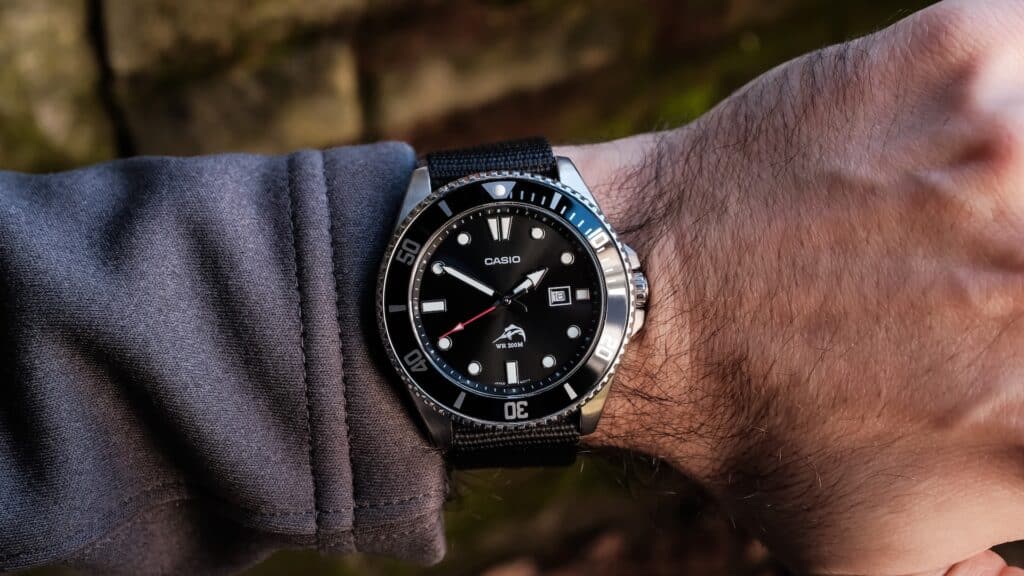
The Casio Duro earns its spot here because it does the legibility thing without making a personality disorder out of it. Large dial, bold markers, reflective arrow-style hands, restrained text, and a framed date at three o’clock all work together in a way that feels unbothered. There is very little visual nonsense to fight through, which is exactly what you want from a dive watch you might grab for swimming, travel, yard work, or the kind of day where the watch gets knocked around, and nobody writes a dramatic forum post about it afterward.
The case is where the Duro feels more substantial than its price suggests, though not without caveats. At 44mm, it is a big watch, and collectors with smaller wrists should be honest with themselves. The shorter lug-to-lug span and downward-curving lugs help it sit better than expected, especially if you’re already comfortable with something in the Seiko Turtle neighborhood. The finishing stays simple but not careless, with brushed upper surfaces, polished sides, and a small bevel that gives the case some shape. The 22mm lug width also makes it easy to throw on rubber, nylon, or a bracelet, depending on how much abuse you have planned.
As a tool-ish budget diver, the Duro has the right practical setup: 200m of water resistance, a screw-down crown, and a solid caseback. The bezel also helps the watch feel less cheap than it is, turning with a controlled, deliberate action instead of the loose, rattly feel that can show up on inexpensive dive-style watches. That said, the flat mineral crystal is one of the expected compromises. It keeps the price friendly, but it won’t resist scratches like sapphire. The lume is another trade-off: useful early, not exactly a sunrise-to-sunrise performance piece.
The quartz movement is part of the appeal, even if it won’t make mechanical purists misty-eyed. In our hands-on review, it ran within ±20 seconds per month. It hacks and includes a quick-set date, which makes ownership wonderfully low-effort. Leave it on the dresser, pick it back up, and move on with your life—no winding ceremony required. The Duro is not romantic, rare, or especially collectible in the precious-object sense. It is a simple, readable, water-ready watch that proves a low price does not have to mean a dial full of compromises.
Pros
- Clean, high-legibility dial with bold markers, reflective hands, restrained text, and a framed date.
- 200m water resistance, screw-down crown, and solid caseback make it easy to trust it around water.
- Quartz movement is accurate, low-maintenance, hacks, and has a quick-set date.
- The bezel action feels controlled and deliberate for the price.
- 22mm lugs give it plenty of strap flexibility across rubber, nylon, and bracelet options.
Cons
- The 44mm case will be too large for some wrists.
- Lume fades earlier than we’d like.
Orient Mako II
| Price: | $160 – $220 |
| Water Resistance: | 200m |
| Case Dimensions: | 41.5mm (diameter) x 47mm (lug-to-lug) x 13mm (thickness) |
| Lug Width: | 22mm |
| Movement: | Orient Caliber F6922 (Mechanical Movement) |
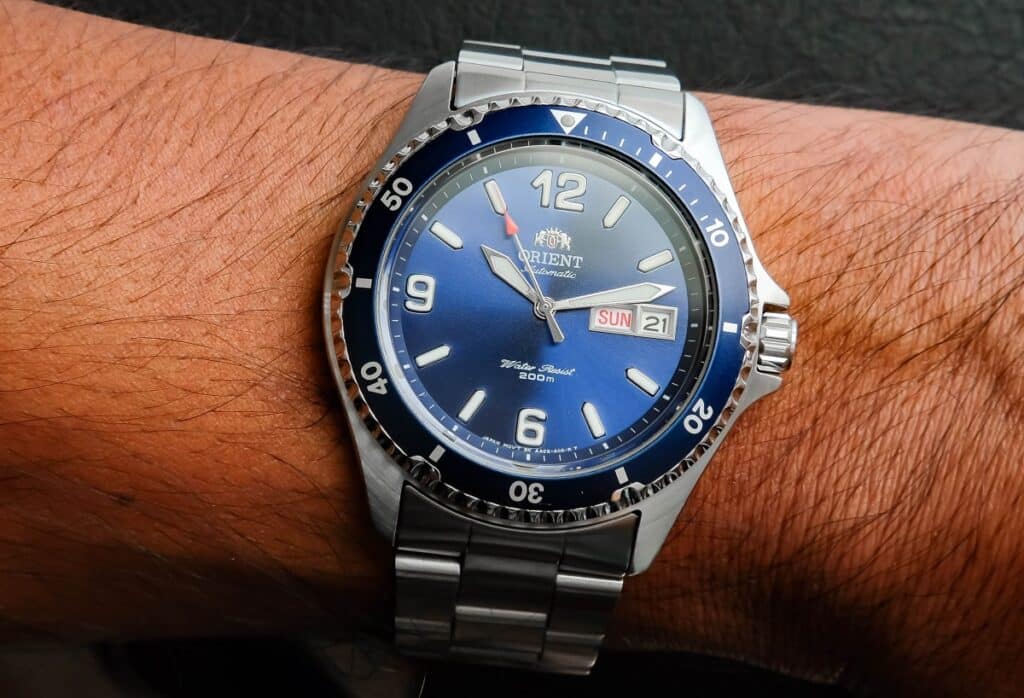
The Orient Mako II belongs here because it gives collectors a clean, easy-reading mechanical diver without making the whole experience feel precious. The dial has enough character from the sunburst finish to avoid looking flat, but it doesn’t get in the way of quick time checks. Applied markers, polished hand accents, a framed day-date window, and that red-tipped second hand all add small visual cues without turning the dial into a budget-watch carnival. For daily wear, that restraint matters more than another fake “vintage-inspired” font ever will.
On the wrist, the Mako II keeps its case in check. At 41.5mm, with a compact lug-to-lug, it wears flatter and more securely than many affordable divers that confuse size with seriousness. It doesn’t feel top-heavy, and the brushed lugs, polished case sides, and cleaner case-to-bracelet transition make it feel more finished than the price suggests. This is also where it becomes useful for collectors still figuring out what fits them. You get enough diver presence, but not so much that the watch starts steering your arm like a small boat.
The functional bits are solid, with a few honest limits. The 120-click bezel feels firm and controlled once it’s moving, though the sloped edge can be less intuitive to grip than a chunkier coin-edge bezel. The bracelet feels secure in normal use, and the clasp does its job, but the hollow end links are noticeable when you’re handling the watch off-wrist. The lume is fine for quick low-light checks, but it fades sooner than stronger dive-watch lume, so this isn’t the one we’d pick if nighttime visibility is the whole mission.
The F6922 automatic movement helps the Mako II feel like a proper entry point into mechanical divers rather than a compromise you immediately start apologizing for. Hacking and hand-winding make ownership easier after the watch has been sitting for a few days, sparing you the old shake-it-awake ritual that never felt as charming as people claimed. It’s not a fancy movement, but it gives new collectors the right kind of mechanical experience: simple, usable, and not fussy. As a legible, budget-conscious diver, the Mako II works because it stays calm, readable, and practical.
Pros
- Sunburst dial, applied markers, polished hand accents, framed day-date, and red-tipped second hand add character without hurting legibility.
- 41.5mm case and compact lug-to-lug help it sit flat and avoid feeling top-heavy.
- F6922 in-house movement offers hacking and hand-winding for easier daily use.
- 120-click bezel feels firm and controlled once it is engaged.
- The bracelet feels secure, and the clasp holds up well during normal wear.
Cons
- The sloped bezel edge can be awkward to grip.
- Lume works for quick checks but does not last as long as stronger dive-watch options.
- Hollow end links are noticeable when handling the watch off the wrist.
Orient Ray II
| Price:: | $160 – $220 |
| Water Resistance: | 200m |
| Case Dimensions: | 41.5mm (diameter) x 47mm (lug-to-lug) x 13mm (thickness) |
| Lug Width: | 22mm |
| Movement: | Orient Caliber F6922 (Mechanical Movement) |
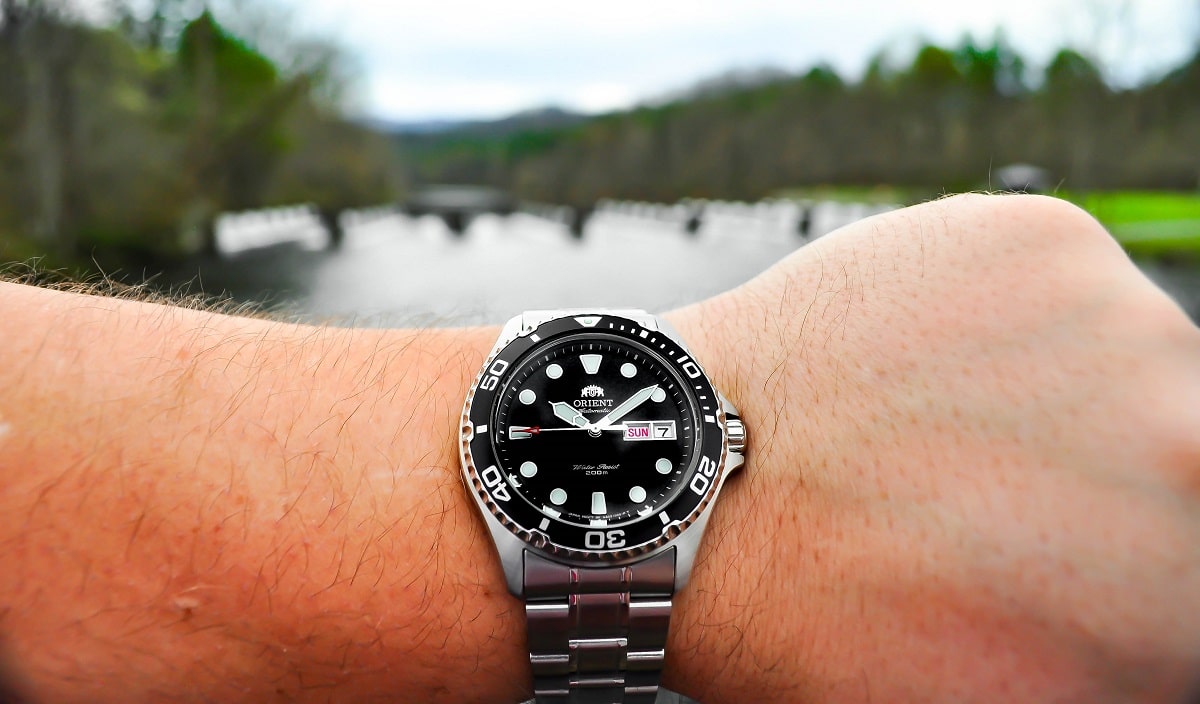
The Orient Ray II takes the Mako formula and makes the legibility argument a little more obvious. The matte black dial, round chrome-edged indices, and trapezoidal quarter-hour markers give it a classic diver layout without sanding off all the Japanese character. The chromed sword hands stand out cleanly, the hour hand has a slight arrow-like shape, and the red-tipped second hand adds a small hit of contrast with a lumed end. Add the framed split day-date window, applied logo, printed name, and that tiny red dot on the shield, and the dial has detail without becoming a cluttered little aquarium.
It also has better low-light usefulness than many affordable divers. As covered in our detailed review, the bright green lume holds up quite well, making the Ray II more convincing if legibility after sunset matters. The surrounding chapter ring adds depth, but it doesn’t crowd the markers, which helps the whole dial stay easy to parse at a glance. Compared with the Mako II’s calmer layout, the Ray II feels more direct: bolder marker language, stronger dive-watch cues, and fewer moments where your eyes have to negotiate with the dial.
The case helps the watch stay wearable rather than turning into a desk-diving appliance. Its proportions leave little wasted space, the softened edges keep it from feeling slabby, and the downward-curving lugs help it sit naturally on the wrist. Brushed top surfaces, polished sides, and the dolphin caseback give it enough personality when it’s off the wrist. However, the mineral crystal is still the predictable compromise if you scrape watches against door frames. The old 2 o’clock screw-down day-correction pusher is gone on this second-generation Ray, which cleans up the case and makes daily use simpler, even if some Orient weirdness enjoyers may miss it.
The F6922 in-house automatic movement is a practical upgrade, with hacking, hand-winding, 22 jewels, a claimed -15 to +25 seconds per day, and about 40 hours of power reserve. The tactile parts are where the Ray II gets cranky. The 120-click bezel has a polished ring, aluminum insert, and small lume pip at 12, but the low coin edge and slightly tucked-in position can make turning it a fingernail project. Bezel feel can also vary from smooth to stubborn. The crown looks nice with its engraved Orient logo, but it is small, polished, guarded, and not very grippy. The stock bracelet is usable, with a secure clasp, but the hollow 22mm end links and 20mm taper still feel broader than the watch’s dressier side wants. NATO, leather, or a better aftermarket bracelet can make the whole thing click.
Pros
- Matte black dial, chrome-edged markers, sword hands, and red-tipped second hand make the time easy to read quickly.
- Bright green lume gives it stronger low-light usefulness than expected from this kind of affordable Orient diver.
- Removing the old 2 o’clock day pusher makes the case cleaner and the daily setup simpler.
- Soft case edges, brushed tops, polished sides, and downward-curving lugs help it wear neatly.
Cons
- The small polished crown is hard to grip, especially with the crown guards crowding it.
- The bezel grip is awkward, and the action can vary a lot between examples.
- Mineral crystal is more scratch-prone than sapphire.
- The stock bracelet is just okay, with hollow 22mm end links and a taper that still feels wide.
Citizen Promaster Diver BN0151
| Price: | $250 – $300 |
| Water Resistance: | 200m |
| Case Dimensions: | 43mm (diameter) x 48mm (lug-to-lug) x 11.5mm (thickness) |
| Lug Width: | 20mm |
| Movement: | Citizen Eco-Drive E168 (solar quartz) |
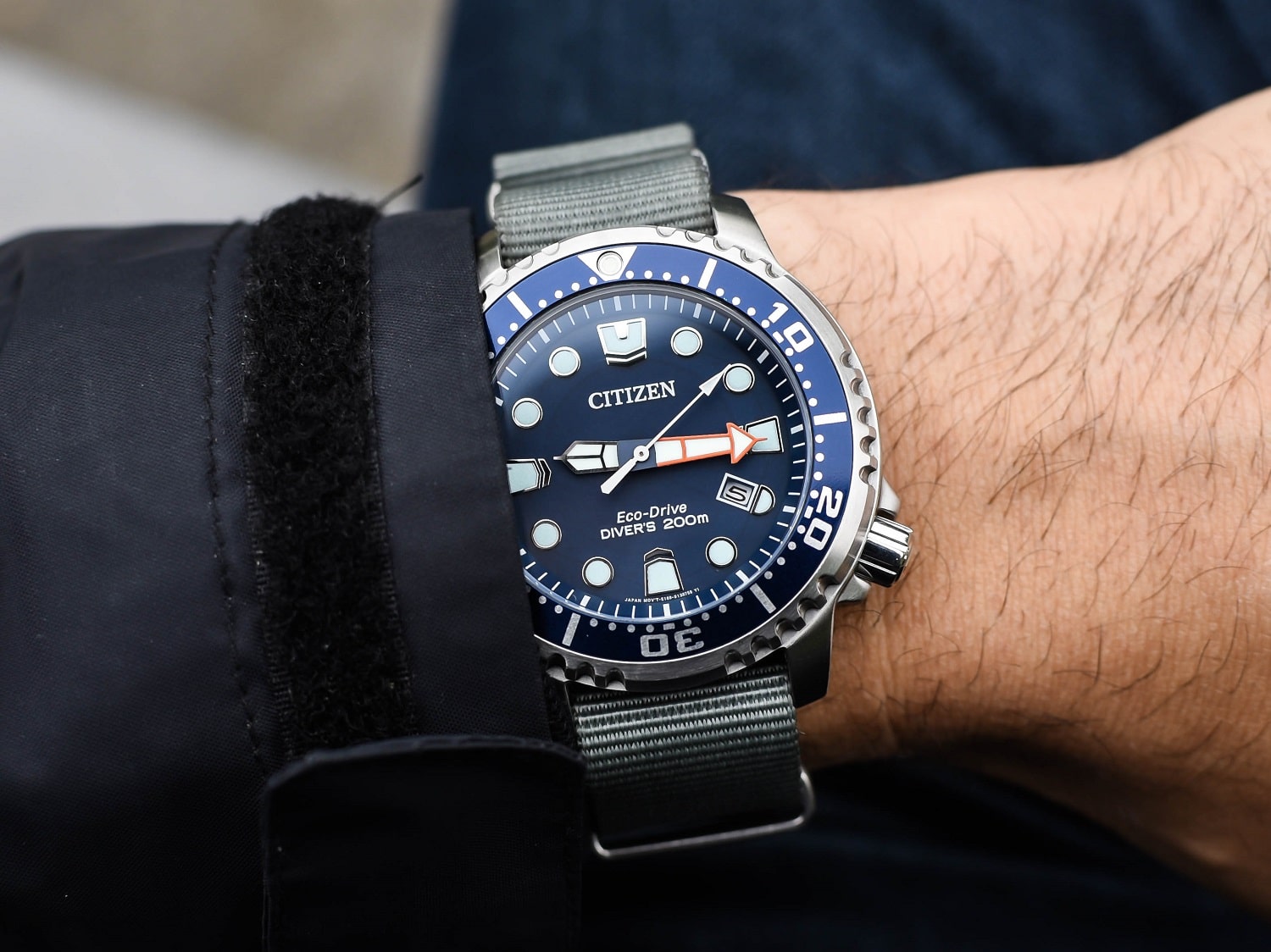
The Citizen Promaster Diver BN0151 makes a strong legibility case by refusing to overcomplicate the job. Big hands, clear markers, restrained dial furniture, and a framed date give you the kind of read-at-a-glance layout collectors sometimes overlook because the watch is too common, too practical, or not surrounded by enough collector mythology. The blue dial adds a slight purple shift from certain angles, which gives it some life without turning the display into a magic-eye poster. In daylight, the hands and markers are easy to catch quickly; in low light, the aqua-toned lume stays visible for hours, and the lumed second-hand pip is a useful little confirmation that the watch is still running.
The case also helps the BN0151 work as a daily-wear diver rather than a spec-sheet lump. At 43mm, it sounds large, but the short lug-to-lug distance and downward-curving profile keep it secure and less sprawling than expected. It also wears lighter than the dimensions imply, almost titanium-like in how little it nags at you over a full day. The 4 o’clock crown stays out of the wrist’s way, which matters when a watch is meant for travel, swimming, beach days, or the usual weekend nonsense where “desk diver” becomes “why is there sand in the bezel?”
The practical hardware mostly backs up the dial’s no-drama personality. You get 200m of water resistance, a case that feels ready for rougher use, and a 60-click bezel that stayed aligned and turned with a deliberate feel during our hands-on review of the watch. The downside is grip: when wet, the bezel can get slick, which is not ideal for a dive watch unless we’ve all agreed water is now an advanced-use scenario. The mineral crystal is another compromise. Sapphire would be better, but during extended wear, it performed better than expected and avoided obvious scratching.
The Eco-Drive movement is what makes the BN0151 so easy to keep in rotation. Once charged, we saw about six months of runtime, with accuracy around ±15 seconds per month. There’s no winding, no routine battery swap, and no resetting every time the watch sits for a few days. We only triggered the low-power indicator once, and a short session in the light brought it back without drama. The stock polyurethane strap works for the tool-watch brief, though it starts stiff and needs break-in time. On NATO, the watch felt more balanced, more casual, and easier to wear for hours. It is not the flashiest diver here, and some collectors may find it too plain. Still, for visibility, durability, comfort, and low-maintenance ownership, the BN0151 is quietly hard to argue with.
Pros
- Big hands, clear markers, restrained dial text, and framed date make it easy to read quickly.
- Aqua-toned lume stays visible for hours, with a useful lumed pip on the second hand.
- Eco-Drive movement offers about six months of runtime, ±15 seconds per month accuracy, and very little upkeep.
- 200m water resistance and a sturdy case make it easy to trust for swimming, travel, and rougher daily use.
- 43mm case wears comfortably, thanks to the short lug-to-lug, downward-curved profile, light feel, and 4 o’clock crown.
Cons
- The bezel grip can get slippery with wet hands.
- The stock polyurethane strap starts stiff and needs time to soften.
- The restrained design may feel too plain for collectors chasing something louder.
Citizen NY0040
| Price: | $250 – $350 |
| Water Resistance: | 200m |
| Case Size: | 42mm (diameter) x 47.3mm (lug-to-lug) x 12.6mm (thickness) |
| Lug Width: | 20mm |
| Movement: | Miyota automatic Caliber 8204 |
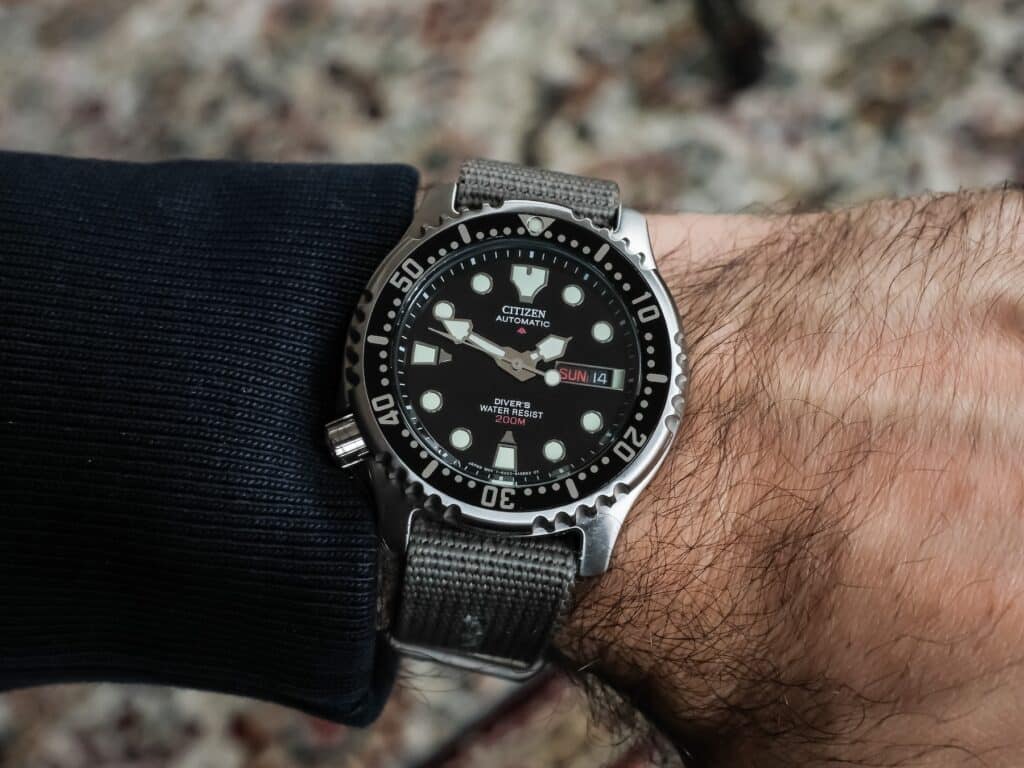
The Citizen NY0040 gives this lineup an enthusiast-focused automatic diver with ISO-rated tool-watch credibility that doesn’t need to be dragged into another SKX-shaped argument. Its appeal is more direct: a clear black dial, readable markers, obvious hands, and a tool-watch layout that prioritizes quick reading over luxury-watch subtlety. The plain “Citizen Automatic” text under twelve keeps the top half clean, the small red arrow adds character without clutter, and the day-date at three blends in better than expected thanks to the darker background and lighter text. The lume is dependable rather than dramatic. It doesn’t blast as hard as some Seiko divers at first, but the hands and markers hold enough glow to stay useful once your eyes adjust.
The case brings the same practical energy. It’s nearly 42mm, but the just-over-47mm lug-to-lug, restrained thickness, compact dial opening, inward-sloping bezel, and shorter visual footprint help it wear smaller than the numbers suggest, even around a 6.75-inch wrist. There’s reassuring density without bulk, and the brushed upper surfaces, polished flanks, broad tooth-like shoulders, and slight skin-diver warmth keep it from feeling like a generic slab. The left-side crown looks odd for about five minutes, then starts making sense because it doesn’t dig into your hand. Right-handed users may need a short adjustment period when setting or winding it, but the comfort payoff is real.
The bezel is one of the NY0040’s better tactile arguments. The coin edge is easy to grip with wet fingers, the 60-click action on our reviewed example felt smooth and confident, the alignment was dead-on, and there was no noticeable wobble or slack between clicks. The aluminum insert suits the watch’s functional personality, and the 200m water resistance text near six feels earned rather than decorative. This is the kind of diver we’d feel comfortable swimming with, snorkeling with, or casually abusing near saltwater without turning the whole thing into a ceremony.
Inside, the Miyota 8204 adds the kind of mechanical usability collectors should care about: hacking and hand-winding, with fair accuracy expectations for an affordable automatic. The rotor is loud because Miyota rotors enjoy making themselves known like a tiny wrist-mounted roommate. The flat mineral crystal is another compromise compared with sapphire, though not a disaster in normal wear. The stock thick rubber strap works, but it isn’t the charming part of the watch. Easy strap changes and strong aftermarket bracelet support help a lot, and on a NATO, the NY0040 feels more relaxed, balanced, and honest.
Pros
- Clear black dial, readable markers, practical lume, and simple text make it quick to read.
- The case wears smaller, thanks to the compact dial opening, inward-sloping bezel, restrained thickness, and just-over-47mm lug-to-lug.
- Left-side crown improves comfort during typing, driving, and extended wear.
- Easy strap changes and strong aftermarket bracelet support make it simple to improve the wearing experience.
- Coin-edge bezel offers strong wet-finger grip, smooth 60-click action, clean alignment, and no noticeable play.
- Miyota 8204 movement adds hacking and hand-winding for easier daily use.
Cons
- Right-handed users may need time to adjust to the left-side crown.
- Miyota rotor noise may annoy wearers who prefer quieter automatics.
- Lume is useful, though not as immediately punchy as some Seiko divers.
Orient Kamasu
| Price: | $250 – $375 |
| Water Resistance: | 200m |
| Case Dimensions: | 41.5mm (diameter) x 47mm (lug-to-lug) x 13mm (thickness) |
| Lug Width: | 22mm |
| Movement: | Orient F6922 (automatic movement) |
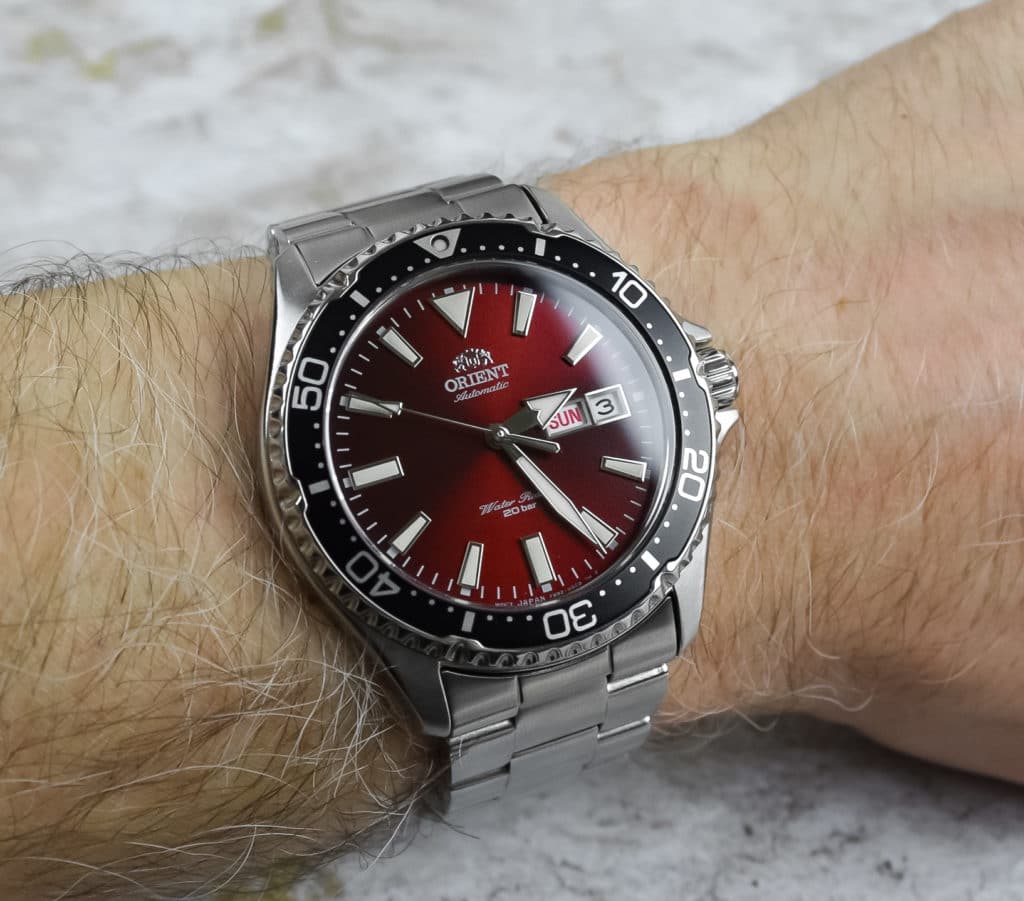
The Orient Kamasu brings more dial personality than the Mako II or Ray II, but it still keeps the important stuff readable. The wine-red sunburst dial has enough movement to feel alive on the wrist, yet the applied indices and properly sized hands keep the time easy to catch quickly. The minute and second hands reach cleanly toward the outer track, which sounds like a small thing until you wear watches where they don’t and suddenly feel like you’re decoding a decorative coaster. The framed day-date window is neatly handled, the Orient logo stays proportionate, and the whole dial has depth without turning into a distraction. Minimalists may find the color a little loud, but the layout itself is doing real work.
Low-light performance is one of the Kamasu’s stronger practical arguments. In our testing, the lume charged quickly, glowed brightly, and held up well against many Seiko divers we’ve spent time with. Paired with 200m of water resistance and a sapphire crystal, it gives the watch a more durable, daily-ready feel than many affordable mechanical divers. The aluminum bezel insert is still a wear point and will pick up scratches more easily than ceramic or steel, but the bezel action itself felt tight without becoming stiff.
On the wrist, the 41.5mm case, curved lugs, and roughly 13mm thickness keep the Kamasu comfortable and balanced. It doesn’t wear top-heavy or slabby, and the brushed case surfaces look clean and consistent. The bracelet fits the general tool-watch brief with a fully brushed finish, a secure feel, and four micro-adjust positions that help when your wrist decides to become a different wrist by mid-afternoon. The clasp and end links are less polished than the rest of the package, which shows Orient left a receipt for the budgeting department.
The in-house F6922 movement rounds out the Kamasu as a practical collector’s diver rather than a spec flex. Hacking and hand-winding make it easy to restart and set after time off the wrist, and accuracy stayed within expected tolerances during our review period. The crown operation felt smooth, though the crown itself is small and can be hard to grip with the guards around it. For enthusiasts who want strong markers, clear hands, real daily durability, and a bit of color without sacrificing readability, the Kamasu still makes a very convincing argument.
Pros
- Applied indices, well-sized hands, and clean hand reach make the dial easy to read quickly.
- Wine-red sunburst dial adds character and depth without overwhelming the layout.
- Lume charges fast, glows brightly, and holds up well.
- Sapphire crystal and 200m water resistance improve daily durability.
- F6922 movement adds hacking and hand-winding for easier ownership.
- Bracelet feels secure and includes four micro-adjust positions for better day-to-day fit.
Cons
- The small crown can be difficult to grip, especially with the crown guards.
- Clasp and end links feel less refined than the rest of the watch.
- The aluminum bezel insert is more prone to scratches than ceramic or steel.
Timex Deepwater Meridian 200
| Price: | $259 |
| Water Resistance: | 200m |
| Case Dimensions: | 44mm (diameter) x 50.5mm (lug-to-lug) x 12.5mm (thickness) |
| Lug Width: | 20mm |
| Movement: | Seiko Epson VX42E |
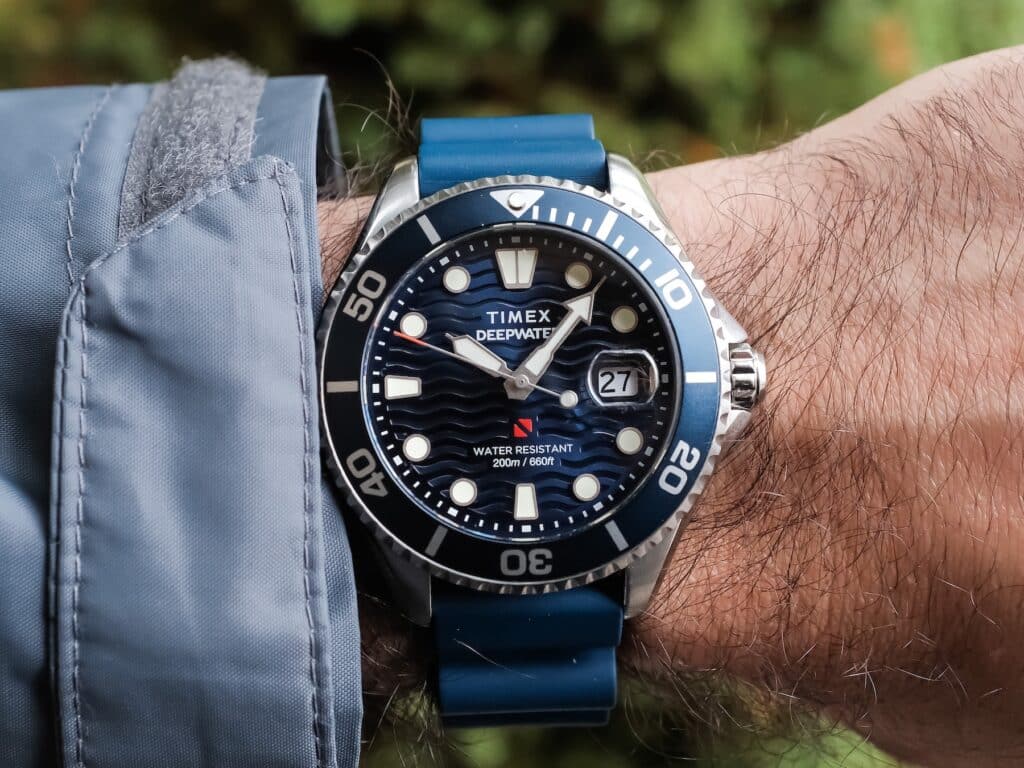
The Timex Deepwater Meridian 200 brings big modern diver energy without burying the time under too much styling. The matte blue wave dial, applied indices, and red diver’s flag at 12 o’clock give it enough personality to avoid feeling anonymous, but the layout stays clean and quick to read. The hands and markers carry Super-LumiNova, which works well for low-light checks around sunset, indoors, or after dark. It does fade sooner than we’d like, so this is useful lume rather than “found it glowing in the sock drawer at 4 a.m.” lume.
The date magnifier will probably be the thing people argue about, because watch people need hobbies within the hobby. In use, though, it stayed clear and didn’t interfere with the rest of the dial. That matters for this topic because the Meridian 200 is strongest when you treat it as a straightforward, legible daily diver rather than a nostalgic tribute piece. It has some Sea-Dweller-style visual cues, but it avoids becoming fussy or too referential.
The case backs up that more serious direction from Timex. You get 200 meters of water resistance, a caseback, a screw-down crown, a sapphire crystal, and an anti-reflective coating, which gives the watch real confidence for pool days, saltwater, travel, and general abuse. At 44mm, it is not trying to be subtle, and smaller wrists may find it too large. Still, the curved lugs and 12.5mm thickness help it sit more comfortably than the diameter alone would imply, and it stayed manageable during longer stretches of wear while testing.
The Seiko Epson VX42E quartz movement keeps the ownership side simple, with a quick-set date and up to 3 years of battery life. The crown action was smooth in use, so setting the time and date didn’t become one of those tiny annoyances you only notice after the initial days. Overall, the Meridian 200 is not the most compact or longest-glowing diver here. Still, for someone who wants an affordable, readable, quartz-powered watch with legitimate water-ready hardware, it makes more sense than a lot of casual dive-style watches pretending to be tougher than they are.
Pros
- Matte blue wave dial, applied indices, and clear hands keep everyday legibility strong.
- Super-LumiNova offers useful visibility for low-light checks.
- Sapphire crystal, anti-reflective coating, 200m water resistance, screw-down crown, and screw-down caseback give it real diver substance.
- Seiko Epson VX42E quartz movement adds a quick-set date and up to 3 years of battery life.
- Smooth crown operation makes time and date adjustments easy.
Cons
- The 44mm case can feel too large on smaller wrists.
- Lume is helpful, but does not stay bright as long as we’d prefer.
- The date magnifier may not suit everyone’s taste.
Momentum Sea Quartz 30
| Price: | $279 |
| Water Resistance: | 300m |
| Case Dimensions: | 42mm (diameter) x 47mm (lug-to-lug) x 11.3mm (thickness) |
| Lug Width: | 20mm |
| Movement: | Ronda R507 high-torque quartz |
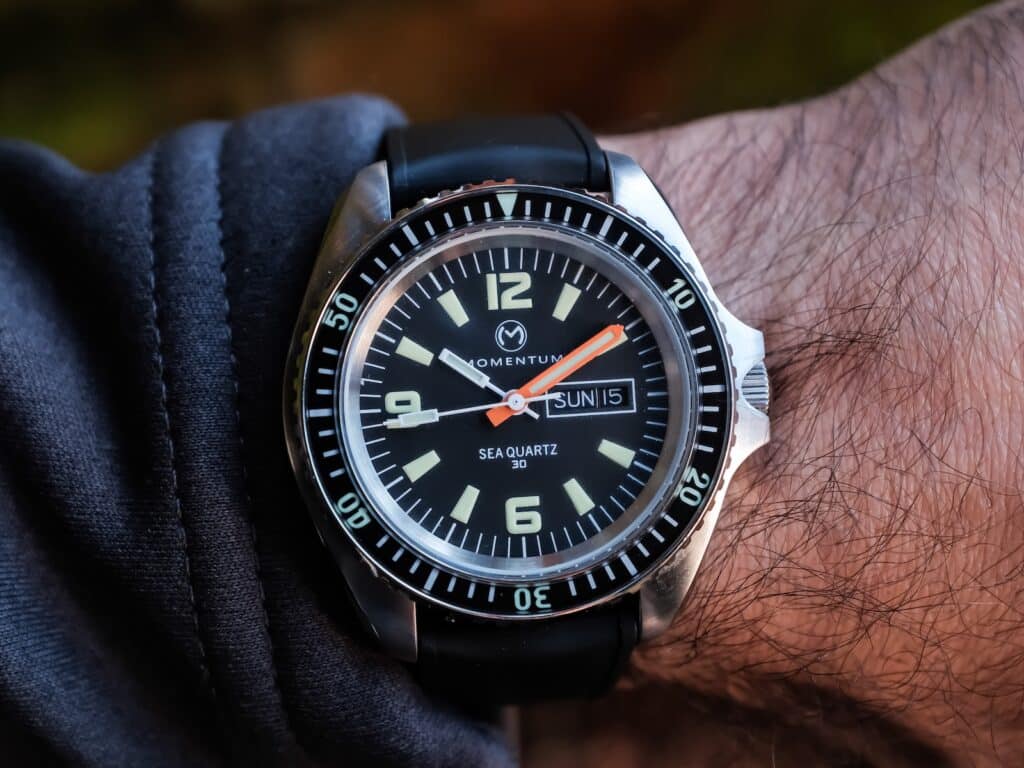
The Momentum Sea Quartz 30 handles legibility with a kind of quiet confidence that suits the watch. The matte black dial, printed markers, and paddle-style hands keep the display simple and fast to read, while the orange minute hand gives elapsed-time reading a useful visual anchor when you’re using the bezel. It has a late-’70s flavor, but not so much that the watch starts demanding you explain “period correctness” to unwilling relatives. The dial gets better with wear because it doesn’t ask much from you. Look down, read the time, move on.
Our hands-on testing experience found that the case has more presence than expected without becoming a chore. At 42mm across with a 47mm lug-to-lug, it stays balanced, though the shape gives it a broader stance than we first assumed. The flat caseback helps it sit planted and comfortable over longer stretches, and the brushed top surfaces with polished sides give the case definition without making it feel overdecorated. The polished underside and lugs do pick up scratches faster than we’d like, especially during strap changes, so the vintage-inspired charm does come with a little “please stop tinkering with spring bars” energy.
Momentum made a few practical updates that help the Sea Quartz 30 feel like more than a throwback. The sapphire bezel insert gives up a bit of old-school warmth, but it makes sense for daily durability. The Ronda quartz movement keeps ownership simple, accurate, and low-maintenance, which is useful if this is the watch you grab after it’s been sitting for a few days. Add 300 meters of water resistance, and it has far more capability than most of us will ever need unless the weekend plans get dramatically out of hand.
The weak point is the bezel. It is stiffer than it should be, not quite easy to grip, and a little too eager to remind you of itself when you’re timing something. Lume is similar: serviceable at first, but it fades earlier than stronger performers. Comfort is stronger than expected, though. The included tropic-style rubber strap worked well, and the watch also plays nicely with NATOs, other rubber straps, or Momentum’s jubilee-style bracelet if you want a more long-term setup. For collectors who want a readable, capable, affordable quartz-powered diver with some vintage flavor and not too much weird behavior, the Sea Quartz 30 makes a lot of sense.
Pros
- Matte black dial, printed markers, paddle hands, and orange minute hand make the watch easy to read quickly.
- 42mm case, 47mm lug-to-lug, flat caseback, and balanced stance keep it comfortable for longer wear.
- Ronda quartz movement makes ownership accurate, simple, and low-maintenance.
- 300m water resistance gives it serious practical capability.
- Sapphire bezel insert improves daily durability.
Cons
- The bezel is stiff and harder to grip than it should be.
- Polished underside and lugs pick up scratches quickly, especially during strap changes.
- Lume is usable at first, but fades sooner than stronger alternatives.
Seiko Turtle
| Price: | $370 – $525 |
| Water Resistance: | 200m |
| Case Dimensions: | 44.3mm (diameter) x 48mm (lug-to-lug) x 14mm (thickness) |
| Lug Width: | 22mm |
| Movement: | Seiko 4R36 |
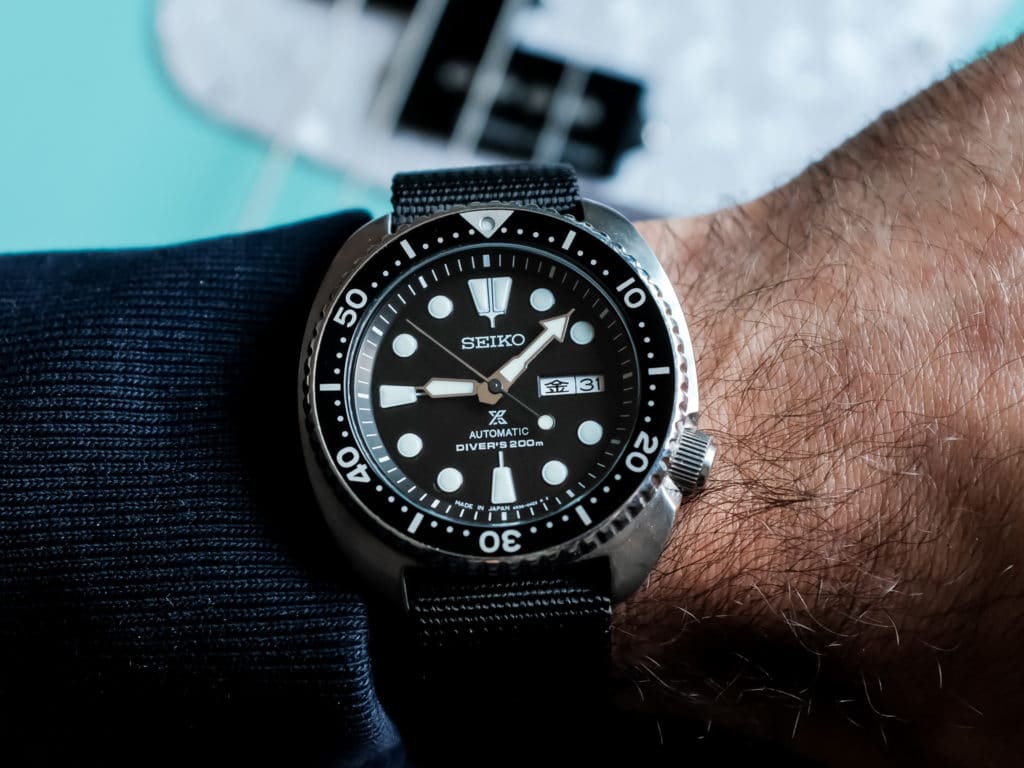
The Seiko Turtle makes the legibility argument in the most Seiko way possible: big Lumibrite markers, a matte black dial that cuts glare outdoors, and a handset you can read without negotiating with the watch first. The oversized plots are not there for decoration. They make the Turtle easy to check near water, outside in harsh light, or half-awake in the dark when your brain is still buffering. In low light, the Lumibrite gives the watch the kind of usefulness collectors expect from an affordable Seiko diver. The Prospex “X” gets its usual amount of online grumbling, but on the wrist, it tends to disappear unless you are actively looking for things to complain about. Which, to be fair, is also part of the hobby.
The case looks intimidating on paper because it sits over 44mm, but the cushion shape changes how it wears. Instead of feeling tall and clumsy, it spreads out with a broad, planted stance that works better than the dimensions imply, especially if your wrist already handles larger divers. The offset crown also makes a real difference over a full day because it stays out of the back of the hand when your wrist bends. Plenty of smaller watches somehow manage to be more annoying. The Turtle, in its big, rounded way, often settles in.
Straps matter here. The stock silicone strap is more usable than older Seiko rubber, soft enough that you don’t immediately start shopping for replacements out of spite. Still, the Turtle opens up on NATOs, where the cushion case feels more casual, more travel-ready, and better suited for beach days or general knockaround wear. Hardlex is the expected compromise for anyone who wants sapphire, but in normal use, it holds up acceptably and helps keep the watch approachable rather than precious.
The 4R36 automatic movement gives the Turtle hacking and hand-winding, which makes daily ownership much easier than older entry-level Seikos. Accuracy can vary, though; during our hands-on review, the watch ran around +35 to +45 seconds per day, which is manageable but not exactly a love letter to precision. Bezel action feels solid and reassuring, but alignment can differ from example to example. Some “Made in Japan” versions and Kanji day-wheel references add collector charm, though the Kanji display can slow down quick reading after the novelty fades. That’s the Turtle’s whole deal: readable, comfortable, imperfect, and still one of the defining affordable diver shapes for a reason.
Pros
- Matte black dial, bold handset, and large Lumibrite markers make it fast to read in daylight and low light.
- The cushion case helps the over-44mm dimensions wear more comfortably than expected.
- Offset crown improves long-wear comfort and avoids digging into the hand.
- 4R36 movement adds hacking and hand-winding for easier everyday ownership.
Cons
- Broad case presence may still be too much for smaller wrists or compact-diver fans.
- Kanji day wheel adds charm, but it can slow down quick reading.
- 4R36 accuracy and bezel alignment can vary depending on the example.
- Hardlex is serviceable but not as scratch-resistant as sapphire.
Seiko Samurai
| Price: | $400 – $500 |
| Water Resistance: | 200m |
| Case Dimensions: | 43.8mm (diameter) x 47mm (lug-to-lug) x 13mm (thickness) |
| Lug Width: | 22mm |
| Movement: | Seiko 4R35 (Mechanical) |
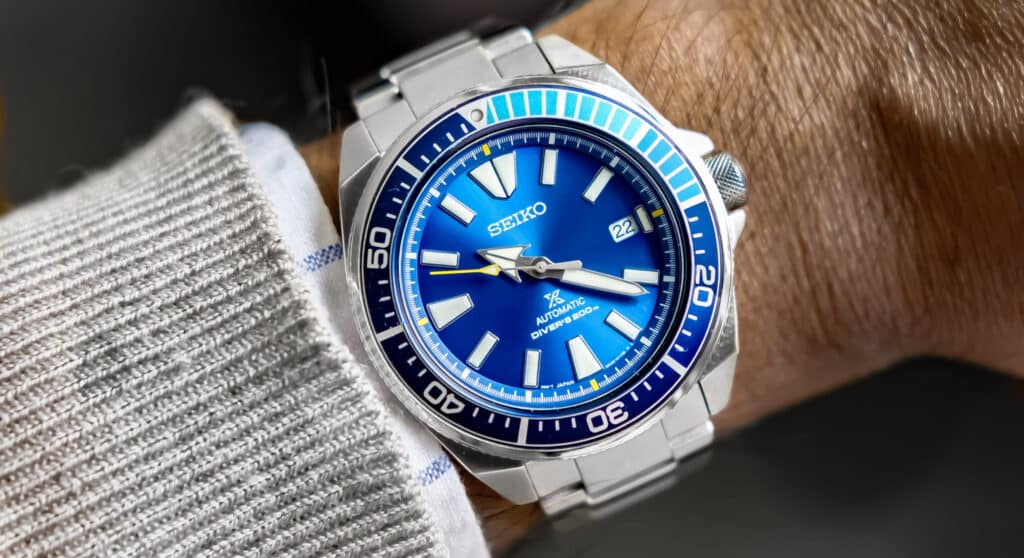
The Seiko Samurai brings a sharper visual language than the Turtle, but it doesn’t sacrifice the reason we’re talking about it here: legibility. The applied markers, strong Seiko lume, and bold Monster-style hands give the dial enough contrast to work at a glance, even with the blue finish shifting between lighter and darker tones depending on the light. Those hands are a little divisive in isolation, but in this case, they make sense. They match the angular personality and keep the watch from becoming another polite diver with no opinions.
The case is the Samurai’s main character trait. Stainless steel, hard-brushed planes, crisp transitions, and deep shadow lines make it feel more modern and severe than the softer SKX and Turtle shapes. On paper, that geometry sounds like it might wear like a tiny shingle, but in our hands-on testing experience, the case hugged the wrist better than expected. It still has presence, and the sharp geometry may show scratches and wear less gracefully than a rounder Seiko case, but that is part of the trade-off. You get a tougher, more faceted look rather than a carefree cushion-case beater.
The bracelet deserves credit because it doesn’t feel like an immediate placeholder. The 22mm bracelet gives the case enough visual support, the case-to-end-link flow is clean, and our example wore securely and comfortably for the category. Drilled lugs are still a welcome touch if you want to experiment with straps, but we didn’t feel the usual instant need to throw it on a NATO and pretend that was the plan all along.
The bezel and crown keep the tool-watch side intact. Sloped crown guards protect the screw-down crown while still leaving it easy to grip, and the coarse knurling suits the Samurai’s no-nonsense feel. The bezel has the same bold knurled character and a firm, confident action, though our example was very stiff to turn. Inside, the 4R35 automatic movement keeps things familiar with hacking, hand-winding, and a 40-hour power reserve. Accuracy expectations should stay realistic, because this is not the movement you buy to win spreadsheet arguments. The Samurai is for collectors who want Seiko diver legibility with more angles, attitude, and wrist presence than the rounder classics.
Pros
- Applied markers, strong Seiko lume, and bold Monster-style hands keep legibility high.
- The angular brushed case feels tough, distinct, and more modern than softer Seiko diver shapes.
- Sloped crown guards protect the screw-down crown while keeping it easy to use.
- The stock bracelet integrates well with the case and feels comfortable for the category.
- Drilled lugs ensure easy strap changes.
Cons
- The bezel action on our example was very stiff.
- Sharp case geometry may show scratches and wear less gracefully than rounder Seiko divers.
Nodus Sector Deep
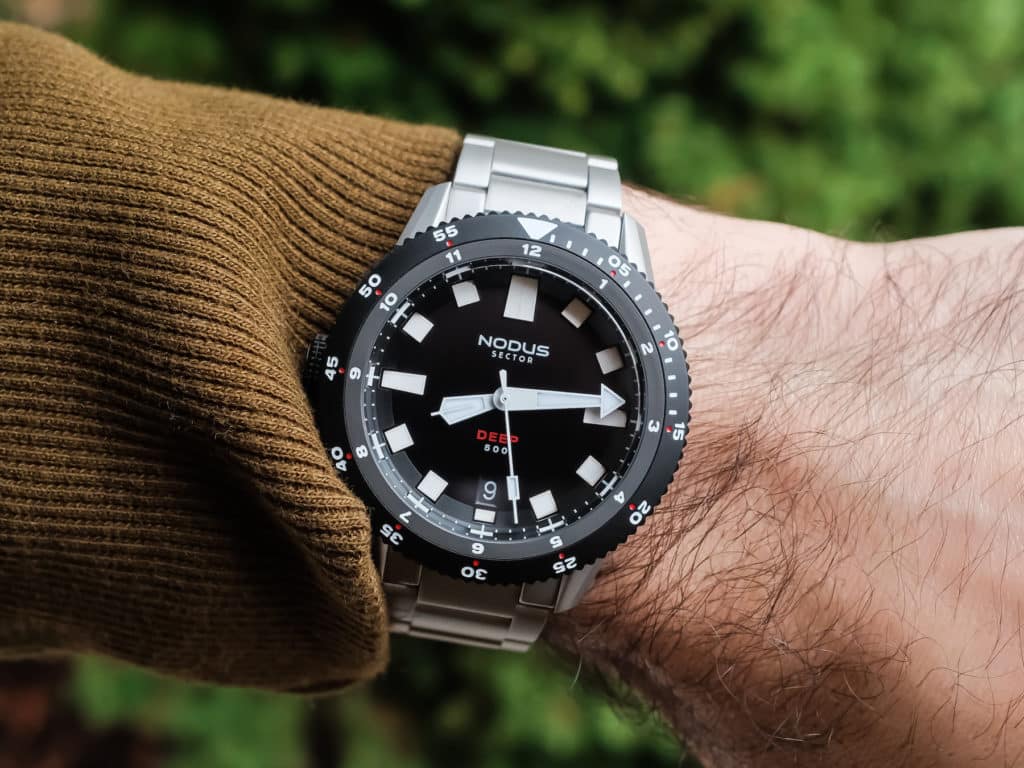
| Price: | $599 |
| Water Resistance: | 500m |
| Case Dimensions: | 38mm (diameter) x 47mm (lug-to-lug) x 13.6mm (thickness) |
| Lug Width: | 20mm |
| Movement: | Seiko NH35 (Mechanical Movement) |
The Nodus Sector Deep takes the modern microbrand route without turning the dial into a design exercise. The white PVD surrounds catch light cleanly, while the lume-filled centers taper toward the cardinal points and give the dial a subtle domed effect when viewed straight on. More importantly, the layout stays readable. Nothing feels crowded, and the markers hold their shape clearly enough for quick checks. In low light, the BGW9 Super-LumiNova held up well during our hands-on review and remained legible through the night, which is the kind of quiet flex we prefer over a dial that only looks good at noon.
The 38mm case is a big part of why the Sector Deep works as a real daily diver. It sits low, balanced, and planted instead of wearing like a miniaturized tool-watch prop. The left-side crown also earns its keep after a long day because it avoids wrist bite and makes the watch easier to forget about in the best way. The asymmetrical layout is practical, though not everyone will find it conventionally handsome. That’s the trade.
The matte DLC bezel keeps the capability-first personality intact. It cuts glare, has enough grip to feel useful when your hands are busy, and the dual-scale setup adds timing flexibility without making the watch look like a cockpit instrument. Inside, the Seiko NH35 is the right kind of practical choice, especially because Nodus regulates it in-house. Our samples hovered around ±10 seconds per day, and the 41-hour reserve makes it easy to rotate without feeling like the watch needs constant attention.
The bracelet continues the same utility-first thinking. Screw links make sizing straightforward, the 20mm-to-18mm taper keeps the clasp from feeling oversized, and the NodeX micro-adjustment system is truly useful when heat, activity, or a long day changes your wrist size. The only visual hiccup is that when the clasp is fully extended, some hardware becomes visible and interrupts the otherwise clean design. Still, the Sector Deep reads as a capable, comfortable, legible microbrand diver rather than a decorative collector piece with a depth rating.
Pros
- Clean dial layout, white PVD surrounds, and tapered lume-filled centers keep the watch easy to read.
- BGW9 Super-LumiNova stayed legible through the night in our testing.
- Matte DLC bezel cuts glare, grips well, and adds useful dual-scale timing.
- Screw-link bracelet, 20mm-to-18mm taper, and NodeX clasp make fit and sizing easy.
- Left-side crown avoids wrist bite and improves daily comfort.
Cons
- Exposed clasp hardware when fully extended disrupts the otherwise clean look.
- Asymmetrical case layout is practical but may not suit traditional tastes.
Seiko Sumo
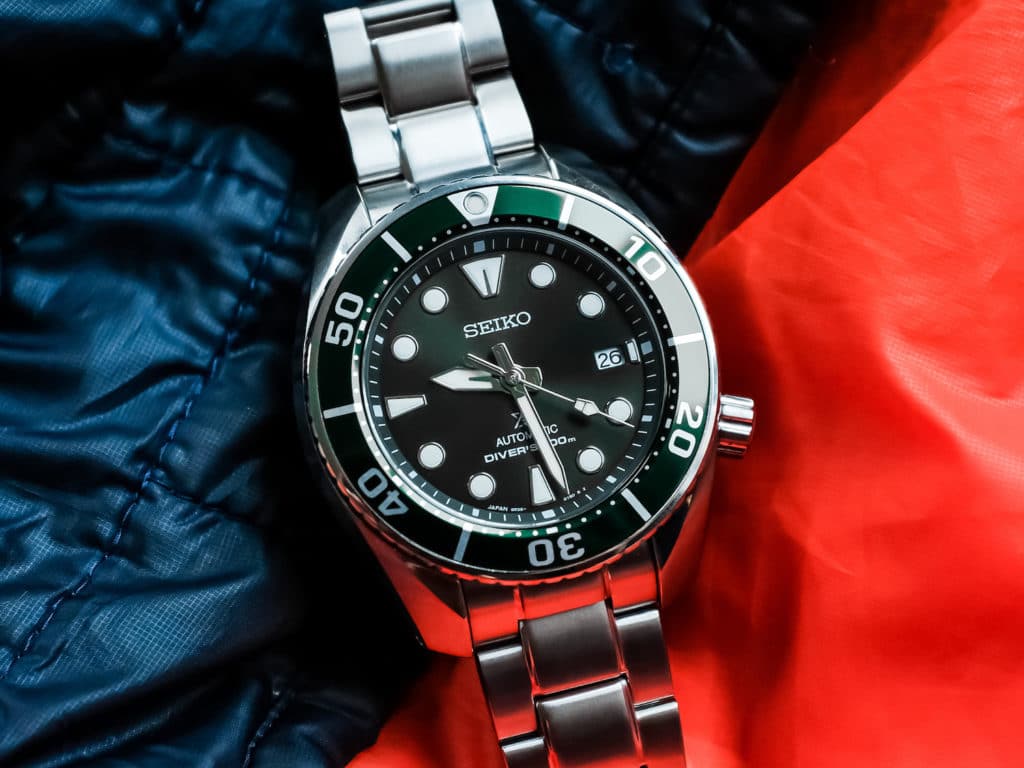
| Price: | $600 – $800 |
| Water Resistance: | 200m |
| Case Dimensions: | 45mm (diameter) x 52.6mm (lug-to-lug) x 13.5mm (thickness) |
| Lug Width: | 20mm |
| Movement: | 6R35 (Automatic Movement) |
The Seiko Sumo is one of the bigger Seiko divers that still keeps the dial doing the right kind of work. Large applied markers, bold hands, strong hand-to-dial contrast, and a purposeful layout make it easy to read quickly, even on the blue “Blumo” variant, where the dial shifts from deep and muted to brighter and more vibrant depending on the light. The beveled chapter ring helps structure the dial and pulls the eye inward without crowding the display. It has more visual polish than a Turtle, but it does not forget that a dive watch should be readable before it starts acting sophisticated.
The 45mm case sounds like a warning from a watch forum, but the Sumo wears with more control than the number implies. The long, sweeping lug-to-lug curve and rounded mid-case help it sit naturally, especially on larger wrists. It has presence, no question, but it avoids the blocky, steel-coaster feeling that can make large divers miserable after the first hour. Smaller wrists may still find it too much, though. In short, curves help, but they do not perform miracles.
Finishing is where the Sumo starts feeling more versatile than a pure knockaround diver. The 200m water resistance, screw-down crown, and solid caseback give it proper tool-watch credibility, while the brushed and polished surfaces make it easier to wear outside beach-and-shorts mode. The polished edges catch light nicely, and the brushed areas keep the whole thing from looking too shiny. It is still a Seiko diver, but one that can clean up a bit without pretending it owns a yacht.
While testing, our review team found that the bracelet is solid and matches the case well with brushed tops and polished sides. That said, the proportions can look a little odd because the lug width feels narrow for a watch this large. Strap pairing also takes more patience than it should, since the spacing between the case and lugs means not every strap fills the gap cleanly. NATOs tend to work well if you want a different personality, but the stock bracelet remains the most coherent setup. Inside, the 6R35 adds hacking, hand-winding, and roughly 70 hours of power reserve, giving the Sumo a practical ownership edge. Depending on pricing, it can land in an awkward middle ground among Seiko divers, but for collectors who want size, legibility, and a more refined case personality, it still has a clear reason to exist.
Pros
- Large applied markers, bold hands, and strong contrast make the dial easy to read quickly.
- Blue “Blumo” dial adds depth and light play without hurting legibility.
- 6R35 movement adds hacking, hand-winding, and around 70 hours of power reserve.
- The 45mm case wears better than expected thanks to the curved lugs and rounded, balanced profile.
- 200m water resistance, screw-down crown, and solid caseback give it real diver credibility.
Cons
- Smaller wrists may still find the 45mm case too large.
- Lug width can look narrow relative to the case size.
- Strap pairing can be tricky because of the gap between the case and lugs.
Gavox Avidiver
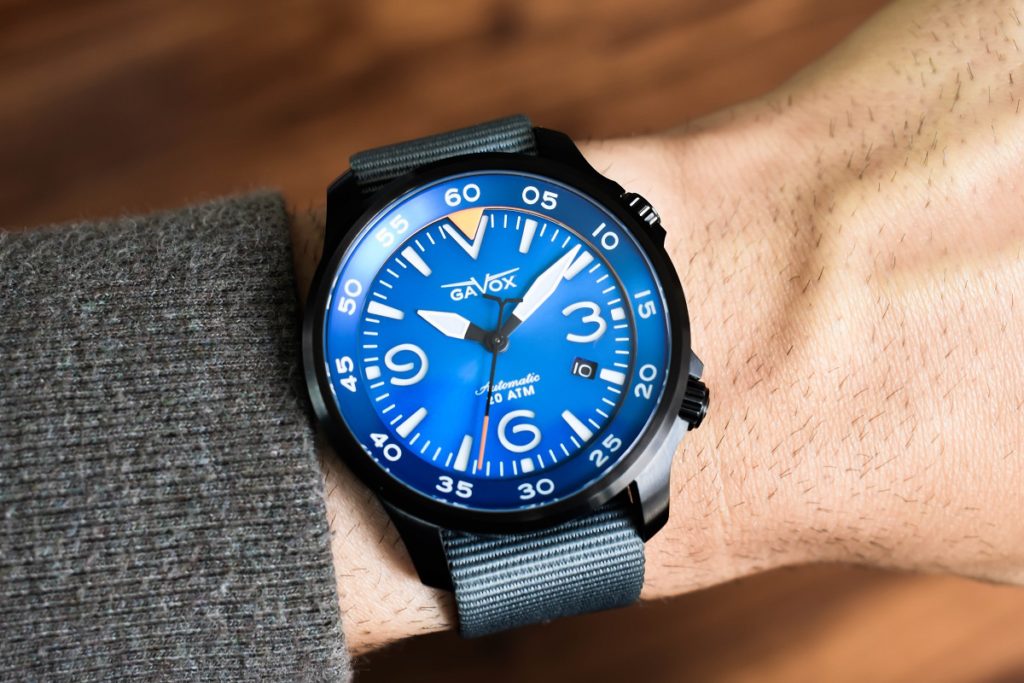
| Price: | $685 – $800 |
| Water Resistance: | 200m |
| Case Dimensions: | 43mm (diameter) x 50.8mm (lug-to-lug) x 12.8mm (thickness) |
| Lug Width: | 22mm |
| Movement: | Miyota 9015 (Automatic) |
In this list, the Gavox Avidiver is the oddball in a good way: part pilot watch, part diver, and much more readable than that combination often deserves to be. The high-contrast markings and large sword hands make time checks fast, while the layered dial adds depth without burying the information. Gavox also went heavy on lume coverage, and in our testing, it charged quickly and stayed visible well into the night. That makes the Avidiver feel less like a category-blurring novelty and more like a proper tool watch that happens to have aviation habits.
The internal rotating triangle is the feature that sneaks up on you. Controlled by the crown at two, it works well for elapsed time, short reminders, and general timing tasks that don’t need a full external dive bezel. It also keeps the case profile cleaner, which helps the watch feel more streamlined on the wrist. The small date at four stays out of the way, doing the useful thing without waving for attention like some date windows do when they get lonely.
The brushed 316L stainless steel case helps the legibility story by cutting reflections and keeping the whole watch visually subdued. At 43mm, the Avidiver sounds large, and the longer lug-to-lug may still push it out of range for smaller wrists. But the 12.8mm thickness, curved lugs, and integrated rubber strap help it sit lower and more securely than expected. The twin-crown layout feels purposeful rather than decorative, and with 200 meters of water resistance, the watch has enough dive-watch credibility to back up the name.
The Miyota 9015 did what we wanted it to do: run consistently across multiple examples and wind smoothly enough to make interaction pleasant. The only annoyance came when moving between winding and setting positions, where the crown action could feel sticky. The exhibition caseback adds a little visual interest, with a rotor logo that nods to the aviation side of the design. The integrated silicone strap deserves credit, too. It is soft, flexible, light, and keeps the watch stable without pressure points. It also collects dust and lint, because apparently, comfort cannot exist without one small punishment. Check out our personal testing insights for a deeper dive.
Pros
- High-contrast markings and large sword hands make the dial quick to read.
- Generous lume coverage charges quickly and stays visible well into the night.
- Internal rotating triangle adds useful timing flexibility beyond dive-specific use.
- Brushed 316L steel case reduces reflections and supports the tool-watch feel.
- Soft integrated silicone strap keeps the watch comfortable and stable.
Cons
- Crown action can feel sticky when moving between winding and setting positions.
- The longer lug-to-lug size may not work for smaller wrists.
- The rubber strap attracts dust and lint easily.
CWC SBS Diver
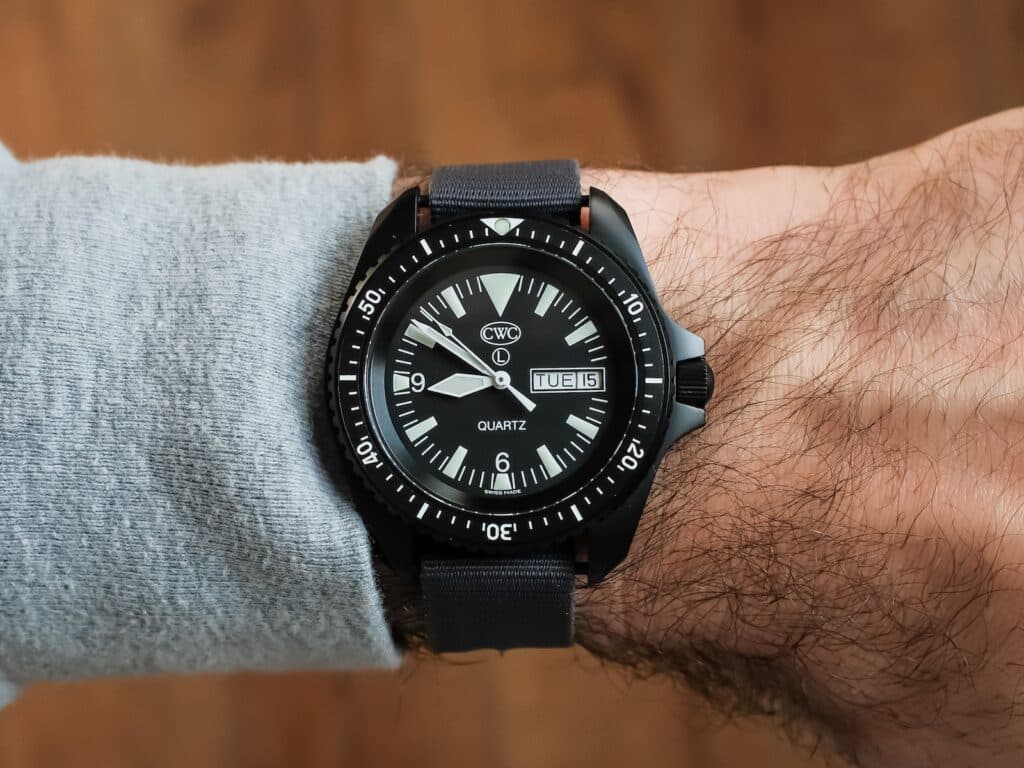
| Price: | $960 |
| Water Resistance: | 300m |
| Case Dimensions: | 45mm (diameter incl. crown) x 47mm (lug-to-lug) x 11mm (thickness) |
| Lug Width: | 20mm |
| Movement: | Ronda Swiss-made 517 quartz |
The CWC SBS Diver makes its legibility case in a very military-watch way: it doesn’t try to charm you first. The dial can look a little busy on first glance, but once you stop inspecting it and start using it, the layout settles down. Oversized hour markers and sword hands do the heavy lifting, making quick checks easy when you’re moving, outside, or in low light. The flat crystal also helps more than it gets credit for, keeping glare under control during longer outdoor wear. That is the kind of detail that sounds boring until the sun hits the wrong watch and you’re suddenly dodging reflections instead of reading the time.
The lume reinforces that use-first attitude. The “circle L” marking points to Luminova, and in our time with the watch, it charged quickly and stayed visible through most of the night. It is not decorative glow-for-the-photo stuff; it supports the whole point of the watch. The black PVD case keeps the visual profile subdued, and the construction feels dense and reassuring without becoming awkwardly heavy. It has that serious, issued-gear feeling, but it doesn’t wear like punishment. Always appreciated.
Daily use is where the SBS Diver starts to make more sense than a quick spec comparison would suggest. We wore it on single-pass nylon, RAF-style straps, and other utilitarian setups, and the watch handled all of them naturally. The character shifts a little with each strap, but the blunt, purpose-driven feel stays intact. That versatility matters for collectors because it keeps the watch from becoming a one-note military object. It worked just as well for camping, errands, and long days out as it did for the more obvious “rugged diver” scenarios.
The quartz movement ties the whole thing together. Across five weeks of testing, it stayed within five seconds, which is the kind of quiet dependability a watch like this should deliver. It doesn’t ask for ceremony, and that becomes part of the appeal. The trade-offs are real: the dial may take a little time to click, and the pricing sits above plenty of quartz alternatives that look similar if you’re only comparing specs. But as a collector-minded military diver where readability, durability, and long-term trust matter more than polish, the SBS Diver has a very clear purpose.
Pros
- Luminova charges quickly and stays visible through most of the night.
- Oversized markers and sword hands make the watch easy to read in motion and low light.
- Flat crystal helps control glare during outdoor wear.
- Dense black PVD case feels solid, subdued, and built for hard use.
- Works flexibly across single-pass nylon, RAF-style straps, and other utilitarian setups.
Cons
- The dial layout can feel slightly busy before you spend time with it.
- Pricing is higher than many quartz divers that may look similar on paper.
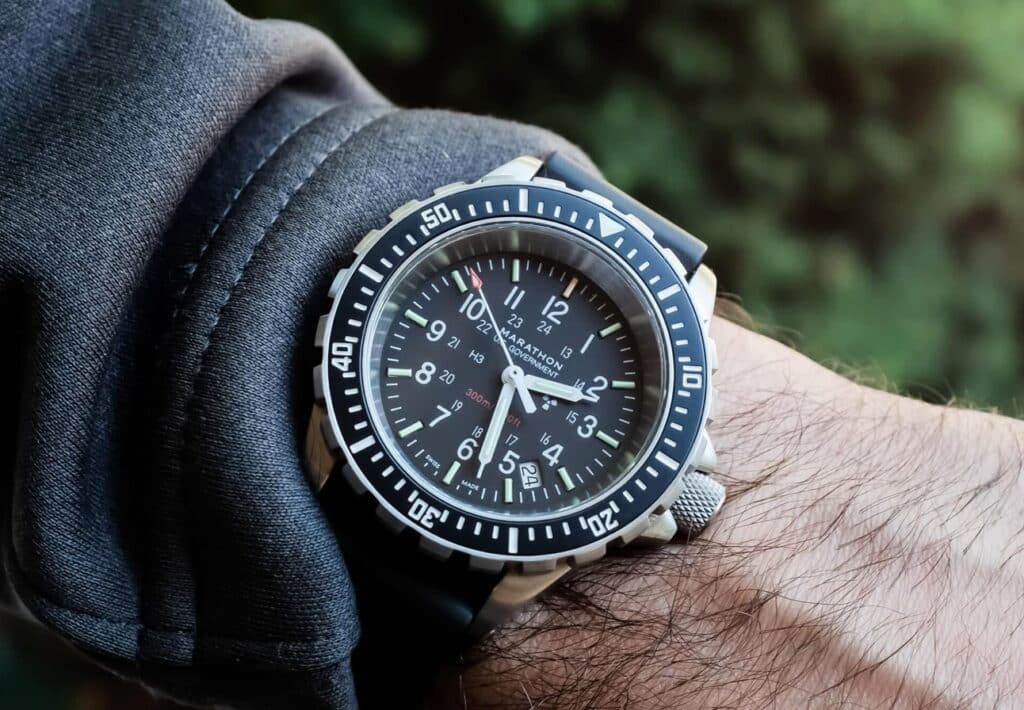
Marathon TSAR
| Price: | $1200 |
| Water Resistance: | 300m |
| Case Dimensions: | 41mm (diameter) x 48mm (lug-to-lug) x 14mm (thickness) |
| Lug Width: | 20mm |
| Movement: | ETA F06 quartz |
The Marathon TSAR is the rare dive watch where legibility doesn’t feel like a nice bonus. It feels like the whole assignment. Designed around a search-and-rescue utility, the dial keeps things blunt and readable, whether you choose the “US GOVERNMENT” dial or the cleaner version. The black dial is easy to parse, the small red depth-rating text adds a bit of contrast without turning decorative, and the tritium tubes change the watch’s real-world behavior. In complete darkness, it stays readable without needing to be charged first. MaraGlo adds extra brightness after light exposure, but it doesn’t turn the night view into a glowing science project.
The controls back up that purpose. The oversized crown and deeply cut bezel teeth feel designed for cold hands, gloves, wet conditions, and general impatience. During our hands-on experience with it, the 120-click bezel turned with a strong, confident action, and the crown was easy to grab without any fiddly nonsense. That tactile clarity matters for this list because a legible dive watch is not only about the dial. If the timing bezel is annoying to use, the watch is already working against you.
The case is very much tool-first. At 41mm, the footprint is manageable, but the thick, fully brushed, slab-sided case brings real weight and density. It feels industrial and reassuring rather than elegant, which is another way of saying it will not be your first choice with tight cuffs unless you enjoy fabric conflict. The steel bracelet feels secure and substantial, while the rubber strap is thick, durable, comfortable, and carries that familiar faint vanilla scent Marathon owners know. Salt water, concrete, long physical days — the TSAR doesn’t make any of that feel dramatic.
The ETA F06 quartz movement suits the watch perfectly because this is not the place for mechanical poetry. In our testing, it ran at roughly half a second per day, and the battery life is rated around 3 years. Some modern high-accuracy quartz options do stretch longer, but the TSAR’s appeal is its ready-for-use dependability. The bracelet does skip micro-adjustment and quick-release spring bars, and the blunt design has very little dress-watch range. But for collectors who care about excellent visibility, controls, and long-term reliability more than polish, the TSAR is about as direct as this category gets.
Pros
- Tritium tubes provide constant low-light visibility without needing a charge.
- Clean dial layout, strong contrast, and restrained red depth-rating text keep the watch easy to read.
- Oversized crown and aggressive bezel teeth are easy to use, even with gloves.
- 120-click bezel feels confident and tactile in use.
- The thick brushed case feels dense, tough, and purpose-built.
- ETA F06 quartz movement delivered roughly half a second per day in testing.
Cons
- The chunky case profile can be awkward under snug sleeves.
- Bracelet lacks micro-adjustment and quick-release convenience.
- Tool-first design has a limited range outside casual or utility settings.
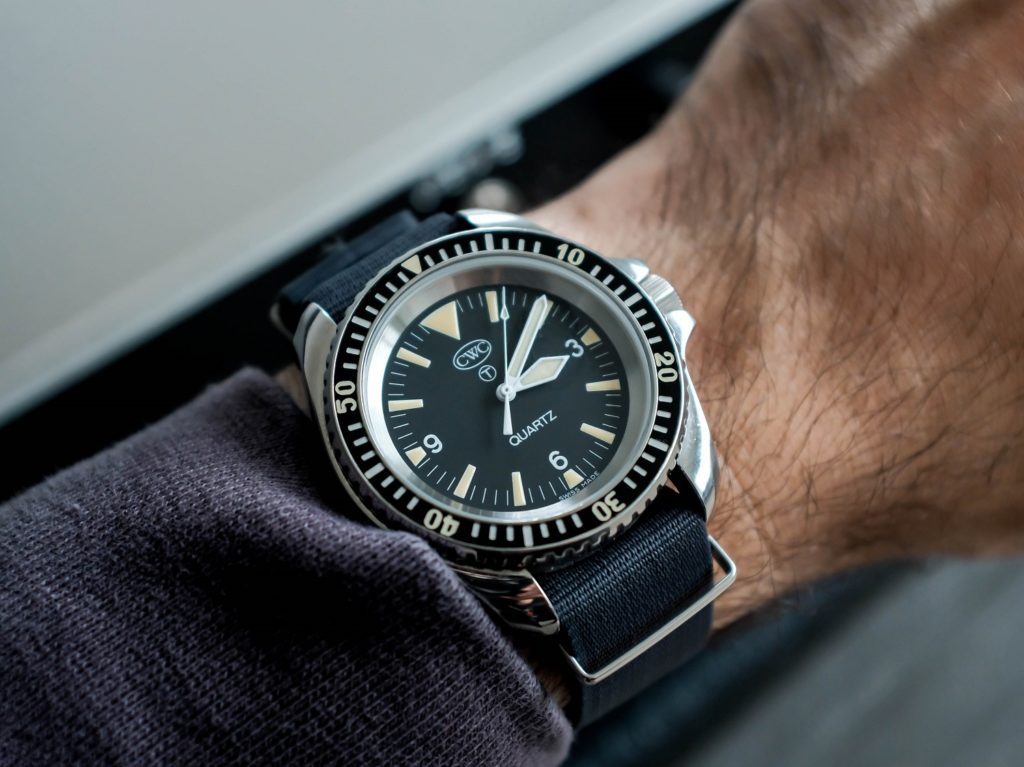
CWC 1983 Quartz Royal Navy Diver
| Price: | $1,210 approx. |
| Water Resistance: | 300m |
| Case Dimensions: | 45mm (diameter incl. crown) x 47mm (lug-to-lug) x 11mm (thickness) |
| Lug Width: | 20mm |
| Movement: | ETA 955.122 Quartz |
The CWC 1983 Quartz Royal Navy Diver is all business, and for a legibility-focused dive watch, that is the whole charm. The matte dial, thick markers, and bold sword hands keep the time easy to read without asking your eyes to sift through decoration. The vintage-toned Super-LumiNova stays visible long after the lights go out, and the familiar “circle T” remains as a nod to the original tritium-era layout. Purists may grumble because it is decorative now rather than literal, but the dial still works the way a military diver should: quickly, clearly, and without trying to be adorable.
The bezel adds a lot of character while staying useful. Its glossy, slightly domed acrylic insert catches light differently from modern ceramic, giving the watch a warmer, more period-correct feel without making timing harder. The 60-click action is firm, with very little play, and the lumed 10-minute markers make elapsed-time checks easy to follow. It is tactile in a way modern bezel inserts sometimes aren’t, which is a nice reminder that “updated” and “better” are not always the same thing.
The asymmetrical case follows old Ministry of Defense specifications, with oversized crown guards and a layout that clearly prioritizes function over symmetry for its own sake. With 300 meters of water resistance, it wears in the neighborhood of a no-date Submariner, but with a tougher, more utilitarian attitude. On the supplied Phoenix NATO, it stays light, balanced, and easy to wear for days at a time. Fixed spring bars limit strap-swapping freedom, though, so this is not the watch for someone who treats straps like mood swings.
The ETA 955.122 quartz movement makes the ownership side quite low drama. Throughout in-depth testing, it ran between -0.3 and +0.5 seconds per day, and the quiet tick fades into the background. Initial setup can feel awkward because of the hidden day-and-date mechanism, but once it is set, there is little reason to fuss with it for years. The price may feel steep to buyers expecting a mechanical movement, but the point here is practical accuracy, Royal Navy character, and everyday readability without the usual collector overthinking tax.
Pros
- Matte dial, thick markers, and bold sword hands make the time easy to read quickly.
- Vintage-toned Super-LumiNova stays visible long after dark.
- The firm 60-click bezel has very little play, with lumed 10-minute markers for clearer timing.
- Acrylic bezel insert adds distinctive character and tactile warmth.
- MOD-spec asymmetrical case, oversized crown guards, and 300m water resistance give it real tool-watch credibility.
- The supplied Phoenix NATO keeps the watch light, balanced, and comfortable.
Cons
- The price may feel high for buyers expecting a mechanical movement.
- Fixed spring bars limit strap-swapping options.
- Decorative “circle T” may bother strict purists.
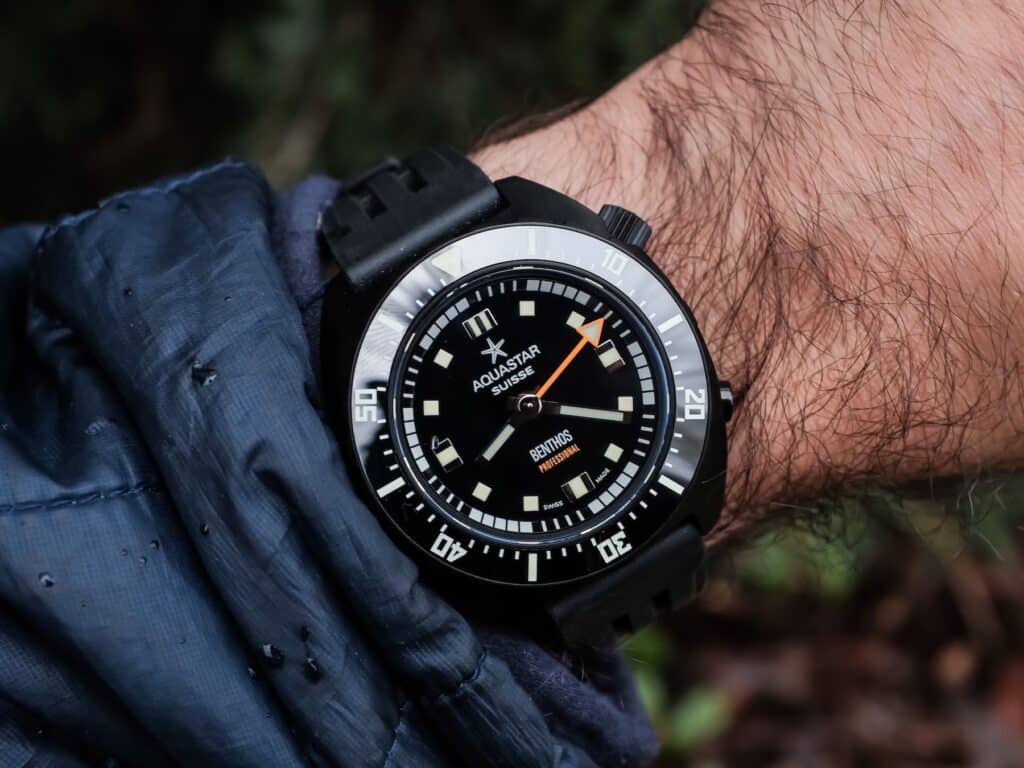
Aquastar Benthos Professional
| Price: | $1,590 |
| Water Resistance: | 300m |
| Case Dimensions: | 42mm (diameter) x 47mm (lug-to-lug) x 13.7mm (thickness) |
| Lug Width: | 20mm |
| Movement: | ETA 2824-2 in Elaboré grade |
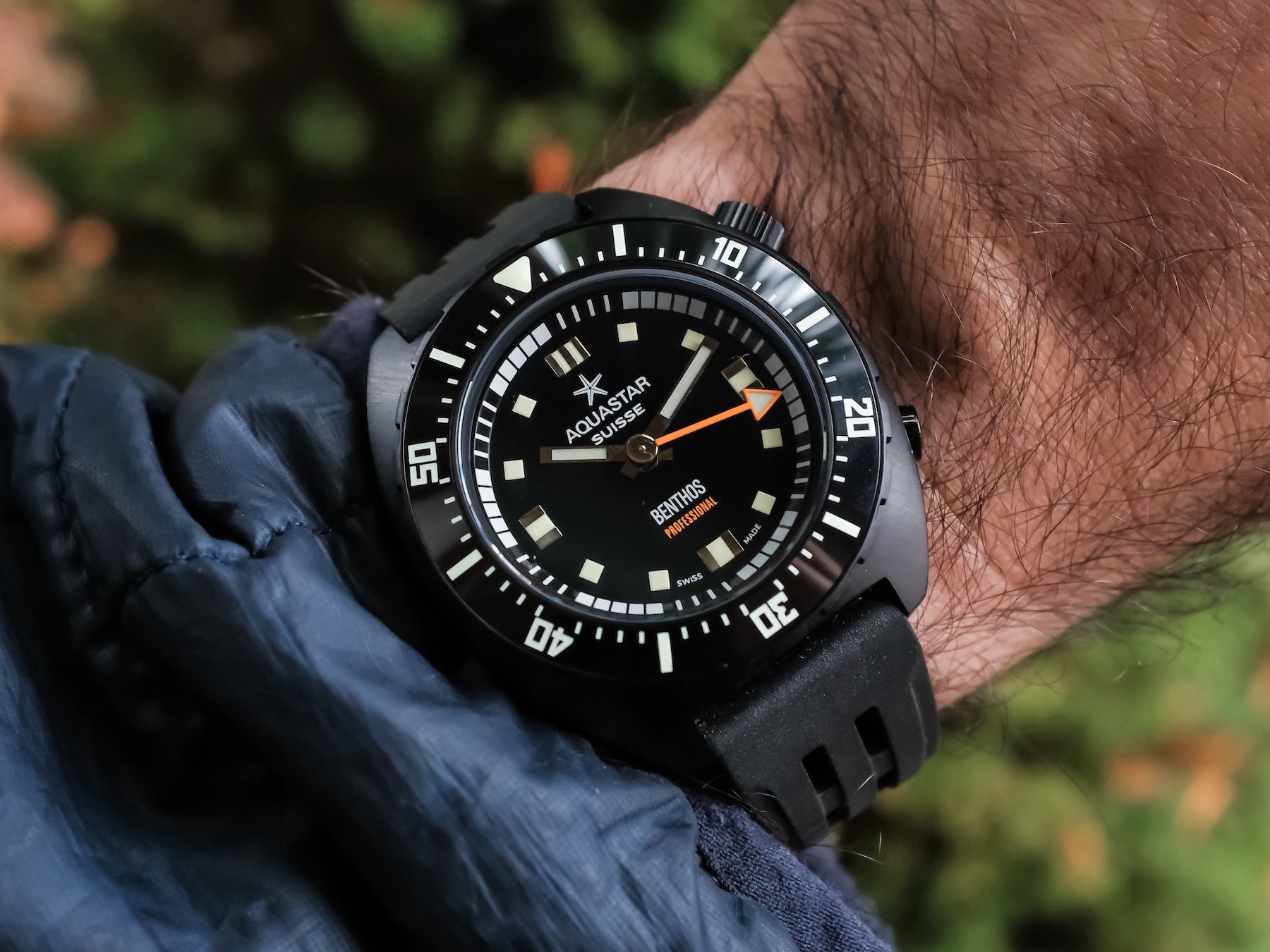
The Aquastar Benthos Professional brings collector appeal without letting the dial drift into retro decoration for its own sake. The semi-gloss black surface, square and rectangular markers, and a mix of applied and printed elements are all arranged around quick reading first. The no-date layout helps, too. Nothing interrupts the main time display, and the flush flat sapphire crystal keeps the view crisp and distortion-free. The checkered rehaut is the detail that surprised us most. It adds texture, but it also makes timing easier at a glance without crowding the dial.
Low-light performance is another reason the Benthos feels purpose-driven. The lume flares quickly, stays useful after the initial charge, and looks sharp against the dark dial, black DLC case, and glossy ceramic bezel. That contrast gives the watch a serious dive-watch personality without needing oversized visual gimmicks. Aquastar’s history with professional, commercial, and military diving gives the design some weight, but the modern version doesn’t feel trapped in 1970. It reads as a current daily diver with an older soul.
The 42mm case keeps the Benthos shape, but the reduced thickness and compact lug-to-lug make it far easier to wear than old-school proportions might imply. It sits lower, feels flatter, and avoids the top-heavy awkwardness that can make vintage-style divers fun in photos but annoying by dinner. The brushing is clean, the edges are defined, and the black DLC adds visual mass without making the watch feel physically heavier or too tactical. The ceramic bezel felt properly sorted in our use, with firm, even clicks, secure resistance, and precise alignment. The two o’clock crown threads smoothly and stays out of the way, while the helium escape valve at four adds function and gives the case some visual balance.
Inside, the ETA 2824-2 Elaboré, adjusted in multiple positions, kept comfortably within a few seconds in daily wear. The power reserve is modest, but winding and setting felt smooth and predictable. The ISOfrane VS 1969 strap also does real work here: dense, substantial, comfortable, resistant to dust and lint, and far better than generic rubber. The Benthos is more engaging than many entry-level big-brand divers, but it does ask you to care about Aquastar’s specific design language. Some buyers may want untreated steel and more traditional vintage warmth, and some will miss a date. For collectors who care about legibility, though, the clean layout and purposeful handset give it a reason to be here beyond nostalgia. To know more, feel free to read our hands-on impressions.
Pros
- Semi-gloss black dial, square/rectangular markers, and no-date layout keep the display clean and quick to read.
- Lume flares quickly, remains useful after the initial charge, and contrasts well against the dark dial and DLC case.
- Checkered rehaut adds texture while helping timing readability at a glance.
- Ceramic bezel has firm, even clicks, secure resistance, and precise alignment.
- ISOfrane VS 1969 strap feels substantial, comfortable, and dust-resistant.
- The two o’clock crown stays out of the way, while the four o’clock helium escape valve adds function and visual balance.
Cons
- The black DLC case may not satisfy buyers who prefer untreated steel and warmer vintage styling.
- No-date dial looks cleaner, but some daily wearers may miss the convenience of a date.
- Power reserve is modest by modern expectations.
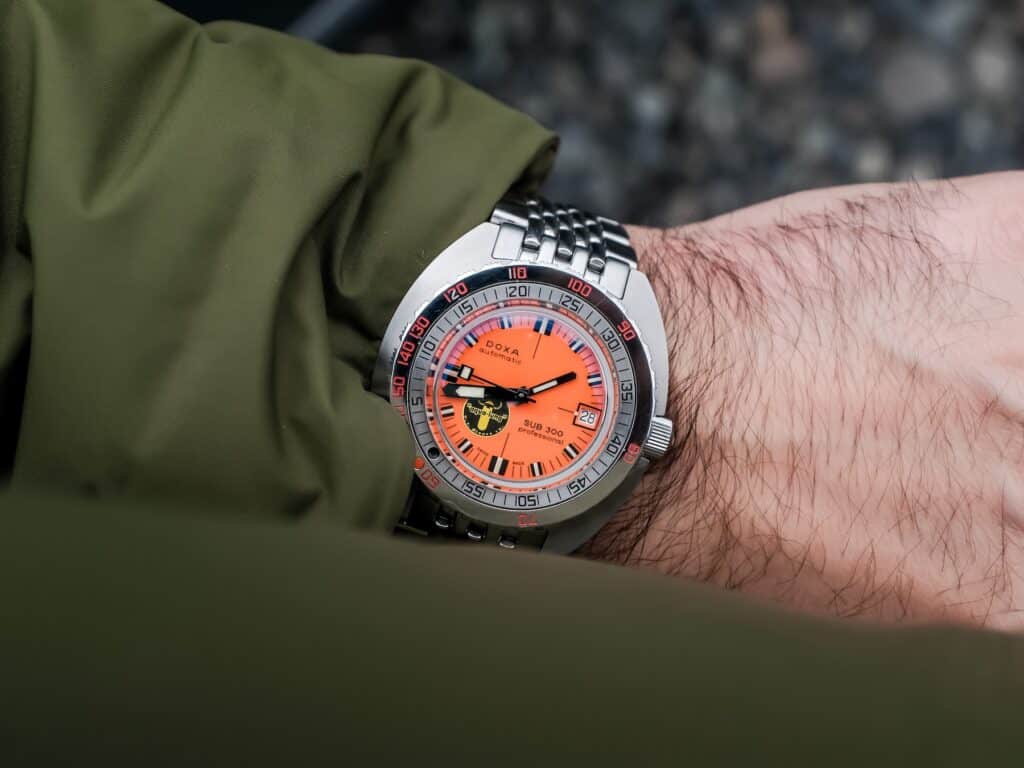
Doxa Sub 300
| Price: | $2,190 |
| Water Resistance: | 300m |
| Case Dimensions: | 42.5mm (diameter) x 45mm (lug-to-lug) x 12mm (thickness) |
| Lug Width: | 20mm |
| Movement: | COSC ETA-2824 |
The Doxa Sub 300 Aqua Lung Limited Edition is loud in a way that still serves readability. The orange dial is not subtle, but the small dial opening concentrates the color inside the cushion case instead of letting it sprawl. Chunky indices, broad blocky hands, and that oversized minute hand make the watch easy to read quickly, especially when timing matters more than admiring the thing like a tiny museum exhibit. The slightly off-center Aqua Lung logo will bother some buyers, and fair enough. Doxa’s weirdness does not always ask for permission before entering the room.
The dual-scale no-decompression bezel is where the watch keeps its instrument feel. For most of us, the scale is more romantic than necessary. However, it still gives the Sub 300 a functional identity that feels specific to Doxa rather than generic luxury-sports polish. The bezel action is firm, the clicks are clean, there is no backplay, and the grip works with wet or dry hands, even when your fingers are cold. The bubble-shaped crystal adds vintage distortion and light play, which gives the watch character, though buyers who want a perfectly flat, clean view may find it distracting.
On the wrist, the 42.5mm cushion case wears smaller than expected because of its wide, low-profile shape. It spreads across the wrist instead of stacking upward, stays planted during daily wear and travel, and flows naturally into the beads-of-rice bracelet. The steel also takes wear in a way that suits the design. Marks and softening don’t ruin the watch; they make it feel more like the tool-diver it’s pretending not to romanticize. The beads-of-rice bracelet looks heavier in photos than it feels, hugs the wrist well, and uses a simple clasp with a dive extension and micro-adjustment holes. The taper is not very even, so it won’t feel as polished as some modern bracelets.
The lume is steady rather than showy. It builds gradually, stays consistent, and remains useful in low light without trying to become the entire personality of the watch. Inside, the COSC-certified ETA 2824 keeps things grounded. It is not exotic, but in our testing experience, it has stayed accurate and reliable through years of travel and regular wear. That matters here because the Sub 300 Aqua Lung is already bold, vintage-inspired, and a bit odd. The movement does not need to join the circus.
Pros
- Orange dial, chunky indices, broad hands, and oversized minute hand make the watch easy to read quickly.
- Dual-scale no-decompression bezel gives it a real Doxa tool-watch identity.
- Bezel action is firm, clean, free of backplay, and easy to grip with wet or cold hands.
- Beads-of-rice bracelet balances the case well and includes a simple clasp, dive extension, and micro-adjustment holes.
- COSC-certified ETA 2824 has stayed accurate and reliable through years of travel and regular wear.
Cons
- The slightly off-center Aqua Lung logo may bother symmetry-focused buyers.
- Bubble-shaped crystal creates distortion and reflections that some will find distracting.
- Bracelet taper is not as smooth or uniform as more modern bracelets.
CWC 1980 Royal Navy Diver Re-Issue
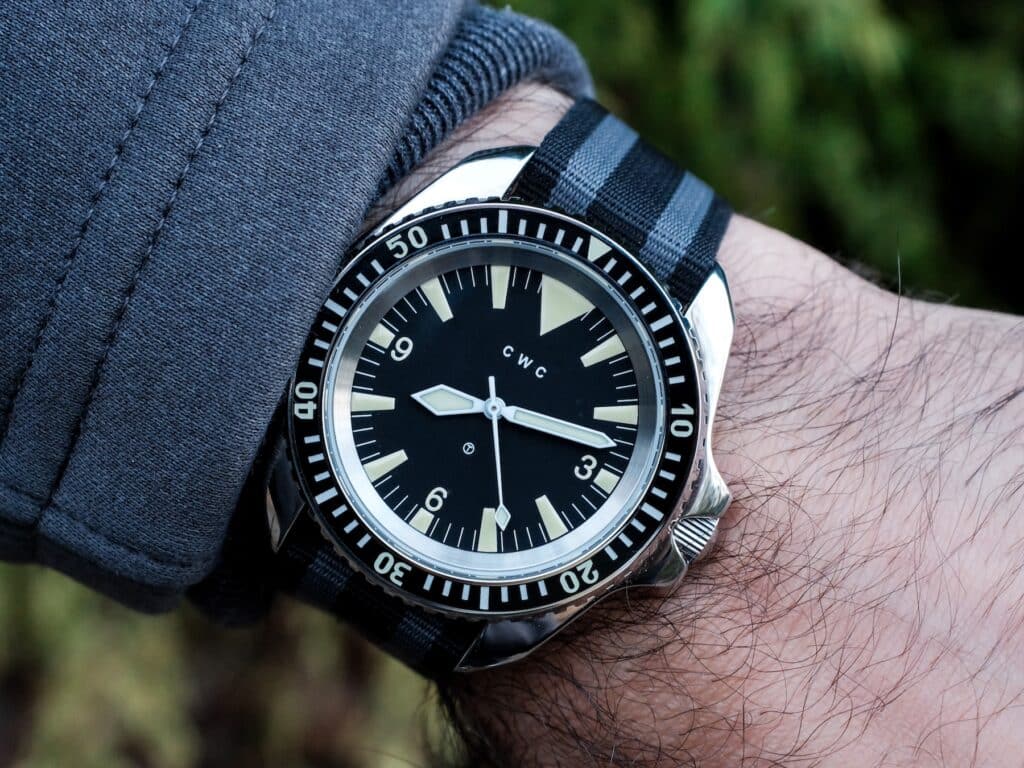
| Price: | $2,800 approx. |
| Water Resistance: | 300m |
| Case Dimensions: | 41mm (diameter) x 47mm (lug-to-lug) x 12.7mm (thickness) |
| Lug Width: | 20mm |
| Movement: | ETA 2824-2, CWC-engraved |
The CWC 1980 Royal Navy Diver Re-Issue has the kind of purpose-built restraint that makes legibility feel baked in rather than added later. It doesn’t wear like a retro diver trying to impress you with patina theater. It wears like a continuation of the Royal Navy design language it came from: compact, direct, and more concerned with being useful than charming. That matters here because the trapezoidal hour markers and sword hands are not just period-correct details. They make the dial quick to read, while the restrained CWC logo and circle T marking keep the layout faithful without overcrowding it.
The vintage-tinted Super-LumiNova works across varied lighting, though the current lume tones are a little frustrating. The bright white option can feel too sterile, while the darker pumpkin shade looks more intentional than aged. Collectors who notice this stuff will notice it immediately, because apparently, we all chose a hobby where beige has subcategories. The sapphire crystal is yet another modern update that earns its keep. It manages glare well, even in bright sunlight, so the dial stays usable rather than turning into a polished little mirror. That matters because the whole appeal of this CWC is not “look, a military-adjacent object,” but a clean, purpose-built diver layout that still works in daily life.
On the wrist, the roughly 41mm case wears compactly, closer to a 1990s Submariner than a modern oversized diver. The polished case and curved profile help it feel comfortable and versatile, though the polish will show hairline marks (because polished steel enjoys documenting your life choices). Fixed spring bars limit strap options, but they also tie back to the original military spec. We wore it on the included Cabot Military Watch Strap and later on a Phoenix Bond NATO, and both setups made the watch feel easy to live with rather than museum-fragile.
The ETA 2824-2 gives the watch a practical ownership backbone. After regulation, our example ran consistently around 3 to 5 seconds per day, and servicing should be straightforward over the long term. The pricing is high for a niche, historically focused diver, and a slight bezel wobble is noticeable during wear. Still, for collectors who want real military design logic, strong legibility, and a watch that feels built around intent rather than tribute-watch theatrics, this CWC makes a very clean argument.
Pros
- Sapphire crystal manages glare well in bright sunlight.
- Trapezoidal markers, sword hands, and restrained dial text deliver strong, fast legibility.
- Vintage-tinted Super-LumiNova remains effective across varied lighting.
- Reliable and easily serviceable ETA 2824-2 movement.
- Included Cabot strap and Phoenix Bond NATO setup both reinforce everyday wearability.
Cons
- Fully polished case shows hairline marks.
- Slight bezel wobble is present during handling.
- Current lume tones lack the natural warmth of earlier versions.
- Premium pricing for a niche, historically focused diver.
Sinn T50
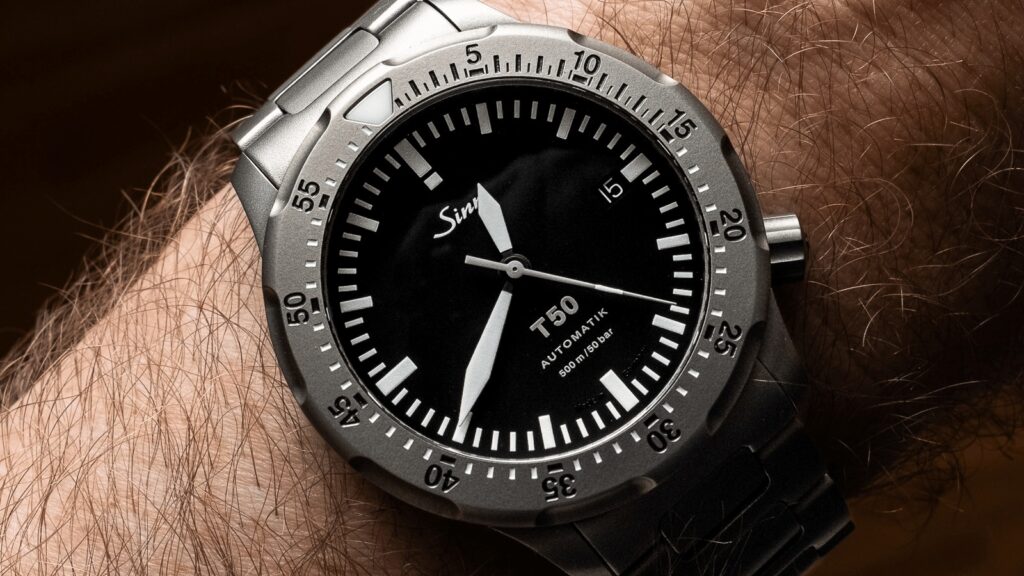
| Price: | $4,280 |
| Water Resistance: | 500m |
| Case Dimensions: | 41mm (diameter) x 47mm (lug-to-lug) x 12mm (thickness) |
| Lug Width: | 20mm |
| Movement: | Sellita SW 300-1 |
The Sinn T50 is the collector-grade diver for people who want the dial to shut up and do its job. The black-and-white layout keeps everything immediate: sword hands, tidy markers, and a date window that stays useful without shouting from across the dial. Sinn’s restraint works in favor of legibility here. There’s no decorative fog to push through, no “look at me” finishing fighting the hands, and no attempt to make the watch feel luxurious through visual noise. The lume on the second hand is useful for confirming the watch is running in the dark, though the patch is small enough that you may need an extra beat to spot it.
The matte titanium case supports that same clarity-first approach by cutting reflections and keeping the whole watch visually calm. At around 95 grams, it feels almost suspiciously light the first time it hits the wrist, but that lightness becomes the point. It stays planted, sits low, and doesn’t keep asking for mid-day adjustments like some overbuilt diver. The 4 o’clock crown also helps during long wear, staying easy to access without digging into the wrist while typing, riding, or running errands.
The bezel is classic Sinn in the best possible way: functional before flashy. The captive bezel system requires you to press down before turning it, which sounds fussy until the watch takes a knock and the bezel stays right where you left it. The tegimented bezel also resists scratches better than standard titanium, and that held up during regular wear. Drilled lugs make strap changes simple, and the T50 works well on rubber or NATO if you want to strip the experience down even further. The H-link bracelet is comfortable and suits the case, but the diver extension didn’t inspire much confidence in our example because it could release with a light pull. We ended up removing it and going with a normal spring bar setup.
Inside, the Sellita SW300 performed very well in our testing, landing around +2 to -3 seconds per day. The trade-off is the 42-hour power reserve, which can feel limiting if your collection already has several watches waiting their turn. Servicing is also less straightforward because it goes through Sinn directly. Still, the T50’s appeal is clear: it is light, readable, restrained, and engineered around function in a way that makes many flashier premium divers feel like they’re trying a little too hard.
Pros
- The matte titanium case cuts reflections and keeps the watch very light at around 95 grams.
- Clean black-and-white dial, sword hands, tidy markers, and restrained date window make it easy to read quickly.
- The captive bezel system helps prevent accidental movement.
- Tegimented bezel treatment improves scratch resistance compared with standard titanium.
- Drilled lugs make strap changes easy, and the watch works well on rubber or NATO.
Cons
- The 42-hour power reserve can feel short if you rotate through several watches.
- Servicing is less straightforward because it requires going through Sinn directly.
- The diver extension can release too easily and may undermine confidence in the bracelet.
- Small second-hand lume patch takes an extra moment to spot in the dark.
Omega Seamaster Diver 300M
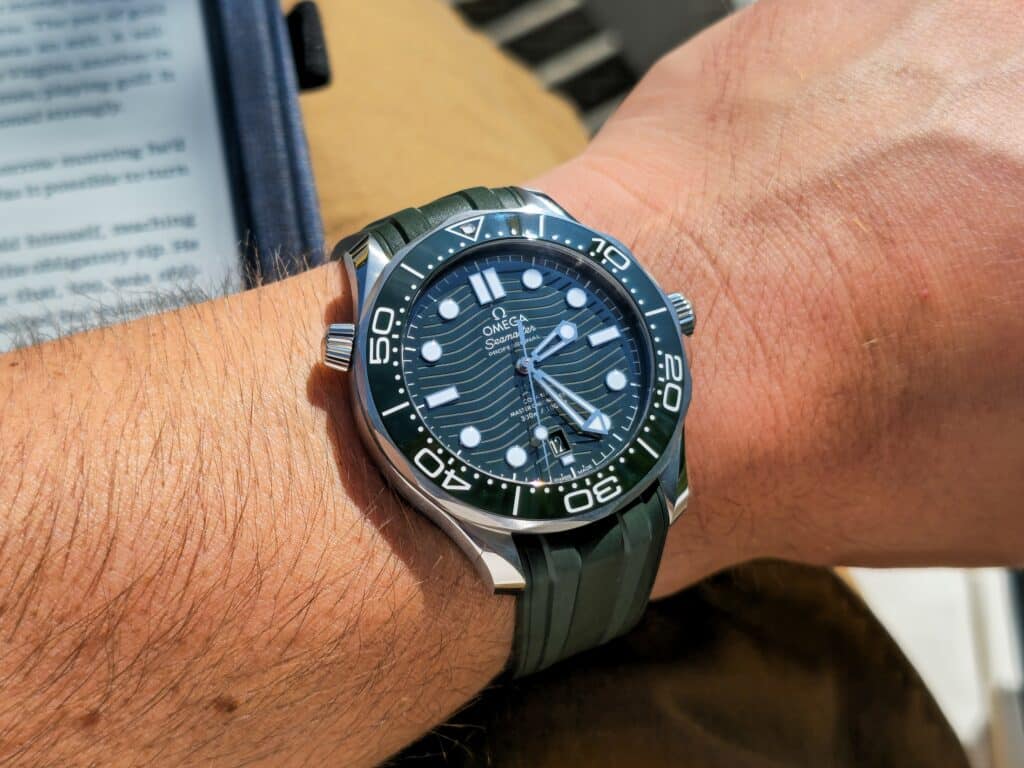
| Price: | $5,600 – $5,900 |
| Water Resistance: | 300m |
| Case Dimensions: | 42mm (diameter) x 49.9mm (lug-to-lug) x 13.9mm (thickness) |
| Lug Width: | 20mm |
| Movement: | Caliber 8800 Co-Axial Master Chronometer |
The Omega Seamaster Diver 300M is one of those luxury divers collectors cross-shop for obvious reasons. Still, its legibility story is more complicated than the spec sheet wants to admit. The wave-patterned ceramic dial has real depth, and the green tone shifts nicely with light without turning the watch into a novelty. Omega also deserves credit for matching the date disc to the dial color, which keeps the layout cohesive. The markers are strong, and the dual-color lume is useful: green on the minute hand and bezel pip, blue on the hour hand and indices, making it easier to orient the watch in the dark. The lume is bright and long-lasting enough for real use, though it still trails some more dive-focused competition like Seiko.
The skeletonized hands are the trade-off. They look Seamaster distinctly and give the watch a lot of its personality, but at certain angles, especially against luminous markers, they can be harder to read than solid hands would be. This is where the Seamaster reminds you that it is a balancing tool-watch function with luxury-watch aesthetics. The anti-reflective-coated sapphire crystal helps a lot, though. In most lighting, it nearly disappears, cutting glare and keeping the dial readable. The downside is that the AR coating can pick up small scratches over time, which feels annoying because it is doing such a useful job.
On the wrist, the 42mm case wears more compactly than expected. The dial and bezel proportions make it feel closer to 12mm thick than its listed 14mm, and the twisted lyre lugs break up the case width in a way that helps comfort. Brushed case sides keep the watch grounded, while polished top surfaces add enough flash. The rubber strap is the better long-wear option in our experience: soft, flexible, and relaxed enough for beach days, travel, or dinner without feeling like a bracelet-shaped ankle weight. The bracelet is durable, but it feels heavier and lacks the taper we’d want for longer wear. The strap holes could also be spaced more precisely for easier fine-tuning.
As covered by our review team, the bezel is refined rather than aggressively tool-like. The glossy ceramic insert matches the dial color, the scalloped edges help the watch look slimmer, and the action is precise with no backplay. Grip is the weak point; it takes more effort than more textured dive bezels, so it is not the one we’d pick for endless bezel-fidgeting therapy. Inside, the METAS-certified Caliber 8800 is excellent, running around +1 second per day in our testing, with smooth, refined winding. The crown itself feels a bit small, and screwing it down is less satisfying than winding it. The helium escape valve at 10 o’clock remains part of the Seamaster identity, whether you see it as useful dive hardware or Omega’s little party hat. Still, the Seamaster 300M works because it gives collectors real luxury finishing while keeping enough practical readability to stay honest.
Pros
- Wave-patterned ceramic dial, strong markers, and color-matched date disc keep the layout cohesive and readable.
- Dual-color lume helps orientation in the dark.
- Anti-reflective sapphire crystal cuts glare and keeps the dial easy to read in most lighting.
- Glossy ceramic bezel has precise action with no backplay.
- 42mm case wears balanced thanks to dial/bezel proportions and twisted lyre lugs.
- The rubber strap is soft, flexible, and comfortable for long wear.
Cons
- Skeletonized hands can be harder to read at certain angles, especially against luminous markers.
- The bracelet feels heavy and lacks a modern taper.
- The bezel grip is less practical than more textured dive-watch bezels.
- AR coating may collect small scratches over time.
Glashütte Original SeaQ
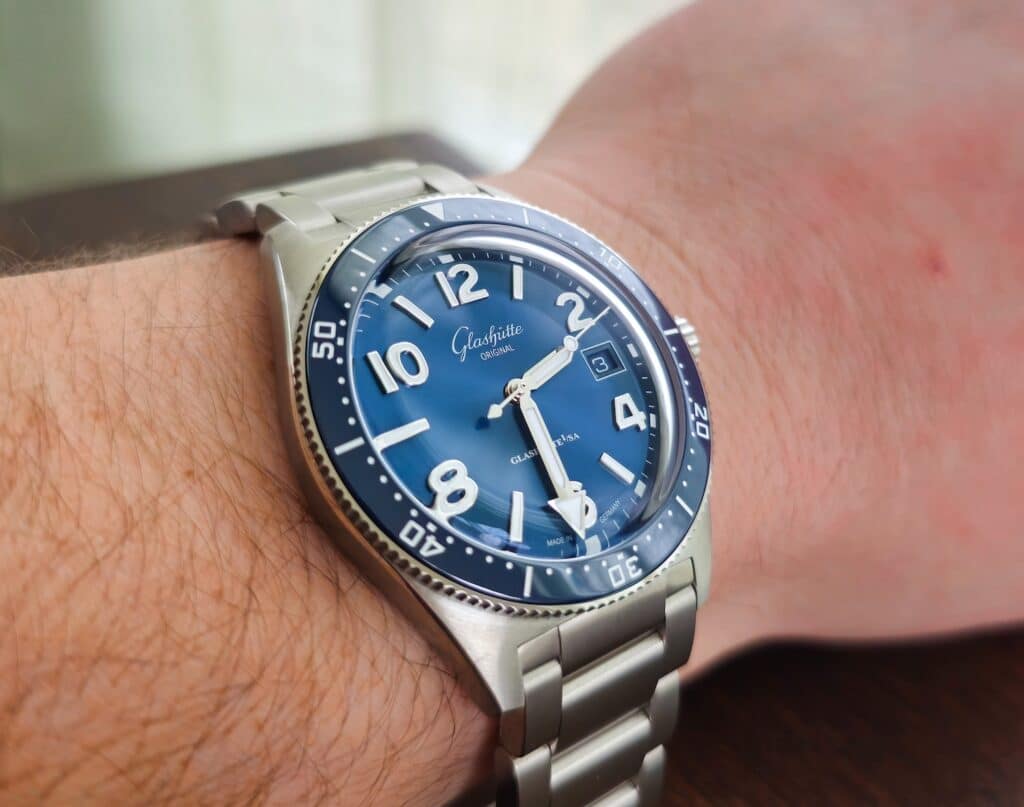
| Price: | $10,200 |
| Water Resistance: | 200m |
| Case Dimensions: | 39.5mm (diameter) x 47.5mm (lug-to-lug) x 12.5mm (thickness) |
| Lug Width: | 20mm |
| Movement: | SeaQ Caliber 39-11 Automatic |
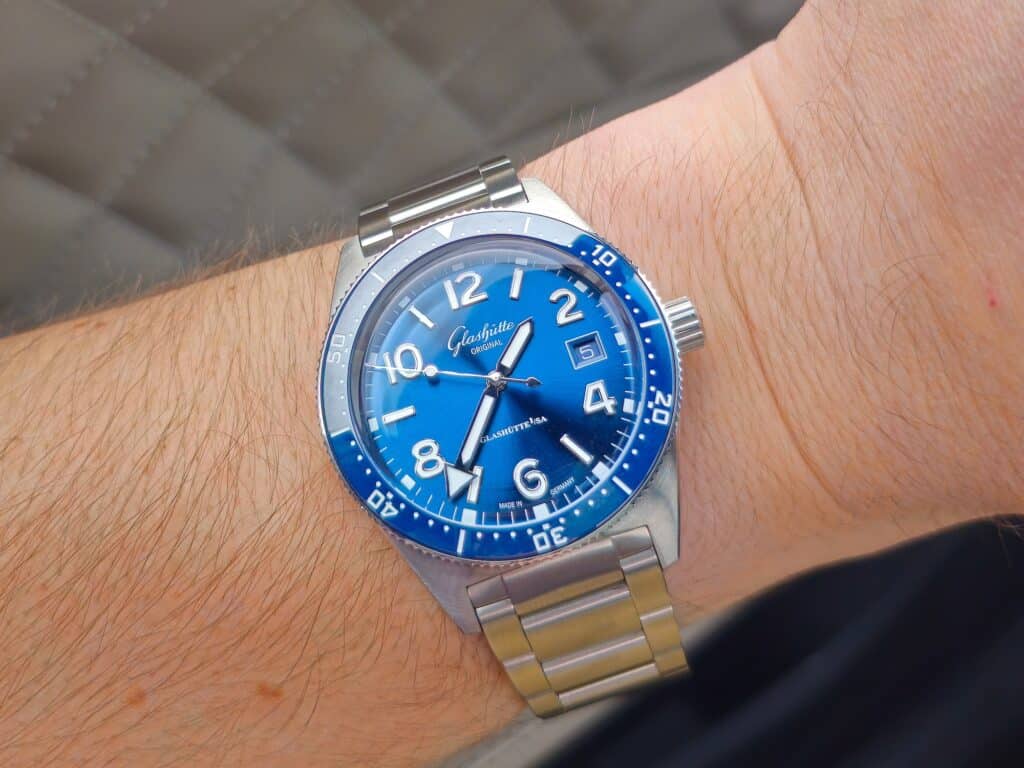
The Glashütte Original SeaQ is the premium diver for collectors who want something bold and readable without defaulting to the usual luxury dive watch answer. The dial is the main pull. In bright light, the sunburst surface opens up with real tonal movement; indoors, it settles into darker, inkier shades that make the watch feel calmer and more restrained. Clean Arabic numerals and minimal text keep the layout open, so the changing dial never turns into a legibility problem. The domed sapphire adds curvature and visual life, but it does not distort the dial in a way that gets between you and the time.
The unidirectional bezel is firm, precise, and deliberate, with none of that vague wobble that makes you immediately start rationalizing a purchase. The screw-down crown has the same measured resistance, so setting the watch feels intentional rather than merely functional. These are small interactions, but on a diver meant to be worn often, they matter more than another paragraph of marketing about heritage.
The case finishing walks a useful line between tool watch and premium object. Brushed surfaces sit where wear is more likely to happen, while polished edges add refinement without making the watch feel delicate. The brushed 20mm bracelet wears smoothly, and the compact, tool-free, quick-adjust clasp is useful when your wrist changes size during the day. The one visual miss is the bracelet-to-case transition, which does not look as seamless as the rest of the execution. Annoying, mostly because the rest of the watch is clearly capable of better manners.
Inside, the Caliber 39-11 brings more finishing than the closed caseback lets you enjoy, including beveled edges, polished screws, a swan-neck regulator, and a skeletonized rotor. During our hands-on testing, it ran consistently, though the roughly 40-hour power reserve feels short at this level. The SeaQ is not the obvious upgrade path, and the price puts it in serious company. But for collectors who have learned what they value, it offers strong dial clarity, satisfying controls, practical adjustment, and enough personality to avoid feeling like the delicate pick.
Pros
- Clean Arabic numerals, restrained text, and an open dial layout keep legibility strong.
- The sunburst dial has real tonal depth across different lighting conditions.
- Domed sapphire adds visual movement without hurting readability.
- Compact, tool-free, quick-adjust clasp is useful for daily wear.
- Bezel action feels firm, precise, and confidence-inspiring.
- Brushed and polished finishing balances durability with refinement.
Cons
- Bracelet-to-case transition is not as cohesive as the rest of the watch.
- Roughly 40-hour power reserve feels short for this tier.
- Closed caseback hides much of the Caliber 39-11 finishing.
Rolex Submariner
| Price: | $10,250 |
| Water Resistance: | 300m |
| Case Dimensions: | 40mm (diameter) x 48mm (lug-to-lug) x 12.5mm (thickness) |
| Lug Width: | 20mm |
| Movement: | In-house caliber 3130 |
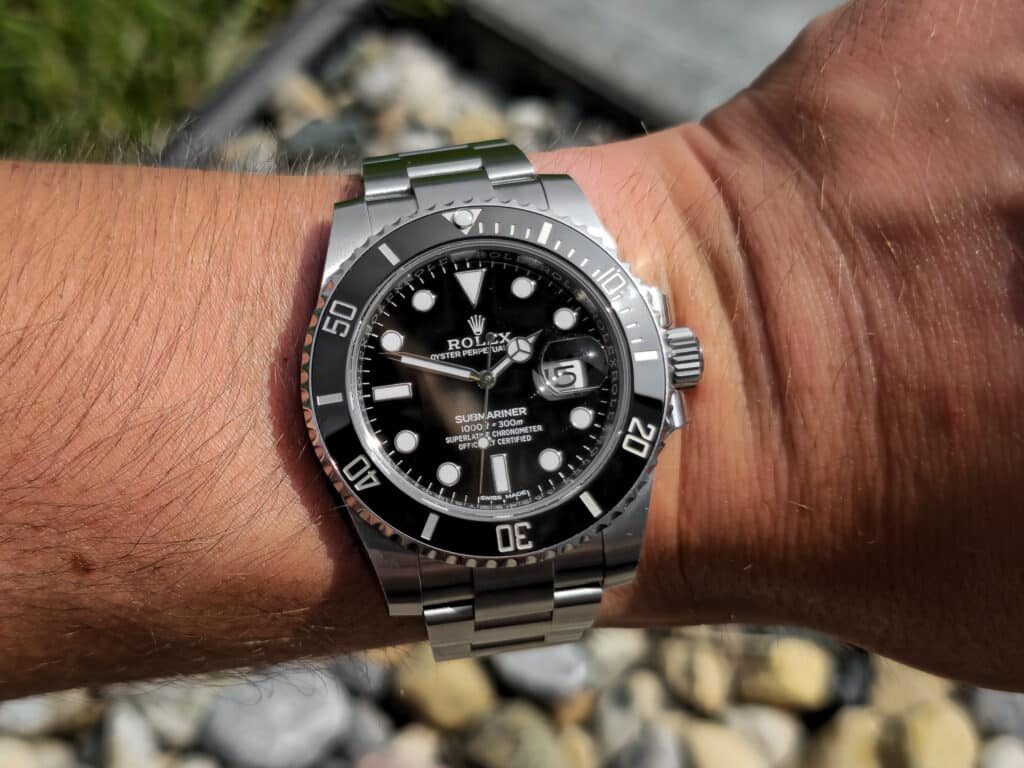
The Rolex Submariner gets so much reputation noise around it that it’s easy to forget why the design stuck in the first place: it is very easy to read. The glossy black dial, luminous markers, Mercedes handset, and white gold surrounds keep the layout clean and fast at a glance. Nothing on the dial feels experimental, which is probably why half the watch world has spent decades either copying it or pretending they are above copying it. The blue Chromalight lume also does real work, staying visible well into the night without turning the dial into a novelty act.
The bezel is just as important to the Submariner’s legibility story. The ceramic Cerachrom insert has engraved numerals filled with platinum, resists fading, and turns with precise clicks and no noticeable back play. The raised lume pip at twelve is a small but useful detail because you can locate it by touch and orient the bezel quickly in low light. That kind of thing gets lost in brand discourse, but it matters more than another argument about whether the watch is “overhyped.”
On the wrist, the Submariner’s proportions are a big part of its staying power. It feels substantial enough to read as a proper dive watch, but slim enough to wear under a cuff without making every sleeve negotiation a scene. The Oyster bracelet is still one of the better arguments for the watch, with smooth articulation, a 20mm-to-16mm taper, and a brushed finish that hides scratches well. Glidelock gives roughly a link-and-a-half of tool-free adjustment, which is useful when your wrist changes size during the day and you don’t want to start using a clasp like a medieval device.
Inside, the in-house caliber 3130 focuses on reliability rather than theatre. As covered in our full review, it ran around +0.5 seconds per day, and the Triplock screw-down crown supports the 300m water resistance while feeling smooth during winding and setting. The sapphire crystal stays clear, though the limited anti-reflective coating can create a faint haze under certain lighting. The bigger ownership headaches are outside the watch itself: retail availability is difficult, gray-market pricing can get uncomfortable, and convincing counterfeits make the used market more stressful than it should be. Still, judged purely as a readable, function-first dive watch, the Submariner’s core design remains brutally effective.
Pros
- Glossy black dial, luminous markers, Mercedes handset, and white gold surrounds keep the layout quick to read.
- Blue Chromalight lume stays visible well into the night.
- Raised lume pip at twelve helps with tactile orientation in low light.
- Balanced case proportions make it comfortable for daily wear and easy to slide under a cuff.
- Oyster bracelet articulates smoothly, tapers from 20mm to 16mm, and includes a useful Glidelock adjustment.
Cons
- Convincing counterfeits make the used market harder to navigate.
- Limited anti-reflective coating can create a slight haze in certain lighting.
- Retail availability is difficult, and gray-market pricing can be steep.
That’s our take on the dive watches that make legibility feel like part of the design, not a line item someone remembered five minutes before launch. None of them gets every detail right, but each one gives you a clear reason to look down, read the time quickly, and keep wearing it after the novelty fades. Let us know which readable divers you’d add to the list, especially the ones that keep earning wrist time while flashier pieces sit in the box.

Co-Founder and Senior Editor
Kaz has been collecting watches since 2015, but he’s been fascinated by product design, the Collector’s psychology, and brand marketing his whole life. While sharing the same strong fondness for all things horologically-affordable as Mike (his TBWS partner in crime), Kaz’s collection niche is also focused on vintage Soviet watches as well as watches that feature a unique, but well-designed quirk or visual hook.
Pretty comprehensive article and reviews. Maybe next go around, try some Deep Blue Divers. Many offerings with Miyota, Seiko and ETA movements. Excellent line and for serious lume, several lines with tritium tubes. That Glashutte is a stunner. Steep price, but a stunner.
Deep Blue has been on our radar for a while (even met the owner in HK), and the tritium tube models especially deserve more attention. The Glashütte is tough to look away from, even at that price. Appreciate the suggestion.