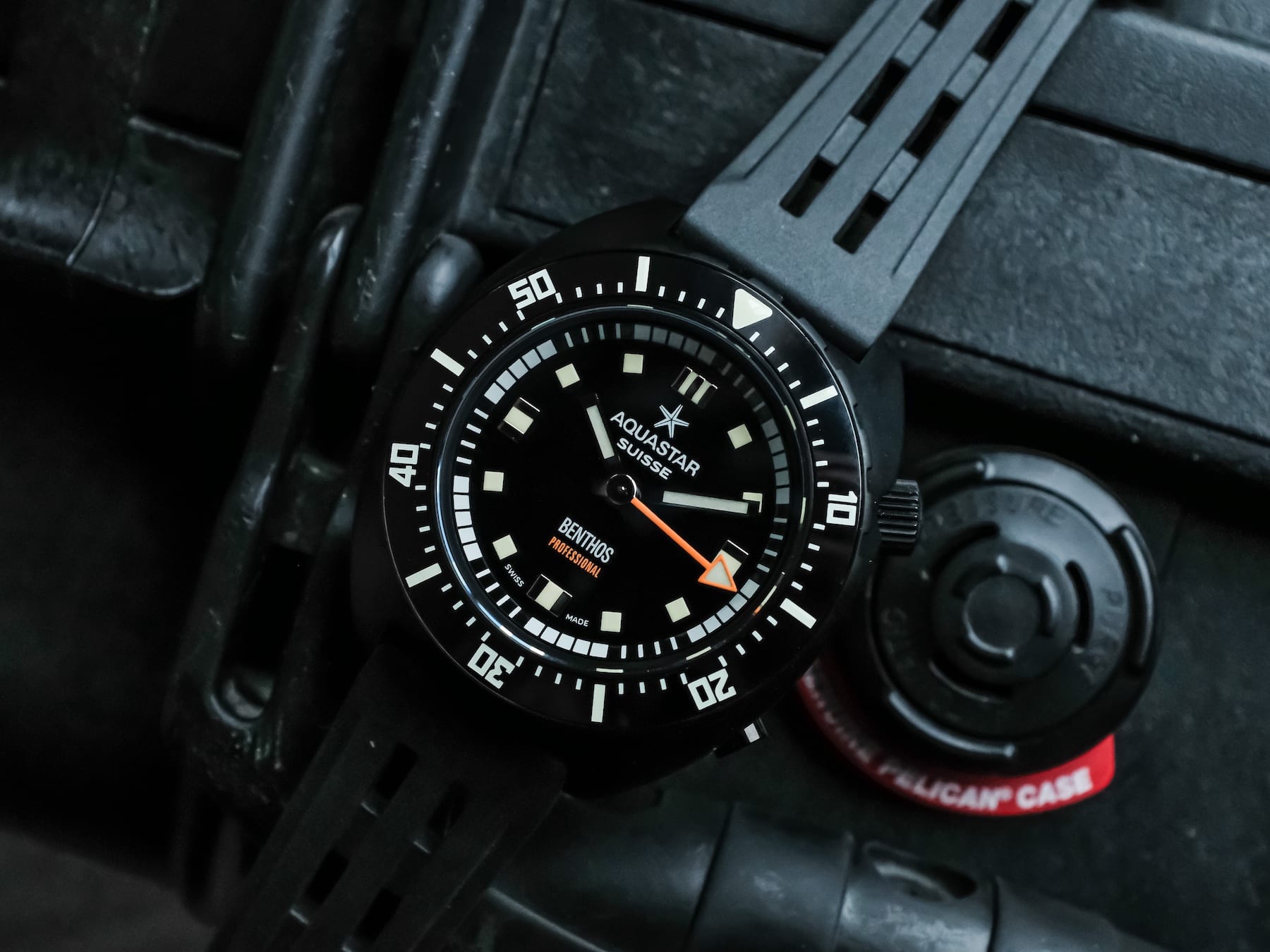
It’s been a while since I’ve had a watch come across my desk that traces back to the family of brands currently stewarded by Rick Marei. Over the years, his name has intersected with my own collecting path in a few meaningful ways. From his earlier involvement with Doxa during a very specific chapter of that brand’s history, to the revival of Synchron, his work tends to show up consistently in the parts of the watch world I pay the closest attention to. These are brands that appeal to collectors who value restraint, purpose, and a clear understanding of why certain watches mattered in the first place. Here, we’ll be looking at the Aquastar Benthos Professional in DLC.
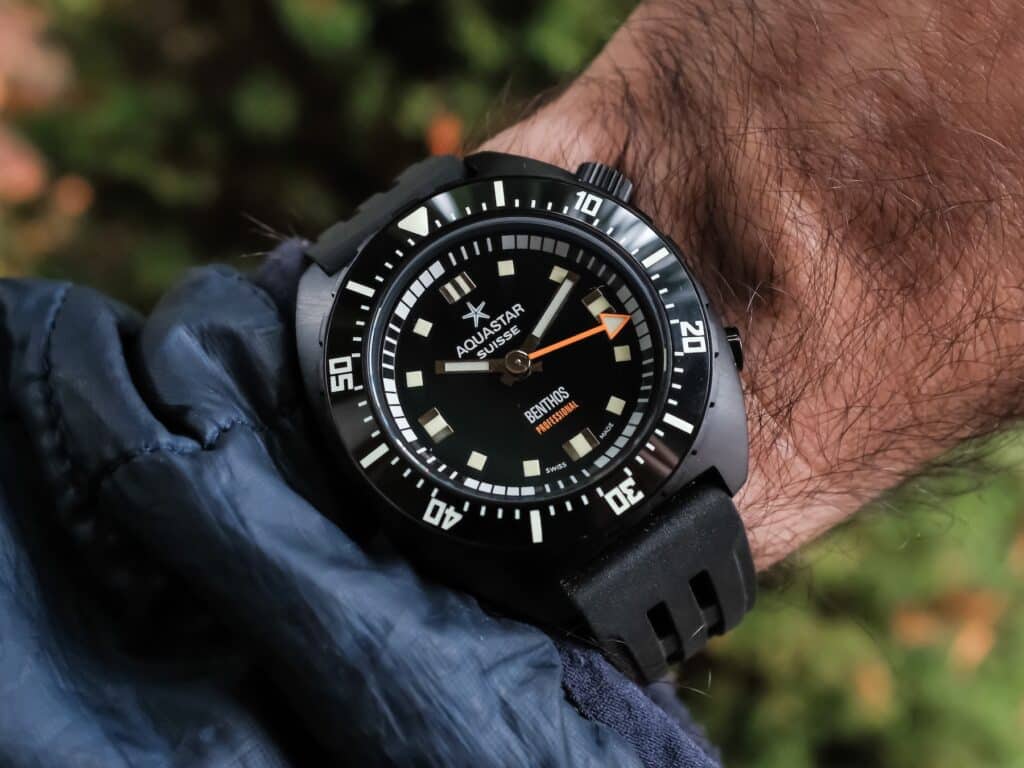
Aquastar has always sat adjacent to those brands in my mind, even if I’d never actually handled one myself. So when the opportunity came up to spend time with the Aquastar Benthos Professional in its black DLC configuration, it felt less like chasing something new and more like finally filling in a blank. This is the first Aquastar we’ve reviewed on the site, and I came into it without any strong expectations beyond curiosity. I wanted to see how it would feel alongside watches I already know well, and whether it would reflect the same kind of deliberate decision-making I tend to respond to as a collector.
Aquastar’s reputation was built through direct collaboration with professional, commercial, and military divers who depended on their watches as tools. That working relationship led to the original Benthos 500 in 1970, a model that became closely associated with real-world use rather than aspirational storytelling. For many dive watch enthusiasts, the Benthos name still points back to that period and the standards it established. What’s interesting about the Benthos Professional is that it doesn’t try to freeze that era in place. Instead, it takes the idea of the Benthos and reshapes it into something that makes sense to wear every day.
Case, Proportions, and the Shift Toward Daily Wear
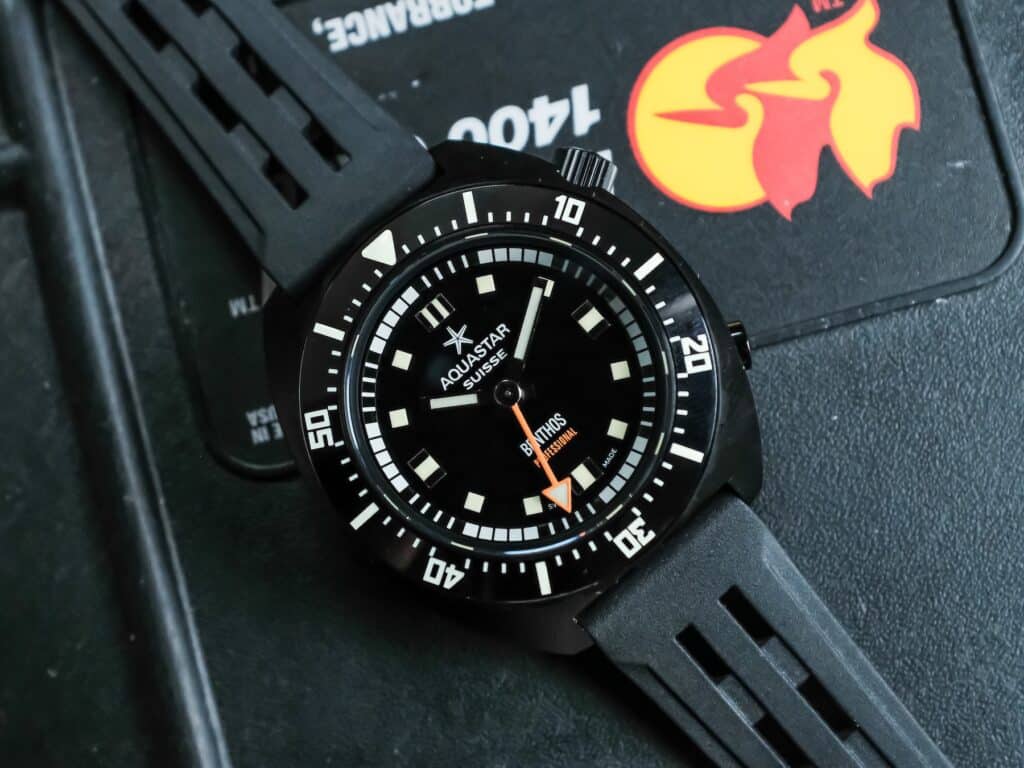
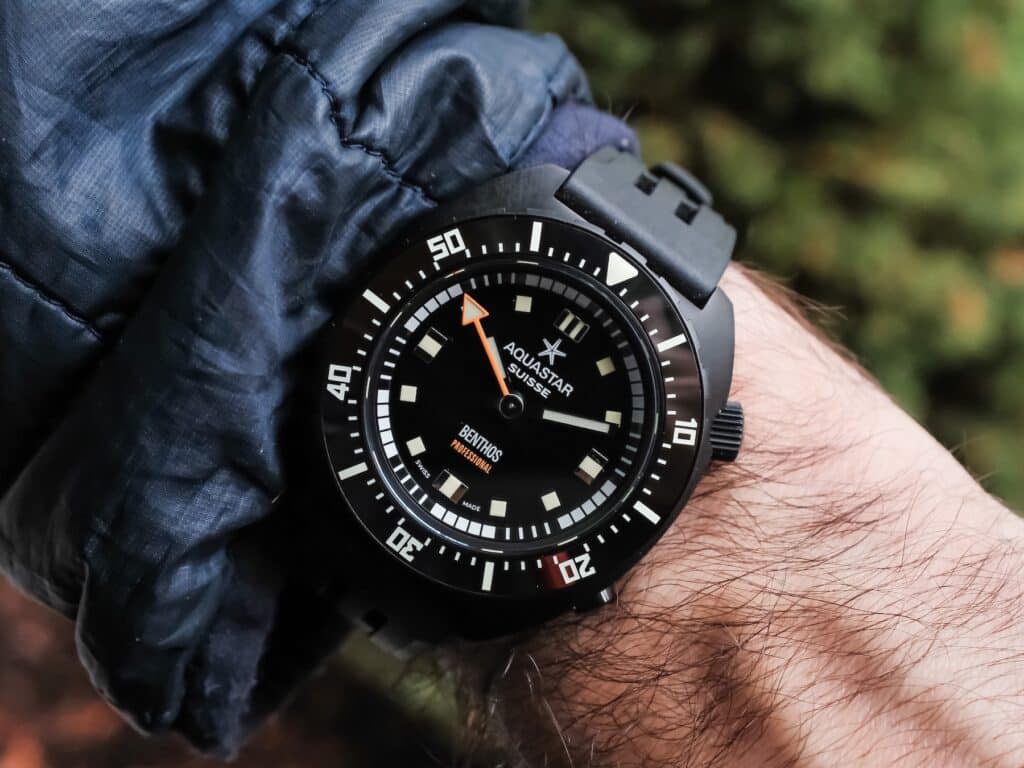
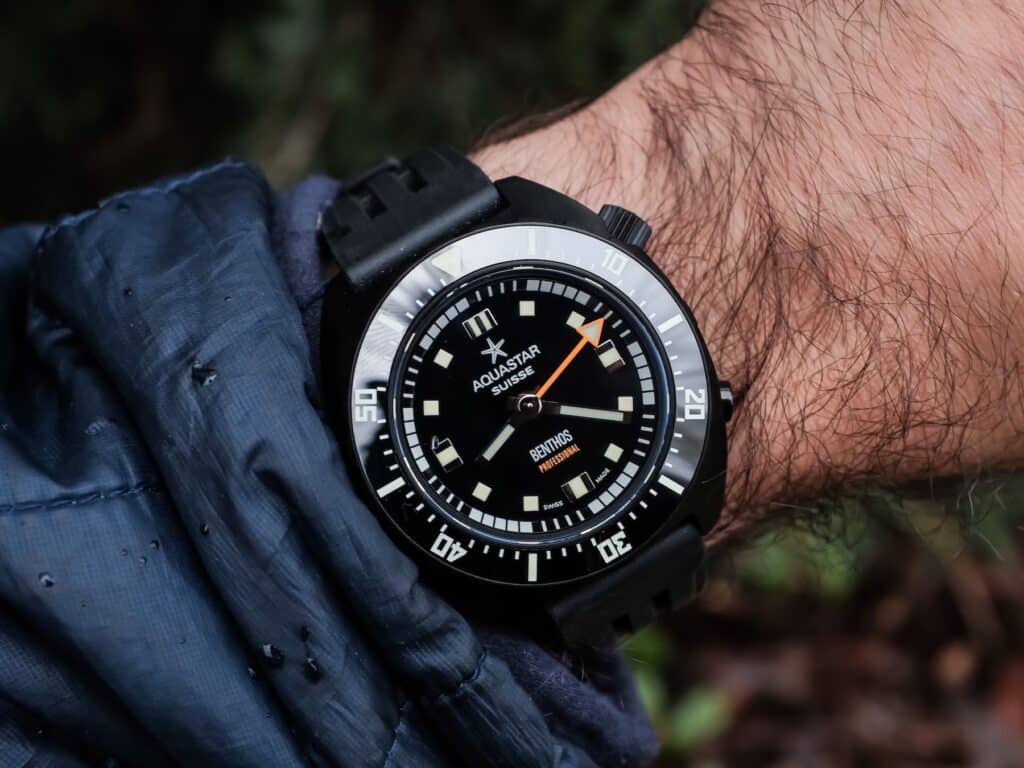
The first thing I noticed when I put the Benthos Professional on the wrist wasn’t the DLC or the bezel. It was the profile. This is still recognizably a Benthos, with a 42mm diameter and a compact lug-to-lug that keeps it centered, but the reduced thickness changes everything. A slimmer case doesn’t just improve comfort. It changes how often you actually reach for the watch.
Older Aquastar Benthos models, and many vintage-inspired divers in general, wear with a certain bravado. They look fantastic in photos and scratch the itch for historical correctness, but they can feel like a commitment. This version is different. It sits lower, wears flatter, and feels far more cooperative in everyday situations. Even with a full 300 meters of water resistance, the watch never feels bulky or top-heavy.
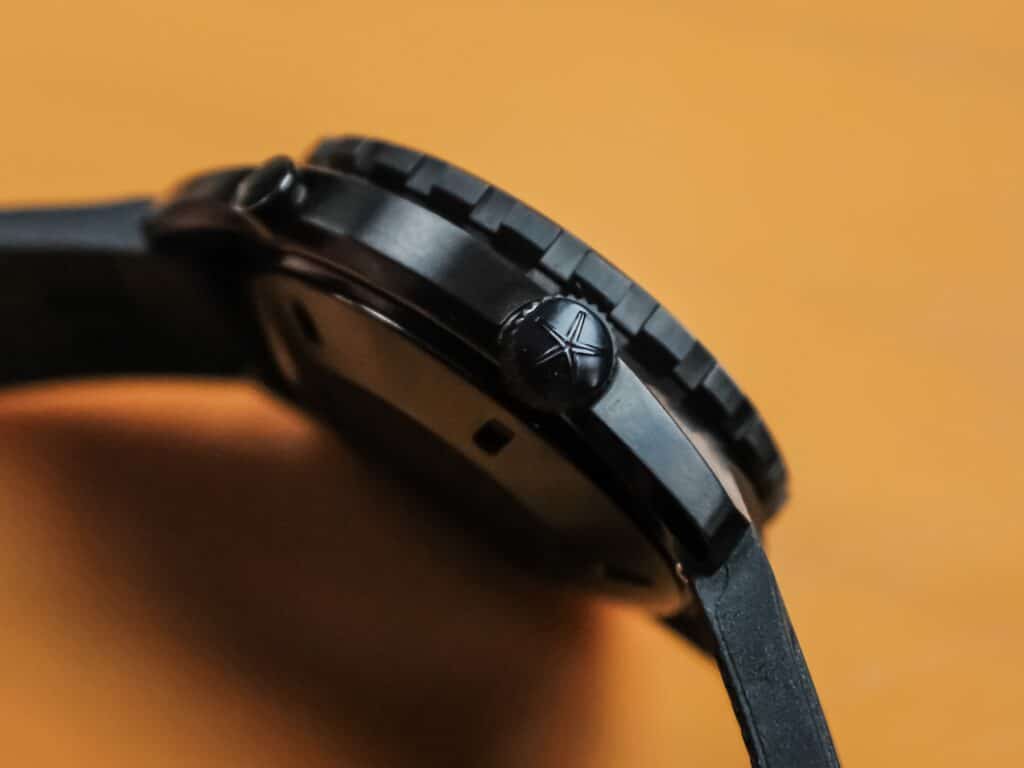
The finishing reinforces that impression. The brushing is consistent, the edges are well defined, and the transitions feel intentional. While I typically lean toward untreated stainless steel, the black DLC case works here. It adds visual weight without adding physical bulk, and on the wrist it feels more considered than aggressive.
Bezel and External Hardware
The ceramic dive bezel does exactly what it should. The clicks are firm and evenly spaced, with enough resistance to feel secure without becoming fussy. It’s easy to operate and lands precisely, which matters more to me than how loud or muted the clicks are.
The crown at two o’clock is another detail that longtime Aquastar Benthos fans will appreciate. It stays out of the way, threads smoothly, and never reminds you it’s there while wearing the watch. Once you get used to this placement, it’s hard not to miss it on other dive watches. Looking at the four o’clock position, I almost had a moment where I thought I was accidentally sent a chronograph version of the Benthos. What looks like a pusher is actually a small helium escape valve. It’s functional, out of the way, and helps the watch retain a certain degree of symmetry when seeing it together with the prominent crown at two o’clock.
Dial Execution, Legibility, and Lume
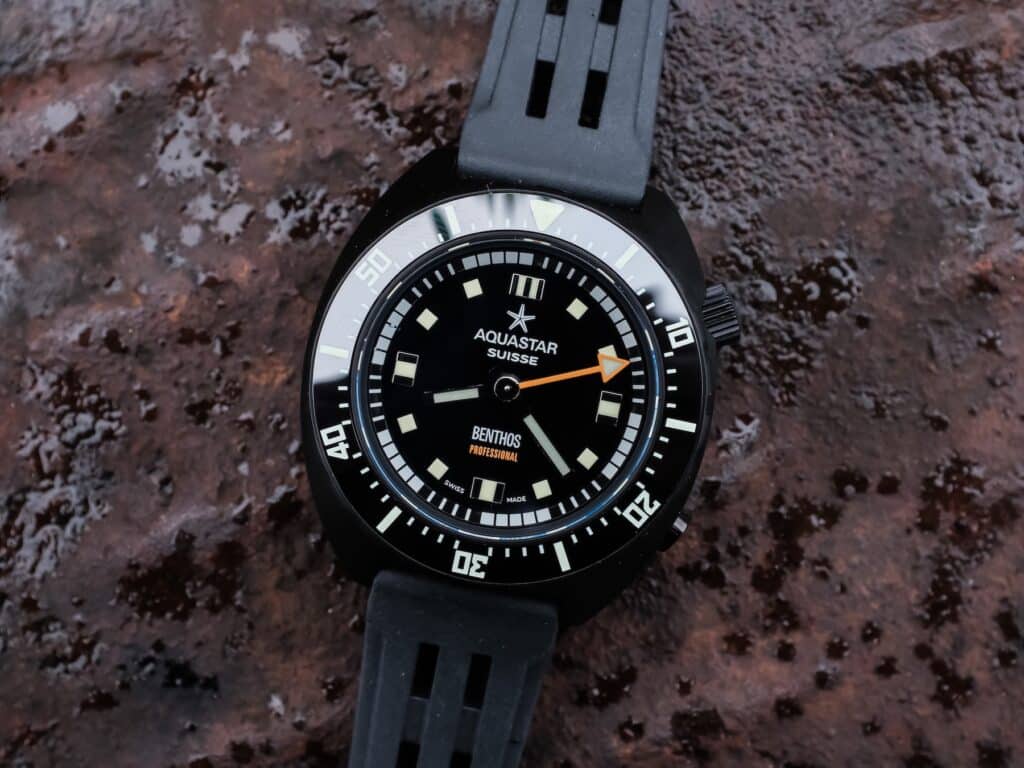
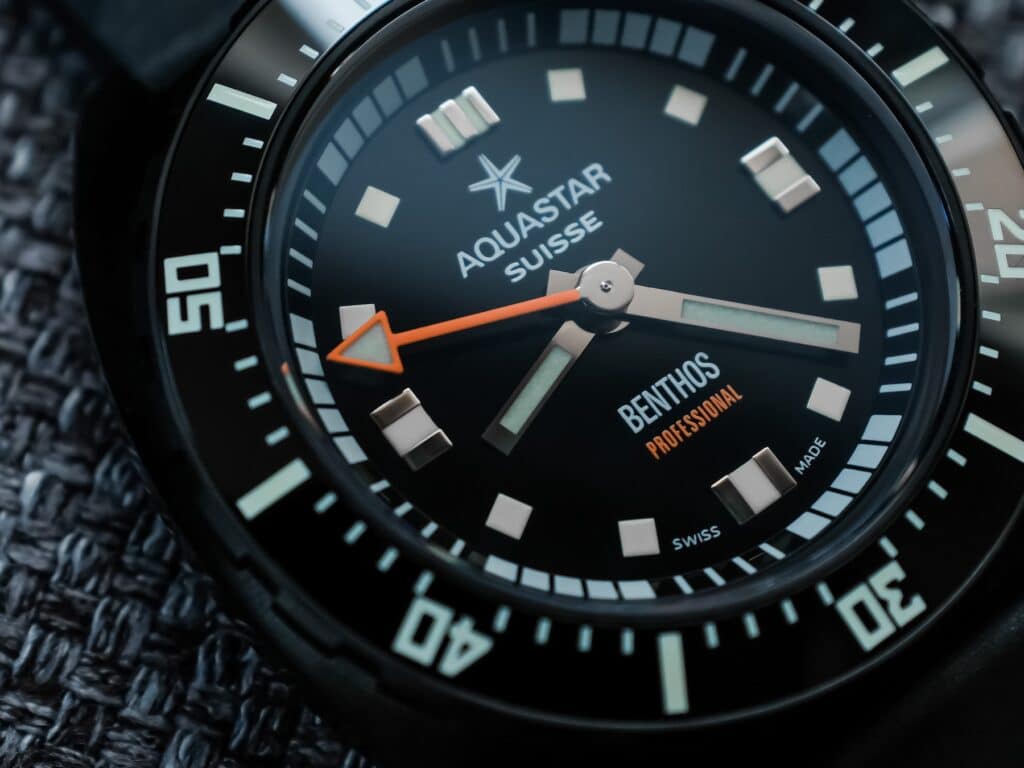
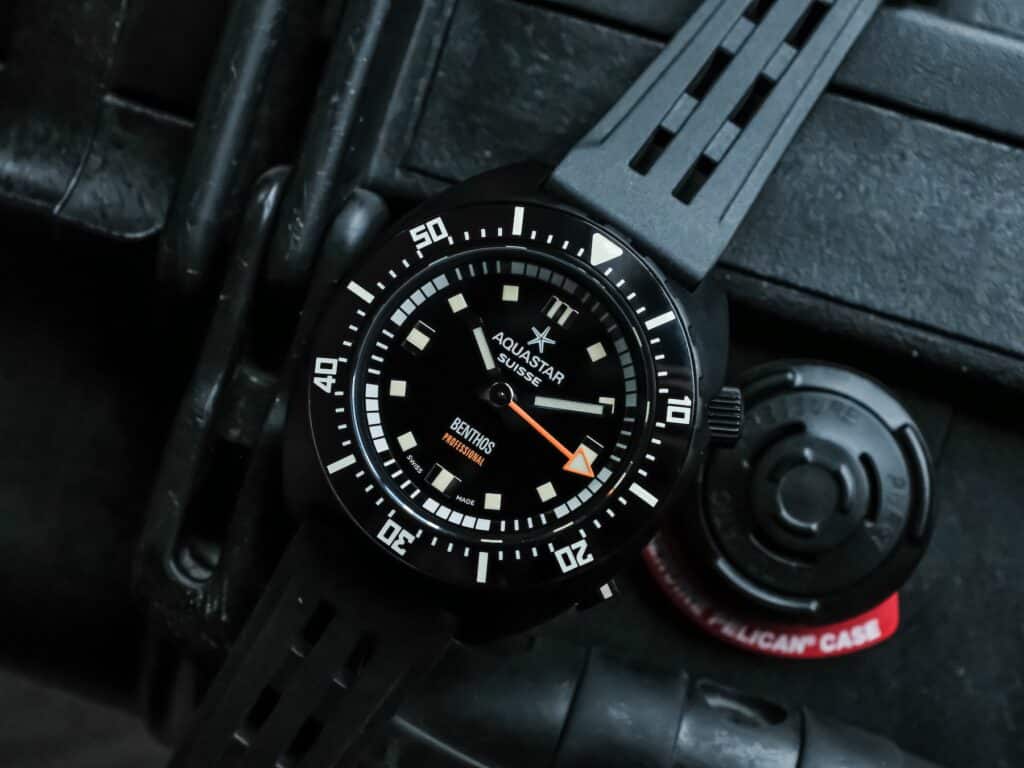
The dial is refreshingly straightforward. A semi-gloss black surface sets the stage for square and rectangular hour markers that prioritize clarity above all else. Some elements are applied, others are printed, but the balance feels right. Nothing competes for attention, and everything is easy to read at a glance.
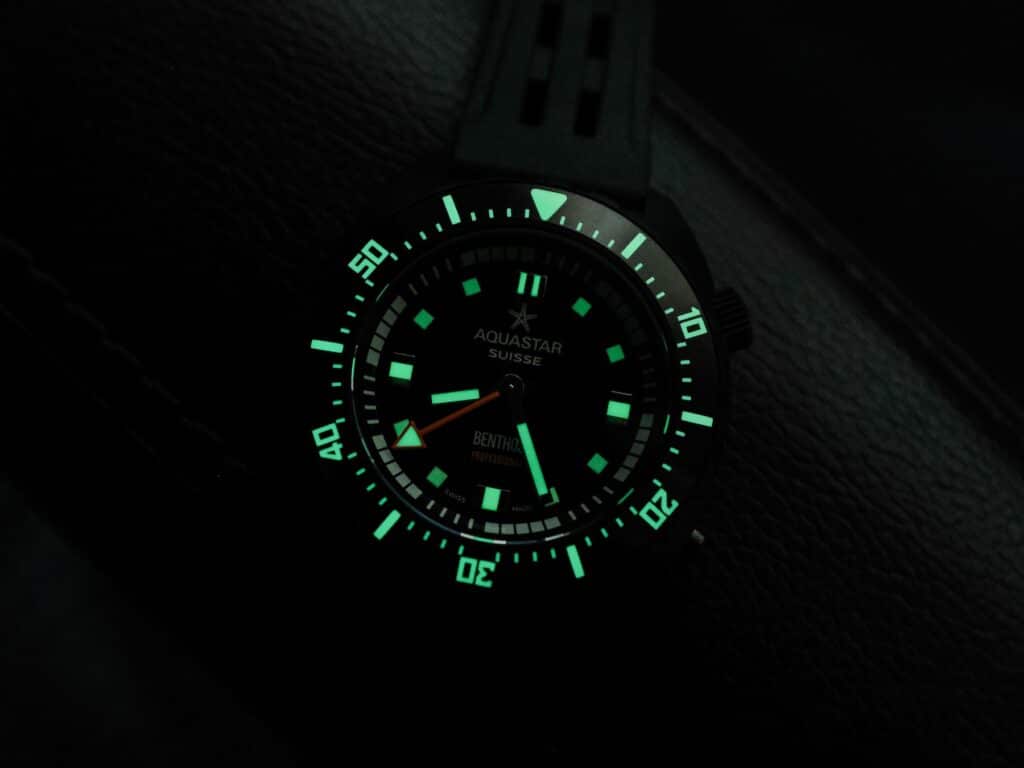
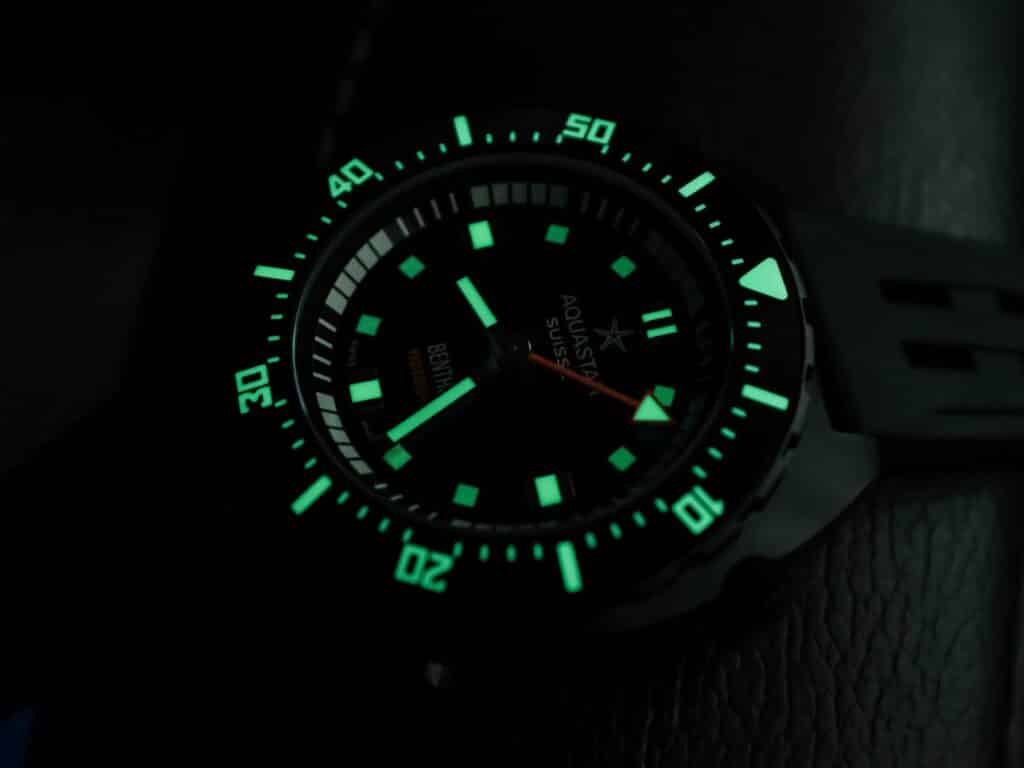
The lume deserves its own moment here. This thing is torch-bright. The kind of lume that flares up immediately, stays legible without effort, and gives you that small hit of satisfaction every time the lights go down. It’s intense without feeling gimmicky, and it holds its own well past the initial charge.
What really makes it work, especially on the DLC version, is the contrast. The bright lume against the dark dial is already effective, but seeing it framed by the glossy black ceramic bezel is something else entirely. There’s a depth to the look at night that photos never quite capture. It’s functional first, no question, but it also happens to look incredibly cool while doing its job.
One detail that kept drawing my eye is the checkered rehaut. It’s subtle, but it makes timing more intuitive and adds a bit of visual texture without cluttering the dial. I also appreciate the absence of a date window here. The layout feels complete without it, and I never found myself wishing it were there. A flat sapphire crystal sits flush with the bezel, keeping everything crisp and distortion-free.
Movement and Daily Interaction
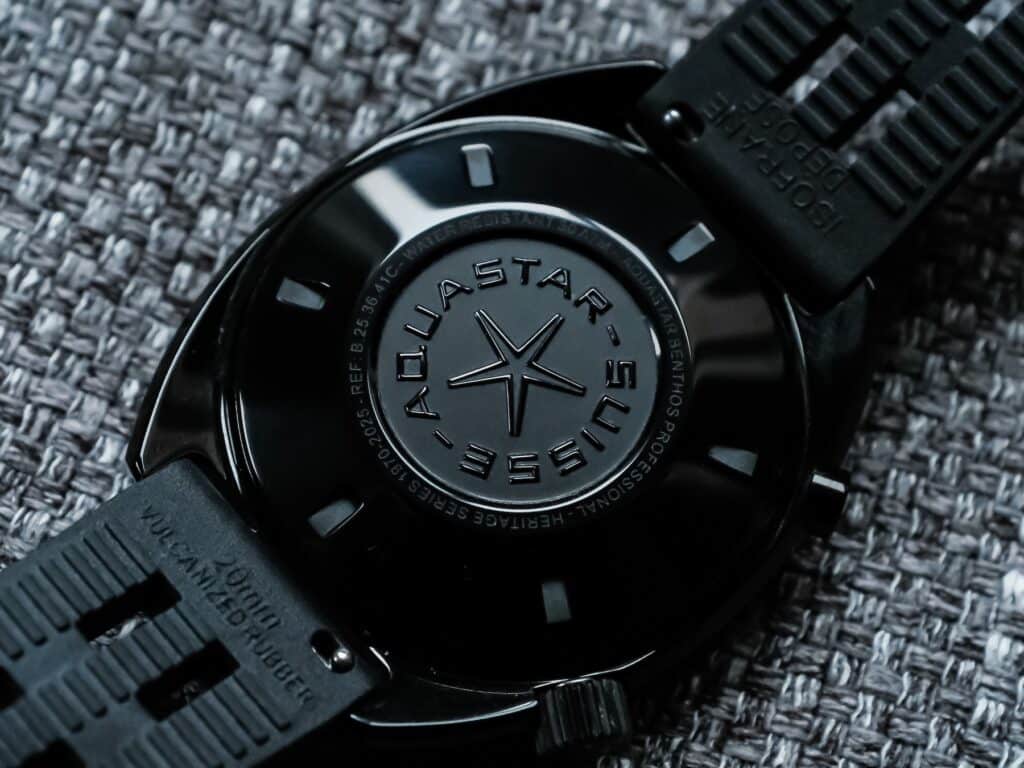
Powering the Aquastar Benthos Professional is the ETA 2824-2 in Elaboré grade, adjusted in multiple positions. It’s a familiar movement, but one that still earns its keep when properly regulated. In day-to-day wear, accuracy was comfortably within a few seconds, which is exactly what I expect from a watch designed to be used regularly.
The power reserve is modest, but this isn’t a watch that feels intended to sit idle. Winding and setting are smooth, predictable, and uneventful in the best possible way. The movement choice reinforces the idea that this watch is meant to be worn often, not admired from a distance.
Strap, Wearability, and Where This Lands
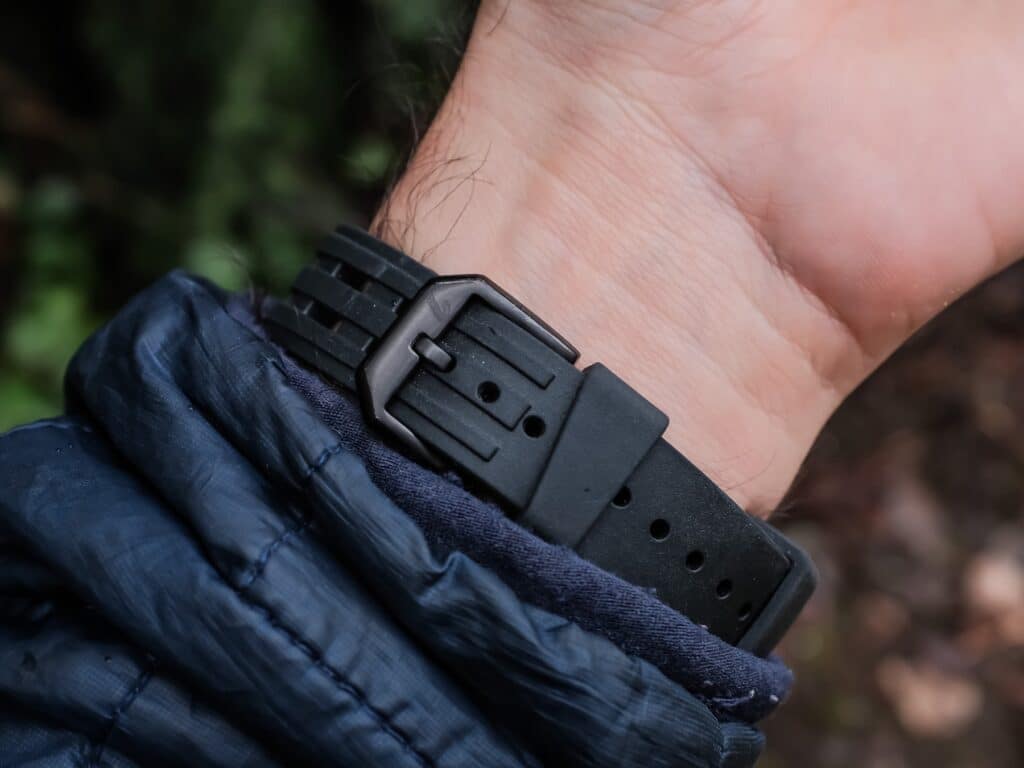
We also need to talk about the strap. The ISOfrane VS 1969 variant included here deserves real attention. The material has a density and texture that immediately feels more substantial than most modern rubber, while still staying comfortable against the skin. It resists dust, doesn’t grab lint, and avoids that plasticky sensation that turns a lot of rubber straps into afterthoughts.
The underside texture is especially well judged, and the hole layout feels intentional rather than decorative. Nothing about it reads as gimmicky. Paired with the slimmer case, the strap helps the watch disappear on the wrist in a way that earlier Benthos models never quite did.
At $1,590 for the DLC version on ISOfrane, the pricing feels fair. You’re getting strong finishing, a properly adjusted movement, and a design that prioritizes wearability without watering down the Benthos identity. It’s more engaging than most entry-level divers from larger brands, while still feeling versatile enough to wear outside of strictly tool-watch contexts.
I only spent time with the DLC version here, but based on wear alone, it never felt like the watch was asking me to second-guess that choice.
Where this watch really lands for me is in how it reframes the Benthos idea. I still love looking at photos of the older, chunkier models, and I always will. But this version is the one I’d actually keep reaching for. It feels like Aquastar took the spirit of the Benthos and made it compatible with how I wear watches now, not how I imagine wearing them. For a watch with this kind of lineage, that feels like the right move.

Co-Founder & Senior Editor
Michael Peñate is an American writer, photographer, and podcaster based in Seattle, Washington. His work typically focuses on the passage of time and the tools we use to connect with that very journey. From aviation to music and travel, his interests span a multitude of disciplines that often intersect with the world of watches – and the obsessive culture behind collecting them.
No common Aquastar crown engagement issues? Good to hear. Still, it’s too often reported for me to ever consider one.
Most problems with engaging or disengaging a crown involve failure to “back” the crown off a little to be able to engage the screw thread without stripping it. It’s not that hard to do.
My thoughts as well. I obsessively press in, screw counter-clockwise until I seat the threads, then I screw the crown in.