After 10 years of hands-on reviewing dive watches, we’ve worn everything from sub-$100 beaters to luxury tool watches costing several thousand dollars. That much wrist time has made one thing clear: the best dive watches are not always the ones with the biggest depth rating, the most expensive movement, or the most recognizable name. The ones that stick with us are the watches that balance durability, legibility, wearability, design, and a price that makes sense for what you’re actually getting.
This piece brings together the dive watches that have stood out most through our hands-on testing and long-term ownership. We’ve personally reviewed nearly every watch on this list, and several have lived in our collections for years, giving us a chance to judge more than specifications alone. That includes how a case actually wears, how the bezel and crown feel in use, how the movement performs over time, and which compromises start to matter after the novelty wears off.
Invicta Pro Diver
| Price Range: | $65 – $100 (Check Current Price) |
| Water Resistance: | 200m |
| Case Dimensions: | 40mm x 48mm x 14mm |
| Lug Width: | 20mm |
| Movement: | Seiko NH35 (Automatic) |
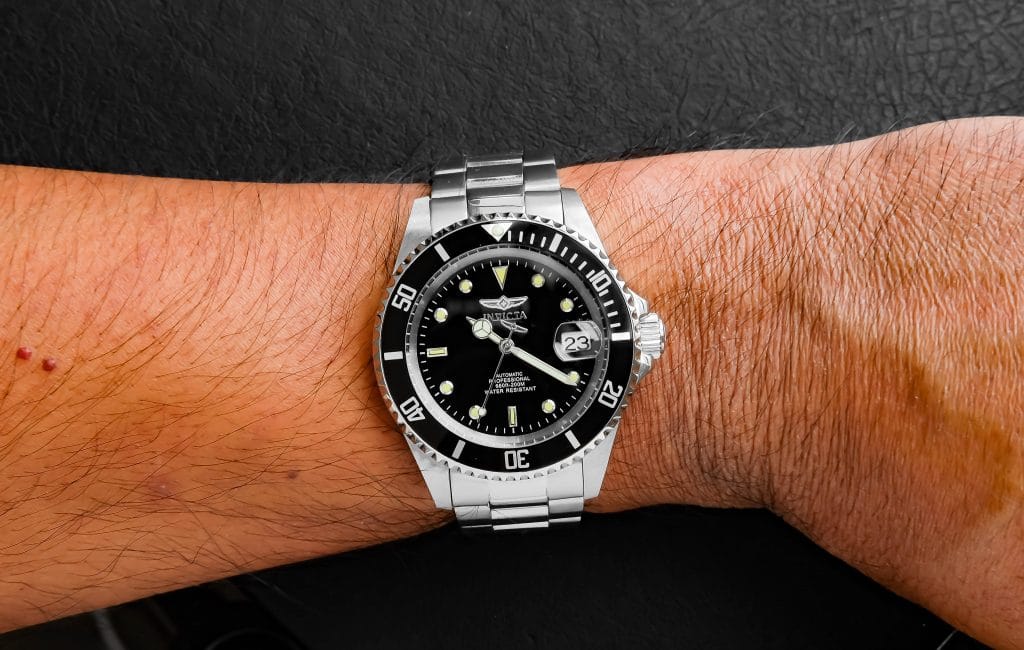
Few watches in this price range arrive with as much baggage as the Invicta Pro Diver. That reputation is exactly why we eventually stopped reading everyone else’s takes and tested one ourselves for our full hands-on review. The surprise was how quickly the controversy faded once it was on the wrist. At 40mm with a roughly 48mm lug-to-lug, it wears like a familiar Sub-style diver rather than the oversized caricature people sometimes imagine when they hear the Invicta name.
The value shows up most clearly in the case, bezel, and movement. Our example had firmer bezel action than expected, the crown was easy to grip, and the brushed-to-polished transitions looked better in person than the price suggests. The bracelet is where the budget starts to show, with hollow end links and a basic clasp, while the lume is inconsistent compared with stronger performers on this list. We also still dislike the oversized branding carved into the case flank.
The NH35 is what keeps the whole package difficult to dismiss. It hacks, hand-winds, is easy to service, and has a long track record for reliability. Invicta states 200 meters of water resistance, although for actual diving we would still reach for something with stronger dive-specific credentials. As an inexpensive automatic you can wear hard, swim with, and not worry about, though, the Pro Diver remains one of the easiest sub-$100 recommendations in the category.
Casio Duro
| Price: | $85 (Check Current Price) |
| Water Resistance: | 200m |
| Case Dimensions: | 44.2mm x 48.5mm x 12.1mm |
| Lug Width: | 22mm |
| Movement: | Casio 2784 (Quartz) |
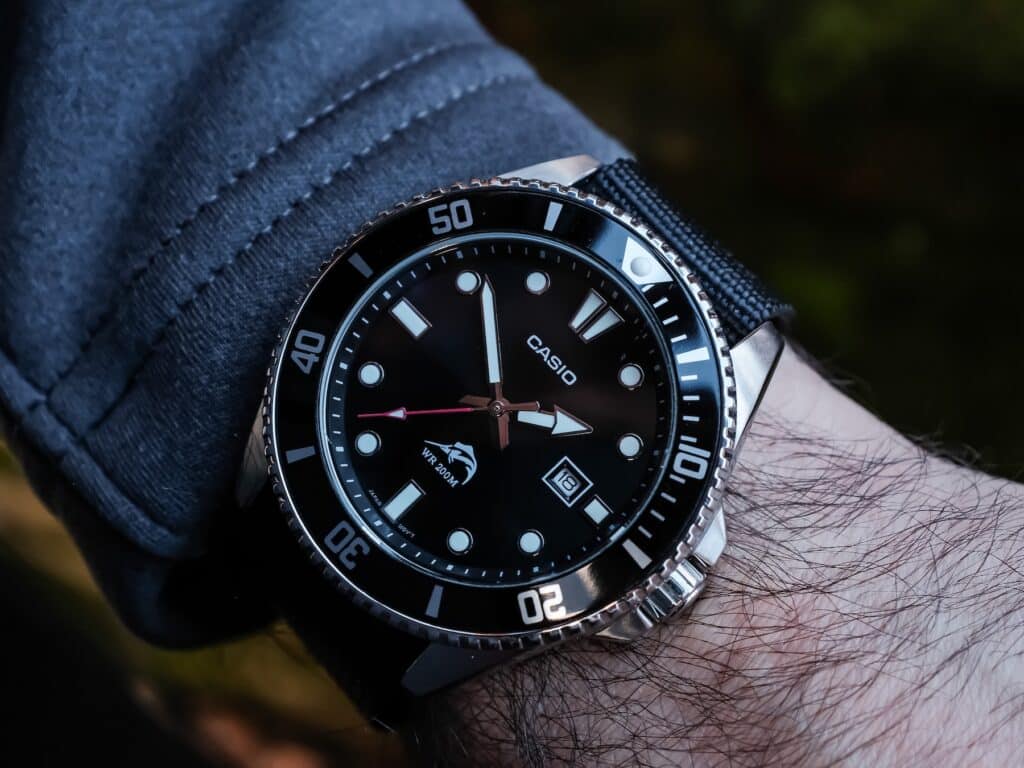
For nearly a decade, the Duro was one of those watches we somehow knew better by reputation than by wrist time. After finally having the opportunity to test it on wrist, the first thing we had to unlearn was the fear of its 44.2mm diameter. The 48.5mm lug-to-lug and downward-curving lugs keep it from sprawling, and the experience felt closer to wearing a Seiko Turtle than the raw dimensions would suggest: still a large diver, but not a clumsy one.
The rest of the watch overdelivers in the places that matter. The screw-down crown and caseback support a proper 200-meter rating, while the aluminum bezel on our loaner turned with a smooth, firm action that felt closer to much more expensive divers than the price would suggest. The dial is simple and easy to read, the applied markers are better finished than expected, and even the framed date window feels more considered than it has any right to at this level. The lume could last longer, and quartz seconds-hand alignment will vary from watch to watch, so this is not some miracle watch without compromises.
What really sold us was how little effort the Duro asks from its owner. We wore the loaner on Toxic NATO and Prometheus Design Werx straps rather than the stock rubber, and the 22mm lug width made it unusually fun to swap around. The Casio 2784 fits the concept perfectly too: roughly three years of battery life, hacking seconds, quick-set date, and no need to think about winding or resetting it every few days. By the time the borrowed watch had to go back, we were already looking at which Duro to buy for ourselves.
Orient Mako II
| Price Range: | $255 (Check Current Price) |
| Water Resistance: | 200m |
| Case Dimensions: | 41.5mm x 47mm x 13mm |
| Lug Width: | 22mm |
| Movement: | Orient Caliber F6922 (Automatic) |
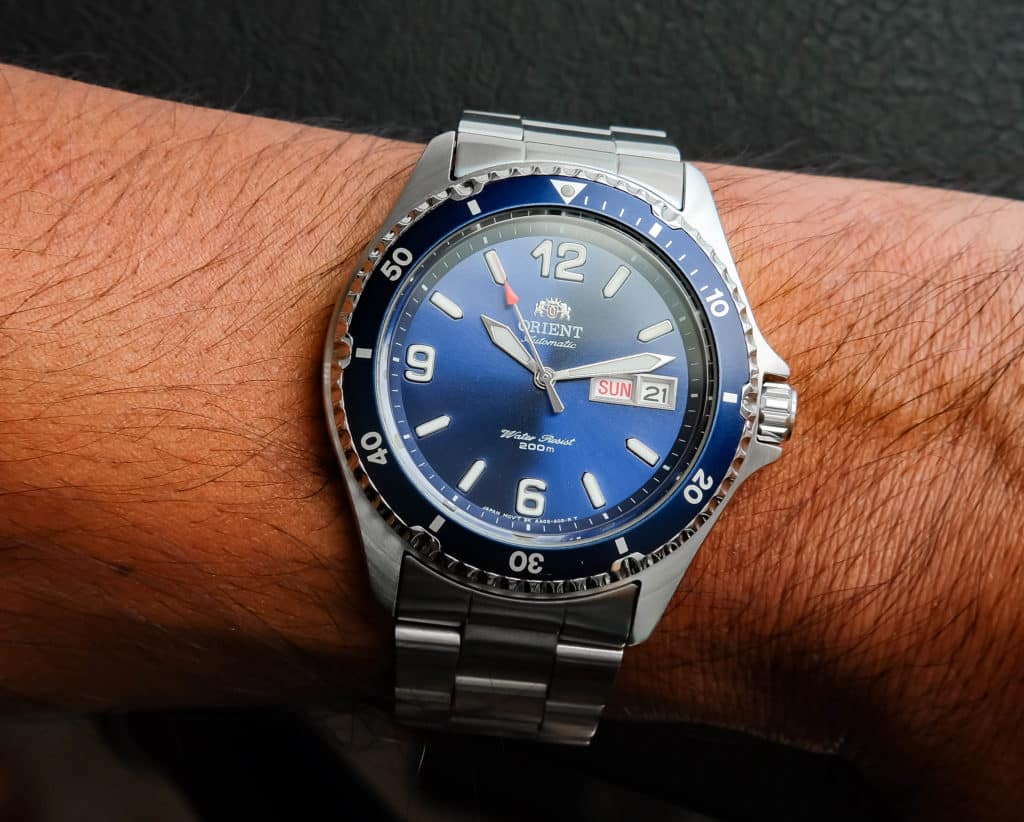
Most budget divers reveal the compromise immediately: a bracelet that feels disposable, sloppy alignment, or a dial that only looks convincing in product photography. The Mako II surprised us because those trade-offs never dominated the experience. During our hands-on review, the 41.5mm case and 47mm lug-to-lug felt balanced right away, while the sunburst dial showed far more depth in changing light than the stock images suggest.
The F6922 movement is also a meaningful step forward from the original generation. You get hacking, hand-winding, and full day-date control through the crown instead of the old 2 o’clock pusher. The winding action has a little mechanical bite to it, but that never bothered us. More importantly, Orient is giving you its own automatic movement in a price bracket where plenty of competitors simply drop in an NH35 or move to quartz.
Case and bracelet finishing are better than the price suggests, with enough brushed and polished contrast to keep the Mako from feeling disposable. The sloped bezel can be tricky to grip, and the bracelet is still not luxury-grade, but neither flaw overwhelms the watch. If you want an inexpensive automatic diver that feels like a complete watch rather than a collection of cost-cutting decisions, the Mako II still earns its spot.
Citizen Promaster Diver Eco-Drive
| Price Range: | $200 – $450 (Check Current Price) |
| Water Resistance: | 200m |
| Case Dimensions: | 43mm x 48mm x 11.5mm |
| Lug Width: | 20mm |
| Movement: | Citizen E168 (Eco-Drive Solar Quartz) |
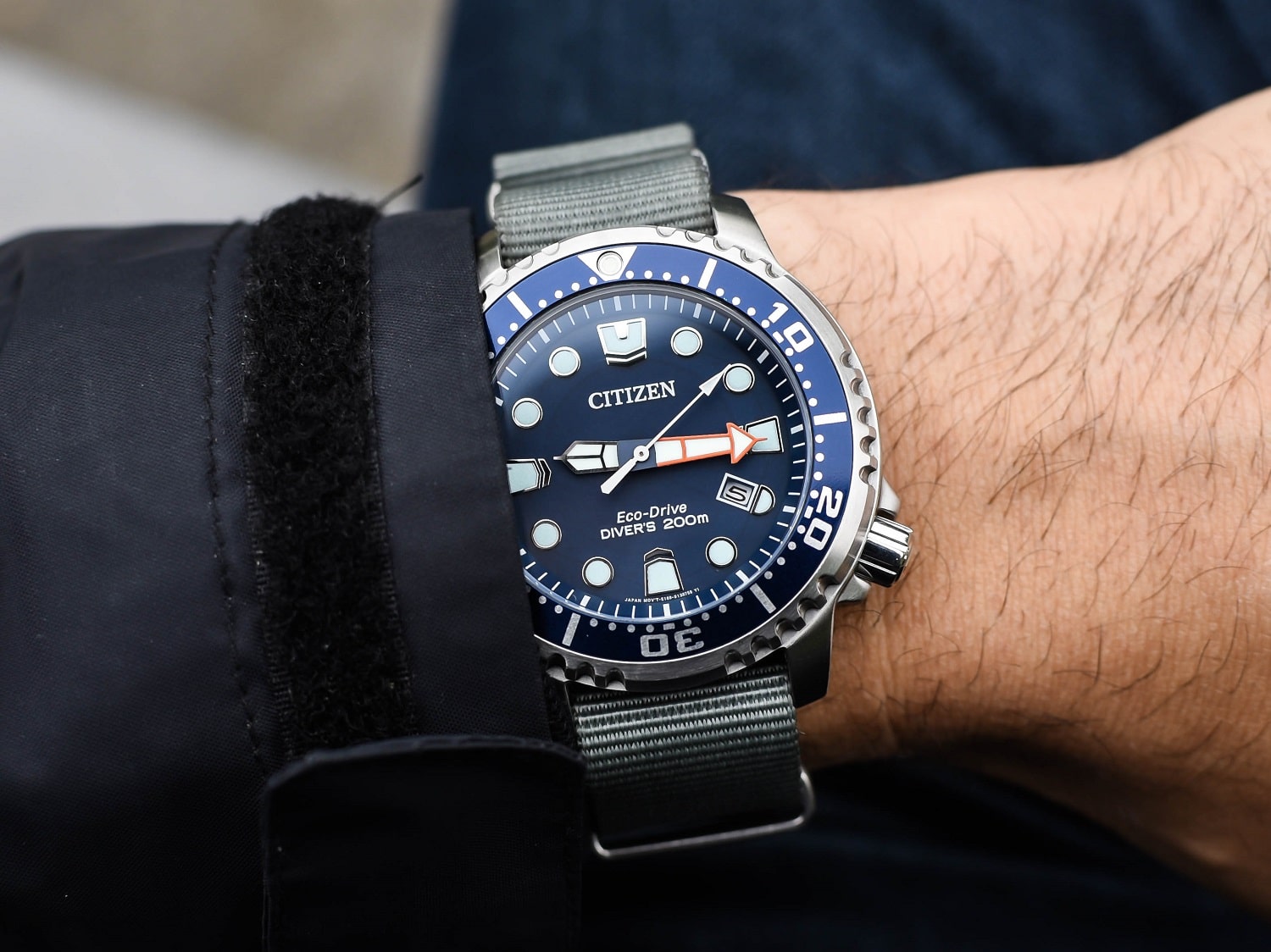
Some watches become favorites because they are exciting. The Promaster Eco-Drive earned its place by becoming the watch we reached for when we did not want to think about the watch at all. Years of collection wear with the BN0151-09L, plus our full review, reinforced how useful that can be: solar powered, accurate, rated to 200 meters, and basically ready whenever you are.
Its 43mm diameter looks large on paper, but the short lugs and 48mm span keep the case controlled on the wrist. The undercut crown stays out of the way, and the deep blue dial remains easy to read from office lighting to low-light outdoor conditions. Citizen even gives the seconds hand lume, a small detail that reinforces the sense that this was designed around visibility rather than just dive-watch aesthetics.
The stock rubber strap is still the weak point for us, and the 60-click bezel feels less refined than some of the mechanical competition here. Fortunately, the standard 20mm lug width makes swapping to nylon, sailcloth, or another rubber strap easy. Those are minor trade-offs for a watch that can sit for months, charge itself from light, and be ready the moment you pick it up. If reliability matters more than mechanical romance, this remains one of the strongest values on the list.
Orient Kamasu
| Price Range: | $250 – $350 (Check Current Price) |
| Water Resistance: | 200m |
| Case Dimensions: | 41.5mm x 47mm x 12.8mm |
| Lug Width: | 22mm |
| Movement: | Orient Caliber F6922 (Automatic) |
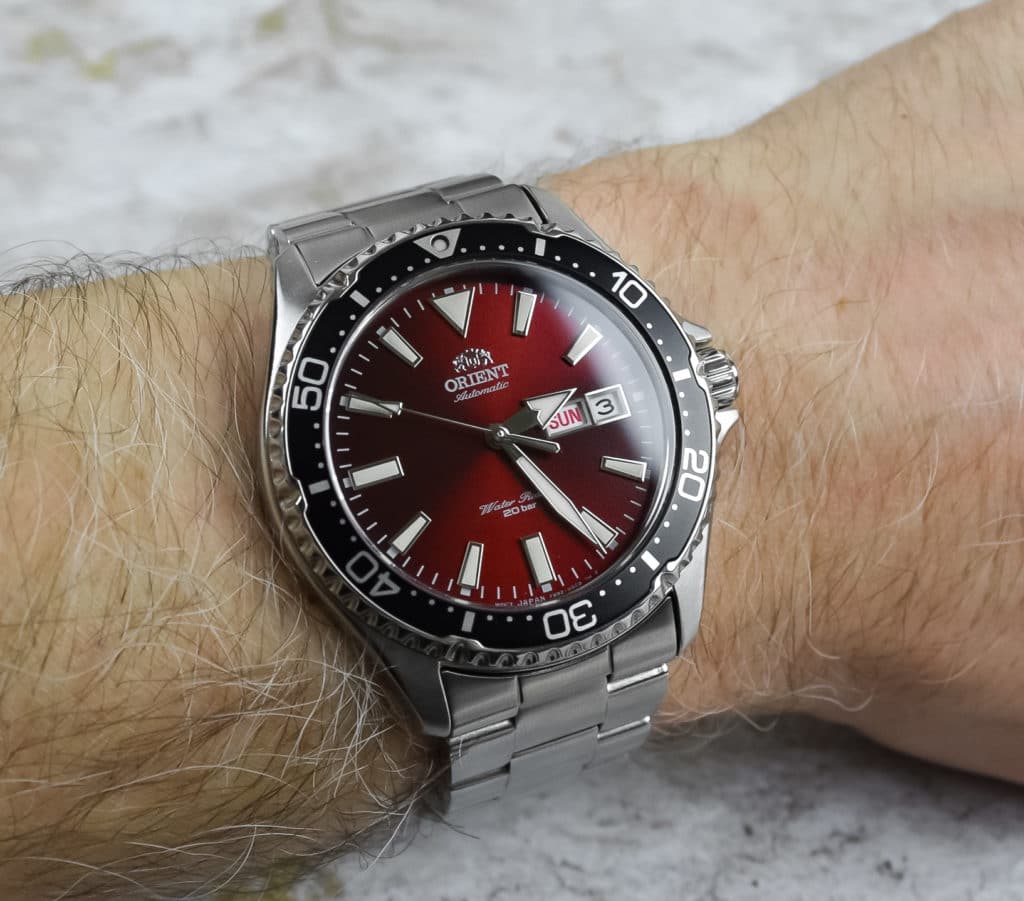
There is a point where “good for the money” stops sounding like a compliment and starts sounding like a limitation. The Kamasu is where Orient began escaping that label for us. In our hands-on review, the familiar 41.5mm diameter and 47mm lug-to-lug made it immediately comfortable, but the slightly slimmer 12.8mm case and sapphire crystal gave it a noticeably more finished feel than the Mako II and Ray II generation.
The dial does most of the visual work. On the red version we tested, the sunburst finish shifts dramatically as the light changes, while the applied markers seem to float because there is no conventional chapter ring crowding the perimeter. The F6922 movement brings hacking, hand-winding, and a day-date display, and it has proven to be exactly the kind of dependable in-house movement we want in an everyday affordable diver.
A few familiar Orient quirks remain. The coin-edge bezel could use more grip, and the crown sits deeply enough between its guards that winding and setting can feel fiddly. Those are small complaints against the overall package. With 200 meters of water resistance, sapphire, strong lume, and a dial that does not look budget, the Kamasu is still one of the clearest arguments that many buyers never need to spend beyond the $300 range for a satisfying mechanical diver.
Scurfa Diver One
| Price Range: | $250 – $399 (Check Current Price) |
| Water Resistance: | 500m |
| Case Dimensions: | 40mm x 47mm x 14mm |
| Lug Width: | 20mm |
| Movement: | ETA F06.402 (Quartz) |
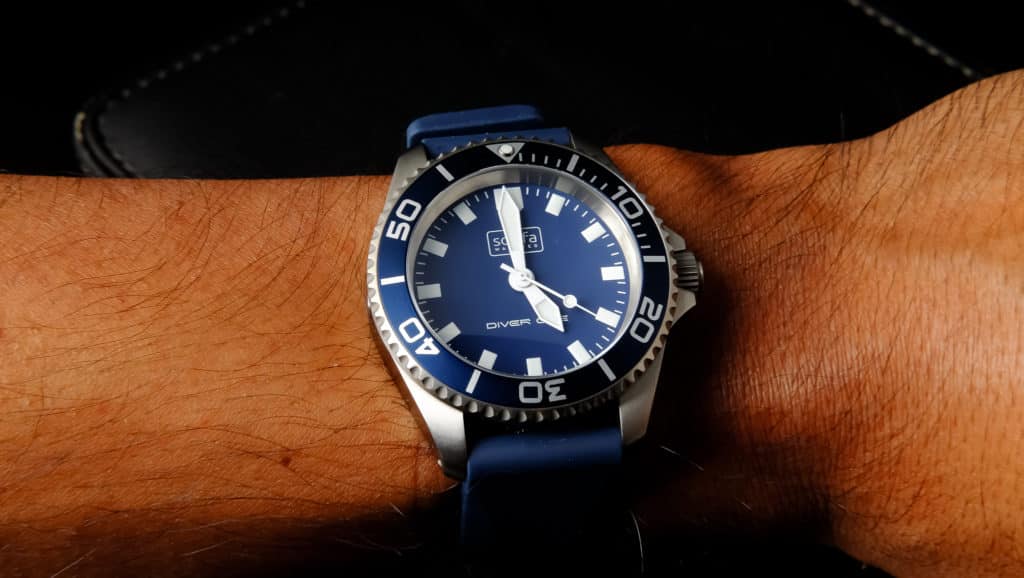
The quickest way to understand the Diver One is to stop thinking of Scurfa as a microbrand trying to look like a professional tool-watch company. The brand was founded by a working saturation diver, and that background came through clearly during our hands-on testing of the watch. At 40mm with a 47mm lug-to-lug, the proportions are already manageable, but titanium makes the watch feel dramatically lighter and easier to wear for long stretches than many comparably capable steel divers.
The spec sheet is almost comically serious for the price: 500 meters of water resistance, a multi-gasket screw-down crown, helium escape valve, domed sapphire, and a quartz movement chosen for accuracy and reliability rather than romance. The bezel on our example had the firm, purposeful action we want from a dive tool, and the lume was strong enough to sit comfortably alongside the best affordable Seiko divers we have tested.
Most people will never need this level of capability, and the straightforward quartz movement will not appeal to collectors who want something mechanical. That is also part of the appeal. Nothing about the Diver One feels added for storytelling. It is compact, legible, genuinely overbuilt, and clearly shaped by someone who understands what dive-watch specifications are actually for.
Seiko Turtle
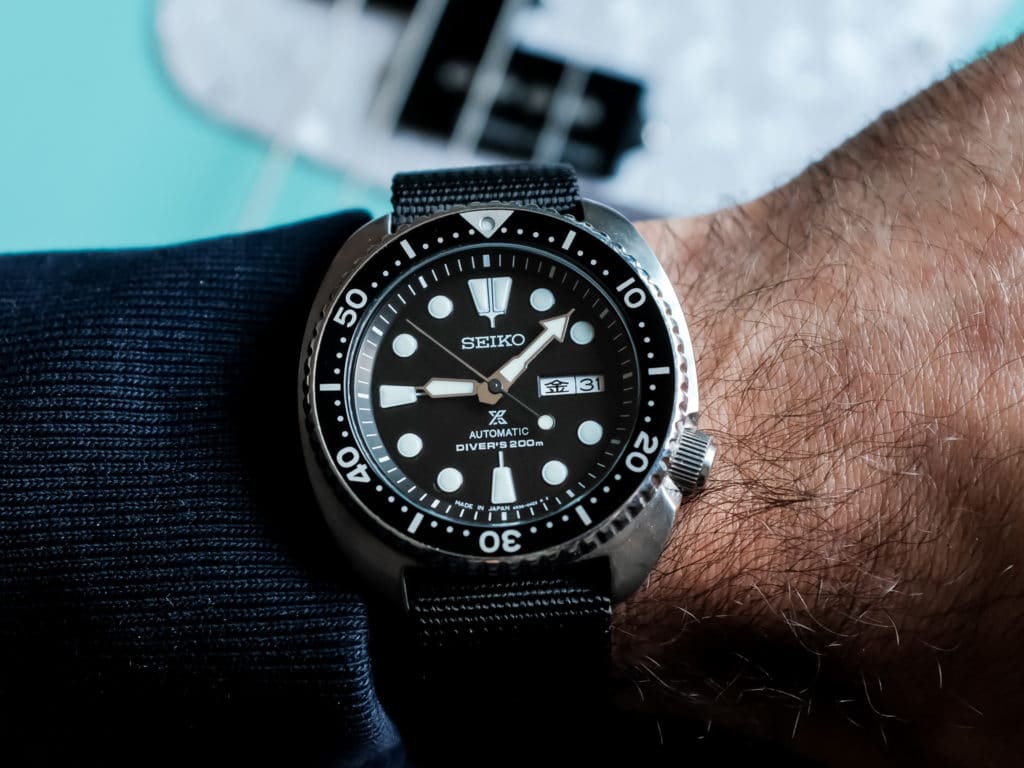
| Price Range: | $380 – $500 (Check Current Price) |
| Water Resistance: | 200m |
| Case Dimensions: | 44.3mm x 48mm x 14mm |
| Lug Width: | 20mm |
| Movement: | Seiko 4R36 (Automatic) |
If you judged the Turtle by diameter alone, you would probably never guess how comfortable it is. Years of living with the modern version, plus our long-term hands-on review, made the case dimensions feel almost misleading: the asymmetric cushion case, short 48mm lug-to-lug, and low-slung profile keep this 44.3mm diver far more controlled than the number suggests.
That case shape is also a huge part of the watch’s identity. Fully brushed surfaces, a vented rubber strap, matte dial, oversized lume plots, and broad hands give the Turtle the same uncomplicated tool-watch feel that made the old 6309 memorable. The 4R36 adds hacking and hand-winding compared with older Seiko movements, and our example performed noticeably better than Seiko’s broad published accuracy tolerance during regular wear.
The usual Seiko caveats are still here. Hardlex is easier to scratch than sapphire, and our review watch showed the kind of bezel alignment issue that has followed affordable Seiko divers for years. Neither flaw stopped us from wearing it. The Turtle survives because it combines lineage, comfort, legibility, easy servicing, and a case design that still feels unlike almost anything else in the price range.
Seiko Samurai
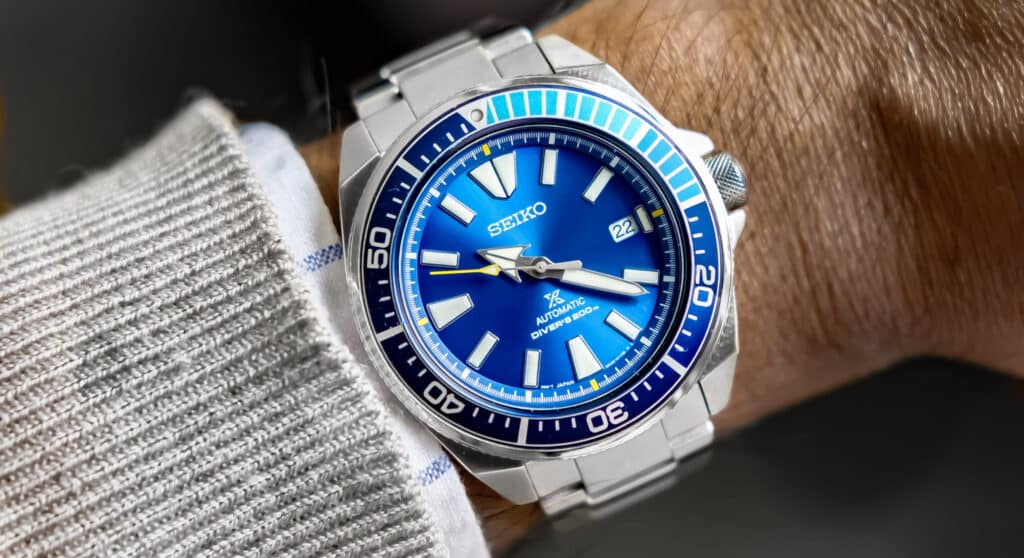
| Price Range: | $400 – $525 (Check Current Price) |
| Water Resistance: | 200m |
| Case Dimensions: | 43.8mm x 47mm x 13mm |
| Lug Width: | 20mm |
| Movement: | Seiko 4R35 (Automatic) |
Put the Samurai next to the Turtle and the family resemblance almost disappears on the wrist. That contrast was obvious during our hands-on review. The 43.8mm diameter and 47mm lug-to-lug suggest another broad-but-manageable Seiko diver, but the straight, angular lugs keep the case sitting higher and give it a much more aggressive presence.
That geometry is the entire point. Sharply faceted case surfaces, squared bezel knurling, an oversized crown, and broad hands make the Samurai feel architectural rather than merely large. Bezel clicks on our example were sharp and deliberate, the crown was easy to manipulate, and Seiko’s lume remained exceptionally bright in low-light conditions. This is a watch that makes its presence known instead of disappearing under a cuff.
Inside, the 4R35 keeps things familiar with hacking, hand-winding, and a movement architecture that is easy to service almost anywhere. The Hardlex crystal and elevated case position will turn off buyers looking for something slimmer and more refined, and the styling is far less universally friendly than the Turtle. But that is exactly why it belongs here: the Samurai gives you a genuinely different Seiko experience instead of another variation on the same affordable-diver formula.
Nodus Sector Deep
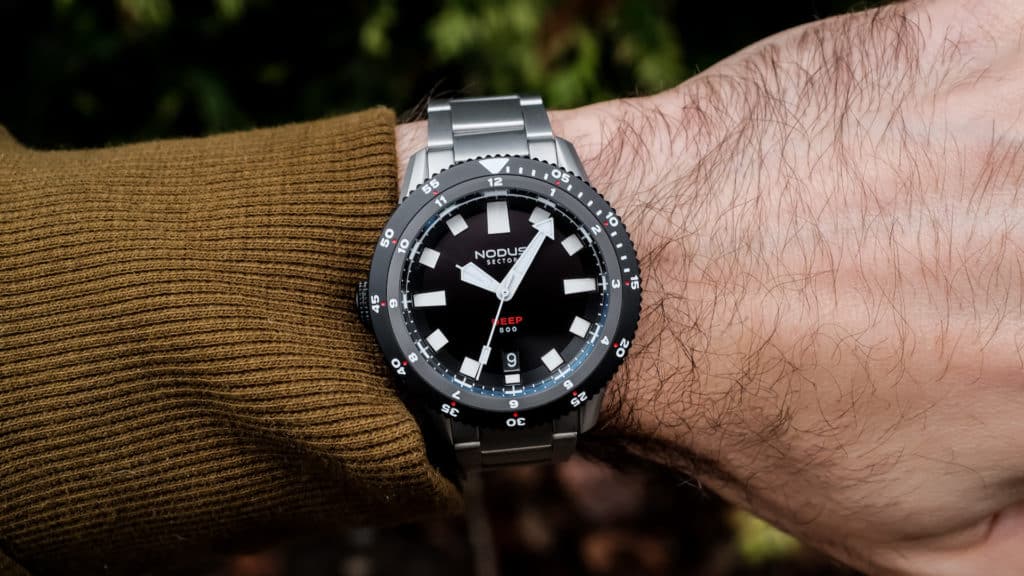
| Price: | $650 (Check Current Price) |
| Water Resistance: | 500m |
| Case Dimensions: | 42mm x 47mm x 13.6mm |
| Lug Width: | 20mm |
| Movement: | Seiko NH35 (Automatic) |
Five hundred meters of water resistance usually comes with some kind of punishment: too much thickness, too much weight, or a case that feels engineered around a number rather than a wrist. The Sector Deep avoided that trap during our hands-on review. The 47mm lug-to-lug and relatively slim 13.6mm profile kept the watch much easier to wear than we expected from something rated this seriously.
The left-side crown became one of our favorite details, partly because it looks distinctive but mostly because it stays out of the way all day. The oversized matte DLC bezel is exceptionally easy to grip and carries both a dive scale and a second-time-zone scale. Bead-blasted surfaces, the broad arrow minute hand, strong BGW9 lume, and small red accents give the watch a mission-ready personality without turning it into generic military cosplay.
Nodus’s NodeX clasp adds useful on-the-fly adjustment, although extending it far enough exposes some of the underlying hardware and makes the mechanism look less polished. The regulated NH35 is familiar rather than exciting, but that simplicity fits the watch. What earns the Sector Deep its place is the combination of real 500-meter capability, distinctive ergonomics, and a design that still looks unmistakably like a Nodus.
Baltic Aquascaphe
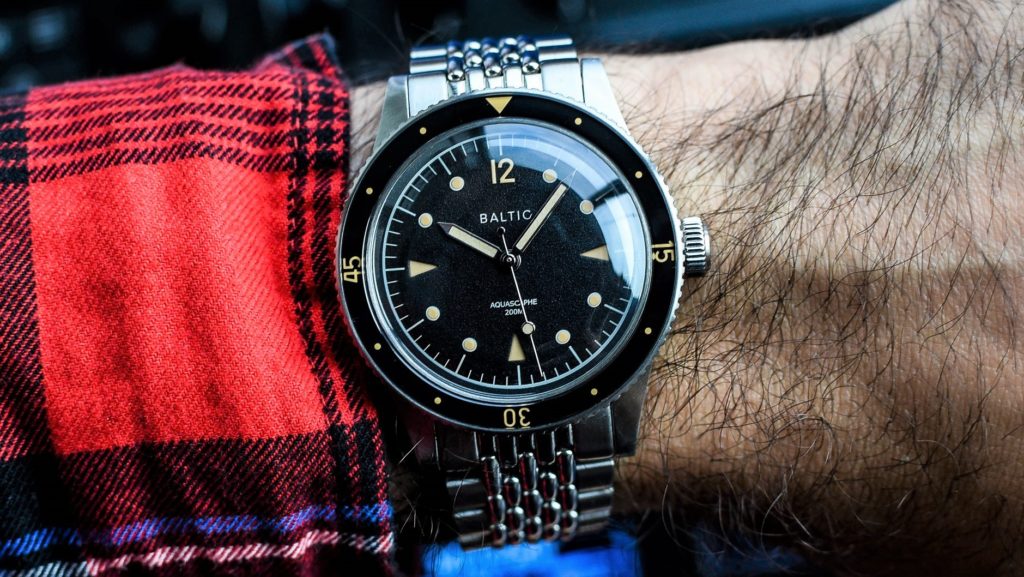
| Price Range: | $650 – $750 (Check Current Price) |
| Water Resistance: | 200m |
| Case Dimensions: | 39mm x 47mm x 12mm |
| Lug Width: | 20mm |
| Movement: | Miyota 9039 (Automatic) |
Vintage-inspired divers often lose us when the reference point becomes too obvious. The Aquascaphe works because it borrows the language of old skin divers without tracing a single famous watch. In our hands-on review, the 39mm diameter, 47mm lug-to-lug, and 12mm thickness created a compact, planted fit that felt closer to wearing an actual older diver than a modern watch scaled up for contemporary tastes.
The light case, sloped profile, and beads-of-rice bracelet keep the watch comfortable for long stretches. A sandwich dial combines cutout markers with surface lume, and the warmer lume tone works with the gilt details without crossing into forced faux-vintage territory. Baltic also gets the practical stuff right: drilled lugs, screw-down crown and caseback, sapphire crystal, 200 meters of water resistance, and a textured crown that is easy to operate.
The Miyota 9039 is thin and dependable, although the winding action is not especially smooth or luxurious. That is one of the few places where the price reveals itself. What impressed us more was how cohesive the design remained after the novelty wore off. The Aquascaphe uses vintage dive-watch language as a starting point rather than a costume, and that distinction is why it has stayed one of our favorite microbrand divers in this range.
Halios Seaforth IV Titanium
| Price: | $930 (Check Current Price) |
| Water Resistance: | 200m |
| Case Dimensions: | 41mm x 46.5mm x 12.4mm |
| Lug Width: | 20mm |
| Movement: | Sellita SW200-1 (Automatic) |
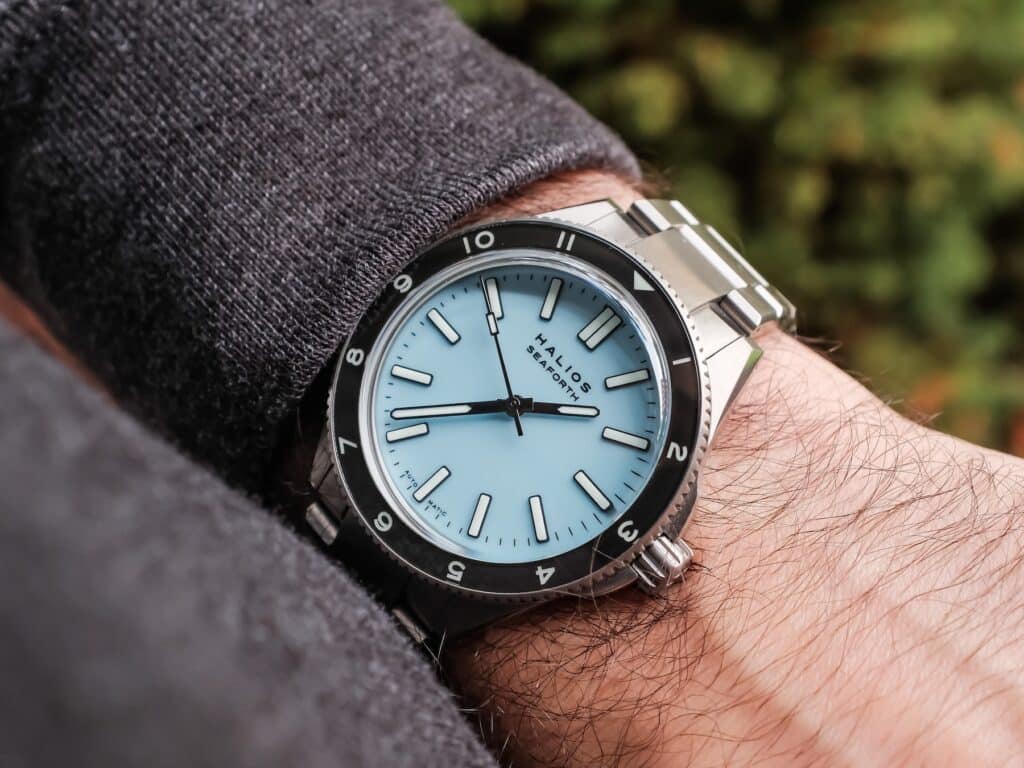
We did not really choose the Seaforth IV Titanium as a favorite; it slowly made the choice for us. During our long-term review, we kept opening the watch box and reaching for it even when other pieces were waiting for wrist time. Weeks passed before we realized the rotation had effectively stopped. That kind of repetition tells us more than an impressive first afternoon with a review sample ever could.
Titanium is a huge part of why it works. The 41mm case and 46.5mm lug-to-lug are already friendly dimensions, but the reduced weight makes the watch unusually cooperative across long days. The pastel-blue dial shifts subtly with the light, ceramic markers add depth, and C3 X1 lume keeps the hands, markers, and bezel fading together instead of at different rates. We chose the 12-hour bezel and ended up using it to track another time zone, turning a small functional detail into part of the daily routine.
The bracelet matters just as much. It is full titanium, uses screw links, integrates cleanly with the case, and includes tool-free adjustment that makes fine-tuning the fit throughout the day almost frictionless. After a few weeks, both case and bracelet picked up scratches, the obvious trade-off with untreated titanium, but that never made us want to baby it. The Sellita SW200-1 is familiar rather than exotic, yet it ran consistently and stayed out of the way. At $965, the Seaforth sits near the top of the sub-$1,000 category, but it earned that price by becoming one of the easiest watches in the box to keep wearing.
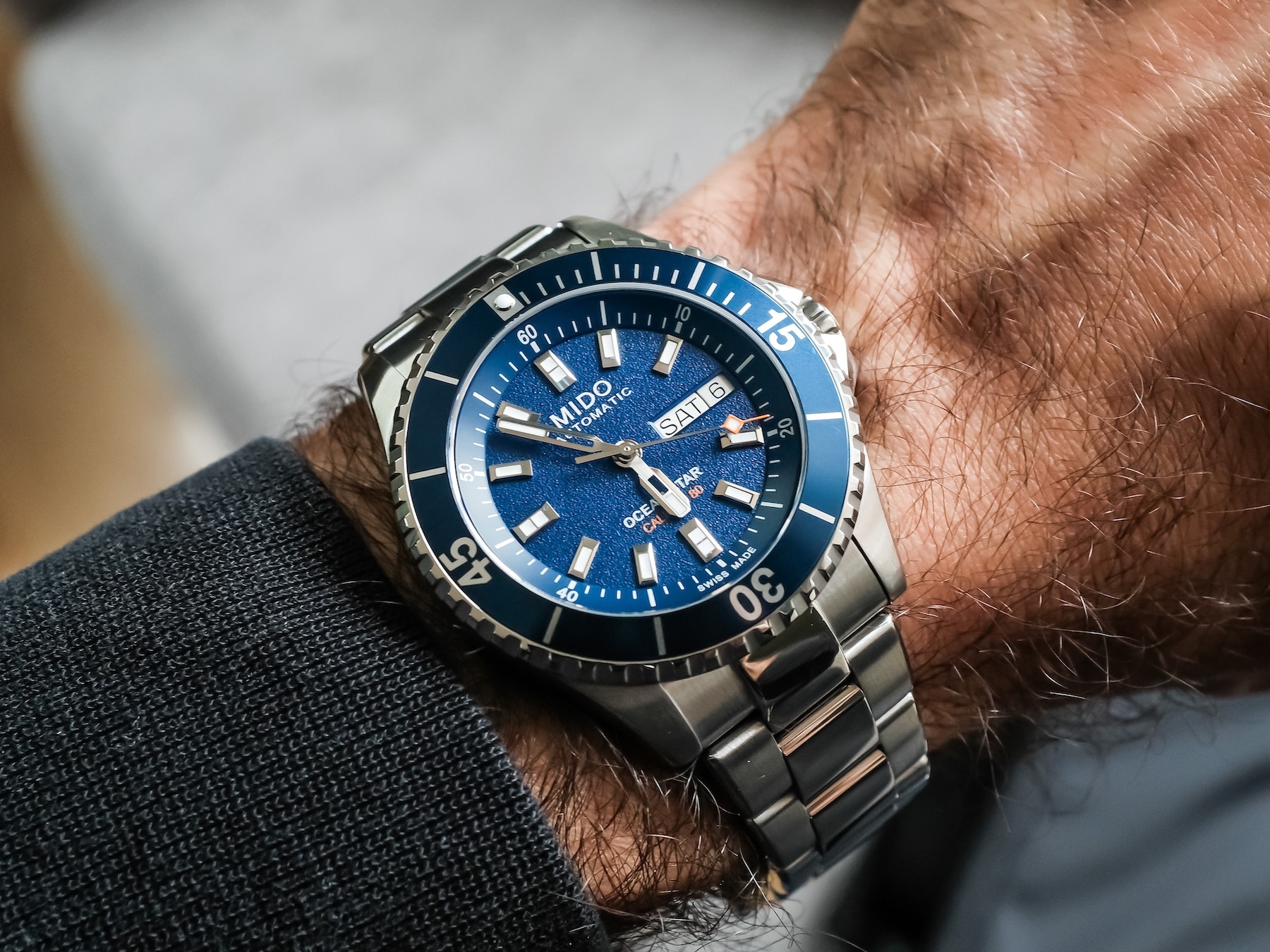
Mido Ocean Star 200
| Price: | $980 (Check Current Price) |
| Water Resistance: | 200m |
| Case Dimensions: | 41mm x 47.03mm x 11.7mm |
| Lug Width: | 21mm |
| Movement: | Mido Caliber 80 Day-Date (Automatic) |
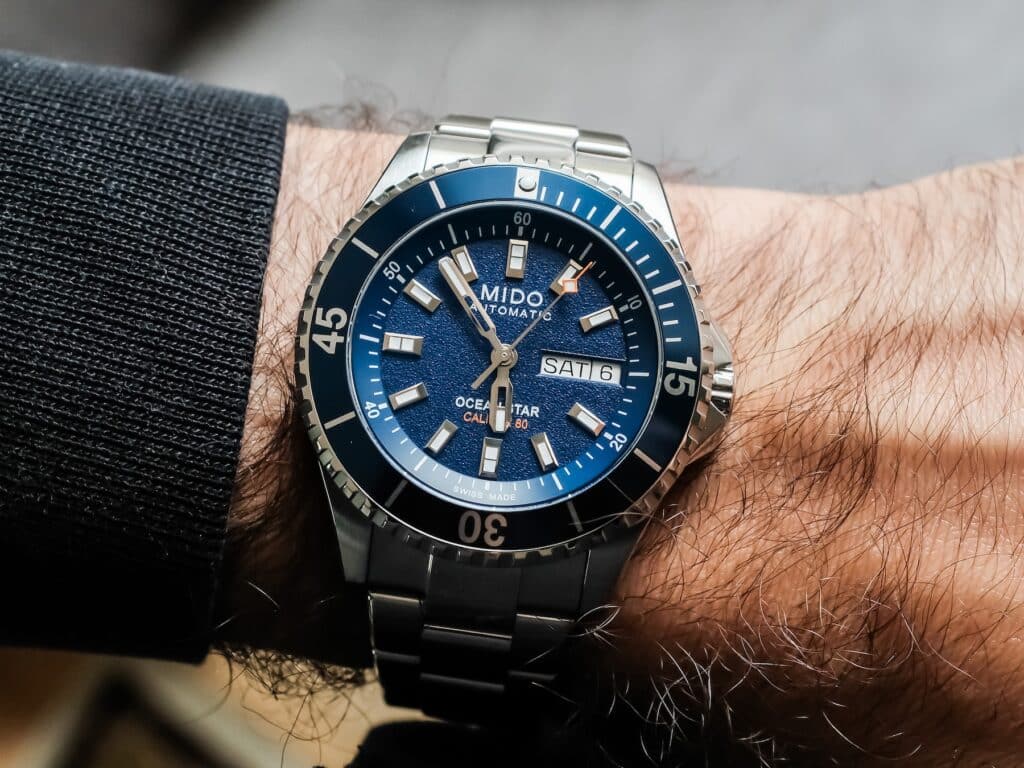
Three colorways on the desk at the same time turned out to be more revealing than any spec sheet. A few weeks after calling the refreshed Ocean Star 200 one of the more compelling Swiss dive-watch releases of summer 2026, Mido sent us the white, blue, and silver versions for a full hands-on review. Rotating through all three made it clear that the appeal was not just theoretical: the 41mm case, 47.03mm lug-to-lug, and 11.7mm thickness felt balanced across full days of wear, and even at 172 grams on bracelet, none crossed into cumbersome territory.
The redesign also feels more meaningful in person than in press photos. A broader chamfer gives the case more definition, the crown guards and bezel feel more confident without becoming oversized, and the raised outer flange plus textured dial add real depth. We kept returning to the white-dial model because the contrast against the black bezel gave it the strongest tool-watch character, while the blue felt like the safest all-rounder and the silver grew on us over time.
Mido’s Caliber 80 Day-Date brings an 80-hour power reserve and Nivachron balance spring, and that reserve was genuinely useful while the watches were constantly being swapped in and out. Sapphire, 200 meters of water resistance, quick-release bracelet hardware, and a diver’s extension round out the package. The day-date display will be a deal breaker for buyers who want a cleaner dial, and $980 is no longer bargain territory, but the Ocean Star 200 feels like a complete Swiss diver rather than the watch you settle for before buying something more expensive.
Serica 5303-2
| Price Range: | $1,720 – $1,950 (Check Current Price) |
| Water Resistance: | 300m |
| Case Dimensions: | 39mm x 46mm x 12.2mm |
| Lug Width: | 20mm |
| Movement: | Soprod Newton; current model uses Soprod M100 (Automatic) |
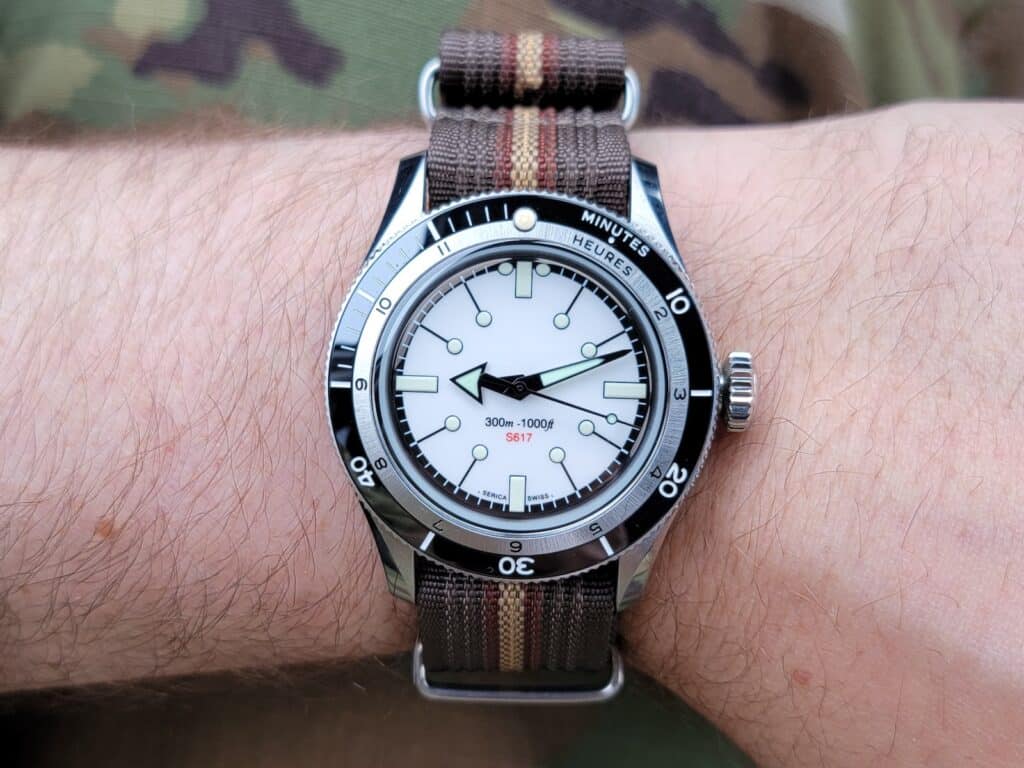
Years of ownership have a way of stripping away the things that only looked good during the honeymoon period. We bought our Serica 5303-2 secondhand in 2022, and our long-term review comes after enough time for both the charm and the flaws to become obvious. The 39mm case, 46mm lug-to-lug, and low visual profile sit squarely in what we would call the Goldilocks zone: enough presence to feel like a dive watch without constantly reminding you that one is strapped to your arm.
The design is still the main reason to buy it. The metallic-silver dial often reads more like white, the pad-printed markers sit unusually far toward the center, and the near-total lack of branding keeps the watch from looking like another generic mid-century homage. Serica’s two-scale bezel is especially good, pairing a black ceramic dive scale with a brushed 12-hour scale. Our example’s 120-click bezel has remained solid with no meaningful play, while the oversized 8mm crown is easy to operate. The one visual nitpick is the black PVD handset, which we felt looked a little less premium than the rest of the watch.
Ownership has also exposed the important caveat. Our first-generation watch uses the Soprod Newton movement, and we have experienced the crown-slipping and hacking issues that helped push Serica toward the newer Soprod M100. Current models are chronometer certified and use that updated movement, so buyers today are not shopping for exactly the same mechanical package. Still, the dimensions, 300-meter rating, bezel design, and overall character remain essentially unchanged. Years later, it is still in the rotation, and that tells us more than a flawless week-long review ever could.
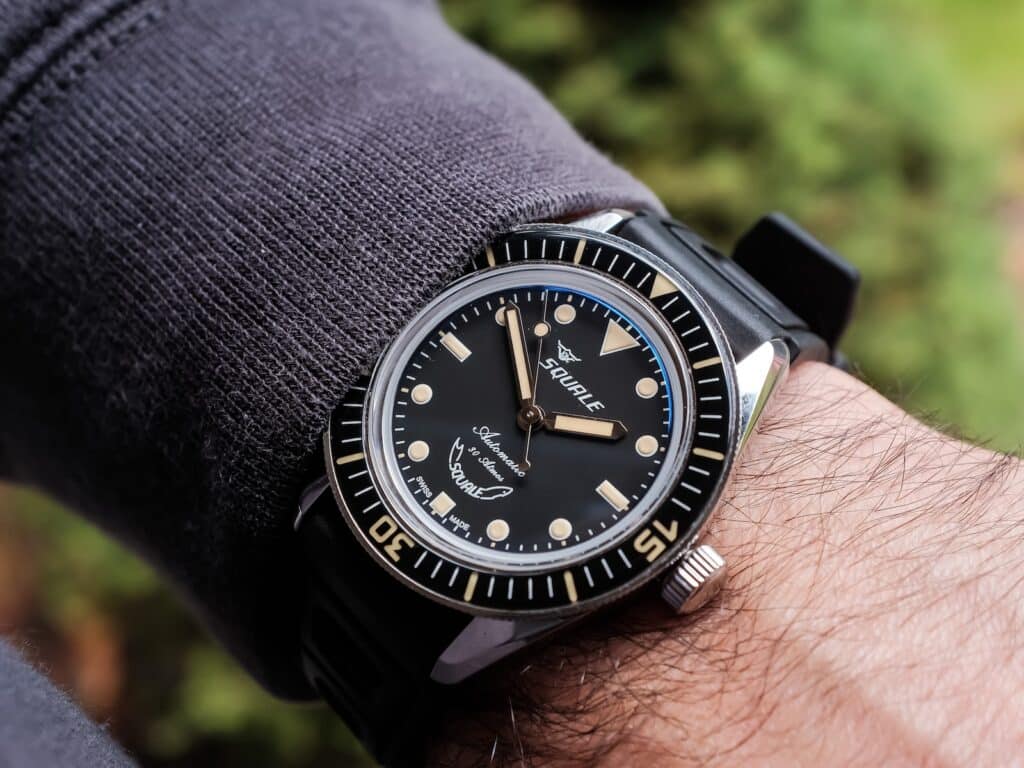
Squale Sub 37 Legend
| Price: | $1,750 (Check Current Price) |
| Water Resistance: | 300m |
| Case Dimensions: | 37mm x 45mm x 11.2mm |
| Lug Width: | 19mm |
| Movement: | Sellita SW200-1 (Automatic) |
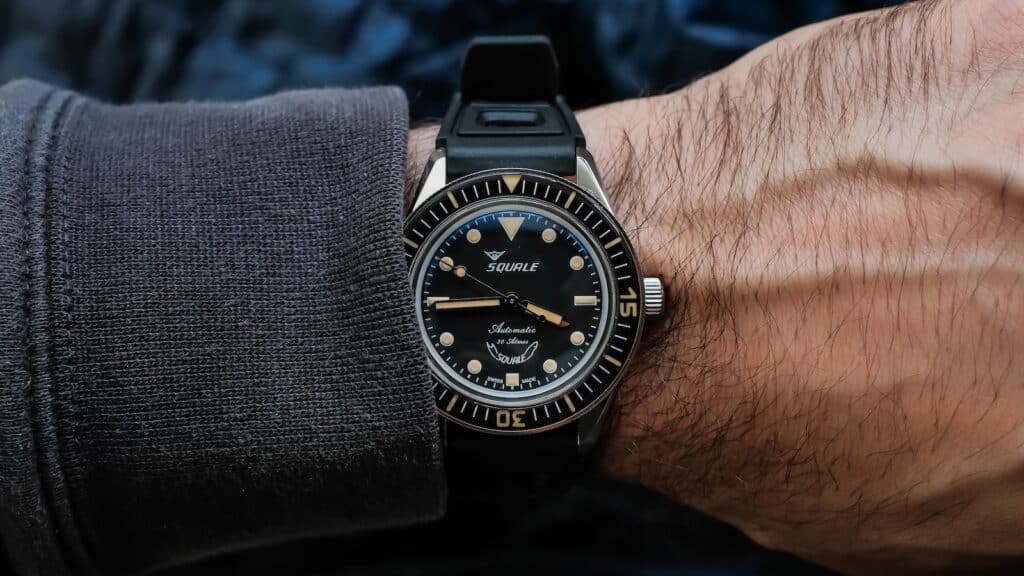
Nearly ten years into TBWS, we somehow still had a Squale-shaped hole in the review archive. The Sub 37 Legend finally filled it, and during the full review the expected headline was the 37mm diameter. Instead, the 11.2mm thickness made the stronger impression. With a roughly 38.5mm bezel diameter and 45mm lug-to-lug, the watch carries more wrist presence than the case number suggests while still sitting low enough to slide under a cuff.
That compactness is paired with a convincing vintage treatment. The curved bezel insert, warm lume, polished case, and double-domed sapphire all pull the design backward without making the watch feel fragile or costume-like. The dial remained easy to read in direct sun and indoors, while the old-radium-colored lume was perfectly adequate at night. The anti-reflective coating can flash a fairly obvious blue tint at certain angles, and there is a small amount of bezel play if you deliberately go looking for it, but neither became a real annoyance in daily use.
The Sellita SW200-1 also did exactly what we wanted: consistent accuracy, smooth winding, positive setting action, and no mechanical drama. We specifically noted that the crown avoided the gritty feel that sometimes appears with this movement family. Add 300 meters of water resistance and a proper screw-down crown, and the Sub 37 is much more capable than its vintage styling implies. At $1,750, the price is the harder sell, but if you want a smaller Swiss diver that feels genuinely distinct instead of merely downsized, this is one of the few we have reviewed that makes a strong case for itself.
Sinn T50
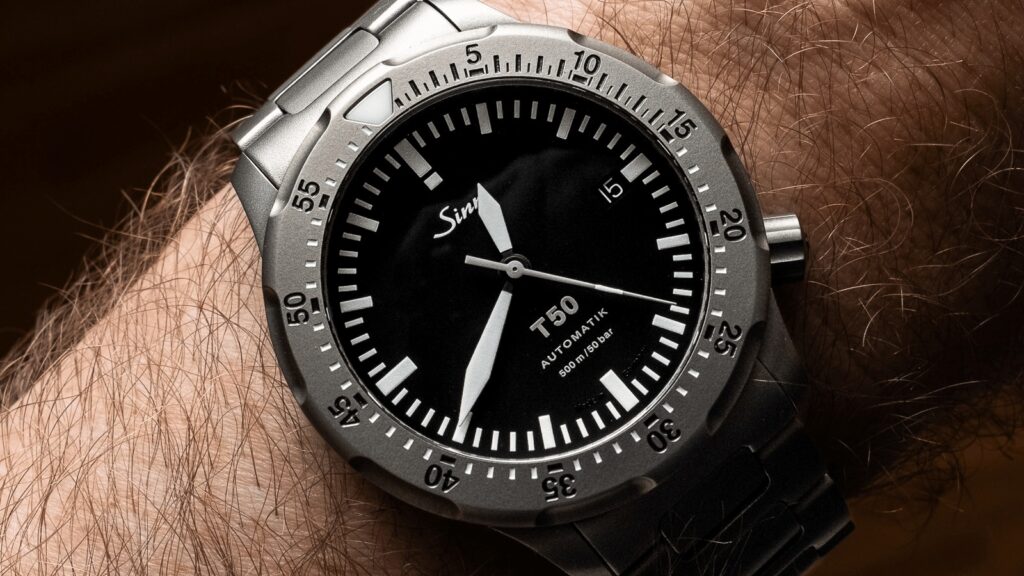
| Price: | $4,400 (Check Current Price) |
| Water Resistance: | 500m |
| Case Dimensions: | 41mm x 47mm x 12mm |
| Lug Width: | 20mm |
| Movement: | Sellita SW300-1 (Automatic) |
Two weeks in Scotland turned out to be the right way to understand the T50. Our history with Sinn had already included multiple U1s that felt awkward and cumbersome, followed by a U50 we loved for its smaller proportions. Taking the titanium T50 on that trip for our full review finally showed us what the brand’s extreme tool-watch philosophy feels like when the ergonomics stop fighting you: 41mm across, 47mm lug-to-lug, 12mm thick, and just over 95 grams on a bracelet sized for a 7-inch wrist.
That lightness changes how all of Sinn’s usual overengineering feels. The matte titanium case flies under the radar, the crown at four o’clock stays out of the way, and the tegimented captive bezel requires downward pressure before it will rotate, which makes accidental movement much harder. We found the mechanism a little extra in practical terms, but it is also exactly the kind of touchpoint that gives Sinn its identity. Legibility is equally uncompromising: white sword hands, white markers, a monochromatic dial, and almost no decorative distraction.
The bigger question is whether you actually need Sinn’s technology package. The Ar-Dehumidifying system uses inert gas, special seals, and a copper-sulfate capsule to manage moisture inside the case, while the tegimented bezel is hardened to better resist scratches. It is clever, but maintaining the full system can require sending the watch back to Sinn in Germany. That is a legitimate ownership downside on a $4,400 diver. Still, the T50 earns its place because it gives you 500 meters of capability and all the nerdy engineering without making the watch feel like a brick on the wrist.
Tudor Pelagos FXD
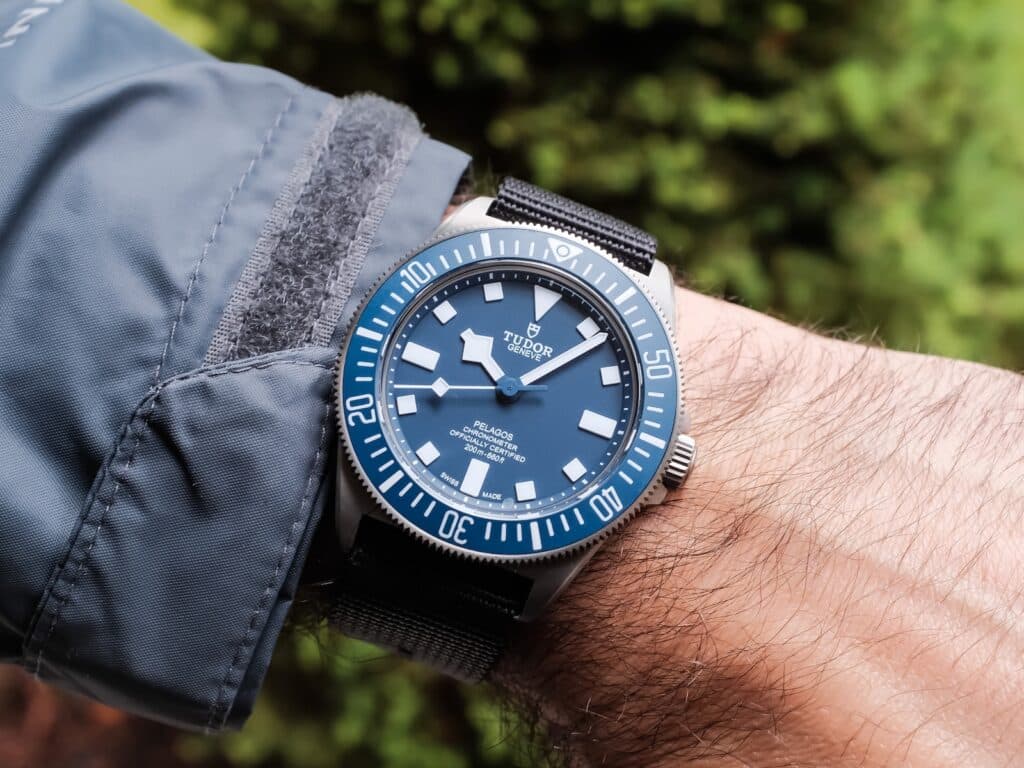
| Price: | $5,025 (Check Current Price) |
| Water Resistance: | 200m |
| Case Dimensions: | 42mm x 52mm x 12.75mm |
| Lug Width: | 22mm |
| Movement: | Tudor MT5602 (Automatic) |
We went into the Pelagos FXD review expecting the collector hype to be part of the problem. After a week with the original blue Marine Nationale version for our hands-on review, most of that skepticism disappeared. The 42mm case and 52mm lug-to-lug sound large, but the 12.75mm thickness and titanium construction make the FXD much easier to wear than the numbers imply, and it avoids some of the slab-sided feel we have experienced with the standard Pelagos.
The fixed bars are the defining feature, and they matter more in use than in photos. Tudor machines them directly into the case and adds a small chamfer to reduce strap wear. We spent most of the review swapping through aftermarket straps, including a Prometheus Design Werx Ti-Ring, a Watches of Espionage Glomar Explorer, and cheap elastic Garmin-style straps. The conclusion was simple: the FXD is almost dangerously good at making different straps feel right. The wider, more aggressively knurled bezel was also easier to grip with wet hands, while the darker navy dial and fully lumed insert kept the watch readable without feeling flashy.
Tudor also deserves credit for removing features instead of chasing bigger numbers. Water resistance drops to 200 meters, the helium escape valve is gone, and the date disappears entirely. On paper those look like reductions; on the wrist they make the watch feel more focused. We remain cautious about Tudor’s in-house movements because of past ownership experience, but the MT5602 in the FXD ran well during testing and the 70-hour reserve made rotation easy. After a few days, the fixed bars, military story, and oversized dimensions stopped feeling like talking points. It just became an unusually easy titanium diver to wear.
Omega Seamaster Diver 300M
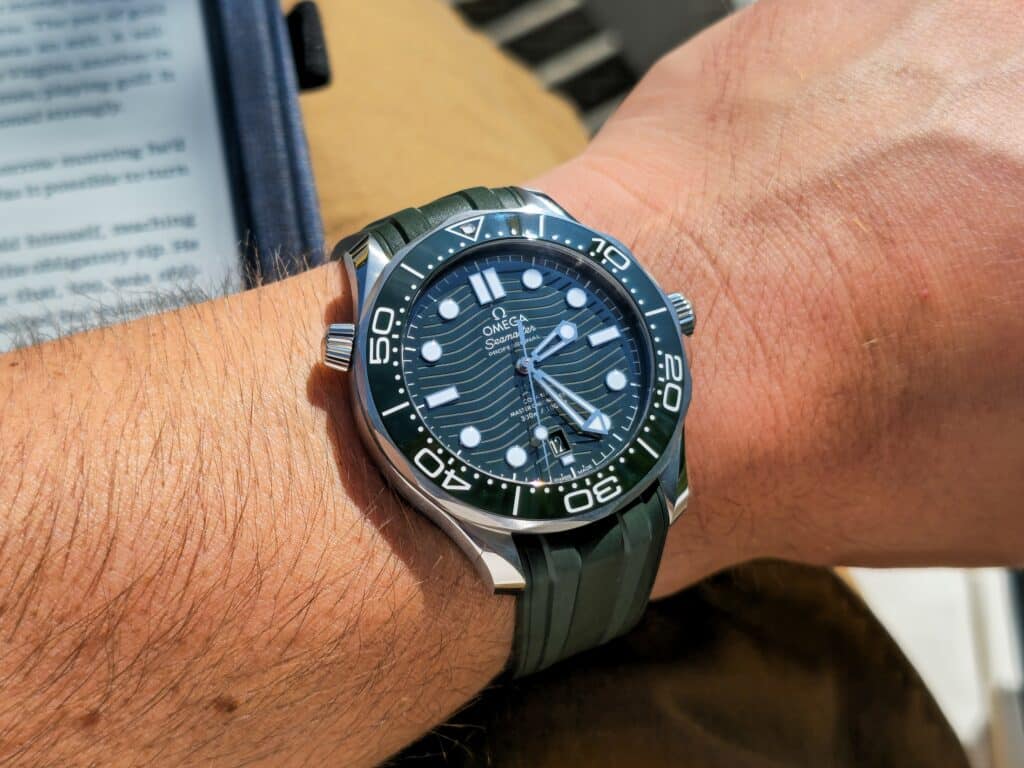
| Price Range: | $5,600 – $5,900 (Check Current Price) |
| Water Resistance: | 300m |
| Case Dimensions: | 42mm x 49.9mm x 13.9mm |
| Lug Width: | 20mm |
| Movement: | Omega Caliber 8800 Co-Axial Master Chronometer (Automatic) |
At nearly $6,000, the Seamaster has to answer a different question than the rest of this list: what are you actually getting for the extra money? During our hands-on review, we expected the 42mm case to be one of the biggest drawbacks. Instead, the twisted lyre lugs and relatively thin-feeling case made wearability one of the surprises. The watch measures 13.9mm thick, yet on the wrist it feels much closer to a 12mm diver, especially on the rubber strap.
The finishing is where the step into luxury becomes obvious. Polished lyre lugs transition into fine brushing along the flanks, the wave-pattern ceramic dial has a glossy, almost porcelain-like depth, and the sapphire’s anti-reflective coating can make the crystal nearly disappear. That external AR can pick up fine scratches over time, the skeletonized hands sacrifice some contrast against the dial, and the scalloped bezel edge is not as easy to grip as a more conventional diver. On bracelet, the watch also feels heavier and less graceful than it does on rubber.
Mechanically, though, the Seamaster makes a real case for where the money goes. The METAS-certified Caliber 8800 ran at roughly +1 second per day in our testing while adding serious anti-magnetic resistance and the kind of accuracy that quickly fades into the background. The dual-color lume is genuinely useful too: the minute hand and bezel pip glow green while the rest glows blue, making dive-time information easier to separate in the dark. It is not remotely the value play here, but it does offer a combination of real 300-meter capability, top-tier movement technology, elaborate finishing, and a design that refuses to look like a Submariner.

Co-Founder and Senior Editor
Kaz has been collecting watches since 2015, but he’s been fascinated by product design, the Collector’s psychology, and brand marketing his whole life. While sharing the same strong fondness for all things horologically-affordable as Mike (his TBWS partner in crime), Kaz’s collection niche is also focused on vintage Soviet watches as well as watches that feature a unique, but well-designed quirk or visual hook.
Great article (a few typos Kaz!)
Appreciate seeing some divers I wasn’t aware of.
Mike:
Thank you! Yup apologies for that – catching and fixing those errors now.
Best,
-Kaz
Revue Thommen has several watches under $1,000 in dive and dive/GMT.
Zak:
I don’t know enough about this brand and whether or not to weigh in on if they are a good fit for the list.
-Kaz
Maybe a nod to the Zodiac Super Sea Wolf? I suppose it comes in just above the price constraints here. Maybe the Longines Hydroconquest, given grey market pricing?
Yea I was trying to really lean on mfg MSRP as the $1k threshold, which is why the Super Sea Wolf and the Hydroconquest didnt make the list. But honestly maybe it’s worth creating a peripheral list of “honorary mentions” that includes grey market pricing as the threshold.
-Kaz
I went swimming with my Invicta provDiver and it leaked,They said only guaranteed for 35 days from purchase.It was 200 m water resistant??Beware
Very true, as I too had the same issue
Well, perhaps you should have screwed down the crown… 😉
Great article and podcast episode. Thanks, Kaz!
For your consideration, Marathon’s MSAR dive watches (the 36mm) are less than $1k. The quartz version is around $720 (around $650 during Marathon’s labor day sale recently) and the sellita auto is around $990. Like you both, I love a good quartz diver!
Ohhhh good call with Marathon! Let me check those out and get them slotted into the next update for this piece. Thank you!
-Kaz
Hi Kaz,
This is a great article that cuts through the BS, plus I’ve owned or own quite a few of the watches in the list.
Not sure how the pricing works in the US but in my native U.K., the Christopher Ward C60 comes in at £915 or £795 on strap. I understand that the brand can be a bit marmite but I think it offers the consumer some features and finishing not usually seen in the £1000 range
John:
Thank you for the kind words!
Ohhh interesting – I thought Chr Ward went crazy up-marketing and started MSRP’ing at like $2k or something. Let me check them out again and reassess whether to include them on the next update for this article. I’ve already loved the C60 designs – they used to do a white dial/green bezel model many many years ago that’s always been on my mind.
Best,
-Kaz
Hey Kaz,
Glad that Certina made the list. Sometimes overlooked but very solid value. What about the Halios Seaforth? I had a Gen 2 and selling it was my one watch regret. Gen 4 will be $775.
Take care,
Mark
Mark!
I’d have to ask Mike’s opinion on the Seaforth since he’s spent more time with it then I have but I think just from what I know anecdotally it can totally make the cut – thank you!
-Kaz
Good list and you have me looking at Baltic again. I’m partial to the Monster and think it’s a future classic so I’d add that to the list.
Hey Kaz,
Thanks for the comprehensive article. Super useful and a fun read.
I’ve come across the Monterey Watch Company recently. I happen to have met the owner (a client of mine) and I have the Great White diver from the brand. You get sapphire, NH 35 clone movement, great lume, nice jubilee bracelet with milled clasp all for under $250! Highly recommend you check them out.
Appreciate you guys!
Tommy
Tommy:
Thank you for the kind words – glad you enjoyed the article! I hadn’t heard of Monterey Watch Company before but I’ll check them out – from your description and that price point it sounds like they’re certainly offering a ton of value and quality.
Best,
-Kaz
Glad to see the Certina 38 DS Diver on the list. I just purchased the black dial two tone. It’s an incredible watch for the money.
Excellent list – and very comprehensive!
I’m probably an outlier in the watch community. I don’t care much about others’ perceptions (I’m with you on the Invicta Pro Diver). I care more about robustness, and how much I enjoy looking at it. I prefer divers because of the way the bezel frames the dial, because I’m not careful about wetting, and because I actually use the dial to time things pretty much every day.
I’ve always liked Scurfa, but the thickness of the Diver 1 has kind of put me off. I have a Deep Blue that’s just too thick to be comfortable – it sort of set my limit for me. I tend to evaluate potential comfort by (diameter/thickness > 3.24, which is the Seiko Samurai).
Have you looked at the Scurfa Treasure Seeker? The dial is quite interesting, good specs, wears comfortably.
How about NTH’s offerings? I have a Thresher which I really enjoy.
Great list, something I wish existed when I started out, maybe it did but I never found it.
It’s worth looking at Unimatic watches, decent affordable, reliable dive watches, Seiko movements in some.
Fantastic article and a great selection of lovely watches; love the fact that the selection include but welll-known and lesser-known brands. As ever with TBWS! You guys are great champions of, and spokespeople for, smaller brands.
One submission for your consideration is the Citizen Promaster Aqualand JP2000-08E. Great watch and as reliable as they come!
Cheers from England!
How about Lorier, been hearing a lot about this ?
Nitin:
Lorier is a good one – at the time of writing this piece they were having inventory issues but I’ll check in on how they’re doing to see if they’re past all that now. Would be nice to add them to the list.
Thank you so much!
-Kaz
There is also a green bezel available with the Casio.
Three words: Glycine Combat Sub. Generally regarded as the best value in watchmaking under USD 500. Any reason why it wasn’t included? Otherwise, your selections are spot on, good work.
Amko:
Ahhh great catch! I’ll get it added here when we revisit the list. Thank you!
-Kaz
I can relate to the “first dive watch” phenomena and the choice for my first was inspired from an article right here on TBWS! The Citizen Promaster Diver (BN0151-09L) remains my all-time favorite, and even though I’ve added a few more to the “dive list,” the Promaster remains the absolute go-to when I head to the water.
What about the hydroconquest from Longines? New GMT release included recently
Kaz,
As a former commercial diver, dive instructor and scientific diver I’d like to make two comments. First, you are correct that many divers today wear computers instead of dive watches, but those of us who dive for a living still wear a good dive watch as a backup for dive elapsed time. For that reason, the unidirectional bezel is important. If the bezel rotates in the clockwise direction, it makes the measured dive bottom time shorter than the actual time and exposes the diver to an increased chance of decompression sickness. Rotating counterclockwise makes the dive appear longer, giving the diver a safety margin when calculating decompression.
My second comment has to do with the hydrogen escape valve. Hydrogen slowly leaks into the watch when living in a saturation bell at depth. When divers complete a job, they ascend in the bell and decompress back to surface pressure. The decompression process is faster than the hydrogen is able to leak out, so the hydrogen valve is a one way valve to release the hydrogen during decompression. Otherwise, the internal hydrogen would push the watch crystal out of the watch.
Nice review of the watches otherwise.
No one ever, ever mentions the (MY) Rolex Deepsea 126660 – undisputed King of Dive Watches, owned by a diver and former soldier… is it too expensive or simply too much hunk of steel for mere mortals? My first watch was the Seiko Sports 100 I inherited from my father; throughout my military career I worked with a G-Shock, and after I educated my daughters I permitted myself this indulgence, 44mm in diameter, and no it’s not the Cameron Deep Blue, basic black for me. I’ll take the pepsi challenge with any Omega, tag or other any day.
Otherwise, a nice review thank you.
Nice article, sent it to friend looking for their first diver. Spot on with the steinhart’s, love my gmt diver!! Also have a revue gmt and really love that too but wish they would add a ceramic bezel option. One brand that always catches my attention is Helm; any thoughts?
All great watches. So many still you could review
I think personally the Sinn U1 is a very good divers watch. Maybe top 10 in the world
What strap (waffle) is that on your green Sumo? I have a gen 2 pepsi I was thinking of another strap for it… Currently blue, thoughts of red.
Where is the best, the real scuba diving watch: the Citizen Aqualand (the first one – anadigi)?
This is the best option if you want the best diving watch, a real toolwatch which was used by thousand divers during the las 40 years.
An outstanding option, well under $1K, would be the popular Seiko Samurai “Mini” (Ref. SRPL13, Black, or one of the other color choices) with 200m water resistance (a true certified diving watch, according to Seiko). This was released in 2024 with great specs especially for wrists that are 7.25″ and under, at 41.7mm in diameter x 12.3mm thin x 49.5mm lug tip to lug tip x 20mm lug width. This one should be at the top of your updated list!
David:
Ooooh excellent suggestion! We’ll work on getting one in for review to see if we’d like to include it on this wrist – we gotta test it out hands-on first before we can add it. We’re always happy to review a new Seiko Diver!
Best,
-Kaz
Nice article, but where is the Casio Marlin? I own that one, cheap as it is, is an amazing diver watch and I can say that from experience
Some immersions after, and is as good as new