Quartz has a way of making watch collectors confess things they don’t always want to say out loud. Sometimes we don’t want to wind anything. Sometimes we don’t want to reset the date because a watch sat untouched for four days. And now and then, the better choice is the one that keeps time, survives the week, and doesn’t turn ownership into homework. This list exists to sort through the best watches that make a strong case for going quartz, not because quartz needs defending, but because plenty of quartz watches make more sense once you stop treating convenience like a flaw.
And after years of reviewing everything from cheap beaters to oddly serious quartz divers, we’ve learned that the watches that stick around often earn it through boring little victories: they’re easy to live with, hard to kill, and useful when the romance of watch collecting gets a little exhausting. The picks here come from watches we’ve covered directly, including solar field watches, no-nonsense divers, high-accuracy quartz pieces, and a few strange little things that would lose half their charm if someone tried to make them mechanical. None of that means quartz is always better. It implies that the right quartz watch can be the one you keep reaching for, even when the rest of the box is trying very hard to be more poetic.
Casio G-Shock GW6900-1
| Price: | $140 |
| Water Resistance: | 200m |
| Case Dimensions: | 53.2mm (diameter) x 50mm (lug-to-lug) x 17.7mm (thickness) |
| Lug Width: | 16mm |
| Movement: | Solar Quartz Module 3179 |
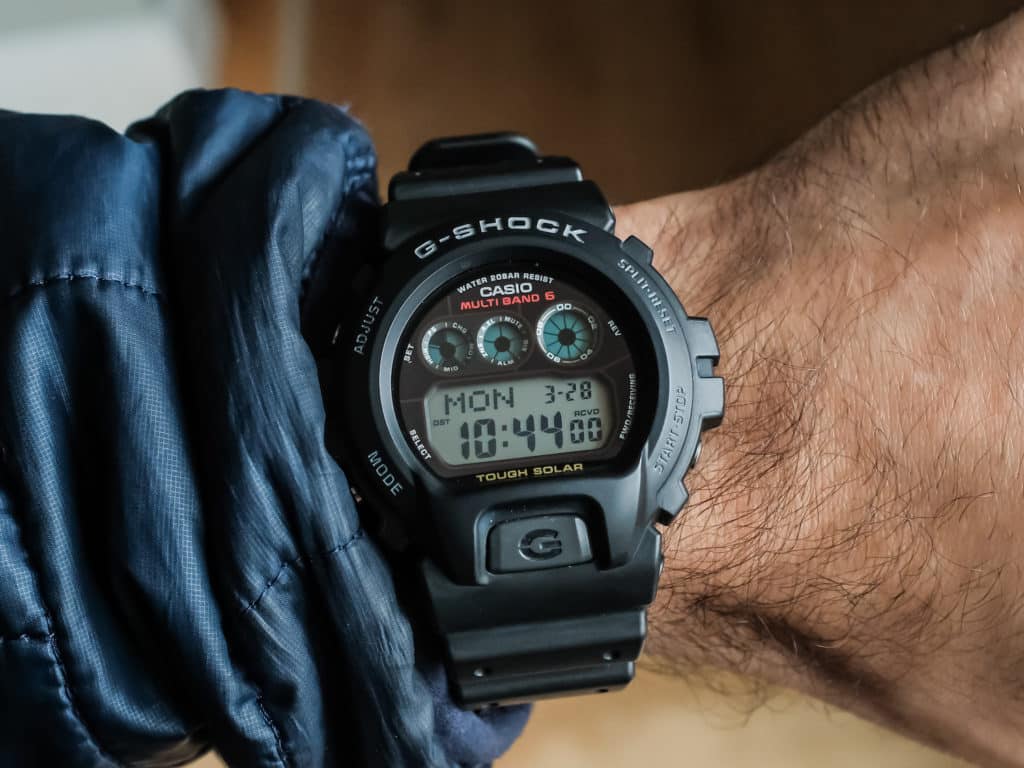
The GW6900-1 is one of those watches that makes the quartz argument without needing to get philosophical about it. It is solar-powered, radio-controlled, loaded with daily-use functions, and tough enough that you stop babying it almost immediately. That matters here because quartz is not merely the cheaper movement choice; it is the whole reason this watch works as well as it does. You put it on when the day involves rain, yard work, errands, travel, workouts, or the general chaos of being a person who owns doorframes, and it handles all of that without asking for much in return.
The low-maintenance side is where it earns the most ground. Tough Solar keeps battery worries in the background as long as the watch sees regular light, and Multi-Band 6 lets it sync with atomic time signals in regions like the U.S., UK, Japan, Germany, and China. In our hands-on experience, it usually corrected itself overnight without us doing anything, which is quite unromantic but extremely useful.
The case sounds huge on paper at a little over 50mm wide and around 18mm thick, but the resin build and steel caseback keep it from feeling like a wrist-mounted brick. It wears more like a protective shell than a dense watch, though smaller wrists will still know it is there. The stock resin strap starts stiff and a little squeaky, because G-Shock ownership apparently needs a break-in period, but it softens up, dries quickly, and stays comfortable over long days.
The triple-eye display looks busy at first, but it becomes easier once your brain stops treating it like a tiny control panel. The main time and date are clear, the upper indicators track things like stopwatch use and radio syncing, and the small dual-time window ends up being more useful than expected. The stopwatch can record up to 1/100 of a second, the countdown timer and five alarms cover normal daily chaos, and the large front button activates a bright green EL backlight that lights the full display evenly. That is the GW6900-1 in a sentence: not elegant, not small, not subtle, but very hard to leave out if you want quartz to earn its keep.
Pros
- Tough Solar keeps upkeep close to zero.
- Multi-Band 6 atomic syncing keeps accuracy dialed in with little effort.
- Stopwatch, countdown timer, five alarms, and dual time add real everyday utility.
- Lightweight resin case makes the large size more wearable than expected.
- Bright green EL backlight is easy to use and evenly lights the display.
Cons
- The case still wears large, especially on smaller wrists.
- The triple-eye display takes a little time to become intuitive.
- The stock resin strap starts stiff and a bit noisy.
Timex Expedition Field Post Solar
| Price: | $199 |
| Water Resistance: | 100m |
| Case Dimensions: | 36mm (diameter) x 44mm (lug-to-lug) x 12mm (thickness) |
| Lug Width: | 18mm |
| Movement: | Solar Quartz |
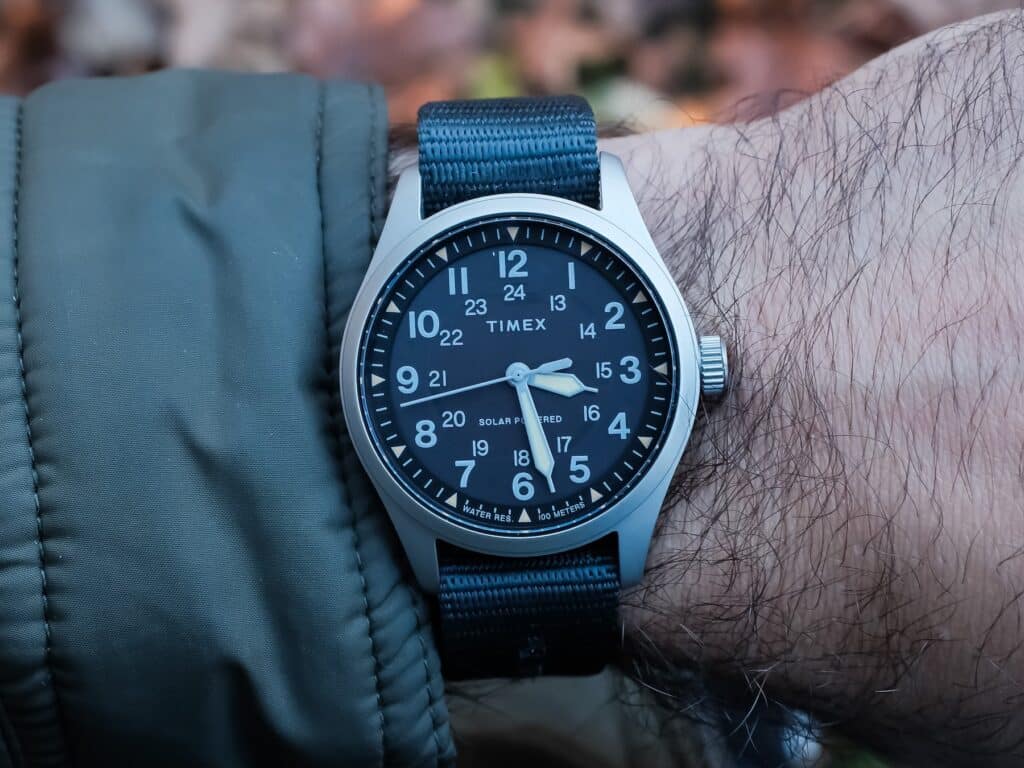
The Timex Expedition Field Post Solar makes one of the cleanest arguments for quartz because it takes the plain field watch formula and removes the little ownership annoyances. The layout is familiar, the size is sensible, and the solar movement means this is not a watch that needs regular attention to feel useful. Once charged, Timex claims around four months of power reserve, and in our wrist-time review, the accuracy stayed steady enough that we barely had to touch the crown. That is what a watch like this should do: get picked up, worn hard enough, and not turn into another small task on the list.
The 36mm stainless steel case does a lot of quiet work here. It sits low, stays centered, and does not demand mid-day wrist repositioning through commuting, errands, and ugly weather. The bead-blasted finish also suits the whole thing better than a shiny case would. It gives the watch a practical, already-broken-in feel, so the first scratch feels less like tragedy and more like the watch doing field-watch stuff. The screw-down crown fits that same dependable personality, though the action is more “gets the job done” than buttery and refined.
The dial sticks close to the military field-watch script, with full numerals and quick legibility doing most of the talking. The slightly domed sapphire crystal keeps it from feeling too flat or sterile, adding a bit of warmth and edge distortion while also bringing better scratch resistance than we expect at this price. The anti-reflective coating also held up better outdoors than expected, cutting enough glare for easy time checks in bright conditions. That said, the lume is where the romance ends. Even after a solid charge, the hands glow briefly, the dial barely wakes up, and the whole thing fades too quickly.
The stock leather strap is not junk, which is nice to say about a Timex strap without immediately looking over our shoulder. It is soft and clearly chosen with some care, but the thickness feels off against the compact case. On a MIL-style strap, the watch feels more balanced and more honest to its no-frills personality. That is where the Expedition Field Post Solar lands: small, practical, legible, solar-powered, and durable enough for normal life without pretending to be more complicated than it needs to be.
Pros
- Solar quartz movement makes it easy to grab and wear without frequent resetting.
- Claimed four-month power reserve adds real convenience once charged.
- Domed sapphire crystal and AR coating improve durability and outdoor legibility.
- 36mm case wears low, centered, and comfortable through long days.
- The full-numeral dial is clean and easy to read quickly.
Cons
- Lume fades too quickly, and the dial barely lights up even after a good charge.
- Screw-down crown is dependable, but the action is not quite smooth.
- The stock leather strap is soft but feels too thick for the compact case.
Citizen Promaster Diver BN0151

| Price: | $250 – $300 |
| Water Resistance: | 200m |
| Case Dimensions: | 43mm (diameter) x 48mm (lug-to-lug) x 11.5mm (thickness) |
| Lug Width: | 20mm |
| Movement: | Citizen Eco-Drive E168 (solar quartz) |
The Citizen Promaster Diver BN0151 gets the quartz brief right by treating convenience like part of the tool-watch job, not a shortcut. Eco-Drive is the center of the appeal here: once the watch was charged, we saw about 6 months of runtime, with accuracy holding at around ±15 seconds per month in testing. No winding, no routine battery swap anxiety, no fiddling with the crown because it sat off-wrist for a few days. It is the kind of diver that is ready when you are, which sounds boring until you live with watches that are not.
On the wrist, the Promaster feels more approachable than its 43mm case suggests. The short lug-to-lug distance and downward case curve help it sit securely, and the whole thing feels lighter than expected during the day, almost titanium-like in how little it nags for attention. The 4 o’clock crown also helps, staying out of the wrist’s way during extended wear. The stock polyurethane strap fits the aquatic tool-watch personality, but it starts stiff and needs time to loosen up. We liked it more on a NATO, where the watch felt more casual, better balanced, and less like it was auditioning for a dive shop display.
The dial is doing practical work, too. The hands and markers are bold enough for quick daylight checks, and the blue dial shifts slightly toward purple from certain angles, which adds some personality without turning the watch into a legibility tax. In the dark, the aqua-toned lume remains visible for hours, and the lumed second-hand pip is a small but useful reassurance that the watch is still running. The mineral crystal is the obvious compromise next to sapphire, though in our extended wear, it held up better than we expected and avoided obvious scratching.
According to our review team, the 60-click bezel felt deliberate and stayed aligned, which matters more than whatever spec-sheet adjective people want to attach to it. The grip can get slick with wet hands, though, and that is not ideal for a diver. Still, the bigger picture holds: 200m water resistance, strong legibility, solar-powered quartz accuracy, and a case you do not have to baby. The Promaster is not the flashiest diver in the box, and it probably does not care. It wins by being easy to trust.
Pros
- Eco-Drive offers long runtime, steady accuracy, and very little maintenance.
- Around six months of runtime once charged keeps ownership simple.
- Blue dial adds subtle character without hurting readability.
- The 4 o’clock crown and curved case shape improve comfort over long wear.
- Bold hands, markers, and long-lasting lume support strong real-world legibility.
- 200m water resistance makes it easy to wear around water without hesitation.
Cons
- Mineral crystal is still less scratch-resistant than sapphire.
- The bezel grip can feel slick when your hands are wet.
- The stock polyurethane strap starts stiff and needs break-in time.
Citizen Ana-Digi Temp
| Price: | $250 – $500 |
| Water Resistance: | 30m |
| Case Dimensions: | 31.5mm (diameter) x 40mm (lug-to-lug) x 8.4mm (thickness) |
| Lug Width: | 18mm |
| Movement: | Citizen caliber 8980 |
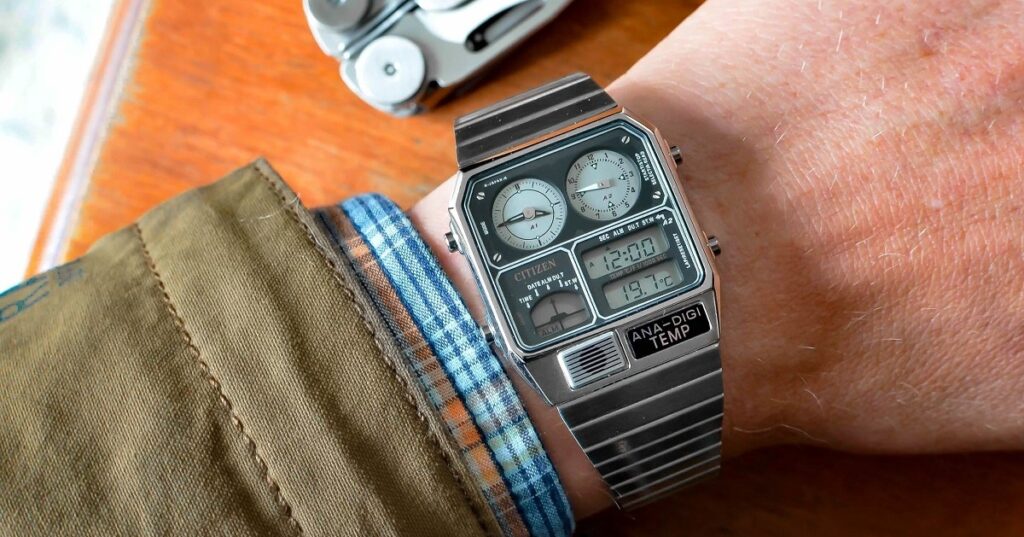
The Citizen Ana-Digi Temp earns its spot here by being the kind of quartz watch that would make no sense as anything else. A mechanical version of this idea would either be wildly impractical, too expensive, or both, which is often where fun goes to die. Here, quartz lets Citizen cram in dual time, analog sub-dials, digital readouts, a temperature display, exposed screws, and a squared-off stainless-steel case that looks like a tiny eighties control panel decided to become wristwear. It isn’t useful in the most polite, sensible way, but with a raised eyebrow.
The layout looks chaotic at first, but Citizen organizes the dial better than the photos suggest. The analog and LCD sections are separated into clear zones, so the display never fully collapses into gadget soup. White markings stand out cleanly against the black backdrop, while the darker LCD panels sit back visually enough to keep things readable. The left analog display uses thin black hands with narrow lume strips; the heavier regulator-style hand on the right is quicker to catch at a glance, and the four luminous cardinal markers help orient the whole thing. Add the polished hand bases and visible screws, and there is enough going on to keep you distracted through at least one meeting you were not emotionally present for anyway.
On the wrist, it is more wearable than the squared-off case implies. The crisp edges give it presence, but the compact proportions, slim profile, and short lug-to-lug span keep it from feeling like a metal tile strapped to your arm. Smaller wrists can usually get away with it, too. The integrated bracelet is the right call visually; a normal strap would break the design language. It carries the case shape through nicely and makes the watch feel complete, though the flared end links are a known weak spot and can bend over time.
The actual functions are where the Ana-Digi Temp feels like more than a retro novelty. The dual-time setup is handy, with the analog display giving a quick reference and the digital readout confirming the exact time. The temperature feature is more conditional since it reads accurately only when the watch is off the wrist, but it still fits the personality of the thing. To know more about the functionalities and our on-wrist experiences, check out our full hands-on review.
In short, this is not a quartz pick because it is simple or invisible. It belongs because quartz gives it the freedom to be weird, functional, nostalgic, and charming in a way a mechanical watch probably could not pull off without becoming insufferable.
Pros
- Dual-time display is useful, with analog reference and exact digital confirmation.
- Strong contrast helps important information stand out despite the dense layout.
- Compact case, short lug-to-lug span, and slim profile keep it wearable.
- Exposed screws, varied hand shapes, polished hand bases, and cardinal-point lume add depth over time.
Cons
- The temperature readings are accurate only when the watch is off the wrist.
- The busy display takes time to learn if you usually wear simpler analog or digital watches.
- Flared bracelet end links can bend with use.
Momentum Sea Quartz 30
| Price: | $279 |
| Water Resistance: | 300m |
| Case Dimensions: | 42mm (diameter) x 47mm (lug-to-lug) x 11.3mm (thickness) |
| Lug Width: | 20mm |
| Movement: | Ronda R507 high-torque quartz |
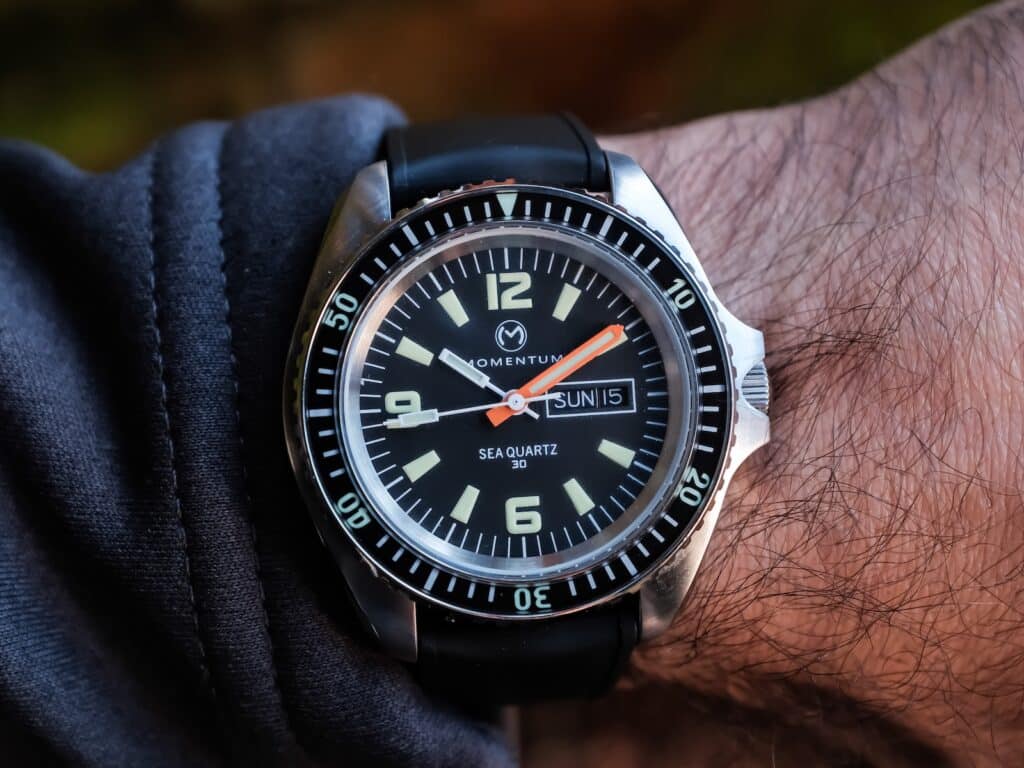
The Momentum Sea Quartz 30 uses quartz in a way that fits the whole personality of the watch. It gives you a vintage dive-watch charm without dragging along the servicing anxiety or fragility that can come with actual older mechanical divers. The Ronda quartz movement keeps things accurate and low-maintenance, so this is the watch you can pick up after a few quiet days and wear without wondering what mood the movement is in. Add 300m of water resistance, and it feels far more capable than most of us will ever need, which is usually how dive watches become fun.
The dial keeps things quite restrained. Matte black, printed markers, and paddle-style hands make it easy to read without turning the whole thing into a nostalgia costume. The orange minute hand is particularly useful when timing with the bezel, giving elapsed time a cleaner visual cue. Momentum also keeps the late-’70s influence present without overplaying it. You get the shape and feel, but not the sense that the watch showed up wearing a rented Halloween outfit.
On the wrist, the Sea Quartz 30 has a substantial presence. At 42mm across with a 47mm lug-to-lug, it sounds manageable, and it is, but the case shape gives it a broader stance than expected. The good news is that it stays balanced. The flat caseback helps it sit planted and comfortable over longer stretches, and the mix of brushed top surfaces with polished sides gives the case more definition than a plain tool case would. The polished underside and lugs do pick up scratches quickly, especially during strap changes, so maybe do not perform your NATO experiments like you are defusing a bomb.
The sapphire bezel insert is a sensible modern update, trading a little old-school warmth for better daily durability. However, the bezel action itself is less charming. It is stiffer than we would like, harder to grip, and more noticeable in use than it should be. The lume starts fine but fades sooner than stronger alternatives. Strap-wise, the included tropic-style rubber worked better than expected, and the watch also fits well on NATOs and other rubber straps. Momentum’s jubilee-style bracelet feels like a smart, longer-term option, too. Overall, the Sea Quartz 30 lands as a capable, wearable, slightly offbeat diver that lets quartz do the boring maintenance work while the design carries the personality.
Pros
- Ronda quartz movement keeps ownership simple, accurate, and low-maintenance.
- 300m water resistance gives it more capability than most daily wear will demand.
- Sapphire bezel insert improves durability for casual daily use.
- Flat caseback and 47mm lug-to-lug help it stay comfortable over long wear.
- Matte dial, printed markers, paddle hands, and orange minute hand support quick readability.
Cons
- Polished underside and lugs collect scratches quickly, especially during strap changes.
- The bezel action is too stiff and harder to grip than it should be.
- Lume is usable at first, but fades earlier than stronger options.
Casio Oceanus T200
| Price: | $300 – $500 |
| Water Resistance: | 100m |
| Case Dimensions: | 41.4mm (diameter) x 49mm (lug-to-lug) x 10.7mm (thickness) |
| Lug Width: | 20mm |
| Movement: | Tough Solar movement (Module 5596) |
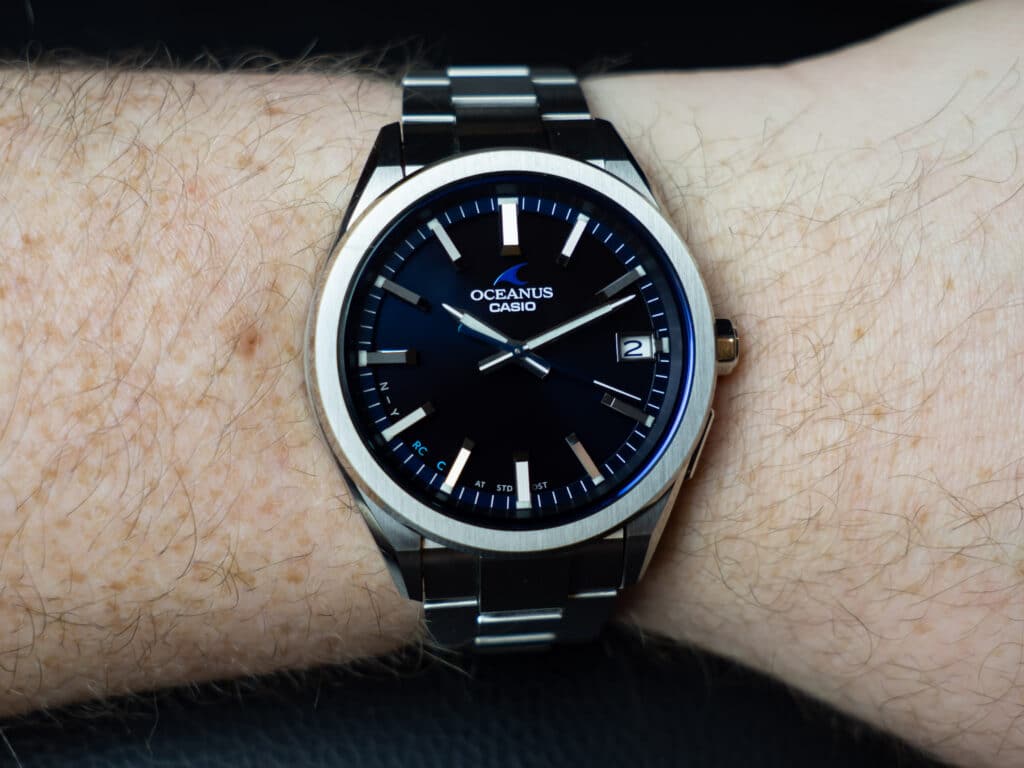
The Casio Oceanus T200 shows how quartz can feel refined instead of merely convenient. This is not the kind of watch that apologizes for having electronics inside. It uses them to make daily wear easier. The Tough Solar 5596 module draws power from light, and during our hands-on time, the watch stayed fully charged without us doing the whole “place it dramatically by a window” routine. That’s the kind of quiet competence that makes quartz so appealing in a watch meant to move through normal life.
The Bluetooth side adds to that low-effort rhythm. Once paired with the Casio Oceanus app, the T200 synced time automatically, and every connection during testing worked cleanly. For anyone who wants an analog watch that still keeps itself accurate in the background, this is where the T200 starts to feel smarter than a lot of mechanical alternatives. There is no winding, no time-setting ritual, and no tiny argument with yourself on Monday morning because the watch stopped sometime over the weekend.
The design helps it avoid feeling like a cheap or disposable gadget, too. The case finishing moves between brushed and polished surfaces in a way that feels considered without getting flashy. The deep blue dial has a layered look rather than a flat glossy one, and the floating hour markers, created through cutouts in the chapter ring, give the dial depth without making it busy. The blue-tinted sapphire crystal adds a subtle glow in natural light, almost like the dial is doing something more interesting than it should at this price.
The compromises are mostly around the bracelet and dial furniture. The bracelet can sound rattly off-wrist, and the pin-and-collar sizing system may test your patience if you have not dealt with one before. Some people may also find the connectivity text on the dial distracting, especially on a watch that otherwise feels clean. The lume works, but it is modest at night. Still, the T200 belongs here because it turns solar quartz, Bluetooth syncing, and office-ready refinement into one very livable package.
Pros
- Tough Solar 5596 module keeps the watch running through light exposure with very little upkeep.
- Bluetooth syncing through the Casio Oceanus app keeps time accurate in the background.
- Strong blend of useful tech and clean design at a relatively accessible price.
- Brushed and polished case finishing gives it a more refined feel than many solar quartz watches.
- Deep blue dial, floating markers, and blue-tinted sapphire crystal add visual depth without clutter.
Cons
- The bracelet can feel rattly when the watch is off the wrist.
- Lume performance is limited for nighttime legibility.
- Dial text related to connectivity may bother some wearers.
- Pin-and-collar bracelet sizing takes some patience.
Bulova Computron
| Price: | $340 |
| Water Resistance: | 30m |
| Case Dimensions: | 31mm (diameter) x 40mm (lug-to-lug) x 13.8mm (thickness) |
| Lug Width: | Integrated strap that tapers from 25mm at the case to 16mm at the ends |
| Movement: | Quartz |
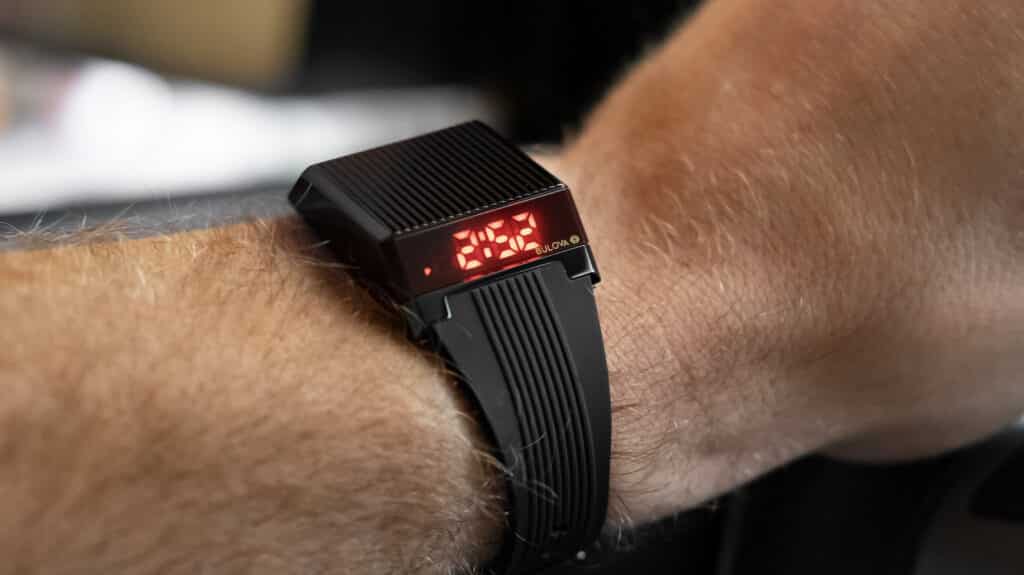
The Bulova Computron is a reminder that quartz does not have to mean sensible in the boring spreadsheet sense. Here, the movement supports the whole bit: a red LED display that stays dark until you press the button, a retro-futurist case shape, and a time-telling experience that feels more like interacting with a tiny prop from someone’s 1970s idea of tomorrow. It is not the easiest way to check the time. That is partly the point.
The display adds both charm and friction. Since the LED stays off until activated, a glance will not do much for you. You have to ask the watch for the time, which slows everything down compared to a normal analog or always-on digital display. Cycling through the time, date, and second time zone becomes simple enough once you live with it, but it never feels as instant as a conventional watch. Somehow, that extra step makes the Computron feel more deliberate rather than merely annoying, though your tolerance for button-press theater may vary.
Bulova was smart not to sand down the case. The wedge-shaped, trapezoidal profile, hard edges, shallow grooves across the top, and late-’70s stance are what give the watch its personality. On the wrist, it behaves better than it looks like it should. The angled case helps it settle naturally, and the watch feels lighter and more balanced than its top-heavy design. The integrated rubber strap helps a lot here, too. It is soft, comfortable, and tapered enough to keep the whole thing planted instead of clunky.
The finishing and overall build feel better than expected for the price, but the black ion-plated version comes with the predictable fingerprint problem. Since pressing the case is part of using the watch, smudges show up quickly, because apparently even retro-futurism requires a microfiber cloth. This is not the quartz watch to buy if you want effortless, everyday practicality. It builds its place here because it shows quartz can be design-driven, nostalgic, weird, and genuinely fun without pretending to be a mechanical object in disguise. Read our full review for the more in-depth on-wrist details.
Pros
- Red LED display gives the watch a distinctive, interactive personality.
- Integrated rubber strap feels well-matched, soft, and secure on the wrist.
- Wedge-shaped case preserves the original late-’70s design language instead of softening the weirdness.
- Angled case profile helps it wear more comfortably and evenly than expected.
Cons
- Time, date, and second time zone functions are easy enough to use, but never as immediate as a standard display.
- Glossy black ion-plated model collects fingerprints quickly.
Vaer C4 Tactical Field Solar
| Price: | $479 |
| Water Resistance: | 200m |
| Case Dimensions: | 41.5mm (diameter) x 48mm (lug-to-lug) x 12.8mm (thickness) |
| Lug Width: | 20mm |
| Movement: | Epson VS-42 solar |
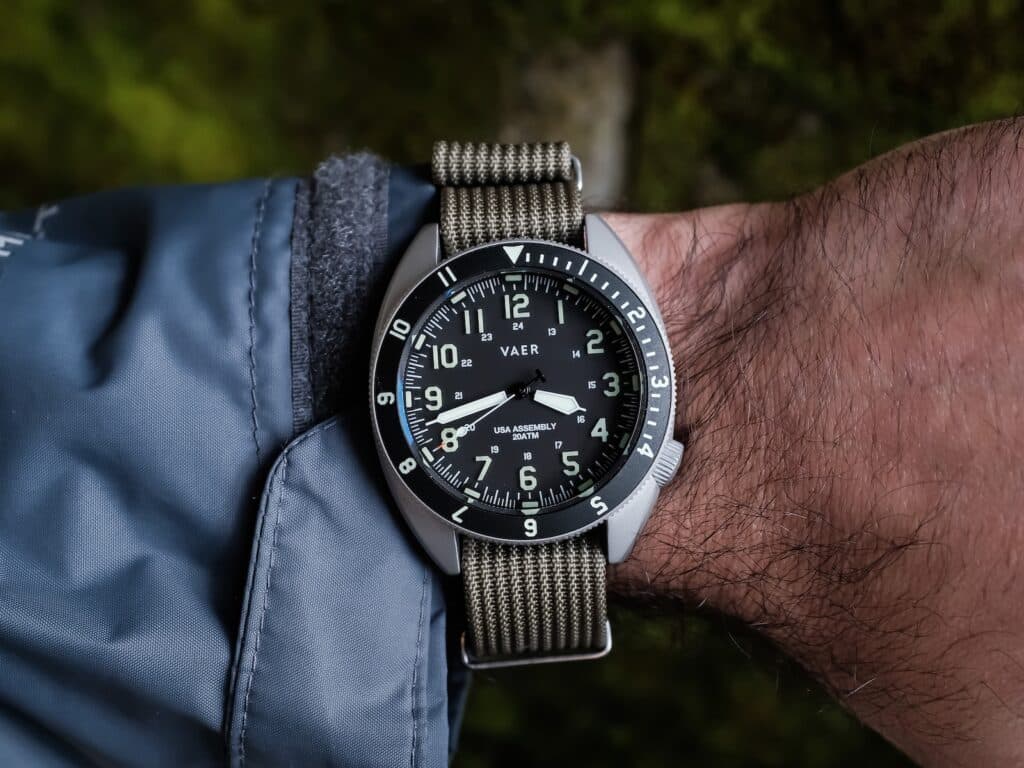
The Vaer C4 Tactical Field Solar gets the field-watch brief right by letting quartz handle the boring stuff. The Epson VS-42 solar movement only needs around six hours of light for up to six months of charge, so it stays easy to keep in rotation without turning into another watch you have to manage. That matters here because the C4 is built for regular use, not just for looking vaguely military next to a canvas jacket. It takes the readable field-watch idea and adds real-world convenience, 200m water resistance, and enough tool-watch hardware to make the solar quartz choice feel central.
The case has more presence than a classic field watch, but it does not wear like a slab. At 41.5mm across and 12.8mm thick, including the bezel, it sat flatter than expected, and the compact lug-to-lug kept it from spilling over a 6.75-inch wrist. The mid-case helps it avoid that blocky, overbuilt feeling some tactical watches fall into. The bead-blasted stainless steel adds a dry, purposeful finish that suits the military tone, while the full DLC version goes harder into the tactical look. Subtle, no. Intentional, yes.
The hardware gives the C4 more range than a simple time-only field watch. You get a screw-down caseback and a 4 o’clock screw-down crown, and during our closer look at the watch, the crown action felt clean in use: easy to unscrew, simple to set, and smooth enough when threading back down that it never gave off cheap-tool-watch anxiety. The 120-click unidirectional bezel has a coin-edge grip that stayed easy to use with damp fingers, and Vaer’s DLC-treated steel insert feels tougher than a typical aluminum insert. It is marked to 20 minutes, but because Vaer also frames it as a 12-hour bezel, it works for quick timing jobs or casual second-time-zone tracking.
The dial keeps its priorities straight. The matte black surface, oversized Arabic numerals, large syringe hands, and smaller 24-hour track make it quick to read. At the same time, the raised lume blocks and rectangular minute markers add depth without feeling decorative for its own sake. The beveled sapphire crystal gives it a small refinement bump without softening the tool-watch personality. Furthermore, lume was one of the high points in our review: it charged quickly, glowed strongly, and stayed readable for several hours. The main nitpick was second-hand alignment, which missed some markers and will annoy the people who notice that before they notice their own lunch getting cold. Strap-wise, the black waffle-textured FKM felt substantial without being stiff and suited the case best. The olive single-pass nylon worked well, and an Admiralty grey CWC strap pushed the whole thing further into military territory.
Pros
- Solar quartz movement is low-maintenance and easy to keep in regular rotation.
- Around six hours of light can provide up to six months of charge.
- Strong lume performance and raised markers make the dial usable after dark.
- 200m water resistance, screw-down caseback, and screw-down crown give it real tool-watch credibility.
- 120-click bezel is useful, grippy with damp fingers, and works for timing or casual second-time-zone tracking.
- Black waffle-textured FKM strap feels substantial without being stiff.
Cons
- Second-hand alignment misses some markers.
- 41.5mm size may still feel large for collectors who prefer smaller military-style watches.
Vaer R1 Racing Chronograph
| Price: | $495 |
| Water Resistance: | 100m |
| Case Dimensions: | 38mm (diameter) x 46mm (lug-to-lug) x 12.6mm (thickness) |
| Lug Width: | 20mm |
| Movement: | Seiko VK-63 meca-quartz |
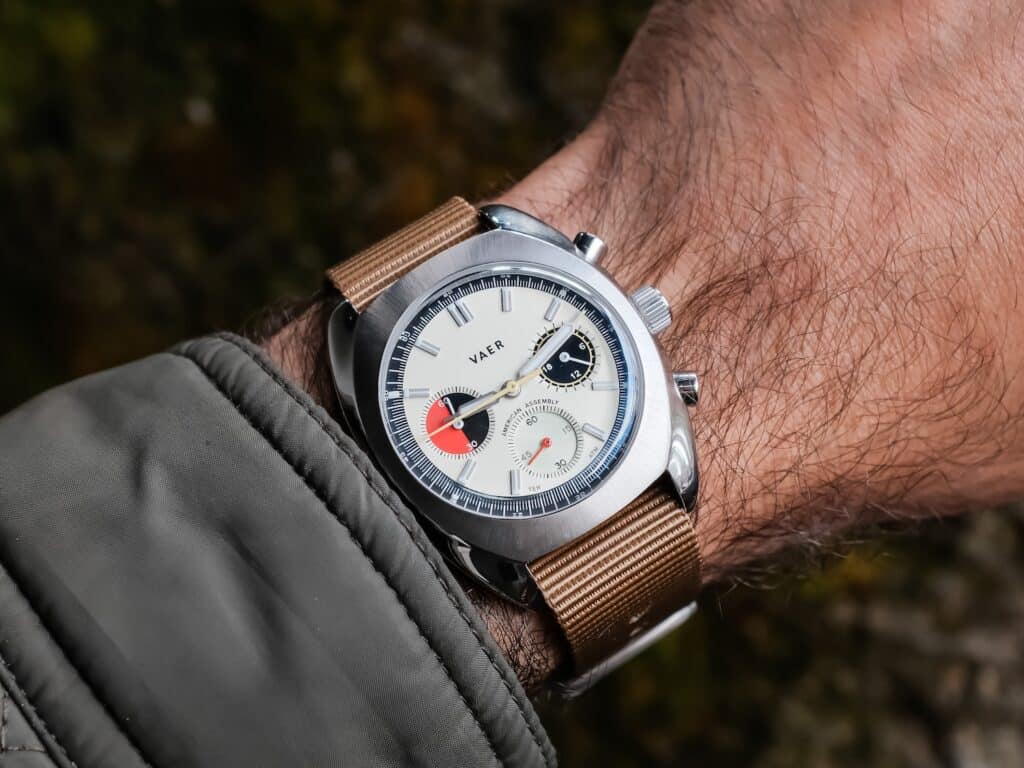
The Vaer R1 Racing Chronograph uses meca-quartz in a way that makes sense for determining the value of the whole watch, not just the spec line. You get the accuracy and low upkeep of quartz, but the chronograph still has that firm, mechanical-style snap when you hit the pushers. That matters because affordable chronographs can get expensive and annoying fast if you insist on going fully mechanical. The R1 gives you the look, function, and tactile fun without turning servicing into a future financial jump scare.
The case helps sell the everyday side of the watch. At 38mm with a 46mm lug-to-lug, it keeps the vintage-leaning proportions without vanishing on the wrist. The brushed and polished surfaces also feel quite solid, and the construction comes across as tougher than the styling first suggests. Vaer added a screw-down crown, 100m water resistance, and a domed sapphire crystal, which means the R1 does not have to be treated like a delicate weekend novelty. Rain, desk work, errands, and a more active day are all comfortably within its lane.
The dial brings the retro energy through a cream base with orange and yellow accents, but it stops short of feeling costume-y. The colorful hands give the watch some life, though the polished edges can blend into the dial under certain lighting. Legibility remains solid most of the time, but that little issue becomes more noticeable after you have lived with it for a while. Lume is also more functional than impressive, fading sooner than we wanted.
Straps change the personality quite a bit. The NATO kept the watch secure and wore flatter than expected, even with the added height. The rubber strap was less convincing and did not feel as refined as the rest of the package, while the bracelet option seems like the better route if you want the watch to feel more substantial. Overall, the R1 works because quartz takes care of the practical side, while the case, pushers, and dial still give you enough of the chronograph theater we all pretend we do not care about. Our hands-on review goes deeper on that.
Pros
- Meca-quartz movement keeps accuracy high with minimal upkeep.
- Chronograph pushers have a firm, satisfying click in use.
- Screw-down crown, 100m water resistance, and domed sapphire crystal improve everyday usability.
- 38mm case and 46mm lug-to-lug work well across small to mid-sized wrists.
Cons
- Lume works, but fades faster than expected.
- Polished hand edges can reduce visibility in certain lighting.
- The included rubber strap feels less refined than the NATO or bracelet options.
Citizen Nighthawk
| Price: | $500 |
| Water Resistance: | 200m |
| Case Size: | 42.5mm (diameter) x 47mm (lug-to-lug) x 12.6mm (thickness) |
| Lug Width: | 22mm |
| Movement: | Citizen B877 Eco-Drive caliber (solar-powered quartz) |
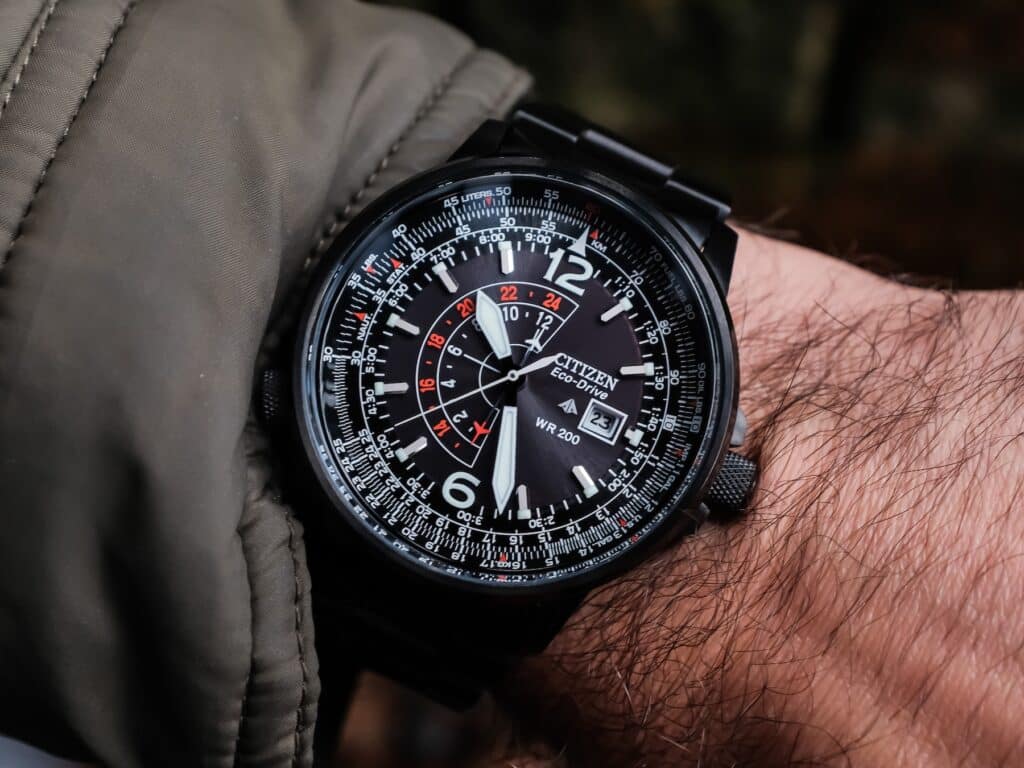
The Citizen Nighthawk fits this list because Eco-Drive turns a busy aviation-style watch into something you can use without making ownership harder than it needs to be. The B877 caliber gives you solar-powered quartz accuracy, a date, second-time-zone functionality, and a jumping local-hour feature that makes travel or schedule-hopping easier to manage. It is rated to within 15 seconds per month, and once fully charged, it can run for about six months without light. A mechanical version with this much going on would probably cost more, need more attention, and give watch forums another annoying reason to argue until 2 a.m.
The dial is dense, but not chaotic. The internal E6B slide rule sits there when needed, controlled by a secondary crown at 8 o’clock that feels secure enough not to get bumped out of place. For normal time checks, the smaller markings recede while the bold indices and sword hands take over. The applied markers stand slightly elevated, with polished edges and lume-filled outer sections, and the GMT hand adds a bit of fun through the red-and-white airplane motifs that show which side of the scale you are reading. The trade-off is that the main hands can cover the secondary time-zone scale at certain points, so this is not as instantly readable as a simple 24-hour bezel.
The black ion-plated case and bracelet give it a more industrial feel than the standard aviation-tool look, without tipping into full “I have strong opinions about cockpit instruments” territory. At 42.5mm wide and 12.6mm thick in stainless steel, it has real weight on the wrist. That can feel reassuring during travel days or long commutes, but it is not the move for someone who wants a small watch that disappears. The screw-down crown, engraved screw-down caseback, and 200m water resistance give it a durability profile that suits the tool-watch attitude, though deep scratches in the black ion plating can reveal the steel beneath.
As we found during our time with the watch, the bracelet fits the watch well, both visually and physically. It is ion-plated to match the case, feels secure, and avoids the cheap, loose rattle that can ruin an otherwise solid watch. The push-button deployant clasp with fold-over safety is easy to use, and the micro-adjustment gives enough room to tune the fit. Still, rubber or nylon makes the watch easier to live with if the bracelet’s weight is too heavy for you. Lume is solid, charging quickly, and giving off Citizen’s familiar blue glow across the markers and numerals after brief daylight exposure. The flat mineral crystal is the obvious compromise: internal AR keeps it readable, but because it sits exposed, sapphire would have felt more reassuring.
Pros
- Eco-Drive B877 movement delivers solar-powered accuracy (within 15 seconds per month) with no routine battery changes.
- About six months of power reserve on a full charge makes rotation easy.
- Second-time-zone display and the jumping local-hour feature are useful for travel and shifting schedules.
- Solid bracelet, fold-over safety clasp, and micro-adjustment support daily wear.
- Internal E6B slide rule crown feels secure in use.
Cons
- Main hands can block the secondary time-zone scale at certain points.
- Black ion plating can reveal steel underneath if accidentally scratched.
- The 42.5mm stainless steel case has noticeable size and weight.
Traser P67 Officer Pro
| Price: | $530 |
| Water Resistance: | 100m |
| Case Dimensions: | 42mm (diameter) x 50mm (lug-to-lug) x 10mm (thickness) |
| Lug Width: | 22mm |
| Movement: | Quartz |
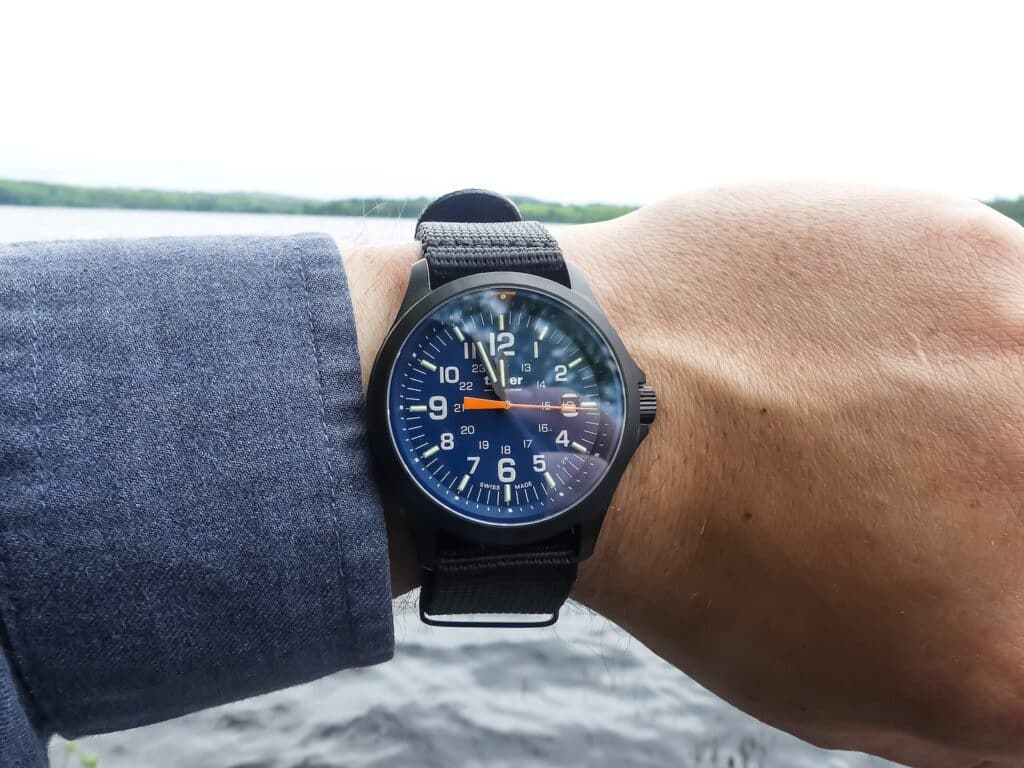
There’s something oddly satisfying about a watch that glows all night without needing a pre-bedtime flashlight blast. The Traser P67 Officer Pro leans into that usefulness without dressing like it’s about to breach a door. This is a field-style watch built around dependable timekeeping, minimal fuss, and low-light readability. The quartz movement keeps it accurate and easy to grab, which fits the personality better than a mechanical movement would. If the point is a watch you can wear through commuting, outdoor time, and desk impacts without turning it into a ritual, quartz is doing exactly what it should.
The dial is clean enough to read quickly but not so plain that it disappears. Large numerals, a tidy 24-hour track, and long minute markers make exact time checks easy, while the orange second hand and matching tritium tube add some life without trespassing into full tactical cosplay. We were not immediately sold on the dark hands against the blue dial, but the white tritium tubes helped keep things readable in daylight and low light. Watching the second hand tick in complete darkness is a small pleasure.
The case keeps the watch more wearable than a 42mm diameter might imply. The slim 10mm profile, shorter lug span, and deep-set dial pull the visual weight inward, so it never felt clumsy during our time with it. The 100m water resistance also made it easy to leave on through normal daily mess: weather, commuting, outdoor stretches, and the usual table-and-doorframe encounters. The PVD case paired well with casual outfits, especially with the included black nylon strap, though the coating does limit your options if you want to polish out wear later.
The anti-reflective sapphire crystal helped legibility in harsh sunlight, which matters because the whole watch is built around being readable in more than one lighting condition. It is not going to win over someone who needs mechanical movement charm in every purchase, and the black-on-blue hand choice may split opinions. But as a quartz pick, the P67 makes sense because its best features are functional rather than ornamental: always-there tritium, easy wear, solid water resistance, and the kind of low-effort accuracy that lets the watch get out of its own way.
Pros
- Tritium illumination stays useful in low light without needing a lume charge.
- The orange second hand and matching tritium tube add personality without feeling gimmicky.
- Large numerals, long minute markers, and a 24-hour track make the dial easy to read.
- The included black nylon strap suits the PVD case and casual wear.
- Slim 10mm case, shorter lug span, and deep-set dial help the 42mm size wear comfortably.
Cons
- PVD coating limits refinishing options as wear builds up.
- Dark hands against the blue dial may not work for everyone visually.
Citizen Promaster Aqualand Depth Meter JP2007-17W
| Price: | $550 |
| Water Resistance: | 200m |
| Case Dimensions: | 50.7mm (diameter) x 51mm (lug-to-lug) x 14.8mm (thickness) |
| Lug Width: | 24mm |
| Movement: | Citizen C520 Quartz |
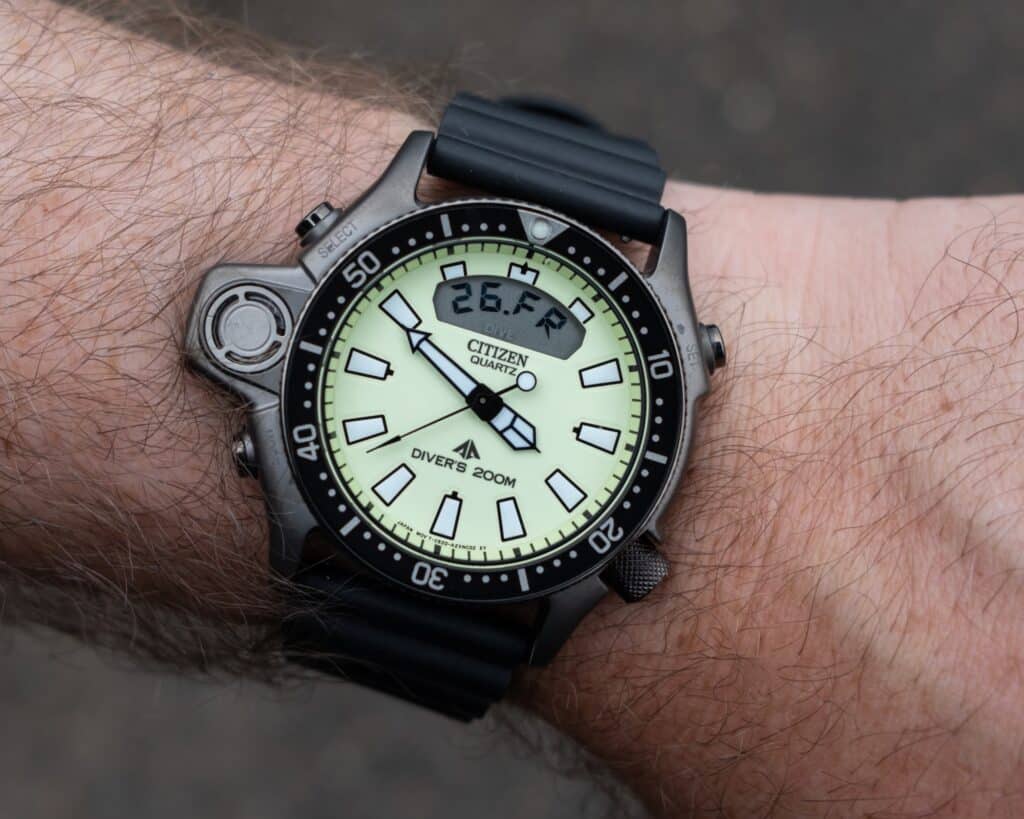
Some quartz watches are convenient because they stay accurate; the Citizen Promaster Aqualand goes further and uses quartz to justify being a quirky wrist instrument. This is not a diver trying to pass as a clean daily sports watch. The external depth sensor, analog-digital layout, and broad case stance all point toward function first, charm second, and subtlety somewhere in another zip code. That is why it belongs here. A mechanical version of this concept would be far less practical and more fragile.
The size is part of the experience, not a random flex. The main case is around 43mm, but the external sensor pushes the total width closer to 50mm, and the 24mm strap gives the watch a wide, planted feel on the wrist. During our wrist-time with it, that footprint felt tied to the purpose of the watch rather than inflated for drama. Smaller wrists may find it excessive, and the 24mm lug width limits easy strap experimentation, but the stock rubber strap helps. It is soft, ventilated, secure, and long enough to wear comfortably without constant fiddling.
The Aqualand’s real personality comes from its dive-computer functionality. It can track depth, log dives, set alerts, and warn you if you ascend too quickly. Most owners probably will not use every feature regularly, and we did not either, but their presence changes how the watch feels. It is not a desk diver pretending to have a weekend hobby. Outside of diving, the digital side still handles useful basics like alarm, chronograph, elapsed time, and calendar functions once the layout clicks. The analog hands and digital display operate independently but stay synced once set, so daily ownership stays low-stress.
Usability is better than the watch’s “tiny submarine equipment” look might lead you to believe. The bezel action is firm, positive, and properly aligned, while the oversized screw-down crown is easy to grip. The pushers become more intuitive with time, and quartz accuracy quietly keeps everything moving without asking for attention. Legibility is strong, helped by a fully lumed dial that glows brightly and lasts for hours, though the all-over glow can soften contrast compared to more selective lume designs. Pre-owned pricing also helps its appeal.
Pros
- Full dive-computer functionality adds real capability beyond standard dive-watch timing.
- Quartz operation keeps the watch accurate, reliable, and low-stress in daily wear.
- Pre-owned prices can make the package even more appealing.
- Firm bezel action, oversized crown, and intuitive pushers support real usability.
- The rubber strap is soft, breathable, secure, and long enough for comfortable wear.
- The case, external depth sensor, and wide strap give it serious wrist presence without feeling clumsy.
Cons
- 24mm lug width limits practical strap options.
- The fully lumed dial can reduce contrast slightly in some conditions.
- The overall footprint may feel too large on smaller wrists.
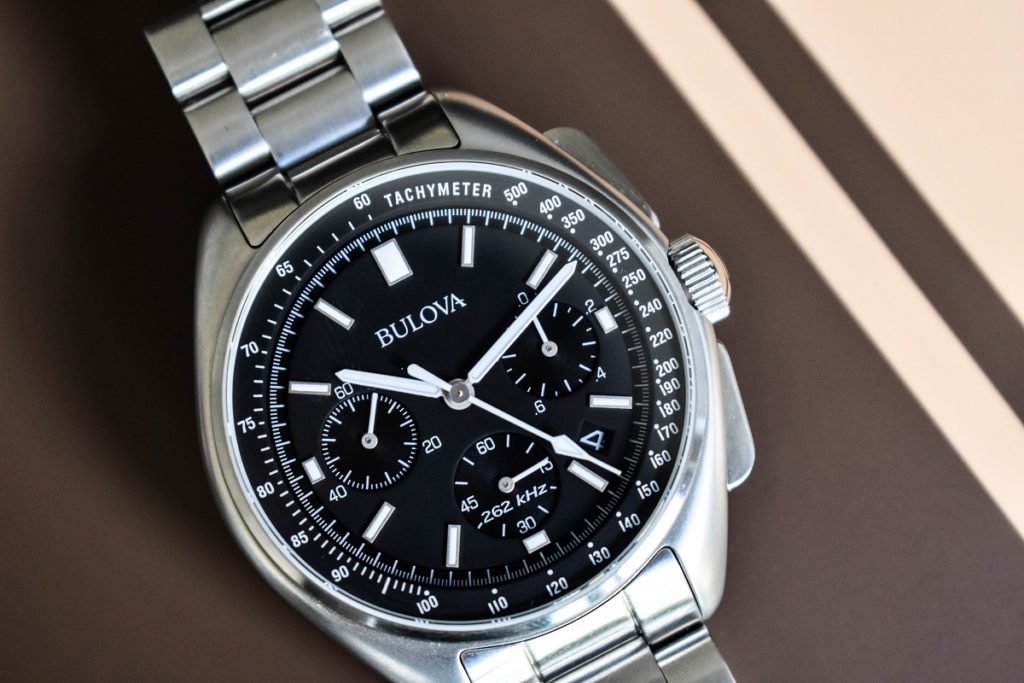
Bulova Lunar Pilot
| Price: | $550 – $895 |
| Water Resistance: | 50m |
| Case Dimensions: | 45mm (diameter) x 52mm (lug-to-lug) x 13.5mm (thickness) |
| Lug Width: | 20mm |
| Movement: | 262 kHz Quartz |
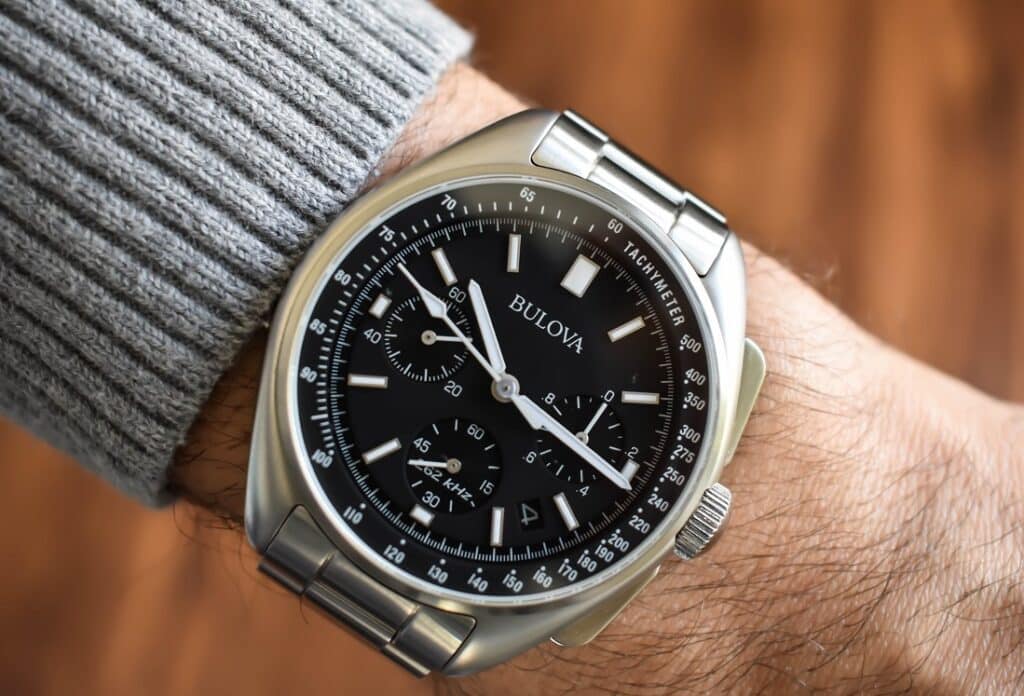
The Bulova Lunar Pilot Chronograph is where quartz starts sounding less like a cheap preference and more like the identity of the watch. Its high-frequency quartz movement gives it excellent accuracy, around 10 seconds per year, and the chronograph second hand has a smooth, gliding sweep that scratches a bit of the mechanical itch without dragging along mechanical chronograph ownership costs. For a watch with this much enthusiast appeal, that matters. It is precise, distinctive, and honest about what it is.
The 45mm 316L stainless steel case is large, and there is no polite way to shrink that sentence. But the size is not wasted. The dial has room to breathe, with a clear chronograph layout and well-sized sub-dials for the 1/10th-second counter, running seconds, and minute totalizer. The 4:30 date window stays discreet enough not to crowd the layout, which is a small mercy on a watch that already has plenty going on. The pushers at 2 and 4 o’clock add character, and the signed crown between them keeps the case side feeling intentional rather than cluttered.
On the wrist, the factory bracelet does a lot of heavy lifting. It integrates with the case in a way that helps the watch sit more comfortably and feel more balanced than a 45mm chronograph has any right to feel. Strap swaps were less successful for us, though. Off the bracelet, the case becomes more visually pronounced, and the watch loses some of the balance that makes it wearable in the first place. The bracelet is comfortable, though the finish mismatch between the bracelet and the case becomes easier to notice over time.
This is not the piece for someone chasing a small, versatile, under-the-radar daily watch. Certainly, the size will rule it out for some wrists, and the modest water resistance keeps it away from heavy-duty use. But as a quartz chronograph with real presence, strong legibility, smooth chronograph action, and serious accuracy, the Lunar Pilot gives quartz more than utility. It gives it a point of view. Which is helpful, because “large but weirdly compelling space-adjacent chronograph” is a much better personality than “big watch.”
Pros
- High-frequency quartz movement delivers excellent accuracy of around 10 seconds per year.
- Smooth gliding chronograph seconds hand gives the watch a more mechanical feel.
- Clear, well-proportioned dial keeps the chronograph layout legible.
- Pushers and the signed crown add character without making the case feel messy.
Cons
- The 45mm case will still be too large for some wrists.
- The watch feels less balanced and more visually bulky on strap options.
- The finish mismatch between the case and bracelet is something you notice over time.
Luminox Pacific Diver

| Price: | $875 |
| Water Resistance: | 200m |
| Case Dimensions: | 44mm (diameter) x 12mm (thickness) |
| Lug Width: | 24mm |
| Movement: | Ronda 515 quartz |
The Luminox Pacific Diver is the sort of quartz watch that feels most natural when you stop asking it to be romantic. It fits Luminox’s military/outdoor personality because the movement keeps things simple, reliable, and low-maintenance, while the rest of the watch focuses on being tough, readable, and easy to live with. The quartz movement also helps keep the case relatively slim at 12mm, which matters on a 44mm diver that could have gone full wrist hockey puck if nobody in the room showed restraint.
According to our review team, the dial stays cleaner than the brand’s tougher image might lead you to imagine. The emerald green shifts with light and gives the watch some depth, while the printed markers and limited dial text keep it from feeling cluttered. The tritium tubes are the real party trick, though calling them a party trick feels unfair because they are truly useful. Instead of traditional lume that blasts bright and then fades, the tubes stay consistently visible through the night. It is not dramatic. It is not torch-like. It is there, quietly doing the job like the least annoying person on a group trip.
On the wrist, the Pacific Diver handles its size better through weight and finish. The dark IP-coated steel case visually tightens things up, and at a little over 100 grams on rubber, it feels lighter than many steel divers in this range. The 44mm case still fills the wrist, and the 24mm lug width adds plenty of stance, but the watch sits close enough that it does not feel top-heavy during longer wear. The crown guards, matching case detail opposite the crown, screw-down crown, 200m water resistance, and AR-coated sapphire crystal all support the idea that this is something you can wear without planning your day around it.
The bezel action is solid, with tight rotation and minimal play, but the fully blacked-out insert is not the quickest to read in low-contrast situations. That did not ruin casual use for us, though anyone who relies on bezel timing often may want more visual separation. The rubber strap is comfortable once sized, but the cut-to-fit system is the kind of thing that makes you measure twice, sweat once, and then wonder if you should have measured a third time. Once trimmed, it sits cleanly and avoids extra strap bulk.
Pros
- Quartz movement keeps ownership simple, reliable, and low-maintenance, and supports the slim 12mm profile.
- Tritium tubes provide constant nighttime visibility without needing a lume charge.
- 44mm case wears light for its size at a little over 100 grams on rubber, and its dark IP-coating reduces visual bulk.
- 200m water resistance, screw-down crown, and AR-coated sapphire crystal add real daily durability.
Cons
- The 24mm lug width limits easy strap options.
- Cut-to-fit rubber strap requires commitment and can be stressful to size.
- The blacked-out bezel insert is harder to read quickly in low-contrast situations.
CWC 1983 Quartz Royal Navy Diver
| Price: | $1,000 approx. (used and grey market) |
| Water Resistance: | 300m |
| Case Dimensions: | 45mm (diameter incl. crown) x 47mm (lug-to-lug) x 11mm (thickness) |
| Lug Width: | 20mm |
| Movement: | ETA 955.122 Quartz |
The CWC 1983 Quartz Royal Navy Diver gives quartz a kind of credibility that has nothing to do with being cheap or convenient. This is a service-history-driven diver built around old Ministry of Defense requirements, so the quartz movement feels tied to the job rather than added as a shortcut. The ETA 955.122 ran between -0.3 and +0.5 seconds per day during our in-depth testing, which is accurate enough to make a lot of mechanical posturing sound like a hobby with extra steps. The tick is quiet in normal use, and once it is set, the watch does not ask for much.
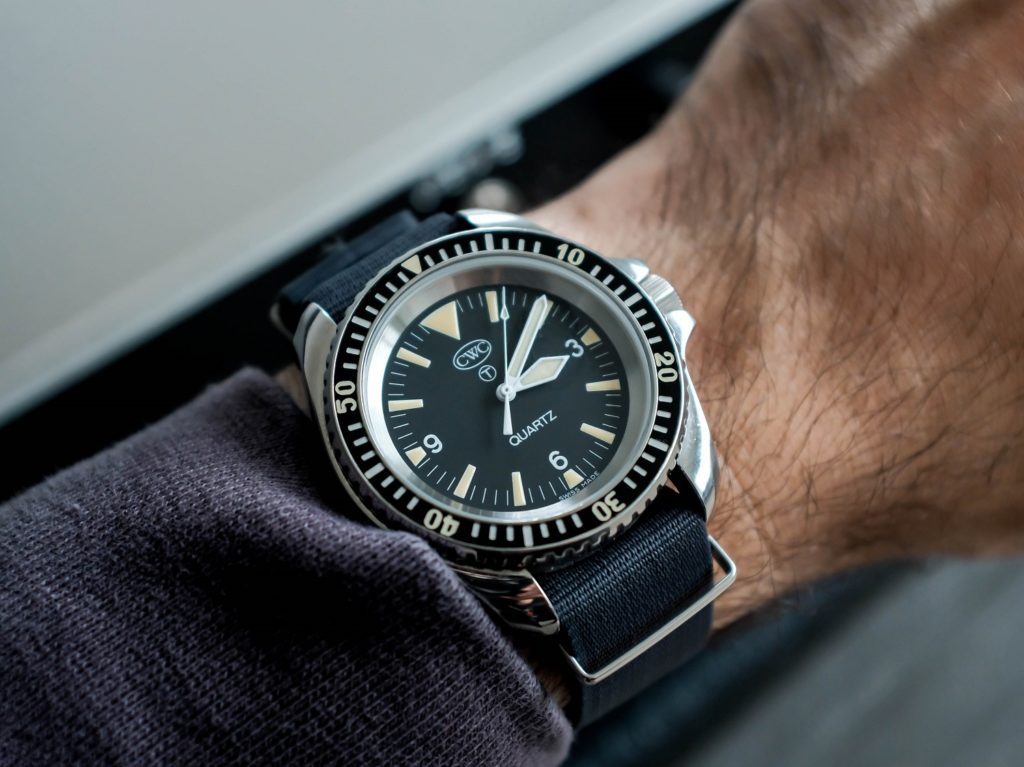
On the wrist, the asymmetrical case feels purposeful rather than decorative. The oversized crown guards and 300m water resistance give it that survival-first attitude, while the wearing profile sits somewhere near a no-date Submariner. but with a more utilitarian vibe. On the supplied Phoenix NATO, the watch stays light, balanced, and easy to wear for days without feeling delicate or too precious. Fixed spring bars support the military-tool character, though they do limit strap-swapping if you like changing straps every time the weather changes.
The bezel is one of the best parts of the experience. CWC uses a glossy, slightly domed acrylic insert instead of modern ceramic, and it catches light in a softer, more period-correct way without turning the watch into fake-vintage cosplay. The 60-click action is firm, has very little play, and the lumed 10-minute markers make quick timing easy. It feels built around repeatable use rather than decoration, which is where this watch starts to make sense.
The dial follows the same practical logic. The matte surface cuts glare, the bold sword hands and thick markers are easy to read quickly, and the vintage-toned lume lasts well into the dark. The “circle T” is now a visual reference rather than a functional tritium marker, since this modern version uses Super-LumiNova, and that may bother purists who enjoy being bothered. The hidden day-and-date setup can make initial setting a little awkward, and the price may feel steep if your brain automatically equates value with mechanical movements. Still, this is one of the more convincing quartz divers because the movement, case, and military design language all point in the same direction: accuracy, restraint, and actual wearability.
Pros
- MOD-spec design gives the watch real military-diver credibility.
- ETA 955.122 quartz movement is accurate (-0.3 to +0.5 seconds per day), quiet, and low-maintenance.
- The glossy domed acrylic bezel insert adds period-correct character without feeling forced.
- Phoenix NATO keeps the watch light, balanced, and comfortable for long wear.
- The firm 60-click bezel has very little play and useful lumed 10-minute markers.
Cons
- Fixed spring bars restrict strap options.
- The hidden day-and-date setup can make the first setting slightly awkward.
- The price may feel high for buyers who expect a mechanical movement at this level.
Marathon TSAR
| Price: | $1200 |
| Water Resistance: | 300m |
| Case Dimensions: | 41mm (diameter) x 48mm (lug-to-lug) x 14mm (thickness) |
| Lug Width: | 20mm |
| Movement: | ETA F06 quartz |
The Marathon TSAR feels like a watch built for situations where accuracy, visibility, and toughness matter more than sentiment or mechanical romance. This is a search-and-rescue-style diver built around reliability and being handled without ceremony. The ETA F06 quartz movement suits that job cleanly. In our testing period, it ran at roughly half a second per day, which gives the watch the ready-when-needed character its design promises. Battery life is rated around 3 years, which is practical enough, even if some newer high-accuracy quartz options stretch that further.
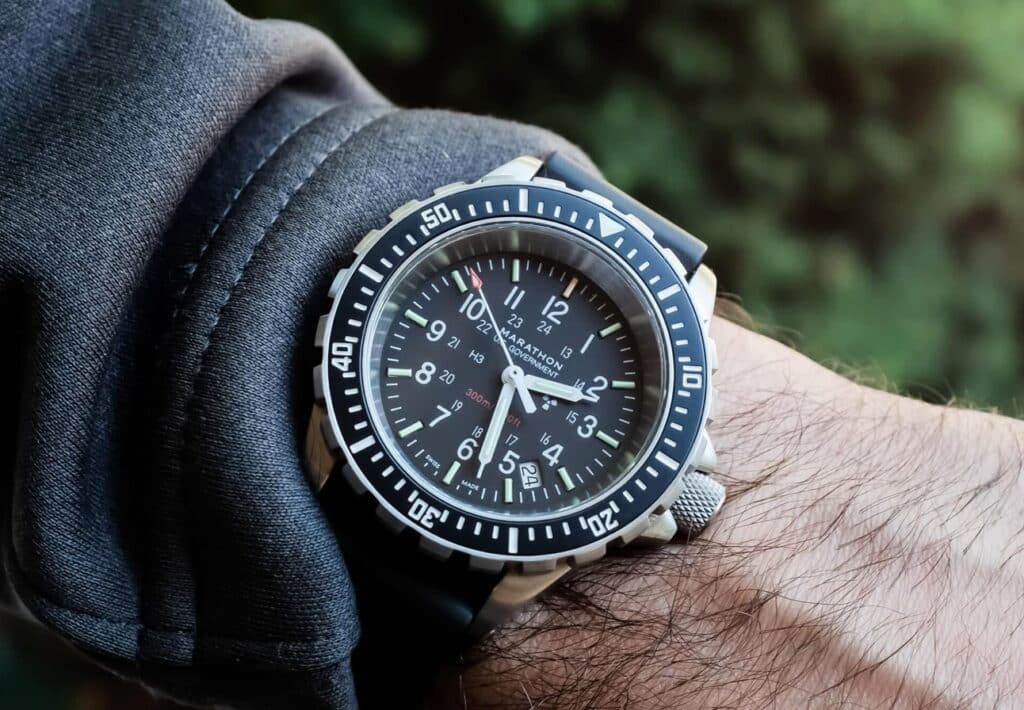
The case feels unapologetically tool-first. At 41mm, it is not oversized in diameter, but the thick, fully brushed, slab-sided construction gives it a dense industrial feel on the wrist. There is real heft here, and it works because the watch feels like equipment rather than jewelry pretending to have weekend plans. The trade-off is wearability under tighter sleeves. Clearly, this is not a thin, polite diver.
The controls are where the TSAR starts to justify its attitude. The oversized crown is easily grippable, even with gloves, and the deeply cut 120-click bezel turns with a firm, confident action. Nothing feels soft or vague. Moreover, salt water, concrete, long physical days, and the usual abuse that makes dressier watches nervous all feel within its grip. The bracelet is secure and substantial, while the rubber strap is thick, durable, comfortable, and carries that faint vanilla scent Marathon owners tend to recognize immediately.
Legibility is just as direct. Whether you choose the “US GOVERNMENT” dial or the cleaner version, the layout stays easy to read, with a small red depth-rating accent adding contrast without turning decorative. Tritium tube markers keep the dial readable in complete darkness without needing a charge, while MaraGlo adds extra brightness after light exposure without overwhelming the view. The TSAR is not refined in the dressy sense, and the bracelet skips micro-adjustment and quick-release convenience. But if the question is whether quartz belongs in a serious tool diver, this thing answers by quietly getting back to work.
Pros
- ETA F06 quartz movement delivers dependable, low-maintenance performance.
- The tested accuracy of around half a second per day supports its ready-to-use character.
- Tritium tubes provide constant dark visibility without needing a lume charge.
- MaraGlo adds extra brightness after light exposure without overwhelming the dial.
- Oversized crown and deeply cut bezel are easy to operate, even with gloves.
Cons
- The chunky case can be awkward under tighter sleeves.
- Bracelet lacks micro-adjustment and quick-release spring bars.
- Its tool-first design has a limited range outside casual or utility-focused wear.
- Battery life is solid, but shorter than some modern high-accuracy quartz options.
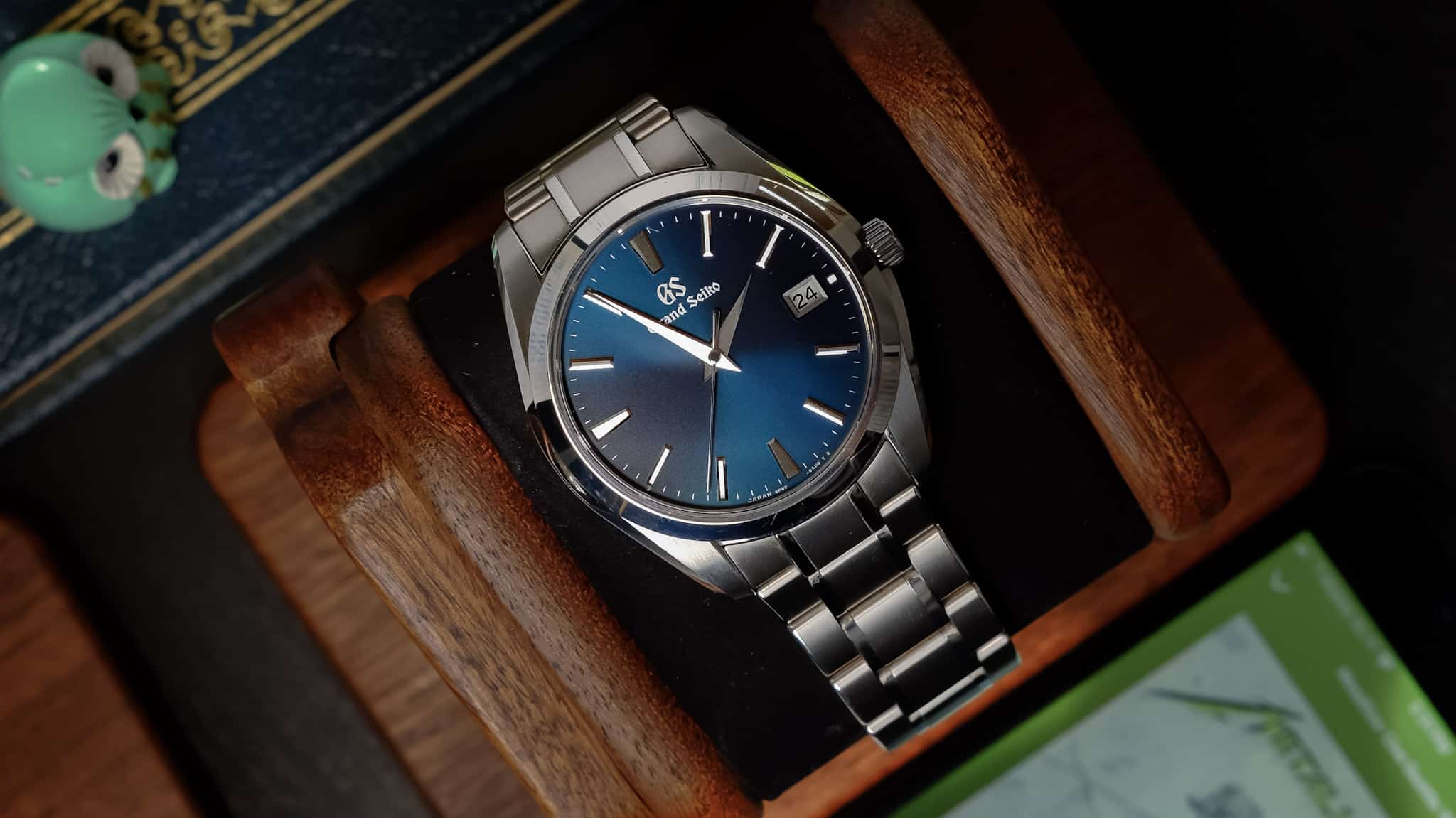
Grand Seiko SBGV233 Quartz
| Price: | $2,400 – $2,600 |
| Water Resistance: | 100m |
| Case Dimensions: | 40mm (diameter) x 46mm (lug-to-lug) x 10mm (thickness) |
| Lug Width: | 20mm |
| Movement: | Seiko 9F82 quartz |
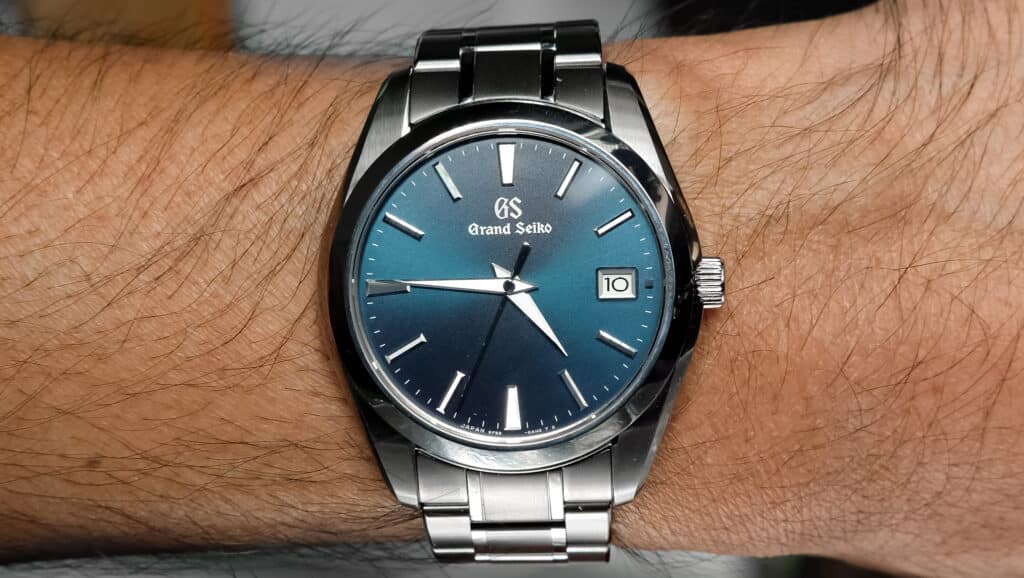
The Grand Seiko SBGV233 is the luxury-end reminder that quartz can be the intention, not the apology. The enthusiast-grade Seiko 9F82 movement is rated to ±10 seconds per year, and during our time with the watch, it stayed in sync without asking for the usual automatic-watch attention cycle. That changes the ownership experience. The three-year battery life means you can leave it off the wrist for a few days, pick it back up on a random weekday, and it is still ready to go. Very boring, yet very useful.
The case is where the SBGV233 starts to feel like something beyond “an accurate watch.” The 40mm titanium case, 46mm lug-to-lug, and roughly 10mm thickness give it enough presence to feel grown-up without fighting a cuff. Titanium keeps it easy to wear all day, while the brushed surfaces and Zaratsu-polished accents stop the case from feeling plain or too clinical. The trade-off is that titanium is not immune to wear. The clasp area can pick up light scuffs where the metal rubs against itself, because apparently, even Grand Seiko does not get to opt out of physics.
The dial gives the watch its personality without turning it into a loud object. The teal color shifts between blue and green depending on the light, adding depth while still keeping the whole thing firmly in quiet daily-watch territory. The sharp dauphine hands and applied markers bring the crispness people expect from Grand Seiko, and the sapphire crystal keeps the view clean. Even when glare showed up during extended wear, the watch stayed easy to read in most lighting, which matters more than another paragraph of dial poetry.
As a quartz pick, the SBGV233 works because it feels intentional. This is not a refined case with a cheap movement tossed in to lower the price. It is Grand Seiko finishing, titanium comfort, long-term accuracy, and low-maintenance ownership all pulling in the same direction. Bracelet sizing takes patience because of the pin-and-collar system. However, once it is fitted, the watch settles into that rare space where restraint, precision, and daily usability all feel equally important.
Pros
- The 9F82 quartz movement is rated to ±10 seconds per year, and it stayed in sync without needing regular adjustment.
- Zaratsu polishing and brushed surfaces give the case real visual depth.
- Sharp dauphine hands, applied markers, and sapphire crystal support clean legibility.
- The teal dial shifts between blue and green without becoming distracting.
- Lightweight titanium case makes it comfortable for full-day wear.
Cons
- The pin-and-collar bracelet sizing mechanism can be tedious.
- The titanium clasp area can develop light scuffs over time.
If you’ve lived with any of these quartz watches, we’d love to hear which ones actually stayed in your rotation after the novelty wore off. We only included pieces we’ve used and reviewed hands-on, but quartz is a deep, strange, unfairly dismissed corner of the hobby, so this list is not closed forever. If there’s another quartz watch that makes the movement feel like part of the appeal rather than a compromise, share it in the comments.

Co-Founder and Senior Editor
Kaz has been collecting watches since 2015, but he’s been fascinated by product design, the Collector’s psychology, and brand marketing his whole life. While sharing the same strong fondness for all things horologically-affordable as Mike (his TBWS partner in crime), Kaz’s collection niche is also focused on vintage Soviet watches as well as watches that feature a unique, but well-designed quirk or visual hook.
Wow, that was an extensive list. Glad to see one meca quartz in there too. I have a couple from the list that have definitely stayed in rotation: Bulova lunar pilot, Nighthawk blue angels, and aqualand depth meter (analog only version). I prefer a Bulova precisionist with the sweeping central second hand, 98b257, so it gets more time than the lunar pilot. Only missing category I saw was something like the Tissot T-touch. For a Casio quartz only feature, the 10 year world timer is rather unique, ae1200whd. On solar divers, I’d have to add the new rev Arnie–it definitely has appeal. Last oddball, the Vaucanson NASA moonwalker–the uv star illumination and a frickin lunar meteorite.
William – that’s a strong rotation, and the Precisionist’s sweeping hand is one of those features that’s hard to go back from once you’ve experienced it. The T-Touch and Rev Arnie are both fair additions, and I’d never heard of the Vaucanson NASA Moonwalker.
Citizen’s “The Citizen” should be in the conversation along with Grand Seiko. Super titanium, beautiful dials and ultra Eco-Drive movements that can match and even exceed Grand Seiko accuracy.
You’re right, Eric. And The Citizen line doesn’t get nearly enough attention in the West. The accuracy specs and finishing are genuinely competitive with Grand Seiko, and the Eco-Drive convenience adds a practical edge. Good call.
Best watches are radio controlled or GPS wave from either citizen or Seiko atomic timekeeping automatic time zone adjustment and precision down to atomic level
Hard argument to beat, Shaj. Both Citizen and Seiko have done impressive work in that space.