Most of us have been stuck in the same loop: we decide it’s time to buy something that isn’t another dive watch, spend days researching field watches, chronographs, GMTs, or integrated-bracelet sports watches, and somehow end up with another diver anyway. It isn’t because divers do everything better. Over time, they become the standard we judge everything else against. Without realizing it, your thumb keeps reaching for a bezel that isn’t there, a slimmer case feels unfamiliar instead of comfortable, and a cleaner dial can seem unfinished at first glance. We’ve learned those reactions usually say more about habit than the watch itself. But the good alternatives don’t replace what makes a diver satisfying. They give you a different reason to enjoy wearing a watch. This list is for people trying to figure out which changes are worth making and which ones will have them reaching back into the watch box after a few days.
That perspective comes from more than a decade of wearing these kinds of watches in everyday life rather than treating them as weekend novelties. We’ve watched lighter cases become the watches we forgot to take off, and discovered that bracelet quality doesn’t reveal itself until a hot summer afternoon exposes every sharp edge and loose link. Those experiences also taught us that not every alternative sticks. Some eventually sent us back to our favorite divers, while others earned permanent places in the rotation because they offered something a dive watch never could. None of the recommendations ahead are presented as better than a diver. They’re simply the ones that gave us a convincing reason to wear something else.
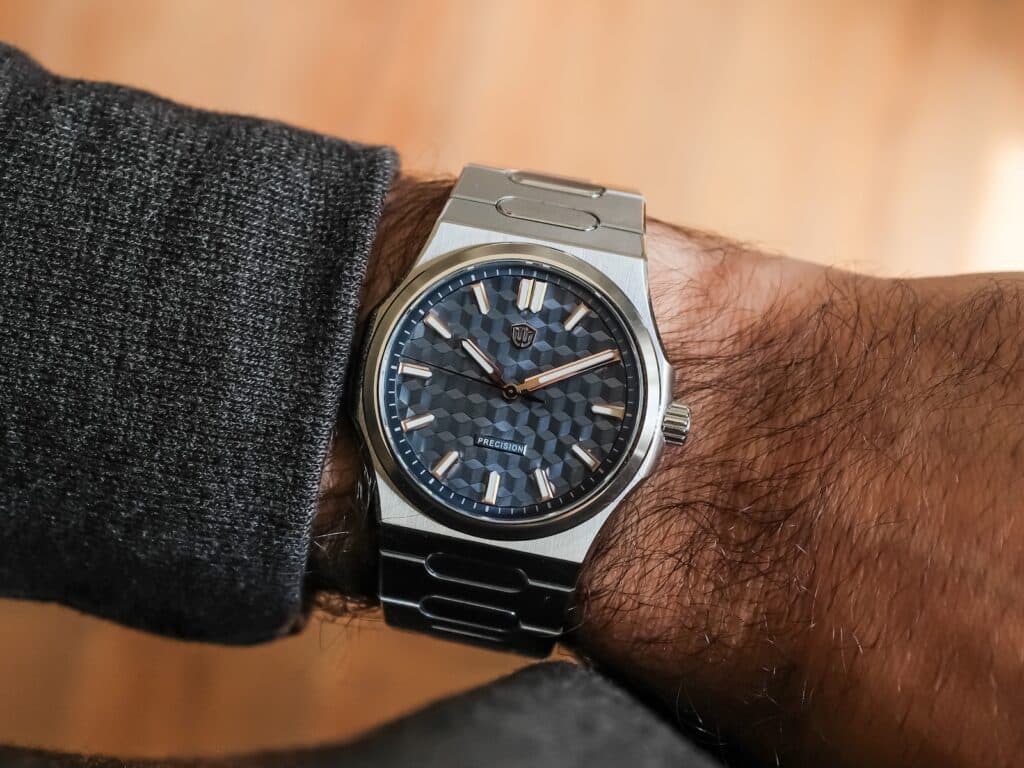
Watchdives Premier WD0016B
| Price: | $219 |
| Water Resistance: | 100m |
| Case Dimensions: | 39mm (diameter) x 44.2mm (lug to lug) x 9.9mm (thickness) |
| Lug Width: | 25 mm tapering to 18 mm |
| Movement: | Seiko VH31 sweeping quartz |
The Premier WD0016B taught us something we weren’t expecting. You don’t have to fall in love with a watch to understand why it deserves a place in your collection. Coming from years of wearing divers, the integrated-bracelet look never felt like an obvious next step for us, and the textured blue dial isn’t something we’d normally chase either. Even so, we kept returning to the Premier because the in-depth ownership experience consistently exceeded our initial impression. That’s probably the highest compliment we can give it. If you’re a diver wearer who’s curious about integrated sports watches but isn’t ready to spend four figures to find out whether they’re your thing, the Premier makes a convincing case.
The biggest surprise was the case. At 39mm across and just under 10mm thick, the integrated bracelet gives the watch far more presence than those numbers indicate, yet it sits flat enough that we stopped thinking about it after a couple of hours. The softened edges, crisp polished chamfers, and even brushing immediately make the watch feel more expensive than its roughly $219 price tag has any right to suggest. We found ourselves absentmindedly running a finger along the case transitions more than once, which probably sounds ridiculous until you spend time with it yourself.
The bracelet deserves equal praise. The articulation is fluid, the underside has been softened everywhere it touches the wrist, and the taper from 25mm to 18mm keeps it comfortable throughout the day. We still aren’t converts to butterfly clasps, but once this one was sized, it largely stayed out of the way. The crown, on the other hand, protrudes farther than we’d like, and we’d happily trade it for something that sat a little more neatly against the case.
The dial remained our biggest point of debate. Objectively, it’s beautifully executed. The textured blue surface changes dramatically as the light moves, while the applied gold-tone markers and hands with brushed centers and polished facets give it real depth. Subjectively, we never completely clicked with it. Outdoors especially, all that texture and reflection occasionally made us search for the hands longer than we wanted, and we’d love to remove the extra text above six o’clock without losing any of the watch’s personality.
Thankfully, everything underneath the dial is exactly what we’d hoped for. The BGW9 Super-LumiNova lasted comfortably through the night, while the Seiko VH31 sweeping quartz movement behaved as a good everyday movement should. The second hand tracked cleanly; there was no ghost date position; the crown action stayed smooth; and the three-year battery life meant we could leave it in the watch box for days before grabbing it on the way out the door. That’s why we’d recommend it to someone trying to step away from divers. You still get that familiar sense of wearing a solid steel sports watch. However, the integrated bracelet shifts the whole experience toward something cleaner and a little more contemporary without feeling precious.
Pros
- Case finishing feels refined for the price, with crisp chamfers and consistently excellent brushing.
- The integrated bracelet is comfortable, thanks to its fluid articulation and thoughtful taper.
- Slim case wears flatter than most divers while retaining satisfying wrist presence.
- Seiko VH31 sweeping quartz movement is dependable, smooth, and genuinely grab-and-go.
- BGW9 Super-LumiNova lasts through the night and is backed by 100 meters of water resistance.
Cons
- The busy dial can make the hands harder to pick out in bright outdoor light.
- Additional dial text above six o’clock feels unnecessary.
- The crown protrudes farther than necessary.
- The butterfly clasp isn’t as convenient as a traditional adjustable clasp.
Vaer G2 Meridian GMT

| Price: | $399 |
| Water Resistance: | 150m |
| Case Size: | 39mm (diameter) x 46mm (lug-to-lug) x 10mm (thickness) |
| Lug Width: | 20mm |
| Movement: | Swiss-made Ronda 515.24H |
Moving away from a dive watch doesn’t have to mean giving up the little habits you’ve built over years of wearing one. That’s where the Vaer G2 Meridian GMT feels like a natural transition. You still get a rotating bezel to fidget with, a screw-down crown, and the reassuring confidence that comes with 150 meters of water resistance. But the watch shifts your attention from timing elapsed minutes to tracking another time zone. It scratches the same tool-watch itch without making you feel like you’re wearing another diver with a different logo. At $399, it also avoids the pressure that often comes with pricier GMTs. We never found ourselves babying it, which is exactly how a travel watch should be used.
Its easygoing personality comes through on the wrist. The slim, lightweight case sits flatter than many mechanical GMTs we’ve worn, making long travel days or all-day wear more comfortable. Vaer also resisted the temptation to overcomplicate the design. The brushed and polished case finishing adds enough visual interest, while the engraved caseback lends it a little personality without trying too hard. The dial is similarly restrained, using applied markers and a neatly integrated 6 o’clock date to create depth without clutter. Daytime legibility is excellent, and the lume on both the hands and markers remains useful after dark rather than serving only as a marketing prop. The upgraded rubber strap complements the watch well, tapering comfortably and matching the lightweight case better than the included NATO, which still felt stiffer than we’d like after extended wear.
The Swiss Ronda 515.24H quartz movement is a sensible choice here because it reinforces the watch’s grab-and-go character with multi-year battery life, dependable accuracy, and a quick-set date. It’s a caller-style GMT, so the independently adjustable 24-hour hand makes the most sense for keeping tabs on home time or for occasional trips, rather than for constant international travel.
The bidirectional bezel has crisp, well-defined clicks that make setting another time zone intuitive, although there is enough play. The occasional alignment miss is a detail-oriented collector’s detail that they will probably notice every time they use it. Nevertheless, for diver owners who enjoy interacting with a bezel but want a watch that changes its purpose rather than its personality, the G2 Meridian is one of the easiest shifts to make.
Pros
- Slim, lightweight case stays comfortable on the wrist through long days.
- The Swiss Ronda 515.24H quartz movement delivers excellent accuracy with minimal maintenance.
- The rubber strap wears better than expected and suits the lightweight case far more than the stiffer NATO.
- A rotating bezel, screw-down crown, and 150 meters of water resistance preserve the reassuring tool-watch feel that diver owners appreciate.
Cons
- Bezel alignment isn’t always perfect.
- The bidirectional bezel has noticeable play despite its positive click action.
- Caller-style GMT functionality is less convenient than a flyer GMT for frequent international travelers.
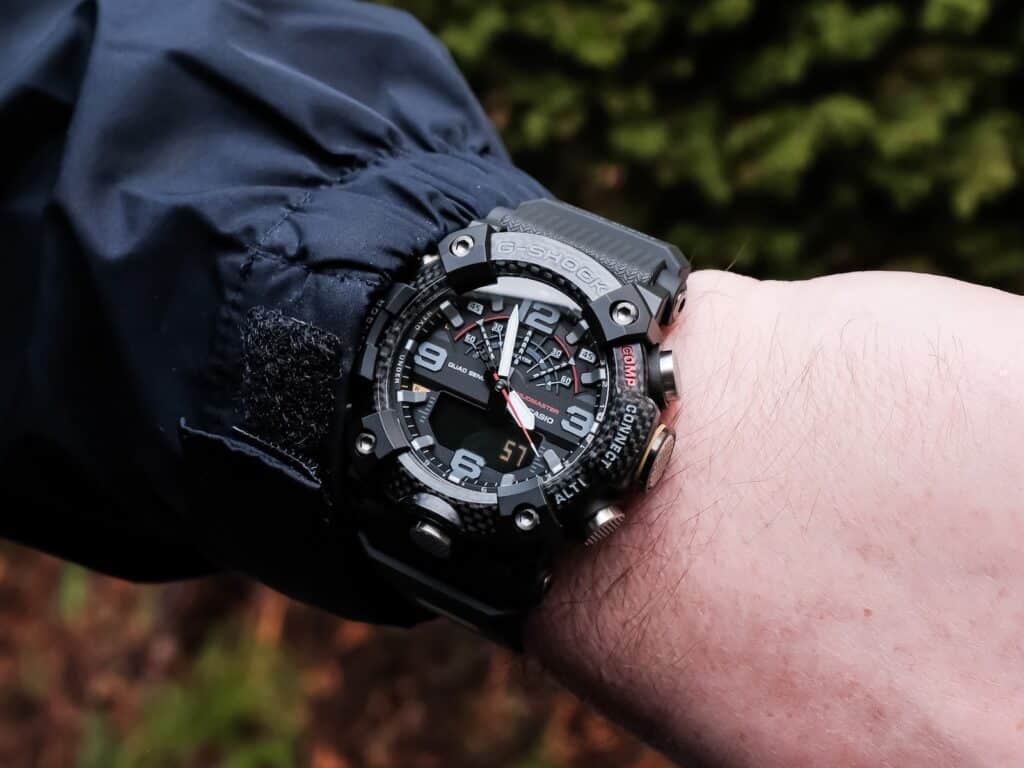
Casio G-Shock Mudmaster GGB100X-1A
| Price: | $420 |
| Water Resistance: | 200m |
| Case Dimensions: | 55mm (diameter) x 51mm (lug-to-lug) x 20mm (thickness) |
| Lug Width: | 23mm |
| Movement: | Quartz |
Many diver wearers say they want a change, but they still want a tough watch that feels ready for abuse. The Mudmaster answers that request by turning the dial all the way up on purpose. This is not a subtle switch from one sports watch to another. It is a leap into a watch that looks and feels designed for bad weather, dirt, impact, and general nonsense. The carbon-reinforced case, layered construction, and sealing against mud and debris make that clear fast, as does the sheer size of the thing. At just over 55mm across, more than 51mm wide, and close to 20mm thick, it is large in the way only a serious G-Shock can be. On a smaller wrist, it’s right at the edge. On a bigger wrist, especially something north of seven inches, it settles in much better and starts to feel like the tool it wants to be.
What surprised us most was how organized the watch feels once you stop staring at the dimensions. The buttons are big, easy to find, and easy to press without a second thought, which matters on a watch built around actual functionality instead of decorative complexity. The analog hands, digital displays, and sensor readouts sound crowded on paper, but the layout is spaced out well enough that it never felt confusing in practice. Time is easy to read at a glance, the hands stay visible against the busy background, and the digital sections stay legible whether you are checking the stopwatch, the temperature, or just the main display in passing. That clarity is what makes the Mudmaster more than a spec sheet with a strap. The compass, altimeter, barometer, thermometer, step tracking, Bluetooth syncing, and app integration are all there, but most of the time we used it like a watch first and a sensor suite second. Which, honestly, is probably how a lot of buyers will end up using it too.
The resin strap does its job well. It is tough, flexible enough to handle the weight, and built to withstand the same kind of punishment as the case. It never feels delicate, which is the point. Even so, no strap can hide the fact that this watch wants space, and that remains the biggest dividing line with the Mudmaster. On the right wrist it feels purposeful. On the wrong one it feels like you are borrowing somebody else’s gear.
The battery life, quoted at around two years, makes ownership easy, and the whole package feels well thought through for its price. We came away respecting it more than we expected, even if we would not keep it in constant rotation ourselves. For diver owners who want a true change of pace and are willing to trade grace for capability, the Mudmaster makes a very clear case. For a deeper look at our wrist time with it, read our hands-on review.
Pros
- The carbon-reinforced, mud-sealed case feels built for real abuse.
- The analog-digital layout stays easier to read than it looks.
- Large buttons are straightforward to find and use.
- Sensor suite adds real utility for users who will actually tap into it.
- Battery life and overall execution make ownership low effort.
Cons
- The watch is very large, especially on smaller wrists.
- Size and lug span can push the limit of what some people can comfortably wear.
- Bluetooth and app features may go unused for buyers who prefer simple, self-contained watches.
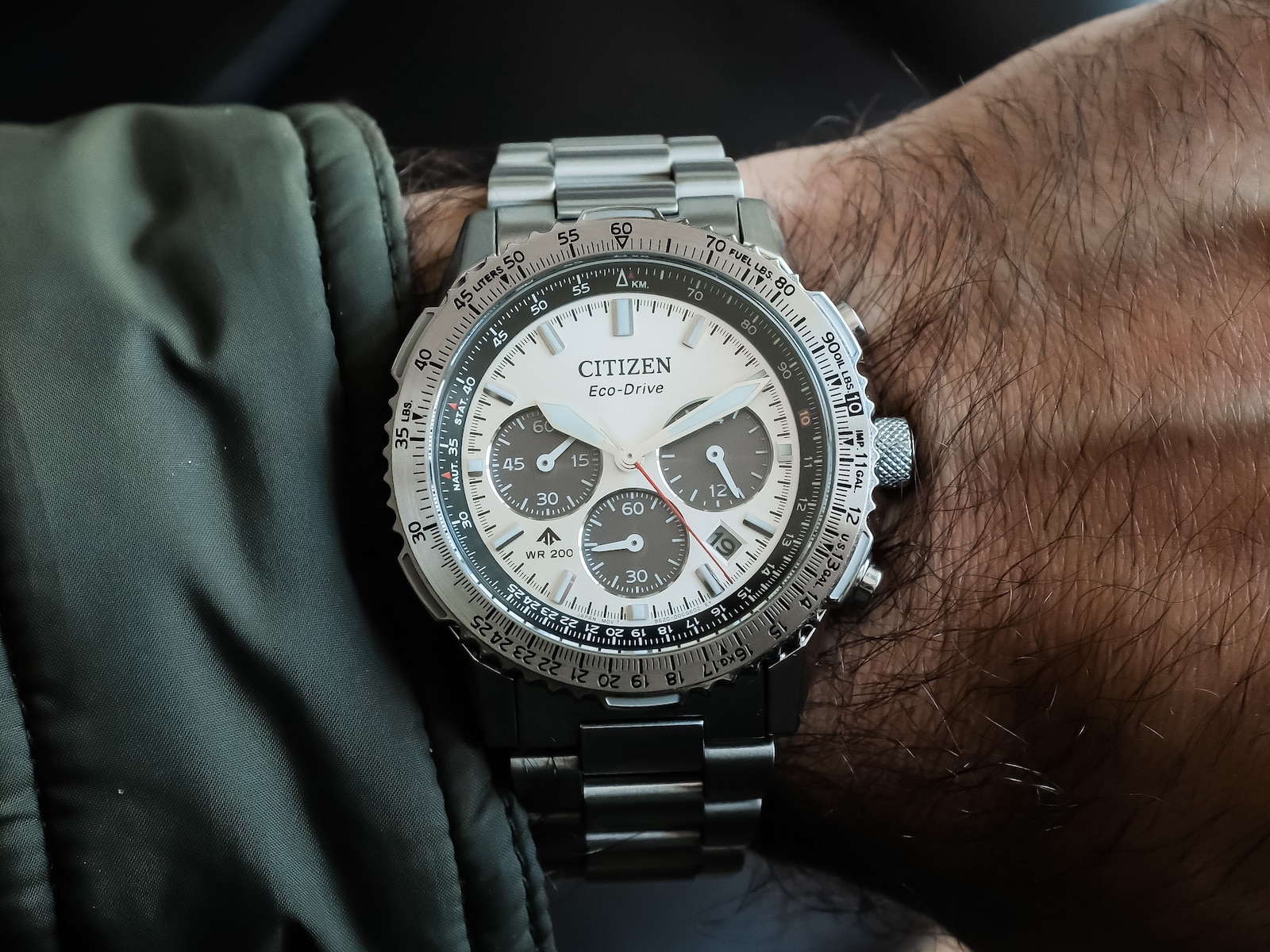
Citizen Promaster Navihawk 40

| Price: | $476 |
| Water Resistance: | 200m |
| Case Dimensions: | 40mm (diameter) x 44.3mm (lug-to-lug) x 13.4mm (thickness) |
| Lug Width: | 20mm |
| Movement: | Eco-Drive caliber B620 |
Most diver owners don’t miss the bezel as much as they miss having something to do with their watch. That’s what makes the Promaster Navihawk 40 such a fun detour. Instead of timing coffee or pretending you’ll remember when you parked, you start playing with the chronograph, reading the slide rule out of curiosity, and appreciating that the watch gives your eyes somewhere to wander without becoming overwhelming. We expected all that aviation hardware to make it feel like a watch we’d wear once a week. Instead, it quietly became one we kept reaching for. Shrinking the Navihawk to 40mm with a compact 44.3mm lug-to-lug finally gives it everyday proportions while keeping the unmistakably purposeful Promaster personality intact.
The surprise isn’t that the dial is busy. It’s that your brain adapts to it far faster than you’d expect. The textured black subdials naturally separate themselves from the silver-white sunburst dial, while the restrained red accents subtly guide your eye instead of shouting for attention. After a few days, even the slide rule stops looking like homework and simply becomes another part of the watch’s character. Citizen carried that same restraint into the case. The broad brushing keeps it firmly in tool-watch territory, polished accents stop it from feeling industrial, and the familiar coin-edge bezel preserves enough Promaster DNA that diver fans won’t feel like they’ve wandered into unfamiliar territory. Add a sapphire crystal and 200 meters of water resistance, and you never feel as though you’ve traded capability for variety. Our only recurring complaint was the deeply recessed date window, which still demands more effort to read than it deserves.
The Eco-Drive B620 turns out to be the perfect partner for this personality. Rated at roughly ±15 seconds per month with around six months of runtime from a full charge, it simply gets out of the way. We found ourselves using the chronograph for coffee, workouts, parking meters, and all the little things we’d normally reach for a dive bezel to manage.
The bracelet also exceeded our expectations. We assumed we’d swap it for rubber within a few days, but it balances the case so well that it stayed on for almost the entire review period, even if we’d happily take an on-the-fly adjustment. We noticed a little vertical bezel play on the particular watch that we reviewed, though it never affected daily wear. If your collection has plenty of divers but you’re realizing you really enjoy wearing capable, interactive aviation-style watches, the Navihawk 40 scratches that itch without feeling like another dive watch in a different costume.
Pros
- Compact 40mm case makes the Navihawk an easy everyday wear.
- Eco-Drive movement offers months of worry-free accuracy with virtually no upkeep.
- The busy dial becomes quite intuitive after only a few days on the wrist.
- The combination of a sapphire crystal and 200 meters of water resistance preserves the everyday toughness diver owners appreciate.
- Bracelet complements the case well and feels secure throughout daily wear.
Cons
- Deeply recessed date window isn’t the quickest to read.
- Bracelet lacks on-the-fly adjustment.
- Our review sample showed slight vertical bezel play.
- Those chasing the charm of a mechanical chronograph may find the quartz movement less emotionally engaging.
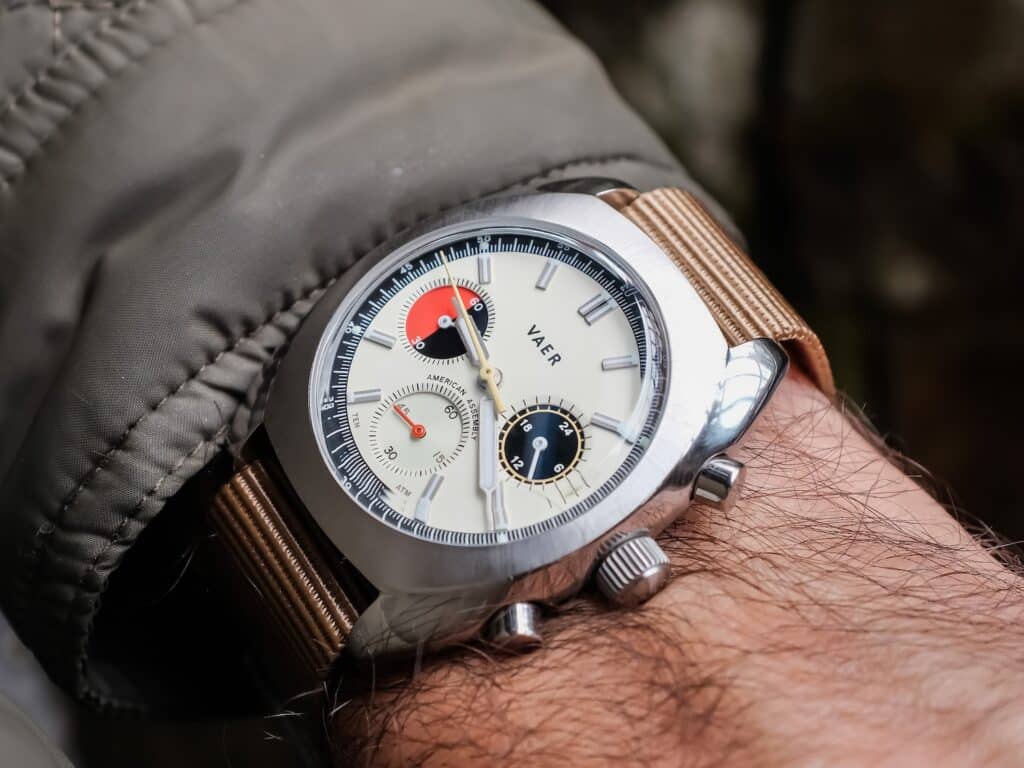
Vaer R1 Racing Chronograph
| Price: | $495 |
| Water Resistance: | 100m |
| Case Dimensions: | 38mm (diameter) x 46mm (lug-to-lug) x 12.6mm (thickness) |
| Lug Width: | 20mm |
| Movement: | Seiko VK-63 meca-quartz |
One reason so many diver collectors struggle with chronographs is that they can feel strangely delicate. Thin water resistance, unsigned pushers, and polished cases don’t exactly inspire the same confidence as a watch you’re happy to bang into a doorframe without apologizing to it afterward. The Vaer R1 doesn’t have that problem. It swaps the rotating bezel for a chronograph but keeps the casual, tool-watch attitude that makes divers so easy to live with. We kept reaching for it because it never demanded a different routine. At 38mm with a 46mm lug-to-lug, it wears with vintage restraint, yet it never disappears on the wrist or feels like you’re wearing something precious.
Vaer also understood that diver owners aren’t usually looking to baby their next watch. The screw-down crown, 100 meters of water resistance, and domed sapphire crystal mean the R1 keeps much of the everyday confidence you’d expect from a capable sports watch. The meca-quartz movement fits that philosophy, too. It delivers dependable accuracy without asking much in return, while the chronograph pushers have a crisp, mechanical snap that makes timing everyday things strangely addictive. We caught ourselves using them far more often than expected—not because we suddenly needed a stopwatch, but because interacting with the watch became part of the fun. It’s the same reason many of us absentmindedly rotate a dive bezel throughout the day.
As covered in our in-depth review, the vintage-inspired dial avoids the trap of feeling like a costume. The cream backdrop, paired with orange and yellow accents, has enough personality to stand apart without turning every outfit into a themed event. Under certain lighting conditions, the polished edges of the hands can blend into the dial, though it never became a major annoyance during daily wear.
The NATO strap also impressed us more than the rubber option, sitting flatter and feeling more natural on the wrist, while the bracelet remains the better pick if you prefer extra weight. The lume won’t satisfy someone coming straight from a Seiko diver, and it fades sooner than we’d like, but that’s one of the few reminders that you’re wearing a chronograph instead of another dive watch. The trade-offs are real, but none of them changed how often we wore the R1. If anything, it proved you can step away from a dive watch without giving up the durable, no-fuss ownership experience that made you gravitate toward divers in the first place.
Pros
- The screw-down crown, sapphire crystal, and 100-meter water resistance encourage everyday wear.
- Meca-quartz movement combines low maintenance with satisfying chronograph action.
- Vintage-sized 38mm case wears comfortably without feeling undersized.
- Pushers have a crisp, mechanical feel that makes the chronograph enjoyable to use.
Cons
- The lume fades noticeably sooner than most dive watches.
- Polished hand edges can reduce legibility in certain lighting.
- The rubber strap doesn’t feel as cohesive as the NATO or the optional bracelet.
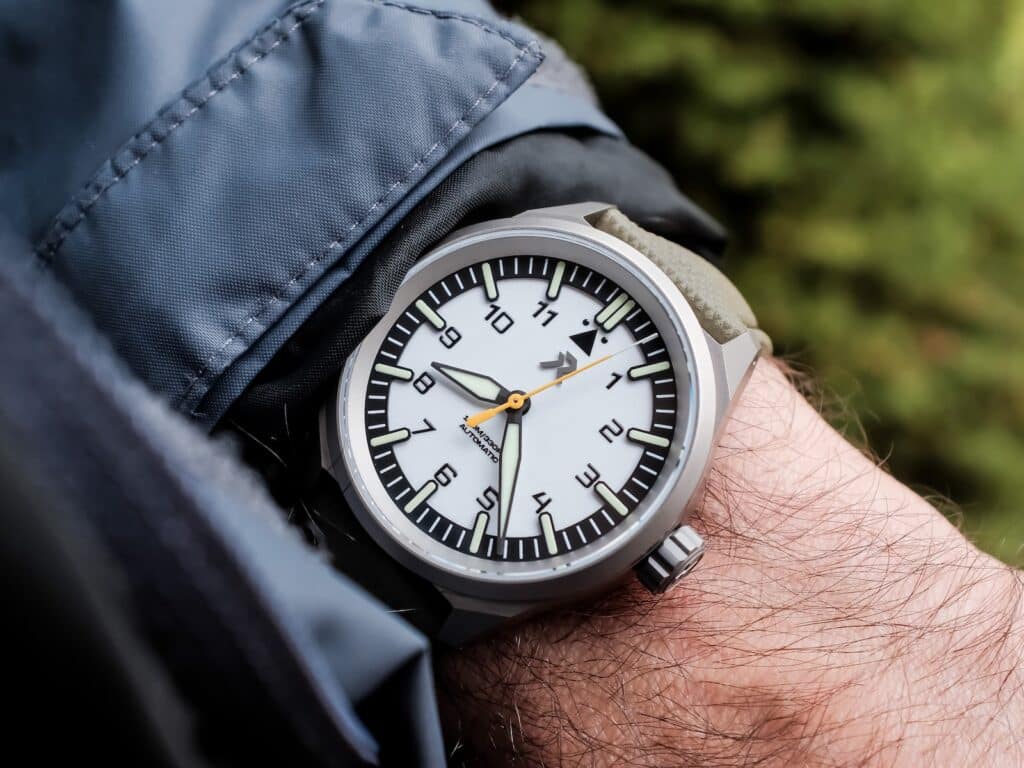
RZE Resolute Type A
| Price: | $499 (TecTuff strap); $699 (matching titanium HexLink bracelet) |
| Water Resistance: | 100m |
| Case Dimensions: | 39.5mm (diameter) x 46mm (lug-to-lug) x 11.5mm (thickness) |
| Lug Width: | 20mm |
| Movement: | Miyota 82S0 |
Most dive watches make your eyes bounce among the bezel, minute hand, and dial. The Resolute Type A is almost the opposite. You glance down, and the time is simply there. We didn’t realize how much mental clutter a rotating bezel adds until we spent time wearing RZE’s take on a flieger. The familiar triangle at 12, oversized sword hands, bold minute track, and clean baton markers make reading the dial feel almost effortless. If your favorite thing about a diver has always been instant legibility rather than the bezel itself, this is one of the easiest watches to adjust to.
It also doesn’t force diver owners to give up the habits they’ve built. The Grade 2 titanium case measures 39.5mm across, 46mm lug-to-lug, and 11.5mm thick, so it has enough substance to avoid feeling like a dress watch, yet it’s much lighter than most steel divers after a full day on the wrist. That difference became harder to ignore the longer we wore it. UltraHex hardening, rated at roughly 1200 HV, removes much of the scratch anxiety normally associated with titanium, while the screw-down crown, proper gasket construction, and 100 meters of water resistance mean we never felt the need to treat it differently from the divers sitting beside it in the watch box. The raised chapter ring and applied markers add welcome depth. On the white dial especially, the sapphire crystal and two-tone lume give the watch the look of a compact instrument panel after dark without pushing it into gimmick territory.
The TecTuff strap deserves more credit than it gets. It felt broken in almost immediately, then continued molding to the wrist over time, thanks to its water-resistant calf leather lining. We kept coming back to the olive green version because it suits the watch’s personality so well, although the quick-release spring bars, tapered profile, and UltraHex-coated titanium buckle make swapping straps painless if you like changing things up.
The Miyota 82S0 won’t win awards for romance, but it gives you hacking, hand-winding, automatic winding, and around 42 hours of power reserve without demanding much attention. Traditional flieger enthusiasts may wish RZE had leaned harder into German history, and the engraved aircraft caseback is the sort of thing you’ll appreciate exactly once. That’s also why it works so well here. The Resolute Type A doesn’t ask diver owners to become pilot-watch enthusiasts overnight. It simply offers the same no-nonsense ownership experience in a watch that feels refreshingly different every time you look down at it. Check out our full review for the smaller on-wrist details.
Pros
- Grade 2 titanium keeps the watch very light, while UltraHex hardening adds meaningful scratch resistance.
- Highly legible modern Type A dial retains the clarity diver owners already appreciate.
- Screw-down crown, proper gasket construction, and 100 meters of water resistance make it easy to wear.
- The Miyota 82S0 offers hacking, hand-winding, automatic winding, and a practical 42-hour power reserve.
- The TecTuff strap breaks in quickly and is paired with thoughtful details, such as quick-release spring bars and a titanium buckle.
Cons
- Modern full-lume treatment may not appeal to collectors wanting a traditional flieger aesthetic.
- Those looking for a historically faithful pilot watch may find RZE’s contemporary interpretation a little too restrained.
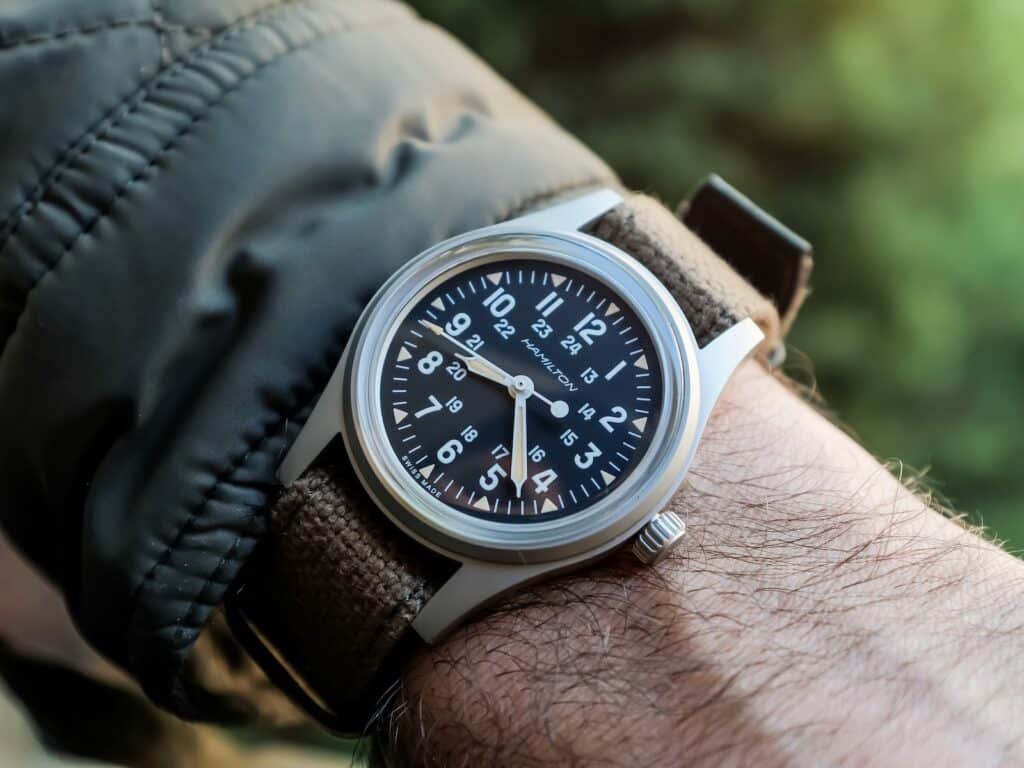
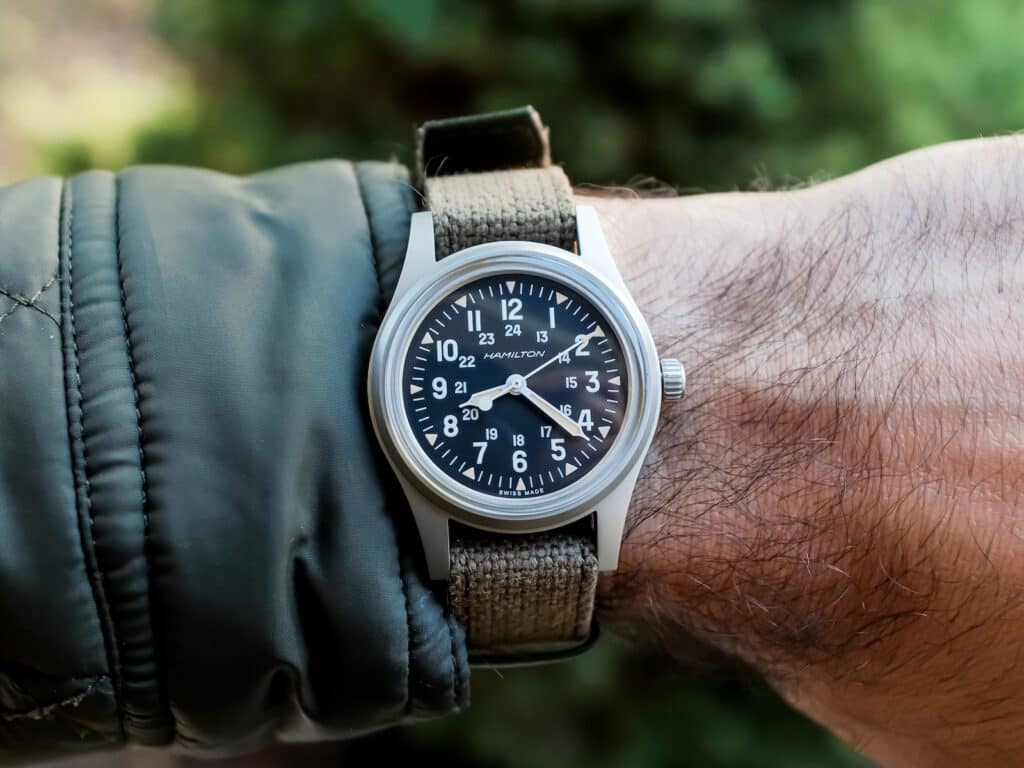
Hamilton Khaki Field Mechanical 250
| Price: | $725 |
| Water Resistance: | 100m |
| Case Dimensions: | 36mm (diameter) x 46mm (lug-to-lug) x 10.2mm (thickness) |
| Lug Width: | 18mm |
| Movement: | H-50 hand-wound movement |
If you’ve spent years wearing dive watches, the Khaki Field Mechanical can feel suspiciously simple for the first couple of days. You keep waiting for the bezel that isn’t there, then realize you stopped looking for it sometime around Wednesday. That’s the trick Hamilton pulls off. It strips away the extra hardware without making the watch feel like a step down. Instead, you start appreciating how little effort it takes to read the time.
The large Arabic numerals, separate 24-hour track, clear minute scale, and vintage-style hands make the dial feel calm rather than sparse. The warm-toned Super-LumiNova also softens the stark black-and-white palette without tipping into faux-vintage territory, while the period-correct typography quietly pulls the whole design together. If what you’ve always liked about a diver is its honest, no-nonsense approach to telling time, the Khaki scratches that same itch with a completely different wrist presence.
Hamilton also avoids one of the biggest traps of military-inspired watches: trying too hard to convince you of their heritage. The Khaki doesn’t need to invent a backstory because it already has one, and that confidence comes through in how it’s worn rather than how it’s marketed. The 36mm case sounds modest until you spend time with its balanced 46mm lug-to-lug proportions and slim profile, which make it feel planted on the wrist instead of undersized. After months of wearing chunkier divers, it almost feels like taking off a heavy backpack. The 100 meters of water resistance means you never have to rethink how you wear it, while the acrylic crystal brings the warmth and gentle distortion we’d expect from a watch like this, cutting glare better than earlier Khaki Field models we’ve worn. Yes, it’ll pick up scratches over time, but that’s exactly why Polywatch exists.
The H-50 hand-wound movement quietly modernizes the experience with an 80-hour power reserve, hacking seconds, and a Nivachron balance spring, yet throughout our testing period, the daily winding never felt like another task on the to-do list. If anything, it became the interaction that replaced absentmindedly spinning a dive bezel throughout the day. The fixed strap bars might seem limiting until you start wearing the watch the way it wants to be worn. Throw it on an olive drab NATO strap, a grey single-pass strap, or a worn canvas strap, and it simply gets on with the job. That’s ultimately why the Khaki works so well for habitual diver wearers.
Pros
- Exceptionally legible military dial stays clean and easy to read at a glance.
- H-50 movement combines an 80-hour power reserve, hacking seconds, and a Nivachron balance spring.
- Balanced 36mm case wears larger than expected while remaining comfortable all day.
- Acrylic crystal adds warmth, softens glare, and suits the watch’s character.
- Fixed bars make it a natural fit for NATO and single-pass straps.
Cons
- Acrylic crystal scratches more easily than sapphire.
- Fixed strap bars eliminate the option of standard two-piece straps.
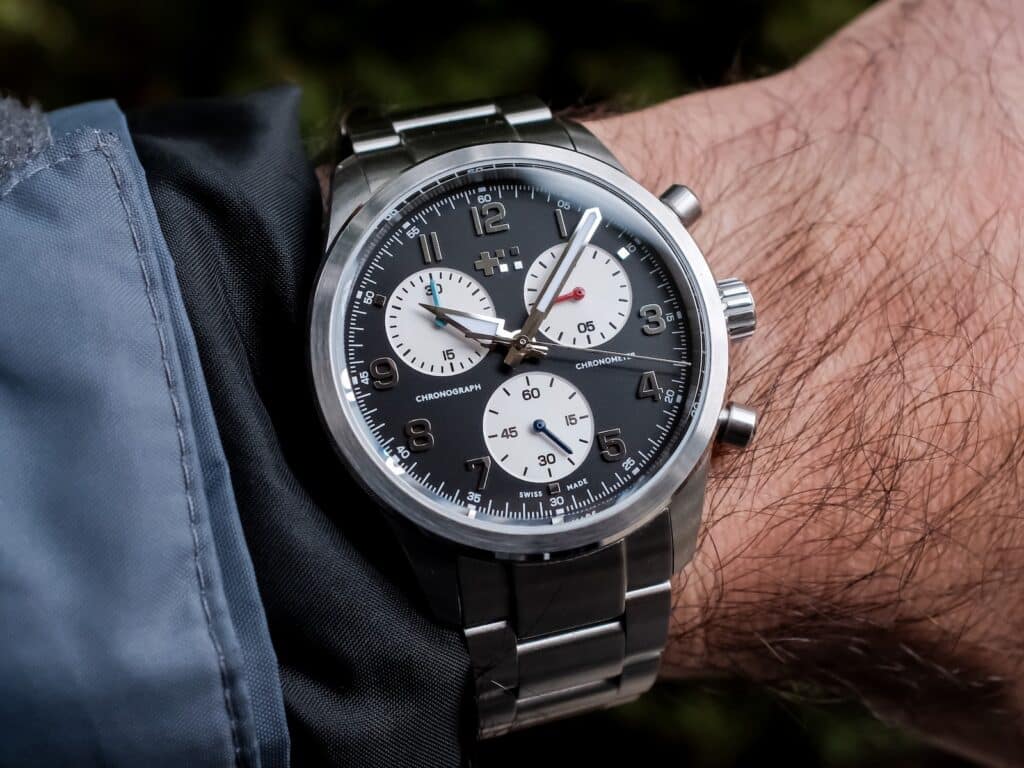
Christopher Ward C63 Valour Chronograph
| Price: | $945 |
| Water Resistance: | 150m |
| Case Dimensions: | 39mm (diameter) x 46mm (lug-to-lug) x 11.55mm (thickness) |
| Lug Width: | 20mm |
| Movement: | ETA G10.212 AD COSC quartz |
We expected the C63 Valour to feel busier than our usual divers. Instead, it made most three-hand sports watches feel a little underdressed. That’s the funny thing about a well-executed chronograph. After a few days, your brain stops seeing “all those subdials” and simply sees the time. The chronograph becomes something you use when you need it and ignore when you don’t. That’s what makes the Valour such a good change of pace for diver owners. It still has the solid construction, reassuring wrist presence, and everyday confidence we’d expect from a capable sports watch, but replacing the familiar dive layout with a chronograph makes it feel genuinely different rather than just another diver in different clothes.
Christopher Ward deserves credit for resisting the temptation to make the watch louder than the complication already is. There’s enough military inspiration to give it personality, but not so much that you feel obligated to start explaining aviation history to whoever asks what you’re wearing. The case helps sell that illusion. At 39mm with a lug-to-lug under 46mm, the Valour wears with the kind of balanced heft we’d normally associate with a good sports watch rather than a chronograph. Christopher Ward’s Light-catcher case also earns its reputation here. Throughout the day, the alternating brushed and polished surfaces constantly catch different light, making the watch feel more dynamic than the measurements alone suggest.
According to our review team’s insights, the reverse panda dial follows the same approach. Applied Arabic numerals create depth, the service-inspired colored chronograph hands reward closer inspection without stealing the show, and generous lume keeps the main handset readable once the sun goes down. Despite everything happening on the dial, we seldom had to hunt for the time.
The COSC-certified ETA quartz movement won’t impress someone who enjoys talking about escapements over coffee, but it makes an awful lot of sense here. Rated at roughly ±10 seconds per year, we set it once and largely forgot it existed. That’s exactly what we want from a watch meant to be worn, not admired from across the room. The chronograph pushers have a crisp, positive feel, and resetting them never lost its appeal, even after we’d run out of legitimate things to time. The Bader bracelet deserves equal praise, with its 20mm-to-16mm taper, on-the-fly adjustment, and quick-release spring bars. Ours developed a slight squeak early on, but it gradually disappeared with wear. If divers have taught us anything, it’s that capable sporty watches become favorites because they make life easier, not because they’re complicated. The Valour simply proves a chronograph can do the same thing.
Pros
- The balanced 39mm case avoids the bulky feel common to many chronographs.
- COSC-certified ETA quartz movement delivers exceptional long-term accuracy with virtually no upkeep.
- The reverse panda dial stays organized and highly legible despite the added chronograph displays.
- Bader bracelet combines a comfortable taper, on-the-fly adjustment, and quick-release spring bars.
- Light-catcher case finishing gives the watch a different character as lighting changes.
Cons
- The bracelet may develop a slight squeak during the early ownership period.
- Quartz movement won’t appeal to people who specifically want a mechanical diver alternative.
Christopher Ward The Twelve 36mm Titanium

| Price: | $1,895 |
| Water Resistance: | 100m |
| Case Dimensions: | 36mm (diameter) x 40.8mm (lug to lug) x 8.95mm (thickness) |
| Lug Width: | Integrated bracelet, starts 22mm at lugs, tapering down to about 16-17mm at the clasp |
| Movement: | Sellita SW300-1 COSC |
There comes a point where a lot of diver owners get curious about integrated-bracelet watches, then immediately talk themselves out of it. They look great in photos, but they also have a reputation for being watches you own more carefully than you wear. The Twelve 36mm Titanium was a pleasant reminder that it doesn’t have to be that way. It still delivers the sharp case architecture, crisp finishing, and bracelet-first design that make this style so appealing. Still, it never made us feel like every desk edge or doorframe had suddenly become a high-risk environment. More importantly, it doesn’t swing too far toward dress-watch territory. It simply gives diver owners a lighter, slimmer sports watch that feels different without feeling delicate.
The bracelet deserves most of the credit. Instead of wrapping your wrist like a polished metal cuff, it drapes naturally and almost disappears after a few hours, thanks to the lightweight titanium construction. That sense of effortlessness continues with the 36mm case and sub-9mm thickness. On paper, those numbers sound modest after a steady diet of dive watches. On the wrist, the twelve-sided bezel and crisp case lines give it enough structure that it never feels small or apologetic.
The Lagoon Blue dial keeps rewarding you throughout the day, shifting from a bright, almost playful blue into a deeper navy as the light changes. Applied markers and polished hands keep everything clean, although we occasionally lost the hands against the dial when direct sunlight hit at the wrong angle. That’s the sort of quirk you only notice after living with a watch instead of photographing it.
The COSC-certified Sellita SW300 was equally drama-free, running between +6 and -4 seconds per day during our wrist time. That’s what we hoped for. Christopher Ward also resisted the temptation to make an integrated-bracelet watch that feels too precious. The screw-down crown and 100-meter water resistance encouraged us to wear it on ordinary days rather than save it for imagined special occasions. The quick-release bracelet can test your patience when it’s time to reinstall it, and there are similarly specified watches that cost less, but neither complaint changed how often we reached for it. If anything, The Twelve proved that taking a break from dive watches doesn’t have to mean giving up the confidence that comes with wearing a proper everyday sports watch.
Pros
- Titanium construction keeps the watch remarkably light and comfortable throughout the day.
- The bracelet drapes naturally instead of feeling stiff or slab-like.
- Compact 36mm case and sub-9mm profile wear flatter than most diver owners expect.
- The screw-down crown, equipped with 100 meters of water resistance, makes it easy to wear without second-guessing your plans.
- COSC-certified Sellita SW300 delivered a consistent +6 to -4 seconds per day during our testing.
Cons
- Polished hands can blend into the blue dial in bright sunlight.
- Reattaching the quick-release bracelet requires more patience than removing it.
Omega Railmaster
| Price: | $6,400 |
| Water Resistance: | 150m |
| Case Dimensions: | 40mm (diameter) x 46.5mm (lug-to-lug) x 12.5mm (thickness) |
| Lug Width: | 20mm |
| Movement: | Omega 8806 Master Chronometer Co-Axial |
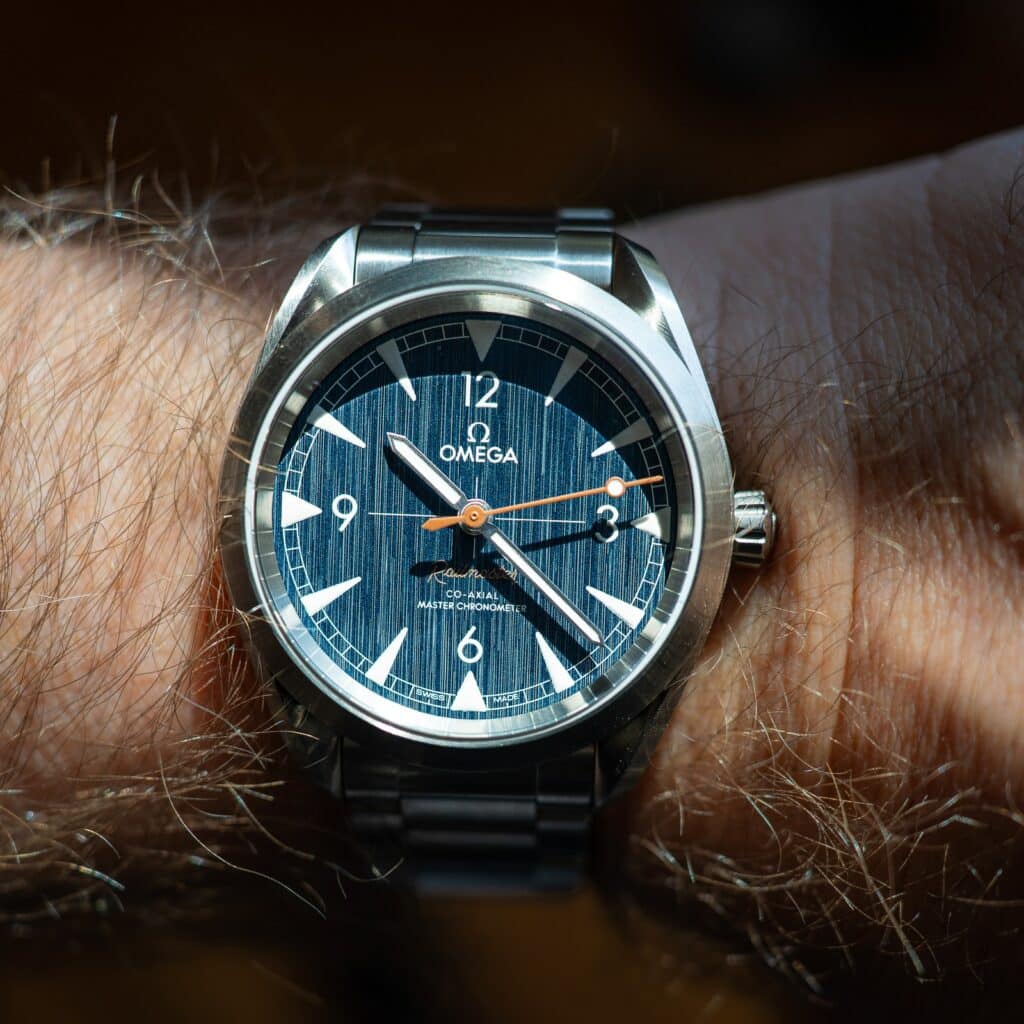
The first couple of days with the Railmaster felt almost uneventful. After years of wearing dive watches, we kept catching ourselves waiting for the watch to do something dramatic. There wasn’t a chunky bezel to frame the dial, no splash of color demanding attention, and no oversized handset shouting “tool watch.” Then, somewhere along the way, we stopped thinking about what wasn’t there. The Railmaster quietly became the watch we reached for when we didn’t feel like wearing a diver but still wanted the same confidence and versatility on the wrist. That’s a harder trick to pull off than making another great dive watch.
Omega resisted the urge to mistake restraint for boredom. The vertically brushed dial constantly shifts between darker and warmer tones depending on the light, while the bronze second hand adds just enough warmth to stop the watch from feeling clinical. It’s the sort of detail you appreciate after weeks of ownership rather than five minutes at a boutique counter. The 40mm case, 46.5mm lug-to-lug, and roughly 12.5mm thickness also strike a sweet spot for anyone coming from a dive watch. It has reassuring substance without wearing like a block of steel, and the predominantly brushed finish means the inevitable desk-diving marks don’t immediately become the only thing you notice. The polished chamfers stop the case from looking utilitarian, even if the bracelet occasionally reminds you it could have used a micro-adjustment system.
The Co-Axial Master Chronometer movement ended up being the least exciting thing to talk about and one of the best things to live with. During our testing, it averaged roughly +1 second per day, but the more meaningful advantage was never having to think about magnets. Phones, laptops, magnetic bag clasps, airport trays—we simply wore the watch instead of wondering whether today’s routine was slowly ruining tomorrow’s accuracy. That’s the kind of quiet competence that diver owners usually appreciate.
In short, the Railmaster isn’t trying to replace a diver, and it won’t satisfy someone who measures value by the number of complications on the dial. It’s a strong luxury option that simply proves that the same everyday dependability can come from a watch that whispers instead of one that shouts. If you’re curious how those impressions held up over extended wrist time, our hands-on review goes into much greater detail.
Pros
- Master Chronometer movement averaged roughly +1 second per day during our testing.
- Strong magnetic resistance adds meaningful peace of mind in everyday environments.
- Mostly brushed case and bracelet disguise daily wear better than highly polished alternatives.
- Polished chamfers add welcome definition to the restrained case design.
- The brushed dial develops more character as the lighting changes without sacrificing legibility.
Cons
- The bracelet lacks micro-adjustment, making a perfect fit harder to achieve.
- Premium price may feel ambitious given the understated design.
- The time-only layout won’t satisfy buyers seeking additional functionality.
Think we overlooked the perfect “break from a diver” watch? Tell us in the comments. If it’s the kind of watch that made you realize you didn’t actually need another rotating bezel, we’ll happily add it to the review queue and spend some wrist time finding out what we’re missing. Bonus points if it’s the watch that accidentally stopped you from buying your fifth dive watch in a row.

Co-Founder and Senior Editor
Kaz has been collecting watches since 2015, but he’s been fascinated by product design, the Collector’s psychology, and brand marketing his whole life. While sharing the same strong fondness for all things horologically-affordable as Mike (his TBWS partner in crime), Kaz’s collection niche is also focused on vintage Soviet watches as well as watches that feature a unique, but well-designed quirk or visual hook.
Cool article. Some very interesting watches. I’ve just experienced what you’ve described – not wanting another diver. After a long search, which included the lovely CW Sandhurst 2 as well as the Ball Master Engineer Endurance and Bertucci A-2T (for a field watch) I finally settled on the Explorer 36. It took a while to get used to none divers but now I can’t be parted from my Explorer (which I’d propose for your list). The other watches I’ve mentioned are worth considering too though.
Explorer 36 is such a grail 🙂
I may wear sneakers and hiking boots most of the time, but I also have dress shoes. This seems like the answer here too–a dress watch. James Bond aside, a dress watch works better with a tux than a submariner. At one point my collection consisted solely of color variations of one dive watch. Think I broke that with a Tissot Le Locle Chronometer based on an article by Jack Forster.
There’s a good lesson there. I need to do more personally to appreciate the idea of a “dress watch” in my own collection.