A dive watch has become one of those pieces collectors are expected to own, even when they have no plans to dive. We understand why. After enough time wearing watches, having something you can take to the beach, wear in the rain, throw on for a weekend, and forget about for the rest of the day is genuinely useful. The problem is that those qualities don’t automatically make a dive watch necessary. We’ve had watches that looked like the obvious all-purpose choice but were too bulky for certain clothes, too awkward on a bracelet, or simply less comfortable than something else in the box. At the same time, some non-divers have handled everyday abuse perfectly well and ended up getting more wrist time.
After more than a decade of wearing and testing these watches, we’ve found that the answer becomes clearer once you stop treating “dive watch” as a category and look at what actually gets worn. The watches we’ve lived with show where water resistance and a rotating bezel are genuinely useful, where a tough case and strong legibility matter more than dive credentials, and where extra bulk or a less versatile shape can work against everyday wear. That’s what we’ll use to judge the role a dive watch plays in a collection: not its reputation, but how well it handles the situations we actually put watches through. By the end, the goal is to make it easier to tell whether your collection genuinely needs a diver or simply needs a dependable watch that can take whatever the day throws at it.
Casio Duro
| Price: | $85 |
| Water Resistance: | 200m |
| Case Dimensions: | 44.2mm (diameter) x 48.5mm (lug-to-lug) x 12.1mm (thickness) |
| Lug Width: | 22mm |
| Movement: | Casio 2784 Quartz |
| Amazon: | See Today’s Price |
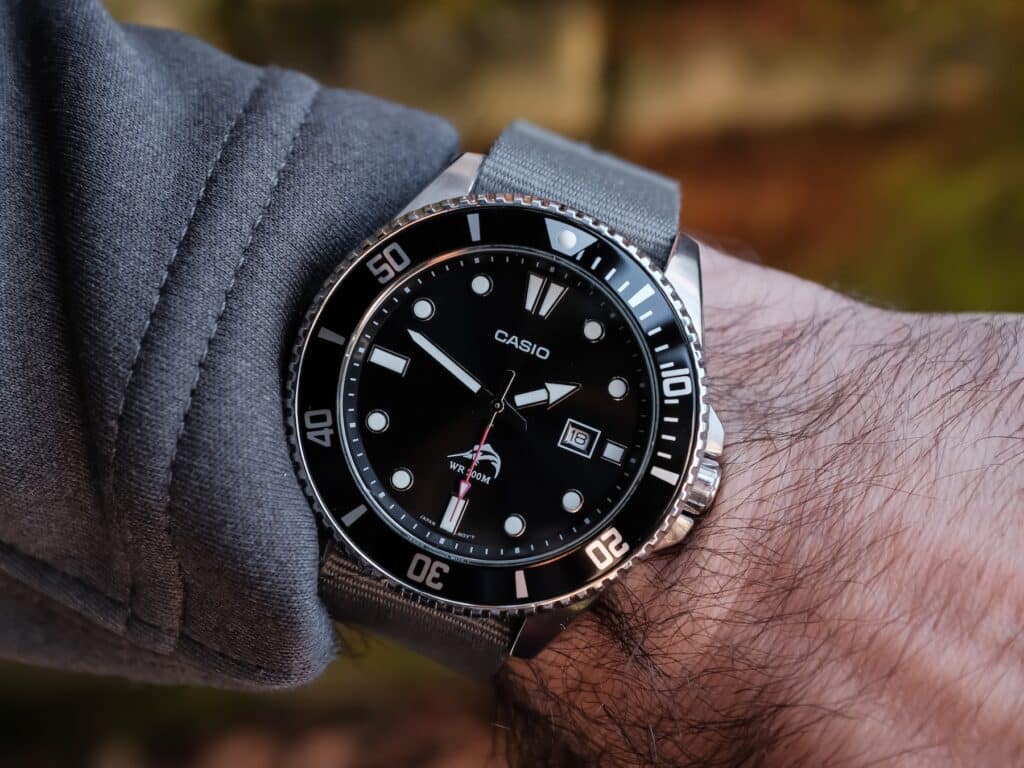
The Casio Duro is the kind of dive watch that makes the “every collection needs a diver” argument harder to dismiss. We’ve handled plenty of affordable divers that seem determined to remind you they’re built for the apocalypse, usually by piling on case thickness, busy dials, and enough visual aggression to make a trip to the grocery store feel like an expedition. The Duro takes a saner approach. The large applied markers, reflective arrow-shaped hands, restrained text, and neatly framed date at three o’clock make it easy to read without making you work for it. Its bezel also feels better than the price suggests, with controlled, positive clicks instead of the loose, rattly action we’ve encountered on cheaper divers. Add 200 meters of water resistance, a screw-down crown, and a solid caseback, and the Duro covers the basic “wear it and don’t worry about it” job extremely well.
The catch is sitting right on top of your wrist: 44mm is a lot of watch. Smaller wrists should think twice, although the 48.5mm lug-to-lug and downward-curving lugs keep the Duro from wearing quite as unwieldy as the diameter implies. If you’re comfortable with something like a Seiko Turtle, the proportions won’t come as a shock. We also like that Casio didn’t overcomplicate the case, using brushed surfaces up top, polished sides, and a small bevel to stop the profile from looking like a metal brick.
As discussed in our in-depth review, the 22mm lugs make strap changes painless, whether you want rubber for water, nylon for weekend duty, or a bracelet for something a little less tool-watchy. Then there’s the quartz movement, which is exactly what we want here. Ours stayed around ±20 seconds per month, hacks, and has a quick-set date, so the Duro can sit forgotten in the box and come back into service without demanding a pep talk. The mineral crystal will pick up scratches more readily than sapphire, and the lume starts strong but loses some of its enthusiasm as the night wears on.
That’s why the Duro works so well for this particular question. It doesn’t prove that every collector needs a dive watch. It shows what happens when a diver genuinely earns its spot by making itself useful. If you want something water-resistant, highly legible, tough enough for ordinary abuse, and cheap enough that a scratch barely deserves a shrug, the Duro delivers. The size and mineral crystal are legitimate compromises, and smaller-wristed collectors may find them hard to overlook. But for someone missing that low-stress, grab-and-go watch from their collection, the Duro makes a pretty good case for choosing the real thing rather than a substitute.
Pros
- Bezel action is controlled and positive for the price, without the loose feel common on cheaper divers.
- Large markers, reflective hands, restrained text, and the framed date make the dial quick to read.
- 22mm lugs make switching between rubber, nylon, and bracelet straightforward.
- Quartz movement tested around ±20 seconds per month, hacks, and has a quick-set date.
- 200m water resistance, a screw-down crown, and solid caseback make it genuinely worry-free around water.
Cons
- Lume starts brightly but doesn’t maintain its intensity through the night.
- The 44mm case is still substantial, particularly for smaller wrists.
- The mineral crystal is more susceptible to scratches than sapphire.
Casio G-Shock GW6900-1
| Price: | $140 |
| Water Resistance: | 200m |
| Case Dimensions: | 53.2mm (diameter) x 50mm (lug-to-lug) x 17.7mm (thickness) |
| Lug Width: | 16mm |
| Movement: | Solar Quartz Module 3179 |
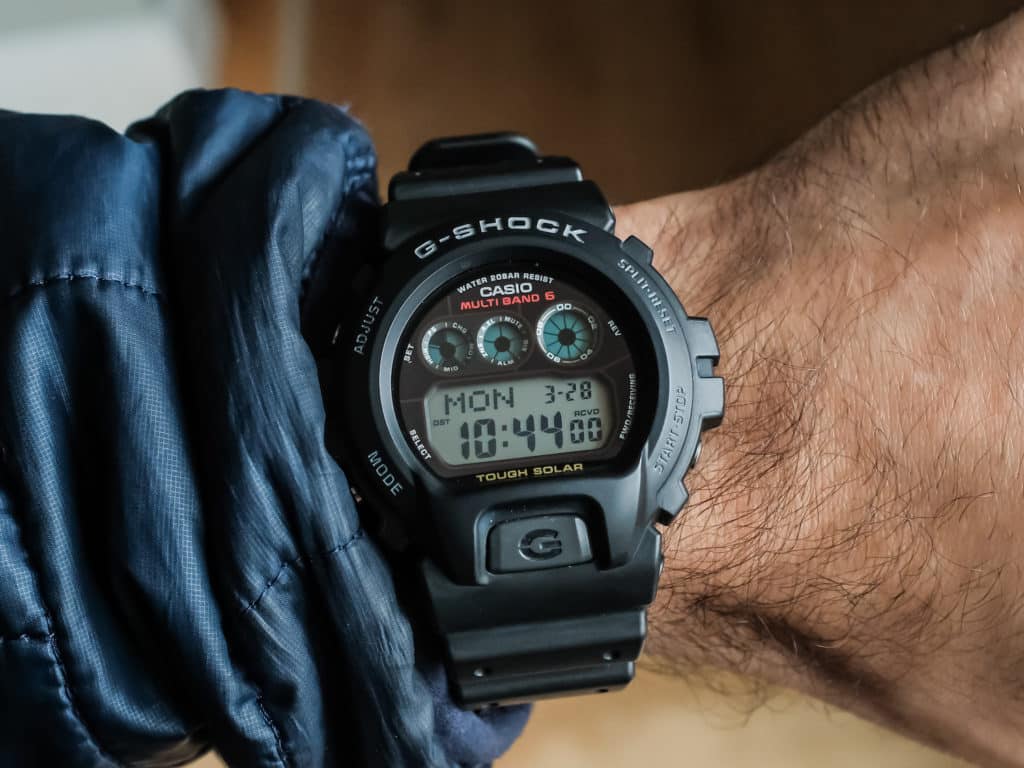
The Casio G-Shock GW6900 makes us question how much of the dive-watch formula a collection actually needs. We’ve reached for it on rushed mornings, during airport runs, for yard work, and on those days when deciding which watch to wear feels like overthinking a hobby that’s supposed to be fun. It’s enormous on paper: over 50mm across and nearly 18mm thick, but the resin construction keeps the weight down enough that it wears much lighter than you’d expect. We found that during our hands-on review of the watch. It doesn’t give you a rotating bezel or the familiar look of a diver. Still, it delivers plenty of the stuff we actually appreciate about one: durability, water resistance, easy legibility, and the freedom to stop worrying about what’s happening to the watch.
The display looks a little like Casio emptied a toolbox onto the dial at first. Give it a few days, though, and the triple-eye layout becomes surprisingly intuitive. The large lower display keeps the time easy to grab, while the upper indicators handle stopwatch status, radio reception, and other information without making the main readout difficult to find. We ended up using the 1/100-second stopwatch and countdown timer more than expected, and the five alarms are handy without becoming cluttered. There’s even a second time zone tucked discreetly into the display, giving you dual-time functionality without another hand.
At night, the large front button activates the green EL backlight, which evenly lights the screen. We’d still take Casio’s newer LED system, but the EL setup never made us squint. The strap is less impressive fresh out of the box. It starts stiff and a little squeaky, then settles down with wear, dries quickly after sweat or rain, and becomes comfortable enough for long days.
The GW6900 also has the sort of ownership experience that makes a watch disappear into your routine, which is a compliment. Tough Solar keeps it charged through ordinary light, while Multi-Band 6 automatically syncs with atomic clocks overnight in supported regions, so battery life and accuracy mostly become someone else’s problem.
The drawbacks are easy to live with if the size works for you: smaller wrists can get swallowed by the case, the strap needs time to loosen up, and the display has a learning curve if your digital experience begins and ends with a basic Casio. But that’s the point for this piece. If your collection needs something durable, legible, water-resistant, casual, and completely unconcerned about getting knocked around, the GW6900 checks those boxes without being a dive watch.
Pros
- Multi-Band 6 keeps the time synchronized automatically where supported.
- The lightweight resin construction makes the oversized case easy to wear.
- Green EL backlight provides even illumination after dark.
- Tough Solar charging means normal light exposure keeps battery worries to a minimum.
- Stopwatch, countdown timer, world time, five alarms, and second-time-zone functions are genuinely useful rather than mere digital window decoration.
Cons
- The resin strap is stiff and slightly squeaky when new.
- The triple-eye display takes a little time to learn.
- The 50mm-plus case can overwhelm smaller wrists.
Citizen Promaster Diver BN0151
| Price: | $250 – $300 |
| Water Resistance: | 200m |
| Case Dimensions: | 43mm (diameter) x 48mm (lug-to-lug) x 11.5mm (thickness) |
| Lug Width: | 20mm |
| Movement: | Citizen Eco-Drive E168 (solar quartz) |
| Amazon: | See Today’s Price |
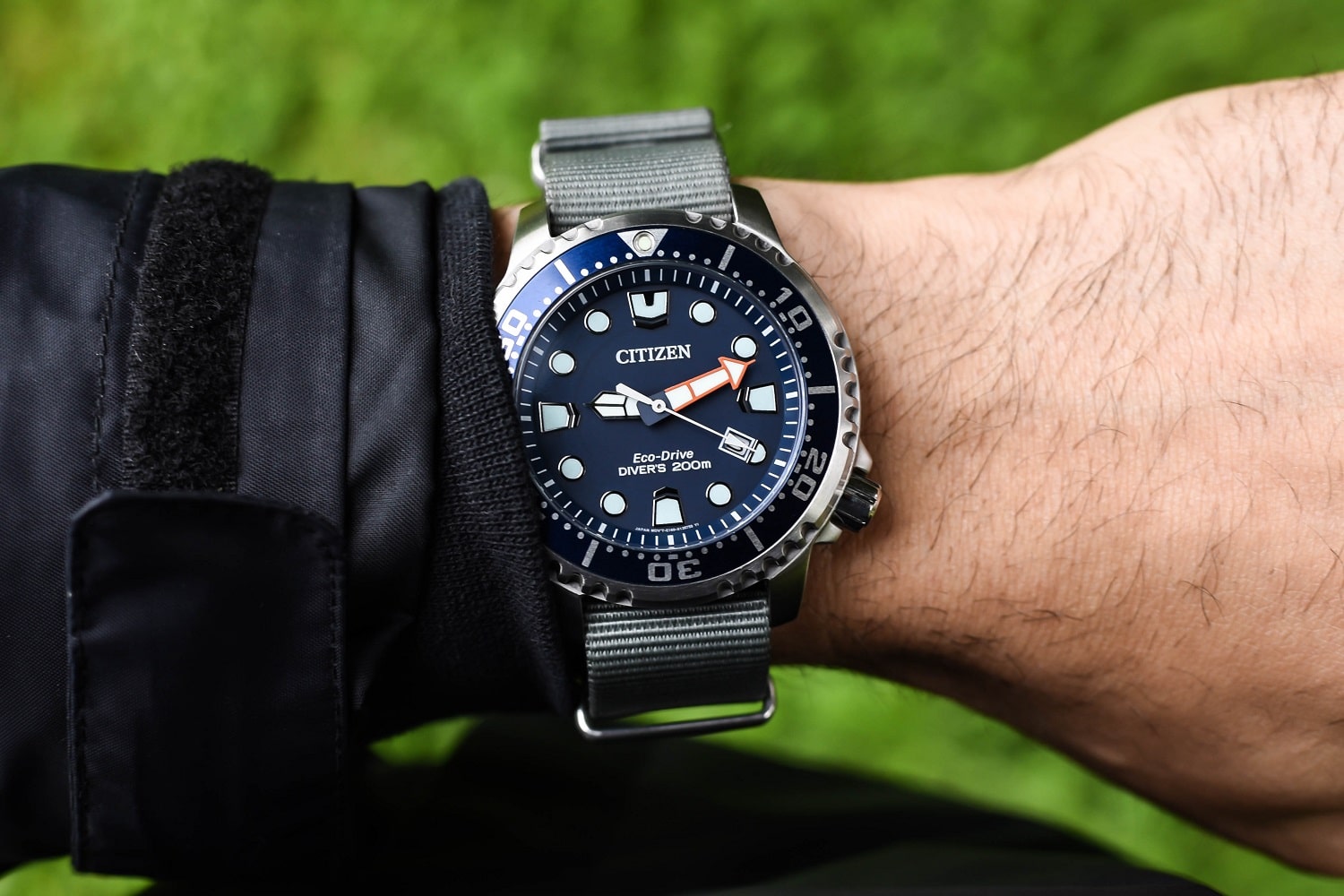
We didn’t reach for the Citizen Promaster Diver BN0151 because the day called for a dive watch. Most of the time, it was the opposite: we put it on because we had no idea what the day would throw at us. Hikes, errands, time around the water, or an ordinary day when the nicer watch could stay safely in the box—the BN0151 handled all of it without asking for much consideration. Its 43mm case sounds substantial, but the light construction and curved profile make it quite manageable once it’s on the wrist. The blue dial also has a little more going on than a standard tool-watch treatment, shifting toward purple in certain light while the bold hands and markers remain easy to pick out. The aqua BGW9-style lume stays useful well after sunset, and the lumed second hand is one of those small diver details we started noticing whenever another watch didn’t have it.
Eco-Drive fits that ownership experience very well. Leave the watch in the light, wear it, forget about it for a while, then put it back on. There’s no winding routine and no battery-change calendar to remember. During our hands-on testing, it stayed within roughly ±15 seconds per month and delivered nearly six months of runtime from a full charge. The 60-click bezel stayed aligned throughout our review, although wet fingers made its grip slippery. With a 200m water resistance rating and a screw-down crown, the BN0151 also has the practical protection that makes a diver useful beyond the theoretical possibility of going underwater. It’s the sort of watch you can wear around water without mentally checking whether you’ve made a terrible decision.
The compromises are easy enough to live with, provided you know what you’re signing up for. The stock polyurethane strap starts stiff, and swapping it for a NATO transformed the wearing experience almost immediately. The mineral crystal is also more vulnerable to scratches than sapphire. But neither issue undermines what makes the BN0151 relevant here.
If your collection is missing something you can grab for a wet weekend, a hike, or a day when you don’t want to worry about your watch, this is a strong way to fill that gap. It doesn’t make a dive watch mandatory. It shows why, when you want durability, water resistance, legibility, and low-maintenance ownership in one package, a straightforward diver can still be very hard to replace.
Pros
- Eco-Drive eliminates the need for regular winding and battery changes, delivering nearly 6 months of runtime on a full charge.
- 43mm case feels more manageable than expected, thanks to its lightweight construction and curved profile.
- 200m water resistance and screw-down crown make it comfortable around water.
- Bold hands and markers, aqua BGW9-style lume, and a lumed second hand provide strong nighttime readability.
Cons
- Wet fingers can make the 60-click bezel difficult to grip.
- Stock polyurethane strap is stiff before it breaks in.
- The mineral crystal is more prone to scratching than sapphire.
Orient Kamasu
| Price: | $250 – $375 |
| Water Resistance: | 200m |
| Case Dimensions: | 41.5mm (diameter) x 47mm (lug-to-lug) x 13mm (thickness) |
| Lug Width: | 22mm |
| Movement: | Orient F6922 (automatic movement) |
| Amazon: | See Today’s Price |
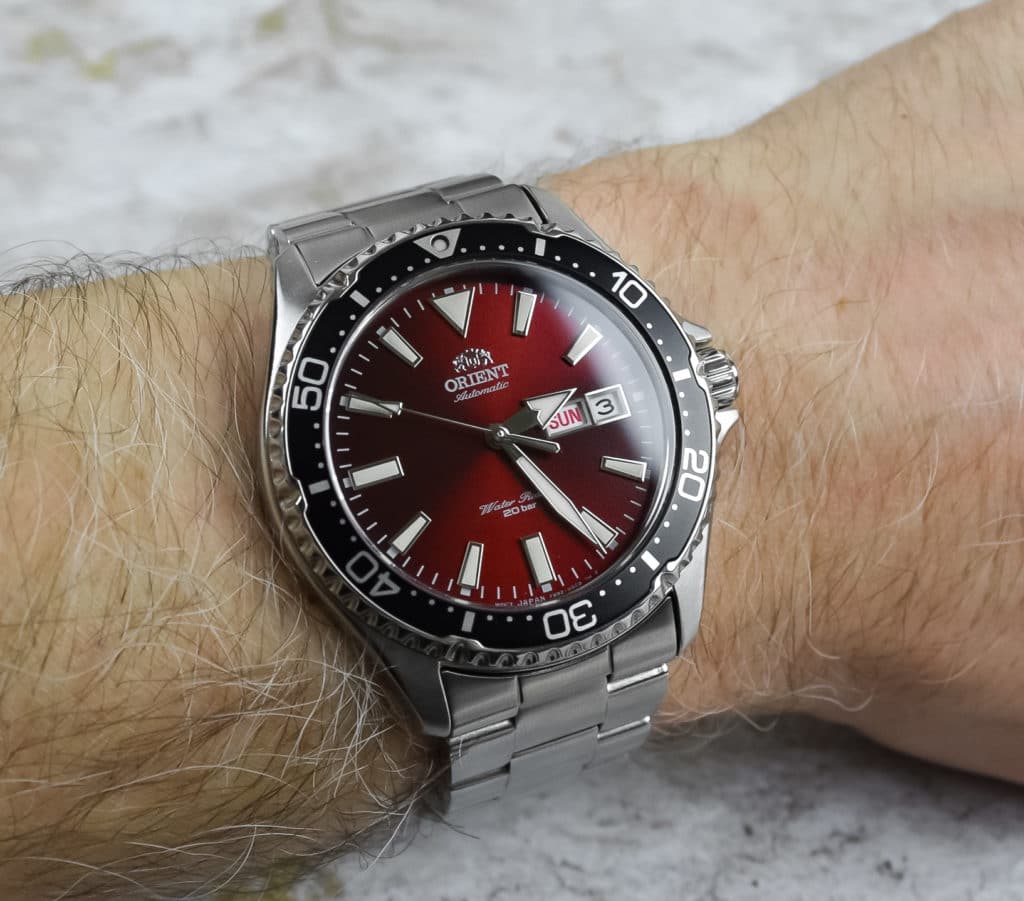
The Orient Kamasu is useful when thinking about what we actually want a dive watch to contribute to a collection. It doesn’t need to be the watch you wear every day, but it covers many situations where having a dependable, water-resistant option makes sense.
The 41.5mm case, curved lugs, and sensible 13mm thickness keep it from developing the top-heavy feel we’ve encountered on some affordable divers. At the same time, the wine-red sunburst dial gives it enough personality that it doesn’t disappear into the “generic tool watch” pile. The applied markers and properly proportioned hands make quick time checks easy, and we particularly liked that the minute and second hands reach their respective tracks. The framed day-date keeps the layout practical without making it busy, and the lume charged quickly, stayed bright, and held its own against several Seiko divers we’ve tested.
The Kamasu also gets several of the ownership details right that become more noticeable after the novelty wears off. Its F6922 movement hacks and hand-winds, making mechanical ownership less of a chore when the watch has been sitting in the box. Sapphire crystal and 200m water resistance are even more useful in this context: you can wear it around water or through normal daily abuse without treating it like something that needs a protective bubble. The fully brushed bracelet is comfortable and offers four micro-adjustment positions, though the clasp and end links don’t quite match the case’s quality. The guarded crown can also be fiddly to grip, while the aluminum bezel insert will collect scratches sooner than a ceramic or steel bezel insert. That said, the bezel action itself remained tight during our review.
That mix of strengths and annoyances is why the Kamasu belongs in this discussion. What it demonstrates is how useful the category can be when a collection lacks a watch that is casual, water-resistant, legible, mechanically interesting, and easy enough to wear without much ceremony. The Kamasu gives you all of that while avoiding some of the bulk that can make larger divers less appealing as everyday watches. If you want those capabilities and also care about getting meaningful watchmaking and character for the money, it makes a strong case. If your collection already has a comfortable, durable watch that serves the same role, the Kamasu is harder to justify simply because it’s a diver.
Pros
- The wine-red sunburst dial adds character without getting in the way of quick time checks.
- F6922 movement offers both hacking and hand-winding, making mechanical ownership easier to live with.
- Sapphire crystal and 200m water resistance give it useful protection for everyday wear and time around water.
- Four micro-adjustment positions help the fully brushed bracelet settle comfortably on the wrist.
- Lume charges quickly, stays bright, and compares favorably with several affordable Seiko divers we’ve tested.
Cons
- The aluminum bezel insert will show scratches sooner than a ceramic or steel bezel insert.
- The guarded crown can be awkward to grip.
- Clasp and end links don’t feel as refined as the rest of the watch.
Casio Oceanus T200
| Price: | $300 – $500 |
| Water Resistance: | 100m |
| Case Dimensions: | 41.4mm (diameter) x 49mm (lug-to-lug) x 10.7mm (thickness) |
| Lug Width: | 20mm |
| Movement: | Tough Solar movement (Module 5596) |
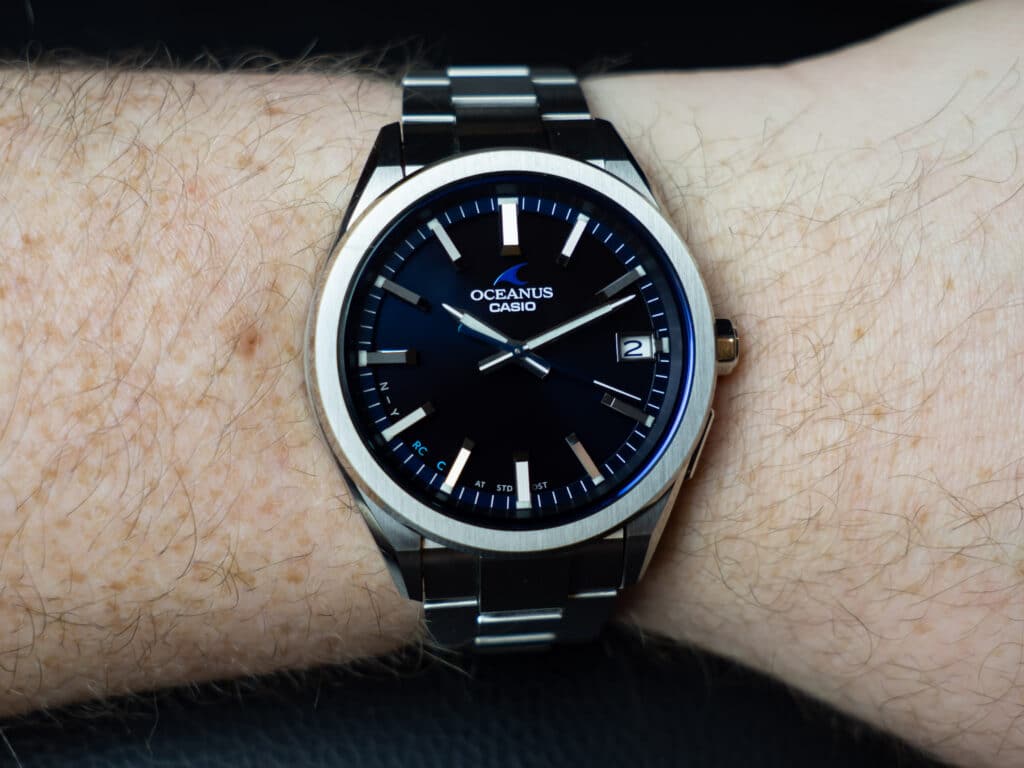
Some watches earn wrist time by being tough. The Casio Oceanus T200 earns it by making itself easy to live with when toughness isn’t the thing you need. We’ve worn it on office days, at dinners, and at more formal occasions, and that range makes it a useful test of what a collection actually lacks. The case mixes brushed and polished surfaces without becoming flashy, while the deep blue dial has more depth in person than its photos indicate. Floating hour markers created through cutouts in the chapter ring give the dial some visual separation, and the blue-tinted sapphire crystal adds a subtle glow outdoors without getting in the way of reading the time. Lume is nothing special after dark, but that’s not where the T200 earns its keep.
The T200’s ownership experience reinforces that distinction. Throughout our testing period, Casio’s Tough Solar 5596 module remained fully charged under normal daylight conditions, while Bluetooth syncing via the Oceanus app updated the time automatically, with no connection issues. Once configured, we rarely needed to think about accuracy or keeping it running.
The bracelet is where the T200 reminds you it isn’t a luxury watch. It rattles when off the wrist, and the pin-and-collar links make sizing fiddlier than it should be. The connectivity text on the dial also won’t suit collectors who prefer a completely clean layout. Those are legitimate annoyances, but they didn’t stop us from enjoying the watch because the T200’s appeal is less about technical toughness and more about being ready whenever the occasion calls for something a little more polished.
That makes the T200 relevant to the question of whether every collection needs a dive watch. It cannot replace the water-ready role of a true diver, and if you have no watch you’d happily wear around a pool, beach, or rainy weekend, you may still have that gap to fill. But if your collection already has the durable, casual, low-stress watch covered, another diver may simply repeat the same assignment. The T200 brings accurate, automatically synchronized timekeeping, solar power, sapphire protection, and dressier versatility instead. It’s a good example of why we’d rather identify what a collection is missing than add a dive watch because some unwritten collector rule says we should.
Pros
- Tough Solar charging and Bluetooth syncing make daily ownership hands-off.
- Floating hour markers and the blue-tinted sapphire crystal give the deep blue dial genuine depth.
- Mixed brushed and polished finishing keeps the case refined without looking flashy.
- Accurate timekeeping means little resetting or maintenance between wears.
- Easily moves from office days to dinners and more formal occasions.
Cons
- Pin-and-collar links make bracelet sizing more tedious than necessary.
- Lume is modest after dark.
- The bracelet rattles when it’s off the wrist.
- Connectivity text on the dial may bother collectors who prefer a cleaner dial.
Seiko SRPE51
| Price: | $315 |
| Water Resistance: | 100m |
| Case Dimensions: | 40mm (diameter) x 44mm (lug-to-lug) x 12mm (thickness) |
| Lug Width: | 20mm |
| Movement: | Seiko 4R36 |
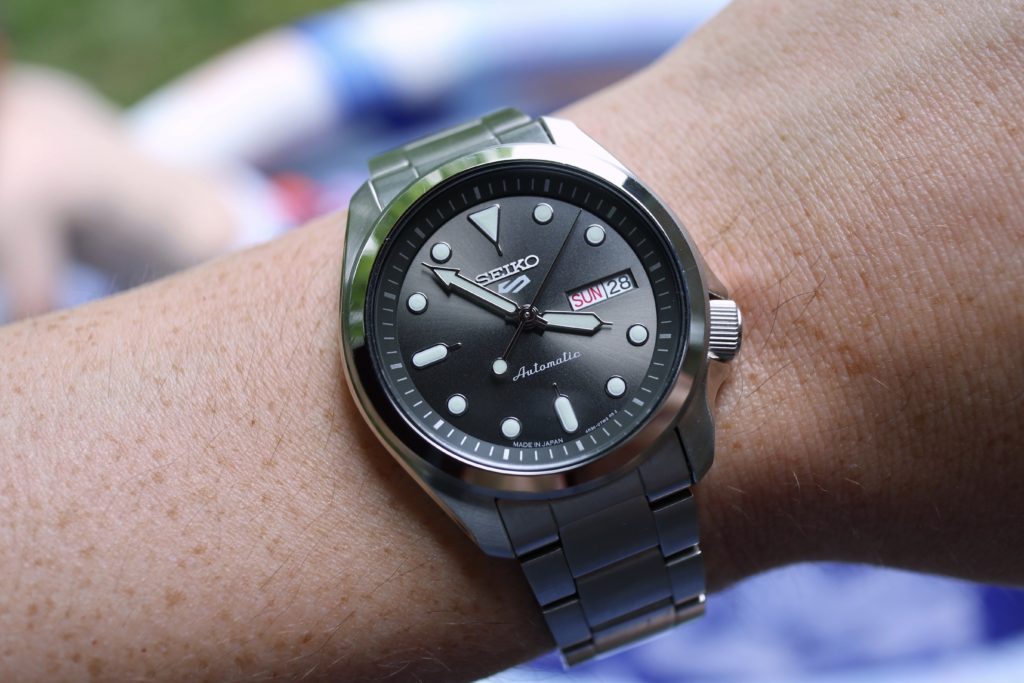
The Seiko SRPE51 is the sort of watch that makes you wonder whether your collection needs another specialist at all. We’ve worn it in situations where a dive watch would have been perfectly acceptable, but also with clothes and plans where a chunky bezel and overtly sporty case would have felt like overkill.
Seiko starts with the familiar SKX-inspired shape, then swaps the rotating bezel for a polished fixed one, and that small change makes a big difference to how often the watch feels appropriate. At 40mm, it sits comfortably across a wide range of wrists, and during our hands-on testing of the watch, it was rarely the watch that needed the rest of the outfit to cooperate. If your collection already has something for the wet and rough stuff, that flexibility can be more useful than adding another watch designed for the same purpose.
The gray dial does plenty of the heavy lifting. Its radiant finish catches the light without turning into a disco ball. At the same time, the applied indices, revised handset, clean Seiko 5 branding, and generous LumiBrite keep it readable from daylight into the evening. We did spot some chapter-ring misalignment on our review example, although it takes a deliberate look to notice. The 4R36 movement adds hacking and hand-winding, and the exhibition caseback gives the mechanical side of ownership a little entertainment. The bracelet is less charming, with hollow end links giving it a light, slightly rattly feel. Fortunately, the drilled 20mm lugs make that easy to escape. We moved between leather, NATO, and other straps during testing, and each one pushed the watch toward a different part of the collection.
The SRPE51 also makes its limits pretty clear. The 100m water resistance and push-pull crown are perfectly reasonable for normal daily wear. Still, they don’t give us the same confidence around serious water exposure that a proper diver’s watch does. Hardlex is another compromise, since it won’t resist scratches as well as sapphire. However, it gives you the casual durability and easy legibility we want from an everyday watch, while its cleaner case lets it move into situations where a dive watch can look a little too ready for an expedition that isn’t happening.
Pros
- The 40mm case and polished fixed bezel give it broad everyday versatility without looking too sporty.
- LumiBrite, applied indices, and the revised handset keep the radiant gray dial highly readable.
- Drilled 20mm lugs make strap experimentation easy.
- The 4R36 offers both hacking and hand-winding, with an exhibition caseback for a view of the movement.
Cons
- The bracelet’s hollow end links give it a light, slightly rattly feel.
- 100m water resistance and the push-pull crown limit its usefulness around serious water activities.
- Hardlex is more vulnerable to scratches than sapphire.
- Minor chapter-ring misalignment can be spotted if you look closely.
Seiko Turtle
| Price: | $370 – $525 |
| Water Resistance: | 200m |
| Case Dimensions: | 44.3mm (diameter) x 48mm (lug-to-lug) x 14mm (thickness) |
| Lug Width: | 22mm |
| Movement: | Seiko 4R36 |
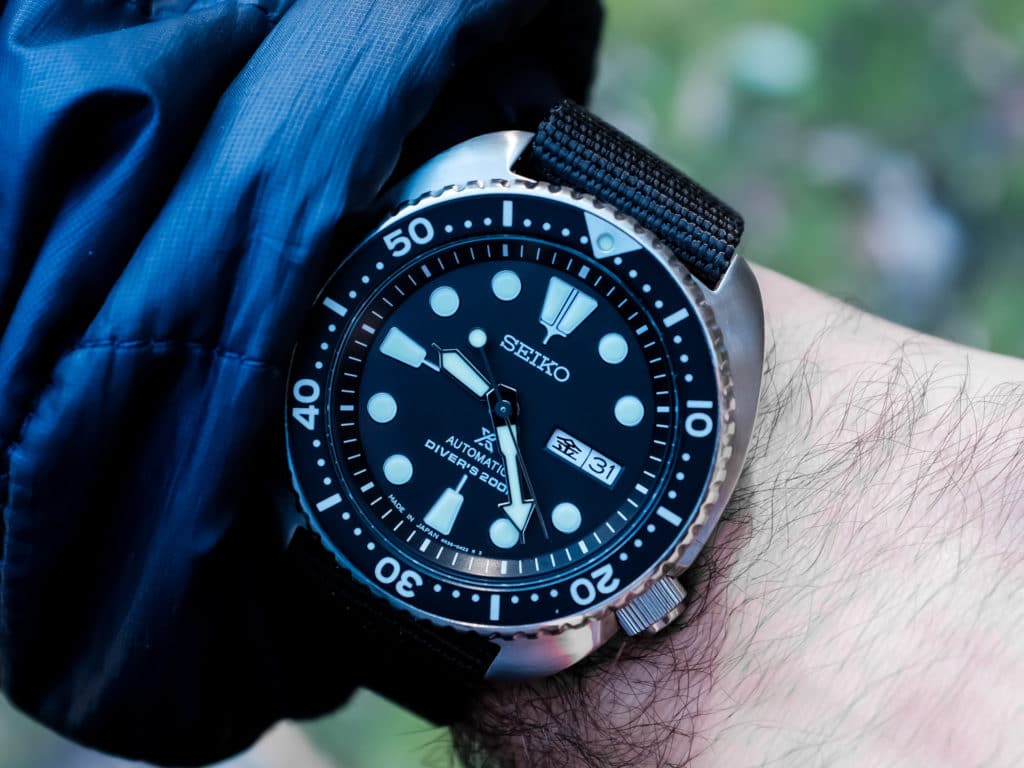
A collection can get by without a Seiko Turtle, but it’s harder to get the same combination of low-stress utility and personality from something else. We’ve worn the Turtle for years, and what keeps it relevant isn’t simply its capability as a diver. It’s how little negotiation it requires once it’s on the wrist. The cushion-shaped case measures more than 44mm, yet its rounded profile spreads that size well enough that it wears noticeably smaller than expected. The offset crown stays clear of the wrist, which is appreciated over the course of a full day, and the supplied silicone strap is a worthwhile step up from Seiko’s older rubber offerings. We still prefer it on a NATO for weekends away or time around water.
The practical side of the Turtle is equally hard to dismiss. Its matte black dial keeps glare under control, while oversized hands and generous Lumibrite make the time almost impossible to miss in bright sunlight or at midnight. The lume stays bright for hours after charging, and the Prospex “X” logo becomes far less noticeable once you’ve lived with the watch instead of staring at photos of it. We also enjoyed the optional Kanji day wheel, although it takes slightly longer to read than the standard English display once the novelty fades. The 4R36 movement adds hacking and hand-winding, but the model we reviewed ran roughly +35 to +45 seconds per day. Bezel alignment can also vary from one example to another, so this is a watch we’d want to inspect rather than mindlessly order.
The Turtle’s flaws are exactly why we wouldn’t call a dive watch mandatory for everyone. Hardlex is more scratch-prone than sapphire, the case is still enormous for anyone who prefers smaller watches, and accuracy and bezel alignment aren’t perfectly consistent. But after years of wearing it, those compromises never stopped us from reaching for it.
In short, the Turtle gives you a genuinely useful combination of water resistance, exceptional legibility, a comfortable cushion case, and enough personality to keep it from feeling like anonymous equipment. That makes it a strong choice for the collection slot where you want a watch you can wear without much concern. When you need it, the Turtle shows why a dedicated diver can still be difficult to beat.
Pros
- The matte dial, oversized hands, and generous Lumibrite make it easy to read in bright light and after dark.
- The offset crown avoids wrist interference during extended wear.
- 4R36 adds hacking and hand-winding for easier daily ownership.
- Rounded cushion case spreads its substantial dimensions quite well.
- The silicone strap is comfortable, while a NATO strap makes it particularly well-suited for weekends and time around water.
Cons
- Bezel alignment can vary between individual examples.
- The large case remains a poor match for collectors who prefer compact watches.
- Hardlex scratches more easily than sapphire.
- Accuracy can vary, with our review sample running roughly +35 to +45 seconds per day.
Nodus Sector Deep
| Price: | $599 |
| Water Resistance: | 500m |
| Case Dimensions: | 38mm (diameter) x 47mm (lug-to-lug) x 13.6mm (thickness) |
| Lug Width: | 20mm |
| Movement: | Seiko NH35 (Mechanical Movement) |
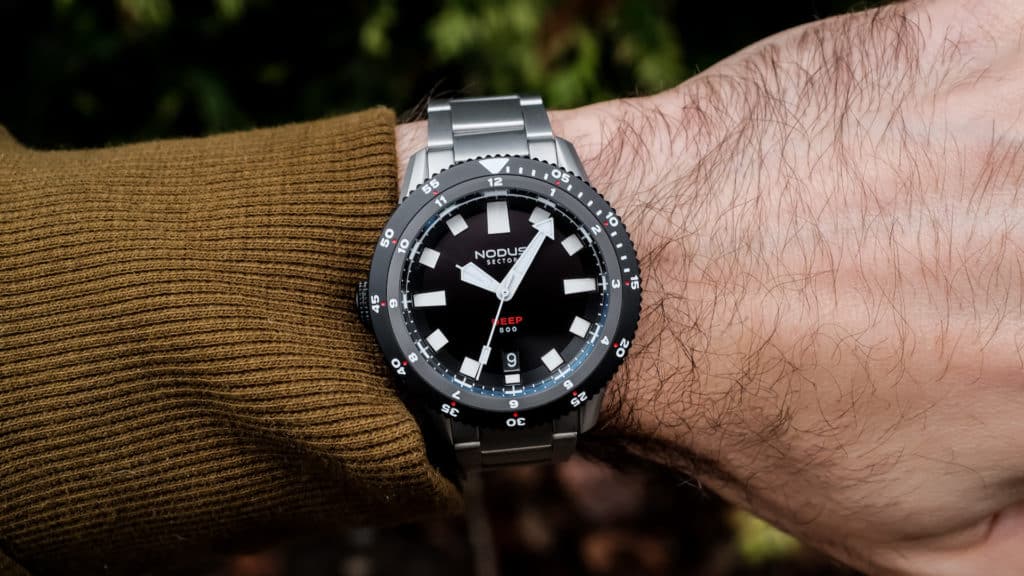
The Nodus Sector Deep is the sort of dive watch that makes us pay attention to the stuff that tends to get ignored when collectors talk about whether they “need” a diver. We’ve worn more expensive watches that were less comfortable, more annoying to size, and harder to adjust as the temperature climbed. The Sector Deep gets a surprising amount of that everyday friction out of the way. Its 38mm case feels purposeful rather than undersized, while the left-side crown disappears against the wrist instead of digging into it. The bracelet is equally well considered: screw links make sizing painless, the 20mm-to-18mm taper keeps the proportions balanced, and the NodeX micro-adjustment clasp gives you the kind of on-the-fly fit control you’ll actually use. That matters if the point of having a low-stress watch is to put it on and stop thinking about it.
The case isn’t conventionally shaped, and that’s probably going to divide people. After living with the watch, though, we cared considerably more about how that asymmetry felt on the wrist than how it looked in a product shot. The dial takes a similarly restrained approach. White PVD marker surrounds catch the light without turning decorative, while the tapered, lume-filled plots add some depth as they move toward the cardinal markers. BGW9 Super-LumiNova stays visible through the night, and the matte DLC bezel keeps reflections down while providing plenty of grip. The dual-scale insert adds useful information without making the dial feel like it needs a map.
Underneath it all, the in-house regulated Seiko NH35 is unremarkable in the best possible way. Ours stayed within roughly ±10 seconds per day during testing and delivered around 41 hours of power reserve. It’s dependable rather than romantic, which is exactly what we want from a watch built to be worn.
The one persistent blemish is the clasp. Fully extended, the exposed hardware looks less finished than the rest of the bracelet, which is hard to ignore given how thoughtfully the rest is executed. The asymmetrical case will also turn off collectors who want their diver to look like a diver from every angle. But that’s where the Sector Deep becomes particularly relevant to this article. If your collection needs a watch that can disappear on the wrist, stay comfortable through a long day, remain highly legible at night, and handle the kind of practical wear we associate with a low-stress everyday piece, this is a very convincing way to get there with a genuine diver. It simply shows how much better that role can feel when the small ownership annoyances have been properly thought through.
Pros
- The in-house-regulated NH35 delivered ±10 seconds per day during our testing.
- Left-side crown and 38mm case make extended wear unusually comfortable.
- Screw links, tapered bracelet, and NodeX micro-adjustment clasp make sizing and fit easy to manage.
- The matte DLC bezel cuts reflections, provides strong grip, and incorporates the dual-scale insert without clutter.
- White PVD marker surrounds, tapered lume plots, and BGW9 Super-LumiNova provide excellent nighttime legibility.
Cons
- Fully extended, exposed clasp hardware looks less resolved than the rest of the bracelet.
- Asymmetrical case shape won’t appeal to collectors who prefer traditional dive-watch proportions.
Baltic Hermétique Tourer
| Price: | $620 – $690 |
| Water Resistance: | 150m |
| Case Dimensions: | 37mm (diameter) x 46mm (lug-to-lug) x 10.8mm (thickness) |
| Lug Width: | 20mm |
| Movement: | Miyota 9039 Automatic |
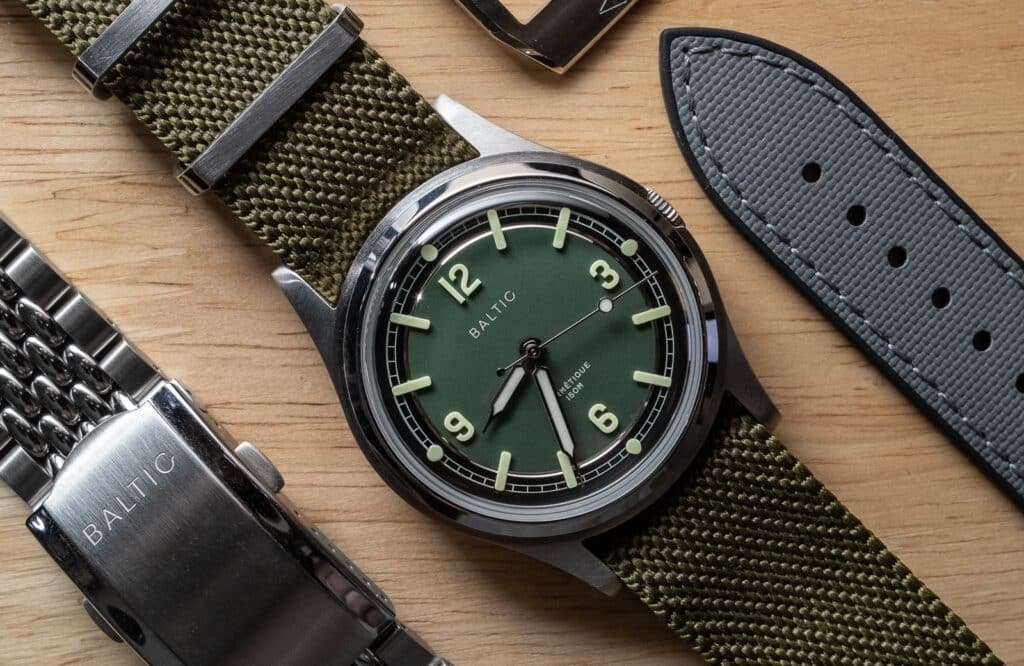
The Baltic Hermétique Tourer is a useful reminder that the job we often assign to a dive watch can be handled surprisingly well by something that looks nothing like one. We’ve worn it when a field watch made more sense stylistically, and in situations where we wanted more confidence around water than a typical field watch offers. Its 37mm case, 46mm lug-to-lug, and roughly 10.8mm thickness keep it close to the wrist throughout the day, while the fully brushed case and slim, polished bezel give it enough refinement to avoid looking like camping equipment. The 150m water resistance is important here. It doesn’t turn the Tourer into a dive watch, but it does mean its tidy proportions aren’t coming at the expense of everyday practicality.
Baltic also gets the legibility-versus-character balance right. The large C3 X1 Super-LumiNova-filled indices and syringe hands make quick time checks effortless, while the different dial colors add personality without making the watch harder to read. The boxed, double-domed sapphire crystal is part of the charm, although its minimal AR coating allows reflections to creep in under certain lighting. That’s a compromise we noticed rather than one that ruined the experience.
The Miyota 9039 stays in the background as it should, providing dependable automatic performance while the rest of the watch handles the personality. More importantly, the Hermétique Tourer can switch roles with little fuss. Quick-release spring bars make swapping between the beads-of-rice bracelet, flat-link bracelet, and Tropic-style rubber strap almost effortless. During our extended testing, both bracelets proved comfortable and offered enough micro-adjustment to dial in the fit, although the clasps feel more functional than premium.
Nevertheless, the little frustrations are easy to identify. The near-flush crown makes manual winding awkward, and the bracelet clasps don’t quite have the refinement of the rest of the watch. But those are minor complaints compared with what the Tourer does for a collection. If you need something that can handle rain, casual water exposure, long days, and different dress levels while staying compact and comfortable, it covers much of the low-stress territory we might otherwise assign to a diver. It won’t give you the rotating bezel or the same confidence for serious underwater use, so it shouldn’t be mistaken for a replacement when those things matter.
Pros
- 150m water resistance gives the compact field-style watch meaningful everyday water capability.
- The 37mm case, 46mm lug-to-lug, and a thickness of roughly 10.8mm make it easy to wear all day.
- Large lume-filled indices and syringe hands deliver excellent legibility well into the evening.
- Quick-release spring bars make switching between the beads-of-rice bracelet, flat-link bracelet, and Tropic-style rubber strap easy.
- Brushed case, polished bezel, and boxed double-domed sapphire give it a nice middle ground between tool-watch practicality and refinement.
Cons
- The minimal anti-reflective coating on the crystal allows noticeable reflections in certain lighting conditions.
- The near-flush crown makes manual winding awkward.
- Bracelet clasps feel more functional than premium.
Baltic Aquascaphe
| Price: | $650 – $750 |
| Water Resistance: | 200m |
| Case Dimensions: | 39mm (diameter) x 47mm (lug-to-lug) x 12mm (thickness) |
| Lug Width: | 20mm |
| Movement: | Miyota 9039 (Mechanical Movement) |
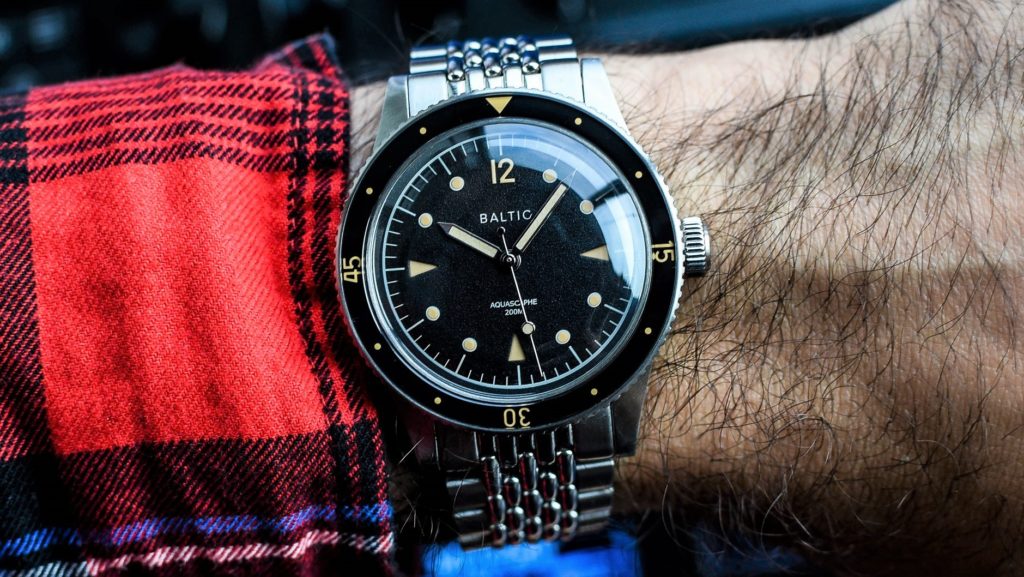
The Baltic Aquascaphe is a useful reminder that a dive watch doesn’t have to take over your wrist to do its job. We’ve spent enough time with it to appreciate how much Baltic deliberately leaves out. The hybrid sandwich dial uses cutout indices to expose a fully lumed layer beneath, adding depth without turning the dial into a visual scavenger hunt. The matte surface, restrained gilt accents, pencil hands, and lollipop second hand all feel properly scaled, with the second hand reaching neatly to the chapter ring. The sapphire bezel insert adds some welcome modern toughness without throwing off the vintage-leaning design. During our in-depth testing, the BGW9 lume stayed bright and evenly distributed well into the night. It’s a diver that manages to be useful without looking like it needs to announce the fact.
It also behaves itself once you start wearing it outside the water. At a little over 12mm thick and 47mm lug-to-lug, the Aquascaphe slips under a cuff more easily than many divers we’ve worn, while still feeling substantial enough on the wrist. The mostly brushed finish is forgiving when daily wear inevitably adds a few marks. The beads-of-rice bracelet is arguably the bigger win: it drapes naturally, tapers cleanly toward the clasp, and stays comfortable throughout the day. Baltic’s quick-release spring bars make it very easy to swap to the supplied Tropic-style rubber strap. We’d only hesitate if you like a little more flash in your case finishing, because the Aquascaphe is intentionally light on polished surfaces.
The Miyota 9039 keeps the mechanical side equally uncomplicated. It beats at 28,800 vph, gives you around 42 hours of power reserve, and proved consistently reliable throughout our review period. Because there’s no date, the crown has only two positions, which makes setting pleasantly simple, although collectors who use the date as a daily sanity check may miss it. What stayed with us about the Aquascaphe was how little of its usefulness depends on the usual dive-watch theatrics. The comfort, legibility, bracelet, and restrained proportions are what make it easy to keep wearing long after the feel of a new diver wears off.
If you’re trying to decide whether a collection needs one, that’s the more revealing test: does having a watch this capable and this easy to live with solve a problem you actually have? For some collectors, the Aquascaphe will make that answer an easy yes.
Pros
- Hybrid sandwich dial adds real depth without sacrificing readability.
- Miyota 9039 offers smooth 28,800 vph operation and roughly 42 hours of power reserve.
- Quick-release spring bars make switching to the Tropic-style rubber strap nearly effortless.
- Beads-of-rice bracelet drapes naturally and remains comfortable through long days.
- BGW9 lume stays bright and evenly distributed well into the night.
Cons
- The mostly brushed finish may feel too restrained for anyone who wants more polished case accents.
- The no-date layout won’t work for collectors who like having the calendar visible.
Hamilton Khaki Field Mechanical
| Price: | $695 |
| Water Resistance: | 50m |
| Case Dimensions: | 38mm (diameter) x 47mm (lug-to-lug) x 9.5mm (thickness) |
| Lug Width: | 20mm |
| Movement: | Caliber H-50 (ETA 2801-2 on previous models) |
| Amazon: | See Today’s Price |
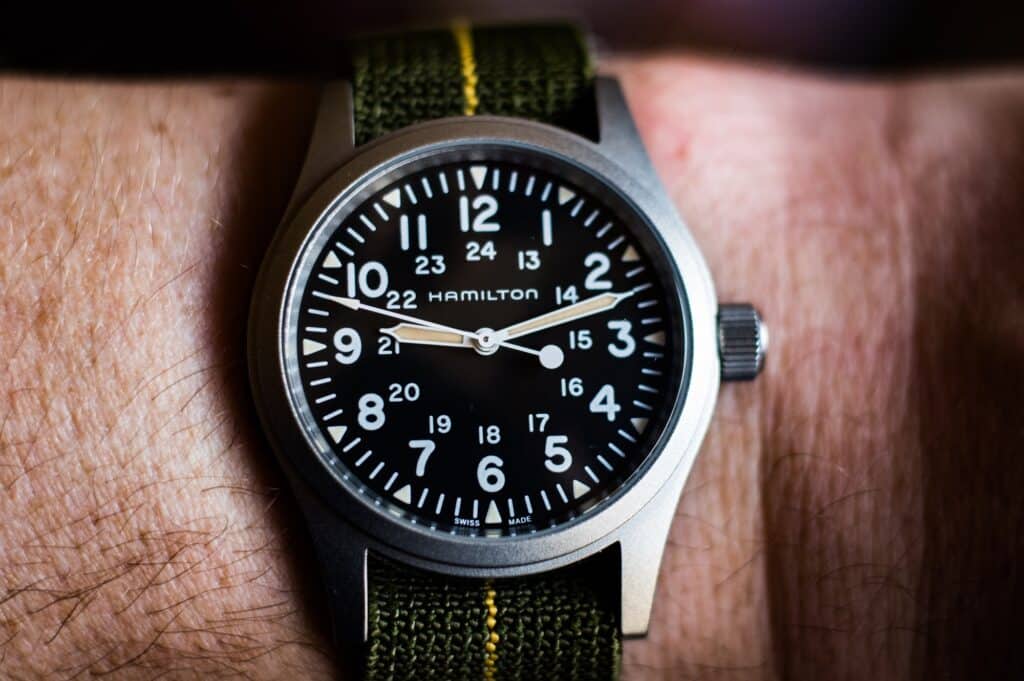
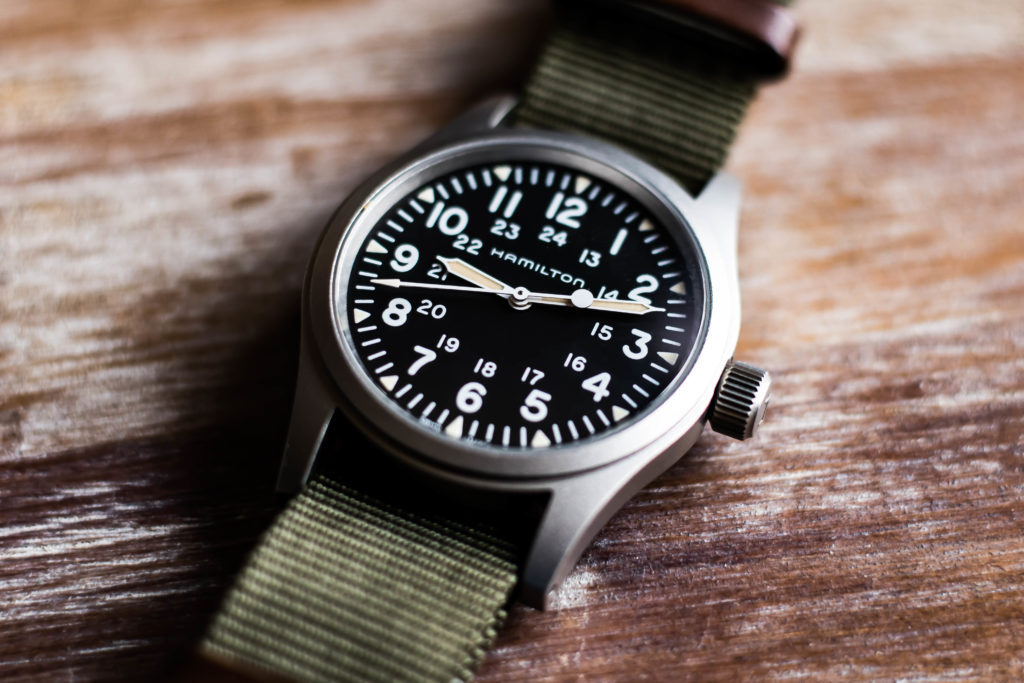
The first few turns of the crown are enough to remind us why the Hamilton Khaki Field Mechanical feels different from most everyday watches. There’s no rotor spinning in the background, no battery to think about, and no need to pretend the winding is an inconvenience. It’s part of the reason this watch stayed interesting after the novelty wore off. The 38mm case sits neatly on the wrist, with its 47mm lug-to-lug and slightly longer lugs giving it more presence than the diameter suggests. At 9.5mm thick, it slips under a cuff without a fight, and the drilled 20mm lugs make changing between NATO, leather, and other straps almost effortless. That makes it a particularly useful piece for the parts of a collection where a dive watch can feel like too much.
The H-50 movement makes the Khaki Field’s old-school personality more than just decoration. The large crown provides the daily winding ritual with some physical satisfaction, and during our testing, consistent winding yielded about +0.8 seconds per day. The dial follows the same practical thinking. It’s dense with numerals and a minute track, but the missing date keeps things from getting unnecessarily busy. Faux-patina lume adds just enough aged character without turning the watch into vintage cosplay, and nighttime visibility is better than the color indicates. The one thing we kept tripping over was the lack of a clearly defined 12 o’clock marker. When checking the time in the dark, finding your bearings takes an extra beat. Also, the Hamilton branding under 12 is noticeable, but not enough to become a genuine annoyance.
Water is where the Khaki Field draws a fairly firm line. The 50m rating and non-screw-down crown mean we’d be much more careful around water than we would with a proper diver, and that’s a meaningful limitation if your collection doesn’t already have something more capable. The included green NATO also wasn’t universally comfortable; the leather keepers irritated some of us during longer wear, while the softer gray pashmina worked better.
That said, if the water-ready job is already covered, the Khaki Field fills a different gap rather nicely. It’s thin, comfortable, easy to switch between straps, and mechanically engaging, making wearing it feel like part of the hobby. A collection doesn’t need every watch to be prepared for the pool. Sometimes it’s better to have one that makes you want to wind it before heading out. For more detail on how this one held up on the wrist, check out our hands-on review.
Pros
- The H-50 hand-wound movement delivered around +0.8 seconds per day of accuracy during consistent winding in our testing.
- 9.5mm thickness and 38mm case make it comfortable under a cuff and through long days.
- Drilled 20mm lugs make switching between NATO and leather quick and easy.
- Faux-patina lume gives the field-watch design character without becoming too theatrical.
- 47mm lug-to-lug adds useful wrist presence without making the watch feel bulky.
Cons
- 50m water resistance and non-screw-down crown make it unsuitable for carefree water use.
- The absence of the 12 o’clock distinction makes low-light orientation less intuitive.
- Leather keepers on the included setup can irritate the wrist during extended wear.
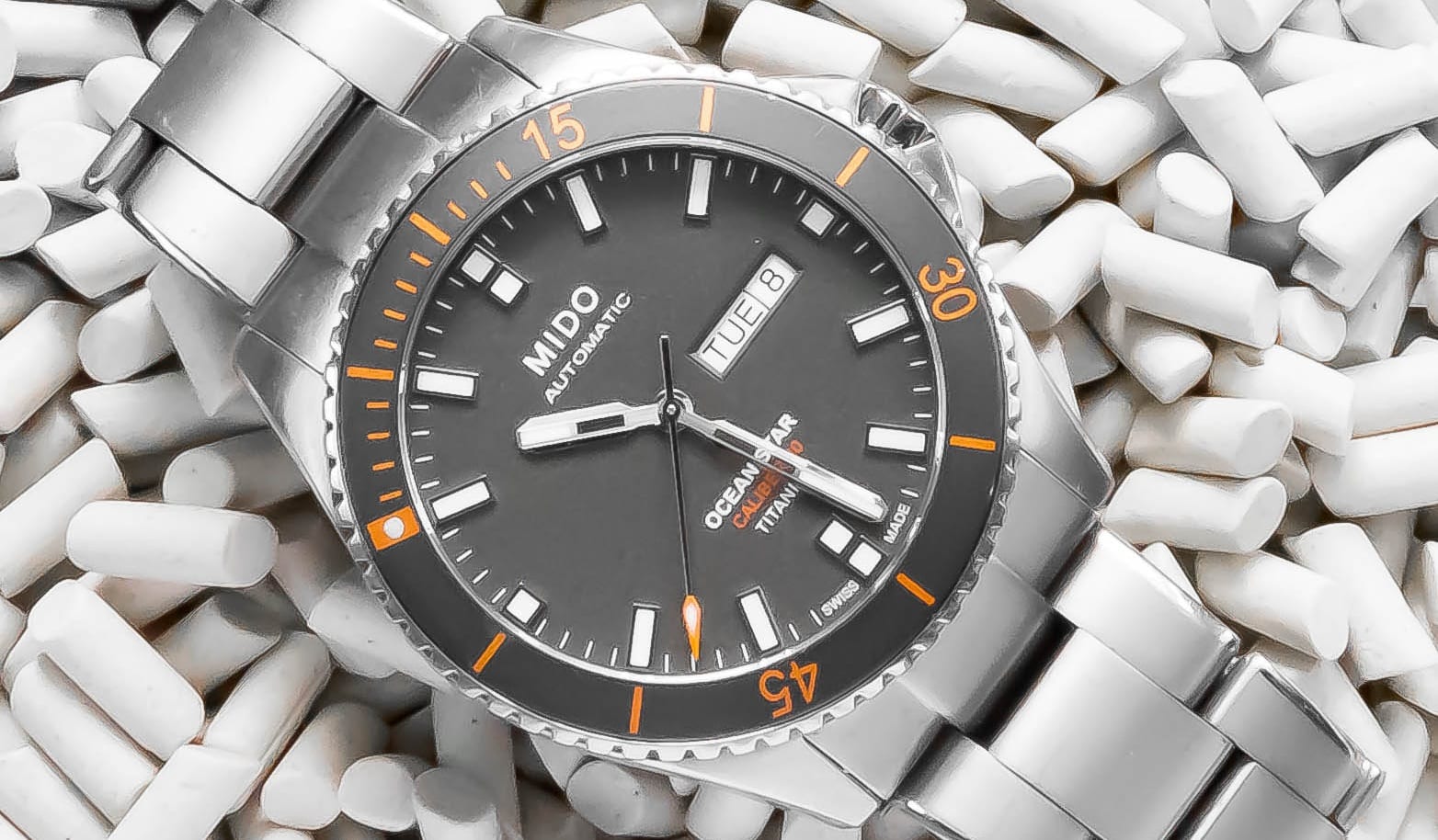
Mido Ocean Star Titanium
| Price: | $1230 |
| Water Resistance: | 200m |
| Case Dimensions: | 42.5mm (diameter) x 42.5mm (lug-to-lug) x 11.75mm (thickness) |
| Lug Width: | 22mm |
| Movement: | Caliber 80 |
| Amazon: | See Today’s Price |
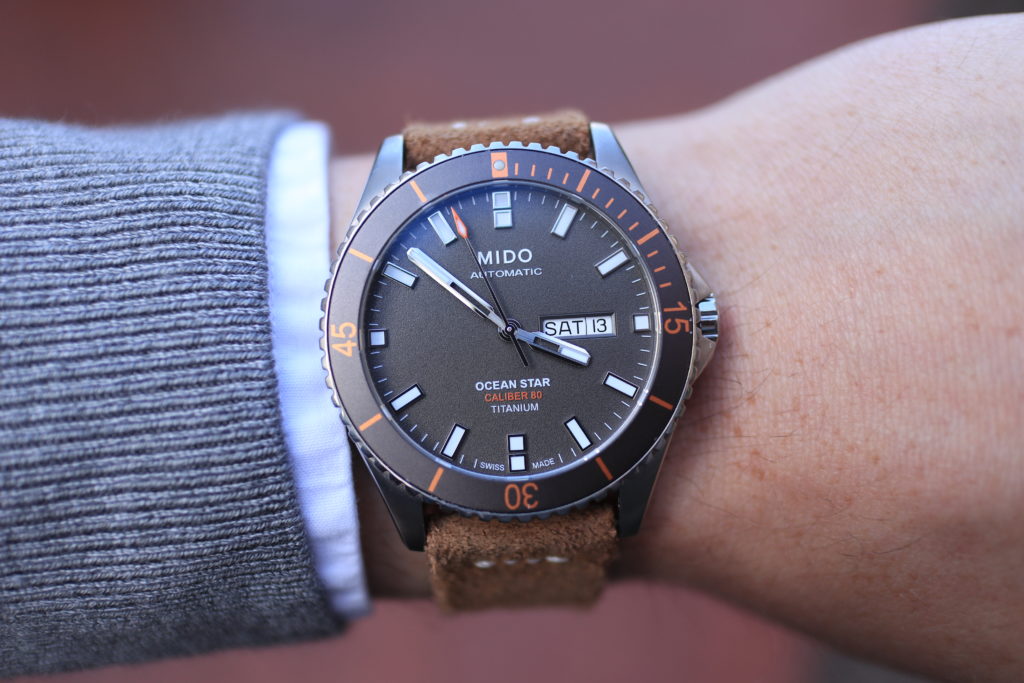
Titanium changes the equation when what we want from a dive watch is durability without spending the day aware we’re wearing one. The Mido Ocean Star Titanium is a good example. At 42.5mm across and roughly 11.75mm thick, it’s not small, but the fully brushed titanium case keeps the watch from developing that steel-diver heaviness after a few hours at a desk or behind the wheel. We wore it while commuting, at the desk, and running errands, and the subtle case contours helped it sit more naturally than the dimensions would imply. Even the sloped bezel follows the shape of the case rather than looking bolted on, while a polished chamfer adds just enough contrast. For someone who wants the water-ready confidence of a diver without the usual wrist burden, that lightness starts to look like a pretty useful feature rather than a gimmick.
The Ocean Star also gets a lot of mileage out of details that are easy to overlook until you live with it. The anthracite dial changes character with the light, sometimes reflecting and sometimes going almost flat, while the double AR-coated sapphire keeps those changes from becoming a legibility problem. The shortened markers at three and nine balance the day-date window nicely, and the pencil hands carry BGW9 Super-LumiNova that charges quickly and gives off a cool blue-green glow after dark. The orange second hand is particularly easy to follow, thanks to its luminous tip reaching toward the edge of the dial.
Then there’s the Caliber 80. Its 80-hour power reserve is truly useful in a collection because leaving the watch off for a couple of days doesn’t automatically mean resetting it before the next wear. The titanium bracelet follows the same practical thinking, with curved links, a 22mm-to-19mm taper, and a ratcheting clasp that lets us make quick fit changes as the wrist expands during the day.
However, there are a few reminders that Mido hasn’t solved every little annoyance. According to our review team’s insights, the screw-down crown can be stubborn enough to need a fingernail to get started, and the lugs could curve downward more aggressively for smaller wrists. The particular dial-and-case combination also limits how freely we’d be able to experiment with straps. Still, those are relatively small complaints against a watch that makes a strong case for what a collection can get from one properly equipped diver: low weight, easy readability, long-running autonomy, and enough Swiss refinement for everyday use without turning into a delicate dress piece. If the appeal of a dive watch is mostly having something capable that you don’t have to baby, the Ocean Star Titanium gets remarkably close to that ideal.
Pros
- Caliber 80’s 80-hour power reserve is particularly useful when the watch rotates in and out of a collection.
- Brushed titanium keeps the 42.5mm case easy to live with during long days.
- Curved titanium bracelet, 22mm-to-19mm taper, and ratcheting clasp make fit adjustments straightforward.
- The anthracite-textured dial and double AR-coated sapphire maintain strong readability in changing light.
- Fast-charging BGW9 lume and the luminous-tipped orange second hand make nighttime checks easy.
Cons
- The screw-down crown can be stubborn to loosen and may need a fingernail to get started.
- The specific dial-and-case color combination limits strap-pairing options.
- Lugs could curve downward more to improve the fit on smaller wrists.
So, Does Every Watch Collection Really Need A Dive Watch?
We don’t think so. What most collections need is the job a dive watch happens to do so well: something durable, easy to read, comfortable enough for all-day wear, and water-resistant enough that a little rain or an impulsive trip to the pool doesn’t require a risk assessment. For some collectors, a proper diver will be the obvious answer. For others, a G-Shock, field watch, GMT, or everyday sports watch can handle that same low-stress role without bringing a rotating bezel along for the ride.
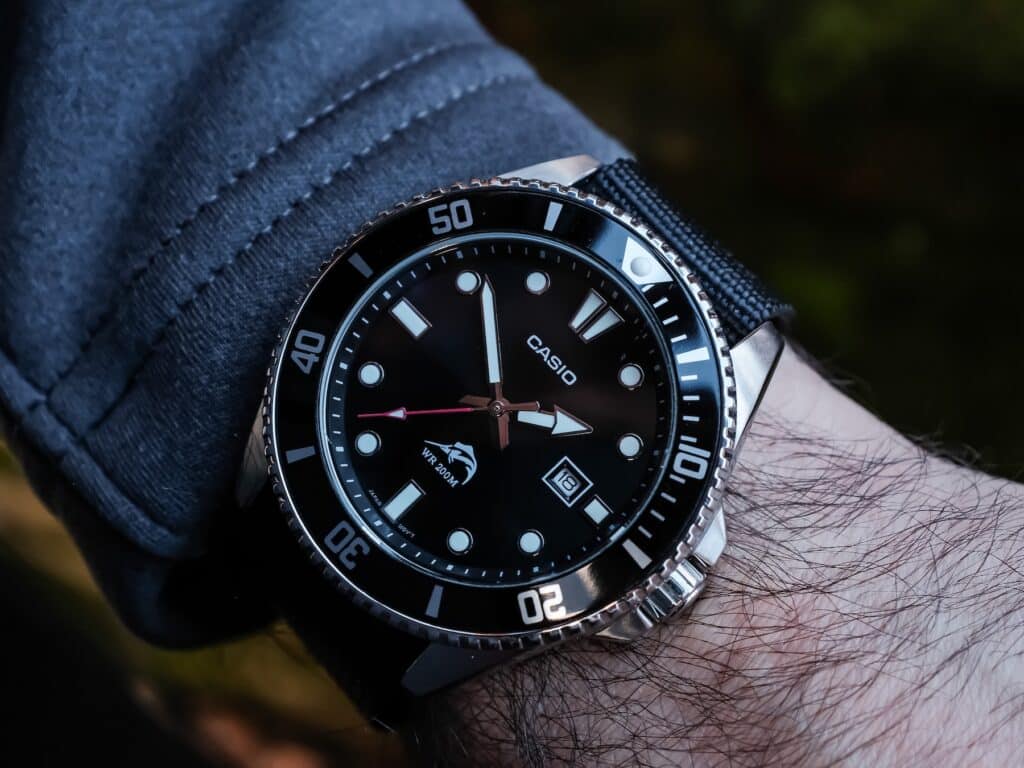
That’s what became clearer after spending time with these watches. The Casio Duro, Citizen Promaster Diver, Orient Kamasu, Seiko Turtle, Nodus Sector Deep, and the others don’t all make the same argument for owning a diver. Some are exceptionally comfortable, some are remarkably easy to live with, and others make a strong case simply because they’re the watch we’d rather grab when the day gets unpredictable. Meanwhile, the non-divers showed how much of that everyday usefulness can come from a field-style case, a tough digital platform, or a more versatile sports watch.
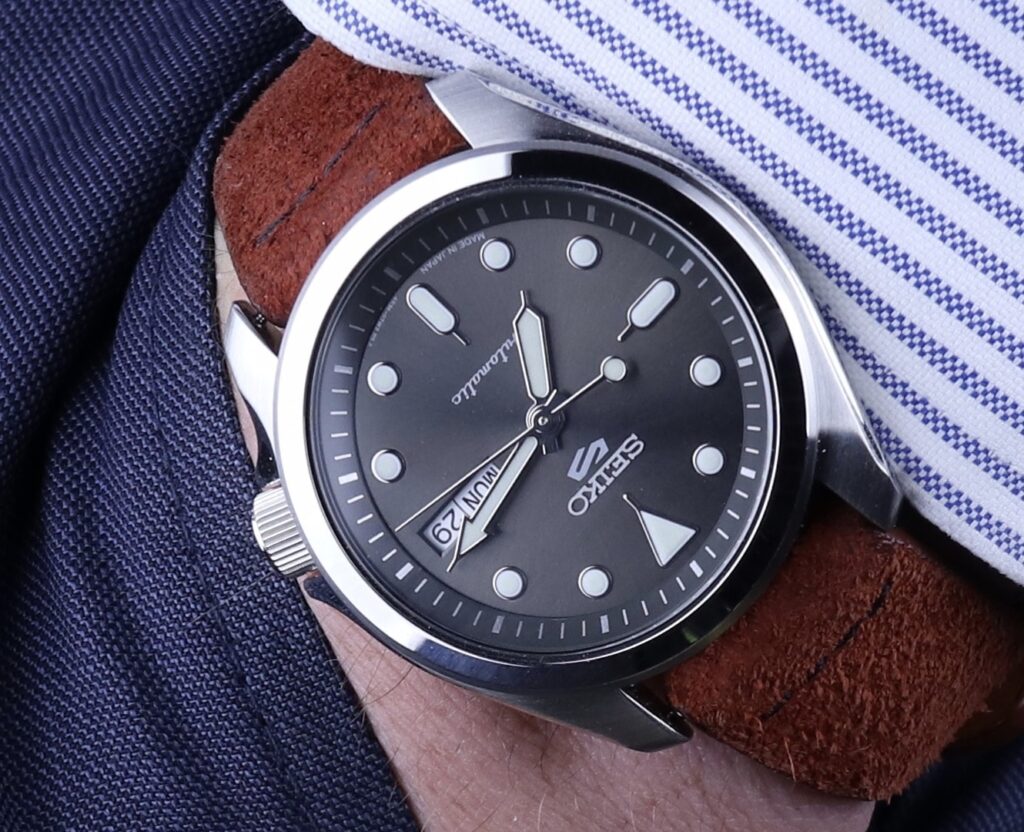
In the end, there’s no prize for having a dive bezel you never use. If your collection needs a watch you can wear without worrying about water, scratches, weather, or whether you dressed appropriately for the occasion, start there and let the category take care of itself. A true dive watch may be the right answer, but it doesn’t have to be every time. And if you’ve got a watch that handles that job better than anything we covered here, tell us about it in the comments. We’re always happy to find another excuse to put something new through some actual wrist time.

Co-Founder and Senior Editor
Kaz has been collecting watches since 2015, but he’s been fascinated by product design, the Collector’s psychology, and brand marketing his whole life. While sharing the same strong fondness for all things horologically-affordable as Mike (his TBWS partner in crime), Kaz’s collection niche is also focused on vintage Soviet watches as well as watches that feature a unique, but well-designed quirk or visual hook.