GMT watches have a funny way of making collectors suspicious of their own judgment. We tell ourselves we want the practical travel function. Still, half the time we’re also negotiating with Pepsi bezels, brand baggage, waitlists, homage anxiety, and the tiny voice that says, “Maybe I’ll just get the obvious one.” This list exists because the obvious one isn’t always the one that makes the most sense on the wrist. The goal here is simple: to sort through the best microbrand GMT watch alternatives to mainstream choices to figure out whether they feel useful, wearable, and interesting after the initial novelty wears off.
We’re coming at this from the same place as a lot of enthusiasts: curious, budget-aware, occasionally impatient, and more interested in the watch than the flex. Over the last 10 years, we’ve handled and reviewed enough GMTs and travel-adjacent watches to know that the small stuff matters more than the spec sheet admits: how easily the bezel turns, whether the dial stays legible when you’re tired, whether the bracelet fights your wrist by dinner, and whether the watch still feels like a good idea once the photos are done. Some of the watches below come from true microbrands, some from more established independent brands, and a few sit in that weird middle ground collectors love arguing about. Good. That’s where a lot of the interesting, affordable GMT watches live. Let’s begin.
Vaer G2 Meridian GMT

| Price: | $399 |
| Water Resistance: | 150m |
| Case Size: | 39mm (diameter) x 46mm (lug-to-lug) x 10mm (thickness) |
| Lug Width: | 20mm |
| Movement: | Swiss-made Ronda 515.24H |
The Vaer G2 Meridian GMT earns its place here because it treats the travel-watch idea with a little less ceremony than the mainstream GMT crowd usually allows. At $399, it lives in the part of the market where we expect a few rough edges, but the watch does not come across like someone slapped a red-and-blue bezel on a bargain case and called it a day. Vaer has built a lane around clean, straightforward tool watches, and the G2 Meridian stays in that lane. It uses familiar GMT visual language, but the appeal is not luxury cosplay. It feels like the easier, more accessible version of a travel watch: practical, low-maintenance, and ready to be worn without the small panic that comes with scratching something expensive.
A lot of that comes down to how it wears. The case dimensions give it a flat, light wrist presence that many mechanical GMTs still struggle to deliver, especially as they creep toward chunkier cases. For travel, that matters. The 150 meters of water resistance and screw-down crown also make the G2 Meridian feel less delicate than its price suggests, while the mix of brushed and polished surfaces keeps the case from looking too plain. The engraved caseback adds a small bit of character without making the watch feel like it is trying to force a backstory.
The Swiss Ronda 515.24H quartz movement handles the GMT functionality, and that choice fits the watch better than a budget mechanical movement would. This is a caller-style GMT, so you adjust the 24-hour hand instead of jumping the local hour hand, which may not please frequent flyers who live out of terminals, but it works well for tracking another time zone from home or during occasional travel. The quick-set date and multi-year battery life reinforce the grab-and-go personality. The rubber strap helps there, too. It tapers nicely, has more substance than some older entry-level Vaer straps, and suits the light case better than expected. The included NATO is useful, but it felt stiff enough that we would probably keep the watch on rubber most of the time.
The bezel’s bidirectional action has defined clicks and makes setting a second time zone feel straightforward, so the GMT feature never feels decorative. But there is some play, and the alignment does not always land cleanly on the markers. Some collectors will shrug that off after a few days; others will notice it every time they glance down, because watches are cruel like that. The dial is more resolved, with applied markers that add depth, a balanced 6 o’clock date, legible hands in daylight, and enough lume coverage on the hands and markers to be useful in lower light rather than merely photogenic. As a microbrand GMT alternative to the usual mainstream picks, the G2 Meridian makes the most sense for someone who prioritizes comfort, accuracy, and low upkeep over mechanical romance. Read our full review for the deeper wrist-time notes.
Pros
- The Swiss Ronda 515.24H quartz GMT movement keeps the watch accurate, simple, and low-maintenance.
- Thin, light 39mm case wears flat and comfortably for daily use or travel days.
- The 150 meters of water resistance, equipped with a screw-down crown, makes it feel more capable than the price suggests.
- The rubber strap suits the lightweight case well and feels more usable than the stiffer included NATO strap.
Cons
- The bidirectional bezel has some play, even though the clicks are clearly defined.
- Bezel alignment can be imperfect, which may bother detail-sensitive collectors.
- The caller-style GMT setup is less ideal for frequent flyers who prefer an independently adjustable local hour hand.
Imperial Oceanguard GMT
| Price: | $600 |
| Water Resistance: | 200m |
| Case Dimensions: | 38mm (diameter) x 47mm (lug-to-lug) x 14mm (thickness) |
| Lug Width: | 20mm |
| Movement: | Seiko NH34 |
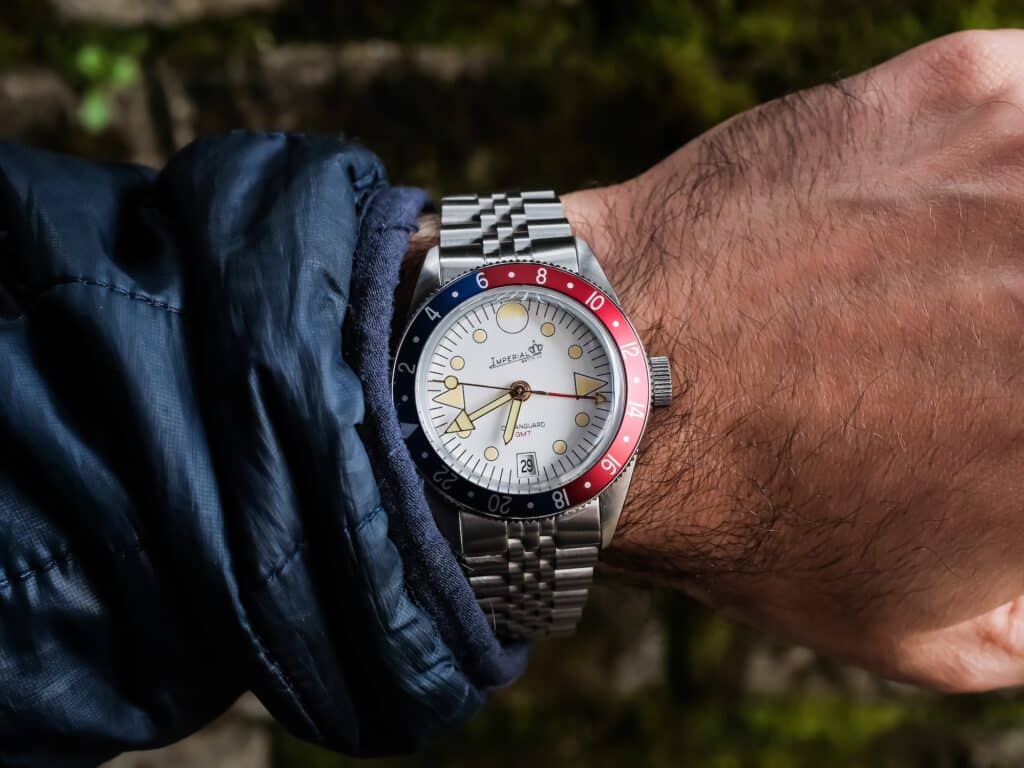
The Imperial Oceanguard GMT works here because it gives collectors a value-driven, independent GMT that does not feel like another automatic reflex answer to the Seiko 5 GMT. That matters in this category. The NH34 movement inside is still part of the Seiko ecosystem, so the watch is not pretending to reinvent the affordable GMT formula. Still, Imperial uses it in a way that feels more personal than generic. It is a caller-style GMT, meaning the 24-hour hand is adjusted rather than the local hour hand jumping independently. For tracking another time zone during the workday, calling family abroad, or keeping one eye on a different market, it is straightforward and dependable. During extended testing, the bi-color bezel ended up carrying enough of the second-time-zone workload that the caller-versus-flyer argument felt less dramatic than watch forums tend to make it out to be.
The 38mm case is the main reason the Oceanguard GMT separates itself from broader mainstream GMT choices. So many affordable GMT watches wear like compact dive watches that got inflated for airport duty, but this one leans into a smaller, skin-diver-style profile. It feels friendly on smaller wrists, sits with more restraint than many modern travel watches, and avoids that slabby feel that can ruin a watch with otherwise good dimensions. The proportions come across as intentional, not like Imperial was chasing vintage charm with a ruler and a mood board.
The dial and controls also help the watch feel more usable than its price might suggest. The oversized crown looks a bit dramatic at first, but it is easy to grip and operate, especially when paired with the bezel for quick second-time-zone reference. The white dial is more effective on the wrist than in photos, mostly because the marker layout gives your eye easy landmarks. The mix of dots, triangles, and the circular marker at twelve makes orientation quick, so there is no little pause while your brain sorts out the dial. Legibility held up well indoors and outdoors during testing, and the lightly aged lume works with the dial without tumbling into fake-patina theater. That restraint matters because a watch like this only works if the retro cues support usability instead of becoming the whole personality.
The bracelet is where the Oceanguard GMT makes one of its strongest arguments against mainstream alternatives. The jubilee-style bracelet articulates well and remains comfortable during extended wear. The tool-less microadjustment is the kind of feature that sounds boring until your wrist swells in warm weather or after travel, and then it becomes the thing you keep mentioning to people who did not ask. The clasp is chunkier than the rest of the watch deserves, and if you are chasing strict vintage proportions, the case may still read a little thick. But as a microbrand GMT alternative, the Oceanguard feels familiar in the right places and more complete where it counts: size, comfort, legibility, and everyday adjustability.
Pros
- The compact 38mm case gives it a smaller, skin-diver-style personality that many modern GMTs lack.
- Tool-less microadjustment makes small fit changes easy when your wrist swells during heat or travel.
- Jubilee-style bracelet articulates well and stays comfortable during longer wear.
- The dial layout is quick to read thanks to the varied marker shapes and a clear 12 o’clock reference.
- The bi-color bezel makes second-time-zone tracking easy in everyday use.
Cons
- The NH34 caller GMT setup is less convenient for frequent flyers than a true flyer GMT.
- The clasp feels thicker than the rest of the watch.
- The case can still appear a little thick if you want stricter vintage-style proportions.
Steinhart Ocean 39 GMT
| Price: | $650 |
| Water Resistance: | 300m |
| Case Dimensions: | 39mm (diameter) x 47mm (lug-to-lug) x 13mm (thickness) |
| Lug Width: | 20mm but tapers down to 16mm |
| Movement: | ETA 2893-2 |
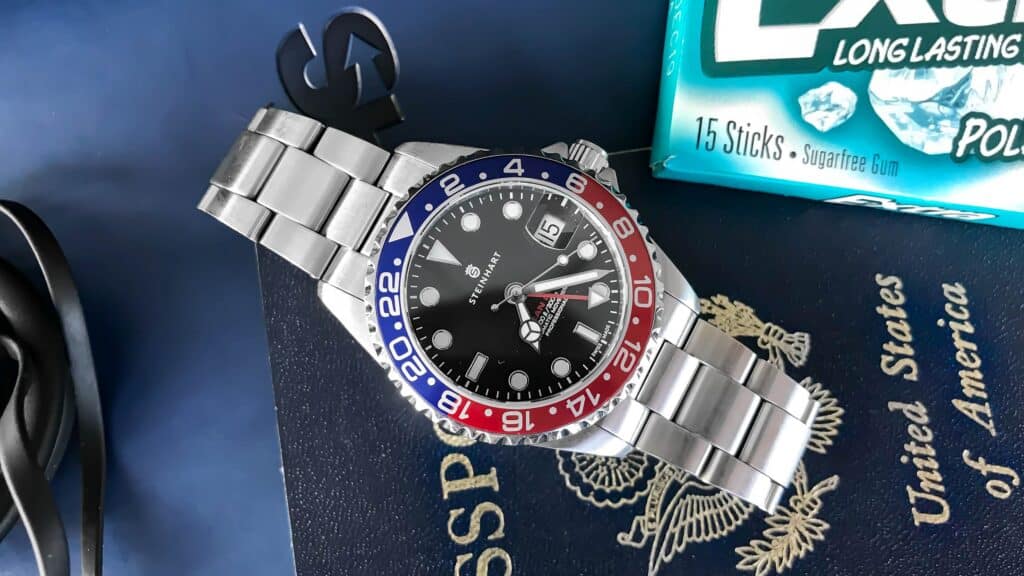
The Steinhart Ocean 39 GMT needs a little honesty before anything else: this is clearly living in the shadow of the Rolex GMT-Master II. There is no point pretending otherwise, and the watch is better served when we do not. In this list of microbrand and independent GMT alternatives to mainstream choices, the Ocean 39 GMT works because it gives collectors a familiar travel-bezel sports-watch experience without the price, waitlist, or brand theater that usually comes with that look. It is not the most original pick here, but it makes a strong case as a value-focused independent GMT for someone who wants the classic Pepsi layout and solid execution more than a fresh design manifesto.
The movement choice helps explain the appeal. Inside is the ETA 2893-2, which keeps the watch in reliable Swiss GMT territory without pushing it into silly-money territory. It is a caller-style GMT, which makes it less convenient for constant time-zone hopping. For tracking another time zone at home, at work, or on the occasional trip, it is a reasonable compromise. The red-tipped GMT hand is easy to pick up against the matte black dial and lines up cleanly with the minute track, while the hands and markers stay crisp and functional, even if they lack the layered depth. The Cyclops makes quick date checks easier, though the magnification could be stronger.
On the wrist, the 39mm case does a lot of work in Steinhart’s favor. It feels compact enough for smaller wrists, yet has enough sports-watch presence to avoid feeling timid. The 13mm thickness reads a bit chunky on paper, though during in-depth testing, it wore slimmer than expected, which matters for a GMT that is supposed to survive normal daily use rather than sit around waiting for vacation. The brushing across the case keeps it from looking too shiny, while the polished sides add some light play without turning it into a wrist mirror. The engraved Neptune caseback also gives the watch a small bit of Steinhart identity, which helps on a design that already borrows heavily from a much more famous template.
The Pepsi bezel is the biggest visual draw. The red and blue are bright and clean without looking plasticky or cheap, and paired with the matte black dial, the whole package stays legible in that familiar, easy-to-understand way. The action, though, is where the usefulness of the travel watch gets a little messier. The 120-click unidirectional bezel feels stiff and secure, almost like a diver’s bezel, but it is not the most convenient setup if you regularly adjust a second time zone. BGW9 lume glows evenly and lasts longer than expected, which helps the watch feel more useful after dark. The bracelet feels solid too, with screwed links and a secure safety clasp, although the flip-lock can be annoying when fine-tuning the fit. Scratches appeared after several days of wear, especially around the polished areas and bezel teeth, but they did not ruin the watch. They made it feel worn-in, which is the right mindset for this kind of GMT.
Pros
- BGW9 lume glows evenly and lasts longer than expected.
- The bracelet feels solid, with screwed links and a secure safety clasp.
- Pepsi bezel colors are vivid and clean without looking cheap.
- Red-tipped GMT hand and matte black dial make second-time-zone reading clear.
- 39mm case wears balanced and approachable across a wide range of wrist sizes.
Cons
- The stiff 120-click unidirectional bezel is not ideal for frequent second-time-zone adjustments.
- The flip-lock clasp can be fussy when trying to dial in the fit.
- Polished bezel teeth and case surfaces show scratches more readily.
Nodus Contrail GMT Laguna
| Price: | $825 |
| Water Resistance: | 200m |
| Case Dimensions: | 40.5mm (diameter) x 46.6mm (lug-to-lug) x 11.8mm (thickness) |
| Lug Width: | 20mm |
| Movement: | Miyota 9075 |
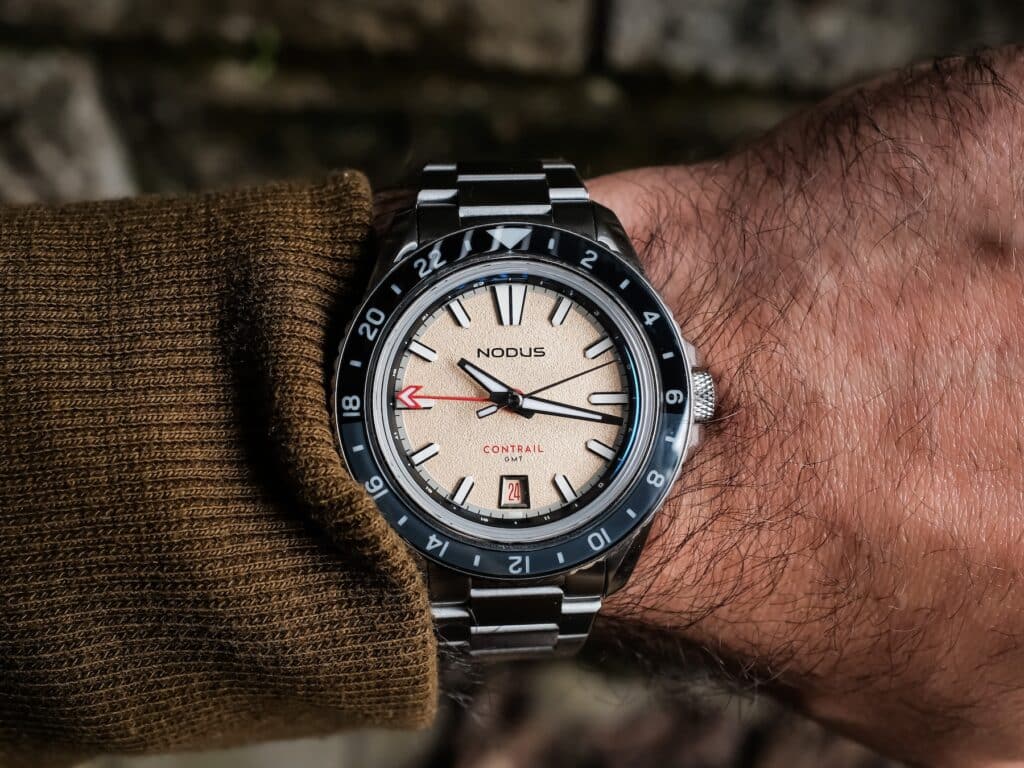
The Nodus Contrail GMT Laguna feels right for this list because it offers the microbrand-collecting aspect the mainstream GMT space often smoothens over: a distinct design point of view, enthusiast-minded functionality, and enough practical refinement to make the watch feel considered rather than merely “alternative.” It is not trying to be the cheaper version of a famous travel watch. It feels more like Nodus looked at what makes a GMT useful day-to-day, then built around those details.
The Miyota 9075 is one of the big reasons the Contrail GMT stands out from more obvious GMT picks. This is a flyer GMT, so the local hour hand jumps independently while the rest of the time display keeps running. For actual travel, that makes a meaningful difference because you can land, pull the crown, jump the local hour, and move on with your life instead of resetting everything like you are defusing a tiny wrist-mounted device. In our hands-on time, the local jump felt clean and precise, the movement stayed steady for accuracy, and the roughly 42-hour power reserve worked well in a normal rotation. The large screw-down crown helps make those adjustments feel deliberate, with enough grip that setting the watch never turns into a fingernail exercise.
Nodus also keeps the case from becoming another thick GMT object. At 40.5mm wide with a 46.6mm lug-to-lug, the Contrail GMT sits in familiar modern sports-watch territory, but the 11.8mm thickness is the number that matters on the wrist. Many watches with this movement are thicker than expected, while this one stays close to the wrist and feels stable throughout the day. The twisted lugs help the case settle cleanly, and the brushed and polished surfaces give the shape more definition without making it look overworked. The box sapphire crystal and sapphire bezel insert add some dimensional light play. At the same time, the 200 meters of water resistance gives the watch enough toughness for travel, swimming, and normal, careless living.
The Laguna dial is where the watch comes into its own. The soft, sandy tone shifts with the light, giving the Contrail a warmer feel than the usual black-dial GMT formula, and the roulette date wheel adds character without cluttering the layout. Time-zone tracking becomes intuitive once you spend a little time with it: the smooth 48-click bidirectional bezel, internal 24-hour scale, main handset, and GMT hand all work together without making the dial feel like a spreadsheet. The bold handset is easy to separate at a glance, and the BGW9 lume across the markers, bezel numerals, and GMT hand gives the watch real low-light usefulness. We would still like larger internal 24-hour numerals for faster reading, and the H-link bracelet, while solid and easy to size thanks to screw links, could use a stronger taper than its 20mm-to-16mm narrowing. The NodeX clasp is also chunkier than the rest of the watch, but the quick on-the-fly adjustment is useful enough that we would take the bulk.
Pros
- A slim 11.8mm case profile helps it wear cleaner and sit closer to the wrist than many GMTs that use the same movement.
- NodeX clasp allows quick fit changes throughout the day.
- Miyota 9075 flyer GMT movement allows the local hour hand to jump independently, making it more useful for travel.
- BGW9 lume on the markers, bezel numerals, and GMT hand gives the watch legitimate low-light readability.
- Smooth 48-click bidirectional bezel makes tracking multiple time zones intuitive after a short adjustment period.
Cons
- NodeX clasp feels chunkier than the rest of the watch.
- The bracelet has a taper down from 20mm to 16mm, which feels conservative if you prefer a more refined narrowing toward the clasp.
- Internal 24-hour numerals could be larger for faster, at-a-glance reading.
Nodus x Raven TrailTrekker
| Price: | $875 |
| Water Resistance: | 200m |
| Case Dimensions: | 39.5mm (diameter) x 46.6mm (lug-to-lug) x 11.8mm (thickness) |
| Lug Width: | 20mm |
| Movement: | Miyota 9075 |
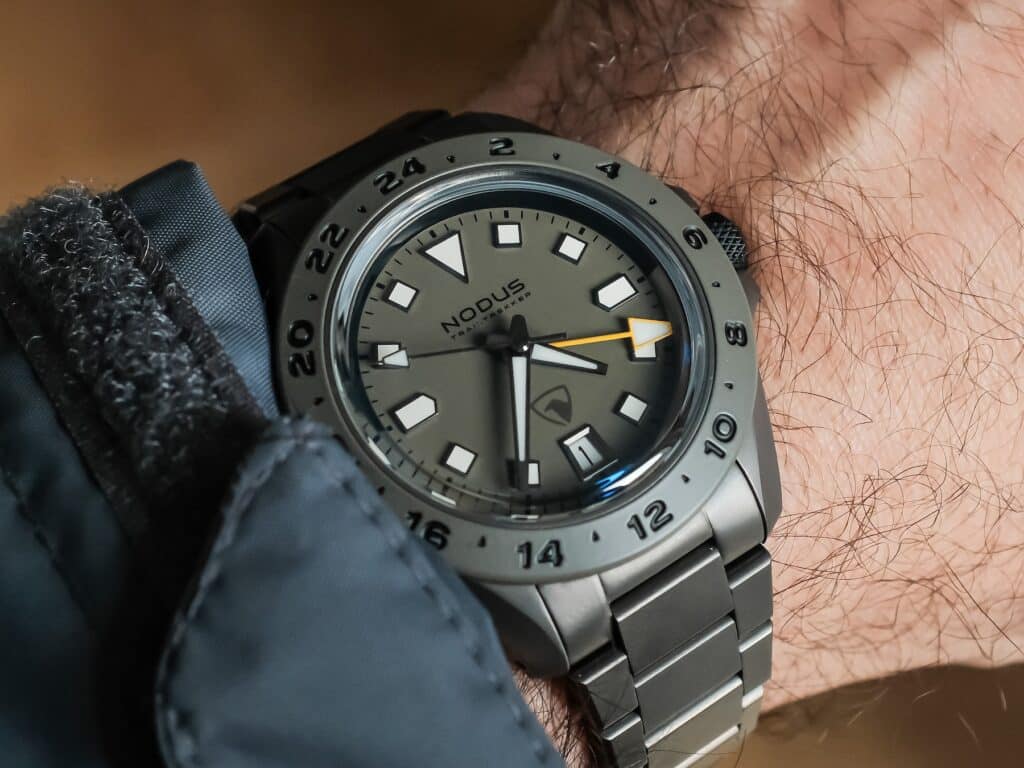
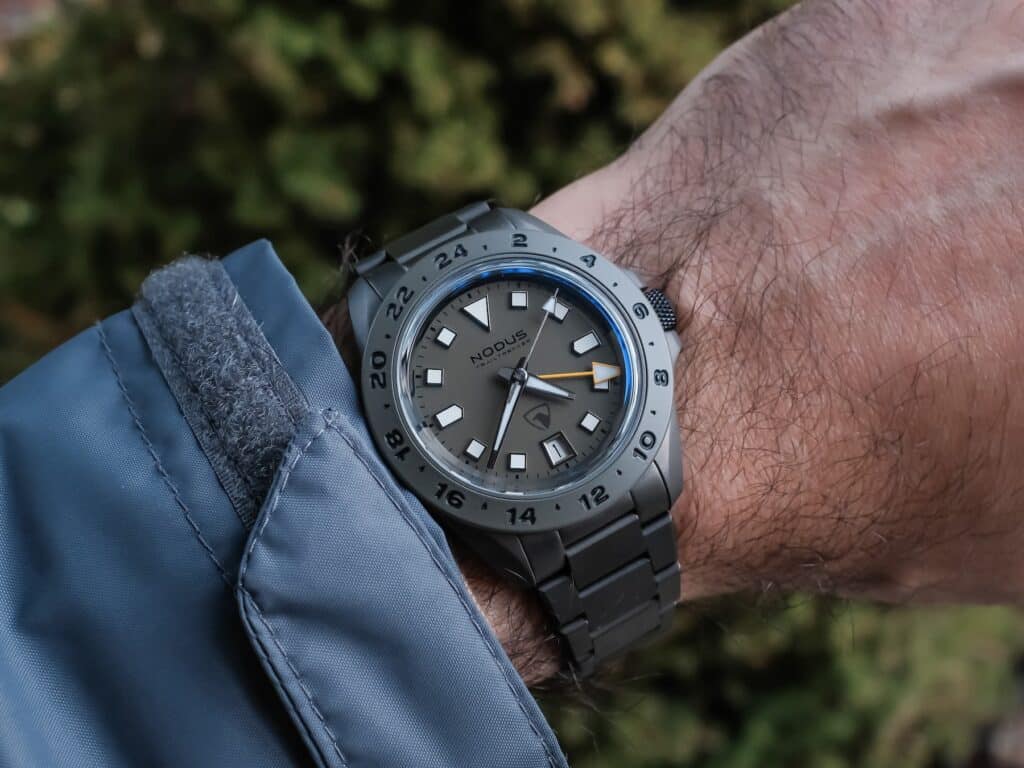
The Nodus x Raven TrailTrekker earns its spot here because it gives the GMT category a little dirt under the fingernails. A lot of GMT watches, especially the mainstream ones, lean toward polished airport-lounge energy. The TrailTrekker feels more like the one we would grab before a weekend with sketchy weather, gravel roads, and no interest in keeping the watch pristine. The 39.5mm case helps a lot. It lands in that useful middle ground where it has enough presence to feel like a tool watch, but not so much bulk that it becomes annoying on smaller wrists. The muted grey DLC finish also works better than a glossy black coating would have. It keeps the watch low-profile and purposeful, without tipping into tactical costume territory.
The dial and bezel are where the TrailTrekker breaks away from the more familiar GMT formula. The sand-colored Cerakote bezel has a dry, textured quality that suits the watch’s adventure-watch personality, and the high-contrast 24-hour scale makes second-time-zone tracking easy to reference. A shiny ceramic bezel would have felt out of place here. This texture gives it more of a used-field-gear feel, which is the point. The sand-toned dial continues that idea with matching texture, gunmetal hands, and applied indices that keep everything visually tied together. The yellow GMT hand is the loudest part of the design; not everyone will love it, but it makes quick GMT checks much easier in practice. The 6 o’clock date keeps the dial balanced, and the dual branding stays restrained enough not to compete with the timekeeping information.
Inside, the Miyota 9075 gives the TrailTrekker proper flyer GMT functionality, which matters if you want more than travel-watch styling. The independently jumping local hour hand makes time-zone changes cleaner, and in our testing, that adjustment felt smooth and precise. Accuracy stayed within a few seconds of the reference time, and the jumping hour hand also made date changes more intuitive while moving between time zones. Since the 9075 is still a relatively new movement, we would keep an eye on its long-term performance, but early use has given us little to complain about. The deeply knurled screw-down crown also enhances the experience, giving you an easy grip when adjusting the watch, while the sapphire crystal and 200 meters of water resistance make it feel ready for active use rather than precious weekend-only wear.
The bracelet is better than the rugged look might suggest. The flat-link bracelet sits close to the wrist, feels solid without becoming heavy, and tapers from 20mm to 16mm, which keeps the clasp area from feeling oversized. During testing, we preferred it over the included nylon strap, mostly because it made the watch feel more balanced for daily wear. The NodeX clasp is a big reason why. Its on-the-fly adjustment offers about 10mm of range across multiple positions, which becomes useful the moment your wrist changes size during heat, travel, or a long day outside. The engraved caravan caseback ties the travel-and-resilience theme together without making the watch feel gimmicky. The lume is usable, though not among the strongest performers in this category, and the yellow GMT hand may be too bold for someone who wants a fully muted design. Still, as a microbrand GMT alternative to the usual polished travel watches, the TrailTrekker feels like the one built for people who might use the GMT hand somewhere messier than a conference room.
Pros
- NodeX clasp offers about 10mm of on-the-fly adjustment across multiple positions.
- Miyota 9075 flyer GMT movement makes local time-zone changes clean and practical.
- High-contrast 24-hour bezel scale and yellow GMT hand make second-time-zone tracking easy.
- Flat-link bracelet tapers from 20mm to 16mm and stays comfortable without feeling heavy.
- 39.5mm DLC-coated case wears purposefully without feeling oversized or too tactical.
Cons
- The yellow GMT hand may be too bold for buyers who prefer a more subdued design.
- Lume is usable, but not as strong as the brightest options in this category.
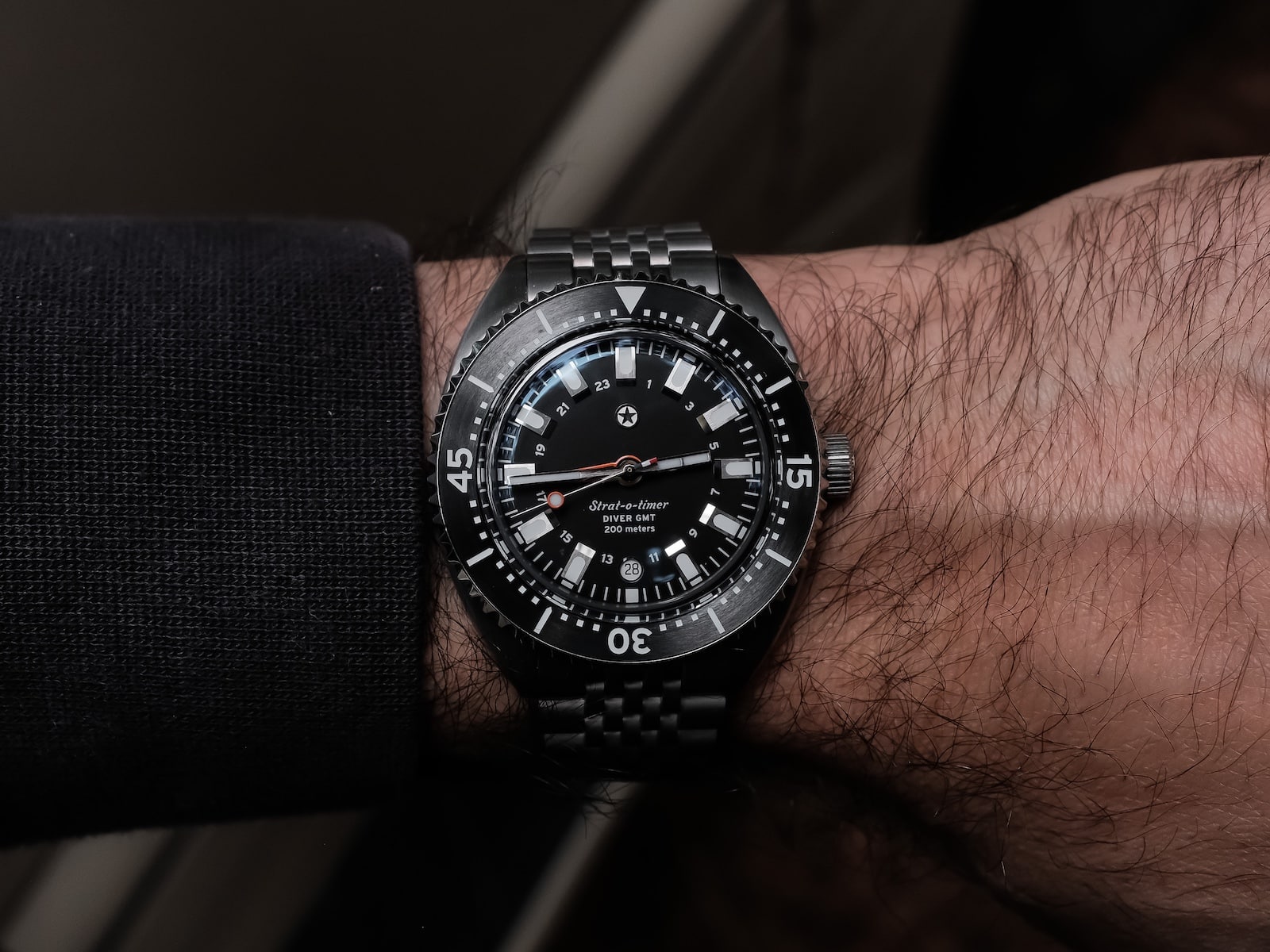
Jack Mason Strat-o-Timer GMT
| Price: | $1,399 |
| Water Resistance: | 200m |
| Case Dimensions: | 40mm (diameter) x 47mm (lug-to-lug) x 13mm (thickness) |
| Lug Width: | 20mm |
| Movement: | Miyota 9075 |
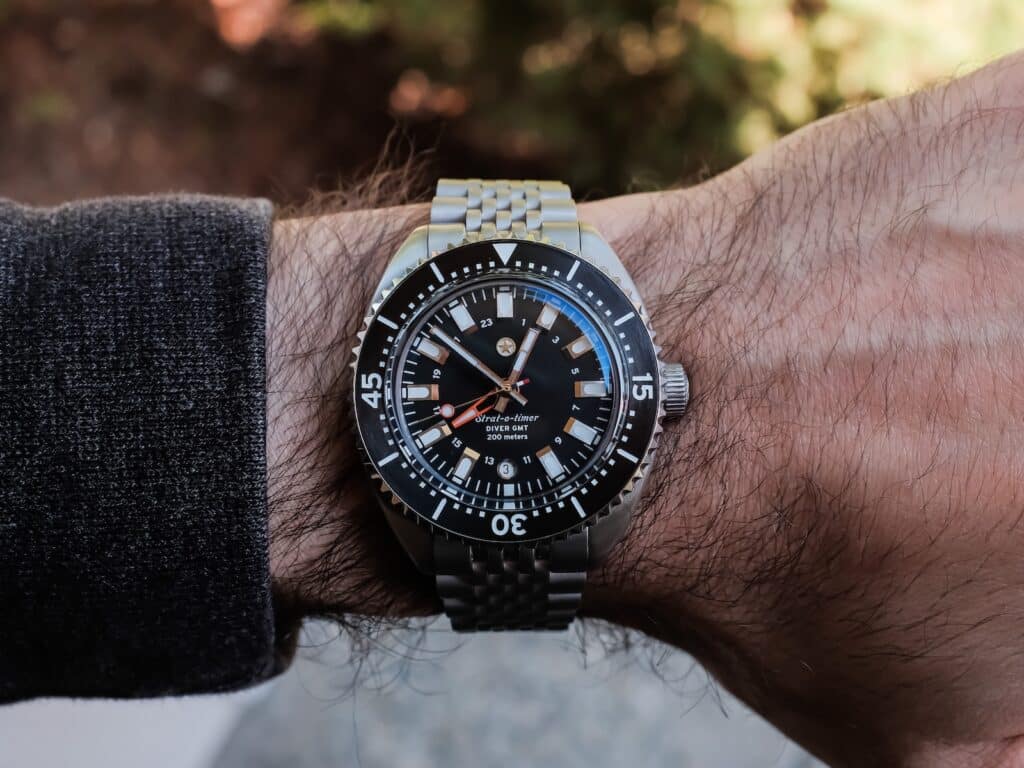
The Jack Mason Strat-o-Timer GMT fits this list because it gives the microbrand GMT space something more polished and more American-brand-specific than the usual “affordable Pepsi bezel” formula. It is a modern diver/travel-watch hybrid, and that combination could have become messy fast. Instead, the titanium version feels refined in the places that matter on the wrist. At its price, it is not chasing the cheapest possible GMT buyer, but the Grade 2 titanium case and bracelet make the price jump over the steel model feel easier to understand once you wear it. Losing roughly forty grams changes the whole personality. It settles more lightly, feels less planted in the wrong way, and stays comfortable for a full day instead of reminding you that you chose a sports watch.
The case dimensions are familiar, but the shape does a lot of quiet work. At 40mm wide, 47mm lug-to-lug, and just over 13mm thick, it could have worn blocky. It does not. The curved mid-case and downward-arching lugs help it sit close, while the fully brushed titanium finish keeps the look muted and tool-forward. No polished surfaces are trying to dress it up, which suits the watch better. The 200 meters of water resistance, sapphire crystal, and easy-to-grip screw-down crown make it feel ready for actual use, whether that means a weekend trip, a swim, or the usual daily chaos that somehow makes a watch earn its keep.
The dial is busy on paper, but more manageable in practice. Jack Mason keeps the dive bezel dedicated to timing and moves the full 24-hour GMT scale onto the dial, which is the right call here. It lets the ceramic bezel remain useful as a proper 120-click dive bezel while still giving you a clear second-time-zone read. The bezel action felt controlled and even, with enough resistance to make adjustments feel intentional, though there was a bit of play, and the markings did not align perfectly on the sample we handled. The black dial and bezel, along with the blue option, keep the palette restrained, so the large applied BGW9 markers, stick hands, lollipop seconds hand, and skeletonized orange GMT hand can all do their jobs without the layout collapsing into visual noise. The lume across the hands, markers, GMT hand, and bezel markings proved genuinely useful in low light, including during a weekend out in the woods, which is often where “good enough” lume starts confessing.
The bracelet reinforces the comfort story. It is a fully brushed seven-link titanium design in 20mm, and the smaller links help it drape naturally around the wrist rather than feel stiff or slabby. Screwed links make sizing simple. The tool-free micro-adjust clasp is useful once you learn its rhythm, but it did take a few tries to engage securely. That is worth noting because a great comfort feature should not feel like a tiny puzzle at first. Inside, the Miyota 9075 gives the watch true flyer GMT functionality, with an independently jumping local hour hand, a 28,800 bph beat rate, and about 42 hours of power reserve. Setting it up felt straightforward, the local-hour jump was satisfying to use, and Jack Mason’s in-house regulation kept accuracy in a range that never made us think about it. That movement is a major reason this works as a real alternative to mainstream GMT choices, rather than a sports watch with a GMT makeup.
As a microbrand GMT alternative to mainstream choices, the Strat-o-Timer GMT makes the most sense for someone who wants real travel-watch functionality, dive-watch durability, and a lighter wrist feel without drifting into luxury-watch self-importance. For the deeper wrist-time notes, including the titanium comfort story and the clasp learning curve, check out our dedicated review.
Pros
- Miyota 9075 flyer GMT movement gives it true travel-watch functionality.
- The Grade 2 titanium case and bracelet noticeably reduce weight, making full-day wear much easier.
- The dial-mounted 24-hour scale keeps the dive bezel free for timing, making the layout more functional.
- BGW9 lume on the hands, markers, GMT hand, and bezel markings gives it strong low-light usefulness.
- The seven-link titanium bracelet drapes well and keeps the watch comfortable without feeling flimsy.
- Tool-free micro-adjustment is very helpful once properly engaged.
Cons
- Dial can feel busy at first because it combines dive timing and GMT information in a compact space.
- The bezel has a bit of play, and the sample’s bezel markings did not align perfectly.
- Tool-free clasp adjustment takes a few tries to understand before it feels secure.
Farer World Timer Roché II
| Price: | $1,695 (leather strap); $1,865 (stainless steel bracelet) |
| Water Resistance: | 100m |
| Case Dimensions: | 39mm (diameter) x 45mm (lug-to-lug) x 11mm (thickness) |
| Lug Width: | 20mm |
| Movement: | Sellita SW330-1 Elaboré |
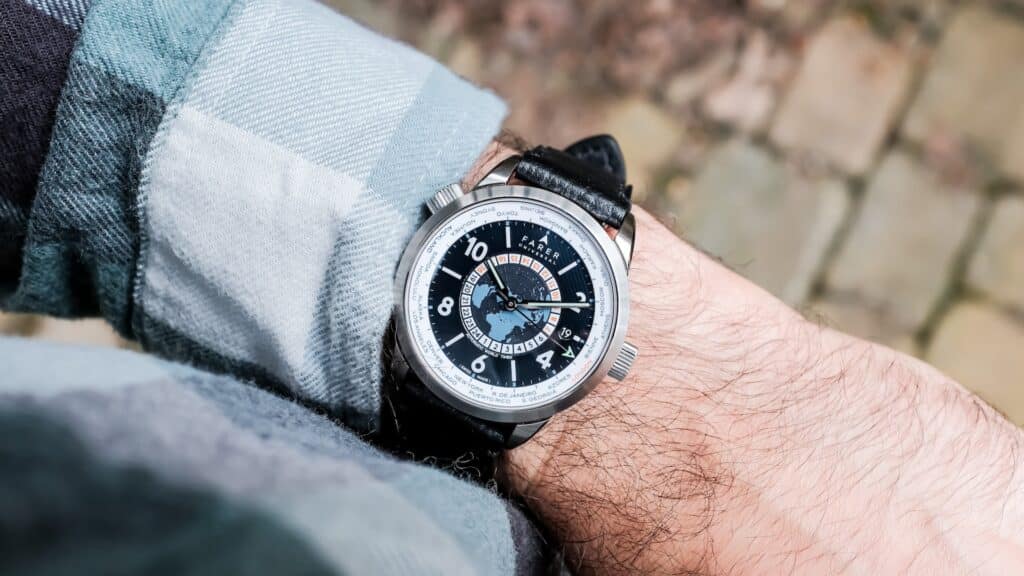
The Farer World Timer Roché II is not a GMT in the most basic, bezel-and-fourth-hand sense, but still belongs here. For anyone looking beyond the usual mainstream GMT choices, this offers a different kind of travel-watch experience: more colorful, more layered, and more Farer in the best possible way. It does more than a standard GMT, but it does not wear like a watch that is trying to punish you for wanting more functionality. The 39mm case stayed flat and balanced during daily wear, whether at a desk, out running errands, or moving through an airport with the usual low-grade travel misery. It also slips under a sleeve without much drama, which matters when travel complications start adding visual and physical bulk. With 100 meters of water resistance, it never felt fragile or too precious either.
The dial is where the Roché II makes its argument against safer, more conventional GMT alternatives. A lot is happening, but Farer keeps the information organized enough that the watch does not feel like a tiny geography quiz on the wrist. The midnight-blue textured dial provides the rotating 24-city ring with enough contrast to remain useful, while the raised markers add dimension without crowding the display. The updated alpha hands were easy to follow during testing, and the rotating 24-hour disc became more intuitive than expected once we spent time with it. Checking another time zone did not require as much mental decoding as the layout first suggested, though this is still busier than a simple GMT. The inner bezel takes a little time to get used to before it feels natural.
Low-light use also made us appreciate some choices that initially felt like Farer being Farer. The lume across the hands, markers, and inner bezel looked a bit generous at first, but late nights and early-morning travel made it feel less decorative and more useful. That is the kind of detail that separates a personality-driven travel watch from one that only looks good in press photos. The Roché II has color and charm, but it also offers enough practical legibility to keep the complication usable even in less-than-ideal conditions. It is expressive without becoming unserious, which is a harder balance than it sounds.
The modified Sellita SW330 performed steadily in our testing, and the 50-hour power reserve made it easier to keep the watch in a weekly rotation without constantly resetting it. The St. Venere leather strap felt comfortable quickly and stayed secure even on smaller wrists, which is not guaranteed with leather straight out of the box. The quick-release system also makes it easy to switch to the bracelet when you want more weight and structure. The catch is price. The Roché II sits above many microbrand GMT options, so the value depends on whether its world-time layout, color, and less mainstream design language speak to you. For someone who wants a travel watch with more personality than the obvious choices, it makes a strong case.
Pros
- Midnight-blue textured dial and raised markers add depth without ruining legibility.
- The rotating 24-hour disc becomes more intuitive with use, making second-time-zone checks easier than expected.
- Quick-release setup makes strap or bracelet swaps painless.
- Strong lume across the hands, markers, and inner bezel helps during low-light travel use.
- The 50-hour power reserve gives the watch more flexibility in a weekly rotation.
Cons
- Inner bezel layout takes time to learn before it feels natural.
- Pricing is above that of many comparable microbrand options, so the appeal depends heavily on whether the design clicks.
- The dial may feel too busy for anyone who prefers a cleaner, more minimal GMT-style travel watch.
Monta Skyquest GMT
| Price: | $2,435 |
| Water Resistance: | 300m |
| Case Dimensions: | 40.7mm (diameter) x 47.4mm (lug-to-lug) x 11.8mm (thickness) |
| Lug Width: | 20mm |
| Movement: | Monta Caliber M-23 (Sellita SW330-2 base) |
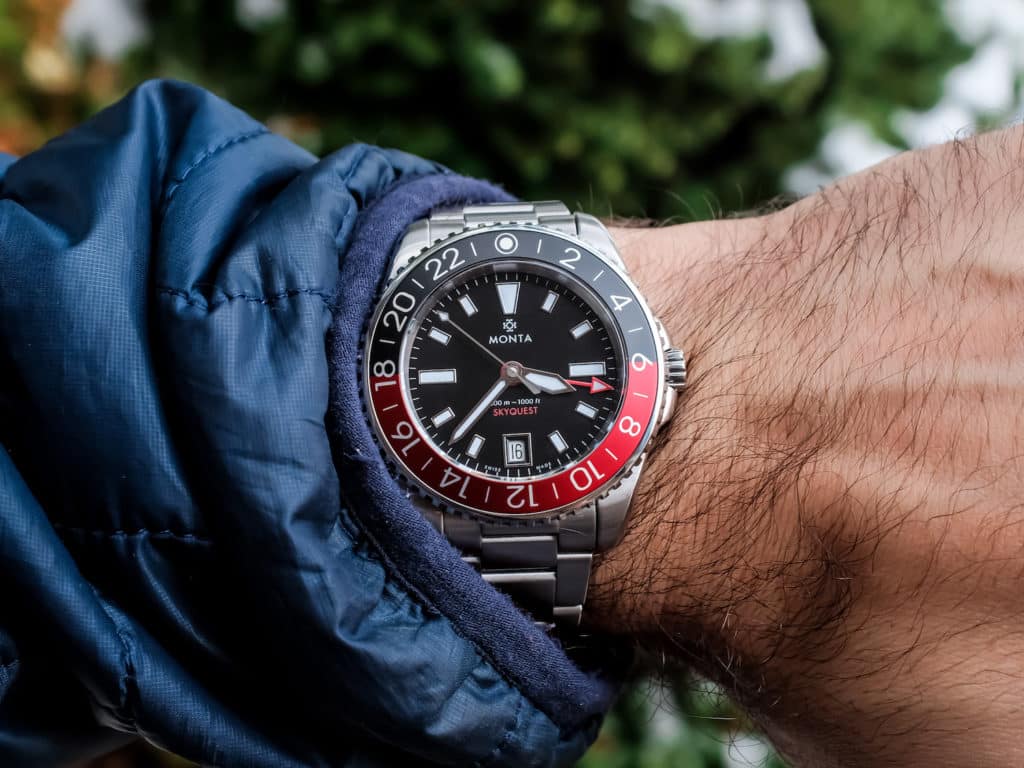
The Monta Skyquest GMT sits in a different lane from the more value-driven microbrand GMT options here. It is the premium independent-brand pick, the one that makes sense when you want to move away from mainstream GMT choices but still want the watch to feel buttoned-up, refined, and fully sorted on the wrist. Its appeal is not loudness. The Skyquest wins by doing the small things well and letting those choices stack up over a long day. The case wears smaller and more proportionate than the specs suggest, and the relationship between the dial and bezel helps a lot. The larger 24-hour bezel markings pull the eye outward, so the watch never feels visually cramped. In daily use, that gives the whole thing a calmer, cleaner presence than many travel watches that try to cram in GMT usefulness with all the subtlety of an airport departure board.
The GMT experience is similarly controlled. The bezel is easy to grip and has a firm, predictable action, which made quick adjustments feel confident during our dedicated review, even with cold hands or gloves. That matters because a GMT bezel should not feel like a decorative ring you are afraid to touch. The dial keeps things legible with applied markers and well-proportioned hands, so checking the time or referencing another zone never turns into a squinting exercise. BGW9 Swiss Super-LumiNova held up nicely into the evening during hands-on wear, staying readable without fading too quickly. Monta has also cleaned up some quirks from earlier versions, giving the Skyquest a more refined overall look. The trade-off is that longtime fans may miss a little of the older model’s extra personality.
The bracelet is where the Skyquest starts to justify its higher position in the independent GMT world. Screw links make sizing straightforward, the milled clasp closes with a precise, reassuring snap, and the tool-free micro-adjustment is the sort of feature that sounds like a spec-sheet extra until you rely on it during a long day. When wrist size shifts with heat, travel, or general human inconvenience, being able to fine-tune the fit without a tool makes the watch easier to live with. Comfort stayed consistently high through extended wear, and that is one of the reasons the Skyquest feels more complete than many cheaper GMTs that get the headline specs right but miss the daily-wear details.
Inside, Monta’s Caliber M-23, based on the Sellita SW330, kept things quite steady. Accuracy was consistent, the roughly 55-hour power reserve gave the watch useful breathing room in rotation, and the familiar movement base should make future servicing less stressful than dealing with something obscure. The Skyquest is not trying to be radical, and that is part of why it works. As a microbrand GMT alternative to mainstream choices, it is for the collector who is ready to pay more for better finishing, cleaner usability, bracelet refinement, and an overall sense that the watch was carefully worked through.
Pros
- The dial layout stays clean, balanced, and easy to read in everyday use.
- The bezel is easy to grip and has a firm, confidence-inspiring action.
- Bracelet quality is excellent, with screw links and a precisely milled clasp.
- Tool-free micro-adjustment is useful during long days when wrist size changes.
- Roughly 55-hour power reserve gives the watch practical flexibility in a rotation.
- The familiar movement base should make future servicing more straightforward.
Cons
- The updated design feels more refined but loses some of the character of earlier versions.
- The price places it directly against more established brands, which some buyers may care about.
Bremont Supermarine S302 GMT
| Price: | Starting at $4,195 |
| Water Resistance: | 300m |
| Case Dimensions: | 40mm (diameter) x 49mm (lug-to-lug) x 12.5mm (thickness) |
| Lug Width: | 20mm |
| Movement: | BE-93-2AV (chronometer-rated and modified ETA 2893-2) |
The Bremont Supermarine S302 GMT is not a microbrand watch in the same scrappy sense as Nodus or Vaer, but it still belongs in this conversation. It gives collectors a non-mainstream British alternative to the usual Swiss GMT choices, especially if the appeal is a sport watch that can handle travel timing and elapsed timing in one package. That combination is harder to find than it should be. Plenty of GMTs look travel-ready, and plenty of divers are built for actual use, but the S302 manages to bring those two ideas together without feeling like one function was awkwardly bolted onto the other.
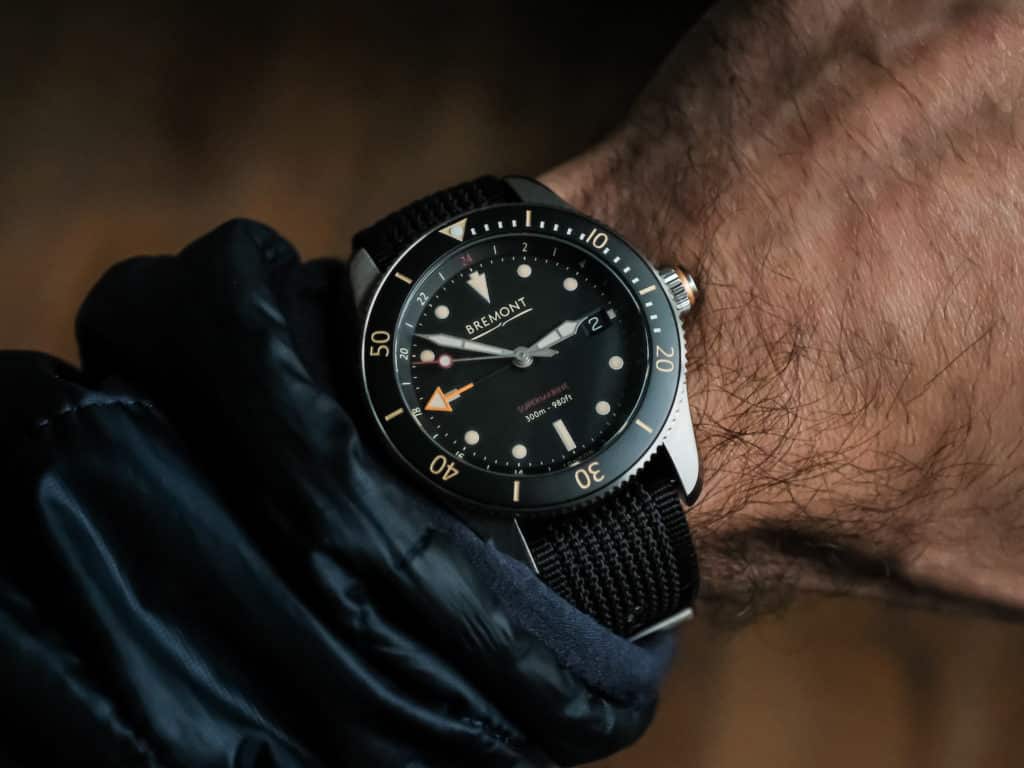
The case is where Bremont starts to justify why this costs more than the typical enthusiast GMT. The three-piece Trip-Tick stainless steel construction gives the watch a shape and structure that does not feel pulled from a catalog case. After time on the wrist, the fuss around that case design starts to make more sense. The lugs flow into the case in a way that feels engineered rather than decorative, and the polished strips along the twisting lug surfaces add a subtle touch of refinement without making the watch shiny. At 40mm wide, 12.5mm thick, and 49mm lug-to-lug, it wears like a properly proportioned sports watch, not a luxury diver pretending to be compact. The screw-down crown has a copper accent and provides 300 meters of water resistance, giving the S302 the real-world durability that makes it easier to wear on trips, around water, or during a long weekend when plans keep changing.
The dial keeps a fairly complicated layout cleaner than expected. The matte black surface, tan markers, and 24-hour chapter ring give the orange arrow GMT hand enough structure to work without making the watch feel like a cockpit instrument. That large GMT hand has some Explorer II energy, but the overall effect feels more casual-travel than expedition cosplay. The dial text is nicely balanced, with the Bremont wordmark and propeller up top and “Supermarine 300m – 980ft” at the bottom. The 3 o’clock date window is crisp and uses a matching wheel, which helps it disappear until you need it. The lume application is fair, and the matte ceramic bezel brings clean white and tan markings with a crisp action. We would still like the GMT scale numerals to be bolder for faster reading, but the core layout works well once your eye settles into it.
Strap choice matters more here than it might seem. The included tan leather strap is well-made, but stiff out of the box, and leather on a dive-style GMT is always a matter of taste. The 20mm lug width makes experimentation easy, and the S302 felt right at home on a Tornek Rayville Nytex Type I-M2 general-purpose strap or a UK-made Phoenix NATO. Bremont also offers the watch on its own NATO-style strap or a matching stainless steel bracelet, but we would be tempted to buy the simplest configuration and let our own strap drawer do the damage.
Inside, the BE-93-2AV is a chronometer-rated, Bremont-modified ETA 2893-2 with about 38 hours of power reserve and an independently adjustable 24-hour hand. It is not the most exotic movement at this price, but the ETA base should make future servicing less stressful than some proprietary alternatives. Starting at $4,195, the S302 is not an “ultimate value” GMT diver, and pretending otherwise would be silly. It makes sense for someone who wants the GMT-plus-dive format, appreciates Bremont’s case construction, and is willing to pay for the British-brand character rather than chase the lowest spec-per-dollar ratio. For more wrist-time detail, check out our full review.
Pros
- 300 meters of water resistance, along with a screw-down crown, make it feel ready for travel and water use.
- The matte ceramic elapsed-time bezel has crisp action and keeps the dive function useful.
- The large orange GMT hand is easy to pick out quickly.
- The 20mm lug width makes strap swaps simple, especially if you prefer NATO or nylon straps.
- ETA-based BE-93-2AV movement should be easier to service than more obscure alternatives.
Cons
- GMT scale numerals could be bolder for faster, at-a-glance reading.
- The included tan leather strap is stiff out of the box and may not suit buyers who want a pure dive-watch setup.
- Power reserve is fine at about 38 hours, but not too impressive at this price.
Think we missed a microbrand GMT that deserves a boarding pass here? We only include watches we’ve reviewed hands-on, so if there’s a budget travel beater, an enthusiast-brand sleeper, or a weird little GMT, share it in the comments. We’ll try to get one in for review and consider it for a future update.

Co-Founder and Senior Editor
Kaz has been collecting watches since 2015, but he’s been fascinated by product design, the Collector’s psychology, and brand marketing his whole life. While sharing the same strong fondness for all things horologically-affordable as Mike (his TBWS partner in crime), Kaz’s collection niche is also focused on vintage Soviet watches as well as watches that feature a unique, but well-designed quirk or visual hook.
It would have been a much better comparison if you would include those of us that prefer watches starting at 42mm. Not all of us have a 5 or 6 something inch wrist. I’m 185lbs and work out a little, and wear a 7¾ to 8 in band. Anything less then 42mm looks dainty on the wrist.
Fair point, M.j. We tend to skew toward what brands are releasing right now, and the industry has been trending smaller lately. But you’re right that a 42mm+ perspective would’ve made the comparison more complete for larger wrists.
MJ, take a look at the Mido Ocean Star GMT, which is 44mm.
Traska Venturer GMT
Great option that keeps coming up. We’d love to test one.
The Traska Venturer is one of the more compelling microbrand GMTs, to me.
Still gotta try one out!
I prefer the Atlas to the Skyquest – it’s a bit more distinctive. The Skyquest looks a little too much like every other Pepsi GMT to me, and they went backwards with the styling of the second hen model IMO. Still a handsome watch, of course
Jon – I lean the same way. The Atlas has its own identity in a way that’s harder to find in the GMT space right now. The Skyquest is well made, but the Pepsi GMT lane is crowded and it doesn’t always stand apart. Fair take.