Aviation and travel watches have always been easy to admire from a distance, but living with them is a different story. We’ve found that the best ones aren’t necessarily the watches with the busiest dials or the strongest military inspiration, but the ones that continue to feel intuitive every time they go on the wrist. After more than a decade of reviewing watches hands-on, we’ve learned that pilot-inspired designs often earn their place through the little things—a dial that’s readable before your morning coffee, a case that never feels cumbersome after eight hours, or a crown you stop thinking about because it works. This list answers the question we keep coming back to: which aviation watches we’ve reviewed still feel worth owning once the excitement of a new purchase has faded?
That perspective comes from spending real time with these watches, not comparing specification sheets. We’ve worn them through daily routines, paid attention to how quickly the dial could be read at a glance, and noticed which crowns, straps, and movements quietly disappeared into the background because they simply worked. Some of the watches here deliver remarkable value, while others ask for a much larger investment but earn it in different ways. None are perfect, but every watch here gave us a reason to keep reaching for it after the review was over. That’s a much tougher test than looking good in the box.
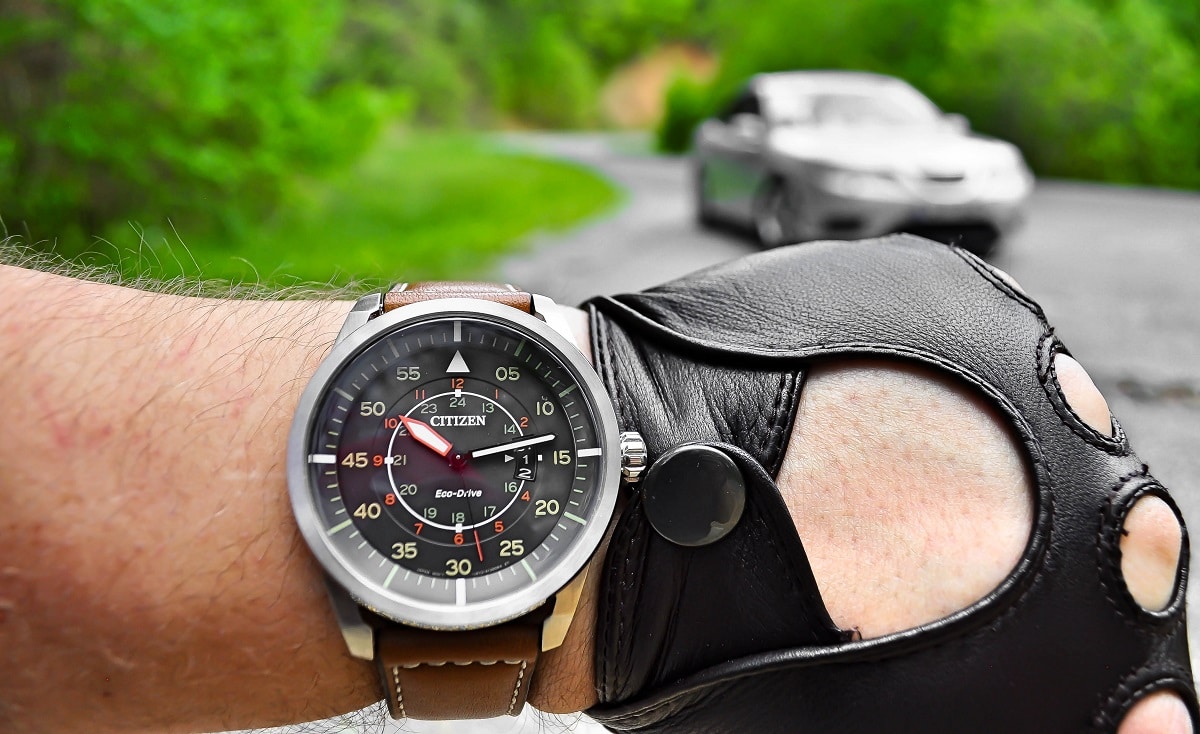
Citizen Avion AW1361-10H
| Price: | $200 |
| Water Resistance: | 100m |
| Case Dimensions: | 45mm (diameter) x 52mm (lug-to-lug) x 12mm (thickness) |
| Lug Width: | 22mm, tapers down to 20mm |
| Movement: | J810 Citizen Eco-Drive quartz |
The Citizen Avion AW1361-10H feels worth it because it delivers the charm of a classic pilot watch without adding another maintenance routine. The Eco-Drive J810 movement is a big reason why. It runs for roughly ±15 seconds per month, charges from regular light, and eliminates battery changes. If you want an aviation watch that lives by the front door and is always ready to wear, that convenience ends up mattering more than an elaborate movement hidden behind a solid caseback.
The dial gives the Avion far more personality than most pilot-style watches at this price. Citizen’s Type B layout could have felt cluttered, but the mustard-yellow minute track, orange hour markers, and white 24-hour scale make it quite easy to read in daylight. The raised chapter ring adds depth, while the matching sword hands and orange-tipped second hand keep the design cohesive instead of feeling like a collection of vintage cues. At 45mm across with a 52mm lug-to-lug measurement, it’s undeniably a large watch, but the 12mm thickness and tapered caseback help keep it planted on the wrist instead of feeling top-heavy. Once the thick leather strap softens with wear, it settles nicely on the wrist and develops the worn-in character that suits the watch’s tool-watch personality.
The trade-offs are worth knowing before buying. The oversized crown feels easy to grip and adjust, even with gloves, but the case finishing stays firmly on the functional side rather than trying to imitate a higher-end watch. More noticeably, Citizen only applies lume to the hands, so the bold instrument-style dial loses much of its usefulness after dark. If nighttime legibility is a priority, you’ll notice that limitation quickly.
Even then, for anyone who wants an affordable aviation watch with distinctive styling, low-maintenance ownership, and enough character to avoid feeling like just another generic quartz watch, the Avion remains money well spent. For a closer look at its on-the-wrist experience, check out our dedicated review.
Pros
- Eco-Drive solar movement keeps ownership simple with no routine battery changes.
- Color-coded Type B dial stays readable without sacrificing personality.
- The oversized crown is easy to operate, even while wearing gloves.
- Thick leather strap develops a worn-in character over time.
- Large case wears better than its dimensions suggest, thanks to the slim profile and tapered caseback.
Cons
- Lume is limited to the hands, reducing nighttime legibility.
- The 45mm case and 52mm lug-to-lug won’t suit smaller wrists.
- Case finishing prioritizes function over refinement.
Vaer G2 Meridian GMT

| Price: | $399 |
| Water Resistance: | 150m |
| Case Size: | 39mm (diameter) x 46mm (lug-to-lug) x 10mm (thickness) |
| Lug Width: | 20mm |
| Movement: | Swiss-made Ronda 515.24H |
The Vaer G2 Meridian GMT feels worth keeping around because it never overcomplicates the idea of a travel watch. Instead of chasing mechanical prestige, it leans into convenience with the Swiss Ronda 515.24H quartz GMT movement. You get multi-year battery life, a quick-set date, and a caller GMT that’s easy to adjust when you want to keep tabs on another time zone. It fits the watch’s personality perfectly: dependable, low-maintenance, and always ready to go.
The compact case is another reason it kept earning wrist time. At 39mm across, 46mm lug-to-lug, and only 10mm thick, it sits flat and disappears on the wrist during long days in a way many GMTs simply don’t. The 150m water resistance and screw-down crown mean you don’t have to think twice about where you wear it, while the brushed and polished surfaces keep it from looking too plain. We also ended up sticking with the rubber strap. It has a nicer taper and more substance than some of Vaer’s earlier straps, and it suits the lightweight case better than the included NATO, which felt noticeably stiffer.
As pointed out in our full write-up, the dial gets the fundamentals right. Applied markers add a little depth, the 6 o’clock date keeps everything balanced, and the hands stay easy to pick out at a glance. The lume is useful too, lasting well beyond the quick glow you get from some entry-level watches. Our biggest complaint was the red-and-blue Pepsi bezel. The bidirectional action makes changing the second time zone easy, but there’s enough play—and the occasional alignment miss—to remind you where Vaer chose to save money.
Even so, those compromises never got in the way of what the G2 Meridian does best: offering a comfortable, grab-and-go aviation GMT that keeps daily ownership quite simple.
Pros
- Slim, lightweight case stays comfortable through long days.
- The Swiss Ronda quartz GMT movement keeps ownership simple and reliable.
- 150m water resistance combined with a screw-down crown makes it easy to wear anywhere.
- Clean, legible dial with lume that’s useful after dark.
Cons
- Bezel alignment isn’t always spot on.
- The bidirectional bezel has a bit of play.
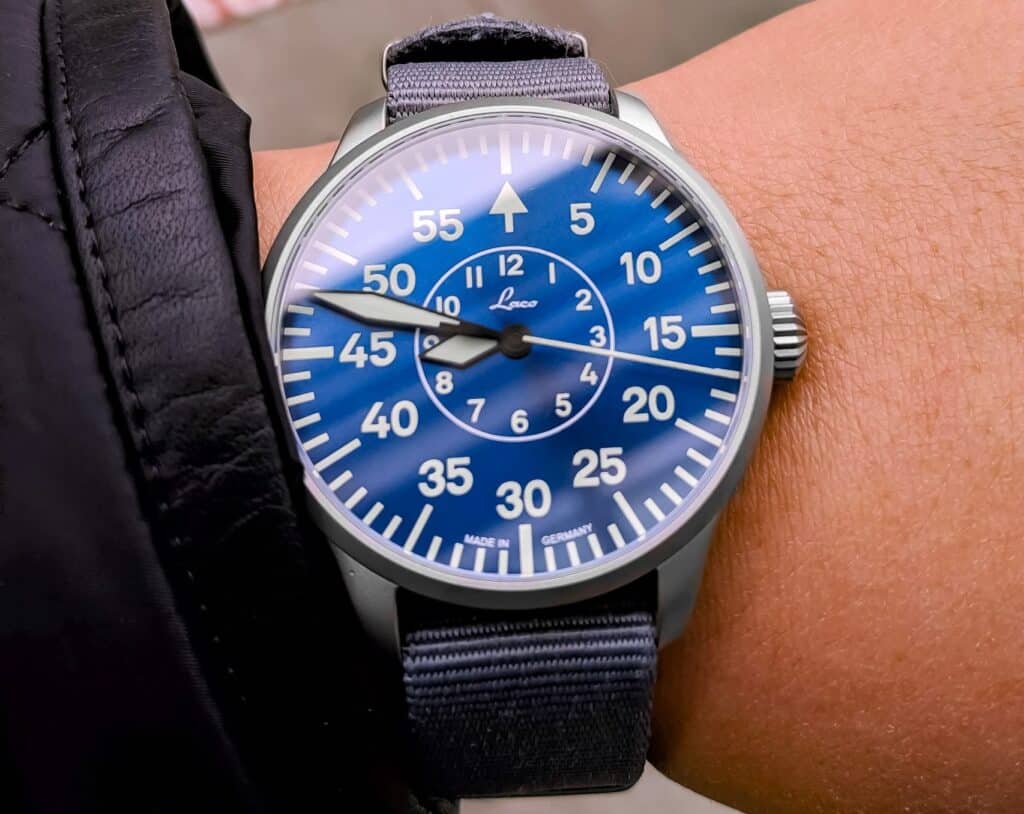
Laco Aachen 42 Blaue Stunde
| Price: | $410 |
| Water Resistance: | 50m |
| Case Dimensions: | 42mm (diameter) x 50mm (lug-to-lug) x 11.75mm (thickness) |
| Lug Width: | 20mm |
| Movement: | Laco 21 (Miyota 821A with a skeletonized rotor) |
The Laco Aachen 42 leans into its aviation roots without turning the whole thing into a museum exercise, and that’s why it belongs here. Laco has the pedigree here, and this version keeps the original pilot-watch idea intact while still feeling usable on an actual wrist.
It is a Type-B flieger, so the big outer minute track and smaller inner hour scale give it a busier look than a Type-A dial. However, in practice, that layout makes quick reading easy enough once your brain stops overthinking it. The blue sunburst dial on this version helps, too. It adds a bit more personality than the usual black-dial flieger, while the white lume on the markers and hands keeps the whole thing readable instead of decorative. Laco also applies C3 Super-LumiNova across the full length of the baton-style second hand, while the matte black edging on the hands helps them stand out cleanly as the light changes.
The case is where the Aachen starts to make sense beyond the spec sheet. At 42mm across and 50mm lug-to-lug, it is not small, but the short downward-curving lugs help it sit flatter, and the 12mm thickness keeps it from feeling like a puck. The full bead-blasted finish does the practical work here: it cuts glare, matches the tool-watch brief, and gives the watch that dry military-adjacent texture without trying too hard. The oversized onion crown is one of those details that looks right in photos and also proves genuinely useful when you are setting the time with one hand or slightly annoyed in a parking lot.
Inside, the Laco 21 movement — basically a signed Miyota 821A — keeps the price from drifting into silly territory. It is hand-wound, runs at 21,600 bph, and offers a 42-hour power reserve, so the watch stays approachable rather than precious. The trade-offs are the usual ones: no hacking, a ghost date click, and accuracy that lives in the broad -20 to +40 seconds-per-day range. That is not the point here, and it never really needs to be. The included grey NATO suits the watch’s lighter feel, the case takes strap changes well, and the whole package lands in a nice place for someone who wants a proper aviation watch that still feels like something they would actually wear, not just admire from across the room. Read our full review for the smaller on-wrist details.
Pros
- Authentic Laco flieger heritage at an approachable price.
- Bead-blasted finish reduces glare and suits the tool-watch character.
- The oversized onion crown is easy to grip and operate.
- 42mm case wears comfortably thanks to the short, curved lugs and modest thickness.
- The lightweight NATO strap is comfortable and works well with strap changes.
Cons
- No hacking seconds.
- Ghost date click remains despite the no-date dial.
- Accuracy isn’t on par with higher-grade movements.
Seiko 5 GMT
| Price: | $475 |
| Water Resistance: | 100m |
| Case Dimensions: | 42.5mm (diameter) x 46mm (lug-to-lug) x 13.6mm (thickness) |
| Lug Width: | 22mm |
| Movement: | Seiko 4R34 (Mechanical Movement) |
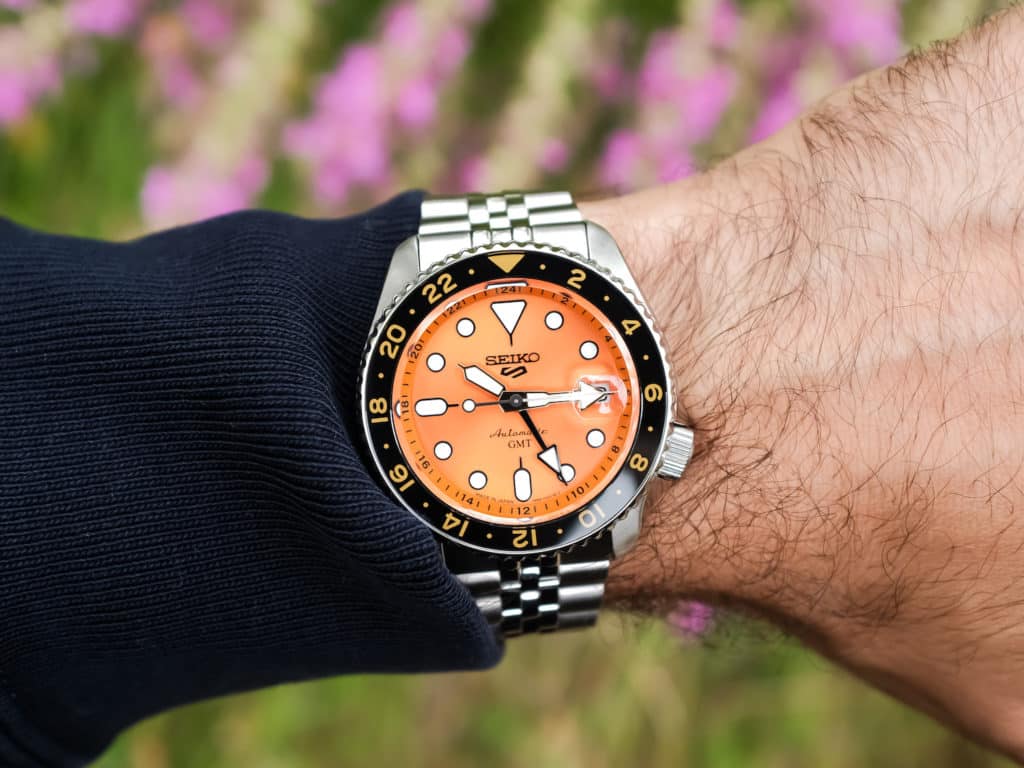
The Seiko 5 GMT isn’t trying to recreate a vintage pilot’s watch, and that’s part of its appeal. It brings aviation into everyday life through a practical GMT complication, then backs it up with the familiar comfort and versatility that kept us reaching for it long after the novelty wore off.
Its 4R34 automatic movement uses a caller GMT setup, so the local hour hand doesn’t jump independently like a flyer GMT. Frequent international travelers may wish for that feature, but for keeping track of family abroad, work in another time zone, or simply making use of the fourth hand, it works without adding complexity. Pair that with the rotating 24-hour bezel, and tracking a third time zone is always an option. The familiar 40-hour power reserve also means anyone who has owned a modern Seiko will know exactly what to expect.
The SKX DNA comes through the moment it hits the wrist. The 42.5mm case, 46mm lug-to-lug, rounded lugs, and asymmetrical crown guards give it the broad-shouldered look of a Seiko sports watch, while the mix of brushed and polished surfaces stops it from feeling like a plain slab of steel. The biggest compromise is the push-pull crown and 100m water resistance, even if independent pressure testing suggests the case is tougher than the spec sheet lets on. The Jubilee-style bracelet is light, a little jangly, and comfortable enough to disappear during long days on the wrist. The stamped clasp, polished center links, and pin-and-collar sizing system won’t win everyone over. Still, if the bracelet starts wearing on your patience, the case transitions effortlessly to a NATO.
Our review team found that the dial is where this watch quietly punches above its price. The orange sunray finish catches changing light beautifully, while the black marker surrounds, gilt hour and minute hands, and glossy black GMT hand create enough contrast to keep everything easy to read. Even the black-and-grey 24-hour bezel insert has sufficient depth. The smooth bidirectional bezel lacks clicks, which takes away some of the tactile satisfaction you’d expect from a sports watch, and the cyclops over the date will split opinions. However, for anyone drawn to the travel side of aviation watches, those compromises are easy to live with because the GMT function and everyday wearability remain the real story.
Pros
- Practical 4R34 caller GMT movement with a rotating bezel for tracking a third time zone.
- The familiar SKX-inspired case is comfortable and well-balanced on the wrist.
- The orange sunray dial offers impressive depth without compromising legibility.
- Lumibrite, black marker surrounds, and the handset make time easy to read.
- Lightweight Jubilee-style bracelet is comfortable for everyday wear.
Cons
- Smooth bidirectional bezel has no clicks.
- Cyclops over the date won’t appeal to everyone.
- The stamped clasp feels basic.
- Pin-and-collar bracelet sizing can be frustrating.
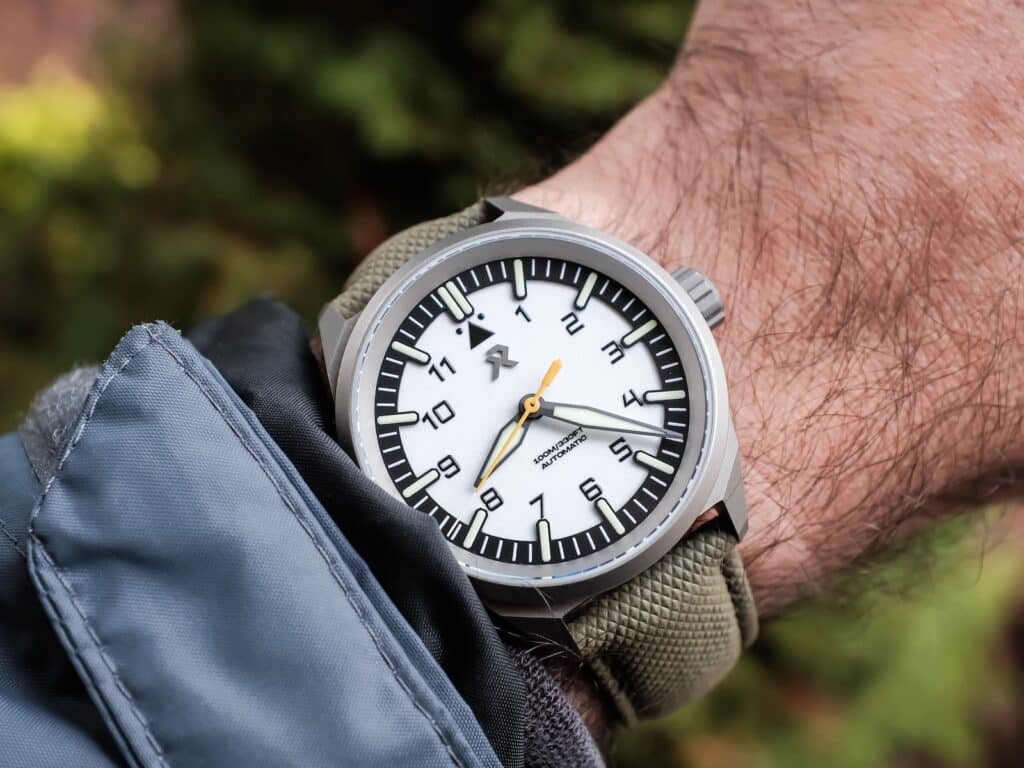
RZE Resolute Type A
| Price: | $499 (TecTuff strap); $699 (matching titanium HexLink bracelet) |
| Water Resistance: | 100m |
| Case Dimensions: | 39.5mm (diameter) x 46mm (lug-to-lug) x 11.5mm (thickness) |
| Lug Width: | 20mm |
| Movement: | Miyota 82S0 |
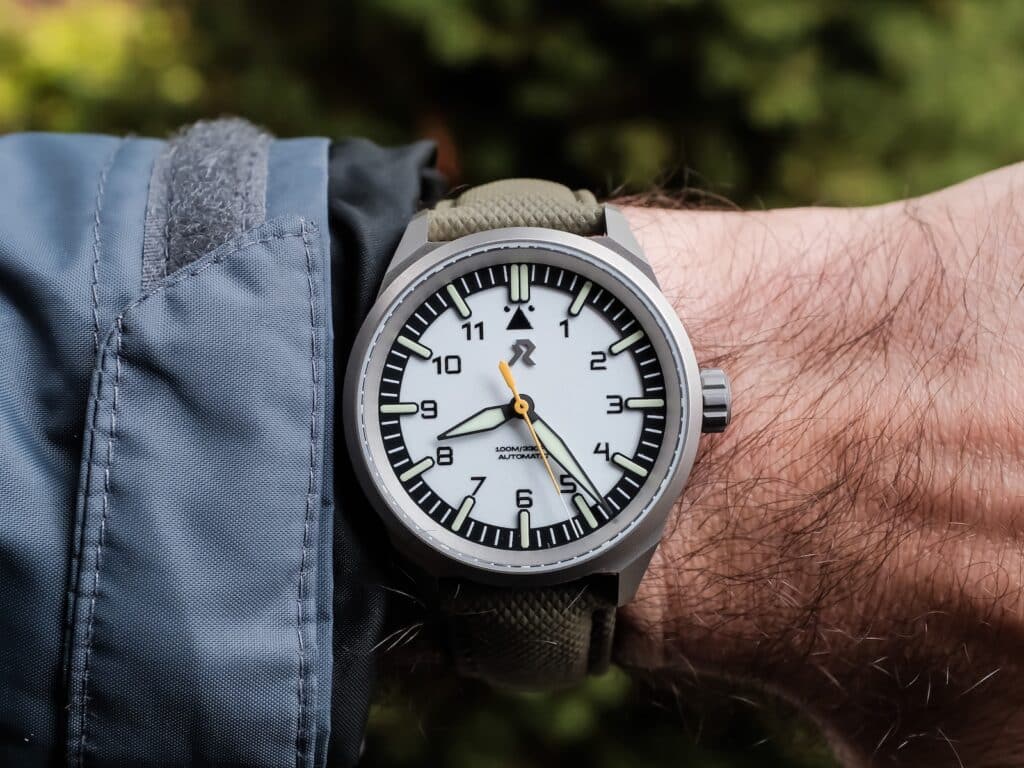
The RZE Resolute Type A proves an aviation watch doesn’t have to feel like a historical reenactment to be worth wearing. It keeps the familiar Type A flieger layout—the triangle at 12, bold outer minute track, sword hands, baton markers, and inner 12-hour scale—but skips the faux-aged lume and heavy-handed heritage cues. The result feels clean, contemporary, and easy to wear, whether you’re heading out for the weekend or just want a pilot-style watch that doesn’t demand the rest of your outfit follow suit.
The lightweight Grade 2 titanium case is what kept us coming back to it. Measuring 39.5mm across, 46mm lug-to-lug, and 11.5mm thick, it has enough wrist presence without ever feeling cumbersome. RZE’s UltraHex hardening treatment, rated at around 1200 Hv, also makes a noticeable difference. You’re far less likely to baby it around door frames, backpack zippers, or the other hazards of everyday life. A screw-down crown, proper gasket construction, and 100m of water resistance reinforce that practical mindset. The TecTuff strap features a synthetic outer layer, a water-resistant calf lining, quick-release spring bars, a comfortable 20mm-to-18mm taper, and an UltraHex-coated titanium buckle that feels as thoughtfully finished as the case itself.
The dial stays true to the flieger formula without feeling sterile. The raised chapter ring and applied markers add welcome depth, while the white-dial version we reviewed gives the watch a crisp instrument-panel character beneath the sapphire crystal. The full-lume treatment certainly pushes it in a more modern direction—traditional flieger fans may grumble into their leather flight jackets—but it works well in practice.
Inside, the Miyota 82S0 offers hacking, hand-winding, automatic winding, a 21,600 vph beat rate, and around 42 hours of power reserve, making ownership straightforward. Even the aviation-themed caseback adds a bit of personality, even if it’s more of a fun nod than something you’ll admire every day.
Pros
- Clean Type A layout stays very legible.
- Lightweight titanium case remains comfortable through long days.
- UltraHex coating adds meaningful scratch resistance.
- Well-executed TecTuff strap with quick-release bars, a comfortable taper, and a titanium buckle.
- Screw-down crown and 100m water resistance encourage everyday wear.
Cons
- Modern full-lume dial won’t appeal to flieger traditionalists.
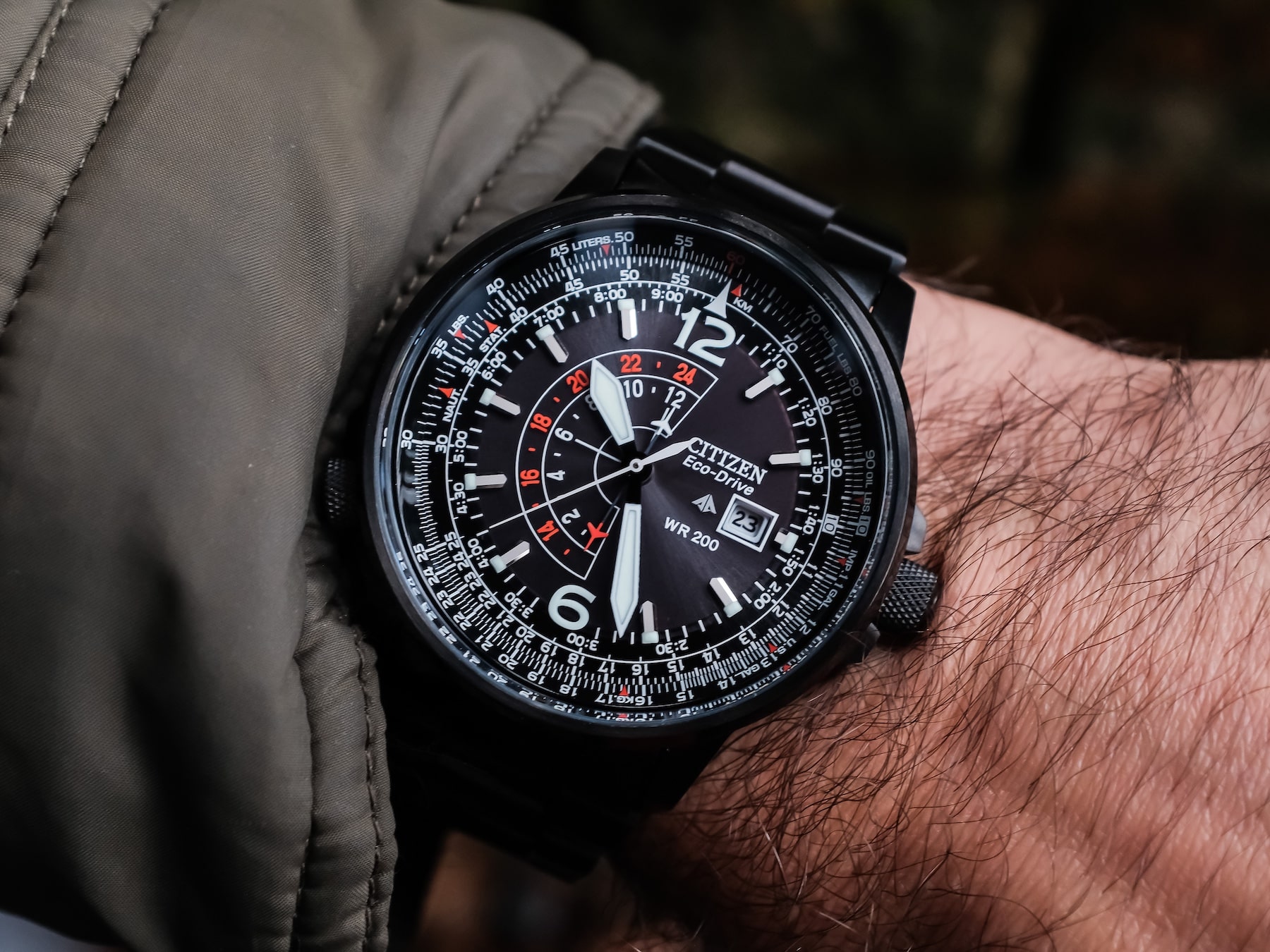
Citizen Nighthawk
| Price: | $500 |
| Water Resistance: | 200m |
| Case Size: | 42.5mm (diameter) x 47mm (lug-to-lug) x 12.6mm (thickness) |
| Lug Width: | 22mm |
| Movement: | Citizen B877 Eco-Drive caliber (solar-powered quartz) |
The Citizen Nighthawk belongs to this list because it packs genuine aviation-inspired functionality into a watch that’s built to be used, not admired from a display case. The Eco-Drive B877 movement keeps ownership simple by combining solar charging, a second time zone, a date display, and a jumping local-hour hand, making switching time zones far less tedious when you’re traveling. It also runs within about ±15 seconds per month and stores enough charge to keep ticking for roughly six months away from light. The setting action feels crisp with very little hand play, which is reassuring because you’ll probably interact with this watch more often than a standard three-hander.
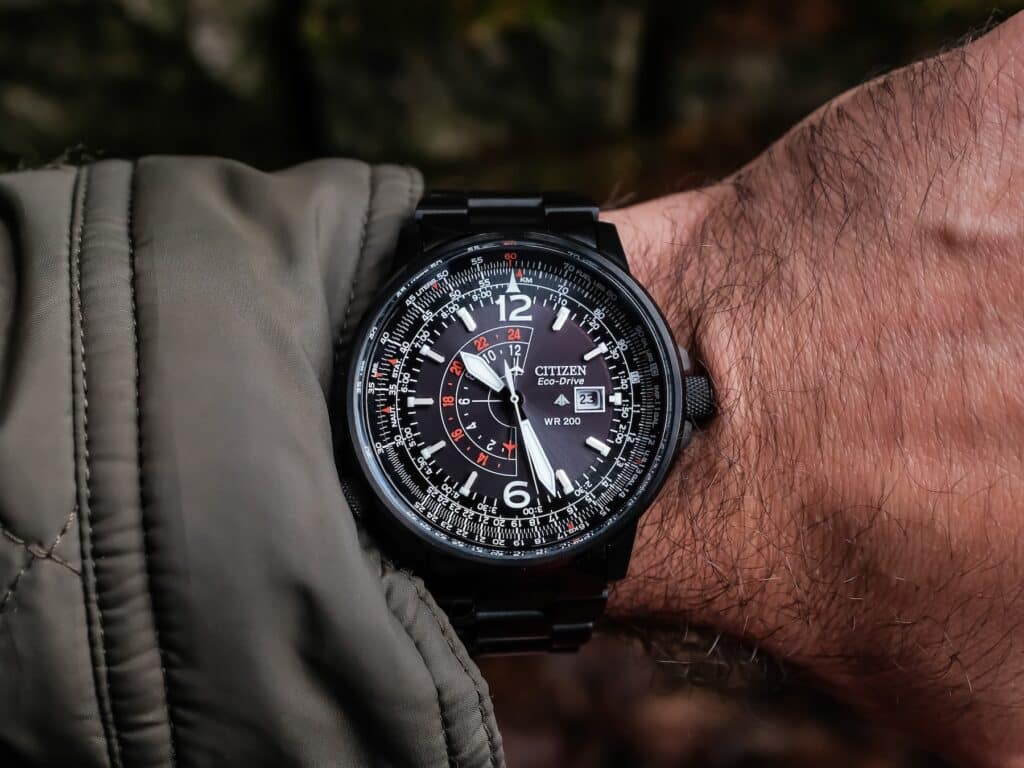
Plenty is happening on the dial, yet it rarely feels chaotic. The internal E6B slide rule sits quietly in the background until you need it, and the dedicated crown at 8 o’clock keeps it securely in place instead of spinning accidentally. For everyday time checks, the bold indices and sword hands naturally stand out, while the applied markers, with polished edges and lume-filled outer sections, add welcome depth. Even the GMT hand gets a bit of personality through its red-and-white airplane motif, making it obvious which side of the scale you’re reading. The compromise is that the main hands occasionally cover parts of the secondary time-zone scale, so reading it isn’t as effortless as a conventional 24-hour bezel.
The black ion-plated stainless steel case gives this version of the Nighthawk a more industrial personality than the standard aviation-tool look. At 42.5mm across and 12.6mm thick, it has real wrist presence, backed by a screw-down crown, an engraved screw-down caseback, and 200m of water resistance, which encourage everyday use rather than careful ownership. The matching bracelet feels solid, avoids the loose rattle found on some watches in this price range, and the push-button deployant clasp with fold-over safety plus micro-adjustment makes finding a comfortable fit easy. We still preferred it on rubber or nylon once the bracelet’s weight became apparent.
While reviewing it, we found that the lume charges quickly and emits Citizen’s familiar blue glow, while the exposed mineral crystal, with an internal anti-reflective coating, remains the clearest reminder that compromises were made to hit the price point. Even then, those trade-offs never overshadow the Nighthawk’s biggest strength: it delivers the kind of practical aviation watch experience that keeps making sense long after the novelty fades.
Pros
- Eco-Drive B877 movement combines solar charging with a practical second time zone.
- Runs within roughly ±15 seconds per month and stores up to six months of charge.
- Secure E6B slide rule, solid bracelet, and adjustable clasp suit everyday wear.
- The screw-down crown, combined with 200m water resistance, makes it more capable than expected.
Cons
- Main hands can obscure the secondary time-zone scale.
- Mineral crystal feels like the obvious cost-saving choice.
- Black ion plating may reveal steel if deeply scratched.
- Large, weighty case won’t suit every wrist.
Imperial Oceanguard GMT
| Price: | $600 |
| Water Resistance: | 200m |
| Case Dimensions: | 38mm (diameter) x 47mm (lug-to-lug) x 14mm (thickness) |
| Lug Width: | 20mm |
| Movement: | Seiko NH34 |
The Imperial Oceanguard GMT earns its spot here because it brings a useful aviation-adjacent GMT into the mix without acting like the Seiko 5 GMT is the only answer under the sun. It uses the NH34, so no one is confusing this with some radical reinvention of the affordable GMT formula. Still, Imperial packages it in a way that feels more considered than default. It is still a GMT caller, so the 24-hour hand adjusts rather than the local hour hand jumping independently. That’s less ideal for frequent flyers but fine for everyone else trying to keep track of work, family, or a second market without turning the watch into a part-time headache. The bi-color bezel carries some of the time-zone work too, so the caller-versus-flyer debate feels a lot less dramatic once the watch is actually on the wrist.
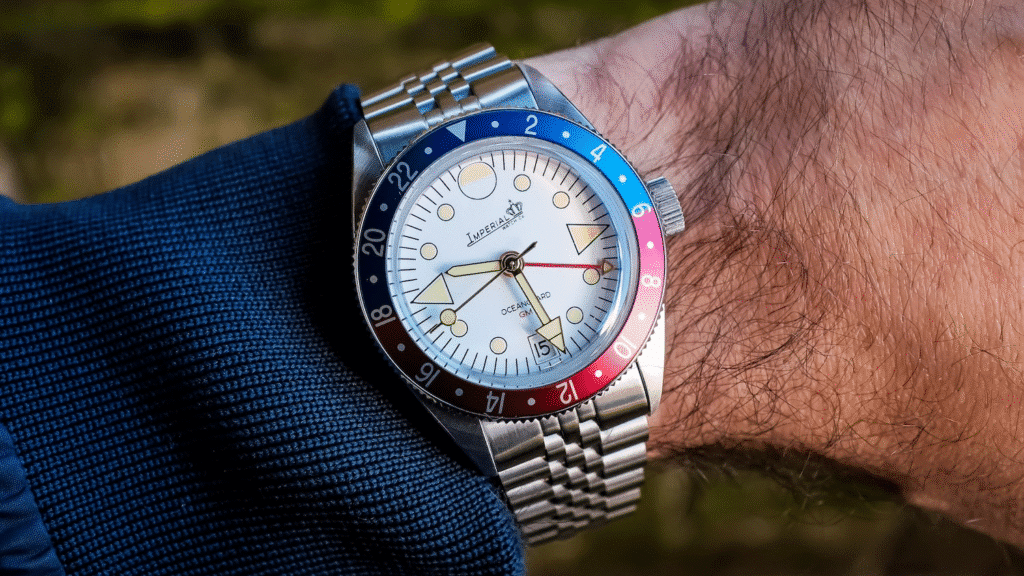
The 38mm case is what separates the Oceanguard from the usual affordable GMT crowd. A lot of entry-level GMTs end up wearing like compact dive watches that got talked into airport duty; this one keeps a smaller, skin-diver-style feel that makes more sense on a wider range of wrists. It sits with restraint instead of bulk, and the proportions feel intentional rather than like somebody waved a vintage reference around a design board and hoped for the best. The oversized crown looks a little theatrical at first, but it is easy to grip, and that matters more than how it looks in photos.
The white dial also looks better in real life than it does in product shots. The mix of dots, triangles, and the circular marker at 12 makes orientation fast, legibility holds up well indoors and outdoors, and the lightly aged lume adds character without sliding into fake-patina cosplay. That restraint is doing real work here; the retro cues support readability instead of becoming the whole personality.
As noted in our hands-on review, the bracelet may be the strongest argument for this watch over more mainstream alternatives. The jubilee-style bracelet articulates well, stays comfortable over long wear, and the tool-less microadjustment is the kind of thing you ignore until your wrist decides to grow a little after lunch or during travel. Then suddenly it seems very smart indeed. The clasp is chunkier than the rest of the watch deserves, and the case can still read a bit thick if you are chasing strict vintage proportions. However, those trade-offs never overshadow the ownership experience. The Oceanguard GMT succeeds because it delivers the kind of comfortable, easy-to-live-with aviation GMT that keeps making sense every time you need another time zone.
Pros
- Compact 38mm case wears comfortably, especially on smaller wrists.
- Clear dial layout makes quick time checks easy.
- The bi-color bezel works well for tracking a second time zone.
- Jubilee bracelet is comfortable and includes excellent tool-free micro-adjustment.
Cons
- The clasp feels chunkier than the rest of the watch.
- NH34 caller GMT isn’t as convenient as a flyer GMT for frequent travelers.
- The case may still appear a little thick for vintage purists.
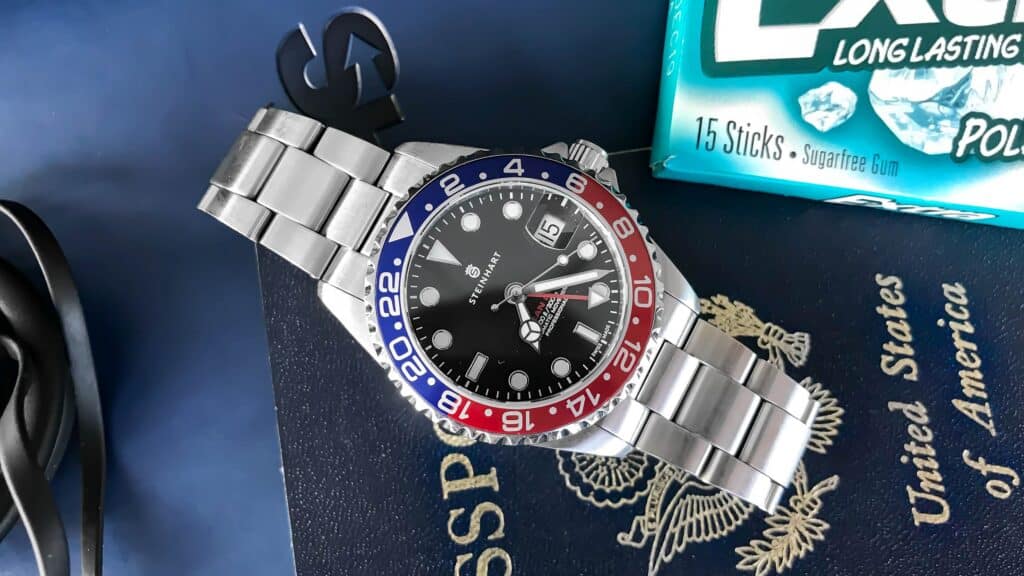
Steinhart Ocean 39 GMT
| Price: | $650 |
| Water Resistance: | 300m |
| Case Dimensions: | 39mm (diameter) x 47mm (lug-to-lug) x 13mm (thickness) |
| Lug Width: | 20mm but tapers down to 16mm |
| Movement: | ETA 2893-2 |
The Steinhart Ocean 39 GMT asks you to accept one thing up front: nobody is going to mistake it for an original design (read, the Rolex GMT-Master II). Once you get past that, it’s easy to appreciate what it does well. It focuses on delivering the familiar aviation-GMT experience at a price that feels attainable. After spending extended wrist time reviewing it, we found ourselves caring much more about how well it worked than what inspired it. The 39mm case plays a big role in that. It has enough presence to feel like a proper sports watch without dominating the wrist, and while the 13mm thickness sounds chunky on paper, it never became noticeable during everyday wear. The brushed finish keeps the watch looking purposeful, the polished case sides add a little contrast, and the engraved Neptune caseback gives it at least one detail that’s signature Steinhart.
The dial also knows when to keep things simple. The matte black background makes the bright red GMT hand easy to pick out, the familiar Pepsi bezel keeps a second time zone intuitive to read, and the Cyclops speeds up date checks, even if we’ve seen stronger magnification elsewhere. Once the lights go down, the BGW9 lume lingers longer than we expected, making the watch feel useful rather than simply photogenic. The bracelet deserves some credit too. The screwed links feel quite solid, and while the flip-lock clasp can become a little stubborn when you’re trying to dial in the perfect fit, it’s a compromise most owners will probably forget five minutes after leaving the house.
Inside is the Swiss ETA 2893-2, so this is still a caller GMT rather than a flyer. If you’re constantly crossing time zones, you’ll notice the difference. For everyone else, tracking another office, a family member, or a destination is straightforward enough that movement never feels like the limiting factor.
The bezel gives and takes away in equal measure. Visually, the bright Pepsi insert pairs nicely with the matte black dial and keeps a second time zone easy to follow. Mechanically, though, it behaves more like a dive bezel. The 120-click action is firm and confidence-inspiring, but because it’s unidirectional, changing the GMT hand’s reference becomes more of a process than it probably needed to be. In short, it’s not the aviation GMT we’d buy for originality. Still, it is one we’d happily keep wearing because it gets the fundamentals right without asking you to overthink them.
Pros
- Matte dial, red GMT hand, and BGW9 lume make time easy to read day or night.
- Pepsi bezel delivers the classic GMT look without feeling cheaply executed.
- Solid bracelet with screwed links and a secure safety clasp.
- The compact 39mm case wears comfortably on a wide range of wrists.
Cons
- The unidirectional bezel isn’t the most practical choice for frequent GMT adjustments.
- Polished surfaces and bezel teeth pick up scratches sooner than the brushed areas.
- Flip-lock clasp can be fiddly to fine-tune.
Nodus Contrail GMT Laguna
| Price: | $825 |
| Water Resistance: | 200m |
| Case Dimensions: | 40.5mm (diameter) x 46.6mm (lug-to-lug) x 11.8mm (thickness) |
| Lug Width: | 20mm |
| Movement: | Miyota 9075 |
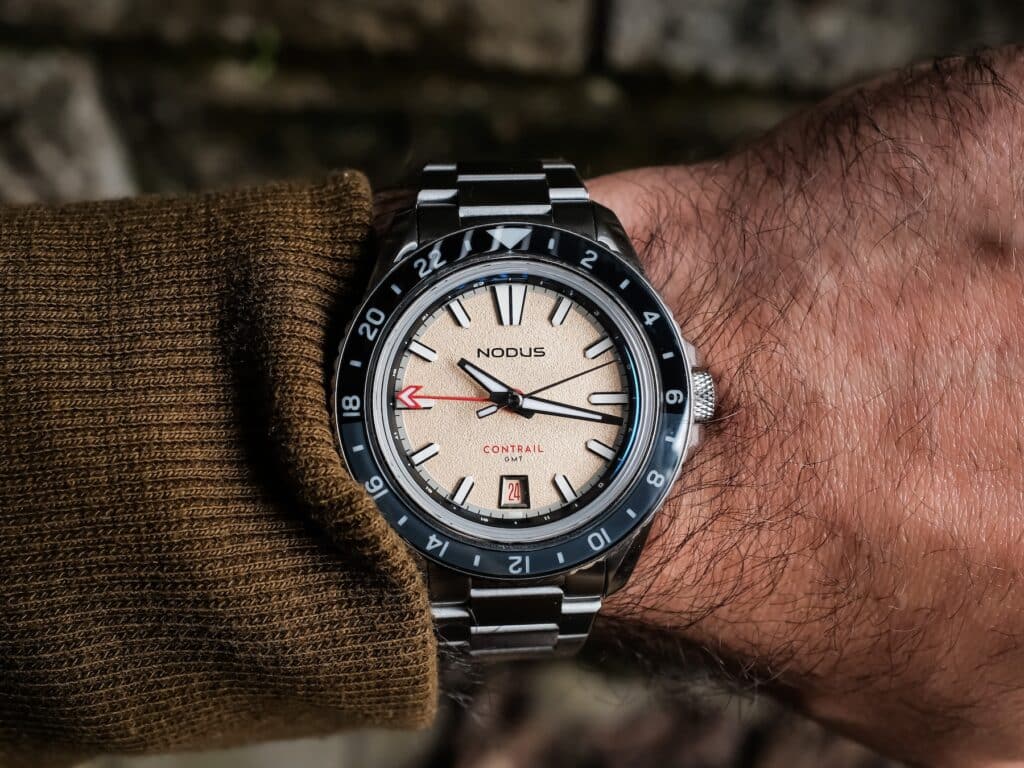
Many aviation GMTs get you the look. The Nodus Contrail GMT Laguna gets much closer to the experience. Between the flyer GMT movement, slim case, and thoughtful everyday details, it kept giving us reasons to wear it.
The Laguna dial has a warm, sandy tone that changes with the light without becoming distracting, while the bold handset stays easy to separate at a glance. The bi-directional 24-hour bezel also deserves applause. Its smooth 48-click action makes tracking multiple time zones feel intuitive after a short learning curve, and the combination of the bezel, internal 24-hour scale, and GMT hand quickly becomes second nature. We only wished the internal 24-hour numerals were a little larger, as they’d make quick reads even easier.
The watch also feels thoughtfully engineered on the wrist. At 40.5mm across, with an 11.8mm profile and a 46.6mm lug-to-lug, it avoids the top-heavy feel that affects many GMTs that use the same movement. Twisted lugs help the case settle naturally, while the mix of brushed and polished surfaces, box sapphire crystal, and sapphire bezel insert gives it substantial visual depth. The H-link bracelet stays comfortable thanks to its 20mm-to-16mm taper; screw links make sizing painless; and the NodeX clasp earns its extra bulk with useful on-the-fly micro-adjustment. (It’s one of those features you stop thinking about until you wear a bracelet without it.)
Powering everything is the Miyota 9075, one of the biggest reasons the Contrail GMT feels worth owning. The flyer GMT setup lets the local hour hand jump independently, making travel-day adjustments far easier than a caller GMT. During our testing period, the movement remained consistent, the roughly 42-hour power reserve fit easily into a normal rotation, and the large screw-down crown made every adjustment feel deliberate instead of fiddly. Add 200m of water resistance and BGW9 lume across the markers, bezel numerals, and GMT hand, and the Contrail becomes the kind of aviation-inspired GMT that’s easy to keep wearing.
Pros
- Flyer-style Miyota 9075 makes travel-friendly time changes effortless.
- The slim case wears much flatter than many GMTs that use the same movement.
- Smooth 48-click bidirectional bezel makes multiple time zones easy to track.
- Excellent BGW9 lume across the dial, bezel, and GMT hand.
- NodeX clasp offers genuinely useful on-the-fly adjustment.
Cons
- Internal 24-hour numerals could be larger.
- NodeX clasp feels chunkier than the rest of the bracelet.
- Bracelet taper is more conservative than some collectors may prefer.
Nodus x Raven TrailTrekker
| Price: | $875 |
| Water Resistance: | 200m |
| Case Dimensions: | 39.5mm (diameter) x 46.6mm (lug-to-lug) x 11.8mm (thickness) |
| Lug Width: | 20mm |
| Movement: | Miyota 9075 |
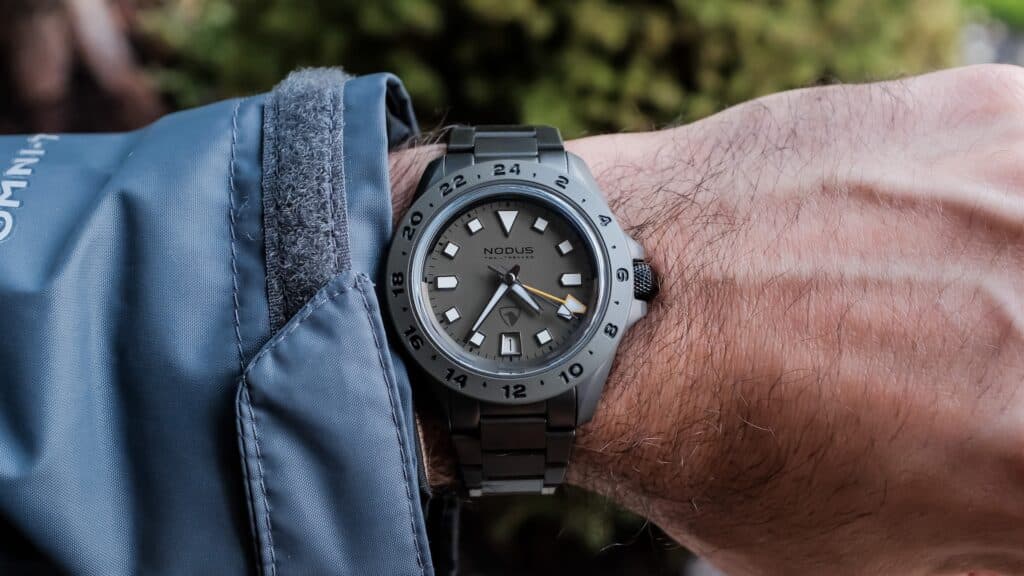
The Nodus x Raven TrailTrekker approaches aviation from the perspective of someone more likely to end a trip on a trail than in an airport lounge. The Miyota 9075 flyer GMT is a big reason it works. Having the local hour hand jump independently makes crossing time zones painless. During our time reviewing the watch, the adjustment felt clean and precise, with accuracy remaining within a few seconds of our reference time. The jumping hour also makes date changes feel more intuitive when traveling. It’s still a relatively new movement, so we’ll keep an eye on long-term durability, but the early ownership experience left a strong impression.
The rugged styling isn’t just for show. The muted grey DLC-coated 39.5mm case avoids the glossy tactical look that some coated watches fall into. At the same time, the sand-colored Cerakote bezel gives the watch a dry, tool-first character that fits its personality perfectly. The high-contrast 24-hour scale keeps second-time-zone tracking straightforward. The textured dial carries the same sandy finish, with applied markers, gunmetal hands, and a bright yellow GMT hand that’s impossible to lose during a quick second-time-zone check—even if traditionalists might wish it had dialed the enthusiasm back a notch. The balanced 6 o’clock date and restrained dual branding keep everything clean, and the sapphire crystal, 200m water resistance, and deeply knurled screw-down crown make it feel ready for far more than desk duty.
The TrailTrekker also wears more comfortably than its rugged appearance suggests. The flat-link bracelet sits close to the wrist, tapers from 20mm to 16mm, and quickly became our preferred setup over the included nylon strap. Much of that comes down to the NodeX clasp. Its on-the-fly adjustment offers around 10mm of travel, and once you get used to making quick fit changes throughout the day, going back to a standard clasp feels primitive. The lume won’t challenge the brightest watches in this category, but it remains perfectly usable after dark. Add the engraved caravan caseback, and the TrailTrekker comes together as an aviation-inspired GMT that’s built to be used, not babied.
Pros
- Flyer-style Miyota 9075 makes travel-friendly time changes effortless.
- Rugged DLC case, Cerakote bezel, and 200m water resistance encourage active use.
- Comfortable flat-link bracelet with an excellent NodeX on-the-fly adjustable clasp.
- Clean, legible dial despite the added GMT information and dual branding.
Cons
- The bright yellow GMT hand won’t suit every taste.
- Lume is usable but not class-leading.
Archimede Pilot 39
| Price: | $1,030 (approx.) |
| Water Resistance: | 100m |
| Case Dimensions: | 39mm (diameter) x 45mm (lug-to-lug) x 9.8mm (thickness) |
| Lug Width: | 20mm |
| Movement: | Swiss-made automatic ETA 2824-2 |
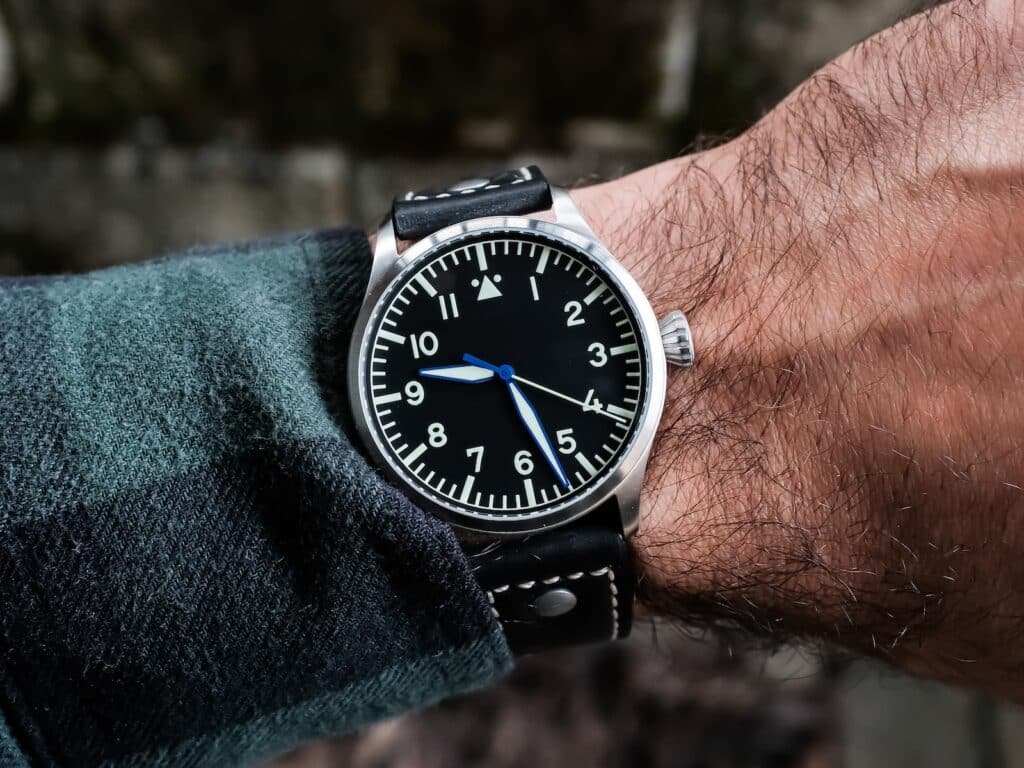
The Archimede Pilot 39 is a good reminder that an aviation watch doesn’t need oversized dimensions to feel authentic. Its 39mm case, 45mm lug-to-lug, and sub-10mm thickness make it one of the easiest fliegers here to wear every day, especially if your routine involves shirt cuffs, long hours at a keyboard, or plenty of time behind the wheel. The signed screw-down onion crown is satisfying to operate, and the 100m water resistance gives the watch a level of everyday confidence that many pilot watches around this price still overlook. At its price point, that practicality feels less like a bonus and more like something that should be expected.
The dial follows the same restrained approach. Nothing is competing for your attention beyond the Arabic hour numerals, the triangle with two dots at 12, and the absence of a date window. That simplicity makes it work. The heat-blued hands add the right amount of personality without disrupting the clean layout, and they’re genuinely heat-blued rather than painted, giving the watch a level of finishing that rewards a closer look. It also helps that this isn’t another anonymous Type A copy. As Ickler’s in-house brand, Archimede benefits from genuine German case-making experience, and it shows in the way the watch is thoughtfully put together.
Power comes from the dependable ETA 2824, a movement that has earned its reputation through reliability and straightforward servicing rather than flashy decoration. The black leather strap, complete with rivets, stitching, and a signed buckle, suits the flieger aesthetic well, although it feels a little thick until it’s broken in. The lume also fades sooner than we’d like, and collectors chasing the deepest historical roots may still gravitate away from this. Even so, those compromises are easy to accept because the Pilot 39 delivers what many aviation watches forget: authentic flieger character in a package that’s truly enjoyable to wear every day. Check out our full thoughts after testing for more wrist-time details.
Pros
- Ickler-built case adds genuine German manufacturing credibility.
- Heat-blued hands elevate the otherwise restrained dial.
- Screw-down onion crown and 100m water resistance improve everyday practicality.
- The compact 39mm case is comfortable for daily wear.
- The leather strap complements the flieger design without overpowering the case.
Cons
- Doesn’t carry the same historical pedigree as Laco or Stowa.
- Lume doesn’t last as long as we’d hoped.
- Leather strap feels thick when new.
- Power reserve is modest by current standards.
Jack Mason Strat-o-Timer GMT
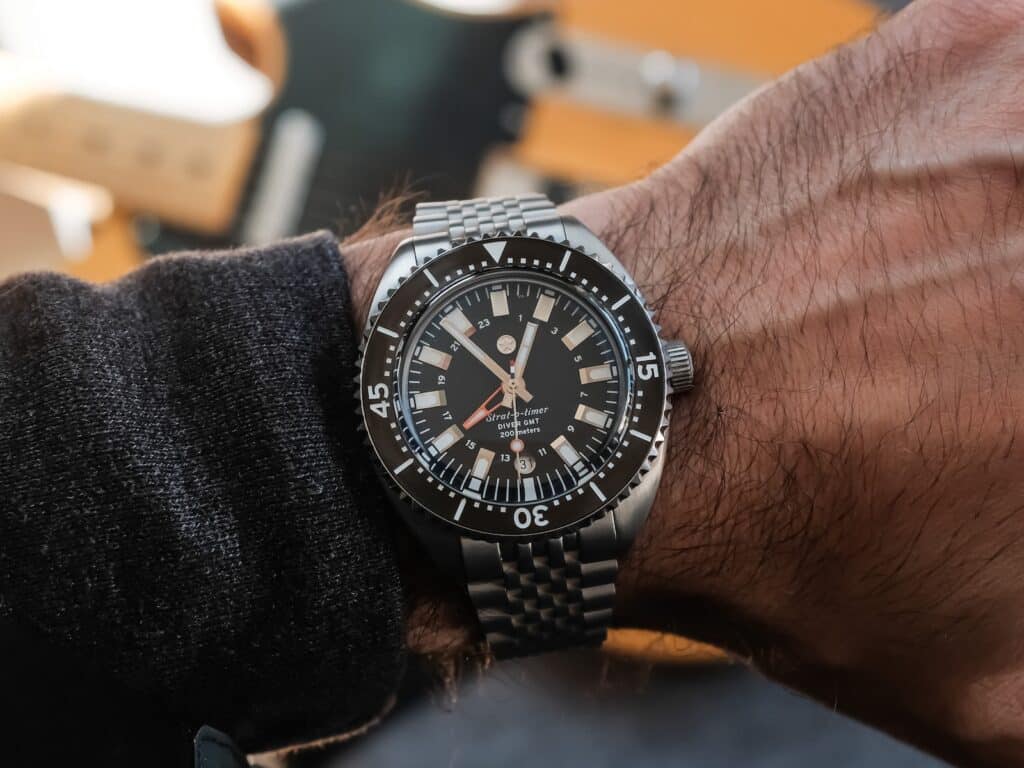
| Price: | $1,399 |
| Water Resistance: | 200m |
| Case Dimensions: | 40mm (diameter) x 47mm (lug-to-lug) x 13mm (thickness) |
| Lug Width: | 20mm |
| Movement: | Miyota 9075 |
The Jack Mason Strat-o-Timer GMT feels like an aviation watch designed by people who spend as much time thinking about travel as they do watches. The Miyota 9075 flyer GMT is the obvious headline, and rightly so. Being able to jump the local hour makes changing time zones painless, but what impressed us more was how naturally the watch used that movement. Instead of forcing the GMT scale onto the bezel, Jack Mason keeps the full 24-hour track on the dial, leaving the ceramic bezel free to work as a proper 120-click dive bezel. It’s a small design decision that makes both complications more useful, rather than asking one bezel to do two jobs poorly.
The titanium version also changed our opinion faster than expected. On paper, saving around 40 grams doesn’t sound transformative. On the wrist, it absolutely is. The Grade 2 titanium case settles in with much less effort than the steel model, and by the end of a full day, you stop thinking about the weight altogether. The 40mm case, 47mm lug-to-lug, curved mid-case, and downward-sloping lugs all help, while the brushed finish, sapphire crystal, screw-down crown, and 200m water resistance encourage you to wear it rather than worry about it. The seven-link titanium bracelet deserves credit too. It drapes naturally instead of feeling slabby, and once you figure out the tool-free micro-adjust clasp, it’s hard to go back to a standard clasp.
Despite juggling dive-watch and GMT duties, the dial never feels as busy as the specifications suggest. Large BGW9-filled markers, stick hands, the skeletonized orange GMT hand, and the lollipop second hand remain easy to separate, while the restrained black and blue color options keep everything under control. The lume also held up well during our evenings outdoors, lighting up the dial, GMT hand, and bezel markings long after many competitors would have called it a night. We did notice a little bezel play, and the markings on our review sample weren’t perfectly aligned, but those quirks never overshadowed the ownership experience.
The Strat-o-Timer succeeds because it doesn’t feel like a dive watch pretending to be an aviation GMT—or the other way around. It simply feels like an American-brand-specific travel watch that was well thought through. If you’d like the full wrist-time story, our in-depth review covers the titanium comfort, clasp adjustment, and everything we noticed after extended wear.
Pros
- Miyota 9075 flyer GMT with Jack Mason’s in-house regulation is useful for travel.
- Lightweight Grade 2 titanium case and bracelet stay comfortable all day.
- Seven-link bracelet drapes naturally and includes tool-free micro-adjustment.
- Strong BGW9 lume across the dial, GMT hand, and bezel markings.
- Dial-mounted 24-hour scale leaves the ceramic bezel free for dive timing.
Cons
- The dial can feel busy initially.
- Tool-free clasp takes a little practice before it feels intuitive.
- The bezel has slight play and imperfect alignment on our review sample.
Farer World Timer Roché II
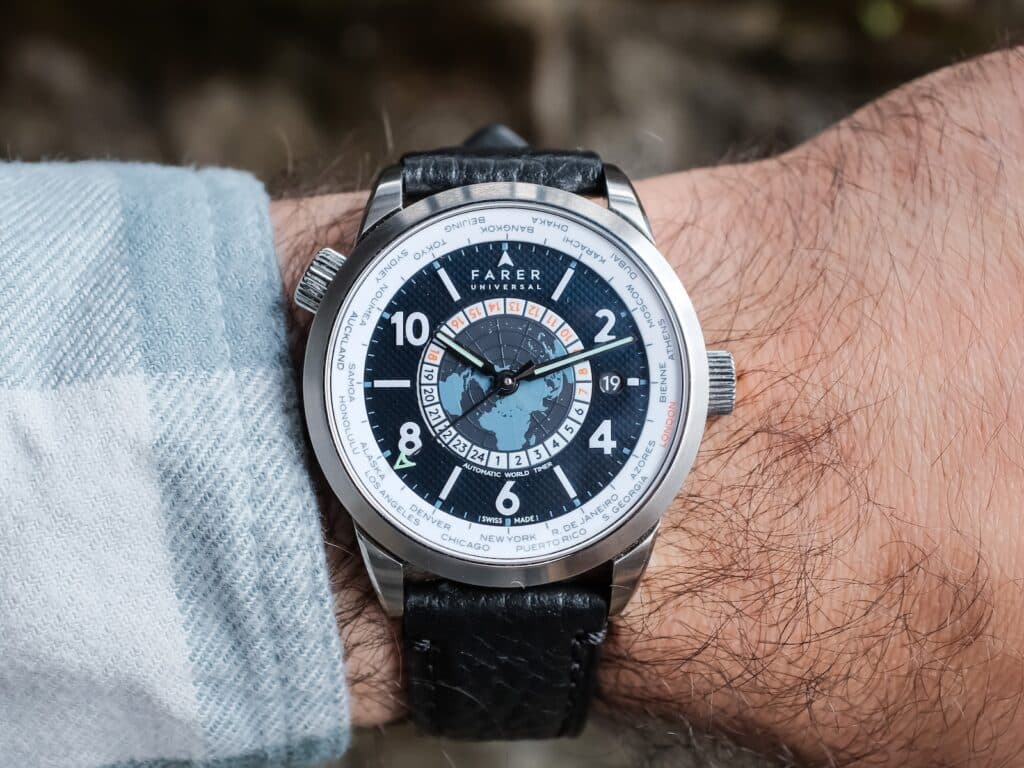
| Price: | $1,695 (leather strap) $1,865 (stainless steel bracelet) |
| Water Resistance: | 100m |
| Case Dimensions: | 39mm (diameter) x 45mm (lug-to-lug) x 11mm (thickness) |
| Lug Width: | 20mm |
| Movement: | Sellita SW330-1 Elaboré |
The Farer World Timer Roché II is proof that an aviation travel watch doesn’t have to sacrifice personality for practicality. At first glance, the world-time display looks like the sort of complication you’ll admire for five minutes before reaching for something simpler. That never happened. After a couple of days, the 24-hour rotating city ring became second nature, and we found ourselves checking another time zone without thinking about the mechanism behind it. That’s ultimately why this watch made the list. It gives you genuine travel functionality without making you feel like you need an instruction manual every time you leave the country.
Farer also resisted the temptation to let the complication overwhelm the watch itself. The textured midnight-blue dial constantly shifts with the light, while the raised markers and updated alpha hands keep the layered display easy to navigate. Yes, there’s more information here than on a traditional pilot watch, but it’s organized rather than overwhelming. The 39mm case helps reinforce that feeling. It sits comfortably across a range of wrist sizes, stays balanced under a cuff, and never develops the top-heavy feel that can creep into watches carrying this much information. Even the generous lume across the hands, markers, and inner bezel proved useful during early flights and late arrivals rather than serving as spec-sheet bragging rights.
As mentioned in our wrist-time review, the modified Sellita SW330 quietly keeps everything moving, delivering consistent performance and a welcome 50-hour power reserve when the Roché II spent a day or two in the watch box. The St. Venere leather strap was comfortable from the first wear, and the quick-release system made switching to the bracelet an easy decision whenever we wanted a different feel.
Add 100m of water resistance, and it becomes a world timer that asks to be worn instead of protected. It isn’t inexpensive, and collectors who prefer clean, instrument-style aviation dials may never warm to the layered display. But if you’re after an aviation-inspired travel watch with a little more personality than the usual GMT formula, the Roché II keeps reminding you why it deserves a place in the collection.
Pros
- Textured blue dial adds plenty of character without sacrificing usability.
- World-time display becomes intuitive after a short learning curve.
- Strong lume is present across the hands, markers, and inner bezel.
- The modified Sellita SW330 performs consistently, with a useful 50-hour power reserve.
- Comfortable leather strap with quick-release convenience and 100m water resistance for everyday wear.
Cons
- Priced above many comparable microbrand alternatives.
- Collectors who prefer cleaner dials may find it visually busy.
- The layered inner bezel takes time to get used to.
Sinn 104
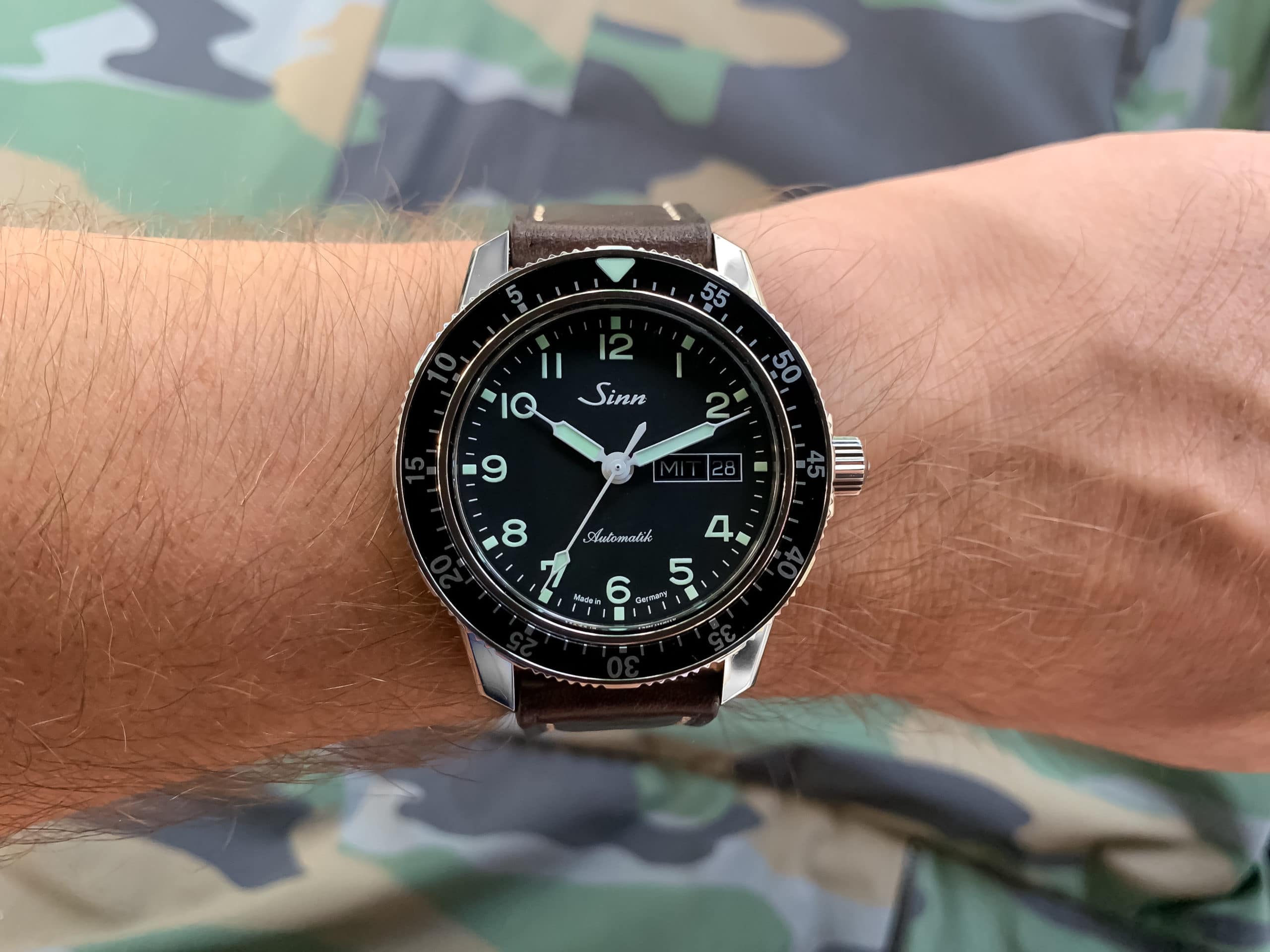
| Price: | $1,860 |
| Water Resistance: | 200m |
| Case Dimensions: | 41mm (diameter) x 11.9mm (thickness) |
| Lug Width: | 20mm |
| Movement: | Sellita caliber SW 220-1 |
The Sinn 104 made this list because it kept reminding us that useful aviation design doesn’t have to shout. The feature we came back to most wasn’t the movement or even the dial. It was the bezel. At first glance, it looks like a standard dive bezel. Spend a few days with it, though, and the bidirectional countdown scale starts making far more sense. We used it for everything from keeping track of boarding times to brewing coffee, while one family member happily adopted it as the household laundry timer. The action deserves plenty of credit, too. Riding on ball bearings instead of the usual spring, it turns with a firm, reassuring feel that has the sort of over-engineered character German tool watches tend to do well.
The case also won us over faster than the specifications suggested. Although it measures 41mm, the excellent lug geometry makes it wear closer to a 39 or 40mm watch, and both smaller and larger wrists found it quite comfortable. The polished case initially felt like an odd choice on such a functional aviation watch, but after spending time with it, we appreciated the extra versatility. It feels just as comfortable with a jacket as it does with a T-shirt. The dial follows the same philosophy. White syringe hands stand out cleanly, the boxed day-date windows keep the display organized, and Sinn wisely avoids cluttering the dial with unnecessary text. We also liked the bilingual day wheel and the crisp, instant day-date change from the Sellita SW220-1. The only thing that consistently reminded us the movement isn’t perfect was its 38-hour power reserve.
The leather strap is built with the same no-nonsense attitude as the watch itself. It’s thick, barely tapers, and feels solid, although the tight fit between the lugs makes swapping straps more awkward than we’d have liked. We eventually moved to quick-release leather straps simply because changing them became far less stressful. Sinn’s optional bracelets are excellent too, but they add a noticeable premium.
Those compromises never changed the bigger picture, though. The 104 fits here because its aviation-inspired details keep proving useful long after the novelty wears off, which is what we look for in watches that continue to feel worth owning. If you’d like a closer look at the bezel, movement, and our long-term wrist-time impressions, be sure to check out our full hands-on review.
Pros
- The countdown bezel is truly useful for everyday timing.
- Clean, highly legible dial with practical day-date layout.
- Sellita SW220-1 offers hacking seconds and crisp bilingual day-date changes.
- The screw-down crown and 200m water resistance encourage everyday wear.
Cons
- 38-hour power reserve feels dated by current standards.
- Thick leather strap fits tightly between the lugs.
- Bracelet options significantly increase the overall price.
Tudor Black Bay GMT
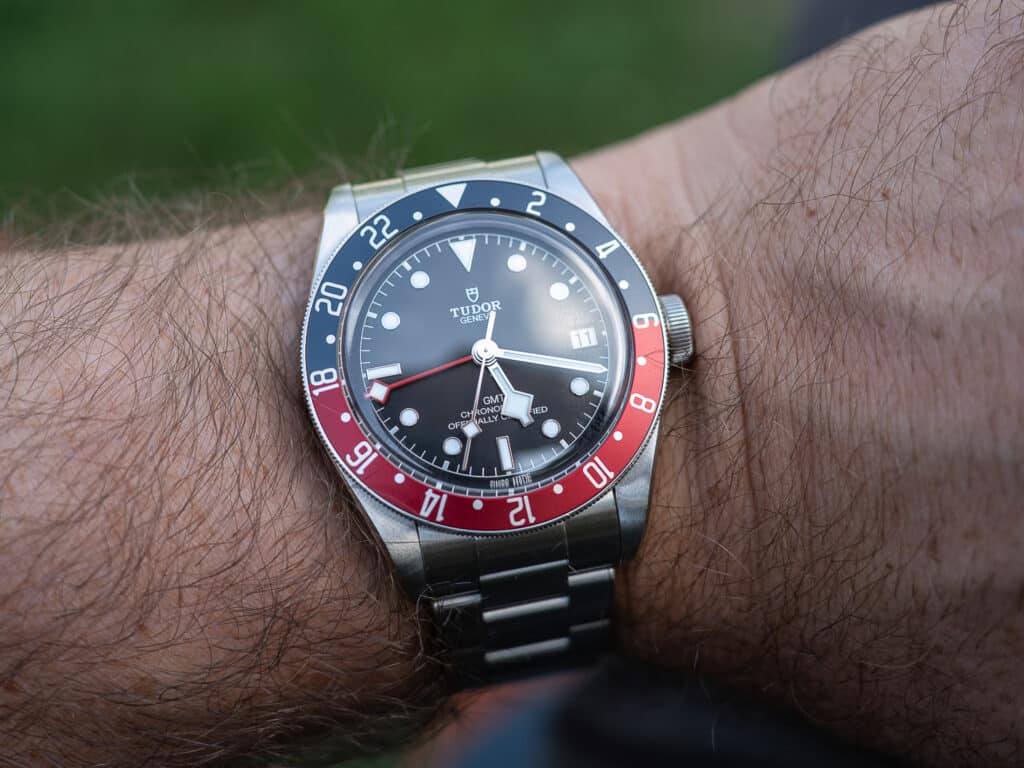
| Price: | $4,300 |
| Water Resistance: | 200m |
| Case Dimensions: | 41mm (diameter) x 50mm (lug-to-lug) x 14.7mm (thickness) |
| Lug Width: | 22mm |
| Movement: | Tudor Caliber MT5652 Automatic Movement (COSC) |
The Tudor Black Bay GMT is the point at which an aviation travel watch starts to feel less like a fun complication and more like a tool built around it. The MT5652 flyer GMT is a big part of that. Once the watch is set, jumping the local hour hand becomes a quick job instead of a small ritual, and it’s one of those features that’s easy to underestimate until you’ve traveled with it. During our wrist time, accuracy stayed around +4 seconds per day, which meant it quietly did its job while we focused on everything else. If you’ve ever fumbled with a caller GMT after a long flight, you’ll appreciate the difference.
The watch also strikes a balance between refinement and practicality, keeping it in regular rotation. The matte black dial is easy to trust at a glance, the generous lume fills the snowflake hands and markers well, and the red GMT hand reaches cleanly out to the burgundy-and-blue 24-hour bezel. The domed sapphire crystal adds a welcome bit of warmth to the overall look, even if it contributes to the watch’s overall height. On the wrist, the Black Bay GMT felt equally convincing on its steel bracelet and a nylon strap. The bracelet gives it that dense, reassuring Tudor feel, while the fabric strap shifts the personality further toward a no-nonsense travel companion.
Its biggest consideration is still the case. At 41mm wide, 50mm lug-to-lug, and 14.7mm thick, this isn’t a GMT that shrinks once you put it on. The sharply downturned lugs and subtle case-side bevel do a lot to make it wearable—we found it comfortable on a 7.5-inch wrist throughout full days—but smaller wrists should be realistic about the fit. The brushed surfaces, polished slab sides, and aluminum bezel stop it from feeling like a block of steel, though the domed crystal does make its presence known under a cuff.
The lack of factory half links also means bracelet sizing can require a little patience. That said, we kept coming back to it because the flyer GMT, highly legible dial, and solid bracelet made it feel like a watch designed around travel rather than one that simply added a GMT hand.
Pros
- Flyer GMT movement makes local time changes simple during travel.
- Matte dial, strong lume, and long GMT hand make the display easy to read.
- Strong value in the pre-owned market.
- Excellent bracelet, with the flexibility to wear equally well on fabric straps.
Cons
- No factory half links make bracelet sizing less precise.
- The thick case is made taller by the domed crystal.
- 50mm lug-to-lug can overwhelm smaller wrists.
Rolex Air-King 14000
| Price: | $5,400 – $6,900 |
| Water Resistance: | 100m |
| Case Dimensions: | 34mm (diameter) x 42.8mm (lug to lug) x 11.2mm (thickness) |
| Lug Width: | 19mm |
| Movement: | In-house caliber 3000 automatic |
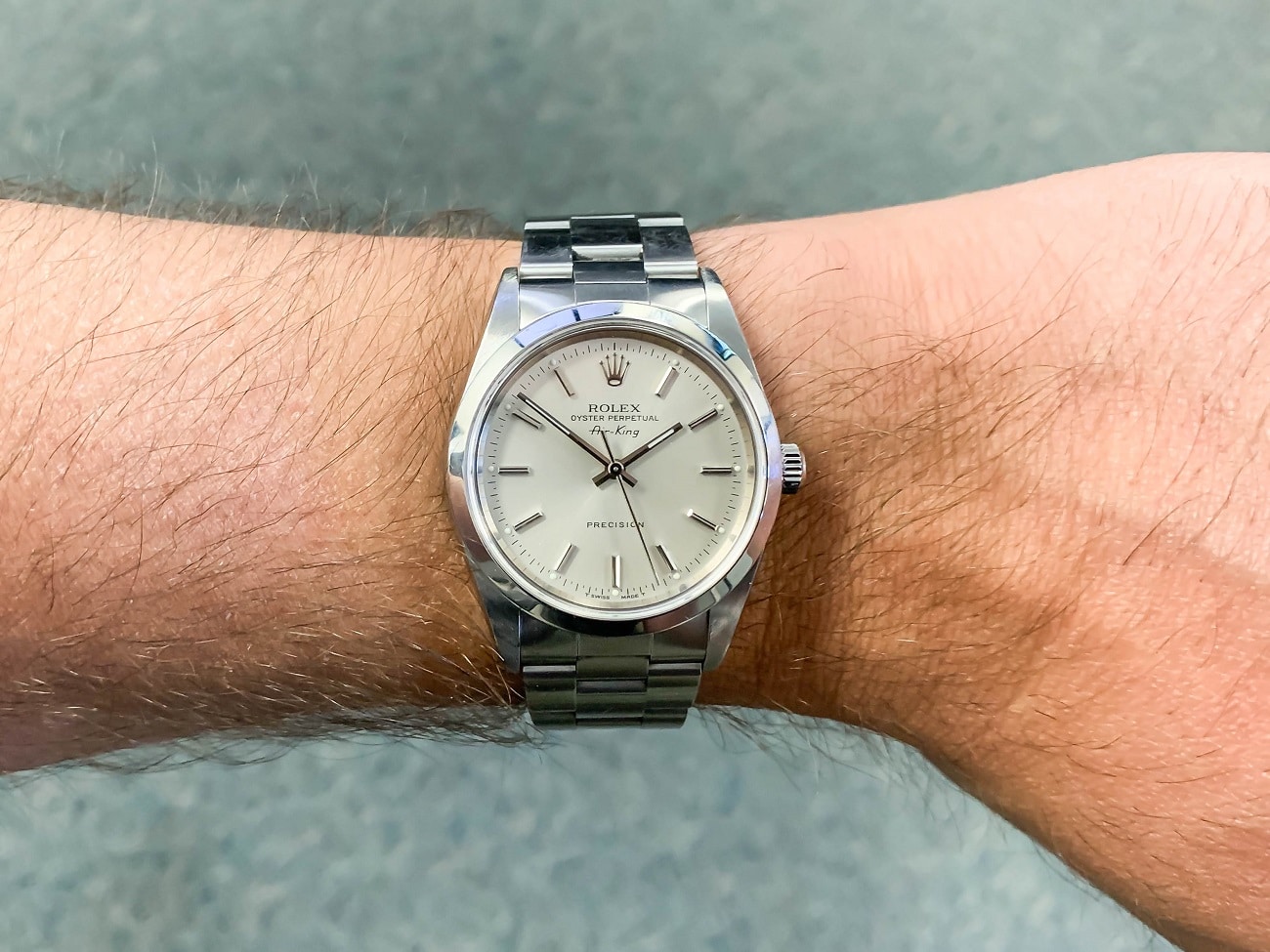
The Rolex Air-King 14000 enters this list by reminding us that not every aviation watch needs extra scales, oversized crowns, or a GMT hand to feel connected to flying. What stayed with us after the review period was how restrained it is. The clean, no-date dial, compact Oyster case, and balanced proportions let the watch fade into your routine instead of always demanding attention. It has Rolex quality, certainly, but without much of the visual noise that often comes with the brand. That’s a combination we appreciated more the longer we wore it.
Its proportions are what make that understated approach work. Measuring 34mm across, about 11.2mm thick, and roughly 42.8mm lug-to-lug, the Air-King sits low and centered on the wrist. The thin, tapered lugs keep it from feeling top-heavy, while the 19mm Oyster bracelet tapers to around 14mm at the clasp, giving the watch a balanced, almost effortless feel over the course of a full day. The bracelet doesn’t offer modern clasp tricks or micro-adjust gadgets, but it feels solid. The silver sunburst dial follows the same philosophy. It catches the light without becoming flashy, the baton markers keep everything clean, and the absence of a date window gives the display a symmetry that’s easy to appreciate. The tritium lume plots and “T Swiss Made T” signature add plenty of vintage character, even if the lume itself is now more nostalgic than practical.
The Caliber 3000 mirrors the rest of the watch. It isn’t trying to impress with elaborate finishes or modern specifications, but during our testing, it still ran at roughly -7 seconds per day despite not having been serviced recently. The winding felt smooth, and the Twinlock crown provides enough everyday water resistance that you don’t feel obliged to treat it like a display piece.
The compromises are part of the ownership experience too. The 19mm lug width limits strap choices, servicing is costly even for such a straightforward movement, and anyone accustomed to modern Rolex sizing may wish it had a little more wrist presence. Those trade-offs never changed what we liked most about the Air-King 14000. It isn’t the aviation watch we reached for when we wanted extra functionality. It was the one we reached for when we wanted none of the functionality to get in the way. That quiet confidence is what makes it feel worth owning.
Pros
- Tapering Oyster bracelet keeps the watch balanced and discreet.
- The smooth-winding Caliber 3000 remained reliable at around -7 seconds/day during our testing.
- Clean no-date dial offers excellent symmetry and legibility.
- Compact Oyster case stays comfortable throughout the day.
- Twinlock crown adds welcome confidence for everyday wear.
Cons
- 19mm lug width limits strap options.
- Servicing costs can feel high for a relatively simple movement.
Nomos Zürich World Time Midnight Blue
| Price: | $6,100 |
| Water Resistance: | 30m |
| Case Dimensions: | 40mm (diameter) x 50mm (lug-to-lug) x 11mm (thickness) |
| Lug Width: | 20mm |
| Movement: | DUW 5201 |
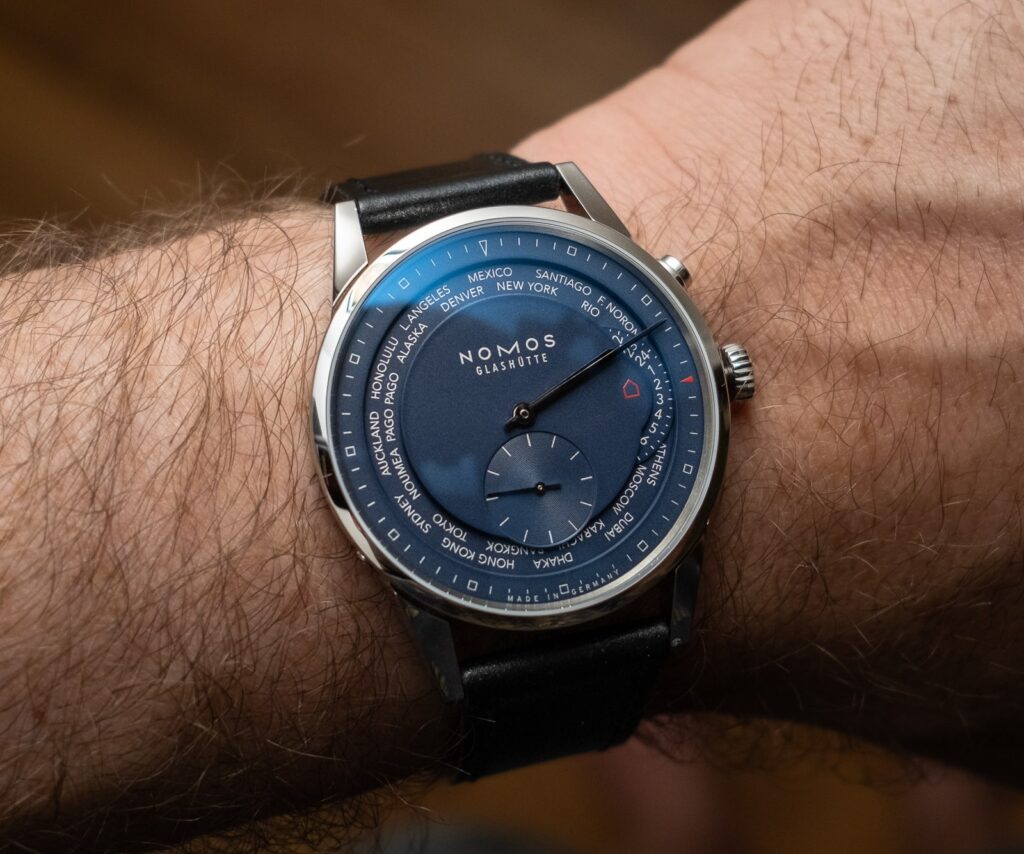
The Nomos Zürich World Time Midnight Blue takes a different route from most aviation-inspired travel watches we’ve reviewed. Instead of oversized numerals or a dial full of instrument cues, it leans on functionality. The highlight is the pusher at 2 o’clock, which advances the local hour in one-hour jumps while leaving your home time untouched on the 24-hour subdial. After spending significant time with it on the wrist, changing time zones became a quick button press instead of a stop-and-reset routine. Nomos calls it a world timer, though in day-to-day use it behaves more like a simplified GMT—and, honestly, that’s part of what makes it so easy to live with.
That same restraint carries through the rest of the watch. The deep midnight-blue dial shifts between rich navy and cooler steel tones depending on the light, giving it plenty of character without becoming flashy. The city ring never feels cramped because the dial leaves enough breathing room around it, while the rhodium-plated hands remain easy to follow throughout the day. We also appreciated the small red home-time indicator. It’s the only real splash of color on the dial, but it stays easy to spot whether you’re under harsh office lights or trying to check the time in a dim aircraft cabin. Behind it all, the in-house DUW 5201 delivered steady performance and its claimed 42-hour power reserve, giving us enough flexibility to leave the watch off for a day without immediately reaching for the crown.
The 40mm case wears with more presence than the specifications imply because of its extended lugs, although the slim profile helps keep it balanced on medium wrists. Collectors with smaller wrists should pay closer attention to the fit. The shell cordovan strap deserves plenty of credit too. It broke in quickly, stayed comfortable through long days, and never demanded constant readjustment. The fully polished case suits the watch’s refined personality, but it also collects fine scratches sooner than we’d have liked. That’s the trade-off with a finish this clean.
Among the aviation watches we’ve reviewed, this was one of the few that made travel feel simpler without constantly reminding us it was built for travel. That’s a surprisingly difficult balance to get right.
Pros
- One-button local hour adjustment makes time zone changes quick and intuitive.
- Deep blue dial offers subtle depth while remaining easy to read.
- In-house DUW 5201 delivers consistent performance with around 42 hours of power reserve.
- The red home-time indicator remains easy to spot in different lighting conditions.
- The shell cordovan strap breaks in quickly and stays comfortable throughout the day.
Cons
- Polished case surfaces pick up fine scratches quite easily.
- Extended lugs can make the watch wear large on smaller wrists.
IWC Spitfire Chronograph
| Price: | $7400 |
| Water Resistance: | 60m |
| Case Dimensions: | 41mm (diameter) x 51.5mm (lug-to-lug) x 15.5mm (thickness) |
| Lug Width: | 20mm |
| Movement: | Caliber 69380 |
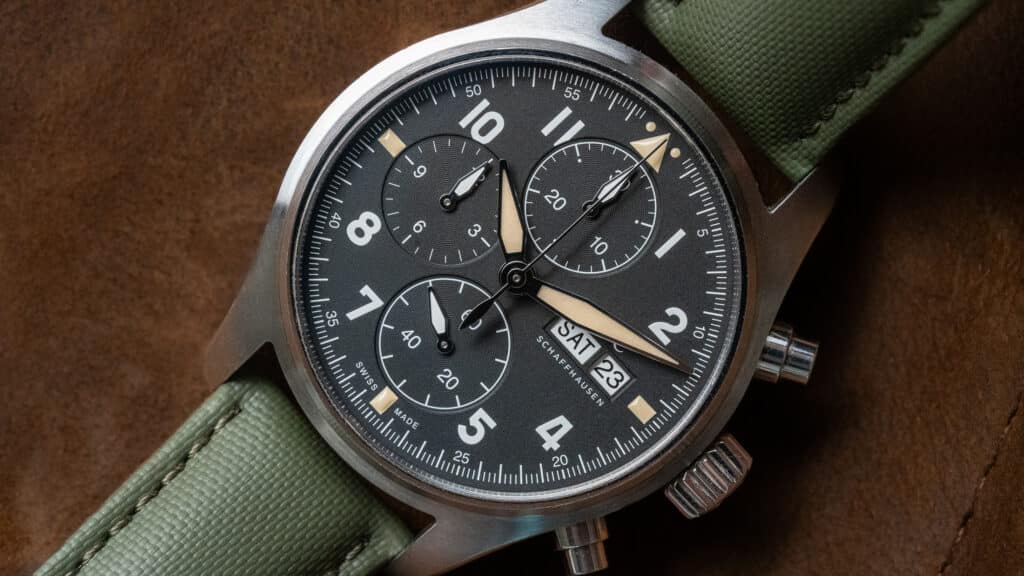
The IWC Spitfire Chronograph sits at the expensive end of this list, so it has to clear a much higher bar than simply being a good aviation watch. What surprised us after spending time with it wasn’t the brand name or the in-house movement—it was how little it relied on either. Instead of recreating a WWII cockpit instrument, the Spitfire takes the familiar pilot-watch formula and makes it easier to live with. The move to IWC’s 69000-series movement helped shrink the case to 41mm, and that decision alone makes this generation feel far more wearable than the older, bulkier Spitfire chronographs. It is still a substantial watch at 51.5mm lug-to-lug and 15.5mm thick, but on a 7.5-inch wrist, the size felt purposeful rather than excessive. Trying to slide it under a dress cuff, however, remained an optimistic exercise.
The matte black dial, recessed chronograph registers, Arabic numerals, sword hands, and day-date layout all stay faithful to the pilot-watch brief. In contrast, polished hands and sub-dial details catch the light in ways a traditional flieger never would. The double AR-coated convex sapphire crystal keeps reflections quite well controlled, and IWC’s claim that it’s secured against sudden pressure changes fits the aviation theme, even if we wisely skipped the cockpit decompression test. Around the back, the engraved Supermarine Spitfire caseback adds personality without tipping into souvenir-shop territory. The tan lume will divide opinion, especially with the rest of the dial remaining bright white, and we would have liked to see more than just the hands and quarter-hour markers glow after dark.
The same balance carries through the rest of the watch. The mostly brushed case keeps the tool-watch roots intact, while polished lug bevels and the slim bezel quietly remind you this isn’t a utilitarian flieger anymore. The oversized 7mm screw-down crown feels excellent in the hand, and the Caliber 69380 backs it up with a crisp column-wheel chronograph, a decisive reset, and a minute counter that snaps forward exactly as it should. The progressive hour totalizer and soft-iron inner case are the sort of details you appreciate more the longer you own the watch.
We’d still like more than 60m of water resistance and a longer 46-hour power reserve, particularly at this price. It also happens to be one of the easiest watches here to transform with different straps, whether you prefer leather, green textile, sailcloth, nylon, or a NATO, provided you’re happy to add another layer beneath an already tall case. In new condition, the price asks difficult questions. Pre-owned, the answers become much more convincing. More importantly, this is one of the few aviation watches we’ve reviewed where the refinements never felt like they came at the expense of the pilot-watch character. We’ve covered the full ownership quirks in our dedicated review.
Pros
- Well-balanced mix of brushed finishing and polished details.
- Excellent Caliber 69380 with crisp chronograph action and confident reset.
- The oversized screw-down crown is easy to operate.
- Double AR-coated convex sapphire crystal keeps the dial very clear.
- The pilot-watch dial remains highly legible while adding welcome refinement.
- Soft-iron inner enclosure improves magnetic resistance.
Cons
- 51.5mm lug-to-lug and 15.5mm thickness won’t suit every wrist.
- New retail pricing places it against formidable alternatives like the Speedmaster.
- 46-hour power reserve trails many newer in-house movements.
- 60m water resistance feels conservative at this price.
We’ve shared the aviation and travel watches that kept proving themselves long after the first few days on the wrist. Now we’d like to hear from you. Which pilot or travel watch has quietly earned a permanent place in your rotation, or which one deserves a hands-on review from us next? There’s always room for one more aviation watch around here, even if our watch boxes keep insisting otherwise.

Co-Founder and Senior Editor
Kaz has been collecting watches since 2015, but he’s been fascinated by product design, the Collector’s psychology, and brand marketing his whole life. While sharing the same strong fondness for all things horologically-affordable as Mike (his TBWS partner in crime), Kaz’s collection niche is also focused on vintage Soviet watches as well as watches that feature a unique, but well-designed quirk or visual hook.