There’s a point with the Orient Bambino when we stop seeing how good it is and start noticing what it asks us to put up with. The dressy look is easy to appreciate, but living with one also teaches us where that formula starts to feel limiting. Maybe we want something that can handle a less careful daily routine, something with a bracelet that feels better after six hours on the wrist, or simply a watch with enough personality that it doesn’t feel like we’re wearing the same idea again. That’s where upgrading gets tricky. Spending more can improve finishing or refinement without fixing what started bothering us in the first place. After enough time with different watches, we think the useful question is not what costs more than a Bambino, but what actually gives you something you were missing.
More than a decade of wearing watches has made us suspicious of upgrades that only make sense in photographs. We’ve learned that proportions become more important after a full day on the wrist, that a case can pick up wear in ways that either improve its character or expose weak finishing, and that a bracelet’s articulation matters far more once you’ve spent an afternoon moving around in it. We’ve watched accurate watches earn trust simply because they’re always ready to grab, while others became rotation pieces because their quirks were worth living with. That experience changes how we judge an upgrade. The watches ahead take different paths from the Bambino, and we’re interested in what each one adds, what it gives up, and whether those differences are noticeable once the watch leaves the box and becomes part of your routine.
Q Timex Reissue
| Price: | $179 |
| Water Resistance: | 50m |
| Case Dimensions: | 38mm (diameter) x 45mm (lug-to-lug) x 11.5mm (thickness) |
| Lug Width: | 18mm |
| Movement: | Seiko Quartz |
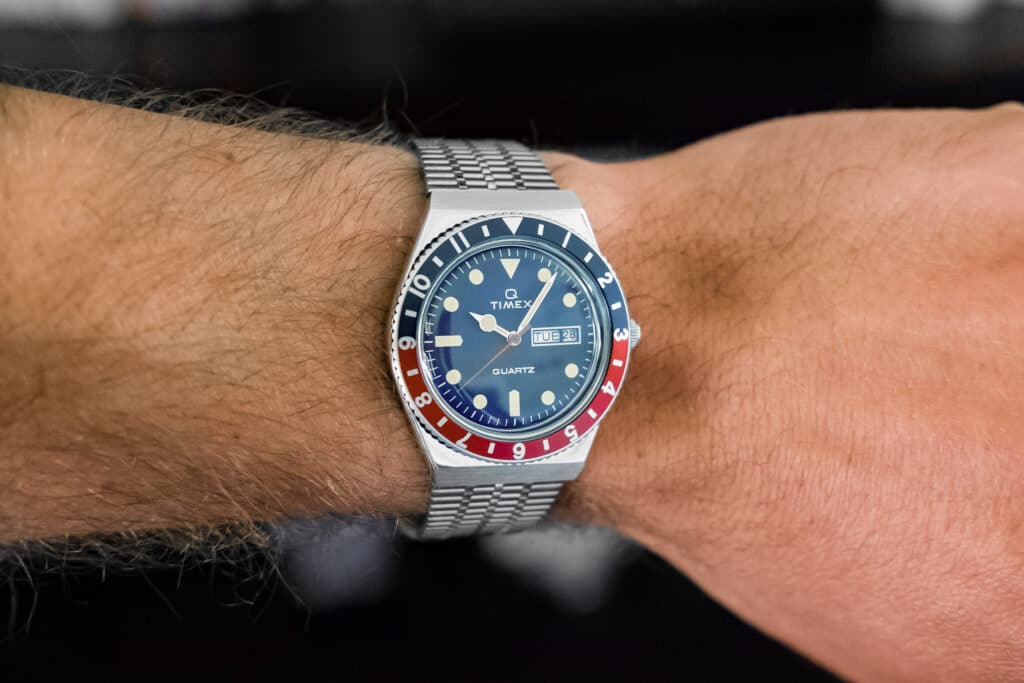
The Q Timex Reissue is the kind of upgrade that makes sense when the Bambino has taught you that you like vintage charm more than you necessarily need another automatic. It offers a very different ownership experience without losing the character that made affordable watches fun in the first place. The audible quartz tick, the unapologetic “Quartz” printing, and the Seiko-sourced movement all lean into the period-correct personality instead of pretending modern technology needs to be hidden. Even the battery hatch on the case back is wonderfully low-fuss. Open it, replace the battery, get on with your life. There’s something satisfying about a watch that doesn’t require a ceremony every time it needs attention.
At 38mm, the Q Timex also goes in a different direction from the Bambino’s more traditionally dressy presence. The hooded lugs help it stay planted on the wrist, while the combination of brushed surfaces and polished facets gives the case enough texture to keep it from looking like a flat slab of vintage cosplay. The matte blue dial stays legible outdoors, and the lightly aged lume adds some warmth without trying to convince us the watch spent 50 years in someone’s sock drawer. The domed acrylic crystal is perhaps the biggest contributor to the old-school feel, bending the light beautifully as you move around. It will also pick up scratches, because apparently acrylic has decided that character should come with receipts. The friction-fit Pepsi bezel turns smoothly enough for casual timing, although anyone expecting crisp modern clicks will be disappointed.
As noted in our dedicated review, the bracelet turns all that personality into something practical. It’s lightweight, tapers nicely, and the tool-free clasp makes fine adjustment painless when your wrist decides to expand halfway through the afternoon. That matters more than another line on a specification sheet once you’re wearing it for hours.
However, the compromises are familiar vintage-watch annoyances: manually adjusting the day display feels dated today, 50 meters of water resistance makes deep swimming a poor idea, and the ticking can become noticeable in a quiet room. Still, as a post-Bambino upgrade, this is less about adding prestige and more about changing the experience. You get something smaller, quirkier, easier to maintain, and much more casual without draining the fun out of the purchase.
Pros
- Lightweight bracelet and tool-free clasp make all-day wear easy.
- The 38mm case and hooded lugs give it a secure, comfortable fit.
- Battery hatch keeps routine maintenance simple.
- Acrylic crystal and period-correct case finishing give it convincing vintage character.
- Smooth friction-fit bezel remains useful for everyday timing.
Cons
- 50 meters of water resistance limits its usage during swimming.
- Acrylic scratches more easily than modern crystal options.
- The audible quartz ticking can become hard to ignore in quiet spaces.
- Manual day adjustment is an oddly old-fashioned chore.
Timex Marlin Draper Automatic
| Price: | $279 |
| Water Resistance: | 50m |
| Case Dimensions: | 37mm (diameter) x 43.5mm (lug-to-lug) x 12.5mm (thickness) |
| Lug Width: | 18mm |
| Movement: | Miyota 8-series automatic |
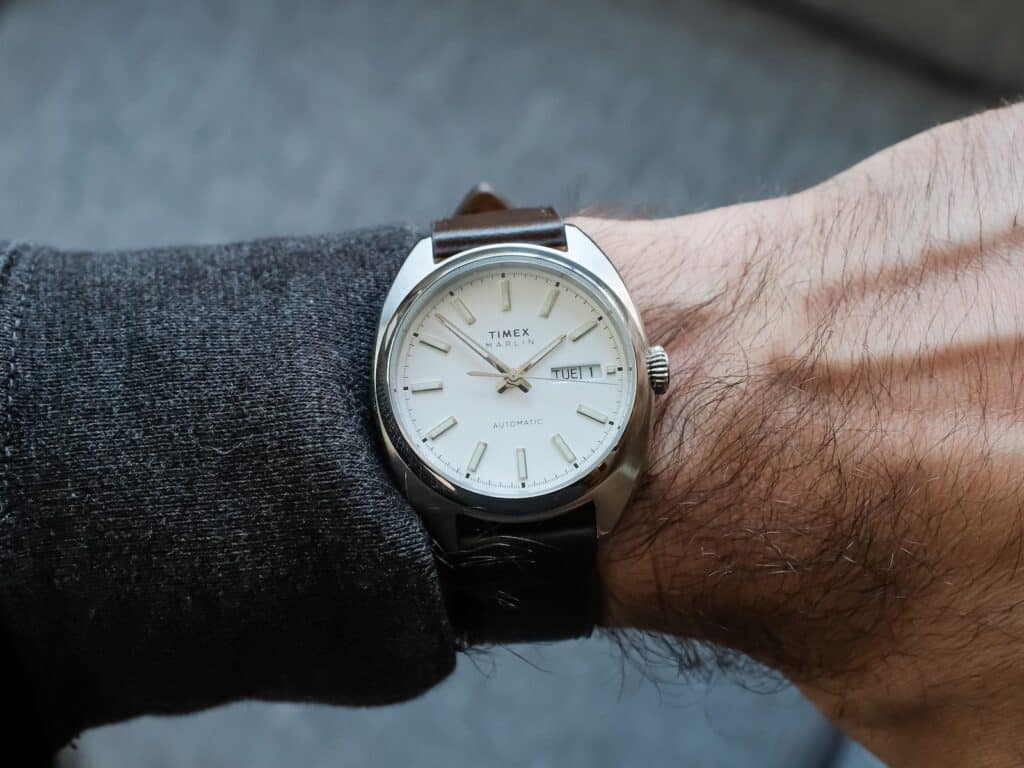
The Marlin Draper Automatic makes sense after an Orient Bambino when the part you want to keep is the vintage dress-watch feel, but the part you’re ready to leave behind is the sense that you’ve bought the default answer. Its 37mm cushion case changes the conversation immediately. With a 43.5mm lug-to-lug, it stays compact on the wrist, but the barrel-like shape gives it more visual weight than a conventional 37mm round case. We found that combination particularly easy to live with because the smaller dial opening keeps the watch from looking oversized or theatrical. It has a mid-century flavor without giving off the impression that someone raided a costume department.
That case works because Timex resisted the temptation to polish every square inch of it into submission. Most of the surfaces are brushed, with a polished bezel and slim chamfer providing just enough contrast. The stock brown leather strap is another small win. It’s thinner and more tapered than expected, and that helps the 12.5mm-thick case sit close to the wrist. We experimented with other straps through the quick-release spring bars, then went back to the original because it simply made more sense with the watch. The silver dial takes the same restrained approach, using applied markers, darker hands, a practical day-date display, and subtle tonal variation for depth. The lume works when you need it, but thankfully doesn’t try to turn a dress watch into a search-and-rescue beacon.
The Miyota 8-series automatic keeps the ownership experience similarly straightforward. During our hands-on time with it, timekeeping stayed consistent, the roughly 40-hour reserve covered a normal weekend rotation, and the rotor remained quiet enough that we stopped thinking about it. That’s exactly what we want from an upgrade: something that becomes easier to enjoy, not another feature we have to manage.
That said, two obvious concessions remain. Mineral crystal leaves less margin for careless desk-diving, and 50 meters of water resistance means pool day belongs to somebody else’s watch. Still, this is a meaningful step beyond the Bambino because it adds individuality rather than simply adding refinement. The TV reference may have put the Marlin Draper on our radar, but the unusual case, comfortable proportions, and understated execution are what kept it there.
Pros
- 37mm size and 43.5mm lug-to-lug make the cushion case easy to wear.
- The original brown leather strap sits comfortably and suits the design better than most alternatives we tried.
- Brushed surfaces, polished bezel, and slim chamfer give the case texture without overdoing it.
- Miyota 8-series automatic delivers consistent timekeeping with a useful roughly 40-hour reserve.
- Day-date layout and contrasting hands keep the silver dial practical throughout the day.
Cons
- Mineral crystal is the obvious long-term durability compromise.
- 50 meters of water resistance keeps this better suited to dry-land duty.
Casio Oceanus T200
| Price: | $300 – $500 |
| Water Resistance: | 100m |
| Case Dimensions: | 41.4mm (diameter) x 49mm (lug-to-lug) x 10.7mm (thickness) |
| Lug Width: | 20mm |
| Movement: | Tough Solar movement (Module 5596) |
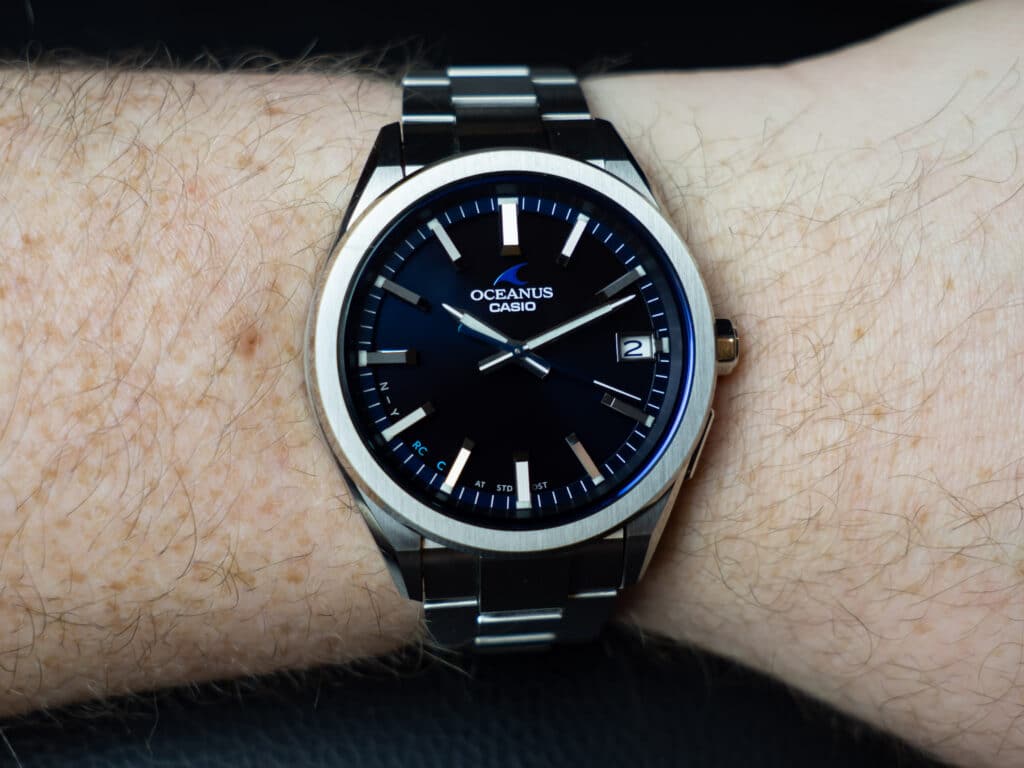
The Casio Oceanus T200 is what happens when an upgrade stops being about adding mechanical-watch credentials and starts being about removing annoyances. After a Bambino, that change can be surprisingly useful. The T200 has the visual polish we want from a dressier everyday watch, but it doesn’t behave like something you need to treat gently or remember constantly.
The combination of brushed and polished surfaces looks quite tidy for the money, while the deep blue dial gets much of its character from the floating markers tucked under the chapter ring. Then there’s that blue-tinted sapphire crystal, which catches daylight with just enough color to make us look at the watch twice. It works with a suit, doesn’t look ridiculous dressed down, and generally avoids the usual trap of looking like it’s trying to impress people. The lume, unfortunately, has all the ambition of someone who has already clocked out.
The T200 earns its place as an upgrade in the boring stuff, which usually decides long-term ownership. The Tough Solar 5596 module stayed charged through normal wear throughout our testing period, meaning we could put the watch on and stop thinking about its power supply. Bluetooth syncing through the Casio Oceanus app was similarly painless and kept the time where it needed to be without turning basic accuracy into a weekend chore. Coming from a Bambino, that changes the rhythm of ownership. There’s no winding, no resetting after it sits in the box, and no little moment of checking whether it’s gained or lost enough time to matter. You get the polished appearance and skip most of the mechanical-watch housekeeping.
The T200 isn’t free of Casio weirdness, though. Take the bracelet off the wrist, and it develops a noticeable rattle. The pin-and-collar system makes resizing more fiddly than it ought to be. The connectivity text on the dial is also difficult to unsee if your taste runs toward cleaner layouts. But none of those things became deal-breakers once the watch was actually being worn. That’s the point here: as a post-Bambino upgrade, the T200 doesn’t try to beat the Bambino at being a mechanical dress watch. It offers a different kind of refinement: one where solar power, accurate timekeeping, sapphire, and low-effort ownership matter more than another automatic movement ticking away.
Pros
- Tough Solar 5596 eliminates the usual battery-swapping routine.
- The blue dial and floating markers have more depth than the price suggests.
- The brushed-and-polished finish gives the case a properly refined feel.
- Bluetooth syncing keeps the watch accurate without regular manual adjustment.
- Sapphire crystal and versatile styling make it easy to wear again and again.
Cons
- Bracelet sizing with pin-and-collar links is unnecessarily fiddly.
- Connectivity text interrupts an otherwise restrained dial.
- The bracelet rattles noticeably when it’s off the wrist.
- The lume is adequate rather than impressive.
Baltic MR01
| Price: | $635 |
| Water Resistance: | 30m |
| Case Dimensions: | 36mm (diameter) x 44mm (lug-to-lug) x 9.9mm (thickness) |
| Lug Width: | 20mm |
| Movement: | Hangzhou 5000a automatic |
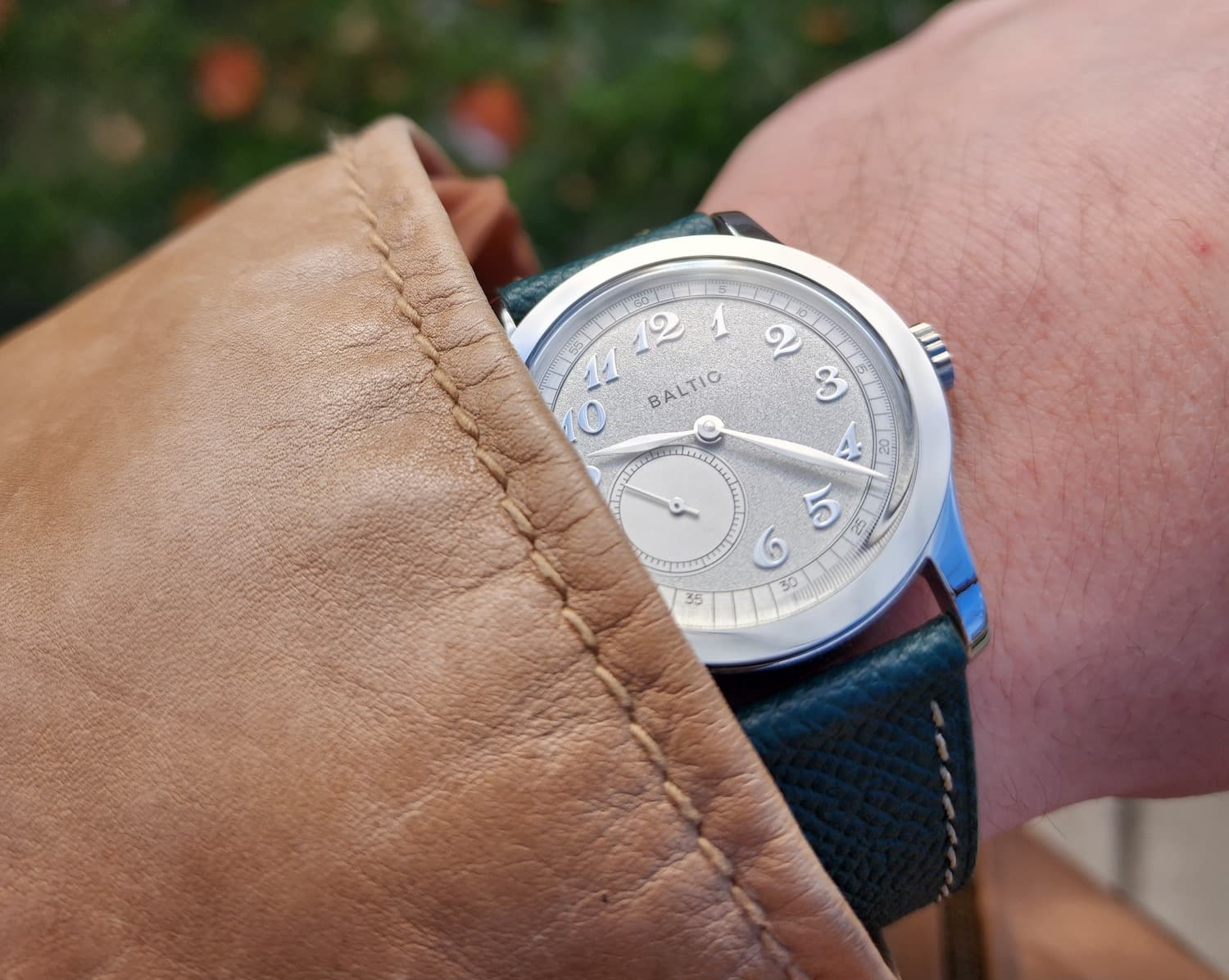
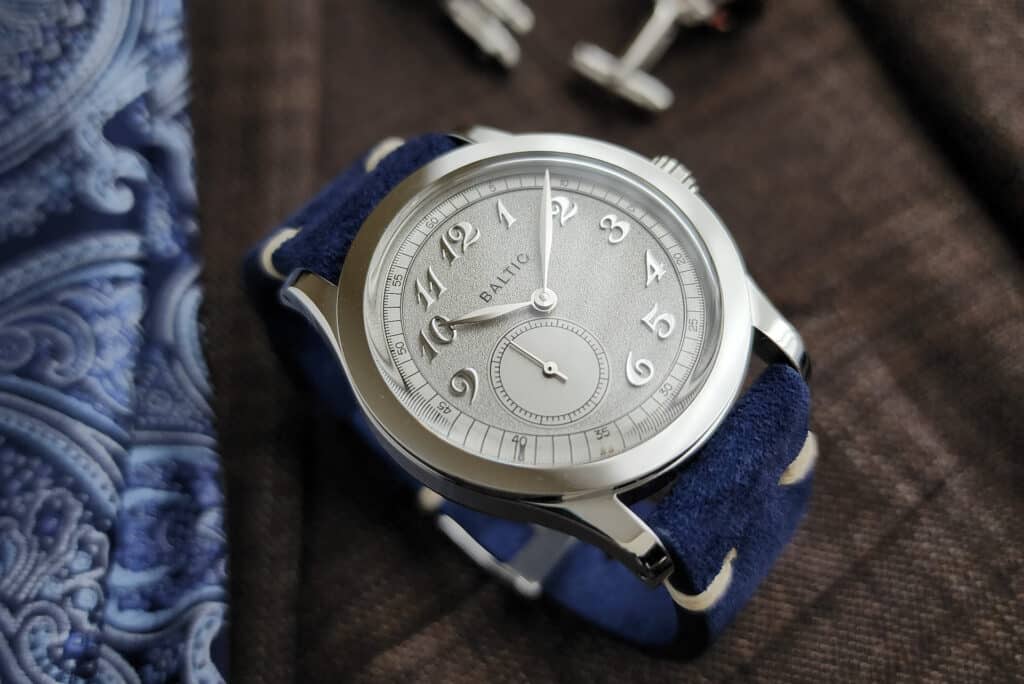
One thing the Bambino does well is make you appreciate restraint. After enough time with one, though, we can start wanting that restraint to come with a little more detail. The Baltic MR01 gets there without turning the dial into a fireworks display. Its 36mm case and sub-10mm thickness give it a compact, tidy presence that feels good when you’ve grown tired of watches that take up more wrist than they need to. The vintage-inspired proportions have enough shape to keep things interesting, but nothing about the case feels like it’s shouting for attention. After wearing it for longer stretches, we noticed the appeal tends to sneak up on you rather than arrive with a trumpet blast.
The dial is where the MR01 rewards closer inspection. Its fine sand-textured silver surface shifts subtly with the light, while the offset small-seconds display uses guilloché to add texture without turning the watch into a miniature Art Deco hotel lobby. The polished Breguet numerals pick up softer light beautifully, and the domed Hesalite crystal adds a gentle distortion around the edges that lends the whole thing more warmth. Sapphire would be tougher, but we’d lose some of that personality in the trade.
Turn it over, and the Hangzhou 5000a gets a chance to make its case, with polished bridges, perlage, and gold-tone engraving. During extended wear, the roughly 42-hour power reserve and steady everyday timekeeping meant the movement was interesting to look at without becoming something we had to babysit.
The compromises are considerably less romantic. Three ATM of water resistance means this is not the watch we’d casually leave on while dealing with a sink, and Hesalite will collect hairlines because that’s what Hesalite does when you give it a normal life. The Hangzhou movement may also bother collectors who have drawn a hard line around Swiss or Japanese calibers. For us, that misses the more interesting point. As an upgrade after a Bambino, the MR01 keeps the easy elegance but adds better proportions, a dial worth lingering over, and a more considered mechanical experience.
Pros
- The 36mm size and sub-10mm thickness impart a clean wrist fit.
- Sand-textured dial, guilloché small seconds, and polished Breguet numerals add layers without clutter.
- The domed Hesalite gives the watch warmth and visual character.
- The decorated Hangzhou 5000a looks more interesting than its price might suggest.
- Roughly 42-hour power reserve and consistent timekeeping keep ownership low-fuss.
Cons
- 3 ATM water resistance makes it a poor choice for carefree water use.
- Hesalite scratches more easily than sapphire.
- Hangzhou movement provenance won’t satisfy every collector.
Mido Commander Datoday
| Price: | $1,270 |
| Water Resistance: | 50m |
| Case Dimensions: | 40mm (diameter) x 10.7mm (thickness) |
| Lug Width: | 21mm |
| Movement: | Mido Caliber 80 automatic |
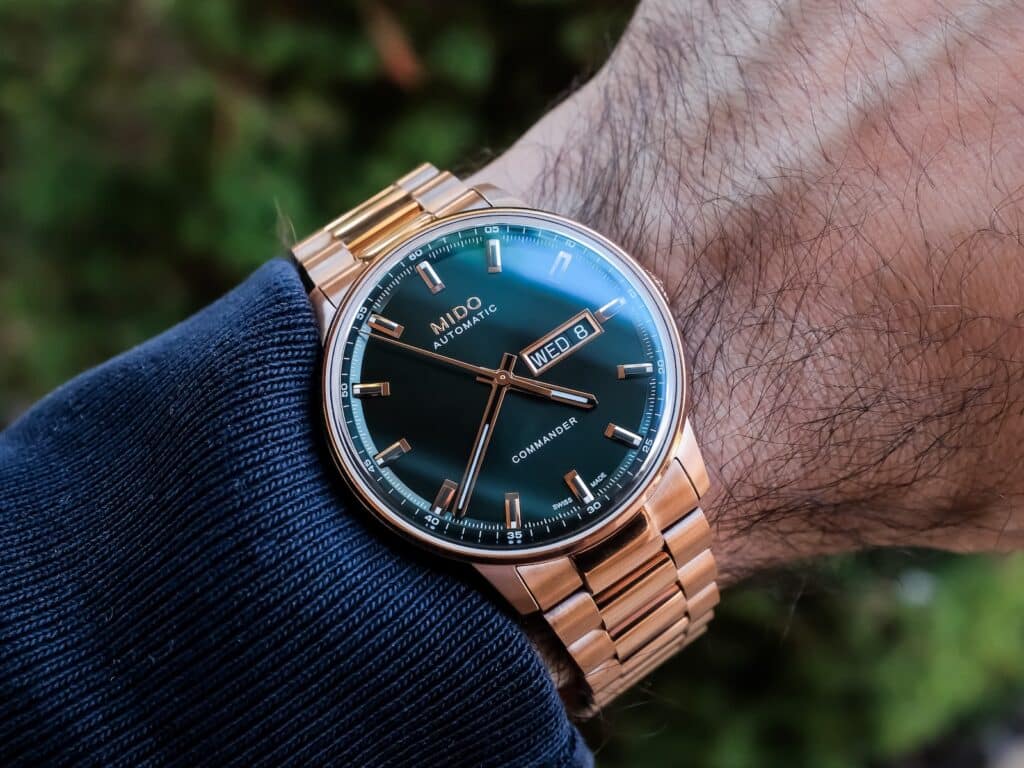
There’s a particular kind of watch that can look completely different depending on what the light is doing, and the Mido Commander Datoday is very much one of them. Its green dial can drift from blue-green to a deeper forest tone, which keeps the rose-gold-tone PVD from becoming too loud. The effect is dressy, but not precious. We could wear it on an ordinary day without feeling like the watch was waiting for a wedding invitation. After a Bambino, that extra visual richness is noticeable, but so is the restraint. Nothing here feels added simply because a more expensive watch is supposed to have more going on.
The bracelet has a lot to do with that. Its three-link construction follows the case closely, giving the Commander a unified look instead of the usual “dress watch plus metal bracelet” arrangement. At 40mm across and only 10.7mm thick, it has enough substance on the wrist without turning into a cuff-clearance problem. The stepped outer dial, white markings, rose-gold-tone applied indexes, and baton hands keep things legible, while the framed day-date window sits neatly within the layout. We also liked the bracelet’s mix of brushed and polished surfaces and the tidy butterfly clasp. The quick-release spring bars are particularly welcome when the PVD starts feeling a little formal and a leather strap sounds better.
Underneath, the Caliber 80 gives the watch some practical advantages that become more apparent outside the honeymoon period. Its 80-hour power reserve can carry it through a weekend off the wrist without stopping, while the Nivachron balance spring adds protection against magnetism and everyday shocks. The display caseback also gives us something to inspect when we turn the watch over.
That said, a few details keep it from being completely carefree: the crown could be larger, 21mm limits the pool of replacement straps, and the push-pull crown combined with 50 meters of water resistance makes us cautious around water. We’d also prefer screw links and a stronger taper near the clasp. But those are fair compromises for a watch that feels more polished and substantial than a Bambino without getting precious about it. For a closer look at how it wears and where those compromises show up in practice, read our full review.
Pros
- Case and integrated bracelet feel like one coherent design rather than two parts.
- Framed day-date display adds useful information without wrecking the dial balance.
- The 80-hour power reserve means fewer resets when the watch leaves the wrist for a few days.
- Nivachron balance spring adds useful resistance to magnetism and everyday shocks.
- Quick-release spring bars make switching away from the PVD bracelet straightforward.
Cons
- 21mm lug width makes finding alternative straps more restrictive.
- Push-pull crown and 50 meters of water resistance limit how carefree it can be around water.
- The small crown can be fiddly to set.
Longines Heritage Classic Sector
| Price: | $2150 |
| Water Resistance: | 30m |
| Case Dimensions: | 38.5mm (diameter) x 47mm (lug-to-lug) x 12mm (thickness) |
| Lug Width: | 19mm |
| Movement: | Longines Caliber L893.5 |
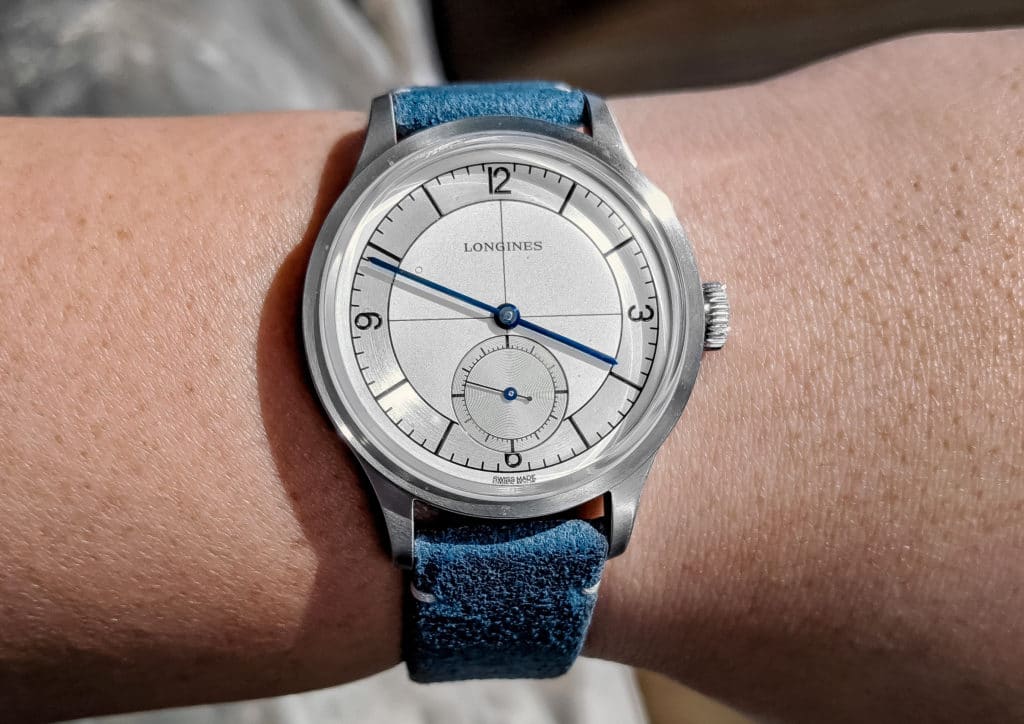
At some point after the Bambino, a dress watch can start feeling too closely tied to the occasions you bought it for. The Longines Heritage Classic Sector is a useful escape from that trap because it still gives us the polished, old-school presence we liked in the Bambino, but it doesn’t feel delicate once it’s on the wrist. The 38.5mm case has short lugs that keep it planted nicely, and while the 12mm thickness won’t win any ultra-thin contests, we never found it cumbersome during commutes, dinners, or lazy weekends. We expected to baby it a little. Instead, it kept getting invited along to things that involved more than sitting politely at a desk.
A lot of that everyday appeal comes from the sector dial. The matte off-white center, polished metal chapter ring, black-painted numerals, and small-seconds register create layers without turning the watch into visual homework. The slightly offset 6 and angled 3 and 9 looked odd at first; after a few days, they stopped registering as quirks and started looking like what they were meant to be. The dial can appear busier in a photograph, but those contrasting finishes separate everything nicely on the wrist. Then there’s the blue suede strap, which was comfortable immediately and suited the watch so well that the included NATO spent most of its time being the backup plan. Strap experimentation is less convenient than it should be, though, thanks to the absence of drilled lugs and quick-release spring bars.
The L893.5 automatic, based on the ETA 2892-A2, also makes this a more practical step up from the Bambino than a purely romantic vintage recreation. Its 64-hour power reserve means a couple of days off the wrist won’t necessarily leave us reaching for the crown on Monday, while the silicon balance spring adds useful resistance to magnetic interference. A hand-wound movement might have suited the period styling better, but regular wear quickly made the automatic case a stronger choice.
The 30-meter water resistance is the bigger limitation, particularly if “everyday” includes anything more aquatic than washing your hands. Still, that is a relatively easy compromise to live with. The Heritage Classic Sector gives us a watch with enough character to feel special, but enough composure to stop behaving like the Bambino’s dressier cousin who only comes out for dinner. For the smaller on-wrist details, read our full review.
Pros
- Short lugs help the 38.5mm case sit comfortably despite its 12mm thickness.
- The blue suede strap is comfortable right out of the box and suits the dial better than we expected.
- Contrasting sector-dial finishes add depth without sacrificing easy reading.
- L893.5 combines a 64-hour power reserve with a silicon balance spring.
Cons
- 30 meters of water resistance leaves little room for careless water use.
- Strap changes are more complicated without drilled lugs or quick-release spring bars.
- The unusual numeral placement takes a little wrist time to appreciate fully.
Grand Seiko SBGV233 Quartz
| Price: | $2,400 – $2,600 |
| Water Resistance: | 100m |
| Case Dimensions: | 40mm (diameter) x 46mm (lug-to-lug) x 10mm (thickness) |
| Lug Width: | 20mm |
| Movement: | Seiko 9F82 quartz |
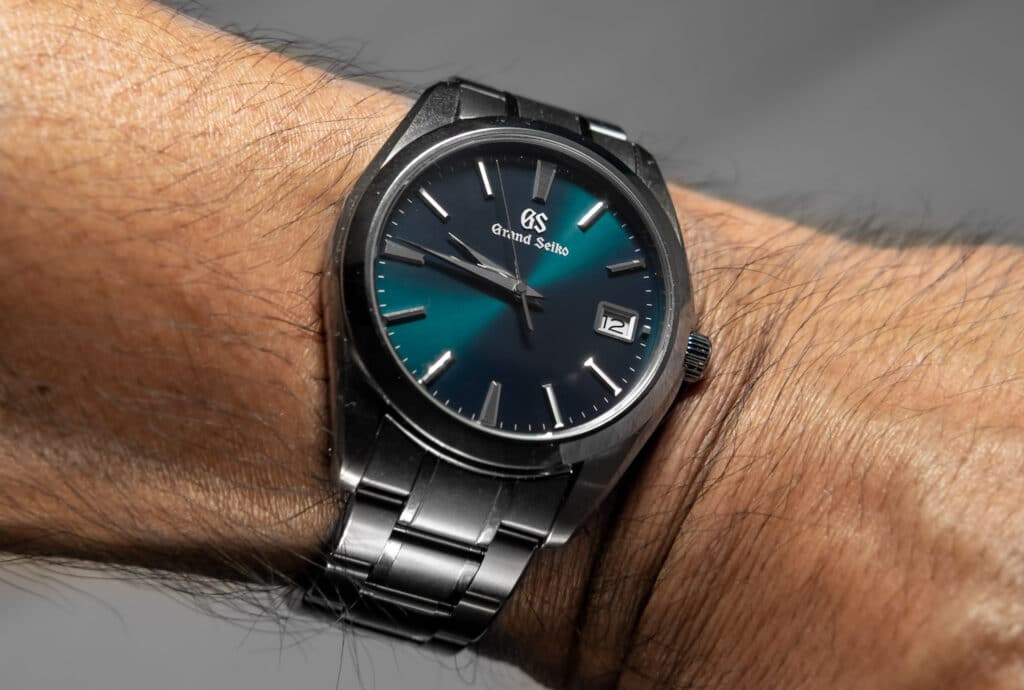
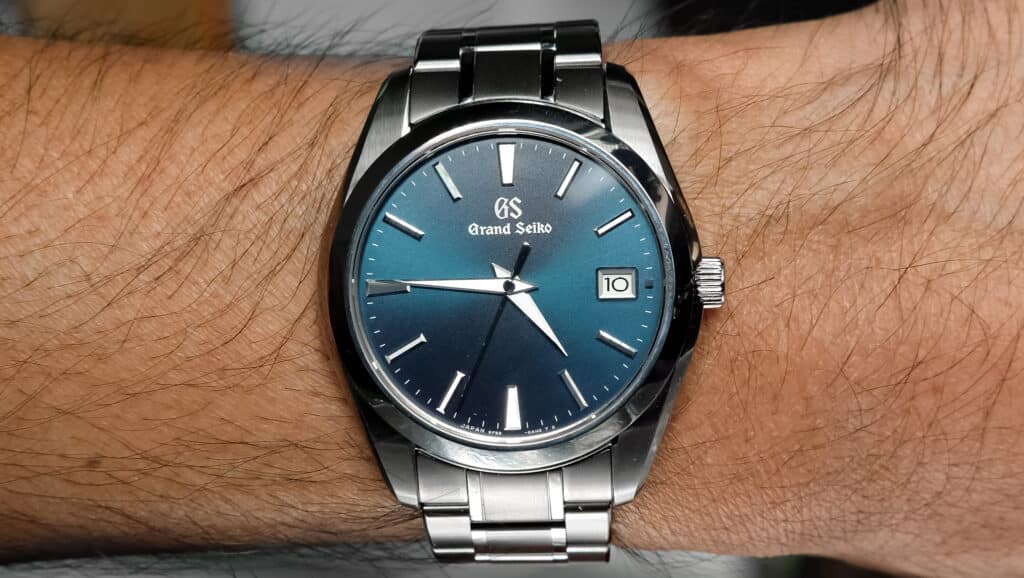
The most convincing reason to move beyond an Orient Bambino may have nothing to do with another mechanical movement. The Grand Seiko SBGV233 made us appreciate how much of watch ownership can disappear when a watch is simply accurate and ready to go. Leave it in the box for a few days, put it back on, and there’s no winding ritual waiting for you. The 9F82 quartz movement is rated to ±10 seconds per year and, in practice, that means far less time spent checking, correcting, and thinking about the watch. After living with automatic watches, there’s something almost suspiciously relaxing about that. We’d hesitate to call it boring when “pick it up, and it’s still right” turns out to be this useful.
Then the case reminds you that convenience isn’t the whole upgrade. The 40mm titanium body is big enough to feel substantial, but its 46mm lug-to-lug and roughly 10mm thickness keep the proportions tidy under a cuff or on a bare wrist. After a few hours, the low weight of titanium becomes one of those details we stopped consciously noticing, which is usually a compliment. Grand Seiko’s mix of brushed surfaces and Zaratsu-polished accents also gives the case plenty of movement as the light changes, without making it look like jewelry. The bracelet eventually records some of the day’s abuse, particularly around the clasp, where light scuffs accumulate from desks, sleeves, and general existence. That’s titanium for you: wonderfully light, not magically immune to life.
The teal dial brings some mischief to an otherwise restrained watch. It shifts subtly between blue and green depending on the light, while the sharp dauphine hands and applied markers keep the display pretty clean. The sapphire crystal is equally crisp, although we did run into some glare during extended wear. A three-year battery life keeps the low-maintenance theme going, leaving very little to do between wearing it and eventually changing the battery.
The pin-and-collar bracelet sizing is the one nuisance we’d happily delete; it takes more patience than modern screw links, although that’s mostly a one-time headache. As an upgrade from a Bambino, the SBGV233 changes the priorities completely: less fuss, far greater accuracy, lighter wear, and finishing that rewards you without asking for attention every five minutes.
Pros
- The titanium case stays remarkably light and comfortable through extended wear.
- 9F82 accuracy of ±10 seconds per year practically eliminates routine timekeeping adjustments.
- Brushed and Zaratsu-polished surfaces give the case plenty of visual depth.
- The teal dial shifts between blue and green while staying highly legible.
- Three-year battery life keeps routine ownership low-maintenance.
Cons
- Pin-and-collar bracelet sizing is more fiddly than screw-link systems.
- Titanium around the clasp picks up light scuffs through normal daily wear.
- Sapphire can catch some glare in certain lighting conditions.
anOrdain Model 1

| Price: | $2,500 |
| Water Resistance: | 50m |
| Case Dimensions: | 38mm (diameter) x 45mm (lug-to-lug) x 12.3mm (thickness) |
| Lug Width: | 18mm |
| Movement: | Swiss Elaboré-grade Sellita SW200-1 |
A Bambino can teach you to appreciate a good dial. The anOrdain Model 1 is what happens when that appreciation gets a little more serious. We noticed that after a few days, we were checking the dial even when there was no reason to know the time. The vitreous enamel surface has that effect. Fired glass gives it a depth that keeps changing with the light. Because every dial comes through a handmade process, it has more visual personality than the neatly executed sunburst finish you might expect from a conventional dress watch. For someone moving beyond the Bambino, that’s the important distinction. The Model 1 doesn’t merely make the same dress-watch idea more expensive; it gives you a reason to look at the watch differently.
The 38mm polished steel case keeps all that dial work from becoming overly precious. Short, curved lugs pull the watch closer to the wrist than the measurements indicate, while the 12.3mm height is easier to live with than it looks, particularly because the layered enamel construction accounts for some of it. We wore it under cuffs without the case becoming a nuisance. More surprising was how well the hardened steel handled normal life. Rated at 800 Vickers, it stood up to the knocks and scrapes that usually make a polished case look like it’s had a difficult week. The painted numerals, railroad track, and skeletonized syringe hands stay deliberately simple, while the double-domed sapphire adds even more depth. The gray suede strap keeps the watch relaxed; swapping to the optional Staib Milanese bracelet pushes it toward a considerably dressier side.
According to our review team’s insights, the Sellita SW200-1 is perfectly happy playing the supporting role through the sapphire caseback. An engraved ring carries the model name, serial number, and anOrdain signature, while the darkened rotor adds a little visual interest without turning the movement into theater.
We did find the small push-pull crown awkward when winding, and 5 ATM of water resistance means this remains a watch for sensible everyday wear rather than aquatic experimentation. Look closely at the enamel, and you may find tiny imperfections, too, but that is part of the bargain with a dial made this way. Add the five-year warranty, and the Model 1 starts to look like a particularly satisfying upgrade after a Bambino for collectors who want the next watch to bring more craft, individuality, and tactile interest.
Pros
- Handmade vitreous enamel dial gives the watch depth and character that changes with the light.
- 38mm case and curved lugs keep the watch compact on the wrist.
- 800 Vickers hardened steel resists everyday knocks and scuffs.
- Sellita SW200-1 and five-year warranty add practical substance behind the handcrafted dial.
Cons
- The small crown can be awkward to grip when winding.
- 5 ATM water resistance limits carefree use around water.
- 12.3mm thickness is more noticeable than the compact diameter suggests.
- Tiny imperfections in the enamel may be visible under close inspection.
Moving on from the Bambino doesn’t have to mean following one particular upgrade path. Some collectors will want finer finishing, others will want better accuracy, more character, or simply a watch that feels easier to live with every day. We’ve kept this list to watches we’ve spent meaningful time with, because wrist time has a habit of exposing what a product page politely leaves out. Have a post-Bambino upgrade you think deserves a place here? We’re always happy to find another excuse to put something interesting on the wrist.

Co-Founder and Senior Editor
Kaz has been collecting watches since 2015, but he’s been fascinated by product design, the Collector’s psychology, and brand marketing his whole life. While sharing the same strong fondness for all things horologically-affordable as Mike (his TBWS partner in crime), Kaz’s collection niche is also focused on vintage Soviet watches as well as watches that feature a unique, but well-designed quirk or visual hook.