There’s a particular kind of watch-buying mistake that’s easy to make when shopping from a screen. We find the diameter, check our wrist size, decide whether the number looks sensible, and think we’ve done our homework. Then the watch arrives and somehow the math turns out to be wrong. We’ve worn smaller cases with plenty of presence and larger ones that settled onto the wrist far more naturally than their dimensions suggested. After enough of that, diameter starts looking less like an answer and more like a rough clue. Case shape, lug length, thickness, and where the case carries its mass can change the entire experience.
The watches below make that point particularly well. Through more than a decade of hands-on reviews at TBWS, we’ve worn enough different cases to see how dramatically those details can change the way a watch feels, and each of these examples proves it in its own way. Some look smaller or larger than expected, while others use an unusual case shape to distribute their size in a way the measurements simply don’t capture. None of this is about gaming the numbers or finding a technical loophole. It’s about the much more useful question we’ve learned to ask after putting watches on our wrists: what does that case actually feel like to wear?
Vostok Amphibia
| Price: | $150 – $200 (Check Current Price) |
| Water Resistance: | 200m |
| Case Dimensions: | 39mm (diameter) x 46mm (lug-to-lug) x 15mm (thickness) |
| Lug Width: | 18mm |
| Movement: | Vostok 2416 Automatic Movement (in-house) |
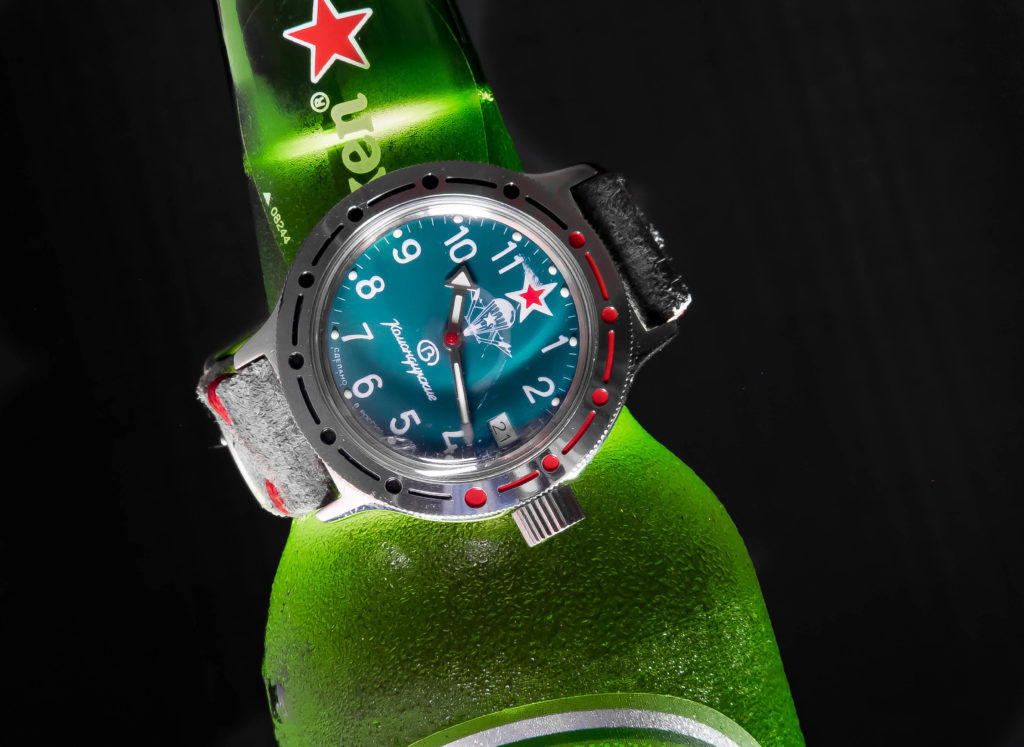
The Vostok Amphibia is a good example of why we’ve stopped trusting diameter and thickness to tell the whole story. At 39mm and around 15mm thick, it has the measurements of a watch that should feel like a small brick, yet the rounded case, sloping lugs, and absence of crown guards keep it from wearing that way. The case rolls into the wrist instead of sitting on top of it, and that changes the impression considerably. It also helps that the polished steel doesn’t pretend to stay pristine. It scratches easily, but those marks suit the watch better than a spotless case ever could. The result is a diver that looks substantial on paper and much friendlier once it’s on the wrist.
The Amphibia also has case engineering that gives you something to talk about after the novelty wears off. Its 200-meter compression-case system uses water pressure and gaskets to improve the seal rather than simply making the case thicker. The spring-loaded, two-piece crown is the sort of thing that makes a first-time owner think, “Well, I broke it,” before discovering that it’s supposed to do that. The loose-feeling crown helps protect the movement from side loads and underwater pressure. Current examples still have lighter-feeling crown metal and threading, though, and the friction bezel can move when you don’t want it to. None of that makes the Amphibia a precision instrument, but it does give the watch a character that more polished alternatives tend to engineer out.
Then there’s the ridiculous variety of versions, which is where the Amphibia starts behaving less like a single watch and more like a hobby that happens to tell time. The example we handled had a green dial, painted Arabic numerals, a red star at 12, vintage-style hands, and a domed acrylic crystal. That combination had plenty of old-school charm, although the red second hand could get lost against the dial and the lume was merely adequate. The hollow stock bracelet is similarly easy to forget, and swapping it for an 18mm NATO or suede strap makes far more sense.
The in-house Vostok 2416 automatic follows the same philosophy: roughly 31 hours of power reserve and a quoted accuracy of -20/+60 seconds per day are hardly numbers to brag about, but the movement is simple, durable, and Vostok puts its average service life around 10 years. Production can still be inconsistent, including lubrication and hand-setting issues. Still, the huge market for replacement bezels, dials, hands, and bracelets turns those imperfections into part of the ownership experience.
For our purposes, that’s exactly why the Amphibia belongs here. Its 39mm diameter and 15mm height make it look far more intimidating than it wears, and the case shape is the reason. This isn’t the watch for someone demanding a perfectly executed bracelet, dead-on precision, or a bezel with zero personality. It is for the collector who enjoys a watch with some mechanical weirdness, a forgiving attitude toward scratches, and enough aftermarket support to let ownership get a little out of hand.
Pros
- The rounded 39mm case wears much smaller than its roughly 15mm thickness indicates.
- Features a clever 200m compression-case system.
- Huge variety of case and dial combinations.
- Acrylic crystal and quirky details add genuine vintage character.
- Extensive aftermarket makes customization part of ownership.
Cons
- The hollow stock bracelet begs for replacement.
- The friction bezel can shift accidentally.
- Crown and threading can feel light on newer examples.
- Inconsistent production and occasional hand-setting or lubrication issues.
- Modest lume and a second hand that can disappear into the dial.
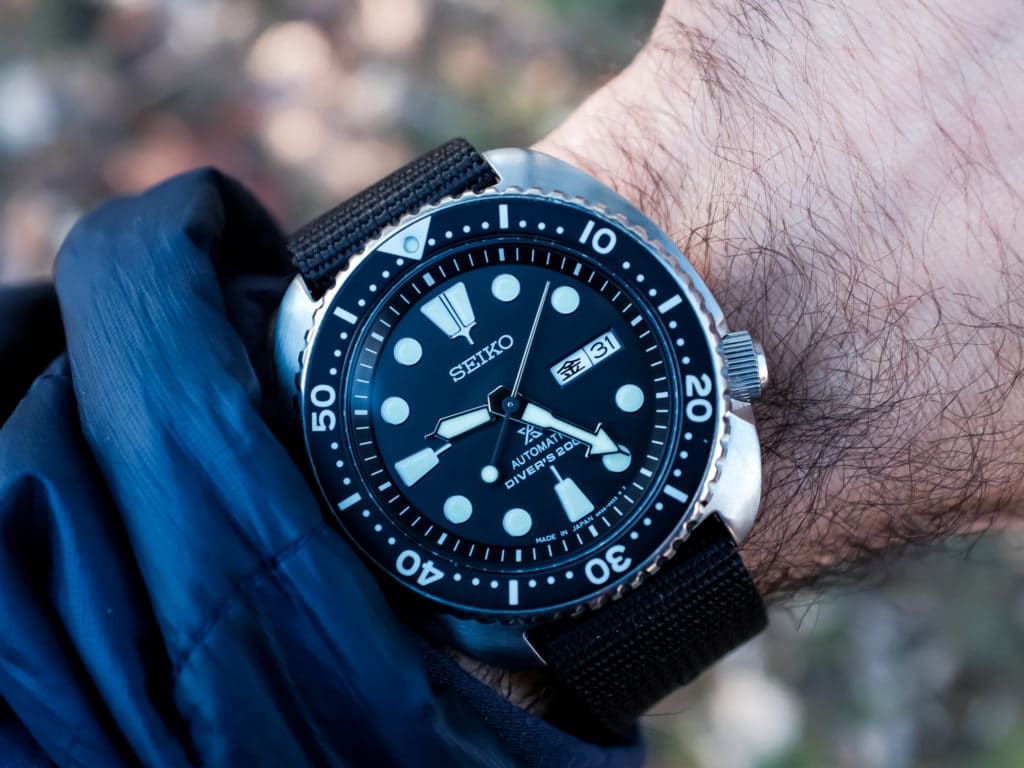
Seiko Turtle
| Price: | $370 – $525 (Check Current Price) |
| Water Resistance: | 200m |
| Case Dimensions: | 44.3mm (diameter) x 48mm (lug-to-lug) x 14mm (thickness) |
| Lug Width: | 22mm |
| Movement: | Seiko 4R36 |
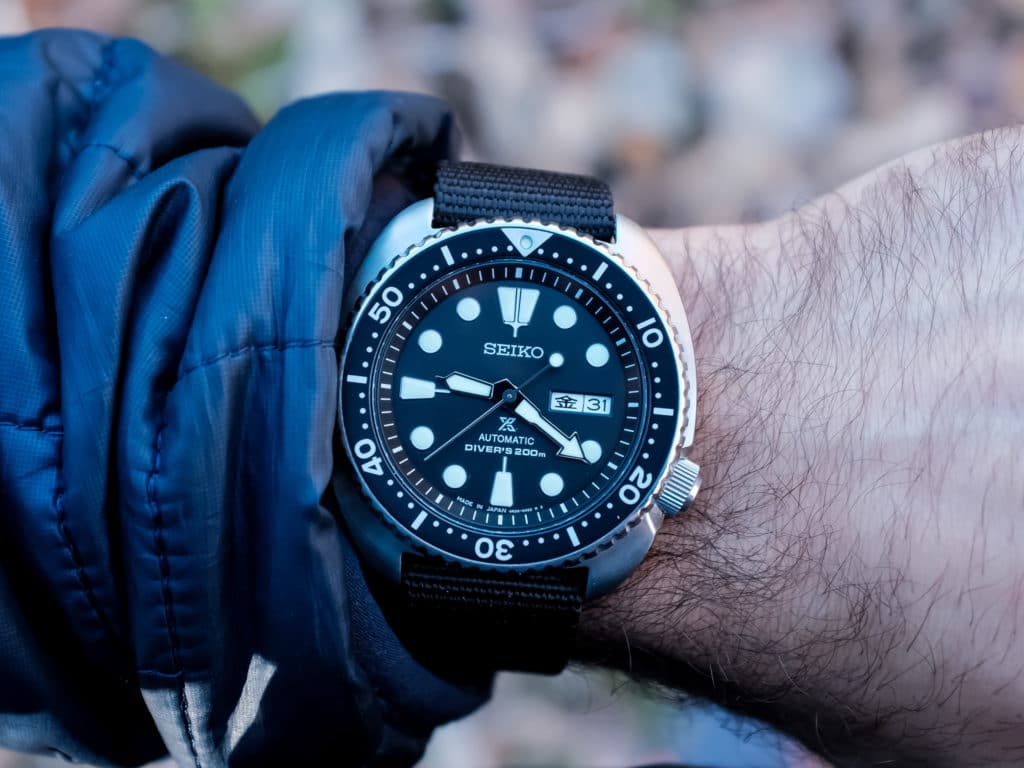
The Seiko Turtle is a 44mm watch that has no business feeling this reasonable on the wrist. On paper, that diameter puts it firmly into “probably too big” territory. In practice, the cushion case spreads that size across the wrist instead of stretching it out like a conventional round diver, so the watch feels planted rather than cartoonishly oversized. The offset crown helps too, keeping a chunk of metal away from the back of your hand when you’re wearing it for hours. There’s still plenty of watch here, especially on a smaller wrist, but the Turtle’s shape is doing a lot of work to make that 44mm manageable.
The dial reinforces that practical approach. The matte surface keeps reflections from getting in the way, while the oversized Lumibrite plots make the time immediately readable without hunting for the markers. We’ve never been interested in arguing about Hardlex once a Turtle is actually on the wrist, and the same goes for the Prospex “X.” Both are much bigger subjects on the internet than they are during everyday wear. The bezel feels reassuring to use, although alignment can vary between examples. That’s a more meaningful caveat than whether the case measures 44mm, because a bezel you can trust affects the experience; a millimeter on a spec sheet generally doesn’t.
The 4R36 gives the Turtle the useful modern conveniences of hacking and hand-winding without turning it into something overly precious. Our example was running around +35 to +45 seconds a day, so nobody should buy one expecting chronometer-level accuracy. The silicone strap is another pleasant surprise: soft, comfortable, and good enough that it doesn’t immediately land in the “replace this” pile. We still prefer the Turtle on a NATO because the whole watch feels more relaxed that way.
The Turtle is a broad, substantial diver whose case shape makes its size much easier to live with than the number implies. That said, the case shape is only part of the Turtle story, and our detailed hands-on review covers the rest of the wearing experience.
Pros
- The 44mm cushion case wears more compactly than its diameter indicates.
- Offset crown keeps the bulky case more comfortable during long wear.
- Matte dial and oversized Lumibrite make legibility excellent.
- Comfortable silicone strap, with a NATO strap bringing out its best casual side.
- 4R36 adds hacking and hand-winding.
Cons
- Still a broad watch for smaller wrists.
- The 4R36 movement isn’t very accurate, at roughly +35 to +45 seconds/day.
- Bezel alignment can vary from one example to another.
Seiko Samurai
| Price: | $500 – $700 (Check Current Price) |
| Water Resistance: | 200m |
| Case Dimensions: | 43.8mm (diameter) x 47mm (lug-to-lug) x 13mm (thickness) |
| Lug Width: | 22mm |
| Movement: | Seiko 4R35 (Mechanical) |
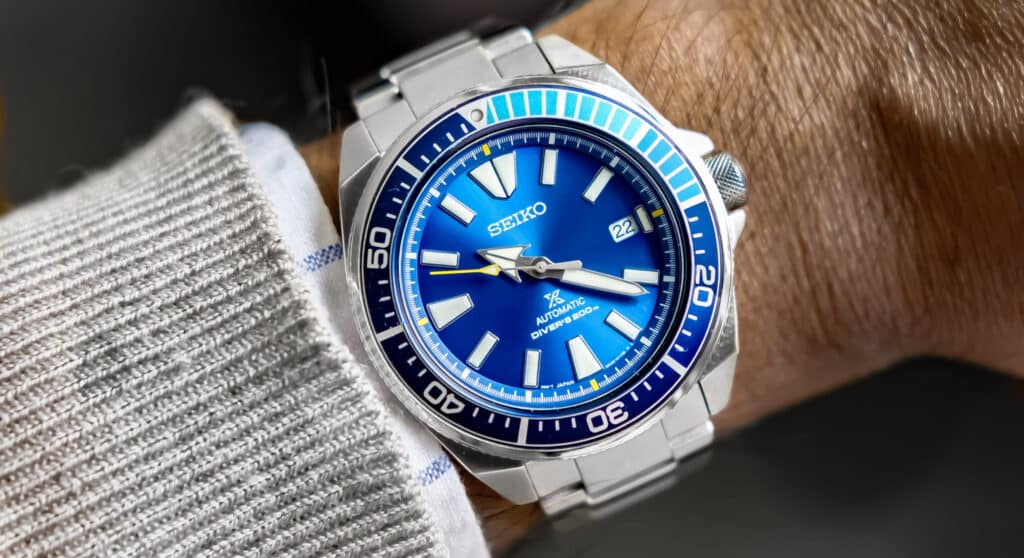
The Seiko Samurai looks like it should wear every bit as aggressively as it looks. The case is all flat brushed surfaces, sharp transitions, and faceted edges, with none of the rounded friendliness you get from a Turtle. On the wrist, though, it’s a different story. We expected those angular lines to make the watch feel larger and awkward, but the Samurai settles in quite well during long wear. That’s a useful distinction for this list: the case creates a lot of visual mass without adding the same physical bulk. The trade-off is that those crisp edges don’t hide scratches as gracefully as Seiko’s softer cushion cases.
During our review we found the dial is just as unapologetic. Oversized Monster-style hands, big applied markers, and generous Lumibrite make it very easy to read, while the blue dial shifts through different shades without sacrificing legibility. The hands look huge in photographs, but they make much more sense once the watch is moving around on your wrist because they reinforce the case’s angular personality. Even the bracelet gets the proportions right. At 22mm, it gives the watch enough visual and physical support; the end links flow neatly into the lugs, and we never felt compelled to replace it out of the box. The drilled lugs are a nice escape hatch for anyone who does want to start experimenting with straps.
Seiko also kept the functional bits sensible. Deep bezel knurling gives you plenty to grab, and the sloped crown guards protect the screw-down crown without turning crown operation into a wrestling match. Our sample’s bezel was stiffer than we’d prefer, although once it started moving, the clicks felt deliberate. The 4R35 underneath is equally straightforward, bringing hacking, hand-winding, and roughly 40 hours of power reserve. Accuracy was within the broad range we’ve come to expect from Seiko’s entry-level automatics. None of that makes the Samurai remarkable on paper. What makes it interesting here is that the case gives the watch a much more imposing visual footprint than the wrist experience ultimately delivers.
For anyone who finds the Turtle’s rounded case a little too comfortable-looking, the Samurai offers the opposite approach without turning into an unwieldy slab. Its proportions reward you for trying it on instead of judging it from photographs, which is precisely the problem with using diameter—or visual heft—as a substitute for actual wrist time.
Pros
- The sharp, faceted case looks substantial but wears better than expected.
- The 22mm bracelet balances the case and feels worth keeping.
- Large hands, applied markers, and strong Lumibrite make it easy to read.
- Sloped crown guards protect the screw-down crown without getting in the way.
- Drilled lugs make strap changes easy.
- 4R35 provides hacking, hand-winding, and roughly 40 hours of reserve.
Cons
- The angular case edges reveal scratches more readily than rounded Seiko cases.
- The bezel on our example was stiffer than ideal.
Seiko Sumo
| Price: | $600 – $800 (Check Current Price) |
| Water Resistance: | 200m |
| Case Dimensions: | 45mm (diameter) x 52.6mm (lug-to-lug) x 13.5mm (thickness) |
| Lug Width: | 20mm |
| Movement: | 6R35 (Automatic Movement) |
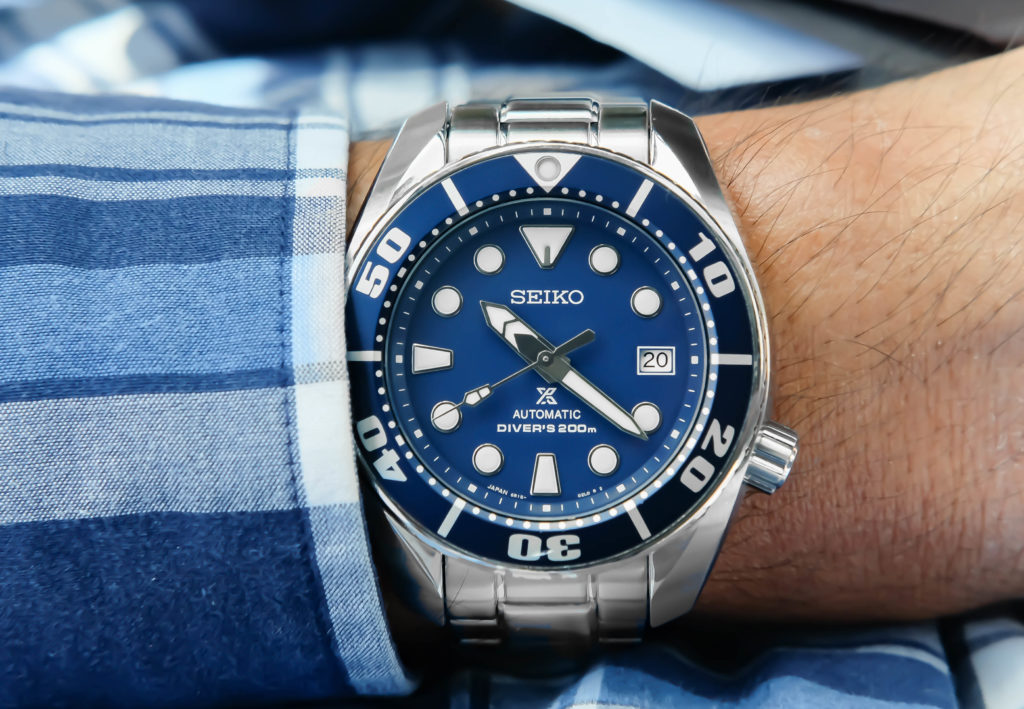
The Seiko Sumo probably makes the strongest case for ignoring case diameter. At 45mm, it has the sort of measurement that can end a conversation before the watch ever reaches your wrist. We’ve worn enough oversized divers to know the type: plenty of case, plenty of movement, and an irritating habit of migrating toward the edge of your wrist. The Sumo doesn’t behave like that. Its rounded mid-case and sweeping lugs let that large footprint settle around the wrist rather than simply sitting on top of it. After enough time with the Blumo, we stopped thinking about whether 45mm was sensible and started noticing how naturally the case stayed put.
That curved profile also keeps the Sumo from feeling like a piece of diving equipment that wandered into dinner. As discussed in our dedicated review, the brushed and polished surfaces soften the tool-watch shape, while the blue dial changes character with the light, moving from deep navy to brighter blue without becoming showy for its own sake. Polished surrounds on the applied markers add some depth, and the beveled chapter ring gives the dial a clean frame. Legibility remains excellent because the hands stand clearly against the dial. Underneath all that, you still get the serious stuff: 200 meters of water resistance, a screw-down crown, and a solid caseback. The case finishing simply means the Sumo doesn’t feel out of place when the nearest body of water is nowhere in sight.
The bracelet suits that more versatile personality, too. Brushed upper links and polished sides continue the case finishing nicely, and it’s the combination we kept returning to despite the narrower lug width and the awkward space around the lugs that can make aftermarket straps look a little odd. NATOs tend to work better than most alternatives. The 6R35 movement adds hacking, hand-winding, and around 70 hours of power reserve, making the watch easy to live with even if its pricing can put it in an awkward spot within Seiko’s own lineup.
None of that changes the main point, though: the Sumo’s 45mm diameter tells you it’s a big watch, but not that it can be remarkably composed once it’s actually on your wrist. That distinction is important. The Sumo will still overwhelm smaller wrists, and no amount of curved casework can make 45mm disappear completely. But for wrists that can carry it, the shape does more to control the size than the raw measurement suggests.
Pros
- Rounded case and sweeping lugs make 45mm wear far more naturally than expected.
- Brushed/polished finishing adds versatility beyond the typical tool diver.
- Excellent legibility and a dial that changes character with the light.
- 200m water resistance, screw-down crown, and solid caseback deliver proper dive-watch capability.
- 6R35 brings hacking, hand-winding, and roughly 70 hours of reserve.
Cons
- 45mm is still a lot of watch for smaller wrists.
- Narrow lugs and the space around them can make aftermarket straps awkward.
- Pricing can put the Sumo in an uncomfortable spot within Seiko’s lineup.
Farer Belzoni 35mm
| Price: | $1,165 (Check Current Price) |
| Water Resistance: | 50m |
| Case Dimensions: | 35mm (diameter) x 38mm (lug-to-lug) x 10mm (thickness) |
| Lug Width: | 18mm |
| Movement: | Sellita SW210-1 Elaboré |
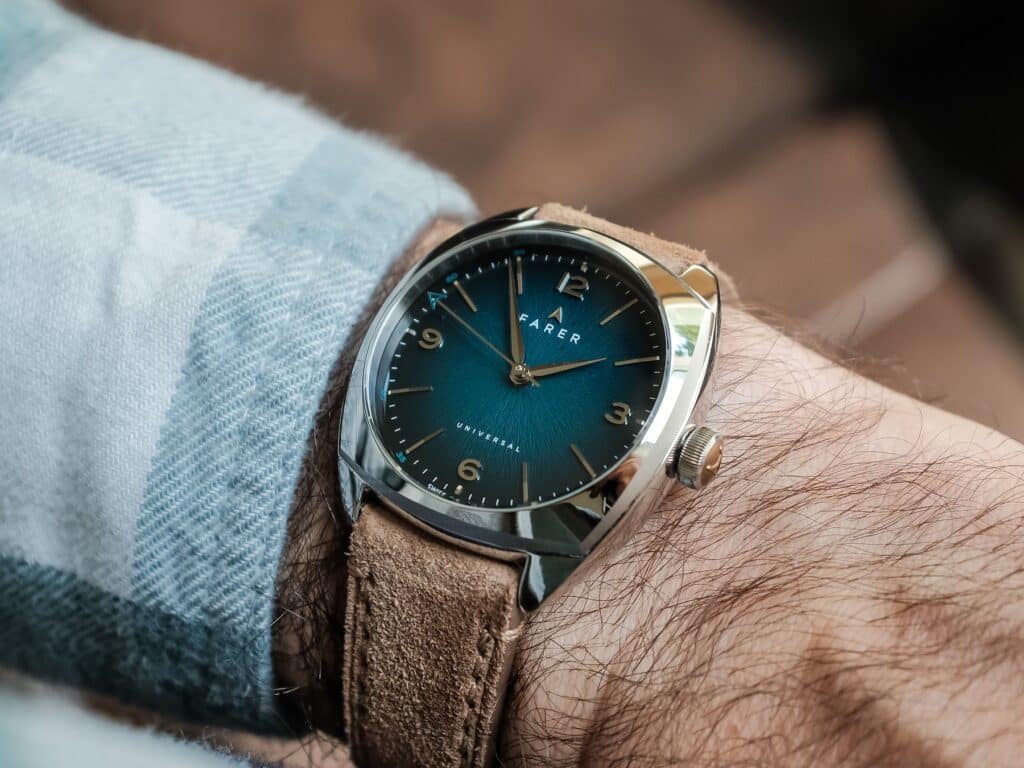
The Farer Belzoni is the kind of watch that makes you question what you’re really asking when you ask for a case diameter. At 35mm, it lands well below what many modern buyers instinctively call “normal,” but the actual wrist experience is much more convincing. On a 6.75-inch wrist, the 38mm lug-to-lug and broad cushion shape give it enough visual width that it never looks undersized. The 10mm thickness helps too, keeping the watch close to the wrist instead of turning a compact case into a little raised platform. We also found the proportions translated naturally to a smaller wrist, which says more about the geometry than the diameter does. Farer has designed around 35mm here rather than simply making a larger watch smaller.
The case finishing makes that geometry even more noticeable. Most of the 316L steel is polished, with a brushed chamfer around the bezel creating just enough separation to keep the case from becoming one uninterrupted reflective blob. In person, the rounded cushion profile catches light from several directions, and that movement is a big part of why the Belzoni looks more substantial than its dimensions suggest. Of course, polished steel has a downside. Fingerprints show up immediately, and scratches won’t be shy about introducing themselves either. We’d still take the polished execution because it suits the shape, especially when the 18mm brown suede strap tucks so closely into the case that there’s almost no visual gap between leather and steel. That little detail makes the whole watch feel considered, not like a case with a strap attached as an afterthought.
The dial is where Farer could easily have gone too far, yet somehow doesn’t. The teal gradient starts brighter toward the center and deepens noticeably around the edges, with the character shifting with the light. In brighter conditions, the teal opens up; in softer light, the outer portion gets much darker. That variability is difficult to appreciate from a press image, but it’s obvious once you live with the watch. Applied baton markers, the contrasting minute track, polished steel alpha hands, and the tiny Farer “A” on the second hand add plenty of detail without turning the 35mm canvas into a traffic jam. The bronze-capped push-pull crown is another nice touch, adding a warmer accent to the polished steel. Water resistance is 50 meters, which feels appropriate for a watch meant for everyday wear, though we’d leave the swimming to something else.
The Sellita SW210-1 Elaboré makes sense here because it adds a little ritual without making it precious. It’s a 4Hz, 18-jewel manual-winding movement with hacking and roughly 45 hours of power reserve. That reserve is the obvious compromise for anyone with a large rotation because it can stop between wears, but we found the need to wind it part of what makes the watch work. Farer also resisted the temptation to hide the movement behind an opaque back, giving it bespoke branding, decoration, and blued screws beneath the sapphire exhibition caseback.
For someone who wants a compact watch that feels deliberately designed rather than merely small, that combination is the real appeal. The Belzoni doesn’t need a larger case to command attention. It has enough shape, color, finishing, and mechanical personality to make 35mm feel like a choice, not a concession. We go deeper into that wearing experience in our Farer Belzoni 35mm review.
Pros
- The 35mm cushion case has surprising presence, thanks to its broad shape and 38mm lug-to-lug.
- 10mm thickness and short lugs keep the watch close and comfortable.
- Polished case finishing works especially well with the rounded geometry.
- The strap sits unusually close to the case, creating a clean transition.
- The teal gradient changes noticeably with the light while staying easy to read.
- Decorated SW210-1 Elaboré adds character and useful hacking with a roughly 45-hour reserve.
Cons
- Highly polished steel shows fingerprints and scratches quickly.
- The manual movement can stop between wears in a larger rotation.
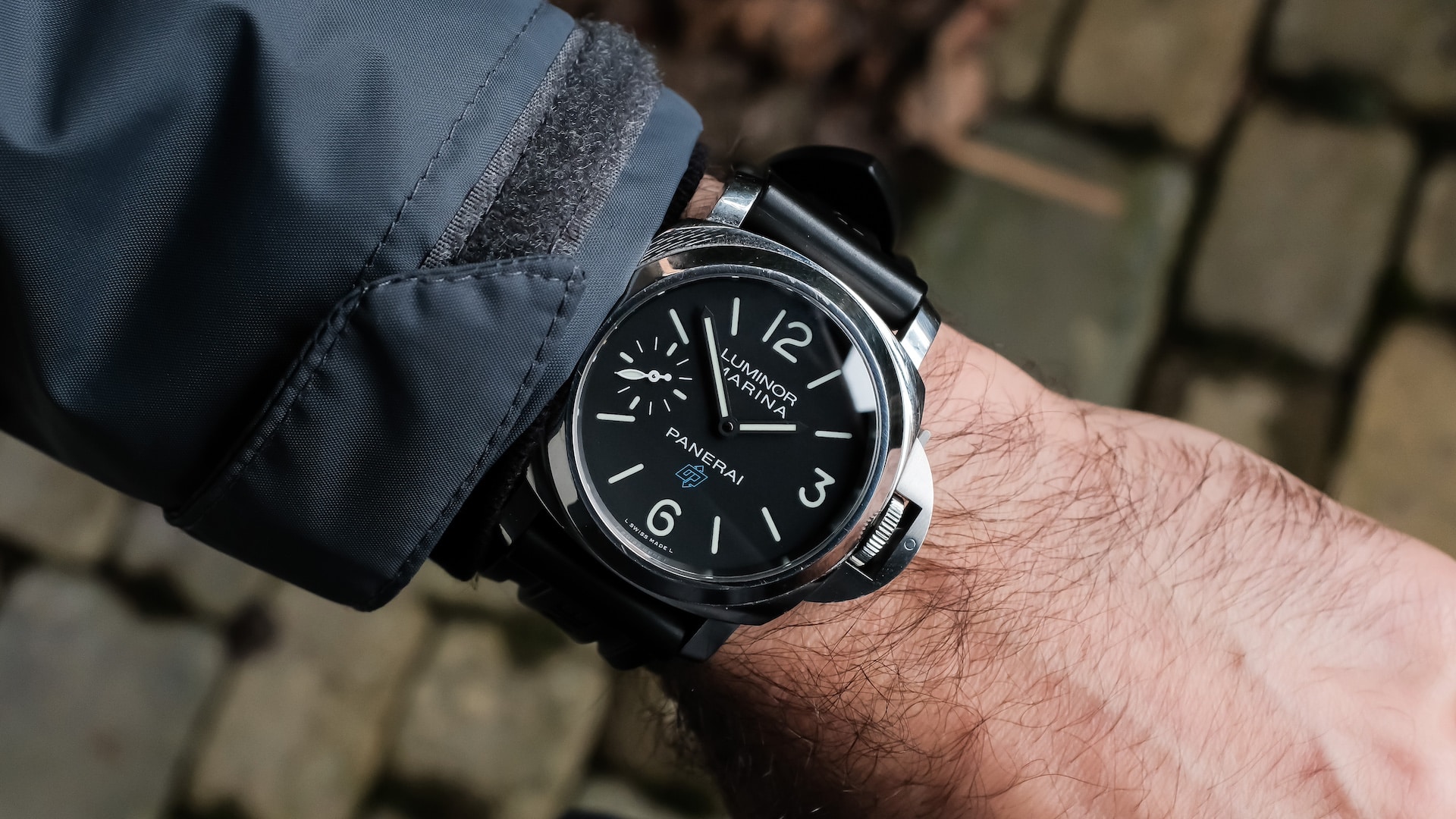
Panerai Luminor Marina PAM00777
| Price: | $3,600 – $5,000 (Check Current Price) |
| Water Resistance: | 100m |
| Case Dimensions: | 44mm (diameter) x 53mm (lug to lug) x 15mm (thickness) |
| Lug Width: | 24mm |
| Movement: | In-house, manual-winding P.6000 |
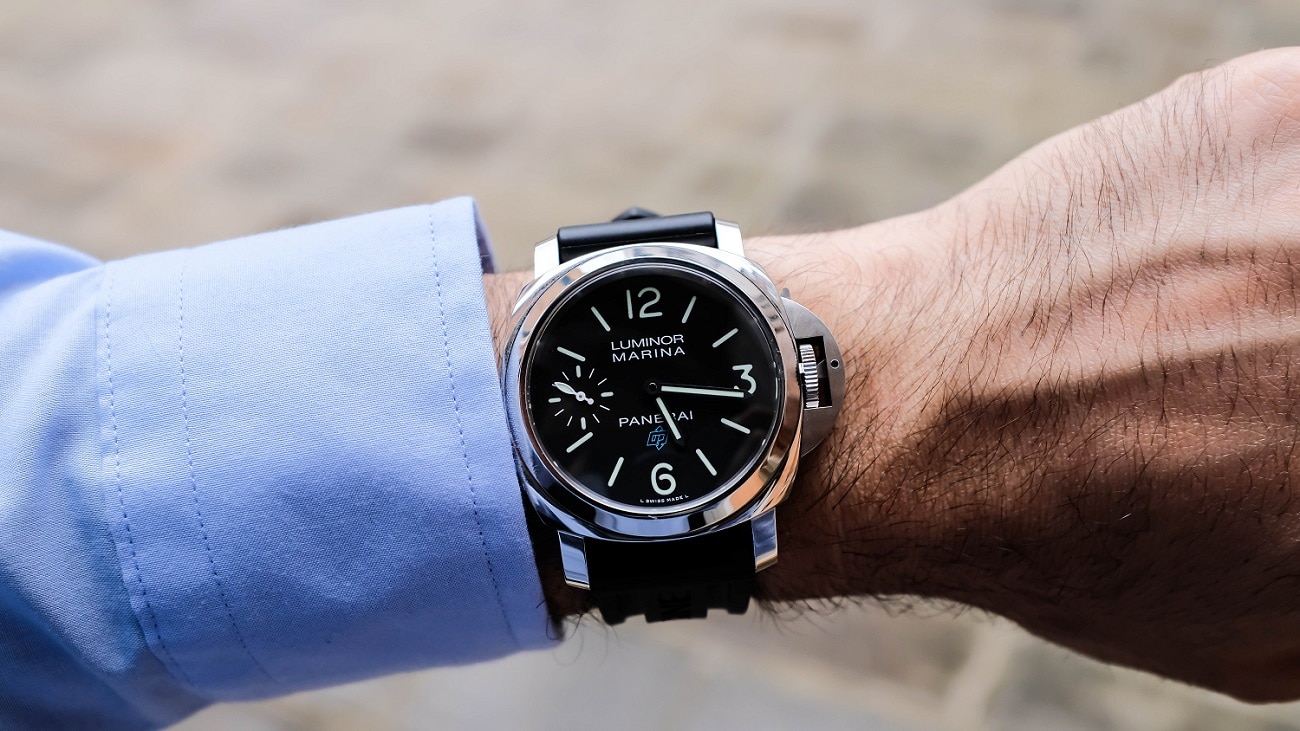
The PAM00777 is where “44mm is too big” stops being a particularly useful sentence. The polished Luminor case is undeniably large, but its broad, deliberate shape gives the watch a kind of casual heft that makes more sense once you’re wearing it than it does beside a ruler. On a larger wrist, the proportions feel relaxed and almost better suited to a T-shirt than a cuff. On a smaller wrist, there’s no clever argument to make: the thing is going to make itself known. The polished case also has a photographic memory for scratches, so regular wear leaves evidence. We never saw a reason to baby it, but anyone buying one should be comfortable with the case telling the story.
The dial is unusually restrained for a watch with this much physical presence. Large printed numerals and indices make it almost effortless to read; the running seconds at 9 o’clock keep the layout from feeling completely static, and the small blue logo at 6 adds a welcome bit of color. There’s a lot of space, which works quite well with the broad case, although we can understand anyone looking at the combination and thinking Panerai could have filled the real estate a little more enthusiastically. The 24mm rubber strap is similarly proportioned to the watch: substantial, well made, and comfortable once you stop noticing how much rubber is actually around your wrist. However, that width does make experimenting with alternative straps more difficult.
Then there’s the crown guard, which is arguably the most enjoyable part of the ownership experience. Flipping the lever, winding the P.6000, and setting the watch with hacking seconds gives you a physical routine that suits a large mechanical watch without turning basic timekeeping into theatre. The three-day power reserve is useful, and our extended review time found the movement reliable and straightforward. The solid caseback means there’s no movement to admire, but that seems like a reasonable trade when the watch is designed around interaction rather than movement-window peeping. The 100m water resistance is less impressive, especially when the visual language suggests something ready for considerably more aquatic punishment.
That’s ultimately why the PAM00777 works for this topic. Its 44mm diameter tells you it is large; it doesn’t tell you why the watch works as well as it does when worn casually. The case architecture, crown guard, dial proportions, and enormous strap all contribute to a very specific kind of wrist presence. It isn’t discreet, it isn’t particularly interested in pretending to be, and it certainly isn’t the watch for someone who wants their sleeve to do the talking. But once you understand what that case shape is trying to accomplish, the 44mm figure becomes less interesting than the experience it creates.
Pros
- The broad Luminor case gives 44mm a coherent, casual presence.
- The crown-guard lever makes winding and setting truly satisfying.
- P.6000 offers hacking, manual winding, and a useful 3-day reserve.
- Sparse dial and large printing deliver excellent legibility.
- The rubber strap suits the oversized case and feels well made.
Cons
- The polished case picks up scratches quickly.
- The 24mm strap width limits replacement options.
- Panerai’s previous build-quality concerns may give cautious buyers pause.
- 100m water resistance is modest for the visual package.
Have you worn a watch that completely fooled you on paper? Tell us which one in the comments. We’re always interested in the cases that made you rethink what a diameter measurement actually means, and we may even get some of your suggestions in for hands-on time.

Co-Founder and Senior Editor
Kaz has been collecting watches since 2015, but he’s been fascinated by product design, the Collector’s psychology, and brand marketing his whole life. While sharing the same strong fondness for all things horologically-affordable as Mike (his TBWS partner in crime), Kaz’s collection niche is also focused on vintage Soviet watches as well as watches that feature a unique, but well-designed quirk or visual hook.