Plenty of watches borrow history. Far fewer have actually earned it. After years in this hobby, we’ve found that the pieces we keep coming back to aren’t necessarily the newest releases or the most expensive ones. They’re the watches that can trace their place in military service, underwater exploration, motorsport, aviation, or spaceflight—and still feel relevant once they’re on your wrist today. That’s what this list sets out to answer: which historically significant watches are still worth buying, wearing, and collecting, rather than simply admiring from behind a display case.
Over the years, we’ve learned that heritage only goes so far if the watch disappoints once it’s on your wrist. Every watch here is one we’ve reviewed, worn, or spent meaningful time with, so these recommendations come from real wrist time instead of brand archives or spec sheets. Some are affordable cult favorites, while others sit much higher on the collecting ladder. Still, each one has earned its place by pairing genuine historical significance with an ownership experience we’d happily revisit. If you’re building a collection around provenance instead of hype, keep reading—these are the watches that continue to reward you long after the history lesson ends.
Vostok Amphibia
| Price: | $100 – $150 |
| Water Resistance: | 200m |
| Case Dimensions: | 39mm (diameter) x 46mm (lug-to-lug) x 15mm (thickness) |
| Lug Width: | 18mm |
| Movement: | Vostok 2416 Automatic Movement (in-house) |
The Vostok Amphibia is one of those watches that reminds us history isn’t exclusive to Swiss brands. Designed in the Soviet Union during the Cold War, it solved the problem of building a capable dive watch with limited manufacturing resources, and many of those engineering decisions are still intact today. That’s what makes it so compelling for collectors. You’re not wearing a modern homage to an old idea; you’re wearing a watch that still follows the same design philosophy.
The famous 200-meter compression-case system is the best example, using water pressure and gaskets to improve the seal instead of simply making the case thicker. Even the spring-loaded, two-piece crown catches first-time owners off guard. It wobbles enough to feel broken until you realize it’s intentionally designed to protect the movement from side loads and underwater pressure. The crown metal and threading on current examples can still feel a little light, and the friction bezel is easy to knock out of place, but those quirks feel like part of the Amphibia’s personality rather than flaws someone tried to engineer away.
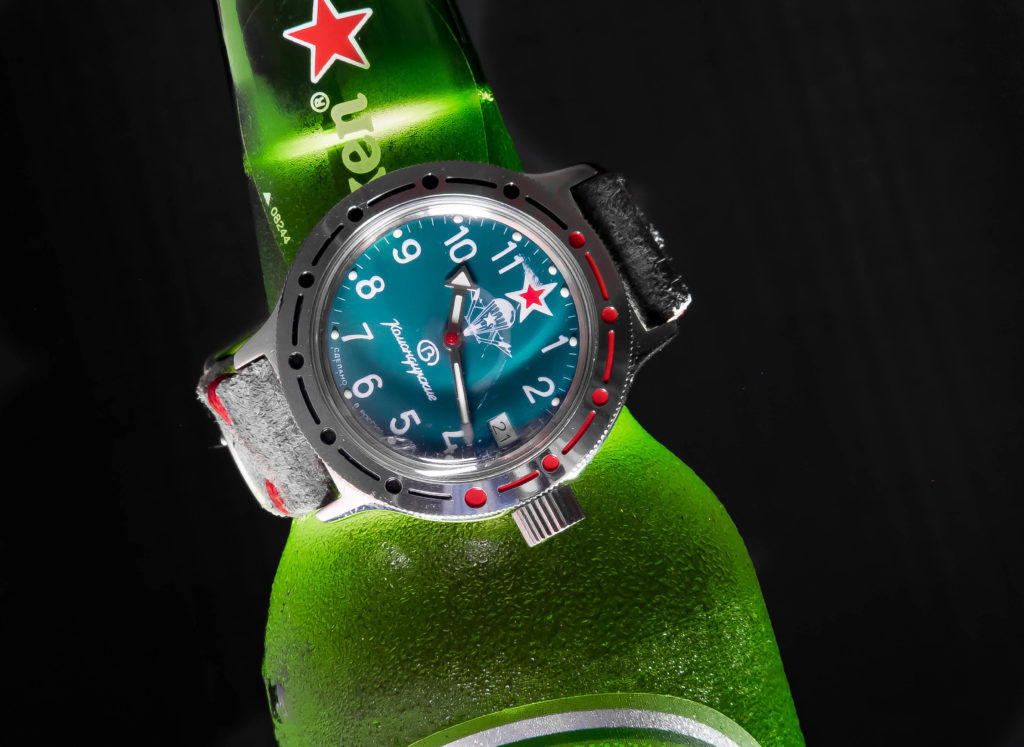
That same sense of history carries over to the experience of wearing it. The rounded 39mm case, sloping lugs, and lack of crown guards keep its 15mm height from feeling overwhelming, while the polished steel case develops scratches that somehow make it look more authentic rather than more worn. The stock bracelet is hollow and forgettable, so most owners end up swapping it for an 18mm NATO or suede strap without much hesitation. Between the dozens of dial and case combinations available, collecting an Amphibia feels less like buying a single model and more like finding your version of an enduring design. The paratrooper-dial example we reviewed, with its green dial, painted Arabic numerals, red star at 12, vintage-style hands, and domed acrylic crystal, captured that historical oddball character perfectly, even if the red second hand occasionally disappeared into the dial and the lume remained fairly modest.
The in-house Vostok 2416 automatic movement reinforces why the Amphibia has earned such a loyal following among enthusiasts. On paper, its roughly 31-hour power reserve and quoted accuracy of -20/+60 seconds per day won’t impress anyone chasing specifications. In practice, though, it’s simple, durable, and easy to keep running, with Vostok claiming an average service life of around 10 years. Modern production can still be inconsistent, and lubrication or hand-setting issues aren’t unheard of. Still, the thriving aftermarket of bezels, dials, hands, and bracelets means ownership often becomes part restoration project, part personal expression.
If your collection is built around watches that tell the story of how different countries solved the same engineering problems in different ways, the Amphibia offers something very few modern dive watches can: history you can still experience every day, quirks included.
Pros
- The rounded case wears far better than its 15mm thickness indicates.
- The acrylic crystal, vintage styling, and soft case shape give it an authentic old-school character.
- The 200-meter compression-case design remains one of the most distinctive engineering solutions in dive watch history.
- The affordable modding ecosystem makes customization part of the ownership experience.
- A huge variety of dials and case styles makes every Amphibia feel a little different.
- Scratches suit the polished case, making it a watch you can wear without worrying.
Cons
- Current production quality can be inconsistent, with occasional issues with lubrication or hand-setting.
- The stock bracelet feels hollow and is the first thing we’d replace.
- The friction bezel is easy to adjust but can move unintentionally.
- The floating crown can feel alarming until you understand how it works.
- Newer examples have somewhat thin crown metal and threading.
Citizen NY0040
| Price: | $250 – $350 |
| Water Resistance: | 200m |
| Case Size: | 42mm (diameter) x 47.3mm (lug-to-lug) x 12.6mm (thickness) |
| Lug Width: | 20mm |
| Movement: | Miyota automatic Caliber 8204 |
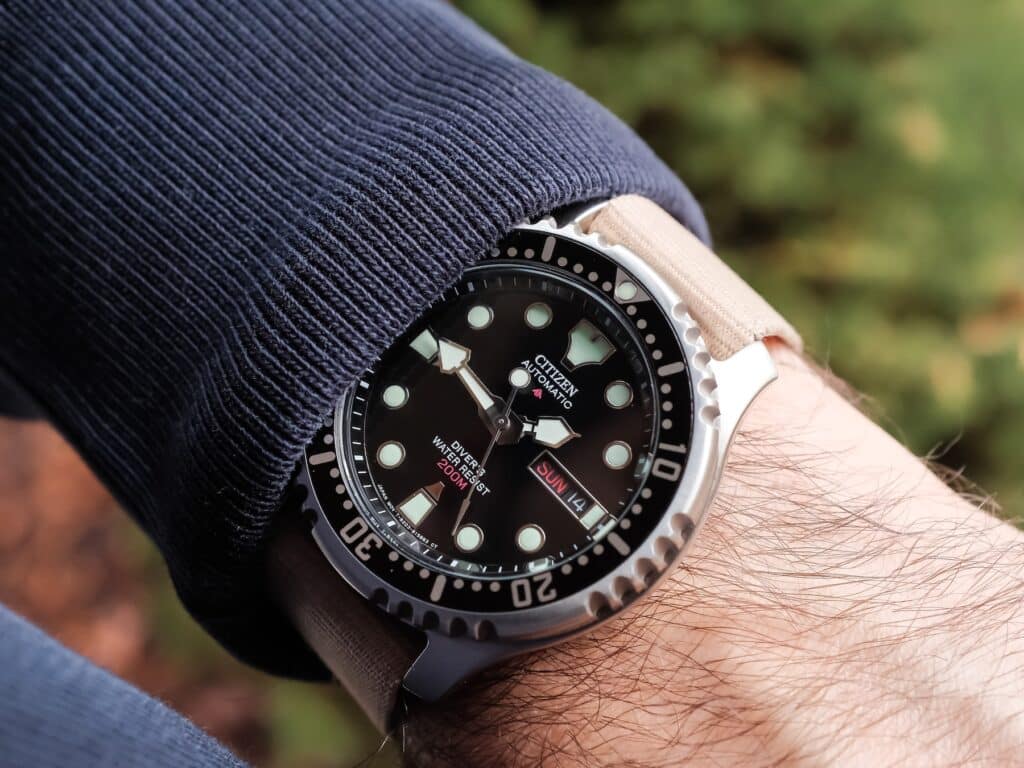
The Citizen NY0040 deserves a place in a history-focused collection because it earned its reputation through service rather than collector mythology. Its association with the Italian Navy’s COMSUBIN diving unit gives it genuine professional credibility, but what we appreciate most is that Citizen never turned it into a marketing exercise. While affordable divers often end up in endless SKX comparisons, the NY0040 has always stood on its own as a purpose-built, ISO-rated tool watch. The left-side crown sums up that idea perfectly. It looks unconventional, yet after a few days on the wrist, it’s hard not to appreciate how it keeps the crown from digging into your hand during long hours of wear. Right-handed users may need a short adjustment period when setting the time, but it quickly becomes second nature.
That practical approach carries through the rest of the watch. Although the case measures nearly 42mm, the compact 47.3mm lug-to-lug, restrained thickness, inward-sloping bezel, and smaller dial opening make it wear smaller than expected. The brushed and polished case finishing gives it reassuring heft without feeling bulky, while the broad shoulders add a subtle skin-diver character. Throughout our testing experience, we were equally impressed by the bezel, which offered excellent coin-edge grip, precise alignment, smooth 60-click action, and no noticeable play.
The dial stays true to the NY0040’s tool-watch roots. The black dial, clear hands, and highly legible markers make it easy to read at a glance, while the day-date at three blends in better than you’d expect. A small red arrow adds just enough character without cluttering the layout. The flat mineral crystal is an understandable compromise, but in everyday wear it isn’t the liability spec-sheet debates often make it out to be. Lume is similarly practical: it doesn’t hit as hard as some Seiko divers do at first, but the hands and markers stay readable once your eyes adjust.
Inside, the Miyota 8204 automatic movement cements the NY0040’s no-nonsense appeal with hacking, hand-winding, and reliability that’s well suited to everyday ownership, even if the famously noisy rotor divides opinion. We’d also swap the thick factory rubber strap sooner rather than later, although the watch works brilliantly on a NATO or one of the readily available aftermarket bracelets. For collectors who value watches with real professional heritage rather than stories crafted in the marketing department, the NY0040 remains one of Citizen’s most authentic cult achievements.
Pros
- The compact proportions make it wear much smaller than its nearly 42mm diameter would suggest.
- The coin-edge bezel has excellent grip, precise alignment, smooth 60-click action, and virtually no play.
- Easy strap changes and strong aftermarket support make it simple to personalize.
- The clean dial, practical lume, and 200m water resistance reinforce its genuine tool-watch credentials.
- Hacking and hand-winding from the Miyota 8204 improve everyday usability.
Cons
- The Miyota rotor is quite loud and won’t appeal to everyone.
- Right-handed wearers may need time to adjust to the left-side crown.
- The mineral crystal is less scratch-resistant than sapphire.
Seiko SKX007

| Price: | $350 – $650+ (based on condition, since it’s discontinued) |
| Water Resistance: | 200m |
| Case Dimensions: | 42.5mm (diameter) x 46mm (lug-to-lug) x 13.25mm (thickness) |
| Lug Width: | 22mm |
| Movement: | 7S26 |
The Seiko SKX007 is one of the few watches on this list whose historical importance comes from modern enthusiast culture rather than military contracts or exploration. It helped define what an affordable automatic dive watch should be for an entire generation of collectors, and its discontinuation has only reinforced that legacy. Plenty of us have owned one, moved on to more expensive pieces, then found ourselves buying another because the SKX007 quietly did everything we asked of it. It never felt precious or overengineered. It was simply the watch we reached for when we wanted something dependable without overthinking.
As covered in our in-depth review, a big part of that staying power comes from how easy it is to live with. The case strikes a sweet spot between presence and comfort, working across a wide range of wrist sizes without feeling bulky. It also adapts well to different straps. The stock bracelet is unmistakably Seiko: functional rather than refined. However, swapping to a nylon strap makes the watch feel lighter and even easier to wear all day.
The dial deserves just as much credit. Its clean black layout, restrained text, and highly legible hands and markers remain easy to read whether you’re outdoors, indoors, or somewhere in between. Seiko’s lume continues to earn its reputation too, charging quickly and staying useful long after the initial burst fades, which matters far more than a quick lume photo.
The 7S26 movement reflects both the SKX007’s strengths and its age. It skips hacking and hand-winding, features that have become common on newer affordable automatics, but its simplicity has also made it approachable to own and service over the years. Accuracy was never the reason people fell in love with this watch; reliability and honesty were. That said, the SKX007 isn’t the bargain it once was, and today’s prices can be difficult to justify compared to newer alternatives. Still, if you want to understand why so many collectors still measure affordable dive watches against it, there’s no substitute for spending time with the original.
Pros
- Seiko’s lume charges quickly and remains useful well beyond the initial glow.
- The 7S26 movement is simple, reliable, widely understood, and easy to service.
- The balanced case wears comfortably across a variety of wrist sizes.
- The clean dial, restrained text, and legible hands and markers make everyday reading effortless.
- Works well on the stock bracelet and feels even more relaxed on a nylon strap.
Cons
- Being discontinued has made pricing and availability a lot more unpredictable.
- The stock bracelet is functional but lacks refinement.
- The lack of hacking and hand-winding feels dated alongside newer entry-level automatics.
Seiko Turtle
| Price: | $370 – $525 |
| Water Resistance: | 200m |
| Case Dimensions: | 44.3mm (diameter) x 48mm (lug-to-lug) x 14mm (thickness) |
| Lug Width: | 22mm |
| Movement: | Seiko 4R36 |
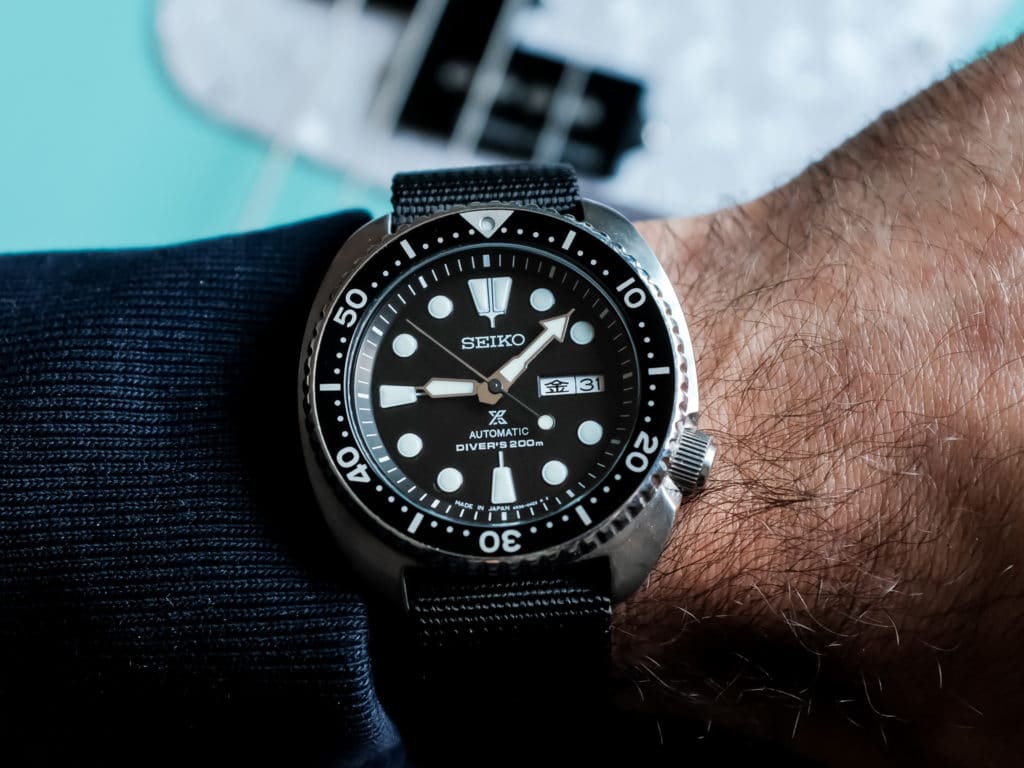
The Seiko Turtle belongs in a history-minded collection because it represents one of the most enduring chapters in Seiko’s dive-watch story. Its cushion case has become so recognizable that plenty of modern divers still borrow from it, yet the Turtle never feels like it’s cashing in on nostalgia. Instead, it carries forward the same idea that made Seiko’s early divers so respected in the first place: build a capable watch that people will actually use. If you’re interested in how Japanese dive watches evolved into the enthusiast staples they are today, the Turtle is one of the easiest places to start.
That practicality comes through the moment you put it on. A 44mm case sounds like a lot until the cushion shape spreads everything across the wrist, making it feel planted rather than oversized. The offset crown stays out of the way during long days of wear, and the included silicone strap is surprisingly comfortable, not something you’ll immediately replace. We still think the Turtle comes alive on a NATO, though, where it feels even more relaxed and ready to be knocked around.
From our testing and wear experience, the dial follows the same philosophy. The matte finish keeps glare under control, the oversized Lumibrite plots make reading the time effortless in almost any light, and Hardlex ends up being much less of a talking point once you’ve actually lived with the watch. Even the Prospex “X,” which sparks endless internet debates, quickly disappears from your thoughts after a few days on the wrist.
The 4R36 movement gives the Turtle the conveniences older Seikos lacked, adding hacking and hand-winding without changing its fundamentally tool-watch character. Ours wasn’t especially accurate, running around +35 to +45 seconds a day, but that’s never been the reason people keep coming back to the Turtle. The bezel has a reassuring action, even if alignment can still be inconsistent from one example to another. And if you enjoy the little details collectors obsess over, references with “Made in Japan” text or a Kanji day wheel add another layer of charm, although none of those details define the Turtle on their own. Together, they explain why this has remained one of Seiko’s most recognizable dive watches for generations.
Pros
- Oversized Lumibrite hands and markers make the dial easy to read day or night.
- The offset crown and cushion case make a 44mm diver wear far more comfortably than expected.
- The 4R36 adds hacking and hand-winding, making everyday ownership more convenient.
- “Made in Japan” variants and Kanji day wheels give certain references extra collector appeal.
- The soft silicone strap is truly wearable, and the Turtle feels even better on a NATO.
Cons
- The 4R36 can run less accurately compared to some competing movements.
- Bezel alignment isn’t always perfect between individual watches.
- If you prefer compact divers, the broad cushion case can still feel hefty.
Marathon General Purpose Mechanical
| Price: | $525 – $575 |
| Water Resistance: | 30m |
| Case Dimensions: | 34mm (diameter) x 41mm (lug-to-lug) x 12.5mm (thickness) |
| Lug Width: | 16mm |
| Movement: | Seiko NH35A Automatic |
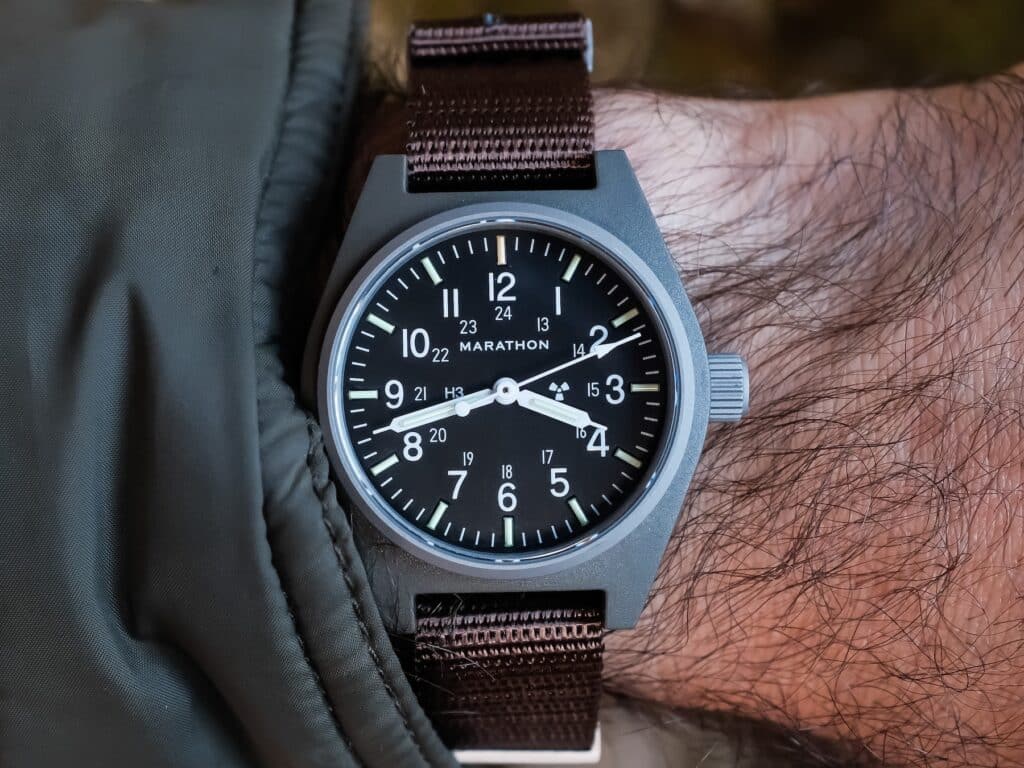
Marathon has spent decades supplying watches to military organizations, and the General Purpose Mechanical still feels as if it were designed with that job in mind. Instead of borrowing military styling from the past, it carries forward the same no-nonsense approach. The sage-green resin case, NSN markings, spec-heavy caseback, and stripped-down design all point to function over nostalgia, making it an easy recommendation for collectors who value authentic military lineage.
The ownership experience follows the same philosophy. At 34mm, the case sounds undersized until you wear it. The 12.5mm thickness, 41mm lug-to-lug, and NATO strap give it more presence than the diameter implies, while the lightweight resin case feels warmer and less fatiguing than steel over the course of a full day. The dial is equally straightforward. Syringe hands, a traditional field-watch layout, and an inner 24-hour scale make reading the time effortless. The tritium tubes quietly steal the show by providing constant nighttime visibility without ever needing to be charged. During our hands-on testing, we also appreciated that Marathon left the bezel alone instead of adding unnecessary dive-watch styling.
Power comes from the familiar Seiko NH35A, a movement that suits the watch’s practical character with hacking, hand-winding, a 41-hour power reserve, and straightforward long-term serviceability. Marathon’s switch to a steel crown is another small improvement that pays off in daily use, offering plenty of grip despite its compact size. That said, we weren’t as sold on the stock ballistic nylon strap, which starts quite stiff, and ultimately preferred the watch on a single-pass olive-drab strap that let the case sit lower and feel even more natural. Like the watch itself, it’s a reminder that genuine military tools usually prioritize function over refinement.
Pros
- Tritium tubes provide constant low-light visibility without relying on charged lume.
- The resin case is light, comfortable, and warmer on the wrist than a steel case.
- The NH35A is reliable, easy to service, and keeps long-term ownership approachable.
- Compact dimensions wear with more presence than the 34mm diameter suggests.
- The all-steel crown offers excellent grip despite its modest size.
Cons
- The 30m water resistance feels conservative for such a rugged-looking watch.
- The narrow 16mm lug width limits strap options.
- Tight spring-bar clearance makes strap swaps fiddlier than usual.
Bulova Lunar Pilot Chronograph
| Price: | $550 – $895 |
| Water Resistance: | 50m |
| Case Dimensions: | 45mm (diameter) x 52mm (lug-to-lug) x 13.5mm (thickness) |
| Lug Width: | 20mm |
| Movement: | 262 kHz Quartz |
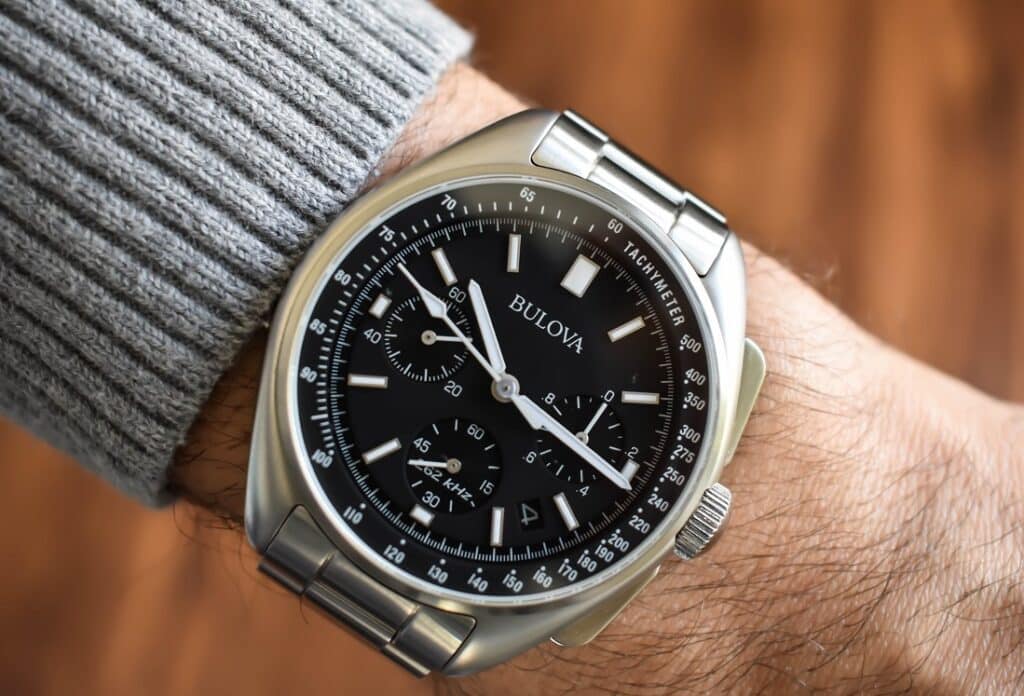
The Bulova Lunar Pilot deserves more attention from history-minded collectors than it usually gets. While the Speedmaster understandably dominates conversations about watches that went to the Moon, Bulova has its own legitimate place in that story through the chronograph worn during Apollo 15. Rather than recreating a generic space-age design, the Lunar Pilot celebrates a genuine piece of lunar exploration history. Just as importantly, it doesn’t pretend to be something it isn’t. Quartz isn’t a compromise here; it’s part of the watch’s identity.
That philosophy carries through to the wearing experience. The high-frequency quartz movement delivers accuracy of around 10 seconds per year, while the chronograph second hand sweeps smoothly enough to satisfy some of the appeal people usually associate with mechanical chronographs, without the added maintenance. The dial also benefits from the generous case size. Yes, the 45mm 316L stainless steel case is substantial, but it gives the chronograph layout plenty of room to breathe, with easy-to-read sub-dials for the 1/10-second counter, running seconds, and minute totalizer. The discreet 4:30 date window avoids disrupting the layout, while the signed crown and pump pushers add enough visual interest without making the case feel crowded.
Once we tested it on the wrist for a while, we found the factory bracelet to be an important part of the package. It integrates neatly with the case and does a good job of balancing what is undeniably a large watch. Moving it to a strap makes the case feel bulkier and less composed, even if the bracelet’s finish doesn’t perfectly match the case when you look closely.
Overall, this was never meant to be an understated everyday watch, nor is its modest water resistance aimed at hard use. Instead, the Lunar Pilot offers something different: an authentic chapter of space-watch history wrapped in a chronograph that’s large, remarkably accurate, and comfortable being its own thing.
Pros
- The smooth-sweeping chronograph second hand gives the watch a more mechanical feel than most quartz chronographs.
- The high-frequency quartz movement delivers outstanding accuracy of around 10 seconds per year.
- The signed crown and pump pushers give the case plenty of character without feeling cluttered.
- The spacious dial keeps the chronograph registers easy to read despite the amount of information displayed.
- The integrated bracelet helps the large case wear comfortably.
Cons
- The 45mm case will simply be too large for many wrists.
- The bracelet and case finishing don’t match as closely as they could.
- The watch loses some of its balance and visual cohesion when worn on straps.
Praesidus A-11 Type 44 Patina
| Price: | $555 |
| Water Resistance: | 100m |
| Case Dimensions: | 32mm (diameter) x 39mm (lug-to-lug) x 13mm (thickness) |
| Lug Width: | 20mm |
| Movement: | Swiss-made, manual-wind Landeron L21 movement |
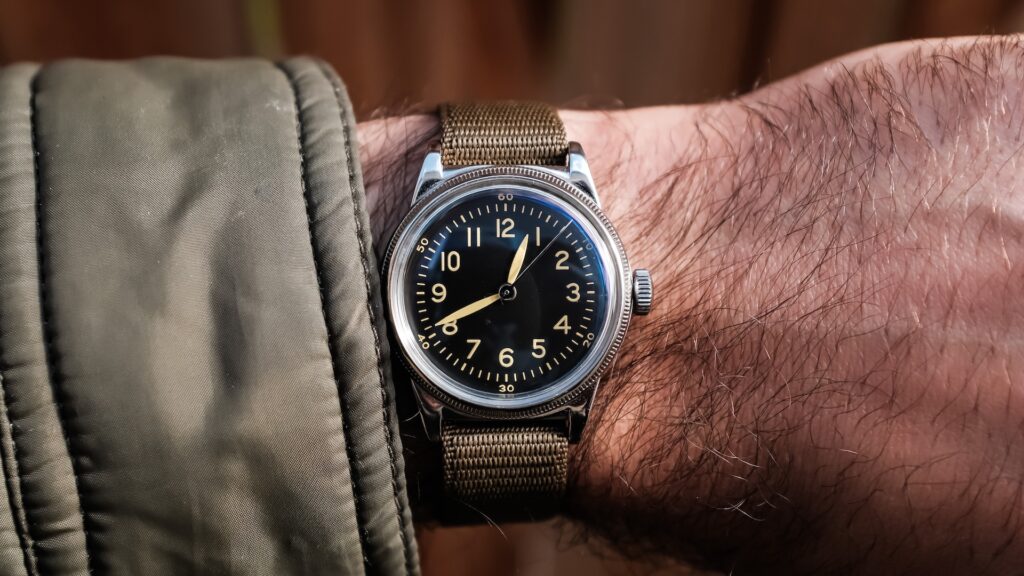
Few watches connect you to military watch history as directly as the Praesidus A-11 Type 44 Patina. It takes its inspiration from the WWII A-11 specification—the watch famously nicknamed “the watch that won the war”—but avoids feeling like a museum replica. Instead, it captures the restrained, purpose-built character of those original Bulova, Waltham, and Elgin-issued pieces in a watch you can comfortably wear every day. Instead of chasing vintage aesthetics for their own sake, it recreates the experience of wearing one of history’s most influential military field watches in an easy-to-live-with package.
The 32mm case demands a bit of trust before it wins you over. On paper, it looks tiny, but the short 39mm lug-to-lug, gently curved lugs, and relatively tall profile give it more presence than the diameter indicates. The domed acrylic crystal plays a big role too, adding the soft distortion and warmth that vintage field watches are known for.
We also appreciated that Praesidus resisted the temptation to modernize the dial. The logo-free layout, Arabic numerals, railroad minute track, polished second hand, and faux-patina hands and markers keep the focus exactly where it belongs: telling the time. Super-LumiNova is serviceable rather than impressive, while the textured bezel quietly stays out of the way. Better still, the 10-ATM water resistance makes the watch feel far less delicate than its vintage appearance suggests.
The hand-wound Swiss Landeron L21 completes the experience in a way that suits the watch’s historical roots. Winding isn’t quite as buttery as a Sellita SW210, with a little more resistance through the crown, but accuracy proved dependable throughout our time with it. We weren’t huge fans of the supplied canvas strap, which felt thicker than necessary, and quickly switched to a 16mm olive single-pass nylon strap that better matched its military personality. A black nylon works just as well if you want a cleaner look. Those standard lugs also make experimenting with straps much easier than on many fixed-bar military watches. The result is a field watch that captures the charm of an original A-11 without asking you to live with the compromises of an actual 80-year-old watch.
Pros
- The logo-free dial keeps the design clean, legible, and true to the original A-11 aesthetic.
- Standard lugs make strap changes easy, with olive or black nylon both suiting the watch well.
- The Landeron L21 offers a satisfying manual-winding experience with dependable everyday performance.
- The 10 ATM water resistance adds everyday practicality rarely found in watches this historically faithful.
- Arabic numerals, the railroad minute track, and a polished second hand make time checks effortless.
Cons
- The crown has more resistance while winding than some comparable manual movements.
- The supplied canvas strap feels thicker than the watch really needs.
- Super-LumiNova is usable but not especially bright.
CWC Mellor 72
| Price: | $600 |
| Water Resistance: | 50m |
| Case Dimensions: | 35mm (diameter) x 42mm (lug-to-lug) x 11mm (thickness) |
| Lug Width: | 18.5mm |
| Movement: | Sellita SW210 hand-wound movement |
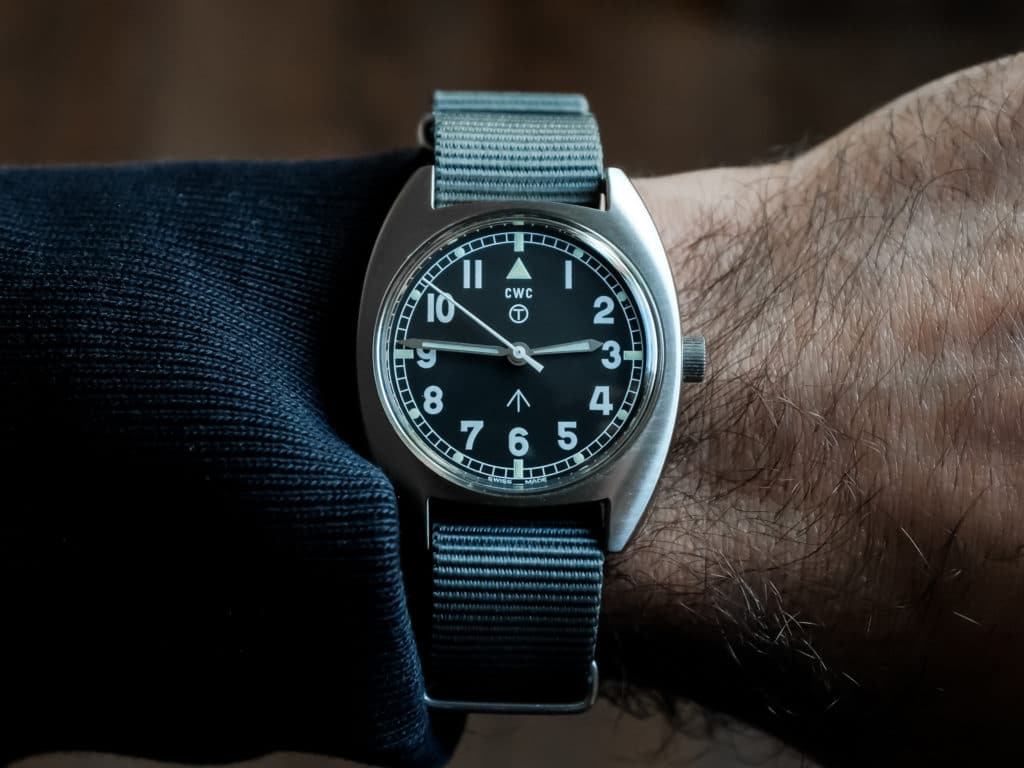
The CWC Mellor 72 is the kind of watch that reminds you military field watches weren’t designed to impress anyone. CWC has been supplying the British Ministry of Defense for decades, and the Mellor 72 stays true to that tradition rather than polishing it into a lifestyle product. If your collection leans toward watches with genuine service heritage, this is one of the most authentic ways to experience the look and feel of a classic British military field watch without taking on the compromises of an original vintage example.
The dial is where that heritage comes through most clearly. Large Arabic numerals, a crisp high-contrast layout, and a railroad-style seconds track make the time instantly readable, while the properly proportioned minute hand reaching the outer track is one of those subtle details that quietly improves everyday use. The vintage-inspired typeface, circled “T,” and Hesalite crystal all reinforce the period-correct character without feeling theatrical. Modern Super-LumiNova adds practical low-light visibility, even if the crystal asks you to accept the occasional scratch as part of the ownership experience.
The compact 35mm tonneau case follows the same philosophy. It wears closer to a 38mm, thanks to its broad shape and crown placement, while the fully brushed finish avoids unnecessary decoration. Fixed bars strengthen its military identity, though they naturally limit strap options, and the 50m water resistance is fine for daily life rather than for serious water use.
The hand-wound Sellita SW210 feels perfectly matched to the watch. Winding is smooth and tactile, becoming part of the routine rather than a chore, and the movement proved dependable throughout our time with it. The snap-back case also makes future servicing less intimidating than some vintage-inspired alternatives. Like the best military watches, the Mellor 72 doesn’t rely on dramatic storytelling or oversized dimensions to make its point. It simply delivers a historically faithful ownership experience that feels honest every time you put it on. Check out our detailed review for a deeper dive into our wrist time.
Pros
- The Sellita SW210 offers a smooth, satisfying manual-winding experience.
- The dial is very legible, with the minute hand reaching the railroad track for precise reading.
- The 35mm tonneau case wears larger than its dimensions indicate.
- The brushed finish reinforces the watch’s authentic military character.
Cons
- The Hesalite crystal scratches more easily than sapphire.
- Fixed bars limit strap flexibility.
- The 50m water resistance is adequate for daily wear but not ideal for frequent water use.
Hamilton Khaki Field Mechanical 250
| Price: | $725 |
| Water Resistance: | 100m |
| Case Dimensions: | 36mm (diameter) x 46mm (lug-to-lug) x 10.2mm (thickness) |
| Lug Width: | 18mm |
| Movement: | H-50 hand-wound movement |
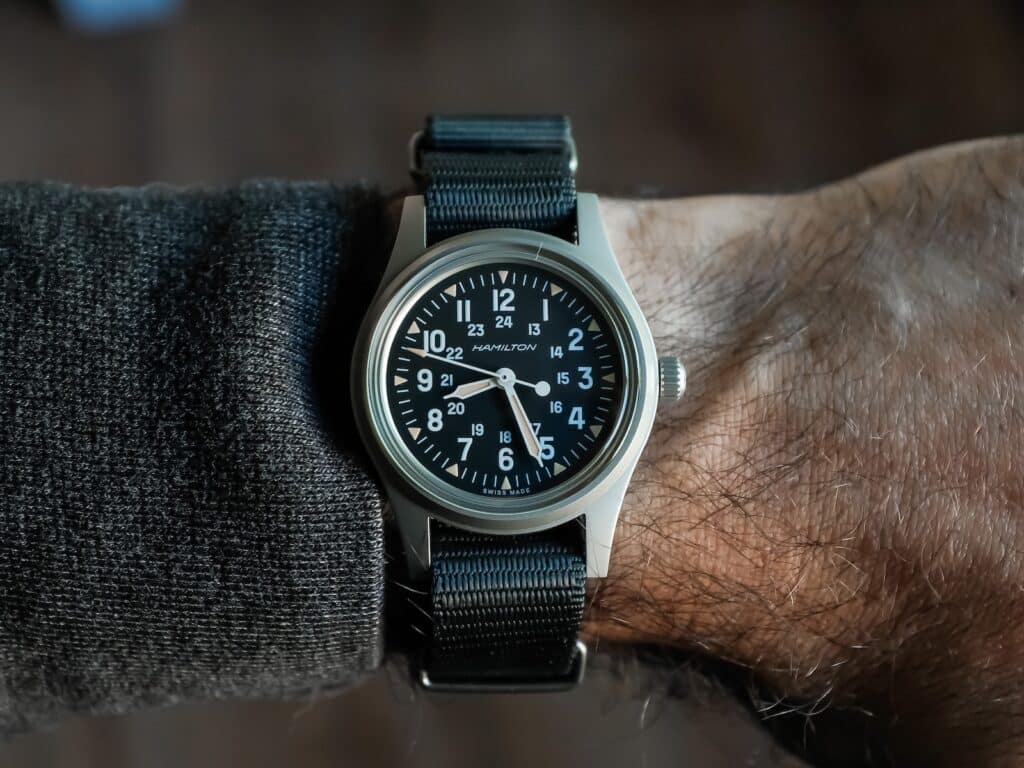
Hamilton didn’t have to invent a military backstory for the Khaki Field Mechanical 250 because it already has one. The brand spent decades making watches for the U.S. military, and this feels like a modern continuation rather than a vintage costume. That’s a big reason history-minded collectors keep coming back to it. It captures the appeal of old military field watches without asking you to tolerate 70-year-old lume, questionable service history, or the existential dread that comes with buying “all original” from an online auction.
The 36mm case is a big reason this version works so well. On paper, it sounds small, but the 46mm lug-to-lug and slim profile give it the balanced proportions that made old military watches so wearable in the first place. Add 100 meters of water resistance, and it becomes the sort of watch you reach for because it’s easy, not because it matches what you’re wearing.
The dial is equally well judged. Large hour numerals, the inner 24-hour military track, and the white minute scale stay easy to separate at a glance, whether you’re outside or stealing a quick look behind the wheel. The warm-toned Super-LumiNova softens the black-and-white palette without drifting into faux-vintage territory, while the vintage-style hands and typography tie everything together. Hamilton also made the right call, sticking with an acrylic crystal. It brings the gentle warmth and distortion we’d expect from a watch with this heritage, cuts glare better than earlier Khaki Field models we’ve worn, and yes, it’ll scratch—but that’s what Polywatch is for.
As mentioned in our hands-on review, the H-50 hand-wound movement quietly modernizes the experience with an 80-hour power reserve, hacking seconds, and a Nivachron balance spring. Yet the daily winding ritual still feels like part of the appeal rather than another task on the to-do list. The fixed strap bars look restrictive until you realize this watch spends most of its happiest moments on a NATO or single-pass strap anyway. Throw it on olive drab, grey, or pretty much any canvas, and it feels ready to disappear into daily life—which is exactly what a military field watch should do.
Pros
- The H-50 movement adds an 80-hour power reserve, hacking seconds, and a Nivachron balance spring.
- The 36mm case wears beautifully thanks to its balanced proportions.
- The military dial remains legible despite the amount of information it displays.
- Acrylic brings warmth and cuts glare in a way sapphire never quite manages.
- Fixed bars suit NATO and single-pass straps perfectly.
Cons
- Acrylic will scratch more easily than sapphire.
- Fixed bars mean conventional two-piece straps are off the table.
CWC SBS Diver
| Price: | $960 |
| Water Resistance: | 300m |
| Case Dimensions: | 45mm (diameter incl. crown) x 47mm (lug-to-lug) x 11mm (thickness) |
| Lug Width: | 20mm |
| Movement: | Ronda Swiss-made 517 quartz |
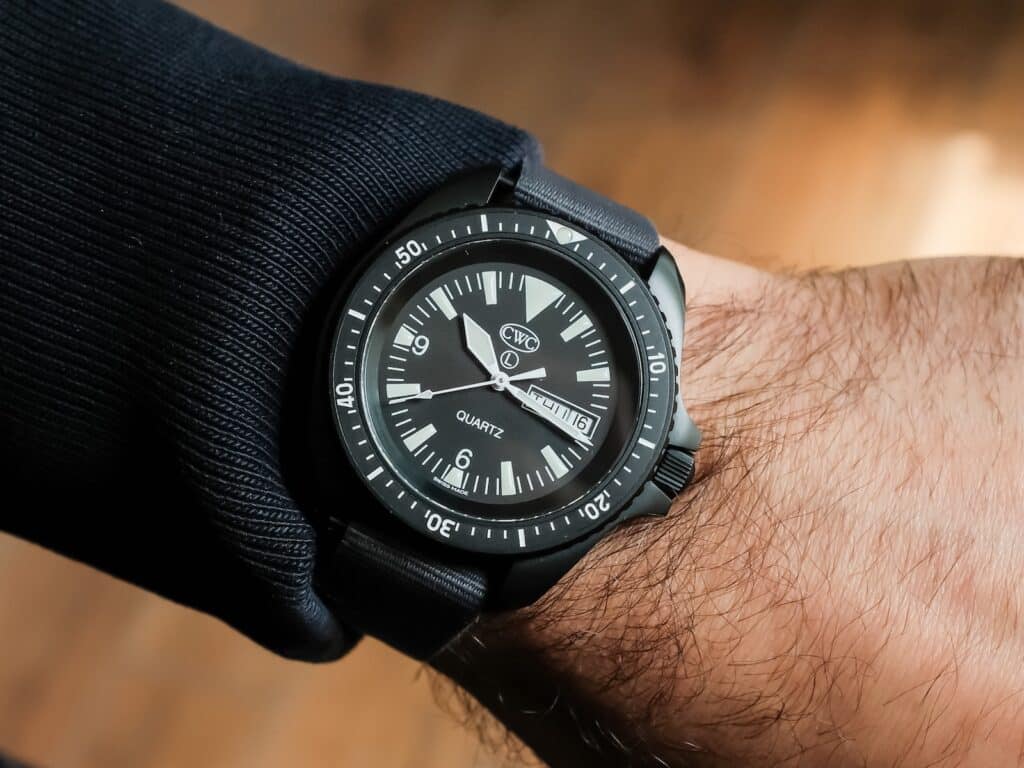
The CWC SBS Diver isn’t interested in winning over people who judge watches by polishing, movement architecture, or how dramatic they look under boutique lighting. Its claim to history comes from somewhere much less glamorous: being built around the requirements of the British Special Boat Service. That military background explains almost everything about the watch. The black PVD case, muted dial, and stripped-back design don’t feel tactical because someone in marketing thought black sells. They do so because that’s simply what the job calls for.
That practicality becomes obvious after a few days on the wrist. Quartz feels less like a compromise and more like the correct answer. Over five weeks of hands-on testing, ours stayed within five seconds, which was quite uneventful. No winding. No wondering whether it spent Sunday developing a personality. Just pick it up and get on with your day.
The case has enough heft to feel reassuring without becoming too heavy on your wrist, and it seems happy on almost any military-style strap. We cycled through single-pass nylon, RAF straps, and a few other utilitarian options, and the watch never really changed character. It just looked like it was ready for whatever came next.
The dial is similar. At first glance, it feels busier than some dive watches, but that impression disappears once you stop staring at it and start using it. The oversized markers and sword hands make quick time checks almost automatic, the flat crystal keeps glare under control outdoors, and the Luminova—marked by the familiar circled “L”—charges quickly enough to stay useful through most of the night. None of that is romantic, and that’s why we like it. For collectors who value military history that’s still connected to the watches being built today, the SBS Diver is one of the more authentic stories you can wear.
Pros
- The quartz movement is remarkably accurate and completely drama-free.
- The black PVD case feels substantial without becoming fatiguing.
- Oversized markers, sword hands, and low-glare crystal make legibility excellent.
- Luminova charges quickly and stays visible for most of the night.
- Feels equally at home on single-pass nylon, RAF straps, and other military setups.
Cons
- Its simple execution makes the price harder to appreciate on paper than it is on the wrist.
- The dial can look slightly busy before you spend time wearing it.
Nivada Grenchen Chronomaster Broad Arrow
| Price: | $1,975 |
| Water Resistance: | 100m |
| Case Dimensions: | 38mm (diameter) x 46.5mm (lug-to-lug) x 14.5mm (thickness) |
| Lug Width: | 20mm |
| Movement: | Landeron 70 |
The Nivada Grenchen Chronomaster Broad Arrow speaks to a different kind of history-minded collector. Instead of recreating a single famous watch, it revives an era when tool watches weren’t boxed into neat categories. Pilot cues, chronograph functionality, dive-watch capability, and even a GMT element all coexist here, making it feel like a product of watchmaking’s experimental years rather than a modern homage chasing a specific icon.
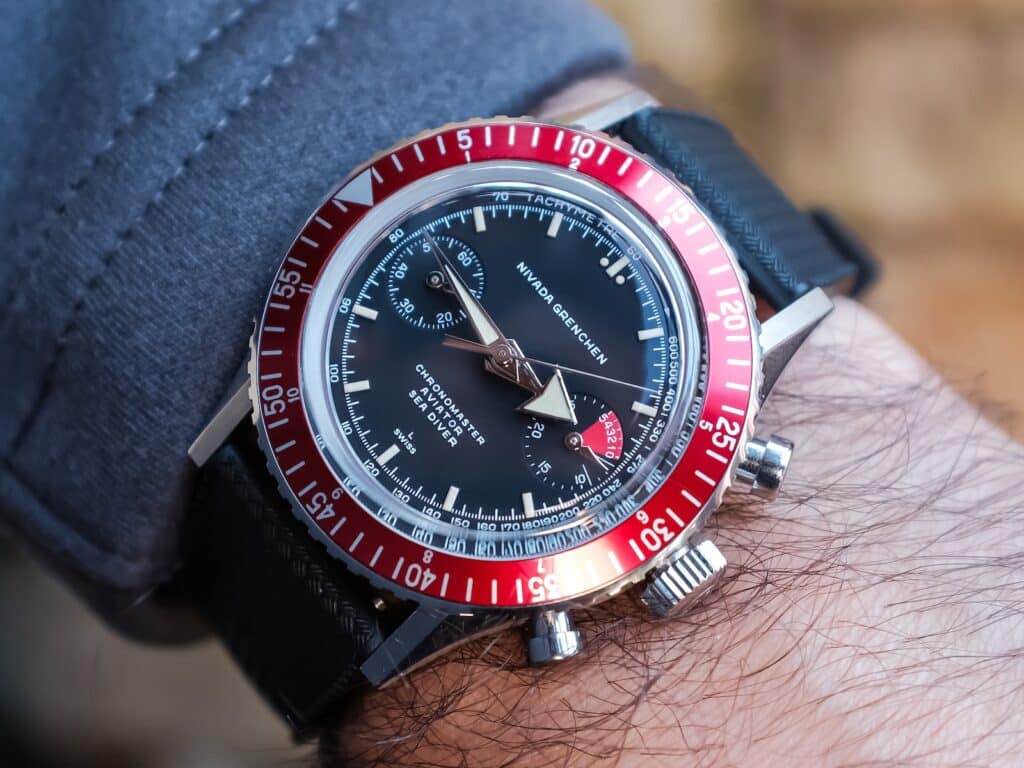
That personality carries over to the wrist. The sharp-edged case has reassuring heft without losing its compact vintage proportions; the finish feels more substantial than the price implies; and even the deeply engraved caseback shows the sort of attention usually reserved for details most people never notice.
It’s also one of those watches that becomes more enjoyable the more you interact with it. The hand-wound Landeron 70 turns winding into part of the daily routine, helped by an oversized crown that’s satisfying rather than fiddly. During our extended testing, it averaged about -5 seconds per day, while the chronograph pushers delivered a crisp, tactile click that almost encouraged us to time things we didn’t really need to time. Then there’s the tool-free bezel system. It sounds like a novelty until you’ve swapped a few. The faded blue bezel leans into the watch’s vintage character, the red adds a bit more attitude, and the green stays understated until the light catches it.
The dial initially feels like there’s a lot to process, but it never comes across as careless. A matte black background keeps the tachymeter, twin sub-dials, and stacked text from competing, while the broad-arrow hour hand makes orientation easy at a glance. Small touches, like the red five-minute subdivisions on the minute counter, become genuinely useful once you spend time with the chronograph. The polished sub-dial hands can disappear in certain lighting, and the domed sapphire introduces some distortion around the edges. However, both feel like acceptable trade-offs for the vintage character the watch delivers.
The included Tropic strap is soft and comfortable, but the watch quietly feels like it belongs on a steel bracelet. Ironically, the non-standard spring bars make strap swapping less convenient than a watch this interactive deserves. For collectors who appreciate vintage chronograph revivals that celebrate an adventurous chapter in tool-watch history, the Chronomaster Broad Arrow fits in well.
Pros
- Tool-free bezel swaps make the ownership experience interactive.
- The case feels substantial while preserving compact vintage proportions.
- Small dial details, including the red five-minute markers, reward close attention.
- The hand-wound Landeron 70 and oversized crown make daily winding satisfying.
Cons
- The domed sapphire crystal introduces noticeable edge distortion.
- The dial takes time to fully decode because there’s so much information.
- Non-standard spring bars make strap swapping less convenient than it should be.
- Polished sub-dial hands can lose contrast in certain lighting.
Doxa Sub 300 Aqua Lung

| Price: | $2,190 |
| Water Resistance: | 300m |
| Case Dimensions: | 42.5mm (diameter) x 45mm (lug-to-lug) x 12mm (thickness) |
| Lug Width: | 20mm |
| Movement: | COSC ETA-2824 |
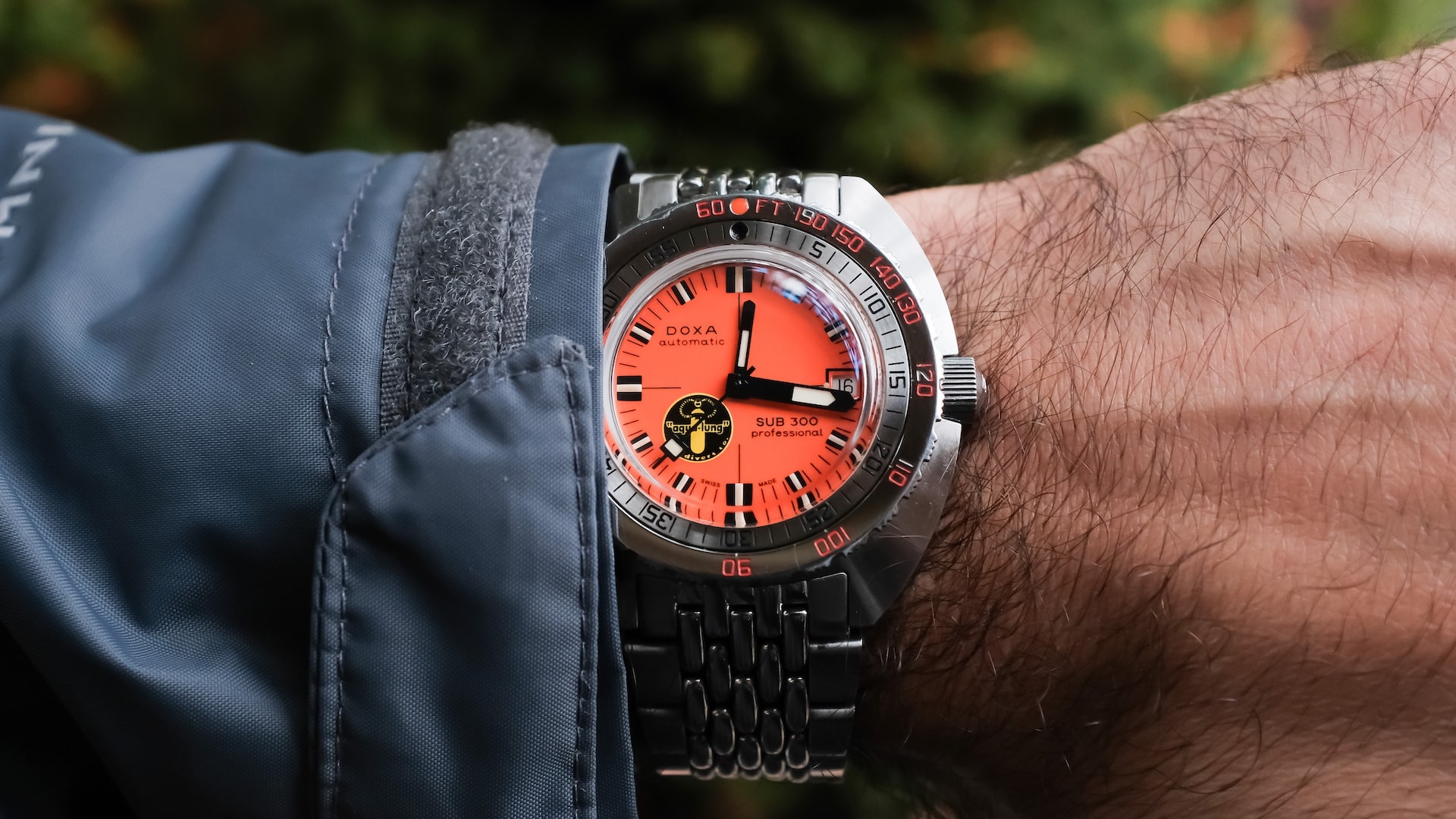
Some dive watches are famous for becoming luxury icons. The Doxa Sub 300 Aqua Lung Limited Edition is here for a different reason. It represents a chapter of dive-watch history where legibility and underwater practicality dictated the design, and Doxa has been stubborn enough not to sand those edges off. The dual-scale no-decompression bezel is a perfect example. Most owners will never need it for its original purpose, but it gives the watch an identity rooted in real dive-watch history rather than another generic rotating bezel. The action feels every bit as purposeful as the design suggests, with crisp clicks, zero backplay, and enough grip to operate confidently with wet or cold hands.
The rest of the watch carries that same playbook. The famous orange dial isn’t trying to be tasteful, and thankfully so. Because it’s framed by the compact dial opening within the cushion case, the color feels concentrated rather than overwhelming. Chunky hour markers, broad hands, and the oversized minute hand make reading the time almost effortless, while the lume builds steadily and stays useful without turning into another marketing exercise. The slightly off-center Aqua Lung logo won’t be everyone’s idea of visual harmony, and the bubble-shaped crystal introduces distortion around the edges. However, both contribute to the watch’s vintage personality. Doxa has always been a little odd, and smoothing out those quirks would probably miss the point.
Despite measuring 42.5mm, the wide, low cushion case wears smaller, sitting flat on the wrist instead of towering over it. The beads-of-rice bracelet complements that experience nicely, wrapping comfortably around the wrist with a straightforward clasp, a dive extension, and micro-adjustment holes, even if the taper isn’t quite as refined as that of more modern designs. Better still, the steel seems to welcome the scratches and softened edges that come with regular wear. They add to the watch rather than subtract from it.
Inside, the COSC-certified ETA 2824 keeps everything uncomplicated, delivering the kind of dependable accuracy we’ve come to appreciate over years of travel and everyday use. For collectors drawn to the history of purpose-built dive watches rather than the prestige that later surrounded them, the Sub 300 Aqua Lung remains one of the most distinctive pieces you can wear. Feel free to read our full review for the smaller on-wrist details.
Pros
- The dual-scale no-decompression bezel reinforces the watch’s authentic dive-watch identity.
- The COSC-certified ETA 2824 has proven accurate and dependable over years of regular wear.
- The orange dial, oversized minute hand, broad hands, and chunky markers deliver outstanding legibility.
- The bezel operates with crisp clicks, no backplay, and excellent grip in wet or cold conditions.
- The beads-of-rice bracelet balances the case well and includes a dive extension with micro-adjustment.
Cons
- The bubble-shaped crystal introduces noticeable distortion and reflections.
- The bracelet taper isn’t as smooth or refined as many contemporary bracelets.
- The off-center Aqua Lung logo may frustrate symmetry lovers.
Yema Yachtingraf Heritage
| Price: | $2,250 |
| Water Resistance: | 100m |
| Case Dimensions: | 39mm (diameter) x 45.5mm (lug-to-lug) x 15.35mm (thickness) |
| Lug Width: | 19mm |
| Movement: | ETA Valjoux 7753 |
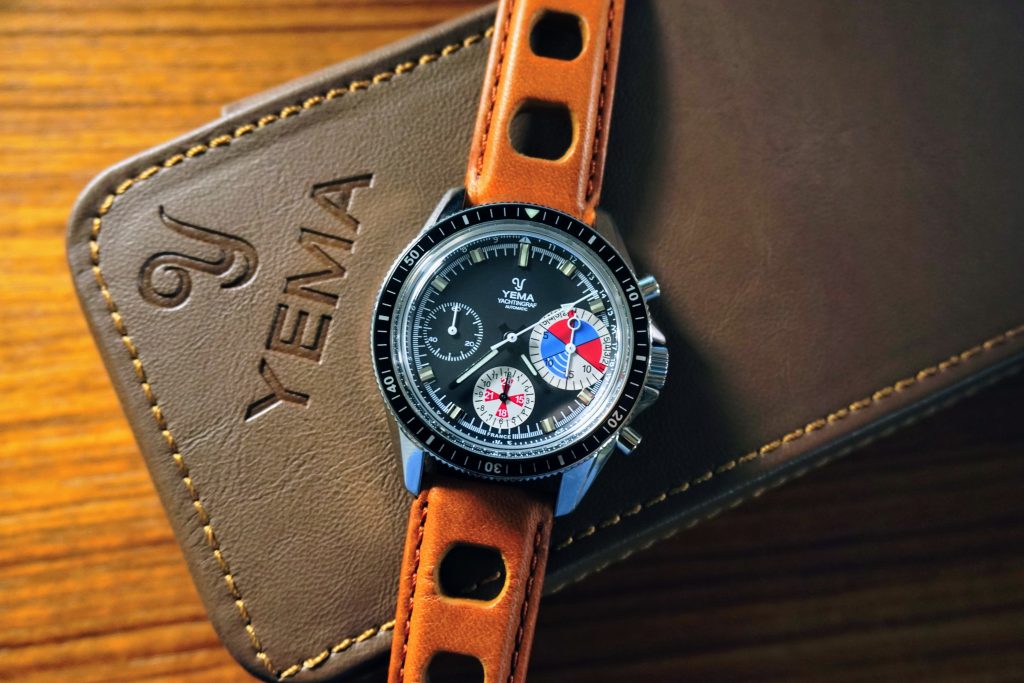
The Yema Yachtingraf feels like it was built for collectors who enjoy the overcomplicated side of vintage chronographs. It doesn’t modernize away the quirks that gave sailing chronographs their personality, nor does it pretend every old design decision deserves a free pass. Instead, it recreates the experience with all the charm and a few of the compromises still intact. The colorful dial, slim bezel, and compact 39mm footprint immediately channel that era, even if the watch’s 15mm thickness requires a bit of recalibration. On paper, the proportions seem awkward. On the wrist, the short lugs do a surprising amount of work, helping the watch settle far better.
The dial is where the Yachtingraf earns its place in a history-focused collection. A lot is happening, and the first day can feel like someone handed you a map without a legend. Give it some time, and the layout starts making sense. The oversized minute counter at three o’clock serves as the visual anchor, while the blue, red, and white accents lend the watch its sailing character. The domed crystal and slim bezel naturally draw your eye toward the center, making the display easier to process. Legibility isn’t flawless, though. The black hands occasionally disappear against the dial in lower light or when crossing the lighter sub-dials.
The friction-fit bi-directional bezel also requires a small adjustment. Without the reassuring clicks of a modern bezel, it initially feels unusual, although it stays securely in place during normal timing tasks. The extra inner bezel markings add to the vintage aesthetic, even if they contribute more visual complexity than practical value. Inside, the Valjoux 7753 brings exactly the sort of dependable mechanical experience you’d hope for from a watch celebrating chronograph history. It hacks, runs consistently, and the pushers have crisp action that encourages you to use the chronograph rather than treat it as decoration. During our closer look at the watch, the chronograph second hand didn’t always snap back to zero, and the rotor made its presence known whenever the watch was off the wrist. The crown is also a little awkward to grip thanks to the tight guards, but the well-made leather straps soften the experience, making it look like it belongs there from day one rather than being the first thing you’d replace.
For collectors drawn to the golden age of sailing chronographs, the Yachtingraf captures the era without polishing away the little imperfections that made those watches memorable.
Pros
- Faithfully captures the character of vintage sailing chronographs.
- The colorful regatta-inspired dial gives the watch a distinctive identity.
- The Valjoux 7753 delivers a satisfying, dependable chronograph experience with crisp pushers.
- The included leather straps suit the watch perfectly and feel well-made.
Cons
- The inner bezel markings add visual clutter without much practical benefit.
- Tight crown guards make setting the time less comfortable than it should be.
- The friction-fit bezel lacks the precise feel of a modern clicking bezel.
- Rotor noise is noticeable when the watch is off the wrist.
- The thick case can feel top-heavy, especially on smaller wrists.
CWC 1980 Royal Navy Diver
| Price: | $2,800 approx. |
| Water Resistance: | 300m |
| Case Dimensions: | 41mm (diameter) x 47mm (lug-to-lug) x 12.7mm (thickness) |
| Lug Width: | 20mm |
| Movement: | ETA 2824-2, CWC-engraved |
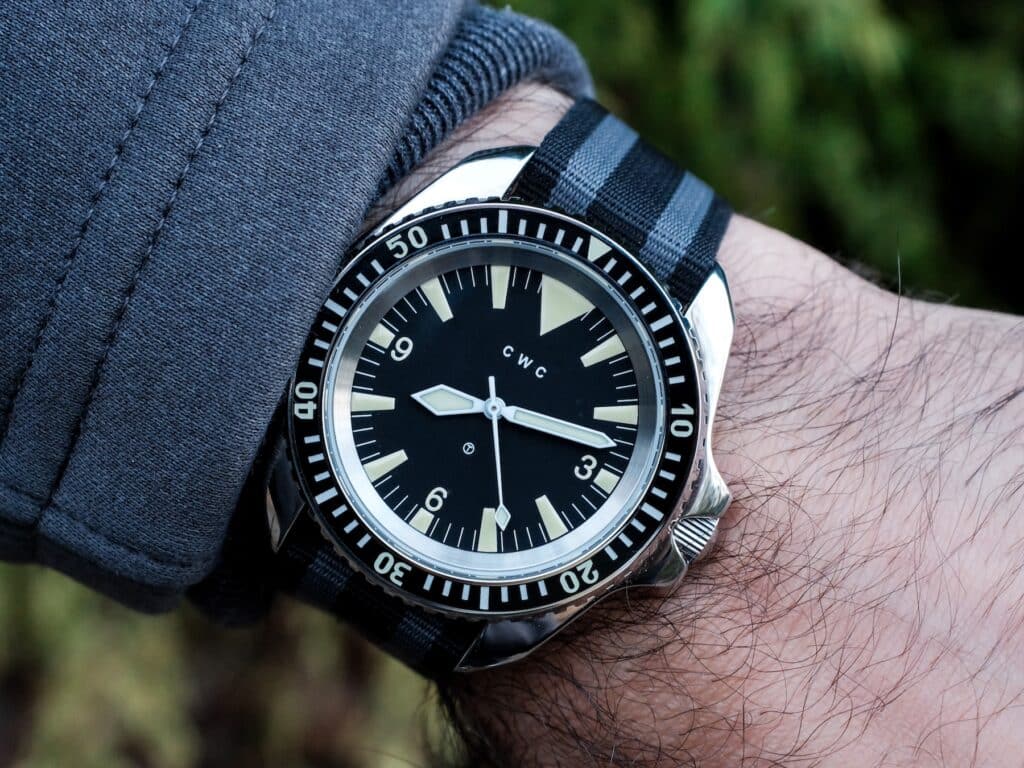
Some military-inspired dive watches borrow the aesthetic. The CWC 1980 Royal Navy Diver Re-Issue barely has to. It feels less like a modern reinterpretation and more like a watch that simply kept reporting for duty after a few sensible updates. That’s why it belongs in a history-oriented collection. The familiar Royal Navy design language is all here, from the trapezoidal hour markers and sword hands to the restrained CWC logo and the decorative circled “T.” It captures the character of the original without turning it into a nostalgia exercise. That restraint is a big part of its appeal.
The watch also avoids making history feel fragile. The ETA 2824-2 isn’t exotic, but that’s the point. During our in-depth testing, it settled into a consistent +3 to +5 seconds per day after regulation, and its widespread serviceability means you’re far less likely to be hunting obscure parts years from now. The 41mm case wears much smaller than the numbers suggest, sitting closer to the compact feel of a classic ’90s-era dive watch than many modern alternatives. The polished surfaces and gently curved profile keep it comfortable over long days, while the fixed spring bars—though they limit your strap choices—remain faithful to the original military specification. Whether on the supplied Cabot Military Watch Strap or a Phoenix Bond NATO, it always felt like a watch meant to be worn instead of preserved.
The dial sticks closely to classic mil-sub language, with trapezoidal hour markers, sword hands, a restrained CWC logo, and the familiar circled “T” retained as a nod to the original. Legibility remains excellent, and the sapphire crystal does an admirable job controlling glare even in harsh sunlight, making the watch feel more practical outdoors than its polished case might suggest. The vintage-tinted Super-LumiNova performs reliably across different lighting conditions, although the current lume options may split opinion. The brighter white looks a little too fresh, while the darker pumpkin tone can feel more deliberately aged than naturally earned. On a watch that trades so heavily on historical authenticity, those are the sort of details collectors tend to notice.
There’s also a hint of bezel play if you look closely, and the price reflects its niche appeal more than its outright value. That said, if your collection is built around watches that actually trace their lineage to military service rather than borrowing the looks, the Royal Navy Diver Re-Issue earns its place with surprising ease.
Pros
- The 41mm case wears smaller than expected and feels well balanced.
- The ETA 2824-2 is accurate, easy to service, and well suited to long-term ownership.
- Strong dial legibility, effective anti-glare sapphire crystal, and dependable lume make it an excellent everyday tool.
Cons
- The price sits on the higher side for a historically focused diver.
- There’s a small amount of bezel play if examined closely.
- The current lume color options don’t look quite as naturally aged as earlier executions.
Omega Speedmaster Professional 3861
| Price: | $9,000 |
| Water Resistance: | 50m |
| Case Dimensions: | 42mm (diameter) x 47.5mm (lug-to-lug) x 13.2mm (thickness) |
| Lug Width: | 20mm |
| Movement: | Omega 3861 |
Plenty of watches have great stories behind them, but very few helped write one. That’s why the Speedmaster Professional remains such an important piece for collectors who care about history. The Moonwatch story is impossible to separate from it, but the 3861 succeeds because it doesn’t ask you to admire that legacy from a distance. It lets you participate in it every time you put it on.
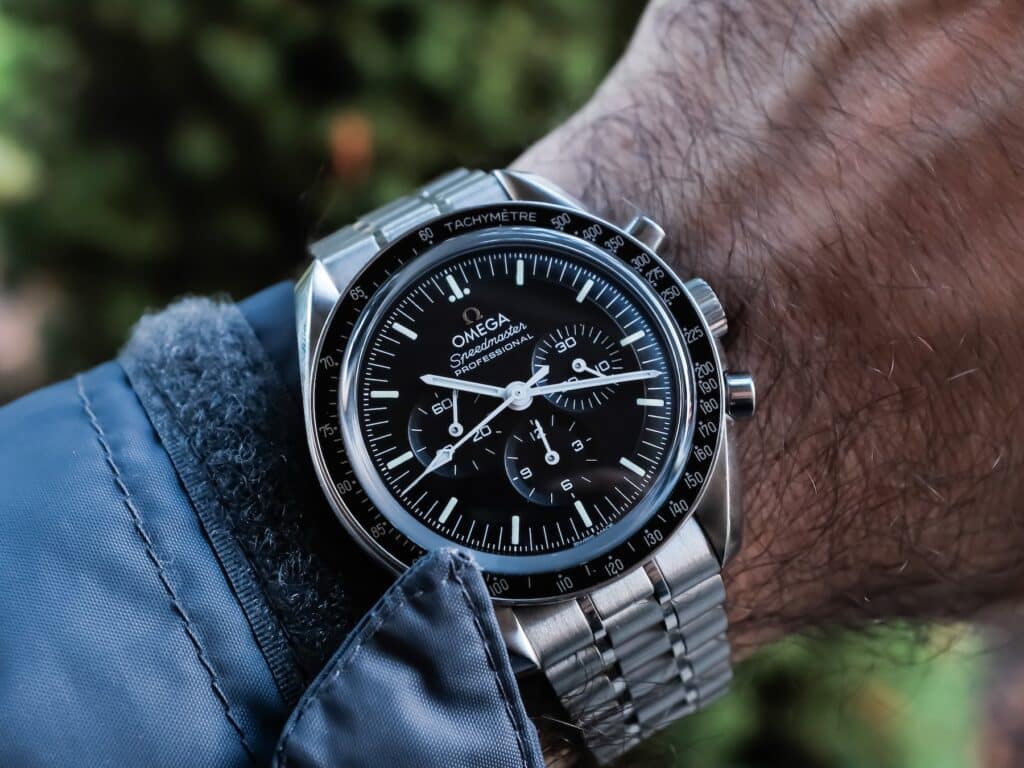
The familiar black stepped dial remains clean, with crisp white markers that make legibility almost effortless. On the sapphire version, the applied Omega logo adds just enough depth without making the watch feel precious, while the lume is practical. It won’t impersonate a lighthouse for five minutes before giving up, but it stays readable long after the lights go out.
The 3861 also reminds you why manual-wind chronographs have never completely disappeared. The winding action is smooth and deliberate enough to become part of the daily routine. At the same time, the chronograph pushers deliver a firm, satisfying click that almost encourages timing things that don’t need timing. While wearing it for review, the movement averaged around +3 seconds per week, quietly reinforcing the confidence you’d expect from a modern Speedmaster. The upgrades in anti-magnetic performance and accuracy are welcome, but they never overshadow the simple pleasure of interacting with the watch.
Despite the familiar 42mm size, the Speedmaster’s case distributes its size well instead of feeling like a large block of steel. The revised case feels better balanced, and the updated bracelet, with its stronger taper, earlier link articulation, and shorter-feeling end links, wraps around the wrist instead of perching on top of it. It’s comfortable enough that constantly browsing aftermarket straps almost feels like procrastination disguised as a hobby. Bracelet sizing can still test your patience without the right tools, and collectors chasing strict vintage proportions may wish it were a little smaller. Even so, if you’re building a collection around watches that genuinely shaped horological history rather than simply borrowing from it, the Speedmaster Professional 3861 remains one of the easiest recommendations.
Pros
- The updated bracelet dramatically improves comfort with better taper and articulation.
- Caliber 3861 combines excellent accuracy with a rewarding manual-winding experience.
- The stepped dial remains legible, while the lume stays useful throughout the night.
- Chronograph pushers deliver crisp, satisfying feedback.
Cons
- Still wears larger than strict vintage purists may prefer.
- Bracelet sizing can be frustrating without the proper tools.
Zenith El Primero A384 Revival
| Price: | $9,000 |
| Water Resistance: | 50m |
| Case Dimensions: | 37mm (diameter) x 47mm (lug-to-lug) x 12.6mm (thickness) |
| Lug Width: | 19mm |
| Movement: | El Primero 400 |
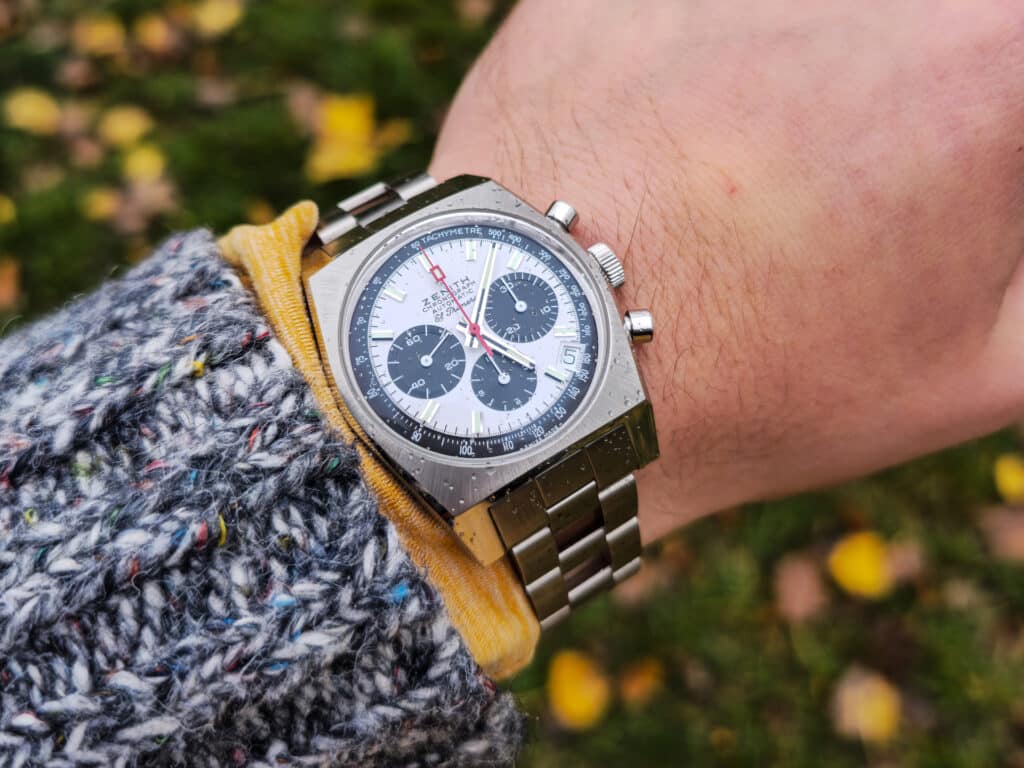
If your collection is built around milestones in chronograph history, it’s difficult to ignore the Zenith A384. This isn’t a modern watch draped in vintage styling; it feels quite close to the era that made it famous. That authenticity comes through in the details rather than the marketing.
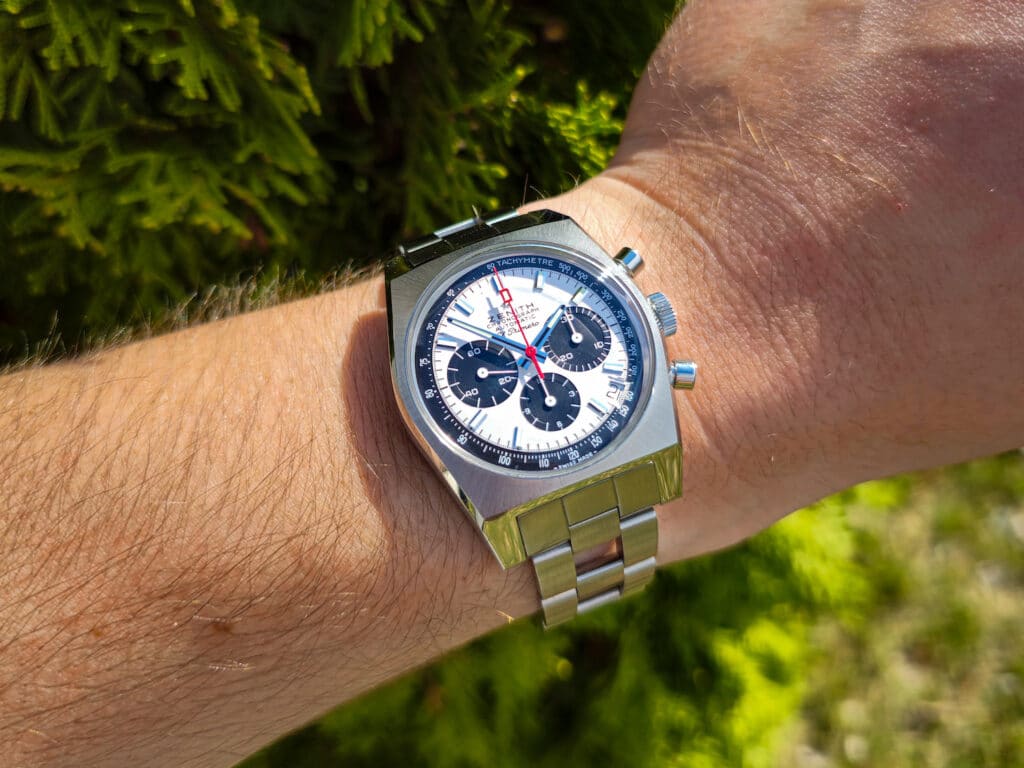
The 37mm cushion case proves that presence isn’t always tied to diameter. Its broad profile and flat case sides give it a reassuring stance without losing the compact proportions that make vintage chronographs so appealing. It lands somewhere closer to a modern 38 or 39mm on the wrist. It’s also light, which makes it one of those rare chronographs you can wear all day without noticing it’s there. The crisp transition between brushed and polished surfaces adds the right amount of visual drama, while the domed sapphire crystal introduces gentle distortion that reminds you why vintage crystals remain so charming in the first place.
The real historical centerpiece, though, is the El Primero 400. For collectors fascinated by chronograph development, few movements carry the same significance, and this one still feels every bit as engaging today. The high-beat sweep gives the chronograph a wonderful fluid motion, the pushers respond with a crisp mechanical click, and winding the movement has just enough resistance to become part of the daily ritual. While testing it hands-on, accuracy stayed consistently strong, while the rotor remained quiet. That’s a small detail you only begin to appreciate after living with noisier automatic chronographs.
The panda dial complements that experience beautifully. Despite juggling twin registers, a tachymeter, polished hands, and faceted indices, it never feels cluttered. The red chronograph second hand adds just enough contrast to keep the layout lively, although the restrained lume reminds you this watch was designed to be admired in daylight, not used as a bedside torch.
The bracelet is probably the biggest surprise. The stamped clasp and less-than-perfectly finished end links don’t make the best first impression, especially at this price. Then you wear it. The lightweight ladder bracelet transforms the experience, balancing the case beautifully and feeling far more comfortable than a chunkier modern alternative would. It’s one of those rare instances where vintage practicality wins over modern expectations. Like the polished bevels that will inevitably collect scratches, it suits the watch better. For collectors who want to own one of the defining chapters in chronograph history rather than simply read about it, the A384 remains a clean recommendation.
Pros
- The El Primero 400 delivers a historically significant, engaging chronograph experience.
- The lightweight construction ensures the watch is comfortable for all-day wear.
- The panda dial stays legible despite its busy layout.
- The domed sapphire crystal adds genuine vintage character.
- The cushion case wears larger than its 37mm dimensions without feeling bulky.
Cons
- Lume is minimal once the lights go down.
- The stamped clasp feels underwhelming for the price.
- End-link finishing doesn’t quite match the case’s quality.
If you feel that is a historically significant watch missing from from our discussion, please let us know in the comments. We also only try to feature watches in these pieces that we’ve reviewed hands-on. So any suggestion would be welcome as we would potentially work to conduct an in-depth review of it.

Co-Founder and Senior Editor
Kaz has been collecting watches since 2015, but he’s been fascinated by product design, the Collector’s psychology, and brand marketing his whole life. While sharing the same strong fondness for all things horologically-affordable as Mike (his TBWS partner in crime), Kaz’s collection niche is also focused on vintage Soviet watches as well as watches that feature a unique, but well-designed quirk or visual hook.
Where, exactly, do I buy a Doxa sub 300 aqualung for $2190!!?
what about the Seiko Kinetic Direct Drive line, for example the SAGG007? Beautiful and unique technology that no other company has besides Seiko. Such an innovative watch company!
Never seen the SAGG007 before. Looks like nothing you’d expect from Seiko. Very cool!