
Blue dial watches walk a fine line between subtle and striking. We’ve seen how the right shade of blue can transform a watch. It adds depth to a simple case, softens the edges of a tool watch, and pairs with almost anything you wear. A well-executed blue dial doesn’t chase attention; it earns it through texture, tone, and light play that only shows itself with time on the wrist.

After nearly a decade of hands-on reviews, we’ve developed a sense for which blue dials truly earn their spot on your wrist and which ones fade into the endless sea of hype. Some are affordable daily wearers that prove you don’t need deep pockets for great design; others stretch into higher budgets for those chasing refinement and precision. Whether you’re after a versatile everyday piece, a standout diver, or a dress watch with character, these are our picks among the best blue dial watches. To simplify your decision-making process, we’ve chosen them based on how they feel and perform in real, daily wear, not just how they look on paper.
Orient Mako II

| Price Range: | $160 – $220 |
| Water Resistance: | 200m |
| Case Dimensions: | 41.5mm (diameter) x 47mm (lug-to-lug) x 13mm (thickness) |
| Lug Width: | 22mm |
| Movement: | Orient Caliber F6922 (Mechanical Movement) |
The Orient Mako II is proof that budget divers don’t have to feel compromised. During our hands-on testing, we discovered a watch that exceeds its sub-$200 price tag. The 41.5 mm case hits that ideal balance between everyday wear and proper dive presence, and the updated proportions make it feel more modern than its predecessors. But it’s the blue dial that stood out for us. The applied markers and polished hands catch enough light to stay legible without glare, and the clean chapter ring adds visual depth without clutter.
Powered by Orient’s in-house F6922 automatic movement, the Mako II finally brings this classic line into modern territory: hacking, hand-winding, and a smooth, deliberate crown feel that makes daily winding oddly satisfying. Accuracy during our tests remained within +/-15 seconds per day, which is impressive at this price. The bezel action feels solid once you find its grip point, and the bracelet, once a weak spot in earlier Makos, now feels purpose-built. If you’re after a blue dial diver that delivers real value without pretense, the Mako II still sets the benchmark. For a closer look, check out our full Orient Mako II review.
Pros
- The in-house F6922 automatic movement features hacking and hand-winding capabilities, representing a significant upgrade over earlier models.
- Highly legible sunburst blue dial with clean, applied markers and contrast that works well across various lighting conditions.
- Case & bracelet finishing punches above its price class.
- The 200m water resistance and screw-down crown give it true diver credibility.
Cons
- The bezel can be stiff and difficult to grip, especially when it’s new out of the box.
- Uses a mineral crystal instead of sapphire, which makes it more scratch-prone.
- Hollow end links remain a cost-saving weak point.
- Lume is serviceable but not exceptional compared to some rivals.
Citizen Eco Drive Promaster Diver

| Price Range: | $250 – $300 |
| Water Resistance: | 200m |
| Case Dimensions: | 43mm (diameter) x 48mm (lug-to-lug) x 11.5mm (thickness) |
| Lug Width: | 20mm |
| Movement: | Citizen Eco-Drive E168 (solar quartz) |
The Citizen Eco-Drive Promaster Diver (BN0151-09L) quickly reminded our team why it’s such a consistent recommendation among affordable divers. During our hands-on testing, the blue dial proved to be a significant attraction. The large analog handset leaves zero room for confusion, and the bold indices hit that perfect balance between presence and proportion. Even the 4 o’clock date window, which nibbles slightly into the hour marker, feels intentionally integrated rather than forced. The handset sizing is spot-on. Switching between this and something like our Doxa test piece highlights how well Citizen nailed the fundamentals here.
On the wrist, we found the 43 mm case surprisingly compact. The short 48 mm lug-to-lug and slim 11.5 mm thickness make it wear smaller than the numbers suggest. The bezel turns with firm, satisfying clicks, and while it could use slightly more grip, it’s precise enough for timing in or out of the water. The 4 o’clock crown tucks neatly away, never digging into the wrist.
We weren’t huge fans of the stock polyurethane strap. It’s durable, but a bit stiff and noisy. However, swapping it for a NATO or rubber aftermarket strap instantly changed the feel. Power comes from the Citizen Eco-Drive E168 solar quartz movement, which maintains perfect time (±15 seconds) for months of wear and never requires a charge for 6 months. For more insights on our personal time with this model, read our in-depth review.
Pros
- Excellent dial legibility with clear hands and a well-integrated 4 o’clock date window.
- Despite its 43 mm spec, the case feels compact on the wrist.
- Reliable Eco-Drive E168 solar quartz movement with six months of power reserve and low-charge mode.
- Functional 60-click bezel that operates smoothly for accurate timing.
Cons
- Bezel teeth are shallow and could use more grip for wet use.
- The polyurethane strap is durable but feels stiff and lacks flexibility.
- Mineral crystal is less scratch-resistant than sapphire.
Casio Oceanus T200

| Price Range: | $300 – $500 |
| Water Resistance: | 10 Bar (100m) |
| Case Dimensions: | 41.4mm (diameter) x 49mm (lug-to-lug) x 10.7mm (thickness) |
| Lug Width: | 20mm |
| Movement: | Tough Solar movement (Module 5596) |
The Casio Oceanus T200 might be one of the most quietly impressive watches we’ve reviewed in recent years. It’s not trying to be a smartwatch or a traditional analog piece; it’s somewhere in between, with the right amount of tech wrapped in an unexpectedly elegant package. The first thing that stood out during testing was the dial. The deep blue tone isn’t loud or overly reflective; it feels layered and precise, with floating indices that appear to hover above the surface thanks to the chapter ring cutouts. The blue-tinted sapphire crystal adds a subtle glow in natural light, almost like the dial has its own built-in lume. Outdoors, that soft radiance gives the whole watch an understated richness you won’t find in most solar quartz pieces.
On the wrist, the Oceanus feels refined and balanced. The brushed and polished case surfaces transition smoothly, and while the bracelet can rattle slightly, it remains comfortable throughout the day. Powered by Casio’s Tough Solar 5596 module, the watch stayed fully charged throughout testing without any intentional exposure to light. Bluetooth syncing with the Oceanus app worked flawlessly every time (unlike what we’ve experienced on other similar watches in the past). It’s the kind of feature you forget about because it works well: set it once, and it keeps perfect time for months.
The T200 isn’t showy or packed with unnecessary functions; it’s a simple, well-built piece that wears as confidently with a suit as it does on a weekend trip. And for the reasons mentioned above, the Oceanus T200 deserves a spot on the list of best blue dial watches. For full hands-on impressions, check out our complete Casio Oceanus T200 review.
Pros:
- Bluetooth synchronization with the Casio app for smooth timekeeping.
- Tough Solar MultiBand 6 for accurate time and solar-powered operation.
- Stunning blue-tinted sapphire crystal.
- Clean dial design with legible markers and hands.
- Affordable for a hybrid timepiece at this level of technology and design.
Cons:
- Dial text for connectivity features might be distracting to some.
- The bracelet jangles when off the wrist (although it’s not noticeable when worn).
- Bracelet sizing requires some work with the pin and collar system.
- The lume could be brighter for better legibility at night.
Scurfa Diver One

| Price Range: | $350 |
| Water Resistance: | 500m |
| Case Dimensions: | 40mm (diameter) x 47mm (lug-to-lug) x 14mm (thickness) |
| Lug Width: | 20mm |
| Movement: | Ronda 713SM Quartz |
The Scurfa Diver One feels like the moment a professional diver decided to build a watch that could take a beating, and then wear it to work. At 40mm across and roughly 14mm thick, it wears compact but substantial, sitting flat on the wrist and feeling secure thanks to its screw-down crown and 500m water resistance.
The matte blue dial is what drew us in the most. It’s functional and honest, with a tone that shifts slightly depending on the light but never strays into “fashion diver” territory. The thick applied markers and sword hands, packed with BGW9 Super-LumiNova, make this one of the most legible dials we’ve tested in this price bracket. Even in broad daylight, the lume almost glows: a rare “day lume” effect that feels intentional rather than accidental. The bezel pip stays bright, the seconds hand is perfectly proportioned, and the overall layout works.
Inside, the Swiss Ronda 713SM quartz movement keeps it simple: accurate, reliable, and unaffected by the pressure or temperature swings that mechanicals can struggle with. Over the course of our hands-on testing, it proved itself in every way that matters: no bezel slop, no crown wobble, and not a hint of fogging after repeated dunking in saltwater and cold rinse cycles. The domed sapphire crystal introduces the right amount of distortion at sharp angles, reminding you that this watch was designed for real-world conditions. You can find more about our detailed experience in our full review.
Pros
- 500m water resistance for serious divers.
- Lightweight titanium case for maximum comfort.
- Bold, highly legible dial with Super Luminova BGW9 lume.
- Durable rubber strap with optional swap for NATO or leather.
- Swiss Ronda 713SM movement for long-term reliability.
Cons
- The movement is quartz, so no mechanical appeal or sweeping seconds for purists.
- The date window is tiny and minimally styled, hence easy to miss.
- Limited branding or design options for strap compatibility.
Dryden Chrono Diver

| Price Range: | $350 |
| Water Resistance: | 100m |
| Case Dimensions: | 42mm (diameter) x 49mm (lug-to-lug) x 12mm (thickness) |
| Lug Width: | 22m |
| Movement: | Seiko Mechaquartz VK63 |
The Dryden Chrono Diver surprised us by bringing real nuance to what could’ve been another overdesigned microbrand chronograph. During our hands-on testing, what stood out most was the dial work. The “Steel Blue” tone features a rich gradient that subtly shifts in different lighting conditions. The darker blue base gives way to lighter tones in sunlight, and the white subdials (in a reverse panda style) pop without feeling forced. The chronograph hands are a slightly lighter blue, and the red-orange spear-tip seconds hand provided a sharp visual cue when we engaged the chronograph while testing. The applied wedge markers, tachymeter ring, and minimal text all come together without cluttering the layout. At 42 mm, the watch wears assertively, but the 12 mm thickness and downturned lugs keep it anchored and surprisingly comfortable.
Powered by the Seiko VK63 mechaquartz, the Chrono Diver hits that sweet spot between mechanical tactility and quartz reliability. The chronograph pushers have a crisp click and reset cleanly, and the hybrid movement’s sweeping chrono hand adds a satisfying bit of theater without the upkeep of a full automatic. The quick-release strap system makes swapping out the stock leather for a NATO or rubber strap an easy, satisfying task. The case’s 100m water resistance makes it more capable than most “desk divers.” If we had to nitpick, the strap stitching frays slightly over time, and the bezel action could use a bit more texture. For further exclusive insights on this piece, read our comprehensive review.
Pros
- Rich “Steel Blue” dial with bold white subdials and red-tip chronograph hand for visual depth.
- Solid dive functionality: screw-down crown, 100 m WR, double-domed sapphire.
- Mecha-quartz VK63 offers mechanical feel with quartz precision.
- Quick-change strap system; the included leather strap is comfortable.
Cons
- The flat, wide bezel and aggressive forward-facing design make the watch appear larger than its 42 mm case.
- Highly polished hands can sometimes reduce contrast, especially under challenging lighting conditions.
Tissot PRX

| Price: | $395 |
| Water Resistance: | 100m |
| Case Dimensions: | 40mm (diameter) x 44.6mm (lug-to-lug) x 10.4mm (thickness) |
| Lug Width: | Integrated bracelet, starts 27mm at the case, tapering down to about 17.5mm at the clasp |
| Movement: | ETA F06.115 Quartz |
The Tissot PRX looks familiar in photos but feels far more refined on the wrist. We’ve handled plenty of entry-level integrated bracelet watches, but few manage to strike this perfect balance between polish and practicality. Our team found the blue dial to be the real hook; it shifts from deep midnight at the center to a cool navy at the edge, coming alive in natural light without the flashy sunburst effect commonly found at this price point. Baton markers, slim hands, and a clean date window at 3 o’clock keep the layout crisp and uncluttered.
On the wrist, the 40mm case wears broader and flatter than the specs suggest, but it hugs comfortably thanks to the slim profile and well-finished bracelet. The brushing and polishing feel well above the price point. During testing, the quartz model proved to be a perfect grab-and-go watch: light, reliable, and easy to wear all day. Powered by the Swiss ETA F06.115 quartz movement, it offers two years of battery life, precise timekeeping, and an end-of-life indicator. The clasp snaps shut with confidence, although polished surfaces attract fingerprints, and legibility can be compromised in low light. Read more of our firsthand impressions in the full Tissot PRX review.
Pros
- Beautiful blue dial that shifts subtly without overdoing the sunburst effect.
- Clean integrated-bracelet design that nails sporty elegance without feeling forced.
- Outstanding build quality and finishing for the price: crisp edges, tight tolerances, sharp brushing & polish.
Cons
- Modest 100 m water resistance lags behind true dive-watch peers.
- No true micro-adjustment on the clasp; you’re limited to the half-links.
- Lume is weak, so polished hands often vanish in dim light.
Dryden Heartlander

| Price: | $500 |
| Water Resistance: | 100m |
| Case Dimensions: | 38mm (diameter) x 46mm (lug-to-lug) x 11.2mm (thickness) |
| Lug Width: | 20mm |
| Movement: | Miyota 9015 |
The Dryden Heartlander Blue leans into field-watch DNA but adds a touch of personality, especially when paired with the blue dial. During our in-hand time, we noticed how the dial stays clean and understated while still catching light subtly. Dryden offers a few dial layouts (Explorer 3-6-9, full Arabic numerals, etc.), and in blue, each version carries that same quiet confidence. The indices and hands feel well-sized and balanced without crowding the dial, and the lume options, Swiss Superluminova BGW9 or Old Radium C3, do their job without trying to steal the show.
The 38 mm case (46 mm lug-to-lug, 11.2 mm thick) struck us as compact yet purposeful. The knurled 6.5 mm screw-down crown is a detail we appreciated: a rare feature on field watches in this price tier, which adds both utility and visual heft. The bracelet impressed our team with quick-release spring bars and fully articulating screw links, though we admit the “president” style wasn’t our personal favorite. Something like an Oyster-style would’ve felt more classic. Powering all of this is the Miyota 9015 automatic movement that’s nothing exotic, but dependable, serviceable, and precisely what you’d want in a field piece. Our hands-on impression: the Heartlander Blue gives you most of what field-watch fans want (compact size, screw-down crown, solid finishing) wrapped in a dial that’s expressive without overreaching. For more information, please head over to our detailed review.
Pros
- The compact 38 mm case wears comfortably and stays restrained.
- Quietly expressive blue dial shifts subtly depending on the light.
- The screw-down crown, sized at 6.5 mm, provides a solid grip and utility.
- The reliable Miyota 9015 automatic movement is easy to service.
- Quick-release bracelet with full articulation links for customized comfort.
Cons
- 11.2 mm thickness may feel chunky on slimmer wrists.
- The dial’s minimalist layout may feel too restrained for collectors seeking a more visually striking design.
Traser P67 Officer Pro

| Price: | $615 |
| Water Resistance: | 100m |
| Case Dimensions: | 42mm (diameter) x 50mm (lug to lug) x 10mm (thickness) |
| Lug Width: | 22mm |
| Movement: | Quartz |
The Traser P67 Officer Pro might not scream for attention at first glance, and that’s what makes it appealing. During our significant wrist time with it, we found that the matte blue dial sets a calm, almost tactical tone, with bold white numerals that stay perfectly legible in daylight. The real magic happens when the lights go out. Instead of the usual Super-LumiNova fade, Traser’s trigalight tubes kick in, glowing with a steady, self-powered light that doesn’t need charging and won’t fade for decades. It’s a tritium illumination system that feels more like engineering than a gimmick.
We wore the Officer Pro for a few weeks of daily use, and it handled everything from weekend hikes to work commutes without issue. The 42mm PVD-coated stainless steel case feels solid but not bulky, and the blue dial adds the right amount of color to set it apart from the usual green or black field watch suspects. Inside, the Swiss quartz movement ensures accuracy and simplicity: no fuss, no winding, no drift. While testing, the nylon strap held up well under heat and moisture, though a quick swap to leather or canvas could make it feel more versatile. It’s one of the few blue dial watches that brings genuine field-watch practicality with a hint of tech intrigue. You can find more of our hands-on impressions in our full review of the Traser P67 Officer Pro.
Pros
- Constant tritium glow ensures effortless night visibility for years.
- 100m water resistance and a screw-down crown make it reliably adventure-ready.
- The titanium-coated case keeps it lightweight and comfortable.
- Substantial value for a durable, tritium-equipped field watch.
Cons
- The blue dial loses contrast with the black hands in certain lighting conditions.
- Quartz movement may turn off mechanical purists.
- The quick-change bracelet system feels finicky to use.
Christopher Ward C65 Super Compressor

| Price Range: | $1025 – $1145 |
| Water Resistance: | 150m |
| Case Dimensions: | 41mm (diameter) x 47.12mm (lug-to-lug) x 13mm (thickness) |
| Lug Width: | 22mm |
| Movement: | Sellita SW200-1 |
The Christopher Ward C65 Super Compressor is more than a mere retro nod; it’s one of the few modern watches that resurrects real, old-school Super Compressor case tech. According to our review team, the Ocean Blue dial is the showpiece. The sunburst finish dances from rich navy to light blue, and with the domed sapphire over it, the color feels fluid, shifting with your wrist, light, and mood. The applied indices and crisp minute markers make it easy to read at a glance, while the pops of orange (minute hand, trident seconds tip) add a touch of fun without being playful. The Super Compressor setup means the inner dive bezel resides beneath the glass and turns via the upper crown. This results in a clean, purposeful, and satisfying user experience.
Over the course of our hands-on testing, we determined that the C65 Super Compressor delivers a kind of refinement rarely found in divers at this price. The twin crowns each feel purpose-built, with the lower screws down with crisp precision, while the upper crown drives the internal bezel with firm, tactile resistance. At 41mm, it wears balanced and comfortable, and the 13mm height slides easily under a cuff. On the tropic strap, it felt light and secure during day-long wear, and swapping to leather gave it an unexpected touch of class.
Inside sits the Sellita SW200-1 no-date caliber: dependable, familiar, and service-friendly. CW decorates the rotor with its logo, allowing you to peek into the movement through the display case back. Although it’s not over-the-top spec-wise (38-hour reserve, standard ±20-second tolerance), it keeps time reliably and keeps costs reasonable. Explore our full hands-on testing experience for more insights and photos.
Pros
- Distinct twin-crown Super Compressor design that functions as intended.
- Excellent case proportions (41 mm × 13 mm) for balanced, comfortable wear.
- Strong build quality and finishing for the price, accompanied by an attractive display case back.
Cons
- The bracelet clasp feels less premium than the rest of the watch.
- 38-hour power reserve is modest compared to newer calibers.
- Lume performance is adequate but fades quicker than expected.
Christopher Ward The Twelve

| Price: | $1,895 |
| Water Resistance: | 10 ATM (100m) |
| Case Dimensions: | 36mm (diameter) x 40.8mm (lug to lug) x 8.95mm (thickness) |
| Lug Width: | Integrated bracelet, starts 22mm at lugs, tapering down to about 16-17mm at the clasp |
| Movement: | Sellita SW300-1 COSC |
Integrated bracelet watches are usually too heavy, too flashy, or too derivative of designs we’ve all seen before. But the Christopher Ward The Twelve (36mm Titanium) manages to avoid nearly all of them. The version we tested, with its Lagoon Blue dial, walks that line between sport and refinement better than most pieces twice the price. The blue itself is the main event: a rich gradient that shifts from sky to navy depending on the light. It gives the dial a surprising sense of motion, especially against the crisp, brushed titanium case and 12-sided bezel that catch reflections enough to feel elevated. At under 9mm thick, it hugs the wrist comfortably, and the titanium keeps things feather-light.
During testing, what stood out most was balance, both in proportions and wear. The bracelet articulation made the watch drape beautifully, though it wore a bit larger than its 36mm spec suggested. The COSC-certified Sellita SW300 maintained accuracy within +6/-4 seconds per day, even after daily wear. The screw-down crown, paired with 100m of water resistance, made it more than capable for travel or office use. If there’s one small trade-off, it’s legibility: the polished hands sometimes blend into the blue in harsh sunlight. However, it is the same interplay of light that makes the Lagoon Blue dial so hypnotic in person. At roughly $1,895, The Twelve delivers premium finishing, a refined blue dial, and a distinct identity in a crowded integrated-sport category. For more information on its performance in long-term testing, see our comprehensive hands-on review.
Pros
- An integrated bracelet is suitable for both casual and formal settings.
- Lightweight titanium construction makes it comfortable for extended wear.
- Easy sizing thanks to screw links.
- The Unique Lagoon Blue dial stands out with its refined depth and style.
- Slim profile but strong wrist presence.
Cons
- The quick-release system is fiddly to reattach.
- The blue dial can hurt legibility due to the low contrast between the white/bright elements.
- Pricier than alternatives, such as the Tissot PRX.
Atelier Wen Perception

| Price Range: | $3,200 – $3,600 |
| Water Resistance: | 100m |
| Case Dimensions: | 40mm (diameter) x 47mm (lug-to-lug) x 9.4mm (thickness) |
| Lug Width: | Integrated bracelet, starts 22mm at the case, tapering down to about 18mm at the clasp |
| Movement: | Dandong SL1588 Automatic |
The Atelier Wen Perception marks a turning point for modern Chinese watchmaking; it’s the moment the conversation shifted from imitation to innovation. On our wrists, it felt both refined and confident, with a 904L steel case that rivals far more expensive pieces in finish and execution. The proportions hit a sweet spot at 40mm wide and 9.4mm thick, wearing slim and balanced thanks to the integrated bracelet. The alternating brushed and polished surfaces play beautifully with the light, but it’s the blue dial that makes this watch unforgettable. Hand-guilloché patterns ripple outward like water, shifting from pale ice to deep ocean tones depending on the angle. It’s intricate without feeling busy.
The Perception’s build quality backs up its looks. The bracelet’s fluid articulation and toolless micro-adjust clasp make it comfortable for all-day wear. However, it does stretch the wrist slightly beyond its stated lug-to-lug measurement. During our testing period, the Dandong SL1588 automatic movement maintained time within +/- 10 seconds per day, and it felt smooth to wind, even though it lacks hacking seconds. Functionally, the watch holds its ground with a screw-down crown and 100m of water resistance. It stands out as proof that thoughtful design and genuine craftsmanship can come from unexpected places. For more detailed impressions from our testing, check out our full hands-on review.
Pros
- 904L stainless steel case is rare at this price; it features crisp, high-end finishing.
- Hand-guilloché dial draws inspiration from traditional Chinese motifs.
- Tool-free micro-adjust clasp makes daily wear more comfortable.
- In-house modified movement with a decent power reserve (41 hours).
- Strong 100m water resistance adds real-world versatility.
Cons
- The bracelet wears larger than the stated dimensions imply.
- Movement doesn’t include hacking seconds.
- Accuracy trails behind similarly priced chronometer-grade options.
- At over $3,200, it faces serious competition in the luxury sports segment.
- Limited availability, with batches released intermittently, making it harder to purchase.
Omega Railmaster
| Price: | $6,400 |
| Water Resistance: | 150m |
| Case Dimensions: | 40mm (diameter) x 46.5mm (lug-to-lug) x 12.5mm (thickness) |
| Lug Width: | 20mm |
| Movement: | Omega 8806 Master Chronometer Co-Axial |
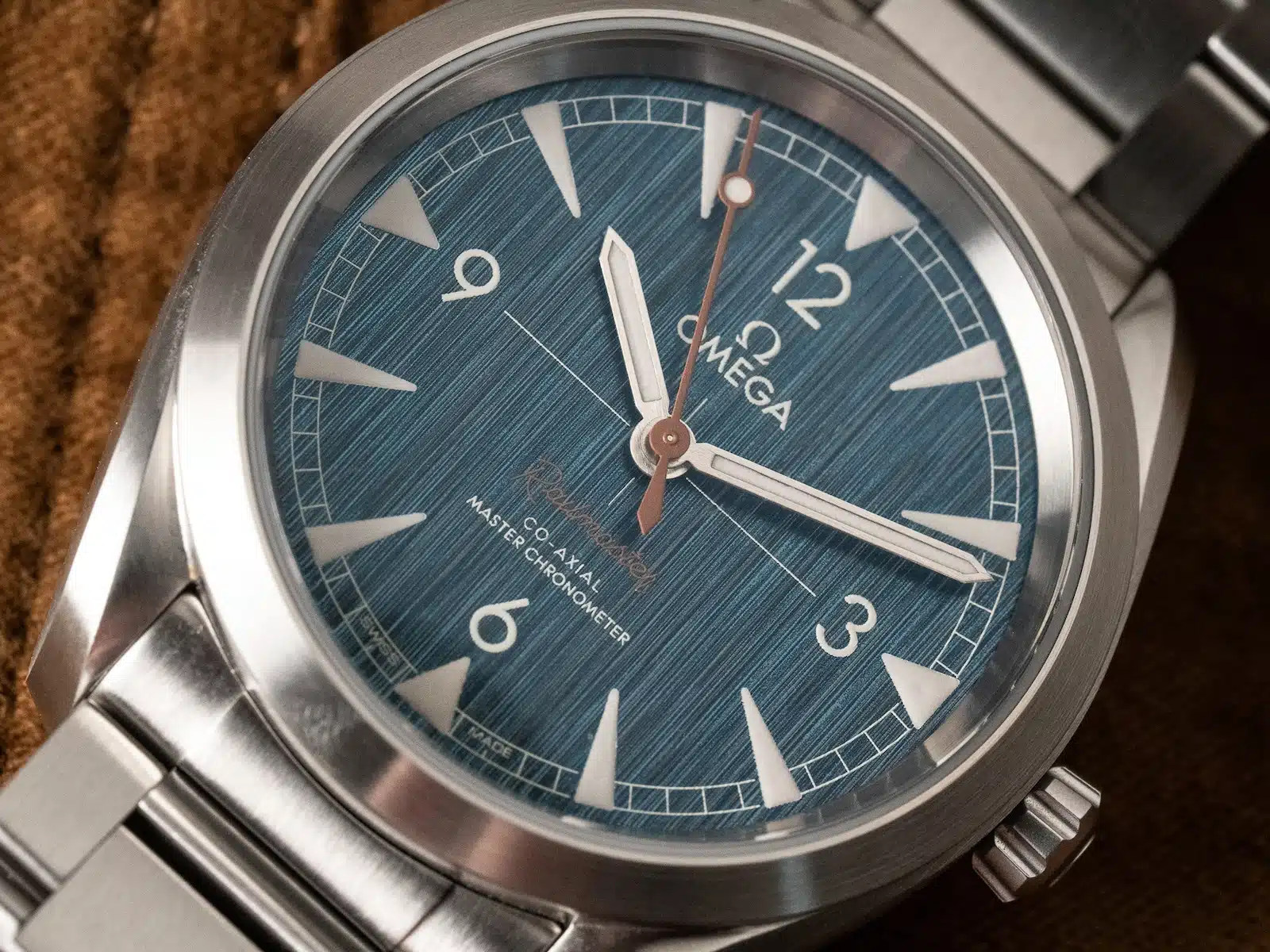
The Omega Railmaster is what happens when a classic tool watch learns a few modern tricks without losing its soul. On paper, it’s simple: a 40mm case, brushed steel finish, and no date. However, on the wrist, the blue dial transforms it into something quietly magnetic (no pun intended). Our review team found that the vertically brushed texture gave it real character, shifting between denim blue, slate, and even a hint of bronze depending on the light. It’s a dial that feels alive but never showy, ideally suited for the Railmaster’s utilitarian roots. The bronze second hand is a small but smart detail that catches your eye just enough to break up the blue without disrupting the balance.
During our testing, the Railmaster felt purpose-built yet refined. The 40mm case and 46.5mm lug-to-lug make it wear neatly on most wrists, and at only 12.5mm thick, it slides under a cuff without effort. The brushed surfaces give it that honest, field-ready look, while the polished chamfers keep it from feeling too basic. Inside is Omega’s Co-Axial Master Chronometer movement: METAS-certified, anti-magnetic, rock-solid, and running well within its certified specs (1 second gain per day) throughout our testing. For full hands-on impressions, see our complete Omega Railmaster review.
Pros
- Master Chronometer: Certified accuracy and durability.
- High-quality dial with dynamic shades and excellent legibility.
- Versatile design: A perfect mix of ruggedness and luxury.
- Comfortable fit on most wrist sizes.
Cons
- The price might be a stretch for some, especially with similar models at a lower price.
- No date or additional complications, keeping it a “time-only” watch.
- The steel bracelet is solid but lacks micro-adjustment for a custom fit.
Nomos Zürich World Time

| Price: | $6,100 |
| Water Resistance: | 30m |
| Case Dimensions: | 40mm (diameter) x 50mm (lug-to-lug) x 11mm (thickness) |
| Lug Width: | 20mm |
| Movement: | DUW 5201 |
The Nomos Zürich World Time is one of those watches that feels entirely different once it’s on the wrist. In photos, it appears minimalist, but while testing in person, we found that the blue dial adds unexpected depth and personality. The tone sits somewhere between navy and steel, shifting subtly under light and giving the clean layout a quiet dynamism. There’s no aggressive sunburst or shimmer; just a refined gradient that makes the dial feel alive without ever crossing into flash. The rhodium-plated hands, the distinctive city ring, and the red home-time indicator stand out crisply against that blue. This makes the display legible whether you’re indoors or walking through an airport terminal.
Functionally, this is where Nomos’ design intelligence really comes through. The single pusher at 2 o’clock jumps the local hour forward with each press while home time stays anchored on the 24-hour subdial. We tested it during a short trip, and switching zones took seconds: two clicks, and you’re synced. The in-house DUW 5201 movement remained steady during our testing, providing approximately 42 hours of reserve. At 40mm, the case is thin and sleek, but the long lugs make it appear to be closer to 41–42mm in size, so those with smaller wrists should take note. The shell cordovan strap sits nicely, though the polished case shows micro-scratches faster than you’d expect. Still, as blue dial world timers go, this one nails the intersection of form and function. It is quietly elegant, mechanically savvy, and suited for those who cross time zones more often than they chase hype. For a deeper dive into its design quirks and long-term wear impressions, check out our full hands-on review.
Pros
- Elegant GMT-style complication that’s more practical than a traditional worldtimer.
- Finishing and blue dial details add depth and character.
- Time adjustment via a pusher, no crown fuss required.
- Comfortably sized at 40mm, perfect for both casual and formal wear.
- Uncommon design so that you won’t find another one easily.
Cons
- The long lug-to-lug design makes it wear larger than the case size suggests.
- Limited water resistance (30m) makes it unsuitable for heavy water activities.
- A fully polished case shows wear quickly if not handled with care.
- On the pricier side in the US market, as compared to its European counterparts.
Glashütte Original SeaQ

| Price: | $10,200 |
| Water Resistance: | 200m |
| Case Dimensions: | 39.5mm (diameter) x 47.5mm (lug-to-lug) x 12.5mm (thickness) |
| Lug Width: | 20mm |
| Movement: | SeaQ Caliber 39-11 Automatic |
The Glashütte Original SeaQ surprised us in the best way. On paper, it’s another high-end diver with classic specs: a 39.5mm case, 200m of water resistance, and a sapphire crystal. But the moment it hit the wrist, the blue dial completely changed the tone. It’s not just “blue” in the way marketing copy tends to overuse the term. This vibrant blue shifts from bright, tropical tones in sunlight to deep, almost inky navy indoors. Under the domed crystal, the sunburst finish gives it a subtle curvature, like light rolling across a calm sea. Paired with clean white Arabic numerals and crisp text, the dial feels open and legible, but never busy.
During testing, the SeaQ felt like a luxury tool watch done right. The unidirectional bezel turned with a firm, satisfying click, and the screw-down crown felt as solid as anything we’ve handled from Omega or Tudor. The case finishing showcases Glashütte’s typical attention to detail: brushed surfaces where it matters, polished edges that catch light without drawing undue attention. Inside, the hidden Calibre 39-11 runs at 28,800 bph and carries all the hand-finished details Glashütte is known for: polished screw heads, beveled edges, a skeletonized rotor, and a swan-neck regulator you unfortunately can’t see behind the closed caseback. And while its 40-hour power reserve isn’t groundbreaking, what stayed with us most was how calm and composed it felt overall. For a deeper dive, check out the full breakdown of our hands-on time with this piece.
Pros
- Exceptionally tight bezel action with zero slop; every click is deliberate and confident.
- A vibrant blue dial that changes shades with varying lighting conditions.
- Comfortable and wearable with a perfect 39.5mm case size.
- Quick-adjust clasp on the bracelet.
Cons
- High price tag for a dive watch.
- Large lug-to-lug measurement may not be ideal for all wrist sizes.
- 40-hour power reserve is unremarkable for a watch at this level.

Co-Founder and Senior Editor
Kaz has been collecting watches since 2015, but he’s been fascinated by product design, the Collector’s psychology, and brand marketing his whole life. While sharing the same strong fondness for all things horologically-affordable as Mike (his TBWS partner in crime), Kaz’s collection niche is also focused on vintage Soviet watches as well as watches that feature a unique, but well-designed quirk or visual hook.
Should look at the microbrand Oceaneva. For the price they are hard to beat.
Hi, Robert:
We aren’t too familiar with this brand, but we’ll look into their collection and see if we’d like to review one of their pieces for consideration in a future piece.
Best,
-Kaz
The Omega Aqua terra blue dial is a better idea than the Railmaster.
The Omega Aqua Terra collection features some fantastic blue dial pieces that would absolutely be great fits for our piece here. The reason we didn’t include it is because we don’t have a formal review of the watch on our site yet, and we try to only include watches here that we have hands-on experience with. We’re trying to see if it would be possible to review part of the Aqua Terra collection in the upcoming year and if it happens to be one of the blue dial models we’ll for sure consider including it here if it meets our testing standards.
Best,
-Kaz
missed the Casio MDV106 Series … as collector of over 50 watches up to several Rolex and Omega… this watch stands out for looks 200 WR and a price under $100.
Hi, Clive:
Ah that’s an excellent callout – so we actually have a lot of experience with the MDV series and it offers so much value for what you’re paying. We actually just don’t have a formal review of the watch on our site. We only try and include watches on this list that we have published hands-on reviews for. We’re planning on formally testing the watch soon and will be sure to include it in an upcoming update.
Thank you for your comment!
-Kaz
No glycine? Very good swiss watch with robust movement,when regulated it’s pretty precise.
Hi, Gary:
We love Glycine! It’s just that we haven’t reviewed any models with blue dials. As soon as we do though it will be considered for inclusion on this list depending on how it performs against our testing criteria.
Best,
-Kaz
I recently picked up a Timex Q falcon eye chronograph, it has a wonderful swirly/wavy blue diamond.
Hi, Adam:
Oh yes, the those Falcon Eye models are really visually appealing. We’ve reviewed the original Q Timex reissue but not one of these Falcon Eye chronos. We actually are planning on trying to review the Chrono in 2026 and if it meets our testing standards, we’ll absolutely include it for consideration on this list.
Best,
-Kaz
The Grand Seiko SLGA021 Lake Suwa after dark would be a great addition to the list. It has a dark, almost black dial in low light but is a beautiful bright navy blue with the texture of ripples on the water when it catches the light. The spring drive movement is also fascinating. Definitely on my short list.
Hi, Scott:
The SLGA021 is an absolute stunner for sure! The reason we didn’t include it on this current version of the list is because we haven’t actually reviewed one of these hands-on. We only include watches in these pieces that we have a full, dedicated review for. In the future if we review the SLGA021 and if it’s up to par with our testing standards, we’ll totally consider it for the list.
Thank you,
-Kaz