Dive watches are where a lot of us first catch the sickness. Not because we’re all saturation divers hiding in comment sections, but because a good diver feels like a shortcut to the whole appeal of watch collecting: legibility, usefulness, durability, and a story you can enjoy without needing a dealer relationship or a trust fund. The problem is that “heritage” gets thrown around so often now that it sounds like seasoning. So the goal here is simple: sort through the best affordable dive watches with real history under $1,000 and focus on the ones that still feel meaningful on the wrist, not just convincing in product photos.
We’re approaching this the same way most affordable watch nerds do: with a budget in mind, a healthy suspicion of recycled vintage language, and enough wrist time to know when a watch is coasting on backstory alone. After nearly a decade of reviewing affordable watches, we’ve learned that real history matters only when it survives the wear of daily use. That’s why we’ve pulled together a list of budget dive watches with genuine roots that can still handle commuting, desk diving, weekends, strap swaps, scratches, and the occasional bad decision near water without turning into expensive little shrines.
Vostok Amphibia
| Price: | $100 – $150 |
| Water Resistance: | 200m |
| Case Dimensions: | 39mm (diameter) x 46mm (lug-to-lug) x 15mm (thickness) |
| Lug Width: | 18mm |
| Movement: | Vostok 2416 Automatic Movement (in-house) |
The Vostok Amphibia earns its place among the best affordable dive watches with real history under $1,000 because it does not feel like a modern watch wearing vintage costume jewelry. It feels like something designed from a different school of budget dive-watch logic. The 200-meter compression-case system is the big clue: instead of relying solely on brute thickness, the case architecture and gaskets are designed to become more water-resistant as pressure increases. That idea still feels clever today, even if the watch itself can feel a little strange when you first handle it.
The crown is usually where that strangeness announces itself. Unscrew it, and the wobble can make you think something has gone wrong. It hasn’t. The two-piece, spring-loaded crown-and-stem setup is there to prevent underwater pressure from forcing the crown into the movement. Once you know that, the looseness feels less cheap and more purposeful, though the crown metal and threading on modern examples can still feel thin. The bidirectional friction bezel has a similar give-and-take: it is easy to set from either direction, but it can also move too easily on its own.
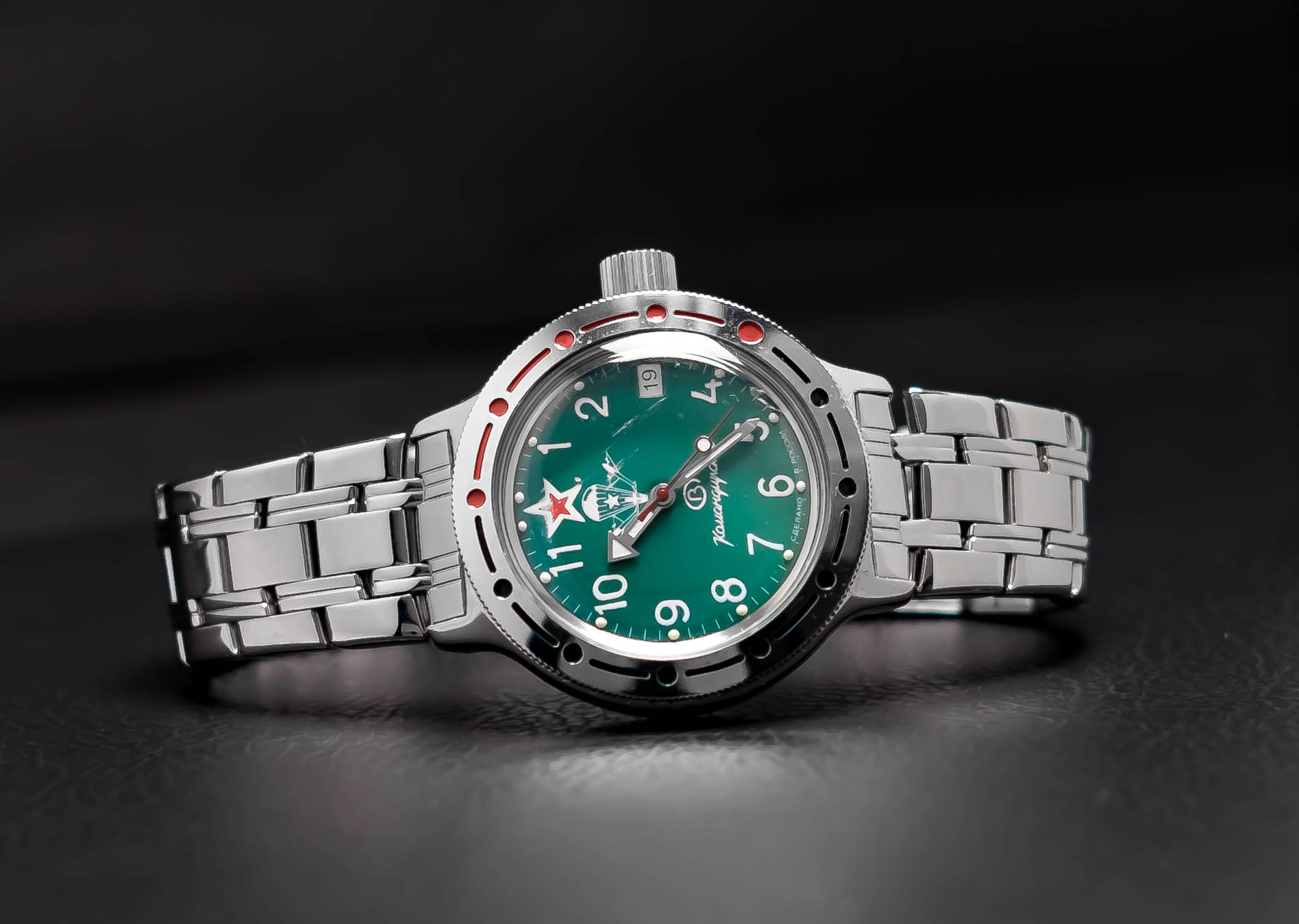
On the wrist, the Amphibia is easier than its oddball reputation suggests. Our team found that it has some height, but the rounded case, lack of crown guards, and downward-sloping lugs keep it from wearing like a wrist anchor. The soft, porthole-like shape feels more nautical than aggressive, and the polished steel case picks up scratches quickly in a way that somehow suits the watch. The stock bracelet is thin, hollow, and fitted with a forgettable clasp, but visually it has that rattly old-diver charm. We would still move it to a NATO, suede, or another 18mm strap pretty quickly, partly because the watch invites that kind of tinkering.
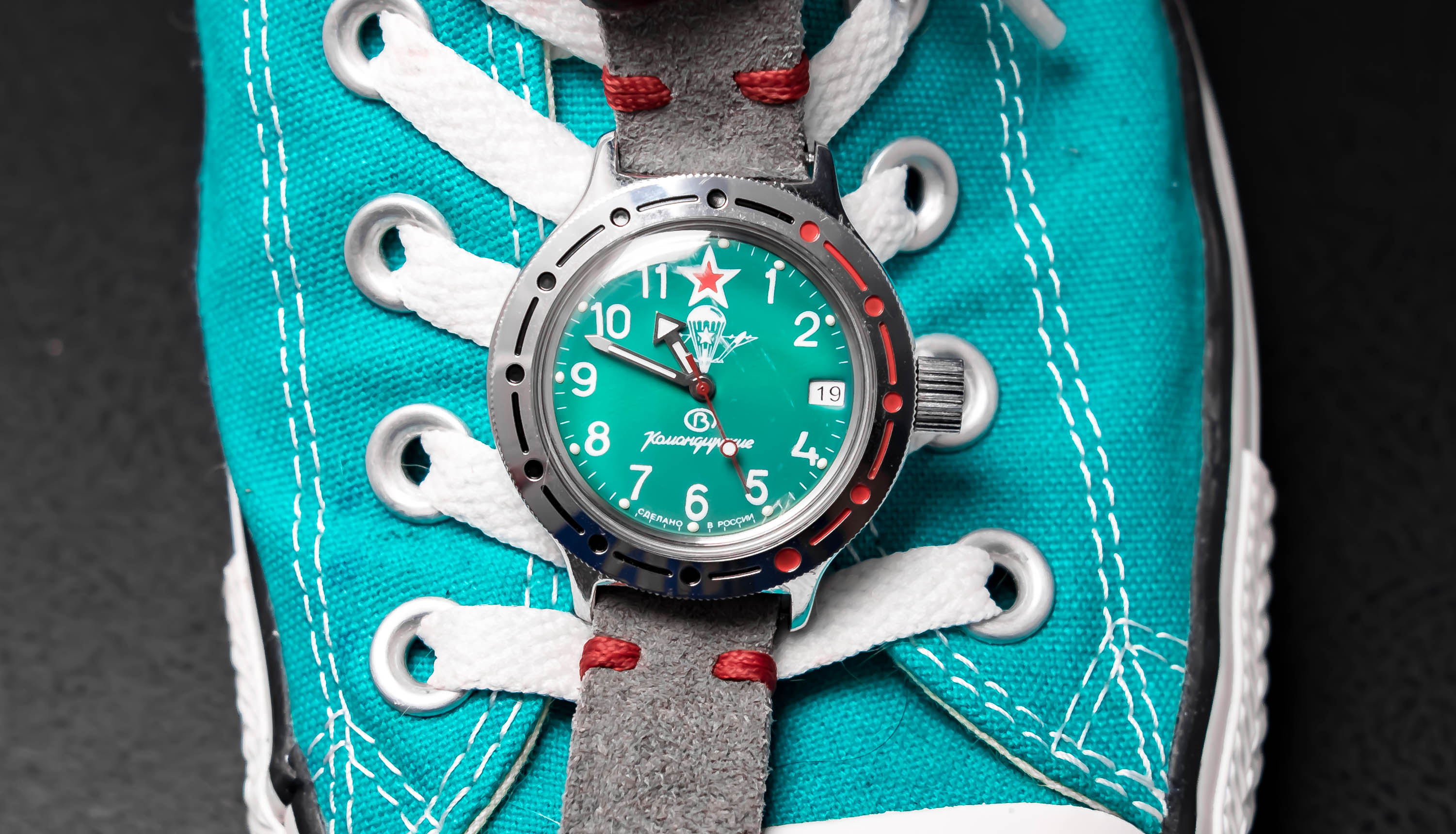
The variety of dials is a huge part of the appeal. With more than ten case styles and a ridiculous number of dial options, buying one feels less like choosing a generic budget diver and more like choosing your Amphibia. The semi-iconic paratrooper dial we lived with had a green surface with a slight sheen and faint gradient, plus painted Arabic numerals, a red star at twelve, and an old-school handset that gave it real personality. The red second hand can get lost against the dial, and the small pip only helps so much. Lume is also modest: the little luminous dots above the markers do most of the work because the numerals themselves are not lumed. The acrylic dome adds vintage warmth and distortion.
Inside, the Soviet-designed 2416 automatic movement brings hand-winding, about 31 hours of power reserve, and a stated accuracy range of -20/+60 seconds per day. That is not impressive in a spec-sheet fight, but the movement is simple, tough, and part of the Amphibia’s long-term charm. Vostok has claimed a 10-year average service term, though current production pieces can still show uneven QC, including hand-setting quirks or lubrication issues. The upside is that many problems are fixable, and the huge, cheap modding ecosystem makes ownership feel hands-on rather than precious. For someone who wants a historically interesting budget diver with quirks, scratches, strap experiments, and a bit of mechanical stubbornness baked in, the Amphibia makes sense.
Pros
- The 200-meter compression-case construction gives the watch a genuine technical identity.
- The rounded 39mm case wears more easily than many thicker modern divers and avoids feeling overbuilt.
- Dial and case variety is huge, making it easy to find an Amphibia that feels personal.
- The acrylic crystal, soft case shape, and old-school dial details give it a strong vintage character.
- The modding community is active and affordable, especially if the stock bezel, bracelet, or dial is not your thing.
- Scratches suit the polished case, which makes the watch easier to wear without babying it.
Cons
- The crown wobble can feel alarming before you understand the design, and the metal/threading can feel thin on newer examples.
- The stock bracelet feels hollow and flimsy, even if it suits the watch visually.
- Current production QC can be inconsistent, with occasional hand-setting or lubrication issues.
- At 15mm thick, it has noticeable height even though the rounded case helps it wear better than the number suggests.
Seiko SKX007
| Water Resistance: | 200m |
| Case Dimensions: | 42.5mm (diameter) x 46mm (lug-to-lug) x 13.25mm (thickness) |
| Lug Width: | 22mm |
| Movement: | 7S26 |
The Seiko SKX007 belongs in this conversation because it became one of the default answers in the history of affordable dive watches without much fanfare. A lot of collectors have owned one, moved on, and later realized the watch was doing the simple things better than plenty of more complicated options. That is the SKX007’s whole trick. It does not feel precious, fragile, or overdesigned. It feels like the watch you grab when you do not want to think too hard.
The wearing experience is a big part of why it is stuck in enthusiasts’ memories. The case lands in a comfortable middle ground that works across a wide range of wrist sizes, and it does not punish you for changing how you wear it. The stock bracelet has that familiar Seiko tool-watch feel: practical, a little basic, and easy enough to live with. Move it to a nylon strap, and the whole thing becomes lighter and even more casual. That flexibility is what made it a fallback piece for so many people.
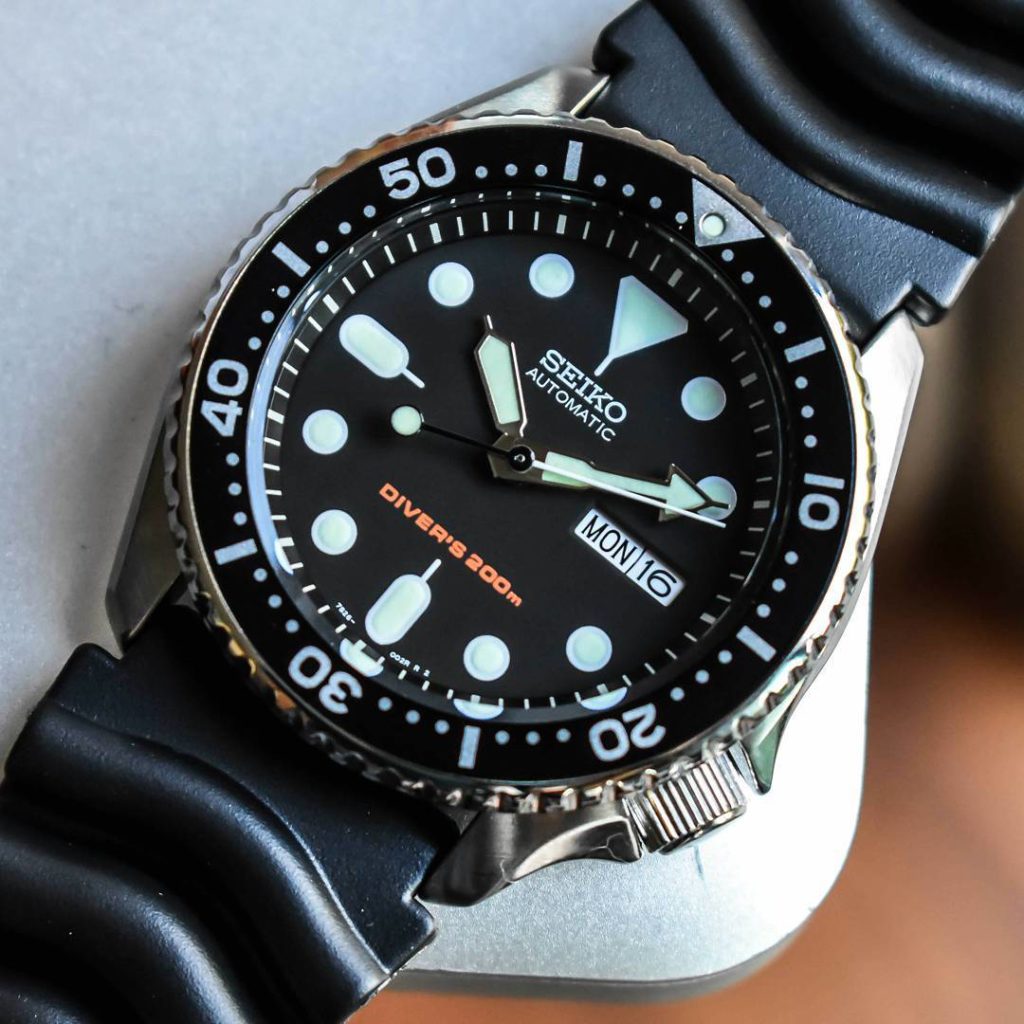
The dial is where the SKX007 still makes its strongest case. The black layout is clean, the text is restrained, and nothing pulls your eye away from the time. The hands are easy to separate at a glance, and the markers stay legible in full sun, dim rooms, and the kind of awkward lighting where some “serious” watches suddenly become decorative objects. As mentioned in our detailed review, Seiko’s lume matters here too. It charges quickly and remains useful well after the initial glow fades, which is what you want from a dive-style watch that will spend most of its life doing everyday work.
The 7S26 movement keeps the SKX007 grounded. It does not hack or hand-wind, which can feel limiting if you are used to more modern automatic movements. But the trade-off is simplicity. In our experience, the appeal comes from how little drama it creates. It keeps running, and when service eventually enters the picture, the movement’s commonness keeps maintenance approachable rather than painful. That said, the bracelet is basic, and the movement feels old-school in ways some buyers will find inconvenient. But its honesty is the reason people keep circling back. It is an essential modern classic because it helped define what an affordable dive watch could be: readable, comfortable, tough enough for normal abuse, and good enough that plenty of us had to buy it more than once before admitting the obvious.
Pros
- Clean black dial layout with strong everyday legibility.
- Seiko lume charges quickly and stays useful beyond the first bright burst.
- Case proportions wear comfortably across a wide range of wrists.
- The 7S26 movement is simple, reliable, and affordable to service.
Cons
- The stock bracelet is functional but basic.
- No hacking or hand-winding can feel dated compared to newer automatic divers.
Seiko Turtle
| Price: | $370 – $525 |
| Water Resistance: | 200m |
| Case Dimensions: | 44.3mm (diameter) x 48mm (lug-to-lug) x 14mm (thickness) |
| Lug Width: | 22mm |
| Movement: | Seiko 4R36 |
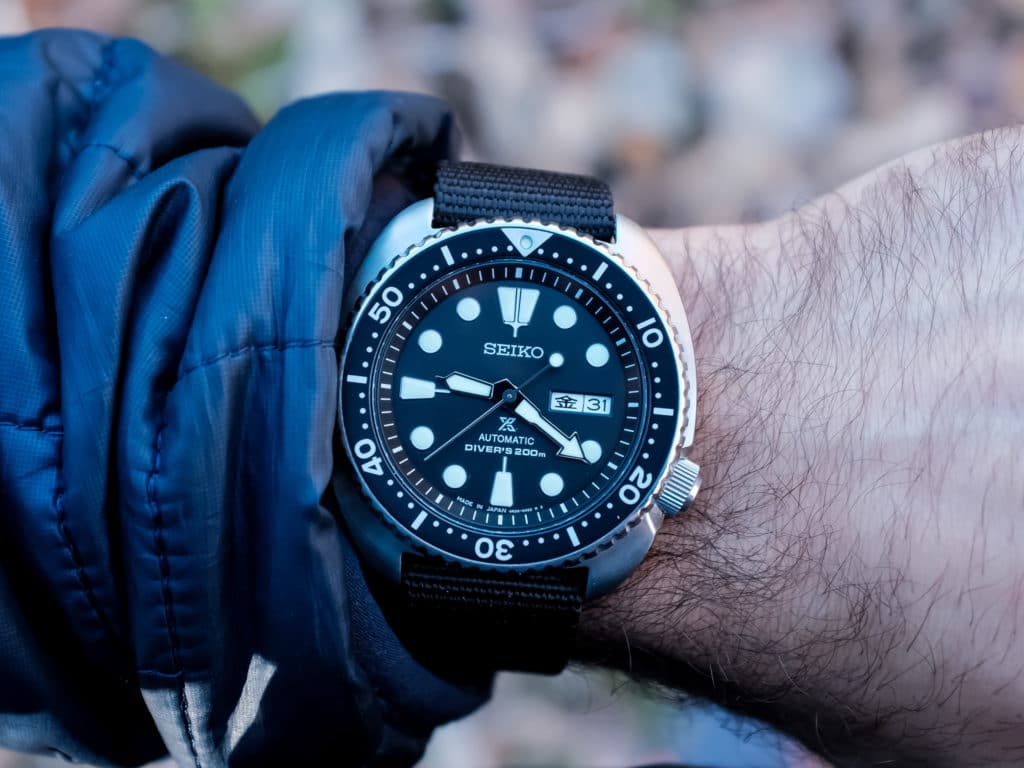
The Seiko Turtle is part of this list because it carries real Seiko dive-watch lineage without turning ownership into a museum exercise. It feels like a working diver first and a heritage piece second, which is why it has stayed relevant for affordable collectors. On paper, the size can scare people off. At over 44mm, it sounds like something that should dominate the wrist, but the cushion case changes the way that size behaves. Instead of stacking height and feeling top-heavy, the case spreads outward, sitting with a broad, planted feel that works quite well on larger wrists.
That comfort is helped by one of the Turtle’s best practical details: the offset crown. It sits slightly out of the way, so it does not dig into the back of the hand when the wrist bends. For a dive watch with this much presence, that makes a real difference over a long day. We’ve found that this is where the Turtle separates itself from plenty of smaller divers that somehow feel clumsier in motion. The stock silicone strap is also better than older Seiko rubber straps, soft enough to wear without immediately hunting for a replacement. Still, the Turtle becomes more flexible once you start experimenting. NATOs suit the case shape well and make the watch feel less formal, more knockaround, and easier to wear across travel, beach days, and regular weekend abuse.
The dial keeps things simple in the right way. The matte black surface cuts glare outdoors, and the large Lumibrite markers give the watch the kind of quick-read clarity that makes Seiko divers so easy to trust. In dim light, the oversized plots do not require squinting or second-guessing, which matters whether you are actually near water or checking the time half-asleep. Hardlex, instead of sapphire, will keep forum arguments alive forever, but in normal use, it holds up well enough and helps the Turtle stay in a more approachable price bracket. Even the Prospex “X” on the dial, which gets more attention online than it deserves, fades into the background when the watch is worn rather than being overanalyzed in macro shots.
Inside, the 4R36 automatic movement is practical in the familiar Seiko way. It hacks and hand-winds, which makes it much easier to live with than older entry-level Seiko movements, though accuracy can vary. During testing, our example ran around +35 to +45 seconds per day, which is not impressive if you obsess over timing logs, but it is manageable for everyday wear. The bezel action feels solid and reassuring, though alignment can still be inconsistent across examples. That is part of the bargain with the Turtle: you get a durable, comfortable, historically connected diver with personality, but not top-notch perfection.
Some versions add extra collector appeal, including “Made in Japan” models and references with a Kanji day wheel. The Kanji display is fun and adds a little extra character to the watch, though it can slow down a glance once the novelty wears off. That sums up the Turtle pretty well. It has quirks, but they rarely get in the way of the larger point.
Pros
- The cushion case makes the large dimensions wear more comfortably than expected.
- The offset crown improves long-wear comfort and avoids hand-digging.
- Screw-down crown and strong water resistance make it feel ready for regular wear.
- The stock silicone strap is usable, and the watch works well on NATOs.
- Matte dial finishing and strong Lumibrite make it easy to read outdoors and in low light.
Cons
- Bezel alignment can vary between examples.
- The Kanji day wheel has charm, though it can be slower to read once the novelty wears off.
- Accuracy from the 4R36 may be looser than some buyers want.
- Hardlex is practical, but sapphire fans may still see it as a compromise.
Certina DS PH200M
| Price: | $810 |
| Water Resistance: | 200m |
| Case Dimensions: | 43mm (diameter) x 52mm (lug-to-lug) x 14.5mm (thickness) |
| Lug Width: | 20mm |
| Movement: | Powermatic 80 |
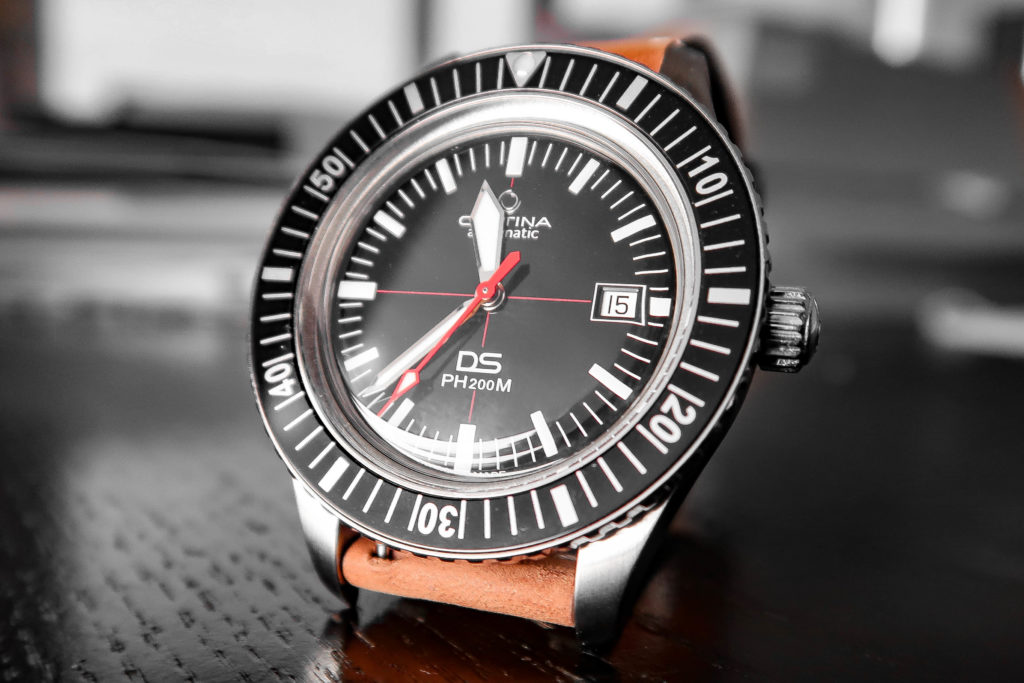
The Certina DS PH200M fits this list because it brings late-1960s Certina dive-watch history into a package that still feels usable rather than fragile. It is a modern reissue, but not the kind that leans on nostalgia while forgetting how the watch has to work on a wrist. The proportions, dial layout, domed crystal, and strap flexibility all point clearly toward vintage-diver territory, while the modern build makes ownership feel less stressful.
The dial carries most of the old-school appeal. Certina uses a matte black surface, clean white markers, and red crosshair accents that add character without clutter. The BGW9 lume stayed useful well into the night during our time with it, which matters because vintage styling gets annoying fast when you can’t read the watch after dark. The aluminum 60-click dive bezel also adds to the period feel, with a luminous marker at 12 and precise alignment between the bezel and the chapter ring on our example. The action itself is not as satisfying. It turns with some resistance and has slight play between clicks, so it works for basic timing but lacks the sharper feel some modern divers deliver.
The case is where the PH200M asks for more wrist. At just under 43mm wide, with a roughly 52mm lug-to-lug span and about 14.5mm of thickness, this is not a slim little skin diver. Larger wrists will probably get a sturdy, purposeful feel from it, while smaller wrists may notice the span right away. The downward-curving lugs help it settle better than the numbers suggest, and much of the height comes from the domed box-style crystal, which gives the watch its vintage verticality. It feels less like a delicate throwback and more like a sturdy travel diver you could take near water, sand, and the usual “one watch should be fine” vacation decisions.
The Powermatic 80 gives the PH200M one of its clearest modern advantages. It runs at 21,600 bph and offers around 80 hours of power reserve, which is very useful if you rotate watches and want to pick it back up after a weekend. Servicing should also be more straightforward than with something obscure, since the movement is widely used across the Swatch Group. Certina’s DS, or Double Security system, adds another practical layer with a rubber shock cushion around the movement, plus standard Incabloc protection. During testing, the included leather strap felt thick and sturdy, with quick-release bars, though the nubuck-style finish may not suit everyone. The watch felt especially right on NATO and mesh options, which made the history-diver personality feel more relaxed and wearable.
Pros
- Certina’s DS shock-protection system adds meaningful durability beyond the vintage styling.
- Matte black dial, white markers, red crosshair accents, and domed box-style crystal give it strong vintage character.
- Works well across straps, especially NATO and mesh options.
- Powermatic 80 movement offers a practical 80-hour power reserve.
Cons
- The case diameter and roughly 52mm lug-to-lug span may be too much for smaller wrists.
- The included nubuck-style leather strap is sturdy, but its texture and look may not appeal to everyone.
- The bezel action has some stiffness and slight play between clicks.
- The 14.5mm height gives it noticeable thickness.
Mido Ocean Star Tribute
| Price: | $1,000 approx. (used and grey market) |
| Water Resistance: | 200m |
| Case Dimensions: | 40.5mm (diameter) x 47mm (lug-to-lug) x 13.5mm (thickness) |
| Lug Width: | 21mm |
| Movement: | Mido Caliber 80 |
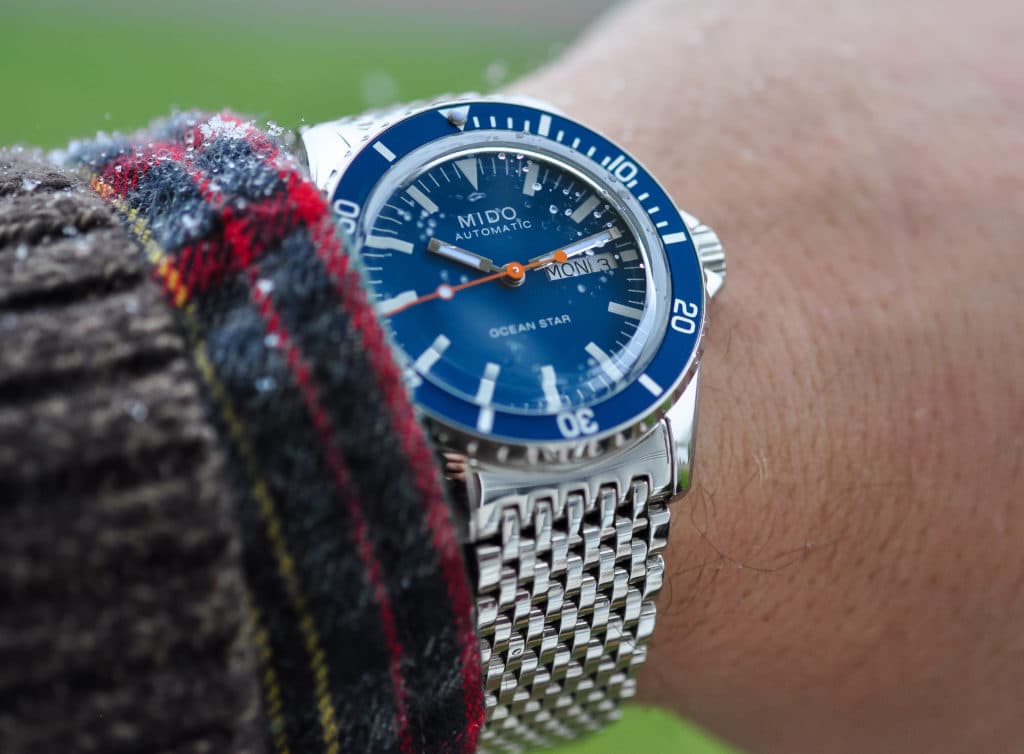
The Mido Ocean Star Tribute works here because it gives you real Ocean Star heritage without requiring you to go too deep into niche-collector territory. It is not a strict reissue of one specific old Mido reference. It feels more like Mido built a vintage greatest-hits diver, then polished every surface until the watch looked ready to stand out. That full polish is worth calling out right away. It looks great out of the box, but it will collect hairlines. If scratches bother you, this one may test your blood pressure. The actual sizing is much friendlier. At 40.5mm wide with a 47mm lug-to-lug, it hits the kind of middle ground we wish more divers remembered existed.
The Mediterranean Blue version we reviewed hands-on is where the watch makes its strongest emotional pitch. The dial has that old dive-advertisement charm, with a simple printed layout, thick painted baton markers at the five-minute points, smaller minute markers, and a Datoday window at 3 o’clock that somehow avoids making the dial feel overstuffed. The chromed paddle hands are easy to read, and the orange lollipop second hand adds a little snap to the blue dial. Mido made the right call with the slightly darker aluminum bezel, too. Ceramic would have felt too modern, and fake bakelite can get theatrical fast. The box sapphire crystal adds a rounded vintage profile and raises the case height to 13.5mm, but it remains clearer than many plexi-style crystals. There is edge distortion, but not enough to make checking the time annoying. Mido also skipped AR coating, and in practice, we didn’t miss it much. On this watch, avoiding that weird color-shifting AR flash feels more fitting than chasing sterile clarity.
The bracelet is where the Tribute surprised us more than the case did. An all-polished multi-link bracelet sounds like it should be a fingerprint magnet with commitment issues. Still, it is fully articulating, comfortable, and drapes over the wrist in a very 1970s, gold-chain-in-Miami sort of way. Somehow, it works. The clasp is another strong point, with a standard push-button release and a smaller button for the extension. That extension is useful for actual water use, sure, but also for sweaty afternoons when your wrist decides to grow half a size. The bezel is less lovable, though. It has a tight 60-click action with very little play, but the polished coin edge does not offer enough grip. Dry hands make it harder to turn than it should be, and slippery hands turn the process into slapstick. The crown is much better, with sharper edges and enough size to make winding, setting, and screwing it down feel secure.
The Caliber 80 keeps the Ocean Star Tribute from being only a handsome nostalgia machine. The 21,600 bph beat rate may annoy some enthusiasts, and it is not as easy to regulate as a standard ETA 2824, but the 80-hour power reserve is very useful if you rotate watches. Our example ran around +2 seconds per day on the timegrapher. The weak spot is lume. For a 200-meter diver, the green Super-LumiNova should be better. The hands and bezel pip outglowed the dial, but none of it felt especially strong, and cheaper Seiko divers can make it look a little silly in the dark. Still, as a heritage-backed Swiss diver under $1,000, the Mido works because it feels charming, wearable, and easy to own.
Pros
- The 40.5mm case and 47mm lug-to-lug hit a genuinely wearable sweet spot.
- Mediterranean Blue dial, orange lollipop seconds hand, and aluminum bezel give it a strong vintage-diver character.
- The box sapphire crystal adds an old-school shape without the anxiety of plexiglass.
- A fully articulated, polished bracelet is comfortable and distinctive.
- The slim clasp extension is useful on hot days or around water.
Cons
- The included blue canvas strap looks right, but it needs real break-in time.
- Caliber 80 is not as straightforward to regulate as a standard ETA 2824.
- Polished coin-edge bezel has little play, but not enough grip.
- Lume is weak for a 200-meter diver, especially compared to cheaper Seiko options.
- The fully polished case and bracelet will show marks quickly.
CWC 1983 Quartz Royal Navy Diver

| Price: | $1,000 approx. (used and grey market) |
| Water Resistance: | 300m |
| Case Dimensions: | 45mm (diameter incl. crown) x 47mm (lug-to-lug) x 11mm (thickness) |
| Lug Width: | 20mm |
| Movement: | ETA 955.122 Quartz |
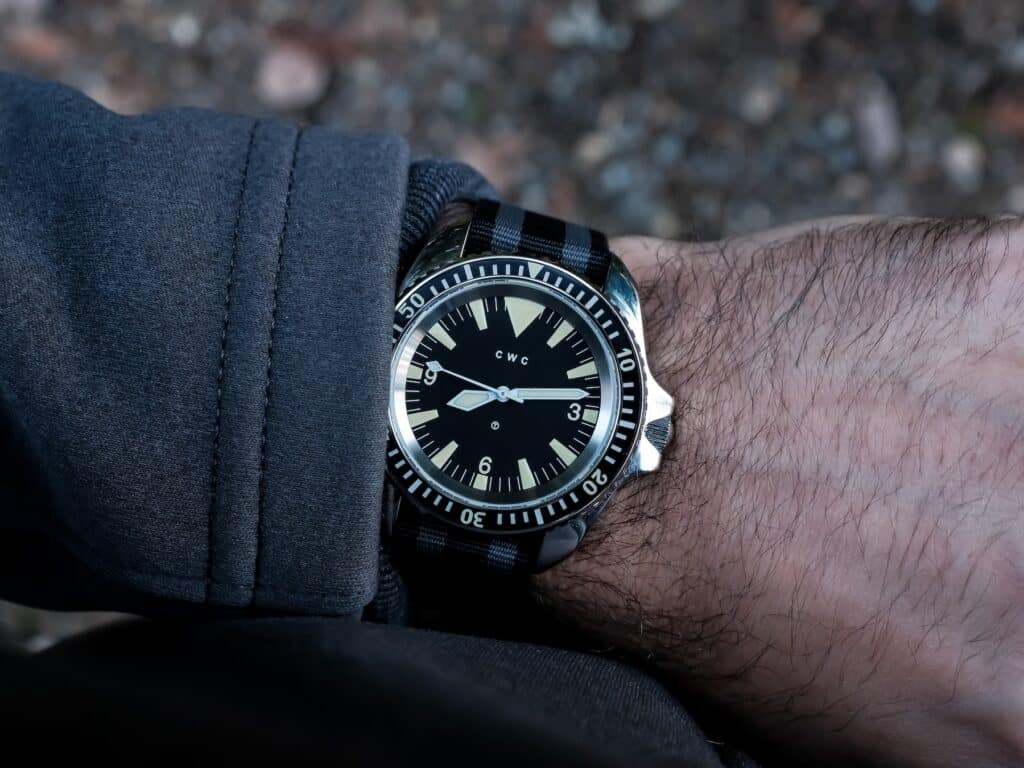
The CWC 1983 Quartz Royal Navy Diver suits this group because its history is not vague catalog dust. This is a service-history-driven dive watch that still feels tied to its original job. The asymmetrical case follows old Ministry of Defense specifications, with oversized crown guards and a layout that seems more concerned with survival than with seduction. That sounds dramatic, but on the wrist it comes across as practical. With 300 meters of water resistance, it has a no-date Submariner-adjacent wearing profile, only with a more utilitarian edge. On the supplied Phoenix NATO, it stays light, balanced, and easy to wear for days at a time without ever feeling like something that needs special treatment.
The bezel gives the watch a lot of its personality. Instead of modern ceramic, CWC uses a glossy, slightly domed acrylic insert that catches light in a softer, more period-correct way. It makes the watch feel connected to its military roots without becoming fake-vintage theater. The 60-click action is firm, with very little play, and the lumed 10-minute markers make quick timing easy. That matters because this watch is not trying to impress you with decoration. It is built around clear, repeatable use.
The dial follows the same logic. The matte surface keeps glare down, while the bold sword hands and thick markers are easy to read at a glance. The vintage-toned lume lasts well after the lights go out, so the old military look does not come at the expense of nighttime usefulness. The “circle T” remains as a visual reference to the original tritium-marked dials, though this modern version uses Super-LumiNova. Purists may grumble about that, but in daily ownership, it reads as part of the watch’s visual language rather than a functional claim.
Inside, the ETA 955.122 quartz movement makes the whole thing feel even more tool-like. During hands-on testing, it ran between -0.3 and +0.5 seconds per day, which is the kind of accuracy that makes mechanical fussing feel a little silly. The tick is quiet enough to disappear in normal use, and while the hidden day-and-date setup can make initial setting slightly awkward, that irritation fades because you barely need to touch the watch afterward. The fixed spring bars do limit strap-swapping, and the price may feel high if you equate value with mechanical movements. But for someone who wants an under-$1,000 dive watch with real military credibility, restraint, accuracy, and everyday wearability, the CWC 1983 Quartz Royal Navy Diver makes a strong case.
Pros
- Genuine MOD-spec design gives it clear military credibility.
- Phoenix NATO keeps it light, balanced, and comfortable for daily wear.
- The firm 60-click bezel has very little play and useful lumed 10-minute markers.
- Glossy domed acrylic bezel insert adds period-correct character.
- ETA 955.122 quartz movement is accurate and low-maintenance.
Cons
- The hidden day-and-date setup can feel awkward during initial setup.
- Fixed spring bars limit strap options.
- “Circle T” is decorative now, since the watch uses Super-LumiNova rather than tritium.
- The price may feel steep for buyers expecting a mechanical movement.
If you’ve spent real wrist time with any of these, we’d love to hear where they’ve impressed you and where the romance wore off. That said, this list sticks to models we’ve reviewed hands-on and if there’s another under-$1,000 diver with real roots that you think deserves a spot, share it in the comments. We’ll see if we can conduct a hands-on review of it.

Co-Founder and Senior Editor
Kaz has been collecting watches since 2015, but he’s been fascinated by product design, the Collector’s psychology, and brand marketing his whole life. While sharing the same strong fondness for all things horologically-affordable as Mike (his TBWS partner in crime), Kaz’s collection niche is also focused on vintage Soviet watches as well as watches that feature a unique, but well-designed quirk or visual hook.
Your headline says divers under 1000 dollars and 3 are over or well over, um, what’s up with that.
Hi, Michael:
That was a mistake and a typo on my part. I removed one of the entries but the other two I clarified that they can be found for under $1000 pre-owned or via the grey market.
Thank you!
-Kaz
Bulova MilShips.
Such a good one. I’ve come so close to buying that watch many times. May do it just to review it 🙂
Diver’s under $1k… mentions Mido and CWC. Couldn’t even follow your own directions! 😂
Hi, Dana:
Lol that’s totally on me – I didn’t catch that in time and I should have done better on that. I removed one entry that was clearly wrong for the piece but the other two pieces I clarified that they can be found for under $1,000 when buying used or from the grey market.
Best,
-Kaz
I did get to see the Delta Hydra up close when someone else had one. It was unique. It was beefy. Loved the orange color. Just a different look than a lot of the things you’ve shown.
Ooooo. Hadn’t seen these before. They look great!
I think the Tissot 2000 Seastar Professional should be given consideration it is a great everyday wear – incredible specs with 2000 feet depth rating helium valve and powermatic 80 – all for under 1K.
Steve, the Seastar Professional is a lot of watch for the money. Worth a look for sure. Thanks for the suggestion.