The Rolex Explorer sits in an awkward spot for many enthusiasts. It’s one of the easiest watches to wear every day, regardless of where you’re headed or what you’re wearing. After spending time with the Explorer 14270, we understood why it has earned such a loyal following. It isn’t the branding or the mountaineering backstory that wins you over. It’s the balanced proportions, uncluttered dial, and the quiet confidence it brings to the wrist. However, crossing the $1,000 mark by several multiples puts it well outside the budget most collectors are willing to spend on a simple three-hand watch.
That’s exactly how we approached this list. Over more than a decade at TBWS, we’ve worn and reviewed hundreds of affordable watches, and we’ve learned that the best Explorer alternatives are the ones that capture the qualities we kept coming back to during our wrist time: versatility, legibility, comfort, and an understated design that still feels rewarding months later. Every watch here is one we’ve reviewed firsthand, and each earned its place through real use—not because of a familiar 3-6-9 dial layout or a passing resemblance, but because it stood on its own after weeks of wear. Some were expected contenders. Others surprised us enough to make us rethink what an Explorer alternative can be.
Casio Oceanus T200
| Price: | $300 – $500 |
| Water Resistance: | 100m |
| Case Dimensions: | 41.4mm (diameter) x 49mm (lug-to-lug) x 10.7mm (thickness) |
| Lug Width: | 20mm |
| Movement: | Tough Solar movement (Module 5596) |
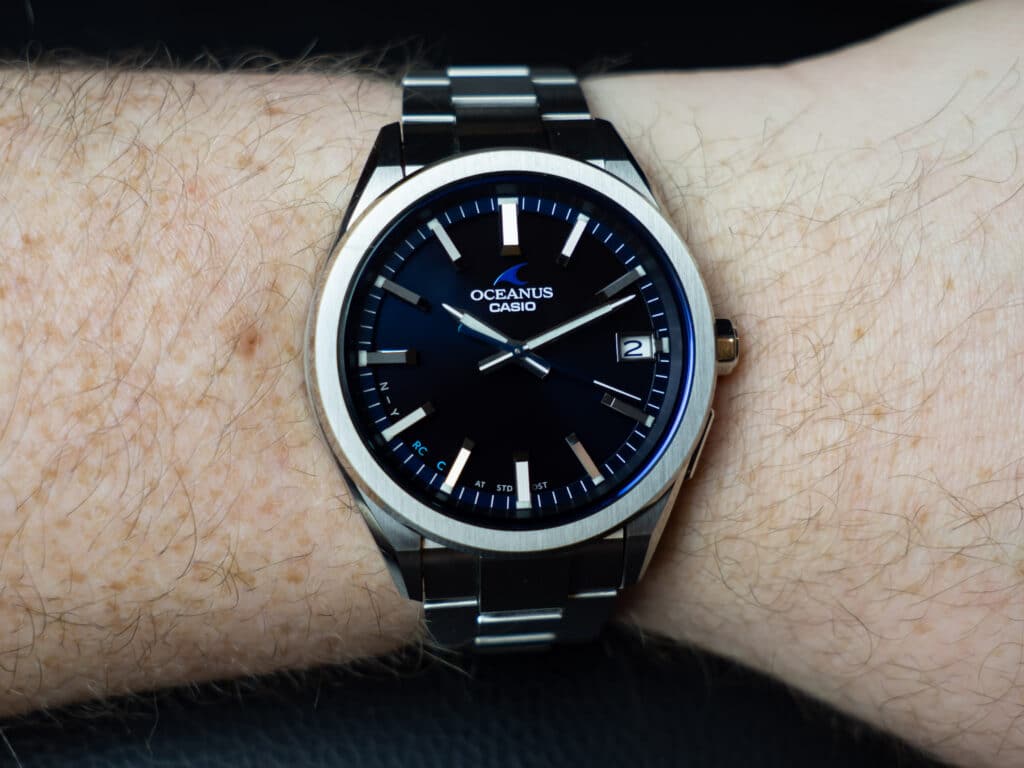
The Casio Oceanus T200 earns its spot in a sub-$1,000 Explorer alternatives list because it nails the part people actually remember after a few days on the wrist: the quiet, slightly smug realization that a watch feels better finished than its price says it should. It is not trying to imitate the Explorer’s field-watch leanings, and that works in its favor. What it offers instead is a simple, accurate, polished everyday watch that slides into the same “wear it without thinking” lane, only with Casio’s own brand of refinement. In our hands-on review, the combination of crisp finishing, a thoughtful dial, and worry-free quartz ownership made it feel far more expensive than it has any right to.
A lot of that impression comes from the dial work. Casio worked in real depth here, especially through the floating hour markers created by those cutouts in the chapter ring. As the wrist moves, the dial picks up light in a way that feels controlled rather than showy. The blue-tinted sapphire crystal adds a subtle outdoor glow without turning the watch flashy, and the case follows suit with a clean mix of brushed and polished surfaces that reads more upscale than most solar quartz pieces in this range. Daytime legibility is excellent, which matters more here than any spec-sheet romance, although the lume is average once the lights go down.
Ownership is quite low-drama. The Tough Solar Module 5596 stayed charged through normal wear during our testing, and Bluetooth sync through the Casio Oceanus app kept the time locked in without any fuss or surprise resets. That means you get to enjoy the finishing and dial details without worrying about winding, batteries, or fiddling with the time after the watch has sat for a while.
That said, the trade-offs are real: the bracelet feels solid on the wrist but rattles more than we’d like when it is off, resizing the pin-and-collar links is more annoying than standard systems, and the connectivity text on the dial will not appeal to everyone. But for anyone who likes the Explorer idea of an understated, easygoing daily watch, the T200 brings a level of refinement that is hard to argue with.
Pros
- Tough Solar Module 5596 stays charged through everyday wear with virtually no maintenance.
- Bluetooth syncing through the Casio Oceanus app keeps the watch accurate without manual intervention.
- Floating hour markers and the blue-tinted sapphire crystal create impressive depth and shifting light effects.
- The combination of brushed and polished finishes gives the case a refined, premium appearance.
- Excellent daytime legibility despite the layered dial design.
Cons
- Pin-and-collar bracelet sizing is more tedious than a standard pin system.
- Lume is only average and trails many sport-focused alternatives in low light.
- The bracelet develops a noticeable rattle when it’s off the wrist.
- Connectivity text on the dial may not appeal to collectors who prefer a cleaner, more minimalist aesthetic.
Seiko SRPE51
| Price: | $315 |
| Water Resistance: | 100m |
| Case Dimensions: | 40mm (diameter) x 44mm (lug-to-lug) x 12mm (thickness) |
| Lug Width: | 20mm |
| Movement: | Seiko 4R36 |
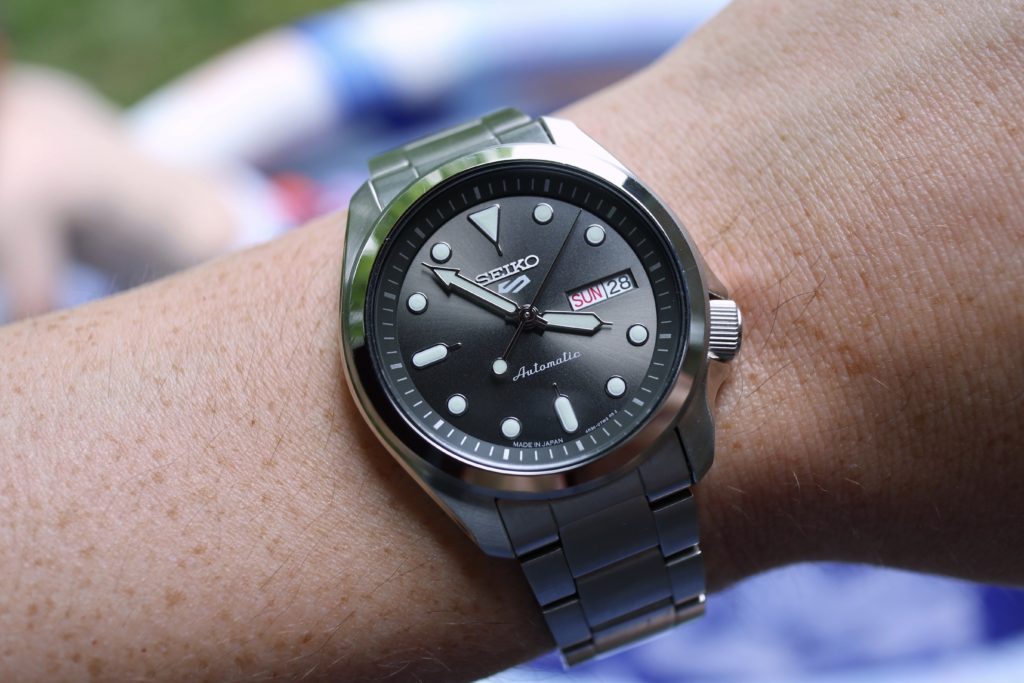
The Seiko SRPE51 earns its place here because it scratches the same itch that draws people to the Rolex Explorer in the first place. It’s the kind of watch you stop thinking about once it’s on your wrist, and that’s meant as a compliment. It isn’t trying to be a field watch or an Explorer homage. Instead, it takes the familiar Seiko SKX formula, swaps the rotating bezel for a polished fixed bezel, and results in a cleaner, more versatile watch that feels at home almost anywhere. During our wrist time with it, we found ourselves wearing it just as comfortably with jeans as we did with a collared shirt, and the 40mm case never felt bulky or out of place under a cuff.
The dial is what kept pulling us back. Rather than relying on a loud sunburst effect, the grey finish shifts subtly throughout the day, giving the watch more personality the longer you wear it. The applied markers and updated handset keep everything easy to read, while Seiko’s LumiBrite once again proves why enthusiasts continue to praise it. Even after the room lights dimmed, the watch stayed easy to read, although we couldn’t help wishing the second hand had a small lollipop tip to make nighttime checks even quicker. The flat Hardlex crystal also deserves some credit for keeping reflections under control, even if we’d still take sapphire given the choice.
Inside, the dependable 4R36 brings hacking seconds, hand-winding, and a display caseback without making ownership feel complicated. The compromises are mostly on the bracelet. The hollow end links introduce more rattle than we’d like, and if you’re the type who inspects every detail, slight chapter ring alignment inconsistencies aren’t unheard of. Thankfully, neither issue kept us from enjoying the watch.
The drilled 20mm lugs make strap changes effortless, and the SRPE51 responds well to almost everything we tried. Leather dresses it up, nylon makes it feel more casual, and that flexibility is why it works so well as an affordable alternative to the Explorer’s everyday philosophy.
Pros
- Seiko’s LumiBrite remains excellent once the lights go down.
- The 4R36 automatic movement offers hacking, hand-winding, and a display caseback.
- The grey dial develops more character as lighting changes throughout the day.
- Drilled 20mm lugs make changing straps quick and painless.
Cons
- Minor chapter ring alignment issues may bother detail-oriented collectors.
- The hollow end-link bracelet feels rattlier than the solid case suggests.
- Hardlex crystal isn’t as scratch-resistant as sapphire.
Mido Multifort 38
| Price: | $350 – $650 (secondary market, based on condition) |
| Water Resistance: | 100m |
| Case Dimensions: | 38mm (diameter) x 45mm (lug-to-lug) x 11mm (thickness) |
| Lug Width: | 20mm |
| Movement: | ETA 2836-2 (Caliber 80 on current models) |
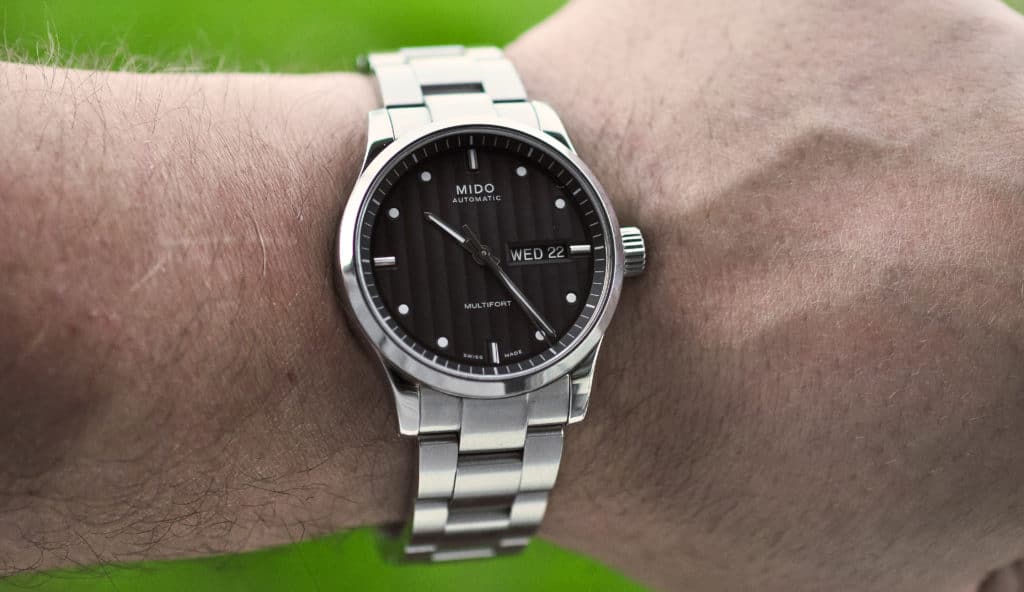
The Mido Multifort 38 takes a different route to the Explorer’s everyday appeal. Instead of leaning into field-watch simplicity, it adds a touch more texture and polish without becoming too dressy. That’s what kept us coming back to it. It felt just as comfortable at a desk as it did on the weekend, and the compact 38mm case never crossed into “dress watch only” territory. At roughly 11mm thick with a 45mm lug-to-lug, it slipped easily under a cuff, while the short, slightly downturned lugs kept the broad dial from appearing larger than the measurements suggest. The signed screw-down crown and 100m water resistance also gave us far more confidence in treating it like an everyday watch than its refined appearance would have.
Most of the Multifort’s personality comes from the dial. The recessed center, finished with vertical Genève stripes, sits below a raised chapter ring, creating depth that becomes more noticeable the longer you wear it. Mido also integrated the black day-date wheels cleanly into the dial, while the applied quarter-hour markers and painted five-minute markers keep the layout balanced without feeling busy. The slim, chromed sword hands occasionally blend into the darker dial, but the blue Super-LumiNova strips running through them do more work than you’d expect during the day. Once the lights go down, though, the restrained lume and the non-lumed second hand leave it trailing behind sportier alternatives.
The case finishing deserves as much credit as the dial. Brushed surfaces dominate, while polished case sides and a slim polished bezel add enough contrast to keep the watch from feeling plain. The slightly recessed sapphire crystal should hold up well over the years of wear, although the lack of an anti-reflective coating can make reflections distracting in bright light. The model we reviewed hands-on used the ETA 2836-2, while current Multifort models now use Mido’s Caliber 80 with an extended 80-hour power reserve, making them easier to leave off the wrist for a weekend. The bracelet complements the watch nicely with its 20mm-to-18mm taper and polished side links, but the butterfly clasp leaves little room for fine adjustment, so getting the fit right can take a bit of trial and error.
Although the 38mm version has been discontinued, we’d still seek it out if we wanted a Swiss-made everyday watch that feels more refined than the typical Explorer alternative, without sacrificing practicality.
Pros
- The brushed case with polished accents strikes an excellent balance between sporty and dressy.
- The Genève-striped dial and neatly integrated day-date display add depth without becoming busy.
- Compact 38mm proportions wear comfortably and slip easily under a cuff.
- The screw-down crown, along with 100m water resistance, makes it far more versatile than its refined styling suggests.
Cons
- The butterfly clasp offers very little micro-adjustment for dialing in the perfect fit.
- Lume is quite restrained, and the second hand isn’t lumed at all.
- The sapphire crystal lacks an anti-reflective coating, making glare more noticeable in bright conditions.
Seiko SARB033
| Price: | $400 – $600+ (secondary or pre-owned) |
| Water Resistance: | 100m |
| Case Dimensions: | 38mm (diameter) x 46mm (lug-to-lug) x 11.2mm (thickness) |
| Lug Width: | 20mm |
| Movement: | 6R15 |
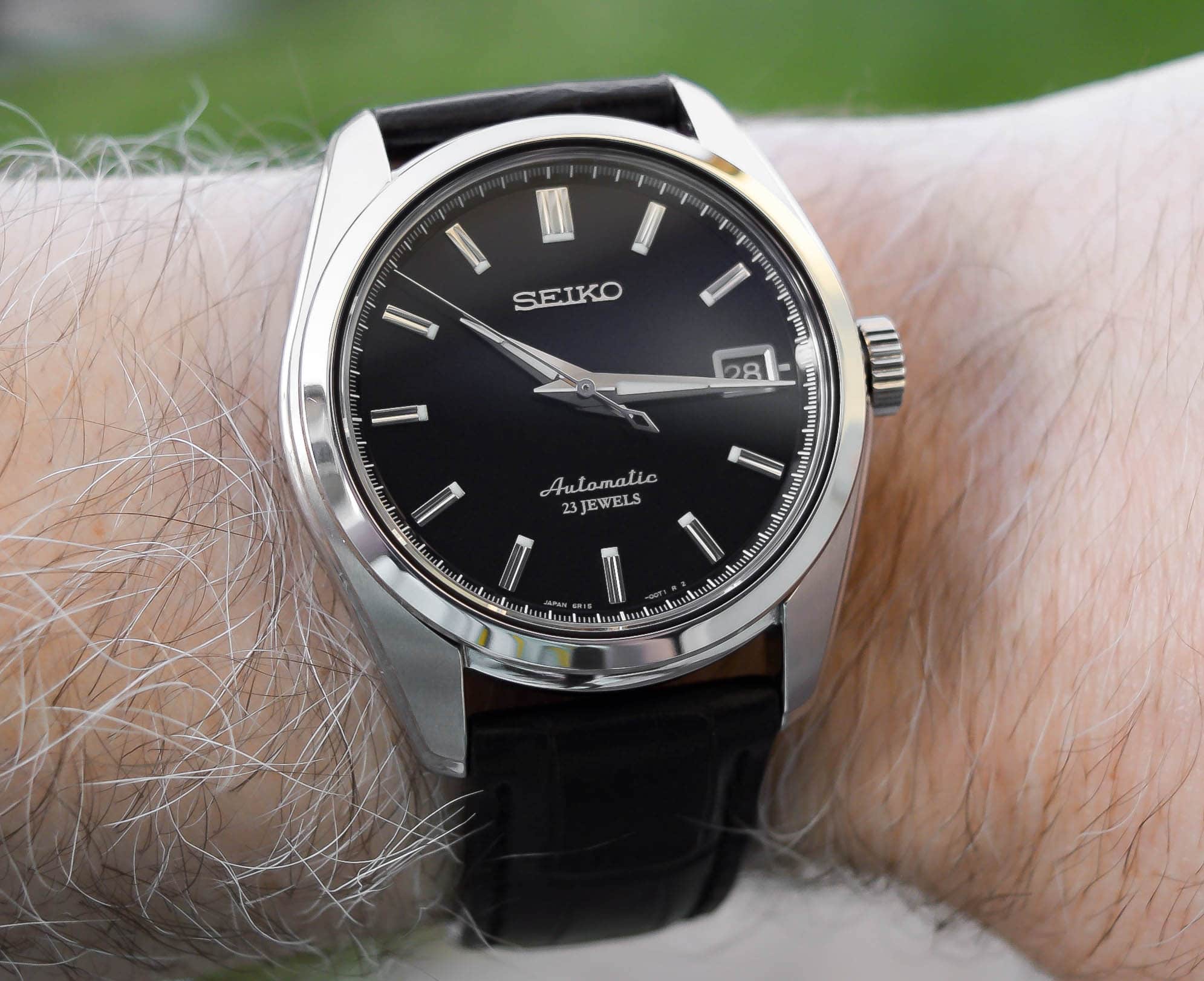
The Seiko SARB033 is probably one of the closest watches to the Explorer’s spirit without feeling like it’s trying to be one. Compact, understated, and equally comfortable with a T-shirt or a blazer, it has earned its reputation by simply being easy to live with. We didn’t fall for it immediately during our review. The proportions felt a little reserved at first, but after a few days of regular wear, the compact case, curved lugs, and balanced lug-to-lug made perfect sense.
That same restraint carries through to the dial. Most of the time, it reads as a deep, inky black, but stronger light reveals subtle brown undertones that keep it from feeling flat. Applied indices catch the light cleanly, while the long minute and second hands reach all the way to the chapter ring, making glances feel quite precise. The dauphine hands constantly shift between bright and dark depending on the angle, adding just enough visual interest without making the watch flashy. Lume is modest, but that’s in keeping with the SARB033’s character.
The stepped case follows the same approach, alternating brushed and polished surfaces that gradually reveal themselves, while the flat sapphire crystal still feels like a standout feature, even if it tends to collect fingerprints. Inside, the 6R15 remains one of the reasons enthusiasts continue to seek this watch out. Hacking seconds, hand-winding, and a healthy power reserve make daily ownership satisfying, and the review sample we tested consistently ran at ±3 seconds per day.
That said, the bracelet is where the experience loses a little momentum. Despite solid end links and a milled clasp, the overall fit never felt quite right, with the clasp leaving a noticeable gap when closed. We found the SARB033 came alive on leather instead. The other compromise is its discontinued status. Prices on the secondary market have climbed well beyond what made it famous, so it’s worth checking current values before buying. Even then, if your favorite part of the Explorer is its compact proportions, quiet confidence, and ability to disappear into everyday life, the SARB033 remains one of the strongest alternatives under $1,000.
Pros
- The 6R15 movement offers hacking, hand-winding, and excellent real-world accuracy.
- Curved case proportions make the watch very comfortable over long periods of wear.
- The well-balanced dial remains legible while revealing subtle character as lighting conditions change.
- Sapphire crystal and layered case finishing continue to feel premium years after release.
Cons
- Rising secondary-market prices have reduced the value it once represented.
- The flat sapphire crystal tends to attract fingerprints on the black dial.
- The bracelet fit and clasp design don’t live up to the case’s quality.
RZE Resolute Type A
| Price: | $499 (TecTuff strap); $699 (matching titanium HexLink bracelet) |
| Water Resistance: | 100m |
| Case Dimensions: | 39.5mm (diameter) x 46mm (lug-to-lug) x 11.5mm (thickness) |
| Lug Width: | 20mm |
| Movement: | Miyota 82S0 |
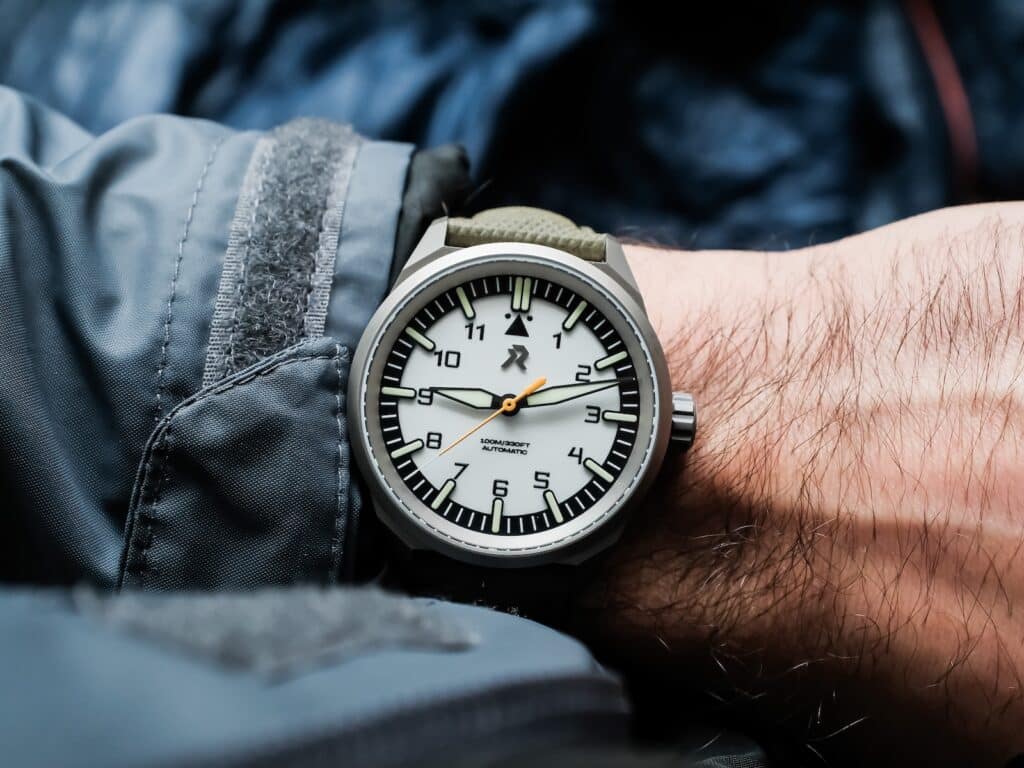
The RZE Resolute Type A reminded us of the Rolex Explorer because we kept reaching for it for the same reasons. It’s light, uncomplicated, and you never have to think twice about wearing it. That’s not something we take for granted at its price point. The Grade 2 titanium case weighs very little on the wrist, and after a few days, it almost disappears, as a good everyday watch should. RZE’s UltraHex hardening (rated to around 1200 Hv) also changes how you treat the watch. Instead of worrying about desk dives or door frames, we found ourselves wearing it without much thought. It is further aided by the screw-down crown, gasket setup, and 100 meters of water resistance, which make it feel more like a genuine daily companion than a pilot watch reserved for weekends.
The dial takes a different route to the Explorer’s easy readability. Rather than a familiar 3-6-9 layout, the Resolute relies on classic Type A flieger cues: a bold triangle at 12, vintage-inspired sword hands, a clean inner hour track, and an outer minute scale that your eyes pick up almost instantly. It feels purposeful without drifting into military costume territory. RZE wisely skipped the fake patina and unnecessary vintage flourishes, giving the watch a cleaner, more contemporary personality. Over the course of our testing, we also appreciated the added depth from the raised chapter ring and applied markers. These details stop the dial from feeling flat without getting in the way of quick time checks. The white version, in particular, stood out after dark thanks to its two-tone full-lume execution beneath the sapphire crystal, although collectors chasing a more traditional flieger aesthetic may find it a little too modern.
The practical toolish touches continue everywhere else. The TecTuff strap felt comfortable from the beginning and gradually shaped itself to the wrist, while its water-resistant calf-leather lining made it feel far less precious than it first appeared. Small details, including the quick-release spring bars, 20mm-to-18mm taper, and UltraHex-coated titanium tang buckle, showed that RZE thought about the ownership experience instead of only the specifications.
The Miyota 82S0 won’t steal headlines, but automatic winding, hacking, hand-winding, and roughly 42 hours of power reserve make it an easy movement to live with. Even the partially exposed rotor and engraved aircraft caseback add a little personality, though they’re hardly the reason we’d recommend the watch. We’d recommend it because it captures something the Explorer has always done well: it gets out of the way and simply lets you wear the watch.
Pros
- Grade 2 titanium construction keeps the watch light, while UltraHex hardening adds meaningful scratch resistance.
- Quick-release spring bars, the 20mm-to-18mm taper, and the titanium buckle make the strap feel well thought out.
- Type A flieger layout delivers outstanding at-a-glance readability.
- Raised chapter ring and applied markers give the dial depth without sacrificing clarity.
- The two-tone full-lume white dial adds plenty of character after dark.
Cons
- The modern full-lume dial won’t appeal to buyers looking for a traditional flieger aesthetic.
Vaer Automatic
| Price: | $599 |
| Water Resistance: | 100m |
| Case Dimensions: | 40mm (diameter) x 48mm (lug-to-lug) x 10.5mm (thickness) |
| Lug Width: | 20mm |
| Movement: | Miyota 9015 |
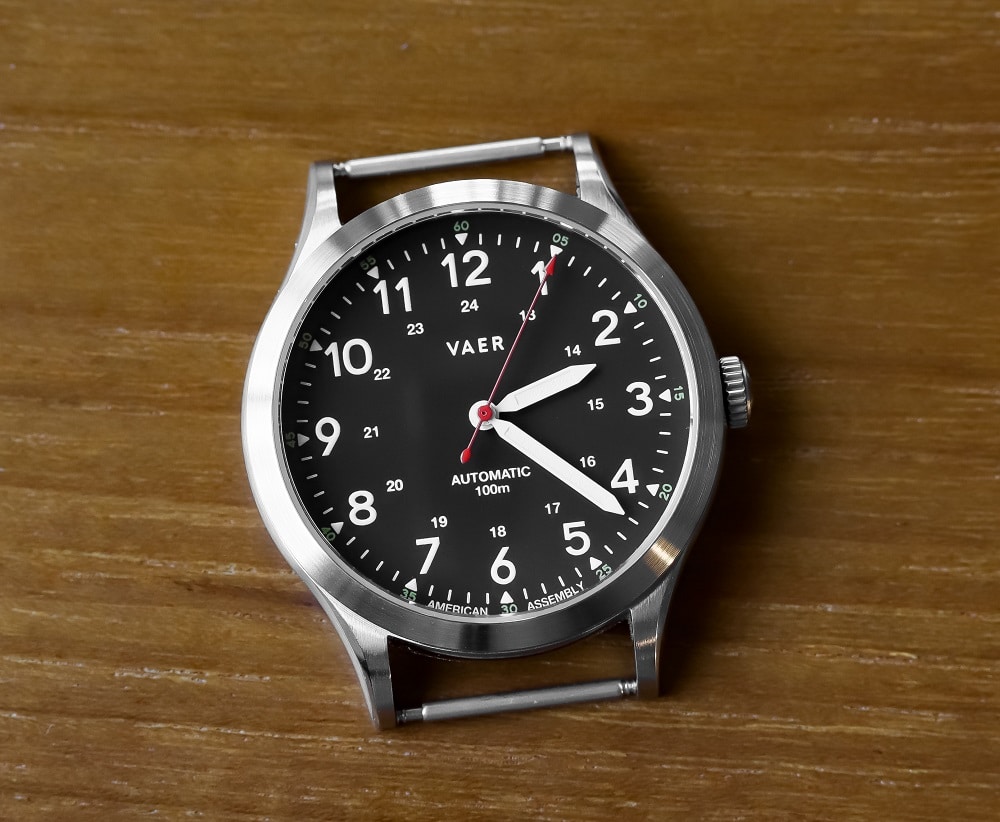
The Vaer Field Black Automatic feels like the kind of watch you’d buy after deciding you want the Explorer’s everyday practicality but not another obvious pick like the Hamilton Khaki. It doesn’t reinvent the field watch, nor does it try to mimic Rolex. Instead, it refines the little things that make an everyday/tool watch easier to live with. As covered in our hands-on review, those details became more noticeable the longer we wore it. The black dial stays clean and easy to read, while the yellow outer numerals and red second hand add the right amount of warmth to keep it from feeling clinical.
The case is equally well judged. Vaer pairs soft brushing with polished chamfers on the 316L stainless steel case, giving it a more finished look than many affordable field watches without making it feel dressy. What impressed us most, though, was something you rarely notice until you start swapping straps. By positioning the spring bars closer to the edge of the lugs, Vaer gives NATOs and single-pass leather straps enough room to sit naturally rather than adding extra thickness underneath the watch. That small decision makes a noticeable difference over the course of a full day of wear. Both included straps also felt broken-in earlier than expected, with the leather softening quickly and the NATO remaining comfortable from the start.
The Miyota 9015 proved to be exactly what we’d hoped for: dependable, straightforward, and accurate within normal real-world expectations during testing. Like many Miyota movements, it lets you hear the rotor spin now and then. Some collectors enjoy the reminder that there’s a mechanical movement at work, while others wish it stayed quieter. The sapphire crystal and anti-reflective coating also deserve credit for keeping the dial easy to read outdoors. Although the lume doesn’t explode with brightness immediately, it held on longer than several brighter-looking alternatives we’ve worn.
The only ergonomic complaint we had was the screw-down crown. It stays secure once locked down, but its smaller size makes setting the time a little fiddlier than it needs to be. Still, if you’re looking for a modern microbrand take on the Explorer’s “wear it anywhere” mindset, the Vaer Field Black Automatic quietly gets a lot of things right.
Pros
- The thoughtfully positioned spring bars allow NATOs and single-pass leather straps to sit comfortably.
- Miyota 9015 automatic movement delivers dependable real-world performance.
- The sapphire crystal with AR coating keeps the dial clear outdoors.
- Clean military-inspired dial remains quick and intuitive to read.
- The 316L stainless steel case combines soft brushing and polished chamfers for a refined everyday look.
Cons
- The smaller screw-down crown takes more patience when setting the time.
- Rotor noise from the Miyota 9015 may not suit collectors who prefer quieter automatics.
- Lume lacks an especially bright initial glow.
Baltic Hermétique Tourer
| Price: | $620 – $690 |
| Water Resistance: | 150m |
| Case Dimensions: | 37mm (diameter) x 46mm (lug-to-lug) x 10.8mm (thickness) |
| Lug Width: | 20mm |
| Movement: | Miyota 9039 Automatic |
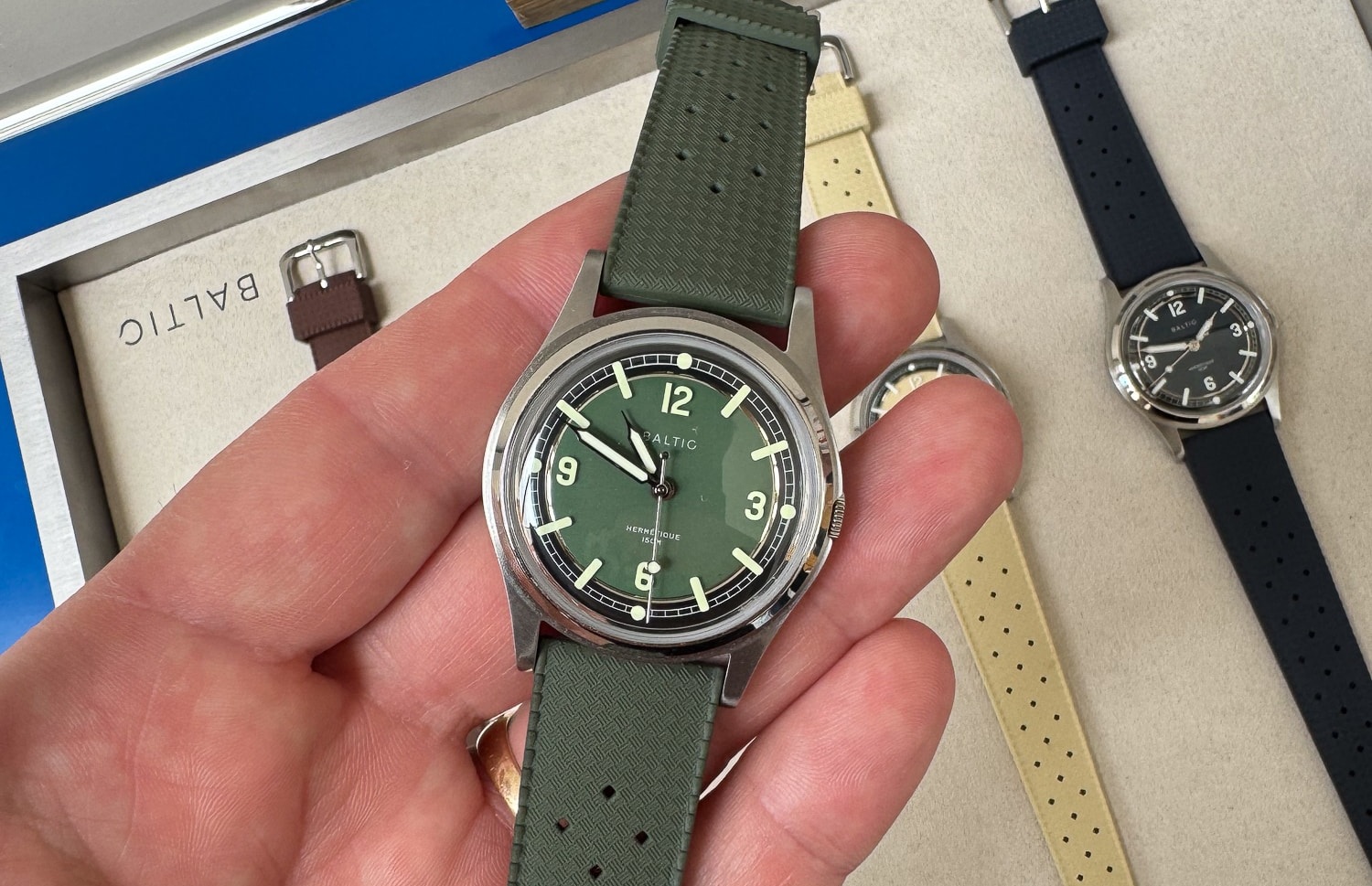
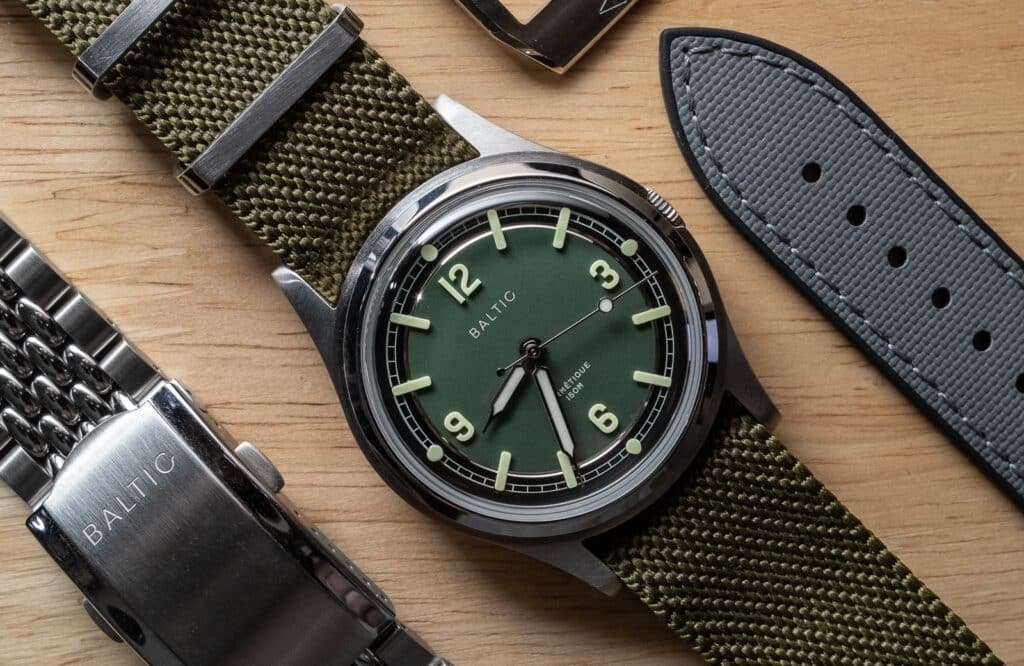
The Baltic Hermétique Tourer is one of the few watches under $1,000 that understands how much versatility can come from restraint. It doesn’t try to look like a Rolex Explorer, yet after spending hands-on time with it, we found ourselves reaching for it for many of the same reasons—a compact case, clean design, and the kind of practicality that rarely gets old. During our time with it, what stood out wasn’t one headline feature. It was how naturally the watch settled into daily wear. The 37mm case, 46mm lug-to-lug, and slim 10.8mm profile make it disappear on the wrist, yet it never feels undersized thanks to the broad dial opening and well-balanced proportions. Add 150 meters of water resistance, and it’s the kind of watch we never hesitate to wear beyond the office.
Baltic also gets the details right. The dial stays clean and instantly legible with large C3 X1 Super-LumiNova-filled indices and syringe hands that make quick time checks effortless. The lume holds a steady green glow well into the evening rather than fading away after an impressive first burst. Around the dial, the fully brushed case keeps the watch firmly in tool-watch territory. At the same time, the slim, polished bezel adds enough refinement to set it apart from more utilitarian field watches. Sitting above it all is a boxed, double-domed sapphire crystal that gives the watch a subtle vintage warmth. However, the light anti-reflective coating means reflections become noticeable from certain angles.
The Miyota 9039 is exactly the sort of movement this watch needs: dependable, unobtrusive, and happy to let the overall ownership experience do the talking. Baltic also makes it easy to tailor the watch to your preferences with beads-of-rice and flat-link bracelets, plus a tropic-style rubber strap, all fitted with quick-release spring bars. We found the bracelets comfortable enough for all-day wear, and the available micro-adjustment made finding the right fit simple, even if the clasps themselves felt a little more basic than the rest of the watch. Our only other complaint was the near-flush crown, which can make manual winding quite awkward.
However, if you’re after a compact everyday watch that captures the Explorer’s effortless versatility while adding a little more character of its own, the Hermétique Tourer is one of the strongest options in this price range.
Pros
- 150m water resistance gives the watch genuine everyday capability.
- Compact 37mm case with a 46mm lug-to-lug wears comfortably for extended periods.
- Large lume-filled indices and syringe hands keep the dial highly legible.
- C3 X1 Super-LumiNova maintains a steady glow in low-light conditions.
- Quick-release bracelets and rubber strap options make changing the look quick and easy.
Cons
- The near-flush crown makes manual winding less comfortable than usual.
- Bracelet clasps feel more basic than the rest of the watch.
- The minimal anti-reflective coating can cause distracting reflections on the crystal in certain lighting conditions.
Hamilton Khaki Field Mechanical 250
| Price: | $725 |
| Water Resistance: | 100m |
| Case Dimensions: | 36mm (diameter) x 46mm (lug-to-lug) x 10.2mm (thickness) |
| Lug Width: | 18mm |
| Movement: | H-50 hand-wound movement |
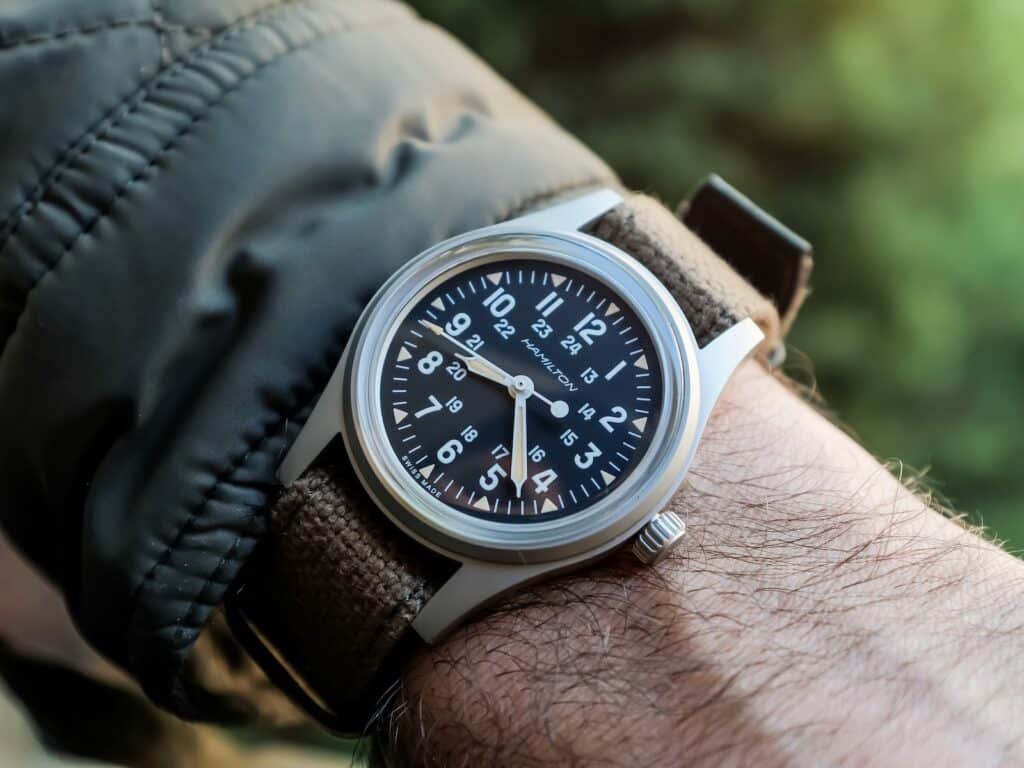
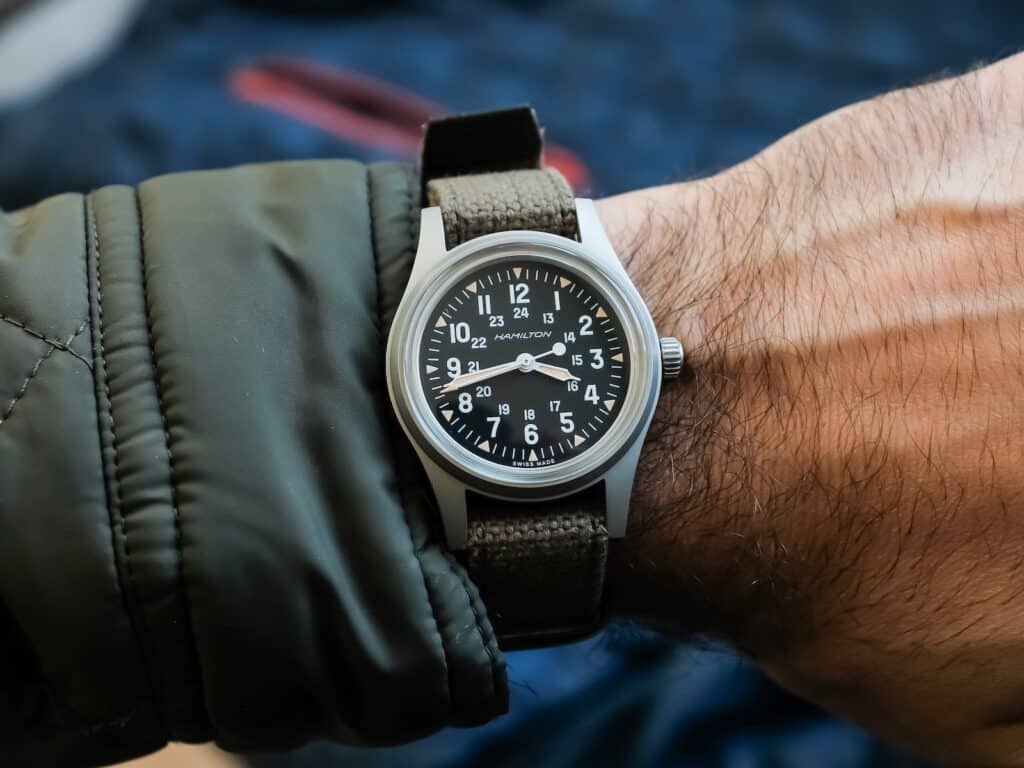
The Hamilton Khaki Field Mechanical 250 doesn’t resemble the Rolex Explorer, but it chases the same idea of an iconic, uncomplicated everyday mechanical watch. As we spent more time with it, we understood why this version stood out from the rest of the Khaki Field lineup. The 36mm case feels remarkably close to the proportions of earlier Explorer models, and paired with a 46mm lug-to-lug and just over 10mm thickness, it wears balanced rather than small. We had never fully connected with the 38mm Khaki Field Mechanical, but this version felt right almost immediately. Add 100 meters of water resistance, and it becomes the sort of watch you wear because it’s easy, not because you’re trying to match an outfit.
Hamilton also showed real restraint with the design. The matte black dial is packed with information, yet never feels busy. Large hour numerals, the inner military time track, and the white minute scale all remain easy to distinguish at a glance, whether you’re checking the time outdoors or from an awkward angle behind the wheel. The warm-toned Super-LumiNova softens the stark black-and-white palette without drifting into faux-vintage territory. At the same time, the old-school handset and typography make the whole package feel cohesive. We were equally happy Hamilton stuck with an acrylic crystal. It introduces a warmth and gentle distortion that sapphire can’t quite replicate, and glare is better controlled than on previous Khaki Field models. Yes, it will pick up scratches, but a little Polywatch is a small trade-off for the character it brings.
Living with the watch turned out to be just as enjoyable as looking at it. The H-50 hand-wound movement offers an 80-hour power reserve, hacking seconds, and a Nivachron balance spring, but what mattered most to us was how naturally it fit into daily use. Winding it each morning never became a chore thanks to the smooth crown action, and the long power reserve meant we could leave it off for a couple of days without having to reset everything.
The fixed strap bars might seem restrictive on paper, but they had the opposite effect during testing. We found ourselves experimenting with straps more than usual, and the watch looked equally at home on an olive drab single-pass strap or a grey NATO. If you’re after the Explorer’s no-fuss approach to everyday ownership rather than its styling, the Khaki Field Mechanical 250 gets close while carving out its own identity. We’ve covered the ownership quirks in our full review. Do check out.
Pros
- Compact 36mm case wears well and echoes the proportions of classic Explorer I models.
- H-50 movement combines an 80-hour power reserve, hacking seconds, and a Nivachron balance spring for easy ownership.
- Outstanding legibility thanks to the clean dial layout and well-balanced military time track.
- Acrylic crystal adds vintage warmth and character while reducing glare compared to earlier Khaki Field models.
- Fixed strap bars encourage experimentation with NATOs and single-pass straps.
Cons
- Fixed strap bars rule out conventional two-piece straps.
- Acrylic crystal scratches more easily than sapphire, even though it’s easy to polish.
- Manual winding won’t appeal to collectors who prefer the convenience of an automatic movement.
Mido Commander Datoday
| Price: | $1,270 |
| Water Resistance: | 50m |
| Case Dimensions: | 40mm (diameter) x 10.7mm (thickness) |
| Lug Width: | 21mm |
| Movement: | Mido Caliber 80 automatic |
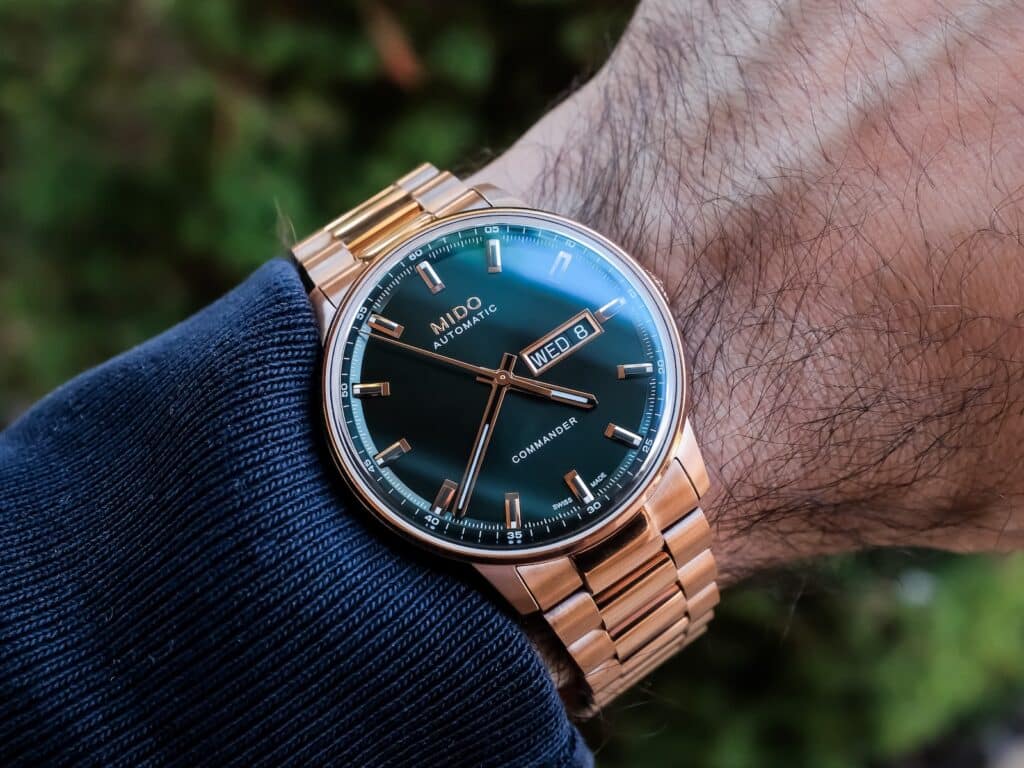
The Mido Commander Datoday sits just outside this list if you’re shopping retail, but it’s worth keeping an eye on. Stainless steel versions typically sell for a little over $1,000, while pre-owned examples regularly fall below that mark. More importantly, it shares something with the Explorer that isn’t easy to quantify. It’s an understated Swiss watch you can wear almost every day without feeling either underdressed or overdressed, although it arrives there with a stronger vintage influence. Throughout our extended time with it, the watch felt equally at home with a button-down and jeans as it did in more formal settings, which is the kind of flexibility we look for in an Explorer alternative.
The dial does more than first impressions suggest. Depending on the light, the green surface shifts between cooler blue-green tones and a deeper forest hue, while the stepped outer track, framed day-date display, and rose-gold-tone applied markers keep everything orderly without making the watch feel busy. The baton hands stay easy to follow beneath the sapphire crystal, and the 40mm case wears slimmer than the measurements imply thanks to its 10.7mm thickness. We also liked how naturally the case flowed into the integrated three-link bracelet. It feels like a single, cohesive design rather than a watch with a bracelet added as an afterthought.
The Caliber 80 is one of the strongest reasons to consider the Commander Datoday. Its 80-hour power reserve means you can leave the watch off for a weekend without coming back to a stopped movement and two calendars to reset. The addition of a Nivachron balance spring also brings better resistance to magnetism and shocks than many watches in this class, while the display caseback gives newer collectors something mechanical to appreciate. The bracelet mixes brushed and polished rose-gold-tone PVD surfaces, includes quick-release spring bars for easy strap swaps, and closes with a tidy butterfly clasp.
The trade-offs are fairly straightforward. We’d have preferred a larger crown, screw links, and a little more taper toward the clasp, though the 21mm lug width limits strap replacement. The push-pull crown and 50m water resistance also remind you that this is built for casual everyday life, not rough treatment. Still, if you’re open to shopping pre-owned, the Commander Datoday remains a compelling sub-$1,000 Swiss alternative for anyone who values the Explorer’s understated, everyday character but wants something with a little more vintage personality.
Pros
- Nivachron balance spring improves resistance to magnetic fields and everyday shocks.
- Caliber 80 delivers an 80-hour power reserve, making day-date ownership far more convenient.
- Slim 10.7mm case wears comfortably under a cuff despite its 40mm diameter.
- Quick-release spring bars make changing straps fast and hassle-free.
- The framed day-date display is practical and integrates naturally into the dial.
- Rose-gold-tone PVD case and bracelet give the watch a distinctive vintage-inspired character without feeling excessive.
Cons
- The crown could be larger for easier winding and time setting.
- The 21mm lug width limits aftermarket strap choices.
- Push-pull crown and 50m water resistance make it less suited to demanding environments.
If one of these watches has made you forget about chasing the Rolex Explorer for a while, we’d say it has done what it was supposed to do. If you’ve spent time with any of these models, let us know which one earned permanent wrist time after the honeymoon phase. And if there’s another sub-$1,000 Explorer alternative we should put through its paces, share it in the comments.

Co-Founder and Senior Editor
Kaz has been collecting watches since 2015, but he’s been fascinated by product design, the Collector’s psychology, and brand marketing his whole life. While sharing the same strong fondness for all things horologically-affordable as Mike (his TBWS partner in crime), Kaz’s collection niche is also focused on vintage Soviet watches as well as watches that feature a unique, but well-designed quirk or visual hook.
Having both, my choice from Seiko for an Explorer alternative would be the “Baby Alpinist” over the SRPE51.
37mm, screw down crown with 200 meters of water resistance and a sapphire crystal to boot. Decent bracelet but also works with any strap for nice versatility.
Albert:
The Baby Alpinist is an excellent Explorer alternative! The main reason it wasn’t included in this list is because we’ve never actually reviewed one hands-on. We strive to only include pieces in these lists that we’ve reviewed in person. But we were just discussing how we need more Seiko reviews on the site so I’ll be sure to get the Baby Alpinist on the list for us to check out as well.
Thank you so much,
-Kaz
What about the Traska Sumiteer and the Nodus Sector Sport? I realize both of these are definitely on the Homage Spectrum. However, they are both under US$1000, have plenty of their own character and unique design cues to be considered, IMO. I would also bring up the VAER Atlas in the same vein.
Hi, Eric:
These are actually both really great suggestions actually! It’s also been a while since we’ve reviewed a Traska, so I think it’s definitely in the cards for us to try and get both of these microbrand pieces in for review. Thank you for reading our piece and sharing these suggestions.
Best,
-Kaz