Legibility is one of those things we don’t obsess over until a watch makes us squint. Then it gets annoying fast. We’ve worn enough watches that looked great in photos but turned irritating on the wrist to know that a clean read isn’t just some boring technical checkbox. It is the difference between using a watch and admiring it from a safe distance. This list of the best watches with excellent legibility exists because certain watches kept making life easier in small, unglamorous ways. For example, glances while heading out the door, reading the time at night without doing wrist yoga, or grabbing something cheap and useful instead of pretending every day needs a serious collector moment.
After years of reviewing watches, the patterns get hard to ignore. Some field watches earn repeat wrist time because they disappear into the day. Some digital Casios make far pricier watches feel fussy. Some pilot watches prove that “big and clear” still needs restraint to work. The goal here is to sort through affordable watches, military-inspired pieces, pilot watches, and everyday watches we’ve already reviewed to figure out which ones stay readable when you’re not posing for a wrist shot. Some are cheap, some are not, and they have flaws we’ll happily complain about. That’s usually how you know they’ve had real wrist time.
Casio F-91W
| Price: | $15 – $20 |
| Water Resistance: | 30m |
| Case Dimensions: | 34mm (diameter) x 38mm (lug-to-lug) x 8.5mm (thickness) |
| Lug Width: | 18mm |
| Movement: | Casio Quartz Module 593 |
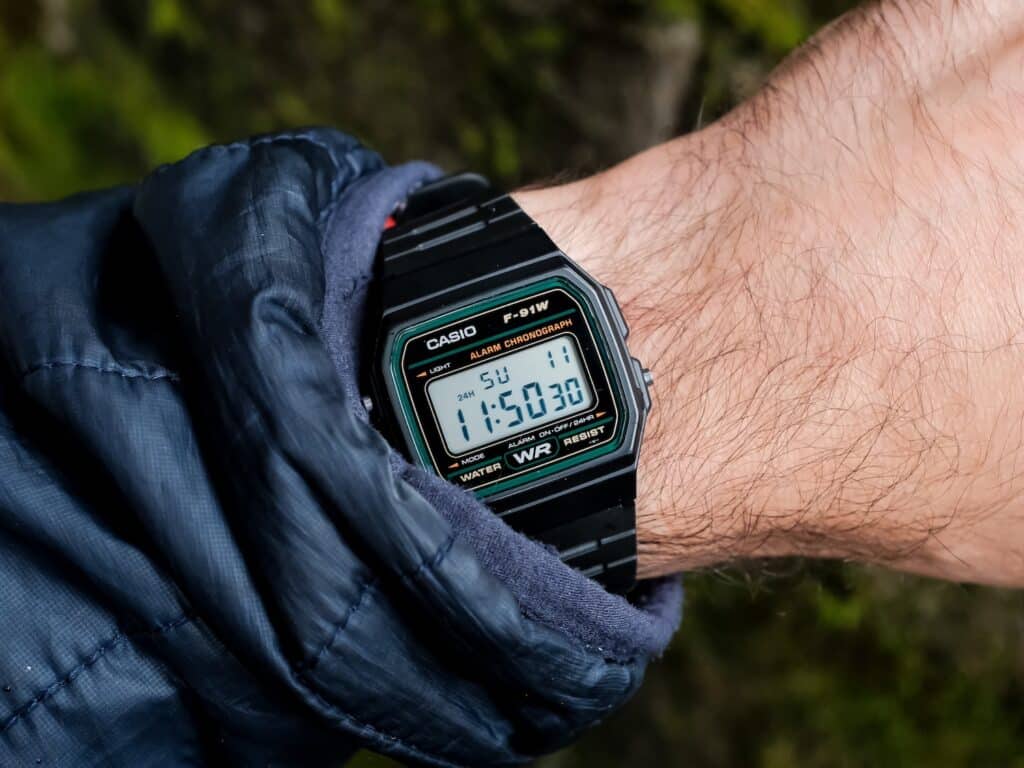
The Casio F-91W belongs here because it does the one thing this list cares about with almost no drama: it lets you read the time instantly. The compact digital display is clean, efficient, and familiar in the best way. Casio fits the calendar, alarm, 12/24-hour time, and chronograph onto a small screen without making it feel like a calculator exploded. That matters more than it sounds, because a legible watch is not only about big numerals or oversized hands. It is about whether your eye knows where to go the second you look down.
The green LED backlight is the obvious trade-off. It has that old-school side-flash quality rather than a full-screen glow, so it won’t embarrass a modern G-Shock in the dark. Still, it gives you enough light for a quick nighttime check, which fits the whole personality of the F-91W: basic, useful, and not pretending to be more advanced than it is. The module is also easy to operate, which supports its legibility more broadly. Reading the time is easy, and so is navigating the alarm, calendar, and stopwatch without having to relearn the button layout every time you wear it.
On the wrist, the F-91W is barely there. The resin case and strap keep the weight down to the point where it almost disappears, making it an easy pick for workouts, travel days, yard work, errands, or any day when you don’t want the watch demanding attention. The stainless steel caseback is simple, held down with four screws, and covered in basic engravings. Nothing about it feels fancy, but that honesty works in its favor. The subtle corner bumpers add a little more presence than the dimensions suggest while also making the buttons easier to locate and press when you’re using the stopwatch or alarm on the move.
The downsides are exactly the ones you would expect from a watch this simple and cheap. The integrated strap limits easy strap swapping; the water resistance is fine for daily splashes but not as strong for heavier water use; and the LED light is weaker than modern full-backlit displays. But the quartz module stayed around ±30 seconds per month while reviewing it, the CR2016 battery can run for years, and the whole thing is affordable enough to replace without ceremony. As a legibility-first watch, the F-91W makes a strong argument by refusing to overcomplicate anything. It is clear, light, durable, and useful in the exact way a daily digital watch should be.
Pros
- Instantly readable digital display with a clean, uncluttered layout.
- Simple module navigation for alarm, calendar, 12/24-hour time, and chronograph.
- Very lightweight and comfortable enough to forget it’s on your wrist.
- Long battery life from the CR2016 cell.
- Reliable quartz accuracy, tested around ±30 seconds per month.
- Cheap, durable, and easy to replace without emotional damage.
Cons
- Weak side-mounted LED light compared to modern full-screen backlights.
- Integrated resin strap limits easy strap swaps.
Rdunae RA02 Field Watch

| Price: | $45 |
| Water Resistance: | 50m |
| Case Dimensions: | 34.5mm (diameter) x 41.3mm (lug-to-lug) x 11mm (thickness) |
| Lug Width: | 19mm |
| Movement: | Miyota 2035 Quartz |
The Rdunae RA02 works because it refuses to decorate the idea of legibility. The matte black dial is sterile, high-contrast, and free of the extra text that often appears when a watch tries to sound more serious than it is: no brand name, no water-resistance line, no awkward little paragraph at six o’clock. You get crisp white numerals, a railroad-minute track, and pencil-style hands sized well enough to keep the layout open. The fully lumed triangle at 12, the small “T” marking, and the broad arrow at 6 give it the military-field flavor without tipping into costume territory.
On the wrist, the small case changes how the RA02 reads and wears. At a little under 35mm with a short lug-to-lug, it feels closer to an older issued-style field watch than a modern “heritage-inspired” piece that quietly ate too much protein powder. That size may feel underwhelming if you want wrist presence, but the upside is obvious in daily use. At roughly 35 grams on a strap, it almost disappears during commuting, desk work, errands, and casual weekend wear. For a watch built around quick readability, that low weight matters because nothing about it distracts from the simple job of checking the time.
The case finish supports that practical mood well. The sandblasted stainless steel keeps glare down and fits the utilitarian personality, while the domed K1 mineral crystal adds some warmth and edge distortion without pretending to be sapphire or luxury-grade material. The dome is more pronounced than some vintage references, which gives the watch a little character when the light catches it. The push-pull crown is easy to operate, though the polished finish feels slightly mismatched against the muted case. Around the back, the screw-down caseback is heavily engraved and includes the battery reference, a small ownership detail we always appreciate because nobody enjoys playing “guess the cell” later.
As we pointed out in our full write-up, the Miyota 2035 quartz movement suits the RA02 better than a fussy mechanical option would. It keeps ownership simple, accurate, and low-maintenance, which fits the watch’s whole point. The lume glows cleanly and remains useful when the lights drop, but it is not strong enough to serve as a low-light specialist. The stock nylon strap works, though we found it forgettable, and slimmer aftermarket straps made the watch feel better balanced. The annoying bit is the 19mm lug width, although an 18mm strap looked fine enough in practice. As a budget-friendly legibility pick, the RA02 gives you a clear, practical dial, lightness, and field-watch honesty without asking you to care about prestige.
Pros
- Sterile matte dial keeps the focus on quick, easy time reading.
- Domed K1 mineral crystal adds warmth and vintage-style edge distortion.
- Compact sub-35mm case wears comfortably and stays out of the way.
- Roughly 35 grams on a strap, so it feels almost weightless in daily use.
- Miyota 2035 quartz movement keeps ownership simple, accurate, and low-maintenance.
Cons
- The small case may feel too restrained for anyone used to modern field-watch sizing.
- The 19mm lug width makes strap searching more complex than it needs to be.
- Polished push-pull crown looks a bit out of place against the sandblasted case.
Casio Wave Ceptor WV-59DJ-1AJF
| Price: | $55 – $60 |
| Water Resistance: | 50m |
| Case Dimensions: | 39mm (diameter) x 48mm (lug-to-lug) x 12.75mm (thickness) |
| Lug Width: | 20mm, tapers down to 18mm at the clasp |
| Movement: | Quartz Module 3054 |
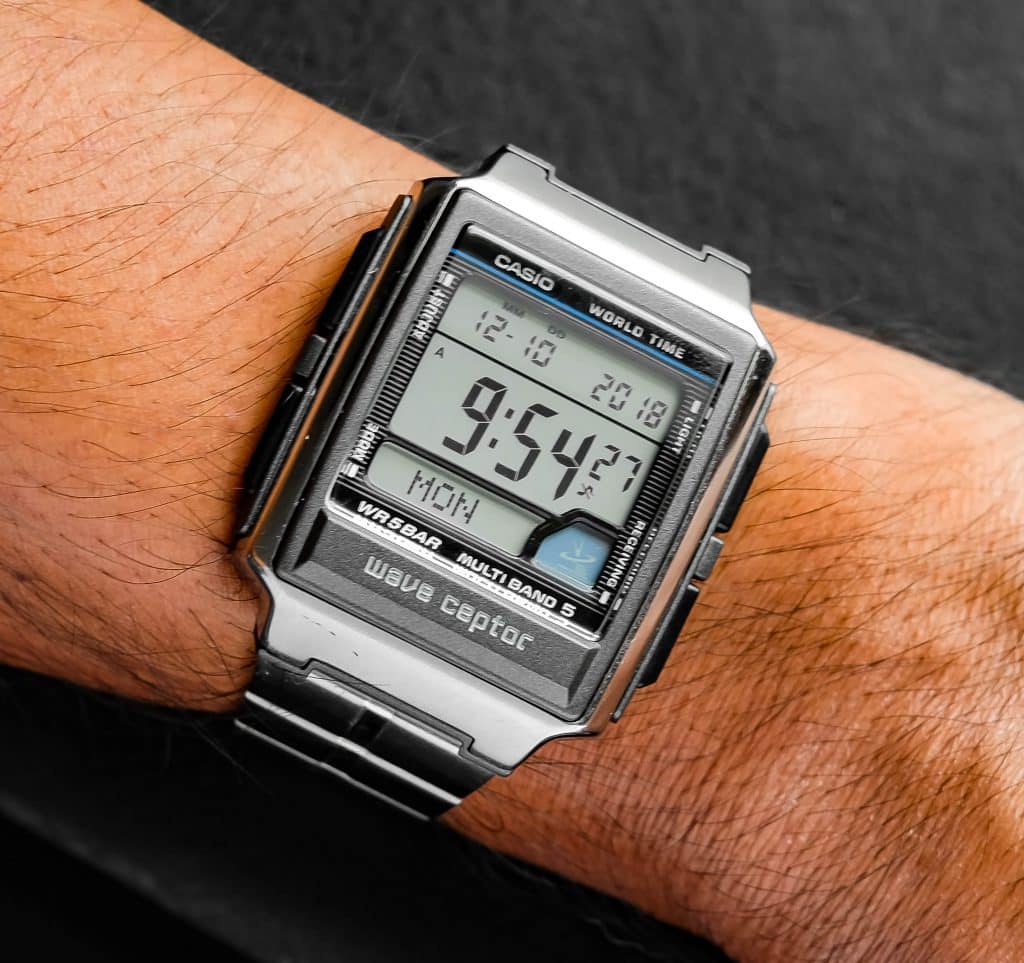
The Casio Wave Ceptor is useful in a very specific way: it gives you a lot of information without making the main time readout fight for attention. The digital layout keeps the time front and center, with the day, date, and signal indicator arranged around it in a way that feels logical after a short bit of use. That last detail matters for this list because legibility is not only about seeing the numbers. It’s also about trusting what you’re seeing. With radio-controlled accuracy in the mix, the Wave Ceptor becomes the watch you glance at without wondering whether it needs a reset.
The LCD is clear when viewed straight on and works well in most normal lighting, though it does lose contrast at sharper angles. That was one of the more noticeable trade-offs during daily wear. It’s readable, but it rewards a direct glance more than an awkward one from the side. The module itself has a more extensive feature set than the simple exterior suggests, so the first few minutes can feel like Casio has handed you homework. Once the core functions start to click, though, the watch settles into a practical rather than fussy mode. The buttons help here. They’re placed well, easy to find by feel, and simple to press while moving around.
The case also wears better than the shape suggests. On paper, the rectangular proportions look a little unusual, especially with the longer lug-to-lug and narrower profile. On a sub-7-inch wrist, though, it settled in quickly and felt more balanced than expected. The watch has enough presence to avoid feeling tiny, but it doesn’t spill over into that awkward oversized digital-watch territory. It’s also very light, which can feel strange if you’re used to heavier steel sports watches. After a while, that lack of weight becomes part of the appeal because the watch stops announcing itself and does its job.
The bracelet is where expectations need to stay grounded. Its folded metal construction feels light and a bit hollow, and anyone expecting the density of a solid steel sports bracelet will probably be disappointed. But after extended wear, that same lightness made the watch feel more relaxed and easygoing. The bracelet suits the case visually, sits naturally, and feels like part of the design rather than an afterthought. Sizing it takes patience the first time, and the integrated setup limits customization, but this is one of those watches where the stock configuration makes sense. It is not trying to feel premium. It is trying to be readable, accurate, light, and useful, and that’s where it lands.
Pros
- Clear digital layout keeps the main time display easy to read at a glance.
- Atomic timekeeping adds real trust to the quick-read experience.
- Buttons are easy to locate and press during regular use.
- The case wears comfortably despite its unusual proportions.
Cons
- LCD contrast drops when viewed from sharper angles.
- Plastic elements and the folded bracelet can feel a bit too basic.
- The integrated bracelet limits customization and requires some patience to size.
Casio G-Shock GW6900-1
| Price: | $140 |
| Water Resistance: | 200m |
| Case Dimensions: | 53.2mm (diameter) x 50mm (lug-to-lug) x 17.7mm (thickness) |
| Lug Width: | 16mm |
| Movement: | Solar Quartz Module 3179 |
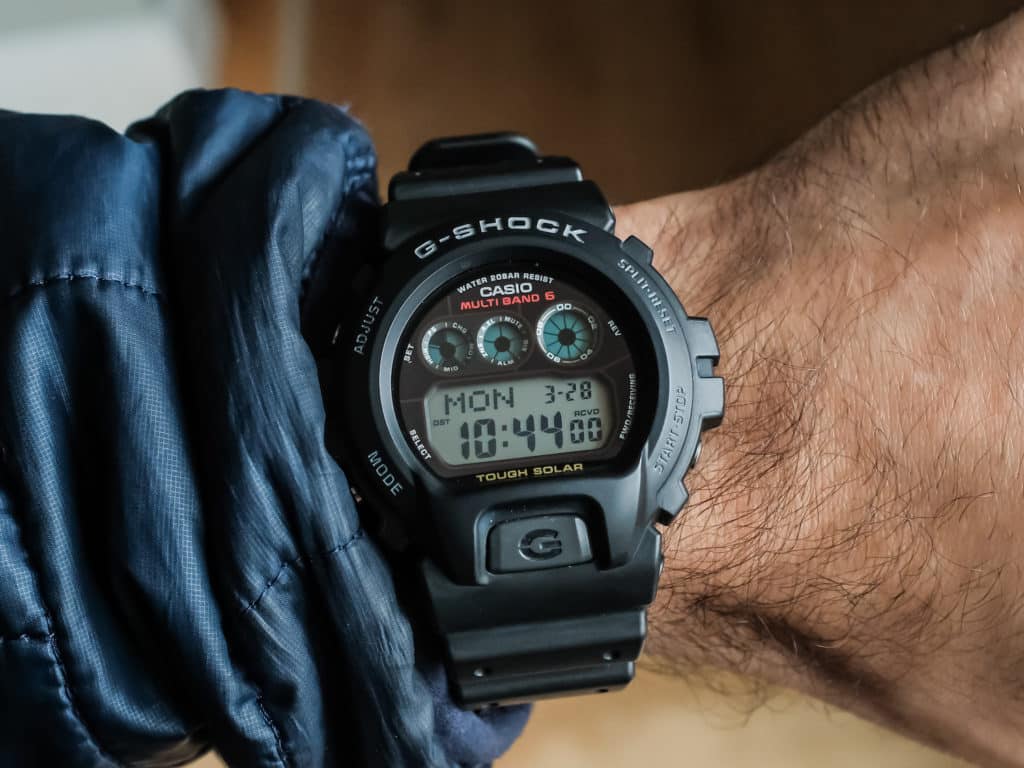
The GW6900 gets legibility right in the very G-Shock way of being slightly overbuilt, slightly chaotic, and still easy to trust once your brain learns the layout. The main time readout is large enough to check quickly, and the front-facing light button is exactly where you want it when you’re half-awake or outside at night. That bright green EL backlight evenly lights the whole display, making the watch far more usable after dark than small side-lit digital watches. It is an older-school illumination setup compared to newer LEDs, but in real use, it does the job without asking you to angle your wrist like you’re decoding a secret message.
The display does take a little time. That triple-eye layout can feel like a tiny dashboard for the first couple of days, with indicators for stopwatch activity, radio syncing, and other functions sitting above the main screen. Once that initial clutter fades into familiarity, the layout becomes practical instead of busy. The time and date stay easy to read, and the small dual-time display tucked into the corner becomes more useful than expected. The stopwatch measures down to 1/100 of a second, and, along with the countdown timer and five alarms, it handles daily timing tasks that most analog watches can’t handle without making a production out of it.
The low-maintenance side also helps the GW6900 feel readable in a broader sense: you’re not second-guessing it. Tough Solar keeps the battery topped up with normal light exposure, while Multi-Band 6 lets it sync to atomic time signals overnight across regions such as the U.S., the UK, Japan, Germany, and China. In our hands-on experience, it corrected itself most nights without any fuss, and even after sitting unused for weeks, it was ready when we picked it up again. For a practical digital watch, that matters. A clear display is good; a clear display showing the right time without your involvement is better.
On the wrist, the size is the obvious trade-off. A case a little over 50mm wide and nearly 18mm thick sounds like a lot because it is a lot, and smaller wrists will notice it immediately. But the resin construction and steel caseback keep it from feeling like a dense brick. It wears more like a protective shell than a heavy lump, which makes it easier to live with during yard work, rushed mornings, rain, knocks, water exposure, and whatever else the day decides to throw at you. The stock resin strap starts stiff and a bit squeaky, but it breaks in quickly, dries quickly, and stays comfortable during long wear. It may catch a doorframe now and then, but the watch usually looks less bothered than the doorframe.
Pros
- The large digital time readout is easy to check once the layout becomes familiar.
- The bright green EL backlight illuminates the full display clearly at night.
- Solar charging keeps upkeep to a minimum.
- Atomic radio syncing keeps accuracy dialed in with very little effort.
- Stopwatch, countdown timer, five alarms, and dual time add real everyday utility.
- Lightweight resin build makes the large case easier to wear than the measurements suggest.
Cons
- The triple-eye display takes a little time to feel intuitive.
- It still wears large, especially on smaller wrists.
Timex Expedition Field Post Solar
| Price: | $199 |
| Water Resistance: | 100m |
| Case Dimensions: | 36mm (diameter) x 44mm (lug-to-lug) x 12mm (thickness) |
| Lug Width: | 18mm |
| Movement: | Solar Quartz |
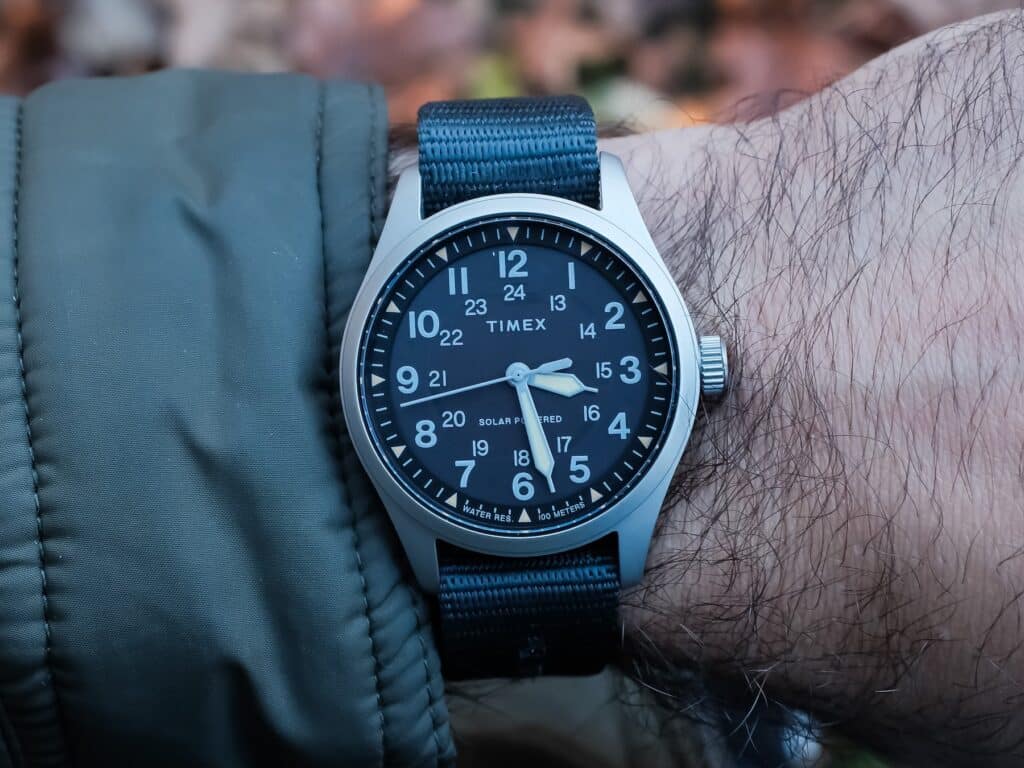
The Timex Expedition Field Post Solar starts with the oldest field-watch trick in the book: make the dial easy to understand before trying to make it interesting. The full numerals, straightforward hands, and open layout keep the time readable at a glance, which is why this one works for the current list. It doesn’t bury the basic task under faux-vintage clutter or unnecessary text. The slightly domed sapphire crystal adds a little warmth and edge distortion so the dial doesn’t feel too sterile, while the anti-reflective coating does more outdoors than we expected. During our time with the watch, quick checks remained easy in bright conditions rather than becoming a glare-management exercise.
The lume is where the legibility story gets more honest. Even after a full charge, the hands glow briefly, the dial barely wakes up, and the whole thing fades sooner than we’d like. So, while the Timex is strong in daylight and normal indoor use, it is not the watch we’d pick first for sustained low-light readability. That trade-off matters because this watch is otherwise built around convenience. The solar quartz movement helps it settle into regular wear without much thought, and once charged, Timex claims around four months of power reserve. Across our in-depth review, accuracy stayed steady enough that we barely had to touch the crown, which is what we want from a no-fuss field watch.
The 36mm stainless steel case does a lot of quiet work on the wrist. It wears low, centered, and balanced, and through commuting, errands, and a stretch of lousy weather, it didn’t demand those annoying mid-day wrist resets that heavier or taller watches can require. The bead-blasted finish also suits the purpose. It gives the case an already-worn-in practicality, so the first scratch doesn’t feel like you’ve ruined some precious object. The screw-down crown fits that same dependable mood, though the action is more functional than smooth. It works, but nobody is going to confuse it for a refined crown experience.
The stock leather strap is softer and more considered than the usual throwaway strap, but it still feels too thick for the compact case. On a MIL-style strap, the watch feels better balanced and more aligned with its plainspoken field-watch personality. That’s the version that makes the most sense to us: a clear dial, solar convenience, a compact case, and enough durability for everyday life without making the watch feel like an event every time you put it on. The Expedition Field Post Solar is not perfect, mostly because the lume lets the side down, but as a readable everyday field watch, it gets the important parts right.
Pros
- The full-numeral field dial is clean, simple, and easy to read at a glance.
- The domed sapphire crystal and AR coating improve usability more than expected at the price.
- Solar quartz movement keeps ownership low-maintenance with minimal adjustment.
- Bead-blasted case finish gives it a practical, already-worn-in feel.
- 36mm case wears low, centered, and comfortable through long days.
Cons
- Lume fades quickly, and the dial barely lights up even after a full charge.
- The screw-down crown action is not very smooth.
- The stock leather strap is too thick for the compact case.
Casio G-Shock Mudmaster GG-1000-1A5
| Price: | $350 – $500 |
| Water Resistance: | 200m |
| Case Dimensions: | 56.2mm (diameter) x 55.3mm (lug-to-lug) x 17.3mm (thickness) |
| Lug Width: | 24mm |
| Movement: | Quartz Module 5476 |
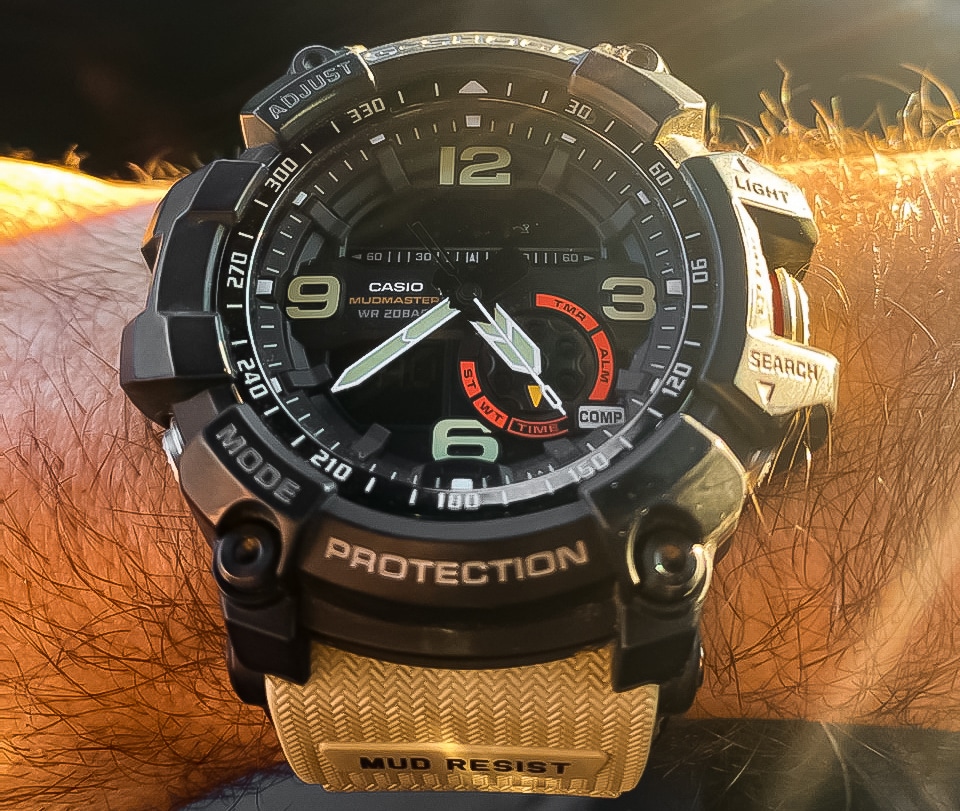
The Mudmaster is the messy-desk version of legibility. It is not clean in the minimalist field-watch sense, and nobody is going to call the dial restrained with a straight face. But the large-format hands, oversized case architecture, and blunt tool-watch layout still make it easy to grab the time when you are outside, moving around, or dealing with a day that involves mud, grit, rain, knocks, or job-site nonsense. It feels more like a piece of equipment than a watch designed to be admired, which is why the busier presentation works better here than it would on something pretending to be elegant.
The analog-digital layout comes with real trade-offs. The hands are strong and readable, which helps the Mudmaster stay useful at a glance, but the negative LCD is less convincing. In bright outdoor light, we found it harder to read than we wanted, and that matters for a watch built around outdoor practicality. The LED backlight gets the job done in the dark, but only in the most functional sense. It gives enough illumination to read the time, not enough to make the whole display feel crisp or modern. So the Mudmaster’s legibility is strongest with its large analog display and weaker with its digital readouts, especially in low-light conditions.
The case is where the watch’s personality comes through loudest. At 56.2mm across and 17.3mm thick, it is a serious lump of resin, and wrists under about 7 inches will notice that immediately. Still, it wears better than the specs suggest because the resin strap helps the case sit better during active use rather than just sitting there like a hockey puck. The oversized bezel adds to the tank-like look, but it also provides real protection for the case. Add Casio’s shock resistance and Mud Resist construction, with internal gaskets and a case design meant to keep out sand, dirt, and debris, and you get a watch that feels prepared for abuse before it worries about refinement.
The outdoor feature sets up the look. The compass and thermometer were useful across different conditions in our time with the watch, though neither came across as lab-grade precise. For general direction checks and rough environmental readings, they made sense. You also get the familiar G-Shock spread of stopwatch, five alarms with snooze, and world time across 31 zones. The version we reviewed skips Tough Solar, so battery changes are still part of ownership every couple of years, even though ours ran without issue during the review period. That is the bargain with this Mudmaster: it is big, busy, and not always perfect to read, but if you want a rugged watch with strong hands and enough outdoor utility to justify the bulk, it has a very clear reason to exist.
Pros
- Large hands give the watch strong at-a-glance readability despite the busy layout.
- Compass, thermometer, world time, alarms, and stopwatch add useful outdoor functionality.
- The Mud Resist construction helps keep dirt, sand, and debris out.
- Oversized bezel and shock-resistant build make it feel ready for serious abuse.
- The resin strap helps the large case wear better than the dimensions suggest.
Cons
- The size is a real commitment, especially on smaller wrists.
- Backlight works, but it is weaker than we’d like in dark conditions.
- The reviewed version does not have Tough Solar, so battery swaps remain part of ownership.
Vaer C4 Tactical Field Solar
| Price: | $479 |
| Water Resistance: | 200m |
| Case Dimensions: | 41.5mm (diameter) x 48mm (lug-to-lug) x 12.8mm (thickness) |
| Lug Width: | 20mm |
| Movement: | Epson VS-42 solar |
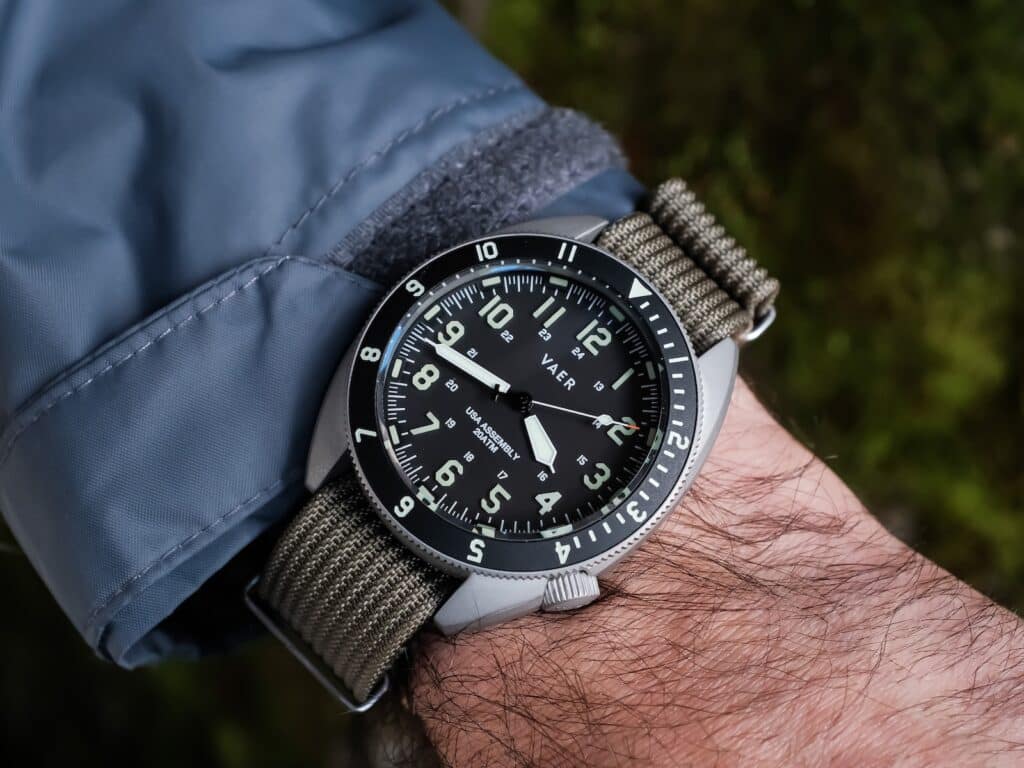
The Vaer C4 Tactical Field Solar reads like a field watch that learned a few useful tricks from dive watches without losing the plot. The dial stays easy to process: matte black surface, oversized Arabic numerals, large syringe hands, and a smaller 24-hour track that adds information without crowding the main read. The raised lume blocks give the hour markers more presence than flat printing would, and the rectangular minute markers get the same treatment, so the depth isn’t just there to look fancy. In use, that makes the dial feel more dimensional and easier to lock onto quickly, especially when the light starts to drop.
Low-light legibility is where the C4 makes a stronger case than many simple field watches. The lume charged quickly, glowed hard, and stayed readable several hours into the night once we had it on our wrist for a while, which matters if you want a watch that works past daylight without leaning on a backlight or a hopeful squint. The beveled sapphire crystal adds a little polish without softening the watch, while the solar Epson VS-42 movement fits the whole low-maintenance angle. Around six hours of light can give it up to six months of charge, so it is the kind of watch that can sit in rotation without demanding much attention when you pick it back up.
The case is bigger than classic field-watch proportions at 41.5mm, but it wears better than the number suggests. At 12.8mm thick, including the bezel, it sat flatter than expected, and the compact lug-to-lug kept it from overhanging a 6.75-inch wrist. The mid-case does a lot of quiet work by keeping the watch from feeling like a block. In bead-blasted stainless steel, the finish has the dry, purposeful look that suits the design, while the full DLC version leans harder into the tactical side. The 4 o’clock screw-down crown was easy to unscrew, simple to set, and clean when threading back down, without the gritty action that can make cheaper tool watches feel suspect. Add 200 meters of water resistance and a screw-down caseback, and the C4 becomes more than a basic field watch with a serious face.
The 120-click unidirectional bezel adds another layer of practical readability. The coin-edge grip stayed easy to use even with damp fingers, and the DLC-treated steel insert feels tougher than a standard aluminum insert. It is marked to 20 minutes, but Vaer also frames it as a 12-hour bezel, so it works for short timing jobs or casual second-time-zone tracking. Strap choice changes the feel quite a bit. The black waffle-textured FKM felt substantial without becoming stiff, and it suited the case better than a standard tropic-style strap. The olive single-pass nylon worked, too, though the FKM was the one we kept reaching for. On an admiralty grey CWC strap, the watch leans fully into its military mood. The main nitpick is second-hand alignment, which missed some markers and will bother anyone who spots that stuff immediately.
Pros
- Matte-black dial, oversized numerals, and large syringe hands make the time easy to read quickly.
- Three-dimensional lume markers and strong lume performance keep it useful after dark.
- Black waffle-textured FKM strap feels substantial without being stiff.
- Solar quartz movement makes it convenient, low-maintenance, and easy to keep in rotation.
- 41.5mm case wears flatter and more balanced than the dimensions suggest.
Cons
- The 41.5mm case may still feel large for someone who prefers compact military proportions.
- The second-hand alignment is not perfect across every marker.
RZE Resolute Type A
| Price: | $499 (TecTuff strap); $699 (matching titanium HexLink bracelet) |
| Water Resistance: | 100m |
| Case Dimensions: | 39.5mm (diameter) x 46mm (lug-to-lug) x 11.5mm (thickness) |
| Lug Width: | 20mm |
| Movement: | Miyota 82S0 |
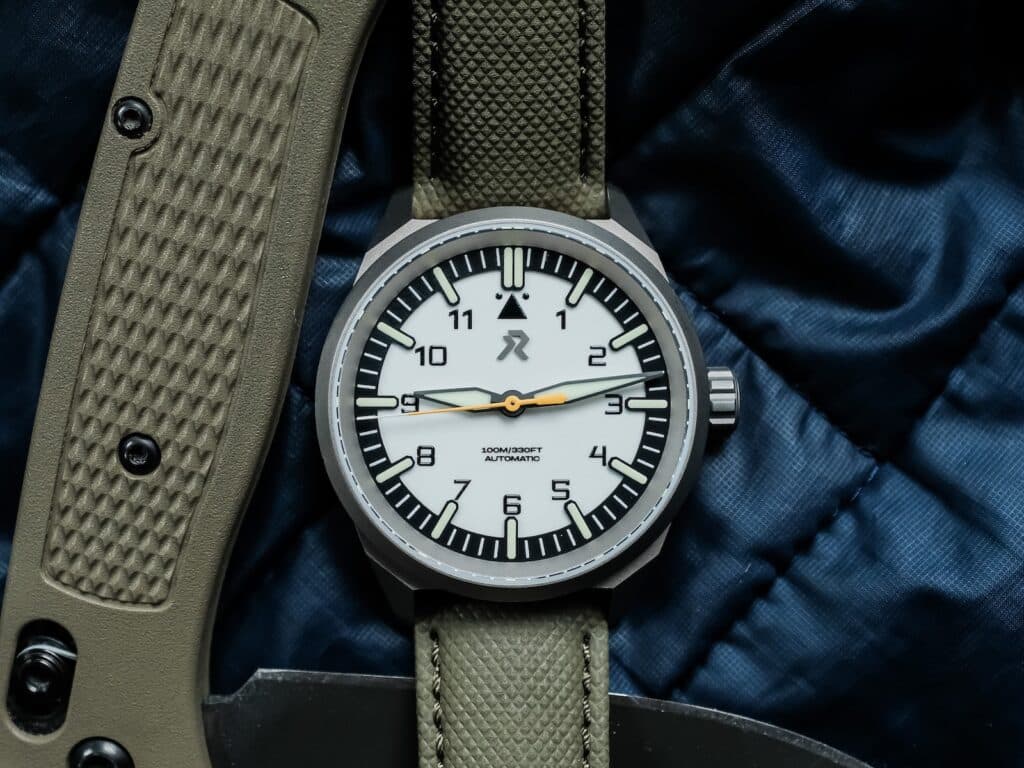
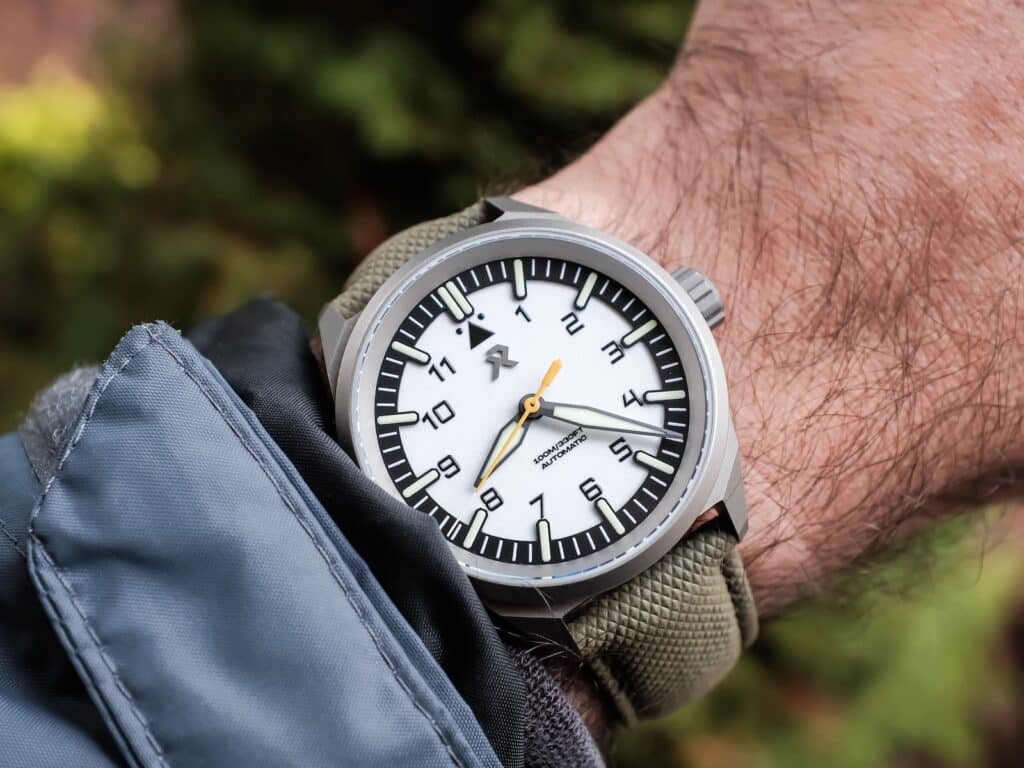
The RZE Resolute Type A achieves legibility through the classic pilot-style watch route: a strong orientation, clear scales, strong contrast, and very little visual nonsense. The triangle at 12 gives your eye an immediate anchor, while the vintage-style sword hands, inner 12-hour scale, bold outer minute track, and clean baton markers keep the layout quick to read without feeling stripped bare. It carries obvious Type A flieger cues, but RZE avoids the costume-party version of the format. No forced patina, no decorative clutter, no attempt to make the dial look like it spent World War II in a drawer. It feels modern, direct, and built for someone who wants clarity without the historical cosplay.
The case is a big part of why the Resolute Type A works as an everyday legibility watch rather than a pilot-style desk toy. At 39.5mm wide, 46mm lug-to-lug, and 11.5mm thick, it has enough presence for the dial to breathe, but it doesn’t turn into one of those oversized pilot watches that start annoying you by dinner. The Grade 2 titanium case keeps the whole thing light, and RZE’s UltraHex hardening treatment, rated around 1200 Hv, adds useful scratch resistance. The number sounds technical, but the real point is simpler: we didn’t feel like we had to baby it. Add the screw-down crown, proper gasket setup, and 100 meters of water resistance, and the watch becomes much easier to treat like a daily piece.
The dial has more structure than a flat spec-sheet description would suggest. The raised chapter ring and applied markers add depth, which keeps the layout from feeling sterile while still supporting quick reading. The white dial version stood out most to us because the sapphire crystal and two-tone full-lume execution give it a compact instrument-panel feel in low light. It is a modern take, and purists may find that too far from the traditional German pilot-watch mood, but for actual use, the added low-light personality helps. It makes the watch easier to enjoy after dark without turning the whole thing into a gimmick.
The strap and movement both maintain the practical theme. The TecTuff strap combines a synthetic outer surface with water-resistant calf leather lining, and it felt supple early on before shaping comfortably to the wrist. The olive green version adds a little character while staying within the tool-watch lane. Quick-release spring bars, a 20mm-to-18mm taper, and an UltraHex-coated titanium tang buckle make the strap feel intentionally matched to the watch rather than tossed in the box. Inside, the Miyota 82S0 brings automatic winding, hand-winding, hacking, a 21,600 vph beat rate, and about 42 hours of power reserve. The partial display caseback, skeletonized rotor, and engraved aircraft with jet-stream motif are fun details, even if not everyone will care. The important part is that the Resolute Type A takes a readable flieger formula and makes it light, durable, and easy to wear often.
Pros
- Type A flieger layout gives the dial strong orientation and quick at-a-glance readability.
- Raised chapter ring and applied markers add depth without hurting dial clarity.
- Two-tone full-lume white dial gives the watch a strong low-light personality.
- Grade 2 titanium case keeps it light for long wear, while UltraHex hardening adds useful scratch resistance.
- Quick-release spring bars, 20mm-to-18mm taper, and the titanium buckle make the strap feel thoughtfully integrated.
Cons
- Full-lume dial execution adds character, but it may feel too modern for some buyers.
- The aviation caseback motif is fun, though not everyone will care about the display detail.
Marathon General Purpose Mechanical
| Price: | $525 – $575 |
| Water Resistance: | 30m |
| Case Dimensions: | 34mm (diameter) x 41mm (lug-to-lug) x 12.5mm (thickness) |
| Lug Width: | 16mm |
| Movement: | Seiko NH35A Automatic |
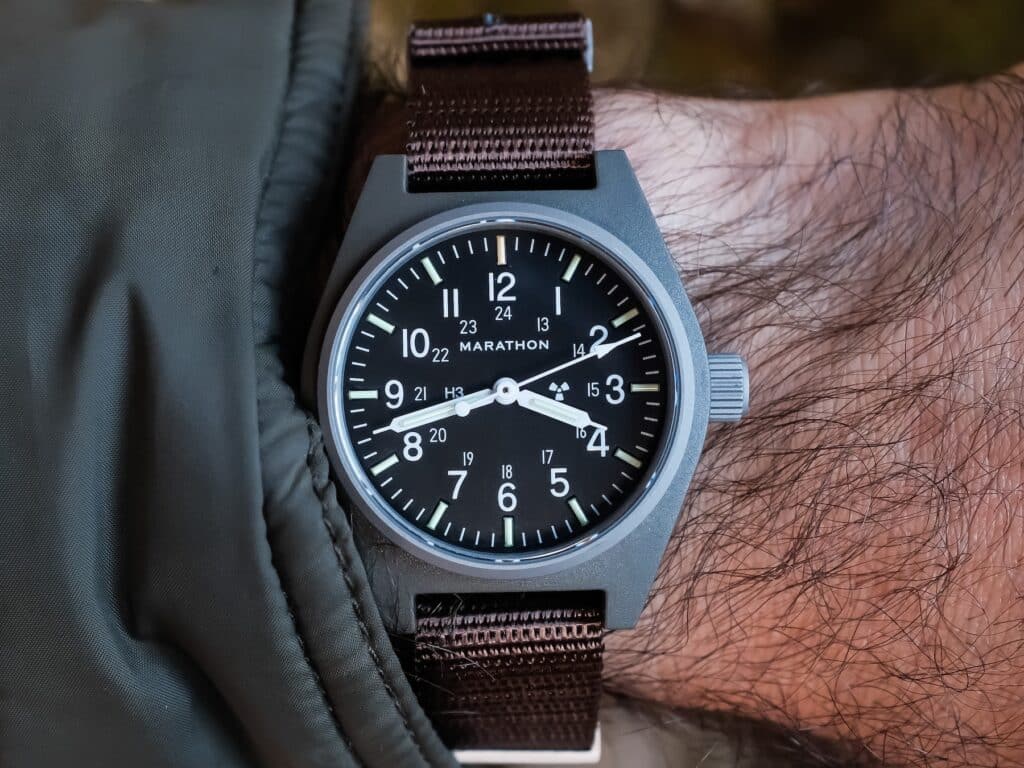
The Marathon General Purpose Mechanical is legible because it doesn’t treat readability as a styling exercise. The dial has that direct military design language where everything exists to be understood quickly: clear hour markers, an inner 24-hour scale, and syringe-style hands that line up well with the rest of the dial without crowding it. The tritium tubes are the real advantage here. Instead of charging lume under a lamp and hoping it sticks around, the low-light read is always present. It’s not theatrical, but it is useful in exactly the way a field watch should be when the room goes dark, or you’re checking the time before sunrise.
The watch also feels closer to issued gear than a civilian watch that’s trying on military clothes for the weekend. The sage green resin case, spec-heavy caseback, NSN markings, and plainspoken build all reinforce that utility-first mood. At 34mm, the case sounds small, especially if your brain has been cooked by years of oversized tool watches, but the 12.5mm thickness, 41mm lug-to-lug, and stock NATO setup give it more stance than expected. It doesn’t feel fragile or toy-like. It feels compact, warm, and light in a way that makes more sense after a full day of errands, walking around, or sitting at a desk.
Compared with steel, the resin case feels lighter and less cold, and it avoids the heavy-case fatigue that can creep in with watches marketed as “rugged.” It won’t disappear like a thin quartz field watch, but it also won’t punish your wrist by mid-afternoon. Marathon’s move to an all-steel crown also helps the practical side. The crown looks small, but the grip is good enough that winding and setting the Seiko NH35A never feels like a fiddly little chore. That movement suits the watch: familiar, dependable, easy to service, and good for around 41 hours of power reserve. It’s not fancy, and that is very much the point.
The compromises are worth knowing before buying. The 30 meters of water resistance feels light for something this outwardly rugged, and 50 meters would give more everyday confidence. The stock ballistic nylon strap looks right and supports the field-kit feel, but it starts stiff, and the tight spring-bar clearance makes swaps more complicated than expected. The 16mm lug width narrows aftermarket strap choices, too. After handling and wearing the watch ourselves, we liked it more on a single-pass olive-drab strap, which helped the case sit lower and feel more natural. Still, as a legibility-first military field watch, the Marathon works because the dial, tritium, case, and movement all pull in the same direction: simple, readable, no-nonsense, and built for use rather than admiration.
Pros
- Tritium tubes provide constant low-light legibility without needing a charge.
- Classic military dial layout with an inner 24-hour scale is quick and intuitive to read.
- The lightweight sage-green resin case stays comfortable during long daily wear.
- All-steel crown is small, grippy, and easy to operate.
- Compact 34mm case wears with more wrist presence than expected.
Cons
- 30 meters of water resistance feels limited for a rugged field watch.
- 16mm lug width limits aftermarket strap options.
- Stock ballistic nylon strap looks right, but starts stiff.
- Tight spring-bar clearance makes strap changes more frustrating than they need to be.
Traser P67 Officer Pro
| Price: | $530 |
| Water Resistance: | 100m |
| Case Dimensions: | 42mm (diameter) x 50mm (lug-to-lug) x 10mm (thickness) |
| Lug Width: | 22mm |
| Movement: | Quartz |
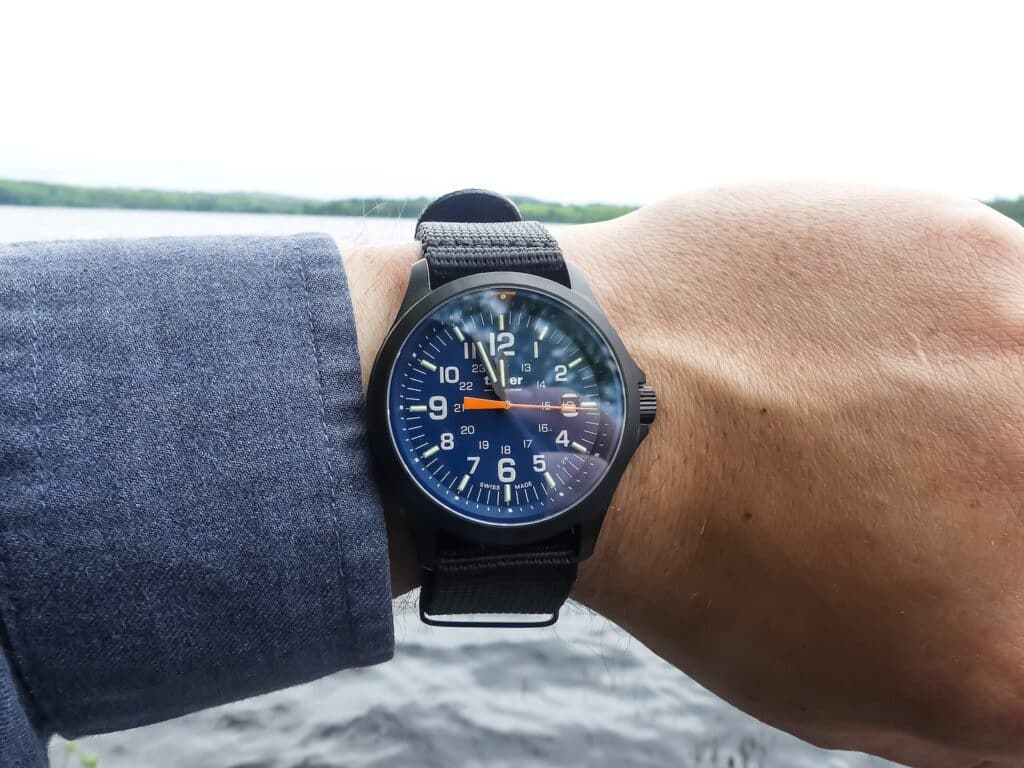
The Traser P67 Officer Pro has the kind of legibility that gets better the worse the lighting gets, which is why it earns attention here. The dial starts with a simple field-watch structure: large numerals, a clean 24-hour track, and long minute markers that make it easy to read the exact time without staring. The orange second hand and matching tritium tube add a little visual energy, but not in a way that turns the dial into a tactical billboard. It still feels controlled, which is not always guaranteed with tritium watches.
The interesting part is how Traser handles contrast. We were initially unsure about the dark hands against the blue dial, since that combination can go sideways quickly if the proportions or markers are off. In use, the white tritium tubes helped keep the hands readable during the day and clear in low light. The constant glow is the point here. You do not need to charge it under a lamp, and you do not have to watch traditional lume fade out before the night is done. Seeing the second hand tick in total darkness is a small pleasure, but it also reinforces the practical reason tritium still works for real-world readability.
The case keeps the watch easier to wear than the 42mm diameter might suggest. At 10mm thick, it stays slim, and the shorter lug span helps keep the footprint on the wrist in check. The deep-set dial also pulls the visual mass inward, so the P67 does not feel as broad or clumsy as the number might imply. Across commuting, outdoor time, and the usual desk bumps, the 100-meter water resistance and low profile made it easy to leave on without much thought. The PVD case looked right with casual outfits, especially on the included black nylon strap, though the coating does mean long-term polishing is not really part of the ownership plan.
The quartz movement fits the watch’s role well. It keeps the P67 accurate, dependable, and low-maintenance, which pairs naturally with the always-on tritium setup. Mechanical fans may want more romance in the movement department, but that is not really the point here. This is a simple field-style watch with a strong low-light hook, an anti-reflective sapphire crystal that stays usable in harsh sunlight, and enough water resistance to handle daily wear without drama. As covered in our in-depth review, the black hands on the blue dial may still split opinions, but as a legible everyday tool, the P67 is more thoughtful than its quiet looks suggest.
Pros
- Tritium tubes provide strong, constant low-light visibility without needing a charge.
- Long minute markers and large numerals make exact time checks easy.
- Anti-reflective sapphire crystal and 100-meter water resistance suit daily use.
- Comfortable wear despite the 42mm diameter, helped by the slim case and shorter lug span.
Cons
- PVD coating limits polishing options over long-term wear.
- Black hands on the blue dial may have polarizing opinions.
CWC Mellor 72
| Price: | $600 |
| Water Resistance: | 50m |
| Case Dimensions: | 35mm (diameter) x 42mm (lug-to-lug) x 11mm (thickness) |
| Lug Width: | 18.5mm |
| Movement: | Sellita SW210 hand-wound movement |
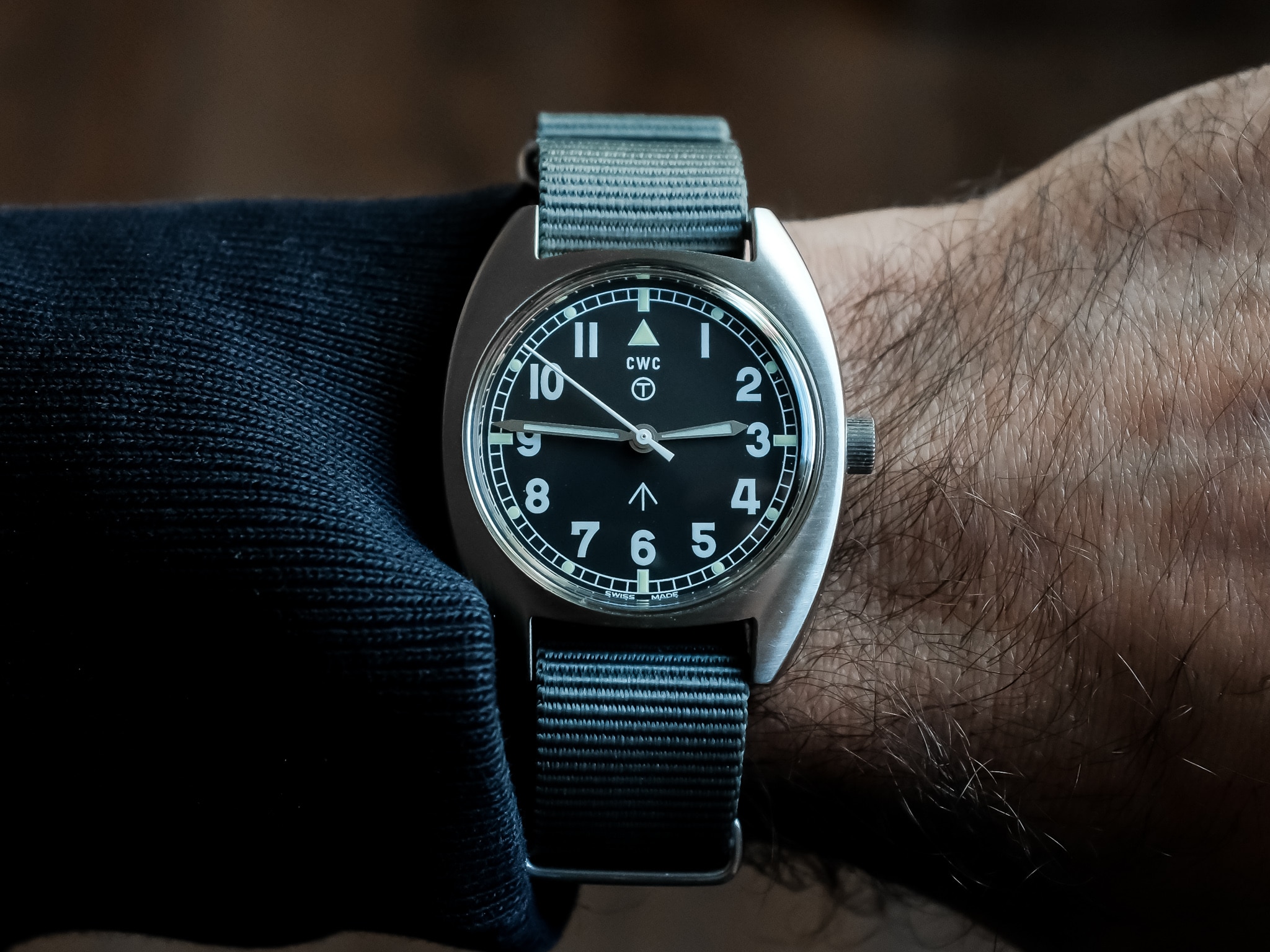
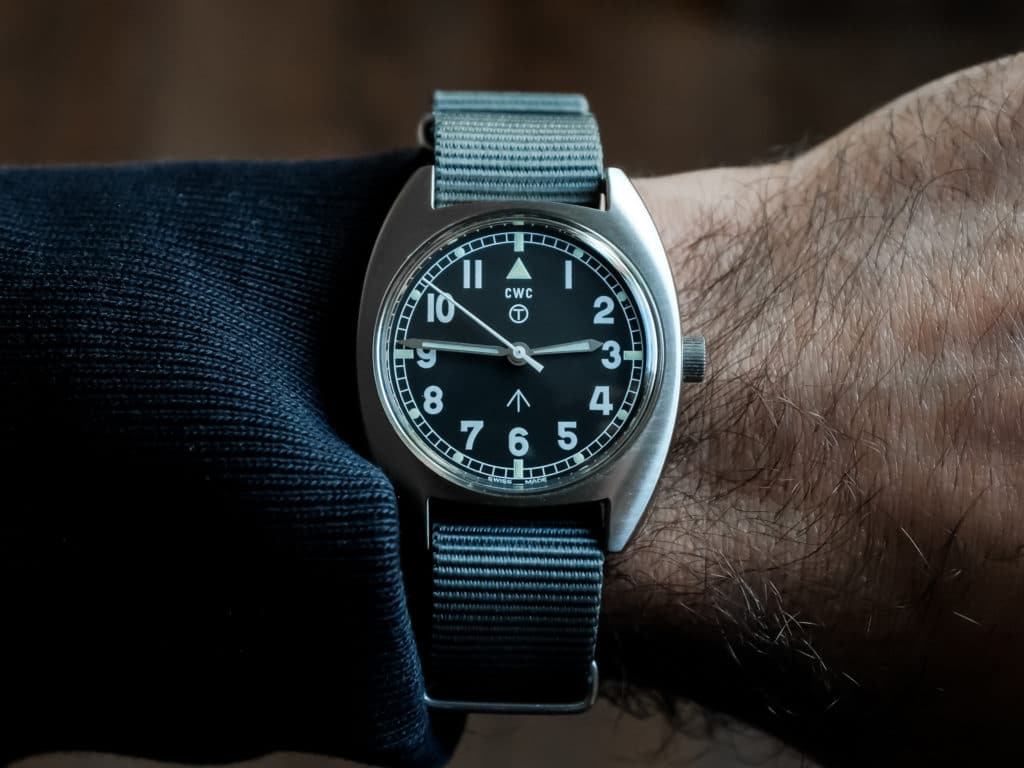
The CWC Mellor 72 is proof that a dial does not need to shout to be easy to read. The layout is plain in the useful military-watch sense: stark numerals, strong contrast, and a minute hand that reaches cleanly to the railroad second track. That last detail matters because it makes the watch feel precise without adding clutter. The old CWC typeface and circle T marker give the dial enough vintage-military personality without getting in the way of the job. It still reads quickly, which is the whole reason this watch works here.
The 35mm case sounds small until it’s actually on the wrist. Thanks to the wider tonneau shape and the crown, it wears closer to a compact 38mm than the spec sheet suggests. On a simple NATO, it never felt like it disappeared or became too delicate. It settled into that useful middle ground where the watch stays out of the way but remains easy to check. The fully brushed stainless steel case and fixed bars also help the experience feel honest. There is nothing precious about it, which makes it easier to wear without treating every doorframe like a personal threat.
CWC keeps the practical side simple. The 50 meters of water resistance was enough for rain, hand washing, and outdoor errands throughout our time with it, though it does limit heavier water use. The Hesalite crystal adds to the old-school feel and keeps the watch from feeling too polished, but it also means scratches are part of the deal if you’re rough on your gear. Keeping some Polywatch around isn’t a bad idea. The lume uses modern Super-LumiNova and holds up well enough for nighttime checks, so the Mellor 72 does not rely solely on daylight contrast to make its case.
The Sellita SW210 hand-wound movement adds a distinct daily rhythm. Winding it became part of the morning routine, and the action felt smooth and predictable, without giving us a reason to question reliability. The snap-back case should also make servicing simpler down the road, which helps if you’re thinking of this as a long-term everyday watch rather than a short-term curiosity. The trade-offs are straightforward: fixed bars improve durability for NATO-style wear but restrict strap choices; water resistance is modest; and Hesalite will mark up sooner than sapphire. Still, for a simple military field watch built around instant readability, the Mellor 72 lands in a very comfortable place.
Pros
- High-contrast dial with bold numerals makes quick reading easy.
- Compact 35mm case wears larger than expected and stays comfortable all day.
- Fixed bars add durability for NATO-style strap use.
- Smooth Sellita SW210 hand-wound movement encourages daily interaction.
Cons
- Hesalite crystal scratches more easily than sapphire.
- Fixed bars limit strap choices.
- 50 meters of water resistance limit heavier water use.
Hamilton Khaki Field Mechanical
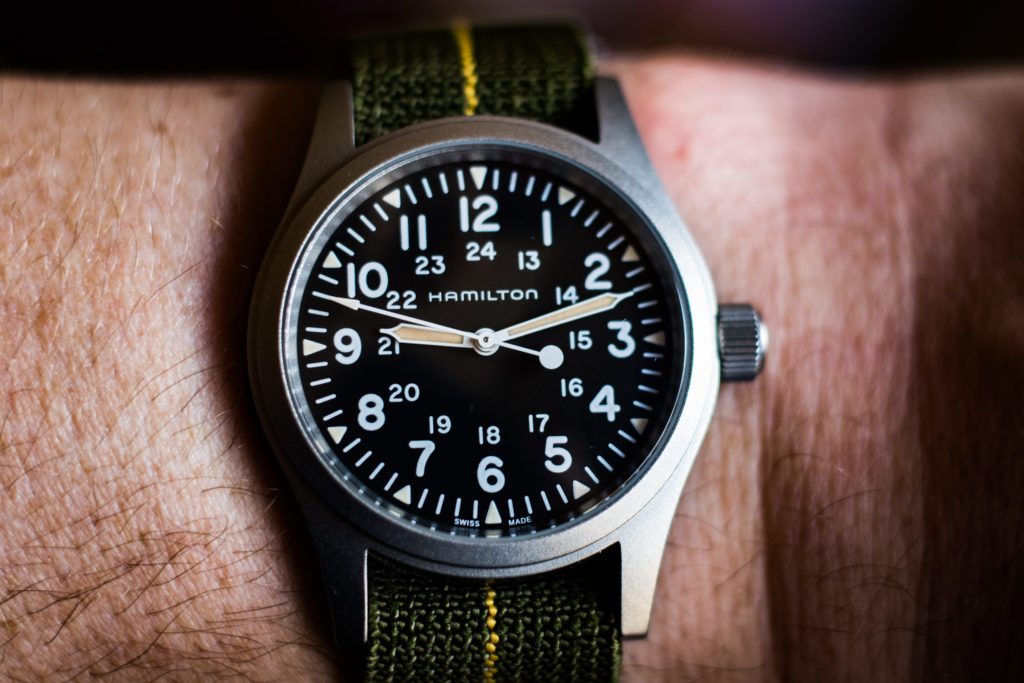
| Price: | $695 |
| Water Resistance: | 50m |
| Case Dimensions: | 38mm (diameter) x 47mm (lug-to-lug) x 9.5mm (thickness) |
| Lug Width: | 20mm |
| Movement: | Caliber H-50 (ETA 2801-2 on previous models) |
The Hamilton Khaki Field Mechanical is one of those watches that makes legibility feel familiar rather than flashy. We already know the shape of the thing: a compact case, a hand-wound movement, a busy-but-purposeful dial, and a general military-field attitude that has been copied, referenced, and argued about forever. What keeps it relevant is that the formula still works on the wrist. The dial carries numerals, minute markings, and military-style information in a layout that could have become messy in less careful hands. In daylight, it can look busy at first glance, but the no-date setup keeps the balance from tipping into clutter. The faux-patina lume is handled with enough restraint to add warmth without turning the watch into a costume piece. The Hamilton branding under 12 is visible, but once the watch is on the wrist, it doesn’t pull attention away from the time.
The one low-light issue is orientation. Night visibility is better than the aged lume color might suggest, but the 12 o’clock position does not stand apart clearly enough. That made middle-of-the-night checks more awkward than they should be, especially for a watch built around field-watch readability. It is not a dealbreaker, but it is the kind of small design choice you notice after actual wrist time. The rest of the dial still does what the Khaki Field has always done well: give you a clear, military-inspired read without making the watch feel overdesigned.
The case helps the watch stay practical rather than precious. At 38mm wide, it sounds modest if you’re coming from chunkier sports watches, but the 47mm lug-to-lug and slightly longer lugs give it more presence than the diameter suggests. The thin 9.5mm profile keeps it comfortable through long wear, and the drilled 20mm lugs make strap changes easy. That matters here because the Khaki Field Mechanical is one of those watches that changes personality quickly depending on what you put it on. NATOs and leather both work without much fuss, though the included green NATO was not perfect for everyone. The leather keepers irritated some of us over longer wear, while the soft gray pashmina strap ended up being the more comfortable option.
The H-50 hand-wound movement ties the whole thing together. Daily winding feels right on this watch, and the large crown makes the routine easy rather than annoying. While wearing it day-to-day, consistent winding yielded a strong accuracy of around +0.8 seconds per day, which is better than many people would expect from a watch in this price range. The trade-off is water confidence. With 50 meters of resistance and a non-screw-down crown, we treated water exposure with some caution. Still, as a readable everyday field watch, the Khaki Field Mechanical works because it keeps the classic formula intact while adding enough modern reliability to make it easy to wear often.
Pros
- Classic field-watch dial stays readable, with faux-patina lume that avoids feeling gimmicky.
- The 38mm case wears better than the modest diameter suggests, thanks to its slim profile and longer lugs.
- Drilled 20mm lugs make strap swaps easy, and the watch works well on NATO and leather options.
- The H-50 hand-wound movement adds tactile appeal and delivers excellent accuracy.
Cons
- The 50m water rating and non-screw-down crown make it less carefree around water than we’d like.
- Low-light orientation suffers because the 12 o’clock marker does not stand out clearly enough.
- The stock green NATO may not suit everyone, especially since the leather keepers can irritate over longer wear.
Archimede Pilot 39
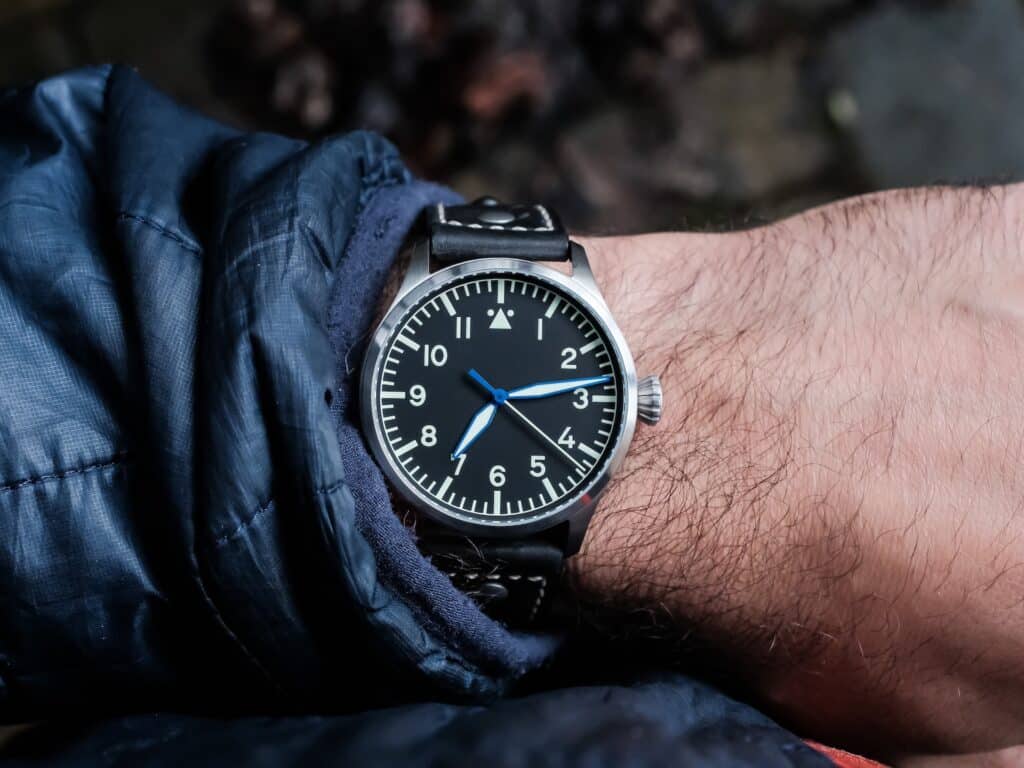
| Price: | $1,030 (approx.) |
| Water Resistance: | 100m |
| Case Dimensions: | 39mm (diameter) x 45mm (lug-to-lug) x 9.8mm (thickness) |
| Lug Width: | 20mm |
| Movement: | Swiss-made automatic ETA 2824-2 |
The Archimede Pilot 39 is a reminder that pilot-watch legibility works best when nobody tries to improve it into something worse. The dial sticks to the essentials: clean Arabic numerals, the triangle with two dots at 12, and no date window that would break the orientation. That gives the eye a clear point of reference and keeps the rest of the dial from turning into a tiny aviation-themed poster. It is one of the cleaner time-only reads in this group, and the restraint is the appeal. This is not a pilot watch that tries to look dramatic. It just gives you the information quickly and gets out of the way.
The proportions help it feel usable rather than costume-sized. A lot of flieger-style watches still carry that oversized historical baggage, which sounds romantic until you’re typing, driving, or trying to fit a cuff over the thing. The Archimede avoids that with a 39mm case, 45mm lug-to-lug, and a thickness of roughly 10mm. On the wrist, that means the dial has enough room to stay open and readable without the watch sprawling. The signed screw-down onion crown is satisfying to use, too, and the 100 meters of water resistance gives it daily confidence that many pilot-style watches skip. Around this price, that matters because nervous water resistance stops feeling charming pretty quickly.
As covered in our in-depth video review, the small finishing choices keep it from feeling like a generic Type A copy. The heat-blued hands are not painted, and that detail along the hour hand, minute hand, and second counterweight adds some warmth without making the dial fussy. Archimede also has real case-making credibility as the in-house brand of Ickler, the German case manufacturer. That context helps the watch feel more considered than the usual homage. Inside, the ETA 2824 is familiar, reliable, and serviceable rather than showy. It is not dressed up for display-back applause, which fits the watch’s practical attitude.
The black leather strap, with stitching, rivets, and a signed buckle, supports the pilot-watch look without overpowering the 39mm case, though it does feel a little thick when new. The lume is the weaker part of the legibility story. It works, but it doesn’t hold a charge as long as we’d like, especially for a watch that otherwise relies so heavily on clear legibility. The power reserve is also modest by current standards. However, the Pilot 39 makes a strong case here because it gives you classic flieger clarity in a size that can be worn like an actual daily watch.
Pros
- 39mm case keeps the flieger layout readable without the oversized wrist feel.
- Heat-blued hands add a thoughtful detail without cluttering the dial.
- Signed screw-down onion crown feels good to operate and helps support 100m water resistance.
- Ickler case manufacturing adds genuine German tool-watch credibility.
- Leather strap, rivets, stitching, and a signed buckle suit the pilot-watch look.
Cons
- The leather strap can feel slightly thick when new.
- Lume does not hold a charge as long as we would like.
- A power reserve of 38 hours is modest by modern standards.
Bremont Broadsword
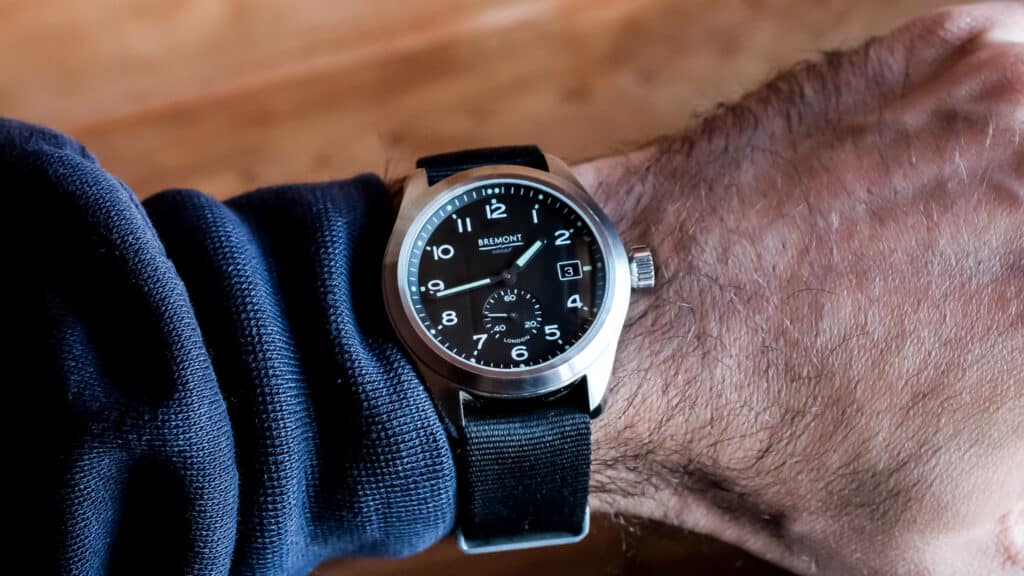
| Price: | $3,445 |
| Water Resistance: | 100m |
| Case Dimensions: | 40mm (diameter) x 47mm (lug-to-lug) x 11.9mm (thickness) |
| Lug Width: | 20mm |
| Movement: | BE-95-2AV (automatic) |
The Bremont Broadsword brings legibility into a more premium military field package without making the watch feel too dressed up. It sits inside Bremont’s Armed Forces collection, and the whole thing has a more direct, purpose-built attitude than the usual Khaki Field-adjacent options we see in this space. What stood out to us during our hands-on review is that it does not try to win people over with extra dial tricks or decorative nonsense. The matte black dial, prominent numerals, and sword-style hands keep the read clean and immediate. That matters for the kind of buyer who wants a serious everyday watch that can move from office life to travel to a wet weekend without the dial feeling like it needs explaining.
The 40mm stainless steel case hits a useful middle ground. It is not oversized, but it has enough substance to feel like proper gear rather than a delicate field-watch tribute. The strong lugs and durable crown reinforce its practical feel, and the 100-meter water resistance gives it enough everyday confidence for rain, handwashing, and most normal water-related situations. We liked the 40mm size more than expected for this watch style. It gives the dial room to breathe, which improves legibility, but it still wears like something you can keep on all day rather than a chunky, military-themed object you tolerate for the look.
Low-light readability is one of the Broadsword’s clearer strengths. The generous lume on the hands and markers works well with the simple matte dial rather than fighting it, so the watch remains useful in low light. That is where the military field design language makes the most sense. It is not about looking tough in photos. It is about being able to check the time quickly when you are half-distracted, outside after dark, or dealing with a day that has already become mildly stupid. The Broadsword does that well, and the restraint keeps it from feeling like a tactical prop.
Inside, the BE-95-2AV automatic movement keeps the watch aligned with the same practical idea. It is not a very complicated movement, and that feels appropriate here. The point is reliability and convenience, not mechanical theater. Strap choice changes the personality a bit. The canvas strap suits the military look and should be comfortable for extended wear, while the bracelet likely lends the watch more polish for everyday office use. Personally, we would lean toward nylon or canvas and avoid adding bracelet weight unless you specifically want that more refined feel. In short, the Broadsword may not be the most exciting watch in the group, and for us, it fell a little flat emotionally. Still, as a clean, dependable, highly legible British military-inspired watch, it understands the assignment.
Pros
- Matte black dial, large Arabic numerals, and sword-style hands make the time easy to read quickly.
- Generous lume on the hands and markers gives it strong low-light usability.
- The 40mm case feels robust without becoming oversized for daily wear.
- 100 meters of water resistance adds practical confidence for normal conditions.
- Canvas or nylon-style straps suit the military field character without adding unnecessary weight.
Cons
- The design may feel too restrained if you want a watch with more personality.
- The bracelet option likely adds refinement but also extra weight.
Please let us know what you think of these legibility picks in the comments below. If there’s a watch we missed that lets you read the time with ease share it with us. We’ll do our best to get one in for hands-on review and consider it for a future update to this list.

Co-Founder and Senior Editor
Kaz has been collecting watches since 2015, but he’s been fascinated by product design, the Collector’s psychology, and brand marketing his whole life. While sharing the same strong fondness for all things horologically-affordable as Mike (his TBWS partner in crime), Kaz’s collection niche is also focused on vintage Soviet watches as well as watches that feature a unique, but well-designed quirk or visual hook.
You left out Seiko.
True. They also have some great options.
I own the Vaer C4Tactical Solar Field and can attest to its legibility, robustness and ease of use. As complete of a set it and forget it tank of a watch as you are going to find. It makes for a formidable field watch as well as a stout, tool dive watch with its 200m water resistance and unidirectional timing bezel. I cannot say enough positive things about the C4. It is truly one of the best all around watches I have ever owned.
Hey Eric. The C4 doesn’t get as much buzz as some of Vaer’s other models, but the people who own one tend to feel exactly the way you do.