The weird watches collectors secretly love usually show up after the sensible part of the hobby is already done. We buy the diver, the field watch, the everyday piece, and for a while, that feels like a healthy, mature way to collect. Then the box starts looking a little too well-behaved. This list exists to answer a simple question: why do so many enthusiasts fall for the oddballs once the basics are covered? From where we sit, it’s often because the strange stuff breaks the routine. After enough time comparing the same handful of “safe” watches, something playful, awkward, or slightly off-center can remind us there’s still room in this hobby for surprise, personality, and a little less optimization.
That said, we’re not saying that as people who only chase novelty for novelty’s sake. Over the years of reviews, we’ve spent time with watches that approach collecting from very different angles. That includes the left-field fun of the Mr. Jones Beam Me Up! to the retro-futurist Bulova Computron, the cult weirdness of the Citizen Ana-Digi Temp, the personality-first Juvenia Sextant, and more. That’s why our take matters here: we’ve lived long enough with these oddballs to know when a watch is merely unusual and when it earns real affection. Sometimes the difference is small. Sometimes it’s the whole point.
Vostok Amphibia
| Price: | $100 – $150 |
| Water Resistance: | 200m |
| Case Dimensions: | 39mm (diameter) x 46mm (lug-to-lug) x 15mm (thickness) |
| Lug Width: | 18mm |
| Movement: | Vostok 2416 Automatic Movement (in-house) |
The Vostok Amphibia fits here because it wins people over through quirks that would probably scare off a first-time buyer. The crown is the best example. The first time you unscrew it, it feels loose enough to make you think something is broken. It is not. That wobble comes from a two-piece, spring-loaded crown-and-stem setup designed so that pressure does not push the crown into the movement underwater. Once we spent time with it, that oddness stopped feeling cheap and started feeling clever.
The same goes for the whole watch. Judging an Amphibia by modern dive watch standards misses the point a bit. This is a 200-meter compression-case diver that becomes more water-resistant as pressure increases, using gaskets and case architecture rather than brute-force heft. On the wrist, it is also smaller and easier than plenty of modern divers. At roughly 39mm wide, 46mm lug-to-lug, and 15mm thick, it has enough presence without turning into a wrist anchor. The rounded case, lack of crown guards, and downward-sloping lugs give it a soft, almost porthole-like profile that feels more nautical than aggressive.
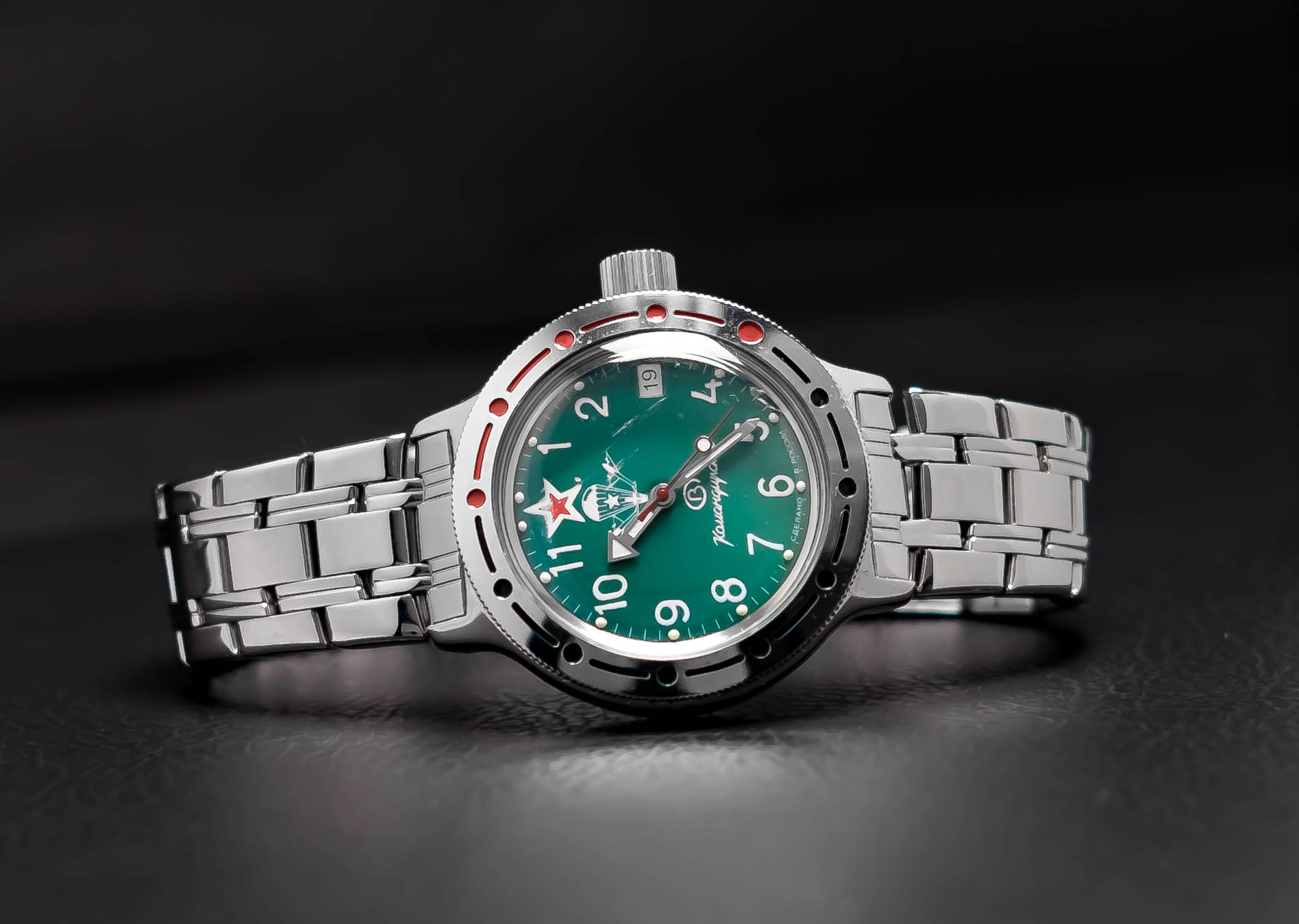
That shape also puts the dial front and center, which matters because the Amphibia lineup is half the fun. There are more than ten case styles and a ridiculous number of dial variations, all at prices that still feel approachable. That means collectors are not only buying an Amphibia. They are choosing their Amphibia. The example we lived with used the semi-iconic paratrooper dial, which had a slight sheen and a faint gradient that gave the green surface a little life in changing light. The painted Arabic numerals, red star at twelve, and old-school hand set give it real personality, even if the red second hand can get a bit lost against the dial, and its pip only helps so much.
The lume is fine, not impressive. The little luminous dots above the markers do the heavy lifting since the numerals themselves are not lumed. The acrylic dome adds even more vintage character, and the bidirectional bezel brings its own trade-off. It is easy to set from either direction, but the friction can feel loose and may shift on its own. That sounds annoying, yet Amphibia owners tend to shrug and swap bezels instead. The modding ecosystem around these watches is huge, cheap, and honestly a big part of why collectors get attached to them.
The flaws are not hard to find. The polished steel case picks up scratches quickly, the bracelet feels thin and hollow, and the clasp is nothing special. Still, this is one of those watches that almost looks better with a few dings. The case wears well with age, and the bracelet, while flimsy in hand, somehow still suits the watch visually in the same way an old vintage diver bracelet would. We would still move it to a NATO, suede strap, or something else pretty quickly. At 18mm, it is easy enough to experiment.
Inside, the in-house Soviet-designed 2416 automatic movement brings hand-winding, a stated accuracy of -20/+60 seconds per day, and about 31 hours of power reserve. Vostok even claims a 10-year average service term, which sounds bold until you remember how robust these things were built. Yes, modern examples can show occasional QC hiccups, from hand-setting issues to lubrication concerns, but those problems are usually fixable and often become the first step into Amphibia tinkering. For the collector who likes odd engineering, endless dial rabbit holes, and a watch that feels more personal the rougher it gets, the Amphibia makes a weird amount of sense.
Pros
- The compression-case design and wobbling crown feel strange at first, but both reflect genuinely clever engineering rather than empty novelty.
- The rounded 39mm case wears comfortably and avoids the bulky, overbuilt feel of many modern dive watches.
- There are enough cases and dial combinations to make the Amphibia feel personal rather than generic.
- The modding scene is affordable, active, and easy to get into, especially if the stock bezel or bracelet is not for you.
- The 2416 movement is simple, robust, and hand-windable, and it is part of the watch’s long-term charm.
- Scratches and wear suit the polished case well, which takes some of the stress out of ownership.
Cons
- The crown can feel quite loose if you do not know the design, and the crown metal and threading can feel a bit thin on modern examples.
- The bidirectional bezel is easy to adjust, but it can also move a little too easily on its own.
- Lume is serviceable at best and nowhere near the standard set by stronger modern diver lume.
- The stock bracelet feels flimsy, with hollow end links and a clasp that does not inspire much affection.
- QC on current production pieces can be uneven, even though the issues are often fixable.
Citizen Ana-Digi Temp
| Price: | $250 – $500 |
| Water Resistance: | 30m |
| Case Dimensions: | 31.5mm (diameter) x 40mm (lug-to-lug) x 8.4mm (thickness) |
| Lug Width: | 18mm |
| Movement: | Citizen caliber 8980 |
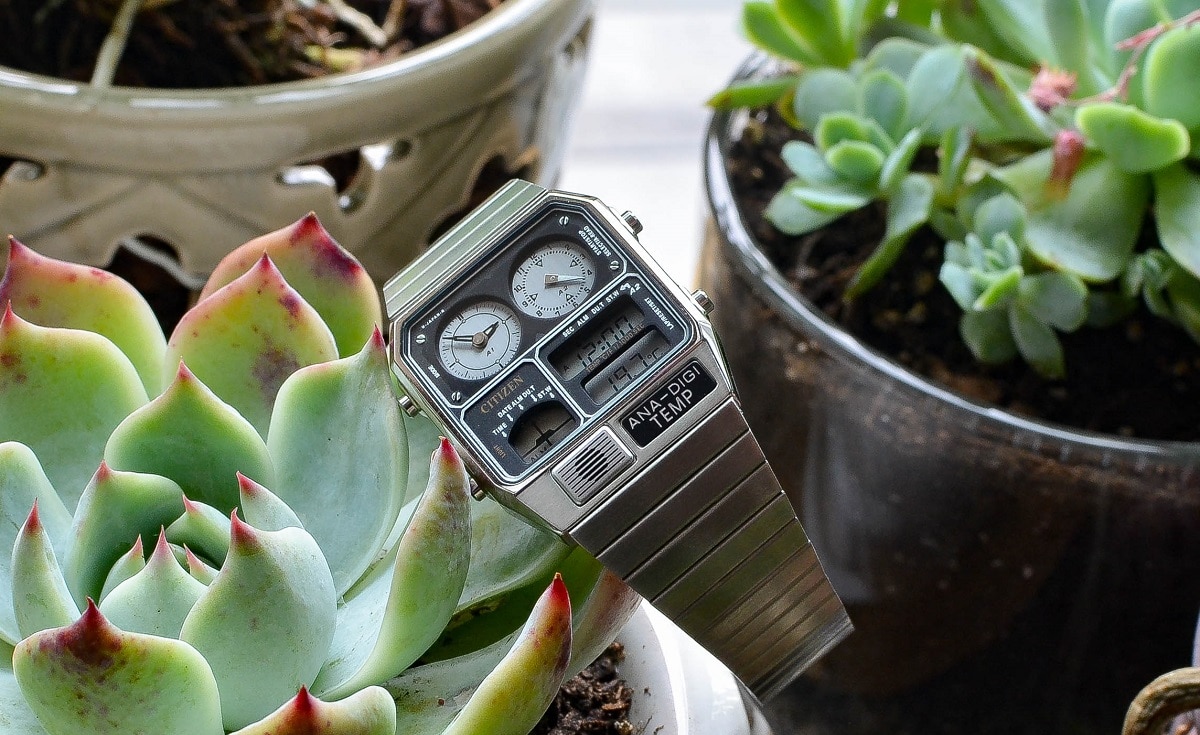
The Citizen Ana-Digi Temp is the kind of watch collectors end up loving once “normal” starts feeling a little too tidy. What makes it work is that the cult tech weirdness isn’t empty. The display is dense, but Citizen organized it with more discipline than you’d expect from something this visually chaotic. The bright white information jumps off the black background, the darker LCD labels fade back where they should, and the brand name stays restrained, which helps the whole thing breathe in actual use. The left-side analog hands are thin, black, and almost needle-like, with narrow lume strips that keep them legible without overpowering the display. In contrast, the heavier regulator-style hand on the right is easier to track at a glance. Add the four lume plots at the cardinal points, the polished hand bases, and the exposed screws anchoring the “dash display,” and it starts to feel less like a gimmick and more like a tiny stainless steel instrument panel.
The dual-time setup is also handy, with the analog readout giving a quick visual cue and the digital display backing it up when precision matters. That is why it comes across more like a useful GMT than a throwaway complication. The temperature function is less seamless, since you need to take the watch off your wrist for a reliable reading, but even that feels true to the watch’s original all-in utility mindset.
Then you get to the case, which is where most people decide whether they’re charmed or repelled. It’s boxy, angular, and pure eighties tech-brain energy, with polished accents along the sides of the steel case and bezel, a brushed lower front section, and even the alarm speaker left out in the open rather than disguised. On paper, 31.5mm across without the pushers, 40mm lug-to-lug, and 8.4mm thick sounds small, but the near bezel-less opening and pseudo-square shape give it more presence than those numbers suggest. The surprise is that it still wears in a manageable, flat, balanced way, especially thanks to the short length and integrated bracelet.
That bracelet feels like part of the case rather than an accessory attached afterward, and it’s hard to imagine the watch on anything else. However, the flared end links are a legitimate weak spot because they can bend under relatively minor pressure. That trade-off is part of the charm, honestly. This isn’t a clean, modern digital watch for someone who wants a quiet, familiar design. It’s for collectors who like early multifunction tech, strange layouts, and watches that still feel a little unruly decades after the first good idea. Refer to our detailed review for more insights into testing.
Pros
- The analog and digital displays complement each other well, so the dual-time function feels useful instead of tacked on.
- The compartmentalized layout keeps all that information readable with strong contrast.
- It wears more comfortably than the shape suggests, thanks to the compact footprint, slim case, and integrated bracelet.
- Small details like the lume treatment, polished hand bases, and visible screws give it more depth the longer you live with it.
Cons
- The temperature feature is only reliable when the watch is removed from the wrist, which makes it more deliberate than convenient.
- There’s a real adjustment period with the display if you’re used to simpler digital watches.
- The bracelet suits the watch perfectly, but the flared end links are prone to bending and don’t scream long-term toughness.
- Anyone chasing a sleek, contemporary digital design will probably know within seconds that this is not their thing.
Bulova Computron
| Price: | $340 |
| Water Resistance: | 30m |
| Case Dimensions: | 31mm (diameter) x 40mm (lug-to-lug) x 13.8mm (thickness) |
| Lug Width: | Integrated strap that tapers from 25mm at the case to 16mm at the ends |
| Movement: | Quartz |
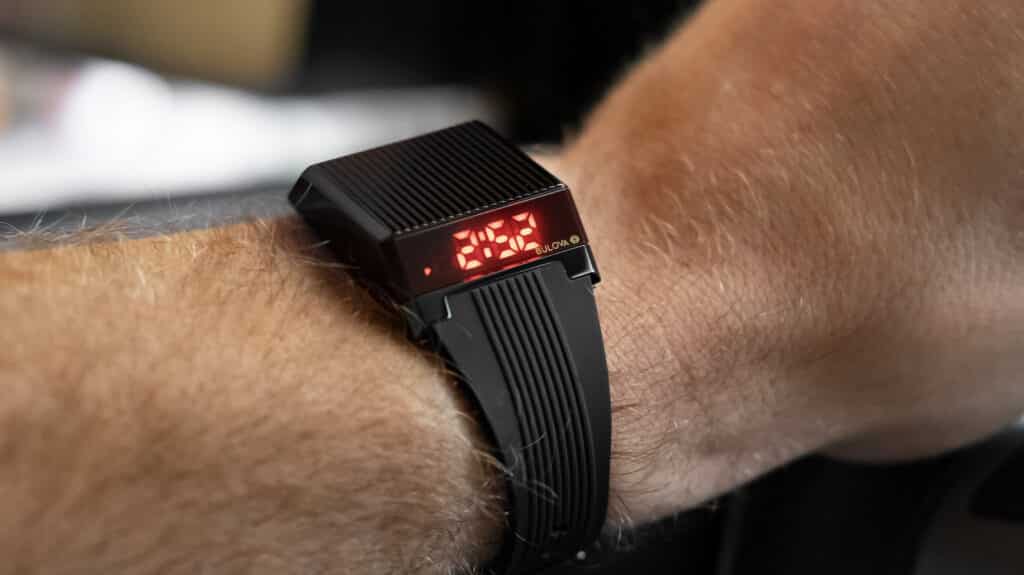
The Bulova Computron is one of those weird watches collectors love because it turns something as routine as checking the time into a small event. That red LED display stays dark until you press the button, which means the watch never fades into the background the way a normal daily beater does. On paper, that sounds inconvenient, and in practice, it sometimes is. A glance won’t cut it here. You have to ask the watch for the time, which adds an extra step and slows everything down. But that bit of friction is also what gives the Computron its charm. It still feels like a leftover vision of the future from a point when digital watches were allowed to be strange, impractical, and a little theatrical. Once you spend some time with it, moving through the time, date, and second time zone functions is straightforward enough, even if it never becomes second nature as a conventional display does.
What keeps it from sliding into pure novelty is the physical execution. Bulova wisely left the wedge-shaped, trapezoidal case alone, rather than sanding off its oddness to suit modern tastes. The hard edges, the late-’70s profile, and even the shallow grooves running across the top of the case all help it feel like a proper retro-futuristic object rather than a lazy reissue with vintage styling pasted on top. On the wrist, it’s better behaved than the photos suggest. The angled case helps it sit naturally, and it feels more balanced and lighter than you’d expect from something this visually top-heavy.
And as mentioned in our review, the integrated rubber strap deserves a lot of credit here. It’s soft, comfortable, and tapered aggressively enough to keep the watch feeling secure instead of clunky. Even the finishing punches a little above its price, though the black ion-plated model has one predictable flaw: it picks up fingerprints fast, and since you’re pressing the case to wake the display, you notice that pretty quickly. This is not the watch we’d grab when we want an effortless everyday option. But if the goal is to add something odd, self-aware, and deeply satisfying to a collection that’s gotten a little too sensible, the Computron earns its spot.
Pros
- The wedge-shaped case stays true to the original late-’70s design language instead of toning down the weirdness.
- It wears with more comfort and balance than the shape suggests, especially thanks to the angled case profile.
- The integrated rubber strap feels like the right pairing and helps keep the watch planted on the wrist.
- Finishing and overall build quality come across better than expected at this price.
Cons
- Reading the time always takes an extra step because the display has to be activated.
- Cycling through the functions is easy enough, but it never feels as immediate as a standard analog or digital watch.
- The glossy black ion-plated version shows fingerprints quickly, which becomes more noticeable the more you interact with it.
Mr. Jones Beam Me Up!
| Price: | $950 |
| Water Resistance: | 50m |
| Case Dimensions: | 40mm (diameter) x 50mm (lug-to-lug) x 11.6mm (thickness) |
| Lug Width: | 18mm |
| Movement: | Sellita SW200 automatic |
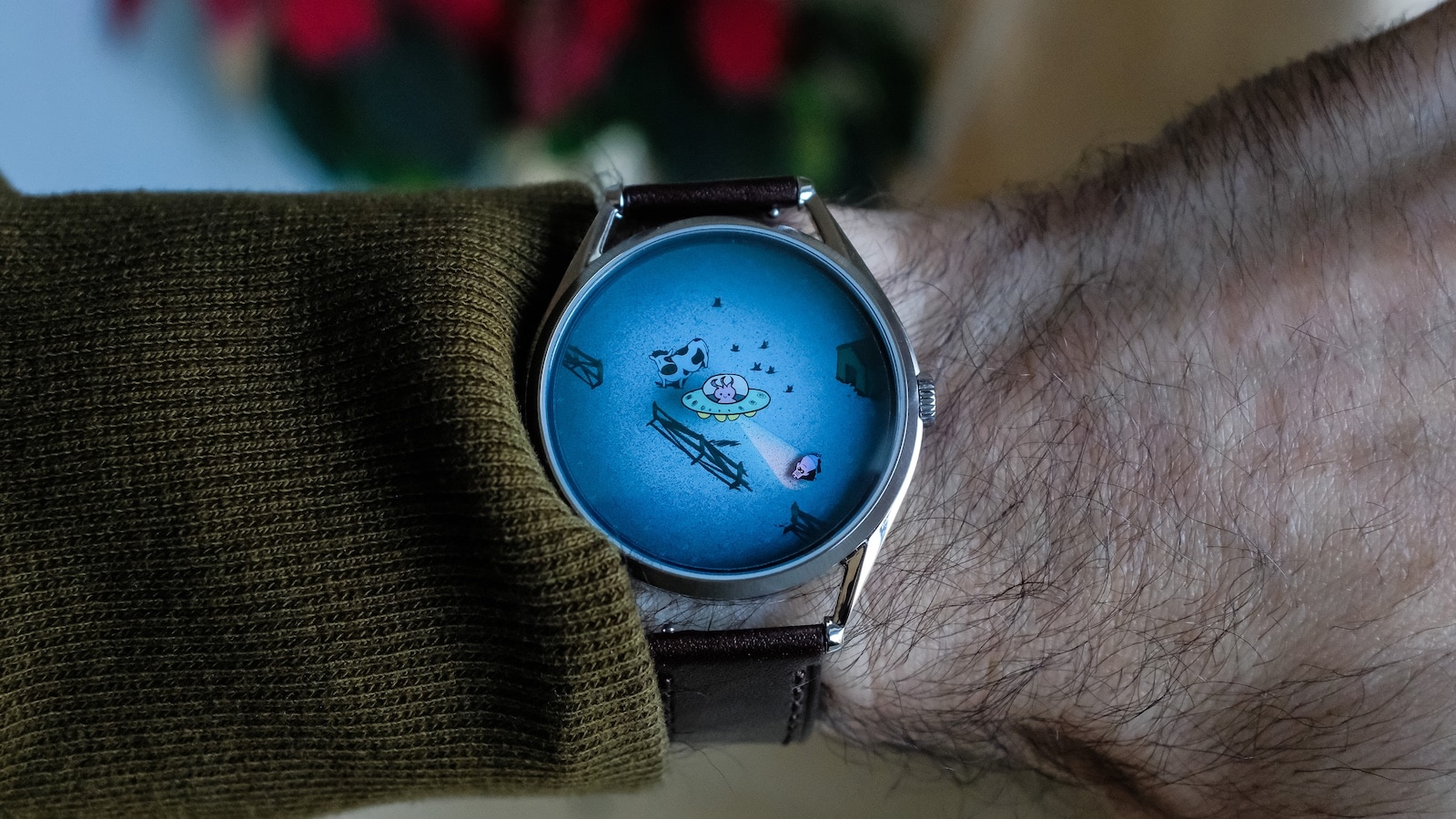
The Mr. Jones Beam Me Up! belongs in a piece like this because it scratches a very particular itch. It’s the watch you end up appreciating once the usual collector priorities start to feel a little stale. In our hands-on time with it, what made it stick was not the novelty on its own, but the way the watch commits to the bit without becoming disposable.
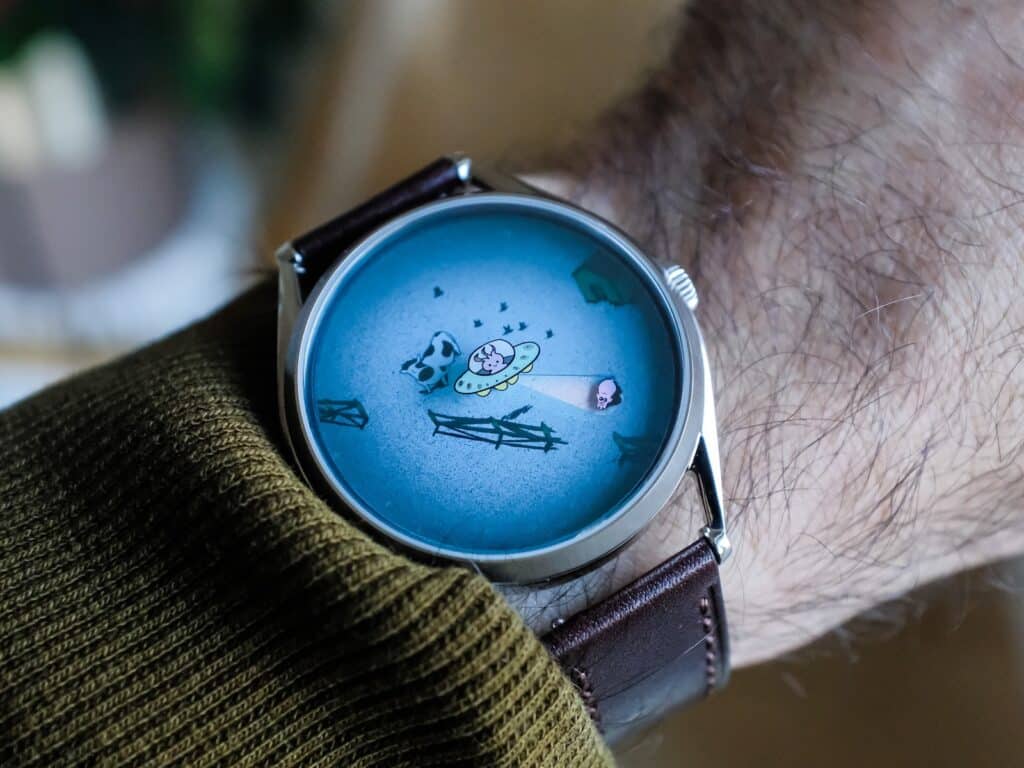
The dial, designed by French illustrator Xavier Broche, leans fully into the image of a UFO beaming up a pig from a farm, and somehow that absurd little scene keeps hooking attention instead of burning out after the first laugh. The blues and turquoise tones have more depth than expected, the pink beam gives the display a strong focal point, and the hand-finished execution adds texture that keeps it from feeling flat or toy-like. This is playful mechanical art, but it still feels like a real watch rather than a punchline.
The way it tells time is a big reason collectors warm up to it. There is a short learning curve at first, because this is not a dial you decode instantly. The UFO beam tracks the minutes, while the pig marks the hours, which means reading it requires a little more effort than a conventional handset. After a few wears, though, it starts to make sense in a way that feels deliberate rather than annoying. You slow down, engage with it, and that slightly altered rhythm becomes part of the appeal.
That same balancing act shows up in the hardware. The 40mm polished 316L steel case, just under 50mm lug-to-lug and about 11.6mm thick, wears with a bit more span than the numbers imply because the lugs are long and slender. However, the gentle curve of the case helps it settle nicely on the wrist. Around the back, the display caseback reveals a Sellita SW200 with a small pig graphic worked into the design, which is the right movement choice here: dependable, familiar, and easy to live with. The included 18mm dark Havana leather strap also does more than expected, soft from the start, and good at grounding the watch so it doesn’t drift too far into costume territory. That’s really the secret to this watch. It resets the mood of a collection without feeling cheap or lazy.
Pros
- The illustrated dial stays entertaining well beyond the first impression and has enough color depth and texture to reward repeat wear.
- The Sellita SW200 is a sensible fit here because it is reliable and uncomplicated to live with.
- The polished steel case keeps the watch feeling wearable and composed, rather than collapsing into pure novelty.
- Once you learn the display, the pig-and-beam timekeeping system becomes easier to use.
- The leather strap is comfortable right away and helps anchor an otherwise unique design.
- Small touches like the hand-finished dial and pig graphic on the display back give it more character up close.
Cons
- Telling the time is slower at first, especially during the first few days of wear.
- The long, slender lugs give it more visual reach than the raw dimensions suggest, so it wears with more presence than some collectors may expect.
- Water resistance is fine for everyday use, but this is not something we’d treat as a true tool watch.
Raketa Polar 0270
| Price: | $1600 – $1650 |
| Water Resistance: | 30m |
| Case Dimensions: | 35mm (diameter) x 40mm (lug-to-lug) x 12mm (thickness) |
| Lug Width: | 18mm |
| Movement: | Caliber 2623 |
The Raketa Polar 0270 is the sort of watch collectors end up loving when the usual idea of “versatility” stops being very interesting. What draws you in first is not the size or the specs, but the commitment. Raketa didn’t do a loose, vintage-inspired tribute here. It rebuilt the watch from the original 1970 design schematics and even brought back the old 24-hour caliber to match. That level of follow-through gives the Polar 0270 a different kind of charm.
The hand-wound caliber 2623 sits behind a solid caseback, which feels right for a watch like this, and winding it becomes part of the appeal rather than a chore. It adds a little ritual to the experience. That matters because this watch is less about convenience and more about connection. It was also a limited edition and has been sold out for a while, which only adds to that quiet, collector-minded pull.
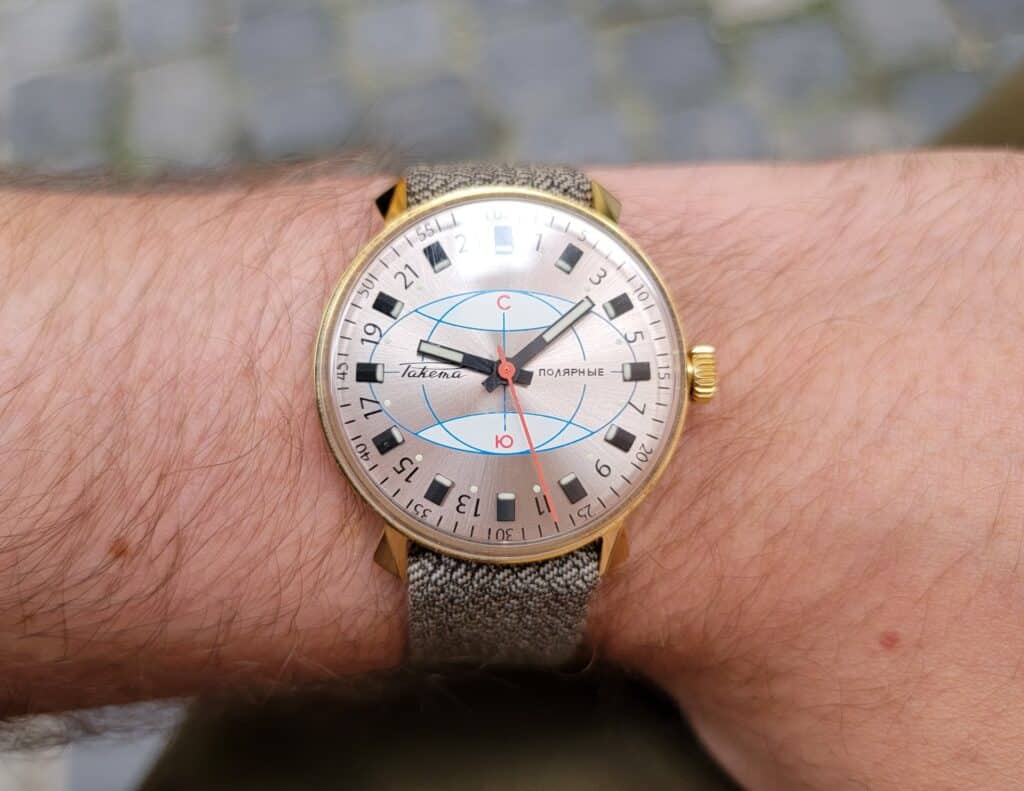
On the wrist, it has more presence than a 35mm watch should. The bezel-free layout gives the dial a lot of visual real estate, and the box-style acrylic crystal adds height and a bit of theatricality without making the case feel clumsy. The gold PVD finish and faceted lugs catch the light in a very period-correct way, while the brushed silver dial shifts to a warmer, almost champagne-like hue depending on the angle. The stylized globe at the center and the Russian north and south markings give it a strong personality, but the outer 24-hour track is what keeps you engaged. With alternating lume dots and applied black markers, it looks a little strange at first and almost Morse-code-like in the dark, yet it becomes quite intuitive once your brain adjusts.
During our hands-on review, we found that the supplied black leather strap is fine, though this one seemed happier on the included NATO or Perlon strap. None of this makes it a modern do-anything watch. The 30 meters of water resistance keeps expectations in check, and the 24-hour format asks for a little patience. But for collectors who like their watches a bit offbeat, quirky, personal, and slightly stubborn, the Polar works.
Pros
- Recreated with unusual faithfulness of a historical design.
- The bezel-free dial and tall acrylic crystal give it more wrist presence than the 35mm diameter suggests.
- The dial has real personality, and the odd 24-hour layout becomes rewarding once you spend time with it.
- Hand-winding suits the watch and adds a satisfying sense of interaction.
Cons
- The 24-hour display is not instantly familiar and takes an adjustment period.
- With only 30m of water resistance, it is not as flexible as a grab-and-go piece.
Juvenia Sextant
| Price: | $4,200 |
| Water Resistance: | 30m |
| Case Dimensions: | 33mm (diameter) x 40mm (lug-to-lug) x 9mm (thickness) |
| Lug Width: | 18mm |
| Movement: | Juvenia caliber 612 (base ETA 2390) |
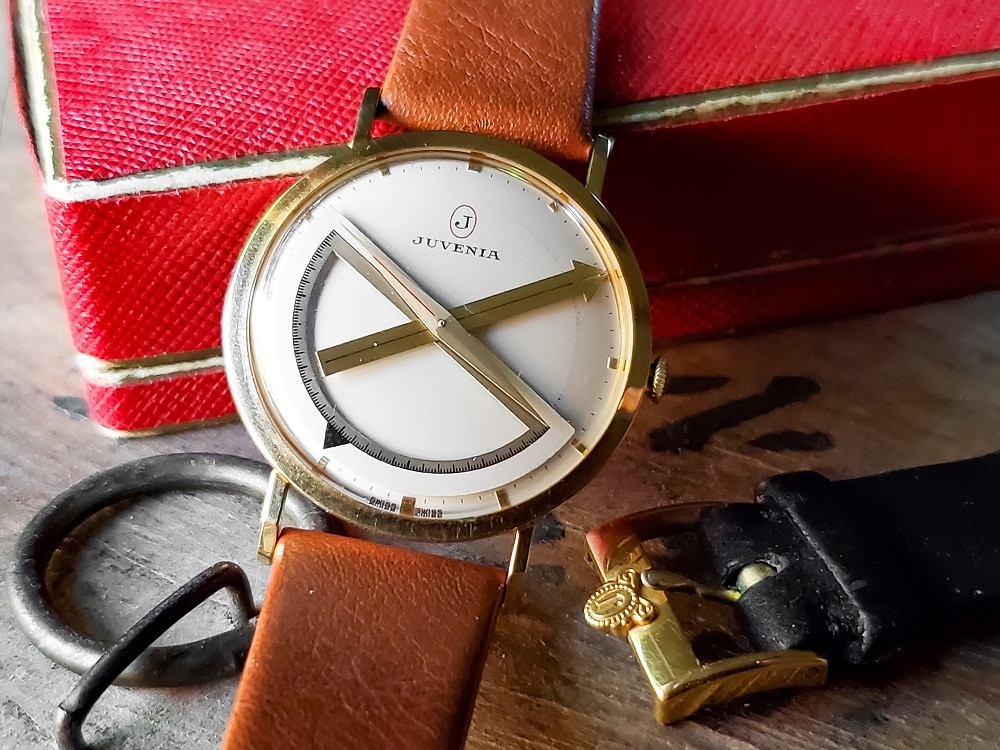
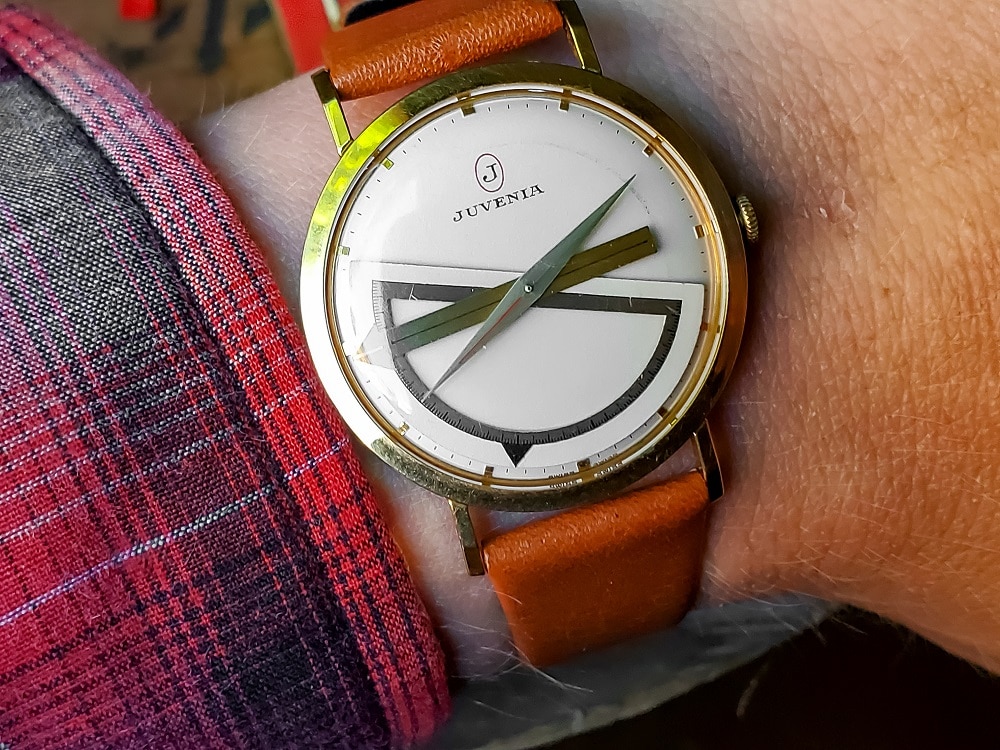
The Juvenia Sextant is the kind of watch collectors end up defending with a little too much enthusiasm once they’ve spent real time with it, which is usually how you know it belongs on a list like this. A lot of that comes down to the dial-side experience. At first glance, the whole thing looks more like a miniature measuring device than a conventional dress watch. The eggshell-white dial has developed a softer, aged tone that adds warmth without trying to manufacture charm, while the applied gold markers around the perimeter keep the outer track legible without cluttering it. The “J” emblem at twelve and the Juvenia signature underneath stay nicely restrained.
Then you get to the handset, if “handset” is even the right word here: a white protractor-style hour display, a gold-plated minute hand shaped like a tiny ruler, and a long silver seconds hand that ties the whole composition together. It’s radical, but not in that forced modern-design way that begs for attention. It feels thoughtful. Reading it is not immediate, and we definitely needed a little time to adjust during our review, but once it clicks, that strange layout becomes part of the pleasure rather than an obstacle.
The case helps that whole experience land. On paper, 33mm sounds like an easy reason to move on, especially if your collection leans toward modern, but this is one of those watches where character does much of the work. The gold-plated case is small, yes, though not anonymous or fragile-feeling on the wrist. At 9mm thick with a 40mm lug-to-lug, it wears light and easy, especially for anyone already comfortable with compact vintage sizing or anyone tired of dress watches that feel visually interchangeable. The signed crown and ornate buckle add just enough detail without going too far, and the 18mm strap width is a quiet blessing, letting you experiment with straps without chasing obscure sizes. The original black leather makes sense, but a simple brown leather option worked well too, especially with the dial’s warmer, lived-in tone.
Inside, the Juvenia caliber 612, based on the ETA 2390, brings a historically cited 47-hour power reserve, which suits a watch like this well enough. Still, this is not the easiest vintage watch to buy casually. Early examples are hard to find, the gold-plated case will not win over every collector, and the unusual display asks for patience. But for someone who wants a watch that says something without raising its voice, the Sextant has the oddly specific charm that lingers longer than the usual safe picks.
Pros
- The aged eggshell dial, applied gold markers, and restrained branding give it a lot of visual warmth.
- Despite the 33mm diameter, the watch carries a surprising personality and presence on the wrist without collapsing into gimmickry.
- At 9mm thick and 40mm lug-to-lug, it stays comfortable, light, and easy to wear.
- The standard 18mm strap width makes strap changes far less annoying than on many odd vintage pieces.
Cons
- Collectors who only wear modern-sized watches may never get past the 33mm case.
- Early examples can be genuinely difficult to track down, making them a tougher oddball buy for casual shoppers.
- Legibility is not instant, and the unconventional display takes time to learn.
- The gold-plated case has a distinct look and won’t suit anyone who wants the quieter feel of steel.
Got a weird watch you think we should’ve included here? Share it in the comments. We’re always looking for the oddballs and unknown designs that somehow make perfect sense once they hit the wrist.

Co-Founder and Senior Editor
Kaz has been collecting watches since 2015, but he’s been fascinated by product design, the Collector’s psychology, and brand marketing his whole life. While sharing the same strong fondness for all things horologically-affordable as Mike (his TBWS partner in crime), Kaz’s collection niche is also focused on vintage Soviet watches as well as watches that feature a unique, but well-designed quirk or visual hook.