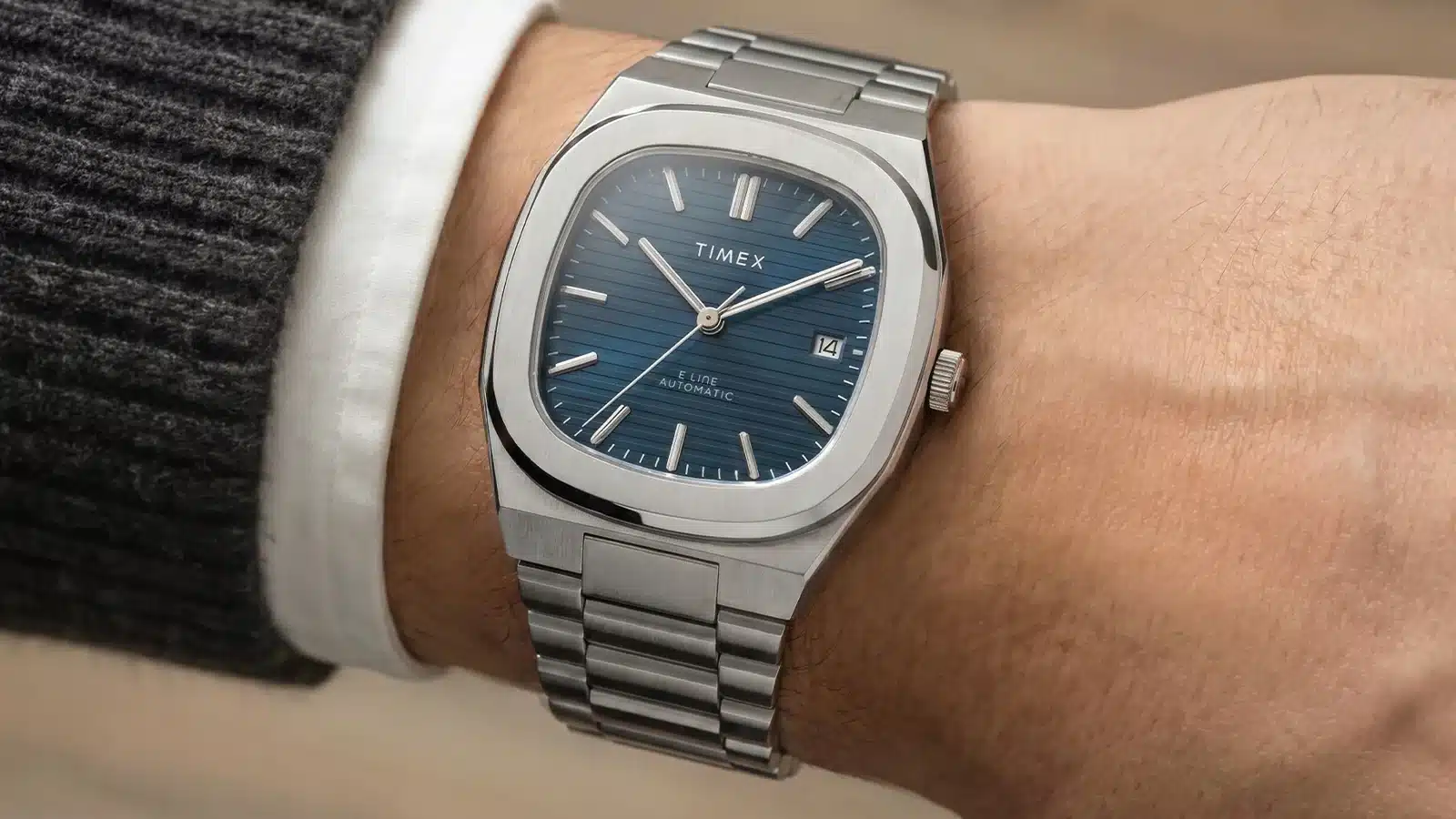
Timex has expanded its Automatic E Line with a new 38mm case, and there’s a good chance the design will look familiar even if the E Line name doesn’t. The original Automatic 1983 E Line Reissue arrived with a 34mm rounded-square case pulled from a relatively obscure corner of Timex history. This new version grows to 38mm and takes that basic shape somewhere more contemporary.
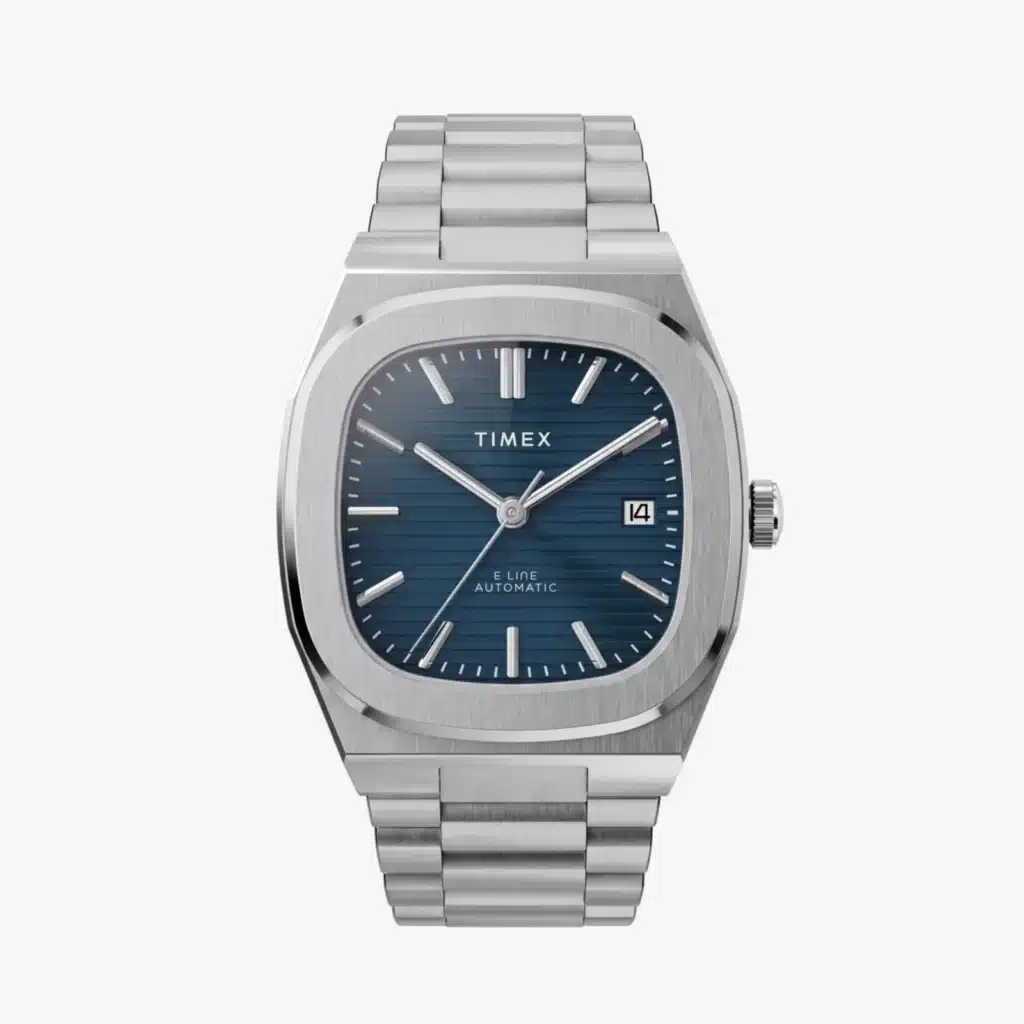
There’s a horizontally textured dial, a stainless-steel bracelet flowing directly into the case, and rounded geometry that inevitably brings the Patek Philippe Nautilus into the conversation. That comparison is difficult to avoid. However, reducing the E Line 38mm to an affordable Nautilus substitute misses some useful context.
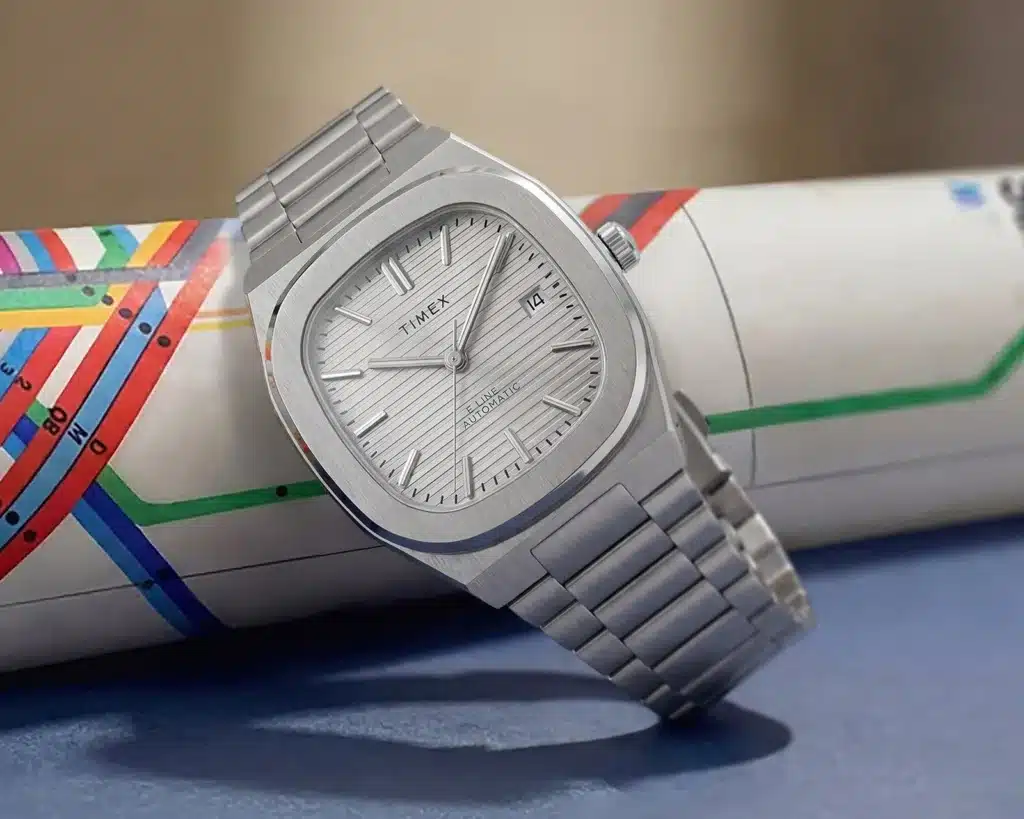
Timex already had the foundation for this watch. The company traces the E Line’s rounded-square “TV Dial” case to 1983, and the previous 34mm automatic reissue stayed considerably closer to that vintage formula. To me, the new model feels more like Timex stretching that existing design into the integrated-bracelet sports-watch territory that remains popular today. We saw a similar approach with the recently covered Q Timex Marbella.
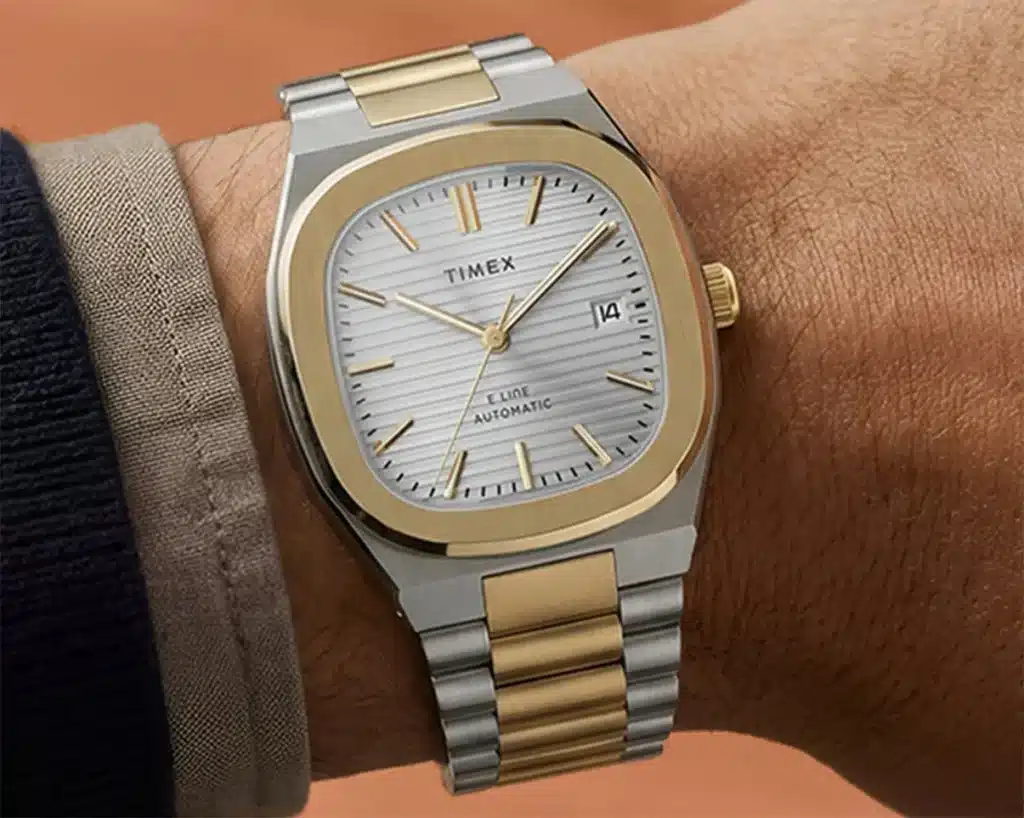
At first glance, I think the balance works. The horizontal dial texture makes the Nautilus association obvious, especially on the blue version, but Timex hasn’t carried every recognizable detail over. The case geometry, handset, markers, bracelet, and overall proportions leave enough distance for the E Line to retain some identity of its own.
The stainless-steel case measures 38mm across, 12.5mm thick, and 45.5mm lug-to-lug. Timex pairs it with a brushed stainless-steel bracelet and butterfly deployant clasp. Water resistance is 50 meters, and an exhibition caseback provides a view of the movement. Timex currently lists the steel versions at $379 and as available for pre-order.
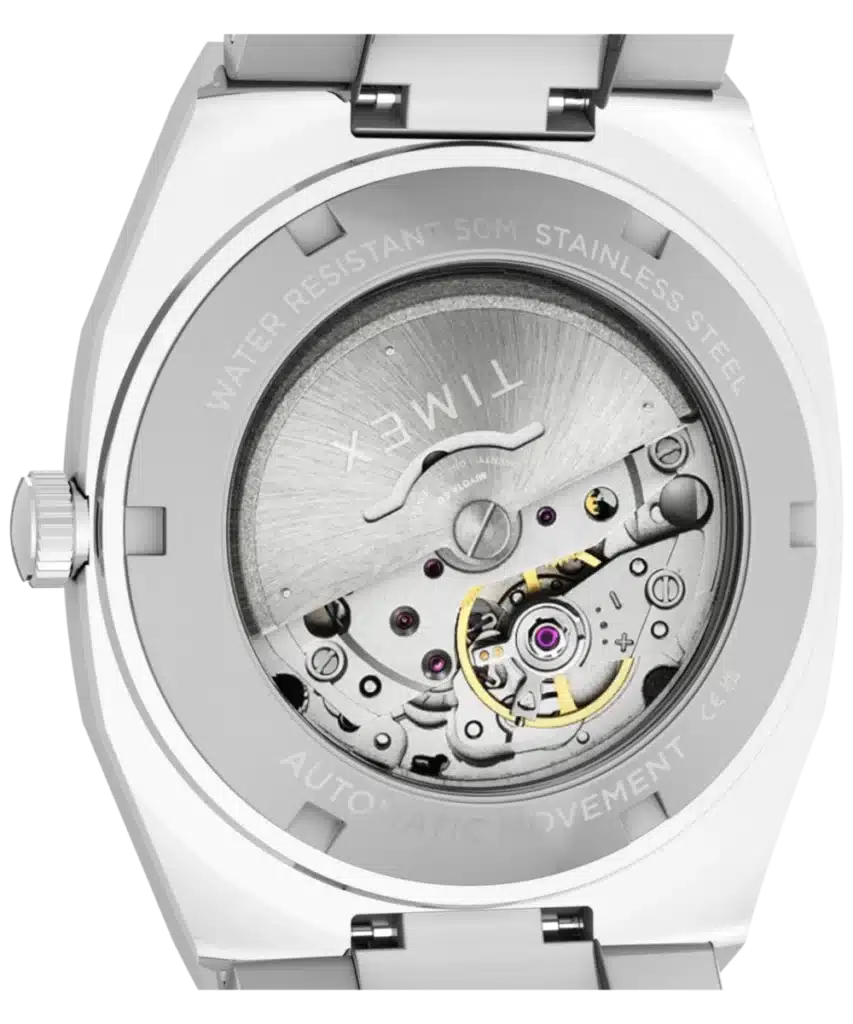
Inside is the Miyota 8215 automatic, the same caliber used in the smaller E Line. Timex specifies 21 jewels and up to 40 hours of power reserve. There’s nothing particularly ambitious about that choice, though at $379 it feels appropriate enough for the package Timex has assembled here.
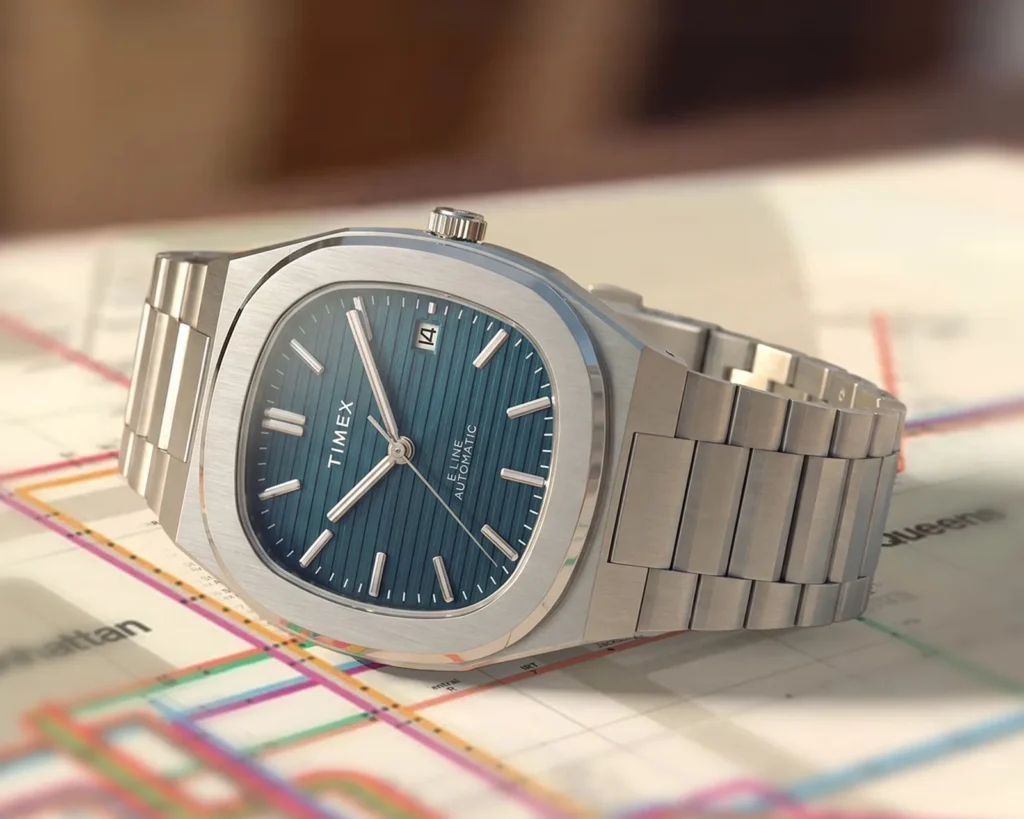
I’m more bummed about the flat mineral crystal. Timex itself acknowledges that mineral glass remains susceptible to scratches, and approaching $400, sapphire would have made a meaningful difference to the overall proposition. This is also a broad, visually prominent crystal sitting over one of the watch’s defining features: that horizontally textured dial.
Still, the bigger story may be what Timex is doing with these designs. The E Line’s history will probably be new information to plenty of buyers. Its visual connection to considerably more expensive integrated-bracelet watches will be much easier to recognize.
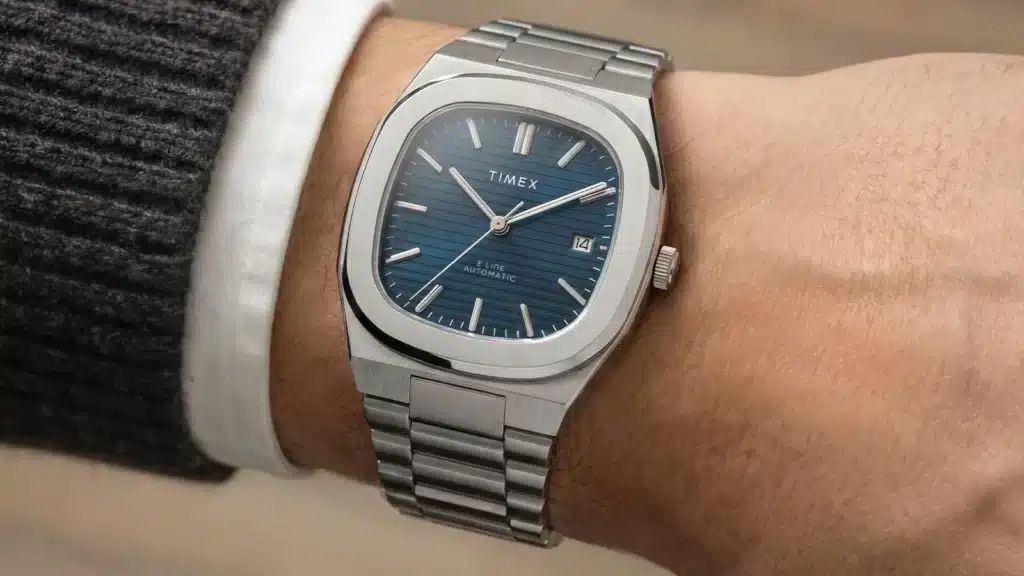
I don’t think that automatically makes the E Line derivative. From what we can see, Timex has found a reasonable middle ground between familiar inspiration and its own catalog history. Whether the bracelet, proportions, and overall execution hold up at $379 will require some hands-on time. For now, the mineral crystal is the one choice that feels harder to reconcile with where Timex has positioned the watch.

Co-Founder & Senior Editor
Michael Peñate is an American writer, photographer, and podcaster based in Seattle, Washington. His work typically focuses on the passage of time and the tools we use to connect with that very journey. From aviation to music and travel, his interests span a multitude of disciplines that often intersect with the world of watches – and the obsessive culture behind collecting them.
Timex is also offering a quartz version of the E line now. I’d be willing to let the mineral glass pass if it comes with the quartz movement and is priced below $200.
Tell me more about the bracelet
It looks nice
I own the original 34mm 1983 E-Line in gold PVD. I am a huge fan. I am looking to add the ice blue dial version as well. Those 34mm versions all have acrylic crystals. For that style of watch, I am glad they went with acrylic instead of mineral glass. It seems Timex only upgrades to sapphire in their more expensive Expedition and Deepwater lines.
Will be cool to have the original and the reissue side by side, Eric. Hope you get it soon.