
We’ve always had a thing for dive watches. They aren’t any random rotating-bezel chunk of steel, but the kind you reach for when you want something rugged, reliable, and meaningful. Over the past 10 years of hands-on reviews, strap swaps, salt-water splashes, and daily wear (yes, even the incidental door-frame scars), we’ve come to realize that the bezel (the rotating ring around the dial) isn’t merely decorative. It’s a living part of the watch. It tells you how long you’ve been submerged, how long your meeting has dragged, or how long your coffee break has taken. And we’ve tested enough divers to know when that bezel works, when it’s just for show, and when it’s downright frustrating.

While testing these pieces, we discovered that a bezel’s feel: how it clicks, how it aligns, and how visible it is, matters more than what a glossy brochure might promise. So, in this blog, we’re going to answer a simple question: Which bezel designs genuinely earn their place on the wrist? If you’re hunting for a diver that promises the utility (and fun) of the rotating bezel without the gimmick, this piece is for you.
Seiko SKX173

The SKX173’s bezel is classic Seiko: a 120-click unidirectional ring that feels tactile without being stiff. It’s not the tightest action you’ll find, but the clicks land with a clear, confident sound that tells you it’s built for work, not display. Even after years of use and testing, the action stays smooth if the gasket’s kept clean. The black aluminum insert maintains a toolish and period-correct look, although it’ll pick up scratches over time. We’ve always seen that as part of its charm. You can swap it easily when you’re ready to refresh or mod the watch, which is something many SKX owners eventually do anyway.
In use, the bezel earns its keep well beyond the water. We’ve used it for timing ramen in the office kitchen and to keep track of parking meters downtown, and it feels as reliable for those moments as it does in open water. During testing, the knurled edge proved to be grippy, even with gloves on. That’s a rare thing at the price point of $400 to $600. After nearly two decades of use, we only needed to replace the gasket once, which speaks volumes about the SKX173’s resilience.
Pros
- Solid 120-click bezel with satisfying tactile feedback.
- Easy to use, even with gloves or wet hands.
- Simple aluminum insert adds vintage charm and modding flexibility.
- Proven long-term reliability with minimal maintenance.
Cons
- Slight bezel looseness compared to higher-end divers.
- The aluminum insert is prone to wear over time.
Seiko Turtle

The Turtle’s bezel is something you expect from a Seiko diver: a clean unidirectional sweep, and the right amount of resistance. Each turn lands with a soft but confident snap, something you start to appreciate when you’ve used enough bezels that grind or slip. However, you can tell it’s not built to impress collectors with microscope-level precision. The aluminum insert keeps that familiar, old-school vibe: functional, easy to replace, and practical. It’s the kind of bezel that feels good to use, not only to look at.
Still, there’s that classic Seiko quirk: alignment. Our review piece had it, too. The bezel insert sits a touch off-center, a minor imperfection that long-time Seiko fans have almost grown accustomed to. It’s annoying, sure, but it doesn’t change how capable the watch feels when you’re timing something that actually matters, like dive intervals, brewing coffee, or a quick pasta boil. For all its minor flaws, the Turtle bezel reminds you why people keep coming back to Seiko. It’s reliable, tactile, and made for everyday wear, not glass cases.
Pros
- Smooth, well-weighted click bezel action.
- Aluminum insert suits the Turtle’s tool-watch character.
- Easy to grip and operate in wet or gloved conditions.
Cons
- Bezel alignment issues persist.
- The aluminum insert can fade or scratch with heavy use.
Glycine Combat Sub

The Glycine Combat Sub’s bezel is a little different from what you might expect on a modern diver. It’s a 60-click unidirectional design with an aluminum insert and a narrow coin-edge rim. The clicks feel deliberate and mechanical: stiff at first, but with zero backplay and perfect alignment against the dial. The bezel sits almost flat, with a subtle bevel that keeps reflections down and gives the watch a slimmer profile. There’s also a small raised nub at 12 o’clock that helps you get a grip on the bezel without looking for it, which is one of those small but thoughtful details that end up mattering in real use.
During our testing phase, we appreciated how the bezel’s precision adds to the Combat Sub’s everyday practicality. The 60-click setup makes it easy to land precisely on the minute, something that feels satisfying when timing your commute or a workout set. While the stiffness can make it tricky to turn with gloves or wet hands, the trade-off is rock-solid stability: you set it once and it stays there. The bezel’s low profile also means it won’t snag on bag straps or scrape against door frames, which makes this watch easy to live with day-to-day.
Pros
- The 60-click bezel provides precise and secure minute alignment.
- Perfect bezel-to-dial alignment and zero backplay.
- Slim profile and beveled edge reduce bulk and glare.
- Raised nub at 12 o’clock improves tactile grip.
Cons
- Bezel stiffness makes adjustment harder with gloves or wet hands.
- The aluminum insert (instead of ceramic) can wear out over time due to heavy use.
Baltic Aquascaphe
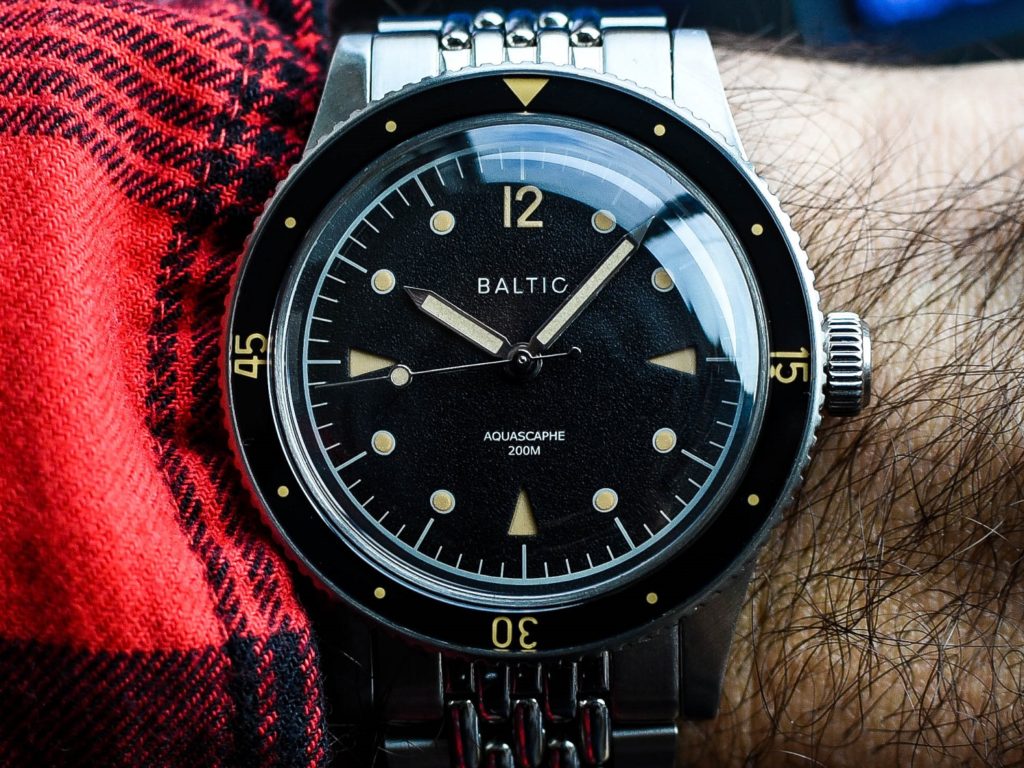
The Baltic Aquascaphe’s bezel is one of its defining features. It features a lumed sapphire insert instead of aluminum or ceramic, providing a glossy depth that complements light beautifully. The sapphire feels premium without being delicate, and the full lume fill means it glows evenly across the scale in low light.
During testing, the click action felt deliberate and smooth, not overly tight or loose. It’s a modern bezel that still channels vintage cues. What stood out most to us in our review was how cohesive the bezel feels in relation to the rest of the watch. The gilt tones on the sandwich dial connect visually with the sapphire insert, creating warmth that’s rare in modern divers.
That same design DNA carries through to other Aquascaphe variants. The GMT version swaps the dive bezel for a 24-hour scale, turning it into a practical travel companion without losing the line’s balanced proportions. Meanwhile, the Dual-Crown model draws inspiration from vintage compression divers, featuring an integrated bezel and a second crown at 2 o’clock for rotational control. Across all versions, the bezel design shows Baltic’s restraint: minimal changes, maximum utility.
Pros
- Lumed sapphire insert adds depth and character.
- Excellent night-time visibility.
- Beautiful integration with gilt dial tones.
Cons
- The sapphire insert can show smudges more easily than matte finishes.
- The bezel edge provides limited grip when used with wet hands.
Scurfa Diver One

The bezel on the Scurfa Diver One feels like it was designed by someone who’s actually used one under pressure. The click action is buttery smooth, yet it locks in with satisfying precision. There’s no wobble or looseness, and each click feels firm and deliberate, with the right amount of resistance to give confidence without fatigue. The teeth along the edge are cut perfectly for grip, offering traction when needed without visually dominating the watch. The aluminum insert keeps the design simple and utilitarian, and the bold font makes timing easy to read at a glance. Even in quick daily tasks, such as timing oatmeal or taking workout breaks, the bezel feels natural and responsive.
While spending hands-on time with it, the bezel pip’s Super-LumiNova BGW9 proved to be a standout feature. It charged quickly and glowed evenly, providing excellent visibility in low-light conditions. This is more than a decorative detail. It’s a real safety feature that also happens to make late-night timing sessions visually appealing. It’s a reminder that Scurfa’s founder is a saturation diver himself, someone who clearly built this watch to perform first and impress later.
Pros
- Exceptionally smooth and solid bezel action.
- Sharp but comfortable edge grip.
- Highly legible aluminum insert with clear timing font.
- BGW9 lume on bezel pip provides strong low-light visibility.
Cons
- The aluminum insert wears faster than the ceramic ones.
Rolex Submariner

The Submariner’s bezel has long set the standard for how a dive bezel should feel. It’s a unidirectional design that glides with near-mechanical perfection—firm, smooth, and absolutely free of back play. Each click feels deliberate, as if every detent was hand-tuned to fall where it should. That precision matters when you’re timing air supply or decompression stops, but it’s as helpful for everyday timing.
The Cerachrom ceramic insert adds depth and durability, featuring engraved numerals filled with platinum that subtly catch light, rather than screaming for attention. Despite being slim, the bezel is easy to grip thanks to a sharply machined coin edge that slightly overhangs the case. That makes it effortless to turn, whether your hands are dry, wet, gloved, or even if you require a quick thumb flick while multitasking.
During our dedicated testing time, we were most impressed by the precision of execution. The raised lume pip at 12 o’clock adds a helpful tactile cue, allowing you to locate the zero mark by touch in the dark or underwater. It’s a small but thoughtful touch that reinforces why the Submariner still feels engineered first, status symbol second.
Pros
- Cerachrom ceramic insert resists scratches and fading.
- Perfect alignment with dial markers.
- Raised lume pip improves tactile use and nighttime visibility.
Cons
- Pricing and availability place it out of reach for most enthusiasts.
- A slim bezel profile may feel delicate to some collectors compared to chunkier tool divers.
Glashütte Original SeaQ

The SeaQ’s bezel feels less like a design flourish and more like a piece of equipment. It’s a unidirectional system, but what stands out is how each click feels. The action is tight, sharp, and deliberate. There’s no drift, no slack, and no “maybe” between positions. When you turn it, you commit. During our time testing this one, we noticed that the first movement meets real resistance, then locks in with a clean mechanical stop. That feels closer to engaging a machine gear than rotating a watch bezel. It’s not playful. It’s serious.
However, that stiffness makes sense when you start using it. Setting a dive interval, tracking a plank, or timing your espresso shot: whatever you throw at it, the bezel doesn’t budge once it’s set. There’s confidence in that; you know the timing you marked won’t shift if your wrist brushes a jacket cuff or hits a doorframe.
The SeaQ bezel doesn’t invite casual spinning like a Submariner. Instead, it forces you to be intentional. It’s a perfect example of a luxury diver built for people who still value the “tool” part of a tool watch.
Pros
- Zero back play with one of the most secure bezel actions around.
- Stiff, deliberate clicks prevent accidental misalignment.
- Feels purpose-built for actual timing tasks, not just aesthetics.
Cons
- Tightness may feel demanding if you’re used to smoother bezels.
- Requires deliberate grip and focus to operate comfortably.

Co-Founder and Senior Editor
Kaz has been collecting watches since 2015, but he’s been fascinated by product design, the Collector’s psychology, and brand marketing his whole life. While sharing the same strong fondness for all things horologically-affordable as Mike (his TBWS partner in crime), Kaz’s collection niche is also focused on vintage Soviet watches as well as watches that feature a unique, but well-designed quirk or visual hook.
Big miss on the Pelagos. Best bezel action ever. Killer matte ceramic insert with lume. 🤦♂️
Oh believe me – we’re very aware of how awesome that bezel is. One of the best. We’d just like to have one in long term for a detailed review before including it in our lists. Just part of making sure things are thoroughly tested and evaluated before getting our thoughts down.
Formex Reef? Hand engraved and interchangeable ceramic bezels.
That’s a good callout. We’d love to try one out.
While I realize any quantitative data risks being unrepresentative, it would be worthwhile to have tested them just to give you an idea of out of the box performance and check for problems. You done have to give actual numbers. The Baltic when I put mine on a grapher was not simply on spec, but so perfect I thought the grapher was broken at first. That doesn’t mean it’s a perfect watch. But it does mean I either got exceptionally lucky or Baltic is an exceptional company. Just a thought. Btw, my favorite watch did not test perfectly out of the box….but still my favorite.
Hi, C.T.
So for this piece we really just focused on the bezels for each timepiece and not so much on accuracy or movement items. Each watch featured here though has a link to our full hands-on review and within that piece you should see accuracy data.
Thank you!
-Kaz