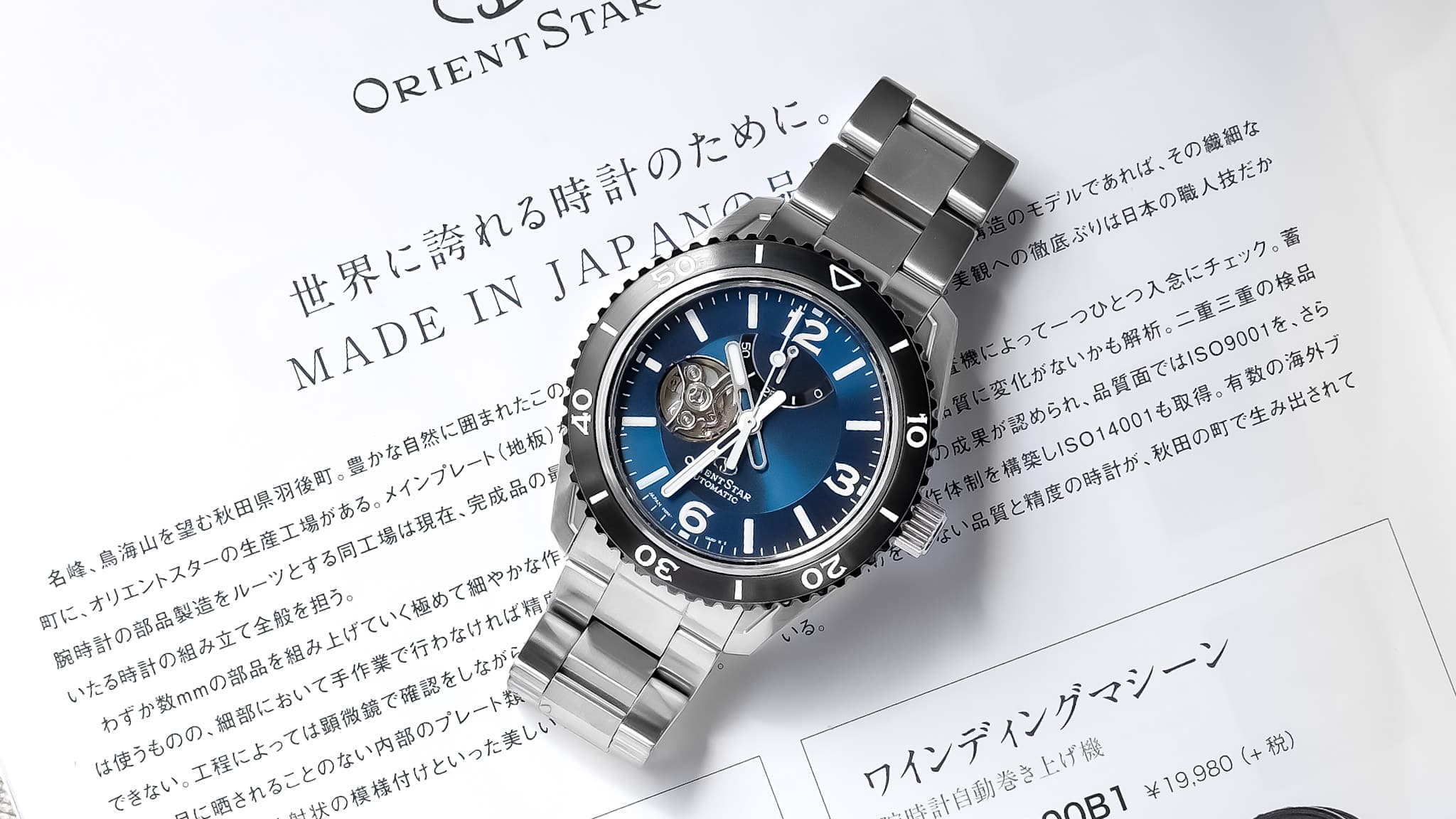
Watch collectors have a fairly generous set of rules for Seiko and a much less forgiving set for Orient. We’ll excuse a crooked bezel insert on a Turtle, complain about it for five minutes, and then spend the afternoon talking about how much we love the case. Ask Orient to charge four figures for a dive-style watch, though, and suddenly we’re inspecting every seam, every click, and every last bit of metal as if the brand has something to prove. The amusing part is that our Orient Star RK-AT0106E really does have some of the hardware we’d like to see Seiko put on more affordable divers. But an impressive list of parts hasn’t settled the argument.
The Seiko Turtle we spent years wearing is the Japanese-market SBDY015, a close relative of the familiar SRP777 and current SRPE93. The Orient Star we imported from Japan is the green RK-AT0106E, a 2019 Prestige Shop model that cost us a little over $1,000 by the time it reached our door. The Turtle promised the familiar comfort and utility that have kept Seiko divers popular for decades; the Orient Star offered color, mechanical theater, and a more ambitious level of finishing. The famous name belongs to the cheaper watch. That’s a more difficult challenge for Orient than it sounds.
Overview and Identity
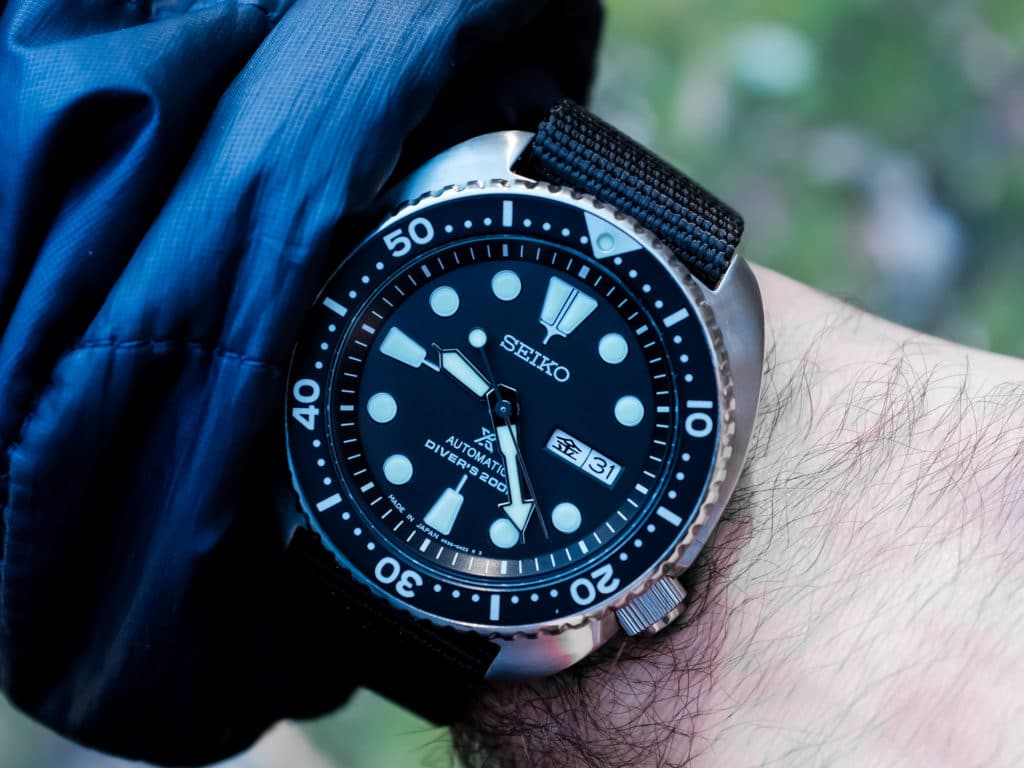
The Turtle owes a lot to the Seiko 6309 divers produced from the late 1970s into the 1980s. When Seiko revived the broad, asymmetrical cushion-case idea in 2016, it didn’t need to invent much of a sales pitch. The silhouette was already recognizable to collectors, and the updated SRP family preserved the things that made the older watches attractive without demanding vintage-watch patience from their owners. Our SBDY015 adds a couple of enthusiast-friendly Japanese-market details, including the Kanji day wheel and the little “Made in Japan” marking. Neither makes the watch demonstrably better. We know that, and we’re perfectly capable of finding them charming anyway. Beneath them sits a straightforward Prospex diver built around very practical choices.
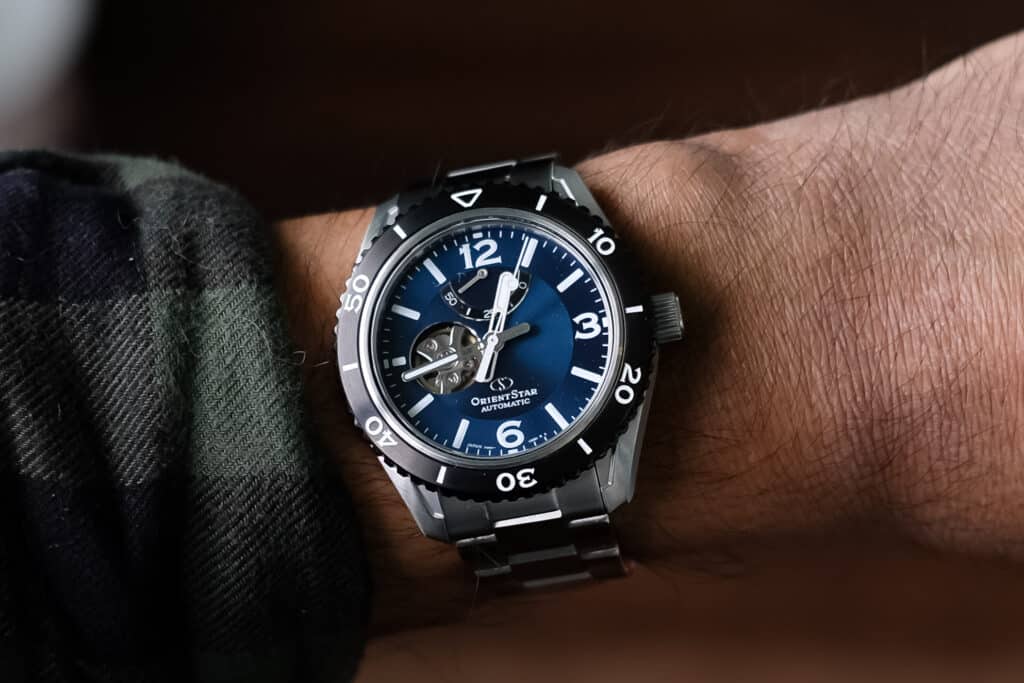
Orient Star comes at the problem from almost the opposite direction. Orient already had the affordable-diver argument covered with watches like the Mako and Ray, so charging roughly $1,000 for the RK-AT0106E demanded something more distinctive than a nicer dial on the same familiar formula. This Japan-market Prestige Shop model uses an open-heart display, a power-reserve indicator, an exhibition caseback, and an unusually expressive green dial to make the mechanical side of the watch part of its appeal. That doesn’t make it Orient Star’s objectively best diver. It does make this a much more ambitious object than the watches that established Orient’s value reputation.
Dial and Straps/Bracelets
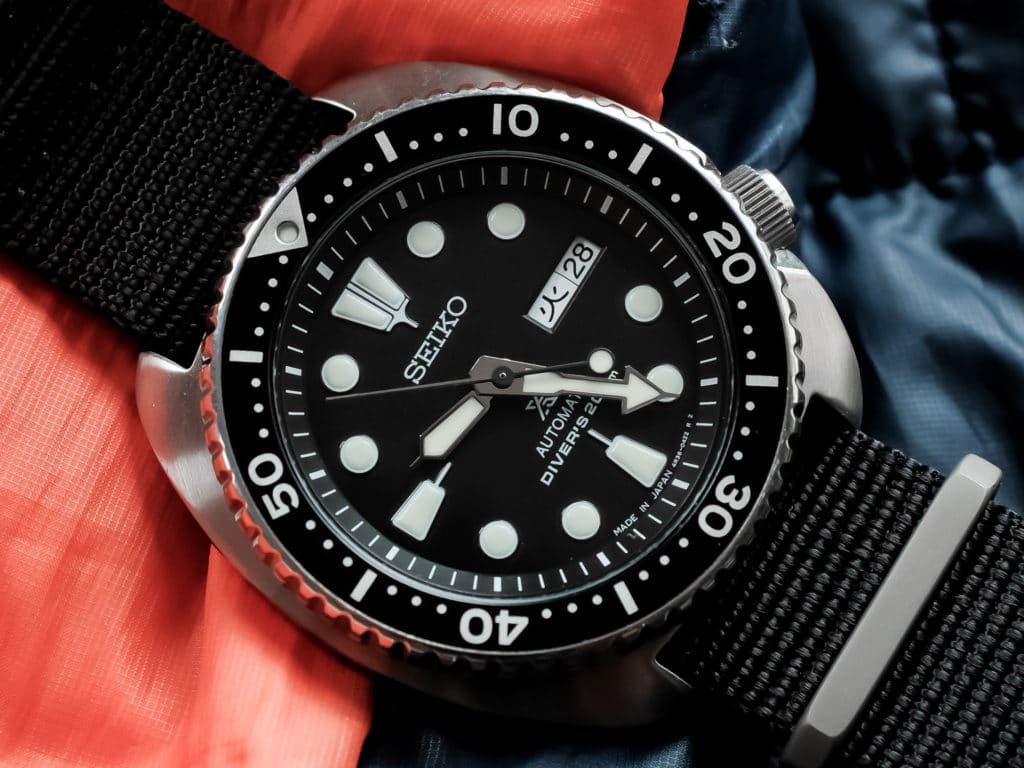
The Turtle’s dial is the kind of design we tend to appreciate more the longer we own watches. Matte black, large hands, thick LumiBrite markers, and a day-date display tucked into a familiar arrangement: nothing here requires a second look to understand what time it is. The Prospex X has always offended some people more than it offended us, and the Kanji day wheel on our SBDY015 makes an otherwise utilitarian watch feel just a little more special. It’s a wonderfully collector-ish detail, given that we’re considerably better at admiring Japanese characters than reading them. Even with that small indulgence, the dial has very little interest in showing off. The hands and markers do their jobs so well that we’ve never wished for another complication.
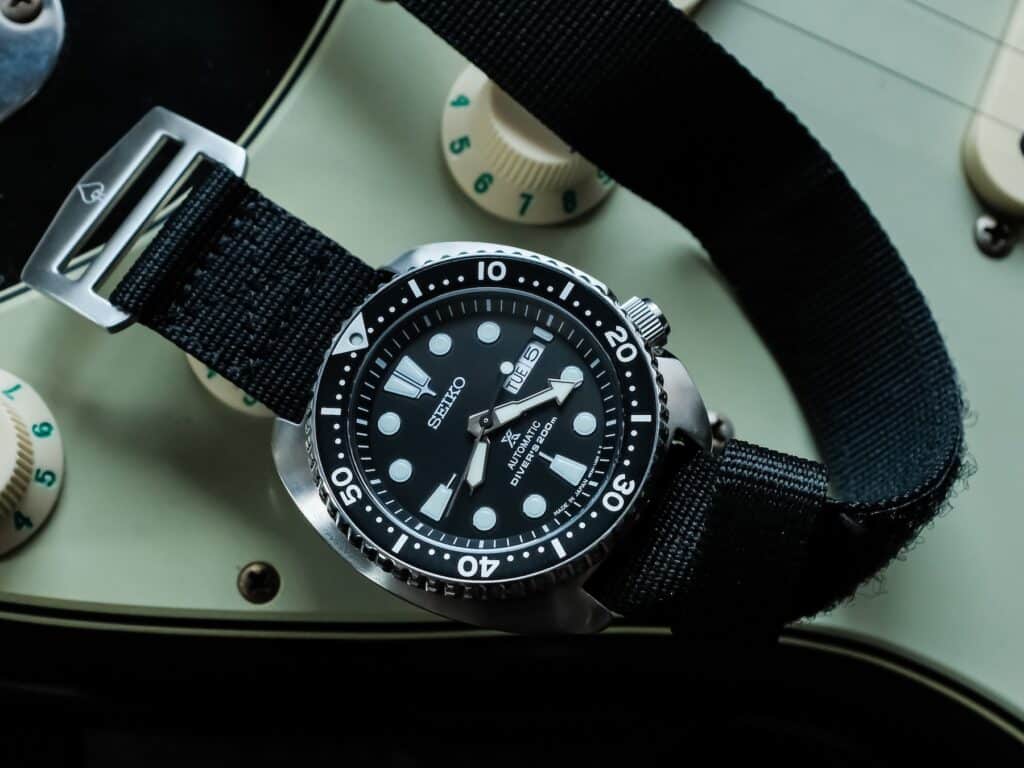
We have just as much affection for how little commitment the Turtle asks of us when it comes to straps. Its original soft, vented silicone strap is genuinely good, with a substantial buckle and steel keeper, but the 22mm lug width makes experimenting almost embarrassingly easy. We’ve worn ours on Ute straps and a titanium-hardware NATO from Prometheus Design Werx, among other combinations, and it never seemed particularly fussy about what was holding it to the wrist. Unlike the steel-bracelet Orient Star, our SBDY015 came on silicone, and we found little reason to change that as a permanent setup. Our favorite thing is how easily the case works with straps we already own, including the cheap ones living in a drawer.
Then there’s the Orient Star’s green dial, which is the reason we paid the money in the first place. Some of its photographs make it look almost blue, while different lighting brings out a deeper green, and the brushed inner and outer sections catch light in ways that keep the color from settling into one predictable shade. Applied bars, numerals at 12, 3, and 6, and a lollipop seconds hand give it some conventional structure. But the balance visible near nine o’clock and the power-reserve display near the top are what make the design distinctly Orient Star. The power reserve is genuinely handy when the watch has been sitting off-wrist. But when a hand passes over the open-heart aperture, reading the time can take an extra beat. The Turtle never asks that of us.
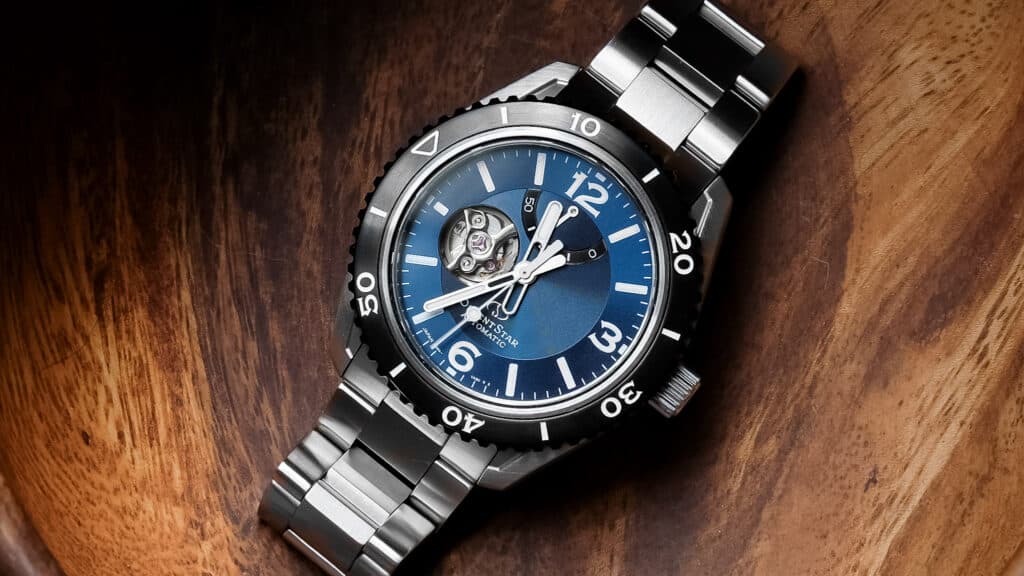
The Orient Star’s bracelet looks and feels like a serious piece of the design. Rounded outer link sections contrast with sharper inner surfaces, the light catches the polished and brushed areas differently, and the clasp combines a stamped outer shell with a milled locking mechanism and three micro-adjustment positions. Unfortunately, it also helps make an already substantial watch feel heavier. We tried a green NATO for a while, and the improvement in comfort was immediate; then we put the steel back on because the watch didn’t look quite right without it. The 21mm lug width isn’t helping matters if, like us, you’ve accumulated far more 20mm and 22mm straps than any sensible person needs. We wish we didn’t have to choose between the bracelet we prefer looking at and the strap we prefer wearing.
Build Quality & Technical Approach
At a distance, these look like two fairly substantial Japanese divers. Up close, they’re trying to please different parts of the watch-collecting brain. The Seiko is concerned with making the basic operations pleasant enough that we stop thinking about them. Orient Star wants us to notice the shape of the case, the decoration of the movement, and the mechanics running beneath the dial. Neither approach is inherently better. With these two, we found reasons to admire both approaches—and several reasons not to confuse sophistication with satisfaction.
Movements
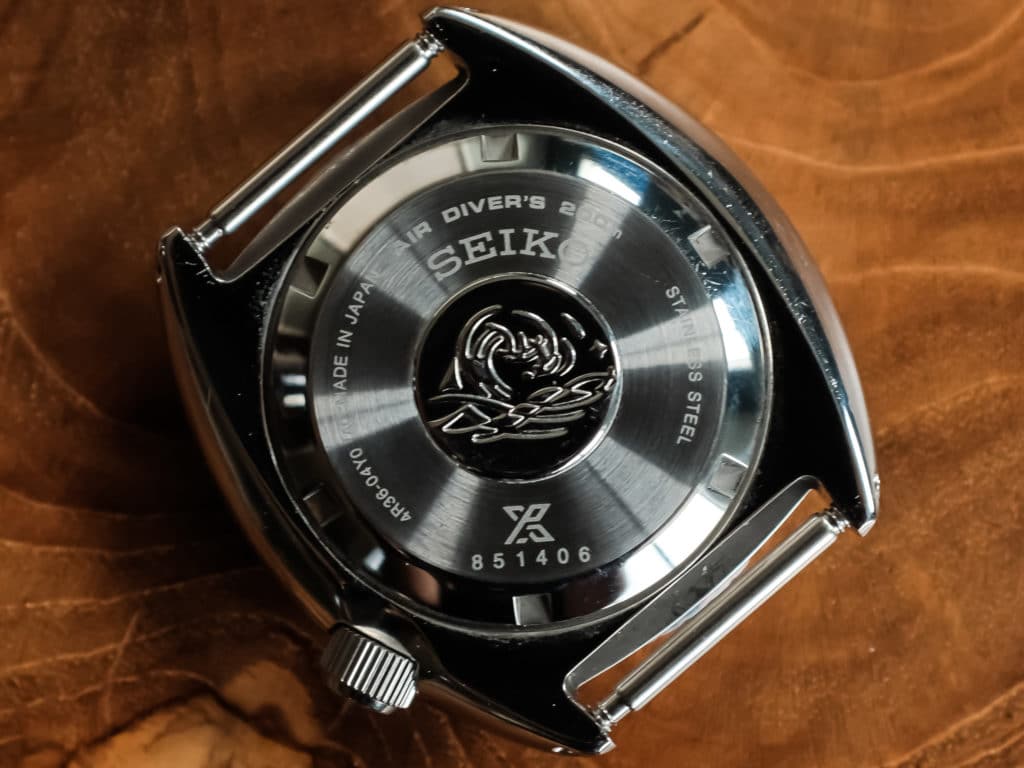
The Turtle uses Seiko’s 4R36, a 24-jewel automatic with hacking, hand-winding, a day-date display, and about 41 hours of power reserve. It isn’t a movement we’d pull the caseback off just to admire, although we’re also not eager to make a dive watch more complicated for the sake of providing a view. The 4R36 has a fairly broad published accuracy tolerance, and our own Turtle performed comfortably within it during the time we reviewed it. If we’ve left it unworn for a few days, we set it again, wind it, and get on with whatever prompted us to wear it. The movement rarely gives us anything to think about, which suits the watch.
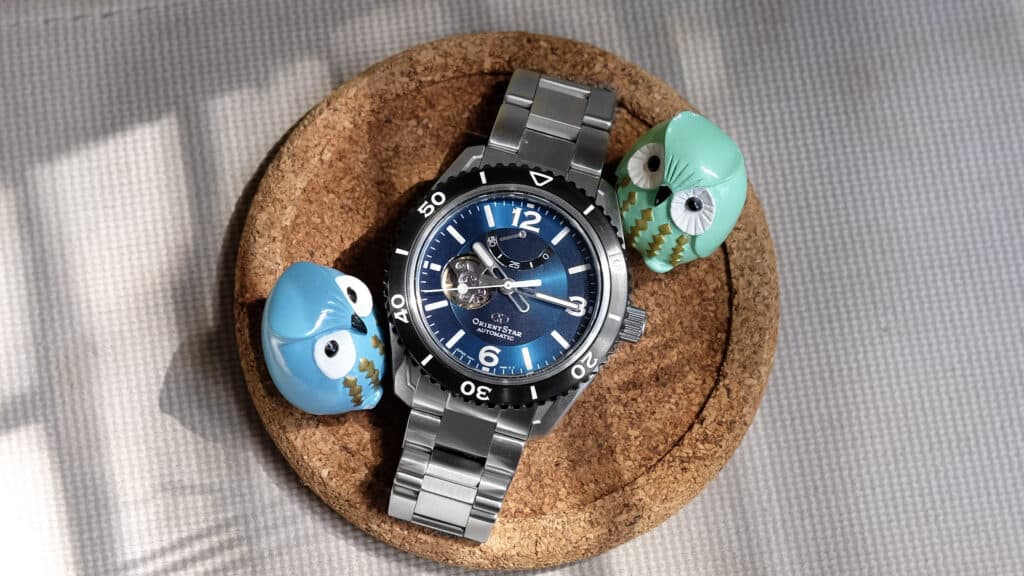
The F6R42 inside our Orient Star has a more interesting personality. Its stated reserve exceeds 50 hours, and the power-reserve indicator makes that extra capacity visible in a way that an ordinary spec sheet can’t. There’s also an exhibition caseback with perlage and striping on the rotor, plus the open-heart view from the front. Nobody should confuse that decoration with haute horlogerie, but we enjoy it. Orient has been making its own movements for a long time, and the F6R42 makes that mechanical identity an everyday part of the watch. Ours has been reliable over years of ownership, so we’re not looking for a reason to question its basic ability to keep time. It’s more engaging than a hidden 4R36, which counts for something in a hobby where almost all of us already own perfectly good phones.
What we can’t give Orient Star is a free pass on the sensations that come with using the movement. Manually winding our RK-AT0106E has always felt a little flimsier than we’d hoped, particularly for a watch that encourages us to interact with its power reserve. Nothing about that has translated into a reliability problem, but it isn’t the satisfying mechanical experience the dial suggests we’re about to have. We don’t expect much ceremony from a 4R36, but the Orient’s dial promises more interaction. At roughly $1,000, the little things start drawing more attention. We can admire a decorated rotor and still wish the simple act of putting energy into the mainspring felt more substantial.
Case Construction, Finishing & Wearability
Our SBDY015 Turtle measures approximately 44.3mm across, 48mm lug to lug, and 14mm thick, which is enough to put off people who haven’t tried one. The newer SRPE93 is officially listed at 45mm, but the familiar case shape tells the more useful part of the story. On a 6.75-inch wrist, its broad shoulders and short reach were easier to live with than the numbers suggested. The lugs are a little longer than those of the old 6309, and we’d have enjoyed seeing Seiko stay even closer to the vintage proportions. It wears like something designed around a wrist instead of a drawing of a watch.
The Orient Star manages the peculiar trick of being smaller across the case and more noticeable almost everywhere else. At 43.2mm in diameter, with a 49.2mm lug-to-lug measurement and 13.7mm thickness, it seems on paper as though it should be no harder to wear than the Seiko. On its steel bracelet, however, Orient lists a weight of 173 grams, against the 124 grams Seiko lists for the silicone-equipped SRPE93. That’s not an equal strap comparison, but it does explain something about the watches as we actually wore them. On the Orient Star, we tended to tighten the bracelet a bit more to keep the weight from moving around, and we remained conscious of the case long after putting it on. It isn’t uncomfortable; it just doesn’t disappear like the Turtle.
Seiko deserves credit for having resisted the urge to tidy all the oddness out of this design. The asymmetrical protection around the crown at four o’clock is instantly recognizable, and the cushion shape still has that slightly oversized, almost friendly quality that makes it work with canvas, silicone, and NATO straps alike. That’s not to say every Turtle is perfectly made. The watch on our wrist had a bezel-alignment annoyance, and the more expensive Seiko variants demonstrate that the company is perfectly willing to sell us additional finishing and specifications when it thinks we’ll pay for them. We find very little missing from the basic case once it’s on the wrist.
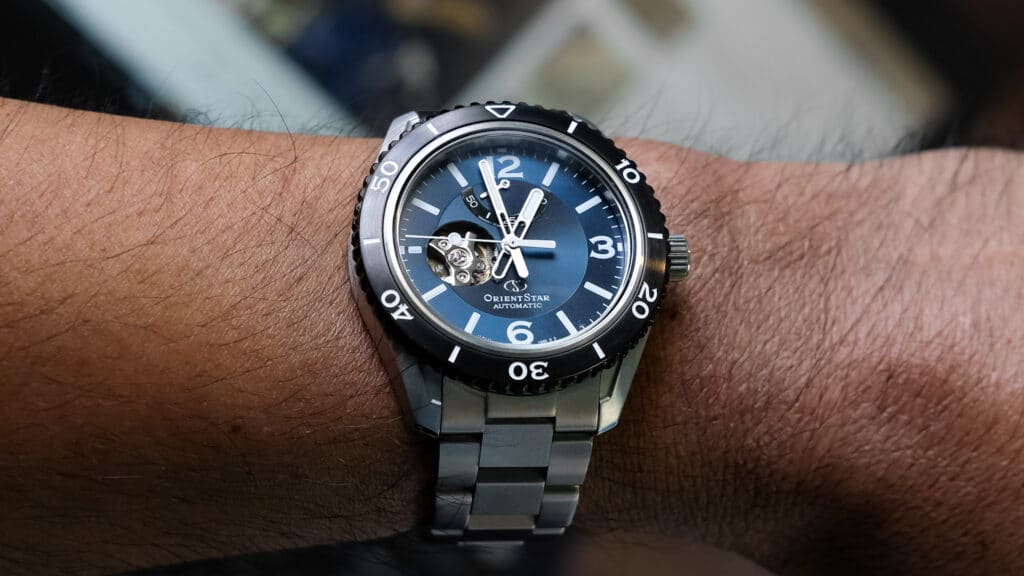
The Orient Star is the more rewarding watch to study in your hand. Little channels cut into the tops of the lugs break up what could have been a fairly featureless slab of steel, and the polished bevels catch light against the brushing in a way the Turtle doesn’t try to match. Orient also softened the underside nicely, which mattered because we wore the watch relatively snug. That’s the finishing we hoped our extra money would buy. The frustration is that an attractive bevel can make a heavy watch more comfortable against the skin without making it feel less heavy. It’s a well-considered case that we’d enjoy more if there were less of it to carry around.
Crystals and Bezels
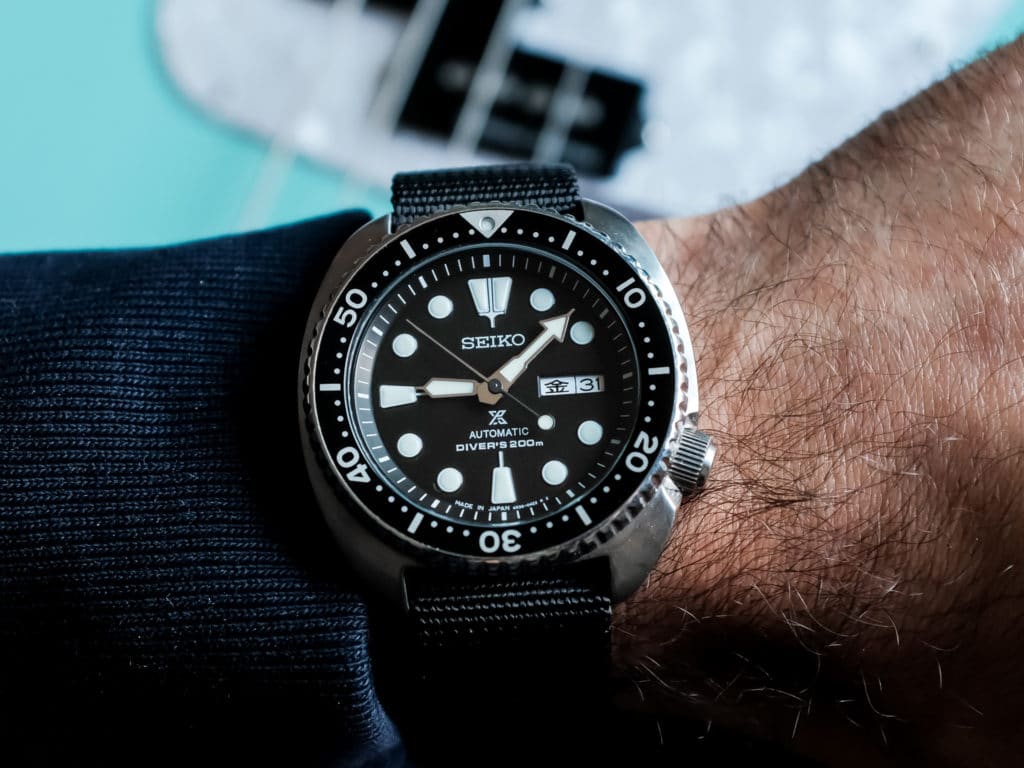
Seiko’s decision to keep using Hardlex on the basic Turtle remains an easy target, particularly now that sapphire has become common on much less expensive watches. We didn’t run into any crystal problems on our SBDY015. We still wouldn’t object if Seiko changed its mind. The aluminum bezel insert fits the watch’s old-school look, and the action itself was pleasantly smooth on ours. Unfortunately, the alignment wasn’t right. We can appreciate the heritage and still find it ridiculous that a modern dive watch with this much experience behind it can leave the factory with the markings slightly out of position. Easy to forgive, perhaps, but hardly excusable.
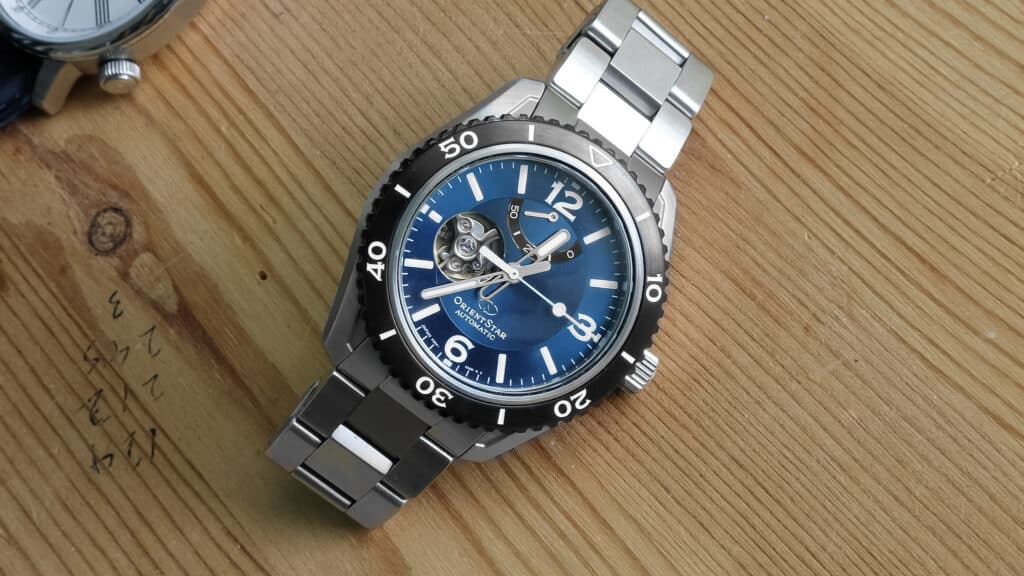
Orient Star gives us a sapphire crystal with an anti-reflective coating, and its bezel is one of the most satisfying parts of the watch to operate. The action on our example is a little heavy and almost sticky between clicks, but there’s virtually no play and none of the loose rattling that can make a rotating bezel feel cheap. The crown has been a less happy story. After years of use, the screw-down threads sometimes won’t catch cleanly, and we’ve had to back out when the action starts feeling metal-on-metal. It may simply need cleaning or service; we can’t diagnose the cause from the sensation alone. Still, it’s a disappointment on a watch we spent this much money importing, particularly when the bezel right beside it feels so carefully executed.
Water Resistance & Lume
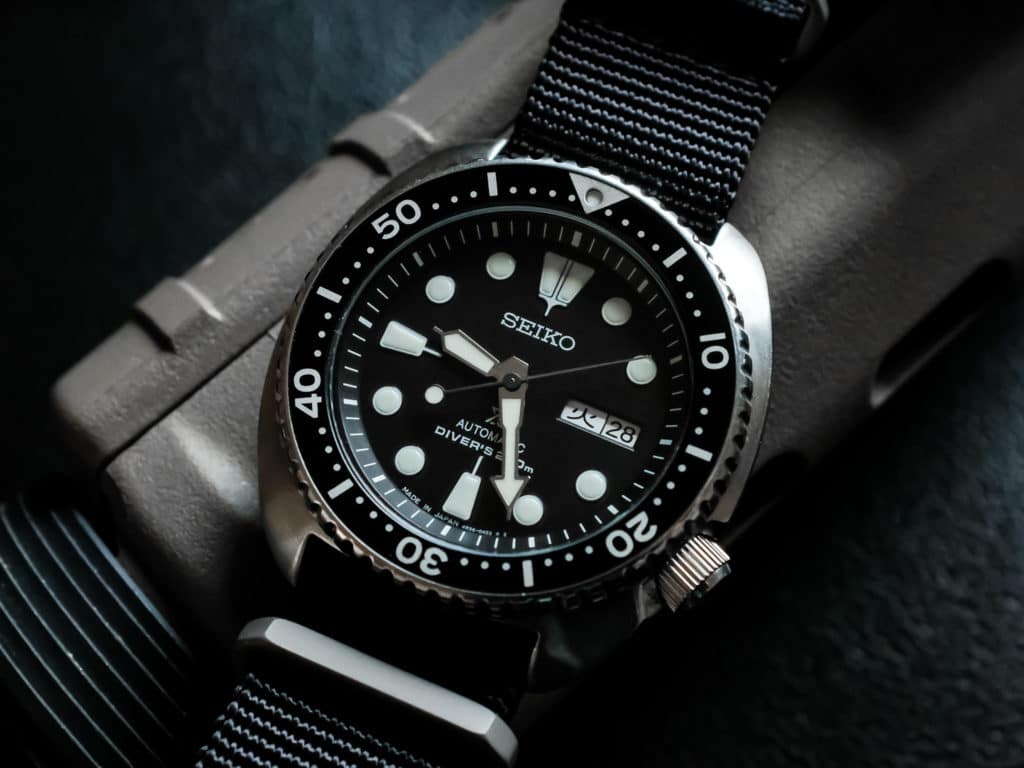
The Turtle is a proper 200-meter Prospex diver, and Seiko explicitly describes the current SRPE93 as meeting ISO standards for scuba diving. The asymmetrical case protects its screw-down crown, the rotating bezel is easy to understand, and the generous LumiBrite makes the hands and hour markers almost impossible to confuse when we glance down. Most of our wear is considerably less demanding than scuba diving, but we appreciate the distinction. Its dial is organized around reading elapsed time and the time of day quickly, without any extra movement hardware asking us to admire it first. That’s an underrated pleasure when a watch is supposed to be a tool.
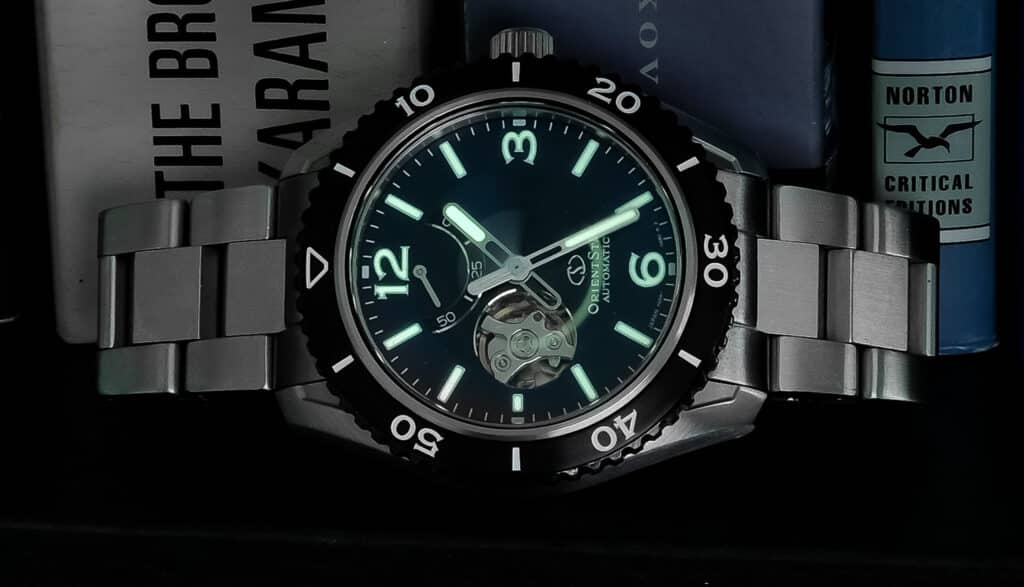
Orient officially rates the RK-AT0106E to 20 bar and provides a unidirectional bezel, luminous hands and markers, and the sort of substantial construction we’d expect of a serious sports watch. The lume on ours is good; the hands and markers can be impressively bright when we come in from outside. But Orient’s published 20-bar rating isn’t the same thing as Seiko’s explicit ISO dive-watch designation, and we shouldn’t turn two similar-looking numbers into an unsupported certification claim. The open-heart aperture and power reserve also make the dial busier before either watch goes near water. We enjoy those details on the Orient Star. We simply don’t confuse enjoying them with getting a more effective dive-watch layout.
Cost Considerations
The price gap needs one qualification. Seiko currently lists the SRPE93 at $525; our long-term Turtle is the related Japanese-market SBDY015. Earlier reissues could be found for around $475 or less, depending on when and where you bought one. We paid a little over $1,000 to import the RK-AT0106E in 2019, when it carried a ¥100,000 pre-tax Japanese price. Those aren’t two receipts from the same shopping trip, but the spending decisions are meaningfully different.
Around $500, we expect a good watch, not a faultless one. There’s room to be irritated by a flaw without feeling the entire purchase was misguided. That shouldn’t let manufacturers off the hook; they still have an obligation to get the basics right. But when an affordable watch works its way into regular rotation, we’ve found that its smaller imperfections tend to matter less than what we paid for it.
At $1,000, that tolerance starts wearing thin. We find ourselves asking what the extra money is doing for us after the new-watch excitement is gone. It isn’t enough to point to a more elaborate package and add up the upgrades; we want to enjoy those differences often enough to justify the bill. Orient Star clearly put the money somewhere. Whether those choices were the ones we’d pay for again is a different question.
And that extra $500 could have bought another perfectly respectable watch, paid for a service, or stayed in the account until the next temptation appeared. We don’t shop with anything approaching that level of discipline, but we do think about it after the fact. Opportunity cost has a nasty habit of becoming obvious only when the thing you spent more on has spent a few weeks untouched.
Of course, nobody gets into watch collecting to maximize enjoyment per dollar like it’s a retirement spreadsheet. Wanting an unusual watch for reasons that don’t survive a rational cost comparison is practically part of the hobby. The Orient Star can be worth its premium to someone who wants precisely what it offers. For us, the harder question isn’t whether the extra money bought more watch. It’s whether it bought enough more enjoyment.
Final Thoughts: Seiko Turtle vs Orient Star
The Turtle doesn’t need us to pretend it’s perfect. Our SBDY015 had a poorly aligned bezel, it still wore a Hardlex crystal, and the 4R36 isn’t going to impress anybody who buys watches to admire high-end movement finishing. We also know the 45mm figure is enough to put some collectors off before they even try one on. Yet the case fits us far better than those measurements suggest, the dial never gets in the way, and the watch seems perfectly happy to be worn on whatever strap happens to be nearby. We found reasons to buy and sell earlier Turtles. The Japanese-market example is the one that finally stayed. That tells us more than another round of specifications could.

We can make a stronger case for the Orient Star than someone looking only at the brands and prices might expect. The RK-AT0106E has a dial we still love, more considered finishing than the Seiko, an engaging movement, and a bracelet that feels like a deliberate part of the design. We’ve admired it for years, even as its flaws have become more apparent. The crown issue is specific to our example and may be service-related, so we aren’t going to turn it into a sweeping verdict on Orient Star’s build quality. The size and weight are harder to explain away. No amount of beautiful dial work changes the way that weight sits on a wrist.
Orient Star can absolutely build a more visually engaging, more elaborately finished watch than an affordable Turtle. Our RK-AT0106E proves as much. The extra cost hasn’t made it the better dive watch to use or the more satisfying one to wear regularly. We’d take the Turtle’s legibility, proportions, and straightforward character over the additional decoration for that job. Anyone buying primarily for the dial and exposed movement could reasonably choose the Orient. We’d encourage trying it on the bracelet first; that’s where our enthusiasm grew more complicated.
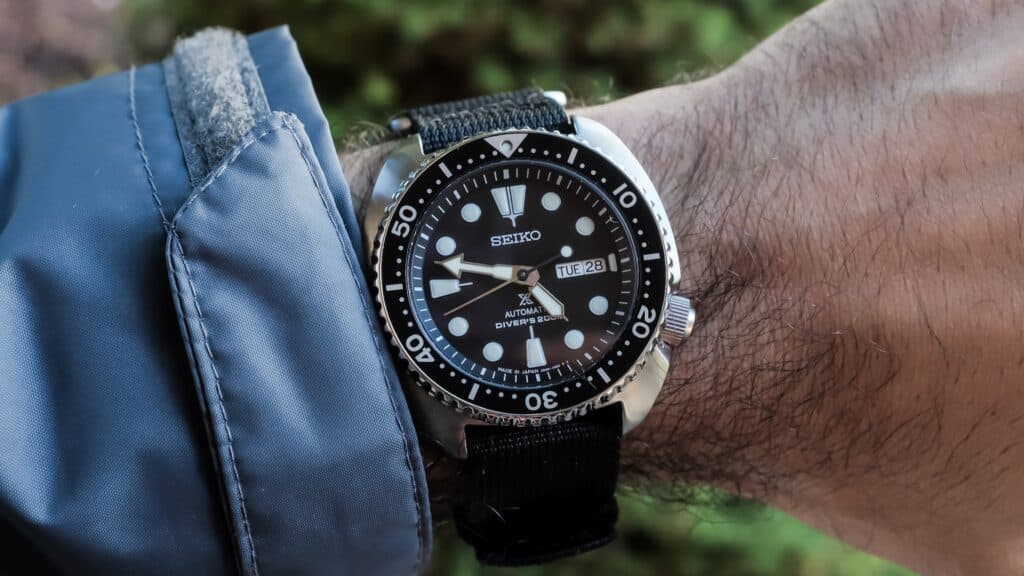
Our pick is the Seiko Turtle. The cheaper watch doesn’t deserve to win on principle alone. The Orient is genuinely nicer in places, and there are moments when looking at that green dial reminds us exactly why we imported it. But after living with both, we care more about which watch we’re happy to put on without a second thought. We wish the Turtle had a better-aligned bezel. We wish the Orient Star carried some of its ambition a little more lightly. Only one of those wishes regularly changes what we reach for.

Co-Founder and Senior Editor
Kaz has been collecting watches since 2015, but he’s been fascinated by product design, the Collector’s psychology, and brand marketing his whole life. While sharing the same strong fondness for all things horologically-affordable as Mike (his TBWS partner in crime), Kaz’s collection niche is also focused on vintage Soviet watches as well as watches that feature a unique, but well-designed quirk or visual hook.