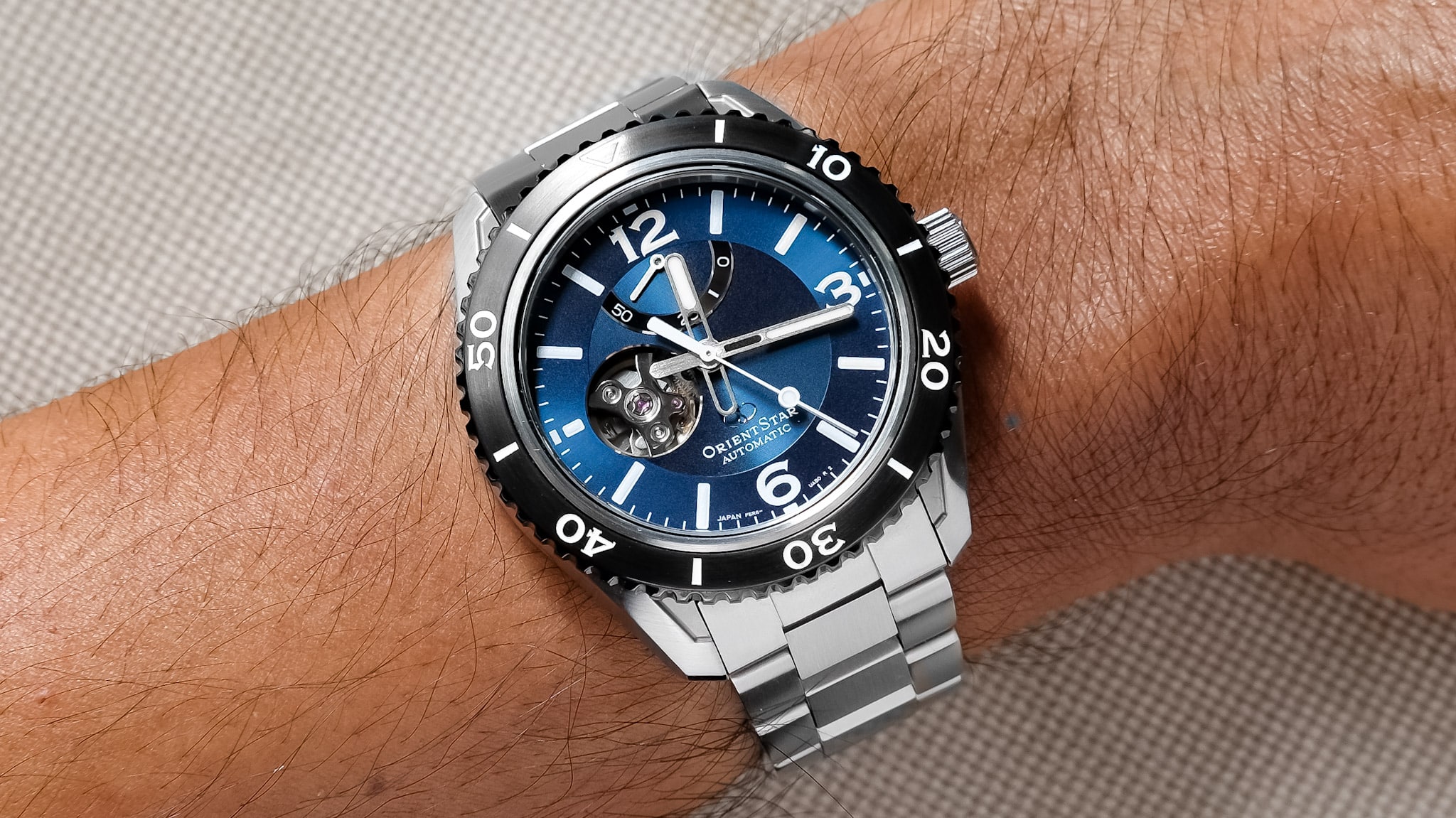
Most watch reviews tell you what something feels like after a week or two. We’ve had this Orient Star RK-AT0106E for several years now, which is long enough for the initial novelty to wear off, for us to experiment with different straps, and even for a few things to start showing their age. Interestingly, the part of the watch that originally convinced us to buy it is still probably its strongest feature.
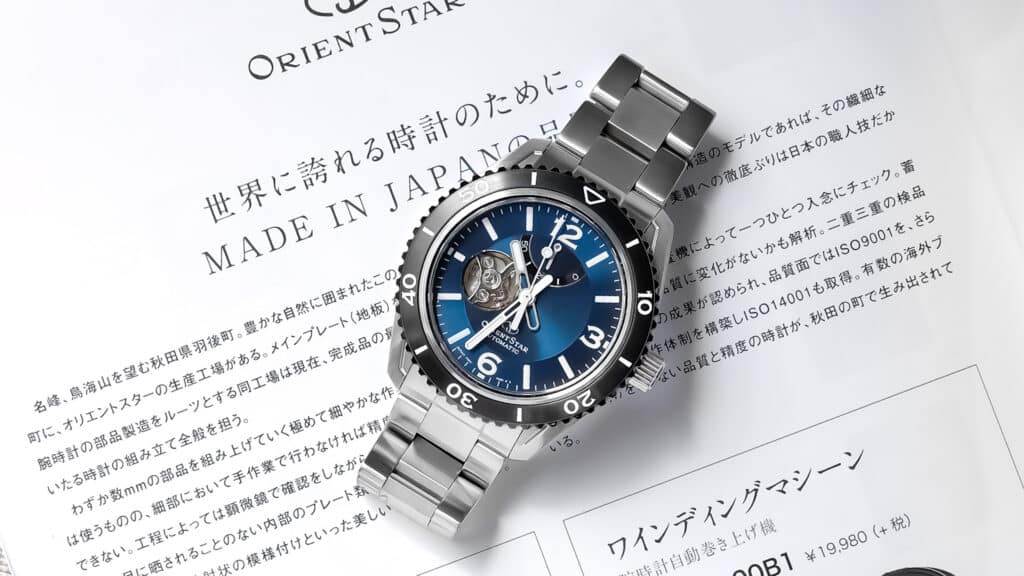
When this model was new, we paid just over $1,000 in 2019 to import it from Japan through SeiyaJapan. Ours is the green RK-AT0106E, a JDM Prestige Shop-exclusive model that originally carried a ¥100,000 pre-tax retail price, which after currency conversion and import costs put our total slightly over $1,000. That put it in a very different position from the affordable Orient divers we were already familiar with. Orient has spent years making watches like the Mako and Ray that could comfortably compete with Seiko at the inexpensive end of the market. Orient Star was asking a different question: what happens when Orient tries to build something closer to a luxury Japanese sports watch?
After living with this one for years, Seiko is still the comparison we keep coming back to. Not because this open-heart Orient Star is a direct Prospex equivalent, but because Seiko has become exceptionally good at making large dive watches feel much better on the wrist than their dimensions suggest. Orient Star gets surprisingly close to Seiko in some areas. In others, you can feel the difference almost immediately.
The Case Is Large, but It Doesn’t Pretend Otherwise
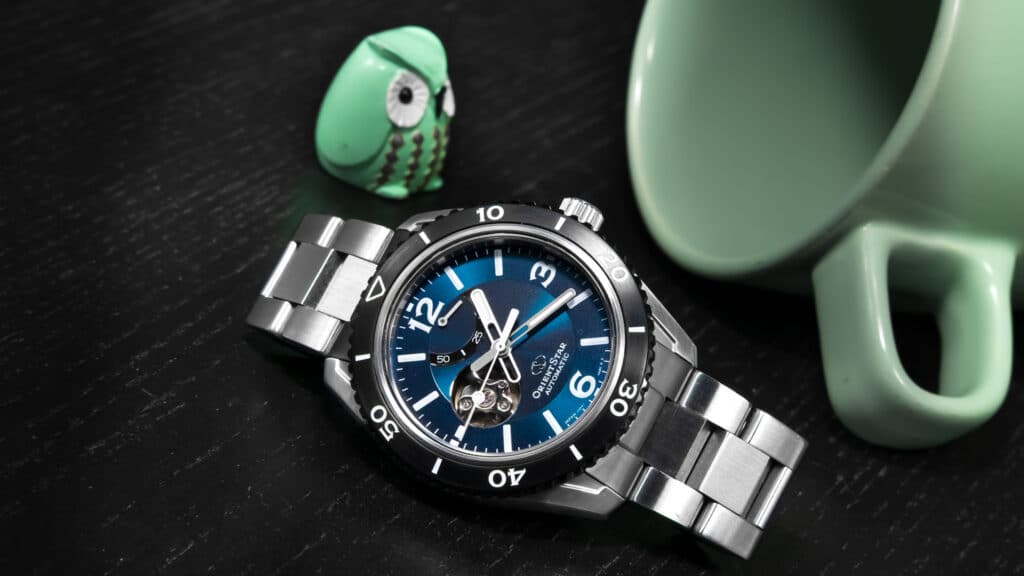
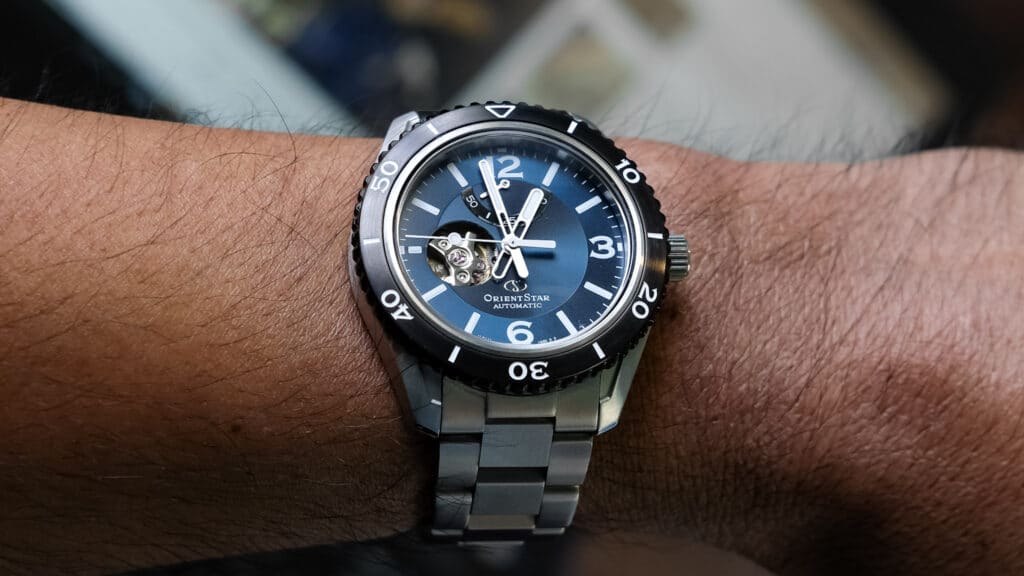
At 43.2mm wide, 49.2mm lug-to-lug, and 13.7mm thick, this is a large watch, and on a 6.75-inch wrist the thickness is especially noticeable. It never crossed over into feeling unwearable or badly balanced for us, but there is no trick here that suddenly makes 43mm feel like 39mm. It wears like a large watch, and because of the weight we usually ended up wearing it a little tighter than we might wear something smaller.
The more interesting part is that Orient Star seems to have understood exactly how much metal it was working with. Just beneath the black bezel, the tops of the lugs have these small channels cut into them that break up what otherwise could have looked like one uninterrupted block of steel, and there is some genuinely nice beveling around the edges of the case. The polished beveling underneath matters even more in actual wear. Since we tended to keep the watch fairly snug, that softer, contoured lower edge kept it from digging into the wrist in the way some thick sports watches can. Orient isn’t disguising the size here. It seems more concerned with making all of that metal interesting to look at and comfortable against the skin.
That is one of the first places where the Orient Star name starts to make sense. The finishing is more deliberate than what we would expect from a basic Orient diver, and the combination of polished and brushed surfaces gives the case a lot more going on visually. It is clearly supposed to look and feel like something further up the ladder from a Mako or Ray, and from a finishing standpoint, we think it does.
Bezel and Crown
The bezel is much simpler than the case. It is black with white markings, easy to read, and doesn’t try to do anything especially clever with the scale. What stood out more was the way it feels. A lot of Citizen Promaster bezels, for example, have a very crisp, obvious click to them, while this feels heavier and more friction-driven. The clicks are still there, but there is a slightly sticky resistance between them that makes the whole thing feel firm rather than snappy. We actually like it. There is basically no play in our example, nothing jingles or shifts around, and turning it gives the impression that you are moving something substantial.
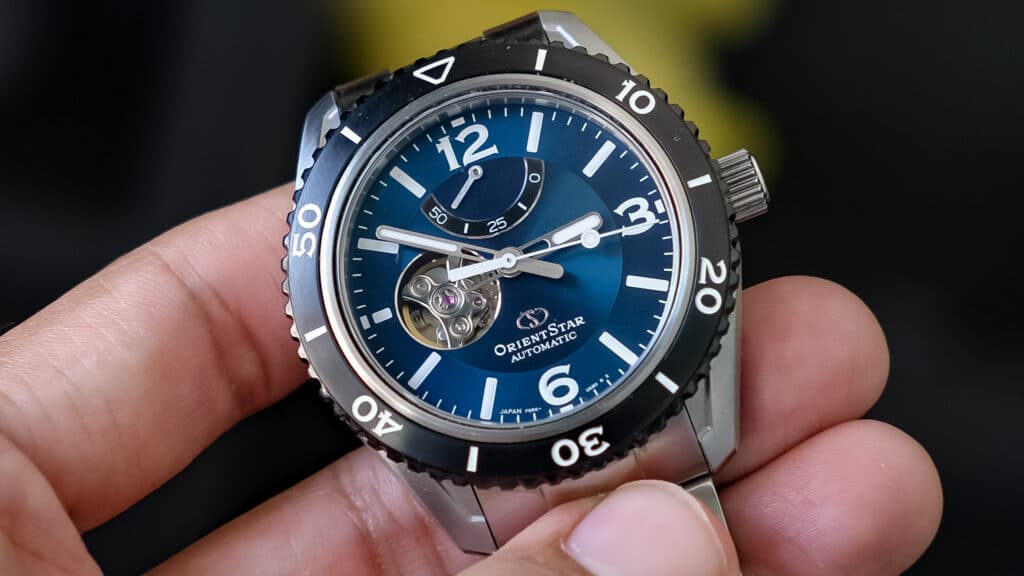
The crown has aged less gracefully. It is a good size and easy to grab, and when the watch was newer the screw-down action worked perfectly well. Over the years, ours has become increasingly difficult to screw back in. Sometimes the threads seem reluctant to catch, and if we keep turning there is an unpleasant metal-on-metal sensation that makes us stop, back the crown out, and start again. The watch could simply be due for cleaning or service at this point, so we aren’t going to pretend we know exactly what caused it. We can only say that we’ve owned other divers for comparable stretches of time without running into the same problem to this degree, and considering what we paid for the Orient Star, it has been disappointing.
The Dial Is Still Why We Like This Watch
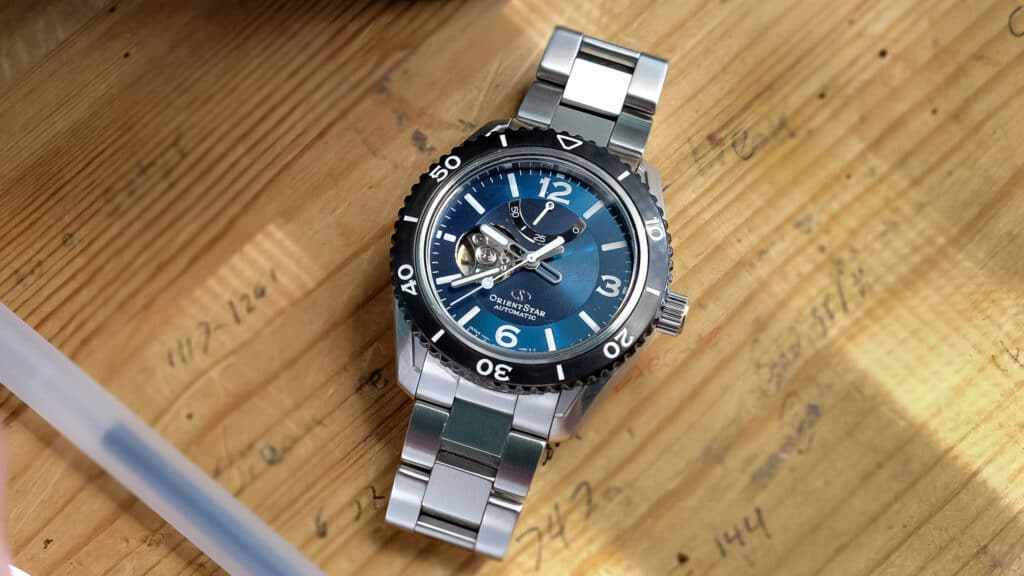
The dial is why we bought it, and several years later it is still the part of the watch that can make us forget some of the other complaints. We have an obvious weakness for teal, blue-green, and anything living somewhere between those colors, and this dial changes quite a bit depending on the light around it. In product photography it can look much bluer than it does in person. Take it outside, or put it under warmer indoor lighting, and much more green starts coming through. The inner and outer areas of the dial also seem to be brushed differently, so light can catch one portion while the other darkens, which gives the whole thing quite a bit of depth.
That isn’t something we noticed during the honeymoon period and then stopped caring about. There are watches where the thing that initially caught your attention eventually becomes background noise, but this one can still make us look down at the wrist and enjoy the color for its own sake. The applied bar markers are large, the Arabic numerals at 12, 3, and 6 give the dial some structure, and the lollipop seconds hand is another detail we still like. The hour and minute hands are also very prominent from the center outward, with enough lume and surface area that, at least initially, this looks like it should be an extremely legible sports watch.
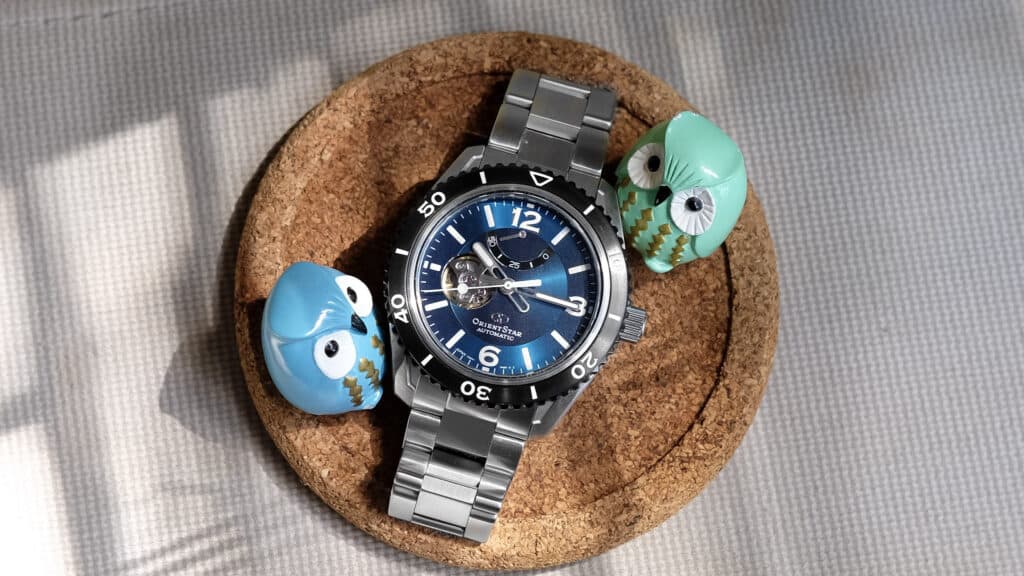
Then you get to the features that make it distinctly Orient Star. The 9 o’clock area is opened up to show the balance, while the power-reserve display occupies a noticeable amount of space near the top of the dial. We understand why Orient Star likes both. Orient has been making its own mechanical movements for a long time, and putting part of the mechanism on display makes that a literal part of the design. We also genuinely like the power reserve. When this watch has been sitting on a stand for a while, it is convenient to look over, see that it has dropped to zero, and realize we should probably wind it or put it back into the rotation.
Those same features interfere with the legibility that the rest of the dial is working so hard to create. The hour and minute hands have fairly long tails extending behind the center, and when one of those tails happens to pass across the open-heart aperture, it can take a fraction of a second to register which end of the hand you are actually supposed to read. You get used to it, and we’re not suggesting the watch is difficult to tell time with, but for something borrowing so heavily from dive-watch design, it is noticeable. Orient built in large markers, substantial hands, good lume, and then added two of its most recognizable Orient Star features into the same space.
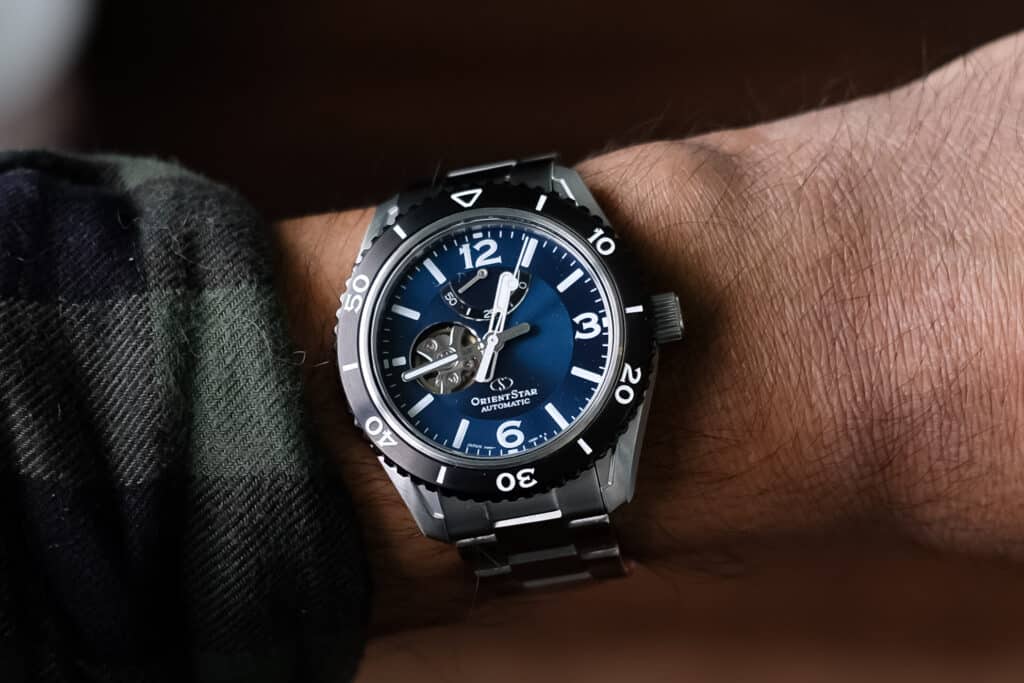
That conflict is actually a pretty good explanation of this watch as a whole. A simpler Orient or Seiko diver is probably a better pure tool watch. This is more interested in being visually interesting. It has the bezel, water resistance, lume, and overall architecture of a diver, but the dial also wants to show off color, movement, and finishing. In our case, that’s the reason we bought it, so complaining that the dial should have been completely stripped back would miss the point. If you already dislike open hearts or Orient Star’s power-reserve displays, though, this one isn’t going to change your mind.
Lume
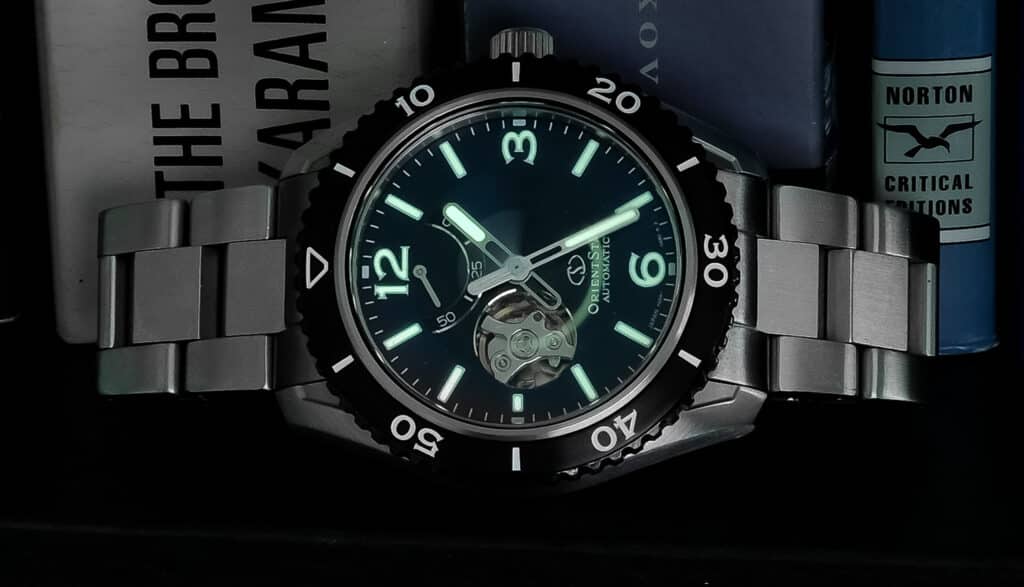
The lume is good, and there have been plenty of times where we’ve walked inside after being outdoors and gotten that bright little burst of what is basically daytime lume from the hands and markers. It works perfectly well for normal use, but this is another area where the Seiko comparison is difficult to avoid. We still own a Seiko Sumo SBDC033, and the lume on that watch is plainly stronger. That’s less an indictment of the Orient Star than another reminder of something Seiko has become exceptionally good at.
The Bracelet Is Nicely Made, but It Doesn’t Help the Size
The bracelet is one of the better arguments that this is more than an expensive version of a normal Orient. The outer portions of the links have a rounded, almost pill-like shape, while the inner sections are much more angular, and those surfaces catch light differently as you move your wrist. The same attention to light that shows up on the dial and case is happening here too. On something like a Mako or even a basic Seiko 5 Sports, that really isn’t the point of the bracelet. Here it clearly was part of the design brief.
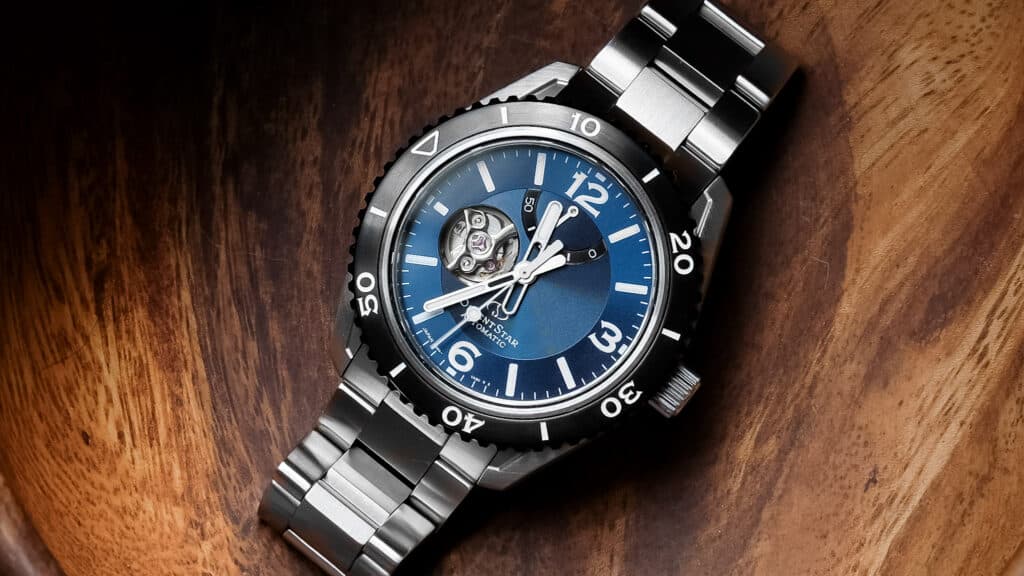
The clasp is also more substantial than what we would expect from the affordable end of Orient’s range. The outer shell is stamped, while the internal locking mechanism is milled, and there are three micro-adjust positions. We never had trouble sizing the bracelet, even with the pin-and-collar construction. The 21mm lug width is mildly annoying if you already own a box full of straps in the usual 18, 20, 22, and 24mm sizes, although it didn’t stop us from experimenting with a 22mm NATO.
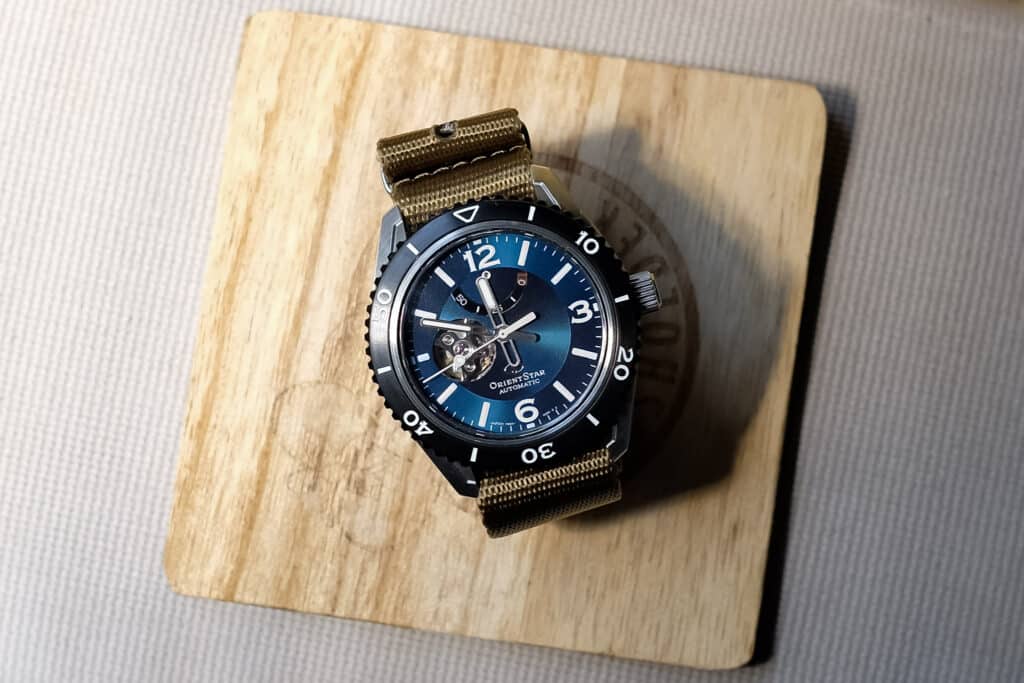
For a while we wore the watch on a green military-style NATO specifically because we wanted to see whether taking all of that bracelet weight away would change how the watch felt. It did. The watch became noticeably easier to wear, and the green strap worked with the dial better than we expected. After several days, though, we put the bracelet back on because the watch had lost some of what made us like it in the first place. All of those different surfaces on the bracelet contribute to the way the watch catches light, and once they were gone the whole thing started feeling a little more ordinary.
That experiment pretty much sums up the problem. The bracelet is very much part of the design, and we’d rather have the watch on it. It also adds enough weight that removing it noticeably improves the wearing experience. There isn’t a perfect solution there, at least for us.
The F6R42 Movement Has Been Reliable
Inside is Orient Star’s F6R42 automatic movement with hacking, hand-winding, and more than 50 hours of power reserve. We haven’t had any meaningful accuracy or reliability complaints over the years. Set it, wear it, and it behaves the way we’d expect a solid Japanese mechanical movement to behave. The power-reserve display is useful when the watch is moving in and out of a larger rotation, while the exhibition caseback gives you another look at the mechanical side of the watch that Orient Star is already putting on display through the dial.
There is enough decoration back there that the exhibition window doesn’t feel pointless, either. You can see the perlage along with striping on the rotor, and while nobody should confuse this with high-end hand finishing, we enjoy looking at it. That’s generally how we’ve thought about Orient movements over the years. Part of the appeal is getting a mechanical watch from a company that has spent decades building its own movements, while still keeping the watches relatively attainable. We didn’t buy this particular watch because we thought the F6R42 was some extraordinary piece of horology. We bought it because the movement was interesting enough to be part of the package.
The winding experience itself could be better. Manually winding it through the crown has never had the smoothness you sometimes get from a movement where turning the crown becomes satisfying on its own. This one feels a little flimsy by comparison. It has never translated into an actual reliability issue, so we’re not overly concerned about it, but when you start pushing a watch toward $1,000, small tactile things like that become easier to notice.
So, Can Orient Star Compete With a Seiko Diver?
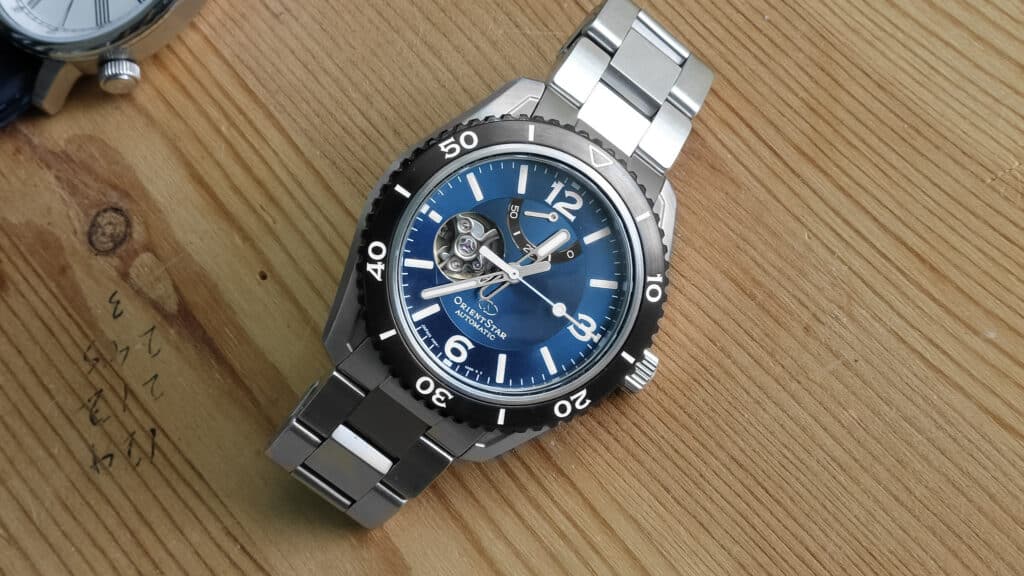
After several years with this watch, we don’t think the answer is as simple as saying Seiko makes the better watch. Orient Star gets a lot right here. The case finishing is interesting, the bracelet is thoughtfully designed, the movement presentation works, and the dial has more personality than a lot of conventional dive watches. Nothing about the RK-AT0106E feels like Orient took a Mako, put an Orient Star logo on the dial, and decided to charge twice as much.
Where we think the difference becomes much clearer is on the wrist. Seiko has spent decades refining large dive-watch cases, and models like the Sumo, Turtle, Willard, and SKX family show how much the shape of a case can matter once the numbers start getting big. The Sumo in particular is a good example. It is a 44mm-plus watch with a roughly 50mm lug-to-lug measurement, yet the actual wearing experience is much less intimidating than those numbers suggest. That’s something Seiko has repeatedly managed to pull off with large divers.
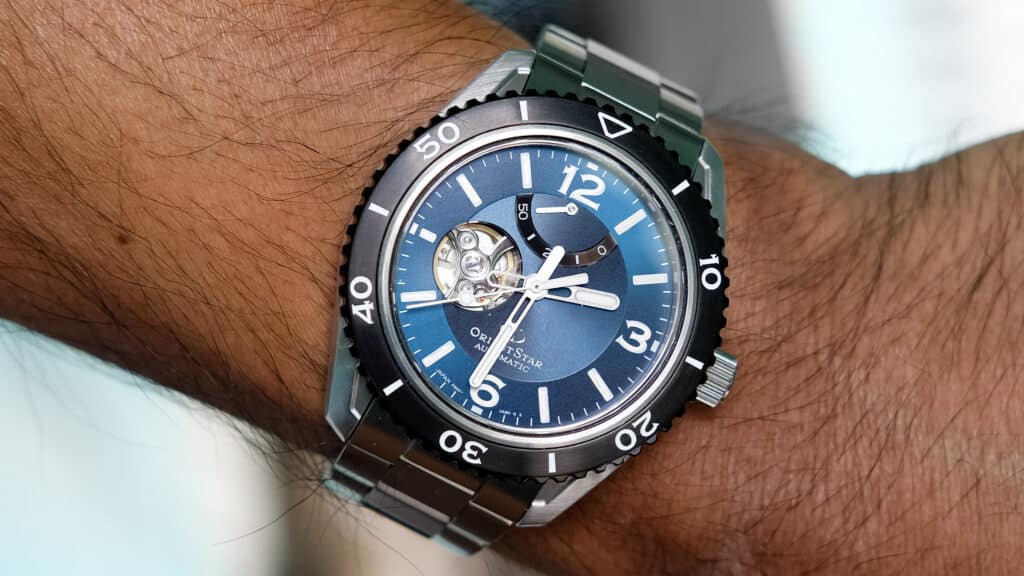
The Orient Star doesn’t have quite the same trick. It is reasonably balanced, the underside is shaped well, and we’ve never found it painful or outright uncomfortable to wear. We are simply much more aware of its size and weight throughout the day. Putting it on a NATO proved that some of that is the bracelet, but doing so also removed a part of the watch we actually liked. Seiko’s advantage here isn’t necessarily that its watches are smaller. A lot of them aren’t. They just tend to be better at making that size disappear once they’re on the wrist.
If you like the idea of a large, more premium Japanese diver but care more about ergonomics and legibility than the Orient Star’s open-heart presentation, the Seiko Sumo is probably the most obvious alternative. We’ve spent years with the Sumo as well, and the current line-up has moved further upmarket with sapphire crystals, longer-power-reserve movements, and, on higher-spec versions, ceramic bezels and upgraded finishing. Depending on the reference, pricing now lands surprisingly close to what we originally paid for this Orient Star.
That matters more to us now than it did when we first bought the Orient Star. At $500 or $600, we would probably be much more forgiving because there is still a lot of watch here for that kind of money. At roughly $1,000, we wanted the whole experience to come together a little more convincingly. The dial still makes us happy, the finishing has aged well visually, and we’re glad we’ve owned it, but it isn’t a watch we reach for often enough that we’d buy it again at the same price. At this point, we’d probably be comfortable selling or trading it for something else.
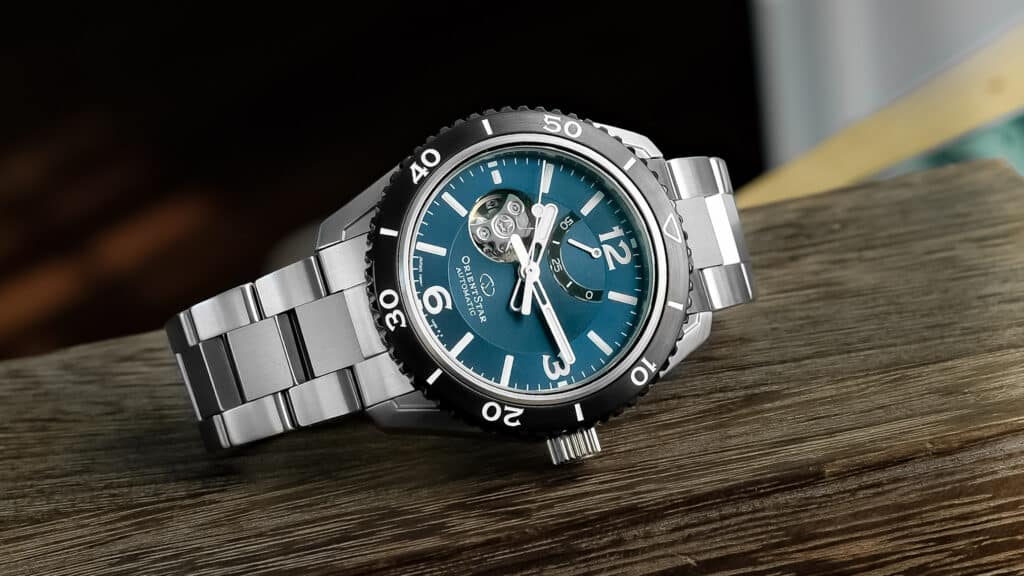
We wouldn’t rule out another Orient Star sports watch because of this experience, but we also wouldn’t buy another large one sight unseen. This is absolutely a watch we’d recommend trying on first, whether it’s this exact reference or another model built around a similar case. Specs can tell you that something is 43.2mm wide and nearly 14mm thick. They can’t tell you whether the case has that strange bit of ergonomic magic that lets a big watch settle into the wrist and stop reminding you how big it is. Seiko has had decades to get very good at that. The RK-AT0106E shows that Orient Star can get surprisingly close on finishing, dial execution, and overall build quality. On the wrist, Seiko still has the advantage.

Co-Founder and Senior Editor
Kaz has been collecting watches since 2015, but he’s been fascinated by product design, the Collector’s psychology, and brand marketing his whole life. While sharing the same strong fondness for all things horologically-affordable as Mike (his TBWS partner in crime), Kaz’s collection niche is also focused on vintage Soviet watches as well as watches that feature a unique, but well-designed quirk or visual hook.