Spending $6,000 on a dive watch is a difficult proposition when you’ve spent years enjoying Seikos, Citizens, and other affordable watches that do nearly everything you need them to. At that price, you’re not necessarily buying a watch that tells time more accurately or survives conditions your current collection couldn’t handle. You’re paying for engineering, finishing, heritage, and the satisfaction of owning something you’ve probably admired for a long time. The Omega Seamaster Diver 300M and Breitling Superocean Automatic 42 both make compelling arguments for that kind of investment, but whether either actually deserves years of saving is another question.
We’ve spent time with both watches through separate hands-on reviews, and our experiences revealed some interesting differences. The Omega impressed us with its sophisticated movement and exceptional case finishing, while the Breitling surprised us with its distinctive design, excellent legibility, and especially satisfying bezel operation. Both are established Swiss divers with 300 meters of water resistance and prices hovering around $6,000, but neither is without its frustrations. If you’re considering making the leap from affordable watches into this price category, which one offers enough to make that financial commitment worthwhile?
Overview and Identity
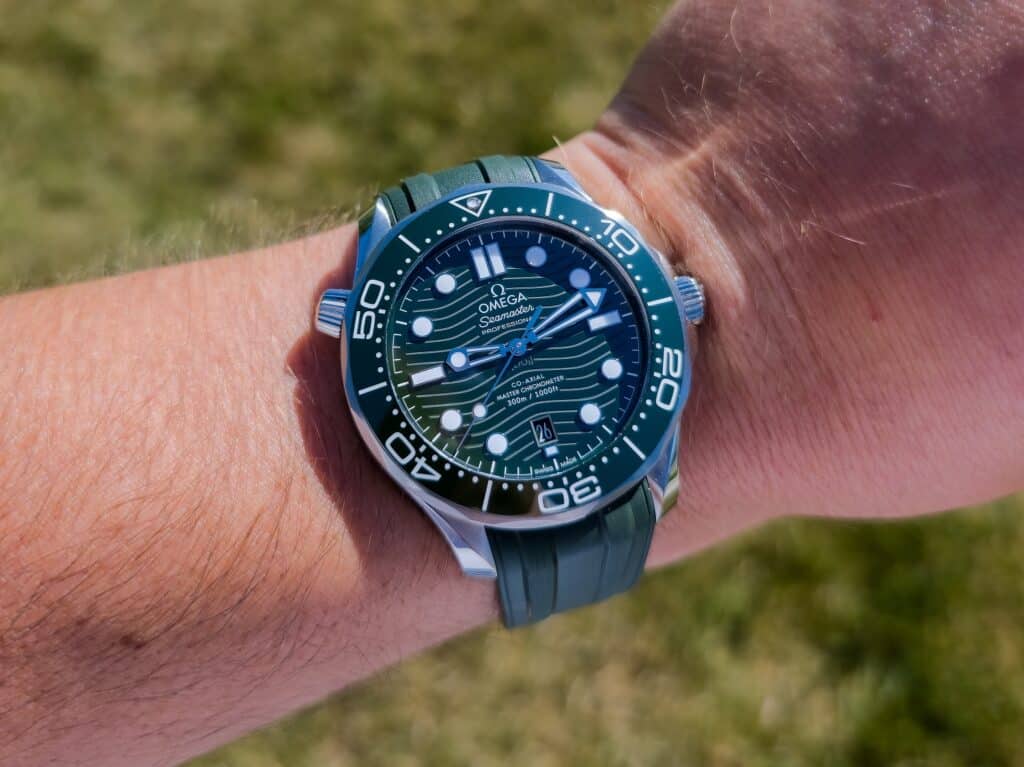
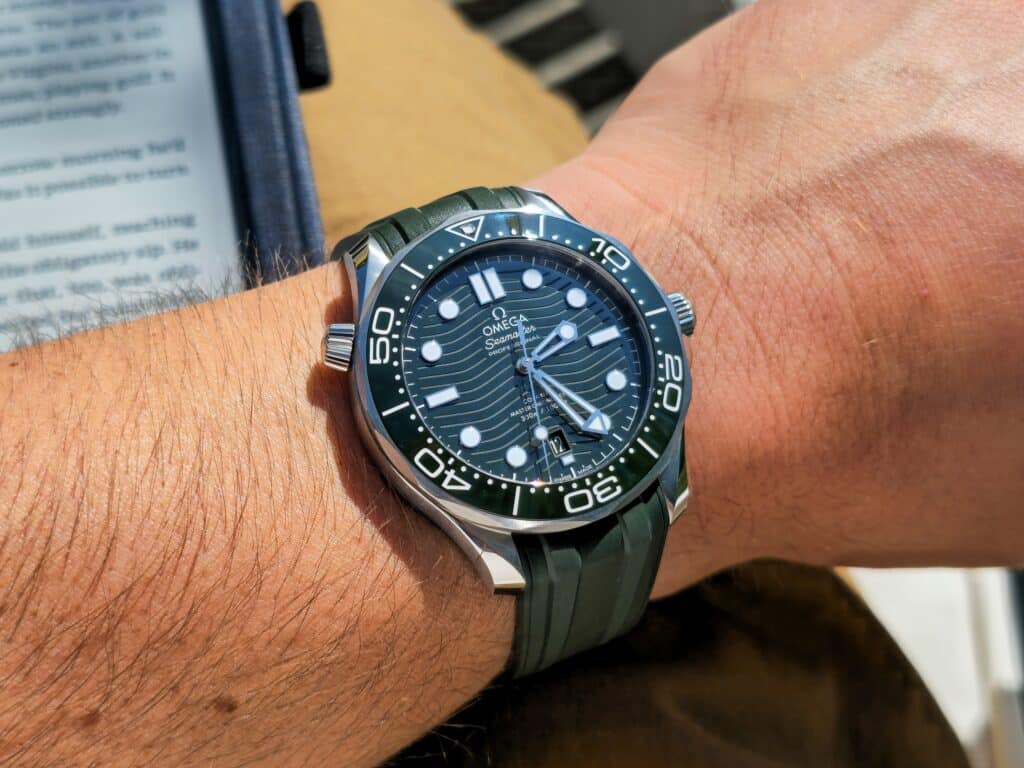
The Omega Seamaster Diver 300M has been one of the brand’s most recognizable watches since its introduction in 1993, helped considerably by its association with the James Bond franchise. But the watch has developed an identity that extends well beyond its appearances on screen. Its distinctive wave-patterned dial, skeletonized hands, scalloped bezel, and helium escape valve make it immediately recognizable among modern Swiss divers. Our hands-on review focused on the green-dial version powered by the Calibre 8800, a configuration that emphasizes the collection’s more refined qualities.
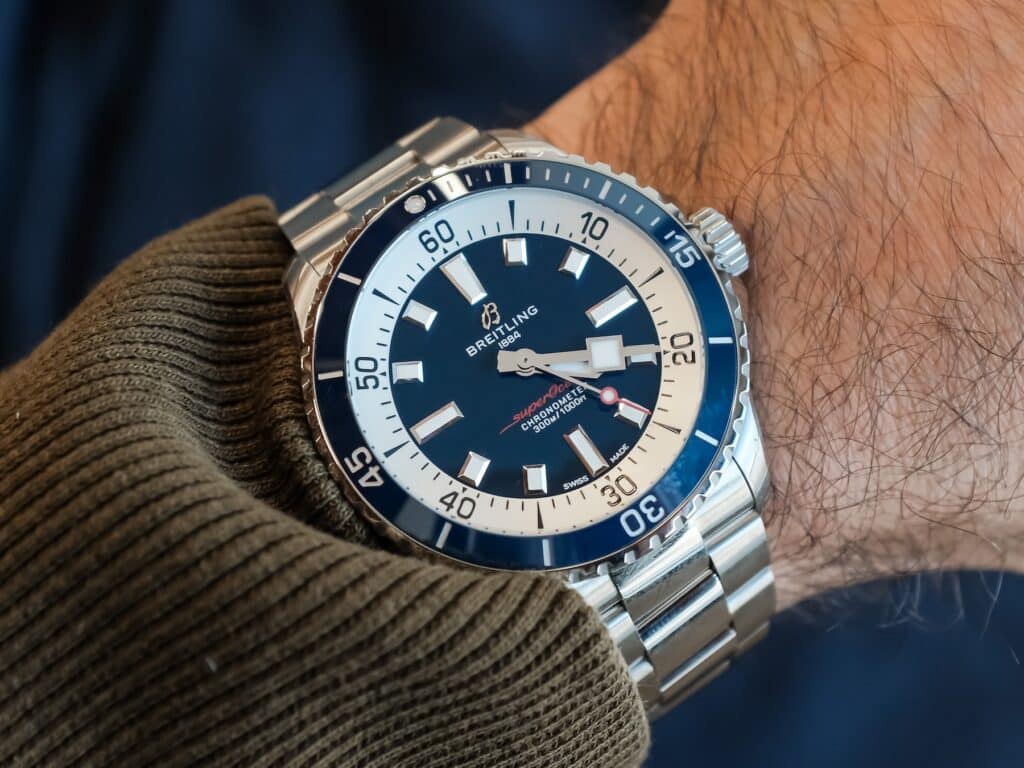
The Breitling Superocean has a longer history, tracing its origins to 1957, although the current Automatic 42 looks noticeably different from many of its predecessors. Its design draws inspiration from Breitling’s unusual Superocean Slow Motion watches of the 1960s, with oversized geometric markers and a prominent minute track replacing the more conventional layouts seen on previous generations. In our recent hands-on review, Mike spent time with the blue-dial reference A17375E71C1A1 on its stainless steel bracelet. The experience challenged some of his existing perceptions of Breitling, particularly his tendency to associate the brand more closely with aviation watches than divers.
Dial and Straps
The green Seamaster we reviewed has one of the most distinctive dials in Omega’s current dive watch lineup. Its polished ceramic surface features deeply laser-engraved horizontal waves that change character depending on how the light strikes them. The green can appear relatively subdued in softer lighting before taking on a considerably brighter appearance outdoors. Omega also color-matches the date wheel to the dial, a small detail that makes the overall design feel especially cohesive. The skeletonized hands are less universally appealing, however, occasionally sacrificing a little immediate legibility against the surrounding luminous markers.

The Seamaster came on Omega’s matching green rubber strap, which played a substantial role in how positively we felt about its wearing experience. The rubber is soft and attractively finished, with raised central ribs and a buckle featuring the same attention to brushing and polishing found on the case. While the adjustment holes could be spaced a little closer together, the overall fit was exceptionally comfortable. We’ve also had experience with the Seamaster’s stainless steel bracelet, although its considerable weight and lack of taper have never been particularly appealing. For everyday wear, the rubber strap was easily our preferred configuration.
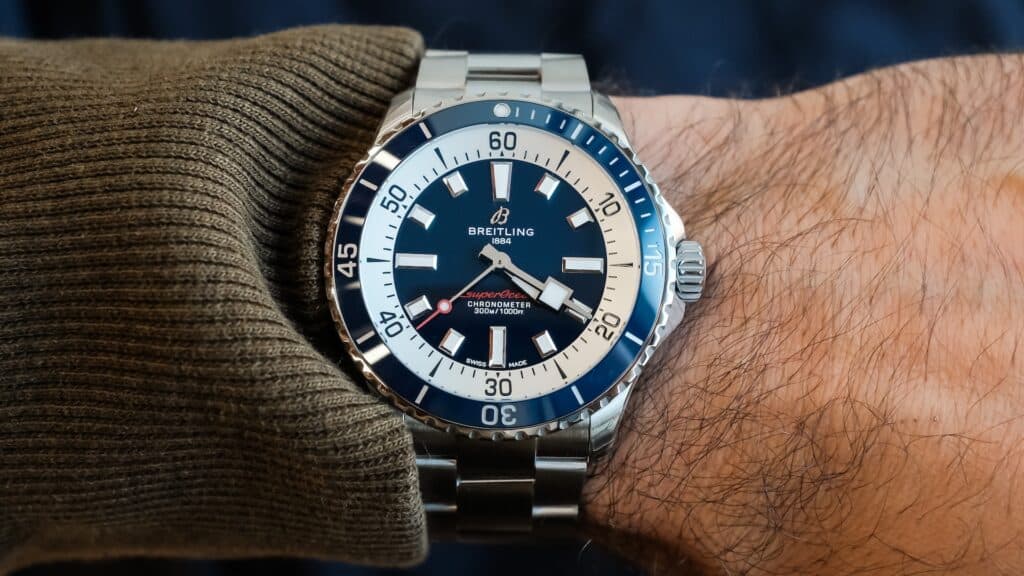
The Breitling Superocean takes a very different approach to its dial. Oversized rectangular and square hour markers dominate the blue surface, surrounded by a bold white minute track that makes the central portion of the dial appear smaller than the watch’s 42mm diameter would suggest. The broad hands and lollipop-style seconds hand reinforce the vintage influence without making the watch feel like a straightforward reissue. During our review, we particularly appreciated how the large markers and hands made reading the time almost effortless. The Omega arguably offers the more elaborate decorative execution, but the Breitling does an excellent job balancing personality with the practical requirements of a dive watch.
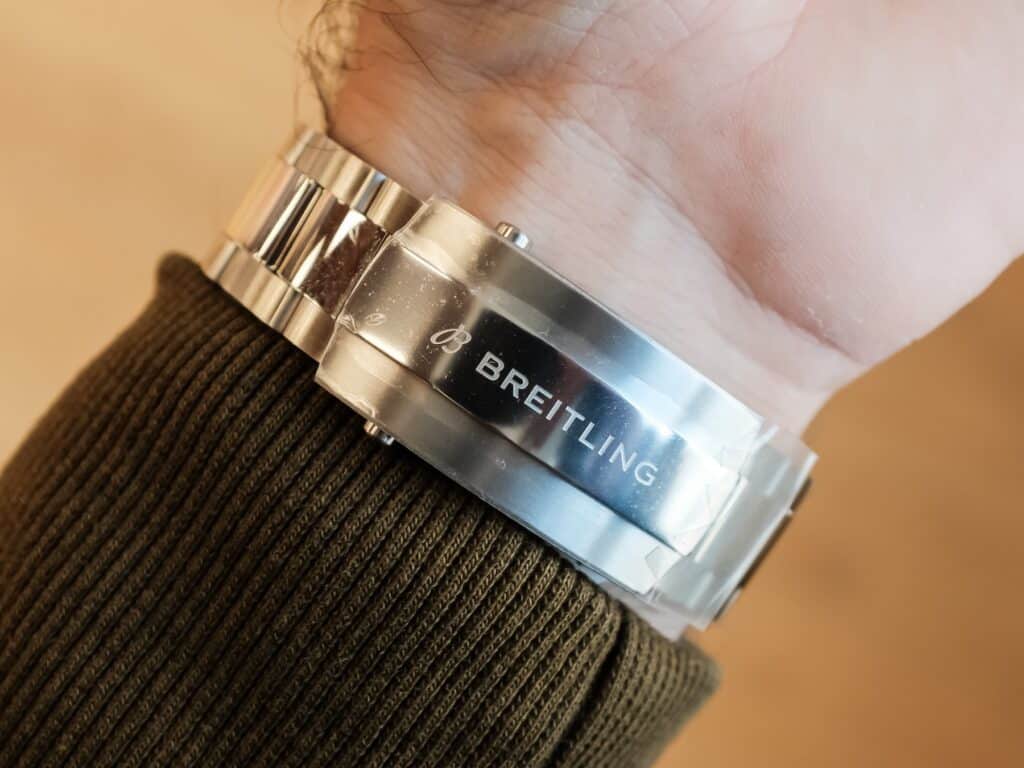
Breitling supplied our Superocean on its stainless steel three-link bracelet, and this was one of the few areas where our enthusiasm faded. The angled links complement the case, and the combination of brushed and polished surfaces gives the bracelet an appropriately substantial appearance. Unfortunately, that substantial construction also translates into considerable weight. Mike found the complete watch bulkier than expected, despite being impressed with the proportions of the case itself. Breitling offers a matching rubber strap, although we haven’t worn that configuration. Both watches demonstrate that an expensive bracelet isn’t automatically the most comfortable option, and we’d be particularly interested in experiencing the Superocean on rubber before making a final purchasing decision.
Build Quality & Technical Approach
There’s an interesting distinction between these watches once we move beyond their appearance. Omega has invested heavily in movement technology and intricate finishing, while Breitling has concentrated much of the Superocean’s appeal around its distinctive design and physical operation. Both approaches can produce an enjoyable watch, although the differences become more difficult to ignore when we’re discussing a purchase approaching $6,000.
Movements:
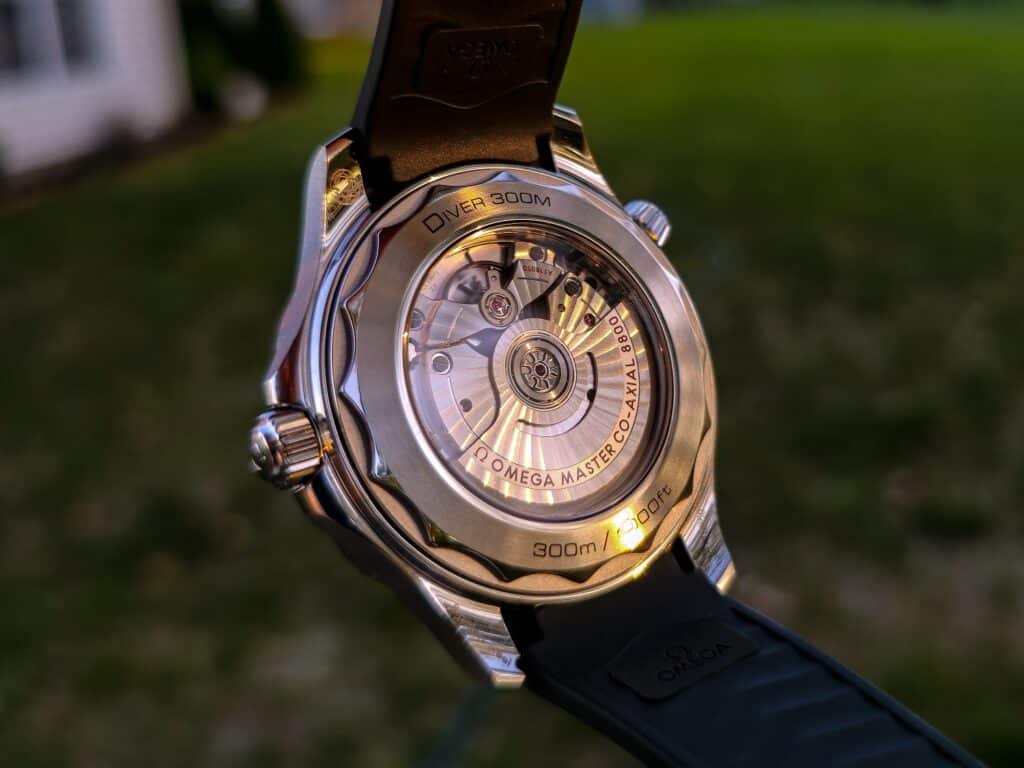
The Seamaster Diver 300M uses Omega’s Calibre 8800 Co-Axial Master Chronometer movement, operating at 25,200 vibrations per hour with a 55-hour power reserve. Its METAS Master Chronometer certification covers demanding performance requirements, including resistance to magnetic fields reaching 15,000 gauss. The movement also uses Omega’s Co-Axial escapement, designed to reduce friction within the mechanism. Our review example performed within approximately one second per day, while the winding action was remarkably smooth. Omega displays the decorated movement through a sapphire exhibition caseback, giving owners another detail to appreciate beyond the specifications.
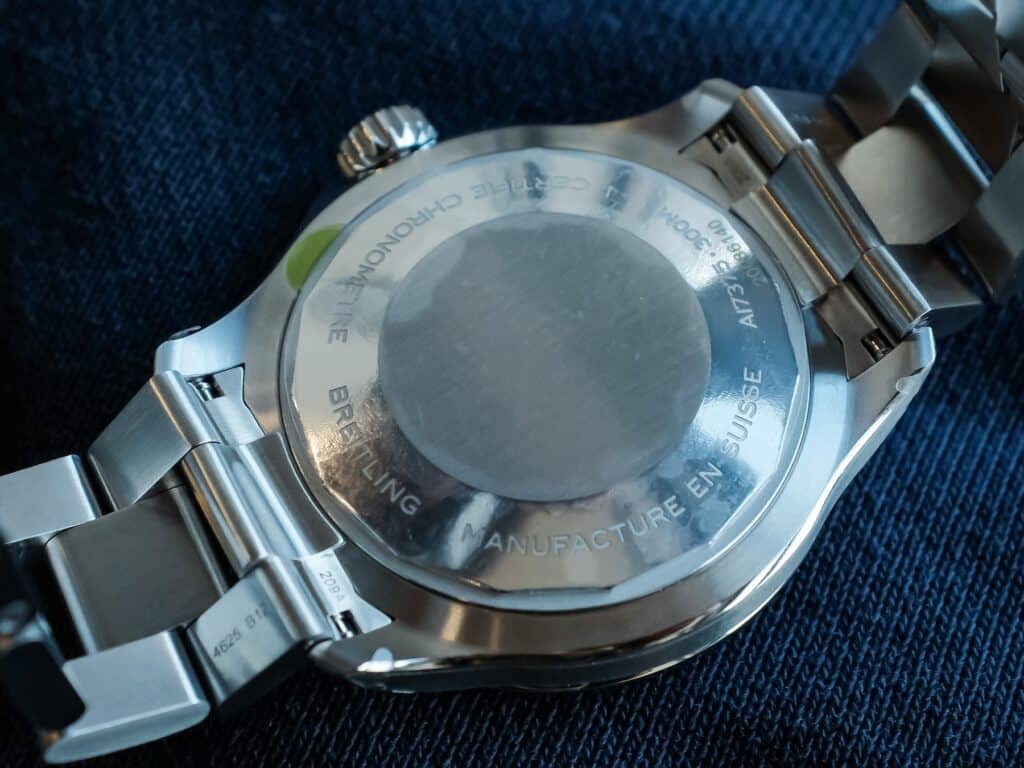
Breitling’s Caliber 17 is a more conventional movement, built on ETA-derived architecture and operating at 28,800 vibrations per hour. It offers 26 jewels, automatic winding, COSC chronometer certification, and approximately 38 hours of power reserve. Mike didn’t encounter any performance issues during his time with the Superocean, although the review wasn’t intended as an extended accuracy test. There’s also something reassuring about a familiar Swiss movement architecture with a long-established service history. Unfortunately, a 38-hour reserve feels limited at this price, especially for enthusiasts who frequently rotate between watches.
Between these two, we’d have a difficult time arguing against Omega’s movement advantage. The additional power reserve, magnetic resistance, and more sophisticated engineering give the Calibre 8800 substantially more to offer on paper. Whether you’ll notice those improvements during ordinary wear is another matter, particularly if you’re accustomed to reliable but relatively inexpensive automatic movements. Still, when movement engineering is one of the reasons you’re considering spending thousands of dollars on a watch, the Seamaster provides considerably more to appreciate.
Case Construction, Finishing & Wearability:
The Omega Seamaster measures 42mm in diameter, approximately 49.9mm lug to lug, and 13.9mm thick. Those dimensions initially concerned our reviewer, who generally prefers smaller watches, but the Seamaster proved surprisingly manageable on the wrist. The twisted lyre lugs and relatively flat wearing profile helped disguise some of the thickness, while the rubber strap prevented the complete package from becoming unnecessarily heavy. Despite measuring nearly 14mm from top to bottom, the watch felt noticeably slimmer during regular wear.
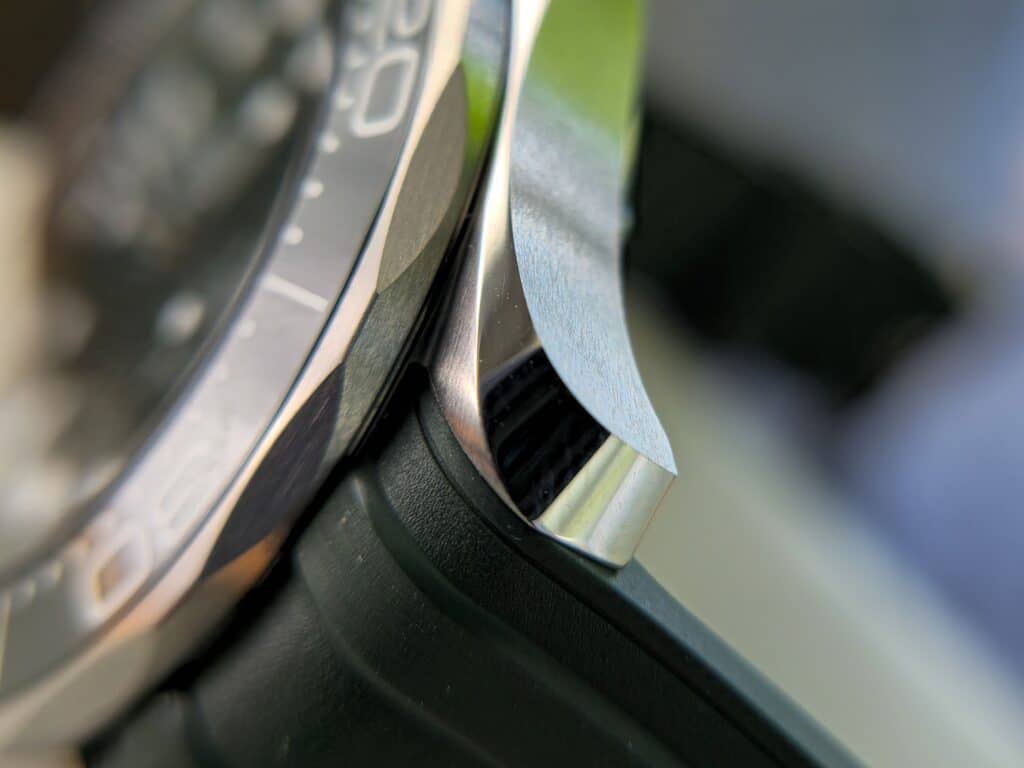
Omega’s finishing was among the strongest aspects of the experience. The polished lug surfaces transition into carefully defined bevels, while finely brushed sections create an attractive contrast around the case. These aren’t particularly unusual finishing techniques, but the execution was impressive enough to become one of our favorite aspects of the watch. The caseback is similarly elaborate, combining a decorative outer ring with the sapphire display window. It’s the kind of attention to detail that’s difficult to appreciate fully from a photograph but becomes increasingly rewarding when examining the watch in person.
The Breitling Superocean Automatic 42 shares the Omega’s 42mm diameter but measures a more restrained 12.56mm thick. During our review, the case proportions felt balanced and approachable, especially considering Breitling’s history of producing considerably larger sports watches. The brushed lug tops and case sides are complemented by polished bevels extending toward the crown guards, giving the case an attractive sense of definition. Mike particularly appreciated how the different finishes broke up the profile without making the design unnecessarily elaborate.
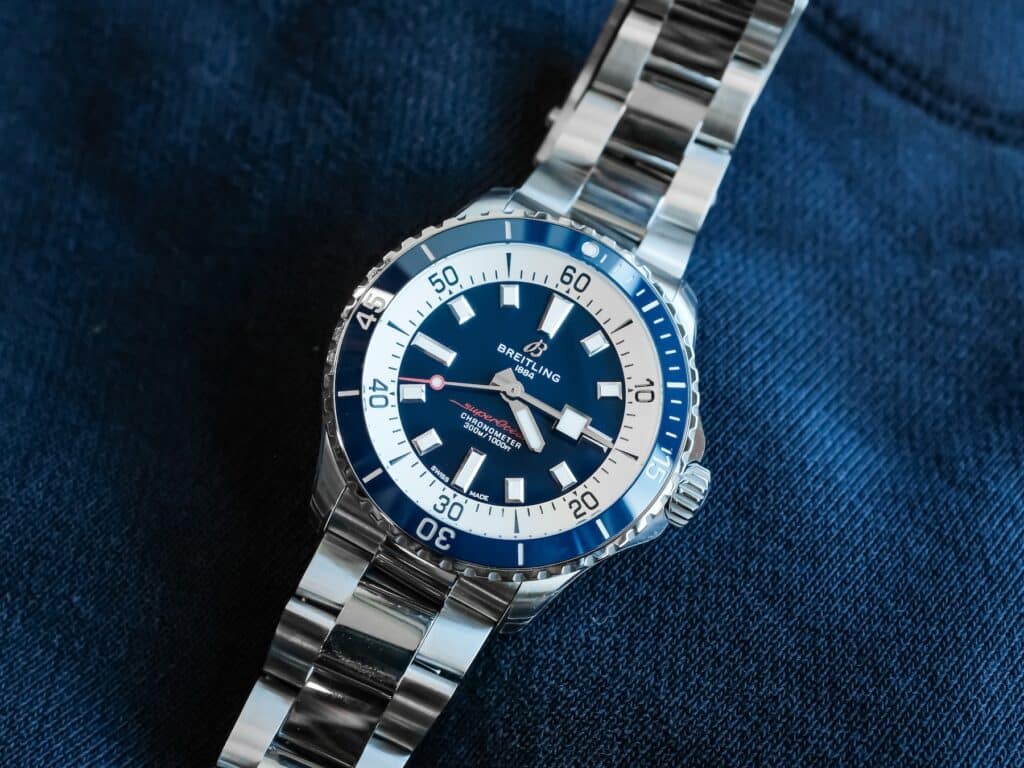
It’s difficult to separate the case from the rest of the wearing experience, however, and the Breitling’s bracelet complicated an otherwise positive impression. The slimmer case initially suggested a watch that might be easier to wear than the Seamaster, but the overall weight became difficult to overlook. Meanwhile, the thicker Omega felt especially comfortable on its rubber strap. We wouldn’t declare either case inherently more wearable without comparing equivalent strap configurations, although our individual experiences suggest the Seamaster offers the more impressive finishing and the Breitling has plenty of potential with a lighter strap.
Crystals and Bezels:
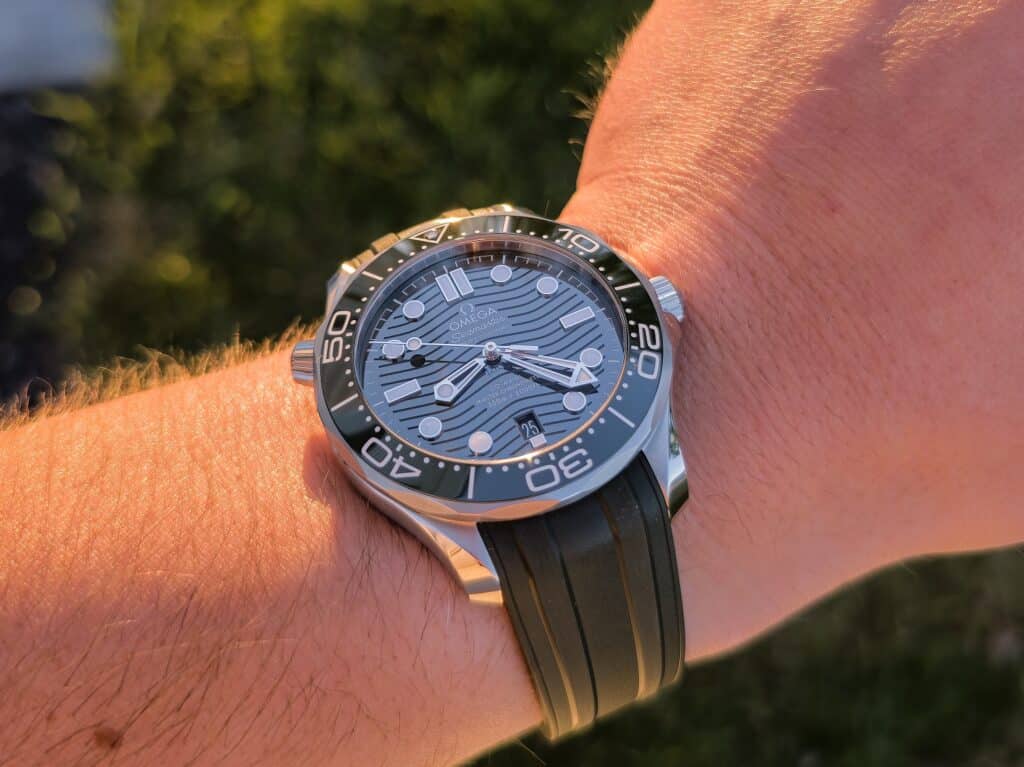
Omega equips the Seamaster with a sapphire crystal featuring exceptionally effective anti-reflective treatment. During our review, the crystal almost disappeared in certain lighting conditions, allowing the polished ceramic dial to remain the focus. The glossy green ceramic bezel complements that presentation beautifully, but operating it was considerably less impressive. Its 60-click action was precise and free of noticeable back play, yet the scalloped edge was sometimes difficult to grasp and the overall feel lacked the mechanical satisfaction we’d expect at this price. It’s an attractive bezel that doesn’t quite deliver the same enthusiasm when you actually use it.
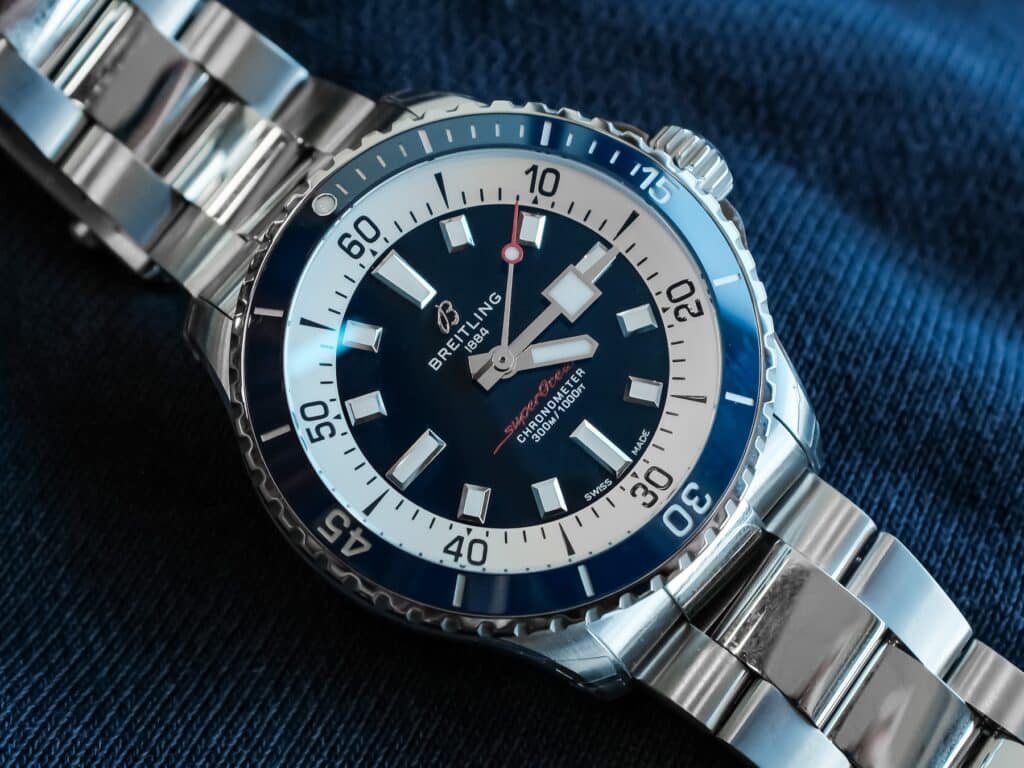
The Breitling also uses a sapphire crystal, with a gently curved profile and anti-reflective treatment on both surfaces. Reflection control was excellent during our review, maintaining clear visibility of the blue dial and oversized markers. More importantly, the Superocean’s unidirectional bezel was among our favorite elements of the watch. Its deeply textured edge provided an excellent grip, while the ceramic insert and firm, precise clicks made it genuinely enjoyable to operate. There was no noticeable looseness, and the entire mechanism felt appropriately substantial for a premium dive watch.
This is one area where Breitling makes a particularly convincing argument against the Seamaster. Omega has produced a beautiful bezel and an exceptionally clear crystal, but the Superocean offers the more satisfying physical interaction. We spend plenty of time discussing movement specifications and finishing quality when evaluating expensive watches, yet something as simple as rotating a bezel can have a surprisingly large impact on ownership satisfaction. It’s also a reminder that a more technologically advanced watch doesn’t necessarily execute every traditional dive watch feature better than its competitors.
Water Resistance & Lume:
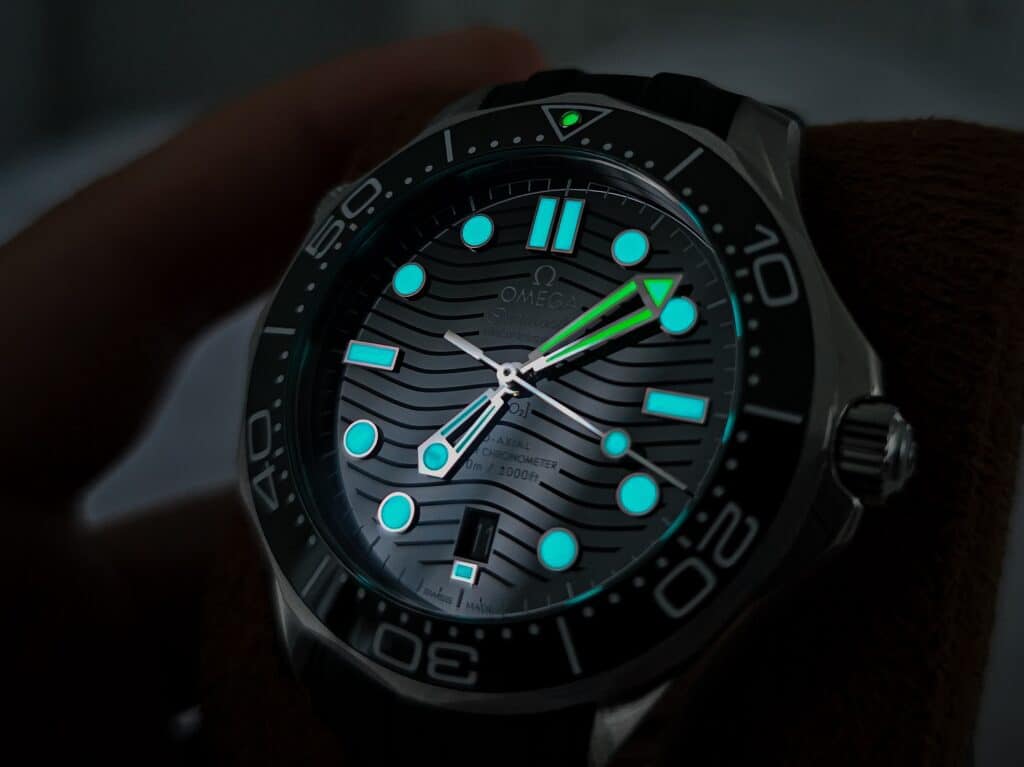
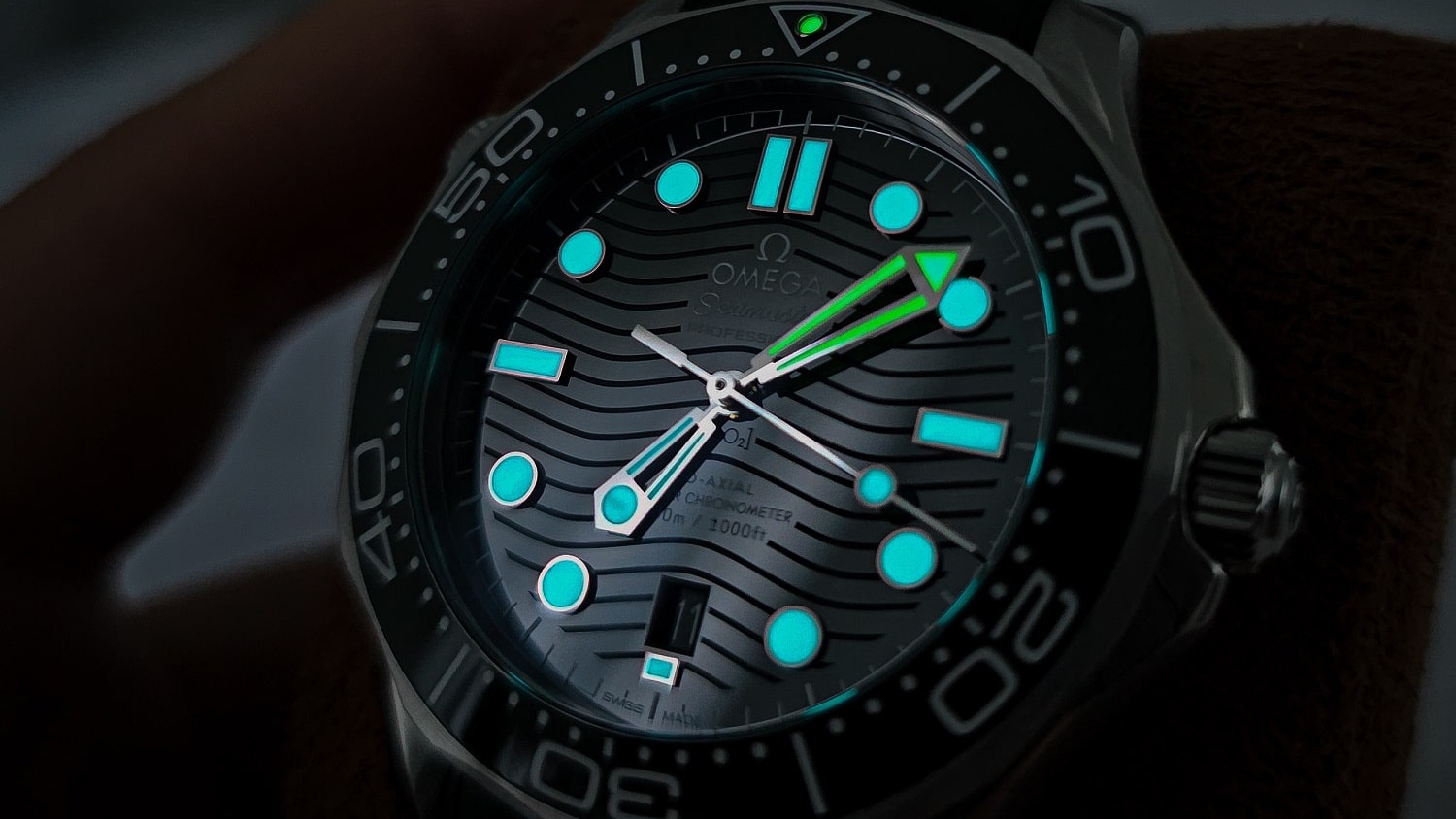
The Omega Seamaster Diver 300M delivers 300 meters of water resistance alongside its familiar helium escape valve at ten o’clock. It’s a feature intended for specialized diving conditions, although most owners will likely appreciate it more as part of the Seamaster’s recognizable design. Omega also uses a two-color luminous arrangement, with blue appearing on the hour markers and selected hands, while the minute hand and bezel pip glow green. The contrast makes it easy to distinguish essential information in darkness, although our original review found the brightness and longevity somewhat disappointing compared with certain affordable Seiko divers.
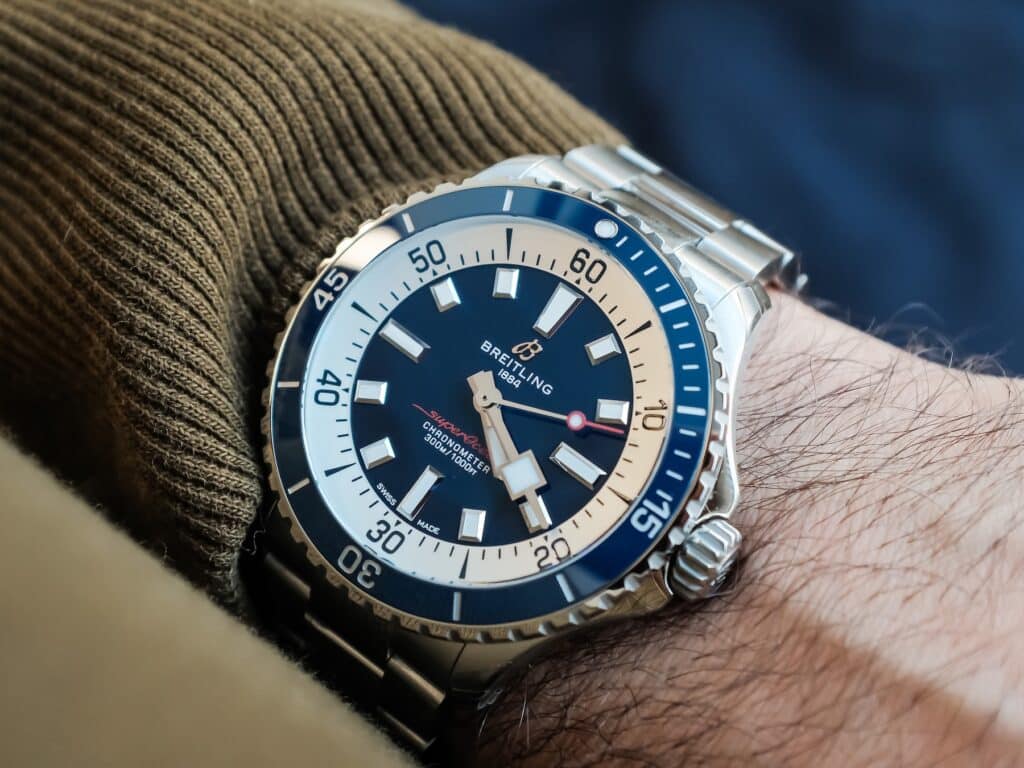
The Breitling matches the Omega’s 300-meter water resistance rating, using a screw-locked crown and substantial case construction. Its oversized hands and markers provide generous surfaces for luminous material, reinforcing the watch’s emphasis on immediate readability. During our hands-on review, we appreciated how clearly the dial presented information, both through its large markers and effective crystal coating. However, we didn’t document a controlled lume endurance test, so it wouldn’t be appropriate to claim that the Breitling outlasts the Omega after an extended period in darkness.
For the overwhelming majority of collectors, either watch offers substantially more water resistance than they’ll ever need. We’ve worn far less expensive dive watches that are perfectly capable of handling swimming and recreational water activities, so we’d hesitate to treat their identical depth ratings as compelling reasons to spend this much money. The Omega offers a more elaborate luminous presentation, while the Breitling’s straightforward layout emphasizes quick readability. Both satisfy the fundamental expectations of a serious dive watch, even if neither makes an inexpensive alternative suddenly inadequate.
Cost Considerations
When we originally reviewed the Seamaster Diver 300M, Omega priced the watch at approximately $5,600 on rubber and $5,900 on the stainless steel bracelet. The Breitling Superocean Automatic 42 we handled carried a $5,900 retail price on its bracelet. Those figures place both watches around the $6,000 threshold that makes this comparison particularly interesting, although current retail pricing may differ from the figures documented in our reviews. For someone accustomed to buying watches between $200 and $600, either represents a substantial commitment rather than an ordinary addition to the collection.
Omega has a strong argument for that money. Its Calibre 8800 offers meaningful engineering advantages, while the case, ceramic dial, and movement finishing demonstrate a level of execution that goes well beyond what we typically encounter in more affordable divers. At the same time, the Seamaster isn’t free of compromises. The bezel operation was underwhelming, the skeletonized hands weren’t always ideal for legibility, and the stainless steel bracelet wasn’t particularly appealing to our reviewer. We’d expect an expensive watch to get these things right, even if its strongest qualities are impressive enough to make the shortcomings easier to accept.
The Breitling presents an almost opposite value proposition. Its movement is technically less ambitious, and the 38-hour power reserve is difficult to celebrate at nearly $6,000. On the other hand, the Superocean delivers an exceptionally satisfying bezel, attractive case finishing, and a design that feels distinct from the many conventional Swiss divers competing in this segment. Those are qualities you’ll notice every time you wear and interact with the watch, even if they don’t translate into impressive specifications. We would have preferred a lighter bracelet configuration, but the overall experience left us with more appreciation for the modern Superocean than we anticipated.
The more difficult question is whether either watch offers enough of an improvement over a significantly less expensive diver to justify years of saving. From a purely practical perspective, we’d struggle to make that argument. Affordable mechanical and solar-powered divers already offer dependable timekeeping, useful water resistance, excellent legibility, and enough durability for most everyday activities. The Omega’s sophisticated movement and the Breitling’s finishing don’t fundamentally change what a dive watch does. Instead, they enhance the experience of owning and interacting with one, and the value of those improvements depends heavily on what you personally enjoy about watch collecting.
If we’d been setting money aside specifically for one of these watches, we’d lean toward the Omega. Its more ambitious movement and exceptional finishing make the price easier to rationalize, especially if this were intended to be a long-term centerpiece of a collection. But we also wouldn’t dismiss someone who found the Breitling’s design more appealing or preferred the way its bezel and dial functioned. There’s no guarantee that spending $6,000 on the technically superior watch will make you happier than choosing the one you genuinely enjoy wearing. And if either purchase would require sacrificing financial priorities elsewhere, we’d be perfectly content continuing to enjoy the affordable watches already in our collection.
Final Thoughts: Is Either Dive Watch Worth Saving $6K For?
The Omega Seamaster Diver 300M is our preferred watch in this comparison. Its excellent Calibre 8800 movement, detailed case finishing, and distinctive green ceramic dial create a package that feels appropriately special for the price. We still have complaints about its bezel operation and factory bracelet, but those limitations don’t entirely overshadow what Omega has accomplished. The Seamaster is the watch we’d be more inclined to save for, particularly if we wanted a single premium diver that could remain an important part of the collection for years.
The Breitling Superocean Automatic 42 deserves more consideration than its movement specifications might initially suggest. Its bold dial is exceptionally legible, the case proportions are appealing, and the bezel operation was genuinely satisfying throughout our hands-on experience. We also appreciate that Breitling has created something with a recognizable identity instead of another conservative take on the traditional Swiss diver. Unfortunately, the heavy bracelet and relatively short power reserve make the $5,900 price harder to accept, especially when Omega offers so much additional engineering at a comparable cost.
There’s also the question of what saving for a watch like this actually means. We understand the appeal of having a grail watch, and there’s something satisfying about eventually owning a piece you’ve admired for years. But we wouldn’t want anyone to assume that moving into this price category automatically makes watch collecting more enjoyable. A well-loved Citizen or Seiko can still deliver an enormous amount of satisfaction, and neither of these Swiss divers changes that reality. What you’re buying here is a different level of refinement and a particular emotional connection, not an entirely new set of practical capabilities.
Our verdict is that the Omega Seamaster Diver 300M is the stronger choice if you’re determined to save approximately $6,000 for a Swiss dive watch. It offers more technical substance, exceptional finishing, and enough character to remain interesting well beyond the initial purchase. The Breitling is still an appealing alternative for someone drawn to its design and tactile qualities, but we’d have a harder time justifying the same financial commitment. As for whether either watch is truly worth saving for, we’d say yes, provided it’s the watch you genuinely want and the purchase makes sense for your circumstances. Otherwise, there’s absolutely nothing wrong with keeping that money and enjoying the affordable collection you already have.

Co-Founder and Senior Editor
Kaz has been collecting watches since 2015, but he’s been fascinated by product design, the Collector’s psychology, and brand marketing his whole life. While sharing the same strong fondness for all things horologically-affordable as Mike (his TBWS partner in crime), Kaz’s collection niche is also focused on vintage Soviet watches as well as watches that feature a unique, but well-designed quirk or visual hook.