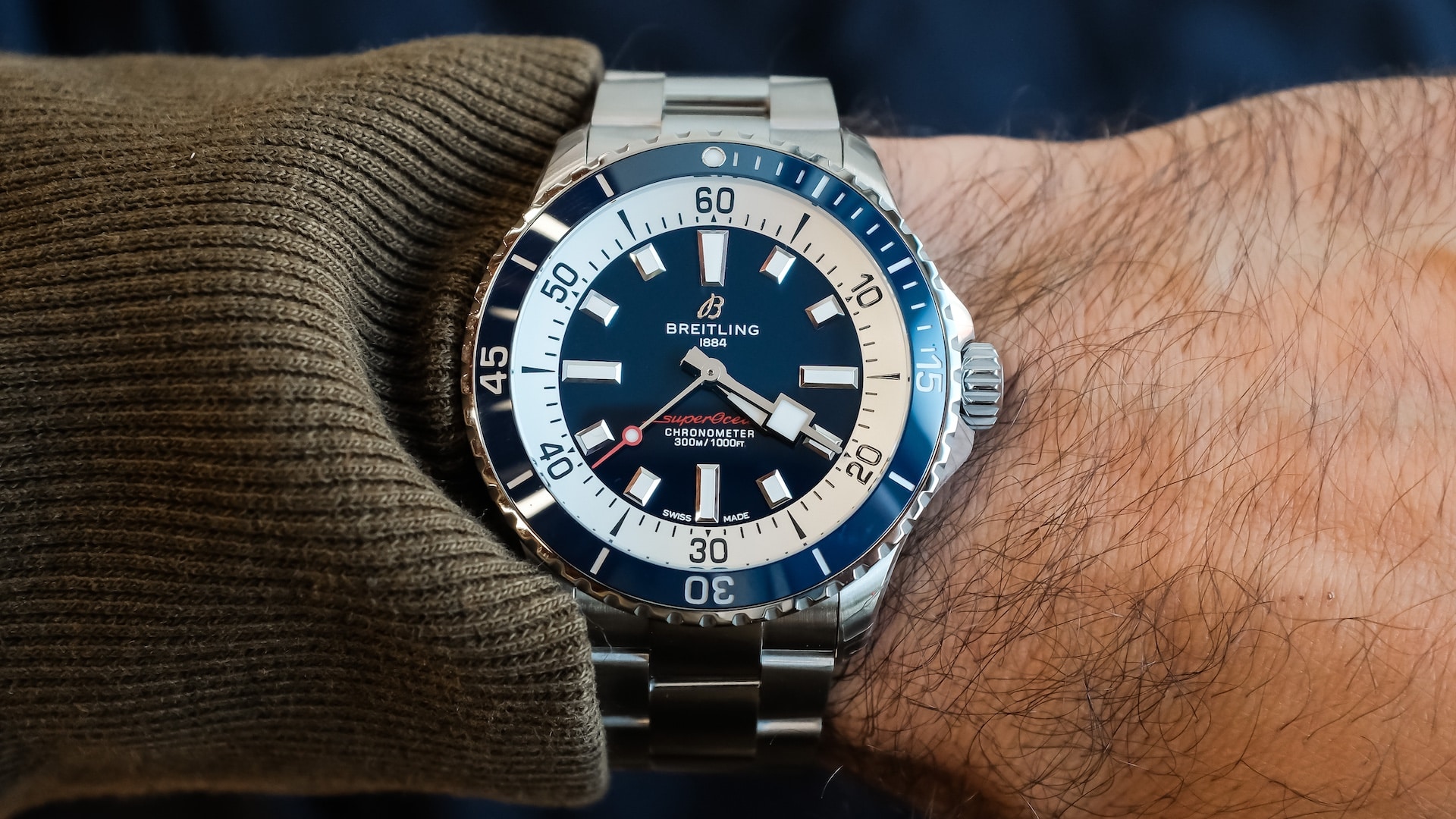
Breitling has always been a somewhat polarizing brand for me. Over the years, I’ve come close to picking up a handful of their more unusual old models, like the Aerospace and some of the smaller chronographs from the ’90s that seem to pop up on eBay regularly. I’ve always appreciated the appeal of that era of Breitling, even if I’ve never quite managed to pull the trigger on one. I’ve also never fully understood how much criticism the brand tends to attract. Granted, there was a stretch when some of Breitling’s contemporary offerings, particularly in the aviation category, became comically oversized and gaudy.
Like most collectors, my immediate association with Breitling has generally been its aviation history and watches like the Navitimer. The Superocean has always been somewhere in the background of my awareness, although I’ve spent considerably less time thinking about Breitling as a dive watch manufacturer. That started to change after getting some hands-on time with the Superocean Automatic 42. I came away from the experience with a greater appreciation for what Breitling is doing in this category, along with a few surprises I hadn’t necessarily anticipated going in.
After wearing this particular blue-dial model, I wanted to dig into how it actually delivers, where some of its design decisions succeed, and how it fits into a fairly crowded segment of Swiss dive watches hovering around the $5,000 mark. It’s an interesting space to occupy, especially for a brand I’ve traditionally associated with an entirely different kind of watch.
A Different Kind of Superocean
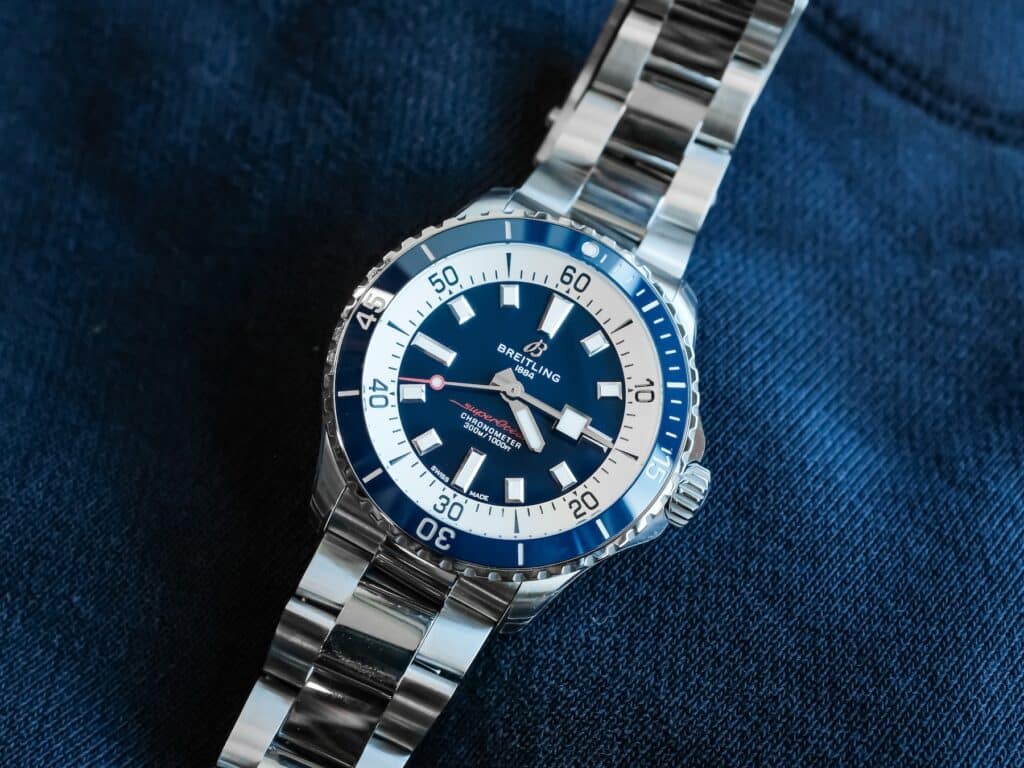
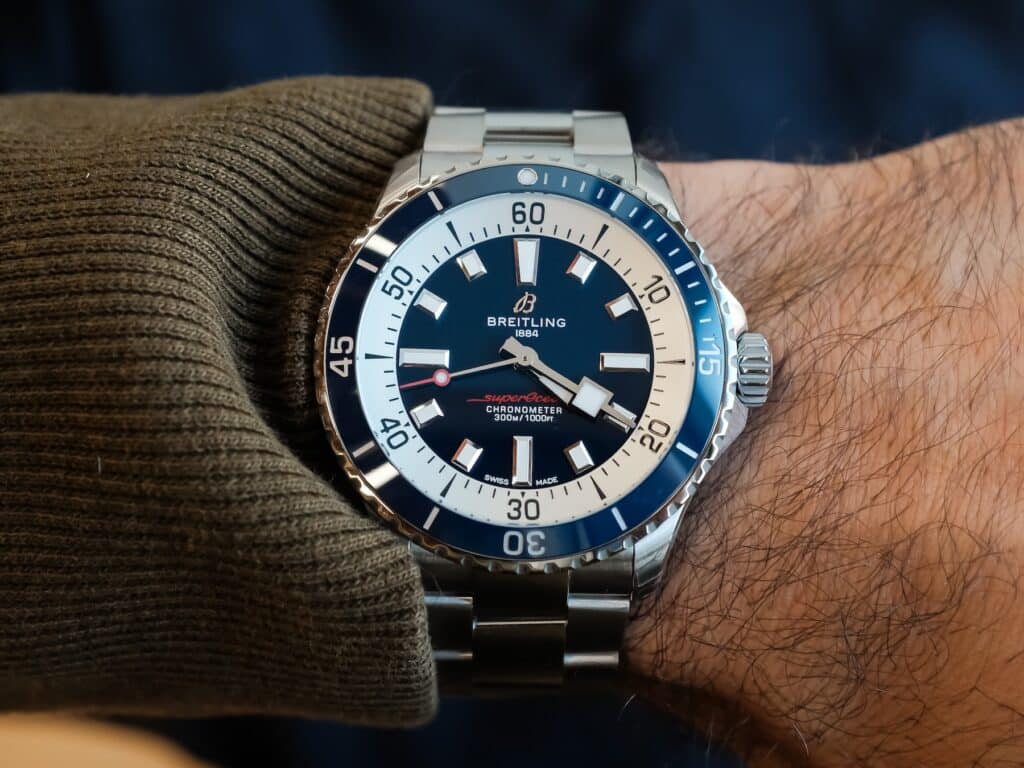
From what I can tell, this current generation of the Superocean draws inspiration from Breitling’s Superocean Slow Motion watches of the 1960s. It’s a departure from previous versions, particularly those with Arabic numerals at six, nine, and twelve. Those have given way to oversized geometric hour markers, and I think the change works well.
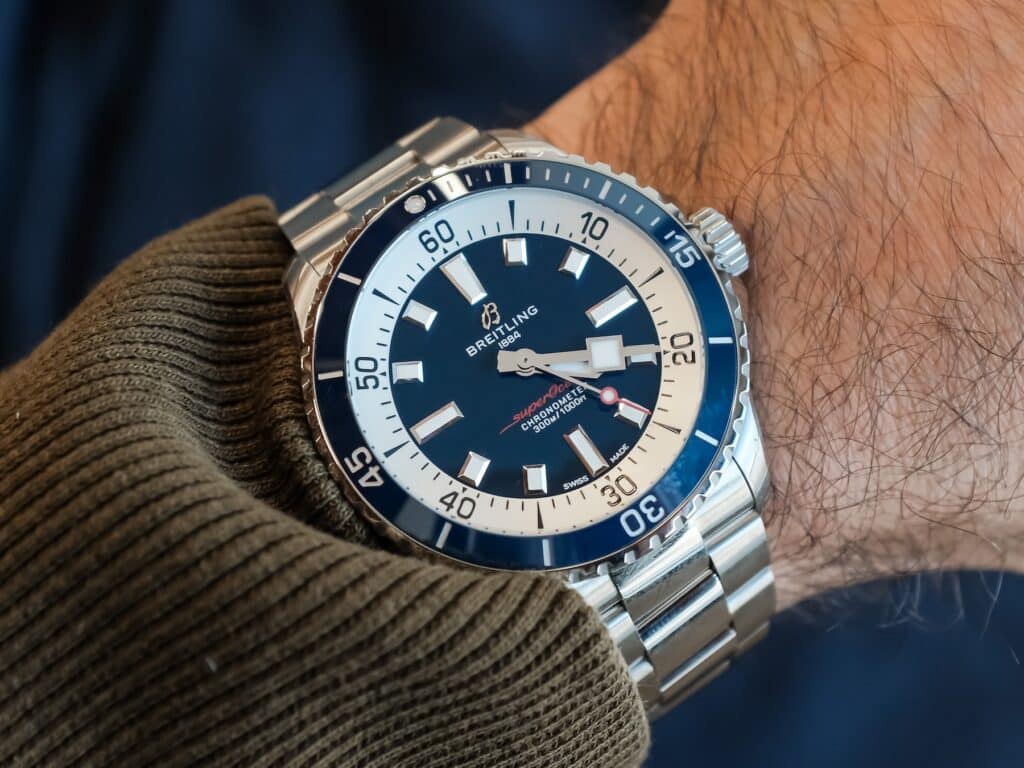
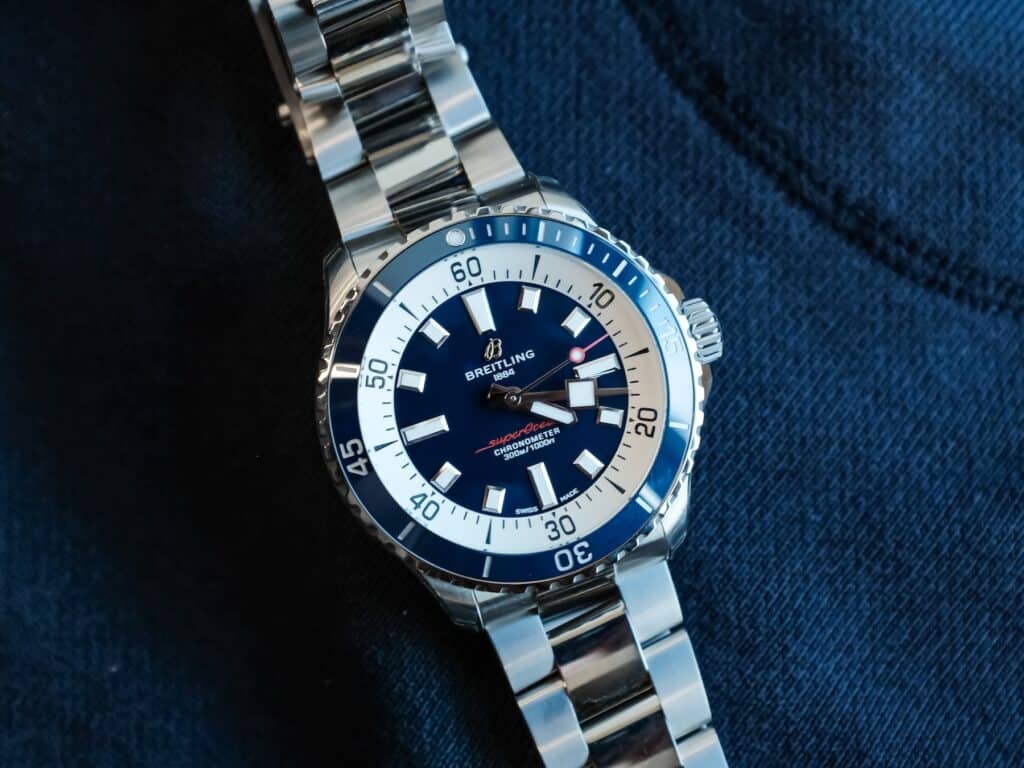
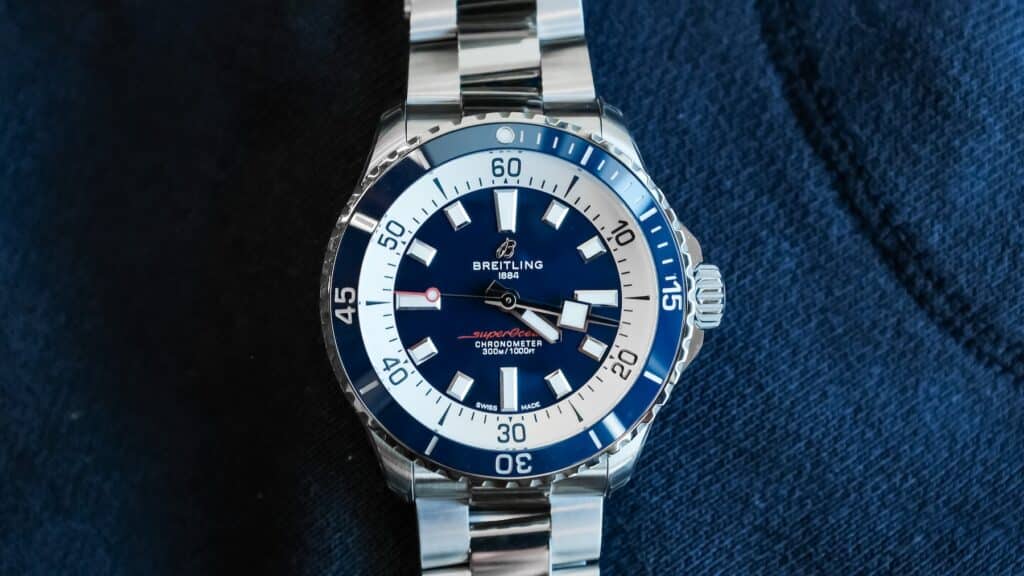
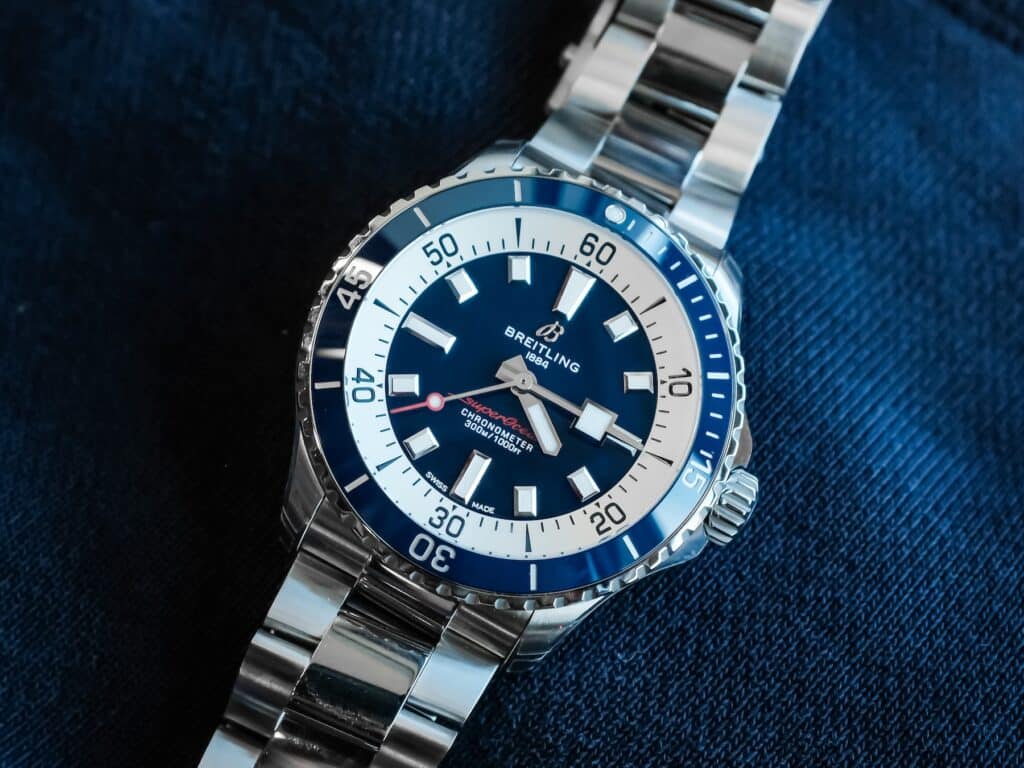
The blue dial on this particular reference is dominated by large, polished surrounds framing the hour markers. A prominent marker sits at twelve, while rectangular and square shapes fill out the rest of the layout. The hands are similarly substantial, and there’s a lollipop-style seconds hand that ties everything back to the vintage inspiration.
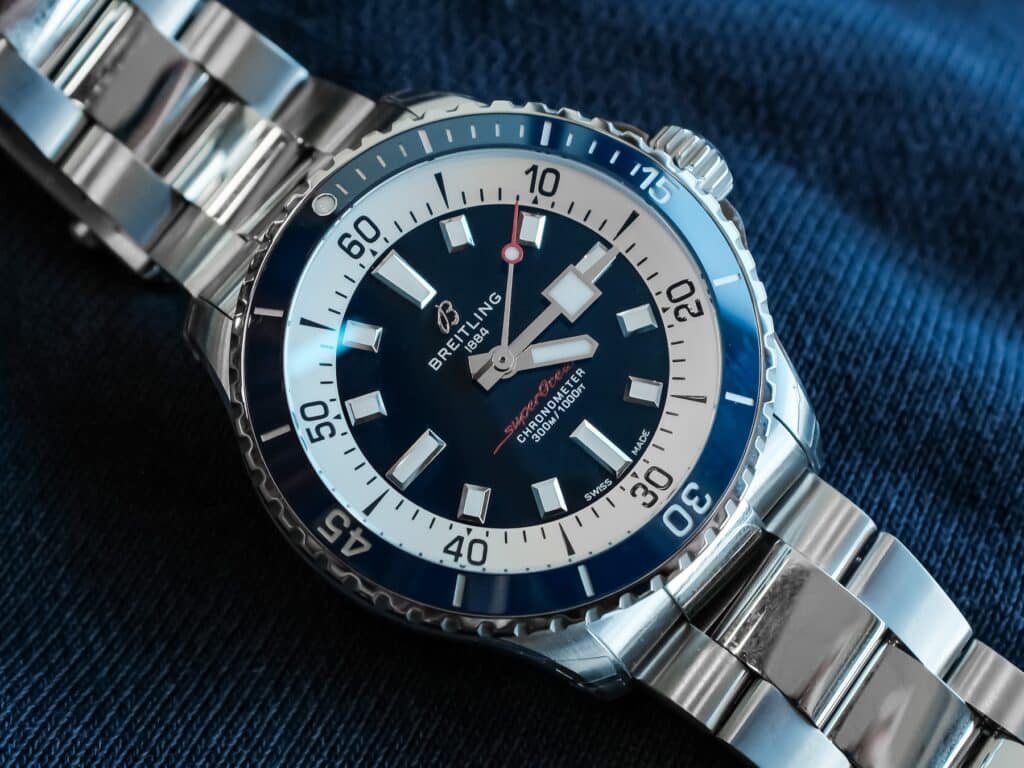
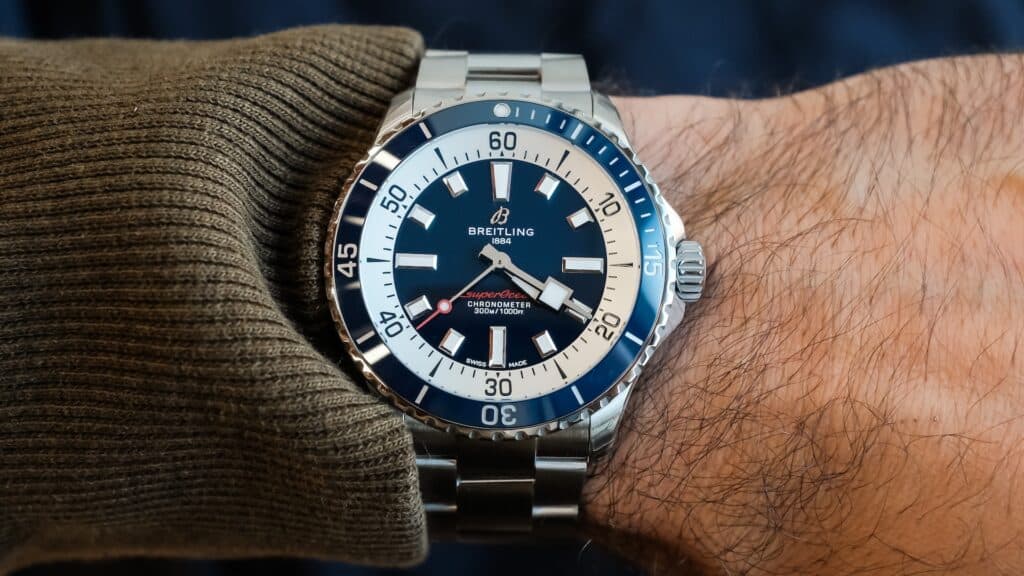
What I like is how the oversized markers interact with the big white minute track around the perimeter. Together, they take up a lot of space, making the central portion of the dial look smaller than you’d expect from a 42mm watch. Kinda like my Doxa. There’s a lot happening here, but the arrangement feels cohesive to me. Breitling has embraced larger design elements throughout the dial, and the result is something I enjoyed looking at.
The layout also makes telling the time remarkably straightforward. The hands and markers are easy to distinguish, and the generous luminous material supports the kind of legibility I’d expect from a serious dive watch. I appreciate that Breitling has given the Superocean such a recognizable appearance while keeping the basic functionality intact.
The design also feels refreshing within the broader Swiss dive watch category. I’ve grown accustomed to seeing familiar combinations of circular markers, Mercedes-style hands, and relatively conservative dial layouts. I have no problem with any of those choices, but I enjoyed spending time with a watch that approaches the same basic requirements differently.
Case, Bezel, and Wearing Experience
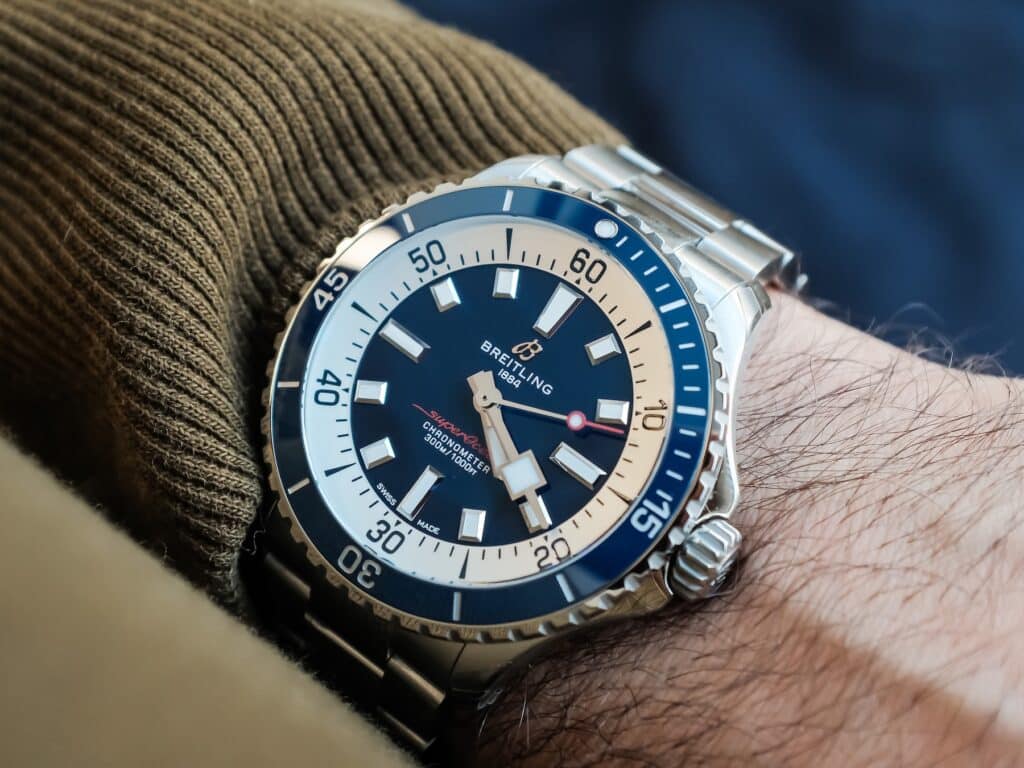
Despite the substantial dial furniture, the Superocean wears pretty much how I’d expect a 42mm watch to wear. The proportions felt generally balanced during my time with it, and I never found the case dimensions themselves particularly intimidating. Given some of Breitling’s historical tendencies toward larger watches, I was surprised by how reasonable this configuration felt on the wrist.
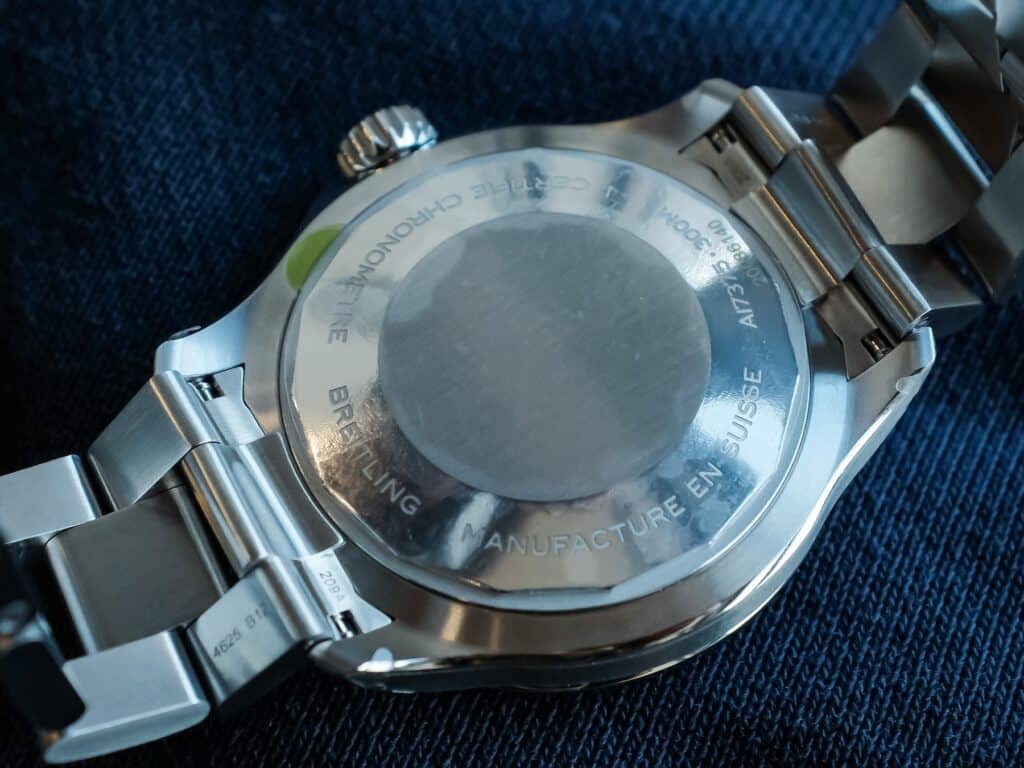
The stainless steel case measures 12.56mm thick and offers 300 meters of water resistance. I think that thickness is perfectly manageable for this type of watch, especially considering the screw-down crown and substantial rotating bezel.
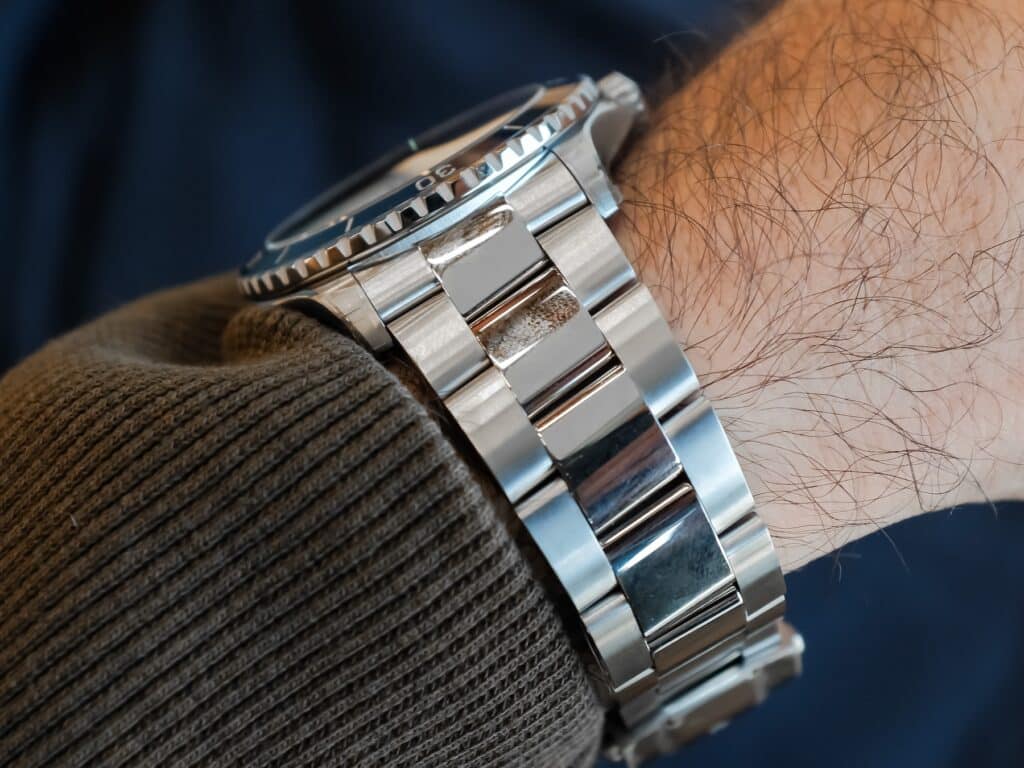
The case finishing also has more detail than I expected. Brushed surfaces cover the lug tops and case sides, while polished bevels create a transition between them. Those polished edges continue toward the crown guards, giving the case some additional definition. I like how the different finishes break up the profile, particularly when viewing the watch from an angle.
The bezel deserves some attention as well. Its deeply textured outer edge is easy to grip, and the ceramic insert complements the polished details elsewhere on the watch. More importantly, I really enjoyed operating it. The unidirectional action has a firm, precise feel, with satisfying clicks and no noticeable looseness.
Breitling has also fitted the Superocean with a gently curved sapphire crystal treated with anti-reflective coating on both sides. I’ve always appreciated the effectiveness of Breitling’s crystal coatings, and this watch continues that tradition. Reflections are well controlled, keeping the dial’s colors and substantial markers clearly visible. Taken together, these details make the case and bezel some of my favorite aspects of the watch. The finishing is attractive without becoming distracting, the proportions make sense, and the bezel operation is particularly satisfying. I think Breitling has done a good job balancing the design’s visual weight with a case that remains approachable.
The Stainless Steel Bracelet
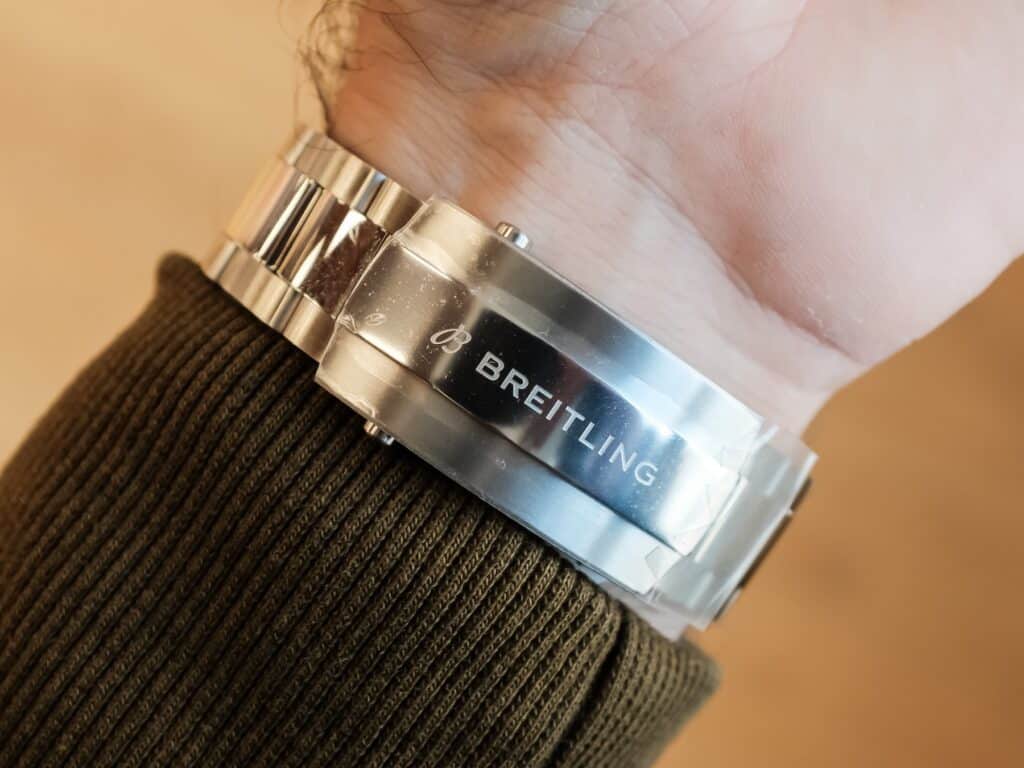
The bracelet was where my impressions became a little more complicated. The example I reviewed, reference A17375E71C1A1, came fitted with Breitling’s stainless steel three-link bracelet. Its angled links complement the case nicely, and the construction feels substantial.
I appreciate the overall design and finishing, especially how the brushed and polished surfaces carry through from the case. The bracelet looks appropriate for the Superocean and contributes to the sense of quality I noticed throughout the watch. However, I was also more aware of its weight than I would have preferred.
I generally don’t mind a stainless steel diver having some heft. It’s a characteristic I’ve come to expect from plenty of watches in this category. With the Superocean, though, the bracelet added enough bulk that it became my main reservation about the overall wearing experience.
That’s interesting because I found the case itself so well proportioned. The 42mm diameter and relatively manageable thickness never seemed like major obstacles. Once the bracelet entered the equation, the complete watch felt more substantial than I would’ve liked.
I wouldn’t characterize the bracelet as poorly executed. My concerns are primarily about its physical presence rather than its construction. For collectors who enjoy the weight of a full stainless steel sports watch, this may be a perfectly reasonable trade-off. Personally, I found myself wishing the overall package felt a little lighter.
Breitling also offers the Superocean on a matching rubber strap, and I’d be interested in spending time with that configuration. I suspect it could address some of my concerns about weight, although I haven’t worn that version and can’t make a direct comparison.
As much as I appreciate the look of the steel bracelet, I think the choice between these configurations is worth careful consideration. The bracelet contributes a lot to the watch’s character, and it was ultimately the component that gave me the most to think about.
Caliber 17 and the $5,900 Question
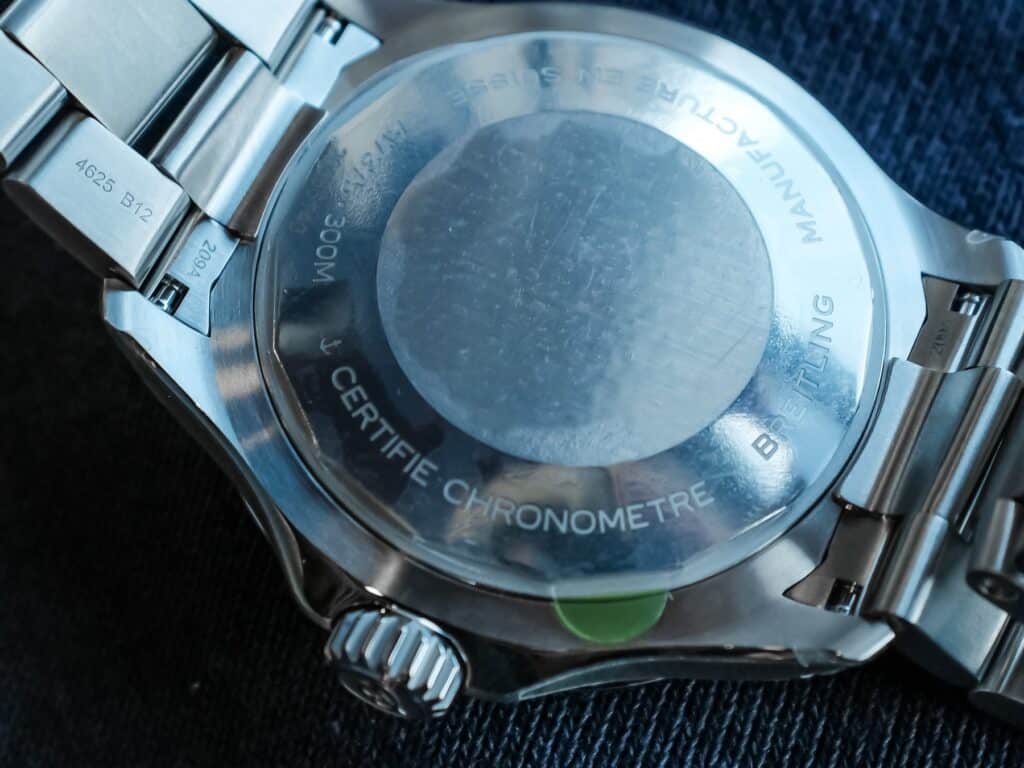
The Superocean is powered by Breitling’s Caliber 17, an automatic movement based on ETA architecture. It runs at 28,800 vibrations per hour, has 26 jewels, and offers about 38 hours of power reserve. The movement is COSC-certified, which is a welcome detail at this price.
During my time with the watch, the movement performed reliably, and I didn’t encounter any noticeable issues. I wasn’t conducting an extended accuracy study, so I can’t offer specific timing results. From a practical standpoint, though, I had no complaints about its operation.
At $5,900 on the stainless steel bracelet, the Superocean sits among some serious competition. Buyers shopping in this range have access to a variety of Swiss divers, including models with longer power reserves and more ambitious movement specifications. I think it’s reasonable to acknowledge that 38 hours feels fairly limited for a contemporary watch at this price.
That limitation may matter more to some collectors than others. If you’re wearing the same watch every day, the available reserve is unlikely to become a major concern. For someone regularly rotating through several watches, there’s less flexibility when leaving the Superocean off the wrist for a day or two.
I also recognize that evaluating a watch involves more than comparing movement specifications. The Caliber 17 has an established architecture, and the example I wore performed exactly as I needed it to. Meanwhile, the case finishing, dial construction, bezel operation, and crystal coating all contributed to my enjoyment in ways I could appreciate every time I put the watch on.
Still, nearly $6,000 is a serious amount of money, and I think the movement deserves some scrutiny at that level. It’s an area where I’d like to see Breitling offer a little more, particularly when so much of the surrounding watch feels carefully executed.
Wrapping Things Up
I came away from my time with the Superocean Automatic 42 with a considerably better appreciation for Breitling’s modern dive watches. The design surprised me most. I really enjoyed the oversized dial markers, the contrasting minute track, and the way the vintage influences have been incorporated into something that feels contemporary.
I was also impressed by the case proportions and bezel operation. The watch wears true to its dimensions, and the finishing includes several details I appreciated throughout the loan period. Those elements made a stronger impression on me than I expected going in. The stainless steel bracelet remains my biggest reservation. I like how it looks and appreciate its construction, although the additional weight made the complete watch feel bulkier than I’d prefer. The Caliber 17 also gives me some pause at $5,900, primarily because of its relatively short power reserve.
Those considerations make the buying decision more complicated, but I can understand the appeal of this Superocean. There’s a distinctive design here, supported by thoughtful case finishing and an especially enjoyable bezel. I had a good time wearing it, even if I’d be inclined to explore the rubber strap configuration before deciding which version suited me best.
Perhaps the most interesting outcome of this review is how much it changed the way I think about Breitling. After spending time with this Superocean, I’m paying attention to another part of the catalog. And considering how little time I’d previously spent thinking about Breitling divers, that’s a pretty meaningful change in perspective.
I want to thank Feldmar Watch Company for making this hands-on look possible. If you’re local or passing through, check out their awesome brick-and-mortar showroom in Los Angeles, California, or shop their online website here.

Co-Founder & Senior Editor
Michael Peñate is an American writer, photographer, and podcaster based in Seattle, Washington. His work typically focuses on the passage of time and the tools we use to connect with that very journey. From aviation to music and travel, his interests span a multitude of disciplines that often intersect with the world of watches – and the obsessive culture behind collecting them.