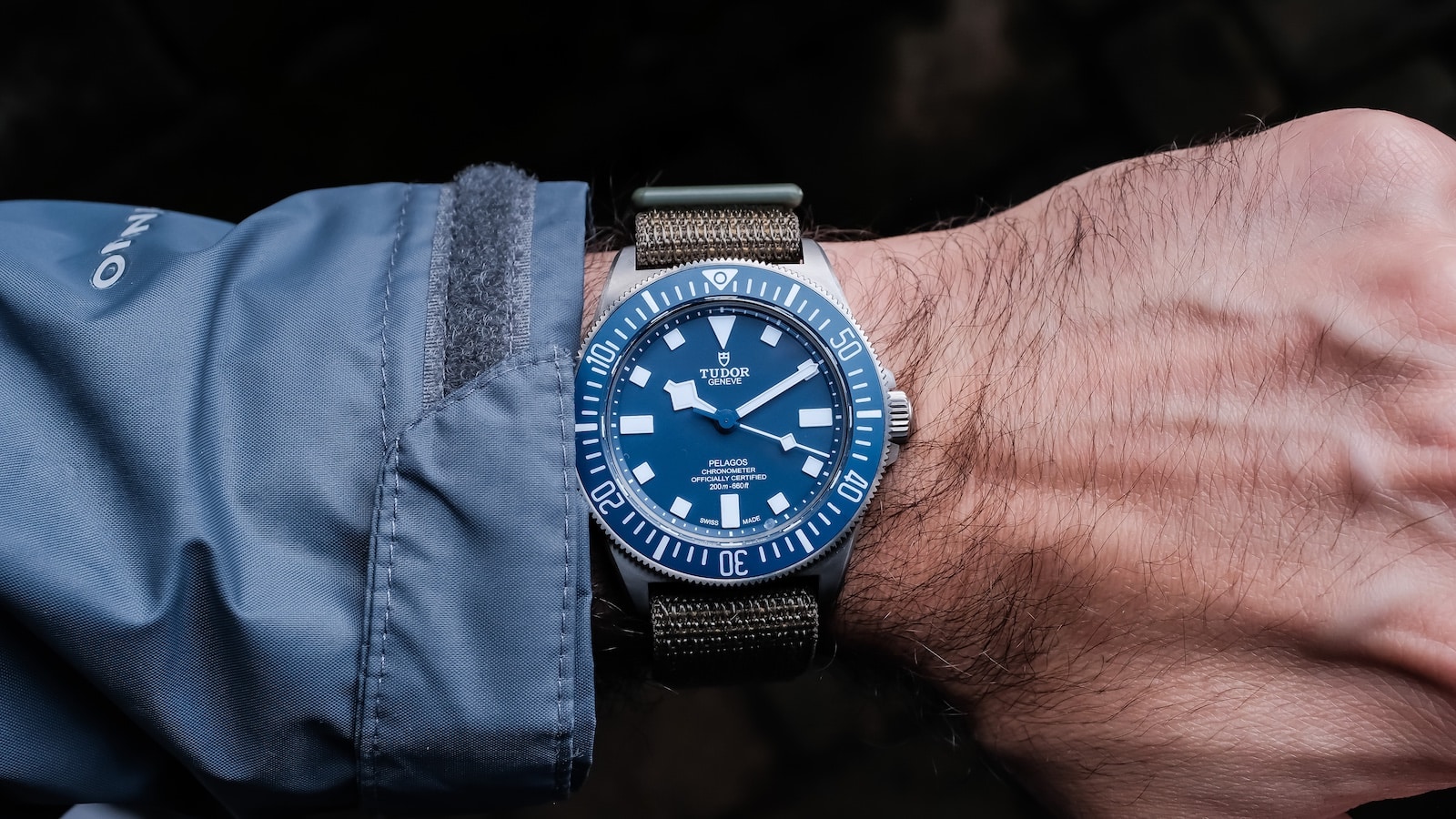
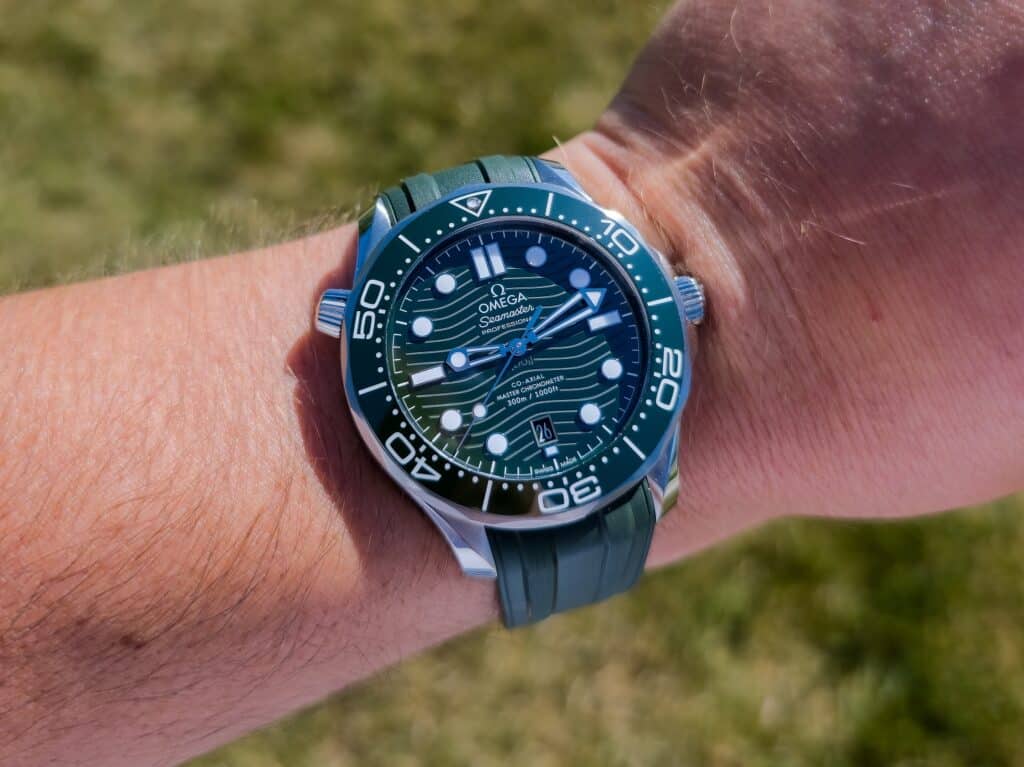
One of the stranger things about living with a good dive watch is discovering that the details you recognize instantly are not always the ones you want to live with forever. I love the Seamaster Diver 300M for how its broad case settles on the wrist without feeling as thick as it looks, and its lyre lugs help tame that larger footprint. But the skeleton hands can reduce readability against the busy dial, and the helium escape valve is hardware we’ve never needed in everyday wear. Our review team and I have spent enough time with the Seamaster to know where those quirks become compromises, which we get into in our full Omega Seamaster Diver 300M review. Here, we’re looking for alternatives that solve those particular annoyances without losing the character that makes a good dive watch worth wearing.
More than a decade of rotating dive watches has taught us that the differences that matter rarely show up on a spec sheet. A substantial case can disappear on the wrist when the proportions are right, while another can feel cumbersome after a few hours. We pay attention to bezel grip, bracelet weight, strap articulation, lume, accuracy, and how a watch wears through a full day because those details determine whether you keep picking it up. That experience shapes these recommendations, so we weigh what each alternative gets right against the compromises we’d have to live with, rather than simply looking for a Seamaster substitute on paper.
Raven Trekker
| Price: | $690 (Check Current Price) |
| Water Resistance: | 200m |
| Case Dimensions: | 39mm (diameter) x 48mm (lug-to-lug) x 12.5mm (thickness) |
| Lug Width: | 20mm |
| Movement: | Miyota 9015 |
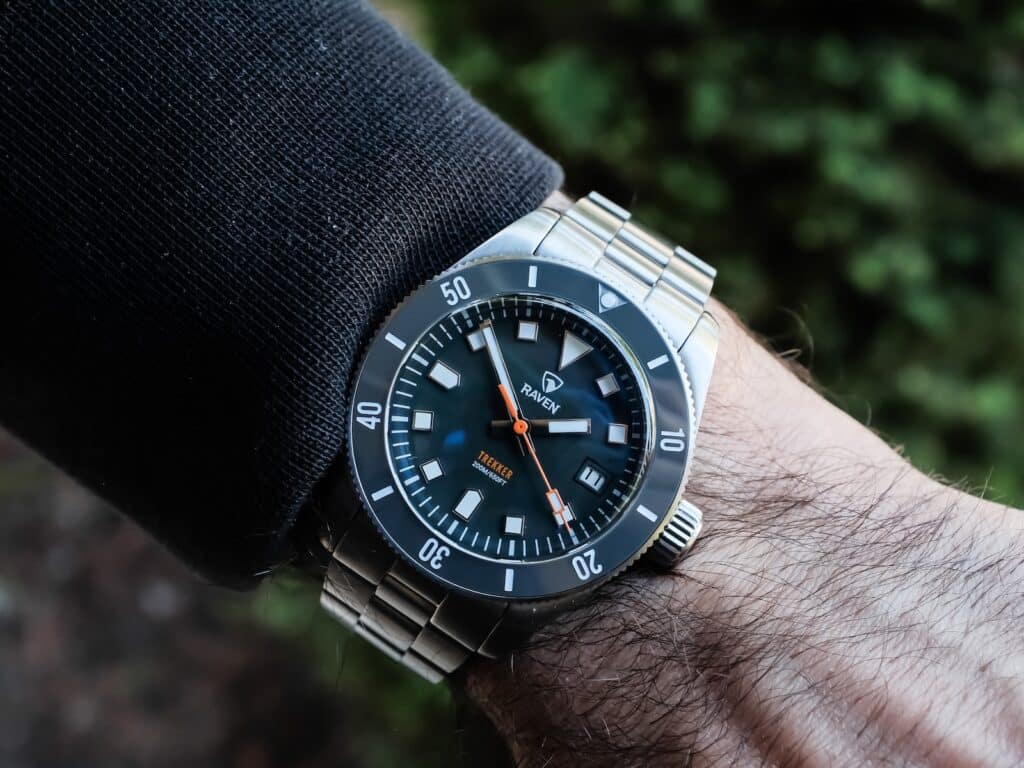
The Raven Trekker is a good example of why we shouldn’t confuse constant redesign with progress. Raven has spent several generations sanding down the rough edges instead, and this 39mm version benefits from that restraint. At 12.5mm thick with its boxed sapphire and a 48mm lug-to-lug, it sits flatter and more naturally than earlier Trekkers, while the flat caseback keeps it from becoming a wrist burden. Water resistance dropped from 300 to 200 meters, but in actual use we never felt deprived. The oversized screw-down crown still supplies enough tool-watch attitude without pretending we’re on a saturation mission every time we leave the house. For this particular search, that matters: it gives us the capable everyday-diver brief without adding a helium valve we’ll spend most of our time explaining to non-watch people.
The dial is where Raven avoids making a sensible watch feel sensible. That glossy gray surface and matching ceramic bezel can look charcoal outside and blue-black indoors, while the heavy blue AR coating does plenty of work shifting the watch’s character with the light. Polished hands and applied markers stay easy to read, and the restrained orange accents add life to the dial without turning it into another faux-military diver. Compared with a busier design, there is less happening at a glance, which makes the Trekker a particularly good fit for anyone looking to move away from skeleton hands without ending up with a dial that feels completely anonymous.
We also like how much of the Trekker’s refinement comes from use rather than advertising. The 120-click coin-edge bezel has crisp engagement and enough texture to operate without fiddling, and the Miyota 9015 wound smoothly while keeping excellent time throughout our hands-on time with it. The bracelet surprised us even more. We expected those drilled lugs to turn the Trekker into a strap-swapping science project, but the oyster-style bracelet stayed on our wrist. That’s because the 20mm-to-16mm taper keeps the watch from feeling bulky, the single-sided screws make sizing painless, and the NodeX clasp gives us genuine on-the-fly adjustment rather than another checkbox labeled “micro-adjust.” The basics are simply done well.
There are still a few reminders that this is a real watch and not a press-release unicorn. The blue AR can throw noticeable reflections in certain light, the clasp extension looks awkward when deployed, and our sample developed some side-to-side play. None of that changes the broader impression: Raven has refined the Trekker in places we actually notice after living with it. If the Seamaster Diver 300M’s skeleton hands and helium valve have started to wear on you, the Trekker offers a cleaner, more straightforward alternative without giving up the comfort, legibility, or serious dive-watch character.
Pros
- The Miyota 9015 wound smoothly and kept excellent time during our testing.
- Raven’s glossy gray dial shifts between charcoal and blue-black depending on the light, with the ceramic bezel adding to the effect.
- The 39mm case measures 12.5mm thick and has a 48mm lug-to-lug, helping it sit flatter and feel less cumbersome than earlier Trekkers.
- The coin-edge bezel gives us 120 crisp clicks and enough grip to operate without fuss.
- The oyster-style bracelet tapers from 20mm to 16mm, which keeps the watch from feeling too bulky on the wrist.
- Drilled lugs, single-sided screws, and the NodeX clasp make the bracelet practical to size and adjust, while the clasp provides genuine on-the-fly adjustment.
Cons
- Our sample developed some side-to-side play, which takes a little shine off an otherwise thoughtfully executed bracelet.
- The strong blue AR coating can catch noticeable reflections in certain lighting.
- The clasp extension looks awkward when fully deployed, a slightly clumsy detail on an otherwise well-resolved watch.
Mido Ocean Star 200
| Price: | $980 – $990 (Check Current Price) |
| Water Resistance: | 200m |
| Case Dimensions: | 41mm (diameter) x 47.03mm (lug-to-lug) x 11.7mm (thickness) |
| Lug Width: | 21mm |
| Movement: | Mido Caliber 80 Day-Date |
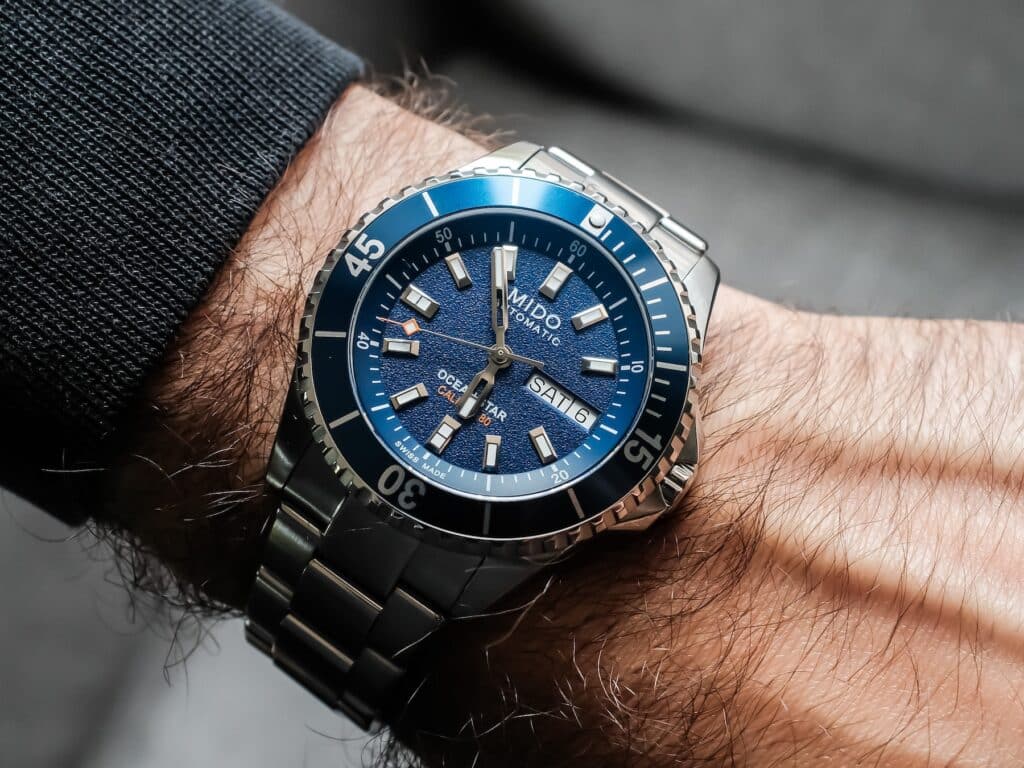
The Mido Ocean Star 200 is a good example of why we prefer a sensible redesign to a brand trying to reinvent a perfectly serviceable diver every few years. We wore three versions side by side for several weeks, and the shared 41mm case kept making the same good impression. At 47.03mm lug-to-lug and only 11.7mm thick, it avoids the oversized proportions that have become almost mandatory in the modern dive-watch category. At 172 grams on the bracelet, it has some heft, but it never felt cumbersome all day. Mido also sharpened the case with a broader chamfer, enlarged the crown guards, and revised the bezel. For someone coming from the Seamaster Diver 300M and wanting a cleaner alternative without the quirks, the Ocean Star 200 gets remarkably close to the useful parts of that formula while being its own watch.
The bezel and dial are where the refresh starts paying dividends. Larger numerals make the bezel much easier to read at a glance, while the raised outer flange, more substantial applied markers, and thicker handset give the dial better depth and balance. The grained finish changes noticeably as the light moves across it, so the watch avoids looking like a flat slab of dial furniture. Mido kept the orange details restrained to the second-hand tip and Caliber 80 text, which is exactly right. After wearing all three, we kept reaching for the white version because its textured dial and black bezel had the strongest tool-watch feel and remained very easy to read. The blue is the obvious safe choice and will probably appeal to the widest audience. The silver took longer to appreciate, but its texture becomes more interesting as the light changes, with those small orange accents keeping it from becoming another anonymous gray diver.
The Caliber 80 Day-Date is another example of Mido putting practicality ahead of watch-box theater. The roughly 80-hour power reserve became especially useful while rotating three watches because we could put one aside for a couple of days and come back to it without immediately reaching for the crown. The Nivachron balance spring adds sensible resistance to magnetism and everyday environmental exposure, which matters more in a watch that will spend time around phones, laptops, travel, and whatever else life throws at it. The solid embossed caseback means none of the movement finishing is there for us to admire, but that is hardly the point. It performed reliably and then got on with the job. Up front, double-sided AR-treated sapphire, a screw-down crown, and 200 meters of water resistance mean the Ocean Star 200 never asks us to treat it delicately.
The redesigned bracelet also deserves more credit than a quick spec list would suggest. Brushed outer links and polished centers add refinement without making the watch feel dressy, while quick-release spring bars encourage strap swapping the case doesn’t otherwise demand. The integrated diver extension is useful when the wrist expands, but the clasp never feels overcomplicated. That balance is what makes the Ocean Star 200 relevant to this particular Seamaster search. We are not getting another watch that copies the Omega’s visual formula after removing two features. We are getting a well-proportioned, highly legible diver with a long-running movement, practical wearability, and enough personality to keep it interesting. Our full hands-on review gets into how the refresh holds up beyond the first impression.
Pros
- 41mm case, 47.03mm lug-to-lug, and 11.7mm thickness wear comfortably without feeling insubstantial.
- Revised case, bezel, and dial details improve presence and at-a-glance readability.
- Caliber 80 offers roughly 80 hours of power reserve.
- Nivachron adds useful resistance to magnetism and everyday environmental exposure.
- The bracelet combines brushed and polished links with quick-release bars and a practical dive extension.
- Double-sided AR sapphire and 200m water resistance make it an easy everyday diver.
Cons
- At 172 grams on the bracelet, it feels noticeably heavy.
- The solid caseback hides the Caliber 80.
Longines HydroConquest
| Price: | $2,000 (Check Current Price) |
| Water Resistance: | 300m |
| Case Dimensions: | 41mm (diameter) x 50mm (lug-to-lug) x 11.9mm (thickness) |
| Lug Width: | 21mm |
| Movement: | Longines L888 |
The Longines HydroConquest is the sort of diver we appreciate more after wearing it for a few days than after staring at its specifications for five minutes. The 41mm case has a 50mm lug-to-lug and measures around 11.9mm thick, numbers that suggest it should feel more substantial than it does. Instead, the caseback barely protrudes, keeping the center of gravity low and the watch nicely planted. During regular wear, it didn’t slide around or develop that top-heavy feeling some larger divers eventually inflict on us. It also squeezed under a cuff without much argument. For this particular search, that everyday behavior is more important than matching the Seamaster millimeter for millimeter.
Longines also made the more aggressive details surprisingly livable. The triangular crown guards look as though they were designed to pick a fight with your wrist, but they sit high enough above the case flank that they never dug in at the desk or while hiking. The crown itself was easy to unscrew and wind without taking the watch off, which is the sort of mundane convenience we notice once a watch has been in rotation for a while. The ceramic bezel is another sensible upgrade over the older aluminum insert, bringing more scratch resistance and a cleaner modern look. The bracelet is where the illusion of refinement slips a little: the oyster-style construction is comfortable, but the minimal taper and basic clasp feel rather ordinary next to the nicely finished case.
The dial is where the HydroConquest stays disciplined. The black sunburst catches light without becoming a glare machine, while the simplified minute markers make the display cleaner than earlier versions. The hands are easy to distinguish, and that diamond-shaped hour hand becomes quite useful once the lights disappear, with its luminous center looking almost like a small blue pointer. The lume starts bright but fades sooner than some rivals; thankfully, the large white markers stay readable after the glow settles. The L888 movement brings another everyday advantage, running quietly at our sample’s observed -5 to +15 seconds per day and offering roughly 72 hours of reserve. That means less winding drama when it spends a weekend sitting in the watch box. We cover the longer-term experience in our full review.
The HydroConquest is appealing precisely because it doesn’t make a song and dance about being a diver. You get 300 meters of water resistance, a screw-down caseback with the Longines winged-hourglass engraving, a ceramic bezel, and a case that behaves itself on the wrist. The trade-offs are easy to identify: the 21mm lug width narrows strap choices, the bracelet is the weak link in an otherwise well-resolved package, and the lume is good rather than memorable. That balance is the point.
Pros
- The 50mm lug-to-lug sounds intimidating, but the low center of gravity keeps the 41mm case stable and comfortable.
- The L888’s roughly 72-hour reserve suits a collection where watches routinely spend weekends in rotation.
- The ceramic bezel, clean brushing, and engraved caseback give the watch a nicely finished feel without overdoing it.
- Those triangular crown guards look aggressive but stay clear of the wrist.
- The 120-click bezel operates smoothly and benefits from the tougher ceramic insert.
- The cleaner dial layout and large markers keep legibility intact after the lume has faded.
Cons
- The bracelet’s modest taper and basic clasp feel less refined than the case.
- A 21mm lug width makes finding the right aftermarket strap more annoying than usual.
- The lume loses its initial punch relatively quickly.
Oris Aquis New York Harbor II
| Price: | $3,000 (Check Current Price) |
| Water Resistance: | 300m |
| Case Dimensions: | 43.5mm (diameter) x 51mm (lug-to-lug) x 13mm (thickness) |
| Lug Width: | 23mm |
| Movement: | Caliber 733 (based on the Sellita SW200-1) |
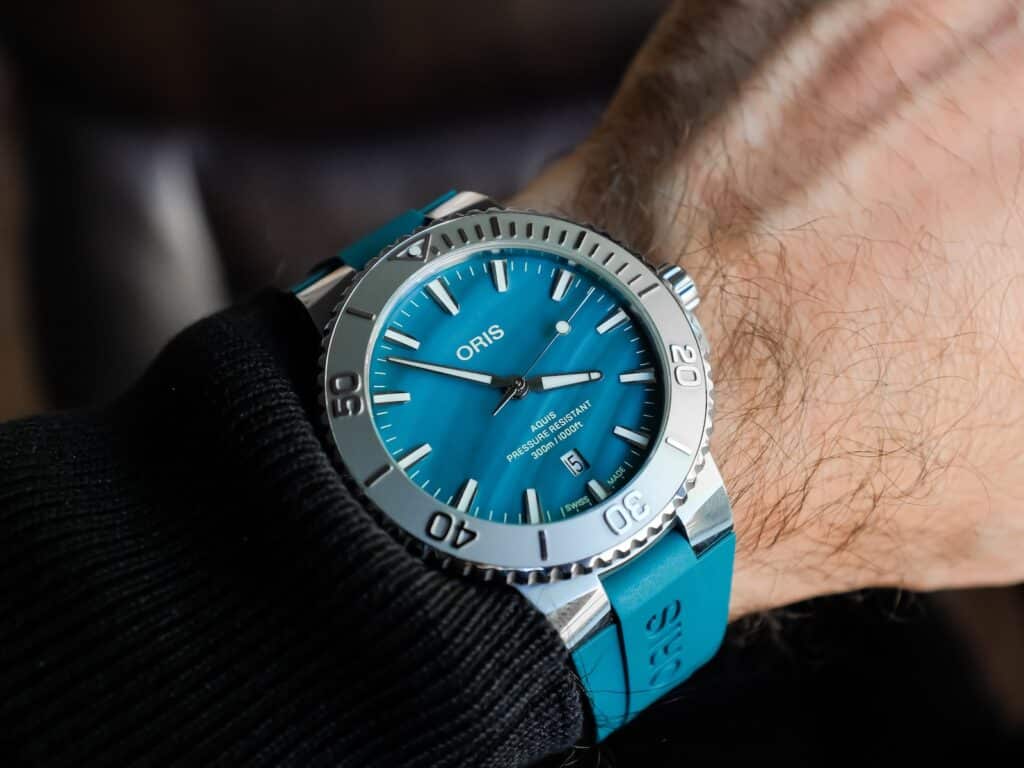
The Oris Aquis New York Harbor II makes a pretty compelling case for leaving the safe black-dial diver behind. Its aqua-green mother-of-pearl dial is the obvious attention-grabber, but it’s more nuanced on the wrist than the color suggests. In direct light, it gets lively and green; indoors, it can calm down into something closer to stone. More importantly, it remains easy to read instead of turning into a decorative exercise. The 43.5mm case sounds like a commitment, and it is, but the curved lugs and integrated rubber strap help it settle better than the diameter implies. At a little over 13mm thick and roughly 51mm lug-to-lug, it is not a small watch. It is, however, a useful alternative for anyone who likes the Seamaster’s premium-diver feel but would rather have a straightforward handset and no helium valve interrupting the case.
The stainless steel bezel is probably the Aquis detail we appreciated most after spending extended time with it. It has a slightly raw, industrial quality that suits the brushed case better than a glossy ceramic insert would, and the crisp action never feels sloppy. The screw-down crown operates smoothly, while the domed sapphire and internal AR coating keep reflections from becoming a constant nuisance. It offers 300 meters of water resistance, so the more distinctive design doesn’t come at the cost of capability. The Caliber 733 is less memorable. It gives us automatic winding, hacking seconds, a date, and about 41 hours of reserve, with accuracy behaving as expected during testing. The downside becomes obvious in a rotating collection: leave it untouched for a couple of days, and you will probably be setting it again.
The rubber strap was another pleasant surprise. We expected the aqua-green color to wear like a gimmick. Still, it proved comfortable enough that we rarely wanted to swap it, even though the integrated lugs make experimenting with other straps difficult. The limited run of 2,000 pieces and the Billion Oyster Project connection also give the watch some substance beyond “new dial, fewer units.” Part of the proceeds supports oyster restoration in New York Harbor, and the oyster-themed caseback carries that idea through without turning the watch into a charity brochure. Those details matter because the Aquis is already unconventional enough; it doesn’t need a story pasted on afterward.
The trade-offs are easy enough to live with, as long as the watch fits you and your collection. That 43.5mm case will be too much for some wrists; the 41-hour power reserve is hardly ideal for a watch rotation addict, and the dial demands more thought with clothes than a conventional black diver. But that is also why it works here. We are not trying to recreate the Seamaster without its skeleton hands and helium valve; we are looking for something with its own reason to exist. The Aquis has one, and it is considerably more interesting than being different for its own sake.
Pros
- The mother-of-pearl dial changes character dramatically with the light while keeping the time easy to read.
- The steel bezel has an industrial feel and crisp, confidence-inspiring action.
- Despite the 43.5mm case size, the curved lugs and integrated rubber strap help it sit more naturally than expected.
- Domed sapphire and internal AR keep reflections manageable during wear.
- The 300-meter rating preserves the Aquis’s serious side beneath all that color.
- The Billion Oyster Project partnership adds a genuine purpose to the limited edition rather than merely dressing up the production number.
Cons
- Integrated lugs make strap experimentation far more complicated than usual.
- The 43.5mm case and roughly 51mm lug-to-lug will still be excessive for some wrists.
- The colorful dial has less grab-and-go versatility than a conventional black diver.
- A 41-hour reserve is easy to outgrow once you start rotating several watches.
Sinn T50
| Price: | $4,330 (Check Current Price) |
| Water Resistance: | 500m |
| Case Dimensions: | 41mm (diameter) x 47mm (lug-to-lug) x 12mm (thickness) |
| Lug Width: | 20mm |
| Movement: | Sellita SW 300-1 |
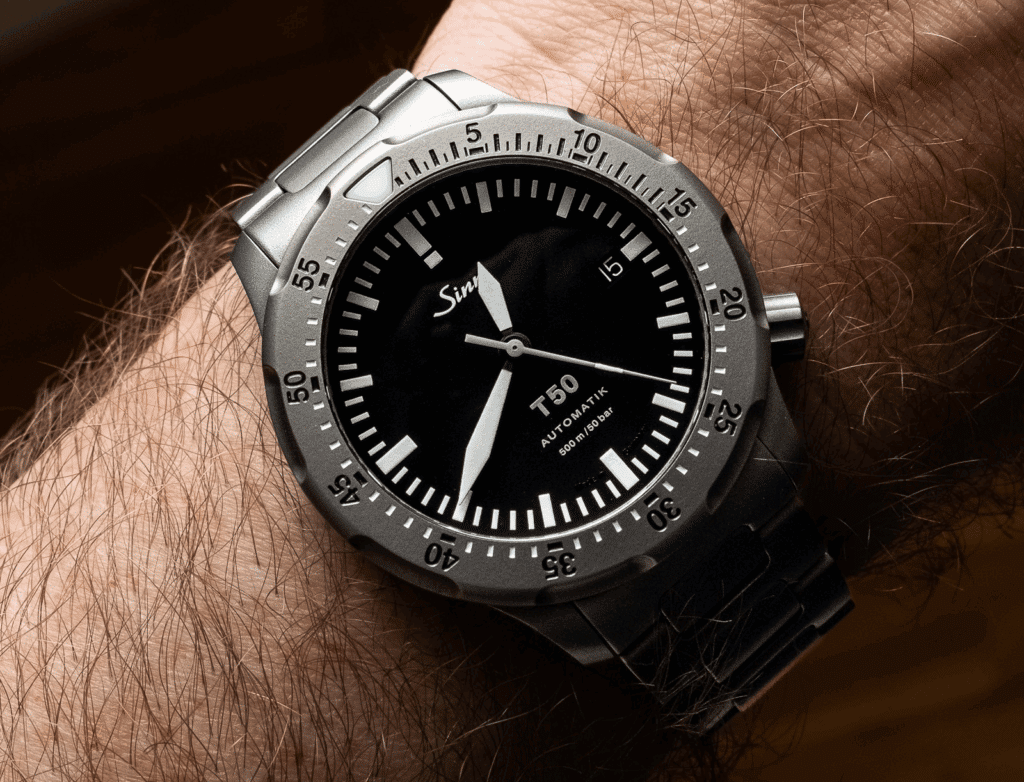
Some divers make us want to stare at the dial. The Sinn T50 makes us want to read it and get on with our day. That difference matters when the Seamaster Diver 300M’s skeleton hands start to feel more decorative than helpful. The T50’s black-and-white layout is almost stubbornly clear, with sword hands, tidy markers, and a date window that stays useful without making itself the center of attention. No glossy visual traffic competes with the hands, either. Even the small lume patch on the second hand has a practical job: confirming that the movement is still ticking in the dark. It is not too large, so we sometimes needed an extra beat to find it, but the point is uncomplicated.
The titanium case takes that same attitude to the wrist. At roughly 95 grams, the T50 feels almost wrong the first time we pick it up (in a good way), then becomes hard to give up once we’ve worn it all day. The matte surface keeps reflections subdued, the case sits low, and the 4 o’clock crown stays out of the way when typing, riding, or generally forgetting that we have a watch on. That lightweight feel doesn’t come from making the watch feel flimsy, either. It simply removes the sense that we are carrying around unnecessary bulk.
Sinn’s captive bezel is another detail that makes more sense through use than explanation. You have to press down before turning it, which is a bit fussy until the watch takes a knock and the bezel stays exactly where it belongs. The tegimented treatment also proved useful against everyday scratches. Drilled lugs make moving to rubber or NATO easy, although our H-link bracelet’s diver extension could release with a light pull, so we removed it and went back to a conventional spring-bar arrangement. Inside, the Sellita SW300 was the quiet overachiever, averaging roughly +2 to -3 seconds per day in our in-depth testing. However, the 42-hour power reserve is less friendly to frequent rotation, and servicing has to go through Sinn.
That combination makes the T50 particularly relevant here. It gives us the serious, engineered feel we want from a premium diver. We get clear execution, a lightweight design, a bezel that is hard to knock out of position, and a case that behaves itself for hours at a time. The compromises are tangible: the shortish reserve, the questionable bracelet extension, and Sinn-specific servicing, but we understand them before buying rather than discovering them halfway through ownership.
Pros
- The lightweight titanium case comes in around 95 grams and stays comfortable without feeling insubstantial.
- The captive bezel needs deliberate pressure to turn, making accidental movement far less likely.
- Tegimented treatment helps the bezel shrug off the scratches that tend to accumulate with real wear.
- The black-and-white dial, sword hands, clean markers, and modest date window make quick reading almost effortless.
- Drilled lugs make switching between the bracelet, rubber, and NATO straightforward.
Cons
- Sinn-specific servicing adds a layer of inconvenience when maintenance eventually rolls around.
- The bracelet’s diver extension could release too readily on our example.
- A 42-hour power reserve is not generous for anyone who rotates watches.
- The second hand’s small lume patch works, but it takes a moment to pick out in the dark.
Tudor Pelagos FXD
| Price: | $5,025 (Check Current Price) |
| Water Resistance: | 200m |
| Case Dimensions: | 42mm (diameter) x 52mm (lug-to-lug) x 12.75mm (thickness) |
| Lug Width: | 22mm |
| Movement: | Tudor MT5602 |
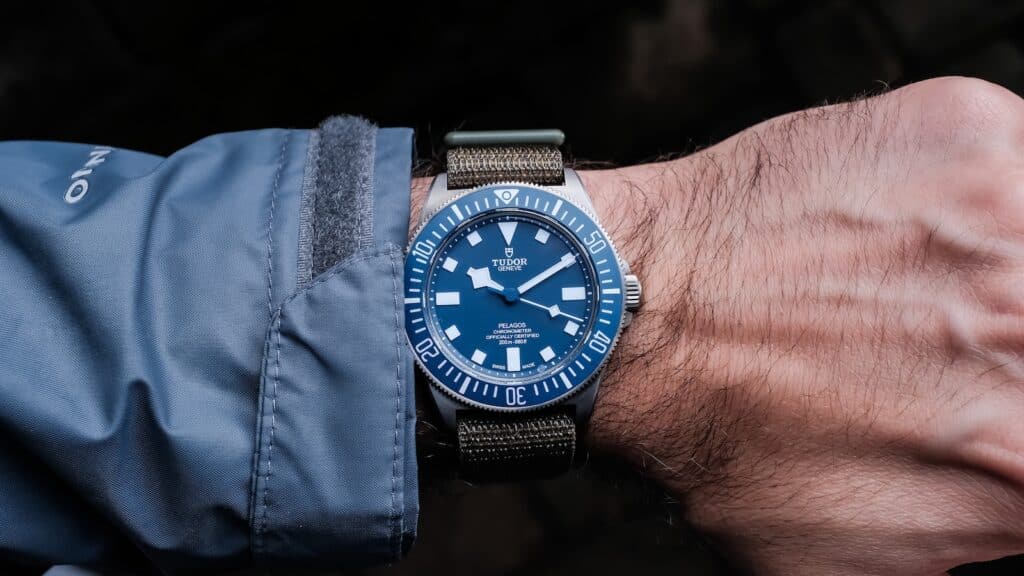
The Tudor Pelagos FXD is almost the opposite of the Seamaster Diver 300M in the way it arrives at a serious dive watch. Instead of adding equipment until the case has something for everyone, Tudor picked a job and stuck to it: titanium, fixed strap bars, a countdown bezel, matte surfaces, and a Marine Nationale connection. We spent a week with the original blue version and found the 42mm case much easier to wear than its 52mm lug-to-lug suggests. At 12.75mm thick, it avoids the standard Pelagos’s blocky feel, while the titanium keeps the weight sensible. The 200-meter water resistance also feels more than adequate. Nobody asked the FXD to moonlight as a saturation-diving instrument.
As covered in our dedicated review, the dial is where the FXD’s focused approach starts paying off. The dark navy, matte surface, no-date layout, and snowflake hands make reading the time almost automatic, while the lume remains strong as the room gets dark. The countdown bezel is a different story. Its deeper knurling gives us plenty to grab, and the 120-click action is crisp, but the scale takes some retraining if your brain has spent years expecting a conventional elapsed-time bezel. Once we adjusted, it made sense within the watch’s intended role. The MT5602 helps the ownership experience, too, with roughly 70 hours of power reserve—handy when another watch inevitably interrupts the rotation.
The fixed bars are where the FXD becomes either very appealing or very annoying, depending on your expectations. They are machined into the case, with chamfered edges that are kinder to fabric than they look at first, but they permanently rule out a bracelet and make strap choice part of the ownership experience. We had good results with a Prometheus Design Werx Ti-Ring, a Watches of Espionage Glomar Explorer strap, and even inexpensive Garmin-style elastic options. That became part of the fun, not a chore. The FXD tells us what it wants to wear, and after enough wrist time, we stopped negotiating.
That focus is also where the compromises live. The 52mm lug-to-lug can still be a deal-breaker for smaller wrists, the fixed bars make the watch far less adaptable than a conventional diver, and the countdown bezel is not as universally useful as a standard dive scale. The price is another step up from the watches many collectors start with, while some buyers may remain wary of Tudor’s in-house movement track record despite our sample performing well. But for anyone looking to get away from the Seamaster’s skeleton hands and helium valve behind, the FXD does something more interesting than simply removing them. It replaces that visual complexity with a watch that knows exactly what it is for.
Pros
- The 42mm titanium case feels more manageable than its 52mm lug-to-lug suggests, and the 12.75mm thickness keeps it from wearing like a block.
- Matte surfaces keep glare down while preserving the watch’s utilitarian character.
- The dark navy no-date dial and snowflake handset make quick reading effortless.
- Generous bezel knurling and crisp 120-click action make the countdown scale easy to operate.
- The MT5602 offers roughly 70 hours of reserve, which works well in a rotating collection.
- The fixed bars give the watch a genuinely purposeful military-tool feel.
Cons
- The 52mm lug-to-lug remains a lot to take on for smaller wrists.
- No bracelet option, and the fixed bars make conventional strap swapping impossible.
- The countdown bezel requires some mental adjustment if you are used to standard dive timing.
- The higher price and lingering concerns around the long-term track record of Tudor’s in-house movement may give cautious buyers pause.
Glashütte Original SeaQ
| Price: | $11,600 (Check Current Price) |
| Water Resistance: | 200m |
| Case Dimensions: | 39.5mm (diameter) x 47.5mm (lug-to-lug) x 12.5mm (thickness) |
| Lug Width: | 20mm |
| Movement: | SeaQ Caliber 39-11 Automatic |
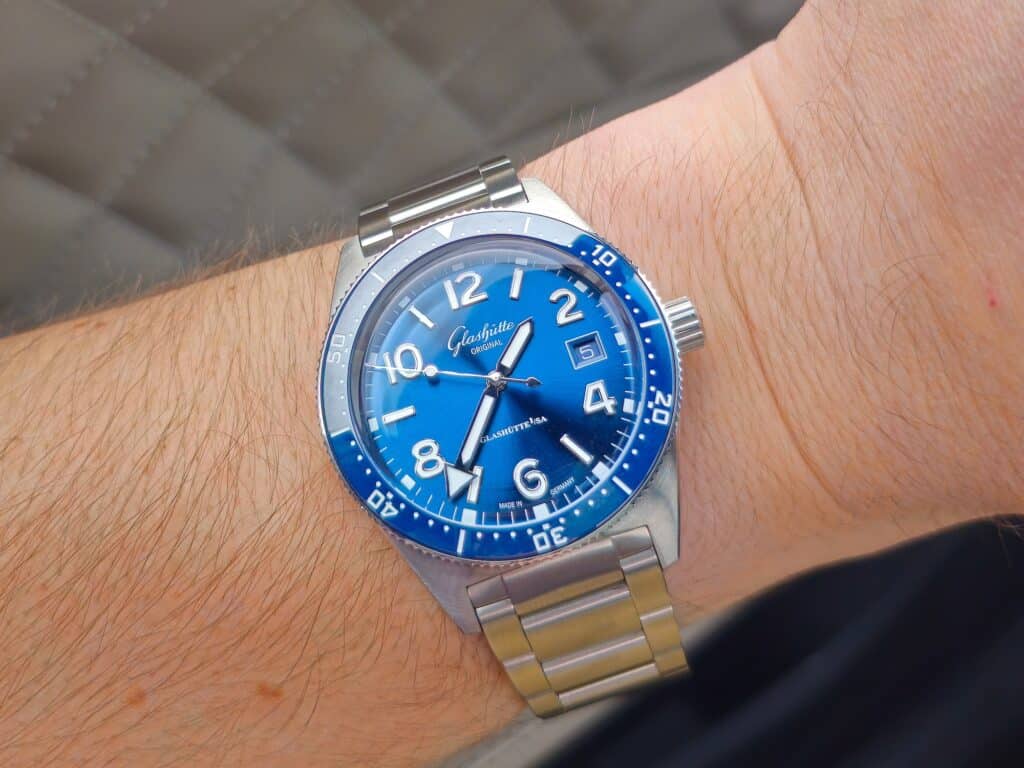
The SeaQ reminds you that a serious diver doesn’t have to arrive wearing a visual weight vest. Its compact case, 200-meter water resistance, and low-key mix of brushed surfaces and polished edges give it plenty of capability without making the wrist feel like it has been fitted with a hockey puck. That makes it particularly interesting here: the SeaQ gives us the everyday credibility and premium execution we like about the Seamaster Diver 300M without making the case look busy. The 20mm bracelet is comfortable, although the way it meets the case is quite awkward for a watch this carefully finished. The tool-free clasp adjustment, meanwhile, is exactly the kind of small feature that earns its keep when a warm day turns our wrist into a slightly larger version of itself.
The dial is where the SeaQ starts showing some personality. Its sunburst surface moves from brighter tones in direct light to deep, almost inky shades indoors, yet the clean Arabic numerals and restrained text keep all that movement from getting in the way of reading the time. The domed sapphire adds a little visual warmth without turning the dial into a funhouse mirror. The bezel follows the same philosophy: firm, precise, and refreshingly fuss-free. The screw-down crown has similarly deliberate resistance, and after enough time with the watch, those tactile details become part of why it feels expensive in a useful way, not merely because someone stamped a prestigious name on the dial.
The Caliber 39-11 is the more complicated relationship. Beneath the closed caseback, it has the sort of finishing we would happily stare at—beveled edges, polished screws, a swan-neck regulator, and a skeletonized rotor—and during our testing it ran consistently. The problem is that the roughly 40-hour power reserve feels modest at this level. A collector rotating several watches can burn through that reserve without trying. The bracelet-to-case transition is another miss in an otherwise carefully executed package. At the same time, the closed back means most of that beautifully finished movement remains something we have to take on faith.
That combination is why the SeaQ works as an alternative rather than simply another luxury diver. It stays compact, offers 200 meters of genuine water resistance, delivers satisfying controls and strong legibility, and has enough visual character to avoid becoming another anonymous sports watch. The compromises are easy to spot—the awkward bracelet transition, short-ish reserve, and hidden movement—but none of them erase the larger appeal.
Pros
- The compact case delivers 200-meter water resistance without piling unnecessary bulk onto the wrist.
- The sunburst dial changes dramatically with the light while keeping the Arabic numerals easy to read.
- The bezel and screw-down crown have controlled, precise feedback that makes everyday interaction feel properly considered.
- Tool-free clasp adjustment is useful when wrist size changes during the day.
- Mixed brushing and polishing give the case refinement without making it feel fragile or precious.
- The Caliber 39-11 is beautifully finished, with beveled edges, polished screws, a swan-neck regulator, and a skeletonized rotor.
Cons
- The bracelet-to-case transition looks basic beside the quality of the rest of the watch.
- Around 40 hours of power reserve is underwhelming for a watch at this level.
- The closed caseback keeps most of the Caliber 39-11’s finishing hidden from view.
That’s our take on the dive watches that address some of the Seamaster Diver 300M’s biggest quirks, from its skeleton hands to the helium escape valve, while still standing on their own as compelling alternatives. Some favor cleaner legibility, others lean into tool-watch practicality or stronger personality. None tries to be an Omega clone, and that’s the point. If you’ve worn another alternative that belongs in this conversation, tell us. We’re always interested in the watches that make a strong case once they’ve had some real time on the wrist.

Co-Founder and Senior Editor
Kaz has been collecting watches since 2015, but he’s been fascinated by product design, the Collector’s psychology, and brand marketing his whole life. While sharing the same strong fondness for all things horologically-affordable as Mike (his TBWS partner in crime), Kaz’s collection niche is also focused on vintage Soviet watches as well as watches that feature a unique, but well-designed quirk or visual hook.