
There’s a point in collecting when 100 meters of water resistance stops looking like a specification and starts changing how freely we wear a watch. We’ve had watches stay on the wrist through wet commutes, bad weather, sweaty summer days, swimming, and last-minute plans without giving them much thought.
The thing is, you don’t need a dive watch to get that kind of freedom. Field watches, GMTs, pilot watches, chronographs, and everyday sports watches can all offer 100 meters of water resistance or more without the rotating bezel, oversized markers, and tool-watch styling that come with a traditional diver.
Of course, water resistance can’t fix a watch that’s uncomfortable, awkwardly proportioned, difficult to read, or simply not enjoyable to wear. After more than a decade of testing watches, we’ve found that the best non-divers are the ones that combine that added durability with the kind of comfort and versatility that actually makes us want to wear them every day.
These are the watches we’ve tested that get that balance right, along with the compromises we found along the way.
Seiko SRPE51
| Price: | $315 (Check Current Price) |
| Water Resistance: | 100m |
| Case Dimensions: | 40mm (diameter) x 44mm (lug-to-lug) x 12mm (thickness) |
| Lug Width: | 20mm |
| Movement: | Seiko 4R36 |
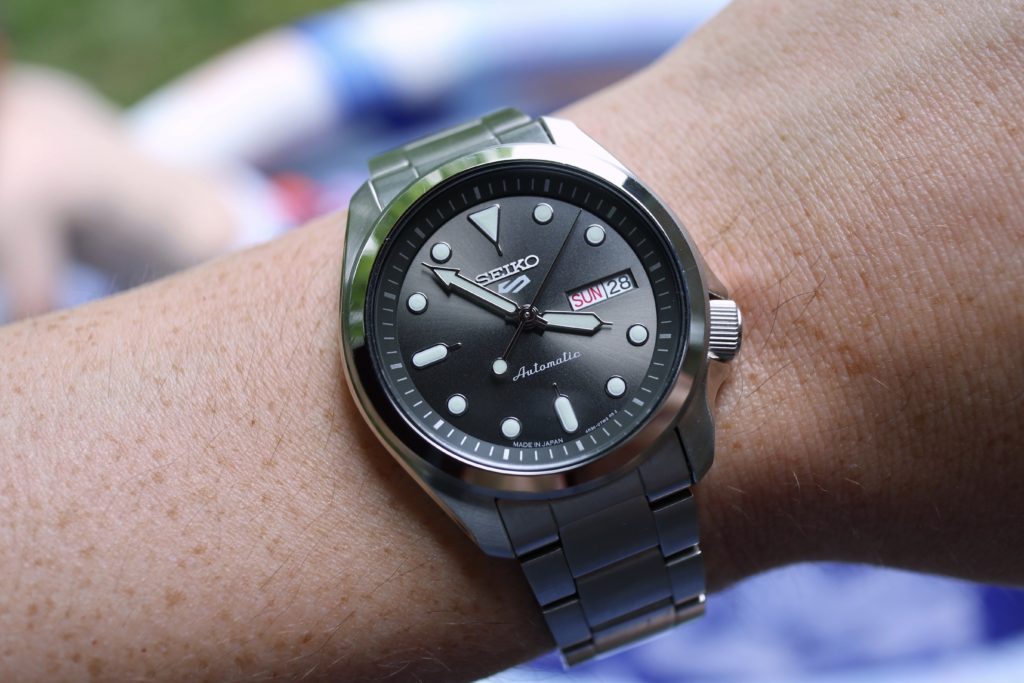
The SRPE51 is a good reminder that a watch doesn’t need a rotating bezel to earn some useful water resistance. Seiko took the SKX formula, removed the dive-watch hardware, and somehow ended up with a watch that makes more sense for the way most of us actually spend a Tuesday. We wore it with T-shirts, button-downs, and everything in between, and the fixed polished bezel never made it feel overdressed or out of place. That 100-meter rating adds a welcome bit of freedom for rain, sweat, accidental splashes, and the occasional swim, without turning the watch into something that looks ready to inspect a shipwreck.
The grey dial is another reason this one sticks around. As noted in our in-depth review, it’s restrained at first glance, but the color picks up subtle shifts as the light moves, giving the watch more personality than the price suggests. Applied markers, the updated Seiko 5 branding, and the modern handset keep everything nicely balanced, while LumiBrite does what Seiko lume tends to do: it gets the job done after the lights go out. We still found ourselves wishing for a lollipop second hand when checking the time in the dark. However, that falls firmly into the category of enthusiast complaints nobody outside the watch world asked for. The 40 mm case also wears surprisingly compact, and the flat Hardlex crystal keeps distortion to a minimum. Sapphire would be nicer, especially on a watch meant for carefree daily wear, but the Hardlex doesn’t get in the way.
The 4R36 automatic keeps the mechanical side of the equation simple, with hacking, hand-winding, and an exhibition caseback that we probably looked at more often than necessary. There’s still something satisfying about seeing the movement working away, even when we have no legitimate reason to turn the watch over. However, the bracelet is less charming. Hollow end links give it a lighter, slightly jangly feel, and chapter-ring alignment remains one of those Seiko quality-control quirks that can make one example look better sorted than another. Fortunately, the drilled 20 mm lugs are a small gift to anyone who likes changing straps. Leather makes the SRPE51 dressier, NATO pushes it back toward its field-watch roots, and the bracelet keeps it in comfortable territory.
That flexibility is ultimately what earns it a spot here. The SRPE51 doesn’t use its 100 meters of water resistance as an excuse to dress like a diver, and it doesn’t pretend to be something more expensive than it is. It’s simply an easy watch to live with, provided you can tolerate a bracelet that feels a little budget and the possibility of alignment glitches.
Pros
- The grey dial develops noticeable depth as the light changes.
- LumiBrite stays highly useful in low light.
- The 4R36 gives you hacking and hand-winding without complicating ownership.
- Drilled 20 mm lugs make strap swapping painless.
- The 100-meter rating adds genuine everyday freedom without dragging the design into dive-watch territory.
Cons
- Hollow end links give the bracelet a lighter, slightly rattly feel.
- Chapter-ring alignment can vary between examples.
- The missing lollipop second hand is a minor gripe, but lume nerds will notice it.
Seiko 5 SSK025
| Price: | $435 (Check Current Price) |
| Water Resistance: | 100m |
| Case Size: | 39.4mm (diameter) x 47.9mm (lug-to-lug) x 13.6mm (thickness) |
| Lug Width: | 20mm |
| Movement: | Seiko 4R34 (Mechanical) |
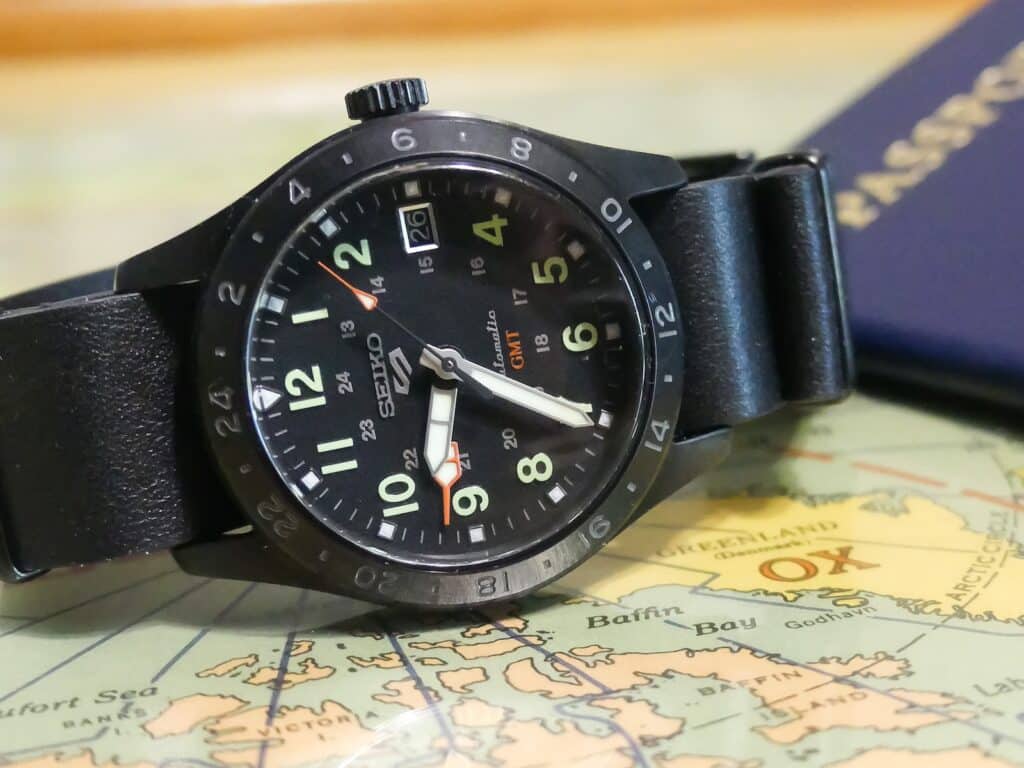
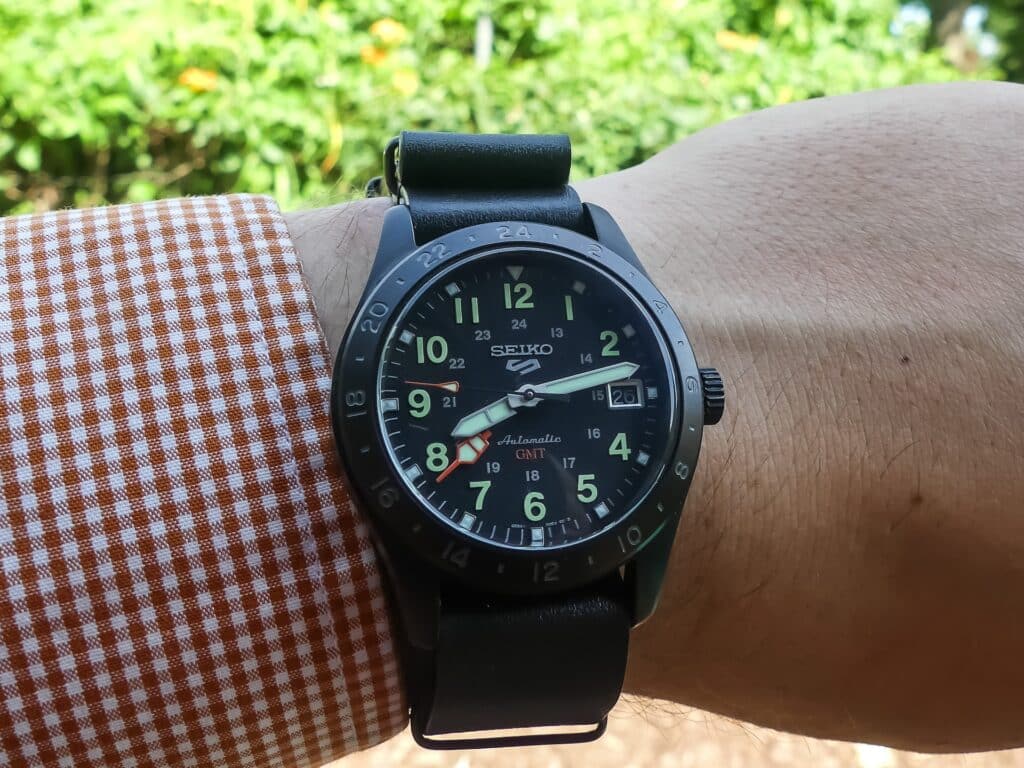
The SSK025 makes 100 meters of water resistance feel useful, not ornamental. This is the kind of GMT watch that makes sense when your “everyday” includes airports, sweaty commutes, and weekends where plans tend to wander. The fixed 24-hour bezel adds Explorer II attitude, but the field-watch dial keeps it from becoming a tribute act.
Full Arabic numerals make the time almost impossible to misread at a glance, while the orange GMT hand and matching accents tell you exactly where to look for the second time zone. The lightly textured black dial, black date wheel with white numerals, and strong lume keep that practicality intact after dark. Even when we weren’t traveling, the GMT never felt like a complication we had to invent a use for.
The 39.4 mm case is where the SSK025 gets a little cheeky with our expectations. On paper, that sounds like an easy everyday size. At 13.6 mm thick, it wears considerably taller and more top-heavy than the diameter implies. Throughout our testing period, we noticed most of the weight was in the supplied single-pass leather strap, and switching to nylon didn’t improve the balance much. Rubber was the plot twist. Without a wad of strap underneath the case, the SSK025 sat lower and became far more comfortable over a full day. That makes strap choice less of an accessory decision and more of a requirement. A watch intended to cover travel, work, and general daily abuse shouldn’t need a wardrobe change to behave itself, but this one does.
Seiko asks us to make a few other allowances. The push-pull crown feels underwhelming for a watch with such a travel-ready personality, while Hardlex is harder to forgive when the rest of the design invites regular use. We’d happily lose the exhibition caseback if it bought us a slimmer case or a screw-down crown. The black IP-coated case does deserve credit, though. It gives the SSK025 a stealthier presence than the regular steel version and helps it move between casual and work settings without looking like it escaped from a watchmaker’s parts bin.
Overall, with the right strap, the combination of a useful GMT and 100-meter resistance makes this a particularly practical non-diver for frequent travelers.
Pros
- 100-meter water resistance gives travelers useful freedom without requiring dive-watch styling.
- Full Arabic numerals make the main time easy to read at a glance.
- Orange GMT details give the second time zone a clear visual identity without turning the dial into a cockpit.
- The textured dial, black date wheel, and strong lume keep the watch legible and useful after sunset.
- Black IP coating gives it a more individual, low-key look than the standard steel version.
Cons
- The supplied leather strap makes the top-heavy feel more obvious, while nylon isn’t much of a fix.
- Rubber improves the balance dramatically, which means budgeting for a strap is almost part of the deal.
- The push-pull crown feels out of step with the watch’s otherwise travel-oriented design.
- Hardlex is usable, but sapphire would make more sense for a watch intended to rack up miles.
- The exhibition caseback looks nice but seems like the least useful place to spend precious millimeters of case height.
Citizen Navihawk

| Price: | $595 (Check Current Price) |
| Water Resistance: | 200m |
| Case Dimensions: | 40mm (diameter) x 44.3mm (lug-to-lug) x 13.4mm (thickness) |
| Lug Width: | 20mm |
| Movement: | Eco-Drive caliber B620 |
The Promaster Navihawk 40 is a good way to escape the gravitational pull of dive watches without giving up their useful excess. Instead of another rotating bezel to absentmindedly click while waiting for coffee, Citizen gives us a chronograph and slide rule to fiddle with. We expected the aviation hardware to make it something we’d wear occasionally, but the 40 mm case and tidy 44.3 mm lug-to-lug changed that. More importantly for this article, its 200 meters of water resistance comfortably clears our 100-meter threshold, so we’re not trading everyday water resistance for aviation-flavored entertainment. It’s capable enough for the same careless daily treatment we appreciate from a good sports watch, but with considerably more going on above the dial.
According to our review team’s insights, the dial is dense, but it earns its complexity once you live with it. Textured black subdials separate from the silver-white sunburst base, while the restrained red accents guide the eye rather than adding visual noise. After a few days, the slide rule starts to feel much more intuitive. The case follows the same practical formula, using broad brushing and restrained polished accents to keep things tool-like without becoming crude. The coin-edge bezel preserves the Promaster character, while sapphire and 200-meter water resistance give us plenty of confidence around water. The deeply recessed date window is the awkward bit; it requires more concentration than a tiny date display has any business demanding.
The Eco-Drive B620 is exactly what we want behind a dial this busy: something that gets on with its job and leaves us alone. Around ±15 seconds per month and roughly six months of runtime from a full charge meant no winding, battery anxiety, or regular time-setting ritual. We also ended up using the chronograph for wonderfully unimportant jobs—coffee, workouts, parking meters—because pressing those pushers is more entertaining than usual. The bracelet pulled another surprise. We expected rubber to take over, but it balanced the case well enough to stay on through most of the review, although the lack of on-the-fly adjustment is an unfortunate omission. Our particular sample also had some vertical bezel play, which never interfered with use but was hard to unsee once spotted.
Its 200 meters, sapphire crystal, compact proportions, and grab-and-use Eco-Drive movement make it quite easy to wear hard, while the chronograph and slide rule give it a personality most straightforward daily watches lack. The buried date and bracelet adjustment are genuine annoyances, and mechanical-watch fans may find quartz less satisfying. But that’s a fair trade for a watch that gives us plenty to interact with while still being perfectly happy getting wet.
Pros
- The 200-meter rating gives the Navihawk plenty of confidence around water.
- The 40 mm case with 44.3 mm lug-to-lug keeps the aviation-heavy design manageable for everyday wear.
- Eco-Drive B620 delivers roughly ±15 seconds per month and about six months of runtime from a full charge, with almost nothing to fuss over.
- The busy dial becomes very easy to decode after a few days, while the textured subdials and restrained red accents keep it from becoming visual soup.
- The bracelet complements the case well enough that we didn’t feel the need to swap it out immediately.
Cons
- No on-the-fly bracelet adjustment limits how precisely you can tweak the fit throughout the day.
- The recessed date window makes a simple date check unnecessarily fiddly.
- Our review sample had slight vertical bezel play, although it didn’t affect normal use.
RZE Resolute Type A
| Price: | $499 (TecTuff strap); $699 (matching titanium HexLink bracelet) (Check Current Price) |
| Water Resistance: | 100m |
| Case Dimensions: | 39.5mm (diameter) x 46mm (lug-to-lug) x 11.5mm (thickness) |
| Lug Width: | 20mm |
| Movement: | Miyota 82S0 |
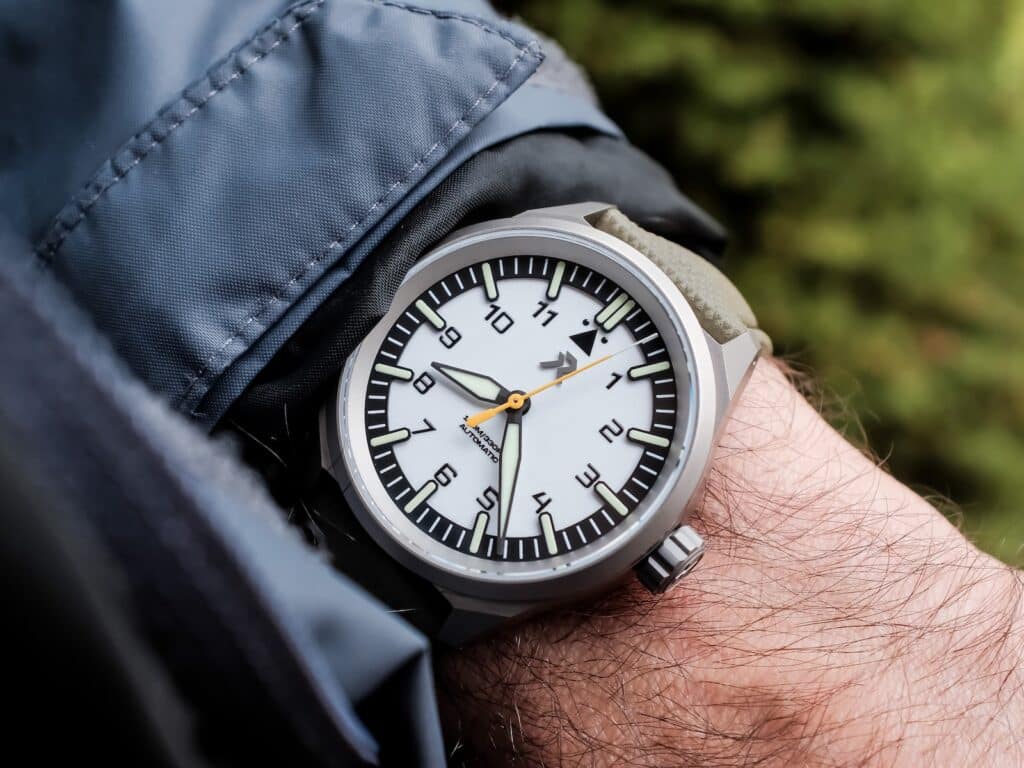
A flieger is usually pretty committed to the bit. Big numbers, cockpit-inspired layouts, military shorthand—you get the idea. The Resolute Type A keeps the useful stuff and leaves much of the costume behind, which makes it a far better fit for this list. The 39.5 mm Grade 2 titanium case is quite light, and after a full day of wear, we stopped noticing it. That matters when you want 100-meter water resistance on a non-diver you can wear without hesitation. The screw-down crown and proper gasket construction reinforce that carefree approach, while UltraHex hardening at roughly 1200 HV means we were less precious about knocking the case around during normal life.
The dial is where RZE gets the flieger formula right without taking itself too seriously. The 12 o’clock triangle, oversized minute track, sword hands, and inner hour ring make reading the time almost automatic, while the raised chapter ring and applied markers add enough depth to keep things from looking like a printed template. We especially liked the white version, where the sapphire crystal and two-tone full lume give the dial an instrument-panel quality after dark. It’s not traditional flieger purism, and that’s probably the point. This pilot-inspired watch can handle rain, sweat, and everyday wear without demanding the rest of your wardrobe show up.
The strap package deserves more credit than it usually gets, too. The TecTuff strap arrived feeling broken-in rather than like something we’d need to replace immediately, and its water-resistant calf-leather lining stayed comfortable through long days. Quick-release spring bars, a tapered profile, and the UltraHex-coated titanium buckle make the whole setup feel thoughtfully finished.
Inside, the Miyota 82S0 brings automatic winding, hand-winding, hacking, and roughly 42 hours of reserve. The engraved aircraft on the caseback is fun but firmly in the “turn it over once or twice” category. Our only real reservations are aimed at flieger purists: the modern interpretation is deliberately restrained, and the two-tone lume won’t satisfy everyone looking for traditional pilot-watch aesthetics. Check out our full review for the finer on-wrist details.
Pros
- The 39.5 mm UltraHex-hardened Grade 2 titanium case is very light, making 100-meter daily capability easy to enjoy.
- Screw-down crown and proper gasket construction make the water resistance feel like part of the design, not an afterthought.
- The white version has a sapphire crystal, and the two-tone full lume adds durability and useful low-light personality.
- The TecTuff strap, water-resistant calf-leather lining, quick-release bars, tapered profile, and titanium buckle require almost no immediate tinkering.
- Miyota 82S0 gives us hacking, hand-winding, automatic winding, and around 42 hours of reserve.
Cons
- Two-tone full lume is deliberately unconventional and won’t scratch the itch for a strictly traditional pilot-watch aesthetic.
- The engraved aircraft doesn’t add much beyond the occasional flip-over-and-smile moment.
Vaer C4 Tactical Field Solar
| Price: | $519 (Check Current Price) |
| Water Resistance: | 200m |
| Case Dimensions: | 41.5mm (diameter) x 48mm (lug-to-lug) x 12.8mm (thickness) |
| Lug Width: | 20mm |
| Movement: | Epson VS-42 solar |
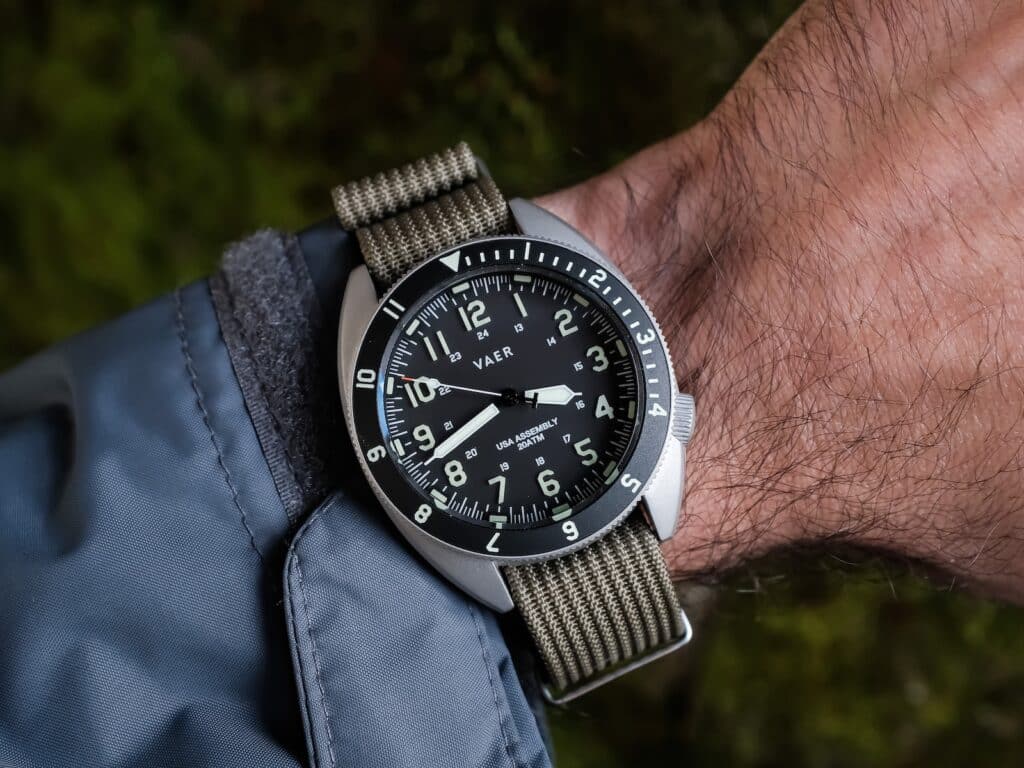
The Vaer C4 Tactical Field Solar comfortably clears the 100-meter bar, and that extra margin is part of why it works so well in this list. At 200 meters, it has twice the stated water resistance of the minimum we’re looking for, but it doesn’t turn into a conventional diver to get there. The screw-down crown and caseback reinforce that practicality, and the crown action feels smooth rather than gritty. Add the DLC-coated steel GMT bezel insert, and the C4 feels built to be used, not admired from a safe distance.
The 41.5 mm case initially looks like the obvious catch, yet it wears far more reasonably. The restrained lug-to-lug and bead-blasted finish keep it from feeling oversized, and on our 6.75-inch wrist, it came across more like a smaller field watch than the numbers would have us expect. That matters here because the C4 manages substantial water resistance without becoming an awkward lump on the wrist. The oversized Arabic numerals, syringe hands, discreet 24-hour track, and raised lume plots also keep the display firmly in field-watch territory. The beveled sapphire crystal adds a little refinement, while the strong lume stays readable for hours after dark instead of fading after its opening performance.
The solar movement is another reason the 200-meter rating feels like more than a headline. The Epson VS-42 can store roughly six months of power after around six hours of light, so we could leave the C4 alone for weeks and pick it up without the usual winding, battery, or time-reset ritual. We also preferred the black waffle-textured FKM strap to the supplied nylon because it felt more comfortable and better suited to the watch’s capable personality. The trade-off is size: collectors who want a genuinely compact field watch may still find 41.5 mm too much territory, and our second hand didn’t align perfectly with every marker. Our dedicated review covers those finer on-wrist details.
In this category, though, the C4 has a clear advantage: it clears the 100-meter threshold by a considerable margin while retaining the look and usability of a non-diver. That makes the 200-meter rating more than a bonus number. It gives us room to wear the watch in wetter conditions.
Pros
- 200-meter water resistance, together with the screw-down crown and caseback, gives the C4 considerably more water-resistance headroom.
- The Epson VS-42 solar movement makes ownership low-maintenance.
- Its 41.5 mm case wears smaller than expected thanks to the restrained lug-to-lug and bead-blasted finish.
- Raised lume plots remain visible well into the night.
- The black waffle-textured FKM strap is comfortable and better complements the C4’s capable, tool-oriented character.
Cons
- The 41.5 mm case may still be too large for collectors who prefer genuinely compact field-watch proportions.
- The second hand doesn’t land perfectly on every dial marker, a minor alignment issue detail-focused collectors will notice.
Vaer R1 Chronograph
| Price: | $539 (Check Current Price) |
| Water Resistance: | 100m |
| Case Dimensions: | 38mm (diameter) x 46mm (lug-to-lug) x 12.6mm (thickness) |
| Lug Width: | 20mm |
| Movement: | Seiko VK-63 meca-quartz |
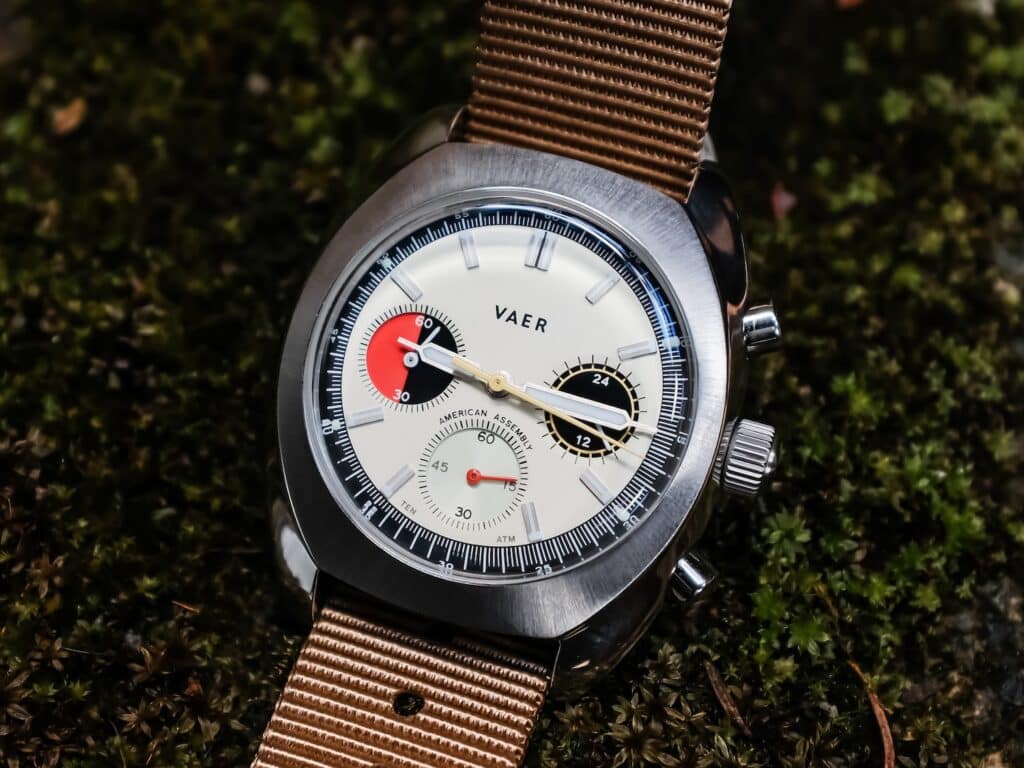
The Vaer R1 fulfills the 100-meter requirement without pretending to be a dive watch in disguise. That matters because plenty of chronographs still feel like watches we’d rather keep away from water, doorframes, and generally careless human behavior. The R1 takes a different approach. Its screw-down crown and domed sapphire crystal give it the everyday protection we want here, while the 38 mm case and 46 mm lug-to-lug keep the proportions vintage without making it feel undersized. We wore it like a normal watch rather than treating it as a special-occasion chronograph, and that low-fuss attitude is a big part of its appeal.
The meca-quartz movement fits that philosophy almost perfectly. It keeps accuracy and maintenance straightforward, but the chronograph pushers still have a crisp mechanical snap that makes them far more satisfying to use than a digital stopwatch.
The dial also helps keep the R1 from getting too serious. Its cream background with orange and yellow accents feels vintage-inspired without crossing into costume territory. At times, the polished hand edges disappear against the dial depending on the light, but it never became a major obstacle in everyday use. Our full review gets into those finer details.
The strap choice changes the experience more than we expected. The NATO sits flatter and feels more natural to us than the rubber option, while the bracelet makes more sense when you want extra heft on the wrist. However, the lume is the weakest part of the package compared with the dive watches many of us are used to, and it fades sooner than we’d like. That’s a fair trade for a chronograph that still offers 100 meters of water resistance, sapphire, and a tactile stopwatch. For anyone wanting a non-diver with enough water resistance for normal life and a more engaging way to interact with the watch, the R1 makes a strong case.
Pros
- The 38 mm case and 46 mm lug-to-lug give the R1 a vintage feel without disappearing on the wrist.
- Screw-down crown, domed sapphire, and 100-meter water resistance provide the everyday protection this category calls for.
- Crisp, mechanical-feeling pushers make the stopwatch function fun to use.
- Meca-quartz keeps the movement easy to live with while retaining the tactile feel of a mechanical-style chronograph.
Cons
- Polished hand edges can blend into the dial in certain lighting.
- Lume fades sooner than we’d expect from a watch worn alongside serious dive watches.
- The rubber strap feels less natural and cohesive than the NATO.
Benrus DTU-2A/P
| Price: | $990 (Check Current Price) |
| Water Resistance: | 100m |
| Case Dimensions: | 34mm (diameter) x 40.2mm (lug-to-lug) x 10.9mm (thickness) |
| Lug Width: | 18mm |
| Movement: | ETA 2671 Swiss Automatic |
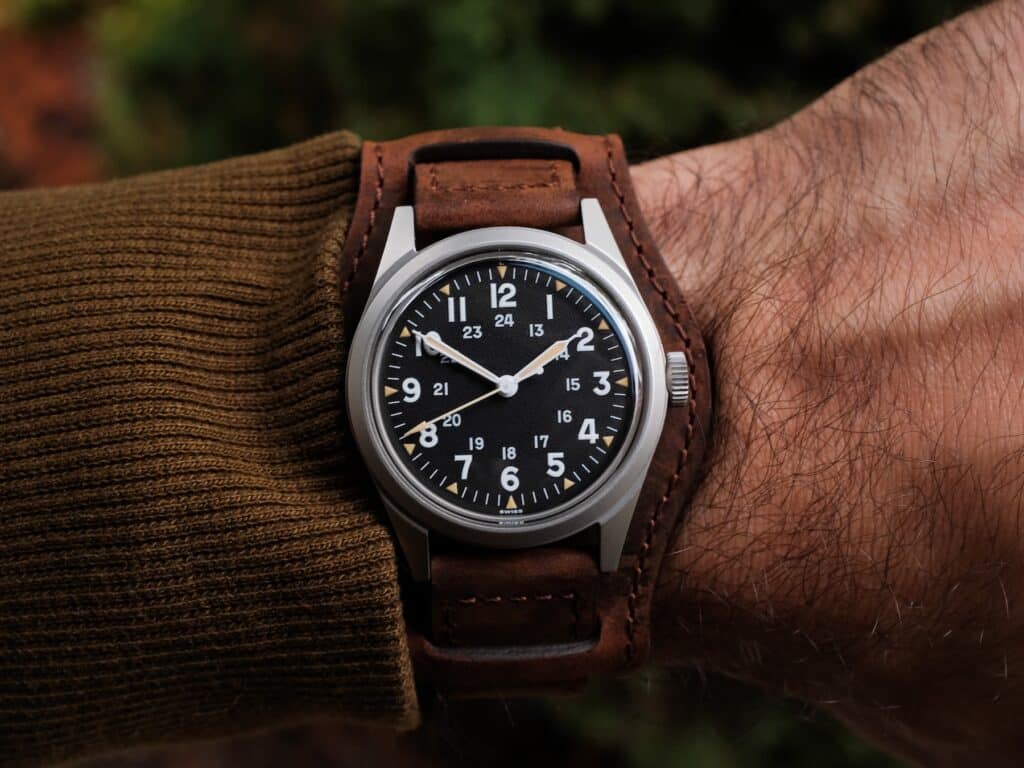
The Benrus DTU-2A/P gets the difficult part of a military field watch right: it stays small without feeling like Benrus compromised the watch to get there. At 34 mm with a 40.2 mm lug-to-lug and just 10.9 mm of thickness, it felt immediately natural on the wrist, especially for those of us who are tired of every “modernized” field watch growing another couple of millimeters. The sandblasted 316L case keeps that compact feel intact, while the screw-down crown and caseback add 100 meters of water resistance. That combination is particularly useful for everyday wear. We get the proportions we like from a traditional field watch without treating rain or an accidental splash like an emergency.
The dial is just as disciplined. Large white Arabic numerals, a clearly separated minute track, inner 24-hour scale, triangular lume plots, and slim syringe-like hands give the 34 mm surface plenty of breathing room. Nothing feels squeezed together, which is where small field watches can sometimes go wrong. The BGW9 Super-LumiNova extends across the hands, hour plots, and second hand, and its warmer tone works nicely against the matte black dial. We found it useful after dark because the lume adds capability without turning the dial into a glowing novelty. The double-domed sapphire crystal and anti-reflective treatment are another practical upgrade. They make the watch easier to live with while preserving the straightforward feel that drew us to it in the first place.
The ETA 2671 automatic is a sensible modern choice for a watch this compact. It runs at 4Hz and offers about 38 hours of reserve, although that modest figure means the DTU-2A/P may need resetting after a couple of days in the watch box. Personally, we’d trade some convenience for a hand-wound caliber here. Winding a small, stripped-down military watch feels like part of the experience, even if an automatic makes it easier to leave alone. The brown leather Bund strap creates a similar compromise. It looks the part and gives the 34 mm case more visual presence, but we would rather put it on a straightforward 18 mm strap for regular wear. The smaller format works well on its own and doesn’t need help looking bigger.
That push and pull between old-school proportions and modern usability is why the DTU-2A/P works here. Benrus kept the case compact instead of expanding it to accommodate contemporary expectations, then added sapphire, modern lume, an automatic movement, and 100 meters of water resistance where those changes genuinely improve daily ownership. The result is a field watch we could wear without fuss, particularly if compact dimensions matter as much to you as practical water resistance. The compromises are straightforward, too: a short power reserve, an automatic where we’d prefer hand-winding, and a Bund strap that adds more presence than we need. We get into those details in our full hands-on review.
Pros
- The 34 mm case, 40.2 mm lug-to-lug, and 10.9 mm thickness deliver compact field-watch proportions.
- The 100-meter water resistance rating, screw-down crown and caseback, and sapphire give the small case much more everyday freedom.
- Large numerals, inner 24-hour scale, defined minute track, and slim hands keep the dial easy to read.
- BGW9 lume across the hands, hour plots, and second hand improves nighttime usability without compromising the military character.
- Double-domed sapphire and anti-reflective treatment add practical durability while keeping the vintage-inspired proportions intact.
Cons
- The ETA 2671’s 38-hour power reserve is fairly modest for a watch that may spend time rotating in and out of a collection.
- The Bund strap looks right but adds bulk that can obscure some of the charm of the compact 34 mm case.
The sweet spot here is finding enough water resistance for real daily life without letting it dictate the kind of watch you wear. A field watch may suit you better than a chronograph, while a GMT can make more sense if travel is part of your routine. What matters is where each watch fits your habits, and which compromises you can live with. Below $1,000, that leaves plenty of room to choose something you’ll actually want on your wrist. That said, if another watch belongs in the conversation, let us know in the comments.

Co-Founder and Senior Editor
Kaz has been collecting watches since 2015, but he’s been fascinated by product design, the Collector’s psychology, and brand marketing his whole life. While sharing the same strong fondness for all things horologically-affordable as Mike (his TBWS partner in crime), Kaz’s collection niche is also focused on vintage Soviet watches as well as watches that feature a unique, but well-designed quirk or visual hook.