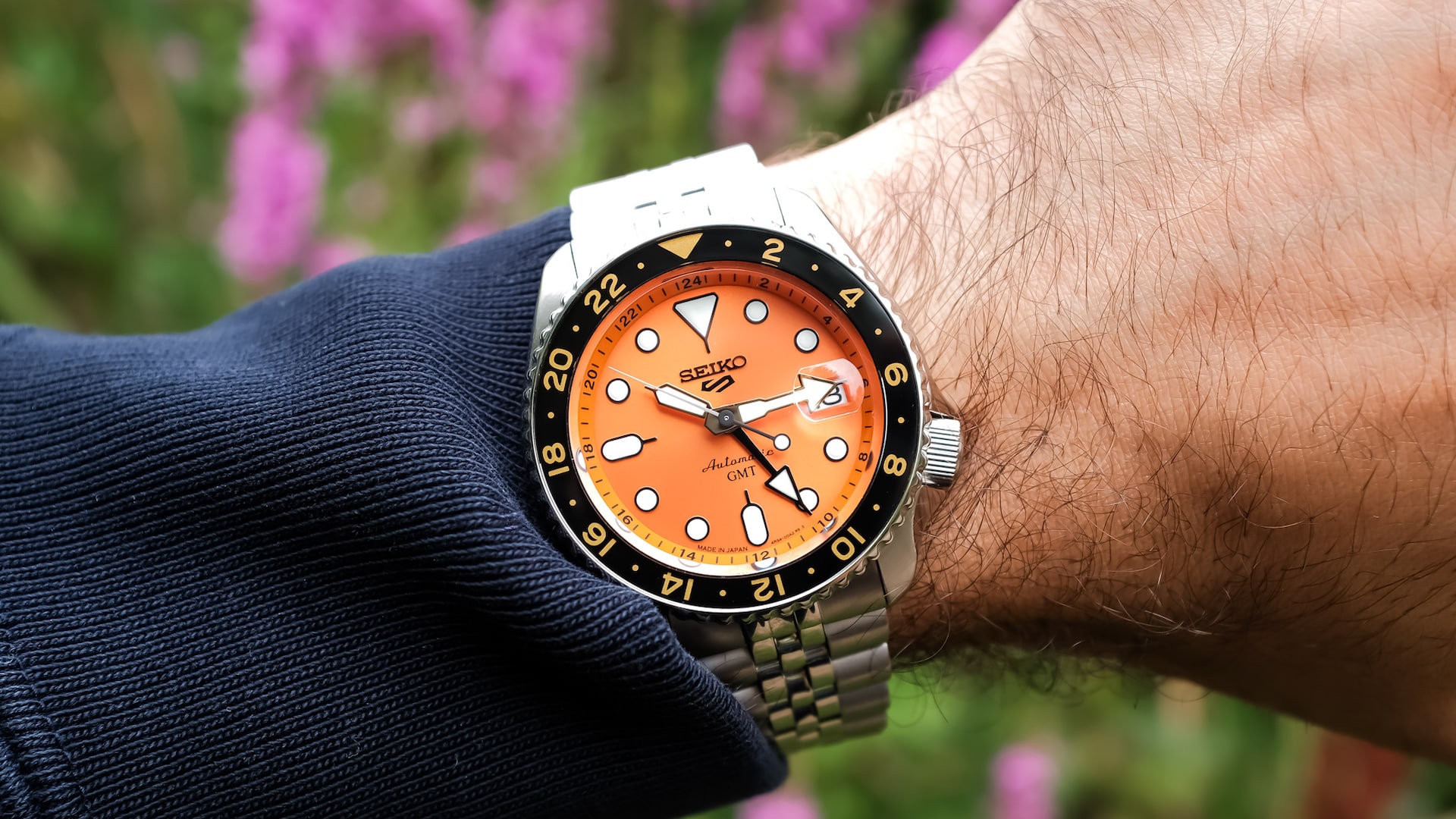
At some point, we realize a travel watch doesn’t need a red-and-blue bezel to tell us it’s a GMT. The Rolex GMT-Master II “Pepsi” is the obvious reference point, but it doesn’t need to define the entire category. After seeing enough of the same familiar formula, the fun comes from watches that approach travel time differently. Some put multiple time zones across the dial, some lean into a field or aviation design, and others find clever ways to make a second time zone useful without turning the watch into another sports-watch homage. That’s what we’re looking for: travel watches for collectors who still want the usefulness of tracking another time zone but are tired of every solution arriving in the same visual package. Pepsi bezels aren’t the problem. Watching the complication become secondary to the color scheme is.
We’ve spent a decade handling, wearing, testing, and reviewing watches, and one thing keeps proving itself: what looks interesting in a product photo doesn’t always translate to the wrist. We’ve also found ourselves reconsidering watches we thought weren’t for us after spending real time with them, especially when a different approach to a familiar complication changes how the watch feels and functions day to day. So this isn’t a generic watch-buying guide built around a pile of GMT specifications. It’s a look at travel watches we’ve actually had in hand, from affordable GMTs to more unusual world-time and travel-focused designs, and what makes each one worth considering when you want your watch to tell you where you are without looking like everyone else’s.
Seiko SSK025 Field GMT
| Price: | $435 (Check current price) |
| Water Resistance: | 100m |
| Case Size: | 39.4mm (diameter) x 47.9mm (lug-to-lug) x 13.6mm (thickness) |
| Lug Width: | 20mm |
| Movement: | Seiko 4R34 (Mechanical) |
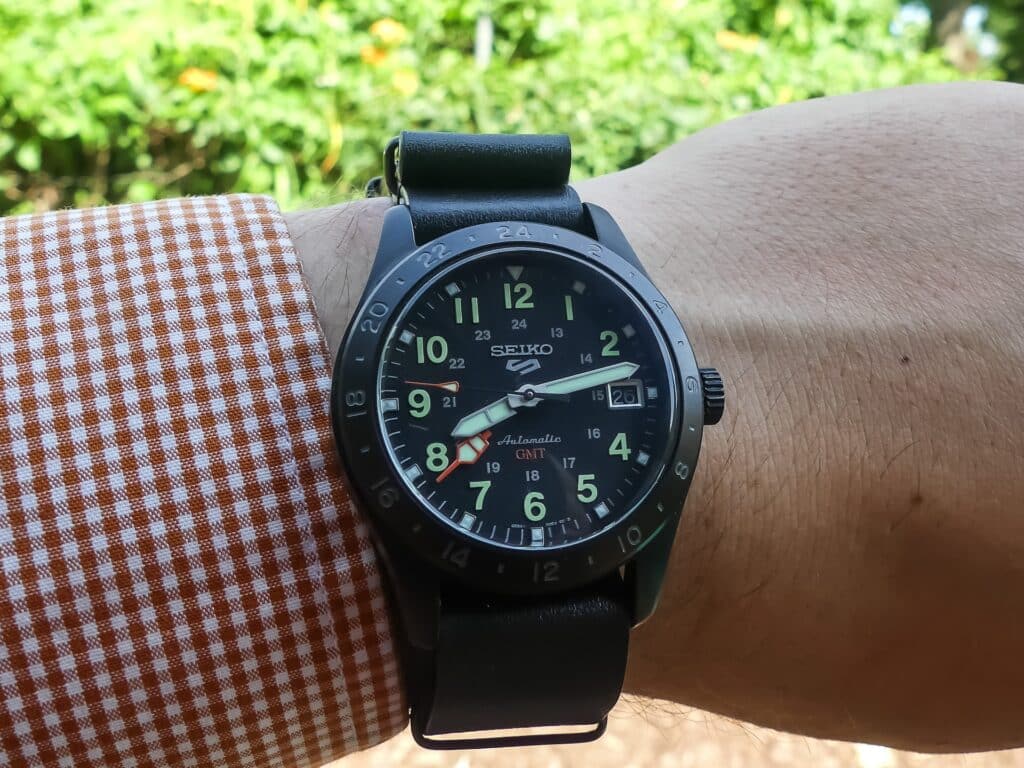
The SSK025 is a GMT for people who’ve seen the usual red-and-blue travel watch and thought, “We’ve seen this movie already.” Seiko takes the complication in a different direction by giving it a field-watch personality, and the 39.4mm case makes that approach easy to appreciate on the wrist. The black IP coating keeps it purposeful rather than dressy. The full Arabic numerals, orange GMT hand, generous LumiBrite, and neatly integrated date make the second time zone easy to find without turning the dial into a tiny airport departure board. There’s even some light texture on the black surface, which adds enough grain to keep everything from looking flat. During our dedicated hands-on review, we expected the extra GMT hand to steal the show. Instead, we liked the everyday legibility most.
Then the strap reminded us that a 39.4mm watch can still wear like it has something to prove. At 13.6mm thick, the SSK025 sits taller than the diameter suggests, and the supplied single-pass leather strap adds another layer of material underneath the case. That combination made the watch rock around on the wrist unless we tightened it more than we felt comfortable with. Nylon didn’t completely fix the problem, either. Rubber did. Once the extra bulk underneath disappeared, the case settled down and wore far more naturally. That’s a useful discovery for a watch like this because a travel GMT should ideally be something we can forget about until we need it, rather than something we keep nudging back into place.
Seiko clearly made a few other compromises we’re expected to swallow. The 100m water resistance is sensible for everyday use, but the push-pull crown feels a little too modest for a watch whose job description includes travel. Hardlex also feels like the obvious place for sapphire, and shaving some thickness from the case wouldn’t have hurt either.
Pros
- The orange GMT hand and full Arabic numerals make tracking the second time zone pretty straightforward.
- The subtle dial texture, orange accents, and black date wheel work together without making the dial feel busy.
- Generous LumiBrite keeps the dial useful when daylight checks out for the evening.
- Black IP coating gives the watch a convincing field-watch/tool-watch character.
Cons
- The supplied leather strap adds enough bulk underneath to make the case rock unless you wear it tighter than ideal.
- The 13.6mm thickness makes it wear taller than the 39.4mm diameter would suggest.
- The push-pull crown feels underwhelming for a travel-focused GMT, while Hardlex is a compromise we’d happily swap for sapphire.
Seiko 5 GMT
| Price: | $475 (Check current price) |
| Water Resistance: | 100m |
| Case Dimensions: | 42.5mm (diameter) x 46mm (lug-to-lug) x 13.6mm (thickness) |
| Lug Width: | 22mm |
| Movement: | Seiko 4R34 (Mechanical Movement) |
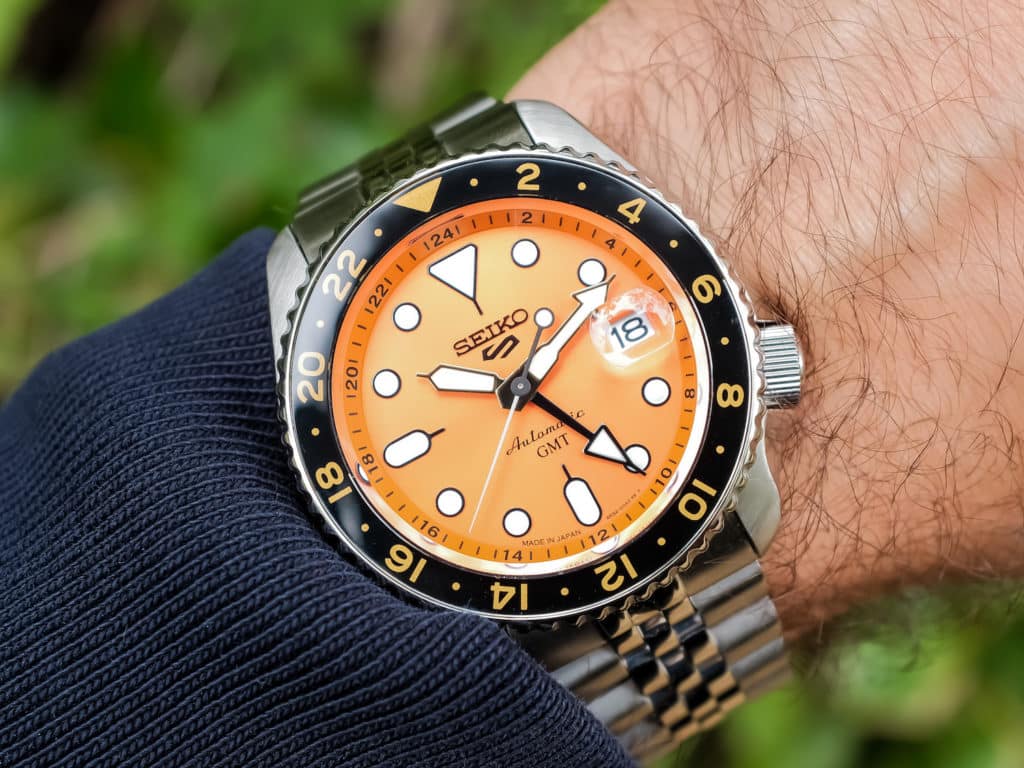
The Seiko 5 GMT doesn’t need to dress like a luxury travel watch to make the complication useful. Its 42.5mm case sounds large, but the rounded profile, softened lugs, and 46mm lug-to-lug keep it quite manageable. The lightweight Jubilee-style bracelet helps too. It has the familiar Seiko rattle, and the polished center links won’t suit everyone, but long wear proved more comfortable than the dimensions imply. More importantly, it doesn’t look like another attempt at someone else’s famous GMT.
The 4R34 uses a caller-GMT setup, which worked well for tracking family overseas, checking work hours abroad, or avoiding the occasional 3 a.m. international phone call. Frequent travelers will notice the limitation: the GMT hand adjusts independently while the local hour hand does not, making constant time-zone changes less convenient. The rotating 24-hour bezel adds a third time zone, though, and when we’re home, the complication largely disappears into the background. That’s part of its charm.
The orange sunray dial changes with the light, while the glossy black GMT hand, gilt hands, black surrounds around the applied markers, and generous Lumibrite keep everything easy to separate at a glance. We even stopped noticing the cyclops, which says a lot. The usual Seiko compromises remain: the bezel is smooth rather than finely indexed, the stamped clasp is basic, and pin-and-collar sizing is unnecessarily fiddly. Also, the push-pull crown is modest for a travel watch, while 100m water resistance is conservative beside Seiko’s divers. Our testing never made it feel fragile, though, and independent pressure testing suggests it has more real-world resilience than the specification alone implies.
For this list, the Seiko 5 GMT works because it treats travel functionality as part of the watch, not an excuse to copy the same visual formula. It’s not ideal for someone constantly crossing time zones, but for a collector who wants a mechanical GMT that remains useful without becoming another Pepsi clone, it earns its spot. Our Seiko 5 GMT review covers the on-wrist experience in greater detail.
Pros
- The orange sunray dial adds depth without hurting legibility.
- 4R34 provides useful second-time-zone tracking without dominating the watch.
- 46mm lug-to-lug helps the 42.5mm case wear smaller than expected.
- The rotating 24-hour bezel adds a third time zone.
- Lumibrite and the contrasting GMT hand make quick checks easy.
- The lightweight Jubilee-style bracelet stays comfortable despite its slightly rattly feel.
Cons
- The push-pull crown feels basic for a travel-focused watch.
- Pin-and-collar sizing makes bracelet adjustment fiddly.
- The stamped clasp feels basic.
- The smooth bezel lacks crisp indexing.
- 100m water resistance is modest beside Seiko’s tougher divers.
- Polished center links won’t appeal to everyone.
Nodus Contrail GMT Laguna
| Price: | $825 – $900 (Check current price) |
| Water Resistance: | 200m |
| Case Dimensions: | 40.5mm (diameter) x 46.6mm (lug-to-lug) x 11.8mm (thickness) |
| Lug Width: | 20mm |
| Movement: | Miyota 9075 |
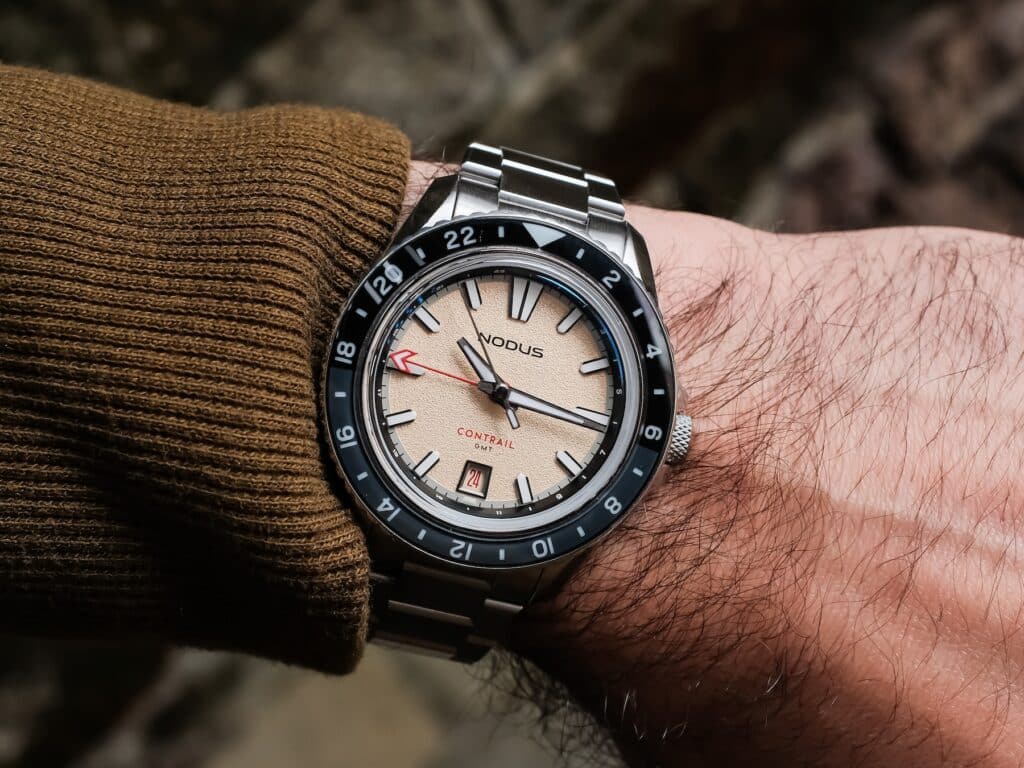
The Contrail GMT Laguna is proof that being tired of Pepsi bezels doesn’t mean being tired of GMTs. Nodus keeps the useful travel complication and drops the familiar visual formula. At 40.5mm wide and 11.8mm thick, with a 46.6mm lug-to-lug, it wears compactly for a modern sports GMT. The twisted lugs help it follow the wrist, while the mix of brushed and polished surfaces, box sapphire crystal, and sapphire bezel insert gives it character without turning it into another chunky GMT homage.
The Miyota 9075 is the bigger reason the Contrail works as a travel watch. It’s a flyer GMT, so changing the local hour after landing takes a simple crown adjustment rather than resetting the watch. Throughout our hands-on review, that jump felt clean and precise, accuracy stayed steady, and the roughly 42-hour reserve fit easily into a normal rotation. The large screw-down crown also gives us plenty to grab without the usual fingernail-versus-crown fight. Add 200m of water resistance, and the Contrail has plenty of practical headroom without becoming a wrist-mounted survival fantasy.
The Laguna dial keeps the anti-Pepsi argument going. Its sandy color shifts with the light, the roulette date adds some character, and the bold handset keeps the layout readable without relying on a red-and-blue bezel for attention. The smooth 48-click bidirectional bezel and internal 24-hour scale take a little getting used to, but once the layout clicks, tracking another time zone is straightforward. BGW9 lume across the markers, bezel numerals, and GMT hand remains useful after dark. We’d still prefer larger internal 24-hour numerals, because airport lighting is already doing enough to test our eyesight.
The bracelet is practical, if not perfect. Screw links make sizing easy, and the NodeX clasp lets you adjust on the fly when your wrist inevitably expands during a long travel day. The clasp is chunkier than the rest of the watch, and the H-link bracelet’s 20mm-to-16mm taper is fairly restrained. Still, the Contrail earns its place here by doing the important things well: it gives us a proper microbrand flyer GMT, 200m water resistance, and a design that looks like its own watch rather than another attempt to recreate a famous red-and-blue traveler.
Pros
- Miyota 9075 provides the more convenient flyer-GMT setup for changing local time.
- 11.8mm thickness and twisted lugs keep the watch planted without feeling bulky.
- 200m water resistance gives it useful everyday and travel versatility.
- Sapphire crystal and bezel insert add durability without excessive case thickness.
- The sandy Laguna dial and roulette date add personality without a Pepsi-style color scheme.
- BGW9 lume covers the markers, bezel numerals, and GMT hand.
- The 48-click bidirectional bezel provides another time-zone reference once the layout is familiar.
Cons
- The NodeX clasp feels noticeably chunkier than the rest of the watch.
- The 20mm-to-16mm bracelet taper is fairly conservative.
- Internal 24-hour numerals are smaller than ideal for quick checks.
Nodus x Raven TrailTrekker
| Price: | $925 – $1075 (Check current price) |
| Water Resistance: | 200m |
| Case Dimensions: | 39.5mm (diameter) x 46.6mm (lug-to-lug) x 11.8mm (thickness) |
| Lug Width: | 20mm |
| Movement: | Miyota 9075 |
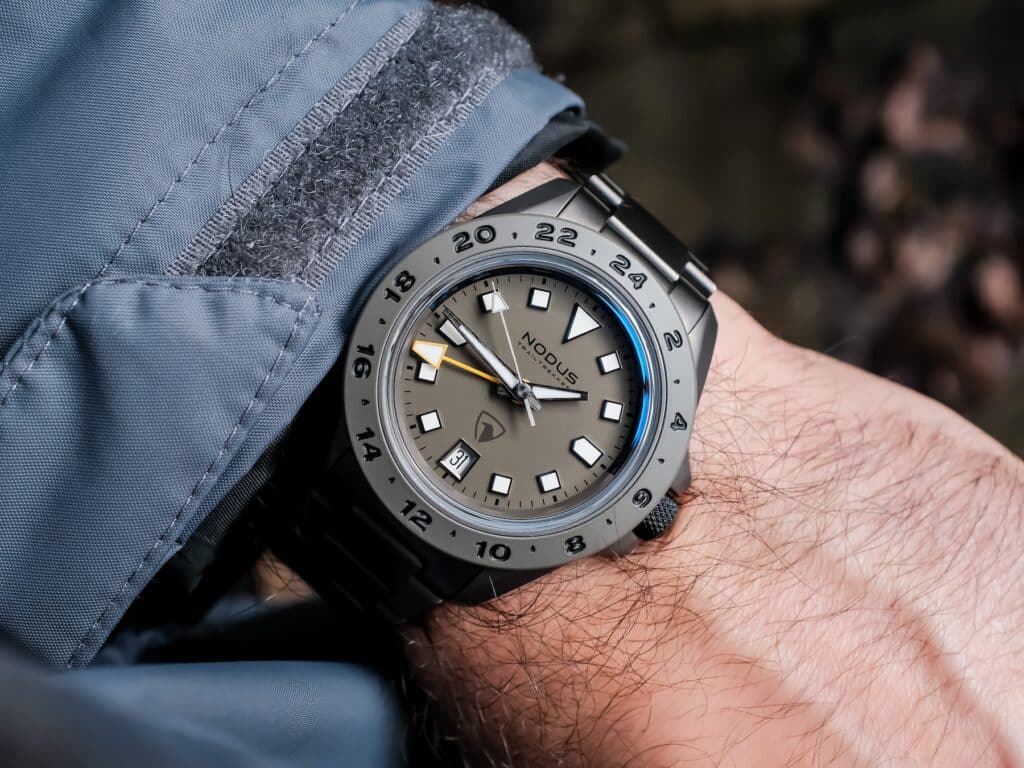
The TrailTrekker feels like a travel watch that was designed for going places rather than posing as one. The 39.5mm DLC case stays compact, the muted gray finish avoids the usual tactical-watch cosplay, and the sand-colored Cerakote bezel gives it a purposeful outdoor character. Sapphire, a deeply knurled screw-down crown, and 200m water resistance mean it’s comfortable with swimming, bad weather, and the general chaos of travel. On the wrist, the flat-link bracelet was our pick over the included nylon because it sits close, tapers from 20mm to 16mm, and doesn’t turn a sub-40mm watch into wrist-based luggage.
The Miyota 9075 is where the TrailTrekker earns its travel credentials. Its flyer-GMT setup lets the local hour jump independently, which is considerably more useful when the next airport is in another time zone. During our in-depth testing, those jumps felt clean and precise, with accuracy within a few seconds of our reference. Crossing midnight also made the date behavior easier to understand. The high-contrast 24-hour scale is easy to follow, while the yellow GMT hand has all the subtlety of a highlighter pen. That may offend the traditionalists, but we’ll take obvious when we’re trying to read the second time zone between airport gates.
The dial’s textured sandy surface works with the bezel, while applied markers, gunmetal hands, a 6 o’clock date, and restrained dual branding keep the information from becoming cockpit cosplay. Lume is serviceable rather than spectacular. What matters more is how little of this package feels oversized. The compact case, close-fitting bracelet, and roughly 10mm of NodeX clasp adjustment make it easy to wear all day while accommodating a wrist that has decided to expand after six hours of sitting around an airport.
Overall, for anyone tired of every GMT eventually circling back to Pepsi colors, the TrailTrekker makes a stronger argument for a travel watch that looks like a travel tool in the first place.
Pros
- Flyer-GMT Miyota 9075 makes local-time changes quick and intuitive.
- The NodeX clasp provides around 10mm of on-the-fly adjustment.
- The flat-link bracelet sits close and tapers from 20mm to 16mm.
- High-contrast 24-hour scale and yellow GMT hand make the second time zone easy to spot.
- Sapphire crystal, knurled screw-down crown, and 200m water resistance suit real-world travel.
- Sand-colored Cerakote bezel and muted gray DLC finish give it character without the usual Pepsi formula.
Cons
- Lume is useful but doesn’t rank among the strongest we’ve tested.
- The yellow GMT hand is loud, by design, and won’t satisfy anyone chasing a restrained look.
Jack Mason Strat-o-Timer GMT
| Price: | $1,399 (Check current price) |
| Water Resistance: | 200m |
| Case Dimensions: | 40mm (diameter) x 47mm (lug-to-lug) x 13mm (thickness) |
| Lug Width: | 20mm |
| Movement: | Miyota 9075 |
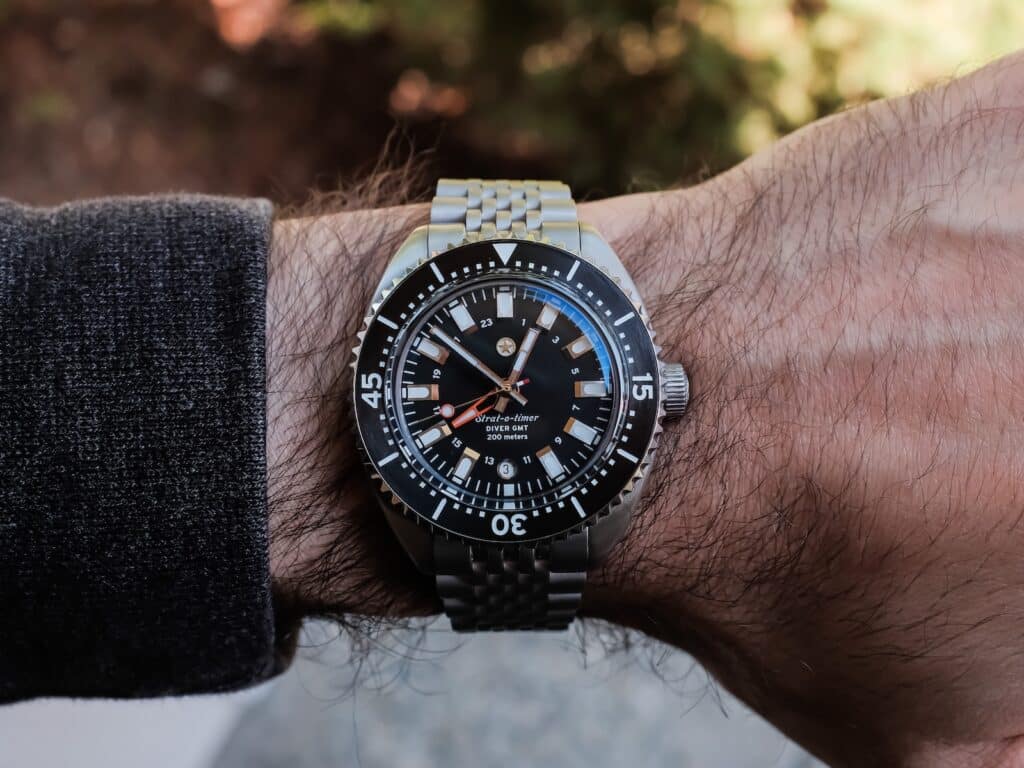
The Strat-o-Timer GMT takes a route we wish more travel watches would consider: instead of adding another colorful Pepsi GMT scale to the bezel, it leaves the bezel alone. The full 24-hour GMT scale sits on the dial, while the ceramic bezel remains a proper 120-click timing tool. That gives the watch a more useful identity than another GMT trying to win us over with familiar colors. The black or blue dial still has plenty happening with its applied BGW9 markers, stick hands, lollipop second hand, and orange GMT hand, so quick reading takes a little practice. However, the layout makes sense once we spend some time with it.
The flyer-GMT Miyota 9075 is the other reason the Strat-o-Timer works so well as a travel watch. The independently jumping local hour makes time-zone changes straightforward, while 28,800 bph and roughly 42 hours of reserve add mechanical heft without complicating the experience. The titanium case helps too. At 40mm wide, 47mm lug-to-lug, and just over 13mm thick, it stays much easier to wear than those numbers suggest, thanks to the curved mid-case, downward-turned lugs, and Grade 2 titanium that keep it close to the wrist. The roughly 40-gram weight saving over steel becomes welcome after a full day of travel.
That said, it isn’t perfect. Our sample’s bezel had some play and imperfect alignment, the lume was useful rather than spectacular, and the clasp’s tool-free micro-adjust took some figuring out. Still, the seven-link titanium bracelet drapes nicely, screwed links make sizing straightforward, and the combination of 200m water resistance, sapphire, and a screw-down crown means the watch doesn’t need to be treated like delicate travel luggage. Our dedicated review gets deeper into those details. For this list, what matters is that the Strat-o-Timer delivers genuine flyer-GMT convenience and diver capability without leaning on the visual shorthand we’re deliberately trying to escape.
Pros
- Full-dial GMT scale leaves the ceramic 120-click bezel available for timing.
- Miyota 9075 provides an independently jumping local hour for easier travel adjustments.
- Titanium makes the watch noticeably lighter than the steel version.
- The seven-link bracelet sits comfortably and offers screwed links plus tool-free micro-adjustments.
- 200m water resistance, sapphire, and a screw-down crown give it genuine travel-and-water versatility.
- BGW9 lume remains useful across the hands, markers, GMT hand, and bezel.
Cons
- The dial requires some adjustment before quick reading becomes natural.
- The micro-adjust clasp demands a little practice.
- Our sample’s bezel had some play and imperfect alignment.
Farer World Timer Roché II
| Price: | $1,775 (leather strap); $1,795 (stainless steel bracelet) (Check current price) |
| Water Resistance: | 100m |
| Case Dimensions: | 39mm (diameter) x 45mm (lug-to-lug) x 11mm (thickness) |
| Lug Width: | 20mm |
| Movement: | Sellita SW330-1 Elaboré |
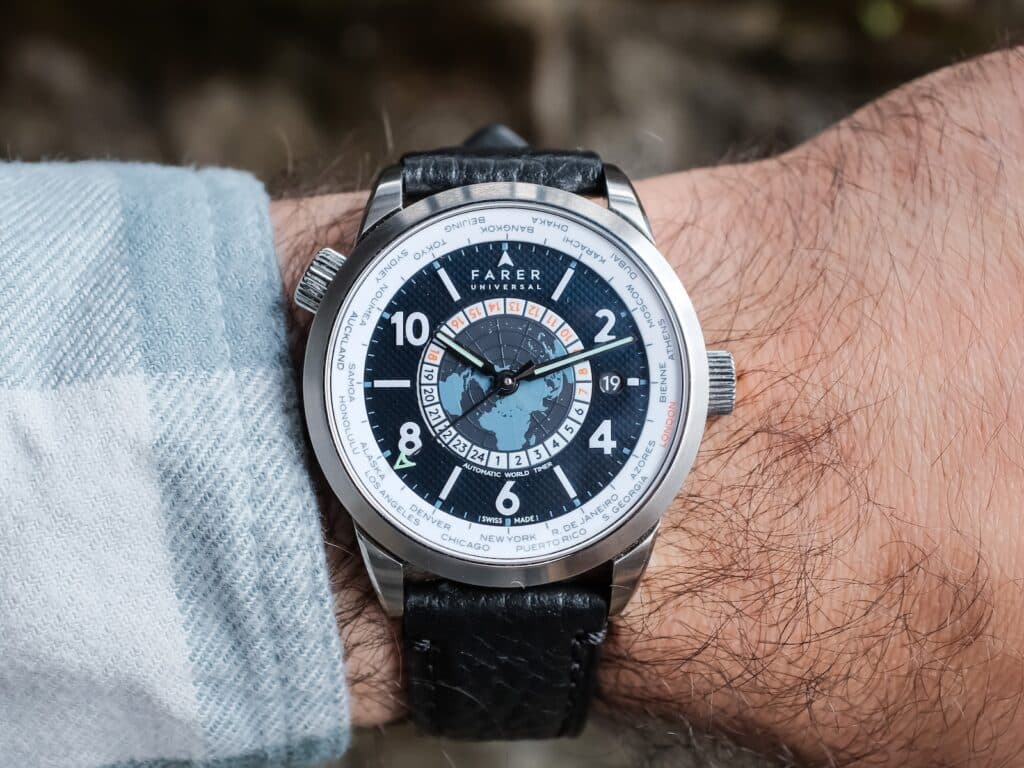
The Roché II makes a strong argument for giving world time a chance when the alternative is another GMT wearing the same red-and-blue uniform. The 39mm case keeps the watch relatively flat and easy to wear, including on smaller wrists, while 100m of water resistance means we don’t have to baby it every time travel gets messy. More importantly, the complication is the reason to wear it. There’s no attempt to disguise a world timer as a familiar sports GMT, and that makes it a much more interesting fit for this list.
The learning curve comes from the midnight-blue dial. Farer packs in a rotating 24-city ring, an inner bezel, and a textured surface, then uses raised markers and redesigned alpha hands to keep the main time readable. During our dedicated wrist time, we needed a few days before the rotating 24-hour disc stopped feeling like something we had to translate mentally. Once it clicked, though, checking another city became second nature. That’s the useful distinction here: the dial is busy because it has more to tell us, not because someone decided another GMT needed more visual noise.
The modified Sellita SW330 gives the Roché II around 50 hours of reserve, while lume across the hands, markers, and inner bezel keeps the display functional after dark. We also liked the St. Venere leather strap, which softens quickly, stays comfortable on smaller wrists, and uses quick-release hardware that makes switching to the bracelet straightforward. The compromises mostly come from packing all that information onto one dial: the world-time display never becomes visually quiet, and the learning curve doesn’t disappear completely. Then there’s the price, which sits well above simpler mechanical travel watches.
That’s also why the Roché II belongs on this list. It tackles the travel problem from a completely different angle, giving us global-time utility without another GMT bezel trying to make the same visual argument. For collectors who want their travel watch to feel distinctive because of what it does, not because it found a new way to color a familiar bezel, the Roché II is a much more interesting proposition.
Pros
- World-time functionality gives the watch a genuine reason to exist beyond checking the local hour.
- The 39mm case wears relatively flat and works well for smaller wrists.
- The modified Sellita SW330 provides a useful 50-hour reserve.
- Lume across the hands, markers, and inner bezel remains practical after dark.
- The St. Venere leather breaks in quickly and stays comfortable.
- Quick-release hardware makes moving between the strap and bracelet easy.
Cons
- The world-time display takes a few days to become intuitive.
- The price puts it well above many simpler mechanical travel watches.
- The 24-city ring and inner bezel stay busy even after you learn the layout.
Monta Skyquest GMT
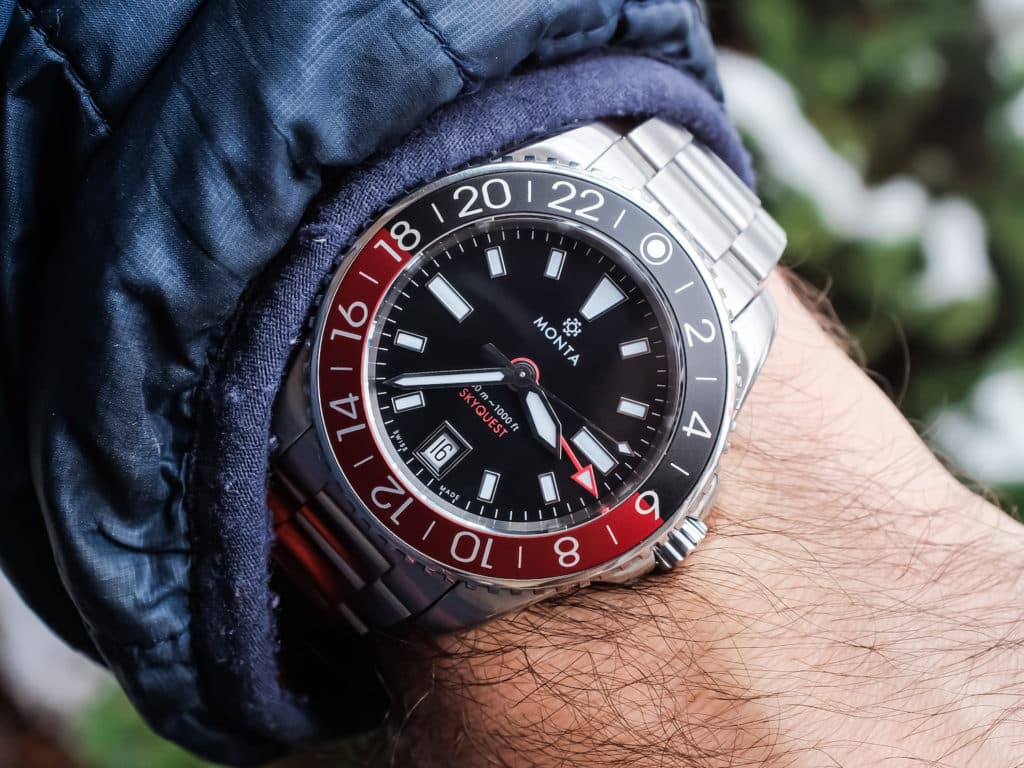
| Price: | $2,435 – $2,500 (Check current price) |
| Water Resistance: | 300m |
| Case Dimensions: | 40.7mm (diameter) x 47.4mm (lug-to-lug) x 11.8mm (thickness) |
| Lug Width: | 20mm |
| Movement: | Monta Caliber M-23 (Sellita SW330-2 base) |
The Monta Skyquest GMT makes more sense for this list once we stop judging a GMT by how closely it follows the Pepsi playbook. In a non-Pepsi colorway, the larger 24-hour bezel markings and cleaner dial give the watch a distinctly more functional, traveler-oriented look. Monta removed the older internal 24-hour scale, enlarged the applied markers, and paired them with broad sword hands, which makes the display easier to read at a glance rather than cramming every possible time-zone reference into the center. After extended wrist time, that cleaner approach made the Skyquest feel more like a dedicated travel watch than another GMT borrowing its personality from a familiar luxury template.
The bracelet is where the refinement starts feeling less like decoration and more like something we’d appreciate on an actual trip. Screw links make sizing painless, while the tool-free quick-adjust system lets us add or remove length without carrying a tiny watchmaking toolkit. The milled clasp closes with a reassuring snap, and the bracelet proves exceptionally comfortable.
Then there’s the Caliber M-23, based on the Sellita SW330-2. It’s a caller GMT rather than a flyer GMT, with the 24-hour hand independently adjustable from the crown, and in our testing, it had no alignment or timekeeping issues. The roughly 55-hour power reserve also gives it some breathing room between wears. That familiar Sellita architecture is useful beyond the spec sheet too, since it should be relatively straightforward to service compared with a more exotic movement.
The case rounds things out without turning the watch into a wrist-filling GMT brick. The dimensions keep it in a comfortable middle ground, while the larger bezel makes the watch look more compact by visually tightening the dial area. The bezel action on our reviewed version felt positive and easy to grip, even though the newer aluminum insert gives up some of the old model’s flashier details. The redesign also loses a little personality, including the stepped GMT hand. However, for this particular brief, the Skyquest feels like a higher-end, deliberate traveler’s watch rather than a Pepsi substitute with swapped colors.
Pros
- The cleaner dial and larger 24-hour bezel markings make travel information easier to follow.
- Tool-free bracelet adjustment is useful when wrist size changes during a long day.
- The 55-hour M-23 power reserve gives the watch useful flexibility between wears.
- The positive bezel action is easy to operate without much fuss.
- BGW9 Swiss Super-LumiNova keeps the hands and markers legible in low light.
- The Sellita SW330-2 base should make future servicing relatively straightforward.
Cons
- The cleaner redesign gives up some of the personality found in the earlier version, including the stepped GMT hand.
- At the higher end of the price spectrum, the Skyquest is no longer competing purely on enthusiast value.
- The caller-GMT layout is less convenient for frequent time-zone hopping than a flyer GMT.
Rado Over-Pole
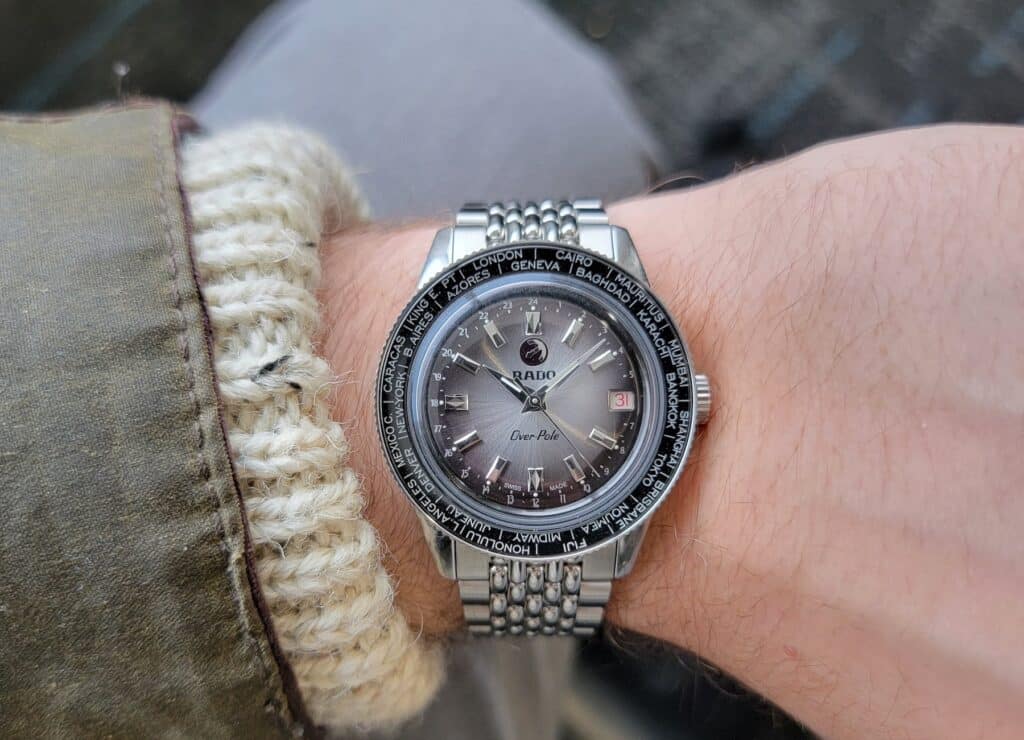
| Price: | $2,700 – $3,300 (Check current price) |
| Water Resistance: | 100m |
| Case Dimensions: | 37mm (diameter) x 43mm (lug-to-lug) x 10.4mm (thickness) |
| Lug Width: | 19mm |
| Movement: | Rado R862 |
The problem with most travel watches isn’t the GMT complication. It’s how quickly they all start looking like variations on the same idea. The Rado Over-Pole sidesteps that entirely, trading the familiar sporty bezel for a dressier 37mm case with a proper world-time display. Its polished surfaces catch plenty of light and a lot of fingerprints, but the low, balanced fit makes it easy to wear all day. We could see this working as naturally with a tailored jacket as with jeans, giving it a useful place in a travel-watch rotation that isn’t built entirely around sports watches.
The world-time setup is the real reason it belongs here. Rado uses a concave ceramic bezel engraved with world cities, so the travel function is part of the watch’s identity rather than an excuse to add another red-and-blue color combination. The gray gradient dial picks up a soft metallic sheen as the light moves, with applied indices and red date text adding some welcome texture. There is a catch: glare can make the city names harder to read under office lighting or in front of a laptop, while the minimal lume is barely useful after dark. Still, those compromises feel more forgivable on a watch that is deliberately doing travel time its own way.
The hand-wound R862 gives the Over-Pole another reason to stay interesting after the trip is over. A few turns each morning become part of the routine, while the 80-hour power reserve gives us plenty of breathing room when the watch sits untouched for a couple of days. The display caseback also lets us see the movement finishing rather than hiding it away.
Rado supplies both leather and a rice-bead bracelet, and we preferred the latter for everyday wear. It drapes comfortably, works particularly well on smaller wrists, and suits the watch’s more refined character. The lack of on-the-fly adjustment can become noticeable as temperatures rise, and the polished case will still demand occasional microfiber therapy. Even so, the Over-Pole makes a compelling alternative for anyone who wants global-time functionality without another familiar GMT formula. Our full Over-Pole review covers the details in greater depth.
Pros
- The concave ceramic world-time bezel provides genuine travel utility without a Pepsi-style color scheme.
- The compact 37mm case wears low, balanced, and comfortably all day.
- Hand-wound R862 adds interaction to the experience, backed by an 80-hour power reserve.
- Gray gradient dial, applied indices, and red date text add plenty of character.
- The rice-bead bracelet drapes comfortably and suits smaller wrists well.
- The display caseback keeps the movement finishing visible.
Cons
- Glare can make the city markings difficult to read in certain lighting.
- The bracelet lacks on-the-fly micro-adjustment, which becomes more noticeable in warmer weather.
- Minimal lume severely limits nighttime legibility.
- The polished case picks up fingerprints and handling marks quickly.
Nomos Zürich World Time Midnight Blue
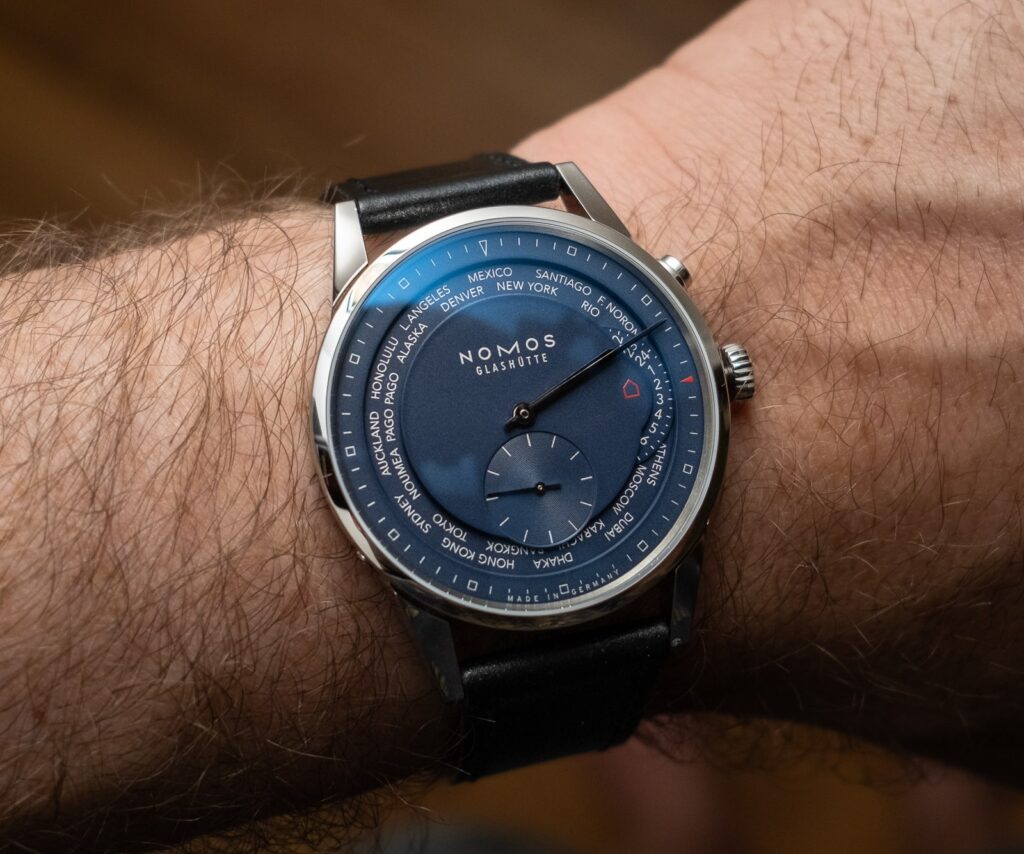
| Price: | $6,870 (Check current price) |
| Water Resistance: | 30m |
| Case Dimensions: | 40mm (diameter) x 50mm (lug-to-lug) x 11mm (thickness) |
| Lug Width: | 20mm |
| Movement: | DUW 5201 |
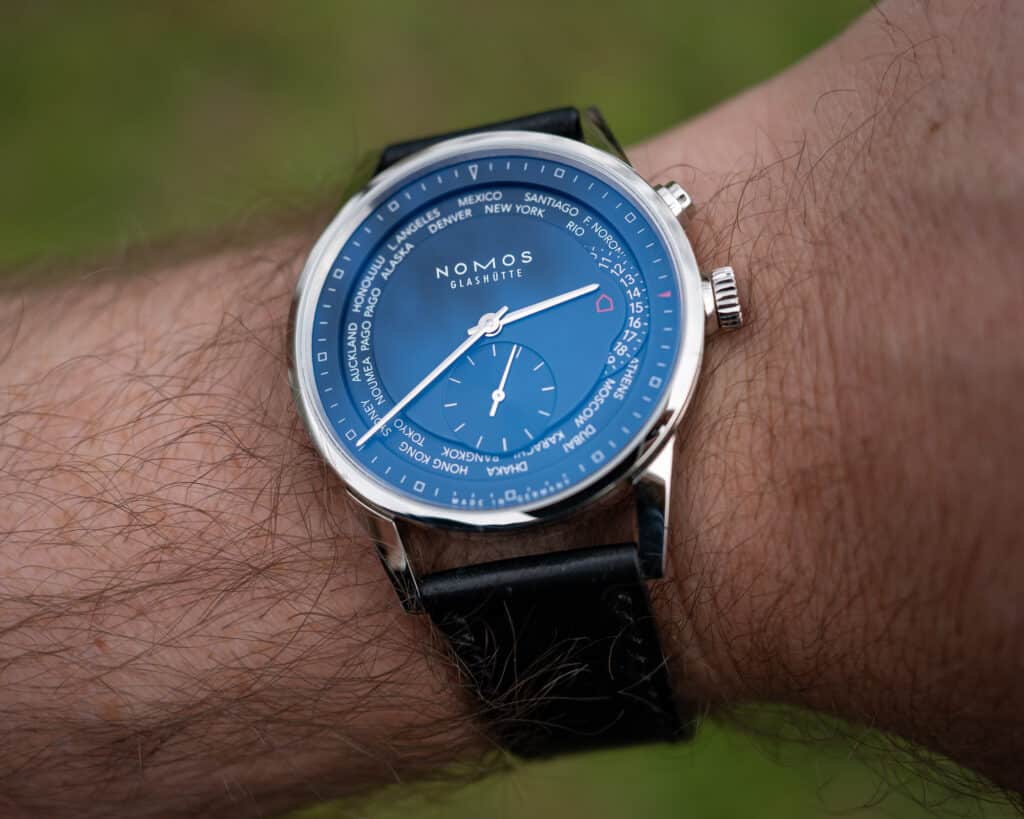
The Zürich World Time doesn’t need a colorful bezel to make the travel-watch point. The midnight-blue dial does plenty on its own, shifting from navy to cooler steel tones as the light changes, while the city ring stays pretty orderly for something with this much information packed in. Rhodium-plated hands remain easy to separate, and the small red home-time indicator becomes useful once we’re actually relying on it. During our time with the watch, it stayed easy to pick out under harsh office lighting and the decidedly less flattering glow of an aircraft cabin. That makes the Nomos feel less like a world-time spectacle and more like a travel tool with excellent taste.
The pusher at 2 o’clock is where the convenience really shows up. One press advances local time by an hour while home time stays fixed on the 24-hour subdial, so changing time zones becomes a series of thumb presses rather than crown fiddling, mental math, and the inevitable “wait, did we set that correctly?” moment. That simplicity makes the system easy to live with. Nomos calls it a world timer, though in practice we treated it more like a very polite GMT. The DUW 5201 kept steady during our testing and offers a claimed 42-hour reserve, enough to keep the low-fuss routine intact.
The 40mm case is slim and nicely balanced, but the long lugs give it more reach than the diameter indicates. Medium wrists should have little trouble, while smaller wrists may find the footprint a touch ambitious. The fully polished surfaces are another reminder that this is not the watch we’d choose for moving furniture or anything else likely to introduce enthusiastic hairline scratches. Thankfully, the shell cordovan strap is much less demanding. It broke in quickly, remained comfortable over long stretches, and didn’t leave us constantly reaching for another adjustment.
That combination is what makes the Zürich World Time relevant here. It offers a truly useful way to change local time without leaning on the familiar Pepsi GMT formula, and the complication feels like part of the design rather than an excuse to add more visual noise. For travelers who want the convenience of quickly switching time zones but would rather their watch look considered than conspicuous, the Nomos makes a pretty persuasive case.
Pros
- The 2 o’clock pusher makes local-time changes quick and intuitive.
- The shell cordovan strap breaks in quickly and stays comfortable for long stretches.
- The midnight-blue dial changes tone with the light while keeping the world-time display composed.
- The red home-time indicator stays easy to spot in bright offices and dim aircraft cabins.
Cons
- Fully polished surfaces pick up fine scratches easily.
- Long lugs make the 40mm case wear larger than the diameter suggests, especially on smaller wrists.
After wearing these watches, we’re less interested in what qualifies as a “proper” travel watch and more interested in whether we’d still reach for it once the airport part of the trip is over. That’s where the variety starts to matter. A field GMT, a world timer, a refined traveler, or a tool watch can all get us home on time without looking like they came out of the same GMT design meeting. The Rolex GMT-Master II “Pepsi” may be the icon, but it doesn’t have to be the template. And maybe that’s the real relief: we can keep the useful complication, lose the visual déjà vu, and still have plenty of room left for a watch with its own personality.

Co-Founder and Senior Editor
Kaz has been collecting watches since 2015, but he’s been fascinated by product design, the Collector’s psychology, and brand marketing his whole life. While sharing the same strong fondness for all things horologically-affordable as Mike (his TBWS partner in crime), Kaz’s collection niche is also focused on vintage Soviet watches as well as watches that feature a unique, but well-designed quirk or visual hook.