
Watches under $100 occupy a strange corner of the hobby: no prestige, no elaborate finishing, just simple tools that keep time and, every so often, surprise you. You learn what bothers you, what you actually notice during a long day, and how little some things matter once the watch is on your wrist and doing its job. Over the years, these were the watches we wore when we weren’t trying to make a point: cheap Casios grabbed without thinking, Timex pieces that survived daily routines, and a few unexpected standouts that refused to feel disposable despite their price.

We’ve been reviewing watches for close to a decade, but more importantly, we’ve spent real time living with these specific models. Not showroom impressions—actual use. We’ve tracked accuracy, noticed where legibility breaks down, paid attention to comfort on smaller wrists, and watched how cases and straps age after months of wear. This list pulls from those experiences. These aren’t the “best” because of specs or nostalgia; they’re here because they held up well enough to deserve mention, flaws and all. And certainly because they helped clarify what value looks like at the very bottom of the price ladder.
Casio F-91W

| Price: | $15 – $20 |
| Water Resistance: | 30m |
| Case Dimensions: | 34mm (diameter) x 38mm (lug-to-lug) x 8.5mm (thickness) |
| Lug Width: | 18mm |
| Movement: | Casio Quartz Module 593 |
The Casio F-91W makes this list for one simple reason: it consistently delivers more real-world usefulness than its price suggests. Once it’s on the wrist, it largely disappears. The case is very light, the profile stays flat, and there’s nothing about it that demands attention throughout the day. That low-impact presence turns out to be its biggest strength. We’ve worn it during travel, workouts, and long errand days without ever feeling the need to take it off or protect it. Despite its low cost, the resin case and strap never felt flimsy or temporary in use. It behaves like a watch that expects to be knocked around.
Flip it over, and that same utilitarian mindset carries through. The stainless steel caseback is plain, secured by four screws, and marked only with essential information. There’s no pretense here, which adds to the confidence. On the wrist, the dimensions read small on paper, but the watch wears with more structure than expected. The subtle corner guards give the case shape and make the pushers easier to find by feel, which matters when you’re setting alarms or using the stopwatch without staring at your wrist.
The digital layout is where the F-91W quietly earns its reputation. Casio managed to fit a calendar, an alarm, a stopwatch, and a 12- or 24-hour time display into a layout that stays clean and instantly readable. Nothing feels crammed. The green LED backlight is modest: it’s a quick flash rather than full illumination, but it’s functional when checking the time in low light. The module itself is intuitive, with button logic that makes sense even if you haven’t worn the watch in months. Comfort is another understated win. The resin strap is soft and flexible, with plenty of adjustment, though its integrated design limits strap changes. During our hands-on testing, accuracy landed around ±30 seconds per month, right where a basic quartz should be, and the multi-year battery life from a CR2016 cell remains one of its most practical advantages.
Pros
- Extremely light and comfortable for all-day wear
- Durable enough to handle daily abuse without concern
- Clean, readable display with straightforward controls
- Consistent quartz accuracy with long battery life
Cons
- Integrated strap design restricts customization.
- Water resistance is limited and not suited for swimming.
- The backlight is functional but much weaker than that of modern panels.
Casio A168WA
| Price: | $20 – $30 |
| Water Resistance: | 30m |
| Case Dimensions: | 37.5mm (diameter) x 33.5mm (lug-to-lug) x 9.6mm (thickness) |
| Lug Width: | 18mm |
| Movement: | Quartz Module 3298 |
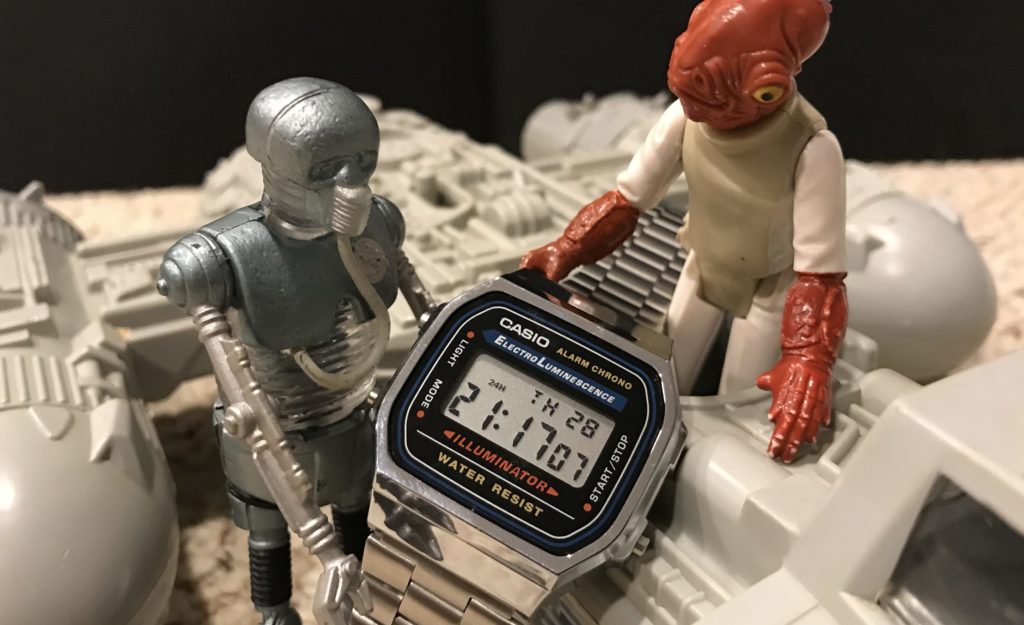
The Casio A168WA earns its place here by being honest about what it is and refusing to dress that up. It’s light, simple, and fully committed to its design era. The compact case, roughly 37.5mm by 33.5mm, sits comfortably on a wide range of wrists, especially if you gravitate toward thinner, low-profile watches that don’t dominate your arm. The case itself is plastic, and Casio doesn’t try very hard to hide that, but the brushed metallic finish does enough to keep it from feeling toy-like once it’s on. It’s not something we’d wear to a formal event, but for everyday errands, casual wear, or leaning into a very specific aesthetic, it stays out of the way.
Where the A168WA shines is in daily use. The feature set is intentionally limited to time, alarm, stopwatch, hourly chime, and an electroluminescent blue backlight. That’s it. During testing, everything behaved as it should—no quirks, no surprises, no learning curve. The backlight flashes briefly rather than staying lit, which works fine for quick time checks but isn’t ideal in complete darkness. The display is also on the smaller side, and while it’s clear in normal lighting, it can lose legibility at sharper viewing angles or under harsher light conditions.
The stainless steel bracelet completes the overall look but comes with trade-offs. While it reinforces the watch’s visual identity, it didn’t fully settle on smaller wrists during extended wear and tended to ride slightly high. Comfort was acceptable for short stints, but after longer stretches, it was more noticeable than the case itself. Build quality across the watch matches the price point: lightweight materials, simple construction, and nothing pretending to be more substantial than it is. Still, that’s part of the appeal. You get reliable quartz performance and a design that commits fully to its identity.
Pros
- Extremely affordable and easy to live with day to day
- Very light on the wrist with a slim, unobtrusive profile
- Clear design direction that doesn’t try to modernize for the sake of it
Cons
- Plastic case lacks the reassuring weight of metal options.
- The bracelet can become uncomfortable during extended wear.
- Backlight duration is short and easy to miss.
- The smaller display isn’t ideal in challenging lighting or glances.
Timex Weekender

| Price Range: | $30 – $60 |
| Water Resistance: | 30m |
| Case Dimensions: | 38mm (diameter) x 45mm (lug-to-lug) x 9mm (thickness) |
| Lug Width: | 20mm |
| Movement: | Quartz Analog |
The Timex Weekender continues to show up in our rotation because it adapts easily to whatever the day looks like. The 38mm brass case sits in a comfortable middle zone, wearing slightly larger thanks to the open dial, while never feeling oversized. On smaller wrists, the downward curve of the lugs helps keep the case centered, and on larger ones, it stays balanced without sliding around. It’s the kind of watch we reached for without much thought: workdays, quick errands, and even a few light hikes, because it never felt out of place or demanding.
Low-light legibility is where the Weekender separates itself. The Indiglo system remains one of Timex’s most practical features, lighting up the entire dial with a soft blue-green glow when the crown is pressed. In our in-depth, hands-on testing, this made checking the time in dark rooms, on evening walks, and even in a tent at night effortless. The matte black dial itself stays clean and readable during the day, though the silver hands can fade into the background once they stop catching light. It’s not a dealbreaker, but you notice it depending on lighting conditions.
From a durability and ownership standpoint, the Weekender keeps things simple. The mineral crystal resisted casual wear better than we expected at this price, and the 30 meters of water resistance handled splashes without issue, though it’s not meant for swimming. Timex also deserves credit for making battery changes painless. The case back clearly marks the battery type and includes a small notch, which makes swapping it out quick and tool-free.
The leather NATO strap plays a bigger role than it gets credit for. It’s thinner and more flexible than most NATOs, keeping the watch light on the wrist even in warmer weather. With a standard 20mm lug width, strap changes are easy, and the dial pairs well with everything from canvas to nylon. Quartz accuracy stayed consistent during testing, but the audible ticking was the one drawback that came up time and again. In quiet rooms, it’s noticeable enough to bother some people, even if it fades into the background elsewhere.
Pros
- Comfortable case size that works across a wide range of wrist sizes
- Indiglo backlight offers clear, full-dial illumination in low light.
- The strap is lightweight, flexible, and easy to swap.
- Clean, legible dial with a useful 24-hour scale
- Battery replacement is straightforward and clearly labeled.
Cons
- Ticking is loud enough to be distracting in quiet environments.
- Water resistance is limited to light exposure only.
- The silver hands can lose contrast against the dial in certain lighting.
Timex Expedition Atlantis T5K463

| Price: | $35 – $60 |
| Water Resistance: | 100m |
| Case Dimensions: | 40mm (diameter) x 45mm (lug-to-lug) x 10.5mm (thickness) |
| Lug Width: | 19mm |
| Movement: | Timex Quartz |
The Timex Expedition Atlantis T5K463 earns its place here thanks to its ease of use. On the wrist, it feels almost weightless. At roughly 40mm wide and about 10mm thick, it sits flat and unobtrusive, making it an easy choice for long days. We wore it through workouts, full errand days, and tightly packed schedules, and it never felt like something we had to adjust or think about. The resin case paired with the soft silicone strap feels better than the price would suggest, and the 100 meters of water resistance adds confidence for everyday exposure to sweat, rain, or the occasional sink splash.
Legibility is a mixed but mostly positive story. The dial layout is dense, filling the glossy round bezel with large numerals and multiple readouts that use the available space efficiently. Straight on, the green-tinted display is clear once your eyes adjust. At steeper viewing angles, though, the display can wash out quickly, sometimes disappearing almost entirely. Where the watch redeems itself is in low-light performance. Indiglo delivers a bright, evenly lit display that makes nighttime checks effortless and reinforces why Timex illumination still gets talked about for practical reasons.
As mentioned in our dedicated review, interaction with the watch is familiar but not perfect. The four-button layout will feel intuitive to anyone who’s used a digital tool watch, but the buttons themselves are small and require a firm, intentional press. That became more noticeable when activating the backlight or running the chronograph during workouts, especially with tired or sweaty hands. Internally, the quartz movement performed well, drifting only a few seconds over months of wear. The feature set is generous without being overwhelming: a stopwatch with lap timing, a countdown timer, a second time zone, alarms, and a full calendar all operate without feeling buried in menus.
According to our review team, the strap was a quiet highlight. The vented silicone design stays comfortable during extended activity, doesn’t trap much dust, and keeps the watch stable on the wrist. The 19mm lug width is an odd choice and limits strap-swapping options, though the proportions work well if you leave it as-is. Availability can be inconsistent depending on current stock. Still, when you come across one, the Expedition Atlantis T5K463 offers a relaxed, practical digital experience that fits easily into workouts, weekends, and everyday use.
Pros
- Very light and comfortable for extended wear
- Strong low-light readability thanks to effective Indiglo
- The soft, vented strap performs well during activity.
- 100m water resistance handles daily exposure without worry.
Cons
- Buttons are small and need deliberate presses.
- Uncommon 19mm lug width limits strap alternatives.
- Display clarity drops off at sharper viewing angles.
- It can be difficult to find consistently in stock.
Rdunae Field Watch RA02

| Price: | $42.90 |
| Water Resistance: | 50m |
| Case Dimensions: | 34.5mm (diameter) x 41.3mm (lug-to-lug) x 11mm (thickness) |
| Lug Width: | 19mm |
| Movement: | Miyota 2035 Quartz |
The Rdunae Field Watch RA02 commits fully to restraint. It does not try to modernize or reinterpret anything, and that choice comes through on the wrist. The case measures just under 35mm with a short lug-to-lug, and it wears every bit as small as that sounds. On the wrist, it felt almost interchangeable with older issued-style field watches like the Mellor 72 we have owned. That smaller footprint never felt limiting. Instead, it reinforced why these designs worked in the first place. At roughly 35 grams on a strap, the watch is barely noticeable during a full day of wear, making it easy to forget it’s even there. For commuting, desk work, or casual weekends, that lack of presence became a benefit.
The dial is where Rdunae’s priorities show. Matte black with crisp white Arabic numerals, it is built around clarity. The fully lumed triangle at twelve and the small “T” marking serve as historical references without overselling authenticity. The broad arrow at six and the clean railroad minute track complete the layout, giving the dial a sense of purpose without visual noise. Pencil-style hands are proportioned well and stay legible without crowding the numerals. What stood out most to us was what was left off. There is no branding, no water resistance text, and no filler. The result feels deliberate rather than bare, and in daily use, the dial stayed easy to read at a glance.
The case and components follow the same straightforward approach. The sandblasted stainless steel finish is uniform and avoids unnecessary shine, which suits the overall character. The domed K1 mineral crystal surprised us more than expected. The dome is more pronounced than many vintage references, adding warmth and distortion at the edges without pretending to be sapphire. Based on our personal impressions, the push-pull crown is easy to operate, though its polished finish feels slightly out of place against the otherwise non-reflective design. Around back, the screw-down caseback is densely engraved and even lists the battery reference.
Inside, the Miyota 2035 quartz movement delivered what we hoped for: reliable timekeeping and long battery life. The included nylon strap was serviceable but forgettable. We preferred slimmer aftermarket options, and while the 19mm lug width is awkward on paper, using an 18mm strap never felt visually off. Lume performance was modest but usable, glowing cleanly enough to read the time when lights dropped. For a watch hovering well under the $100 mark, the RA02 captures a very specific design language with more care than we expected. That makes it an easy recommendation for anyone curious about field watches without wanting a project or a commitment.
Pros
- The compact case wears comfortably and stays unobtrusive all day.
- The super clean, sterile dial prioritizes legibility over decoration.
- Extremely light on the wrist, making it easy to forget during wear
- Quartz movement offers reliable accuracy with low maintenance.
- The domed crystal adds character without pretending to be premium.
Cons
- The small case size will not appeal to those who prefer modern proportions.
- The polished crown feels slightly out of character for the design.
- The supplied strap is functional but unremarkable.
- Uncommon 19mm lug width limits strap choices slightly.
Casio G-Shock DW9052-1V

| Price: | $45 |
| Water Resistance: | 200m |
| Case Dimensions: | 47mm (diameter) x 48mm (lug-to-lug) x 15mm (thickness) |
| Lug Width: | 24mm; tapers to 20mm at the buckle |
| Movement: | Casio 3232 digital module |
The G-Shock DW9052 enters this list by doing what it’s always done well: taking repeated abuse without asking for attention. It’s the watch we reached for when conditions were likely to be rough, and over time, that choice proved itself. The thick urethane resin bumper wraps around the case, extending above the crystal and surrounding the buttons. That design isn’t subtle, but it’s effective. After months of yard work, workouts, and more than a few hard knocks into door frames, ours showed only cosmetic scuffs, with no impact on legibility or function.
There’s no getting around the size. The case is tall, the profile is bulky, and it makes its presence known on the wrist. That bulk, however, serves a clear purpose. The added mass translates into impact protection, and once you accept the dimensions, the watch fades into the background and does its job. The digital display looks busy at first glance, with multiple windows sharing space, but it didn’t take long for the layout to become familiar. During testing, the electroluminescent backlight stood out for evenly lighting the entire display, making quick nighttime checks easy. Even with recessed buttons, operation remained simple, including when hands were wet or gloved.
Comfort was better than expected given the size. The free-moving lugs allow the case to settle closer to the wrist, avoiding the stiff, top-heavy feel that often comes with large watches. The vented strap manages sweat well during longer wear, and the stainless steel buckle feels built to handle repeated stress without bending. One design detail we could do without is the decorative metal pins embedded in the bumper. Over time, they can loosen and, if they fall out, tend to trap dirt. That’s an unnecessary complication in an otherwise purpose-driven design.
From a performance standpoint, the DW9052 has been consistent. The quartz module stayed within roughly ±15 seconds per month, the auto calendar ran without issue, and battery life held firmly in the multi-year range. It’s not refined or discreet, but as a watch built around durability, usability, and reliability, it continues to justify its place in our rotation. For more hands-on insights, read our dedicated review.
Pros
- The protective resin bumper effectively shields the crystal and buttons.
- The even backlight makes the display easy to read in low light.
- Free-moving lugs improve comfort despite the large case.
- The vented strap handles sweat well during extended wear.
- Stable quartz accuracy with long battery life
Cons
- Tall case and bulk limit wear under sleeves.
- Decorative bumper pins can loosen and collect debris.
- The display can feel crowded during the initial learning period.
Timex Easy Reader 35mm

| Price: | $50 |
| Water Resistance: | 30m |
| Case Dimensions: | 35mm (diameter) x 8mm (thickness) |
| Lug Width: | 18mm |
| Movement: | Quartz Analog |
The Timex Easy Reader does something many inexpensive watches struggle with: staying completely out of your way. At 35mm and just 8mm thick, it sits flat, disappears under sleeves, and never demands attention unless you’re checking the time. The brass case keeps weight to a minimum without feeling flimsy, and the overall balance makes it an easy choice for long days when comfort matters more than presence.
Legibility is where the Easy Reader excels. The white dial is open and uncluttered, with bold black numerals that register instantly, even during glances while driving or working. The red 24-hour track adds useful context without crowding the layout. Day and date windows blend into the design, though adjusting them isn’t particularly quick thanks to the lack of a dedicated quickset. The crown is also on the small side, which can make setting a little fiddly for larger fingers, but once everything is dialed in, there’s rarely a reason to touch it again.
The expansion bracelet proved more divisive than expected. For some of us, the pull-on convenience was appealing: no clasp, no buckle, just on and off. It stayed comfortable through full office days and casual errands, though those with hairier wrists may find it less forgiving. The brushed links align well with the lugs, keeping the watch looking clean and practical. Up top, the mineral crystal handled bright light without issue, and Indiglo once again proved its worth by lighting the entire dial evenly at night. Quartz performance was steady throughout testing, with no noticeable drift over time.
What stood out most during our time with this one was how easily the Easy Reader blended into daily routines. It worked just as well with casual clothes as it did under a shirt cuff, never feeling out of place in either setting. The combination of clarity, comfort, and low-effort wear made it feel like a watch almost anyone could pick up and enjoy without adjustment.
Pros
- Clear dial that’s easy to read at a glance
- The slim, lightweight case stays comfortable all day.
- Indiglo provides full, even illumination in low light
- The expansion bracelet offers quick, no-fuss wear.
- Quartz movement delivers consistent accuracy.
Cons
- The small crown can be tricky to handle for larger fingers.
- Day adjustment is slower due to the lack of quickset.
- The bracelet may catch hair on some wrists.
Casio Wave Ceptor

| Price: | $55 – $60 |
| Water Resistance: | 50m |
| Case Dimensions: | 39mm (diameter) x 48mm (lug-to-lug) x 12.75mm (thickness) |
| Lug Width: | 20mm, tapers down to 18mm at the clasp |
| Movement: | Quartz Module 3054 |
The Casio Wave Ceptor earns its spot on this list by doing something quietly impressive: it takes a lot of everyday functionality and packages it in a form that works better on the wrist than its specs suggest. At first glance, the rectangular case proportions can seem a little off, but once worn, they make more sense. On a sub-7-inch wrist, the case settled quickly and felt well-balanced. The narrower profile paired with a longer lug-to-lug gives it enough presence without crossing into awkward or oversized territory. It’s also very light. Coming from heavier steel sports watches, that lack of weight can feel odd at first, but over time, it becomes one of the reasons the watch is so easy to wear.
Interaction is another area where the Wave Ceptor gets things right. The buttons are well placed and easy to find by feel, even when you’re on the move. That matters more than you’d think once you’re using the watch rather than looking at it. The digital layout is equally thoughtful. Information is arranged logically, with the main time display front and center, the day and date easy to glance at, and a small signal indicator confirming the watch is keeping time accurately. Straight on, the LCD is clear in most lighting situations. At sharper angles, contrast drops, which we noticed during daily wear. The module offers a deep feature set, and while it can feel like a lot at first, the core functions reveal themselves quickly with use.
The bracelet plays a bigger role in the overall experience than expected. Its folded metal construction feels light and somewhat hollow, which won’t appeal to everyone, especially if you’re expecting the solidity of a steel sports watch. That said, after extended wear, it encouraged a more relaxed approach to the watch as a whole. It sits naturally on the wrist and visually matches the case better than aftermarket options would. Sizing the bracelet requires a bit of patience the first time, but it’s manageable without specialized tools. The integrated design means you’re committing to the stock setup, and in this case, that feels like part of the watch’s intent. Overall, it’s not trying to feel premium, but it is trying to be useful, and in daily wear, that comes through clearly.
Pros
- Thoughtfully arranged digital display that’s quick to understand
- Atomic timekeeping paired with a robust feature set at a low price
- The case wears comfortably despite unconventional proportions.
- The buttons are easy to locate and press during regular use.
Cons
- LCD contrast drops at sharper viewing angles.
- Plastic elements and a light bracelet can feel insubstantial.
- The integrated bracelet limits customization and takes time to size.
Timex X Peanuts Weekender Collection

| Price Range: | $60 – $70 |
| Water Resistance: | 30m |
| Case Dimensions: | 38mm (diameter) x 45mm (lug-to-lug) x 9mm (thickness) |
| Lug Width: | 20mm |
| Movement: | Quartz |
The Timex X Peanuts Weekender Collection reminds us that watches do not always have to be serious to be worth wearing. At its core, this is still a Weekender, which means a familiar 38mm case that sits comfortably on most wrists and stays slim enough to slip under sleeves. In daily wear, it felt easy and approachable, the watch you throw on without overthinking. What changes the experience is the Peanuts treatment. Snoopy takes center stage, and the watch leans into that charm without turning into a novelty piece that feels disposable after a week.
Once we had it out of the packaging and pulled the battery saver from the crown, the first thing that hit us was Indiglo. That full-dial blue glow is still so useful. At night, it makes checking the time effortless. During the day, legibility was better than expected given the playful dial. Snoopy’s arm forms the hour hand, holding a baseball, while the minute hand becomes his bat. On paper, that sounds like a recipe for confusion. In practice, it worked. Timex kept the dial clean by moving the logo off to the side and removing the second hand entirely. The result was a layout that stayed readable at a glance and avoided the loud ticking that usually comes with basic quartz watches.
Strap choice turned out to be a big part of the experience. The included red single-pass nylon strap was not to our liking. It pulled attention away from the dial and felt loud. Swapping it out changed the watch. On a simple black leather strap, it felt calmer and more wearable, and with the standard 20mm lug width, options are endless. We tried it on nylon, canvas, and leather, and it looked at home on each. That flexibility matters, especially for a watch that is meant to be worn casually and often. Over time, what stood out most was how the Peanuts Weekender reset our expectations. It brought some levity back into wearing a watch, which felt refreshing in a hobby that can get overly serious.
Pros
- The playful dial remains easy to read thanks to a clean layout.
- Indiglo provides full, practical illumination at night.
- The comfortable 38mm case wears well across wrist sizes.
- Standard 20mm lugs make strap changes simple and impactful.
- No second hand keeps things quiet and uncluttered.
Cons
- The red nylon strap feels distracting and should be replaced.
- Mineral crystal offers limited scratch resistance.
- The graphic-heavy design will not appeal to those wanting a neutral daily watch.
Invicta Pro Diver

| Price: | $60 – $80 |
| Water Resistance: | 200m |
| Case Dimensions: | 40mm (diameter) x 48mm (lug-to-lug) x 14mm (thickness) |
| Lug Width: | 20mm |
| Movement: | NH35A (Mechanical) |
The Invicta Pro Diver ends up on this list once you strip away brand expectations and look at how it actually behaves on the wrist. The familiar 40mm Sub-style case is better executed than the price would suggest. Proportions feel settled immediately, with a lug-to-lug length that sits flat and avoids the awkward break-in period some watches require. From the first wear, it feels comfortable and natural, which is a bigger part of daily enjoyment than it gets credit for.
Living with the watch reveals a mix of strengths and predictable trade-offs. The aluminum bezel surprised us with firm, confident clicks and only minimal play between positions. It proved capable of timing everyday tasks, which is how most people will use it. The crown is generously sized and easy to grip, making manual winding straightforward. Dial execution also exceeds expectations, with applied markers and hands that catch light well during the day. After dark, however, the compromises show. Lume is uneven and fades quickly, with the hands staying visible longer than the markers. It works in a pinch, but it isn’t something you’d rely on.
Comfort over longer stretches is where the Pro Diver quietly wins points. The 20mm bracelet tapers down to around 18mm at the clasp, keeping the watch balanced and comfortable throughout the day. Hollow end links are noticeable if you’re looking for them, but the bracelet overall feels more substantial than most alternatives at this price. Articulation is smooth, edges are clean, and it avoids the sharp, unfinished feel that often shows up in entry-level bracelets. The clasp itself is functional and offers useful micro-adjustments, though the flip lock is quite stiff and has already shown signs of wear with repeated use.
Inside, the NH35 movement does what it’s known for: steady, forgiving performance with no drama. Winding is smooth, daily timekeeping remained stable during our testing period, and maintenance is straightforward. Water exposure was never a concern in normal use: rain, swimming, and the occasional accidental soak were handled without issue as long as the crown was secured. It’s not a purpose-built dive tool, but as an everyday watch built around a familiar case shape, it delivers the fundamentals reliably.
Pros
- Comfortable 40mm case with proportions that work immediately
- Dependable NH35A movement with easy ownership
- The bezel action feels more solid than expected at this price.
- The bracelet wears comfortably with decent finishing and taper.
Cons
- Lume performance is inconsistent and fades quickly.
- Large Invicta branding on the case side is divisive.
- Mineral crystal offers limited scratch resistance.
- The clasp is stiff and shows wear faster than ideal.
Casio Duro

| Price: | $85 |
| Water Resistance: | 200m |
| Case Dimensions: | 44.2mm (diameter) x 48.5mm (lug-to-lug) x 12.1mm (thickness) |
| Lug Width: | 22mm |
| Movement: | Casio 2784 Quartz |
The Casio Duro feels far more intentional than its price suggests. On paper, the case dimensions sound intimidating. A 44mm diver with genuine water resistance is unlikely to read as subtle or forgiving. That gave some of us pause before wearing it. Once on the wrist, that concern faded quickly. The lug-to-lug is shorter than expected, and the lugs curve down enough that the case stays planted instead of spreading out. It still wears large, but it wears honestly. If you have spent time with watches like the Seiko Turtle, the Duro lands in familiar territory. After a few days, we stopped wishing it were smaller and started appreciating that the proportions are part of its identity.
The case finishing plays a big role in that impression. Brushed surfaces on top contrast cleanly with polished sides, and a subtle bevel along the case adds enough visual interest without feeling decorative. Our review team found that the overall shape feels deliberate rather than generic. Functionally, it behaves like a proper dive watch. The screw-down crown and solid caseback inspire confidence during everyday water exposure. The aluminum bezel rotates with a smooth, controlled action that felt more refined than expected, especially considering the price. It never felt loose or cheap during use, and timing everyday tasks was easy and predictable.
The dial is familiar but not lazy. Under the flat mineral crystal, legibility is strong thanks to arrow-style hands that catch light well and applied indices that feel thoughtfully finished. Lume is generous enough to be useful, though it fades sooner than we would like. The framed date window at three is proportionate and easy to read, which stood out compared to many more expensive watches we have handled. Dial text is minimal, with Casio branding at twelve and the 200-meter rating near six. The marlin logo adds character without turning the watch into a novelty.
The quartz movement inside makes practical sense here. It hacked, offered a quickset date, stayed within roughly ±20 seconds per month, and ran without needing attention. That ease of ownership mattered. We found ourselves wearing it longer simply because it was always ready. Strap versatility sealed the deal. With a 22mm lug width, the Duro works well with everything from nylon to rubber to aftermarket bracelets, making it easy to tailor to different days and settings. For more insights on its popularity and usability, refer to our in-depth review.
Pros
- The large case wears more comfortably than the dimensions suggest.
- Solid bezel action and real 200m water resistance inspire trust.
- Clean, legible dial with well-finished hands and indices
- Reliable quartz movement with low maintenance and good accuracy
- Excellent strap versatility thanks to standard 22mm lugs
Cons
- The case size will feel oversized on smaller wrists.
- Lume fades faster than ideal for extended low-light use.
- The mineral crystal offers less scratch resistance than sapphire.
Timex Standard

| Price Range: | $85 – $90 |
| Water Resistance: | 50m |
| Case Dimensions: | 40mm (diameter) x 48mm (lug-to-lug) x 9.5mm (thickness) |
| Lug Width: | 20mm |
| Movement: | Analog Quartz |
The Timex Standard takes its spot here by leaning into comfort and familiarity rather than trying to impress. The polished brass case is thin and light, and during wear it slides easily under cuffs without catching or feeling bulky. Although it measures 40mm, the rounded edges and low profile make it wear smaller than the numbers suggest. The longer lug span is the one dimension you notice, especially on smaller wrists, where it can stretch a bit farther than ideal. Even so, it remained comfortable through full workdays and casual weekends without becoming a distraction.
Design details are where opinions started to split. The oversized onion crown and wire-style lugs push the watch toward a vintage-leaning aesthetic. Some of us appreciated the pocket-watch-inspired cues and the added personality they bring, while others felt the lug design slightly narrowed strap options. Either way, it’s a watch with character rather than a neutral blank slate. The stock canvas-over-leather strap was a pleasant surprise. It broke in quickly, stayed comfortable throughout the day, and benefited from quick-release bars that made strap swaps painless. We ended up pairing it with everything from canvas NATOs to black and brown leather, and the dial handled those changes well.
At a glance, the dial looks straightforward, but it rewards closer inspection. Arabic numerals at the cardinal points anchor the layout, while the yellow arrow markers introduce a touch of warmth that mimics age without going overboard. The broad arrow hour hand and dagger-style minute hand borrow from classic field and rail designs, and while the inspiration is familiar, it remains effective. Daytime legibility was solid throughout testing. After dark, performance drops off. Lume fades quickly, and while Indiglo fills the dial with light, its grainy texture feels a bit out of step with the rest of the design.
The quartz movement itself kept steady time during our review period, but it wasn’t invisible. The ticking is loud enough to notice in quiet rooms, and once we caught it, the occasional misalignment of the second hand became hard to unsee. Neither issue is shocking at this price, but they’re worth knowing about before committing. It’s not the strongest value play in Timex’s lineup, but for someone looking for a lightweight quartz watch that’s easy to style and comfortable to wear, the Standard justifies its spot.
Pros
- The slim, lightweight case fits easily under sleeves.
- Dial design works well across a wide range of strap styles.
- Strong daytime readability with clear hands and numerals
- The stock canvas-over-leather strap is comfortable and easy to change.
Cons
- Lume performance is limited, and Indiglo feels visually mismatched.
- The second hand can miss markers on certain ticks.
- The longer lug span may overhang on smaller wrists.
- Ticking is noticeable in quieter environments.
That’s our take on the watches under $100 that earned their wrist time the hard way: by being useful, comfortable, and easy to forget about once they were on. None of these is flawless, but every one of them proved reliable enough to matter, which says more at this price than any spec ever could. As always, this list isn’t finished. If there’s a watch you picked up cheaply and somehow keep wearing anyway, tell us about it in the comments. We’re always interested in the watches people actually live with, and we’re happy to see whether your unsung favorite holds up on our wrists.

Co-Founder and Senior Editor
Kaz has been collecting watches since 2015, but he’s been fascinated by product design, the Collector’s psychology, and brand marketing his whole life. While sharing the same strong fondness for all things horologically-affordable as Mike (his TBWS partner in crime), Kaz’s collection niche is also focused on vintage Soviet watches as well as watches that feature a unique, but well-designed quirk or visual hook.
I thoroughly enjoyed this piece. Timex has made quite a few watches that deliver these qualities at almost ridiculous prices. My 17-year old Times Expedition T41101 is the cheapest watch I wear, and it continues to maintain an accuracy well within 10 seconds a month. On top of that, it still gets comments when I wear it.
Hi, Bob:
Isn’t it funny how that works? Sometimes the cheapest pieces we own become the most reliable or at least special ones to us haha. I’m also not surprised about your Timex Expedition still keeping accuracy. People can bash quartz all they want, but at the end of the day its one of the most reliable ways to ensure top notch, long term accuracy for a timepiece.
Best,
-Kaz
I don’t usually read articles suggested by Google. But I like watches. Your list was legitimized by including the Duro; one of my favorites. And you had something I hadn’t heard of before. The Wave Ceptor. I’ll be hunting one of those down. Good job!
Hi, Jeff:
Glad you enjoyed the piece! Yea these Wave Ceptor models don’t get as much attention as some of the other Casio digital models but they are a ton of fun to wear and experience.
Thank you for reading our piece and commenting!
Best,
-Kaz
Nice review. Hoever I must ad a correction on the casio F91W.
We manage a surf school and we all 10 people wear this particular watch since 10 years and during endless surf lesson and personal surf sessions sometimes getting pounded under ton of water. The only reason we purchase around 5 -10 pieces a year is because we loose them due to the surfboard leash getting stuck on it. I have not seen a single F91W loose its water resistance in a decade.
Hi, Edgar:
Oh that’s actually something we hadn’t thought about in regard to people surfing (or doing any type of watersport with the watch). I’m glad to hear from your personal experience that the WR of the F-91W has never been an issue. Thank you for sharing your insights!
Best,
-Kaz
The only thing about that Rdunae watch is I think it would be better be equipped with vh31 movement, which can provide a smother second hand movement.
Hi, Johney:
Oh that’s actually a really cool idea – it may drive up the price slightly, but swapping out the Miyota movement for a the VH31 Seiko mecaquartz would be a very cool upgrade.
Thank you for commenting on our piece!
Best,
-Kaz