Business casual is a strange dress code because it asks for a watch to clean up without turning bland. We’ve all had mornings where a diver feels too weekend, a dress watch feels like we’re auditioning for a finance brochure, and the “safe” option drains the whole outfit. So, this list is to sort out the best watches for business-casual style: watches that slip under a cuff, pair with denim or chinos, and still feel like something a watch person chose on purpose.
We don’t approach this from a “how to dress for the office” angle, partly because most office style advice reads as if it were assembled in a beige conference room. Our perspective comes from nearly a decade of reviewing watches and wearing them in the normal places business casual happens: offices, travel days, dinner after work, and the occasional “why did I wear this bracelet today?” moment. Some watches dress up without losing their personality. Some have polish but miss comfort, while others look right in photos and feel wrong by lunch. By the end, you should have a clearer sense of which ones belong in your rotation, and which ones only work when the coffee-table lighting is doing most of the labor.
Orient Bambino
| Price: | $180 – $250 |
| Water Resistance: | 30m |
| Case Dimensions: | 40.5mm (diameter) x 44.3mm (lug-to-lug) x 12mm (thickness) |
| Lug Width: | 21mm |
| Movement: | Caliber F6724 Automatic |
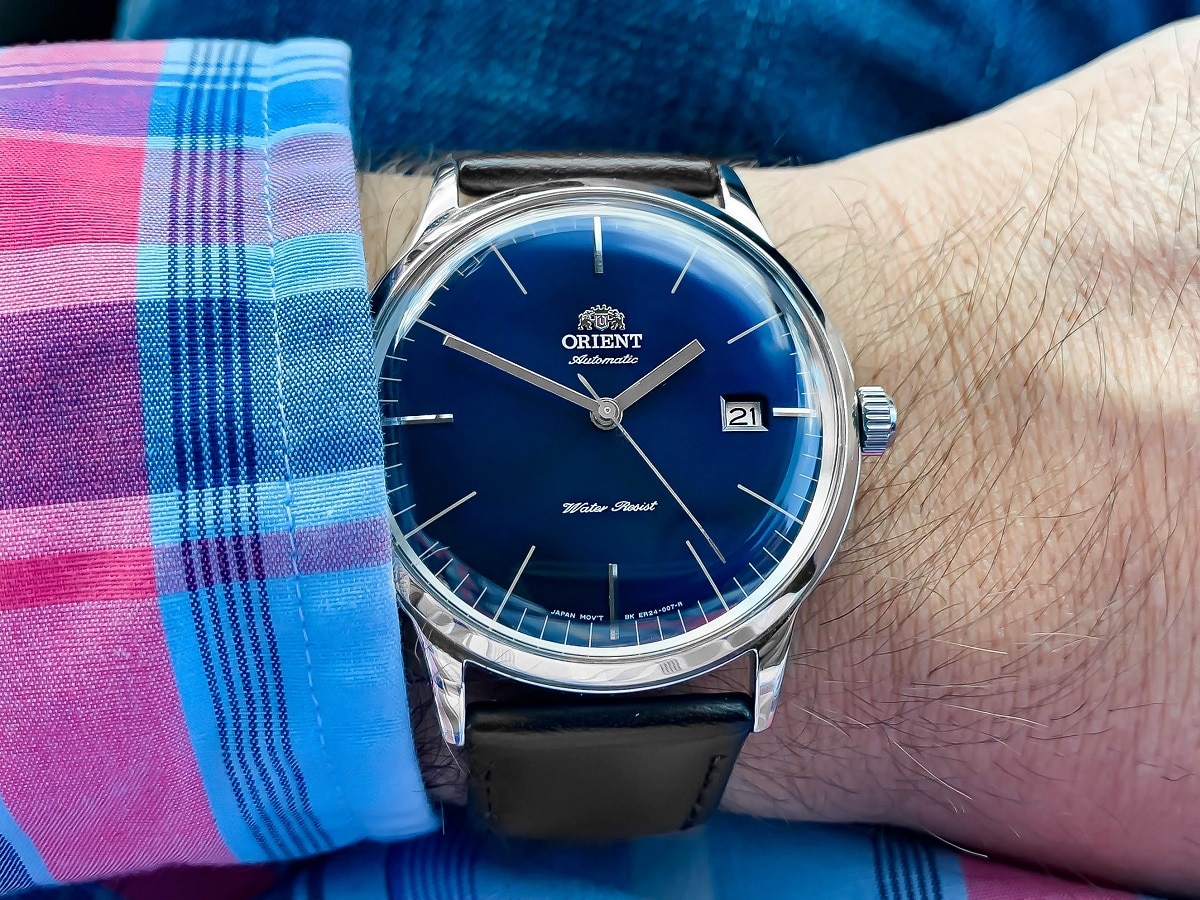
The Orient Bambino works for business-casual style because it doesn’t try too hard to look “professional,” which is often where affordable dress watches start to get weird. It has enough traditional office-watch DNA to sit comfortably with a button-down, chinos, or a soft jacket, while still giving you the small pleasure of wearing a mechanical watch every day. That matters here. Business casual is not black-tie dress watch territory. It’s the middle ground where a watch needs to look intentional without making you feel like you’re playing dress-up.
The case is listed at 40.5mm, which sounds a little large for something this dress-leaning. On the wrist, though, the Bambino behaves better than that number suggests. The lug-to-lug is compact enough to keep the watch from spreading out awkwardly, and the lugs’ downward turn helps it sit flatter than expected. During testing, our reaction across the team was pretty consistent: it wears smaller than the spec sheet implies and didn’t feel locked to one wrist size. The slim enough case profile also helps it slide under a shirt cuff, which is where this watch earns much of its keep in a business-casual rotation.
The dial is where the Bambino gets most of its charm. Orient offers it in several rich colorways, and in good lighting, it can look more refined than the price would suggest. The design also has more sharpness than softness, so it avoids feeling like an old-fashioned dress watch your uncle bought for weddings and never wore again. The catch is that the same polished surfaces that give it that dressed-up look can work against it. The domed mineral crystal looks great from angled views, especially around that 45-degree sweet spot, but it throws reflections pretty hard. Add polished hands and markers, and legibility can suffer under bright office lighting. After dark, there’s no backup plan either, since the dial has no lume.
The in-house F6724 automatic movement is a real ownership win at this price because it includes hacking and hand-winding, both of which make the watch easier to live with. That said, the movement is not quite discreet. The rotor can be loud, and the power reserve coming in under 30 hours means the Bambino may need resetting if it spends a day off-wrist. The crown also feels undersized; hence, hand-winding can be fiddly, especially for someone new to mechanical watches. The stock leather strap is another budget reminder: comfortable enough, but not very convincing. Swap it out, and the Bambino becomes a much stronger business-casual piece, especially for someone who wants an affordable mechanical watch that cleans up well without losing its personality.
Pros
- Wears smaller than the 40.5mm case size suggests, thanks to the compact lug-to-lug and downward-curving lugs.
- The dial colors and finish feel more refined than the price suggests.
- Sharp dial design keeps it from feeling too old-fashioned or formal.
- In-house F6724 automatic movement includes hacking and hand-winding.
- The stock leather strap is comfortable enough for daily wear and easy to replace.
Cons
- The domed mineral crystal reflects light aggressively, especially in bright office settings.
- Small crown makes hand-winding a little fiddly.
- Power reserve falls short of 30 hours.
- No lume, so nighttime readability is basically off the table.
- Rotor noise can be noticeable.
Casio Oceanus T200
| Price: | $300 – $500 |
| Water Resistance: | 100m |
| Case Dimensions: | 41.4mm (diameter) x 49mm (lug-to-lug) x 10.7mm (thickness) |
| Lug Width: | 20mm |
| Movement: | Tough Solar movement (Module 5596) |
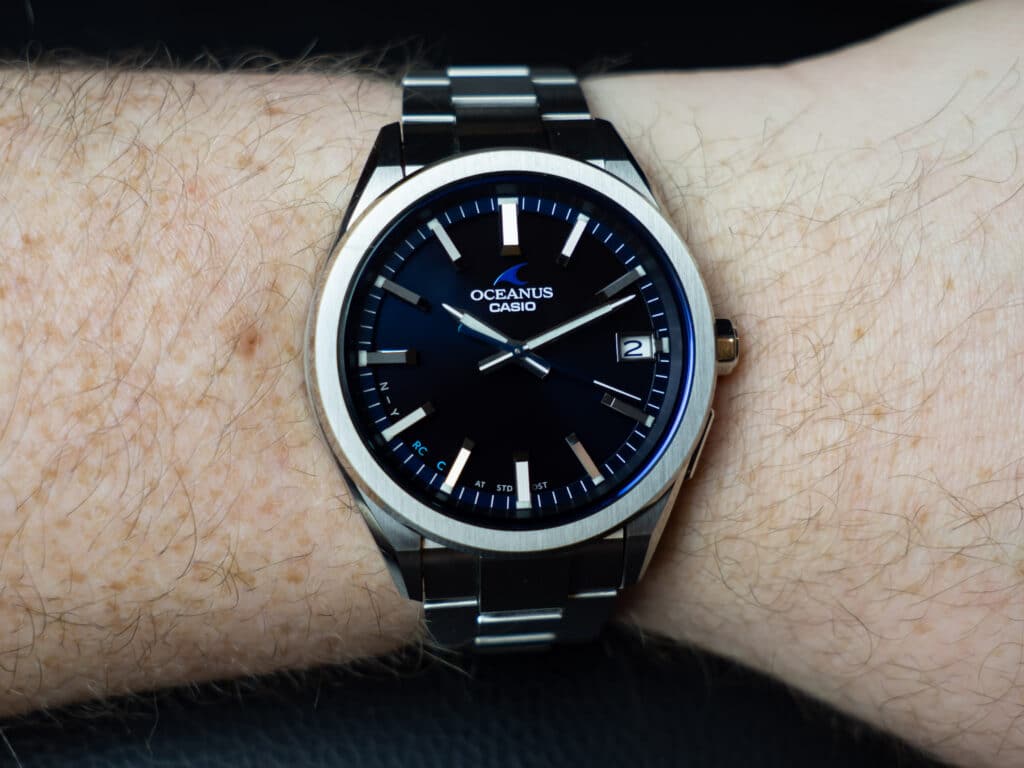
The Casio Oceanus T200 fits a business-casual style because it looks like a clean analog watch first and a piece of Casio tech second. That balance is the whole appeal. It has enough polish to pair with a button-down, a knit polo, or a jacket, but it doesn’t wander into shiny “boardroom cosplay” territory. The case’s alternating brushed and polished surfaces give it some presence, though the overall impression stays controlled. It feels refined in the way a good daily office watch should: noticeable when you care to look, easy to forget about when you’re answering emails.
The dial does a lot of the heavy lifting here. The deep blue has more depth than a flat glossy finish, and the floating hour markers, created through cutouts in the chapter ring, give the watch a little architecture without making it busy. That matters for business casual wear because the T200 can add interest to a plain outfit without becoming the loudest thing in the room. The blue-tinted sapphire crystal also catches natural light, creating a soft glow across the dial, as if it has its own quiet illumination. It’s not dramatic, but it gives the watch some life when you’re moving between office lighting, daylight, and whatever sad overhead bulbs your conference room has been cursed with.
Where the T200 separates itself from most dress-leaning watches is the convenience. The Tough Solar 5596 module runs on light, and in our hands-on review, the watch stayed fully charged without us having to park it near a window or baby it deliberately. Bluetooth syncing through the Casio Oceanus app also worked cleanly during testing, with each connection going through without drama. Once paired, the watch keeps itself accurate in the background, which is the kind of feature that sounds boring until you stop having to set your watch on a Monday morning. For someone who wants a reliable business-casual watch without the reset-and-wind rhythm of a mechanical watch, that’s a real advantage.
However, the bracelet can sound rattly when the watch is off the wrist, which takes a little shine off the otherwise refined feel. Sizing it also involves a pin-and-collar system, so patience helps if you’re doing it yourself. The connectivity text on the dial may bother anyone who wants a completely clean look, and the lume is only modest, so nighttime legibility isn’t its strongest suit. Even so, the Oceanus T200 earns its place here because it handles the business casual brief with rare practicality: clean enough for work, interesting enough, and low-maintenance enough to disappear into daily life.
Pros
- Strong blend of practical tech and clean design at a relatively accessible price.
- Tough Solar 5596 module runs on light and stays charged for months without deliberate charging.
- Bluetooth syncing through the Casio Oceanus app keeps timekeeping accurate with little effort.
- Blue-tinted sapphire crystal creates a subtle glow in natural light.
- The deep blue dial has useful depth and character for business-casual wear.
Cons
- The bracelet can feel noisy and rattly when the watch is off the wrist.
- Lume is modest, so nighttime readability is limited.
- Connectivity-related dial text may feel distracting if you prefer a cleaner layout.
- The pin-and-collar sizing system takes more patience than some bracelet setups.
Seiko SRPE51
| Price: | $315 |
| Water Resistance: | 100m |
| Case Dimensions: | 40mm (diameter) x 44mm (lug-to-lug) x 12mm (thickness) |
| Lug Width: | 20mm |
| Movement: | Seiko 4R36 |
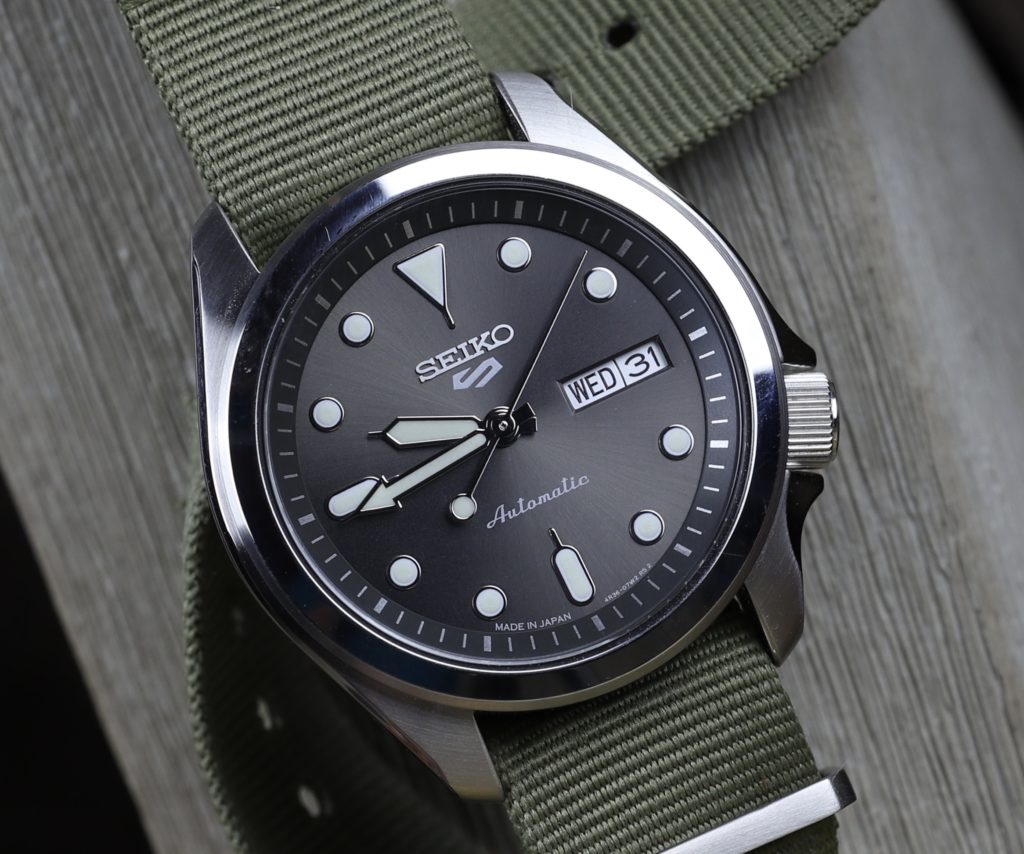
The Seiko SRPE51 works for business casual style because it keeps the useful parts of Seiko’s sport-watch language without dragging the whole dive-watch costume into the room. You can see the SKX influence in the general shape, but without the rotating bezel, the watch relaxes into something cleaner and easier to wear with a button-down or overshirt. It still feels approachable, which is important. Some office-friendly watches get so polished and careful that they lose any sense of daily-wear comfort. The SRPE51 avoids that by staying casual at its core, then adding enough refinement so it doesn’t look out of place next to a laptop, notebook, or mildly depressing office coffee.
The grey dial is a big part of why this one fits the business casual lane. It shifts subtly as the light changes, so it has some visual movement without screaming for attention during a meeting. Applied indices and the modern Seiko 5 branding make it feel current, while the updated handset improves legibility compared to older SKX-style layouts. The flat Hardlex crystal also reduces distortion, making quick time checks easier during the day. Seiko’s LumiBrite is another real advantage here. It keeps the watch readable after the lights dim, though, while testing, we still found ourselves wanting a lollipop-style second hand when reading it in lower light. Tiny complaint, yes, but worth noting.
On the wrist, the 40mm case lands in a useful middle zone. It doesn’t feel dainty, but it also doesn’t carry the bulk or visual weight of a full diver. During longer desk-bound stretches, it stayed light and low enough that we could forget about it until someone noticed it across the table. The polished fixed bezel helps dress the watch up compared to its sportier relatives, giving the SRPE51 a cleaner profile that works very well with chinos, casual tailoring, and the kind of shirt you bought because you swore you were going to “dress better this year.” The drilled 20mm lugs also give it a lot of range. Leather can push it smarter, while a more casual strap keeps it relaxed.
Inside, the SRPE51 uses Seiko’s 4R36 automatic movement, visible through the display caseback. It has hacking and hand-winding, which makes it easier to own if this becomes your main weekday watch. The case itself feels solid, but the bracelet is where the budget shows a little. The hollow end links make it feel light and jangly, and that can clash with the otherwise composed feel of the watch. It does size easily and stays secure once adjusted, though many of us would swap it quickly. The Hardlex crystal is also more scratch-prone than sapphire, and a slight chapter ring alignment issue can show up if you inspect it closely. Still, as a business-casual pick, the SRPE51 makes a lot of sense for someone who wants a single watch that can move between casual and professional settings without looking like it borrowed someone else’s wardrobe.
Pros
- The grey dial shifts nicely under changing light without becoming distracting.
- Applied indices and an updated handset give the watch strong everyday legibility.
- Seiko LumiBrite keeps it readable in low light.
- The polished fixed bezel gives it a cleaner, more business-casual look than SKX-style divers.
- Drilled 20mm lugs make strap changes easy.
- 4R36 automatic movement includes hacking and hand-winding.
Cons
- The bracelet feels light and jangly because of the hollow end links.
- A slight chapter-ring alignment issue is visible on close inspection.
- Hardlex crystal is more vulnerable to scratches than sapphire.
Mido Multifort 38
| Price: | $350 – $650 (secondary market, based on condition) |
| Water Resistance: | 100m |
| Case Dimensions: | 38mm (diameter) x 45mm (lug-to-lug) x 11mm (thickness) |
| Lug Width: | 20mm |
| Movement: | ETA 2836-2 (Caliber 80 on current models) |
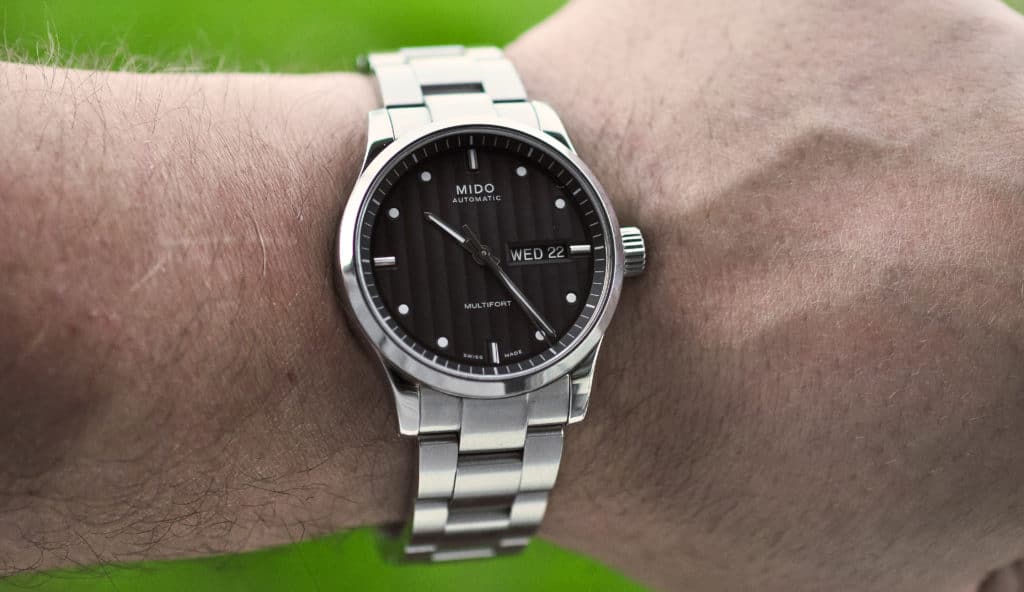
There’s a specific kind of watch that works best with business casual clothing: not too dressy, not too sporty, and not so polished that it starts looking nervous next to rolled sleeves. The Mido Multifort 38 lives in that middle space pretty comfortably. It has enough brushed steel and water resistance to feel like something you can wear without babying, but the slim case, polished accents, and bracelet give it enough polish for a shirt cuff. The 38mm case and 45mm lug-to-lug keep the footprint sensible, and the short, slightly downturned lugs help control the big dial opening. That matters here, because watches with dials pushed close to the edge can wear larger than expected. On the Multifort 38, the proportions stay tidy. At roughly 11mm thick, it falls within the size range that makes sense for long workdays, whether you are sitting at a desk or running around pretending meetings need to be in person.
The case finishing has more going on than the simple shape first suggests. Most surfaces are brushed and smooth to the touch, while the sides facing the wearer catch the light with a cleaner, polished shine. The small, polished bezel adds enough brightness without making the watch feel too dressy. The flat sapphire crystal sits protected inside the bezel, so exposed crystal edges are less of a worry, but Mido skipped anti-reflective coating here. That means reflections show up often, sometimes with your own face staring back at you like a tiny judgmental coworker. Viewed straight on, though, the dial remains clear and legible. The screw-down signed crown is also a real win for ownership. It is large enough to grip easily, takes only a turn or two to secure, and adds confidence in its 100m water resistance.
The dial is probably the love-it-or-leave-it part, but it gives the Multifort 38 a lot of its character. The vertical Genève stripes sit within a recessed border that transitions to a raised chapter ring, while the applied quarter-hour markers and painted five-minute dots add depth along the outer edge. The black day-date wheels sit in a deep window and blend into the dial quite well in certain light, with spacing that works nicely on the 38mm case. The Mido and Multifort text also sits cleanly above the striped pattern rather than being swallowed by it. We would not call the lume strong, but the soft blue Super-LumiNova on the primary markers helps. The chromed, thin sword hands can be risky on a dark dial, yet the lume running down them keeps visibility better than expected during the day. The tapered needle-like second hand looks great reaching the minute track, though without lume, it can disappear at certain angles.
The bracelet keeps the watch leaning business casual rather than pure sport. It tapers from 20mm to 18mm, uses thicker links than you might expect, and only polishes the sides, which adds a little dressiness without overdoing it. The butterfly clasp gives the bracelet a cleaner, more jewelry-like look, but it also brings the usual fit problem. There is almost no micro-adjustment beyond two smaller removable links, so finding the perfect fit may take some patience. The 38mm version we reviewed used the ETA 2836-2 at 28,800 bph, but current Multiforts now use Mido’s Caliber 80, with an 80-hour power reserve and a 21,600 bph beat rate. That longer reserve is a meaningful upgrade for weekday wear, since you can leave the watch off for a couple of days without immediately resetting the day and date. The bad news is that the 38mm model is discontinued, while the 42mm remains available with broader proportions and a day-date window that sits more inboard. Still, the 38mm Multifort is the version that best captures the business casual sweet spot: sturdy enough for everyday use, slim enough for the office, and detailed enough not to feel anonymous.
Pros
- 38mm case, 45mm lug-to-lug, and 11mm thickness make it easy to wear under a cuff.
- Screw-down signed crown and 100m water resistance add real daily-use confidence.
- The recessed Genève stripe dial and well-integrated day-date display give it depth without getting loud.
- Brushed case and side-polished bracelet balance sportiness with a dressier business-casual polish.
Cons
- The bracelet has very limited micro-adjustment, which can make achieving a perfect fit tricky.
- The sapphire crystal has no anti-reflective coating, so the glare can be distracting.
- Lume is soft rather than strong, and the second hand has no lume at all.
Baltic MR01
| Price: | $635 |
| Water Resistance: | 30m |
| Case Dimensions: | 36mm (diameter) x 44mm (lug-to-lug) x 9.9mm (thickness) |
| Lug Width: | 20mm |
| Movement: | Hangzhou 5000a automatic |
The Baltic MR01 earns its business casual spot by not trying to be a softened sports watch. It leans into dress-watch language instead, but in a way that still feels wearable on an ordinary weekday. That matters because business casual can make traditional dress watches feel a little too formal, especially if the rest of the outfit is closer to a knit polo and chinos than to a suit and tie. The MR01 avoids that stiffness. It has enough restraint for meetings, but enough texture and oddball charm to keep a watch person from getting bored by lunch.
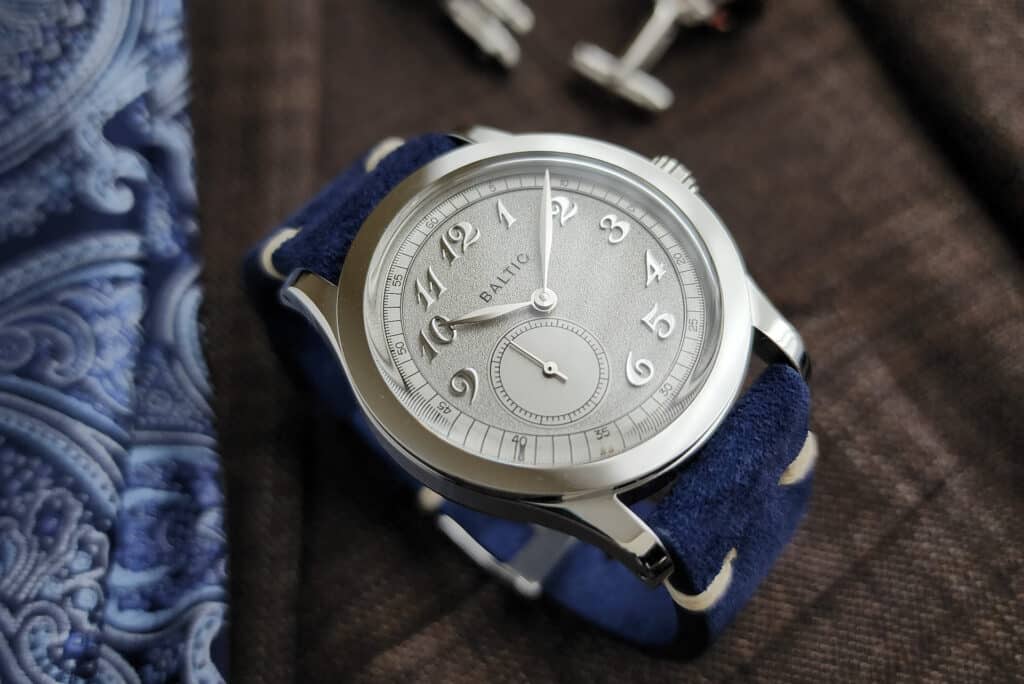
The 36mm case is a huge part of why it works. Paired with a sub-10mm thickness, it sits slim and controlled on the wrist, which makes it easy to live with during desk-heavy days. The fully polished surfaces bring the expected dressy shine, while the brushed mid-case keeps the whole thing from feeling too precious. On leather, it reads more traditional. The optional beads-of-rice bracelet relaxes a bit and becomes easier to wear with less formal attire. That flexibility is exactly what a business casual watch needs: enough polish to clean up, but not so much that it gets awkward next to rolled sleeves.
The dial is where the MR01 does most of its quiet showing off. The fine sand-textured silver surface gives the watch depth without clutter, and the offset guilloché small-seconds subdial adds structure without making the layout feel busy. The polished Breguet numerals pull your eye in, especially under softer lighting, where they have more of a glow than a hard reflection. The domed Hesalite crystal adds a subtle distortion around the dial’s edge, softening the overall presentation. It is not the crisp, clinical look of sapphire, and that is the point. The MR01 feels warmer and more tactile because of it.
Flip it over, and the Hangzhou 5000a automatic movement is visible through the display caseback, with polished bridges, perlage, and gold-tone engraving that feel generous for the price. The Chinese-made movement may still give some collectors pause, but in daily use while testing, the 42-hour power reserve was easy to live with, and the watch ran consistently enough to avoid becoming a source of irritation. The practical cautions are clear: Hesalite scratches more easily than sapphire, and 3 ATM water resistance means this is not the watch to wear through accidental sink duty with confidence. Still, for someone who wants business casual style with proportion, texture, and a little microbrand personality, the MR01 makes a strong case without raising its voice.
Pros
- 36mm case and sub-10mm thickness wear slim and comfortable during long workdays.
- Fully polished surfaces and brushed mid-case create a refined look without looking flashy.
- Sand-textured silver dial adds depth while staying clean and restrained.
- Polished Breguet numerals catch soft light beautifully without cluttering the dial.
- A 42-hour power reserve is easy to live with day to day.
Cons
- Hesalite crystal scratches more easily than sapphire.
- Chinese-made Hangzhou movement may bother some collectors.
- 3 ATM water resistance limits real-world water exposure to an extent.
Baltic Hermétique Tourer
| Price: | $650 |
| Water Resistance: | 150m |
| Case Dimensions: | 37mm (diameter) x 46mm (lug-to-lug) x 10.8mm (thickness) |
| Lug Width: | 20mm |
| Movement: | Miyota 9039 Automatic |
The Baltic Hermétique Tourer is a good business casual pick because it starts with field-watch practicality, then sands off enough of the ruggedness to feel appropriate around a desk. It still has that clear, functional personality, but the design is more composed than “weekend beater with a nicer shirt.” That balance matters here. Business-casual watches need to handle real life without looking like they wandered in from a camping trip, and the Tourer walks that line better than most compact field-style watches.
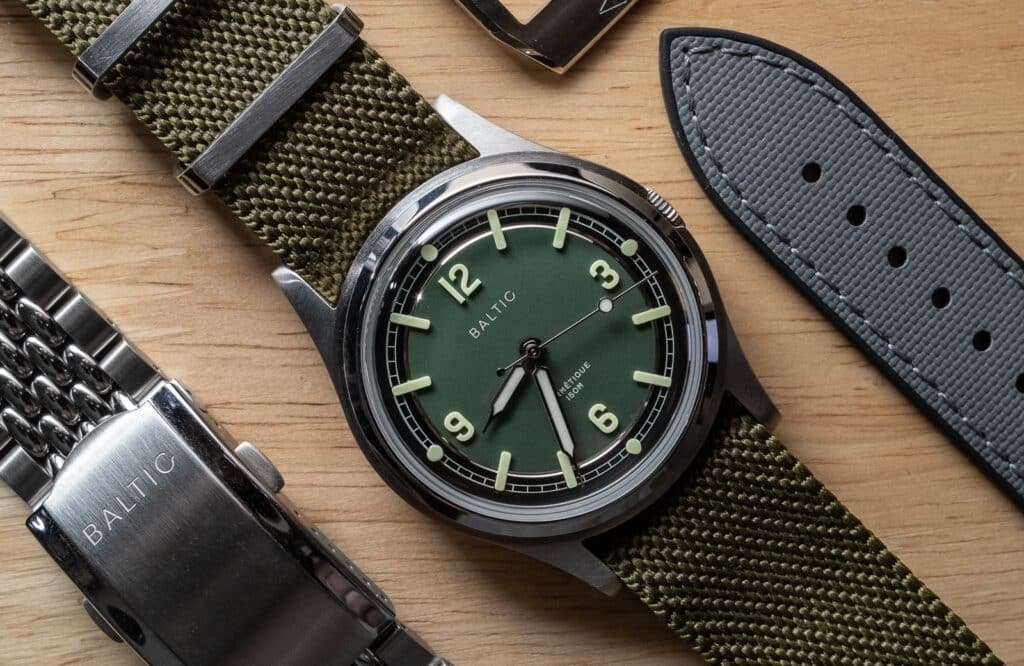
The proportions do a lot of the work. At 37mm wide, 46mm lug-to-lug, and around 10.8mm thick, the Hermétique Tourer stays compact and comfortable over long workdays. The fully brushed case keeps things subdued, while the thin polished bezel adds a small flash of light so it doesn’t feel flat under office lighting. Baltic also offers it with drilled lugs, which make it easy to swap straps if you want to shift from a more casual look to something cleaner during the week. The crown sits nearly flush with the case, which helps preserve the tidy side profile, though it also makes hand-winding more annoying than it needs to be. The 150 meters of water resistance is a nice bonus, too, especially for a watch that can still look composed with business-casual attire.
As mentioned in our dedicated review, the dial is built around quick legibility rather than decoration, which helps its case for office wear. Large indices filled with C3 X1 Super-LumiNova and syringe-style hands make it easy to read at a glance, without the visual clutter that can make some field watches feel too busy. In low light, the lume gives off a steady green glow, which is useful during a late commute or after the lights dim. A polished ring around the dial adds a bit of refinement, and the color options, including green, beige, blue, and brown, give the watch some personality without pushing it into novelty territory. The boxed, double-domed sapphire crystal adds vintage character, but because the anti-reflective treatment is minimal, reflections can appear at certain angles.
Inside, the Miyota 9039 automatic movement keeps the Tourer in sensible daily-watch territory. It’s a known workhorse that delivers dependable accuracy without making the price feel precious. Baltic also offers buyers a useful range of strap options, including beads-of-rice and flat-link bracelets, as well as a tropic-style rubber strap. The bracelets use simple clasps, and they don’t feel as refined as the rest of the watch, but the generous micro-adjustment and quick-release spring bars make daily wear and strap changes much easier. The Tourer is not the dressiest watch here, and that’s part of the point. It’s for someone who wants a business casual style with field-watch usefulness still intact.
Pros
- Well-proportioned 37mm case with solid finishing.
- Highly legible dial with strong C3 X1 Super-LumiNova.
- 150 meters of water resistance adds practicality beyond the office.
- Multiple strap options with easy, quick-release changes.
- The boxed double-domed sapphire crystal adds vintage character.
Cons
- The minimal anti-reflective coating can still cause reflections.
- Flush crown design makes manual winding less convenient.
- Bracelet clasps feel quite basic compared to the rest of the watch.
Mido Commander Datoday
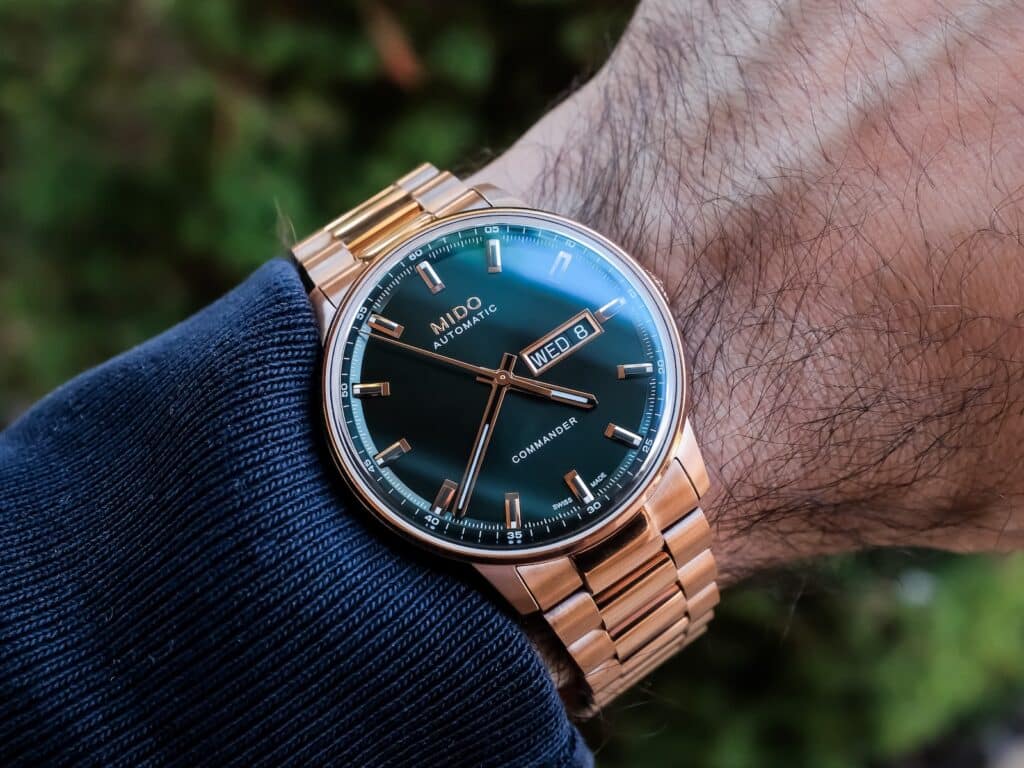
| Price: | $1,260 |
| Water Resistance: | 50m |
| Case Dimensions: | 40mm (diameter) x 10.7mm (thickness) |
| Lug Width: | 21mm |
| Movement: | Mido Caliber 80 automatic |
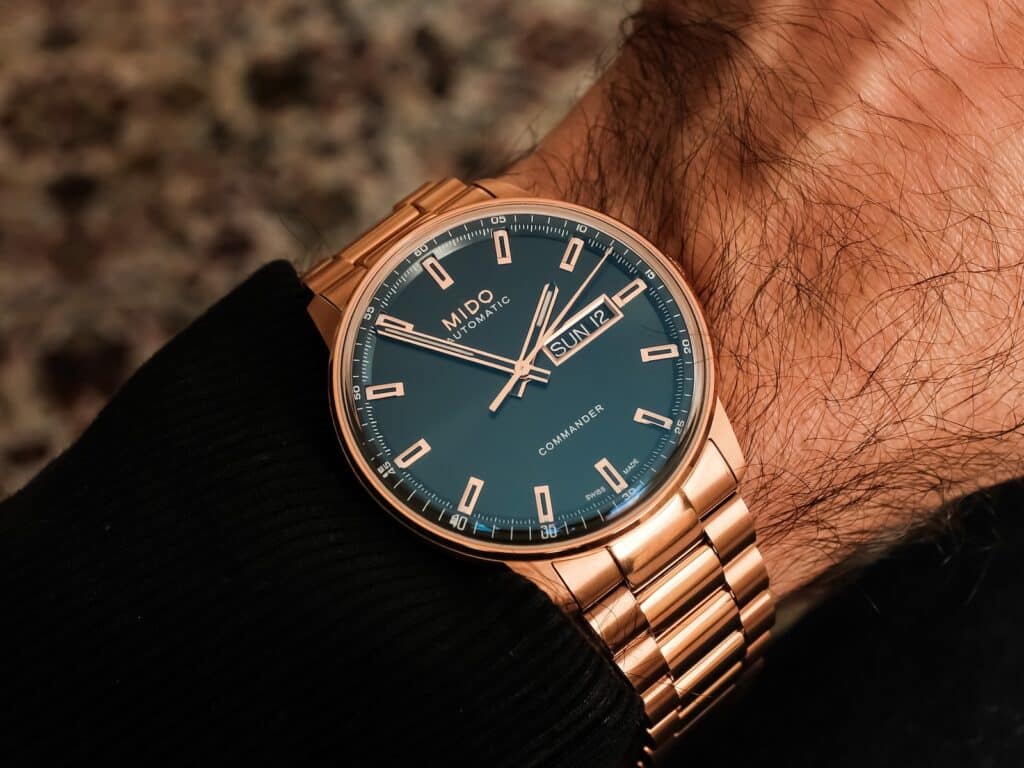
The Mido Commander Datoday settles naturally into business-casual style because it brings bracelet-watch polish without feeling like another safe silver-on-silver office choice. The rose-gold-tone PVD case and bracelet could have gone sideways quickly, but the green dial keeps the whole thing grounded. It shifts from a cooler blue-green to a deeper forest tone depending on the light, which gives the watch some personality without turning it into wristwear theater. The stepped outer dial and white markings keep things organized, while the rose-gold-tone applied markers and baton hands tie the case and dial together. Under the sapphire crystal, legibility stays clean, and the framed day-date display is easy to read without feeling like an afterthought.
The case has enough presence at 40mm, but the 10.7mm thickness is what makes it work for business casual wear. It sits slimmer than the warm-toned bracelet might suggest, so it can move from a casual button-down to something sharper without feeling bulky under a cuff. The way the case flows into the three-link bracelet also helps the watch feel like a complete design, not a dressy head awkwardly bolted to a bracelet. This is where the Commander Datoday earns its place: it has a little old-school charm, but it still behaves like a weekday watch.
The Caliber 80 is the practical reason this one becomes easier to live with than some day-date watches. An 80-hour power reserve means you can leave it off for a couple of days without immediately having to reset both windows, which is the kind of quiet convenience that matters in real life. The Powermatic-style architecture feels familiar, and the Nivachron balance spring provides useful resistance to magnetic fields and shocks. The display caseback is there if you want to look, though the bigger win is the movement’s low-effort dependability. There’s also a small mechanical pleasure in watching the day and date snap over after midnight, which suits the watch’s vintage-leaning mood.
The bracelet looks the part with brushed and polished rose-gold-tone PVD surfaces, and the butterfly clasp keeps the underside tidy on the wrist. Quick-release spring bars are a smart touch, especially because this watch would probably look excellent on dark brown leather. The annoyances are familiar but worth calling out. The push-pull crown and 50 meters of water resistance make it clear this is for normal daily wear, not sports-watch abuse. The crown could also be larger for easier winding and setting, and the 21mm lug width limits strap options. During hands-on testing, we felt the bracelet would benefit from screw links and a stronger taper near the clasp as well. Still, for someone who wants a business casual watch with warmth, color, and a bit more character than the usual office-safe formula, the Commander Datoday makes a convincing case.
Pros
- Rose-gold-tone PVD case and bracelet feel distinctive without overpowering the watch.
- Caliber 80 offers an 80-hour power reserve for easier ownership.
- The framed day-date display is clear and practical, adding old-school charm.
- The slim 10.7mm case helps it fit under cuffs and in smarter casual settings.
- Quick-release spring bars make strap changes simple.
- The Nivachron balance spring provides resistance to magnetic fields and shocks.
Cons
- The crown could be larger to make winding and setting easier.
- 21mm lug width makes strap options more limited.
- The push-pull crown and 50m water resistance limit its everyday toughness to some extent.
Christopher Ward The Twelve 36mm Titanium

| Price: | $1,895 |
| Water Resistance: | 100m |
| Case Dimensions: | 36mm (diameter) x 40.8mm (lug to lug) x 8.95mm (thickness) |
| Lug Width: | Integrated bracelet, starts 22mm at lugs, tapering down to about 16-17mm at the clasp |
| Movement: | Sellita SW300-1 COSC |
The Christopher Ward The Twelve 36mm Titanium slots neatly into a business-casual rotation for someone who wants polish without the usual dress-watch mannerisms. It is sportier than a traditional office watch, but that is also why it works so well with modern business casual clothing. A small case, an integrated bracelet, and a sharper case profile give it enough refinement to pair with a button-down or light jacket. At the same time, the overall attitude still feels relaxed enough for denim, knitwear, or sneakers. It does not read like weekend gear trying to sneak into the office. It feels more like a contemporary daily watch that happens to clean up well.
The case is where the watch earns most of its everyday credibility. At 36mm wide and under 9mm thick, it has presence without the bulk that can make integrated-bracelet watches feel stiff or overdesigned. The titanium construction keeps the whole thing light, and that matters during long desk days when a heavier bracelet can start making itself known. The case sits low, and the bracelet wraps naturally around the wrist rather than sitting on top of it like a metal plate. The 12-sided bezel gives the profile some architectural definition, adding a sharper edge without turning the watch into a design object you’re afraid to wear.
The Lagoon Blue dial gives The Twelve its personality. It shifts from a brighter sky blue to a deeper navy depending on the light, keeping the watch visually alive without relying on loud color for attention. The applied indices and polished hands are cleanly executed, and under softer lighting, the dial adds just enough visual interest to make a simple outfit feel more considered. The trade-off is reflectivity. In bright outdoor light, the polished hands can disappear against the dial at certain angles, so quick legibility is not always as effortless as the otherwise clean layout suggests.
The COSC-certified Sellita SW300 helped justify the more premium feel during our time with it, running within +6/-4 seconds per day over a week of testing. Add a screw-down crown and 100 meters of water resistance, and the watch becomes more than a slim integrated-bracelet watch. It is a practical daily wearer, not something that needs to be babied between meetings and errands. The price is above some comparable alternatives, and the quick-release bracelet system can be fiddly to reattach. Still, for someone who wants business casual style with light wear, compact proportions, and a modern bracelet-driven design, The Twelve 36mm Titanium gets the tone right.
Pros
- Titanium case and bracelet keep the watch light on the wrist.
- 36mm width and sub-9mm thickness make it compact without feeling fragile.
- Integrated bracelet drapes naturally instead of sitting stiffly on the wrist.
- COSC-certified Sellita SW300 ran within +6/-4 seconds per day during testing.
- Screw-down crown and 100m water resistance support real daily wear.
Cons
- The quick-release bracelet system can be fiddly when reattaching.
- Polished hands can blend into the Lagoon Blue dial in bright outdoor light.
Rado Over-Pole
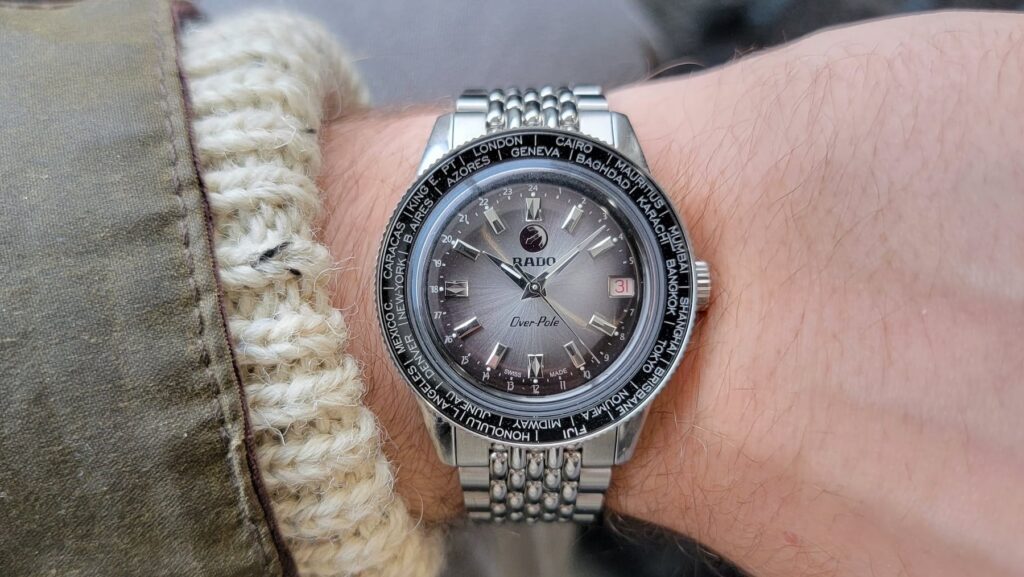
| Price: | $2,400 |
| Water Resistance: | 100m |
| Case Dimensions: | 37mm (diameter) x 43mm (lug-to-lug) x 10.4mm (thickness) |
| Lug Width: | 19mm |
| Movement: | Rado R862 |
The Rado Over-Pole feels at home in the business-casual territory because it brings vintage character without the bulk or loudness that often comes with travel-inspired watches. It is compact, polished, and a little unusual, which is a useful combination when the rest of the outfit is fairly restrained. At 37mm, the case sits low and balanced on the wrist, and during full workdays, it stayed comfortable enough to fade into the background. That is not always a given with watches that lean this hard into nostalgia. The polished case gives it some dressy energy in motion, though it also means fingerprints and handling marks show up faster than they would on a more brushed, tool-leaning watch.
The dial and bezel are where the Over-Pole earns its personality. The gray gradient dial has a soft metallic sheen that catches light without turning loud, and the applied indices give the surface more depth than expected. The red date text is a nice bit of restraint, too. It adds character without making the watch feel like it is trying to be quirky for its own sake. The concave ceramic bezel with laser-engraved cities gives the watch its travel-watch identity, but it is not purely decorative. It makes the Over-Pole feel more considered than many vintage-inspired releases. The catch is readability. Under overhead lights or near a laptop, glare can make those city markings harder to read than they should be.
The hand-wound R862 movement suits the watch’s personality better than an automatic would. Winding it in the morning adds a small routine to ownership, and in our time with it, that ritual became part of the appeal rather than a chore. The 80-hour power reserve keeps that routine from becoming annoying, since missing a day does not mean starting over immediately. It also behaved reliably in use, and the display caseback gives you a clean view of the movement’s tidy finishing. For business casual wear, that matters less as a spec and more as a feeling: this is a watch that rewards a bit of attention without demanding too much.
Rado also included both a leather strap and a rice-bead bracelet, which helps the Over-Pole shift moods easily. The leather strap pushes it dressier, while the rice-bead bracelet was the nicer surprise: comfortable, planted, and friendly to smaller wrists. On warmer days, the lack of micro-adjustment becomes more noticeable, though not enough to ruin the experience. The lume is the bigger practical weakness. It is minimal and barely helpful in low light, so this is not the watch for quick low-light checks. Still, for someone who wants a business casual watch that feels thoughtful, compact, and less predictable than the usual polished daily wearer, the Over-Pole holds its own.
Pros
- The compact 37mm case wears comfortably and stays balanced throughout the day.
- The concave ceramic bezel and gray gradient dial give the watch a distinct personality.
- Hand-wound R862 movement adds engagement, helped by an 80-hour power reserve.
- The rice-bead bracelet is comfortable and fits well on smaller wrists.
- Leather strap and bracelet options let the watch shift between dressier and more relaxed wear.
Cons
- Minimal lume makes nighttime readability weak.
- Lack of bracelet micro-adjustment is noticeable in warmer weather.
- Bezel city markings can be hard to read when glare hits.
- Fully polished surfaces collect fingerprints and show handling quickly.
Atelier Wen Perception
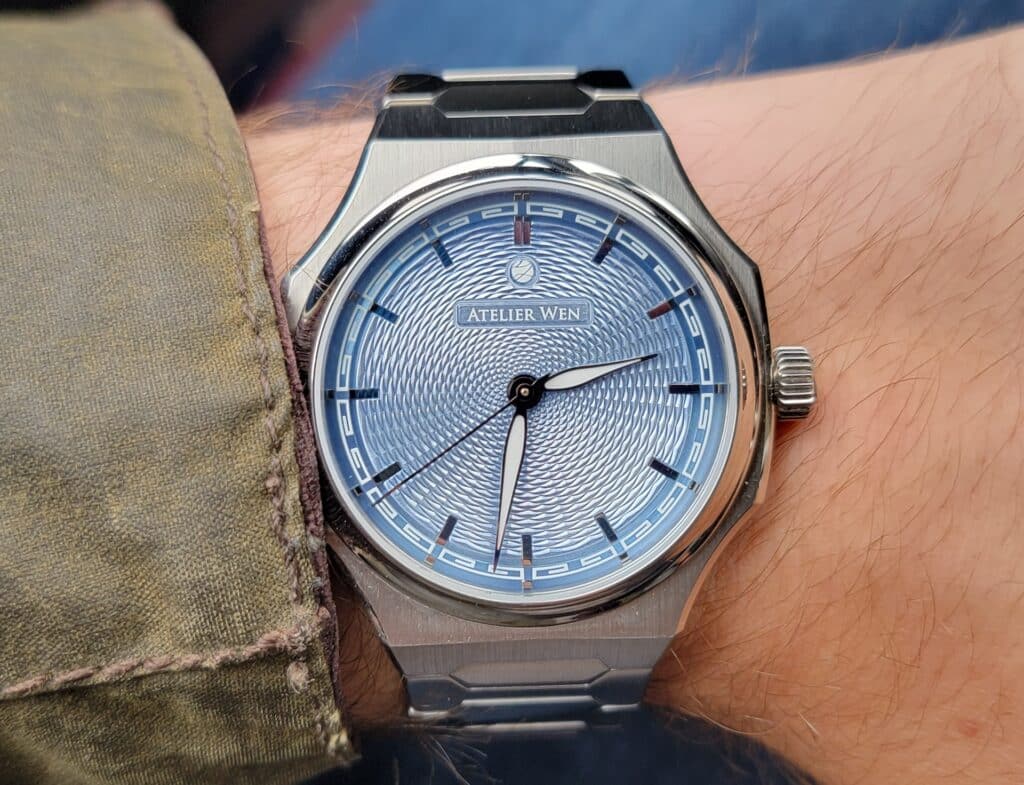
| Price: | $3,200 – $3,600 |
| Water Resistance: | 100m |
| Case Dimensions: | 40mm (diameter) x 47mm (lug-to-lug) x 9.4mm (thickness) |
| Lug Width: | Integrated bracelet, starts 22mm at the case, tapering down to about 18mm at the clasp |
| Movement: | Dandong SL1588 Automatic |
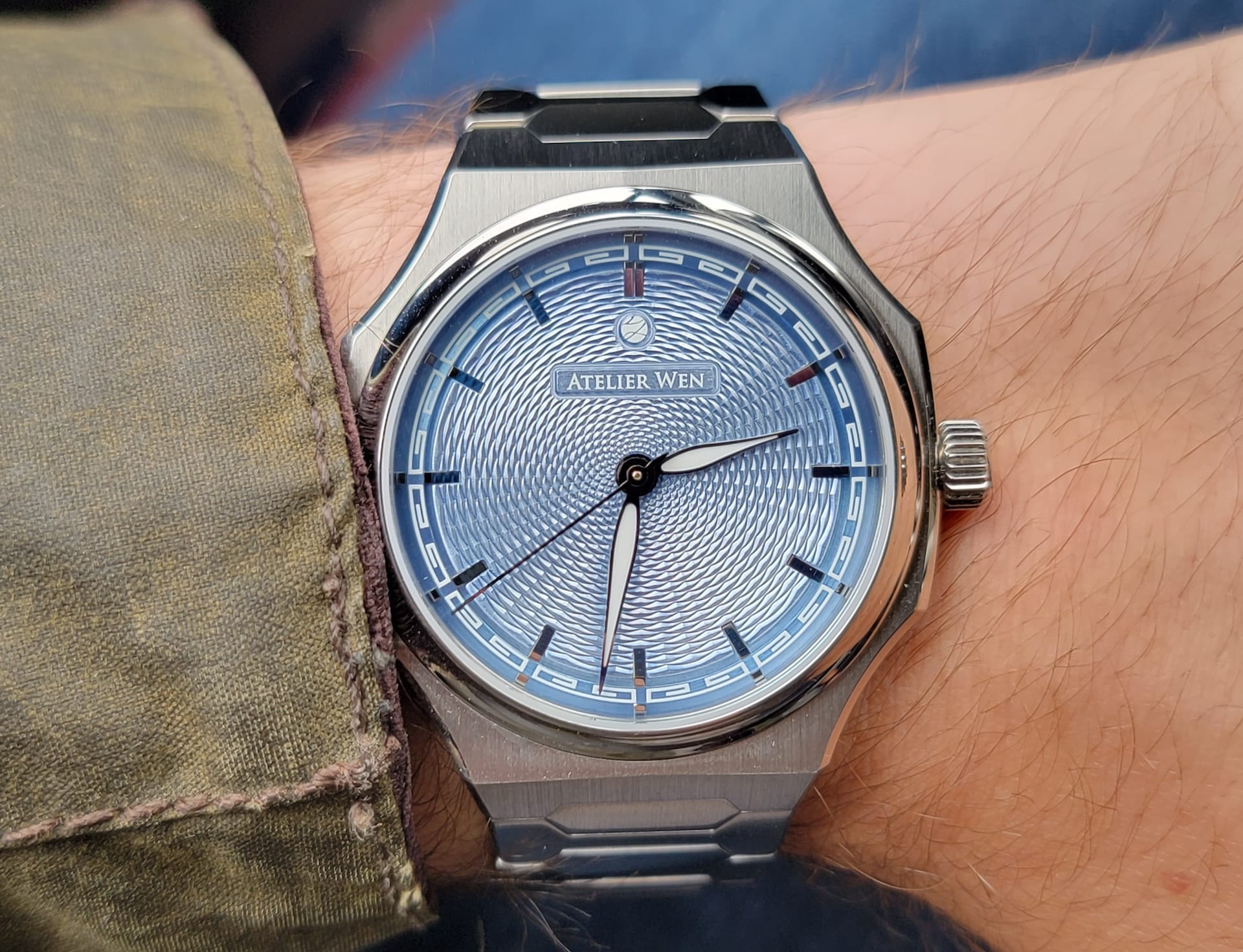
The Atelier Wen Perception earns its place in this lineup by feeling distinctive without relying on loudness. This is not the watch for someone who wants their weekday piece to disappear completely, but it also does not scream across the conference table. The blue dial carries most of that balance. Its hand-guilloché pattern, inspired by Chinese architectural motifs, gives the watch a clear identity and a real sense of surface depth. During our hands-on time with it, the color shifted between cooler, steel-like tones and brighter ocean blues depending on the light, which made it genuinely hard not to glance down. The useful part is that all this texture does not wreck legibility. It stays readable, which is where many “interesting” dials quietly trip over themselves.
The case and bracelet make the Perception feel more coherent than many design-forward watches in this range. Atelier Wen uses 904L steel, but the more important point is how the material is handled. The brushed and polished surfaces are crisp, the finishing feels sharp in the hand, and the chamfers along the bezel and bracelet give the watch real shape as it moves on the wrist. At 40mm wide and 9.4mm thick, it wears slim enough to slide under a cuff, which matters if you’re trying to wear it with business-casual clothing rather than treating it as a weekend showpiece. The screw-down crown, equipped with 100 meters of water resistance, also helps the watch feel low-stress for daily wear.
The integrated bracelet is comfortable and articulates well, but it changes the way the watch wears. Once attached, the effective lug-to-lug stretches to about 52mm, so the Perception feels longer than the 40mm case size suggests. That will be fine for many wrists, but smaller-wristed buyers should pay attention. The toolless micro-adjust clasp is very helpful during the day, especially when your wrist size changes with temperature or humidity. The engraved stone lion on the caseback also deserves mention, as it does more than fill space. It gives the watch cultural grounding and makes the whole design feel more personal than generic.
Inside, the modified Dandong SL1588 was respectable in our testing, running around 10 seconds per day with roughly 40 hours of power reserve. The lack of hacking seconds is harder to ignore at this price, and the Perception sits in a part of the market where collectors will compare movements closely. That scrutiny is fair. But the watch makes its argument through the full package: the dial work, the bracelet, the finishing, the slim case, and the fact that it feels like it has a point of view. For business casual wear, it suits someone who wants polish and daily practicality, but also wants their watch to say something more specific than “nice integrated bracelet.”
Pros
- The toolless micro-adjust clasp is useful across a full day on the wrist.
- 904L steel, crisp finishing, and sharp chamfers make the watch feel premium in hand.
- Slim 9.4mm case and 100m water resistance support daily wear.
- Hand-guilloché dial adds real depth and a clear design identity.
- The engraved stone lion caseback gives the watch a stronger cultural character.
Cons
- Modified Dandong SL1588 does not offer hacking seconds.
- The integrated bracelet makes it wear longer than the 40mm case size suggests.
- Accuracy around 10 seconds per day is solid, but not chronometer-level at this price.
Rolex Explorer 14270
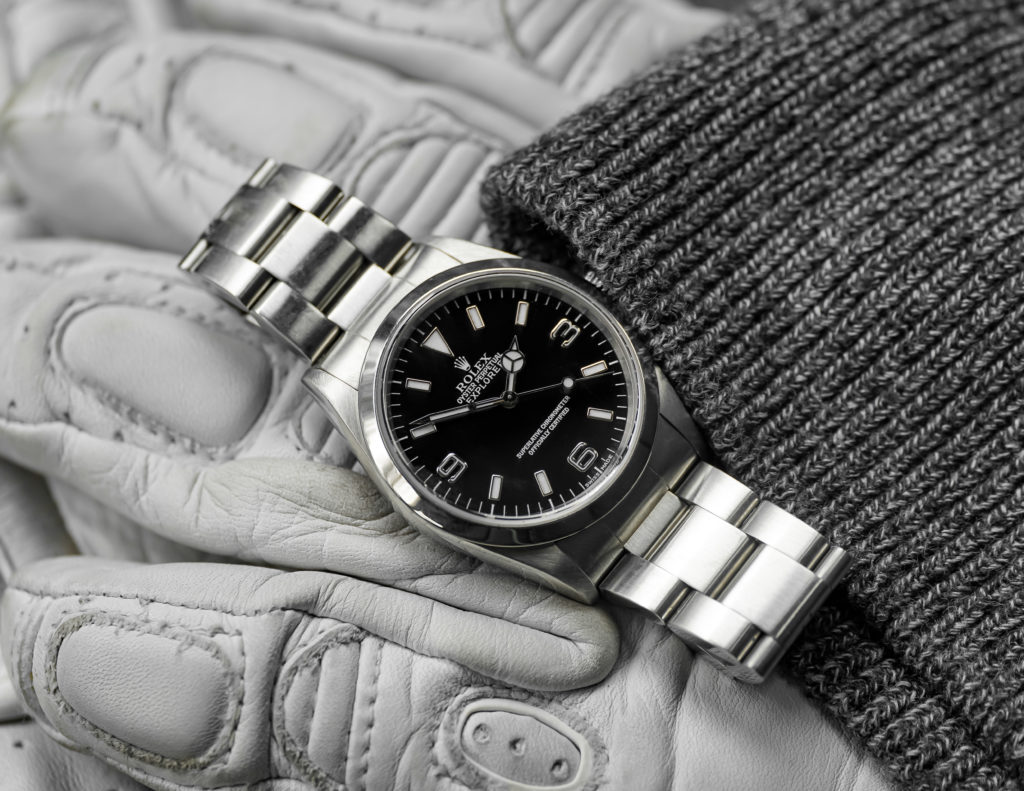
| Price: | $5,900 – $6,900 |
| Water Resistance: | 100m |
| Case Dimensions: | 36mm (diameter) x 44mm (lug to lug) x 11mm (thickness) |
| Lug Width: | 20mm |
| Movement: | Cal. 3000 (in-house) movement |
The Rolex Explorer 14270 lands well into business casual style because it has the everyday Rolex thing without feeling like it is performing the “nice watch” routine too loudly. No date window, no polished-dress-watch posturing. It keeps the formula simple: a black dial, smooth bezel, Oyster case, and a layout that stays out of the way. That restraint is useful when the rest of the outfit is somewhere between denim and a blazer, because the watch adds a touch of quality without making the whole thing feel staged.
The dial is the reason the 14270 remains so easy to wear. The black surface, white printing, and 3-6-9 numerals make time checks quick and clean, which is what you want from a weekday watch. Many examples now have aged tritium lume that has faded into a soft cream tone. Under bright light, it may still give off a faint glow, but this is not modern lume performance by any stretch. The upside is character. The patina adds warmth without making the dial harder to read, which is a better trade than most vintage-adjacent quirks manage.
The case keeps the whole thing balanced. At 36mm wide, around 11.1mm thick, and with a 44mm lug-to-lug, it sits flat and stable on the wrist without trying to look larger than it is. The absence of crown guards softens the side profile, while the smooth bezel gives it enough dressiness to work in settings beyond purely casual ones. On smaller wrists, it feels natural. On larger wrists, it makes the same annoying-but-true point collectors keep rediscovering: proportion matters more than diameter. The 20mm Oyster bracelet reinforces that easygoing character, wearing light but solid and tapering gradually toward the clasp.
Inside, the Caliber 3000 keeps ownership straightforward. During our extended wrist time, it stayed around -4 seconds per day, started quickly with light wrist movement, wound smoothly through the crown, and offered roughly 42 hours of power reserve. None of that is flashy, which is also the point. The dated parts are part of the ownership equation too: hollow end links, a stamped clasp, potential age-related servicing costs, movement-sourcing concerns, and secondary-market prices that have climbed as cleaner examples become harder to find. Still, as a business-casual watch, the Explorer 14270 works because it is compact, legible, restrained, and capable without leaning on overt polish.
Pros
- Clean black 3-6-9 dial makes time reading quick and intuitive.
- Caliber 3000 delivered steady accuracy around -4 seconds per day during wrist time.
- 36mm case, 44mm lug-to-lug, and 11.1mm thickness wear balanced and compact.
- The 20mm Oyster bracelet feels light, solid, and simple.
- The smooth bezel helps it move between casual and dressier business-casual settings.
Cons
- Hollow-end links and a stamped clasp feel old-fashioned next to newer Rolex bracelets.
- Limited availability keeps secondary-market prices high.
- The 36mm size may feel small for people used to modern sports watches.
- Older examples can bring expensive servicing and movement-sourcing concerns.
Nomos Zürich World Time Midnight Blue
| Price: | $6,100 |
| Water Resistance: | 30m |
| Case Dimensions: | 40mm (diameter) x 50mm (lug-to-lug) x 11mm (thickness) |
| Lug Width: | 20mm |
| Movement: | DUW 5201 |
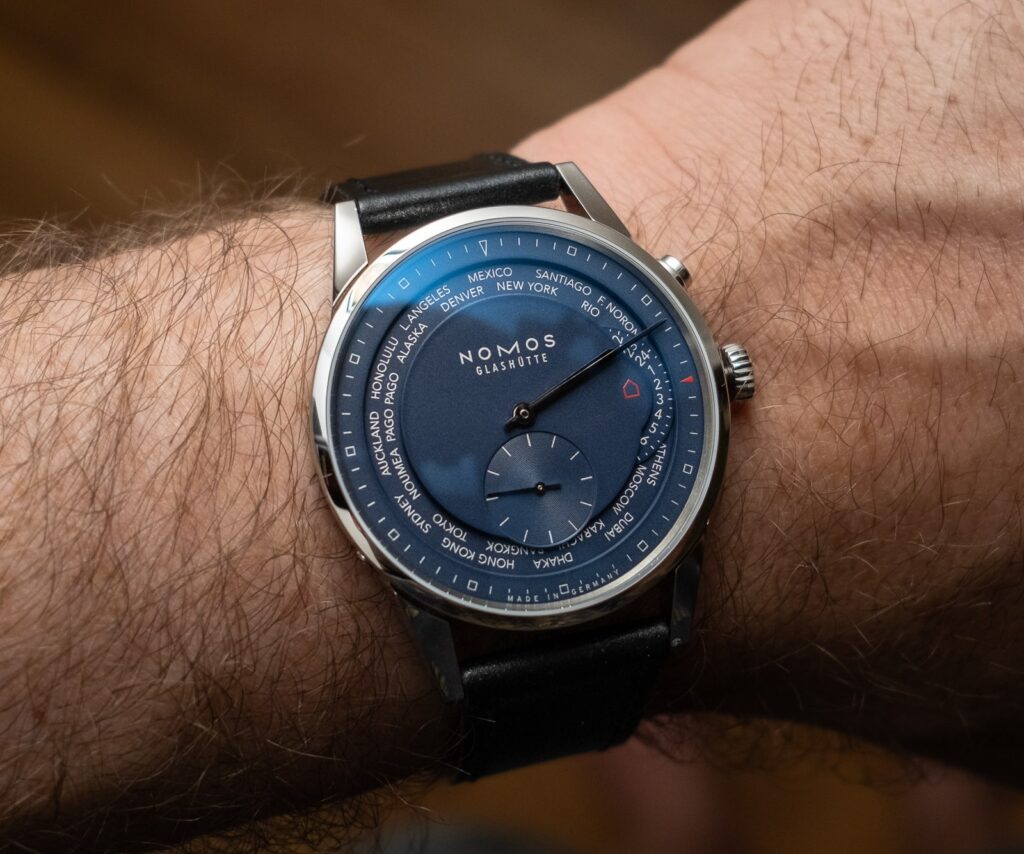
The Nomos Zürich World Time Midnight Blue brings a different kind of business casual energy: quiet, organized, and a little more useful than it first lets on. It does not announce itself the way many luxury travel watches do, which is part of the appeal. Under a cuff, it looks clean and composed, but the longer you wear it, the more the layout starts to feel deliberate rather than plain. For someone whose business-casual life includes airports, client calls across time zones, or the occasional “what time is it there again?” moment, this one earns its place with calm functionality.
The dial carries that restraint well. The deep blue surface shifts between navy and cooler steel tones depending on the light, so it stays visually interesting without pulling too much attention in a work setting. The city ring could have made the watch feel crowded, but the calm dial color gives everything enough breathing room. Rhodium-plated hands remain easy to read through the day, and the small red home-time indicator adds the only real hit of color. It is also useful to stay visible under bright office lighting and in dimmer travel situations, such as an airplane cabin.
The case wears with more presence than the 40mm diameter suggests because of the extended lugs. On medium wrists, it felt balanced and elegant, but smaller wrists may find the span close to the comfort limit. The slim case helps, though, and the shell cordovan strap does a lot for daily comfort. It breaks in quickly, sits well through long workdays, and does not need constant adjustment. The polished case surfaces fit the watch’s refined personality, but they also pick up fine scratches sooner than we would like during regular wear. That is the less romantic side of polished minimalism, unfortunately.
The travel function is what makes the piece more than a clean, blue-dial office watch. The pusher at two o’clock advances the local hour hand in one-hour jumps while leaving home time alone on the 24-hour subdial. During short trips, they made adjustments quickly and painlessly, with no crown fiddling or mental math. The in-house DUW 5201 movement also performed steadily in testing. It delivered its stated roughly 42-hour power reserve, enough to leave it off overnight or through a busy day without turning ownership into a reset ritual. It is worth noting that the “world time” name slightly oversells the complication; in daily use, it behaves more like a simplified GMT system. That may disappoint complication purists, but for business casual travel wear, it makes the watch easier to live with.
Pros
- One-button local time adjustment is quick and intuitive while traveling.
- Shell cordovan strap breaks in quickly and stays comfortable through long days.
- Deep blue dial stays legible while showing subtle depth in changing light.
- The in-house DUW 5201 movement delivers consistent performance with about 42 hours of reserve.
- The red home-time indicator remains easy to spot in varied lighting.
Cons
- Extended lugs may make the 40mm case feel large on smaller wrists.
- Fully polished case surfaces show fine scratches more easily over time.
Omega Railmaster
| Price: | $6,400 |
| Water Resistance: | 150m |
| Case Dimensions: | 40mm (diameter) x 46.5mm (lug-to-lug) x 12.5mm (thickness) |
| Lug Width: | 20mm |
| Movement: | Omega 8806 Master Chronometer Co-Axial |
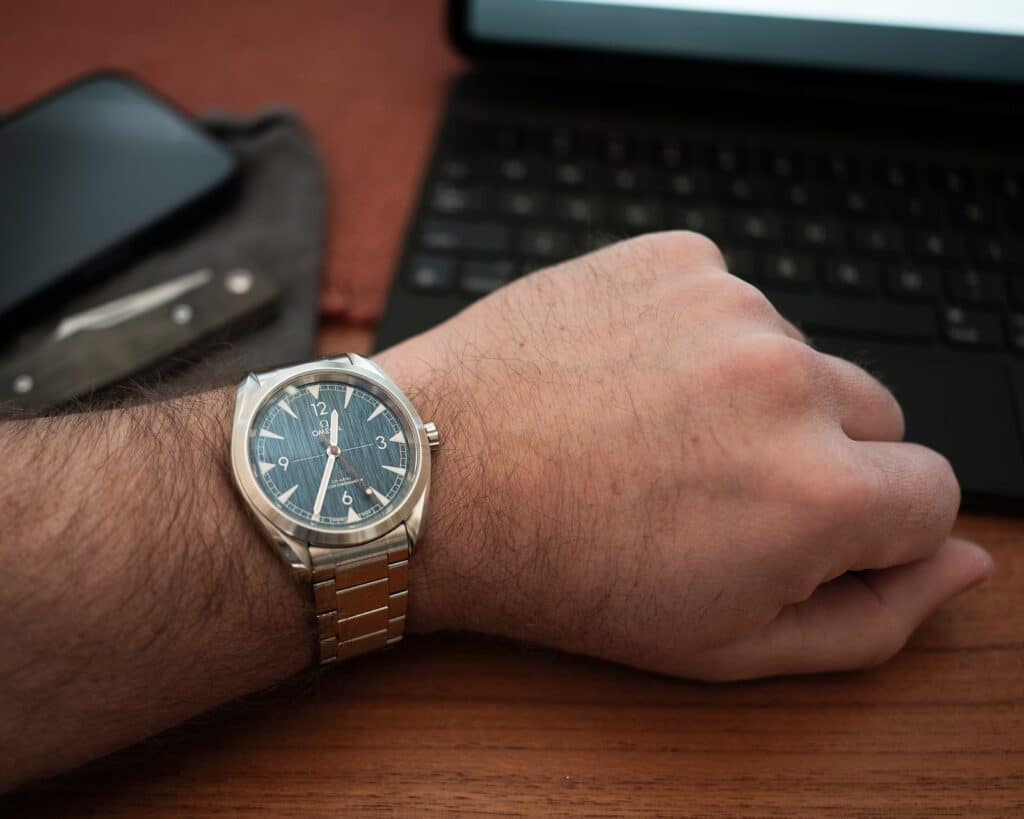
The Omega Railmaster holds its own in business casual style because it does not lean on the usual Omega noise. No chronograph pushers, no dive bezel, no “look what I bought” energy. It is a time-only watch with enough texture, finishing, and movement credibility to feel special once you live with it for a few days. That makes it useful in the business casual lane. It can sit with a button-down, knitwear, chinos, or a casual jacket without making the outfit feel overbuilt. The restraint is the point, even if the restraint at Omega pricing can take a minute to justify mentally.
The dial is where that quiet personality starts to make sense. The vertically brushed surface does more than fill space; it changes character as light moves across it, shifting between darker and warmer tones depending on the angle. That keeps the time-only layout from feeling empty. The bronze second hand adds a subtle contrast, enough to warm up the design without turning into a novelty detail. Legibility stays strong because there isn’t much competing for attention, and for a business-casual watch, that matters more than people admit. A glance during a meeting should not feel like decoding a submarine panel.
The case has the kind of steadiness that makes the Railmaster easy to wear across different settings. At 40mm wide, 46.5mm lug-to-lug, and around 12.5mm thick, it has substance without becoming awkward under a cuff. It sits low enough to behave, but not so low that it feels delicate or too dressy. Most of the case is brushed, which suits the watch’s practical personality and helps small marks blend in over time. The polished chamfers along the edges add a touch of refinement, keeping the case from looking flat or too utilitarian. The three-link bracelet follows the same idea: solid, mostly brushed, and visually consistent with the watch. The miss is the lack of micro-adjustment, which makes fine-tuning the fit more annoying than it should be on a watch at this level.
The movement is what makes the Railmaster more than a handsome, understated office-adjacent watch. Omega’s Co-Axial Master Chronometer caliber ran at roughly +1 second per day in our testing. That kind of consistency becomes easy to appreciate over a few weeks of actual wear. The METAS certification and strong magnetic resistance also matter in normal modern life, even if they sound boring on paper. Between laptops, phones, travel, bags, and all the random electronics we pretend aren’t constantly surrounding us, that extra resistance adds real peace of mind. The trade-off is that the Railmaster can feel expensive for something this visually quiet, and buyers who want complications may find the time-only format too plain. But for someone who wants a business-casual watch that is restrained, accurate, durable-feeling, and not the obvious Omega choice, the Railmaster makes its case by refusing to shout.
Pros
- Master Chronometer movement delivers excellent accuracy at roughly +1 second per day.
- Strong magnetic resistance adds practical reassurance around modern electronics.
- 40mm case with 46.5mm lug-to-lug wears steady without feeling oversized.
- Mostly brushed cases and bracelets hide everyday marks better than high-polish designs.
- The brushed dial has more depth than the simple time-only layout suggests.
Cons
- Price can feel steep for such an understated design.
- Bracelet lacks micro-adjustment, making fine-tuning the fit more frustrating.
- The time-only format may feel too restrained for buyers who want extra functionality.
Grand Seiko SBGH295 Sōkō Frost
| Price: | $6,900 |
| Water Resistance: | 100m |
| Case Dimensions: | 40mm (diameter) x 47mm (lug-to-lug) x 12.7mm (thickness) |
| Lug Width: | 21mm |
| Movement: | 9S85 Hi-Beat Automatic |
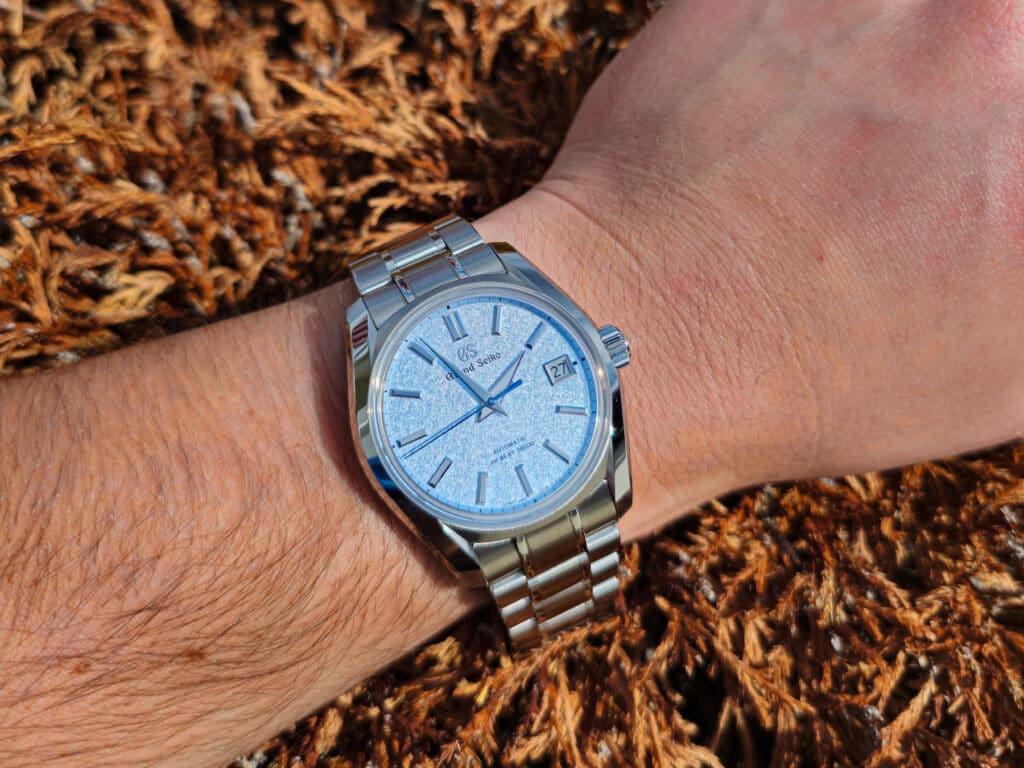
The Grand Seiko SBGH295 Sōkō Frost strikes the right balance for business-casual style, adding refinement without making the whole outfit a luxury-watch announcement. It is polished, yes, but not flashy. The frosted dial takes a little time to sink in, which is part of the appeal. Its delicate cross-hatched texture shifts from cool and airy to warmer and softer depending on the light, so the watch keeps rewarding attention without demanding it. The stepped, faceted hands and indices catch the light as the wrist moves, and the date window feels properly worked into the layout rather than dropped in because someone remembered that calendars exist.
According to our review team, the case is what keeps the Sōkō Frost from feeling like a delicate office-only piece. At 40mm in stainless steel, it wears true to size, and the downward-curving lugs help it stay planted through long days. The 12.7mm thickness reads a little concerning on paper, but the case shape hides it well. Brushed mid-case surfaces are framed by Zaratsu-polished bevels that twist upward toward the flat sapphire crystal, creating an almost bezel-less transition that makes the watch look slimmer than the numbers suggest. The anti-reflective coating keeps the dial view clear without adding a distracting tint, which matters when the whole point is appreciating the texture. Add the screw-down crown and 100 meters of water resistance, and it becomes much easier to wear this as a real daily watch rather than something reserved for careful days.
The Hi-Beat 9S85 movement gives the watch mechanical substance without making the dial experience feel secondary. Running at 36,000 vibrations per hour, it gives the second hand a smoother sweep than most mechanical watches, which suits the piece’s overall precision. The MEMS-fabricated components and Spron 530 mainspring are the kind of technical details that matter because they support consistency and reliability over time, not because they sound impressive in a product meeting. In day-to-day wear, that reinforces the feeling that this is a polished watch built to be used.
The bracelet is comfortable, well-finished, and free of rattles, with a smaller push-button clasp that helps it articulate cleanly on the wrist. This is also where the familiar Grand Seiko complaint shows up. There is no micro-adjustment, so fit comes down to link sizing, which can be annoying when your wrist changes throughout the day. Drilled lugs and the included strap help soften that issue by making bracelet alternatives easier to explore, though the 21mm lug width limits aftermarket strap choices. Still, the SBGH295 works beautifully in business casual settings for someone who wants dial texture, case finishing, and quiet precision to carry the experience rather than obvious flash.
Pros
- Frosted cross-hatched dial gains depth and character as the light changes.
- Drilled lugs and the included strap make bracelet alternatives easier to explore.
- Zaratsu-polished bevels and brushed case surfaces create exceptional daily-wear refinement.
- The 40mm case wears comfortably despite the refined presentation.
- Hi-Beat 9S85 movement adds a smoother seconds sweep and serious technical credibility.
Cons
- 21mm lug width narrows aftermarket strap choices.
- The bracelet lacks micro-adjustment, so the fit depends heavily on link sizing.
Think we missed a business casual watch that deserves wrist time here? Quite possible since we only include watches we’ve reviewed hands-on. So, if there’s a cuff-friendly Seiko, overlooked Swiss daily wearer, or microbrand piece that handles the office-to-dinner shift better than expected, drop it in the comments. We’ll try to get one in for review and consider it for a future update.

Co-Founder and Senior Editor
Kaz has been collecting watches since 2015, but he’s been fascinated by product design, the Collector’s psychology, and brand marketing his whole life. While sharing the same strong fondness for all things horologically-affordable as Mike (his TBWS partner in crime), Kaz’s collection niche is also focused on vintage Soviet watches as well as watches that feature a unique, but well-designed quirk or visual hook.