Finding your first mechanical field watch sounds simple until you start looking. You probably want something affordable, legible, tough enough for daily wear, and not so precious that it turns into a fragile little desk ornament. Mechanical field watches should do the opposite. They should slip into your routine, take a few knocks, and remind you why a hand-wound or automatic movement can feel more personal than another battery-powered thing in your life. So this list answers a specific question: which watches make the most sense for your first mechanical field watch to have real character, not just a familiar case shape and some vintage-flavored numerals?
After nearly a decade of reviewing watches, we’ve learned that field watches reveal the small things first-time collectors don’t always consider. The watch that looks too small on paper can feel right after a full day of wear. The crown you expect to ignore can make or break the ownership experience. The stock strap can ruin an otherwise good watch until you swap it for something thinner, softer, or less committed to making your wrist sweat. We’ve handled the obvious picks, the military-spec weirdos, the microbrand alternatives, and the modern tool watches that only half-belong in the field-watch conversation but earn their place through wearability. For a first mechanical watch, that matters more than chasing the loudest spec sheet. So stay tuned.
Marathon General Purpose Mechanical
| Price: | $525 – $575 |
| Water Resistance: | 30m |
| Case Dimensions: | 34mm (diameter) x 41mm (lug-to-lug) x 12.5mm (thickness) |
| Lug Width: | 16mm |
| Movement: | Seiko NH35A Automatic |
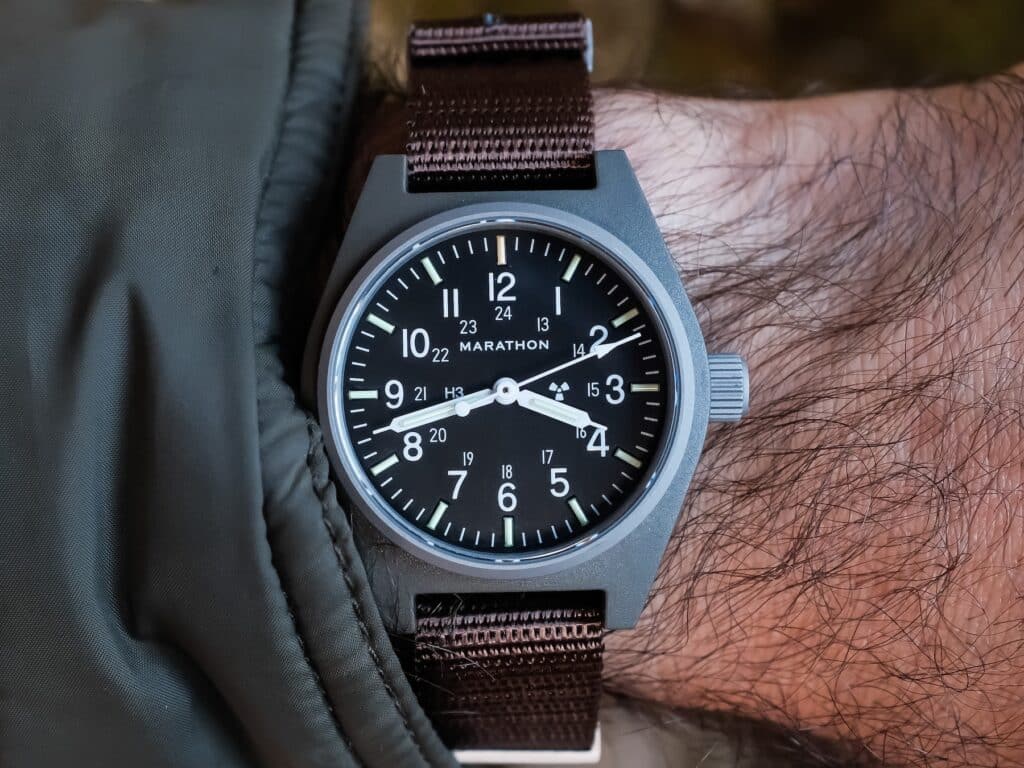
The Marathon General Purpose Mechanical is one of the clearest examples here of a watch feeling purpose-built rather than decorative. For a first-time mechanical owner, that matters because field watches can quickly slide into “military-inspired” styling without much real tool-watch attitude behind them. This Marathon doesn’t have that problem. The sage-green resin case, NSN markings, spec-heavy caseback, and plainspoken overall build make it feel closer to issued gear than to a civilian watch dressed up for the part. The appeal is mostly about getting a compact mechanical field watch with actual utility baked into the experience.
The case sounds tiny on paper at 34mm, but it doesn’t wear like a fragile or toy-like piece. The 12.5mm thickness, 41mm lug-to-lug, and stock NATO strap give it enough stance to feel secure on the wrist without turning it into another oversized “rugged” watch. The resin case is a big part of the wearing experience. Compared with steel, it feels warmer, lighter, and more forgiving during a full day of errands, walking around, or sitting at a desk. It may feel strange at first if your idea of a proper mechanical watch involves metal heft, but that low weight starts to make sense fast. It does not vanish like an ultra-thin quartz field watch, but it also avoids the heavy-case fatigue that can make some tough-looking watches annoying by the end of the day.
The dial keeps the watch useful in the way a field watch should be useful. The classic layout, inner 24-hour scale, and syringe-style hands make it easy to read quickly, and the markers do their job without making the dial feel cluttered. The tritium tubes are the practical win here. Instead of needing to charge lume under a lamp or hoping it holds on through the night, the low-light visibility is always present. That suits the Marathon’s low-maintenance personality better than traditional lume would. The bezel stays simple, too, which we appreciated. It doesn’t try to turn the watch into a diver or add another layer of functionality most buyers won’t use.
Inside, the Seiko NH35A keeps the ownership side approachable, which is what you want in a first mechanical field watch. It is familiar, dependable, and not precious, with a 41-hour power reserve that works fine for normal rotation use. More importantly, it should not make a newer buyer nervous about servicing or replacement down the line. Marathon’s move to an all-steel crown also helps the daily experience. The crown looks small, but the grip is strong enough that winding and setting never feel fussy. The stock ballistic nylon strap looks the part but starts stiff, and during our testing period, we preferred it on a single-pass olive-drab strap because it helped the case sit lower and feel more natural.
Pros
- The sage green resin case is light, warm on the wrist, and comfortable over long days.
- Compact 34mm sizing wears with more presence than expected thanks to the thickness, short lug-to-lug, and NATO setup.
- Tritium tubes give constant low-light legibility without needing a lume charge.
- Seiko NH35A movement keeps first-time mechanical ownership familiar, serviceable, and low-stress.
- All-steel crown is small but grippy enough for easy winding and setting.
Cons
- The 16mm lug width narrows strap choices, which may frustrate buyers who like to experiment.
- 30 meters of water resistance feels limited for a first mechanical field watch with this much rugged character.
- Tight spring-bar clearance makes strap changes more fiddly than they should be.
Praesidus A-11 Type 44 Patina
| Price: | $555 |
| Water Resistance: | 100m |
| Case Dimensions: | 32mm (diameter) x 39mm (lug-to-lug) x 13mm (thickness) |
| Lug Width: | 20mm |
| Movement: | Swiss-made, manual-wind Landeron L21 movement |
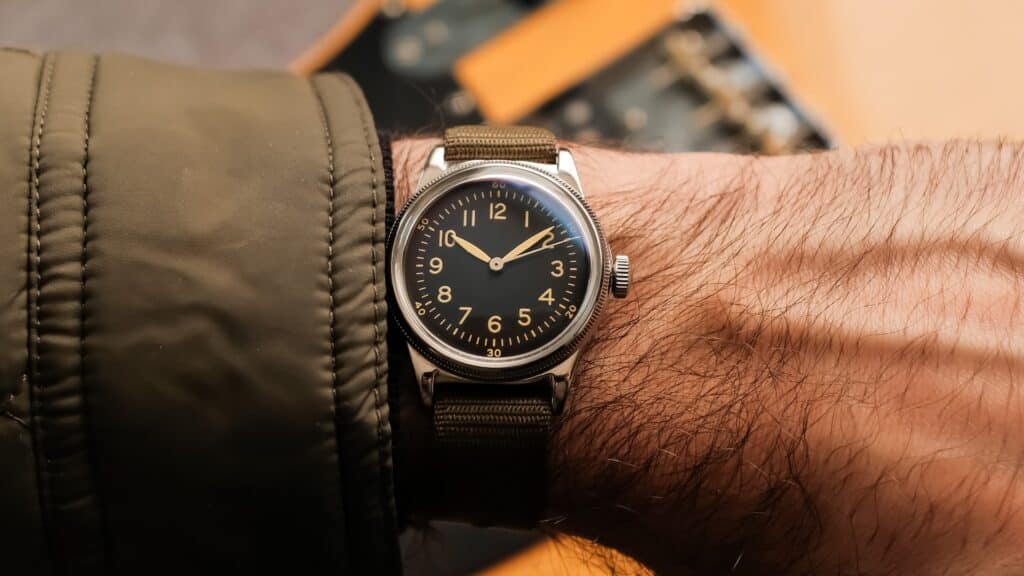
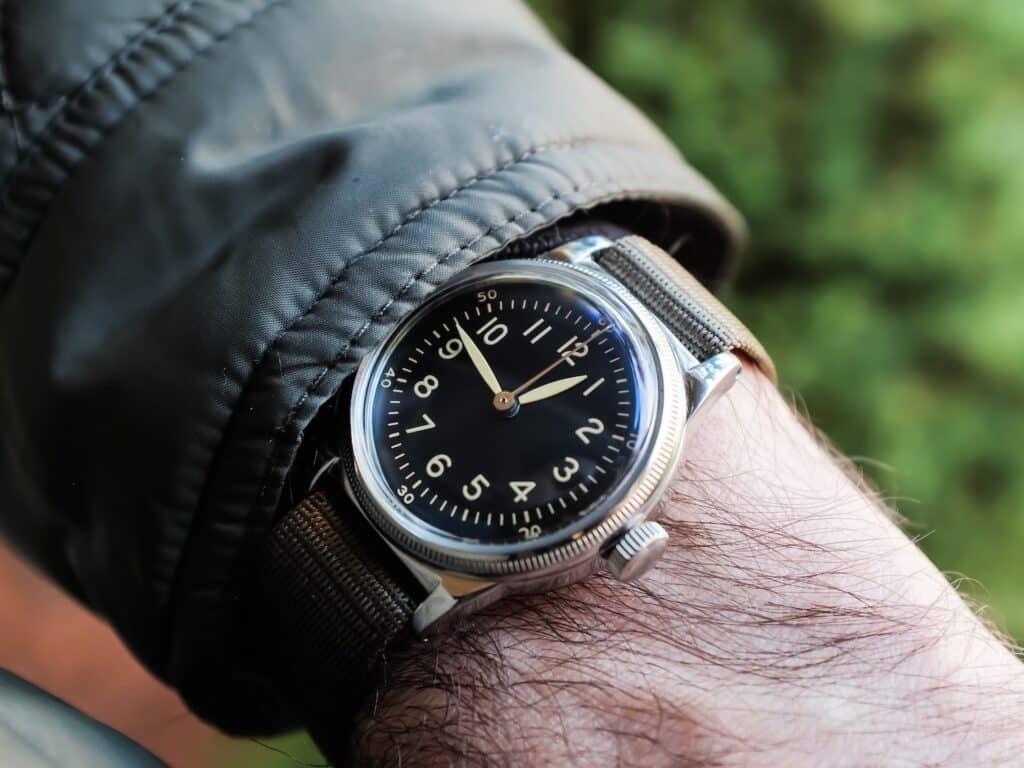
The Praesidus A-11 Type 44 Patina is one of the easier watches here to understand from a first-time mechanical buyer’s point of view. It is small, hand-wound, simple, and not trying to bury the experience under specs. The original A-11 was a U.S. Army WWII specification made by brands like Bulova, Waltham, and Elgin, which is why people still call it “the watch that won the war.” That context matters, but the Praesidus works because it turns that history into something wearable rather than a museum-prop exercise. If the CWC Mellor 72 feels like the British MOD side of the conversation, the A-11 Type 44 leans harder into U.S. Army minimalism with a logo-free dial and a smaller footprint.
The 32mm case will scare off some buyers before they even try it on, which is understandable in a world where 40mm still gets called “modest” with a straight face. But on the wrist, the size makes sense. The 39mm lug-to-lug, gently curved lugs, and light case help it settle flat without sliding around or feeling flimsy. At 13mm thick, with a domed acrylic crystal, it has more shape than its diameter suggests, and that crystal adds the kind of soft distortion that makes vintage-inspired watches feel warm rather than sterile. Praesidus also offers a 38mm version and a Bonklip bracelet option, but the 32mm case on an olive canvas strap feels closest to the original idea. For a new mechanical buyer, the adjustment is mostly mental. After a few hours, the small size starts to feel freeing because the watch stops asking for attention.
Our review team found that the dial keeps things clean, helping the watch earn its place. Arabic numerals, a railroad minute track, faux-patina hands and markers, a polished second hand, and no logo. That lack of branding gives the dial a calmness that newer buyers may appreciate, especially if they are tired of watches shouting their own importance from six inches away. The Swiss Super-LumiNova is not very bright, but it is functional enough for low-light checks. The textured, minimal bezel stays in the background, which suits the watch. Nothing here feels decorative for the sake of it. The 10-ATM water resistance is also a pleasant surprise for something this historically styled, since it gives the watch more everyday confidence than its delicate looks might suggest.
Inside, the Swiss-made manual-wind Landeron L21 keeps the ownership experience straightforward. Setting and winding are easy, though there is some resistance in the crown action. It does not feel as smooth as the Sellita SW210, but in daily use, accuracy was solid, and there were no reliability issues to report. That matters for first-time mechanical buyers because the point is to enjoy the winding ritual, not immediately start researching service horror stories at 1 a.m. The supplied canvas strap was thicker than we preferred, so we moved it to a 16mm olive single-pass nylon strap, which made the watch feel more natural and utilitarian. A black nylon strap would also work if you want to tone things down. The Praesidus gives you strap flexibility, which is useful when you are still figuring out what kind of field-watch setup actually works for your wrist. At this configuration, it gives you a vintage field-watch charm without the fragility or maintenance anxiety of buying an actual old A-11.
Pros
- Logo-free dial keeps the layout clean, calm, and easy to read.
- Arabic numerals, railroad minute track, and polished seconds hand support quick time checks.
- 10 ATM water resistance gives it more daily confidence than expected.
- Manual-wind Landeron L21 keeps mechanical ownership simple and tactile.
- Standard lugs allow more strap flexibility than fixed-bar field watches.
Cons
- The supplied canvas strap is thicker than ideal and may not be the best match for the case.
- Lume is functional, but not very strong.
- Winding has noticeable resistance.
Dryden Heartlander
| Price: | $599 |
| Water Resistance: | 100m |
| Case Dimensions: | 38mm (diameter) x 46mm (lug-to-lug) x 11.2mm (thickness) |
| Lug Width: | 20mm |
| Movement: | Miyota 9015 Automatic |
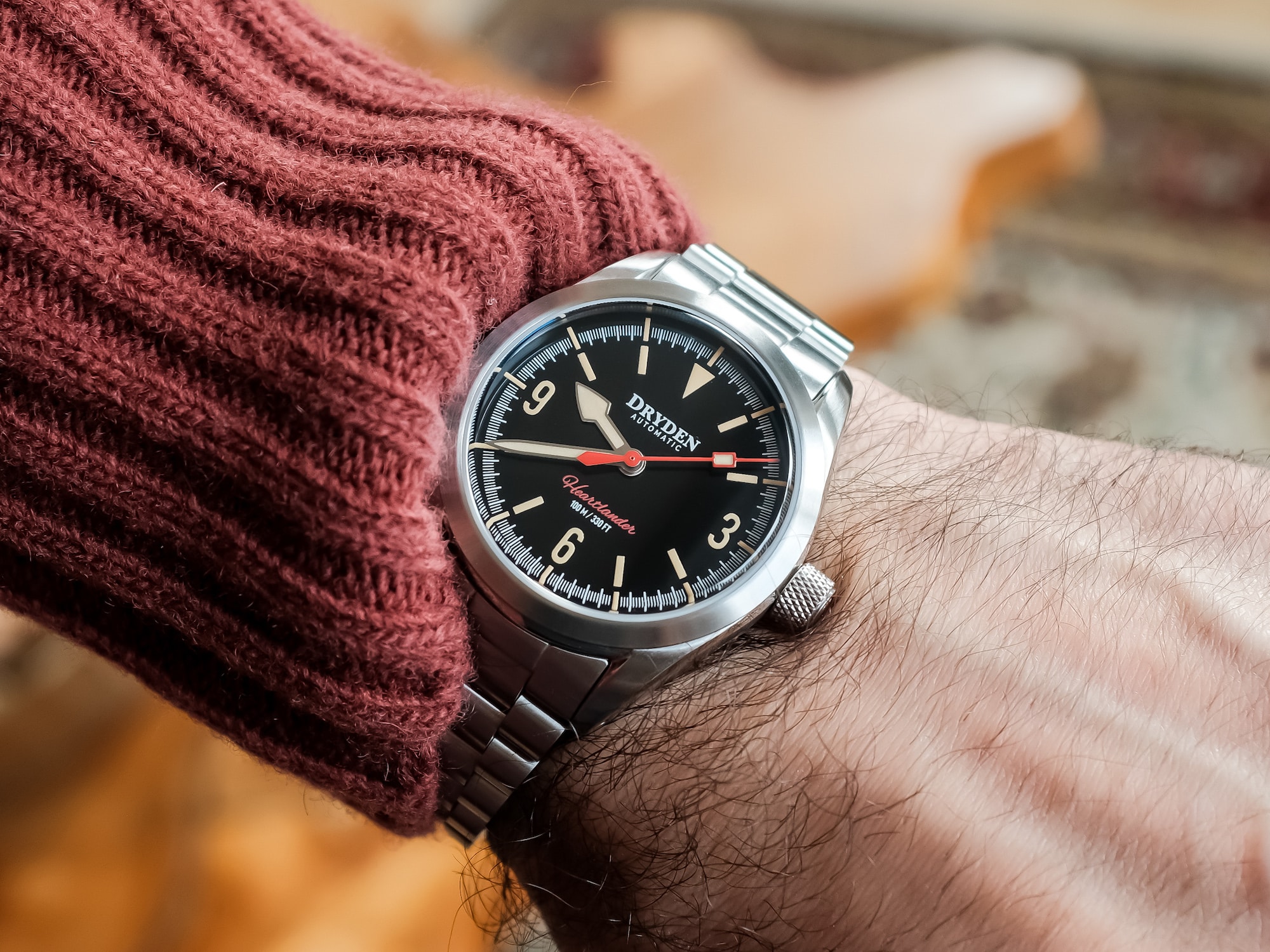
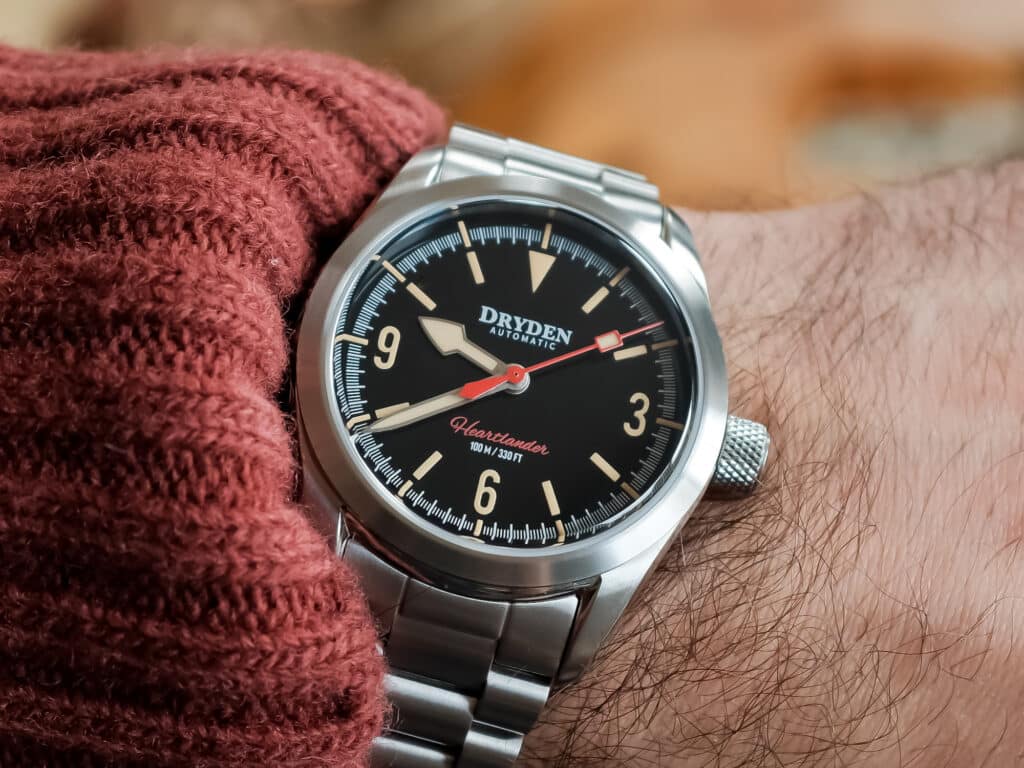
The Dryden Heartlander fits this list because it makes the first mechanical ownership feel approachable instead of ceremonial. It has enough microbrand personality to avoid feeling like the default entry-level recommendation. Still, it does not ask a new buyer to put up with weird proportions or fussy daily behavior. The 38mm case is the main reason it works so well. In our hands-on testing, it felt friendly across wrist sizes and never developed that top-heavy feeling that can make a mechanical watch tiring by the end of the day. Add 100 meters of water resistance and a domed sapphire crystal, and the Heartlander comes across as the kind of field watch you can wear through office days, commutes, and quick hikes without treating it like a fragile object.
The oversized screw-down crown gives the watch some of its practical charm. It is easy to grip when you are rushing out the door or dealing with cold hands, and that matters more than crown proportions on a spec sheet ever suggest. For a first-time buyer, winding and setting should feel intuitive, not like a tiny metal negotiation every morning. The Heartlander gets that part right. Inside, the Miyota 9015 keeps the experience approachable with smooth winding, consistent timekeeping, and the kind of reliability that lets you focus on learning what you like about mechanical watches rather than worrying whether the movement will become your new personality flaw.
Dryden also gives buyers a useful choice in dial personality without making the decision feel complicated. The Classic Sport version leans toward an Explorer-style layout, while the Traditional Field version goes with full Arabic numerals and a date. Both are clean, readable, and easy to understand at a glance, which is what you want when you are still figuring out how a mechanical watch fits into daily life. The lume options, either Superluminova BGW9 or Old Radium, add enough character to shape the watch’s mood without compromising legibility. That balance is the Heartlander’s strength: it has choices, but not the kind that send you into a three-hour forum spiral.
The bracelet is where opinions split. The presidential-style bracelet feels well-made, articulates smoothly, and uses quick-release bars, so taking it off is painless. Still, some of us felt a simpler oyster-style bracelet would better match the watch’s tool-leaning field personality. Thankfully, the 20mm lug width makes strap changes easy, which is useful when you are learning whether you prefer a bracelet, canvas, leather, or something else entirely. Overall, the Heartlander matters here because it offers new mechanical buyers sensible proportions, real usability, and enough character to feel like a personal choice rather than the safest answer in the room.
Pros
- The comfortable 38mm case suits a wide range of wrist sizes and avoids feeling top-heavy.
- The 20mm lug width and quick-release bracelet make strap experimentation easy.
- Superluminova BGW9 and Old Radium lume options add character while preserving usability.
- Oversized screw-down crown is easy to grip and improves winding and setting.
- 100 meters of water resistance, paired with a domed sapphire crystal, make it feel ready for everyday wear.
Cons
- The domed sapphire crystal introduces minor distortion at certain angles.
- The presidential-style bracelet may feel too dressy for buyers seeking a stricter field-watch personality.
CWC Mellor 72
| Price: | $600 |
| Water Resistance: | 50m |
| Case Dimensions: | 35mm (diameter) x 42mm (lug-to-lug) x 11mm (thickness) |
| Lug Width: | 18.5mm |
| Movement: | Sellita SW210 hand-wound movement |
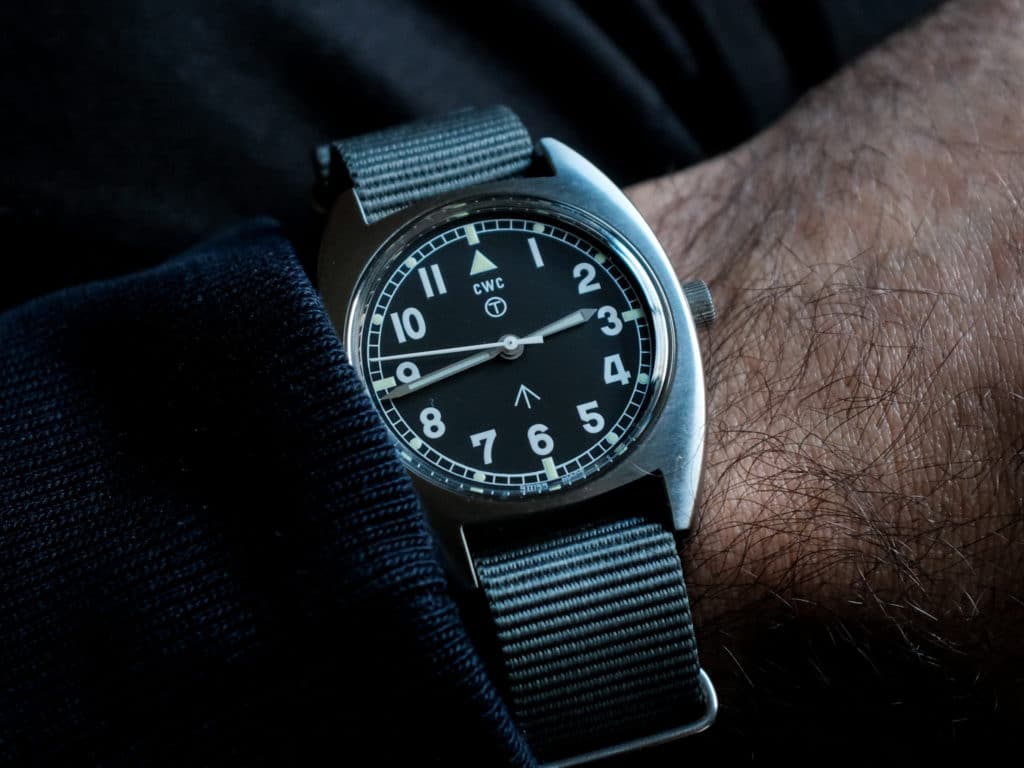
The CWC Mellor 72 is one of the more straightforward hand-wound picks here. It does not try to modernize the military field-watch formula into something glossy or overbuilt. Instead, it gives you the small case, clean dial, fixed bars, and manual-wind routine that make this category feel honest in the first place. For someone who wants their first mechanical field watch to feel connected to military design without the uncertainty of owning an actual vintage piece, the Mellor 72 lands in a useful spot.
The case is compact at 35mm, but it has more wrist presence than that number suggests. The wider tonneau shape and crown position help it wear closer to a 38mm in practice, so it avoids feeling dainty while still keeping the old-school proportions intact. The fully brushed finish suits the watch well because it keeps the whole thing plain, toolish, and free of polish-for-its-own-sake nonsense. Fixed bars add to that utilitarian character and make the strap connection feel secure, though they also mean strap changes are less flexible than they would be on a standard spring-bar case. Water resistance is rated to 50 meters, which is enough for splashes and normal daily use, but this isn’t the one we’d pick for heavy water exposure.
The dial is where the Mellor 72 feels most convincing. The bold Arabic numerals, high-contrast layout, and railroad-style seconds track make the watch quick to read without requiring a second glance. The minute hand reaches properly into that outer track, which sounds like a tiny detail until you notice how much cleaner and more precise it makes time checks feel. CWC’s vintage-style typeface and the circled T marker bring in the historical military flavor, but they do it quietly rather than turning the dial into a prop. Modern Super-LumiNova gives it usable low-light visibility, while the Hesalite crystal adds the right vintage warmth. The catch is that Hesalite scratches more easily than sapphire, so a new owner needs to be comfortable with a little extra care, or at least with the idea that marks are part of the deal.
The hand-wound Sellita SW210 is a big part of the Mellor’s appeal for a first mechanical watch. Winding it is smooth and satisfying, and during our in-depth testing, the movement delivered steady performance without reliability drama. That daily interaction helps make mechanical ownership feel intentional instead of mysterious. The snap-back case also makes future servicing more practical. The Mellor 72 matters because it captures the simple field-watch formula without asking you to gamble on an old watch with unknown problems. It is compact, legible, tactile, and historically flavored in the right ways.
Pros
- 35mm tonneau case wears larger than expected, with a closer-to-38 mm feel on the wrist.
- Sellita SW210 hand-wound movement gives a smooth, satisfying winding experience.
- High-contrast dial with bold Arabic numerals is quick and easy to read.
- The minute hand reaches the railroad-style seconds track, helping with more precise time checks.
Cons
- Fixed bars limit strap flexibility for new buyers who want to experiment.
- Hesalite crystal suits the vintage feel, though it scratches more easily than sapphire.
- 50 meters of water resistance is not ideal if you want a more water-ready everyday field watch.
Seals Model C Field Watch
| Price: | $655 |
| Water Resistance: | 200m |
| Case Dimensions: | 40.5mm (diameter excluding crown) x 48.5mm (lug-to-lug) x 11.4mm (thickness) |
| Lug Width: | 22mm |
| Movement: | Sellita SW200-1 |
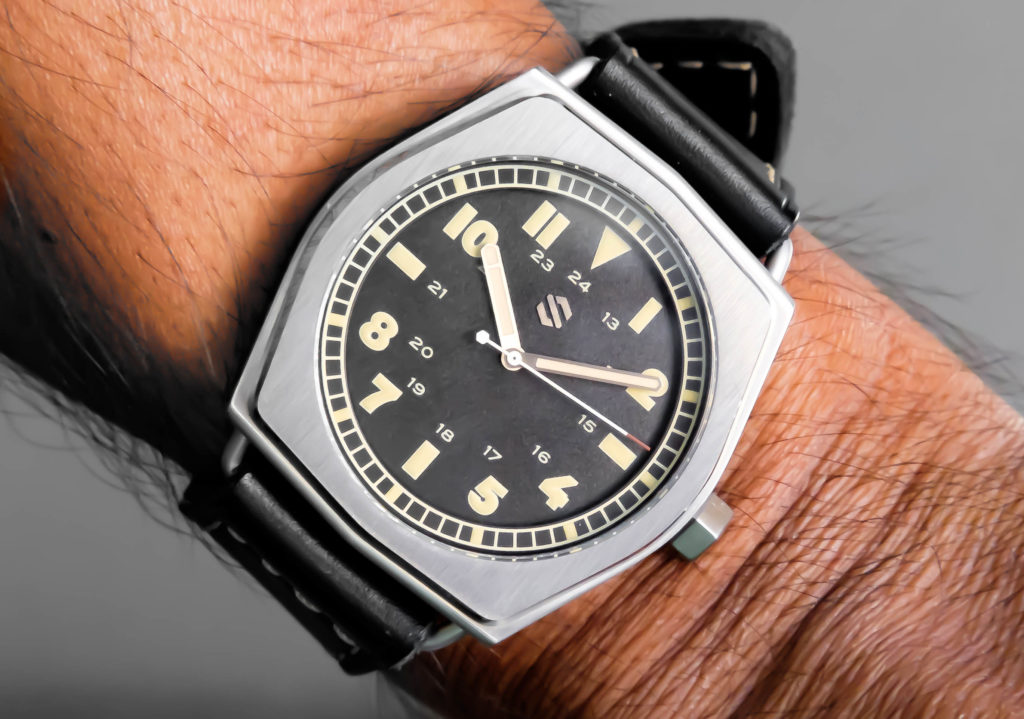
The Seals Model C is the microbrand pick for someone who wants their first mechanical field watch to feel a little less predictable. It draws on WW2 tank design, which could read as a setup for something painfully cheesy, but the watch avoids that trap. In hand, the case feels purposeful before the whole tank reference even matters. That is usually a good sign. At 40.5mm wide, 48.5mm lug-to-lug, and 11.4mm thick, it has more presence than the smaller military reissue pieces on this list, but the proportions stay manageable enough for daily wear. If the Hamilton or CWC feels too familiar, this offers a new buyer a more distinctive entry point into rugged mechanical watches without completely leaving the field-watch territory.
The case is doing most of the storytelling here. The bezel and case structure sit in stacked layers, loosely echoing the relationship between a tank turret and hull, but the execution stays restrained enough that you don’t feel like you’re wearing a prop from a military gift shop. The fixed bezel has finely polished details around the outer edge, while the top and most of the case use brushing that gives the watch a more industrial, tool-like feel. The faux wire lugs add a lot of personality, and with 200 meters of water resistance (plus a screw-down crown), and a tight fit and finish, the Model C feels robust on the wrist. The crown is the weak point in use. It looks right and photographs well, but the shape and sharper angles make it harder to grip than we’d like, especially if you enjoy manually winding your watches.
The dial balances the heavy case design by keeping the WW1 and WW2 inspiration cleaner and more traditional. A raised outer chapter ring carries the minute and hour ticks, while the next layer mixes Arabic numerals with geometric markers. The inner military-time indicators are the kind of practical detail a field watch should have, and the vintage-style numeral font gives it a trench-watch feel without making the whole thing too precious. Simple baton hands keep legibility strong. The faux-patina Super-LumiNova will split opinions. Here, though, it makes sense. Bright white lume would feel strange against the rest of the design, while the warmer tone helps the dial, case, and strap feel like they belong together. It charges green and adds enough low-light utility without becoming the whole reason to buy the watch.
The strap continues that same cohesive thinking. The Italian leather feels sturdy enough to match the case, and the stitching is tight and clean. We liked that the thread color matches the lume tone. The oversized buckle looks like it might be too much at first, almost Panerai-adjacent, but on the wrist, it helps balance the thicker leather and broader case. Inside, the STP1-11 automatic movement brings manual winding, hacking, 26 jewels, and a 44-hour power reserve. The movement has its quirks, though. Winding can feel clunky, and because the movement has a date wheel but the watch has no date window, you can run into that phantom date-position weirdness when setting the time. Accuracy was fine in use, and Seals notes that its movements are regulated to “COSC type standards” of -4/+6 seconds in five positions, though that is not official COSC certification. For a first mechanical buyer, the Model C works best if you want something rugged, uncommon, and design-forward, not if you want the safest or plainest field-watch starting point. For more testing insights, check out our dedicated review.
Pros
- Distinctive WW2 tank-inspired case gives first-time buyers something more memorable than the usual field-watch shape.
- Brushed-case finish, polished bezel edge, and faux wire lugs make the design feel cohesive rather than gimmicky.
- Raised chapter ring, military-time scale, Arabic numerals, and baton hands keep the dial practical and readable.
- Faux-patina Super-LumiNova works with the vintage design language and glows green in low light.
- Italian leather strap, matched stitching, and oversized buckle feel thoughtfully paired with the case.
Cons
- The crown can be awkward to grip when winding or setting the watch.
- The phantom date position may confuse newer buyers, since the movement has a date wheel, but the dial has no date window.
- “COSC type standards” regulation is reassuring, but it is not the same as official COSC certification.
Hamilton Khaki Field Mechanical
| Price: | $695 |
| Water Resistance: | 50m |
| Case Dimensions: | 38mm (diameter) x 47mm (lug-to-lug) x 9.5mm (thickness) |
| Lug Width: | 20mm |
| Movement: | Caliber H-50 (ETA 2801-2 on previous models) |
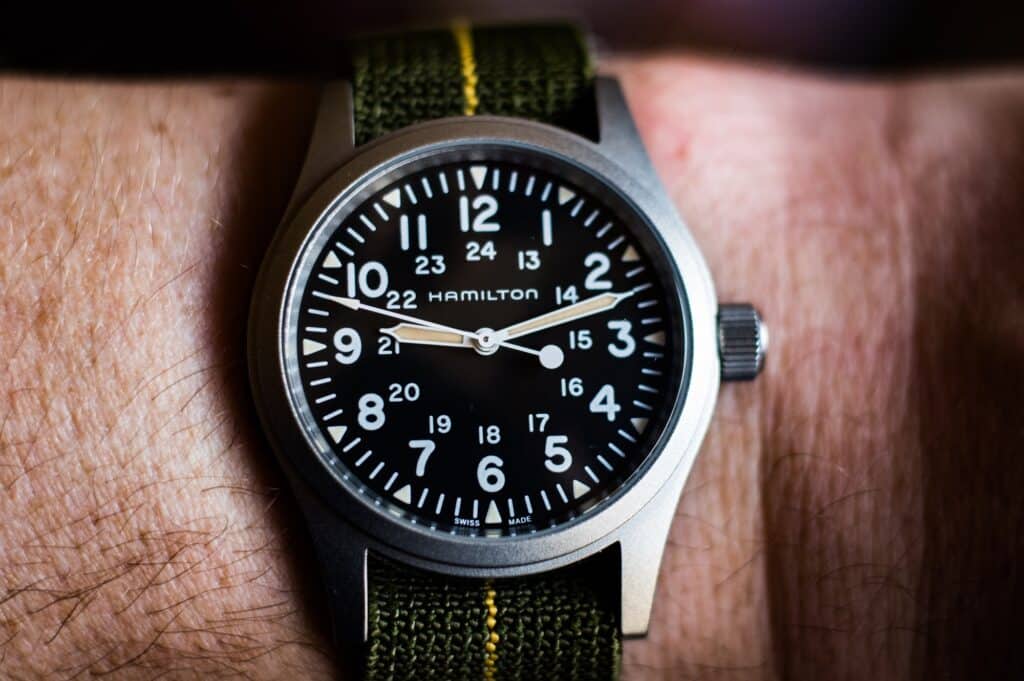
The Hamilton Khaki Field Mechanical is the obvious anchor for this list because it gives first-time mechanical buyers the classic hand-wound field-watch experience without making the whole thing feel precious. Its appeal is not novelty, and that’s the point. This is the familiar formula done well: a compact steel case, a manual-wind movement, a military-style dial, drilled lugs, and a strap-friendly personality that lets you figure out how you like to wear a field watch.
The case is a good example of why specs only tell part of the story. At 38mm, it sounds modest, especially if you’re coming from chunkier sports watches, but the 47mm lug-to-lug and slightly longer lugs give it more wrist presence than the diameter suggests. It doesn’t feel timid, but it also doesn’t become tiring. The 9.5mm thickness makes the watch easy to live with throughout the day, sliding under sleeves and staying comfortable during extended wear. The drilled 20mm lugs are another first-buyer-friendly detail. Strap changes are simple, and the watch looks natural on NATOs, leather, and softer fabric straps.
The dial has that classic Khaki Field density: Arabic numerals, minute markings, and enough visual information to feel purposeful rather than decorative. In daylight, it can look busy at first, but the lack of a date window keeps the layout from tipping into clutter. The faux-patina lume is handled with enough restraint that it doesn’t feel like Hamilton is trying too hard to cosplay an old issued watch. Low-light visibility is stronger than the aged color might suggest, though the missing clearly defined 12 o’clock marker bothered us during middle-of-the-night checks. Orientation takes a second longer than it should. The Hamilton branding under 12 is noticeable, but in practice, it does not throw the dial off enough to become a real issue.
The H-50 hand-wound movement is what makes the watch more than a field-watch costume. The daily winding routine fits the design, and the large crown makes the interaction easy rather than fiddly. In our testing, regular winding delivered excellent accuracy of around +0.8 seconds per day, which is better than many first-time buyers would expect in this category. The trade-off is that this is still a 50-meter water-resistant watch with a non-screw-down crown, so we treated water exposure with some caution. The included green NATO looks right, but the leather keepers irritated some of us during longer wear; the soft gray pashmina was the more comfortable setup. That sums up the Khaki Field Mechanical well: not flawless, but honest, tactile, easy to understand, and still one of the clearest starting points for anyone buying their first mechanical field watch.
Pros
- Slightly longer lugs give the watch a useful wrist presence.
- Drilled 20mm lugs make strap changes easy for new buyers experimenting with NATOs, leather, or fabric straps.
- No-date dial keeps the dense field-watch layout from becoming cluttered.
- The H-50 hand-wound movement adds tactile charm.
- The large crown makes daily winding and setting simple.
Cons
- 50 meters of water resistance and a non-screw-down crown mean it is not the most carefree field watch around water.
- Low-light orientation is weaker than it should be because the 12 o’clock marker does not stand out clearly.
- The leather keepers of the included NATO strap may irritate some wrists during prolonged wear.
Archimede Outdoor Protect
| Price: | $1100 – $1300 |
| Water Resistance: | 200m |
| Case Dimensions: | 38.5mm (diameter) x 43.5mm (lug-to-lug) x 11.5mm (thickness) |
| Lug Width: | 18mm |
| Movement: | Sellita SW200-1 automatic |
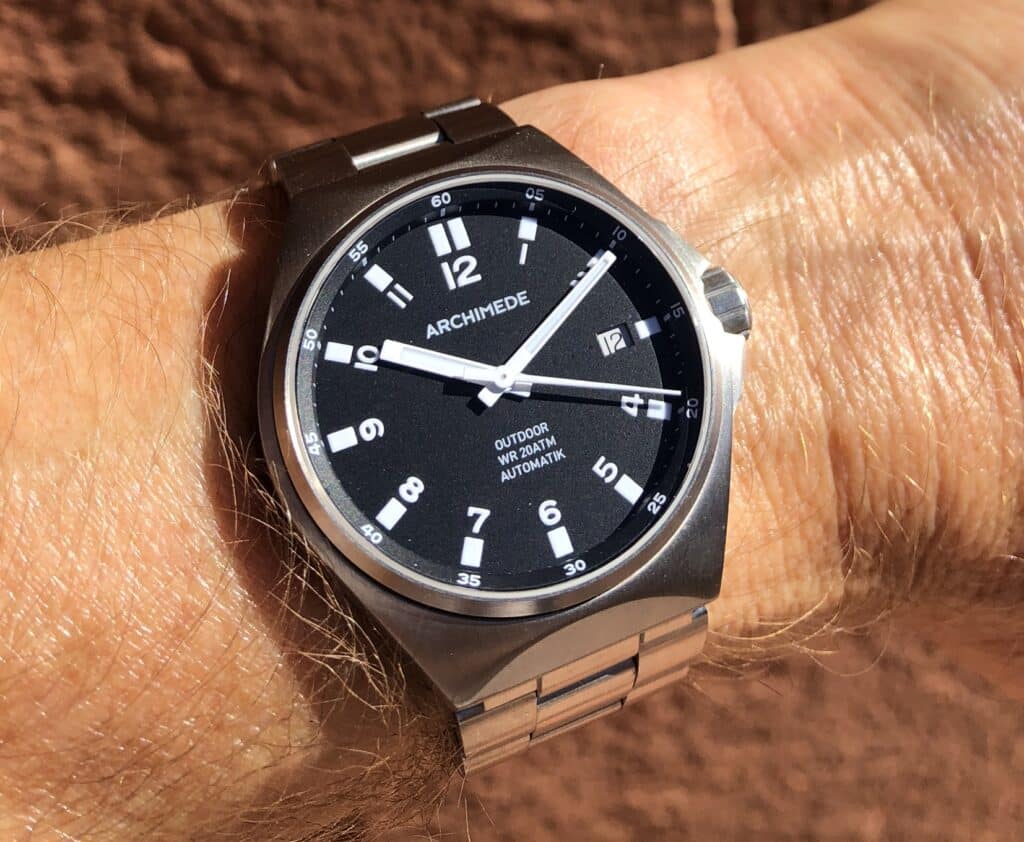
The Archimede Outdoor Protect is here with a small disclaimer taped to its forehead: it is not a traditional field watch. There’s no vintage military dial, no faux patina. But if we’re talking about a first mechanical watch that can do field-watch things in the real world, the Outdoor Protect makes a lot of sense. It is compact, legible, tough, and very uninterested in being babied. That matters when you’re buying your first mechanical and still trying to get over the idea that every scratch is a personal failure.
The case is the whole point. Archimede uses hardened stainless steel, and over our extended wear period, it shrugged off surface marks better than standard steel. The barrel-shaped, lugless case also wears better than photos suggest. It sits tight and secure, without feeling bulky or awkward by the end of the day. Every visible surface, including the integrated crown guards, is brushed lengthwise, which gives the watch a clean tool-watch look and helps hide the kind of wear that comes from living a normal human life. The crown guards are machined into the midcase and protect the crown without making it a pain to use. With a screw-down crown, sealed caseback, and 200 meters of water resistance, this is the kind of mechanical watch you can wear through rain, chores, travel, and whatever else your week decides to throw at you.
The dial does not try to charm you with history. It tries to be readable, and it succeeds. The flat black surface, white-printed numerals, and cleanly aligned markers made quick time checks easy during testing. That sounds plain, but plain is often what you want in a watch you’re going to wear hard. Inside, the Sellita SW200-1 delivered an average of +6 seconds per day across three positions over a week, which is reassuring for a watch built for daily use rather than mechanical romance alone. It is not the warmest or most nostalgic pick here, but it is one of the easiest to trust.
The biggest catch is the same thing that makes it wear so well: the lugless case. You are not going to spend a Saturday afternoon trying six straps on this thing unless those straps are the supplied bracelet and rubber option. For some first-time buyers, that will be frustrating. Thankfully, both included options fit the watch’s purpose. The Outdoor Protect is the pick for someone who wants the everyday field-watch values of rugged durability, clarity, and no special treatment, but would rather have them in a modern mechanical tool watch than a vintage-inspired military package.
Pros
- Flat black dial with white-printed numerals and markers is quick to read.
- The compact, barrel-shaped case sits securely and doesn’t feel cumbersome.
- Brushed finishing across the case and integrated crown guards hide wear well.
- Hardened stainless steel case resists surface wear better than standard steel.
Cons
- Lugless case kills the usual aftermarket strap rabbit hole.
- Strap choice is limited to the supplied bracelet or rubber strap.
Please let us know what you think of these field-watch picks in the comments below. If there’s a first-mechanical field watch we missed, especially one that isn’t another tired “this looks vaguely military, please clap” situation, share it with us. We’ll do our best to get one in and conduct a thorough hands-on review.

Co-Founder and Senior Editor
Kaz has been collecting watches since 2015, but he’s been fascinated by product design, the Collector’s psychology, and brand marketing his whole life. While sharing the same strong fondness for all things horologically-affordable as Mike (his TBWS partner in crime), Kaz’s collection niche is also focused on vintage Soviet watches as well as watches that feature a unique, but well-designed quirk or visual hook.
It’s interesting to note that you have not included any of the “dirty dozen” homages to the original design of the field watch, which come with a sub-seconds function near the six o’clock position, and can be found within the price range you are showing, albeit in the upper part of that range.
If only Vertex would send me that badass 36mm version they make. Maybe one day.
Vaer has a 36mm quartz dirty dozen watch that’s outstanding.