The Rolex Submariner might be the most recognizable dive watch on the planet, and there’s a pretty good reason for that. As we discovered in our own hands-on review, it’s comfortable, beautifully engineered, remarkably versatile, and has spent decades establishing the design language that nearly every other dive-watch manufacturer has borrowed from at some point. But here’s the thing about perfecting a formula: eventually, it starts to feel a little predictable. The black dial, rotating bezel, familiar case proportions, and restrained styling have become so ubiquitous that even watches without Rolex written on the dial often look suspiciously familiar. None of that makes the Submariner a bad watch. Far from it. But for collectors who enjoy a little eccentricity, there’s an argument that the most technically accomplished watch isn’t always the most interesting one to wear.

Over the years, we’ve reviewed hundreds of watches at TBWS, including plenty of divers that take a completely different approach to what belongs on our wrists. Some embrace ridiculous colors, others experiment with unusual case shapes, and a few incorporate engineering decisions that seem almost deliberately opposed to conventional watch design. More importantly, we’ve had all twelve of the watches below on hand, giving us a chance to understand whether those unconventional choices actually make them enjoyable to wear. This isn’t a ranking of watches that are objectively better than the Rolex Submariner, nor are we suggesting that every collector should abandon understated design. These are twelve dive watches with personalities of their own, arranged from the most affordable to the most expensive, each offering something beyond another interpretation of the same familiar design.
Vostok Amphibia 420: Beautifully Strange Soviet-Era Engineering

Approximate price: $150–$160 | Case: 39mm | Water resistance: 200m | Movement: Vostok 2416 automatic
Few watches on this list are as entertainingly unconventional as the Vostok Amphibia. Its rounded case resembles a small nautical porthole, the acrylic crystal rises dramatically above the dial, and the crown feels alarmingly loose when unscrewed. Depending on the version, the dial might feature military imagery, unusual colors, or graphics that seem to have arrived from an entirely different era of watch design. It’s a wonderful collection of details that would probably never survive the product-development process at a contemporary Swiss manufacturer. Yet much of the Amphibia’s eccentricity has a legitimate engineering explanation. Its pressure-assisted case construction and unusual crown mechanism reflect the resourceful approach taken by Soviet watchmakers when developing an affordable mechanical diver capable of handling serious water pressure.
The first thing that takes some getting used to is the crown. It feels almost broken when unscrewed, wobbling in a way that would be alarming on practically any other watch. As we discovered in our Vostok Amphibia 420 review, that’s actually part of its intentionally unconventional engineering. The decoupling mechanism helps protect the movement when the crown is secured, while the 39mm case wears surprisingly comfortably despite its approximately 15mm thickness. The watch also develops scratches readily, especially across its polished surfaces, but we found that wear suited its character. Not everything was charming. The factory bracelet felt thin and inexpensive, the lume was unimpressive, and the friction-operated bezel could move too easily. These are genuine compromises, but the overall experience remains unusually entertaining for something so affordable.
The Amphibia is for collectors who enjoy watches with stories, mechanical oddities, and enough imperfections to keep things interesting. There’s an enormous customization community surrounding these models, and replacing the bezel or strap can dramatically change the watch’s appearance without requiring much money. We love that Vostok hasn’t attempted to modernize the design into something indistinguishable from every other diver. Owning one requires accepting a few quirks, including the strange crown action and basic finishing, but that’s arguably the entire point. The Submariner represents decades of refinement toward a highly polished experience. The Amphibia reminds us that unconventional engineering, inexpensive materials, and a little mechanical weirdness can be just as enjoyable.
Citizen Promaster NY0040: The Affordable Diver That Does Things Its Own Way
Approximate price: $205–$250 | Case: 42mm | Water resistance: 200m | Movement: Miyota 8204 automatic
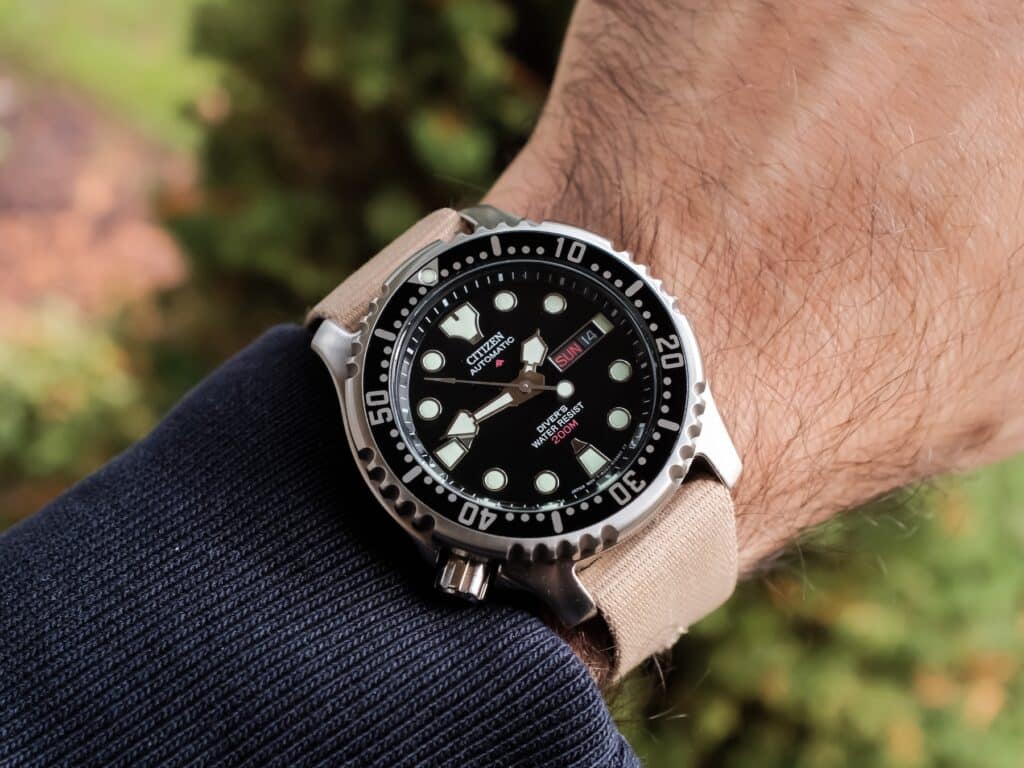
Citizen’s NY0040 doesn’t attract attention through dramatic colors or complicated technology. Instead, it distinguishes itself through a series of small design choices that add up to something instantly recognizable. The crown sits on the left side of the case, the shoulders have an unusual rounded shape, and the bezel slopes inward toward a compact dial. Even the proportions feel different from what we’d expect of a conventional automatic diver. These details originated from Citizen’s practical approach to producing professional diving equipment, including models associated with Italy’s COMSUBIN divers. It’s a watch that has spent decades quietly doing its job while other affordable divers developed louder enthusiast followings.
What surprised us most was how compact the NY0040 felt once it was on the wrist. Although it measures nearly 42mm across, the approximately 47mm lug-to-lug distance and inward-sloping bezel help it wear considerably smaller. We also appreciated the left-side crown, which stays clear of the back of the hand during normal use. The bezel was another highlight, delivering firm 60-click operation with excellent alignment and virtually no unwanted movement. As we noted in our Citizen NY0040 review, the Miyota 8204 automatic movement provides hacking and hand-winding, although its rotor is noticeably loud. We also moved away from the factory rubber strap, which was serviceable but didn’t become our favorite part of the wearing experience. A simple NATO proved especially appropriate for the watch’s utilitarian personality.
There’s something appealing about how little effort the NY0040 makes to impress anyone. No elaborate dial finishing, no attempt to imitate a more expensive Swiss model, and no complicated story explaining why its design should matter. Citizen built a capable, ISO-rated automatic diver and allowed the functional decisions to shape its appearance. The result is a watch that feels distinctive without being eccentric for the sake of it. We’d recommend the NY0040 to someone who wants an inexpensive mechanical diver with genuine character but doesn’t necessarily want to wear something bright orange or unusually large. It’s also a useful reminder that personality can emerge from thoughtful ergonomics and proportions just as easily as from adventurous styling.
Seiko Turtle: A Classic Diver With an Unmistakable Shape
Approximate price: $350–$400 | Case: 44.3mm | Water resistance: 200m | Movement: 4R36 automatic
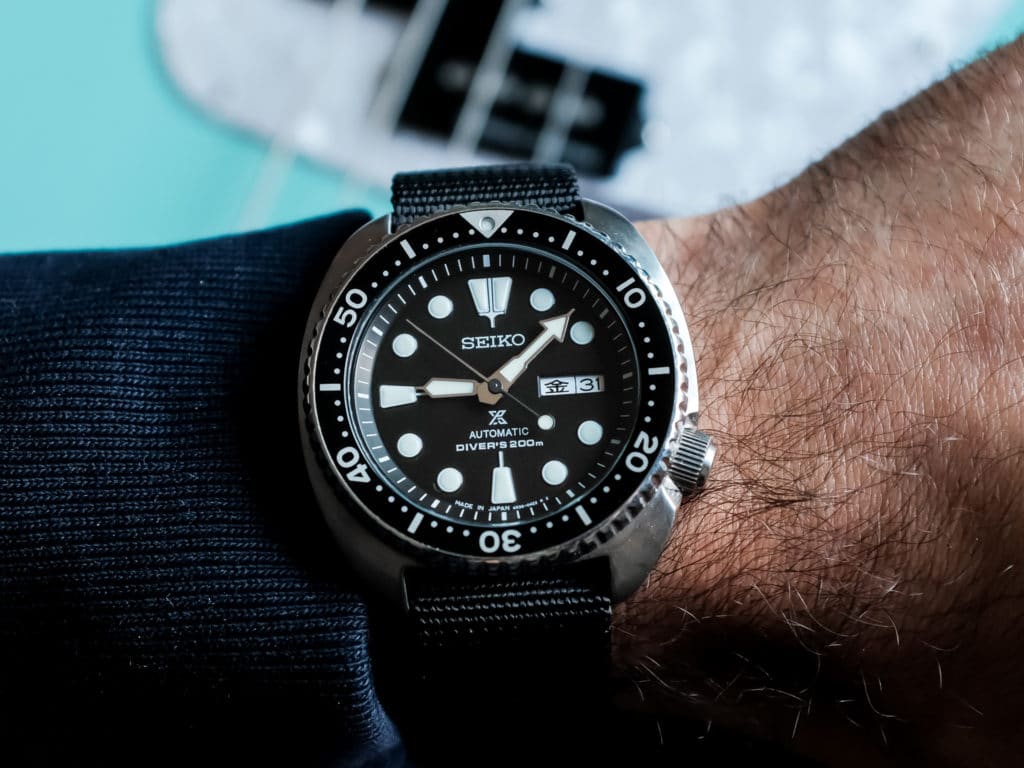
Not every dive watch needs a dramatic dial or unusual color scheme to develop a recognizable identity. Sometimes the case does most of the work. The Seiko Turtle is a perfect example, with its rounded cushion-shaped case, recessed four-o’clock crown, and broad proportions creating a silhouette that has very little in common with the Submariner. The design descends from Seiko’s 6309 divers of the 1970s and 1980s, and the modern reinterpretation retains much of what made those earlier watches so distinctive. It’s a wonderfully Japanese approach to watchmaking, where an unconventional shape has been refined over decades until it feels almost inevitable. The fact that the design remains relatively affordable only adds to its appeal.
At 44.3mm across and approximately 14mm thick, the Turtle sounds like a watch that should dominate the wrist. Instead, its short 48mm lug-to-lug distance and rounded case geometry make it surprisingly manageable. That’s one of the qualities that stood out in our Seiko Turtle review, which focused on the Japanese-market SBDY015, a black-dial variation of the familiar SRP777. We enjoyed the oversized luminous markers, straightforward dial, and the way the case worked with virtually any reasonable strap choice. The Kanji day wheel on our example also adds a detail that enthusiasts can appreciate without changing the fundamental design. The biggest disappointment was the misaligned bezel insert, a frustrating issue given how satisfying the bezel itself felt to operate. The 4R36 movement isn’t especially sophisticated either, although it provides the basic reliability we’d expect from an affordable automatic diver.
The Turtle is proof that a watch can become iconic without depending on expensive materials or a dramatic color scheme. Its character comes from proportions, history, and the comfort of a case that appears more intimidating in photographs than it does on the wrist. We also appreciate that the design doesn’t attempt to be a smaller, cheaper version of something Swiss. It’s unmistakably a Seiko, with all the strengths and familiar frustrations that come with that identity. If the Submariner feels too conventional but a bright orange Doxa seems excessive, the Turtle provides an appealing middle ground. It’s distinctive without demanding attention and interesting without needing to explain itself.
Citizen Promaster Aqualand: An Actual Diving Instrument on Your Wrist
Approximate price: $370–$490 | Case: Approximately 50.7mm across the external sensor | Water resistance: 200m | Movement: Citizen C520 quartz
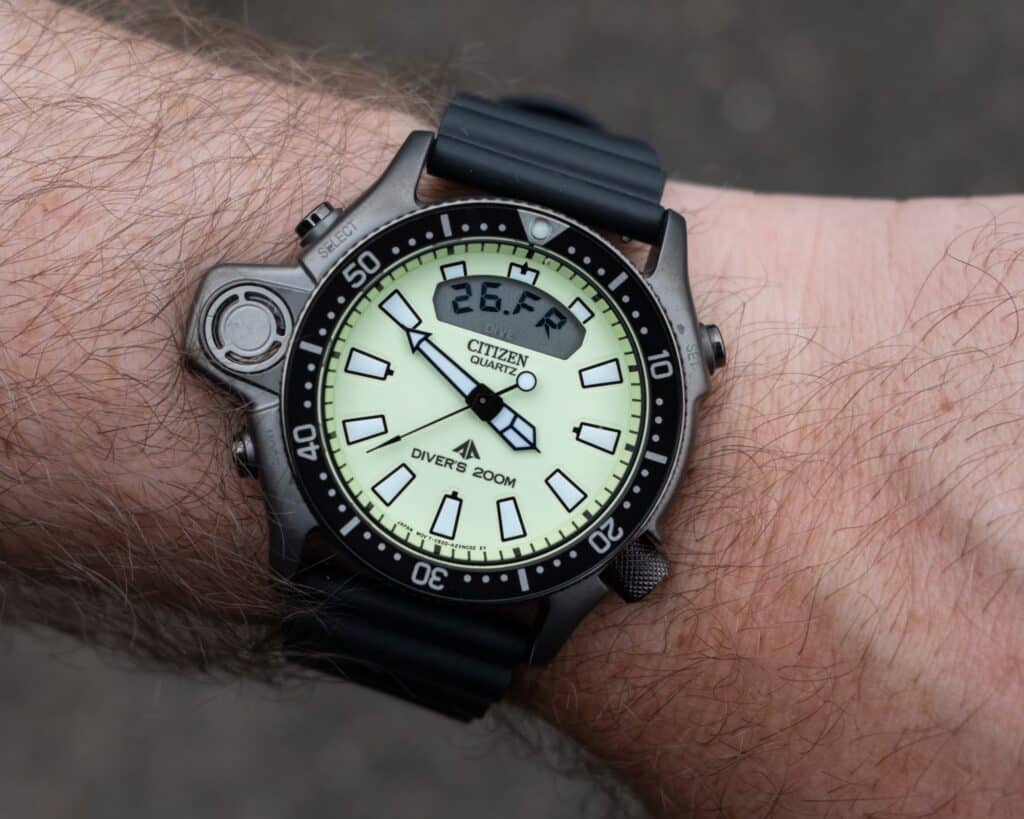
There are dive watches that look like professional equipment, and then there’s the Citizen Promaster Aqualand. Its enormous external depth sensor, analog-digital display, and broad case make it look less like a conventional wristwatch and more like something removed from an underwater research station. That’s not an insult. The original Aqualand helped establish Citizen’s reputation for combining electronic functionality with serious diving capability, and the modern JP2007-17W continues that tradition in unapologetic fashion. The depth sensor isn’t decorative, either. The watch can record depth information, store dive data, and provide warnings related to ascent and depth. It’s a level of specialized functionality that makes the familiar timing bezel on a conventional diver seem almost quaint.
Up close, the Aqualand is every bit as strange as its photographs suggest. The external sensor extends the overall footprint to approximately 50.7mm, while the 24mm strap and substantial case leave little doubt about what this watch was built to do. We were drawn to the fully luminous dial, which gives the watch an almost theatrical appearance in low light. There’s also something wonderfully satisfying about the combination of conventional hands and electronic displays. Our Citizen Promaster Aqualand hands-on review explored these features and the overall wearing experience, although we didn’t personally evaluate every diving function underwater. The physical design alone makes a convincing case for the watch’s specialized identity.
The Aqualand is probably the least appropriate watch here for someone who wants a discreet, versatile everyday accessory. It’s large, unconventional, and equipped with features that many owners will never use. But those are precisely the qualities that make it so appealing to a certain kind of enthusiast. We love watches that inspire conversations, especially when their unusual appearance has a functional explanation. The Submariner’s design has evolved toward becoming an exceptionally refined everyday sports watch, while the Aqualand still looks and behaves like specialized diving equipment. There’s something wonderfully entertaining about that distinction. For collectors who enjoy unusual technology and watches whose functionality shapes their appearance, the Aqualand offers an experience that conventional mechanical divers simply can’t reproduce.
Nodus Sector Deep: Modern Tool-Watch Design Done Differently
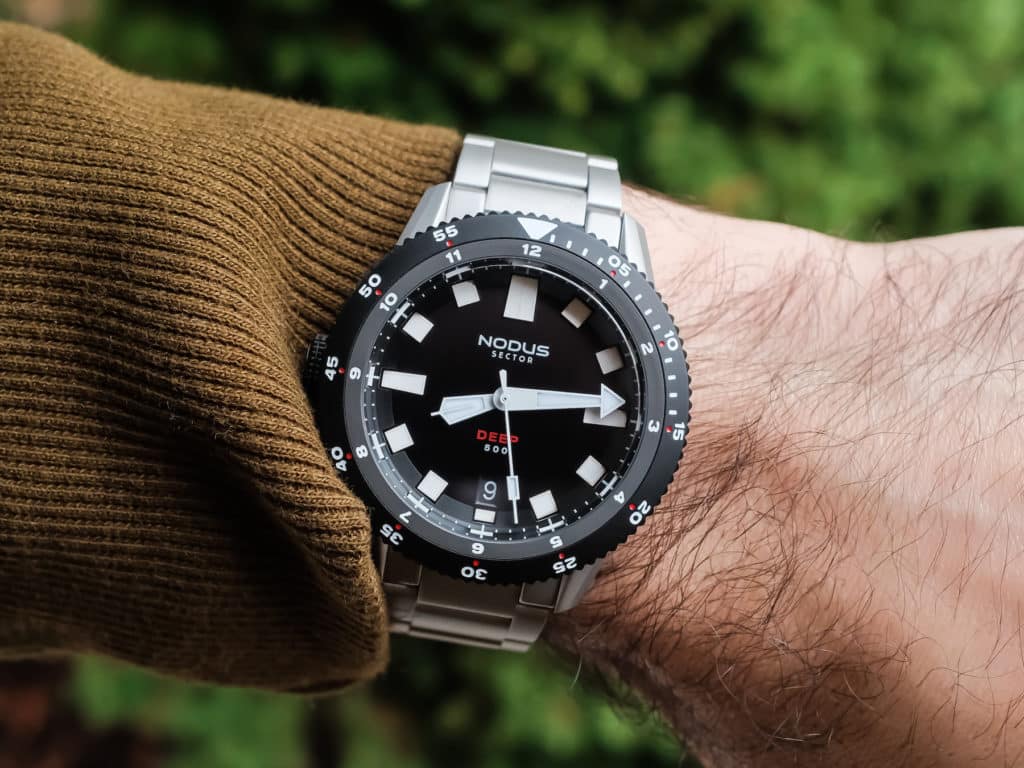
Approximate price: $650 | Case: 38mm | Water resistance: 500m | Movement: Seiko NH35 automatic
The Nodus Sector Deep looks like the sort of watch someone might design after becoming frustrated with the compromises found on conventional divers. Its 38mm case, left-side crown, bold handset, and unusual proportions give it a modern identity without leaning on vintage nostalgia. More interestingly, Nodus manages to package 500 meters of water resistance into a compact automatic watch, creating a combination that feels unusual even among more expensive alternatives. The design has a purposeful aggression, especially in the relationship between the broad bezel, compact case, and large luminous hands. It’s not trying to be elegant or universally acceptable. Instead, the Sector Deep appears to have been built around a series of practical decisions that eventually produced something visually distinctive.
That combination of a compact case and serious diving credentials became one of the most convincing aspects of our time with the Sector Deep. The case feels substantial without becoming unwieldy, and the unusual crown placement helps prevent the irritation that conventional right-side crowns can create during everyday wear. We enjoyed the matte finishing, balanced dial layout, and intense BGW9 Super-LumiNova. The broad arrow minute hand also gives the watch a recognizable appearance while making the display exceptionally easy to read. In our Nodus Sector Deep review, the NodeX clasp was another standout, offering tool-free bracelet adjustment we’d like to see on considerably more expensive watches. Extending the mechanism could expose a visible gap and part of the adjustment hardware, which isn’t especially elegant, but the function works.
This is a watch for collectors who enjoy functional design but don’t necessarily want the visual language of traditional military divers. The Sector Deep feels contemporary in ways that many expensive watches don’t, combining serious depth capability with compact proportions and practical bracelet features. It also offers an interesting alternative for enthusiasts who appreciate brands such as Sinn or Tudor but want something with an independent personality. We’d argue that the Nodus is at its best when we stop trying to identify which famous watch influenced it and simply appreciate the decisions that went into its construction. Those choices produce a diver that feels modern, capable, and refreshingly uninterested in becoming another Submariner alternative.
Baltic Aquascaphe: Personality Without the Need to Shout
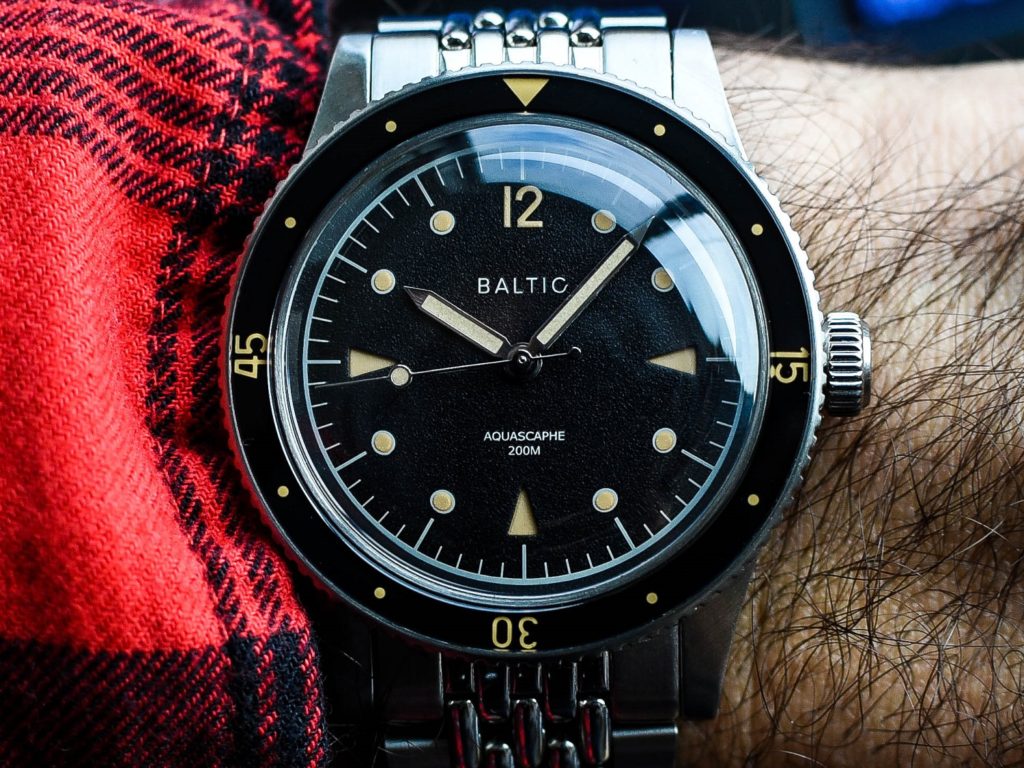
Approximate price: $700–$800 | Case: 39mm | Water resistance: 200m | Movement: Miyota 9039 automatic
Baltic has become exceptionally good at creating watches that evoke the past without feeling like direct copies of something else. The Aquascaphe demonstrates that philosophy through a combination of modest proportions, restrained colors, and carefully selected vintage details. Its hybrid sandwich dial incorporates cut-out elements that reveal luminous material beneath the surface, while warm gilt accents and a matte dial create visual depth without making the watch appear overly elaborate. The handset is another highlight, with slender pencil-style hands and a lollipop seconds hand reinforcing the vintage character. Nothing about the design is especially loud, but the more closely we examine it, the more apparent the attention to detail becomes.
There’s a cohesiveness to the Aquascaphe that becomes easier to appreciate once it’s on the wrist. The 39mm case, 47mm lug-to-lug distance, and approximately 12mm thickness produce proportions that feel natural for everyday use. We also enjoyed the double-domed sapphire crystal, luminous sapphire bezel, and comfortable beads-of-rice bracelet. The latter was especially convincing, with a pleasing taper, seven micro-adjustment positions, and quick-release spring bars that made switching straps straightforward. As we explored in our Baltic Aquascaphe hands-on review, the watch didn’t rely on vintage styling alone to carry the design. The Miyota 9039 automatic movement supported the overall proportions without introducing an unnecessary date complication.
Not every collector looking for something different wants a bright orange dial or a case that resembles underwater equipment. The Aquascaphe offers a quieter kind of personality, built around details that become more enjoyable the longer we examine them. Its sandwich dial, warm gilt accents, domed crystal, and beads-of-rice bracelet create a distinctly vintage appearance without feeling like a reproduction of one particular historical watch. There’s a cohesiveness to the design that makes it easy to wear, but enough individuality to keep it interesting. For collectors who appreciate the Submariner’s versatility but want something with a little more vintage character, the Baltic strikes an appealing balance between restraint and personality.
Squale Sub 37 Legend: A Properly Old-School Diver

Approximate price: $1,750 | Case: 37mm | Water resistance: 300m | Movement: Sellita SW200-1 automatic
Modern dive watches have become so comfortable with substantial cases, oversized bezels, and aggressive styling that it’s easy to forget how different some of the earliest examples looked. The Squale Sub 37 Legend offers a refreshing reminder. Its compact 37mm case and vintage-inspired proportions create a watch that feels much closer to early diving instruments than the muscular sports watches dominating the category today. The appeal isn’t based on unusual technology or an extravagant dial. It’s the deliberate refusal to make the watch larger, more complicated, or more contemporary than necessary. Squale has taken the design language of its early divers and translated it into something suitable for modern ownership, preserving much of the charm without asking collectors to deal with the uncertainties of a genuinely vintage watch.
The restrained dimensions were immediately appealing when we handled the Sub 37, especially after spending time with larger modern divers. But the size wasn’t the only thing working in its favor. The finishing and overall construction felt carefully considered, supporting the watch’s $1,750 launch price without relying solely on nostalgia. Our Squale Sub 37 Legend review found an interpretation of the brand’s history that felt convincing rather than artificially aged. It didn’t give us the impression that Squale had simply recreated an older reference for collectors who wanted something fashionable. The case, dial, and proportions worked together to produce a watch that felt authentic to the brand’s design heritage.
The Sub 37 is for collectors who find the proportions of modern dive watches more tiresome than their styling. Where the Submariner has evolved into a substantial contemporary sports watch, Squale embraces the compact dimensions and distinctive case architecture of early diving instruments. That might not sound particularly adventurous, but there’s something refreshing about wearing a 37mm diver that doesn’t feel the need to announce its capabilities through sheer size. The appeal is in the proportions, the historical character, and the experience of wearing something that feels genuinely different from most modern alternatives. For anyone who appreciates vintage dive watches but doesn’t want the complications of owning one, the Sub 37 makes a convincing case for doing things the old-fashioned way.
Serica 5303: A Vintage Diver That Doesn’t Copy Anyone
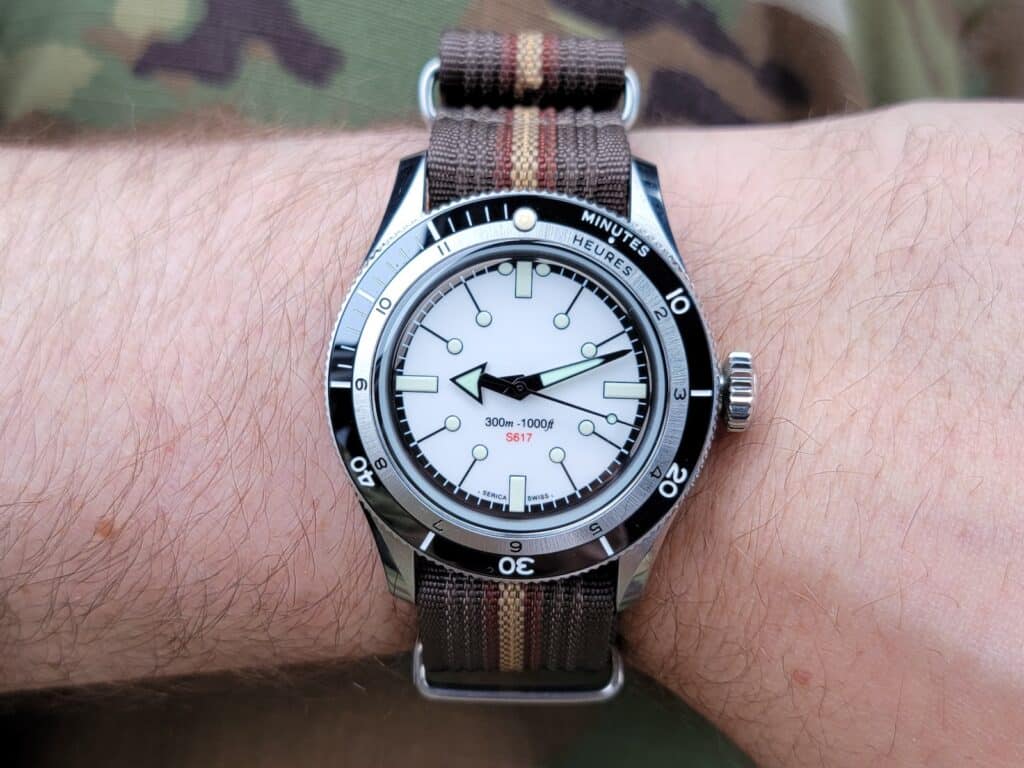
Approximate price: $1,850 | Case: 39mm | Water resistance: 300m | Movement: Soprod M100
There’s a peculiar problem with many vintage-inspired dive watches. Manufacturers want to capture the appeal of historical models without copying them directly, but the finished products often resemble familiar references with a few details rearranged. Serica’s 5303 manages to avoid that trap. The metallic silver dial, geometric hour markers, unusually restrained branding, and dual-scale bezel create something that looks entirely believable as a mid-century design without feeling like an imitation of a particular watch. The visual language is especially interesting because so much of it depends on proportion and negative space rather than decoration. The dial is simple, but it’s arranged in a way that immediately distinguishes the watch from the usual collection of Submariner-inspired divers.
After spending years with a first-generation Serica 5303-2, we came to appreciate just how much thought had gone into the design. The 39mm case and 46mm lug-to-lug distance create comfortable proportions, while the two-scale bezel combines conventional dive timing with a 12-hour scale. We liked its solid bezel action and the versatility of the case across different straps. The mesh bracelet was less convincing, with some sharp clasp components and a design that didn’t become our preferred wearing option. Our example also exhibited intermittent crown and hacking issues associated with the original Soprod Newton movement. As detailed in our long-term Serica 5303-2 review, those problems complicated an otherwise enjoyable ownership experience. Serica subsequently revised the model with a different caliber, so the criticisms shouldn’t automatically be applied to current production.
The Serica is compelling because virtually every design element has been reconsidered without sacrificing the basic identity of a mechanical dive watch. The dial is recognizable without needing prominent branding, the bezel incorporates additional functionality without becoming cluttered, and the restrained case makes the watch feel appropriate for regular use. There’s also something refreshing about a young brand developing a coherent visual identity rather than leaning entirely on historical references. For enthusiasts who enjoy vintage design but are tired of seeing the same interpretations repeatedly, the Serica offers a thoughtful alternative that feels both old-fashioned and original.
Doxa Sub 300: The Dive Watch That Refuses to Be Subtle
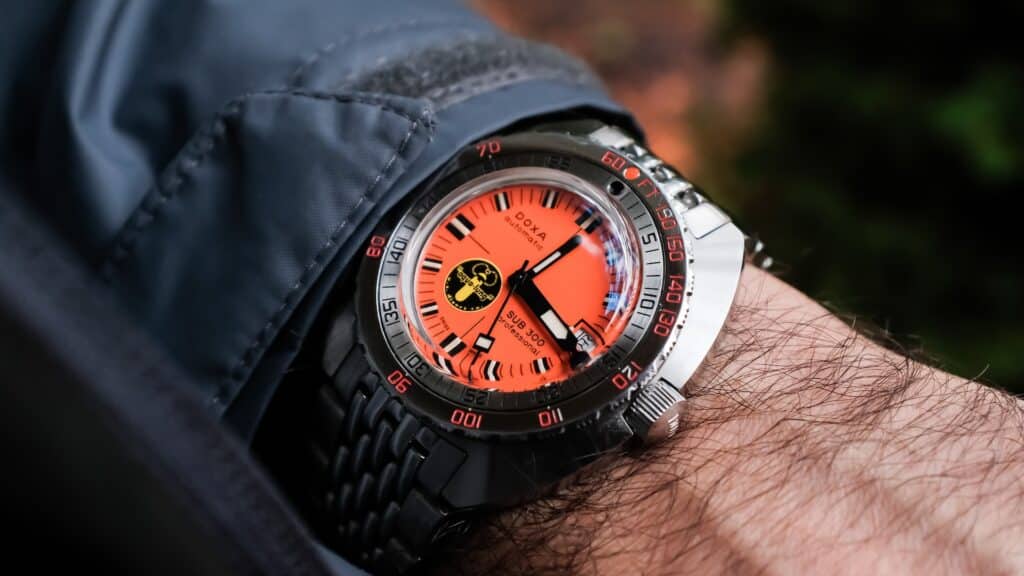
Approximate price: $2,890 for the standard SUB 300 | Case: 42.5mm | Water resistance: 300m | Movement: ETA 2824 automatic
Most dive-watch manufacturers seem determined to produce something that looks appropriate with absolutely everything. Doxa apparently never received that memo. The SUB 300’s bright orange dial, broad cushion case, and unusual decompression bezel make it look like equipment recovered from a colorful 1970s diving expedition. There’s nothing understated about the design, yet nearly every peculiar detail has a connection to the brand’s history of producing serious underwater instruments. The orange dial wasn’t chosen simply because it looked entertaining, and the dual-scale bezel reflects an era when divers relied on mechanical timing tools rather than computers. Doxa has resisted the temptation to dilute those features into something more conventional, leaving us with one of the most recognizable dive-watch designs ever produced.
Years of travel and daily wear have been unusually kind to the SUB 300’s personality, even when they haven’t been kind to its surfaces. Our long-term Doxa review follows the Aqua Lung Black Lung reissue as it accumulated scratches, worn bezel paint, and the kinds of marks that come from actually wearing a watch rather than treating it like a collectible. Its 42.5mm case sounds substantial, but the short lug span, low profile, and flexible beads-of-rice bracelet make it exceptionally comfortable. The bezel action also remained satisfying despite years of use. There are imperfections, including less-than-ideal visibility for some bezel markings, but none fundamentally undermined our enjoyment. If anything, the accumulated wear made the watch more interesting.
The SUB 300 makes the most sense for collectors who have already accepted that their watches don’t need to coordinate perfectly with every outfit. It has a distinctive silhouette, an unmistakable dial color, and a design history that’s interesting without requiring an elaborate sales pitch. More importantly, it remains a genuinely capable diver rather than a novelty built around vintage aesthetics. We’d happily recommend it to someone who wants a watch that feels like an artifact from diving’s more adventurous years. The Submariner has become the benchmark for a dive watch that looks appropriate almost anywhere. Doxa takes the opposite approach, embracing a bright orange dial and unconventional case that won’t appeal to everyone. We’d argue that willingness to be polarizing is exactly what makes the SUB 300 so memorable.
Oris Aquis New York Harbor II: When a Dive Watch Gets Colorful
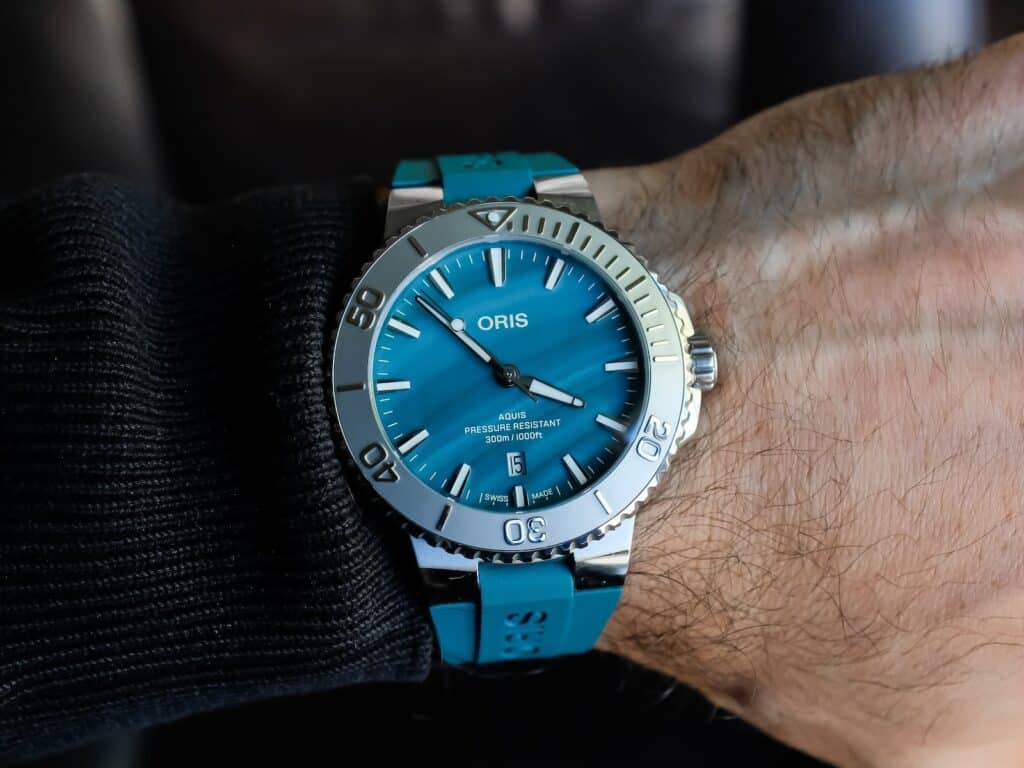
Approximate price: $3,000 | Case: 43.5mm | Water resistance: 300m | Movement: Oris Calibre 733 automatic
Green dive watches aren’t unusual anymore. Almost every major manufacturer offers one, and most approach the color by applying some variation of a sunburst finish to an otherwise conventional dial. The Oris Aquis New York Harbor Limited Edition II goes much further. Its aqua-green mother-of-pearl dial changes dramatically depending on the lighting, shifting from lively, almost luminous greens to quieter tones that resemble polished stone. The effect comes from the natural structure of the material, creating an appearance that feels genuinely unpredictable. There’s also a meaningful connection to the Billion Oyster Project, with the limited edition supporting efforts to restore oyster habitats in New York Harbor. That combination of unusual materials and environmental purpose gives the watch a personality that extends beyond its appearance.
We weren’t entirely convinced by the New York Harbor II at first. The dial appeared almost too decorative for our usual preferences, but that impression changed once we handled the watch. The mother-of-pearl surface proved surprisingly easy to live with, while the familiar Aquis case and integrated rubber strap provided the substantial wearing experience we’ve come to appreciate from the collection. At 43.5mm across and approximately 51mm from lug to lug, this isn’t a compact watch, and we’d encourage smaller-wristed collectors to try it before committing. The curved lugs and secure rubber strap helped make those dimensions manageable. Our hands-on Oris Aquis New York Harbor II review explores how the dial’s unusual appearance translated into a much more convincing experience on the wrist.
This is the watch we’d recommend to someone who appreciates conventional Swiss dive-watch engineering but wants something considerably more interesting to look at. It doesn’t reject the basic Aquis design, nor does it need to. Oris demonstrates how dramatically the character of an established watch can change through one carefully chosen material. The limited-edition nature adds a degree of exclusivity, although that could complicate finding a particular example. We’d much rather wear a watch whose dial keeps surprising us than one whose greatest achievement is matching every shirt in the closet. For anyone who finds a conventional black Submariner visually monotonous, the Oris offers an entirely different experience.
Omega Seamaster Diver 300M: The More Expressive Swiss Diver
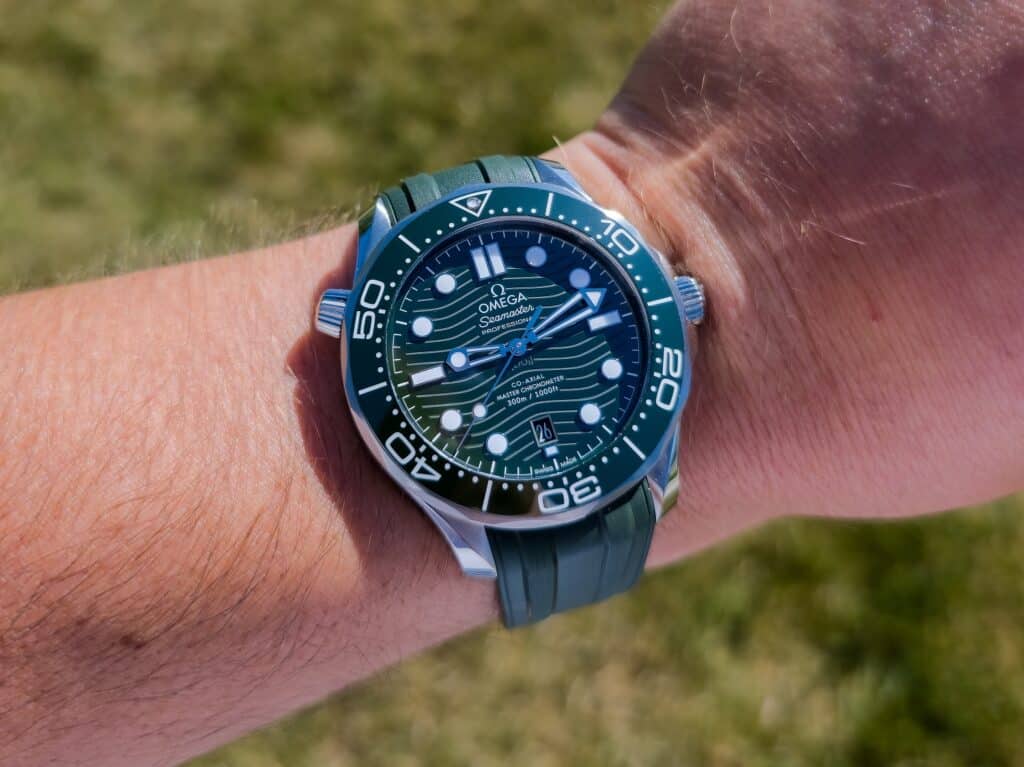
Approximate price: $6,300 | Case: 42mm | Water resistance: 300m | Movement: Omega caliber 8800 automatic
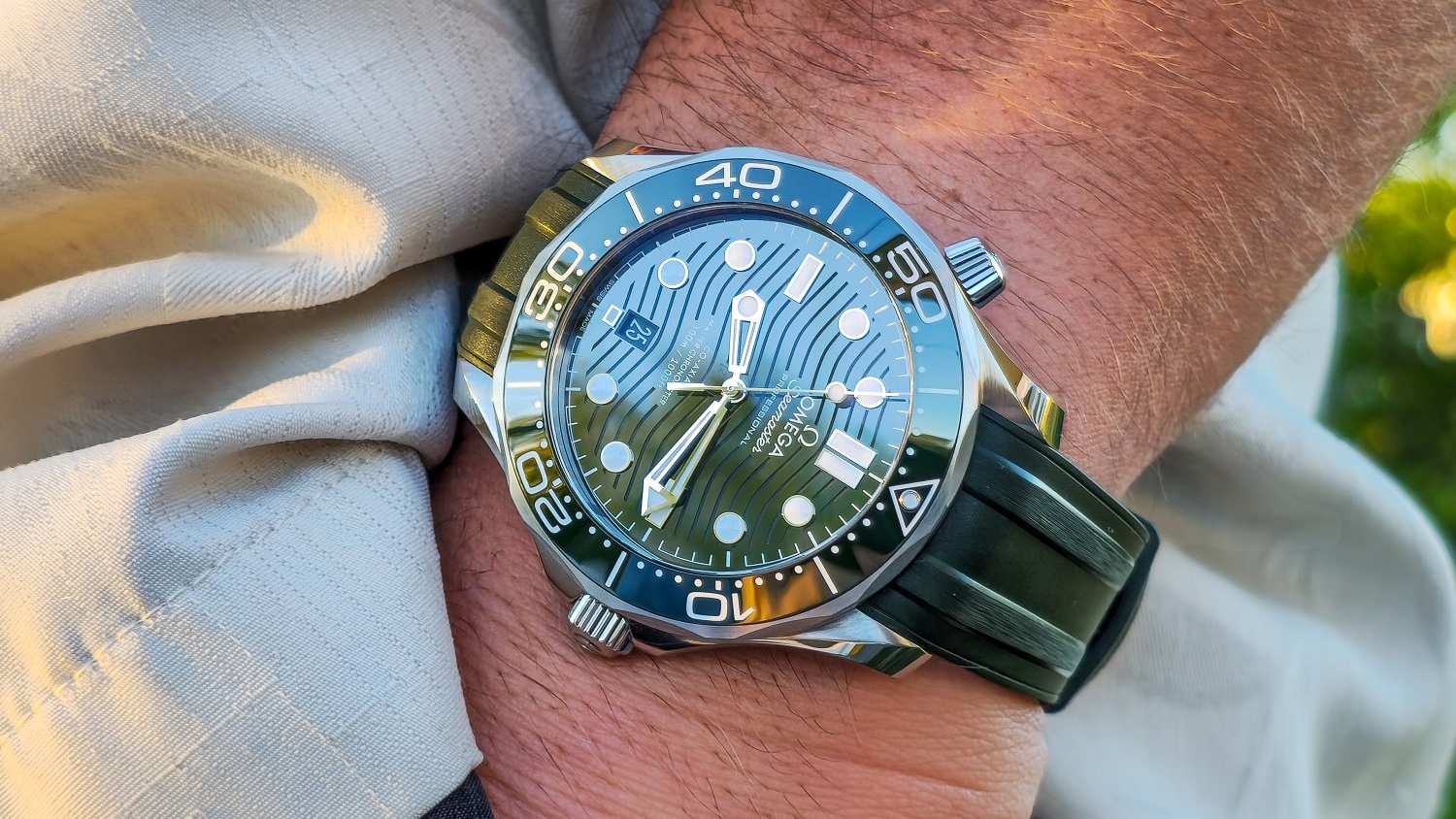
If Rolex represents the conservative side of modern Swiss dive-watch design, Omega has generally been more willing to experiment with the formula. The Seamaster Diver 300M is an obvious example, combining a scalloped bezel, distinctive skeletonized hands, a wave-pattern dial, and a helium escape valve that remains one of its most recognizable features. None of these details is subtle, especially when they’re presented together. But that’s part of the appeal. Omega seems comfortable making a watch that looks more technical, decorative, and contemporary than the Submariner. The green-dial configuration we’ve reviewed takes that approach even further, replacing familiar black-and-blue combinations with a shade that shifts considerably depending on the light.
The green dial is what stayed with us most after handling this Seamaster. Its laser-engraved waves create real depth within the polished ceramic surface, while the color moves between darker olive tones and brighter green depending on the environment. We also appreciated the matching date disc, which prevents the display from being interrupted by an unnecessary white window. The skeletonized handset looks distinctive, although its limited luminous surface introduces a legibility compromise. In our Omega Seamaster Diver 300M review, the bezel was a less satisfying discovery. Despite the premium materials and excellent finishing, its grip and tactile operation weren’t as convincing as we’d hoped. It’s an irritating weakness on an otherwise highly accomplished dive watch.
The Seamaster makes a strong argument for collectors who want a recognized Swiss watchmaker without adopting Rolex’s restrained visual language. We wouldn’t describe the Omega as an objectively better diver simply because it has a more complicated appearance. Some of those stylistic choices introduce practical compromises of their own. But there’s something appealing about a major manufacturer being willing to maintain an unusual design identity even when simpler alternatives might appeal to more people. The Seamaster has its own recognizable character, and the green version demonstrates how expressive that design can become.
Glashütte Original SeaQ: The Luxury Diver That Goes Its Own Way
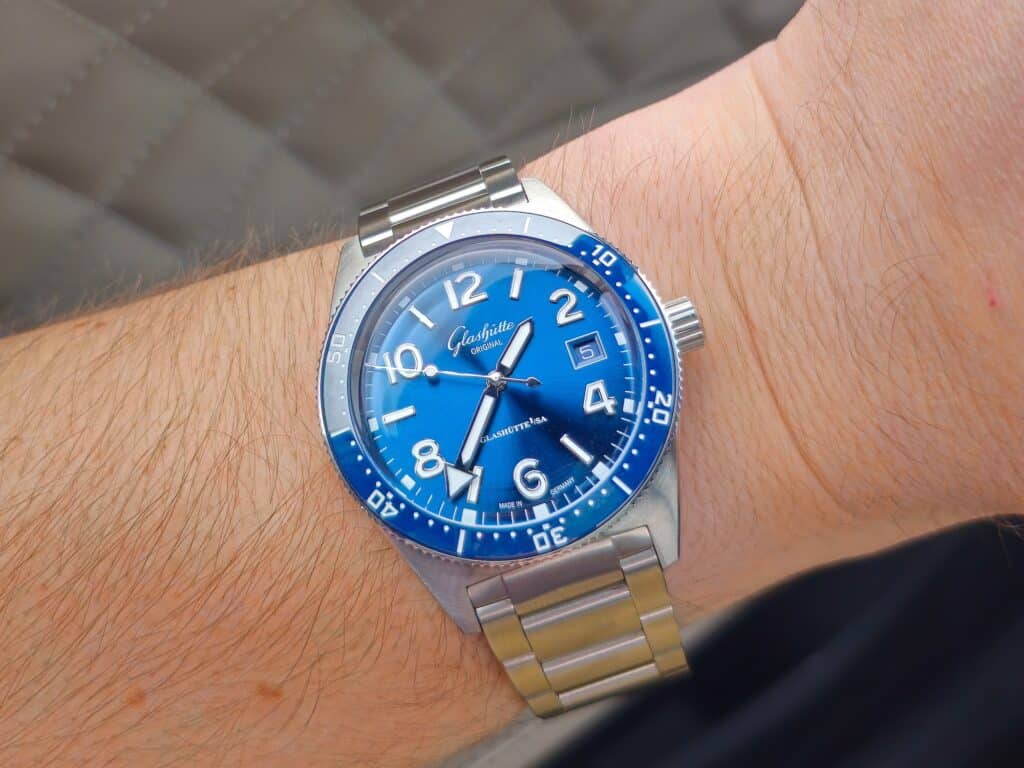
Approximate price: $9,500 | Case: 39.5mm | Water resistance: 200m | Movement: Original Calibre 39-11 automatic
At the expensive end of the spectrum, the Glashütte Original SeaQ demonstrates that a premium dive watch doesn’t need to follow the Submariner’s design blueprint. The large Arabic numerals, distinctive handset, domed crystal, and richly colored dial draw heavily on vintage German watchmaking rather than Swiss sports-watch conventions. The blue-dial version we reviewed is especially appealing, with a radial sunburst finish that shifts between bright tropical tones and much darker shades. There’s something almost playful about combining such a vivid dial with sophisticated case finishing. The SeaQ doesn’t attempt to hide its luxury credentials, but it expresses them through a visual identity that feels quite different from Rolex’s more restrained approach.
What impressed us was how naturally the SeaQ combined distinctive styling with a refined wearing experience. The 39.5mm case, slim mid-case, and domed sapphire crystal create a comfortable package that feels more elegant than its approximately 12.5mm thickness might suggest. We also appreciated the precise bezel, which requires deliberate force to move and has virtually no unwanted play. The large luminous Arabic numerals remain highly legible despite the decorative dial finish. Our Glashütte Original SeaQ review also highlighted the excellent bracelet construction and convenient adjustment mechanism, although the transition between the bracelet and case felt less elegant than we’d expect at this price. It’s a small criticism, but one worth acknowledging on a watch competing directly with established luxury divers.
The SeaQ makes sense for collectors who appreciate the craftsmanship and refinement associated with luxury dive watches but have little interest in wearing the most recognizable option in the category. Its design is rooted in Glashütte Original’s own history, and the combination of vibrant dial finishing, unusual numerals, and compact proportions creates something distinctive. We wouldn’t describe it as a value alternative to the Submariner, given its ambitious pricing. Instead, it’s an alternative expression of what a high-end mechanical diver can be. The SeaQ succeeds because it doesn’t seem concerned with matching Rolex’s aesthetic or reputation. It offers exceptional finishing, serious construction, and a character that rewards anyone willing to look beyond the usual Swiss suspects.
Final Thoughts: Great Dive Watches Don’t Have to Look Alike
The Rolex Submariner deserves much of the reputation it has built over the decades. Its combination of comfort, engineering, durability, and visual restraint makes it one of the most accomplished everyday mechanical watches available. But the same qualities that make the Submariner so versatile can also make it feel predictable, especially for collectors who have spent years looking at similar designs. There’s no universal definition of an interesting watch, and we wouldn’t suggest that every diver needs a bright dial or unconventional case to justify its existence. The appeal of the twelve watches we’ve explored is that each approaches the category through a different set of priorities, whether that’s Doxa’s unapologetic use of color, Vostok’s resourceful engineering, Citizen’s specialized diving instruments, or the vintage sophistication of Glashütte Original.
What we’ve learned through reviewing these watches is that personality often emerges from the details manufacturers are unwilling to compromise. The Seiko Turtle wouldn’t be the same without its cushion case, the Serica would lose much of its identity if the dial were redesigned to look more conventional, and the Aqualand would be considerably less entertaining without its oversized depth sensor. Some of these decisions make the watches less universally appealing, but that’s not necessarily a bad thing. We don’t think collecting should be an exercise in finding the safest possible choice every time. Sometimes the watches that make the strongest impression are the ones that look a little strange, wear differently than expected, or inspire us to appreciate a design we’d never have considered otherwise. The Submariner might be the standard against which many dive watches are judged, but it certainly doesn’t have to be the standard for what makes one interesting.

Co-Founder and Senior Editor
Kaz has been collecting watches since 2015, but he’s been fascinated by product design, the Collector’s psychology, and brand marketing his whole life. While sharing the same strong fondness for all things horologically-affordable as Mike (his TBWS partner in crime), Kaz’s collection niche is also focused on vintage Soviet watches as well as watches that feature a unique, but well-designed quirk or visual hook.