We think GMT watches get a pass for wearing too damn big. Somewhere along the way, long lugs, thick cases, and bracelets with the flexibility of a metal cuff became an accepted part of the package, as if tracking another time zone requires a watch to take over your wrist. After enough time wearing GMTs, we’ve found that the diameter on the spec sheet tells only part of the story. A GMT watch can be modest across the wrist and still feel cumbersome once the case sits high or the bracelet refuses to follow your wrist. Others disappear surprisingly well once you actually live with them. That difference is what this list is about: six GMTs we’ve handled and worn that make a stronger case for compact, genuinely wearable travel watches.
More than a decade of wearing and testing watches has taught us that the small details often decide whether one stays on the wrist. We’ve learned to notice how naturally a case settles, how a bracelet behaves through a long day, whether a bezel stays controlled without getting fussy, and whether the GMT display stays easy to read in real use. Those experiences shaped these six picks, including the compromises that only become obvious after the novelty wears off.
Vaer G2 Meridian GMT

| Price: | $459 (Check current price) |
| Water Resistance: | 150m |
| Case Size: | 39mm (diameter) x 46mm (lug-to-lug) x 10mm (thickness) |
| Lug Width: | 20mm |
| Movement: | Swiss-made Ronda 515.24H |
The Vaer G2 Meridian GMT is the sort of watch that makes you realize how much bulk we’ve apparently agreed to tolerate from GMTs. It keeps the familiar tool-watch furniture—rotating bezel, screw-down crown, and 150 meters of water resistance—but does it in a slim, lightweight case that sits flatter than many mechanical GMTs we’ve worn. That matters after a few hours, when a thick travel watch can start feeling like it has appointed itself the main event on your wrist. The G2 doesn’t do that. It’s also affordable enough that we never felt compelled to treat it like fragile luggage. Toss it on before a trip, wear it all day, and get on with things.
The dial is similarly disciplined. Applied markers add depth, while the 6 o’clock date is tucked neatly into the layout instead of turning the dial into a small spreadsheet. Daytime legibility is excellent, and the lume on the hands and markers remains useful once the lights go down. The case finishing helps, too: brushed and polished surfaces give the lightweight case enough texture without adding visual bulk. Even the engraved caseback adds personality without turning it into a billboard. During hands-on testing, we preferred the upgraded rubber strap to the included NATO by a comfortable margin. The rubber tapers naturally and suits the light case; the NATO feels noticeably stiffer after hours of wear.
The Ronda 515.24H quartz movement is arguably one of the G2’s smarter decisions. Multi-year battery life, dependable accuracy, and a quick-set date make this a genuine grab-and-go GMT rather than another watch demanding attention before every trip. It is a caller GMT, though, with an independently adjustable 24-hour hand, so it makes more sense for keeping home time visible or handling occasional travel than for someone constantly crossing time zones. That’s the trade-off.
The bidirectional bezel brings some of the hands-on fun we like in a tool watch, with crisp clicks that make setting another time zone straightforward. Unfortunately, it also has enough play to annoy anyone who notices small imperfections, and we occasionally saw alignment misses. Neither issue ruins the experience, but both are reminders that $459 buys a very capable watch rather than a miniature exercise in perfection. For someone who wants a GMT that stays light, readable, and easy to wear without giving up the tactile appeal of a bezel, the G2 Meridian gets the important stuff right. The compromises are mostly in the finer details.
Pros
- Ronda 515.24H quartz movement offers dependable accuracy, multi-year battery life, and a quick-set date.
- Excellent daytime legibility and useful lume keep the dial easy to live with.
- The slim, lightweight case stays comfortable through long days and extended travel.
- Rotating bezel, screw-down crown, and 150-meter water resistance retain plenty of tool-watch character.
- The upgraded rubber strap tapers comfortably and suits the case better than the stiffer NATO.
Cons
- The bidirectional bezel has noticeable play despite its crisp clicks.
- Bezel alignment can miss occasionally.
- The caller-style GMT setup is less convenient for frequent international travel than a flyer GMT.
Steinhart Ocean 39 GMT
| Price: | $730 (Check current price) |
| Water Resistance: | 300m |
| Case Dimensions: | 39mm (diameter) x 47mm (lug-to-lug) x 13mm (thickness) |
| Lug Width: | 20mm |
| Movement: | ETA 2893-2 |
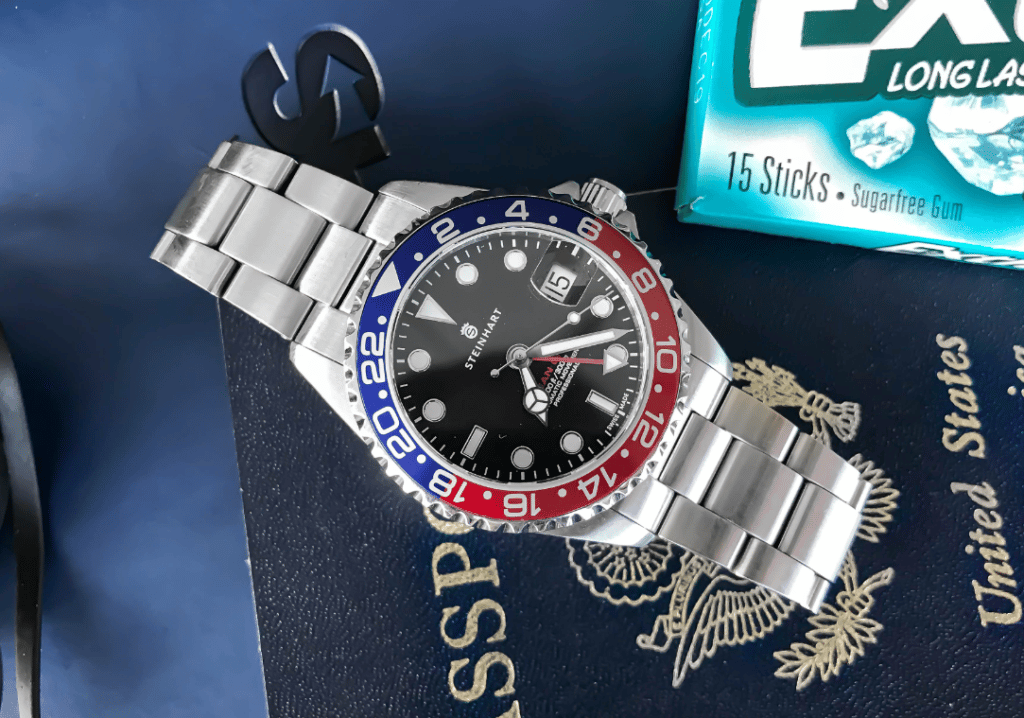
The Steinhart Ocean 39 GMT demands a certain bit of honesty up front: the resemblance to the Rolex GMT-Master II is obvious, and pretending otherwise would make the list less useful. The more interesting part is what Steinhart does with that familiar formula. The 39mm case and relatively skinny 47mm lug-to-lug give it a compact footprint that works especially well on smaller wrists, while the 13mm thickness wears slimmer than it suggests. The polished case sides help with that visual trick, although this is still a fairly substantial sports watch once you factor everything in.
According to our review team, the bezel is where the Ocean 39 GMT earns its personality. The red-and-blue insert has exactly the bright, clean color combination we associate with a Pepsi, and the matte black dial gives those colors plenty of contrast. The red-tipped GMT hand stretches to the minute track, making the second time zone easy to read. The thin hands and markers keep the dial crisp but a little short on depth. BGW9 lume holds up better than you might expect, and the Cyclops makes the date easier to spot, although the magnification could be stronger. The engraved Neptune on the caseback adds Steinhart character to a watch whose front end hardly tries to hide its inspiration.
The Ocean 39 GMT also leans pretty hard into its sporty roots. Its 120-click unidirectional bezel is very stiff, with enough resistance to make a Seiko Samurai look comparatively cooperative. That diver-style setup is less convenient for regularly adjusting a second time zone than a bidirectional GMT bezel. The ETA 2893-2 keeps things reliably Swiss but uses a caller-GMT layout. On the bracelet, solid end links, screwed links, a slight taper, and a sturdy safety clasp give it a reassuring feel, but the flip-lock is quite loose while the clasp itself is tight, making the four micro-adjustment positions difficult to dial in.
This is also not a watch we’d recommend trying to preserve in showroom condition. The 316L steel picks up scratches, particularly around the polished surfaces and bezel teeth, but the watch responds better to wear than to being babied. That suits its 300-meter water resistance and generally practical character. The case and bracelet have enough substance to feel dependable without turning the watch into another oversized GMT, and the flaws are mostly the sort you notice because the fundamentals work so well. Overall, the Ocean 39 GMT isn’t the freshest design here, and its homage-heavy appearance will bother some collectors. Still, for someone who wants vintage-leaning proportions, a highly legible Pepsi layout, and a GMT that actually behaves itself on a smaller wrist, it makes a compelling case.
Pros
- 39mm case and 47mm lug-to-lug give the watch a balanced, compact feel, especially on smaller wrists.
- The vivid Pepsi bezel colors are clean, while the matte black dial keeps the display easy to read.
- The full-length, red-tipped GMT hand makes the second time zone easy to spot.
- BGW9 lume performs well, and the Cyclops makes the date easier to read.
- A solid end-link bracelet, screwed links, a useful taper, and a secure safety clasp give the bracelet a substantial feel.
- 300-meter water resistance adds genuine everyday toughness.
Cons
- Polished bezel teeth and case surfaces show scratches readily.
- The 120-click unidirectional bezel is extremely stiff and less practical for frequent GMT adjustments.
- The flip-lock clasp is awkward to fine-tune, with the adjustment holes falling between too tight and too loose.
- The Rolex-inspired design leaves little room for originality, which some collectors will find hard to overlook.
Nodus Contrail GMT Laguna
| Price: | $825 – $900 (Check current price) |
| Water Resistance: | 200m |
| Case Dimensions: | 40.5mm (diameter) x 46.6mm (lug-to-lug) x 11.8mm (thickness) |
| Lug Width: | 20mm |
| Movement: | Miyota 9075 |
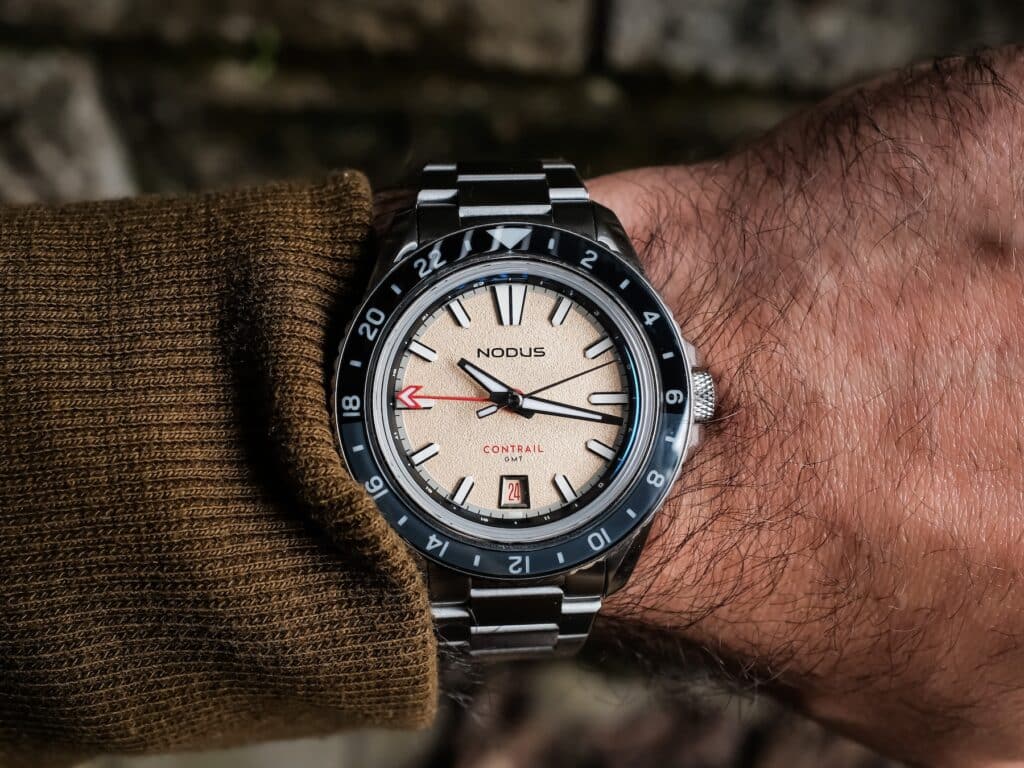
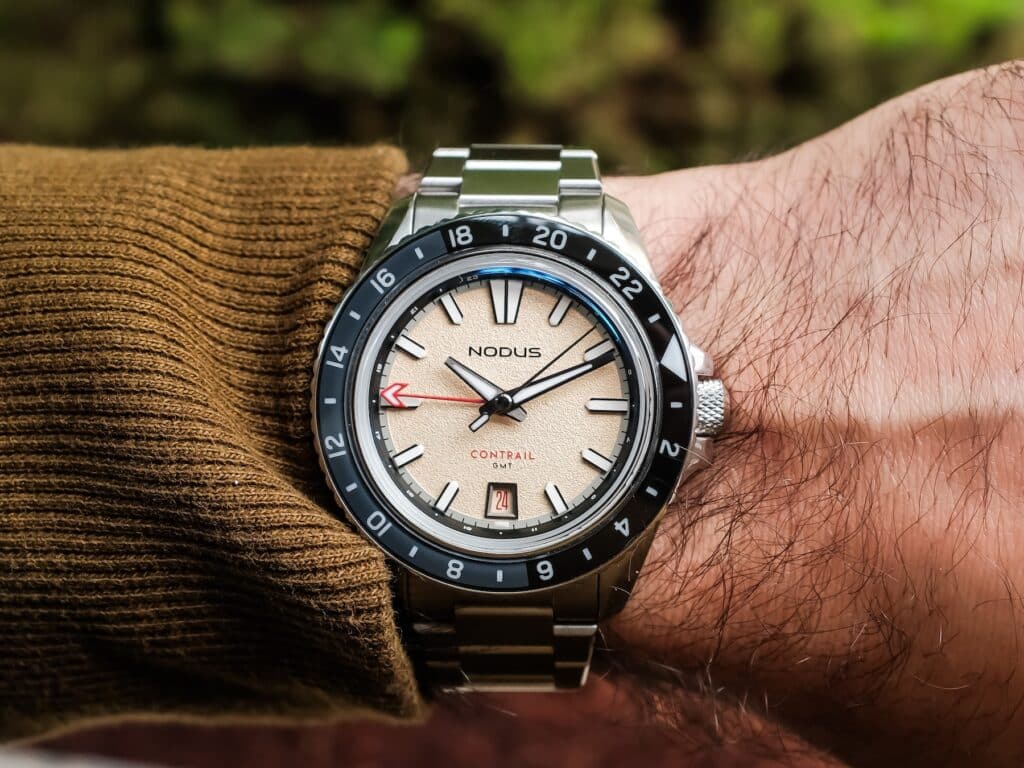
The Nodus Contrail GMT Laguna is a good reminder that “40mm GMT” doesn’t tell you much about how the thing actually wears. At 40.5mm, it sounds like a fairly ordinary modern sports watch, but the 11.8mm thickness and 46.6mm lug-to-lug are what make the difference once it’s on the wrist. The twisted lugs help it settle instead of sitting rigidly on top of your wrist, and the case stays close to the skin for a watch with a flyer GMT and 200 meters of water resistance. We also like that Nodus didn’t turn that compactness into visual blandness. The mix of brushing and polishing, box sapphire crystal, and sapphire bezel insert gives the case enough going on without adding bulk.
The Miyota 9075 earns its keep here, too. This is a proper flyer GMT, so changing the local hour means one easy crown adjustment rather than resetting the whole watch when you land. In our hands-on time, that jump felt clean and precise, the movement kept steady for accuracy, and the roughly 42-hour reserve was perfectly manageable in a normal rotation. The large screw-down crown gives you something substantial to grab when making those adjustments without the usual fingernail-versus-crown nonsense. And because the watch stays relatively thin despite the movement, the useful GMT hardware doesn’t come with the usual penalty of a thick, top-heavy case.
Then there’s the Laguna dial, which does a lot of work without shouting for attention. The sandy color shifts with the light, and the roulette date adds character without turning the dial into a dashboard. The smooth 48-click bidirectional bezel, internal 24-hour scale, main handset, and GMT hand take a short adjustment period, but once you get familiar with the layout, tracking another time zone becomes straightforward. The bold hands help at a glance, and BGW9 lume across the markers, bezel numerals, and GMT hand keeps the display useful after dark. Our one complaint is the internal 24-hour numerals: they could be larger, because when you’re checking the time quickly rather than admiring the dial, every bit of legibility helps.
The bracelet is where Nodus gets the balance mostly right, with one mildly chunky footnote. Screw links make sizing easy, and the NodeX clasp lets you adjust on the fly when your wrist changes during the day. The clasp itself is noticeably bulkier than the rest of the watch, though, and the H-link bracelet’s 20mm-to-16mm taper feels restrained if you prefer a more pronounced narrowing toward the clasp. Still, those are small complaints next to what the Contrail gets right for this particular job: it retains a flyer GMT, a useful bezel, and serious water resistance in a microbrand watch that stays thin, stable, and pretty unobtrusive on the wrist.
Pros
- At 11.8mm thick and 46.6mm lug-to-lug, the watch stays compact and stable on the wrist.
- Miyota 9075 flyer GMT makes local-time adjustments useful when traveling.
- 200 meters of water resistance adds plenty of practical headroom.
- The Laguna dial adds warmth and character without sacrificing clarity.
- BGW9 lume on the markers, bezel numerals, and GMT hand remains useful after dark.
- The smooth 48-click bidirectional bezel makes multiple-time-zone tracking intuitive once you learn the layout.
Cons
- Internal 24-hour numerals are smaller than we’d like for quick reading.
- The NodeX clasp feels chunkier than the rest of the watch.
- The 20mm-to-16mm bracelet taper is fairly conservative.
Nodus x Raven TrailTrekker
| Price: | $925 – $1075 (Check current price) |
| Water Resistance: | 200m |
| Case Dimensions: | 39.5mm (diameter) x 46.6mm (lug-to-lug) x 11.8mm (thickness) |
| Lug Width: | 20mm |
| Movement: | Miyota 9075 |
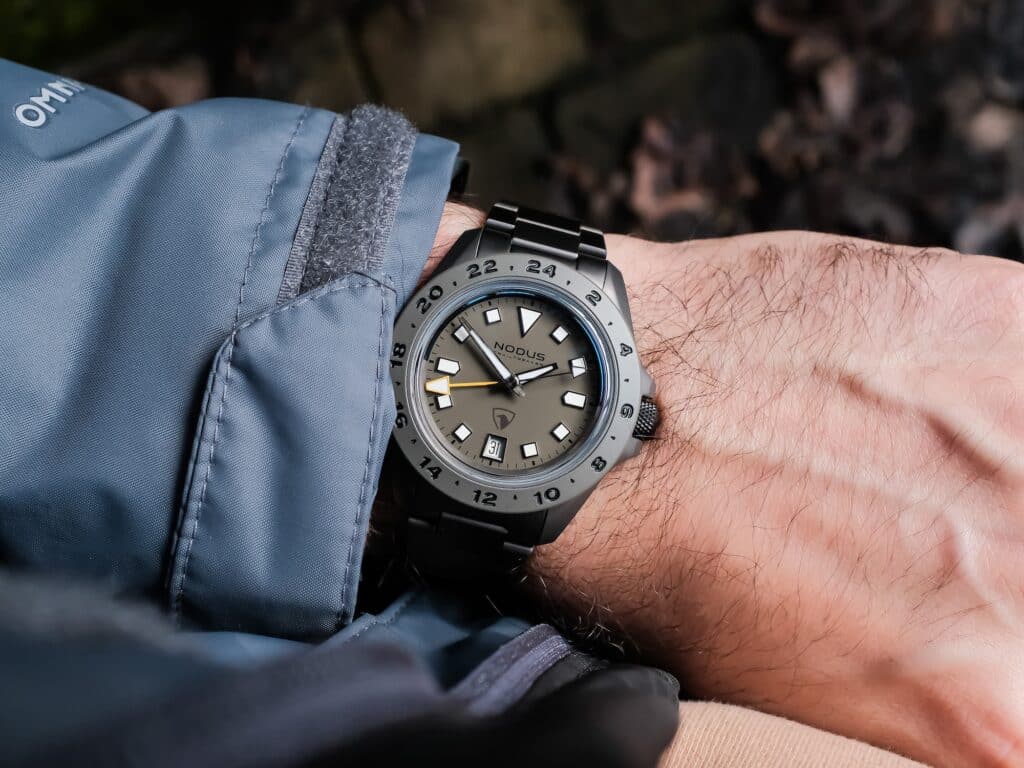
The TrailTrekker proves a GMT can get you somewhere without turning the journey into an endurance test for your wrist. At 39.5mm, the DLC-coated case stays compact while still feeling rugged, and the muted gray finish avoids the dress-up-as-a-tactical-watch look that black coatings can sometimes fall into. The sand-colored Cerakote bezel fits the outdoor character nicely, while the sapphire crystal, deeply knurled screw-down crown, and 200-meter water resistance give the watch plenty of protection for swimming, bad weather, and forgetting it’s on your wrist. For a watch with this much hardware, it never develops the bulk that can make a GMT feel more like gear than something you actually want to wear.
The Miyota 9075 is arguably the more important part of the package because this is a flyer GMT, and that matters when you’re actually traveling. The local hour hand jumps independently, making time-zone changes much less tedious than on a caller GMT. Throughout our review period, those jumps felt clean and precise; accuracy stayed within a few seconds of our reference time. The jumping hour also made date changes more intuitive when crossing time zones. The high-contrast 24-hour scale is easy to follow, and that bright yellow GMT hand is about as subtle as a highlighter pen, which is either exactly what you want or something traditionalists may need time to forgive.
The dial keeps the rest of the information from becoming too much of a cockpit. Its textured sandy surface picks up the character of the bezel, while applied markers, gunmetal hands, and the 6 o’clock date keep the layout balanced. The restrained dual branding helps, too. Lume is serviceable after dark, although it isn’t going to bully the brightest lume we’ve tested off the stage. More importantly, none of this visual or functional equipment makes the watch feel oversized. The compact case does the heavy lifting, while the flat-link bracelet sits close to the wrist, tapers from 20mm to 16mm, and quickly became our preferred setup over the given nylon strap.
Then there’s the NodeX clasp, which is one of those details you don’t think much about until you’ve used it and suddenly wonder why every watch doesn’t do this. Around 10mm of on-the-fly adjustment makes it easy to loosen or tighten the bracelet as your wrist changes during the day. In short, at just under 40mm, this GMT feels rugged, travel-ready, and properly wearable without forcing you to make peace with a giant case.
Pros
- The 39.5mm DLC-coated case keeps the GMT compact while still feeling rugged.
- Accuracy stayed within a few seconds of our reference time during testing.
- The flat-link bracelet sits close to the wrist and tapers neatly from 20mm to 16mm.
- NodeX clasp offers around 10mm of genuinely useful on-the-fly adjustment.
- Flyer-style Miyota 9075 makes local-time changes quick and intuitive.
- High-contrast 24-hour scale and bright yellow GMT hand make the second time zone hard to miss.
- Sand-colored Cerakote bezel and muted gray DLC finish give it a rugged look without going full tactical cosplay.
Cons
- The bright yellow GMT hand is visually loud and won’t suit collectors looking for a more subtle dial.
- Lume falls short of the brightest watches we’ve tested.
Farer World Timer Roché II
| Price: | $1,775 (leather strap) $1,865 (stainless steel bracelet)(Check current price) |
| Water Resistance: | 100m |
| Case Dimensions: | 39mm (diameter) x 45mm (lug-to-lug) x 11mm (thickness) |
| Lug Width: | 20mm |
| Movement: | Sellita SW330-1 Elaboré |
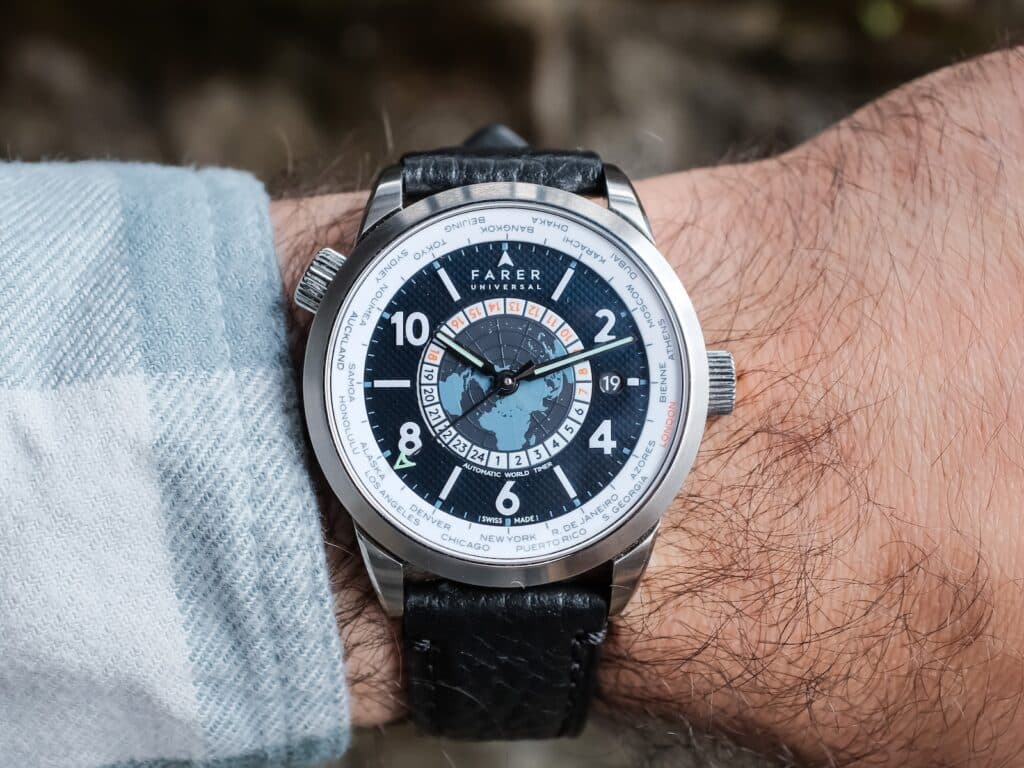
The Farer World Timer Roché II takes a different route to keeping a travel watch manageable. Instead of stripping the complication back, it packs more information into a case that still feels properly wearable. The 39mm case sits flatter than expected and slips under a cuff without making you feel like you’ve strapped travel equipment to your wrist. That matters because a world timer can easily become visually and physically busy once you add extra information. It stays comfortable enough for a full day and sturdy enough to avoid feeling precious, thanks in part to its 100 meters of water resistance. It also reminds you that a compact travel watch doesn’t have to look like every other understated sports GMT.
Farer does a good job of keeping the dial from turning into a geography quiz on your wrist. The textured midnight-blue surface separates the rotating 24-city ring from the rest of the display, while the raised markers add some depth without making everything fight for attention. The redesigned alpha hands are easier to follow, too. We needed a few days with the watch before the rotating 24-hour disc and inner bezel stopped feeling like something we had to decode consciously, but that learning curve is worth mentioning. Once familiar, the setup becomes natural. The lume across the hands, markers, and inner bezel also pulls its weight after dark, which matters when the watch is doing actual travel duty rather than sitting under good studio lighting.
As pointed out in our dedicated review, the modified Sellita SW330 delivers dependable performance and a 50-hour power reserve, making it forgiving when you rotate the watch out for a few days. The St. Venere leather strap is another small but important win: it softens quickly, stays comfortable on smaller wrists, and doesn’t spend the first week behaving like a belt. When you want a more substantial feel, the quick-release system makes switching to the bracelet painless. Those little ownership details matter more here than squeezing another complication onto the dial.
The compromise is largely financial and aesthetic. The Roché II costs more than plenty of straightforward GMTs, and there’s no getting around the fact that the dial is busier than the average travel watch. Minimalists may never make peace with it. But for the collector trying to avoid the usual oversized GMT formula, this is an interesting solution: rather than making the watch smaller by making it boring, Farer keeps the 39mm case comfortable and uses the extra visual complexity to add personality.
Pros
- Strong lume across the hands, markers, and inner bezel remains useful in low light.
- The St. Venere leather strap breaks in quickly and stays comfortable.
- The modified Sellita SW330 offers dependable performance and a useful 50-hour power reserve.
- Quick-release hardware makes switching between the leather strap and bracelet easy.
- The 39mm case wears flatter than expected and remains comfortable all day.
- The rotating 24-city world-time display provides more travel information than a conventional GMT without overwhelming the dial.
Cons
- The dial remains busy and won’t suit collectors who prefer a cleaner GMT layout.
- The inner bezel and 24-hour disc take some time to become second nature.
- The price is higher than many simpler enthusiast-oriented travel watches.
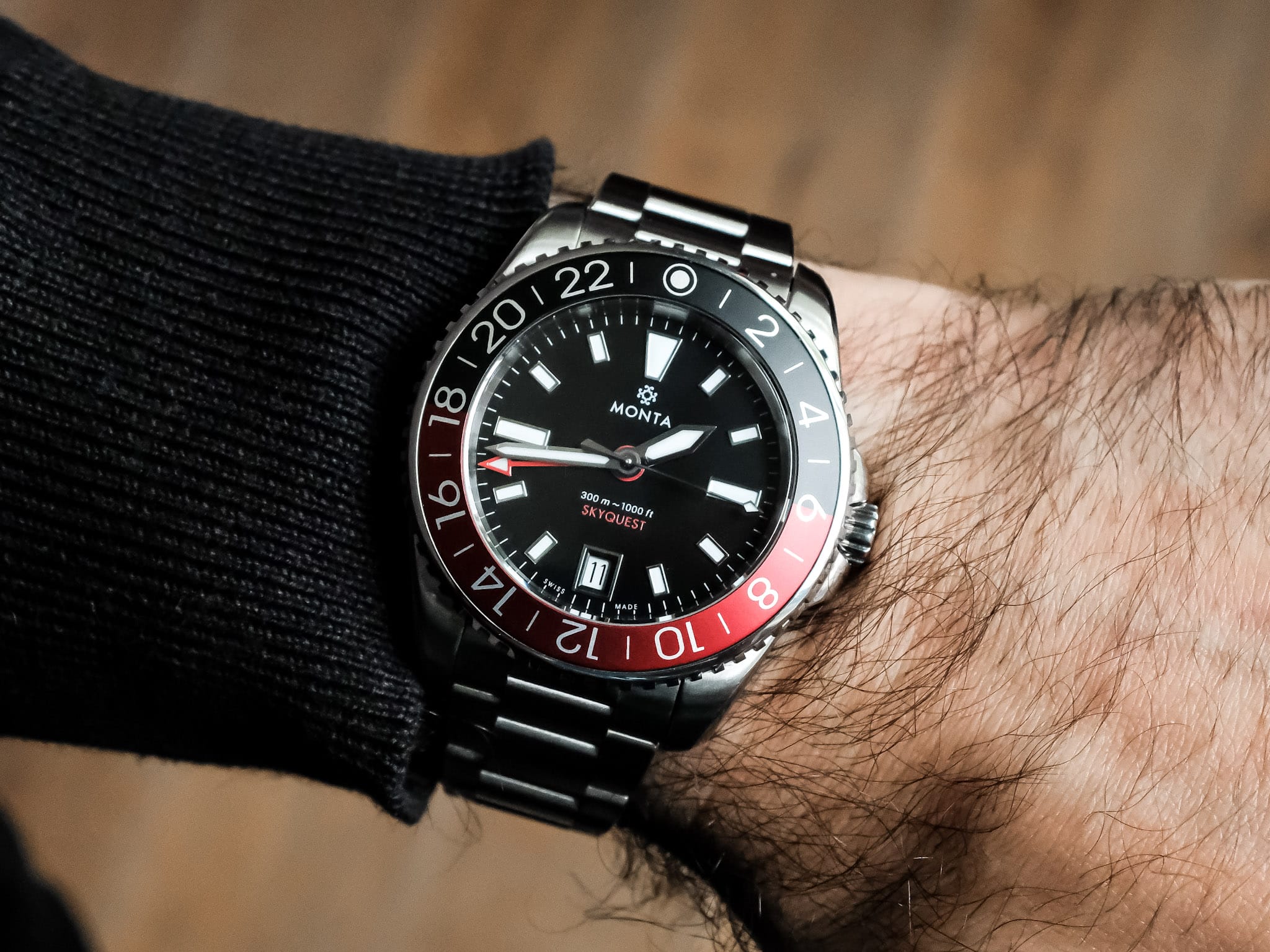
Monta Skyquest GMT
| Price: | $2,435 – $2,500 (Check current price) |
| Water Resistance: | 300m |
| Case Dimensions: | 40.7mm (diameter) x 47.4mm (lug-to-lug) x 11.8mm (thickness) |
| Lug Width: | 20mm |
| Movement: | Monta Caliber M-23 (Sellita SW330-2 base) |
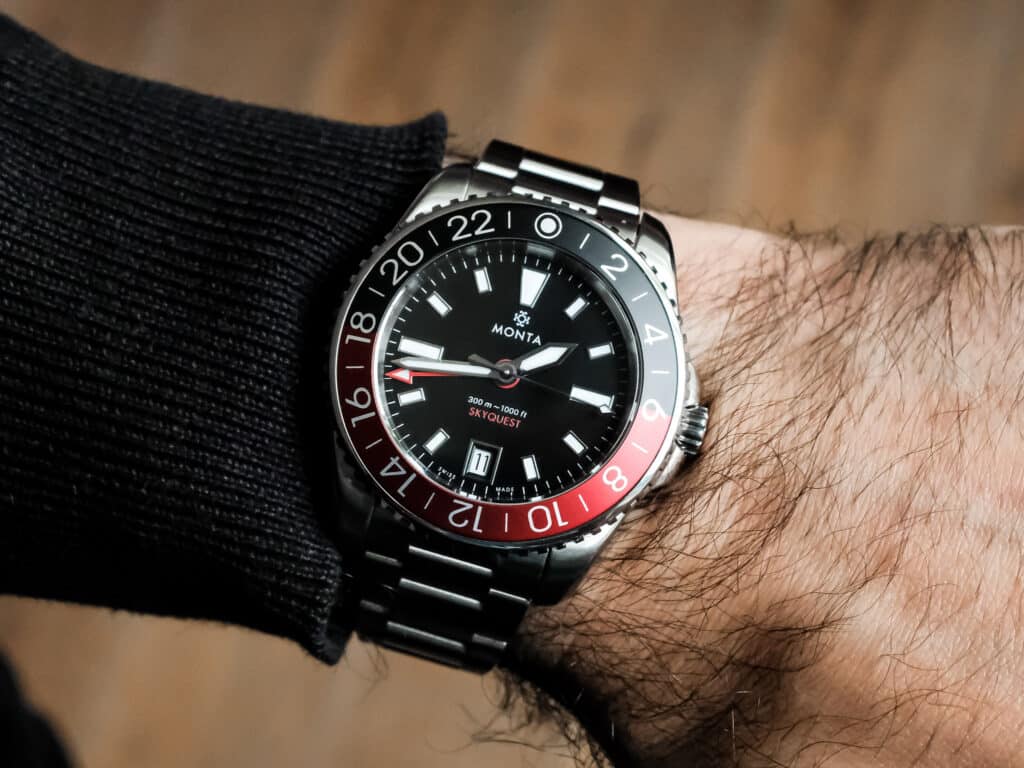
The Monta Skyquest GMT doesn’t immediately look like the kind of watch we’d pick for a list about keeping GMTs compact, which is why its time on the wrist is worth noticing. It has enough visual weight to feel substantial, but the case never seems to spread beyond where it needs to be. The larger 24-hour bezel markings help here, drawing the eye outward instead of cramming more information into the dial center. After extended wear, that balance becomes one of its biggest strengths. It feels settled rather than top-heavy, with enough presence for a sports watch but none of the wrist-filling attitude that makes some GMTs tiresome by mid-afternoon.
The bezel is where Monta’s attention to the unglamorous stuff starts paying off. It’s easy to grab and turns with a firm, predictable action, so you can adjust without wondering whether you’re about to overshoot. We found that confidence held up even with cold hands and gloves. The dial follows the same sensible approach, with applied markers and well-proportioned hands that keep the main time easy to read. At the same time, BGW9 Swiss Super-LumiNova stayed readable well into the evening. Monta also cleaned up some of the stranger details from earlier versions, giving the current Skyquest a more polished look. That’s arguably the right move for a watch this refined.
Then there’s the bracelet, which you’ll probably appreciate most once the novelty has worn off. Screw links make sizing straightforward, but the real payoff is the tool-free micro-adjustment. Wrists swell in heat, shrink in air conditioning, and generally refuse to behave consistently through a long day. Being able to fine-tune the fit without a tool sounds minor until you’ve spent a day traveling with a bracelet that is either too tight or flopping around. The milled clasp closes with a precise snap, and comfort stayed consistently high during extended wear. This is the kind of refinement that rarely makes the Instagram shot but makes a watch much easier to live with.
The Caliber M-23, based on the Sellita SW330, kept steady during testing, with consistent accuracy and roughly 55 hours of power reserve giving it useful breathing room in a rotation. The familiar movement base should also make future servicing less of a headache. The catch is the price, which pushes the Skyquest well beyond the value end of this group and into territory where brand name starts becoming part of the conversation. The cleaner update also loses some of its predecessor’s personality. But if the point is finding a GMT that wears like a considered piece of equipment rather than a wrist-mounted brick, the Skyquest makes a strong argument through the small stuff.
Pros
- Larger 24-hour bezel markings help keep the dial from feeling cramped.
- Tool-free micro-adjustment makes it easy to compensate for changing wrist size during the day.
- The firm, predictable bezel action remains easy to operate with cold hands or gloves.
- The screw-link bracelet and precisely milled clasp feel secure during extended wear.
- Caliber M-23 delivered consistent accuracy and around 55 hours of power reserve.
Cons
- The higher price puts it into territory where established-brand alternatives become part of the decision.
- The cleaner redesign loses some of the character found on earlier versions.
GMT watches don’t need oversized cases to feel capable. The best examples here prove that a compact footprint, sensible thickness, and a comfortable bracelet can matter more than diameter alone. After wearing all six, that’s the common thread we kept coming back to: useful travel functionality is better when the watch itself stays out of the way.

Co-Founder and Senior Editor
Kaz has been collecting watches since 2015, but he’s been fascinated by product design, the Collector’s psychology, and brand marketing his whole life. While sharing the same strong fondness for all things horologically-affordable as Mike (his TBWS partner in crime), Kaz’s collection niche is also focused on vintage Soviet watches as well as watches that feature a unique, but well-designed quirk or visual hook.