There’s a point in collecting where buying another dive watch starts to require a better excuse than “this one is nicer.” We’ve all been there. The first few divers are easy to justify because they teach you what works on your wrist: which proportions feel natural, how much heft you actually enjoy, and whether you’ll tolerate a bracelet that looks great but becomes annoying halfway through the day. After that, the differences get harder to spot in a product photo. A watch can have a strong reputation and still spend more time in the box than on your wrist, while another can quietly become the one you keep grabbing without thinking about it. Moving beyond starter pieces is less about finding a technically better diver and more about finding one that earns its place in the collection. That’s what we’re looking for here.
Years of wearing and testing watches have made us pay attention to the things that only become obvious once the honeymoon is over. A bezel that still feels good after the hundredth turn matters more than one that impressed us on day one. The way a bracelet articulates, how a case sits after eight hours, whether the dial stays legible in harsh light, and how a watch picks up scratches all tell us more than a spec sheet can. We’ve also learned that refinement doesn’t automatically make a watch more enjoyable, and that a few quirks can be exactly what makes a piece worth keeping. So while every watch here gives us a reason to consider it a step beyond the usual starter diver, we’ll also get into the little things that might make you choose one over another.
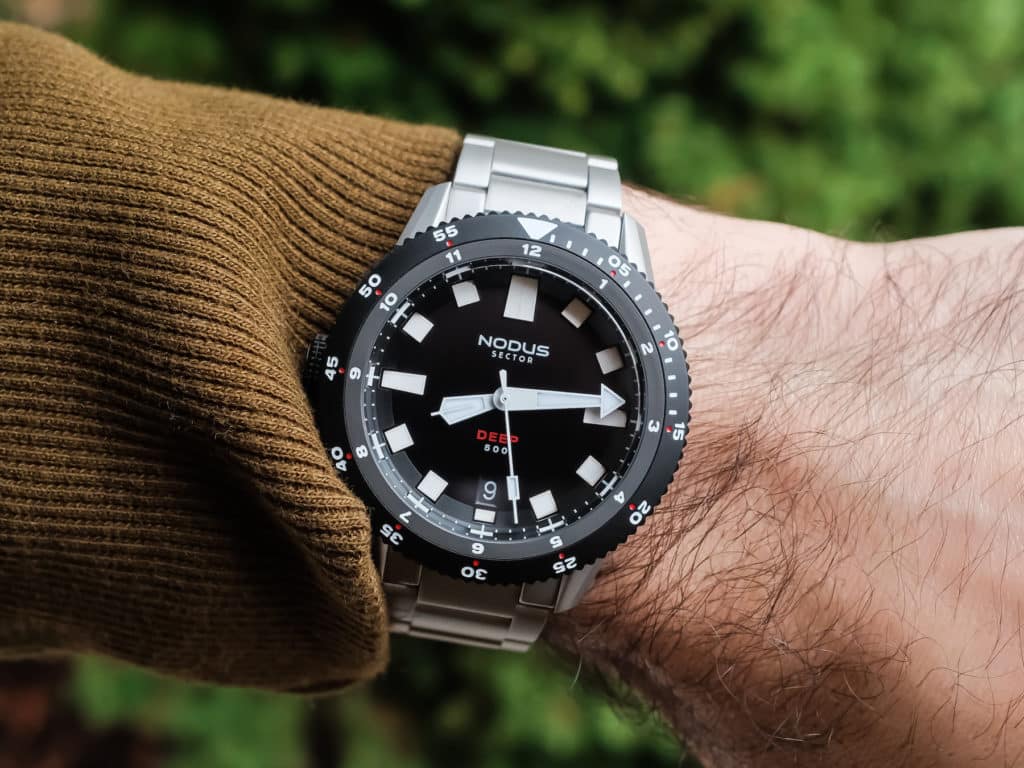
Nodus Sector Deep
| Price: | $599 |
| Water Resistance: | 500m |
| Case Dimensions: | 38mm (diameter) x 47mm (lug-to-lug) x 13.6mm (thickness) |
| Lug Width: | 20mm |
| Movement: | Seiko NH35 (Mechanical Movement) |
The Nodus Sector Deep feels like it was designed by someone who has spent enough time wearing watches to get annoyed by the same little problems the rest of us eventually notice. The 38mm case has enough heft to avoid feeling dainty, but it doesn’t turn into a wrist anchor by lunchtime. Better still, the crown sits on the left, so there’s no digging into the wrist when you bend your hand. That matters more once you’re past your first few divers and start realizing that “good enough” comfort gets old quickly. The Seiko NH35 is familiar territory, but Nodus regulates it in-house, and our example stayed within ±10 seconds per day during testing. Around 41 hours of power reserve isn’t going to make headlines either, but it does mean the Sector Deep behaves predictably when you take it off for a day and come back to it.
The bracelet is where the Sector Deep starts feeling like a watch made for someone who has already owned a few watches. Screw links mean sizing doesn’t require an afternoon, the 20mm-to-18mm taper keeps the bracelet from looking like it’s carrying the case around, and the NodeX clasp’s micro-adjustment is handy when your wrist swells in the heat.
The case itself is deliberately odd, with an asymmetry that looks more interesting in person than it does in isolation. After living with it, we stopped thinking about the shape pretty quickly because it simply wears well. The dial takes a similarly restrained approach. White PVD surrounds catch the light without shouting for attention, the lume-filled plots narrow toward the cardinal markers, and BGW9 Super-LumiNova stays legible through the night. It has enough texture and depth to keep things interesting without turning into a tiny dashboard.
The matte DLC bezel is another practical win. It gives you enough grip to operate it confidently, keeps reflections under control, and somehow accommodates a dual-scale insert without making the whole watch look busy. There is one bit that feels like it missed the final round of quality control: fully extending the clasp exposes hardware. That’s a shame because the rest of the Sector Deep is unusually cohesive. And that, more than its movement or water-resistance credentials, is why we’d put it on a collector’s shortlist. It feels like Nodus took the lessons that usually come after owning a few starter divers and dealt with them before asking you to buy the watch. That’s a pretty good way for an independent brand to earn its place in a collection.
Pros
- The 38mm case and left-side crown make all-day wear notably comfortable without feeling undersized.
- Screw links, the 20mm-to-18mm taper, and NodeX micro-adjustment make the bracelet easy to live with.
- Nodus’ in-house regulation kept our NH35 within approximately ±10 seconds per day during testing.
- The matte DLC bezel gives good grip, reduces glare, and keeps the dual-scale insert from becoming visually cluttered.
- White PVD surrounds, tapered lume plots, and BGW9 Super-LumiNova provide strong low-light legibility.
Cons
- Fully extending the clasp exposes hardware that looks unfinished compared with the rest of the bracelet.
- The asymmetrical case won’t win over collectors who want their next diver to stick to conventional proportions.
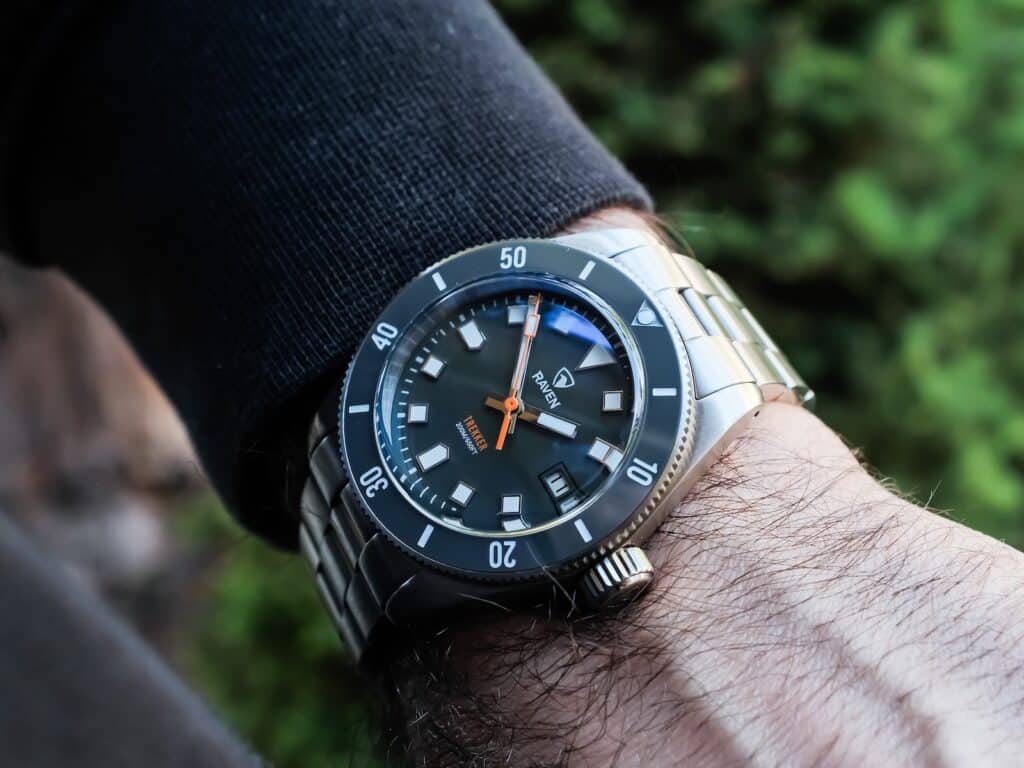
Raven Trekker
| Price: | $690 |
| Water Resistance: | 200m |
| Case Dimensions: | 39mm (diameter) x 48mm (lug-to-lug) x 12.5mm (thickness) |
| Lug Width: | 20mm |
| Movement: | Miyota 9015 |
The Raven Trekker is the kind of mature microbrand diver that makes more sense after you’ve owned enough watches to recognize when “new” is being used as a substitute for “better.” Raven has spent several generations refining this design rather than constantly reinventing it, and the latest version benefits from that patience. The 39mm case is the slimmest Trekker yet at 12.5mm, including the boxed sapphire crystal, and the flat caseback helps it sit flatter and more naturally on the wrist than its predecessors. The 48mm lug-to-lug gives it enough presence without making it cumbersome. Raven also reduced water resistance from 300 to 200 meters, but after living with it, we never felt shortchanged. The oversized screw-down crown still gives the watch plenty of tool-watch attitude without turning it into a piece of diving equipment cosplay.
The glossy gray dial and matching ceramic bezel are where the Trekker separates itself from the usual microbrand formula. The dial shifts from charcoal outdoors to something closer to blue-black indoors, with the strong blue AR coating doing plenty of the visual heavy lifting. Polished hands and applied markers remain easy to pick out, while restrained orange accents keep the dial from becoming another anonymous gray diver.
The coin-edge bezel is more satisfying to use than it has any business being: 120 clicks, crisp engagement, and enough grip to operate without fuss. Underneath, the Miyota 9015 fits the watch’s practical character. It wound smoothly and kept excellent time throughout our review, without the noisy rotor behavior or other little movement irritations that can make a supposedly refined watch feel less refined.
The bracelet is arguably where the Trekker makes its strongest case for moving beyond starter pieces. We expected the drilled lugs to encourage strap experimentation, but the oyster-style bracelet stayed on our wrist most of the time because Raven got the basics right. The 20mm-to-16mm taper keeps the watch from feeling bulky, single-sided screws make sizing straightforward, and the NodeX clasp provides useful on-the-fly adjustment rather than another checkbox on the spec sheet. There are still a couple of rough edges: the clasp extension looks awkward when deployed, our sample developed some side-to-side play, and the blue AR coating can throw noticeable reflections in certain light. But those are relatively minor complaints against a watch that has clearly been refined through use. For a collector moving beyond starter divers, that matters.
Pros
- The revised 39mm case is thinner and sits flatter than previous Trekker versions, making it easy to wear.
- The glossy gray dial and ceramic bezel change character with the light without resorting to faux-military styling.
- The oyster-style bracelet, drilled lugs, and NodeX micro-adjustment make it easy to live with.
- Miyota 9015 winds smoothly and delivered excellent timekeeping during testing.
- Crisp 120-click coin-edge bezel provides excellent grip and precise operation.
Cons
- The strong blue AR coating can produce distracting reflections under certain lighting conditions.
- The NodeX clasp extension looks awkward when fully deployed, and our sample developed slight lateral play.
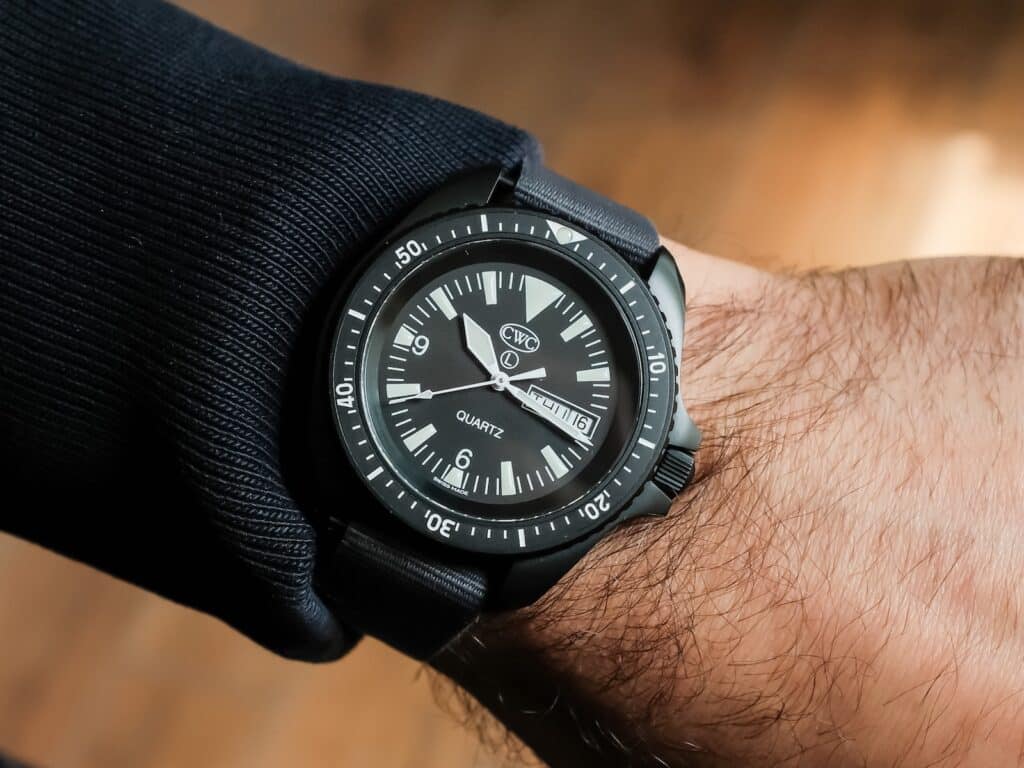
CWC SBS Diver
| Price: | $960 |
| Water Resistance: | 300m |
| Case Dimensions: | 45mm (diameter incl. crown) x 47mm (lug-to-lug) x 11mm (thickness) |
| Lug Width: | 20mm |
| Movement: | Ronda Swiss-made 517 quartz |
The CWC SBS Diver is a good reminder that moving beyond a starter diver doesn’t have to mean moving toward something shinier. This is a specialized watch that knows what it wants to be. The black PVD case is dark, blunt, and unapologetically utilitarian, with none of the polished bevels or decorative finishing you might expect from a more expensive upgrade. Its Special Boat Service connection makes that restraint feel appropriate rather than theatrical. The case also has a reassuring density without becoming a nuisance after several hours, and we found ourselves enjoying it on single-pass nylon, RAF-style, and other utilitarian straps. Swap the strap and the mood changes slightly, but the SBS Diver never stops looking like it has somewhere useful to be.
The quartz movement is another example of CWC refusing to play the usual collector game. Over five weeks of wear and timing, ours stayed within five seconds. That’s wonderfully unexciting, which is exactly the point. There’s no winding, no weekend correction, and no wondering how much time disappeared while the watch sat in the box. The dial takes more getting used to. It looks busier than many contemporary divers at first. Still, the oversized markers and sword hands make quick readings quite easy, especially when you’re moving around or the light is fading. The “circle L” marking denotes Luminova, which charged quickly and stayed visible through most of the night. The flat crystal also kept reflections in check outdoors, where excessive glare can turn even a highly legible dial into a guessing game.
That makes the SBS Diver an unusually honest upgrade for the collector who wants something with a job rather than another prettier version of a familiar diver. It felt equally at home camping, running errands, or spending a long day outside, and the combination of dependable quartz, subdued finishing, useful strap options, and excellent legibility never felt like it was trying too hard.
The catch is that the price may not make sense if you’re looking for luxurious finishing or mechanical charm, and the dial’s busier layout takes some wrist time to appreciate fully. But if your collection has reached the stage where authenticity matters more than showing off what you spent, the SBS Diver has a pretty compelling argument.
Pros
- Five weeks of timing showed excellent accuracy, with the quartz movement staying within five seconds.
- The black PVD case has genuine purpose-built character rather than decorative military styling.
- Flat crystal controls glare effectively when worn outdoors.
- Luminova charges quickly and remains visible for most of the night.
- Works particularly well across single-pass nylon, RAF-style, and other utilitarian straps.
Cons
- Collectors chasing polished finishing or mechanical personality may struggle to justify the price.
- The dial initially feels busier than cleaner contemporary divers.
Halios Seaforth IV Titanium
| Price: | $965 |
| Water Resistance: | 200m |
| Case Dimensions: | 41mm (diameter) x 46.5mm (lug-to-lug) x 12.4mm (thickness) |
| Lug Width: | 20mm |
| Movement: | Sellita SW200-1 |
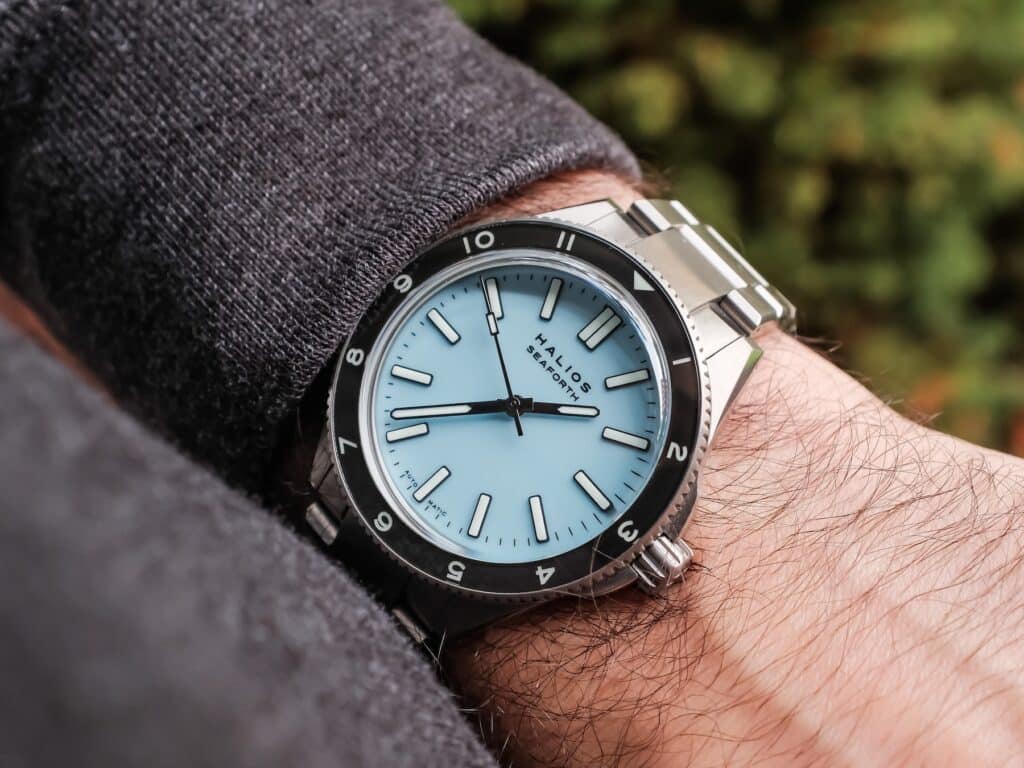
The Halios Seaforth IV Titanium is a good example of what happens when a microbrand stops trying to convince you that an upgrade needs to be bigger, heavier, or more complicated. The first surprise is how little of the watch you feel. Pick it up, and the titanium case is almost comically light; wear it all day, and the case taper makes it feel slimmer than the numbers suggest. The double-domed sapphire adds some visual lift without turning the watch into a wrist-mounted bubble. Halios also avoided the usual titanium problem of making everything look like unfinished gray hardware. The brushing is clean, the polished lug chamfers give the case some shape, and it still works as a practical sports diver, with a screw-down crown, screw-down caseback, and 20 ATM water resistance.
The Seaforth also gets the less glamorous stuff right. The titanium bracelet pairs well with the case, uses screw links for straightforward sizing, and stays comfortable throughout the day. The stainless steel clasp gives the otherwise featherweight setup a little balance. At the same time, the tool-free micro-adjustment became genuinely useful when our wrists expanded in the heat during hands-on testing. The 120-click bezel is similarly well judged: smooth, positive, and grippy without requiring gloves or a wrestling background. We also liked the 12-hour bezel, which gives you a simple second-time-zone reference without adding another hand or turning the dial into a miniature airport departures board. The Sellita SW200-1 follows the same sensible approach. It set easily, ran predictably, and delivered a practical 40-hour power reserve.
The blue dial is another thing that makes more sense with wrist time. It changes subtly with the light instead of sitting there looking like a flat slab of blue paint, while raised ceramic markers add some welcome crispness. Super-LumiNova C3 X1 on the hands, markers, and bezel fades evenly in low light, which is exactly what you want when you’re trying to read the thing at 2 a.m. without negotiating with uneven lume. The no-date layout helps, too; there’s less clutter and less to reset when the watch has been sitting in the box.
Titanium does have its price to pay, though. The case and bracelet picked up scratches through normal wear, and Halios availability can make the whole “I’ll just buy one” plan unnecessarily optimistic. For collectors moving beyond starter divers, though, that scarcity is secondary to what the watch gets right. It’s light, distinctive, thoughtfully finished, and full of the kind of small decisions that become more impressive the longer you wear it.
Pros
- Tool-free micro-adjustment makes the lightweight titanium bracelet easy to fine-tune throughout the day.
- The blue dial shifts naturally with changing light, while raised ceramic markers add definition.
- Smooth 120-click bezel action and a useful 12-hour scale add practical functionality without clutter.
- The case taper and double-domed sapphire help the watch wear slimmer than its measurements imply.
- Clean brushing and polished lug chamfers give the titanium case enough character without over-dressing it.
Cons
- Availability is frustrating enough that finding one can be harder than deciding whether you want one.
- Regular wear leaves visible scratches on the titanium case and bracelet.
Mido Ocean Star Titanium
| Price: | $1040 |
| Water Resistance: | 200m |
| Case Dimensions: | 42.5mm (diameter) x 42.5mm (lug-to-lug) x 11.75mm (thickness) |
| Lug Width: | 22mm |
| Movement: | Caliber 80 |
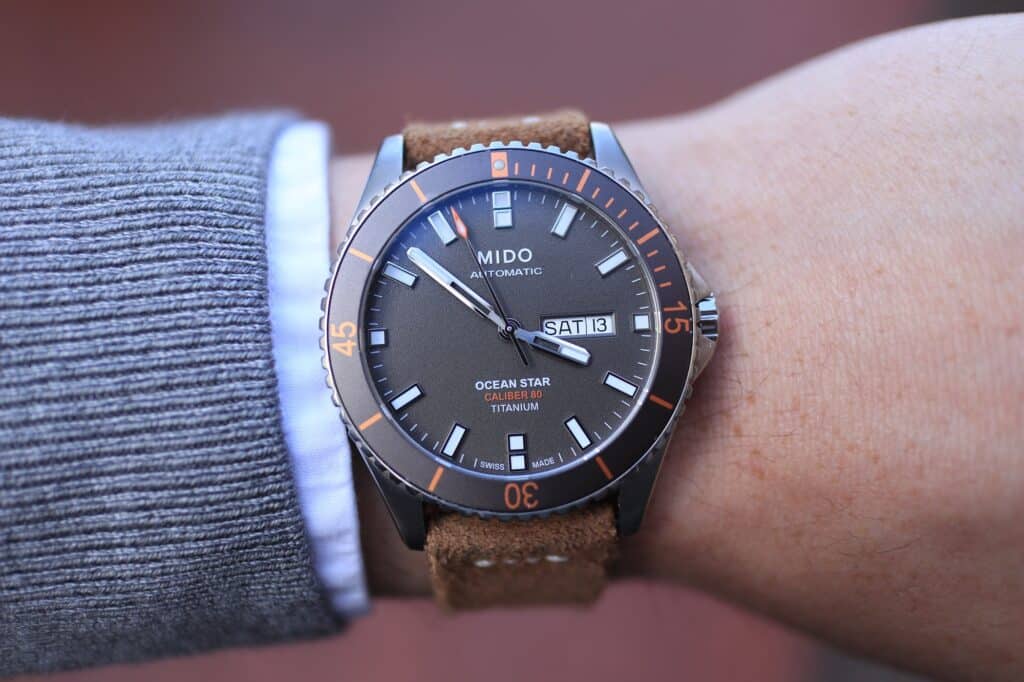
The Mido Ocean Star Titanium is the kind of attainable upgrade that makes sense after you’ve owned enough divers to stop romanticizing every new purchase. It is not trying to be the loudest thing in the room, and honestly, that helps. The 42.5mm case sounds like it should wear like a small appliance, but the fully brushed titanium keeps it from turning into a wrist brick, and at about 11.75mm thick, it stayed comfortable through commuting, desk work, and errands that expose a watch’s bad habits. The case has enough contour to avoid feeling slabby; the sloped bezel follows that shape rather than sitting on top like an afterthought; and the polished chamfer along the edge adds enough contrast to keep the whole thing from going full “anonymous titanium object.”
The dial is where the Ocean Star stops being merely sensible and becomes a little more interesting than it first appears. The anthracite texture shifts with the light, sometimes reflecting it, sometimes soaking it up, and the double AR-coated sapphire does its job without turning the watch into a mirror. That matters more than it sounds like it should, because a diver that looks good for ten minutes and then turns into a glare machine is an inconvenience. Mido also handled the day-date layout with more thought than many brands bring to the job, using shorter markers at nine and three so the dial still feels balanced. The pencil hands, filled with BGW9 Super-LumiNova, charge quickly and cast a cool blue-green glow at night, while the orange second hand with its luminous tip makes the whole thing easy to track at a glance.
Underneath, the Caliber 80 is the kind of movement upgrade that matters in real life, not in brochure-world. Based on the ETA 2824 architecture, it stretches power reserve to 80 hours, which means the watch can sit for a couple of days without turning into a dead project on the dresser. The titanium bracelet fits the same no-nonsense brief: curved links help it wrap around the wrist, the underside shaping keeps it from feeling rigid, the 22mm-to-19mm taper avoids the dreaded titanium-plank effect, and the ratcheting clasp makes small fit changes easy when your wrist decides to behave differently in heat.
The annoyances are real, though. As discussed in our dedicated review, the screw-down crown can be stubborn enough to require a fingernail; the lugs could drop a little more aggressively for smaller wrists; and the case/dial color combo does not exactly audition well with every strap in the drawer. Still, for collectors who want to move past starter pieces without turning the purchase into a personality test, the Ocean Star Titanium is straightforward: lightweight, Swiss, durable, and just interesting enough to keep wearing.
Pros
- The 80-hour Caliber 80 power reserve is genuinely useful in a rotation.
- Fully brushed titanium keeps the large-ish case lighter and easier to live with.
- Curved links, a 22mm-to-19mm taper, and a ratcheting clasp make the bracelet easy to wear and adjust.
- Anthracite dial texture and double AR-coated sapphire keep legibility strong as lighting changes.
- BGW9 lume and the orange second-hand tip make night checks and glances easy.
Cons
- The screw-down crown can be stubborn to start loosening.
- The dial and case color combo limits strap flexibility more than ideal.
- The lugs could curve down more to improve fit on smaller wrists.
Serica 5303-2
| Price: | $1,720 – $1,950 |
| Water Resistance: | 300m |
| Case Dimensions: | 39mm (diameter) x 46mm (lug-to-lug) x 12.2mm (thickness) |
| Lug Width: | 20mm |
| Movement: | Soprod Newton (current model has Soprod M100) |
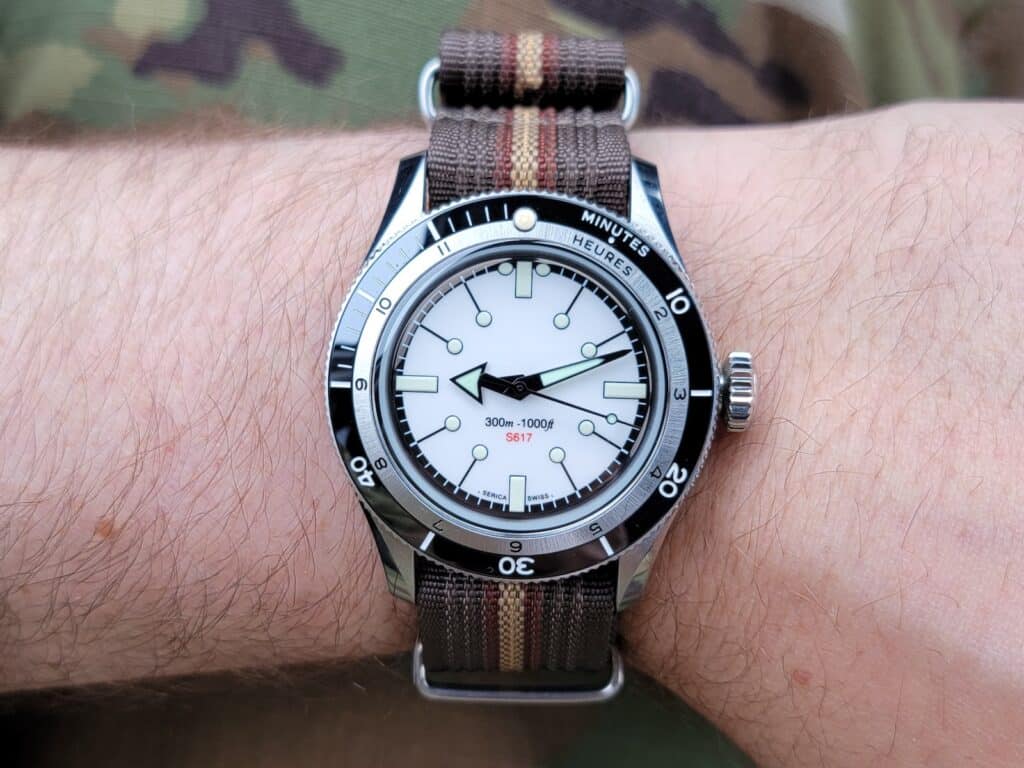
The Serica 5303-2 is difficult to file neatly under “dive watch,” which is probably why it belongs on a collector’s upgrade list. After enough hands-on time with it, we found ourselves treating it less like another piece of diving equipment and more like the watch we’d grab when a conventional diver felt a little too predictable. The 39mm case, 46mm lug-to-lug, and 12.2mm thickness keep it compact without making it feel undersized, while the oversized 8mm crown is easy to grab. The case mixes straightforward brushing with polished lug chamfers, but the real personality comes from the metallic silver dial. It often looks almost matte white, with geometric-textured markers and minimalistic branding giving it a clean yet unmistakable presence. If your starter-diver phase has left you with several variations on black and blue, this is a welcome change of scenery.
Then there’s the bezel, which initially looks as if Serica had a few too many ideas and decided to use them all. In practice, it works. The black ceramic outer ring handles elapsed timing, while the steel inner 12-hour scale gives you a second-time-zone reference without adding another hand. The 120-click action is crisp and free of play, and after using it for a while, the two scales no longer feel like competing instructions. Strong lume backs up the clean daytime layout after dark. However, the integrated mesh bracelet is less successful. It looks fantastic and suits the watch, but the clasp can feel sharp, there’s no safety catch, and some of the hand-finishing doesn’t quite reach the level set by the case and dial. Luckily, the standard 20mm lug spacing makes strap changes painless, and this watch benefits from them.
Our example had the earlier Soprod Newton movement, which occasionally gave us minor crown-engagement and hacking quirks but remained dependable in normal use. Newer examples now use the revised Soprod M100, addressing those issues without fundamentally changing what makes the watch interesting. That’s a pretty sensible evolution for a watch already aimed at collectors rather than first-time buyers.
In short, the Serica isn’t the obvious choice if you want a familiar diver that disappears into the background, and the dual-scale bezel takes a little patience before it becomes second nature. But that’s also the point. Once you’ve owned a few competent starter divers, competence alone gets boring. The 5303-2 gives you unusual design, genuinely useful functionality, and enough quirks to make it feel like something you deliberately chose rather than something an algorithm handed you.
Pros
- The dual-scale bezel adds elapsed timing and second-time-zone functionality without requiring a dedicated GMT hand.
- The metallic silver dial, geometric markers, and restrained branding give it an identity that stands well apart from conventional divers.
- The 39mm case and 8mm crown make the watch compact but easy to handle.
- Strong lume keeps the unusual dial practical once the lights go out.
- Standard 20mm lug spacing makes experimenting with straps quite easy.
Cons
- The bezel’s two scales take some getting used to if you’re accustomed to a straightforward dive bezel.
- The mesh bracelet clasp can feel sharp and doesn’t include a safety catch.
- Some of the bracelet hand-finishing feels under-resolved compared with the quality of the case and dial.
Squale Sub 37 Legend
| Price: | $1,750 |
| Water Resistance: | 300m |
| Case Dimensions: | 37mm (diameter) x 45mm (lug-to-lug) x 11.2mm (thickness) |
| Lug Width: | 19mm |
| Movement: | Sellita SW200-1 |
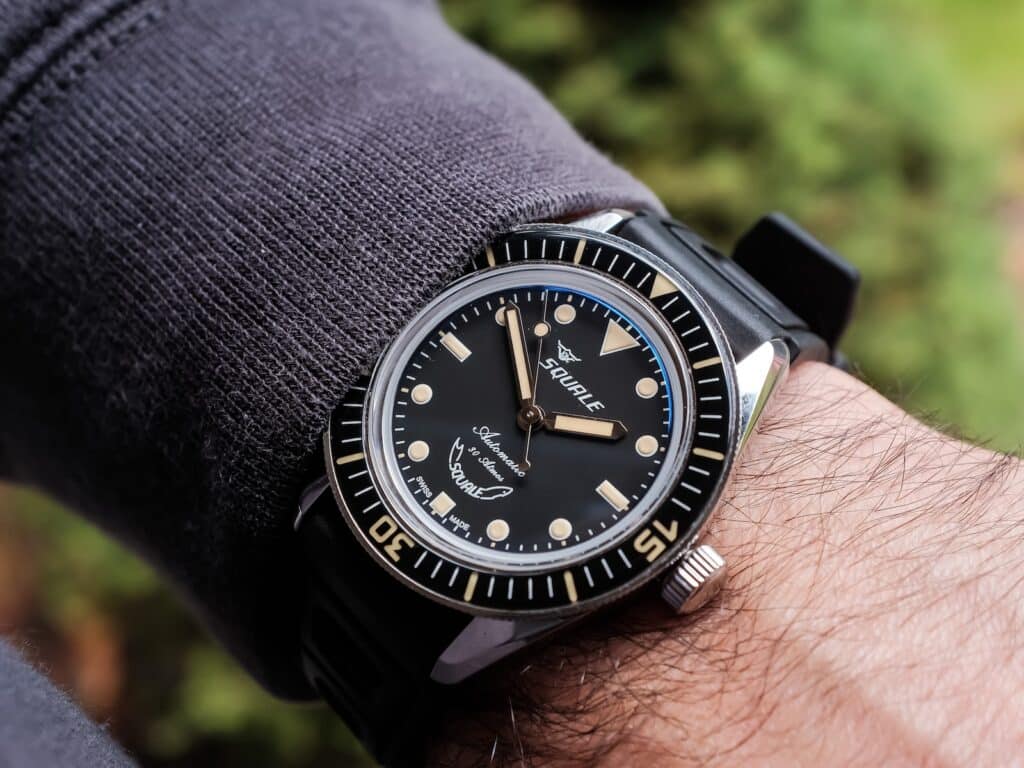
The Squale Sub-37 Legend is a useful reality check for collectors who have spent years being told that a proper dive watch should be getting bigger. At 37mm, it initially sounds like a niche choice, but the wrist quickly makes a better argument. The 45mm lug-to-lug gives it enough presence, while the remarkably slim 11.2mm profile lets it sit close enough to the wrist that plenty of modern 40mm divers start feeling like they brought unnecessary luggage.
The polished case also gives it some life without turning it into a dress watch. More importantly, the vintage influence never feels like a costume. The curved black bezel insert, double-domed sapphire, and old radium-toned lume create the right atmosphere without sacrificing the sense that this is a modern, properly built watch.
The details hold up once you stop admiring the proportions and start using the thing. The black dial is clean and easy to read, while the Sellita SW200-1 quietly does its job with consistent accuracy and smooth crown action. The signed von Büren crown is a small touch, but it gives the watch a satisfying sense of completeness every time you wind or set it. The bezel operates with positive, smooth clicks, though there is a little play if you look for it. The 300 meters of water resistance reinforces the watch’s practical side, while the Bonetto Cinturini rubber strap turned out to be one of those rare factory straps we had no desire to replace. It’s soft from the start, settles naturally around the wrist, and makes the unusual 19mm lug width far less troublesome than it sounds.
That combination is why the Sub-37 Legend makes sense as a step beyond the obvious starter divers. It brings genuine enthusiast credibility, heritage, and compact vintage proportions, but it doesn’t ask you to tolerate awkwardness just because the design is retro. The blue tint from the AR coating can become noticeable at certain angles, and the bezel’s slight play is worth acknowledging, but neither issue bothered us in normal wear. What stuck with us during testing was how little the watch seemed to need explaining after a few days on the wrist. For collectors used to larger, more generic divers, the Sub-37 Legend offers a different kind of upgrade: a more considered one.
Pros
- The 37mm case, 45mm lug-to-lug, and 11.2mm thickness create unusually balanced proportions for a compact diver.
- Clean black dial and restrained old radium-toned lume deliver excellent legibility without fake-aged theatrics.
- The Bonetto Cinturini rubber strap is soft, comfortable, and good enough to leave on rather than immediately replace.
- Sellita SW200-1 provides consistent performance, with smooth winding and confident crown action.
- The curved bezel insert and double-domed sapphire give it a convincing vintage character while retaining modern durability.
Cons
- The AR coating can produce a noticeable blue hue under certain lighting and viewing angles.
- The bezel has a small amount of play.
CWC 1980 Royal Navy Diver Re-Issue
| Price: | $2,800 approx. |
| Water Resistance: | 300m |
| Case Dimensions: | 41mm (diameter) x 47mm (lug-to-lug) x 12.7mm (thickness) |
| Lug Width: | 20mm |
| Movement: | ETA 2824-2, CWC-engraved |
The CWC 1980 Royal Navy Diver Re-Issue is one of those watches that makes a collector stop and admit that “military provenance” can be more than a line in a sales listing. It doesn’t try to impress by looking polished in the modern, overdesigned sense of the word. It feels settled, like a watch that already knew what job it was built to do and never needed a rebrand to prove it. That matters here, because CWC’s appeal only really clicks when the Royal Navy connection stops being an abstract talking point and starts showing up in the way the watch sits, reads, and wears.
The ETA 2824-2 is a big part of why that confidence holds up. After regulation, ours ran within about 3 to 5 seconds per day during testing, which is the kind of unglamorous accuracy that suits a watch like this perfectly. It is also the sort of movement you can imagine a watchmaker dealing with without drama years down the road, which feels more important than people usually admit.
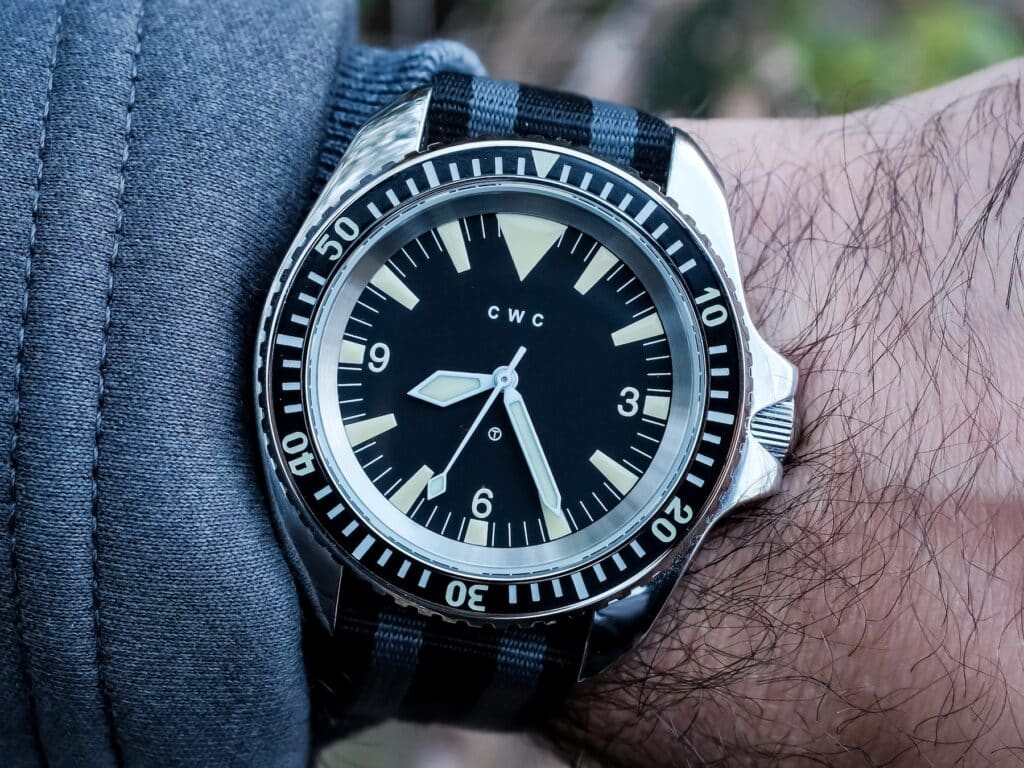
The dial plays the same no-nonsense game: trapezoidal markers, sword hands, a restrained CWC logo, and the familiar circle T mark all keep the mil-sub language intact without turning the thing into a museum piece. The sapphire crystal handled glare well even in harsh light, while the vintage-tinted Super-LumiNova did its job after dark, though the brighter white and darker pumpkin options may split opinion depending on how much “aged” you want your aging watch to look.
The case is where the watch earns its place. At around 41mm, it wears smaller than the number suggests and lands closer to a 1990s Submariner than a lot of bulkier modern divers. The polished surfaces and gently curved profile help it sit neatly on the wrist, and that balance was one of the most convincing parts of our dedicated time with it. The fixed spring bars do limit strap swapping, but they also stay true to the watch’s original military specification, which is the point rather than a flaw to be politely ignored. On the included Cabot Military Watch Strap and later a Phoenix Bond NATO, it stayed easy to wear and never felt like a watch asking for special treatment. There’s a minor amount of bezel play if you go looking for it, and the price is not exactly casual, but for collectors who want a diver with real service roots instead of a homage playing dress-up, that trade-off makes sense.
Pros
- The case wears smaller than its 41mm size suggests and sits comfortably on the wrist.
- Dial layout stays clean, legible, and true to the original Mil-Sub feel.
- Sapphire crystal does a good job controlling glare in bright outdoor light.
- The ETA 2824-2 ran within roughly 3 to 5 seconds per day after regulation and should be easy to service long term.
- Works naturally on the included Cabot strap and on a Phoenix Bond NATO.
Cons
- Fixed spring bars reduce strap flexibility.
- Pricing is fairly steep for a niche, heritage-driven diver.
- Some bezel play is noticeable if you handle it closely.
- The current lume color choices may not please everyone.
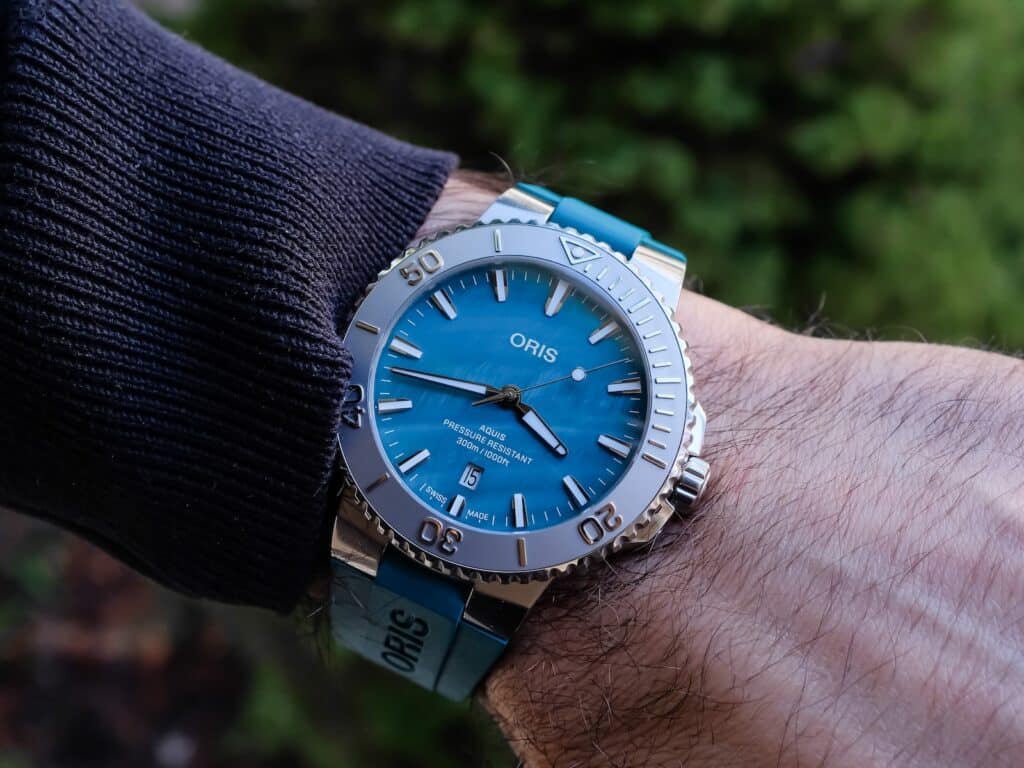
Oris Aquis New York Harbor II
| Price: | $3,000 |
| Water Resistance: | 300m |
| Case Dimensions: | 43.5mm (diameter) x 51mm (lug-to-lug) x 13mm (thickness) |
| Lug Width: | 23mm |
| Movement: | Caliber 733 (based on the Sellita SW200-1) |
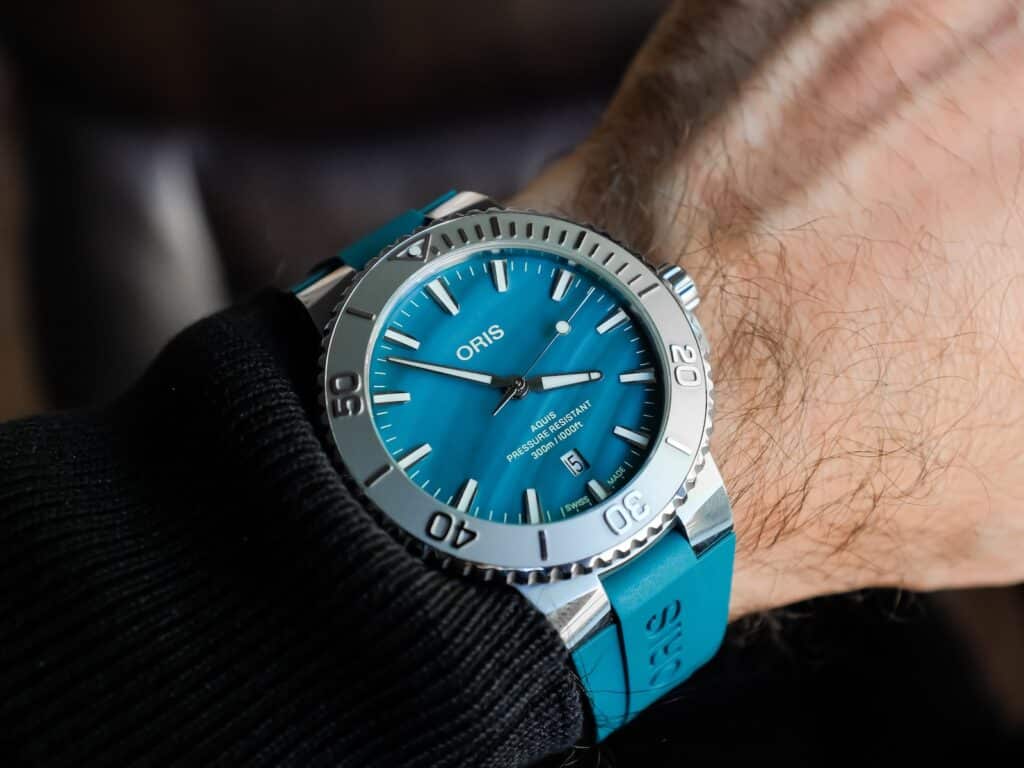
The Oris Aquis New York Harbor II is a better fit for a collector who has already learned that “versatile” can become another word for “forgettable.” This is still an everyday sports diver, but it has enough going on to stop it from blending into the usual luxury-diver crowd. The aqua-green mother-of-pearl dial is the obvious stand-out, shifting from lively green in direct light to something much quieter and almost stone-like indoors. It gives the watch personality without sacrificing legibility. The 43.5mm case sounds intimidating, but its curved lugs and integrated rubber strap help it sit more naturally than expected. At just over 13mm thick and roughly 51mm lug-to-lug, it isn’t small, but the predominantly brushed finishing keeps all that real estate from feeling too showy. For someone moving beyond starter pieces, it offers a meaningful change in character.
The Aquis gets more convincing once you start poking at the details. As covered in our testing insights, the stainless steel bezel insert won us over precisely because it isn’t the obvious choice. It has a slightly raw, industrial quality that suits the case better than a glossy ceramic insert might. The bezel action is crisp, the screw-down crown operates smoothly, and the domed sapphire with internal AR coating keeps reflections manageable. There’s 300 meters of water resistance here, too, so the personality isn’t coming at the expense of capability. The Caliber 733 is less interesting but perfectly sensible, with automatic winding, hacking seconds, a date, and a 41-hour power reserve. Accuracy stayed where we expected during testing, though leaving it off for a couple of days will probably mean resetting it when it returns to the rotation.
The more unusual bits are what make this feel like a collector’s choice rather than a safe luxury purchase. The aqua-green rubber strap proved comfortable enough that we had little desire to replace it, which is fortunate because the integrated lugs make strap experimentation awkward. The 2,000-piece production run and Billion Oyster Project partnership also give the watch a story that extends beyond “we changed the dial and made fewer of them.” Part of the proceeds support oyster restoration in New York Harbor, and the oyster-themed caseback carries that idea through without making the watch feel like a charity billboard.
That said, the compromises are straightforward: the case won’t work for every wrist, the power reserve is mediocre for a rotating collection, and the dial is never going to be as easy to pair as black. But those are reasonable concessions for a premium diver with a visual identity of its own—and that’s the sort of distinction that starts mattering once the entry-level pieces have taught you what you actually want.
Pros
- The stainless steel bezel insert brings a convincing industrial character to the Aquis.
- The limited-edition partnership with the Billion Oyster Project gives the watch substance beyond its colorway and production number.
- The aqua-green mother-of-pearl dial changes dramatically with the light while remaining readable.
- Curved lugs and the integrated rubber strap help the 43.5mm case sit comfortably.
- The domed sapphire, internal AR coating, and crisp bezel action reinforce its status as a serious everyday diver.
- 300m water resistance leaves little doubt about its practical capability.
Cons
- The integrated lugs make experimenting with other straps difficult.
- The 41-hour power reserve is a weak point for collectors who frequently rotate watches.
- The 43.5mm case remains a lot of watch for smaller wrists.
- The expressive dial sacrifices some of the grab-and-go versatility of a conventional black diver.
Seiko Marinemaster
| Price: | $3,100 |
| Water Resistance: | 300m |
| Case Dimensions: | 44mm (diameter) x 50.5mm (lug-to-lug) x 15.4mm (thickness) |
| Lug Width: | 20mm |
| Movement: | Seiko 8L35 (Automatic Movement) |
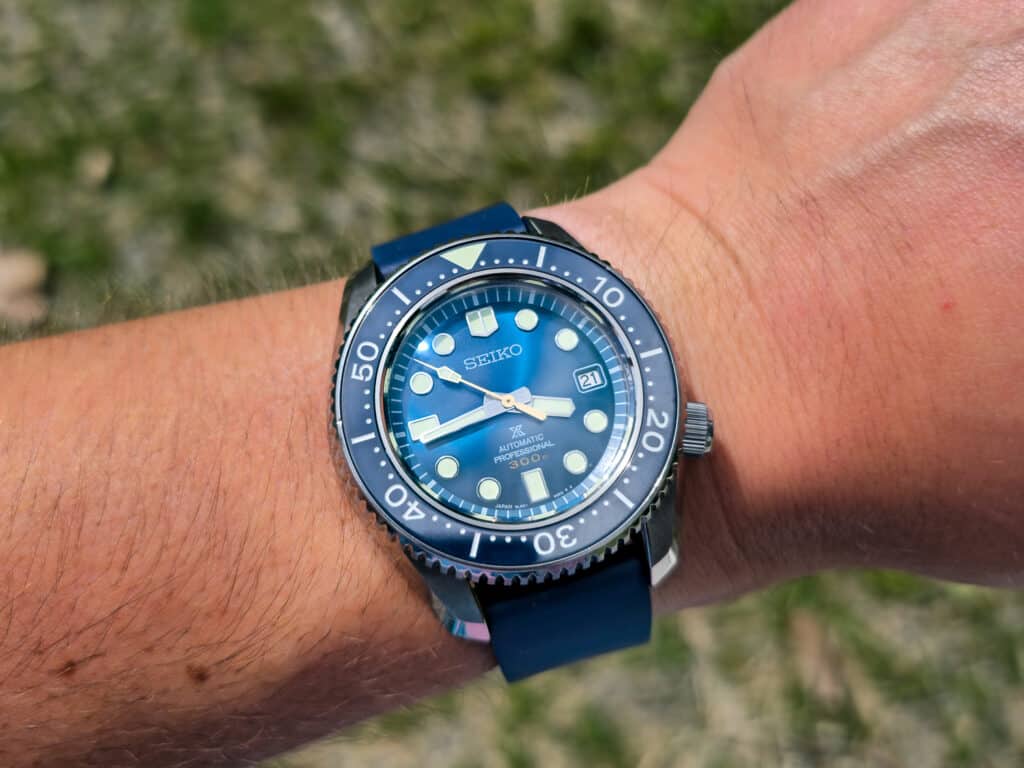
The Seiko Marinemaster 300 is where the usual “Seiko is great value” conversation starts to fall apart, in a good way. If you came up through the brand’s affordable divers, this is the point where Seiko stops feeling like the sensible choice and starts feeling like the serious one. It’s also a watch with some explaining to do. Close to 200 grams on the wrist is not exactly a recipe for disappearing, and the bracelet itself doesn’t do the case any favors. Yet the sculpted monocoque case wears considerably smaller than you’d expect, thanks to its compact dial, polished flanks, and smooth caseback. After enough time with it, we found ourselves thinking less about the size and more about why the watch felt so solid and self-assured.
The 8L35 certainly helps. During our hands-on testing, it hovered around +4 seconds per day, which feels like a meaningful jump compared to the Seiko movements most collectors encounter earlier in their collecting journey. The bezel is even more of a departure. Its tall, deeply knurled edge turns with smooth, almost hydraulic resistance rather than the familiar click-click-click we’ve come to expect from most divers. It’s not necessarily better, but after a few weeks, we started to miss it when we switched back. The blue dial has that same quality where repeat wear reveals more than the first glance. It shifts naturally with the light, the framed date and restrained gold accents add some warmth, and the lume keeps glowing well into the morning. The watch head gets little wrong; the bracelet is another story.
Long links, limited articulation, and male-end links make the stock bracelet feel bulkier than the case itself warrants. We eventually put the Marinemaster on a rubber or NATO strap, and suddenly the nearly 200-gram watch became much easier to live with while retaining its reassuring heft. There’s also a price for that beautifully solid monocoque construction: servicing the movement means accessing it from the front, which is more involved than a conventional case design.
None of that makes the Marinemaster a bad everyday watch. It makes it a very particular one. For collectors who started with affordable Seiko divers and now want to see what the brand can do when it takes off its gloves, this is an upgrade rather than simply buying a larger or fancier Seiko. It has quirks, weight, and a bracelet we’d happily change, but enough character and mechanical substance to make those quirks part of the ownership story.
Pros
- The 8L35 averaged around +4 seconds per day during extended wear.
- The smooth, highly controlled bezel action is satisfying once you get used to it.
- The monocoque case feels very solid while wearing smaller than its dimensions suggest.
- Seiko’s lume remains legible well into the night.
- The one-piece case construction gives the watch a substantial feel.
Cons
- The bracelet’s long links and limited articulation make it less comfortable than the watch head deserves.
- Male end links add even more wrist presence to an already substantial watch.
- At close to 200 grams on the bracelet, the watch can become tiring during extended wear.
- Front-loading movement access complicates servicing.
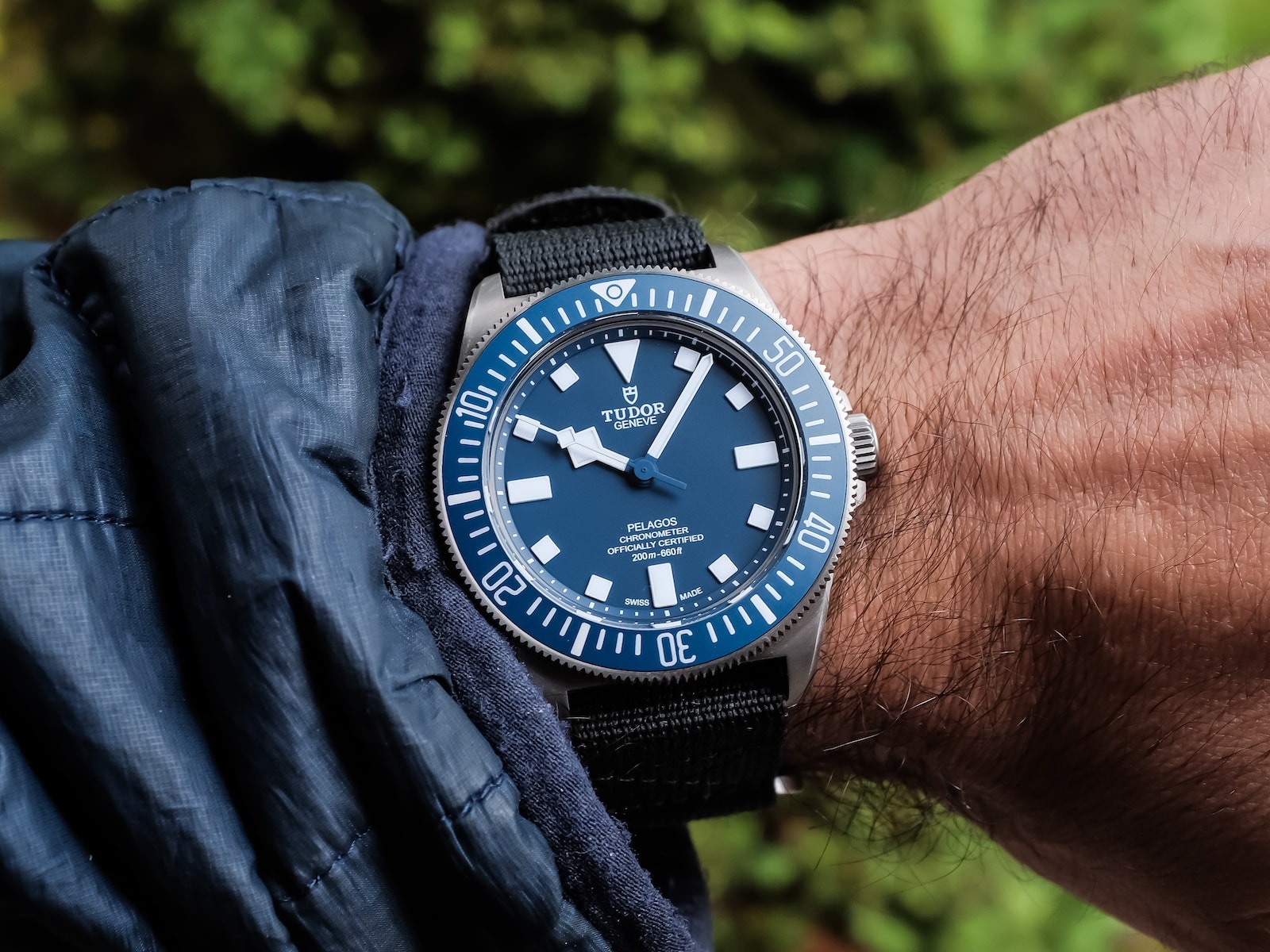
Tudor Pelagos FXD
| Price: | $5,025 |
| Water Resistance: | 200m |
| Case Dimensions: | 42mm (diameter) x 52mm (lug-to-lug) x 12.75mm (thickness) |
| Lug Width: | 22mm |
| Movement: | Tudor MT5602 |
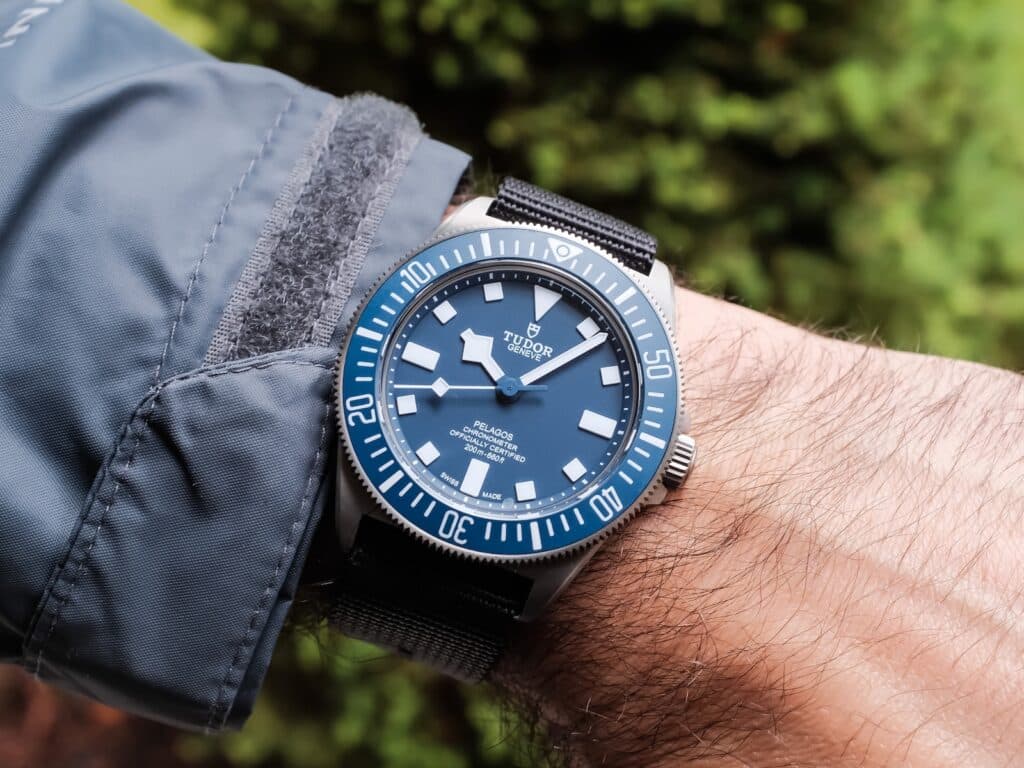
The Tudor Pelagos FXD makes the most sense when you stop treating the fixed bars and countdown bezel as quirks and start seeing them as the reason to own this particular Tudor. The design is unusually specific: titanium case, Marine Nationale connection, fixed strap bars, matte surfaces, and a bezel intended for countdown timing. None of it feels like Tudor adding military flavor after the fact. We spent a week with the original blue version, and the 42mm case proved far easier to wear than its 52mm lug-to-lug indicates. At 12.75mm thick, it avoids the blocky feel of the standard Pelagos, while titanium keeps the weight sensible. Tudor also removed the helium escape valve and brought water resistance down to 200 meters, which feels reasonable for a watch this focused rather than another attempt to win a depth-rating contest.
After living with it beyond the first impression, we found that the fixed-bar setup is both the FXD’s party trick and its biggest limitation. The bars are machined into the case, with chamfered edges that help prevent fabric straps from getting chewed up, and the watch clearly prefers fabric or elastic over anything conventional. We had good results with a Prometheus Design Werx Ti-Ring, a Watches of Espionage Glomar Explorer strap, and even inexpensive Garmin-style elastic straps.
The matte titanium case reduces glare, while crisp brushing gives it enough definition without polishing away its military character. The countdown bezel is similarly purposeful. Its larger knurling gives you plenty to grab, and the 120-click action is crisp and deliberate. If you’ve spent years using conventional dive bezels, the countdown scale takes some adjustment, but it fits the FXD’s intended role far better than a generic elapsed-time setup would. The dial is where all that specificity becomes easy to live with. The darker navy tone, matte surface, no-date layout, snowflake handset, and strong contrast make reading the time almost effortless, with Tudor’s lume holding up well as the light disappears. The MT5602 movement also gives the watch a 70-hour power reserve, which is useful when it inevitably gets bumped out of the rotation by something else.
The compromises are baked into the concept: fixed bars mean no bracelet and fewer strap options, the 52mm lug-to-lug remains a concern for smaller wrists, and the countdown bezel is less universally useful than a standard diver’s bezel. The price is also a substantial jump from the watches most collectors start with, and some buyers will have reservations about Tudor’s in-house movement track record despite our sample performing well. Still, the FXD earns its place by being committed to one idea. For a collector who wants a modern military diver rather than another all-purpose luxury sports watch, that focus is exactly what makes it interesting.
Pros
- The fixed bars are integrated into the case and give the watch a genuine military-tool character.
- Titanium keeps the 42mm case manageable, while the 12.75mm thickness prevents it from feeling overly slabby.
- The darker navy dial, snowflake hands, and no-date layout make legibility straightforward.
- The 120-click countdown bezel has useful knurling and a crisp, deliberate action.
- MT5602 provides a useful 70-hour power reserve for a watch that may spend time off the wrist.
- Matte finish reduces reflections without making the case look unfinished.
Cons
- The 52mm lug-to-lug remains a significant consideration for smaller wrists.
- Fixed bars eliminate bracelet use and narrow your strap choices.
- The countdown bezel is less versatile if you prefer conventional dive-watch timing.
Omega Seamaster Diver 300M
| Price: | $5,600 – $5,900 |
| Water Resistance: | 300m |
| Case Dimensions: | 42mm (diameter) x 49.9mm (lug-to-lug) x 13.9mm (thickness) |
| Lug Width: | 20mm |
| Movement: | Caliber 8800 Co-Axial Master Chronometer |
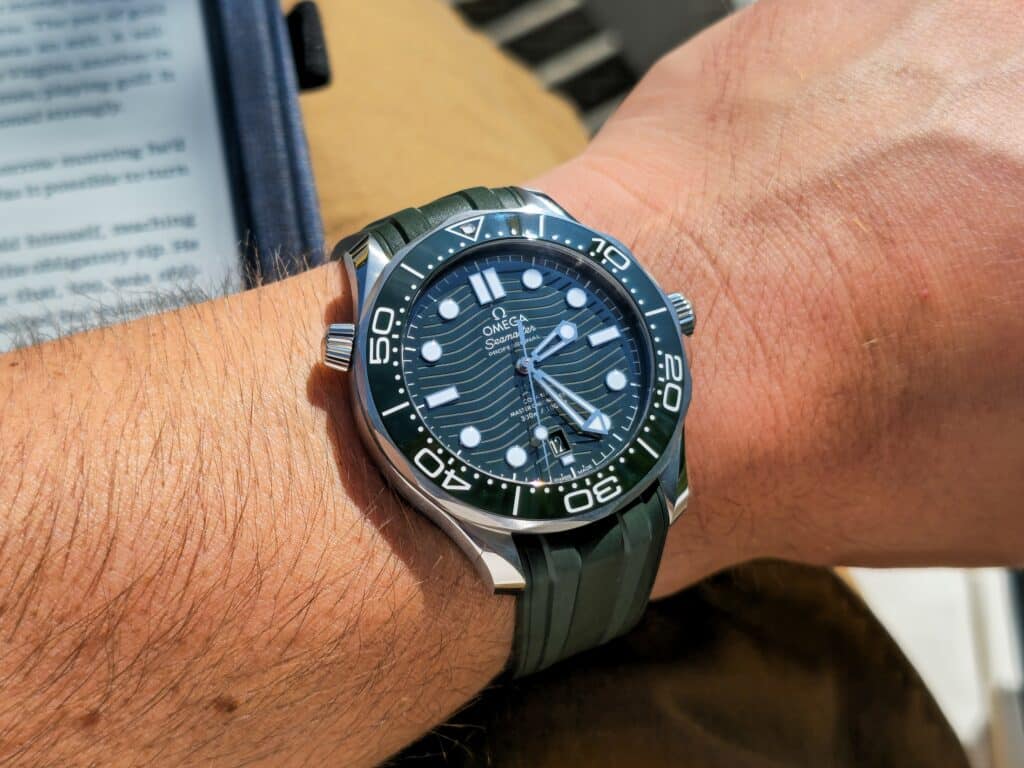
The Omega Seamaster Diver 300M is the point where “I want a better diver” can turn into “I want something that feels significantly different.” The Seamaster doesn’t take the quiet, restrained route into luxury. It is bigger in personality, shinier in execution, and considerably more willing to show off its design. During our in-depth review, it proved perfectly capable of everyday duty, but it never confused practicality with playing it safe. The 42mm case and stated 14mm thickness sound intimidating, yet the twisted lyre lugs make it wear closer to a 12mm watch. The polished upper surfaces and brushed flanks also keep that thickness from becoming a featureless slab. It’s a natural move into luxury diving watches, thanks to stronger finishing, brand history, and a highly distinctive design.
The movement is where the Seamaster gets boring (in a satisfying manner). The METAS-certified Caliber 8800 averaged around +1 second per day in our sample, and the winding action felt suitably refined. The crown, unfortunately, did not get the same memo. It’s smaller than we’d like, and screwing it back down lacks the smoothness you’d expect at this level. The bracelet has a similar problem: it looks appropriate but feels heavy and doesn’t taper enough, which is why the rubber strap won most of our wrist time. The dial is much harder to complain about. The ceramic wave pattern has genuine depth, the green version changes character with the light, and the color-matched date wheel prevents the date from looking like someone remembered it at the last minute. Strong AR coating keeps the sapphire clear, although the external treatment is vulnerable to light scratches.
Then you get to the details that make this an Omega rather than a generic luxury diver with a nice movement. The helium escape valve sits at 10 o’clock. The dual-color lume is considerably more useful: the minute hand and bezel pip glow green while the hour hand and markers glow blue, making the information easier to separate in darkness. The skeleton hands can lose contrast against the dial at certain angles, and the scalloped ceramic bezel, while crisp and free of noticeable back play, isn’t too friendly to cold or wet fingers.
Those are real compromises, but they’re also part of why this watch works for collectors who have moved beyond starter pieces. It gives you a clear jump in finishing and engineering without sanding away the personality that made you want a collection in the first place.
Pros
- The green ceramic wave dial changes with the light and gives the watch far more character than a conventional diver.
- The color-matched date wheel integrates neatly into the dial.
- Dual-color lume separates the key indications clearly in low light.
- Twisted lyre lugs make the 42mm case wear more comfortably than its dimensions suggest.
- Caliber 8800 delivered around +1 second per day during our testing, with smooth winding.
- Strong AR treatment keeps the sapphire very legible in bright conditions.
Cons
- The scalloped bezel looks distinctive but is less practical to grip than a conventional dive bezel.
- The crown feels undersized, and the screw-down action isn’t as satisfying as it should be.
- Skeleton hands can disappear against the dial at certain angles.
- External AR coating can accumulate light scratches.
- The bracelet is heavy and could use more taper.
If there’s a diver you think belongs in this conversation, tell us in the comments. We’re especially interested in watches that don’t get handed the “obvious choice” badge but have enough personality, wearability, or downright weirdness to make a collector rethink their next piece. If you’ve spent real wrist time with one that deserves to move beyond starter-watch status, send it our way.

Co-Founder and Senior Editor
Kaz has been collecting watches since 2015, but he’s been fascinated by product design, the Collector’s psychology, and brand marketing his whole life. While sharing the same strong fondness for all things horologically-affordable as Mike (his TBWS partner in crime), Kaz’s collection niche is also focused on vintage Soviet watches as well as watches that feature a unique, but well-designed quirk or visual hook.
your list does not mention either christopher ward that make a 1000mtr, chronometer dive watch for under 2500 us dollars or a delma blue shark IV, rated at 5000mts for under 3000 us dollars. I wonder why that is.
We’ll happily accept loaners for testing if you’d like to send them our way. We like to base our recommendations on hands-on time with these models.
I miss Sinn U1
Is it discontinued?
I’ve noticed the CWC 1980 Royal Navy Diver Re-Issue comes up on this site a fair bit, but the 1981 re-issue is never mentioned. Seeing as the 1980 model was a limited edition, or in any case has been discontinued, while the 1981 model is currently available new from CWC (and is nearly identical, as far as I’ve been able to tell), I wonder why that is. I even saw in one article that noted the 1980 reissue is no longer available new and discussed its price on the used market, it did not mention a very similar model in the current lineup.
Thanks for reading, Gopal. We usually only like to recommend watches we have hands-on experience with, and I have not spent any hands-on time with the 1981.