Most of us have a soft spot for the Casio F-91W because it’s one of those watches that authentically earns its reputation. It’s cheap, it’s light, it tells the time reliably, and keeps ticking day after day without much fuss. For many years, it’s been the default digital for students, office workers, and budget-conscious collectors alike—a truly tried-and-tested tool watch that proves you don’t need flashy features to get the job done. That said, the very simplicity that makes it dependable also leaves some of us wanting a bit more: maybe a sturdier case, a retro-metal look, a touch of solar or atomic accuracy, or just something that feels different on the wrist while keeping the same low-cost, no-drama vibe. That’s why we start exploring F-91W alternatives that scratch the same low-cost Casio itch without feeling like a second copy of the same idea.
Our perspective here comes from the very TBWS kind of testing: community wrist time with a Casio A168WA getting passed between friends, family, and coworkers; a Wave Ceptor making us rethink what a grab-and-go digital quartz can be; a GW6900 living by the hallway keys instead of in some precious little watch box; and, after nearly ten years of TBWS, even admitting when a cheap Casio like the Duro took too long to get proper wrist time. So these aren’t abstract picks pulled from a search page. They’re affordable watches we’ve worn, argued with, laughed at, and occasionally respected more than watches costing many times more. Some are best value watches because they disappear on the wrist. Some are here because they’re tougher, weirder, cleaner, or more useful for the way we actually wear watches.
Casio A168WA
| Price: | $20 – $30 |
| Water Resistance: | 30m |
| Case Dimensions: | 37.5mm (diameter) x 33.5mm (lug-to-lug) x 9.6mm (thickness) |
| Lug Width: | 18mm |
| Movement: | Quartz Module 3298 |
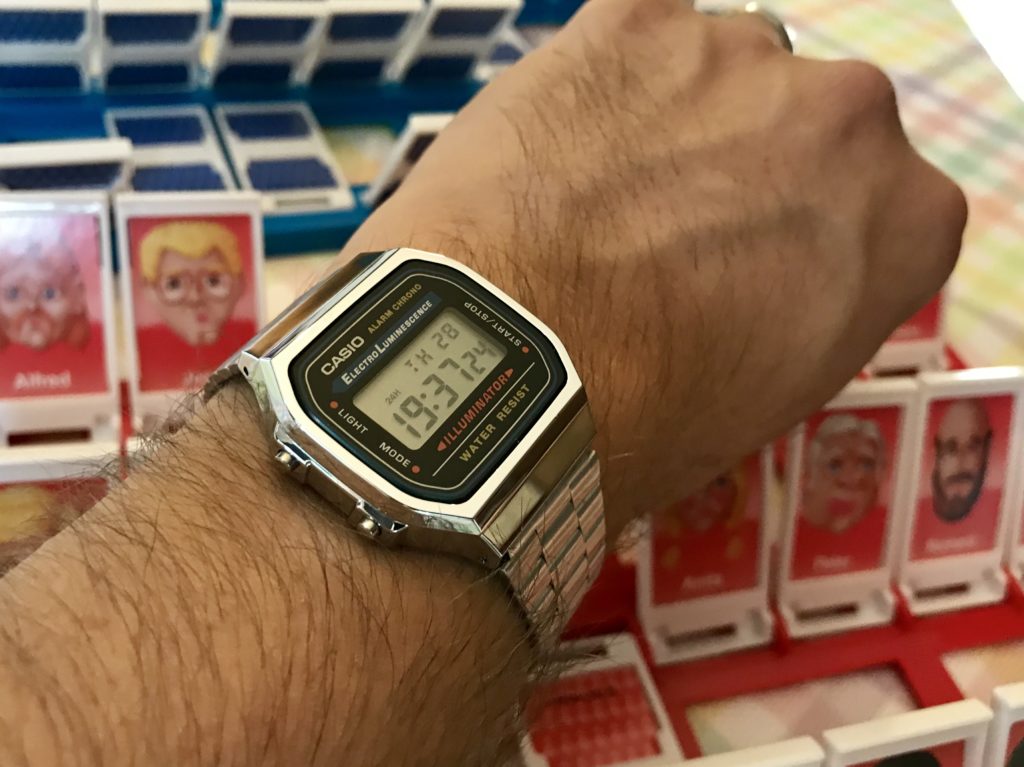
The Casio A168WA is probably the cleanest first stop for anyone looking at Casio F-91W alternatives because it does not abandon the cheap digital Casio formula. It simply puts that formula in a slightly dressier jacket. You still get the same general sense of low-cost, grab-and-go usefulness, but the brushed metallic finish and stainless steel bracelet give it a stronger retro presence than the F-91W’s black resin case. It feels a little more intentional on the wrist, especially if your daily style already leans into old electronics, vintage sneakers, or the kind of outfit that makes people say “nice watch” before realizing it cost lunch money.
The watch itself stays compact at roughly 37.5mm by 33.5mm, which helps it fit smaller wrists and suits anyone who likes thin, low-profile watches. The case is still plastic, and Casio is not fooling anyone there, but the metallic finish does enough visually to keep it from feeling like a toy. This is not the watch we’d reach for with a suit unless the suit was part of a joke, but for errands, casual days, or a deliberately retro look, it lands well.
In use, the A168WA keeps things familiar and simple: time, alarm, stopwatch, hourly chime, and that blue electroluminescent backlight. As mentioned in our community review, there were no weird button quirks or menu gymnastics. It behaved like an inexpensive Casio should, which is the compliment here. The small display is clear in normal light, though it can get harder to read from sharper angles or in harsher conditions. The backlight also flashes briefly rather than staying on, so late-night time checks need a bit of timing.
The bracelet is the main trade-off. It completes the look, but it did not fully settle on smaller wrists during extended wear and tended to sit a touch high. For short stretches, comfort was fine. However, over the course of a full day, the bracelet became more noticeable than the lightweight case. Still, as an F-91W alternative, the A168WA works because it keeps the same cheap, reliable quartz practicality while adding enough visual character to feel like a more stylish choice.
Pros
- Very affordable and easy to use.
- The slim case wears comfortably and does not take up too much wrist space.
- Straightforward functions make it easy to use without any learning curve.
Cons
- Smaller display and viewing angles can hurt legibility in harsher lighting.
- Bracelet comfort can be reduced during longer wear, especially on smaller wrists.
- The brief backlight is useful, but easy to miss in complete darkness.
- The plastic case still feels light and inexpensive despite the metallic finish.
Timex Expedition Atlantis T5K463
| Price: | $35 – $60 |
| Water Resistance: | 100m |
| Case Dimensions: | 40mm (diameter) x 45mm (lug-to-lug) x 10.5mm (thickness) |
| Lug Width: | 19mm |
| Movement: | Timex Quartz |
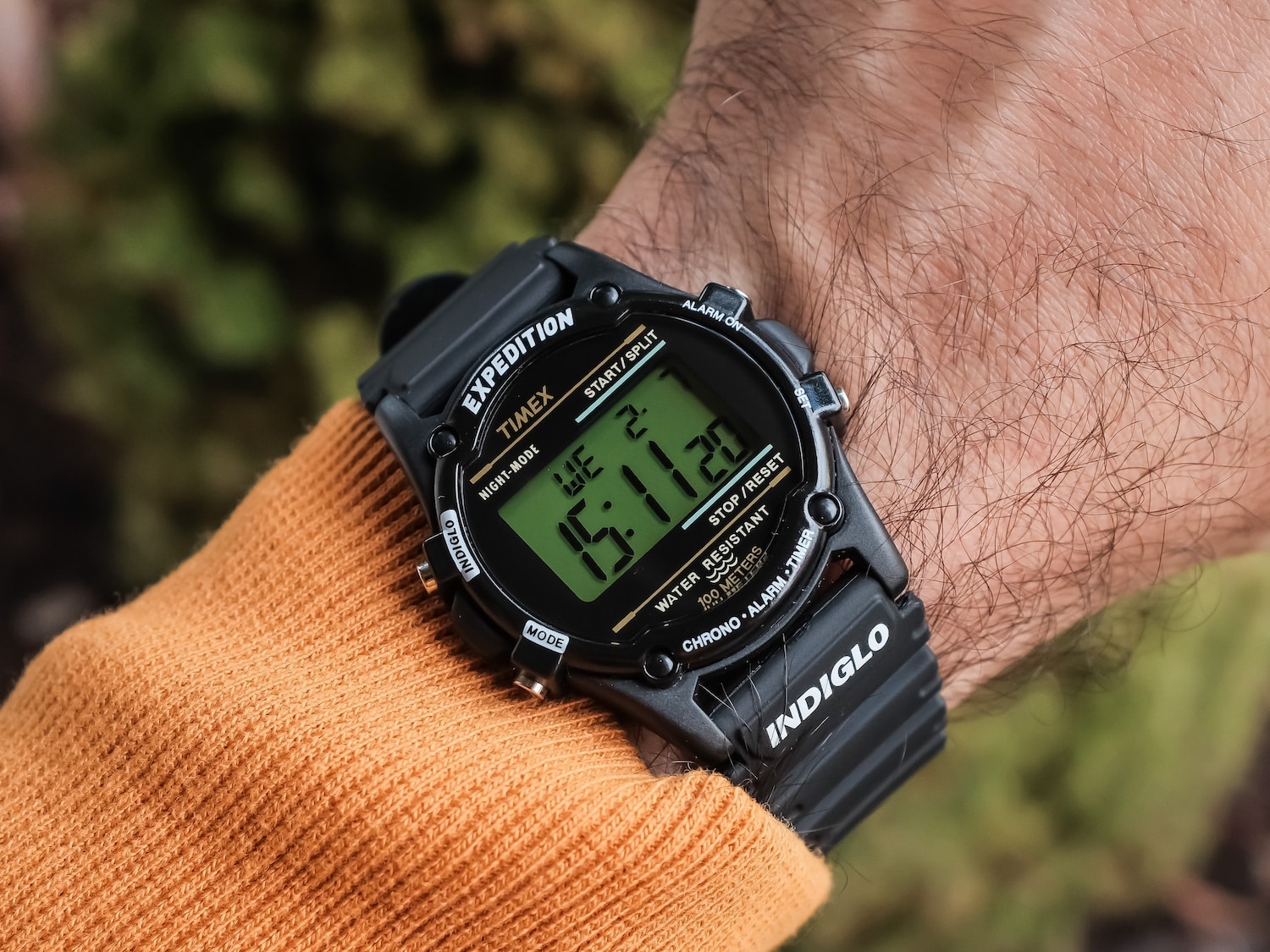
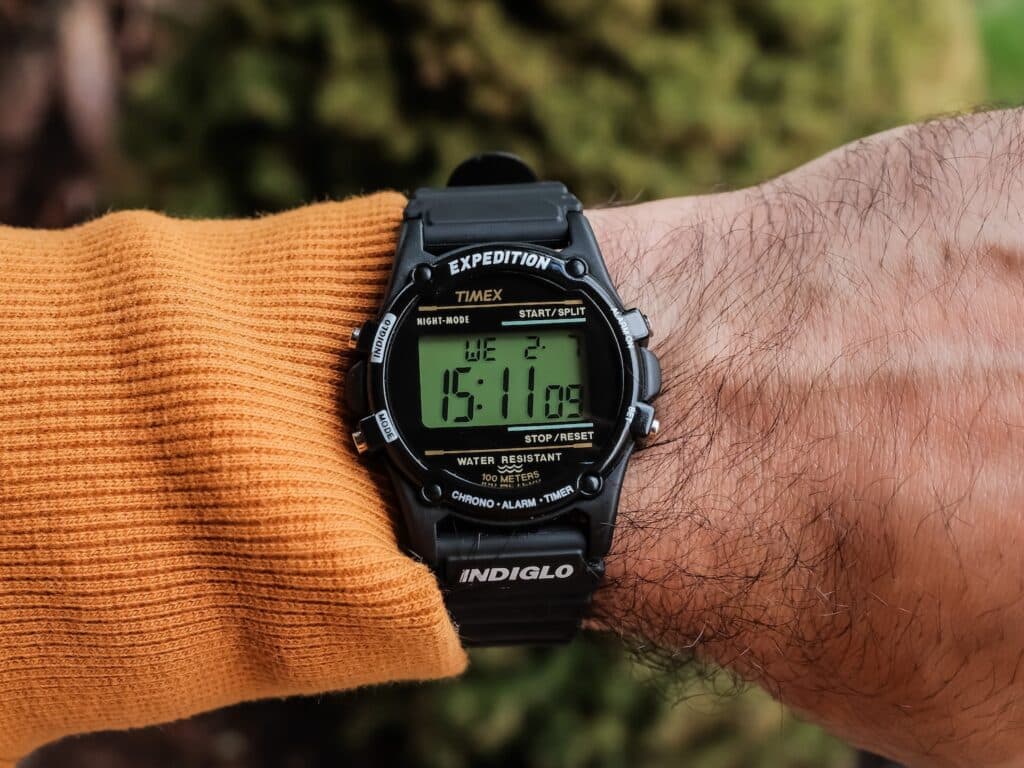
The Timex Expedition Atlantis T5K463 makes sense as a Casio F-91W alternative for someone who still wants a cheap, low-stress digital watch but prefers it to lean more toward the outdoorsy side than retro. It keeps that same “wear it, beat it up, don’t overthink it” attitude, only with a rounder field-watch personality and enough water resistance to feel less fragile in the face of sweat, rain, and sink duty. At about 40mm wide and 10mm thick, it wears flat and light, so it never feels like a bulky sports watch pretending to be tactical. We wore it through workouts, errands, and long packed days, and the best compliment is that it mostly disappeared.
The resin case and soft silicone strap deliver more comfort than the price suggests. The strap was a quiet win in our testing: vented, stable, and comfortable when moving around, without collecting too much dust or turning into a sweaty mess after activity. The 19mm lug width is annoying if you like swapping straps, because that size cuts down your options. Left alone, though, the stock setup works well and keeps the watch planted.
The display is where the Atlantis shows both its usefulness and its limits. Straight on, the green-tinted screen is readable once your eyes settle into the layout, even though Timex packs a lot into the dial with large numerals and multiple readouts. At sharper angles, legibility drops fast and can wash out almost entirely. In the dark, though, Indiglo does what it does best. It lights the whole display cleanly and evenly, making nighttime checks easy in a way that reminds you why people still bring up Timex backlights without irony.
Functionally, it gives you more than enough without making the watch feel like a homework assignment. You get a stopwatch with lap timing, a countdown timer, a second time zone, alarms, and a full calendar, all handled through a familiar four-button layout. The catch is that the buttons are small and need a firm press, which became noticeable when using the backlight or chronograph during workouts, especially with tired or sweaty hands. Accuracy was solid in our review sample, with the quartz movement drifting only a few seconds over months of wear. Availability can be spotty, but when you find one, the Expedition Atlantis is a rugged budget alternative for anyone who likes the F-91W’s practicality but wants something more activity-ready.
Pros
- Indiglo gives strong, even low-light visibility.
- Lightweight case and flat profile make it easy to wear all day.
- 100m water resistance adds confidence for sweat, rain, and daily splashes.
- Vented silicone strap stays comfortable and stable during activity.
Cons
- Small buttons require deliberate presses, especially during workouts.
- Stock can be inconsistent, so finding one is not always straightforward.
- The 19mm lug width limits strap changes.
- Display readability falls off quickly at sharper angles.
Casio G-Shock DW9052-1V
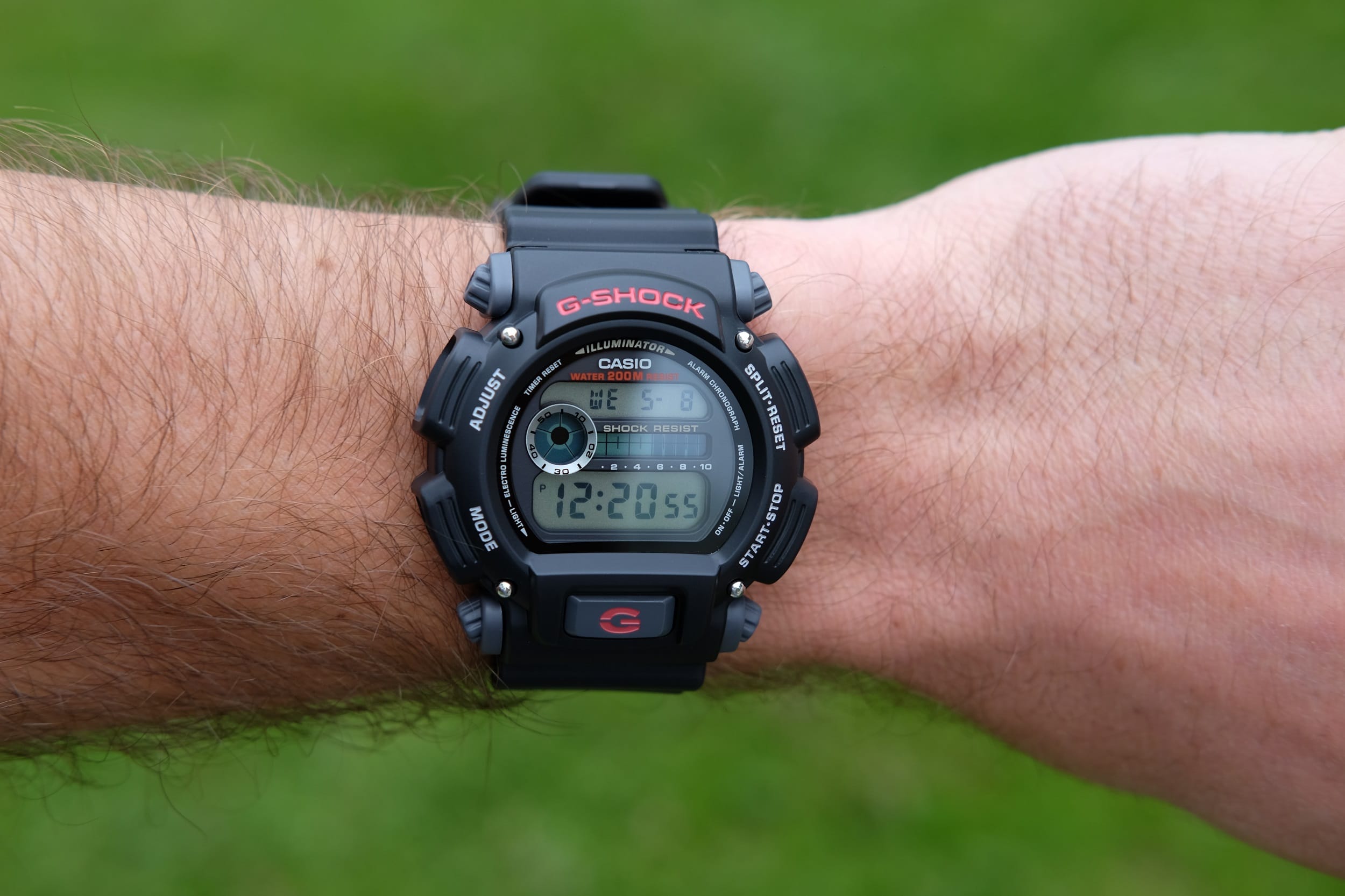
| Price: | $45 |
| Water Resistance: | 200m |
| Case Dimensions: | 47mm (diameter) x 48mm (lug-to-lug) x 15mm (thickness) |
| Lug Width: | 24mm; tapers to 20mm at the buckle |
| Movement: | Casio 3232 digital module |
The DW9052-1V is the point where the F-91W’s cheap digital usefulness gets wrapped in enough resin armor to survive the parts of the day we usually don’t plan for. This is not the “barely there” Casio experience. It is bigger, thicker, and far less discreet than an F-91W, but that extra bulk has a job. The urethane resin bumper rises around the crystal and buttons, giving the watch a protective shell that proved useful through yard work, workouts, and the usual door-frame collisions that make us question our spatial awareness. After months of wear, ours picked up scuffs, but nothing that affected the display or function.
On the wrist, the DW9052 has presence. The case sits tall and will not slip under every sleeve, so anyone chasing the F-91W’s slim profile should know this is a different animal. The upside is that it does not feel as awkward as the dimensions suggest. The free-moving lugs help the case settle better than expected, and the vented strap manages sweat well during longer sessions. The stainless steel buckle also feels ready for repeated use rather than like an afterthought waiting to bend.
The display looks crowded at first, with several windows competing for attention, but the layout becomes easier after a little time. It is less immediately simple than the F-91W, though still practical once your eyes know where to go. The electroluminescent backlight was a highlight during our testing period because it lit the full display evenly, making nighttime checks easy. The recessed buttons are protected by the case design, but they remained usable even with wet hands or gloves, which matters if this is the watch you grab for messy jobs.
Performance was exactly what we want from this kind of G-Shock: consistent and boring in the best way. The quartz module stayed around ±15 seconds per month, the auto calendar worked without drama, and battery life remained firmly in multi-year territory. The only design flourish that feels less useful is the set of decorative metal pins in the bumper. Over time, they can loosen, and if they fall out, the empty spots tend to collect dirt. Still, as a tougher alternative to the F-91W, the DW9052 makes sense for anyone who wants the same low-cost digital dependability with much greater resistance to abuse.
Pros
- Protective resin bumper helps shield the crystal and buttons from knocks.
- Quartz accuracy stays stable, with battery life measured in years.
- Free-moving lugs keep the large case more comfortable than expected.
- The even electroluminescent backlight makes low-light reading easy.
- Vented strap handles sweat well during longer wear.
Cons
- Multi-window display takes a little adjustment at first.
- Tall, bulky case is not sleeve-friendly or subtle.
- Decorative bumper pins can loosen and collect dirt over time.
Casio Wave Ceptor WV-59DJ-1AJF
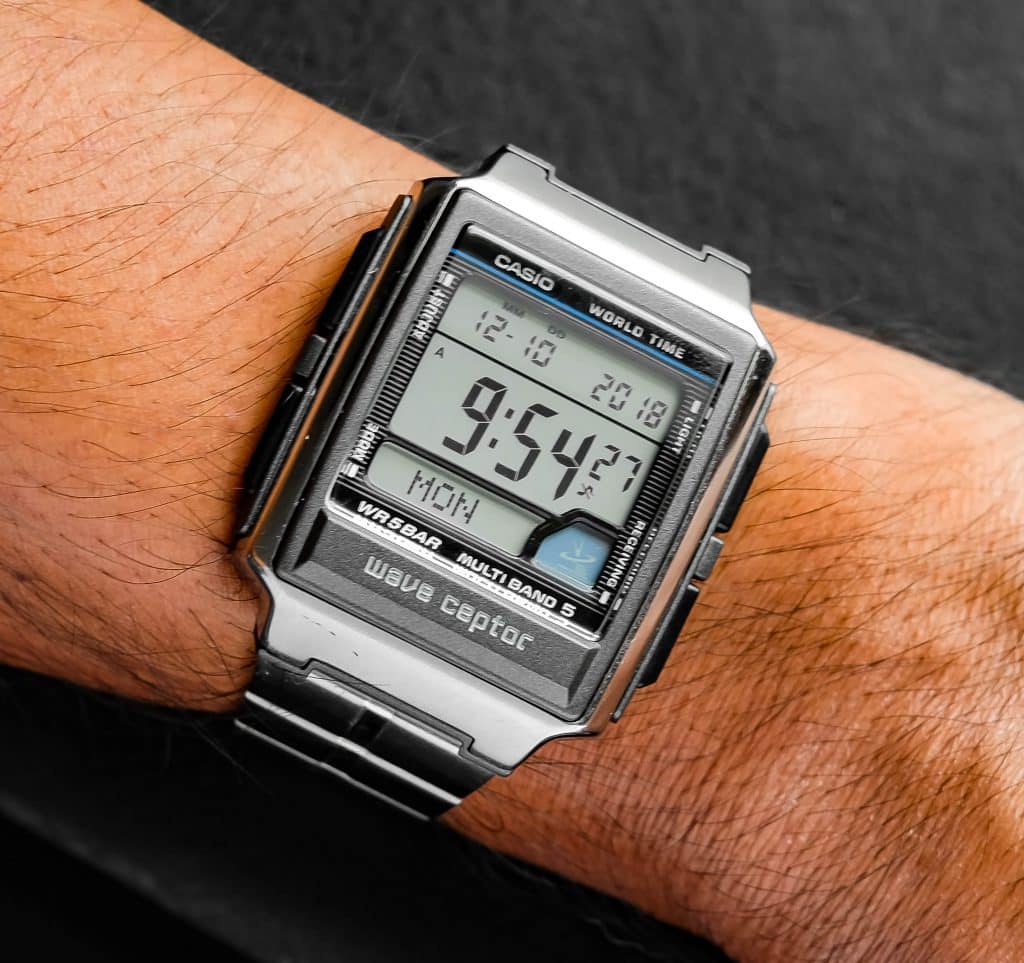
| Price: | $55 – $60 |
| Water Resistance: | 50m |
| Case Dimensions: | 39mm (diameter) x 48mm (lug-to-lug) x 12.75mm (thickness) |
| Lug Width: | 20mm, tapers down to 18mm at the clasp |
| Movement: | Quartz Module 3054 |
The Casio Wave Ceptor WV-59DJ-1AJF feels like the watch you buy after realizing the F-91W’s simplicity is great, but your calendar, commute, and general adult nonsense could use a little more help. It keeps the practical digital Casio appeal, but with radio-controlled accuracy and a deeper feature set that makes it feel like a genuine step up rather than a shinier version of the same thing.
The case proportions are odd on paper. The rectangular shape, narrow body, and longer lug-to-lug can look slightly unbalanced until the watch is on the wrist. On a sub-7-inch wrist, though, it settled better than expected, giving it enough presence without feeling oversized. It is also very light, which can feel strange if you have been wearing heavier steel sports watches, but that lack of weight becomes part of the appeal after a few days. This is the kind of watch that stops asking for attention once it is sized and worn.
The display is one of the stronger parts of the experience. The main time is easy to find; the day and date sit where your eyes expect them, and the small signal indicator gives you a quiet little confirmation that the watch is doing its atomic timekeeping thing in the background. Straight on, the LCD is clear in most daily lighting. At sharper angles, contrast drops, so side glances are not always as clean. The module has plenty going on, and the full feature set can feel dense at first, but the core functions reveal themselves quickly once you start using it.
The bracelet may be the part that divides people. Its folded metal construction is light and a little hollow, so it will not satisfy anyone expecting the reassuring feel of a solid steel bracelet. Still, it suits the watch visually and sits naturally on the wrist once adjusted. Sizing takes patience the first time, though it can be handled without specialized tools. Since the bracelet is integrated, customization is limited, but that also feels like part of the watch’s personality. It is not trying to feel premium. It is useful, accurate, and easy to live with. To know more about our wrist-time insights and button functionalities, check out our dedicated review.
Pros
- Radio-controlled accuracy and a generous feature set make it a meaningful step up from simpler digitals.
- Buttons are easy to find and press during regular use.
- Display layout is logical, with time, day, date, and signal information easy to understand.
- Lightweight case wears comfortably, even with its unusual rectangular proportions.
Cons
- LCD contrast fades when viewed from sharper angles.
- Integrated bracelet limits strap options.
- Folded bracelet and plastic elements can feel a little insubstantial.
- First-time bracelet sizing takes some patience.
Casio Duro
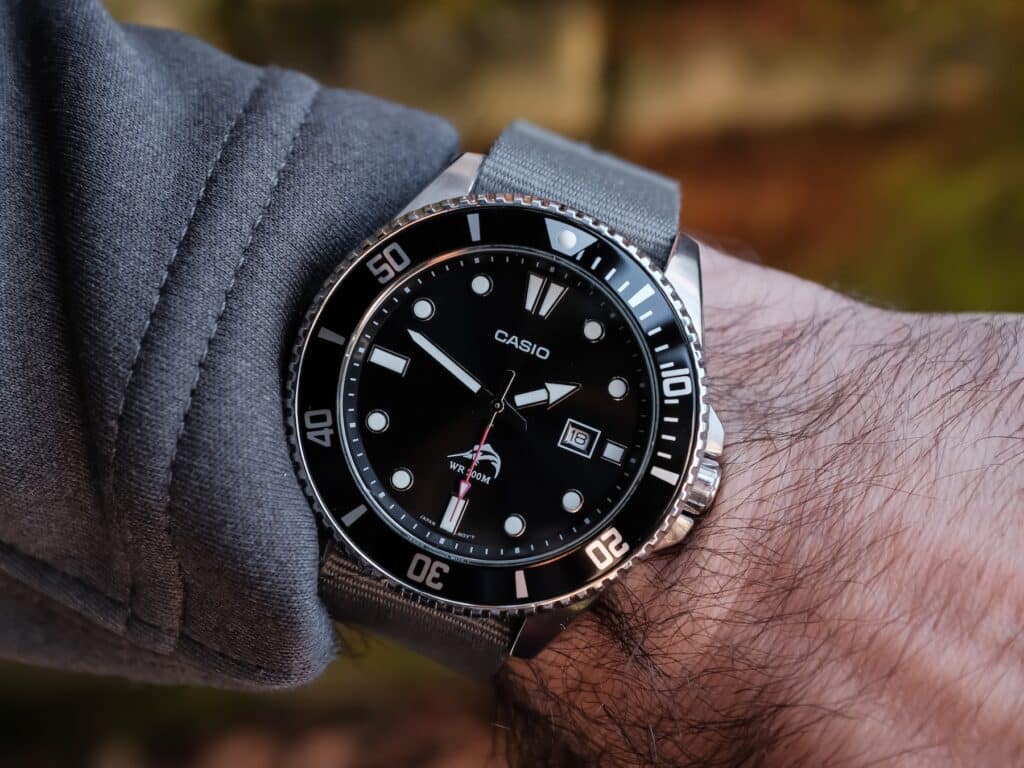
| Price: | $85 |
| Water Resistance: | 200m |
| Case Dimensions: | 44.2mm (diameter) x 48.5mm (lug-to-lug) x 12.1mm (thickness) |
| Lug Width: | 22mm |
| Movement: | Casio 2784 Quartz |
The Casio Duro is what happens when the F-91W’s value-first mindset trades a digital display for a timing bezel, a screw-down crown, and a more traditional dive-watch shape. It is not tiny, and it is not trying to recreate the F-91W experience button-for-button. Instead, it carries over the part that matters most: cheap Casio practicality without the feeling that you bought something disposable. It is the inexpensive dive-style watch you grab when you want the same low-stress ownership in a more traditional analog format.
The case gives the Duro more wrist presence than anything F-91W-adjacent. At 44mm, it is a large watch, and those with smaller wrists should take that into account. The shorter lug-to-lug span and downward-curving lugs help it sit more securely on the wrist than the diameter suggests, but it still feels like a proper dive watch. If something in the Seiko Turtle neighborhood already works for you, the Duro should feel manageable. The finishing is simple and honest: brushed surfaces on top, polished case sides, and a small bevel that gives the case some shape without pretending it belongs in a display case with dramatic lighting.
Where the Duro earns its place is in the useful stuff. The 200m water resistance, screw-down crown, and solid caseback make it easy to wear while swimming, traveling, doing yard work, and in those moments when you forget you have a watch on until your hand is already underwater. The bezel action also helps separate it from the worst cheap divers. It turns with a controlled, deliberate feel rather than the loose, rattly action that makes you wonder who gave the final approval at the factory. The dial stays practical, which is the right call. The layout is clean, the text is restrained, the reflective arrow-style hands are easy to catch at a glance, and the applied markers add enough depth without making the dial busy. The framed date at three o’clock keeps it useful for daily wear. The flat mineral crystal helps keep the price down, though it will pick up scratches more easily than sapphire. Lume is usable early on, but it fades sooner than we’d like if you expect strong visibility deep into the night.
The quartz movement is a big part of why the Duro makes sense as an F-91W alternative. In our hands-on review, it ran at around ±20 seconds per month and also hacks and offers a quick-set date. That means you can leave it alone for a few days, pick it up, set the date if needed, and move on with your life. There is no mechanical romance here, and anyone chasing a sweeping second hand will probably want something else. But for a first affordable diver, a travel watch, or a cheap analog Casio that can handle water without becoming a whole ownership project, the Duro gets the point.
Pros
- 200m water resistance, along with a screw-down crown and solid caseback, make it useful around water.
- 22mm lugs give you plenty of room to experiment with rubber, nylon, or bracelet options.
- Bezel action feels controlled and deliberate rather than loose or cheap.
- Quartz movement is accurate, low-maintenance, offers hacking, and includes a quick-set date.
- Clean dial, reflective hands, applied markers, and framed date keep everyday legibility strong.
Cons
- Mineral crystal is more vulnerable to scratches than sapphire.
- Lume is useful at the beginning but fades sooner than we’d want for extended low-light use.
Casio G-Shock CasiOak
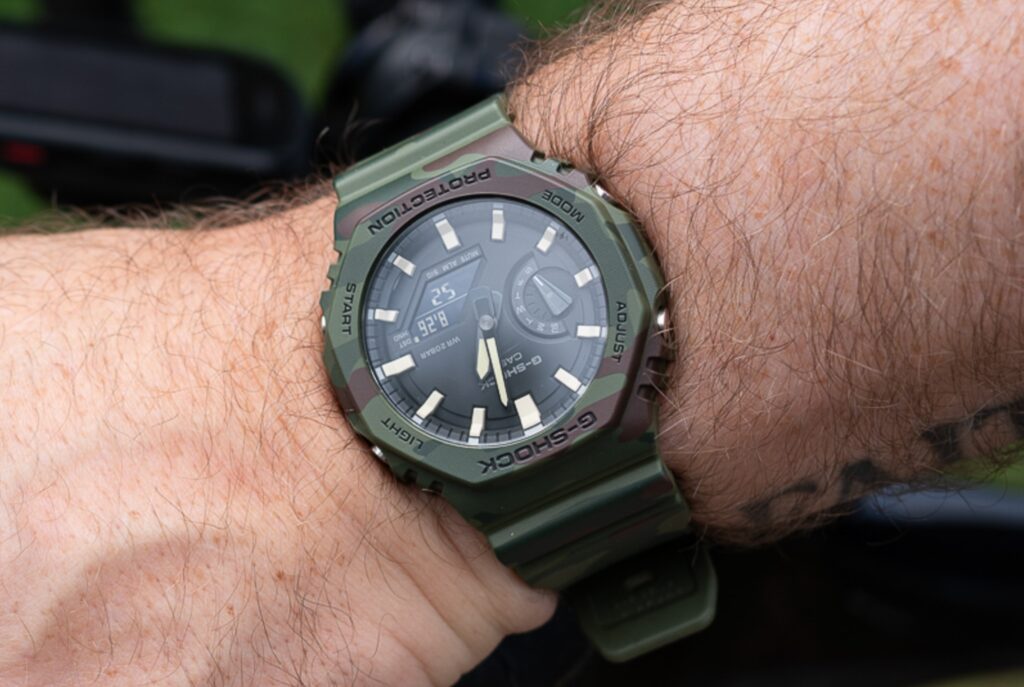
| Price: | $100 – $210 |
| Water Resistance: | 200m |
| Case Dimensions: | 45.4mm (diameter) x 48mm (lug-to-lug) x 11.9mm (thickness) |
| Lug Width: | 20mm |
| Movement: | G-Shock Quartz 5611 Module |
The Casio G-Shock CasiOak takes the F-91W’s cheap Casio usefulness and gives it a sharper makeover, a tougher frame, and enough analog-digital weirdness to make it feel like a proper everyday upgrade. It is still practical in the familiar Casio way, but it carries itself with more wrist presence than a simple resin digital. For someone who likes the F-91W for its affordability and ease of living but wants something more modern, more durable, and a little more stylish, the CasiOak makes a lot of sense.
The size looks intimidating before you put it on. At 45.4mm wide, it sounds like the kind of G-Shock that should dominate the wrist and snag on everything within a three-foot radius. In use, it wore better than expected. The square-adjacent case spreads the footprint evenly, and the downward-angled strap connection helps the watch sit flat rather than hovering awkwardly above the wrist. Through commutes, hikes, and quick errand runs, it stayed planted and did not feel like it was fighting us. The Carbon Core Guard shell helps here, keeping the weight down while giving the case a more structured, reassuring feel compared to older, chunkier G-Shocks.
The dial is where the CasiOak differs most from the F-91W. Instead of a pure digital display, you get an analog-digital layout with raised tan indices and sword-style hands layered over the module. It gives the watch more depth and makes it feel more contemporary, though it does take a short adjustment period if your brain prefers the clean simplicity of a digital readout. The lack of stronger lume is the biggest frustration. The hands and indices are readable enough in normal light, but in the dark, you are leaning heavily on the LED. That is common G-Shock behavior, but on a watch this otherwise capable, stronger low-light visibility would have been welcome. Functionally, the 5611 module gives you the usual modern G-Shock toolset without making the watch feel overloaded. World time, stopwatch, timer, and alarms are all there, and after some time testing it, switching between modes became second nature. It is more involved than an F-91W, but not in a way that feels punishing. The extra capability is part of the point here, especially if you want one watch to handle travel, workouts, errands, and daily wear without looking like a pure utility watch.
The strap setup adds another layer of flexibility. The camo version we reviewed came with multiple straps and OEM adaptors, which means standard 20mm third-party straps are an option. The stock camo rubber strap felt secure and matched the case well, while the orange Cordura strap was comfortable but let down by loose nylon keepers that tended to wander. Still, the ability to swap straps easily makes the watch feel more adaptable than a fixed digital beater.
Pros
- Carbon Core Guard construction keeps the watch light while adding greater durability.
- Large case wears more balanced than the 45.4mm width suggests.
- Included straps and adaptors make it easy to use standard 20mm strap options.
Cons
- Lume on the hands and indices is weak, so low-light use depends heavily on the LED.
- The analog-digital layout may require adjustment if you prefer straightforward digital displays.
- Loose keepers on the Cordura strap can slide around during wear.
Casio G-Shock GW6900-1
| Price: | $140 |
| Water Resistance: | 200m |
| Case Dimensions: | 53.2mm (diameter) x 50mm (lug-to-lug) x 17.7mm (thickness) |
| Lug Width: | 16mm |
| Movement: | Solar Quartz Module 3179 |
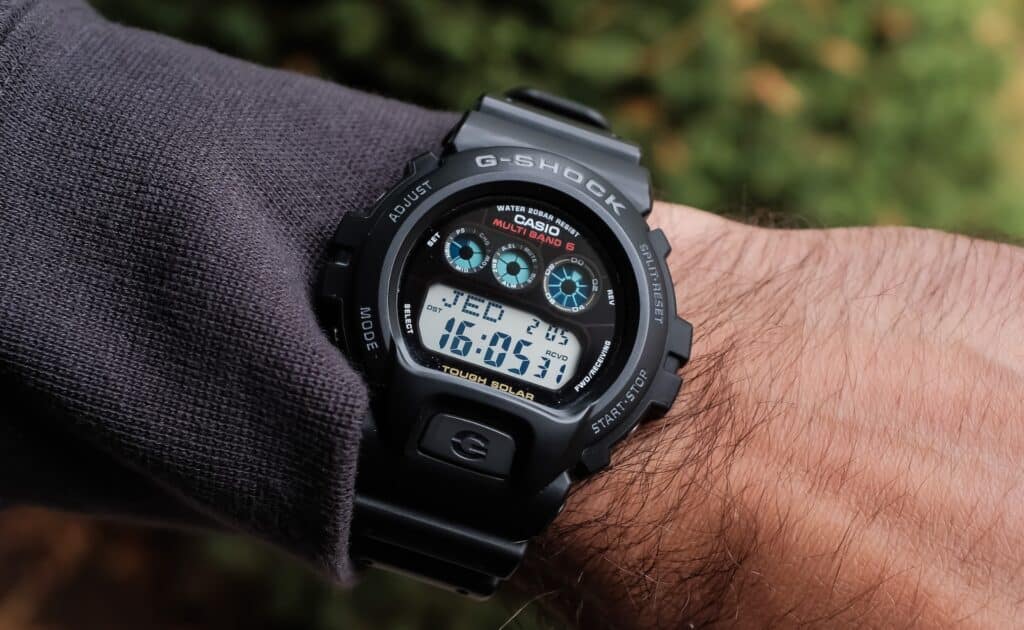
The Casio G-Shock GW6900-1 feels like the point where the F-91W’s cheap digital convenience grows up, gets solar power, syncs itself overnight, and stops asking us to think about batteries or accuracy. It still gives you that familiar Casio digital experience, but with legitimate G-Shock durability and enough low-maintenance tech. The real appeal here is how little the GW6900 asks from you once it is in rotation. Tough Solar means regular light exposure keeps it charged, so battery changes are mostly off the table. Multi-Band 6 atomic syncing keeps time corrected overnight across regions such as the U.S., the UK, Japan, Germany, and China. During our hands-on review, it handled that quietly most nights without any button-poking ceremony. We’ve left it sitting for weeks, picked it back up, and found it ready to go. That is the kind of grab-and-go reliability that makes it so easy to love.
The case is large, and there is no point pretending otherwise. At over 50mm wide and nearly 18mm thick, the GW6900 will be noticeable on smaller wrists. Still, the resin construction and steel caseback keep it from feeling like a heavy lump. It wears more like a protective shell than a dense sports watch, which makes the size easier to forgive once it is on. We have used it through yard work, rushed mornings, rain, knocks, water, and the usual accidental impacts, and the watch tends to come away looking more composed than whatever it just hit.
The display takes a little time to settle down. The triple-eye layout can feel busy for the first couple of days, especially if you are coming from the F-91W’s dead-simple screen. After that adjustment, the layout starts to make sense. The main display keeps time and date easy to read, the upper indicators help track things like stopwatch activity and radio syncing, and the small dual-time readout tucked into the corner ends up being more useful than expected. The stopwatch measures down to 1/100 of a second, and between that, the countdown timer, five alarms, and dual time, it handles workouts, cooking, travel, and daily reminders better than most analog watches could.
The large front button activates a bright green EL backlight that evenly illuminates the entire display. It feels older-school next to newer LED systems, but it works cleanly at night and does not require much precision to use. The stock resin strap has the familiar stiff, slightly squeaky feel out of the box, but it breaks in fairly quickly and starts wrapping the wrist better with wear. It dries fast after water exposure, stays comfortable through longer stretches, and does not make a strong case for replacing it unless you are already the kind of person with a drawer full of straps.
Pros
- Tough Solar keeps maintenance low and makes battery changes far less of a concern.
- Multi-Band 6 syncing keeps the time accurate with very little effort.
- Stopwatch, countdown timer, five alarms, and dual time add real daily usefulness.
- Bright green EL backlight evenly illuminates the full display at night.
- Lightweight resin construction makes the large case easier to wear than the measurements suggest.
Cons
- The case is still large, and smaller wrists will notice it immediately.
- Triple-eye display takes a few days to feel natural.
- The resin strap starts stiff and a bit noisy before it breaks in.
Bulova Computron
| Price: | $450 |
| Water Resistance: | 30m |
| Case Dimensions: | 31mm (diameter) x 40mm (lug-to-lug) x 13.8mm (thickness) |
| Lug Width: | Integrated strap that tapers from 25mm at the case to 16mm at the ends |
| Movement: | Quartz |
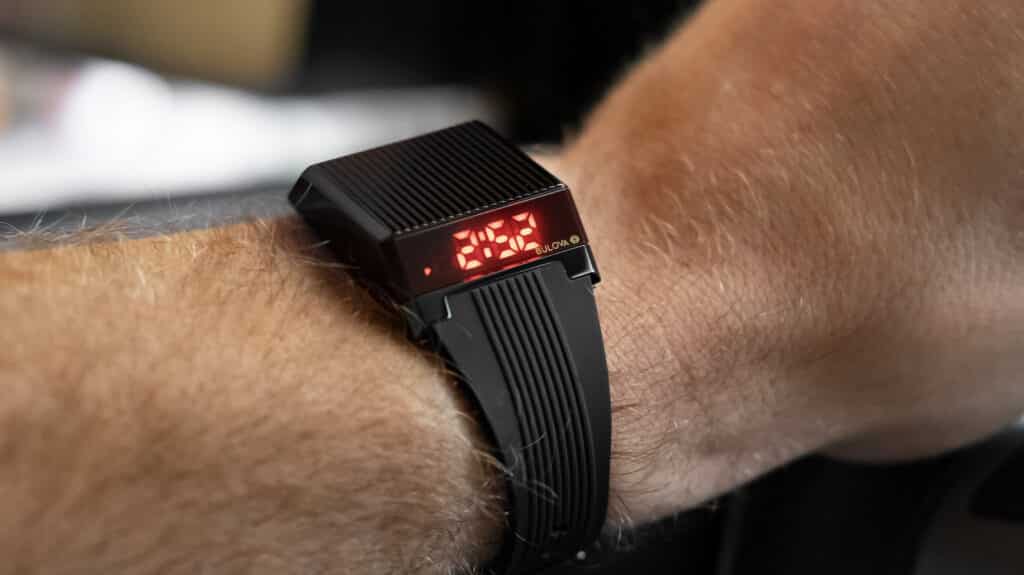
The Bulova Computron is the piece you reach for when the F-91W’s nostalgic digital charm is the starting point, but subtlety has already left the room. This is not the practical little digital you glance at while half-awake in line for coffee. It is louder, stranger, more design-forward, and much more committed to the idea that a watch can be fun without being sensible in the usual way.
The case does most of the talking. Its trapezoidal shape, sharp edges, and late-’70s attitude make it feel completely aloof from the usual round-case rotation. The shallow grooves along the case add texture and keep the design from feeling like a flat slab of retro cosplay. On the wrist, it wears better than the shape suggests, partly because it feels lighter than expected and partly because the integrated rubber strap keeps the whole thing balanced. The strap itself is soft and comfortable, with enough taper to stop the watch from feeling top-heavy.
The LED display is where the Computron becomes either charming or mildly irritating, depending on how patient you are. Unlike the F-91W, you do not get instant glance-and-go readability. You press a button to reveal the time, which slows down the whole interaction. That sounds inefficient because it is. But it also gives the watch its personality. The red LED display is clear once activated, and navigating the time, date, and second time zone functions becomes easier after a little time. Still, as we covered in our dedicated review, this is not the watch we would choose for constant, no-look daily utility.
Finishing is impressive for the price, and the build feels more solid than the novelty shape might suggest. The glossy black IP finish has one annoying habit, though: it picks up fingerprints quickly. Since checking the time usually means touching the case, that can get old unless you accept smudges as part of the whole retro-machine experience. As a Casio F-91W alternative, the Computron works best for someone who likes the old-school digital idea but wants more wrist presence, more conversation, and a lot less quiet practicality.
Pros
- Trapezoidal case gives it a bold, unapologetic ’70s digital look.
- Wears more comfortably than the angular shape suggests.
- Soft rubber strap helps balance the case and keeps it comfortable.
- Build quality and finishing feel strong for the price.
Cons
- LED display requires a button press, so quick time checks are slower.
- Glossy black IP finish shows fingerprints easily.
Citizen Ana-Digi Temp
| Price: | $450 – $500 |
| Water Resistance: | 30m |
| Case Dimensions: | 31.5mm (diameter) x 40mm (lug-to-lug) x 8.4mm (thickness) |
| Lug Width: | 18mm |
| Movement: | Citizen caliber 8980 |
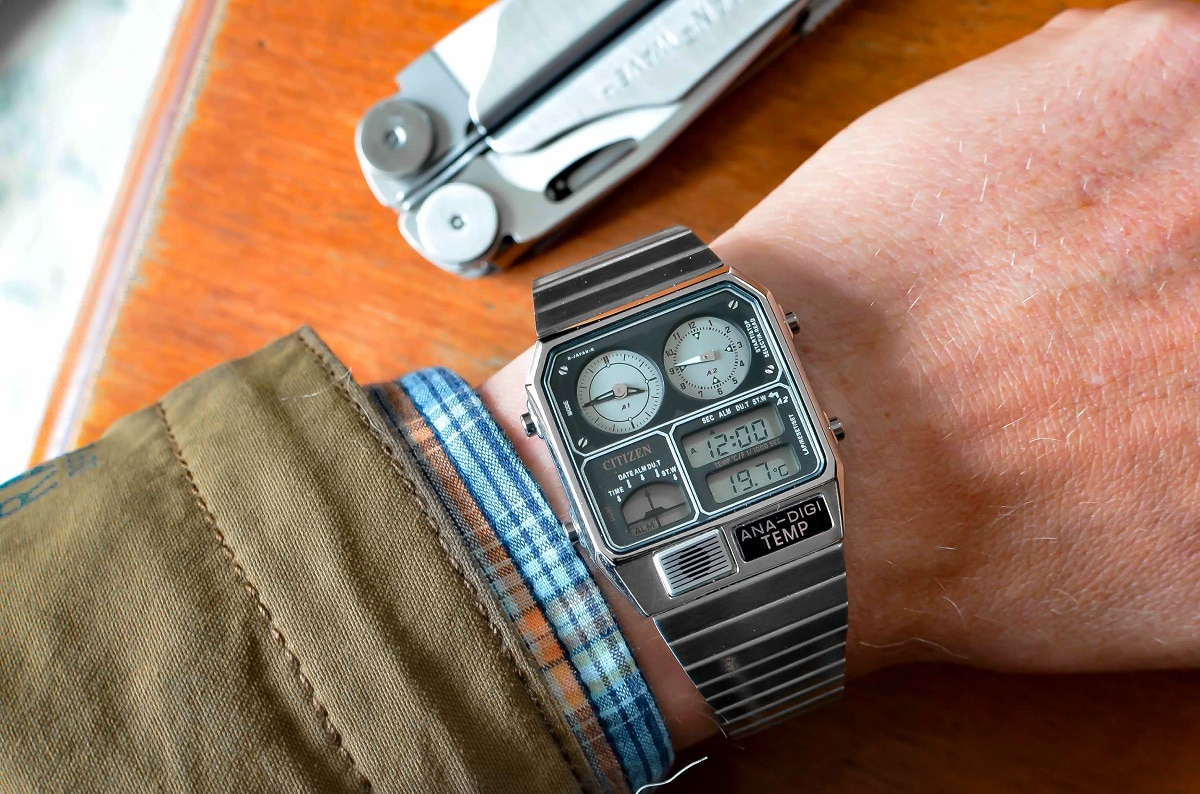
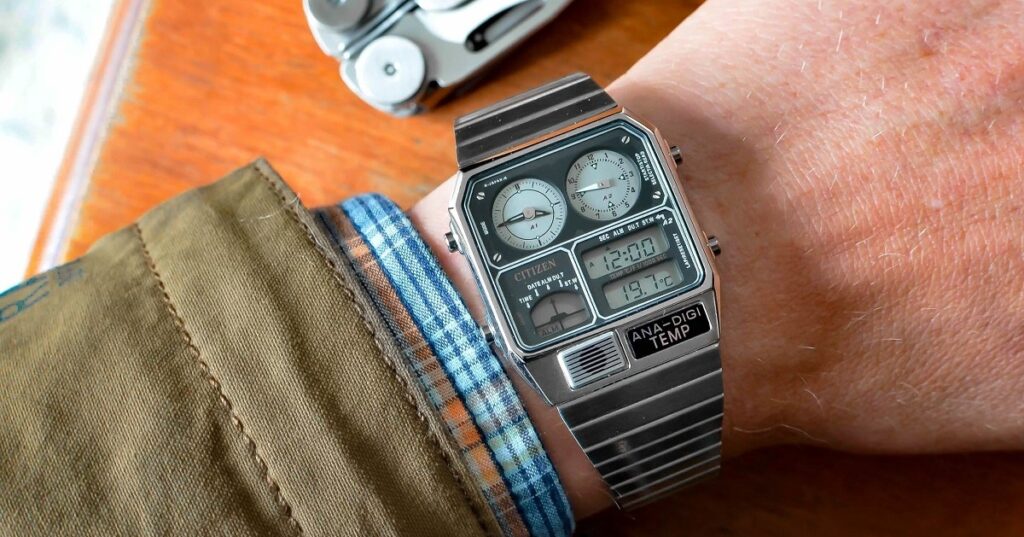
The Citizen Ana-Digi Temp is for the F-91W fan who looked at a simple digital watch and thought, “Fine, but what if it also looked like a tiny wrist-mounted control panel?” It keeps the digital utility spirit alive, but swaps the F-91W’s clean simplicity for ana-digi complexity, early-tech charm, and the kind of weirdness that makes collectors lean closer instead of scrolling past.
The case sets the tone immediately. Its boxy stainless-steel shape, sharp edges, and eighties-tech attitude feel more industrial than sleek, which is part of its appeal. This is not a modern minimalist digital, and it is not trying to be. The dial looks busy at first because, well, it is busy. But the more time you spend with it, the more the organization starts to make sense. Citizen breaks the information into clear zones, keeping the analog sub-dials and LCD sections distinct enough that the whole thing avoids collapsing into visual noise. Key information pops in crisp white against the black background, while secondary labels sit back in darker LCD tones. Even the branding stays restrained, which helps more than you might expect on a watch already doing this much.
Wearability is also better than the design suggests. The Ana-Digi Temp demands attention visually, but it does not wear like a huge novelty object. The short lug-to-lug length and slim profile help it sit comfortably on a range of wrists, including smaller ones. Small details reward closer inspection, too: the thin black needle-like hands with lume on the left side, the larger regulator-style hand on the right, polished hand bases, and exposed screws all add texture without turning the watch into pure decoration.
In use, the dual-time setup is the feature that feels most practical. It works almost like a casual GMT, giving you both an analog reference and digital confirmation when tracking another time zone. The temperature function is more of a situational party trick, but a good one. For accurate readings, you need to take the watch off, which limits how spontaneous it feels. Still, it never comes across as pointless because it fits the watch’s whole “useful but strange” personality. The integrated bracelet also suits the case well, though the flared end links are a known weak spot and can bend over time. Over the course of our review, we found that the Ana-Digi Temp is not for someone who wants pure speed, simplicity, or quiet daily wear. It is for the person who likes inexpensive digital utility but wants more layers, more character, and a watch that refuses to blend into the background.
Pros
- The dual-time analog-digital layout makes tracking another time zone practical and easy to confirm.
- Compact case, short lug-to-lug, and slim profile keep it wearable despite the busy design.
- High-contrast display treatment makes key information quick to read.
- Small details like hand shapes, lume placement, polished bases, and exposed screws reward closer inspection.
Cons
- Dial layout can feel overwhelming at first.
- Bracelet end links can bend over time.
- Temperature readings require removing the watch for better accuracy.
If you’ve spent time with any of these Casio F-91W alternatives, we’d love to know which one stuck around after the cheap-watch honeymoon wore off. Share your pick in the comments, and if there’s another F-91W-adjacent piece we missed, let us know.

Co-Founder and Senior Editor
Kaz has been collecting watches since 2015, but he’s been fascinated by product design, the Collector’s psychology, and brand marketing his whole life. While sharing the same strong fondness for all things horologically-affordable as Mike (his TBWS partner in crime), Kaz’s collection niche is also focused on vintage Soviet watches as well as watches that feature a unique, but well-designed quirk or visual hook.