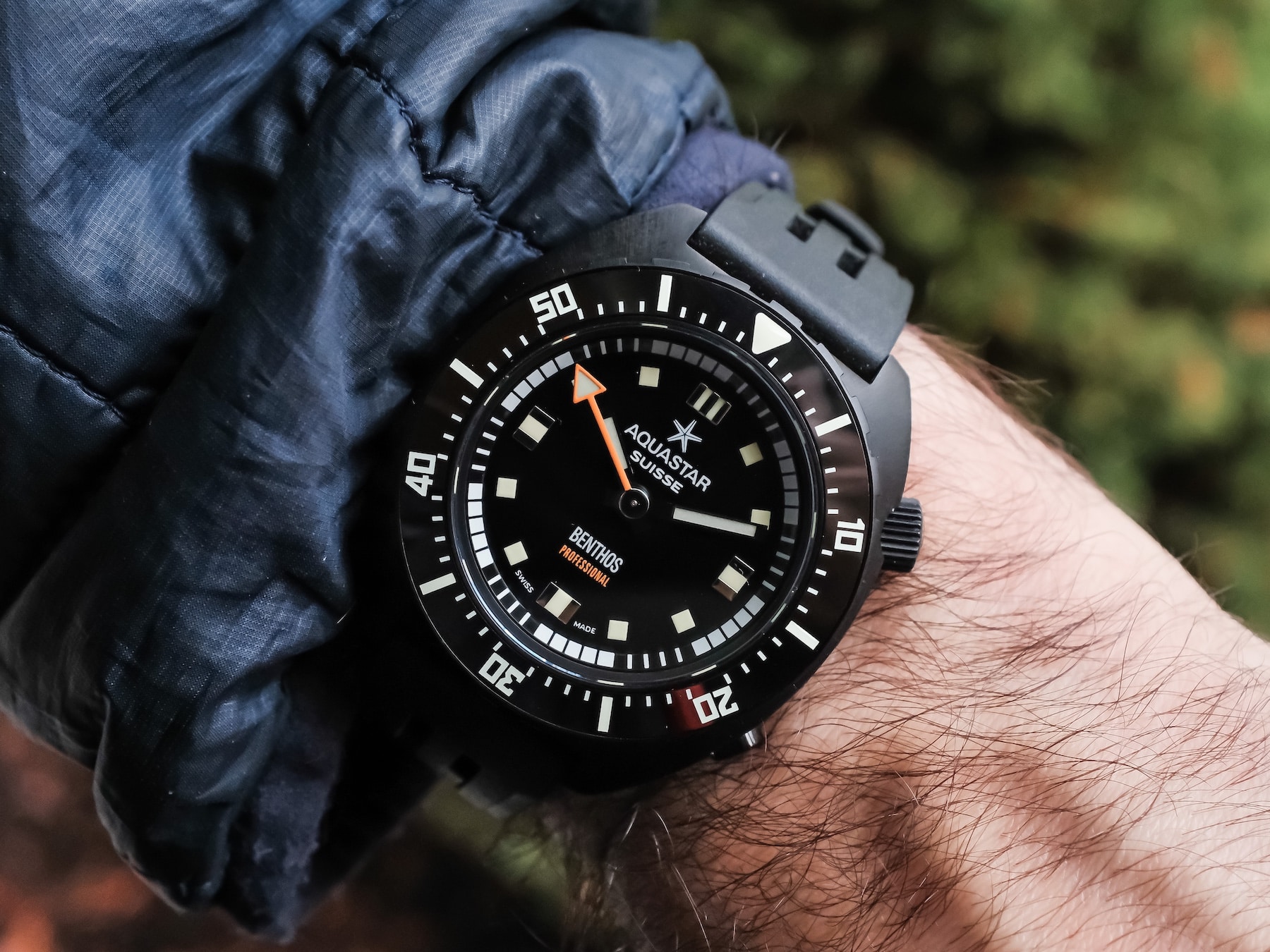
Vintage-style dive watches have a way of making otherwise reasonable people start excusing bad decisions. Often, you’ll probably forgive a foggy crystal, a suspicious service history, or a bezel that turns with the confidence of a wet cracker because the thing has “character.” That’s charming until you want a watch you can wear to work, take near water, and not spend the next three weeks tracking on a replacement part. So the goal here is simple: to sort through the best vintage-inspired dive watches for modern buyers and figure out which ones capture that old-school dive-watch feeling without dragging every old-school problem along for the ride.

We’ve been reviewing watches for nearly a decade, and this particular corner of the hobby has given us plenty to argue with: polished cases that pick up desk-diving scars if you breathe near them, bezels that feel great until your hands are dry, and strict reissues that make you wonder whether “faithful” is always a compliment. The watches we’re looking at here are backed by TBWS hands-on time, from microbrand watches, to in-the-know picks, and well-known Swiss divers.
Wolbrook Skindiver Douglas Reissue
| Price: | $500 |
| Water Resistance: | 100m |
| Case Dimensions: | 40mm (diameter) x 48mm (lug-to-lug) x 11mm (thickness) |
| Lug Width: | 20mm |
| Movement: | Miyota 8215 automatic |
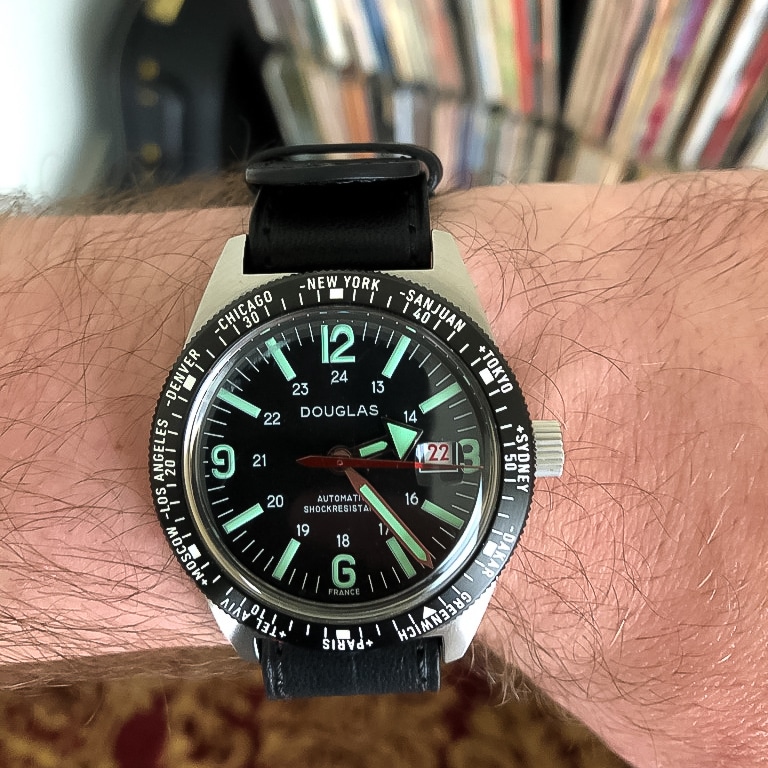
The Wolbrook Skindiver Douglas Reissue earns its place here because it represents a specific corner of the vintage dive-watch world: the skin diver. These watches were never about looking like overbuilt saturation-diving equipment. They were meant to be slimmer, simpler, and easier to wear, which makes the Douglas feel relevant for modern buyers who want vintage dive-watch character without strapping on a hockey puck.
Wolbrook leans hard into the watch’s possible space-race connection, with the story that Neil Armstrong may have worn one, or at least something like it. That link is too thin for us to buy the watch on that narrative alone. Still, the mythology gives the piece a little extra weirdness, and that is not always a bad thing in this hobby. Once we pushed the space lore to the side, the watch made more sense as a practical vintage-inspired diver with its own personality.
The case is a big part of that. At 40mm wide, 48mm lug-to-lug, and 11mm thick, it has enough wrist presence to feel like a modern watch, but it avoids the bloated feel that kills the charm of many retro divers. The straight lugs help it sit flatter, making it easier to wear under sleeves or for a full day without constantly noticing it. For buyers with smaller wrists, or anyone tired of vintage-inspired divers that confuse “heritage” with “oversized,” this size feels approachable. The details keep it from feeling like another generic old-diver revival. The world time bezel is the most obvious one. It is not a true travel-tool bezel in the strict sense, but it adds visual texture and gives the watch a different rhythm than the usual countdown or dive bezel layout. The polished red second hand, roulette date, and cyclops tucked under the crystal all add character without making the dial feel cluttered or novelty-driven.
As covered in our detailed review, the modern updates make the Douglas easier to recommend as a daily watch, though they also change the experience. The sapphire crystal makes it more durable than a fragile vintage original, and the Miyota 8215 automatic movement keeps servicing and ownership quite straightforward. Wolbrook also offers a quartz version with Seiko’s VH31 sweeping-seconds movement, a smart option for buyers who like the look but do not care about the maintenance of automatic watches. The trade-off is that the piece feels heavier and a touch more substantial than a true vintage skin diver. Anyone used to the light, nimble feel of older examples will notice the difference right away. That makes the Douglas best for someone who wants the skin-diver look at a lower price tier, with enough modern practicality to wear it without babying it.
Pros
- The proportions give it vintage-leaning proportions without making it feel fragile or undersized.
- Straight lugs and a flatter stance help it wear comfortably under sleeves.
- The worldtime bezel, roulette date, under-crystal cyclops, and polished red second hand add personality without turning the watch into a gimmick.
- Sapphire crystal, a Miyota 8215 automatic movement, and the available Seiko VH31 quartz option make it far easier to live with than an actual vintage skin diver.
Cons
- The worldtime bezel is more of a visual signature than a serious travel function.
- The branding leans harder on the Neil Armstrong connection than the evidence can comfortably support.
- It feels heavier and less nimble than vintage skin divers, which may bother collectors used to the original formula.
- The modern upgrades make ownership easier, but they also smooth away some of the raw charm people chase in old skin divers.
Baltic Aquascaphe
| Price: | $650 – $750 |
| Water Resistance: | 200m |
| Case Dimensions: | 39mm (diameter) x 47mm (lug-to-lug) x 12mm (thickness) |
| Lug Width: | 20mm |
| Movement: | Miyota 9039 (Mechanical Movement) |
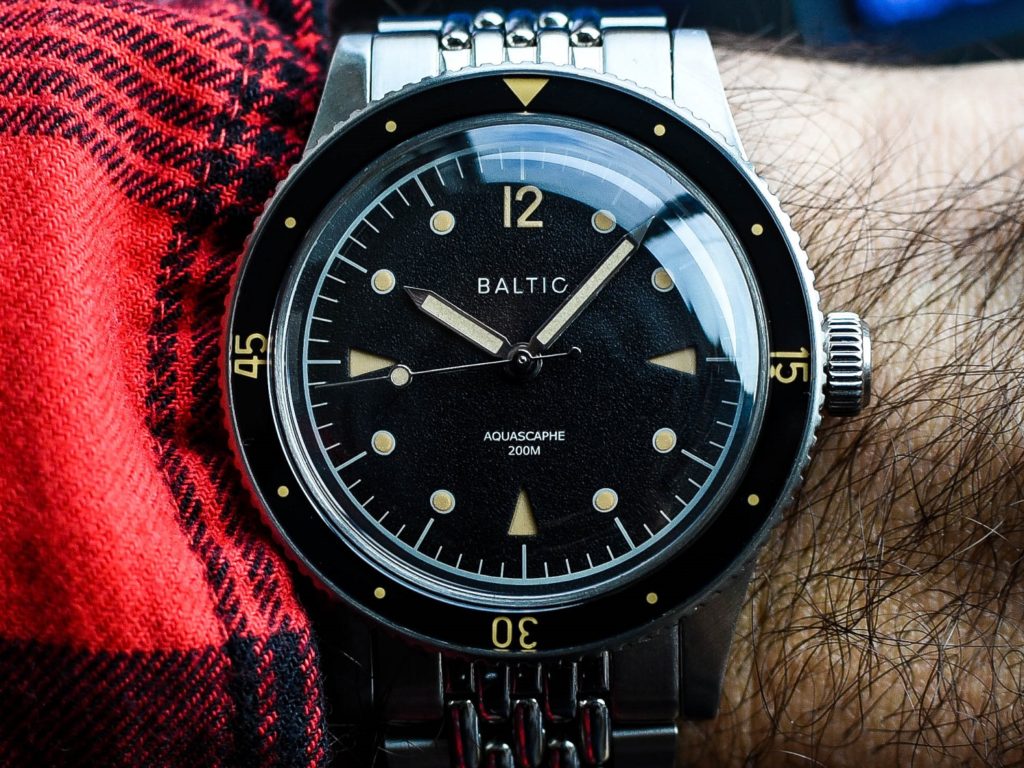
The Baltic Aquascaphe has become a modern microbrand benchmark for vintage dive styling because it understands restraint. It isn’t trying to revive one exact archival diver, which gives it room to feel old-school without becoming a costume piece. The case proportions, finishing, dial layout, and bracelet all pull from mid-century dive-watch language, but the whole thing feels built for someone who wants to wear the watch now, not baby it through a carefully curated weekend.
The dial does most of the emotional work. Baltic uses a hybrid sandwich construction with a fully lumed layer sitting beneath the cut-out indices, which gives the surface real depth without cluttering it. In low light, that setup creates a smooth, even glow that’s easy to read at a glance rather than just impressive for the first ten minutes after charging. The gilt accents add warmth without slipping into heavy-handed faux-vintage territory, and the sapphire bezel insert helps keep the watch feeling polished and modern. The matte dial shifts subtly depending on the light, the pencil-style hands stay clean and legible, and the lollipop second hand reaches neatly toward the chapter ring. Add the minimal dial text, and the whole layout feels considered instead of decorated.
On the wrist, the Aquascaphe wears with more refinement than its tool-watch styling might suggest. The case sits over 12mm thick, so it slips under a sleeve without much protest, while the 47mm lug-to-lug keeps it stable without creating overhang. There’s enough weight to feel reassuring, but it never turns into the kind of diver you notice for the wrong reasons halfway through the day. The mostly brushed case finish also makes sense for regular wear because it hides small marks better than a high-polish case would, though buyers who like more visual contrast may find it a little subdued. The crown has a subtle texture that makes unscrewing and adjusting it easier than expected. With a double-domed sapphire crystal plus 200 meters of water resistance, it lands in that useful zone where you can wear it without planning your day around the watch.
The beads-of-rice bracelet is a big part of why the Aquascaphe works as an everyday vintage-inspired diver. It conforms naturally to the wrist, tapers well, and stays comfortable over longer wear without creating pressure points at the clasp. During testing, we found that the polished center beads and brushed outer links add enough contrast to keep it from looking flat, while the quick-release spring bars make swapping to the Tropic-style rubber strap painless when you want more obvious vintage-dive energy. Inside, the Miyota 9039 keeps ownership simple: no date, a two-position crown, a 28,800 vph beat rate, and a practical 42-hour power reserve. That no-date layout helps the dial stay clean, though it may feel limiting if you rely on a date window every day. Still, for modern buyers who want vintage dive-watch charm with real wearability, the Aquascaphe strikes the right balance.
Pros
- The hybrid sandwich dial adds real depth while keeping the layout clean and legible.
- The just-over-12mm case thickness and 47mm lug-to-lug make it easy to wear under sleeves without feeling undersized.
- The beads-of-rice bracelet is flexible, well-tapered, and comfortable throughout the day.
- Gilt accents, the matte dial, sapphire bezel insert, pencil hands, and lollipop second hand create vintage warmth without overdoing the faux-aging.
- Quick-release spring bars make switching to the Tropic-style rubber strap easy.
Cons
- The no-date layout keeps the dial clean, but some buyers may miss the everyday convenience of a date window.
- The mostly brushed case may feel visually flat if you prefer a stronger contrast with polished surfaces.
Certina DS PH200M
| Price: | $810 |
| Water Resistance: | 200m |
| Case Dimensions: | 43mm (diameter) x 52mm (lug-to-lug) x 14.5mm (thickness) |
| Lug Width: | 20mm |
| Movement: | Powermatic 80 |
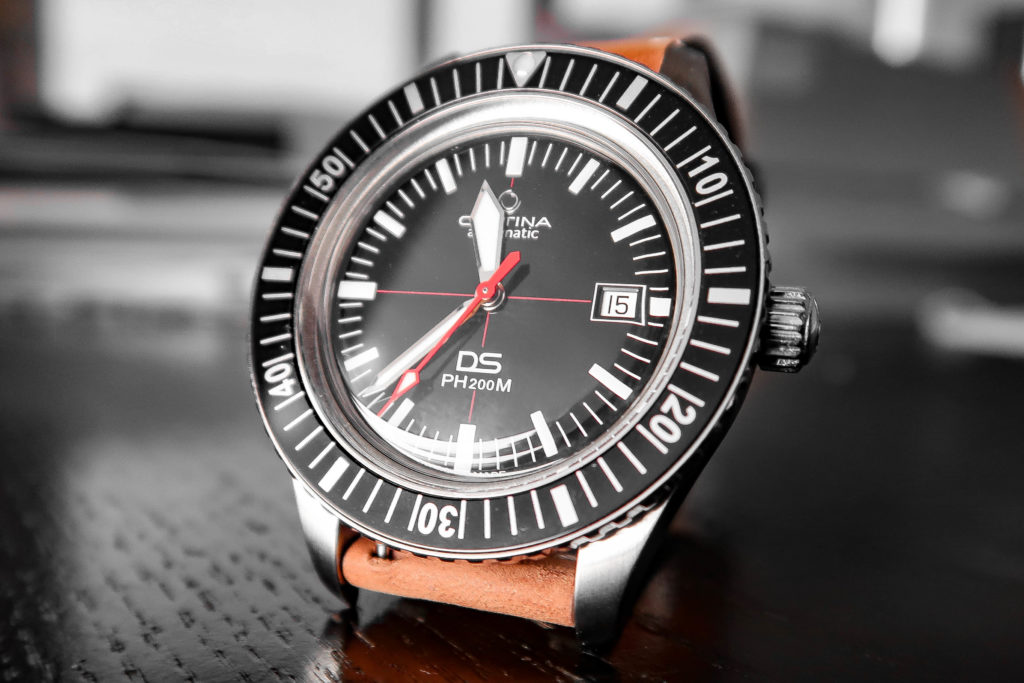
The Certina DS PH200M is the kind of vintage-inspired diver that makes more sense after a few days than it does in photos. It’s a modern reissue of a late-1960s Certina dive watch, but it doesn’t feel like Certina dusted off an old design and called it a day. The proportions, dial layout, crystal shape, and strap flexibility all lean heavily into vintage-diver territory, while the underlying build gives modern buyers fewer reasons to worry. It also occupies a nice middle ground: more mainstream and serviceable than many niche microbrand watches, but still less obvious than the usual Seiko/Citizen recommendations that dominate this category.
The dial carries most of the watch’s old-school personality. Certina keeps the layout simple with a matte black surface, clean white markers, and red crosshair accents that add enough tension without making the watch feel busy. The BGW9 lume proved useful well into the night during our time with it, which matters because vintage styling should not come at the expense of being able to read the thing after dinner. The aluminum dive bezel adds to the period-correct feel, using a traditional 60-click setup with a luminous marker at 12. We appreciated that the bezel and chapter ring alignment were precise, especially since that is not always guaranteed, even on some very popular divers. The action itself is less impressive: it turns with a bit of resistance and wiggles slightly between clicks. It still does the job for timing basic tasks, but buyers expecting sharp, modern bezel tactility may find it a little soft around the edges.
The case is where the DS PH200M becomes more complicated. At under 43mm wide and with a roughly 52mm lug-to-lug span, it has real wrist presence. On larger wrists, that gives the watch a purposeful, slightly rugged feel that suits the design. On smaller wrists, there’s no pretending it disappears, though the lugs curve downward enough to help it settle better than the numbers suggest. The case height comes in at around 14.5mm, with much of that contributed by the domed box-style crystal, so the watch has that vintage verticality without feeling delicate. This is not the skin-diver end of the vintage-inspired spectrum. It feels more like a sturdy vacation diver: ready for water, sand, travel, and whatever abuse comes from deciding that one watch is “probably fine” for the whole trip.
Inside, the Powermatic 80 automatic movement gives the PH200M one of its clearest modern advantages. It runs at 21,600 bph and offers about 80 hours of power reserve, which means you can take it off on Friday night and still find it running Monday morning. That’s pretty useful if you rotate watches often. Servicing should also be less stressful than with something obscure, since this movement is widely used across the Swatch Group. Certina’s DS, or Double Security system, adds another practical layer by using a rubber shock cushion around the movement, along with standard Incabloc protection. In our hands-on review, the included leather strap felt thick and sturdy and came with quick-release bars, though the nubuck finish will not be for everyone. The watch felt especially right on a NATO or mesh bracelet, both of which push the vintage diver personality further while making the whole package more casual and wearable.
Pros
- Certina’s DS shock-protection system adds meaningful durability beyond the vintage styling.
- The matte black dial, white markers, red crosshair accents, and domed box-style crystal give it excellent vintage-leaning character.
- The Powermatic 80 movement provides a practical 80-hour power reserve.
- The precise bezel/chapter-ring alignment is better than what we’ve seen on some popular divers.
- It works well across different straps, especially NATO and mesh options.
Cons
- The just-under-43mm case and roughly 52mm lug-to-lug span may be too much for smaller wrists.
- The bezel has some stiffness and slight play between clicks, so it does not feel as crisp as stronger modern competitors.
- The 14.5mm height, helped along by the domed box-style crystal, gives it noticeable thickness.
- The included nubuck-style leather strap is sturdy, but its texture and look may not appeal to everyone.
Mido Ocean Star Tribute
| Price: | $1,200 – $1,400 |
| Water Resistance: | 200m |
| Case Dimensions: | 40.5mm (diameter) x 47mm (lug-to-lug) x 13.5mm (thickness) |
| Lug Width: | 21mm |
| Movement: | Mido Caliber 80 |
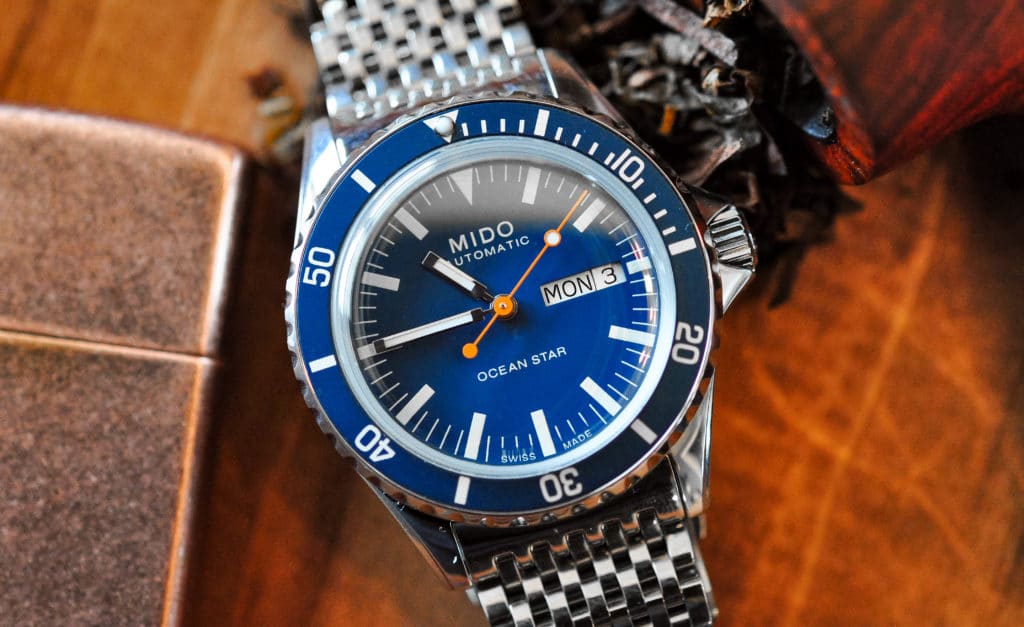
The Mido Ocean Star Tribute is the accessible heritage diver in this group, making it useful for buyers who want vintage flavor from a mainstream Swiss brand without straying too far into niche-collector territory. It is not a direct reissue of one specific Mido reference. It feels more like Mido built a greatest-hits version of a vintage dive watch, then gave it enough modern polish, literally, to make it stand out. And yes, the entire watch is polished. If small scratches make your eye twitch, that matters. But on the wrist, the 40.5mm case and 47mm lug-to-lug hit a sweet spot we wish more divers would remember. It is smaller than the standard Ocean Star, and the mostly straight lugs with a slight chamfer keep it from feeling slabby. On bigger wrists, it still has enough presence. On smaller wrists, it avoids the oversized diver problem pretty well.
The vintage-diver mood comes through strongest in the dial and crystal. The Mediterranean Blue version has that old dive-advertisement charm, with a simple printed dial, thick painted baton markers at five-minute intervals, smaller minute markers, and a Datoday window at 3 o’clock that somehow does not make the dial feel crowded. The chromed paddle hands are easy to read, and the orange lollipop seconds hand plays well against the blue. The aluminum bezel, also blue but slightly darker, was the right choice here. Ceramic would have felt too modern, and fake bakelite can get a little costume-party fast. The big box sapphire crystal raises the height to 13.5mm and gives the watch a rounded vintage profile, but it remains clearer than many plexi-style executions. There is some distortion at the edges, as expected, but not enough to wreck legibility. Mido skipped AR coating, and we did not miss it much during our review. On a watch like this, avoiding that color-shifting AR glare feels more appropriate than clinical perfection.
The bezel and bracelet are where the Tribute becomes both lovable and annoying. The coin-edged bezel looks Submariner-adjacent, uses a 60-click action, fits tightly, and has very little play. The problem is grip. Because it is polished, dry hands make it harder to turn than it should be, and lotioned hands would probably turn the whole operation into a small comedy routine. The larger crown is a smarter functional move. It looks right on the case and gives a much better grip for winding, setting, and screwing it down, thanks to sharper edges than the bezel. The all-polished multi-link bracelet is polarizing, but we liked how fully articulating and comfortable it felt. It drapes over the wrist with a very 1970s, gold-chain-in-Miami kind of energy. The clasp is excellent, with a standard push-button release and a smaller button for the extension, useful for diving or giving yourself a few extra millimeters on a sweaty day. It also avoids becoming bulky, which is the part that many brands still mess up. Mido includes a matching blue canvas strap with leather backing, but it felt like it would need real break-in time, while the bracelet was comfortable immediately.
Inside, the Caliber 80 does a lot to make the Ocean Star Tribute feel like more than a polished nostalgia machine. It beats at 21,600 bph, which will bother some enthusiasts, and it is not as simple to regulate as a standard ETA 2824. But the 80-hour power reserve is a real benefit if you rotate watches, and our example ran at about +2 seconds per day on the timegrapher. That is hard to argue with at this price. The weak point is lume. The standard green Super-LumiNova underperformed for a 200-meter diver, with the hands and bezel pip glowing brighter than the dial, but none of it felt strong. Most owners will probably wear this more to dinner than to actual dive sites, but still, an $80 Seiko should not be embarrassing a Swiss diver here. Even with that gripe, the Ocean Star Tribute works because it gives modern buyers a charming, wearable vintage-style diver with a strong movement, a standout bracelet, and enough mainstream support to feel easy to own.
Pros
- The 40.5mm case and 47mm lug-to-lug hit a practical sweet spot for many wrist sizes.
- The Mediterranean Blue dial, orange lollipop second hand, and aluminum bezel create a strong vintage dive-watch character without feeling cheap.
- The box sapphire crystal adds old-school shape while staying clearer and more practical than plexiglass.
- The polished multi-link bracelet is comfortable, fully articulating, and more distinctive than most bracelets in this category.
- The clasp extension is smooth, slim, and genuinely useful for hot days or when using water.
- The Caliber 80 gives an 80-hour power reserve, and our example ran around +2 seconds per day.
Cons
- The fully polished case and bracelet will show marks quickly, so scratch-sensitive buyers should be warned.
- The polished coin-edge bezel has little play, but it can be hard to grip with dry or slippery hands.
- Lume performance is weak for a 200-meter dive watch, especially compared with cheaper Seiko divers.
- The included blue canvas strap looks the part but may need significant break-in time.
Aquastar Benthos Professional
| Price: | $1,590 |
| Water Resistance: | 300m |
| Case Dimensions: | 42mm (diameter) x 47mm (lug-to-lug) x 13.7mm (thickness) |
| Lug Width: | 20mm |
| Movement: | ETA 2824-2 in Elaboré grade |
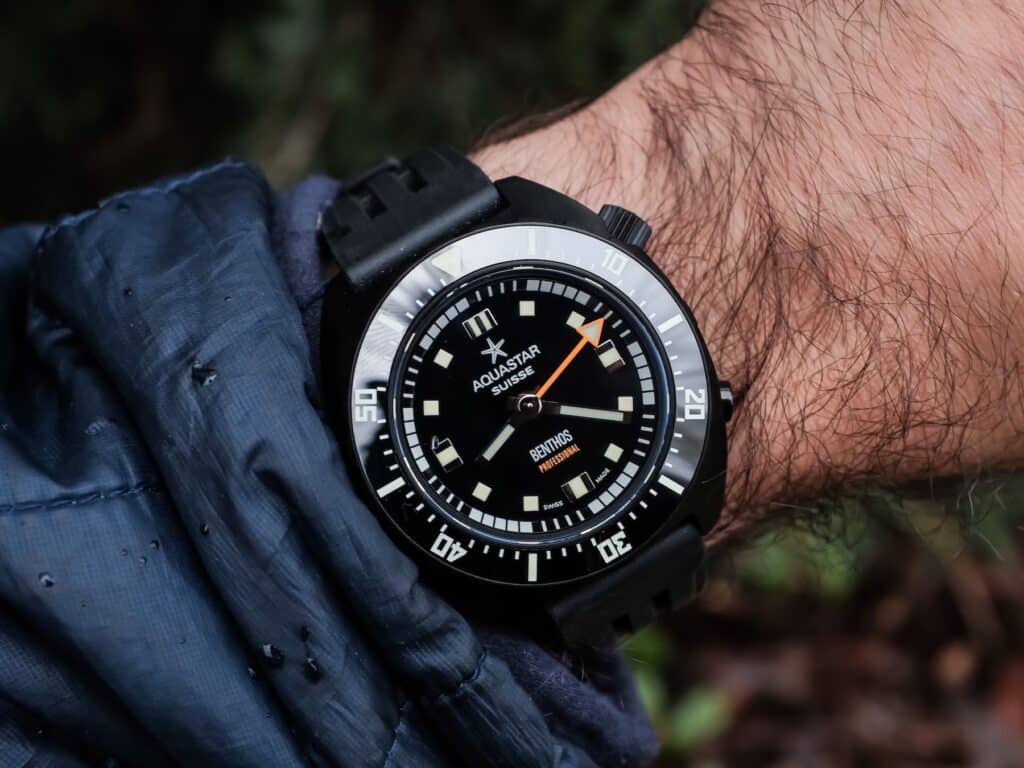
The Aquastar Benthos Professional is the niche pick here, and that is part of its appeal. Aquastar’s credibility comes from watches built around real professional, commercial, and military diving use, not lifestyle cosplay. The original Benthos 500 from 1970 sits right in that world, which gives this modern version more weight than a retro diver built from mood-board nostalgia. What we appreciated in testing is that the Benthos Professional does not try to trap itself in 1970. It keeps the Benthos identity, especially the purposeful case shape and tool-watch attitude, but reshapes the experience for someone who might wear it to work, on a weekend trip, or near actual water without treating it like a fragile collector object.
On the wrist, the biggest improvement is the profile. The 42mm case still reads as a Benthos, and the compact lug-to-lug keeps it centered, but the reduced thickness makes it less likely to wear. It sits lower, feels flatter, and avoids the top-heavy awkwardness that can make older-style divers fun to admire but tiring by dinner. Even with 300 meters of water resistance, it never felt like Aquastar was asking us to tolerate bulk in the name of authenticity. The brushing is clean, the edges are defined, and the black DLC case works better than we expected. It adds visual mass without making the watch feel physically heavier or too tactical. The ceramic bezel also feels properly sorted, with firm, even clicks, enough resistance to feel secure, and precise alignment during use. The two o’clock crown threads smoothly and stays out of the way on the wrist, while the small helium escape valve at four o’clock, which can look like a pusher at first glance, adds function and helps visually balance the case.
The dial keeps the same practical attitude. The semi-gloss black surface, square and rectangular markers, and a mix of applied and printed elements all prioritize quick reading over vintage decoration. The lume is the standout. It flares immediately, stays useful past the initial charge, and looks quite sharp against the dark dial, DLC case, and glossy black ceramic bezel. The checkered rehaut is a small but smart detail because it adds texture and makes timing easier without crowding the dial. We also liked the no-date layout here. It feels complete, and the flush flat sapphire crystal keeps the view crisp and distortion-free.
Inside, the ETA 2824-2 Elaboré, adjusted in multiple positions, was comfortably accurate within a few seconds in daily use. The power reserve is modest, but winding and setting felt smooth and predictable. Paired with the ISOfrane VS 1969 strap, the watch becomes much easier to wear than earlier Benthos models. The strap feels dense and substantial without turning plasticky, resists dust and lint, and uses underside texture and hole spacing that feel considered. Overall, it lands as a collector-focused vintage reissue that still makes sense as a modern daily diver. It is more engaging than many entry-level big-brand divers, but it does ask you to care about Aquastar’s specific history and design language. Read through our full review for a deeper understanding.
Pros
- Compact lug-to-lug proportions and a lower profile help it sit flat without feeling bulky, even with 300 meters of water resistance.
- Black DLC adds visual weight and character without making the watch feel aggressive or physically heavy.
- The ceramic bezel has firm, even clicks, secure resistance, and precise operation.
- The two o’clock crown stays out of the way, while the four o’clock helium escape valve adds function and visual balance.
- The checkered rehaut improves timing at a glance without cluttering the layout.
- ISOfrane VS 1969 strap feels substantial, comfortable, dust-resistant, and far better than generic rubber.
Cons
- The DLC case will not appeal to buyers who prefer untreated stainless steel and more traditional vintage warmth.
- The no-date dial looks cleaner, but some everyday wearers may miss the convenience of a date window.
Doxa Sub 300 Aqua Lung

| Price: | $2,190 |
| Water Resistance: | 300m |
| Case Dimensions: | 42.5mm (diameter) x 45mm (lug-to-lug) x 12mm (thickness) |
| Lug Width: | 20mm |
| Movement: | COSC ETA-2824 |
The Doxa Sub 300 Aqua Lung Limited Edition is not quietly borrowing vintage cues to look tasteful in a lineup of retro divers. It carries a deep Doxa identity through the 42.5mm cushion case, bold orange dial, dual-scale no-decompression bezel, and Aqua Lung branding. That historical weight is the point.
The case looks large on paper, but it wears smaller than expected thanks to the wide, low-profile cushion shape. Instead of stacking tall and feeling top-heavy, it spreads across the wrist and flows naturally into the bracelet. During daily wear, travel, walking around town, or taking it near water, it stays planted without shifting or feeling awkward. The steel also seems to wear in a way that suits the watch. Marks and softening do not ruin the design; they add to the tool-watch character, which is useful if you want a vintage-inspired diver you can wear instead of constantly protecting it.
The bezel is where the Doxa still feels properly functional. The action is firm, the clicks are clean, there is no backplay, and the grip works with wet or dry hands, even when your fingers are cold. The dual-scale no-decompression layout may be more romantic than necessary for most of us. Still, it gives the watch a real instrument-like quality rather than feeling like decorative nostalgia. The dial works the same way. The orange is loud, but the small dial opening, around 25.5mm across, makes that color feel concentrated inside the cushion case. The bubble-shaped crystal adds vintage distortion and catches light in a way that gives the watch character. However, buyers who prefer a flatter, cleaner view may find it distracting. Legibility still holds up thanks to chunky indices, broad blocky hands, and an oversized minute hand that reaches where it should.
The lume is not trying to win a brightness contest, which is fine. It builds gradually, stays consistent, and remains useful in low light without becoming part of the watch’s personality. The slightly off-center Aqua Lung logo is more divisive. Some people will notice it every time they look down. Others will treat it as part of the charm, which feels about right for a watch this specific. The beads-of-rice bracelet also looks heavier in photos than it feels on the wrist. It hugs the wrist well, balances the case nicely, and uses a simple, reliable clasp with a dive extension and micro-adjustment holes. The taper is not perfectly even, so it will not satisfy buyers who want a more polished, uniform modern bracelet experience.
Inside, the COSC-certified ETA 2824 keeps the whole thing grounded. It is not exotic, and that is a strength here. In our experience, it has stayed accurate and reliable through years of travel and regular wear, without strange quirks or attention-seeking behavior. That makes the Sub 300 Aqua Lung Limited Edition a strong fit for buyers who want vintage dive-watch history, real collector appeal, and a watch that can still handle ordinary life. It is bold, a bit odd, and not built to please everyone, which is probably why it still feels so convincing.
Pros
- The 42.5mm cushion case wears smaller than expected, thanks to its wide, low-profile shape and natural curve into the bracelet.
- The bezel action feels functional, with firm clicks, no backplay, and a grip that works well with wet or cold hands.
- The dual-scale no-decompression bezel gives the watch real Doxa tool-watch character, even for non-divers.
- The beads-of-rice bracelet wears comfortably and balances the case well, with a simple clasp, dive extension, and micro-adjustment holes.
- The COSC-certified ETA 2824 has been reliable and accurate through years of travel and regular wear.
Cons
- The Aqua Lung logo sits slightly off-center, which may bother buyers who want cleaner dial symmetry.
- The bracelet taper is not perfectly even, so it may not feel as polished or uniform as some modern bracelets.
- The bubble-shaped crystal creates light distortion that can be distracting.
Think we missed a vintage-inspired diver that deserves a spot here? It’s entirely possible because we only include watches we’ve reviewed hands-on. So, if there’s a vintage-leaning diver you think belongs in the conversation, drop it in the comments below. We’ll see if we can get one in for review and find out how it measures up.

Co-Founder and Senior Editor
Kaz has been collecting watches since 2015, but he’s been fascinated by product design, the Collector’s psychology, and brand marketing his whole life. While sharing the same strong fondness for all things horologically-affordable as Mike (his TBWS partner in crime), Kaz’s collection niche is also focused on vintage Soviet watches as well as watches that feature a unique, but well-designed quirk or visual hook.