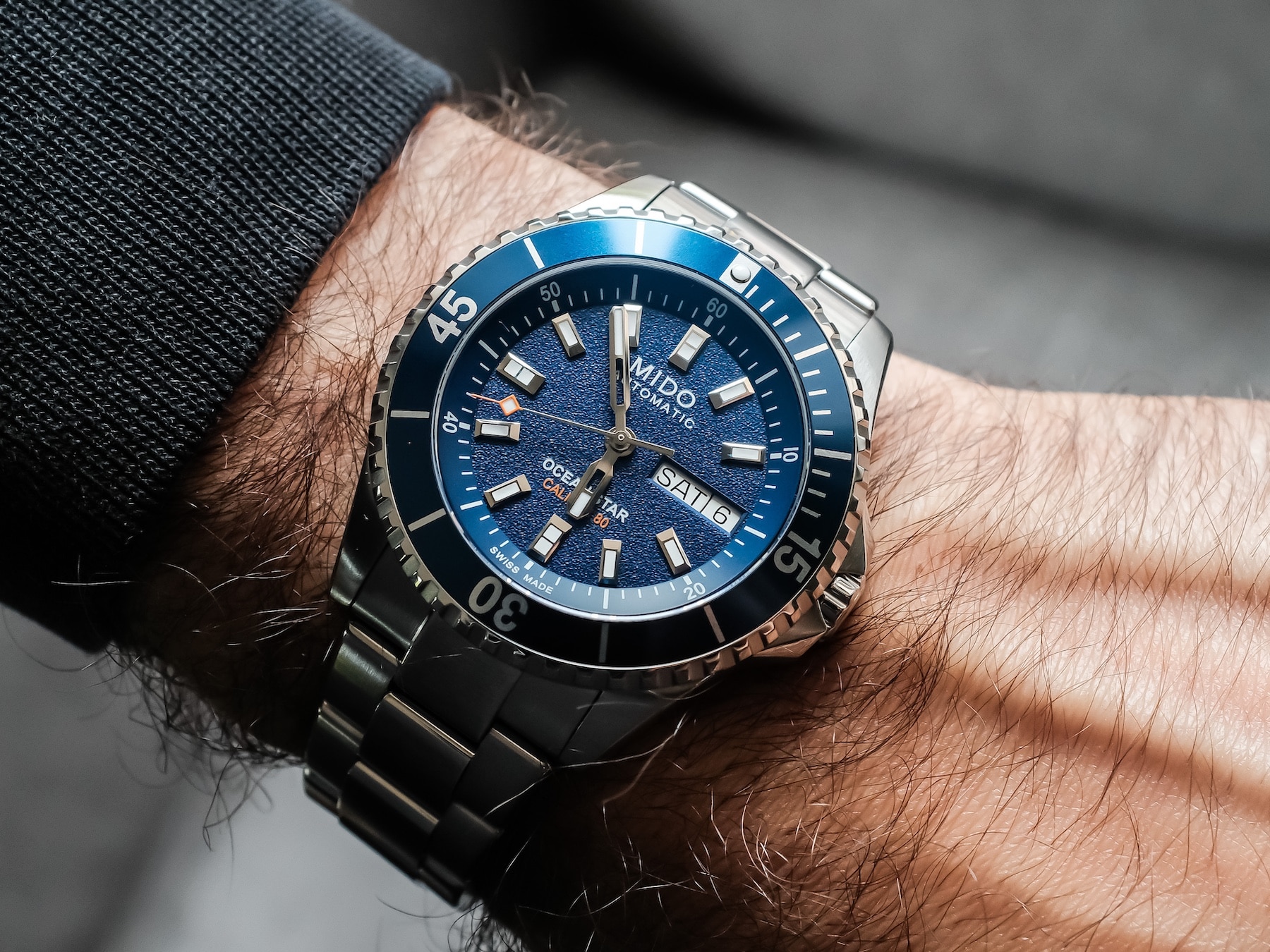
The Rolex Submariner and Mido Ocean Star 200 are separated by roughly $9,000, which makes a head-to-head comparison sound a little absurd. Then again, that price gap is exactly why we want to do it. After more than a decade of hands-on watch reviews, we’ve learned that the differences that matter aren’t always the ones that look impressive on a spec sheet. They show up when a watch spends real time on the wrist. We’ve spent several weeks with three versions of the Ocean Star 200, and our time with the Submariner gave us a pretty good idea of why Rolex has made this particular diver so difficult to ignore. The question is whether that experience is enough to explain the jump from roughly $1,000 to $10,000.
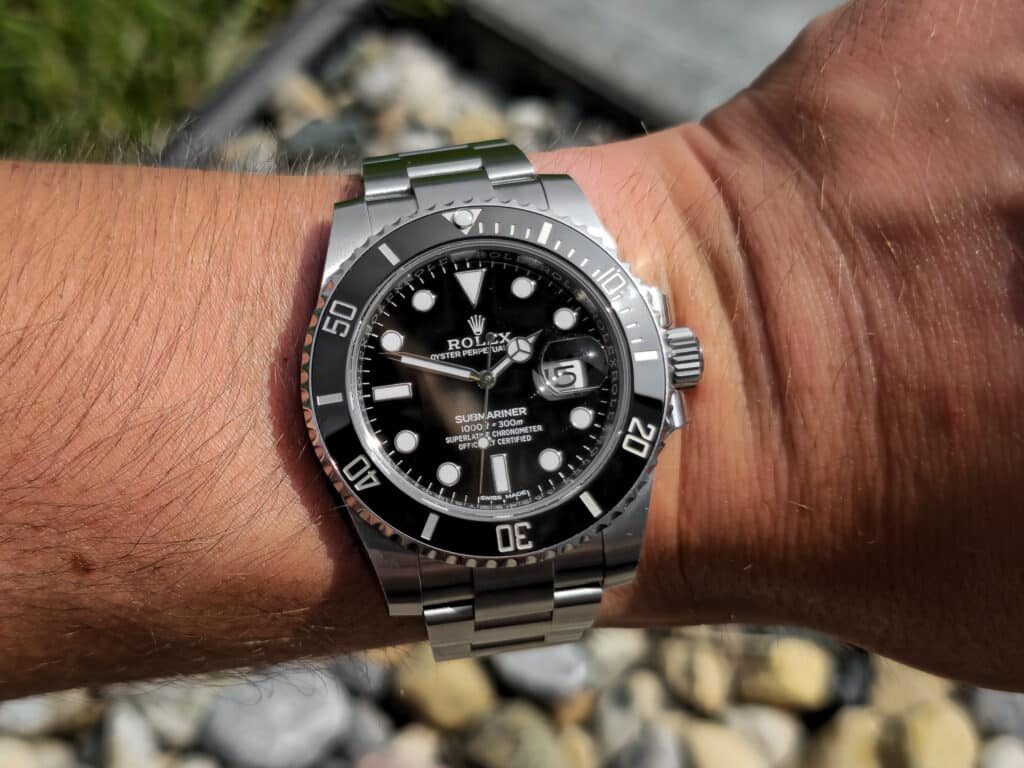
That’s what makes this $1k vs. $10k diver face-off more interesting than a simple battle of specifications. The Ocean Star 200 has to prove how much watch you can get without spending luxury-watch money, while the Submariner has to justify a price that makes most of us stop and do some uncomfortable mental arithmetic. We’re not going to pretend those watches are interchangeable, but we are going to ask where the extra $9,000 shows up when both are being worn, used, and lived with. And once the honeymoon period is over, which one still feels like the watch we’d rather reach for?
Overview and Identity
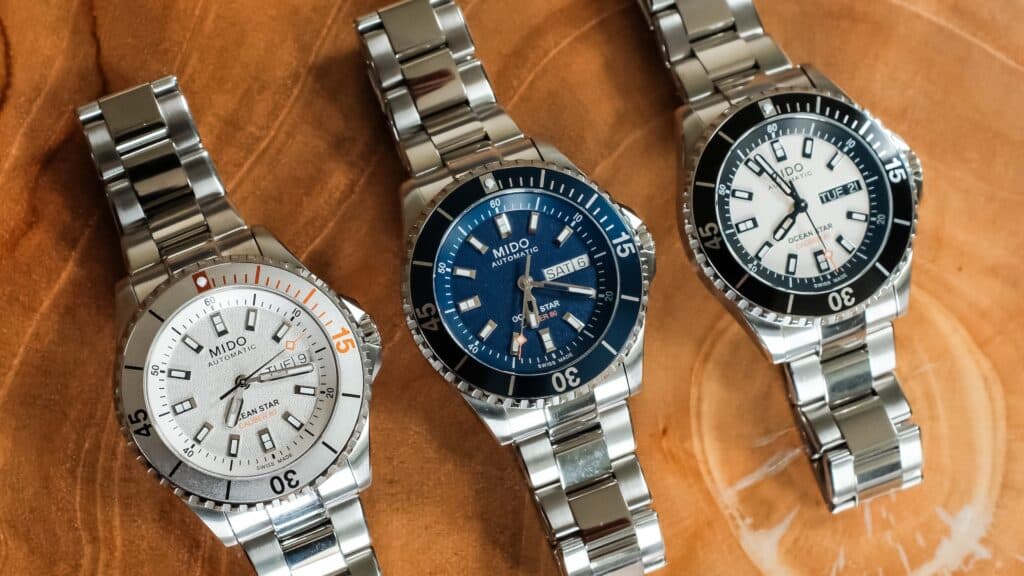
The Mido Ocean Star 200 comes across as the diver that doesn’t need to apologize for being the cheaper watch in the room. We had three different colorways for in for our hands-on review, all under the $1,000 mark, and wearing them side by side made the platform’s appeal clearer than reading the specifications ever could. The case and movement stay consistent, but each version brings a different personality to the wrist. That matters in practice because the Ocean Star 200 doesn’t feel like one watch being offered in three costumes. It feels like a straightforward diver platform that gives you some room to choose how you want it to wear.
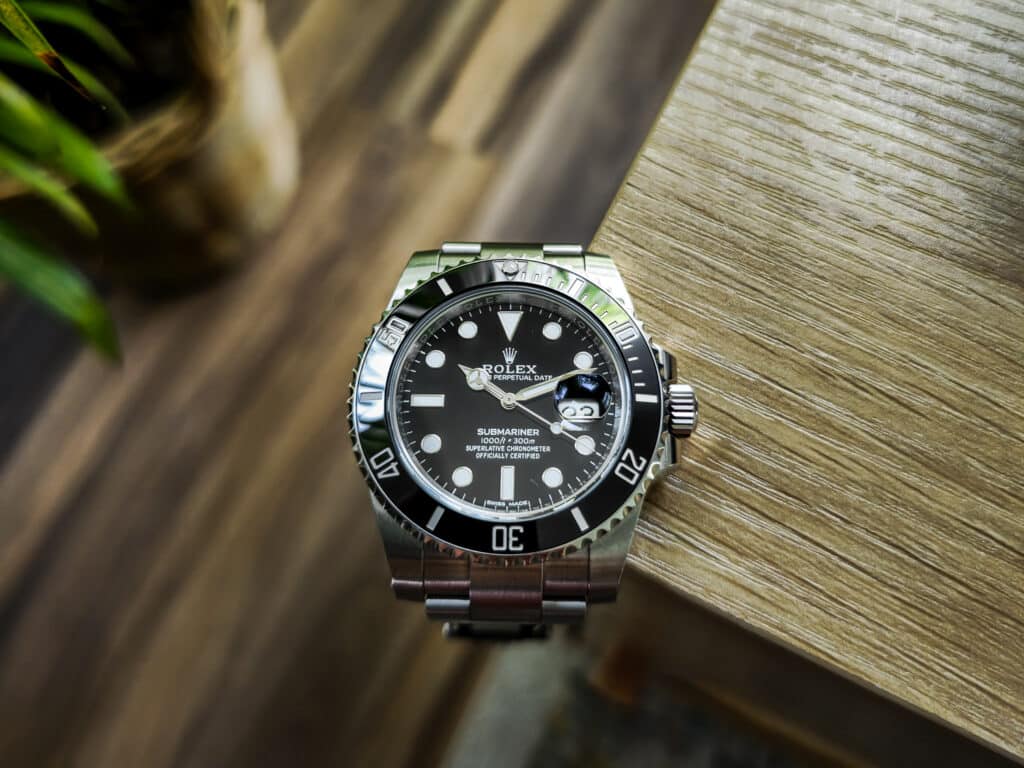
The Rolex Submariner plays a very different role. The dive watch icon brings its own expectations to the wrist, but after spending hands-on time with the watch, we found it surprisingly easy to separate the hype from the object itself. Underneath the name is a genuinely compelling dive watch, although we also uncovered shortcomings that are harder to ignore once the logo stops doing some of the talking for you. The design has evolved slowly, too, and that restraint shows on the wrist: the Submariner still feels cohesive rather than like a watch repeatedly tweaked in search of the next big thing. That makes it a fascinating benchmark for the Mido.
Dial, Bracelets & Wearability: Textured Personality vs. Seamless Comfort
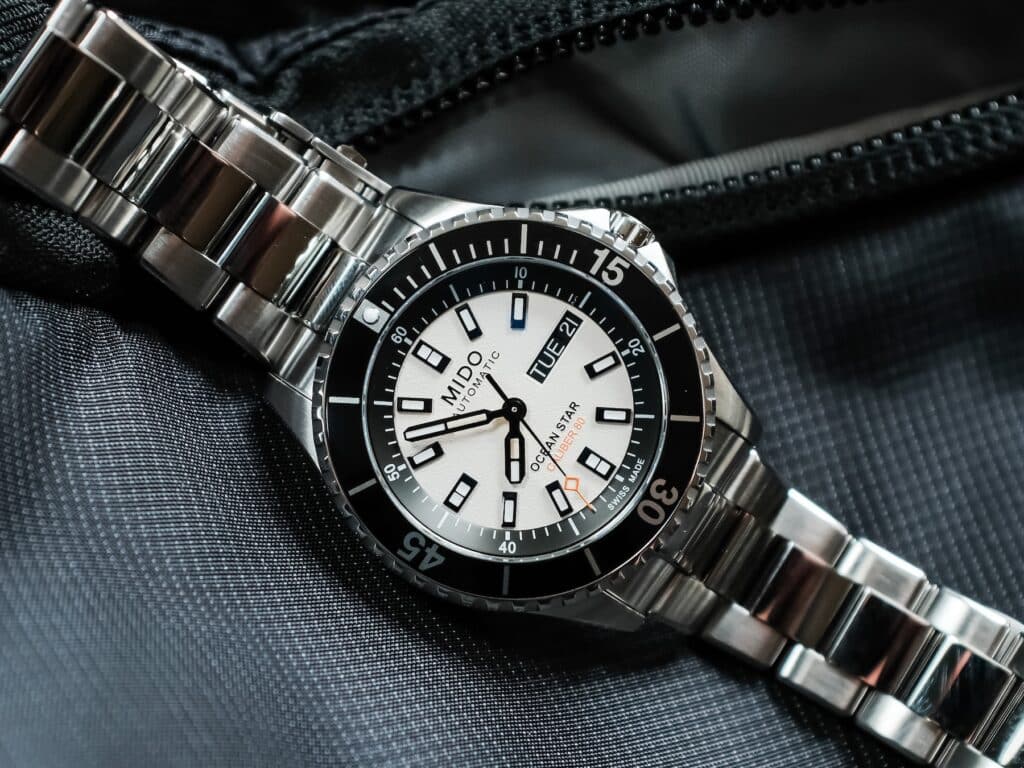
The Mido Ocean Star 200’s dial is one of the places where the redesign earns its keep. The raised outer flange adds depth, while the chunkier applied markers and thicker handset better balance the proportions. We noticed that most in changing light, where the grained surface moves from subtle to surprisingly prominent instead of sitting there like a flat printed dial. The orange second-hand tip and Caliber 80 text add a little Mido personality without hijacking the layout. Of the three we wore side by side, we kept reaching for the white version. The black bezel against the textured white dial gives it the strongest tool-watch feel, and the contrast makes it easy to read in almost any lighting. The blue version is the obvious safe choice, with its matching bezel and dial doing what we’d expect from a modern diver. The silver one takes longer to appreciate because the texture does more of the talking as the light changes, but that also gives it more personality than its first impression indicates.
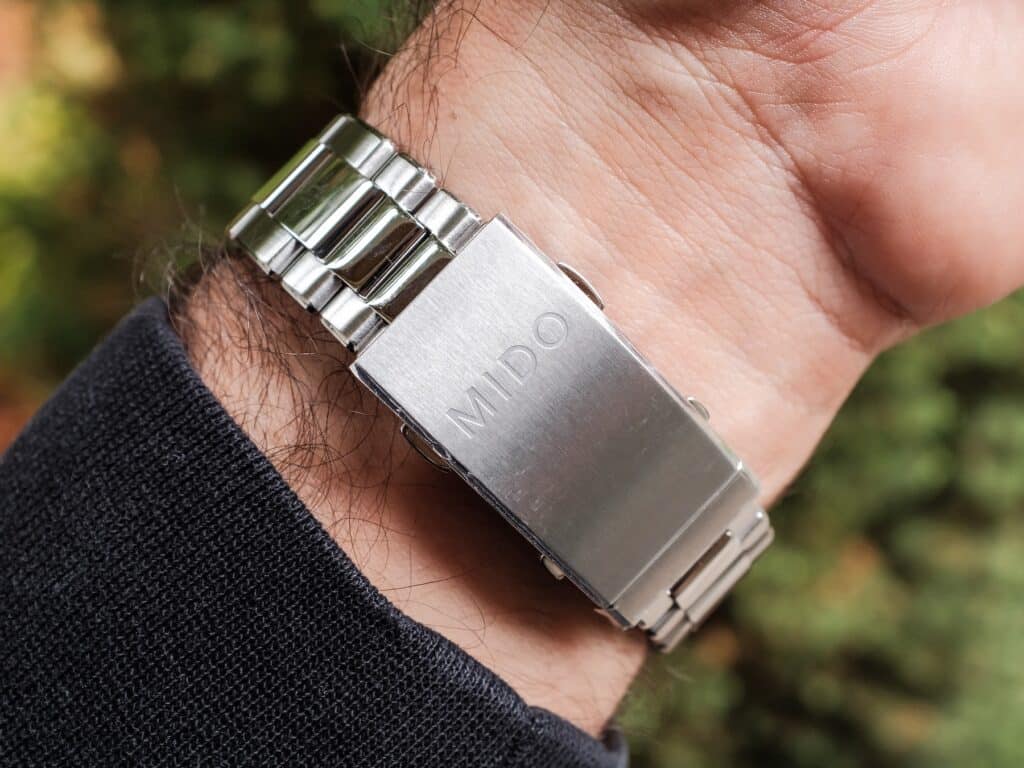
Mido also gives the Ocean Star 200 a redesigned three-link bracelet that mixes brushed outer links with polished center links. It adds some visual polish without making the watch feel like it is trying to dress up as something it isn’t. We like that balance. The quick-release spring bars are useful for anyone who likes swapping straps. At the same time, the integrated diver’s extension gives you extra room when needed without turning the clasp into a mechanical puzzle. This bracelet does its job and gives the watch some versatility; we don’t need to pretend it is competing with Rolex’s bracelet to appreciate that.
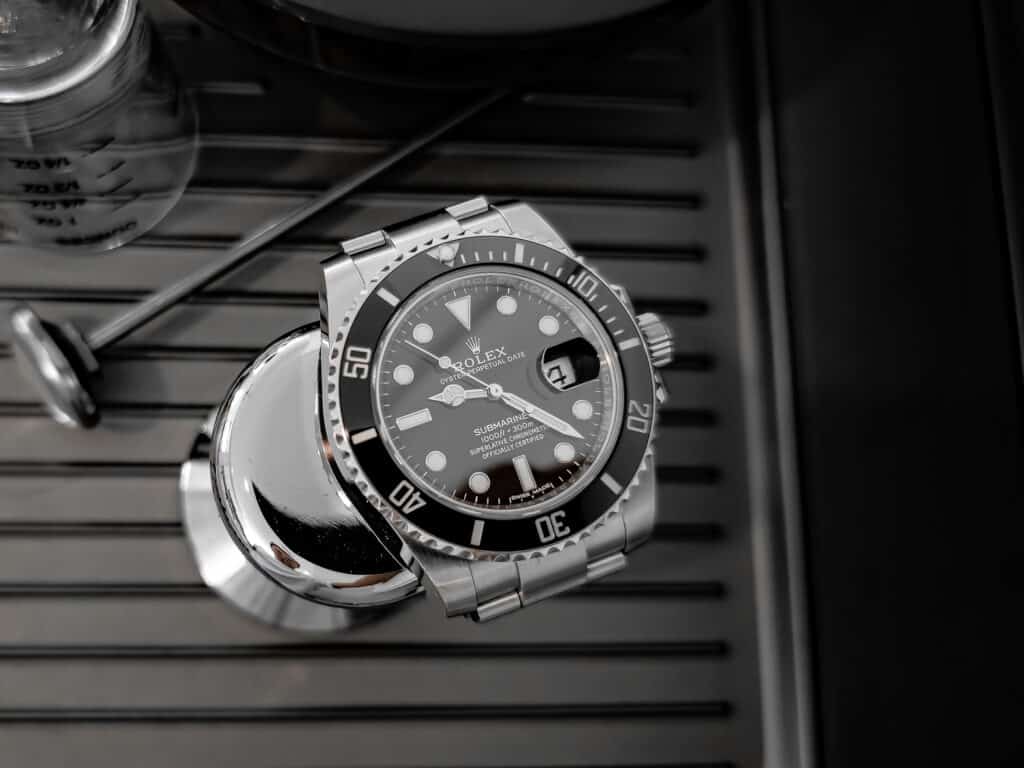
The Submariner takes a much more restrained approach to the dial, and we think that restraint works. Nothing flashy happens on the glossy black surface. Still, the printing is crisp, the lume-filled hands and markers are surrounded by white gold, and the Mercedes handset remains one of those designs that looks immediately right without explanation. Even with seven lines of text, the dial never felt busy to us. It is the kind of design that quietly disappears into the job of telling time, which becomes useful when the rest of the watch is already carrying plenty of visual weight.
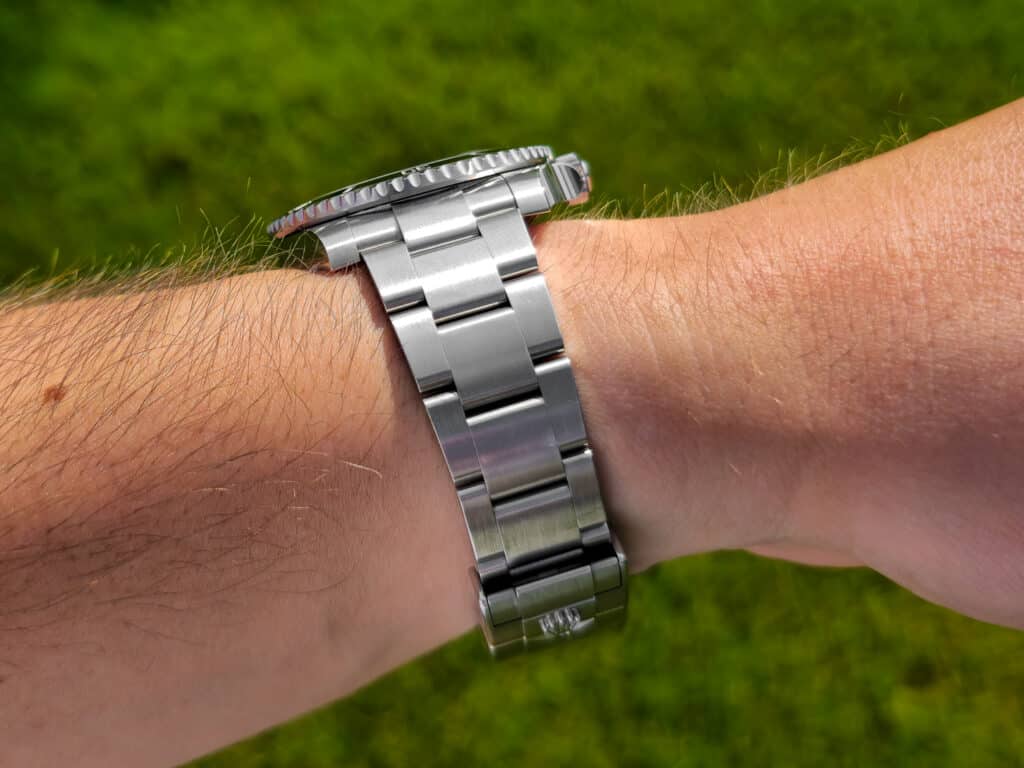
Then there is the Oyster bracelet, which is where the Sub starts making its case through wrist time rather than reputation. We found it easy to wear, even under a cuff, and the links articulate smoothly enough that the bracelet follows the wrist rather than fighting it. The male end links work well here because they flow neatly into the case, with no noticeable gap or wiggle. The 20mm-to-16mm taper also gives the watch some substance without leaving a slab of metal hanging off the wrist. Most importantly, the Glidelock clasp lets us make about a link and a half of adjustment without tools, and its release action is very smooth. The clasp stays comfortably thin, there are no obvious hot spots, and the brushed surfaces forgive the inevitable desk-diving scratches. These are small things individually. After hours of wear, they stop feeling small.
Build Quality & Technical Approach
Both watches bring serious dive-watch credentials to the table, but they do so with very different levels of engineering fussiness. This is where we get into what matters after the initial wrist-photo dopamine wears off: how the cases, movements, crystals, water resistance, and lume translate into real-world ownership. One is trying to deliver a lot of watch without making our wallets file for bankruptcy; the other has had decades to obsess over the details. The fun part is figuring out which approach we notice once we stop staring at the logo.
Movements:
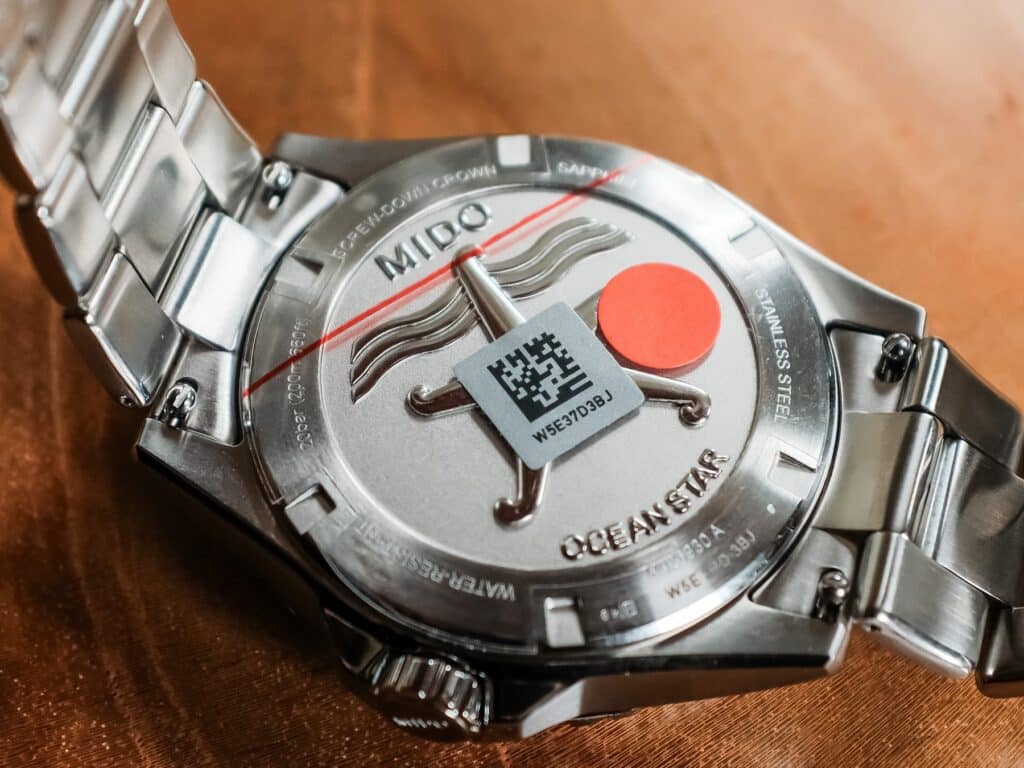
The Mido Ocean Star 200 runs on Mido’s Caliber 80 Day-Date, a movement we’ve encountered across the Swatch Group portfolio and one that makes a lot of sense here. The headline number is the 80-hour power reserve, but its usefulness became clear when we rotated three Ocean Stars during testing. We could park one for a couple of days, come back to it, and still find it running instead of immediately reaching for the crown. The Nivachron balance spring is another practical touch, helping resist magnetism and everyday environmental influences. None of this is particularly glamorous, and that’s fine. The movement is hidden behind an embossed solid caseback anyway, so there’s no attempt to turn it into something you need a loupe and a quiet afternoon to appreciate. It simply kept doing its job throughout our time with the watches.
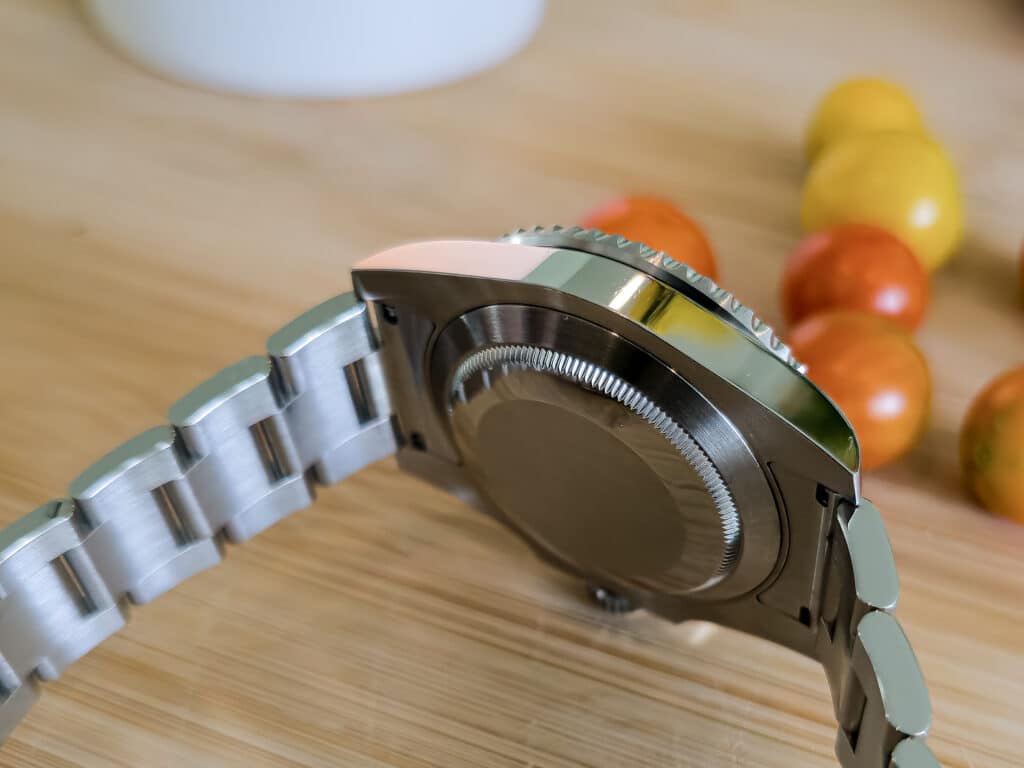
On the other hand, the Sub 116610 we reviewed uses Rolex’s in-house Caliber 3130, a movement that has been powering Rolex watches since the early 2000s. Its 48-hour power reserve looks modest next to the Mido’s 80 hours, but the 3130 has a reputation for being a rugged, reliable workhorse, and our experience backed that up. Rolex rates it at +2/-2 seconds per day, while ours ran at roughly +0.5 seconds per day. There isn’t much decorative finishing to admire, but this is a tool watch, not a movement beauty contest. The 3130 feels appropriately overbuilt for the job, and that matters more when you’re wearing the watch than when it’s displayed with its caseback facing the ceiling.
Case Construction & Finishing:
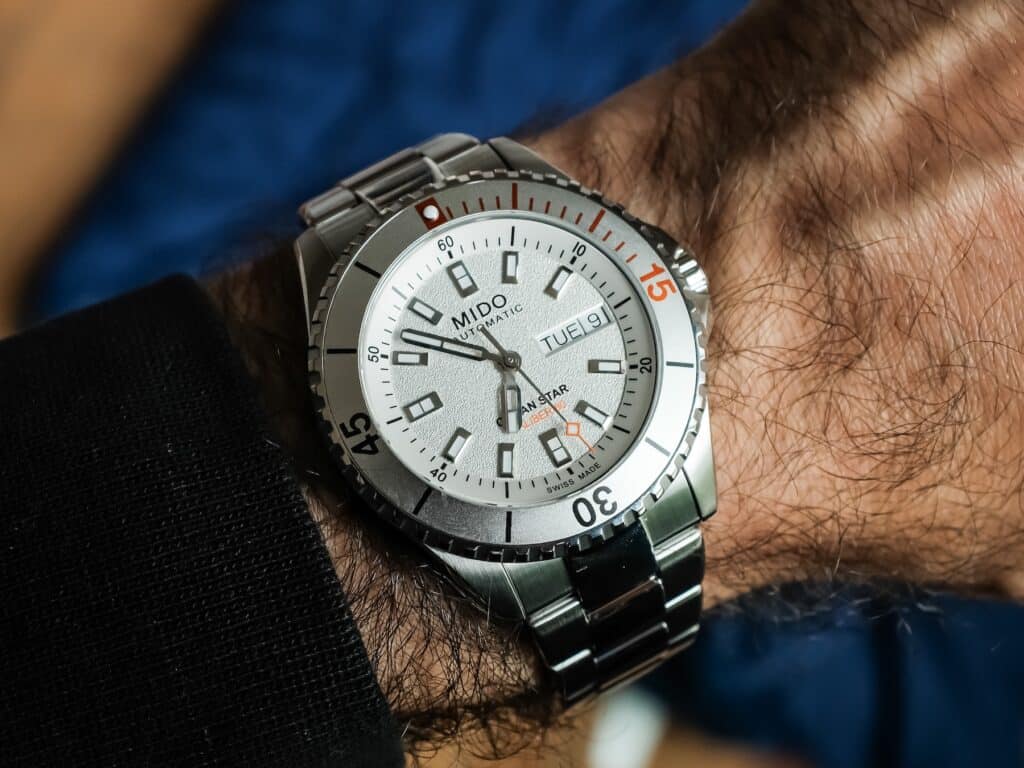
The Mido Ocean Star 200 measures 41mm across, 47.03mm lug-to-lug, and 11.7mm thick, but the numbers undersell how balanced it feels on the wrist. We never found it cumbersome, even at 172 grams on the bracelet. That matters because plenty of modern divers manage to turn ordinary wrist presence into a minor strength-training exercise. The Ocean Star 200 avoids that. The redesign also gives the case a broader chamfer that catches the light better and makes the profile feel sharper without adding needless visual drama. Nothing about the construction feels exaggerated for the sake of looking newer, and that cohesion became more noticeable the longer we wore it.

The Submariner takes a similarly restrained approach, and our 40mm example reminds us that wrist presence has never been about diameter alone. At 12.5mm thick with a roughly 48mm lug-to-lug span, it manages a useful mix of tool-watch heft and easy wearability. The 904L Oystersteel case is brushed on top and polished on the sides. However, we didn’t notice any obvious real-world advantage over conventional 316L steel in terms of corrosion or tarnish resistance. The caseback is equally plain and sterile, but that also leaves it smooth against the wrist. We can understand why some people might want more visual excitement here. But we also think the deliberately plain case is part of the Submariner’s character, and its slimness goes a long way toward explaining why this particular kind of dive watch can disappear under a cuff without feeling out of place.
Crystals and Bezels:
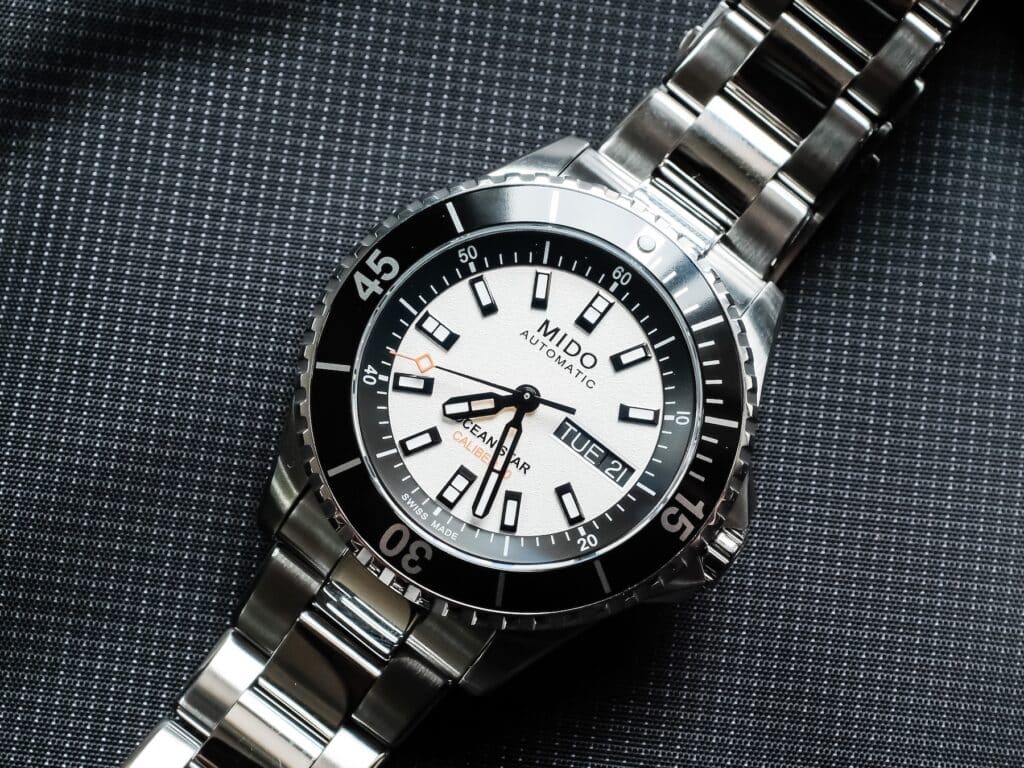
The Ocean Star 200 keeps the crystal side sensible, with sapphire and anti-reflective coating on both sides. That combination does its job without becoming something we need to think about during normal wear. The bezel is more noticeable in use. Its larger numerals and markers are easy to pick out quickly, and the extra visual weight helps the watch read immediately as a diver rather than another steel sports watch with a timing ring attached. It is a small distinction, but when we’re checking elapsed time without stopping to squint at the wrist, it matters.
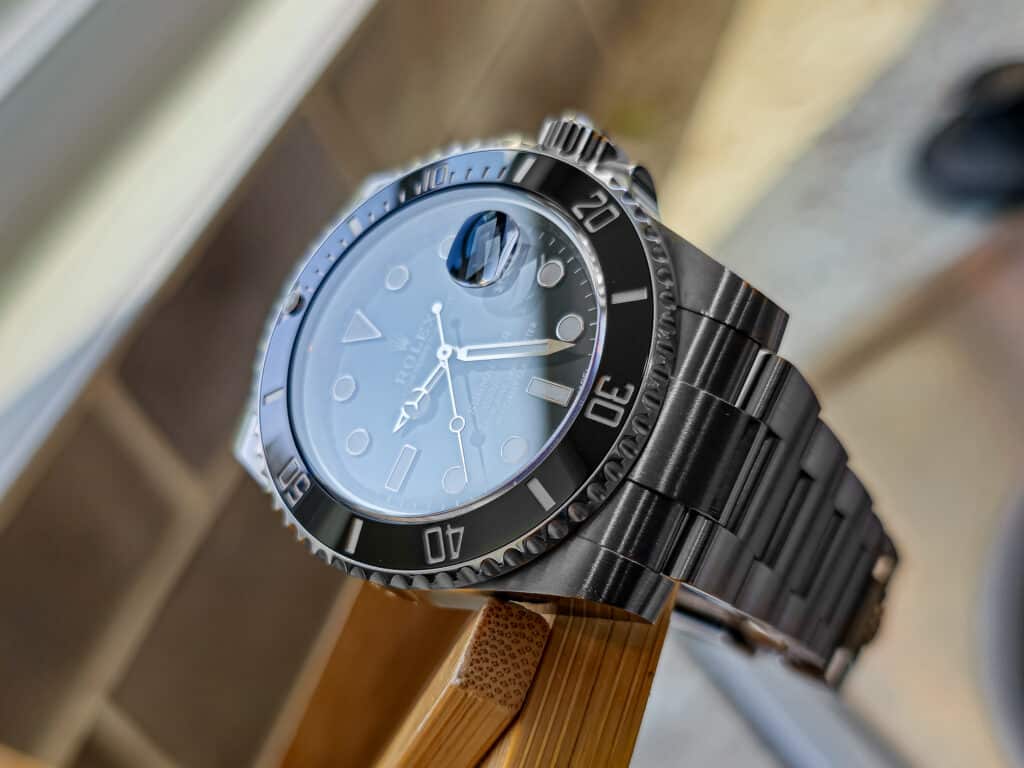
The Submariner’s sapphire crystal is good, but oddly ordinary for a watch at this level. We’ve grown to like the Cyclops, though, because it makes the date very easy to read at a glance. On the 116610 we reviewed, the magnifier is the only part of the crystal with AR coating, which can leave a faint milky haze across the dial in certain light. It never hurts legibility, but once you notice it, you can’t avoid it. For a watch this polished elsewhere, that feels like an odd compromise. The unidirectional bezel is a different story. There’s no noticeable back play, and it glides between clicks with exceptional precision. It aligns cleanly with the minute track, while the slim profile, sharp taper, and slight case overhang make it easy to grip. The Cerachrom insert adds engraved graduations and platinum-filled numerals.
Water Resistance & Lume:
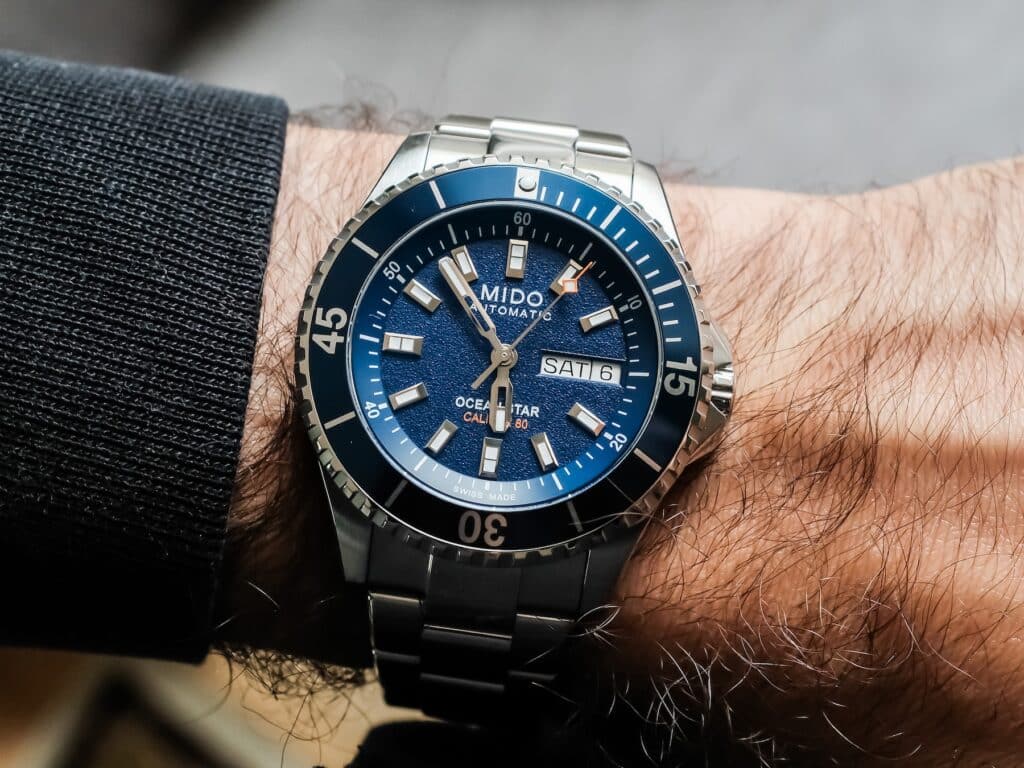
The Ocean Star’s 200-meter water resistance and screw-down crown never felt like numbers added for the spec sheet. They simply made it a watch we didn’t have to think twice about wearing around water. The Super-LumiNova-coated hands and indices keep that practical mindset going, providing the visibility we want when the light disappears. Nothing here feels overcomplicated; the water resistance and lume support the basic reason we’d wear a dive watch in the first place.
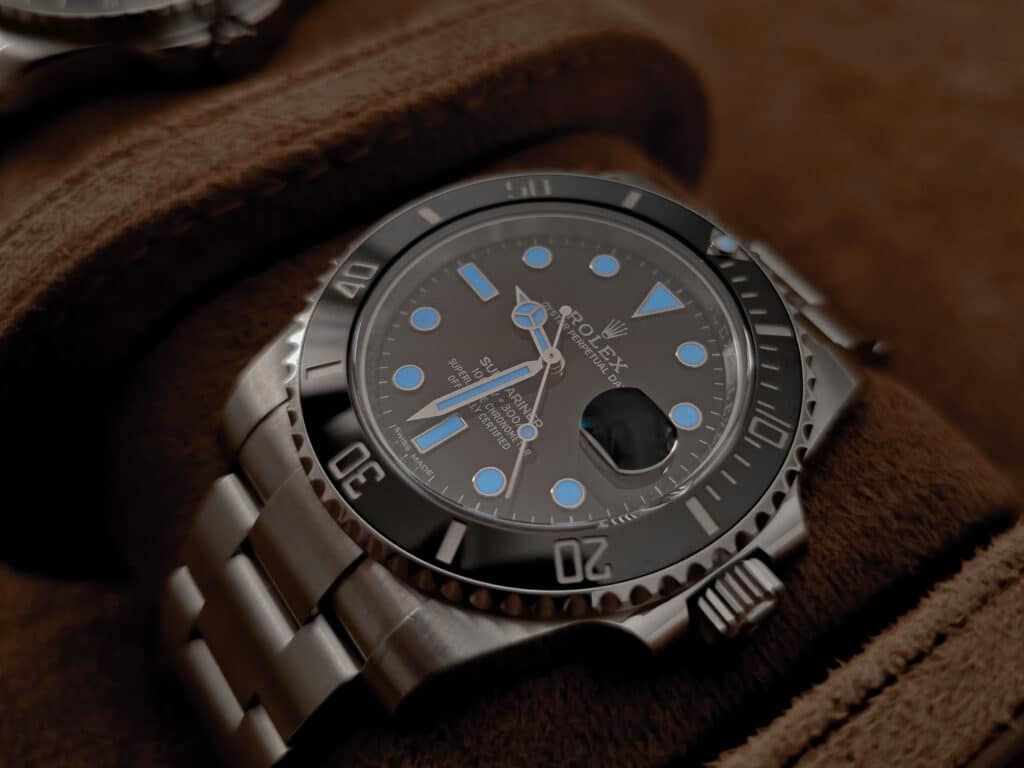
The Submariner pushes the water-resistance figure to 300 meters, but the more memorable detail is the Triplock crown. Its silky screw-down action and multiple gaskets add confidence around water, while the curved crown guards keep everything neatly tucked away. The lume is equally well executed. Rolex’s blue Chromalight glows strongly and steadily, and we could still read the time at 3 a.m. (which, as we’ve learned, is less theoretical than it sounds when a baby has other plans). We also like the raised lume pip at 12, with its tiny sapphire cover providing a tactile reference point and nighttime visibility.
Cost Considerations
The Mido Ocean Star 200 landed at around $990 when we reviewed it, and the price became more convincing after several weeks rotating all three versions. None of the refresh’s changes are dramatic on their own. Still, the sharper case definition, deeper dial, and more cohesive overall package make the watch feel more complete than the earlier model. That matters because we’re not getting a bargain-basement diver that happens to stay below four figures. We’re getting a watch where the improvements show up in actual wrist time, which is what we want from an everyday purchase at this level.
The Submariner we reviewed was $10,250, and getting one at retail can be almost as frustrating as paying for one. A roughly three-month wait was considered reasonable at the time. Yet, it still meant dealing with the strange experience of needing an authorized dealer to eventually bless us with the opportunity to spend nearly ten grand. And this isn’t even some extravagant, loaded-up Rolex; it sits close to the brand’s entry point while still demanding a serious chunk of money. Buying gray makes the value equation worse, and buying used carries its own headache because counterfeit Submariners are everywhere, including frighteningly convincing examples. That leaves us with a very TBWS question: how much of the $10k goes toward the watch, and how much are we being asked to tolerate just to own it?
Final Thoughts: Can a $1,000 Diver Hold Its Own Against a $10,000 Rolex?
After wearing both, we think the Mido Ocean Star 200 holds up remarkably well against the Submariner. The Rolex is the more refined watch, and that is obvious once it’s on the wrist. But our question isn’t whether the Sub is better made. It’s whether it is $9,000 better, and for us, that answer is no.
The Ocean Star 200 gives us a complete ownership experience without leaving us thinking something is missing because the Crown isn’t on the dial. That is the most important takeaway here. The Mido doesn’t need us to make excuses for its price or convince ourselves that we bought “almost a Sub.” It works perfectly well on its own terms.
That said, the Rolex makes sense when owning a Submariner is the point. That watch offers a satisfaction that goes beyond what a practical value calculation can explain, and we understand why someone would spend the money. But that makes it an emotional purchase, not the stronger value proposition. At $10,250, the Submariner gives us a more refined experience, not a fundamentally different one.
So the verdict is straightforward: the Mido Ocean Star 200 wins the $1k vs. $10k face-off for value and everyday ownership. Choose the Submariner only if you specifically want a Submariner. Choose the Mido because it gives you the diver experience without requiring the other $9,000 to come along for the ride.

Co-Founder and Senior Editor
Kaz has been collecting watches since 2015, but he’s been fascinated by product design, the Collector’s psychology, and brand marketing his whole life. While sharing the same strong fondness for all things horologically-affordable as Mike (his TBWS partner in crime), Kaz’s collection niche is also focused on vintage Soviet watches as well as watches that feature a unique, but well-designed quirk or visual hook.
Not even the current sub, where they’ve fixed the crystal and proportions
Hey Johnny – let us know if you want to send us a 124060 for testing 😉
My 39mm Certina DS Action diver in Titanium offered even more that the Mido for slightly less money, as it’s lighter, more shock resistant, and equals the Rolex in terms of water resistance given that it’s ISO Certified to 300m. Oh…..and it’s better looking than either… 😉
Certina is still seriously underrated!