
A $300 budget gives us plenty to choose from: an automatic diver, a dress watch, a solar-powered field watch, a digital beater, or a retro-inspired quartz piece. The harder part is separating watches that look good on paper from those we’d genuinely keep wearing. Comfort, legibility, design quirks, and how a watch feels after the novelty fades matter as much as its specifications.

At TBWS, we’ve spent a decade reviewing, handling, and wearing watches. Every pick here has its own hands-on TBWS review, so these recommendations aren’t stitched together from spec sheets or retailer listings. For pricing, we’re looking at watches normally available new for $300 or less, including regular prices at established retailers and gray-market sellers; temporary flash sales, clearance finds, and used-market bargains don’t qualify. Gray-market purchases may carry seller warranties rather than manufacturer warranties. Prices and availability change, so check the linked offer before buying. We’ll explain what each watch gets right, where it compromises, and who will enjoy wearing it most.
Casio F-91W
| Price: | $15 – $30 (Check current price) |
|---|---|
| Water Resistance: | 30m |
| Case Dimensions: | 34mm (diameter) x 38mm (lug-to-lug) x 8.5mm (thickness) |
| Lug Width: | 18mm |
| Movement: | Casio Quartz Module 593 |
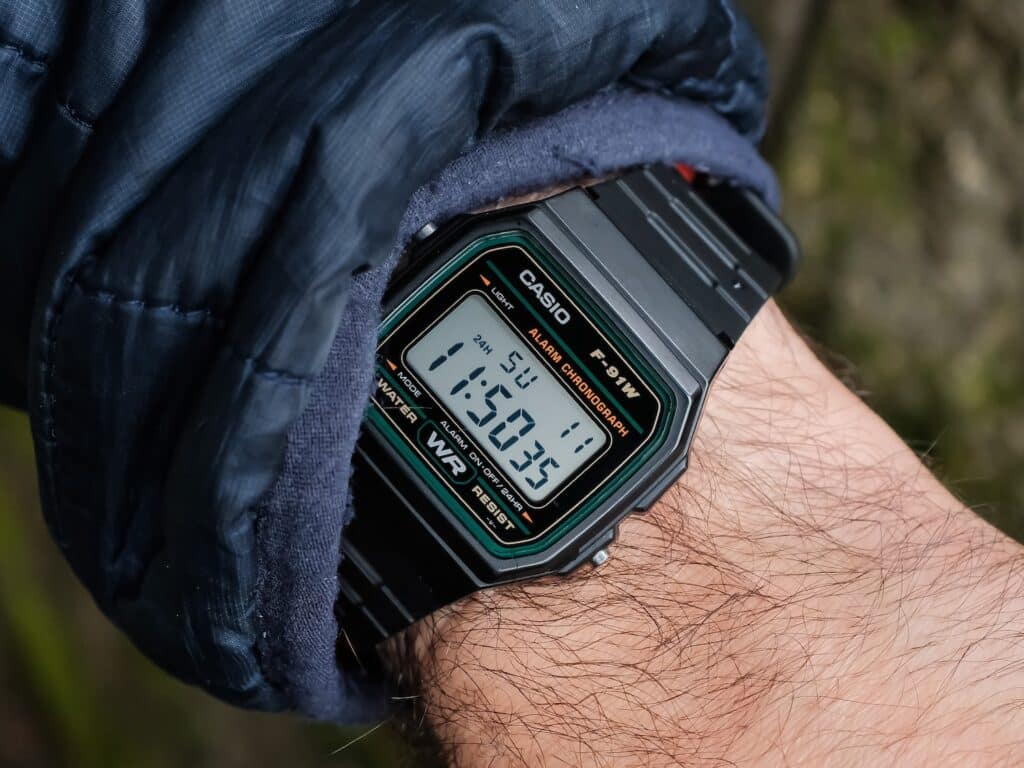
The Casio F-91W has one advantage that’s easy to overlook in a hobby obsessed with wrist presence: it barely has any. At just 20.5g on our scale, this little digital watch is so light that we can wear it through a chaotic day and forget it’s there. The resin case measures 34mm across, 38mm lug-to-lug, and just 8.5mm thick, making it an easy fit under sleeves and around smaller wrists. Handwashing, kitchen spills, playground duty, or getting through bath time without losing track of the clock are all well within its everyday wheelhouse. Our hands-on review of the F-91W also found it surprisingly capable of handling ordinary knocks, despite looking like something that came free with a school lunchbox. The four corner bumpers add some visual heft while making the three pushers easy to locate and operate by feel.
Casio hasn’t exactly overloaded the LCD, but there’s more going on here than the basic time and date display indicates. Module 593 brings a daily alarm, stopwatch, annual calendar, hourly time signal, and 12- or 24-hour formats. We found the interface easy to navigate and adjust without needing a refresher course in button combinations. The quartz movement is rated to approximately ±30 seconds per month, while the CR2016 3-volt lithium battery is designed to last for years. No charging cables, no winding routine, and no worrying about whether the watch has stopped while sitting in a drawer. It gets on with the job without fuss.
The compromises are equally straightforward. Its 30m water-resistance rating makes it fine for splashes and wet hands, but we’d leave it off the poolside packing list. Broader evidence suggests the F-91W can tolerate more water than its rating implies, but we’re not particularly interested in finding the limit firsthand. The single green LED is another weak point, illuminating only part of the display rather than the whole thing. Anyone accustomed to Timex Indiglo will notice the difference immediately. The soft integrated resin strap is comfortable and offers plenty of adjustment, but replacing it is quite fiddly. The F-91W has a healthy modding following if we ever want to change its look.
As an under-$300 purchase, the F-91W makes an interesting case for spending considerably less than the budget allows. It’s comfortable, accurate, practical, and inexpensive enough that an accidental knock won’t send us into a minor financial crisis. For anyone after an uncomplicated everyday digital watch with useful functions and practically no ownership drama, the F-91W remains hard to argue with.
Pros
- The CR2016 3-volt battery is designed to last for years, eliminating the need for frequent charging or battery changes.
- At just 20.5g, the F-91W is light enough to wear all day without constantly noticing it.
- Module 593 packs a daily alarm, stopwatch, annual calendar, and hourly chime without complicating the interface.
- The soft resin strap is comfortable and offers plenty of adjustment holes for a secure fit.
- Four corner bumpers provide some protection against ordinary knocks and make the three pushers easy to find by touch.
Cons
- The integrated resin strap limits straightforward aftermarket strap options.
- The 30m water-resistance rating makes it less suitable for regular swimming or pool use.
- The single green LED illuminates only part of the display.
Casio Duro
| Price: | $50 – $85 (Check current price) |
|---|---|
| Water Resistance: | 200m |
| Case Dimensions: | 44.2mm (diameter) x 48.5mm (lug-to-lug) x 12.1mm (thickness) |
| Lug Width: | 22mm |
| Movement: | Casio 2784 Quartz |
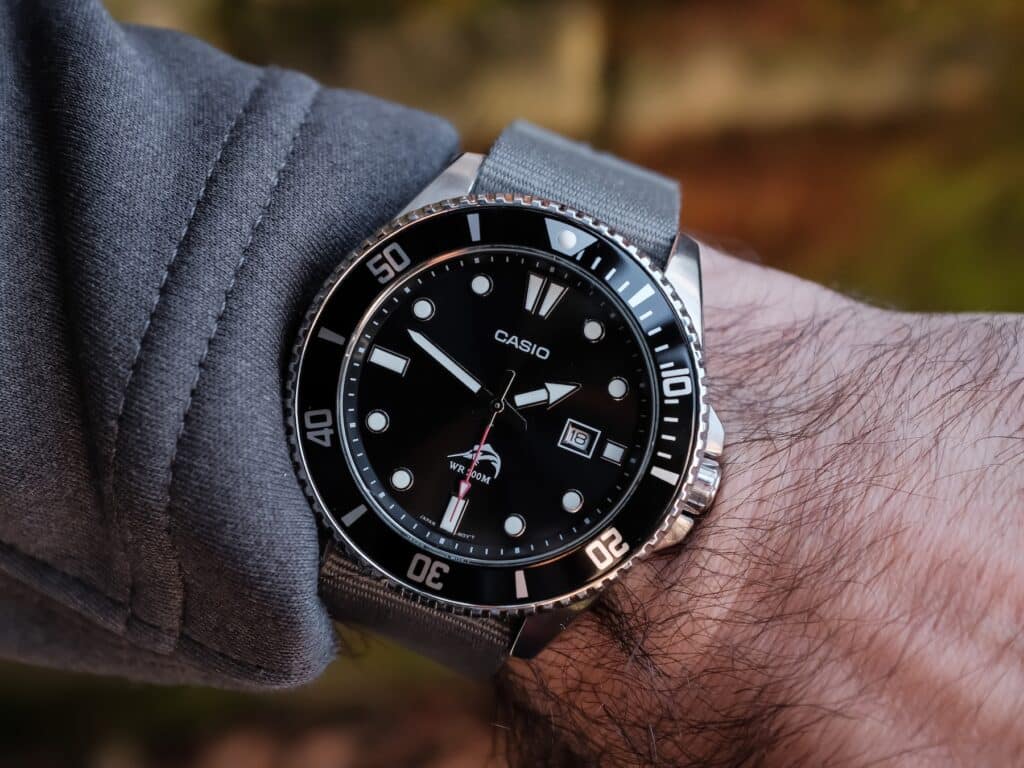
The Casio Duro makes a strong case for spending less on a dive watch without giving up the bits that make one useful. Its 200m water resistance and screw-down crown mean handwashing, spilled drinks, showers, and pool days aren’t occasions to remove the watch and find somewhere safe to put it. We were also pleasantly surprised by the bezel during our in-depth testing period. It has firm, controlled clicks without the loose play that makes some budget divers feel like toys. No fancy tricks, just a bezel that feels properly put together.
The dial follows the same practical approach. Large applied markers, reflective arrow-shaped hands, restrained text, and a neatly framed date keep everything legible without visual clutter. Its quartz movement is rated at approximately ±20 seconds per month, while hacking and quick-set date make adjustments painless. We can leave it in the drawer for days and pick it up without winding or charging rituals. The 22mm lugs also make strap experimentation easy, whether we’re in the mood for rubber, nylon, or a bracelet.
Size is where the Duro starts asking for some wrist real estate. At 44mm wide and 48.5mm lug-to-lug, it’s a substantial watch, although the downward-curving lugs help it sit better than those numbers suggest. Smaller wrists may struggle with the footprint. The flat mineral crystal is another budget concession, and the lume starts brightly but fades sooner than we’d like. At least the case avoids looking like a generic slab of stainless steel, with brushed surfaces, polished sides, and subtle beveling adding some welcome character.
For its regular asking price, the Duro gets an awful lot right. It’s accurate, water-ready, easy to maintain, and inexpensive enough that a scratch won’t require a moment of silence. We’d skip it if we wanted a compact diver or stronger lume, but otherwise, it’s one of those watches that makes spending closer to $300 feel a little unnecessary.
Pros
- The quartz movement is rated at approximately ±20 seconds per month.
- Its brushed surfaces, polished sides, and subtle beveling give the case some welcome character.
- 200m water resistance and a screw-down crown make it a dependable companion around water.
- The 22mm lugs accommodate rubber, nylon, and bracelet options without fuss.
- Firm, controlled bezel clicks feel more reassuring than the loose action found on some budget divers.
- Large applied markers and reflective arrow-shaped hands make quick time checks effortless.
Cons
- The lume fades sooner than we’d like, despite starting brightly.
- The 44mm case and 48.5mm lug-to-lug make it a handful for smaller wrists.
- The flat mineral crystal is more vulnerable to scratches than sapphire.
Invicta Pro Diver 8926OB
| Price: | $60 – $100 (Check current price) |
|---|---|
| Water Resistance: | 200m |
| Case Dimensions: | 40mm (diameter) x 48mm (lug-to-lug) x 14mm (thickness) |
| Lug Width: | 20mm |
| Movement: | NH35A (Mechanical) |
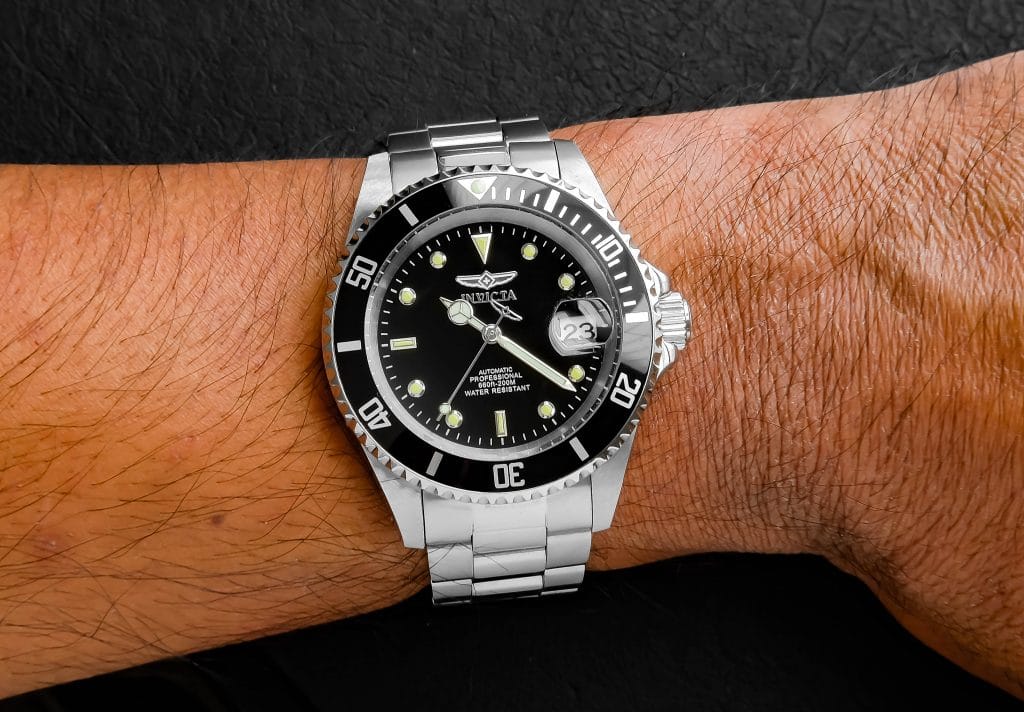
The Invicta Pro Diver 8926OB isn’t winning any originality contests. We all know which famous dive watch it takes inspiration from, and Invicta hasn’t been shy about it. But originality isn’t the only reason to buy a watch, particularly when we’re shopping below $300. After living with it beyond the first impression, we found that its 40mm case wore flatter and more comfortably than the dimensions implied. The proportions feel well resolved, making it an easy watch to wear rather than another Submariner homage that looks more convincing in a product photo than on an actual wrist. There’s something to be said for a familiar design that gets the fundamentals right.
The NH35A automatic movement is another reason the Pro Diver deserves consideration. It gives us the mechanical interaction that makes an inexpensive automatic enjoyable, without turning ownership into a part-time job. The oversized screw-down crown is easy to grip, and the bezel clicks positively, though our review noted a little play between clicks. Applied dial markers and polished hands add welcome depth to the familiar layout, though the lume is less convincing after dark. The hands stay visible longer than the markers, which rather defeats the purpose of having both glow. The bracelet is better than its price might suggest, too. Its links articulate smoothly without sharp edges, and the taper from 20mm to roughly 18mm helps it sit comfortably all day. The 200m water-resistance rating looks impressive, but we’d avoid treating it as an invitation to take budget-dive-watch heroics too seriously.
The cost-cutting becomes easier to spot around the edges. Hollow end links, a basic flip-lock clasp, and a mineral crystal remind you where Invicta saved money. The crystal is considerably more vulnerable to scratches than sapphire. At the same time, the oversized Invicta branding on the case side won’t appeal to anyone who prefers their watches to do the talking. Still, the 8926OB gets the important things right: comfortable proportions, an engaging automatic movement, and a familiar design that’s easy to live with. We’d recommend it to anyone who wants an affordable mechanical diver and doesn’t mind wearing a watch whose design references are hardly a mystery. The hollow end links and stiff flip-lock clasp are reminders of what its low price buys.
Pros
- The bezel action feels reassuring for the price, even with a little play between clicks.
- Applied dial markers and polished hands add depth to the familiar layout.
- The 20mm-to-18mm bracelet taper and smoothly articulated links make it comfortable over extended wear.
- The NH35A automatic movement adds mechanical appeal without making everyday ownership unnecessarily complicated.
- The 40mm case wears flatter and more comfortably than its dimensions suggest.
Cons
- The oversized Invicta branding on the case side won’t appeal to everyone.
- Lume performance is uneven, with the hands remaining visible longer than the dial markers.
- Hollow end links and the basic flip-lock clasp expose the bracelet’s budget construction.
- The mineral crystal is more susceptible to scratches than sapphire.
- The 200m water-resistance rating shouldn’t be mistaken for a guarantee of suitability for serious diving.
Q Timex Reissue
| Price: | $129 – $179 (Check current price) |
|---|---|
| Water Resistance: | 50m |
| Case Dimensions: | 38mm (diameter) x 45mm (lug-to-lug) x 11.5mm (thickness) |
| Lug Width: | 18mm |
| Movement: | Seiko Quartz |
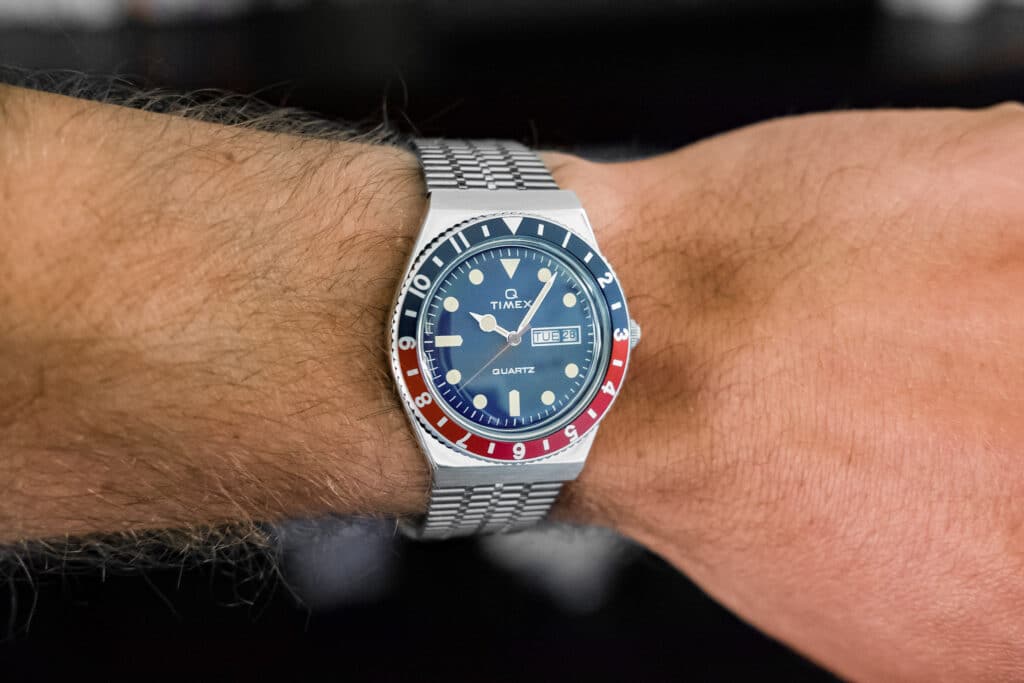
The Q Timex Reissue gets the details of a late-1970s watch surprisingly right, from its compact 38mm case to its distinctive Pepsi bezel and prominent “Quartz” lettering. Even the audible ticking and Seiko-made quartz movement feel in keeping with the original design. We also like the battery hatch on the caseback, which lets us replace the battery ourselves rather than making a routine maintenance job someone else’s problem. It’s a small but thoughtful touch that suits the Q Timex perfectly: a watch that’s stylish, accessible, and uncomplicated to own.
At 38mm, the case gets the vintage proportions right without making the watch feel like a shrunken novelty. The hooded lugs help it sit flat and balanced across different wrist sizes, while the finishing gives it more character than we’d expect at this price. Brushing across the top surface reduces reflections, and the polished case facets add welcome visual depth. We particularly liked the matte blue dial during our hands-on time with the Q Timex Reissue. It remains legible in bright daylight, while the lightly aged lume adds warmth without making the watch look like it was recently dug out of a backyard.
The friction-operated Pepsi bezel is another detail that gives the Q Timex its personality. It doesn’t click like a conventional dive-watch bezel, but it turns smoothly and predictably enough for timing short tasks. The domed acrylic crystal catches light nicely and suits the vintage design better than a sterile-looking modern replacement, though scratches come with the territory. The bracelet is lightweight, flexible, and nicely tapered, while the adjustable clasp lets you adjust the fit tool-free and stays secure once set. That said, a few reminders: this is a vintage-inspired quartz watch. The audible tick can become noticeable in quiet surroundings, manually adjusting the day feels unnecessarily dated, and 50m water resistance doesn’t give us the same confidence around swimming as a proper sports watch.
For under $300, the Q Timex Reissue makes a stronger argument through personality and wearability than mechanical credentials. We get thoughtful case finishing, comfortable proportions, a useful bezel, and a battery system that doesn’t require a watchmaker’s intervention. We’d recommend it to anyone who enjoys vintage styling but would rather avoid the maintenance lottery that sometimes comes with buying an actual vintage watch. Besides, there’s something rather enjoyable about wearing a quartz watch that isn’t embarrassed to be quartz.
Pros
- The friction-operated bezel turns smoothly and predictably, making it useful for timing short everyday tasks.
- A user-accessible battery hatch makes replacement straightforward.
- The lightweight, flexible bracelet tapers nicely, while its adjustable clasp allows tool-free sizing and stays secure.
- At 38mm, the case and hooded lugs deliver comfortable, balanced proportions across different wrist sizes.
Cons
- The 50m water-resistance rating doesn’t inspire much confidence for swimming.
- The audible ticking can become noticeable in otherwise quiet surroundings.
- The domed acrylic crystal scratches more easily than sapphire.
- Manually adjusting the day feels unnecessarily dated, even by quartz-watch standards.
Orient Bambino
| Price: | $150 – $250 (Check current price) |
|---|---|
| Water Resistance: | 30m (reviewed Bambino Version 3) |
| Case Dimensions: | 40.5mm diameter x 44.3mm lug-to-lug x 11.8mm thickness |
| Lug Width: | 21mm |
| Movement: | Orient Caliber F6724 Automatic |
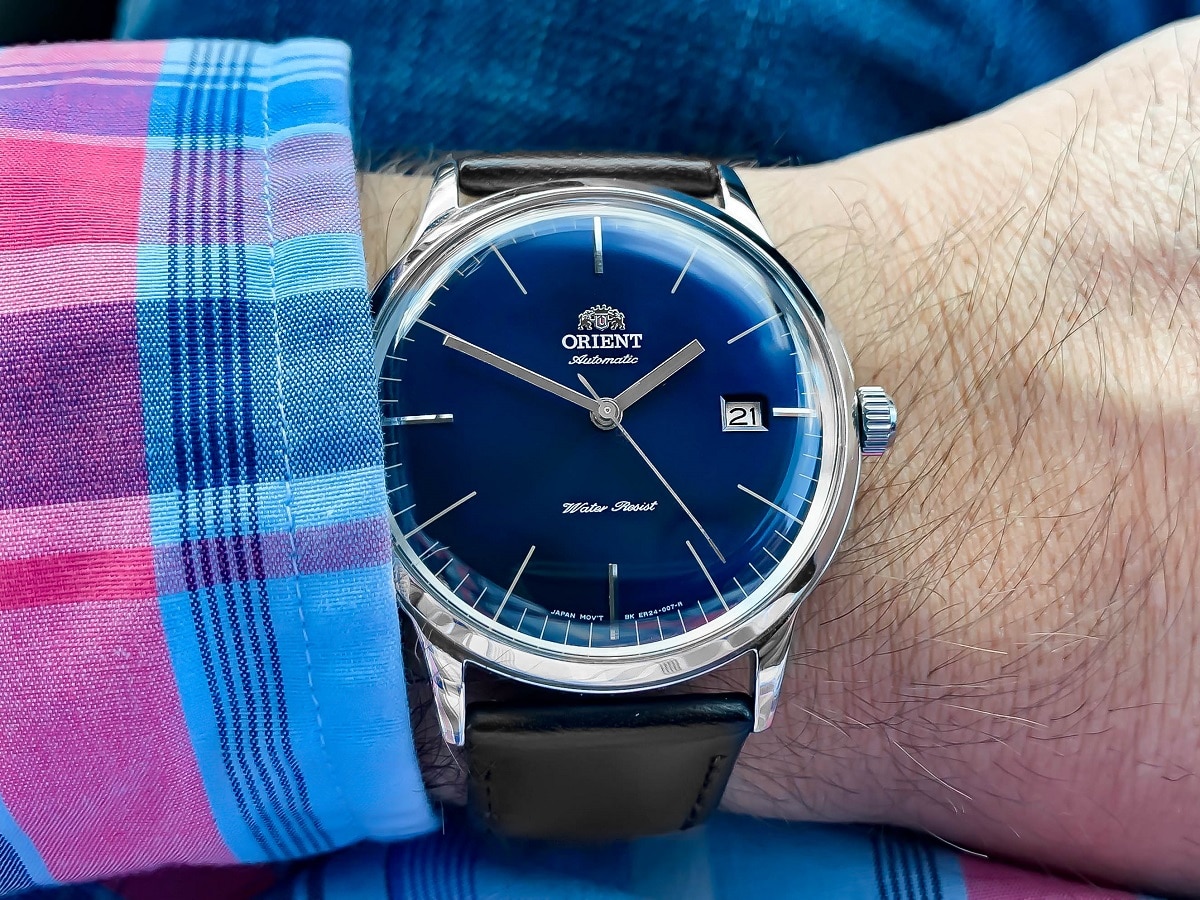
Some dress watches spend most of their lives waiting for a wedding invitation. Our blue-dial Version 3 had other ideas. We initially expected it to be an occasional option for smarter outfits. Still, it kept finding its way onto our wrist for office days, dinners, and even the odd polo-shirt-and-jeans combination. That’s a useful quality in an affordable mechanical watch. The Bambino has enough refinement to clean up an outfit without demanding that we change our entire wardrobe to accommodate it.
The dial does much of the heavy lifting here. There’s impressive depth and richness for the money, while the slightly sharper design keeps it from looking like a vintage dress watch assembled from a sepia photograph. The 40.5mm case sounds a little ambitious for this category, but the short lug-to-lug and downward-sloping lugs help it sit comfortably without taking over the wrist. Its relatively slim profile also slips under shirt cuffs without much resistance. We appreciated that combination of dial presence and sensible wearability as we spent more time with it.
As mentioned in our dedicated review, the in-house F6724 automatic movement adds some mechanical charm, with both hacking and hand-winding available. That’s a welcome feature at this price, although interacting with the movement isn’t always a pleasure. The small crown is awkward to grip when winding, and the rotor makes more noise than we’d like. Although Orient rates the F6724 for approximately 40 hours of power reserve, our reviewer found that his example did not last more than 30 hours, so leaving it unworn can mean resetting it sooner than expected. The domed mineral crystal catches noticeable glare, too, while the polished hands and markers can disappear against the dial when the lighting isn’t cooperating. There’s no lume to rescue nighttime legibility, and the stock leather strap feels about as budget-friendly as we’d expect. None of these is a deal-breaker, but the Bambino certainly has its share of reminders that we’re shopping below $300.
Still, we’d rather have a watch with a few irritating habits that we enjoy wearing than a technically impressive dress watch that never leaves the box. The Bambino gets the proportions and dial character right while giving us an accessible entry into mechanical ownership. It is the one we would reach for when a sports watch feels out of place.
Pros
- The in-house F6724 offers both hacking and hand-winding, adding some welcome mechanical interaction at this price.
- The short lug-to-lug and downward-sloping lugs help the 40.5mm case sit comfortably without dominating the wrist.
- The dial has impressive depth and richness, giving it a quite refined appearance.
Cons
- The absence of lume makes nighttime legibility practically nonexistent.
- The small crown is awkward to wind, while the rotor is louder than we’d prefer.
- The domed mineral crystal catches noticeable glare, and the polished hands and markers can blend into the dial in unfavorable lighting.
- Our review sample fell short of Orient’s approximately 40-hour rated power reserve.
- The stock leather strap doesn’t quite match the watch’s refinement.
Casio G-Shock GW6900-1
| Price: | Check current price for the newer GW-6900U-1 (Check current price) |
|---|---|
| Water Resistance: | 200m |
| Case Dimensions: | 53.2mm (diameter) x 50mm (lug-to-lug) x 17.7mm (thickness) |
| Lug Width: | 16mm |
| Movement: | Solar Quartz Module 3179 (reviewed GW6900-1) |
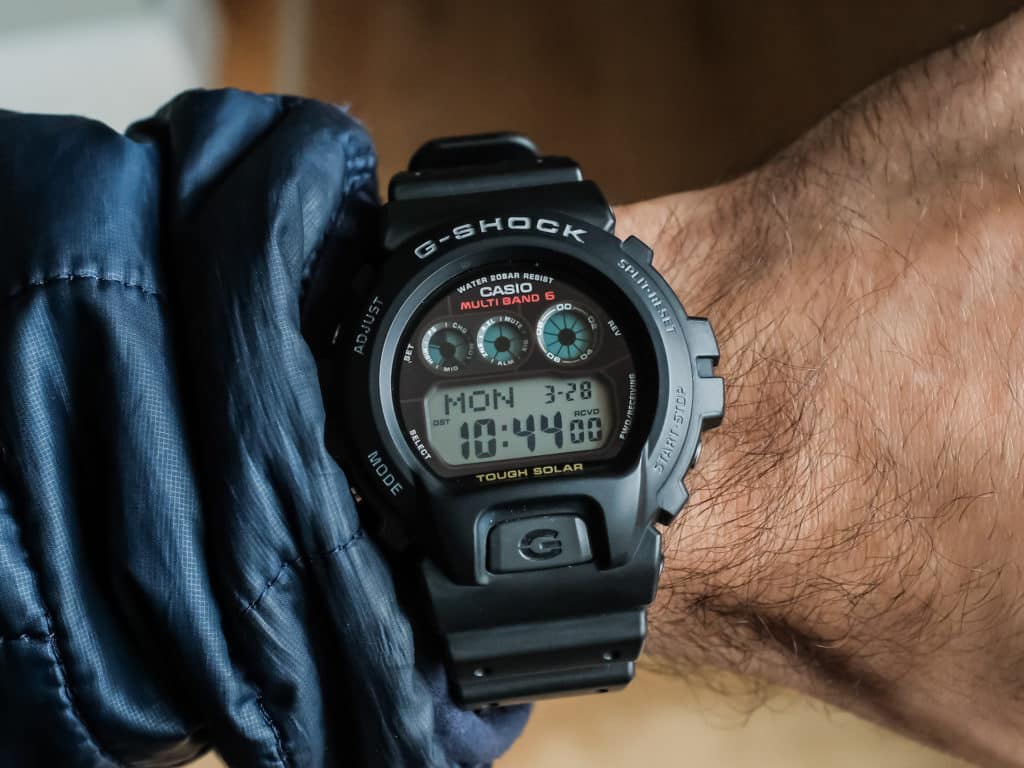
Our reviewed Casio G-Shock GW6900-1 isn’t winning any awards for discretion. Its 53.2mm by 50mm case measures nearly 17.7mm thick, making it a substantial chunk of resin that won’t exactly disappear under a shirt cuff. Fortunately, the full-resin construction keeps the weight manageable, and we’ve worn ours through yard work, workouts, rain, water exposure, and enough accidental knocks to make a dress watch reconsider its life choices. The resin strap is less convincing initially. It starts stiff and slightly squeaky, but softens with regular wear, sits securely on the wrist, and dries quickly after getting wet.
The triple-eye display packs a lot onto the dial, but it becomes intuitive once we’ve spent some time with it. The main time and date are easy to locate, while the smaller windows handle dual time and radio reception. There’s also a 1/100-second stopwatch, countdown timer, five daily alarms with snooze, world time covering 31 time zones, and an hourly chime. On the older GW6900-1 we reviewed, a large front button activates a bright green EL backlight, which illuminates the display evenly. The linked newer GW-6900U-1 instead has an LED backlight and a different module, so that particular hands-on observation applies to our older watch. It’s a practical setup, although the initial learning curve might have us pressing buttons in the wrong order a few times.
What makes the GW6900-1 particularly appealing under $300 is how little maintenance it demands. Tough Solar keeps the battery charged through regular light exposure, while Multi-Band 6 automatically corrects the time using radio signals in the U.S., UK, Japan, Germany, and China. During our in-depth testing of the GW6900-1, it regularly synced overnight without needing a phone, an app, or any intervention from us. After a few weeks in a drawer, a couple of hours in sunlight brought the battery indicator back to high in our review. Between solar charging, automatic time correction, and its hard-wearing construction, this is about as close to set-it-and-forget-it ownership as we get in this price range. It isn’t subtle, but it has very little interest in making our lives more complicated.
Pros
- The full-resin construction keeps the oversized case lighter and more manageable than its dimensions suggest.
- Tough Solar maintains the charge through regular light exposure, avoiding routine charging and frequent battery changes.
- Five daily alarms with snooze, 31-zone world time, a countdown timer, hourly chime, and 1/100-second stopwatch offer plenty of practical functionality.
- The reviewed older GW6900-1 has an evenly lit green EL backlight; the newer linked GW-6900U-1 uses LED.
- Multi-Band 6 automatically corrects the time through radio signals without phone pairing or an app.
- Once broken in, the resin strap sits securely and dries quickly after getting wet.
Cons
- The stock resin strap starts stiff and slightly squeaky, requiring some wrist time to soften.
- The triple-eye display takes a little getting used to before navigating its functions becomes second nature.
- At 50mm wide and 17.7mm thick, the case is difficult to hide under shirt cuffs and overwhelming for anyone who prefers smaller watches.
Timex Expedition Field Post Solar
| Price: | $159 – $209 (Check current price) |
|---|---|
| Water Resistance: | 100m |
| Case Dimensions: | 36mm (diameter) x 44mm (lug-to-lug) x 12mm (thickness) |
| Lug Width: | 18mm |
| Movement: | Solar Quartz |
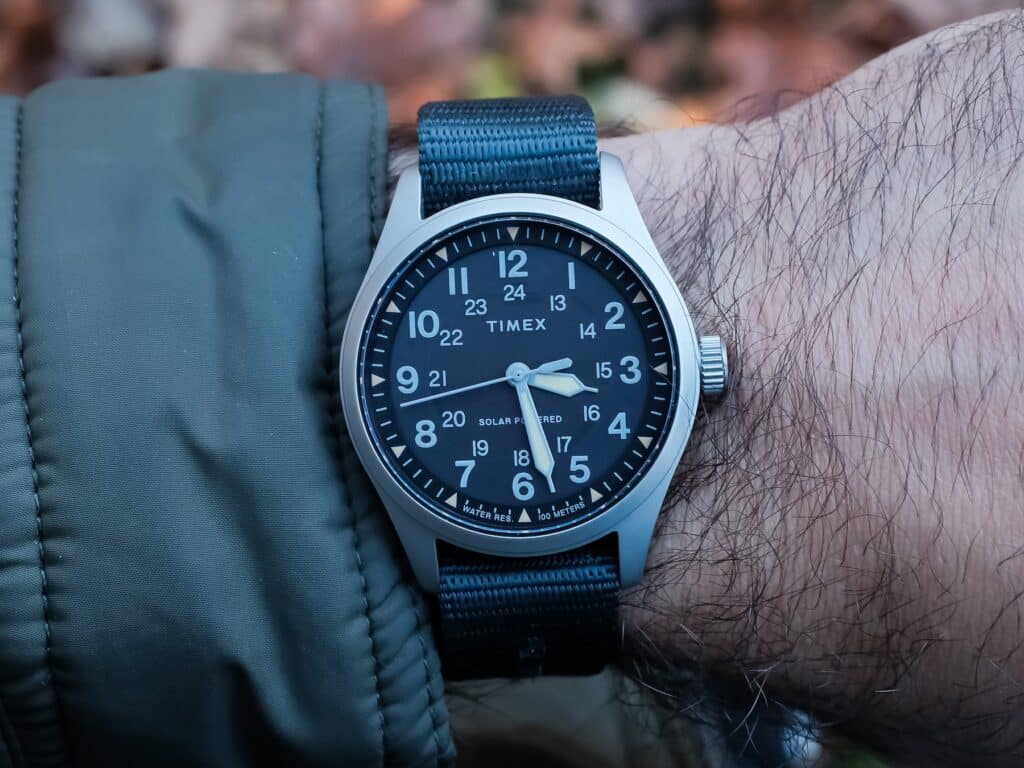
We like watches that mind their own business, and the Timex Expedition Field Post Solar does it particularly well. Give it some daylight, and its solar quartz movement can run for roughly four months on a full charge, according to Timex. No winding, no charging cables, and no wondering whether the battery will give up halfway through the week. During our extended wear testing, we also found it consistently accurate without much intervention. The full-numeral dial makes quick time checks effortless, while the domed sapphire crystal and anti-reflective coating help keep things legible outdoors. For a watch under $300, we’d take that combination over a dozen features we’d forget how to use.
At 36mm, the stainless steel case sits low and balanced on the wrist, making it an easy companion for commutes, errands, and long days when a bulky watch becomes another thing to work around. The bead-blasted finish suits the field-watch personality, too. Everyday scratches and scuffs blend into the utilitarian surface instead of demanding an emergency polishing session. It has a screw-down crown for added water protection, though its threading feels functional rather than particularly refined. The supplied leather strap is less convincing. It’s thick and looks disproportionate against the compact case; a simple MIL-style strap would make more sense for a watch expected to encounter rain, spills, and general everyday abuse.
The weak lume is another compromise. The hands glow briefly, but very little light reaches the dial before everything fades, so nighttime legibility isn’t its strong suit. Still, the Field Post Solar gives us the essentials we want at this price. We get sapphire, solar convenience, sensible proportions, and a straightforward dial without spending the full $300. It won’t satisfy anyone looking for a chunky military-style watch or impressive after-dark visibility, but those wanting a compact, low-maintenance field watch have plenty to appreciate here.
Pros
- The slightly domed sapphire crystal and anti-reflective coating offer scratch resistance and help maintain outdoor legibility.
- The 36mm case sits low and balanced, making it comfortable for daily wear.
- The solar quartz movement provides approximately four months of rated operation on a full charge.
- Full Arabic numerals make quick time checks straightforward.
- The bead-blasted finish helps everyday scratches and scuffs disappear into the utilitarian styling.
Cons
- The thick supplied leather strap looks disproportionate against the compact case.
- The screw-down crown works as intended, but its threading lacks the refinement we’d prefer.
- The lume is weak and short-lived, with very little illumination reaching the dial.
Citizen Avion AW1361-10H
| Price: | $159 – $295 (Check current price) |
|---|---|
| Water Resistance: | 100m |
| Case Dimensions: | 45mm (diameter) x 52mm (lug-to-lug) x 12mm (thickness) |
| Lug Width: | 22mm, tapers down to 20mm |
| Movement: | J810 Citizen Eco-Drive quartz |
Some watches make us work harder to own them than they should. The Citizen Avion takes the opposite approach. Its Eco-Drive J810 movement runs on light, needs no routine battery replacement, and is rated for approximately ±15 seconds per month. Occasional light exposure keeps it running, making it a sensible grab-and-go option for anyone who doesn’t want another mechanical watch demanding attention. For under $300, getting reliable solar quartz technology from Citizen is already a decent proposition. The fact that the Avion has some personality doesn’t hurt.
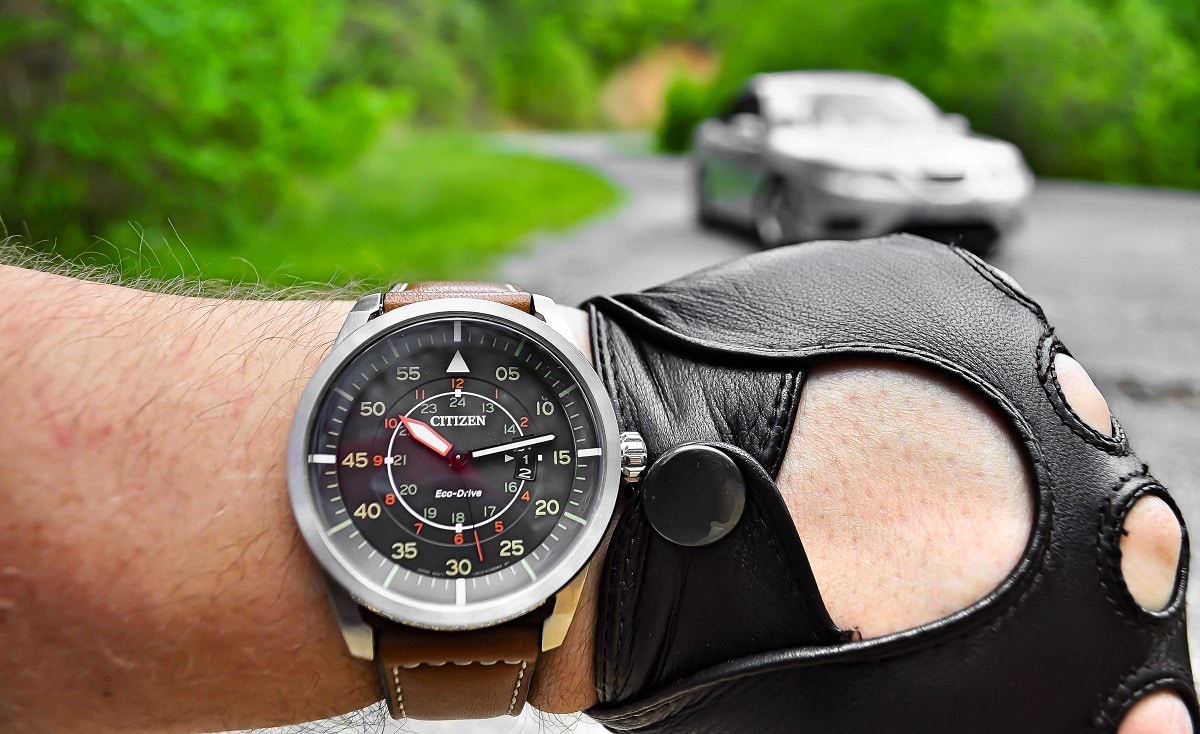
That personality comes with a fairly large footprint. The 45mm case stretches 52mm lug-to-lug, so smaller-wristed enthusiasts should probably approach with caution. Fortunately, the 12mm thickness and slight inward taper towards the caseback help it sit more securely than those numbers imply. The oversized crown is another practical touch, offering plenty of grip when adjusting the time, even with gloves on. Its thick leather strap gradually develops a worn-in appearance that suits the aviation-inspired styling, though it starts out stiff. However, the case finishing is less impressive. The brushing is perfectly functional, although it lacks the refinement we’d like to see.
As covered in our closer look at the watch, the dial is where the Avion stops behaving like another inexpensive solar watch. Its Type B layout separates the information using mustard-yellow minute markings, orange hour numerals, and a white inner 24-hour scale. A raised chapter ring adds depth, while the color-matched sword hands and orange-tipped second hand keep the busy display visually coherent. There’s enough contrast for comfortable daytime reading, although the dial takes a little getting used to.
Unfortunately, only the hands are lumed, leaving the rest of the display struggling once the lights go out. That’s a disappointing omission on something styled like an aviation instrument. Still, the Avion makes a convincing under-$300 purchase for anyone who enjoys larger watches, wants an interesting pilot-style design, and values solar-powered convenience over mechanical theatrics.
Pros
- The oversized crown is easy to grip, including when wearing gloves.
- Citizen’s Eco-Drive J810 runs on light and is rated for approximately ±15 seconds per month.
- The color-coded Type B dial, raised chapter ring, and matching sword hands give the watch plenty of visual personality.
- The 12mm thickness and tapered caseback help the large 45mm case sit more securely than its dimensions indicate.
- The oversized case has a manageable 12mm thickness and a caseback that tapers inward.
Cons
- Only the hands are luminous, making the dial hard to read in the dark.
- The 45mm diameter and 52mm lug-to-lug will overwhelm many smaller wrists.
- The thick leather strap can feel stiff at first and needs some wearing in.
- The case brushing is functional but lacks the refinement we’d like to see.
Citizen Promaster Eco-Drive Diver BN0151
| Price: | $200 – $300 (Check current price) |
|---|---|
| Water Resistance: | 200m |
| Case Dimensions: | 43mm (diameter) x 48mm (lug-to-lug) x 11.5mm (thickness) |
| Lug Width: | 20mm |
| Movement: | Citizen Eco-Drive E168 (solar quartz) |
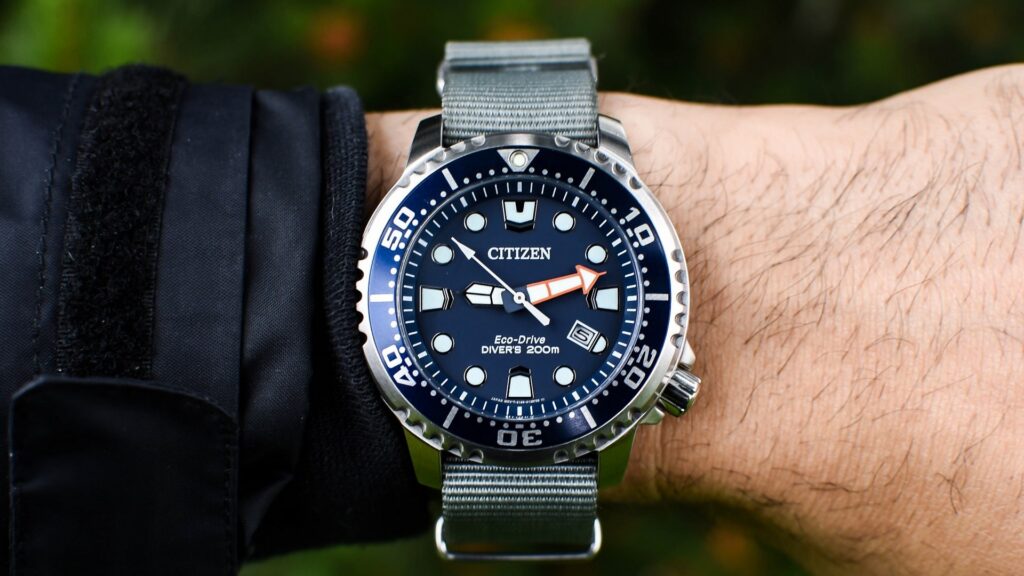
The Citizen Promaster Diver BN0151 is a 43mm dive watch that doesn’t wear like it’s trying to occupy the entire wrist. Its short lug-to-lug and downward-curving case help it sit securely, while the surprisingly light feel makes it comfortable through longer days. The 4 o’clock crown is another thoughtful touch, staying away from the back of the hand instead of becoming an annoying pressure point. Add 200m water resistance, and we have an affordable diver that doesn’t need to be treated like a fragile accessory. Pools, lakes, rain, and everyday knocks are all fair game.
Citizen also gets the dial fundamentals right. The bold hands and markers are easy to read at a glance, while the blue dial develops a subtle purple shift at certain angles. During our extended hands-on testing, the aqua-toned lume remained visible for hours, and even the second hand gets a luminous pip. That last detail gives us a quick way to confirm the watch is still running in low light. The 60-click bezel stayed aligned and felt deliberate during use, although its grip becomes quite slippery with wet fingers. A dive bezel that gets harder to operate when wet is an odd place to save a little traction.
The bigger reason to consider the BN0151 under $300 is its Eco-Drive movement. Citizen rates the movement at approximately ±15 seconds per month, with around six months of runtime on a full charge. We triggered the low-power indicator only once, and a short spell in the light brought it back to normal—no winding, regular battery changes, or dead watches found after being left in the drawer. The mineral crystal is less scratch-resistant than sapphire, though ours held up through extended wear without obvious scratches. We’d also swap the stock polyurethane strap. It starts stiff and takes time to relax; we preferred the watch on a NATO, which felt more balanced and casual.
The Promaster Diver BN0151 gets the expensive part of owning a dive watch right without making us pay for mechanical credentials we may not need. We get 200m water resistance, excellent lume, comfortable ergonomics, and solar-powered convenience in a package that’s easy to wear and maintain. The slippery bezel and stubborn stock strap deserve criticism, but they don’t undo the fundamentals.
Pros
- The 4 o’clock crown stays out of the way and improves comfort.
- Citizen rates Eco-Drive for approximately ±15 seconds per month and around six months of runtime on a full charge.
- The aqua-toned lume stays visible for hours, while the luminous second-hand pip makes it easy to check that the watch is running.
- 200m water resistance makes it a capable companion for regular water exposure and everyday abuse.
Cons
- The stock polyurethane strap starts stiff and takes time to break in.
- The 60-click bezel can become slippery when operated with wet fingers.
- The mineral crystal offers less scratch resistance than sapphire.
Seiko 5 Sports SRPD51 (5KX)
| Price: | $200 – $300 (Check current price) |
|---|---|
| Water Resistance: | 100m |
| Case Dimensions: | 42.5mm (diameter) x 46mm (lug-to-lug) x 13.5mm (thickness) |
| Lug Width: | 22mm |
| Movement: | Seiko 4R36 |
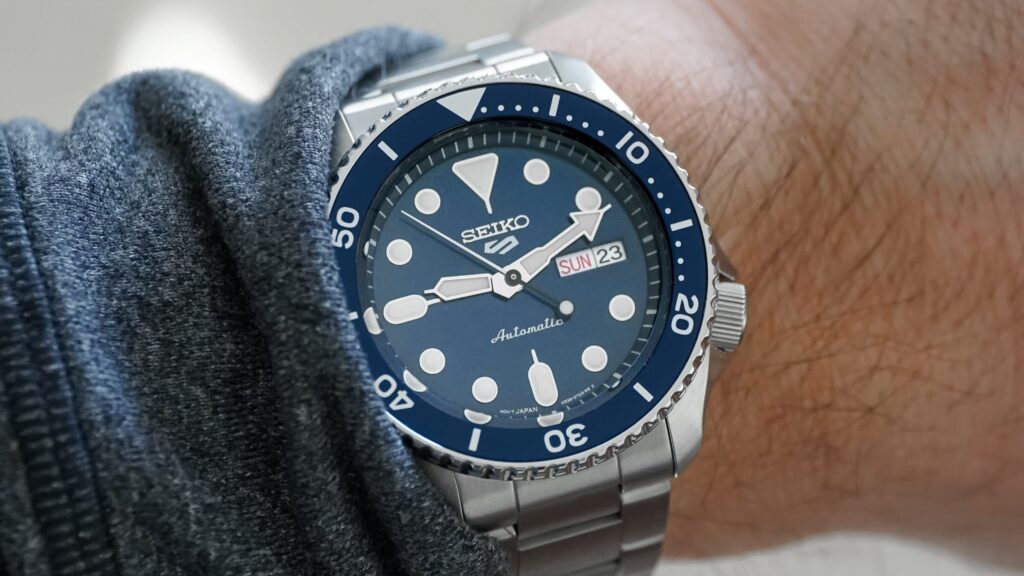
The Seiko 5 Sports SRPD51 shows why you don’t need to spend hundreds more to get an enjoyable automatic sports watch. Its blue sunburst dial does much of the convincing, shifting from a fairly restrained navy indoors to a brighter blue in sunlight. The matte aluminum bezel keeps things from getting too shiny, while the applied markers and Seiko logo add enough depth to keep the dial interesting. We particularly liked the Lumibrite after handling and wearing the watch ourselves. It stayed impressively bright for hours, making nighttime legibility one of this watch’s stronger points. Seiko certainly hasn’t forgotten how to do lume.
The 46mm lug-to-lug measurement suggests a sizeable watch, but the SRPD51 wears more compactly than expected. The 4 o’clock crown stays clear of the back of the hand, and its deeper milled grip makes setting the watch easier. At 13.5mm thick, however, there’s still some height to contend with, particularly on smaller wrists. The factory bracelet is another area where our enthusiasm cools. Its thin clasp and fiddly adjustment links feel less considered than the rest of the watch. We preferred it on NATO or rubber, and the drilled lugs make swapping straps painless.
There’s some mechanical appeal here, too. As we pointed out in our full write-up, the 4R36 automatic movement supports hacking and hand-winding, so we can stop the second hand when setting the time and give the watch a little manual attention when needed. The exhibition caseback also lets us watch the movement at work, which is part of the fun of owning an affordable automatic.
One important detail, though: despite the familiar dive-watch appearance, the SRPD51 is a 100m sports watch with a push-pull crown, not an ISO-certified diver with the screw-down crown and 200m rating of the older SKX. We’d buy it for everyday wear, its strong lume, and the experience of owning a mechanical Seiko, not for diving credentials it skips. Under $300, it’s a convincing Seiko sports watch, as long as we’re happy to treat the styling as inspiration rather than a professional diving specification.
Pros
- The blue sunburst dial changes character under different lighting, while applied markers and the Seiko logo add welcome depth.
- Lumibrite remains bright for hours, giving the watch excellent nighttime legibility.
- The 4R36 offers both hacking and hand-winding.
- Drilled lugs make switching between NATO and rubber straps straightforward.
- The 4 o’clock crown stays out of the way, while its deeper milled grip makes setting the time easier.
- The exhibition caseback gives us a glimpse of the automatic movement.
Cons
- The factory bracelet feels underwhelming, particularly the thin clasp and fiddly adjustment links.
- At 13.5mm thick, the case has noticeable wrist presence despite its relatively compact wear.
Orient Mako II
| Price: | $225 (Check current price) |
|---|---|
| Water Resistance: | 200m |
| Case Dimensions: | 41.5mm x 47mm x 13mm |
| Lug Width: | 22mm |
| Movement: | Orient Caliber F6922 (Automatic) |
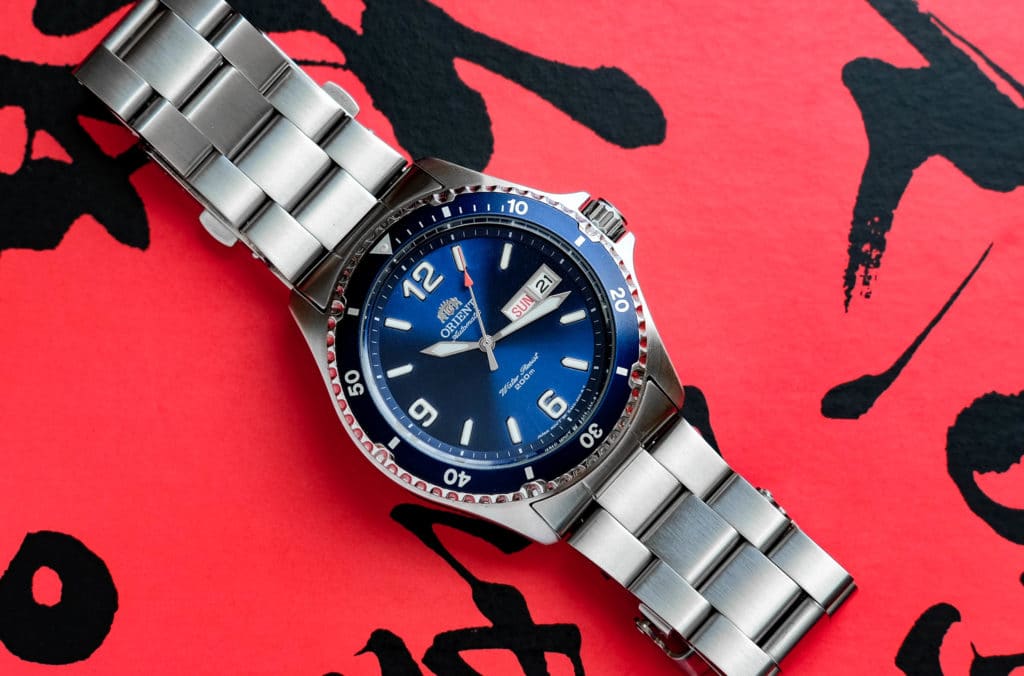
The Orient Mako II is what happens when a watch gets recommended so often that we almost forget to ask why it deserves the attention. After spending hands-on time with it, we’re reminded that its appeal isn’t some spectacular feature or headline-grabbing specification. It’s the balance between the traditional dial, bracelet comfort, and dependable automatic movement. The 41.5mm case wears flatter than expected, thanks to its compact lug-to-lug measurement, keeping it planted rather than spreading across the wrist. Orient also gets the finishing right, with brushed lugs, polished case sides, and neat transitions into the bracelet. The bracelet stayed comfortable throughout our testing, although the hollow end links feel noticeably cheaper to handle than they do during actual wear. That’s a compromise we can live with.
The in-house F6922 automatic movement gives us another reason to spend our money here. Hacking and hand-winding let us set the time precisely and get the watch running without resorting to the usual shake-it-and-hope routine. The dial is equally well judged. Its sunburst finish catches the light without becoming flashy, while applied markers, polished hands, a framed day-date display, and a red-tipped second hand add personality without making the layout messy. The 120-click bezel delivers firm, positive action, although we’d appreciate more grip on its sloped edge. The lume is another modest compromise, offering enough visibility for quick nighttime checks but fading sooner than we’d like compared with brighter competitors.
The Mako II earns its place next to the pricier Kamasu by offering a subtler dial and a surprisingly comfortable bracelet, even though it gives up the Kamasu’s sapphire crystal and stronger lume. If those upgrades matter, spend more on the Kamasu; if you favor the Mako II’s cleaner look and can live with mineral crystal and a less grippy bezel, this remains a rewarding automatic diver.
Pros
- The bracelet remains comfortable during extended wear, despite the hollow end links.
- The sunburst dial, applied markers, polished hands, framed day-date, and red-tipped second hand add character without visual clutter.
- Hacking and hand-winding make the in-house F6922 more convenient and engaging.
- The 120-click bezel offers firm, positive action.
- The 41.5mm case and compact lug-to-lug measurement keep the watch balanced and flatter on the wrist than expected.
- Brushed lugs, polished case sides, and tidy bracelet transitions give it a refined appearance.
Cons
- The lume fades sooner than we’d prefer, particularly compared with brighter dive-watch alternatives.
- Hollow end links reveal some of the bracelet’s budget construction when handling the watch.
- The sloped bezel edge doesn’t offer enough grip for our liking.
Orient Kamasu
| Price: | $250 – $300 (Check current price) |
|---|---|
| Water Resistance: | 200m |
| Case Dimensions: | 41.5mm (diameter) x 47mm (lug-to-lug) x 13mm (thickness) |
| Lug Width: | 22mm |
| Movement: | Orient F6922 (automatic movement) |
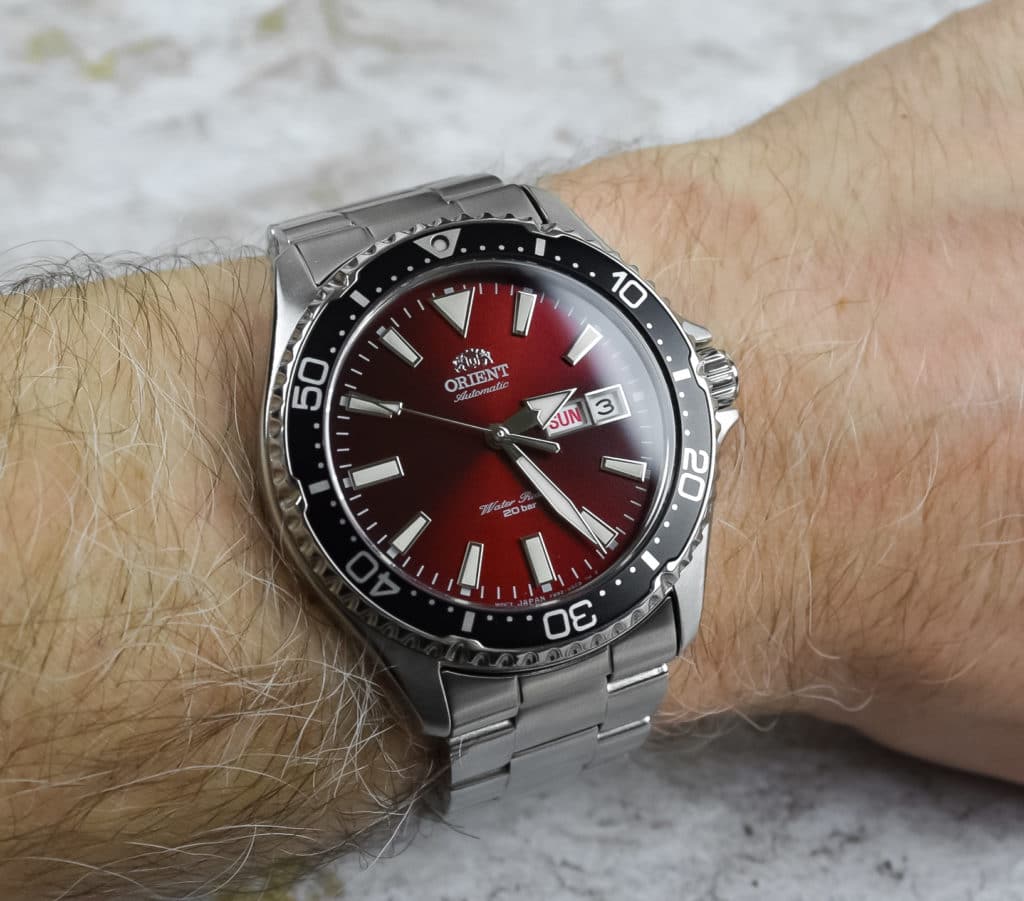
The Orient Kamasu shows what paying a little more than the Mako II can buy in an affordable dive watch. It comes with sapphire crystal, 200m water resistance, and a bezel with tight, deliberate action that feels reassuring rather than loosely assembled. We were perfectly comfortable taking it around the pool and beach without treating every splash like a potential insurance claim. The screw-down crown is less convincing, though. It threads smoothly, but its relatively small size and protective guards leave our fingertips wanting more room.
The wine-red sunburst dial keeps the Kamasu from becoming another interchangeable black-and-blue diver. It changes character with the light without turning into a disco ball, while the applied markers and properly sized hands reaching the minute track make reading the time straightforward. The lume charges quickly and stays visible well into the night, which makes this an enjoyable watch beyond daylight hours. Its 41.5mm case also wears better than expected. The curved lugs keep the watch planted without spreading across the wrist, giving it considerably less bulk than the diameter suggests.
The in-house F6922 automatic movement brings hacking and hand-winding, so getting the watch running after a few days in the hotel drawer doesn’t require the traditional shake routine. The bracelet is secure, and its four-position micro-adjust clasp is particularly useful when warmer weather makes our wrists swell. Unfortunately, the end links and clasp feel cheaper than the watch head deserves. The aluminum bezel insert is another drawback, picking up scratches more readily than ceramic.
At the top of this budget, the Kamasu stands out for combining sapphire, strong lume, and a well-proportioned automatic dive-watch design. We’d happily take its distinctive dial, strong lume, sapphire crystal, and comfortable proportions over a more expensive diver that looks better on paper but is less enjoyable to wear. Just don’t expect every bracelet component to punch above its price. Our dedicated Kamasu review covers the watch’s everyday strengths and compromises in more detail.
Pros
- The four-position micro-adjust clasp makes it easier to maintain a comfortable fit as wrist size changes throughout the day.
- The in-house F6922 offers hacking and hand-winding.
- The wine-red sunburst dial adds personality without compromising legibility.
- Tight, deliberate bezel action feels reassuring during use.
- Curved lugs and balanced 41.5mm proportions help the case wear with less bulk than expected.
- The sapphire crystal and 200m water resistance combination makes it a dependable everyday companion.
- The lume charges quickly and remains visible well after dark.
Cons
- The aluminum bezel insert picks up scratches more readily than ceramic.
- The bracelet’s end links and clasp feel less refined than the watch head.
- The small crown and protective guards make it harder to grip than a standard diver.
If we were buying one under-$300 diver, the Citizen Promaster BN0151 would be our pick for solar convenience and excellent lume, while the Orient Kamasu makes more sense for someone who specifically wants an automatic movement and sapphire crystal. For a dressier watch, we’d choose the Orient Bambino; for an inexpensive everyday beater, it’s difficult to beat the Casio F-91W or Duro. The Timex Expedition Field Post Solar is an easy choice for smaller wrists and anyone who wants a no-fuss field watch. None of these requires spending the full $300. The better purchase is the one whose strengths fit how we’ll actually wear it—and whose compromises we can live with.

Co-Founder and Senior Editor
Kaz has been collecting watches since 2015, but he’s been fascinated by product design, the Collector’s psychology, and brand marketing his whole life. While sharing the same strong fondness for all things horologically-affordable as Mike (his TBWS partner in crime), Kaz’s collection niche is also focused on vintage Soviet watches as well as watches that feature a unique, but well-designed quirk or visual hook.