Some watches stay with us for reasons that have nothing to do with hype, resale chatter, or the usual greatest-hits list. They linger because they’re odd in a convincing way, or because they solve a practical problem with more personality than they probably should. That’s the question driving this list: which iconic watches have we actually reviewed and kept thinking about, even though plenty of collectors seem to skip right past them? In our experience, the overlooked stuff is often where the fun starts. These are the watches that surprised us after a shaky first impression, kept nagging at us to use them, or made more sense on the wrist than they ever did in photos.
That said, we’re coming at it like the kinds of collectors who’ve spent enough time with watches to know when a first impression is wrong, when a “weird” design turns into a favorite, and when a watch deserves more than a quick honeymoon-phase endorsement. Across our reviews, that has meant giving a piece enough time before judging it. That includes noticing when a quartz watch only needed a seconds correction after weeks of wear, admitting when vintage ownership starts to feel like work, and still making room for the kind of overlooked watch that earns trust the slow way. That’s why this list exists.
Citizen Ana-Digi Temp
| Price: | $250 – $500 |
| Water Resistance: | 30m |
| Case Dimensions: | 31.5mm (diameter) x 40mm (lug-to-lug) x 8.4mm (thickness) |
| Lug Width: | 18mm |
| Movement: | Citizen caliber 8980 |
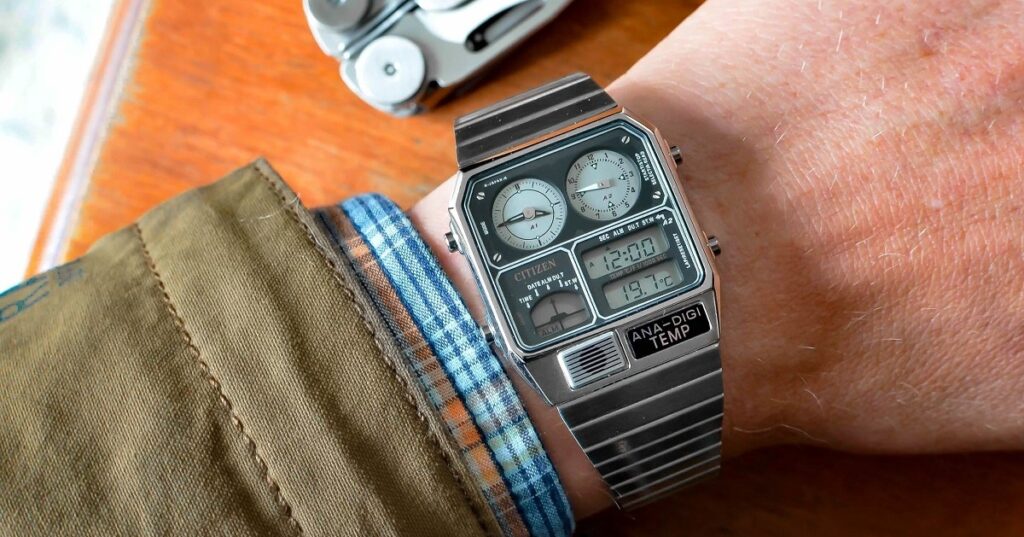
The Citizen Ana-Digi Temp earns its place here because it still feels unlike almost anything else you can buy or wear now. The practical side of it is what surprised us most. The dual-time setup works more like a genuinely useful GMT than a novelty, with the analog display giving you a quick reference and the digital readout backing it up when you need precision. When we were juggling schedules across time zones, that setup made sense. The temperature function is a little less immediate. You do have to take the watch off your wrist to get an accurate reading, so it’s not something you use on impulse. Still, it never crossed into gimmick territory for us during the review. It feels like an artifact from a time when brands were trying to cram real utility into strange little stainless steel machines.
Visually, it tells you pretty quickly whether someone will connect with it. This thing does not try to look sleek, minimal, or updated for modern tastes. It wears like a surviving chunk of eighties problem-solving, with a boxy steel case, sharp edges, and a display that looks closer to a control panel than a traditional dial. But the surprise is that it wears smaller than the case shape suggests. The short lug-to-lug span and fairly slim profile help it sit flat and balanced, even on smaller wrists. The integrated bracelet helps, too, and it feels like the only bracelet this case should have, though the flared end links are a known weak point and can bend over time.
On the dial, Citizen did the smart thing by separating everything into distinct zones. A lot is going on, but it rarely feels messy in actual use. The bright white information stands out clearly against the black background, while the darker LCD labels stay subdued. The branding stays restrained, which helps. The thin needle black hands on the left remain readable thanks to their narrow lume strips, while the heavier regulator-style hand on the right is easier to follow at a glance. Add in the four lume plots at the cardinal points, polished hand bases, and those exposed screws, and you get a watch that rewards close attention without losing sight of function.
It won’t win over anyone who wants a clean, quiet digital watch. But if you like early multifunction tech, unconventional layouts, and watches that refuse to disappear into the background, the Ana-Digi Temp still offers something most modern digital pieces don’t.
Pros
- The analog and digital displays work together to make dual-time useful.
- Despite the dense look, the compact proportions keep it comfortable and manageable on a wide range of wrists.
- The high-contrast display makes the most important information easy to pick out quickly.
- Small details like the hand shapes, lume placement, and exposed screws give it more depth the longer you study it.
Cons
- The temperature readout is only reliable when the watch is removed from the wrist, which makes it less spontaneous in day-to-day use.
- There’s a learning curve to the layout, especially if you’re seeing one for the first time.
- The bracelet suits the case well, but the end links can be a long-term weak point.
- Anyone who prefers a stripped-down or more contemporary digital design will probably bounce off it fast.
Bulova Computron
| Price: | $340 |
| Water Resistance: | 30m |
| Case Dimensions: | 31mm (diameter) x 40mm (lug-to-lug) x 13.8mm (thickness) |
| Lug Width: | Integrated strap that tapers from 25mm at the case to 16mm at the ends |
| Movement: | Quartz |
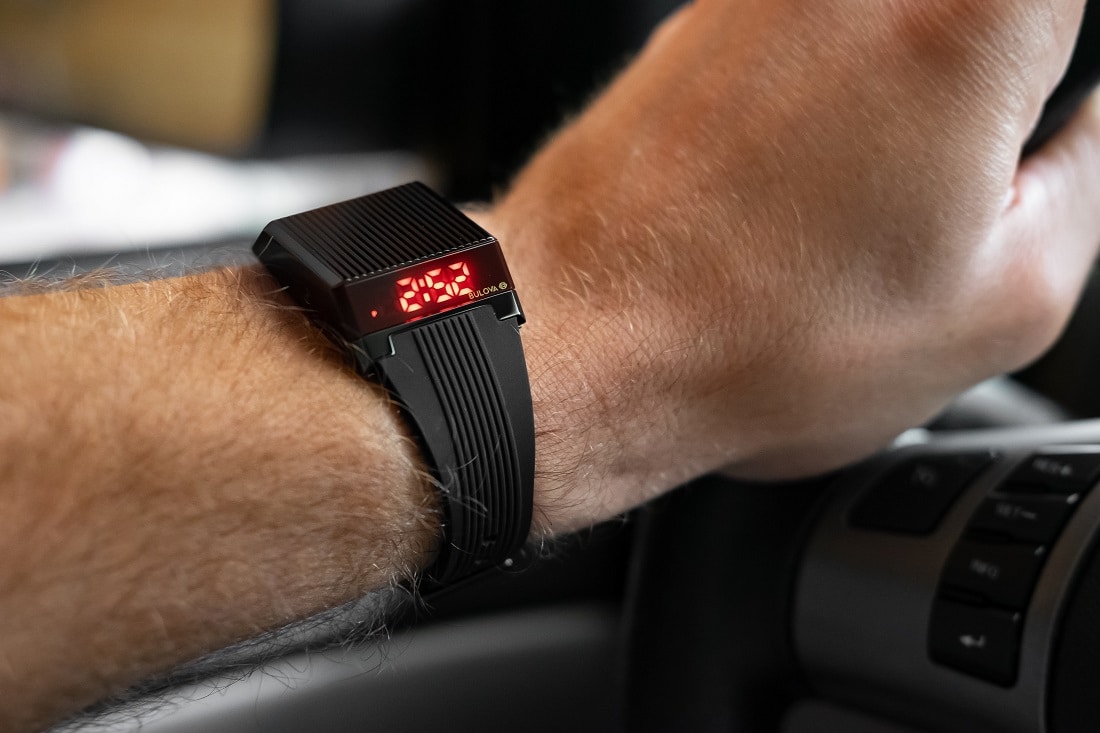
The Bulova Computron makes sense once you stop expecting it to behave like a normal daily watch. In use, that’s the whole point. You press the button, the red LED display lights up, and suddenly, checking the time becomes a deliberate act rather than a reflexive glance. That can feel a little irritating if you’re used to quick readouts, and it definitely slows things down. But that slight friction is also part of the appeal. It reminds you that this came from an era when digital watches still felt experimental, a little strange, and a lot more fun than practical. Once you settle into it, cycling through the time, date, and second time zone is simple enough, even if it never becomes effortless.
What keeps the Computron from feeling like a novelty is how well Bulova handled the physical design. The trapezoidal case, hard edges, and overall late-’70s silhouette are left intact without trying to soften the weirdness for modern tastes. We appreciated that in our hands-on review. The shallow grooves across the top of the case help, too, adding some texture to what could have come off as a single geometric block. More importantly, it wears better than the shape suggests. The angled case sits comfortably on the wrist, stays balanced, and feels lighter than you might expect from the photos.
The integrated rubber strap also does a lot of work here. It’s soft and comfortable, and its aggressive taper makes the whole watch feel planted rather than top-heavy. The finishing is also stronger than expected for the money. However, the black ion-plated version picks up fingerprints fast, which becomes noticeable when you’re constantly touching the case just to read the display. So no, this isn’t the watch we’d reach for when we want a thoughtless everyday workhorse. But as a piece that breaks the rhythm of a collection and delivers a very specific kind of design satisfaction, the Computron still earns its place.
Pros
- The unusual case shape stays faithful to the original 1970s digital look without feeling watered down.
- It wears more comfortably than expected, with good wrist balance despite the unconventional form.
- The build quality and finishing feel better than the price might suggest.
- The integrated rubber strap suits the design and helps keep the watch comfortable and stable.
Cons
- Reading the time is slower than on a standard digital or analog watch because you need to activate the display.
- The glossy black ion-plated finish shows fingerprints quickly.
Wolbrook Skindiver “Douglas” Reissue
| Price: | $513 |
| Water Resistance: | 100m |
| Case Dimensions: | 40mm (diameter) x 48mm (lug-to-lug) x 11mm (thickness) |
| Lug Width: | 20mm |
| Movement: | Miyota 8215 automatic |
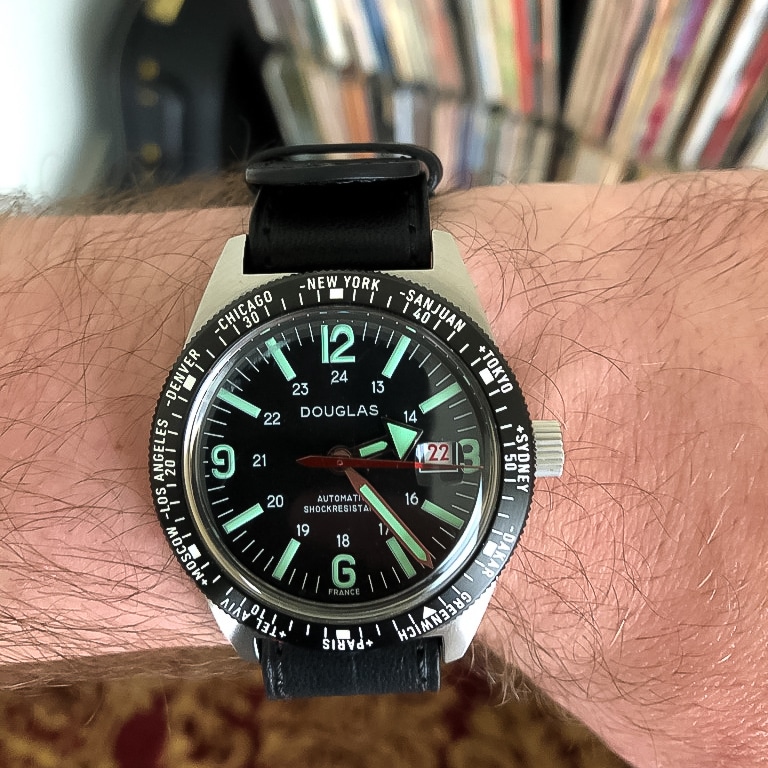
The Wolbrook Skindiver “Douglas” Reissue is easy to overlook because it sits in an awkward corner of the hobby. It is not a famous mainstream reissue, and the space-adjacent storytelling around it can distract from the watch itself. Once we got past that, what stood out was how sensible it feels on the wrist. The 40 mm case, 48 mm lug-to-lug, and 11 mm thickness land in that sweet spot where the watch feels substantial without becoming a brick. The straight lugs make it sit a bit flatter than some modern divers, which helped it wear neatly under a cuff and kept it from banging into desks and door frames during normal daily use. For readers who want a compact, old-school tool-watch feel without going full tiny-vintage, this sizing makes a lot of sense.
Design-wise, it has the skindiver look most people want, but with a few details that keep it from feeling generic. The worldtime bezel is the obvious one. It is not a true worldtimer in the strict sense since there is no dedicated extra hand, but it still adds a useful travel-minded twist and gives the watch more personality than a standard elapsed-time bezel would. We also liked the polished red seconds hand, the roulette date, and the cyclops tucked under the crystal. Those details give the watch a little life without ruining the clean, functional feel.
That said, we were less sold on how hard Wolbrook leaned into the Neil Armstrong connection and the broader space-theme engraving. The watch does not need that much narrative help. In fact, the heavy-handed caseback treatment made us trust the watch a little less, not because the build is weak, but because it’s already interesting enough on its own. Our dedicated review digs further into that trade-off if you want the full story.
Where this reissue gets complicated is in how modern it feels compared to what inspired it. Sapphire, a Miyota 8215 automatic, and even a quartz option with the Seiko VH31 sweeping-seconds setup all make it more durable and easier to live with than an actual vintage piece. Most buyers will appreciate that. We did too, up to a point. But those upgrades also make it feel heavier and a bit clunkier than the original formula. If you are coming in fresh, that may not bother you. But if you have spent time with vintage skindivers, you will notice the extra mass right away. That is why this works best for someone who wants the charm of a vintage-adjacent design without the maintenance, fragility, or sketchy auction-lore rabbit holes.
Pros
- Well-judged case dimensions make it easy to wear day to day, including for smaller wrists.
- Slim profile and flat stance help it stay comfortable under sleeves and out of the way.
- The bezel, red seconds hand, and roulette date add character without making the watch feel fussy.
- Sapphire crystal and modern movement choices make ownership easier than with a true vintage piece.
Cons
- The worldtime bezel is more of a visual and casual-use feature than a true travel tool.
- Compared with actual vintage skindivers, the reissue feels heavier and less nimble.
- Buyers looking for a purist reissue may find the modernized formula a little too cleaned up.
- The space program branding and the Armstrong connection feel overplayed, given how thin that link is.
Bulova Lunar Pilot Chronograph
| Price: | $550 – $895 |
| Water Resistance: | 50m |
| Case Dimensions: | 45mm (diameter) x 52mm (lug-to-lug) x 13.5mm (thickness) |
| Lug Width: | 20mm |
| Movement: | 262 kHz Quartz |
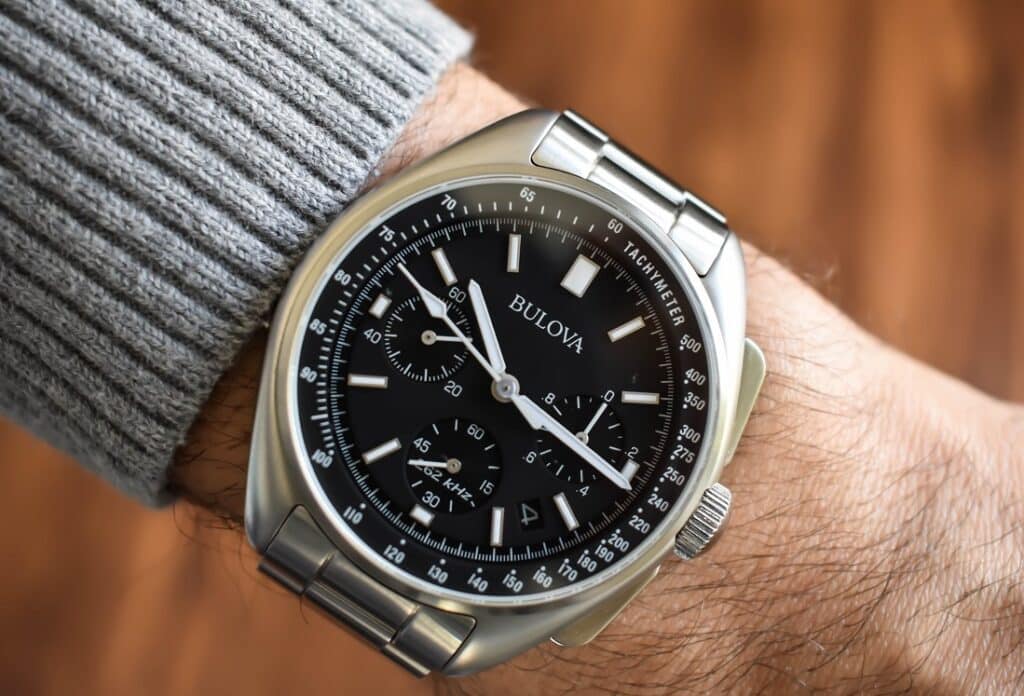
The Bulova Lunar Pilot Chronograph gets overlooked more often than it should, and much of that comes down to two things people immediately fixate on: the size and the quartz movement. We get it. A 45 mm 316L stainless steel chronograph does not sound subtle, and plenty of collectors still dismiss quartz the second they see it on a spec sheet. But this is one of those watches that changes a bit once it is on your wrist. The case is undeniably large, yet the bracelet integration helps pull the whole thing together, making it feel flatter and more controlled than the dimensions suggest. The factory bracelet stays better balanced during daily wear than we expected. Off the bracelet, though, the size becomes harder to ignore, which is why this is one of those watches where the stock setup matters more than usual.
What keeps the Lunar Pilot from feeling like a novelty is how purposeful everything is once you start using it. The dial is laid out with real clarity. Bulova made good use of all that available space, so the sub-dials never feel squeezed and the hand lengths land exactly where they should. That sounds like a small thing until you are timing something and realize how much easier it is to read than a more crowded chronograph. The date at the 4:30 position stays out of the way, and the sub-dials at 3, 6, and 9 o’clock house the 1/10th-second counter, running-seconds display, and minute totalizer, respectively. During our testing period, we also liked the pushers at 2 and 4 o’clock. They have a distinctive feel, and along with the signed push-pull crown between them, they give the watch a tactile personality that suits the rest of the design.
The high-frequency quartz movement is still the real story here. In our experience, the accuracy is excellent, sitting around 10 seconds per year, and the seconds hand has a smoother, gliding motion than most people expect from quartz. That blend of mechanical-like visual charm and quartz practicality is a big part of why this watch works.
Still, it is not for everyone. Smaller wrists will likely hit their limit quickly; the bracelet finish does not match the case as cleanly as it should, and the modest 50m water resistance means this is not the chronograph we would throw into harsher conditions without thinking twice. But if you want an overlooked icon that feels grounded in actual use rather than collector mythology alone, the Lunar Pilot deserves more wrist time than it usually gets.
Pros
- The dial is easy to read in real use, with sensible spacing and hand proportions.
- The high-frequency quartz movement is very accurate and gives the seconds hand a smoother sweep than standard quartz setups.
- On the factory bracelet, the large case wears more evenly and feels more balanced than the raw measurements suggest.
- The pushers and crown give the watch a tactile, purposeful feel rather than a generic chronograph experience.
Cons
- The 45 mm case will still be too much for plenty of smaller wrists.
- The bracelet finish does not blend with the case as well as it should, and that mismatch becomes noticeable once spotted.
- Strap changes tend to make the watch feel larger and less cohesive than it does on the bracelet.
- Water resistance is limited enough that we would not treat it like an all-conditions grab-and-go watch.
CWC SBS Diver

| Price: | $960 |
| Water Resistance: | 300m |
| Case Dimensions: | 45mm (diameter incl. crown) x 47mm (lug-to-lug) x 11mm (thickness) |
| Lug Width: | 20mm |
| Movement: | Ronda Swiss-made 517 quartz |
The CWC SBS Diver belongs on a list like this because it does almost everything in a low voice. It is not trying to charm you with polished surfaces or nostalgic flourishes. On the wrist, it feels like a watch built to get through the day without fuss. The black PVD case keeps the whole thing visually quiet, and the build feels denser and more reassuring than the dimensions might suggest. Even so, it never felt bulky or awkward during extended wear. One thing we kept appreciating was how naturally it worked across different straps. A single-pass nylon strap, an RAF-style strap, or another no-nonsense option could shift the mood slightly, but the watch never lost its direct, utilitarian character. It felt as right during a long day outside as it did knocking around through routine errands.
That same stripped-back seriousness shows up in how the watch performs. The quartz movement is a big part of that. Over five weeks of wear and timing, it stayed within about five seconds, which is the kind of low-maintenance dependability this sort of watch should deliver.
The dial may look a little crowded at first, but that impression faded quickly once we started using it normally. The oversized markers and sword hands make fast time checks easy, especially when the light is poor or you are not in a position to stare at your wrist for long. The Luminova, indicated by the circle L, does its job well, too. It charges fast and stays visible for most of the night in our experience. The flat crystal also deserves some credit because it cuts glare outdoors better than you might expect, which helps during extended time outside.
The main trade-off is price. For a quartz diver, it sits above plenty of alternatives, and some buyers will need a stronger reason than military lineage and real-world competence to justify that. Still, if you want an overlooked watch that feels grounded, capable, and uninterested in showing off, the SBS Diver earns its place.
Pros
- Dense, purpose-built construction gives it a reassuring feel without making it clumsy on the wrist.
- Quartz movement delivers excellent accuracy with very little upkeep.
- Oversized markers, sword hands, and strong lume make it easy to read in poor light.
- Flat crystal helps reduce outdoor glare.
- Works well on a range of utilitarian straps, which adds flexibility without changing its core character.
Cons
- The dial can feel a bit busy at first glance.
- Its higher price puts it above many other quartz divers that compete on pure practicality.
- The subdued, military-first design will not appeal to anyone looking for a more expressive or polished dive watch.
Marathon TSAR
| Price: | $1200 |
| Water Resistance: | 300m |
| Case Dimensions: | 41mm (diameter) x 48mm (lug-to-lug) x 14mm (thickness) |
| Lug Width: | 20mm |
| Movement: | ETA F06 quartz |
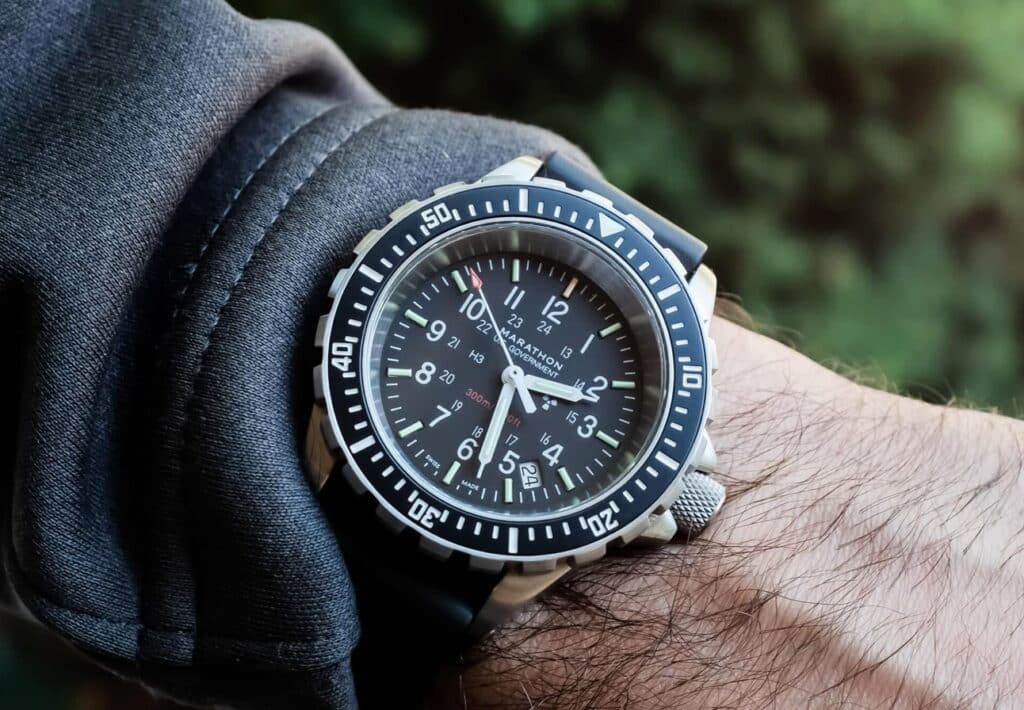
The Marathon TSAR is one of those watches that gets ignored because it refuses to play the usual collector game. It is quartz. It is thick, brushed like a tool, and shaped like one, too. On paper, that can sound a little severe. On the wrist, it makes more sense. The 41 mm case has a dense, industrial feel, but it does not feel awkward once worn. The weight adds confidence rather than drag, and the slab-sided shape feels intentional instead of lazy.
That attitude shows up in the parts you actually touch. The oversized crown is easy to grab, and the deep bezel teeth give you plenty of purchase, especially if your hands are wet or gloved. During our time with it, the 120-click bezel turned with real authority and never felt mushy or vague. Legibility is also where the TSAR stands out from many other dive watches. Whether you go with the dial marked “US GOVERNMENT” or the cleaner version, the display stays direct and easy to process. The small hit of red from the depth rating gives the dial enough contrast without making it feel dressed up.
The tritium tubes are what make the watch memorable in daily use. They keep the dial visible in total darkness without any need to charge lume first, and that changes the experience more than spec sheets usually suggest. The MaraGlo accents help after light exposure, but they do not overpower the dial once the lights go out. Inside, the ETA F06 quartz movement fits the TSAR’s whole personality. It is here to be dependable, not romantic. In our testing, it ran at roughly half a second per day, which is quite strong for a watch built around readiness. The bracelet feels secure and solid, while the rubber strap is thick, durable, and comfortable, with that faint vanilla scent Marathon fans tend to appreciate.
That said, the chunky case can fight tighter sleeves, and the bracelet skips modern conveniences like micro-adjustment and quick-release spring bars. Battery life, rated around three years, is fine but not remarkable by modern quartz standards. And this is never going to be the watch you reach for when you want something refined. Still, that is also why it belongs here. The TSAR is an overlooked icon because it feels built from the job outward, and there are not many watches left that commit to that so completely.
Pros
- Tritium tubes keep the watch readable in complete darkness without charging the lume.
- Oversized crown and deeply cut bezel are easy to operate in real-world conditions.
- The ETA quartz movement proved dependable in testing.
- Both the bracelet and the rubber strap feel secure and ready for hard use.
- The dense, brushed case gives the watch a reassuring sense of toughness.
Cons
- The thick case profile can feel bulky under tighter sleeves.
- Bracelet lacks micro-adjustment and quick-release spring bars.
- Battery life is decent, but not standout compared to some newer quartz options.
- Strictly utilitarian styling limits versatility with dressier clothes.
Nivada Grenchen Chronomaster Broad Arrow
| Price: | $1,975 |
| Water Resistance: | 100m |
| Case Dimensions: | 38mm (diameter) x 46.5mm (lug-to-lug) x 14.5mm (thickness) |
| Lug Width: | 20mm |
| Movement: | Landeron 70 |
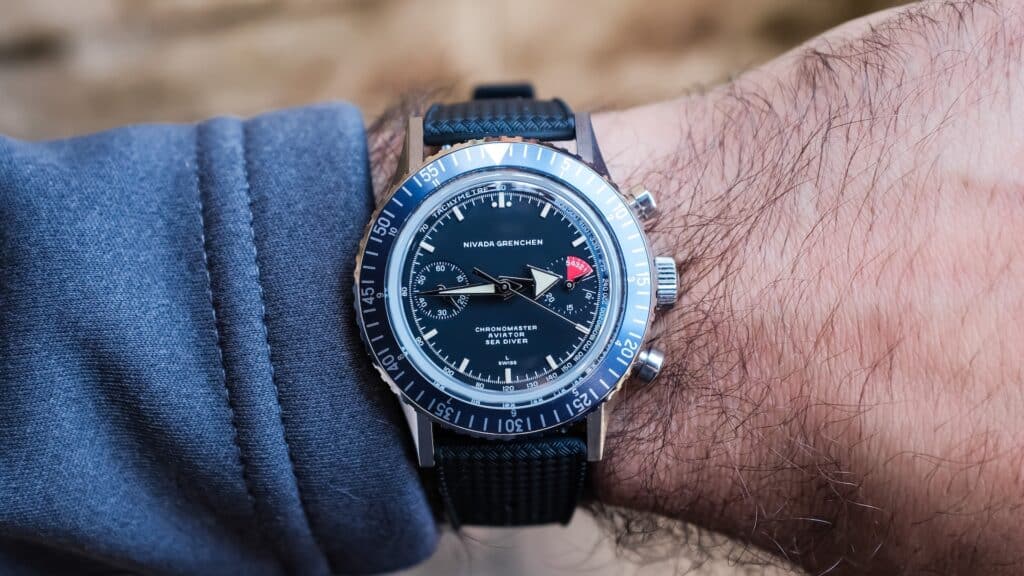
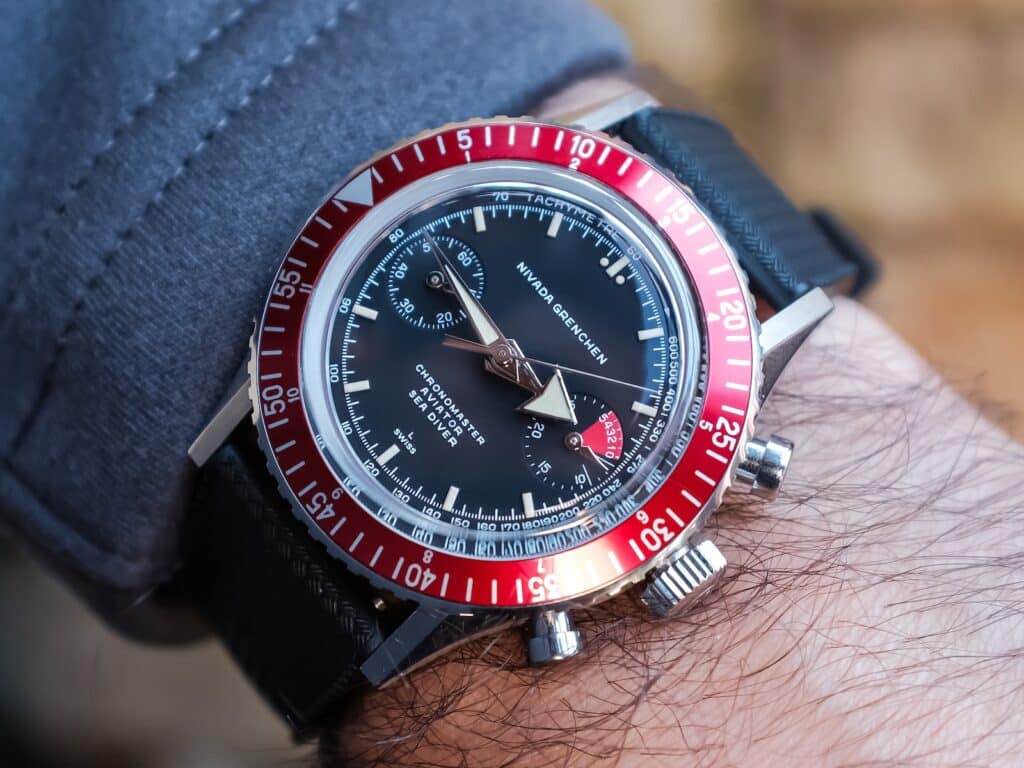
The Nivada Grenchen Chronomaster Broad Arrow belongs here because it is the kind of watch people can dismiss too quickly. At a glance, it seems to be trying to do too much. You have pilot-watch cues, chronograph functionality, dive-watch toughness, and a second-time-zone angle all competing for space. On the wrist, though, it settles down in a way the photos do not fully explain. The case has sharp lines, real heft, and a level of finishing that makes it feel more substantial than many watches in this range. Even the caseback gets proper attention, with deep engraving instead of the usual forgettable blank slab. It feels like a watch for someone who enjoys detail and is willing to spend a little time with it.
What hooked us first during extended wear was the bezel system. Being able to swap bezels by hand, without tools, sounds a little gimmicky until you live with it. Then it turns into one of those small rituals that make the watch more fun. The faded blue bezel leaned into a worn-in, nostalgic mood. The red one gave the watch a louder personality. The green bezel stayed more restrained, at least until sunlight woke it up. That flexibility matters because this is not a passive watch. It rewards owners who like interacting with what they wear, rather than just strapping something on and forgetting about it.
Our review team found that the dial is busy but not careless. Nivada managed to fit a tachymeter scale, two sub-dials, and stacked text at six o’clock without tipping into a mess. The matte black surface helps keep the layout under control, and the broad-arrow hour hand makes orientation easy when the dial starts to feel visually dense. We did notice that the polished sub-dial hands can lose contrast in certain lighting, which occasionally disrupts their otherwise strong legibility. The domed sapphire crystal also adds a bit of distortion at sharper angles, but in this case, it works with the watch rather than against it. It adds to the old-school character instead of feeling like a gimmick layered on top.
The hand-wound Landeron 70 is a big part of why this watch sticks with you. Winding it becomes part of the daily experience, and the oversized crown makes that feel smooth and satisfying rather than fiddly. In our testing, it ran about minus 5 seconds per day, which felt reasonable given what this watch is trying to be. The chronograph pushers had a crisp, tactile click that made us want to use them more often than necessary, and small details like the red five-minute subdivisions on the minute counter proved more helpful than expected.
The included tropic strap is soft and comfortable, though the case feels like it is quietly asking for a steel bracelet. That is also where one of the frustrations shows up. The lack of standard spring bars makes strap swapping less flexible than it should be on a watch that otherwise invites this much hands-on interaction. Still, if you want an overlooked watch with real personality and more depth than the market usually gives it credit for, the Chronomaster Broad Arrow makes a strong case.
Pros
- The case has a strong presence and reassuring weight without losing its compact vintage-minded proportions.
- Tool-free bezel swaps add real personality and make the watch feel more interactive in daily wear.
- The hand-wound movement makes ownership more engaging, especially with the oversized crown.
- Dial details, including the red five-minute marker, reward closer attention over time.
Cons
- The dial takes a little time to understand because a lot is happening at once.
- Polished sub-dial hands can blend into the dial in certain lighting.
- The domed crystal introduces distortion at angles, which not everyone will enjoy.
- Non-standard spring bars make strap changes less convenient than they should be.
Yema Yachtingraf Heritage
| Price: | $2,250 |
| Water Resistance: | 100m |
| Case Dimensions: | 39mm (diameter) x 45.5mm (lug-to-lug) x 15.35mm (thickness) |
| Lug Width: | 19mm |
| Movement: | ETA Valjoux 7753 |
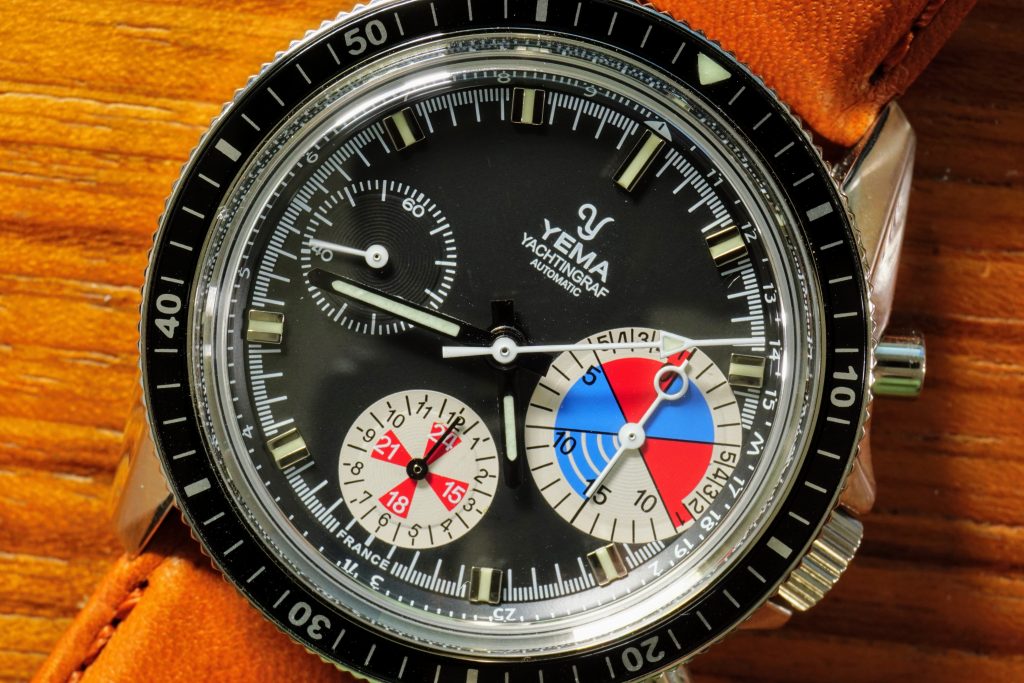
The Yema Yachtingraf earns its spot here because it is the kind of watch that can lose people before they have spent enough time with it. The proportions are the first hurdle. At 39 mm wide, it sounds manageable, but the case height changes the conversation fast. It has a tall, layered profile that can feel top-heavy on smaller wrists and a bit commanding on larger ones at first. Still, after some wrist time, the shape starts to make more sense. The short lugs keep the overall footprint tighter than the thickness suggests, and once it settles in, the whole watch feels coherent rather than awkward. It has presence, no question, but it does not feel random or inflated for its own sake.
The dial is where the watch either wins you over or sends you packing. A lot is happening. Multiple subdials, colorful accents, and dense markings compete for attention right away, and our first impression was that it bordered on too much. After a couple of days, though, the layout became easier to read and more enjoyable to use. The minute counter at 3 o’clock gives the watch its identity, and the blue, red, and white accents pull the whole nautical theme together without feeling cartoonish. Legibility is good once your eyes adjust, but it is not flawless. The black hands can disappear a bit in lower light, and when they pass over the lighter subdials, reading the time takes more effort than it should. The domed crystal and thin bezel help by drawing your eye inward, which improves things once you have acclimatized to the dial.
Using the watch day-to-day is a mix of charm and compromise. The friction-fit bi-directional bezel feels unusual if you are used to the crisp clicks of modern dive bezels. It holds its place well enough for everyday timing, and for casual stuff around the house or at work, it is serviceable. However, we would be less enthusiastic about depending on it for anything more demanding. The inner bezel markings also add visual complexity without offering much real function, which felt a bit out of step with the rest of the watch.
Inside, the Valjoux 7753 makes more sense. It is a proven chronograph movement, and in our testing, it ran consistently and delivered that satisfying mechanical feel you want from a watch like this. The chronograph pushers were good, with a firm, rewarding action that made us want to use them. The crown was less enjoyable, though. The tight guards make it awkward to grip, even off the wrist, which turns simple adjustments into more of a chore than they should be. The rotor noise is also noticeable when the watch is off the wrist, though that mostly disappears once worn. On the plus side, the leather straps are excellent. They feel considered, suit the watch well, and do not create that immediate urge to start shopping for replacements.
For the right collector, that mix is exactly why the Yachtingraf matters. It is not smooth or universally easy. It asks for a little patience, and it rewards that patience with a personality that many cleaner, safer chronographs lack. If you like watches that feel rooted in a specific design language and you do not mind a few rough edges along the way, this is one of those overlooked pieces worth spending real time with.
Pros
- Distinctive dial colors and layout give the watch a strong identity once you settle into it.
- Short lugs help contain the footprint and keep the watch from feeling sprawling on the wrist.
- Valjoux 7753 brings dependable chronograph performance and satisfying mechanical character.
- Chronograph pushers have a firm, tactile action that makes timing functions enjoyable to use.
- The included leather straps suit the watch well and feel better than standard throw-in options.
Cons
- The case is thick for its diameter, which can make it feel top-heavy, especially on smaller wrists.
- Friction bezel lacks the precision and reassurance of a modern clicking setup.
- Crown guards make time and date adjustments more awkward than they should be.
- Inner bezel markings add clutter without offering much practical value.
Rado Over-Pole
| Price: | $2,400 |
| Water Resistance: | 100m |
| Case Dimensions: | 37mm (diameter) x 43mm (lug-to-lug) x 10.4mm (thickness) |
| Lug Width: | 19mm |
| Movement: | Rado R862 |
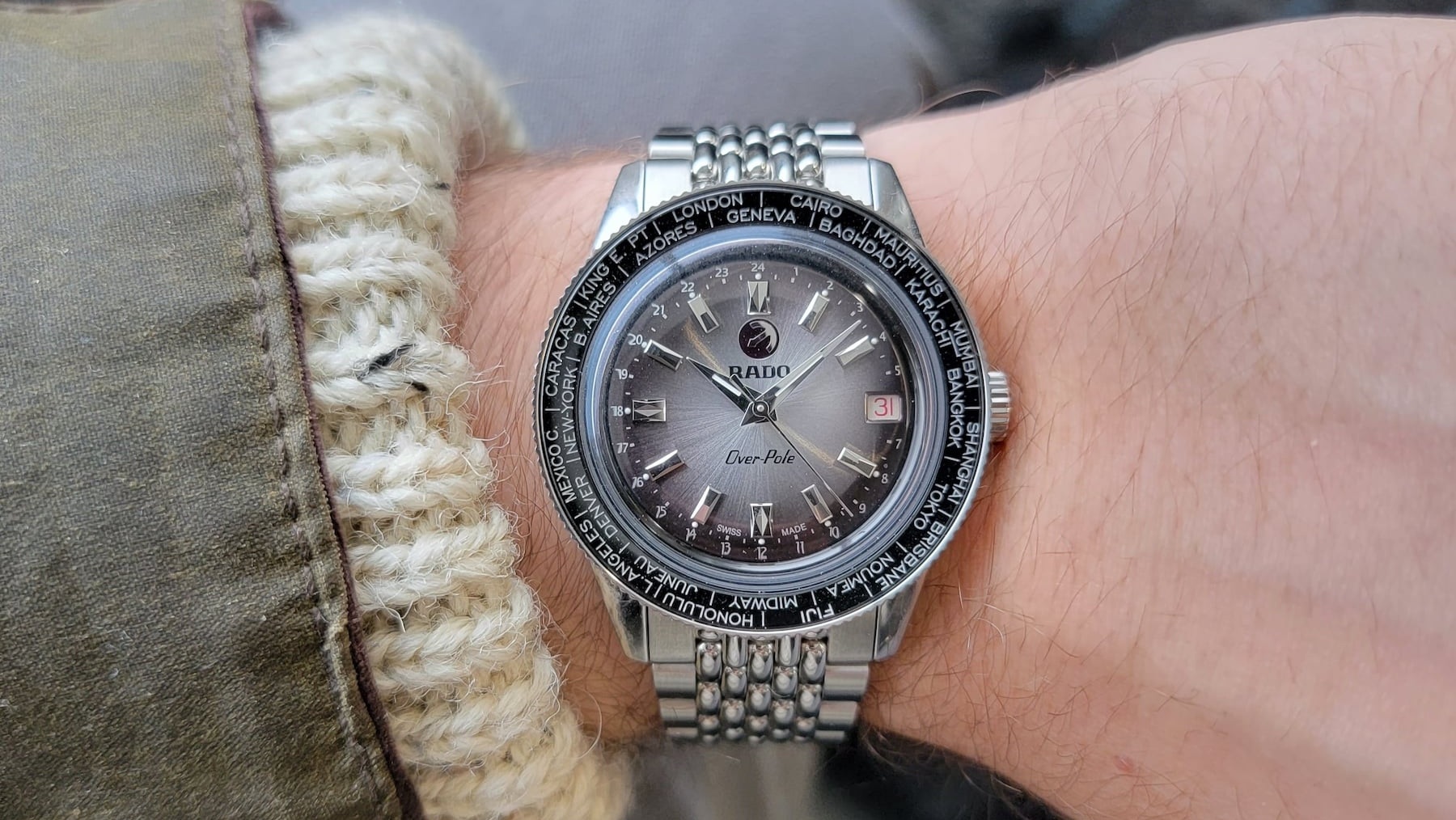
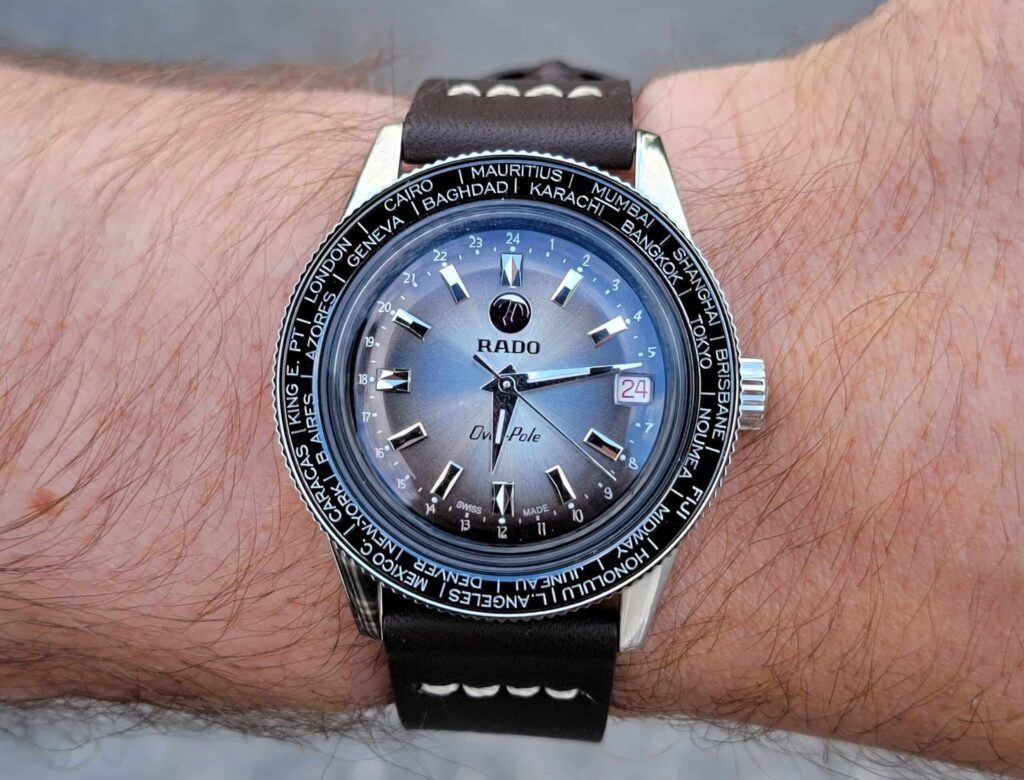
The Rado Over-Pole is easy to miss if your attention usually goes to louder travel watches or chunkier vintage reissues. In person, though, it has a very different kind of pull. The 37 mm case sits low, balanced, and easy on the wrist, which made it one of those watches we could wear through a full workday without thinking much about comfort. It still carries some dressy energy thanks to all that polished surface, and that polish looks good in motion. The trade-off is obvious pretty quickly. It picks up fingerprints and signs of handling faster than a more brushed, utilitarian watch would. Still, it never felt fragile or too precious, which matters for a piece leaning this hard into nostalgia.
A lot of the charm comes from the dial and bezel. The concave ceramic bezel, with its laser-engraved cities, gives the watch a distinctive identity right away, and it is one of those details that makes the Over-Pole feel more special than many vintage-inspired releases. The gray gradient dial helps, too. It has a soft metallic sheen that catches light without turning flashy, and the applied indices add more depth than we expected. The red date text was another small win for us. It adds enough personality without tipping the design into gimmick territory. The one frustration is legibility on the bezel itself. Under overhead office lights or in front of a laptop, glare could make those city markings harder to read than they should be.
The hand-wound R862 movement suits the watch better than an automatic would have. Winding it each morning gave the watch a more personal rhythm, and several of us ended up enjoying that routine more than expected. It slows the whole experience down in a good way. The 80-hour power reserve also helps, as missing a day does not require you to reset everything from scratch. In use, it behaved reliably, and the display back gives you a good view of the movement’s tidy finishing. That combination made the watch feel considered rather than dressed up for a reissue.
Rado also made the smart call by including both a leather strap and a rice-bead bracelet. The bracelet was the better surprise. It was very comfortable and stayed planted well, even on smaller wrists. We did notice a greater lack of micro-adjustment on warmer days, though not enough to make the bracelet frustrating. The leather strap is well done too, but it pushes the watch into dressier territory. The bigger limitation is nighttime use. Lume is minimal and barely useful after dark, so this is not the watch we would grab when quick low-light legibility matters. Even with those compromises, the Over-Pole feels like one of those overlooked pieces that rewards collectors who want something more thoughtful and a little less obvious. Our Rado Over-Pole review goes deeper into that experience.
Pros
- Concave ceramic bezel and dial details give the watch a distinct personality.
- Hand-wound movement makes ownership feel more engaging, with a useful 80-hour reserve.
- The rice-bead bracelet is comfortable and works well on smaller wrists.
- The compact 37 mm case wears comfortably and stays balanced throughout the day.
Cons
- Minimal lume makes it a weak choice for nighttime readability.
- Fully polished surfaces collect fingerprints and show handling quickly.
- Bezel markings can be harder to read when glare hits at the wrong angle.
- Bracelet comfort is strong, but the lack of micro-adjustment becomes noticeable in warmer weather.
Juvenia Sextant
| Price: | $4,200 |
| Water Resistance: | 30m |
| Case Dimensions: | 33mm (diameter) x 40mm (lug-to-lug) x 9mm (thickness) |
| Lug Width: | 18mm |
| Movement: | Juvenia calibre 612 (base ETA 2390) |
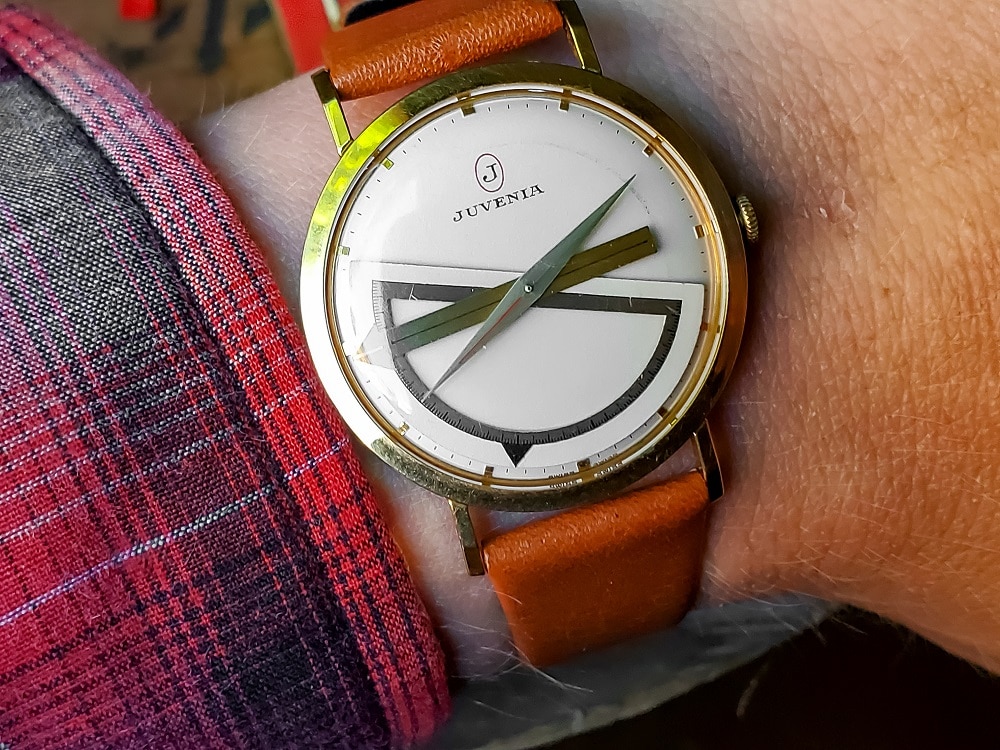
The Juvenia Sextant is exactly the kind of watch that makes this list necessary. Most people see 33 mm and move on before the conversation even starts, and that’s understandable. By modern standards, that sounds tiny. But this is one of those rare iconic pieces where the personality does a lot of the heavy lifting. On the wrist, the small gold-plated case does not feel anonymous or too delicate. It feels deliberate. At 9 mm thick with a 40 mm lug-to-lug, it stays light, easy, and quite wearable, especially if you already lean toward smaller vintage cases or want something that does not wear like a dinner plate. For collectors tired of the same safe dress watches, this one offers a very different kind of presence.
Most of that comes from the dial. The eggshell-white tone that developed over time gives it a softer, lived-in look, and the applied gold markers keep the outer track readable without competing for attention. The “J” emblem sits at the twelve with “Juvenia” below. Then your eyes land on the hands, or what passes for hands here. The white protractor-style hour display, the gold-plated, ruler-like minute hand, and long silver seconds hand turn the whole watch into a miniature measuring instrument. It is clever without feeling cute. More importantly, it still works once you give it a little time. Legibility is not instant. While reviewing this piece, we had to adjust to it, and anyone expecting a quick, conventional read will probably feel thrown off at first. By the end of the day, though, the layout started to click. That learning curve became part of the charm rather than a deal-breaker.
What makes the Sextant stick with us is that it feels restrained in a way many modern “creative” watches do not. It is unusual, but it is not trying too hard. The signed crown and ornate buckle details help, and the 18 mm strap width gives you enough room to experiment without getting stuck hunting for obscure options. The original black leather strap fit the watch’s mood, but even a simple brown leather alternative worked well with the aged dial and overall tone.
Inside is the Juvenia caliber 612, based on the ETA 2390, with a historically cited 47-hour power reserve. It’s not a practical daily choice for everyone, and finding an early example is not easy. Still, for the kind of collector who wants a watch that says something without shouting, the Sextant feels like one of those overlooked pieces you remember long after the usual suspects blur together.
Pros
- Huge personality for such a compact case, which makes the 33 mm size feel more at home on the wrist.
- The sextant-inspired handset gives the watch a distinct identity that still feels thoughtful rather than gimmicky.
- Slim case and moderate lug-to-lug keep it comfortable and easy to wear.
- Aged dial tones and applied markers give it a lot of visual warmth.
- Standard 18 mm strap width makes it easier to live with than many odd vintage pieces.
Cons
- The 33 mm case will still be a non-starter for collectors who prefer modern sizing.
- Reading the time takes some getting used to because the handset is so unconventional.
- The gold-plated case will not appeal to buyers who want the lower-key look of steel.
- Early examples can be difficult to track down, which limits accessibility for casual vintage buyers.
If there’s an overlooked icon you think deserves to be here, put it in the comments section. We’re always up for a watch that slipped past the usual collector radar while everyone else was busy arguing over the same three models again.
Please share your thoughts on these pieces and our analysis in the comments below. Also, if there’s an overlooked icon you think should be included in this list, please share that as well. We’ll do our best to see if we can get it in for review in order to be considered for this list.

Co-Founder and Senior Editor
Kaz has been collecting watches since 2015, but he’s been fascinated by product design, the Collector’s psychology, and brand marketing his whole life. While sharing the same strong fondness for all things horologically-affordable as Mike (his TBWS partner in crime), Kaz’s collection niche is also focused on vintage Soviet watches as well as watches that feature a unique, but well-designed quirk or visual hook.