
Tudor has always had a bit of an uphill climb with me. Over the years, I’ve added three of the brand’s watches to my collection, and two of them ended up developing movement issues. Thankfully, my most recent purchase, the Pelagos FXD, has been treating me well. Still, those earlier experiences have made my relationship with Tudor a little complicated, even as I’ve continued to appreciate what the brand has been doing with its modern lineup.

Somewhere along the way, I also realized that I knew surprisingly little about Tudor’s chronographs. I’ve followed the brand’s efforts to explore this category through the Black Bay and FXD collections, but I’ve never had the opportunity to spend meaningful time with one. The Black Bay Chrono “Carbon 25” seemed like an interesting place to start, especially with its racing-inspired design and forged carbon construction. Of course, I’ve also spent years looking at chronographs through the lens of established models like the TAG Heuer Carrera, Monaco, and Omega Speedmaster, so I was curious to see how Tudor’s approach would compare. After spending some time with the Carbon 25, I came away with a few impressions I wasn’t entirely expecting.

A Different Side of the Black Bay Chrono
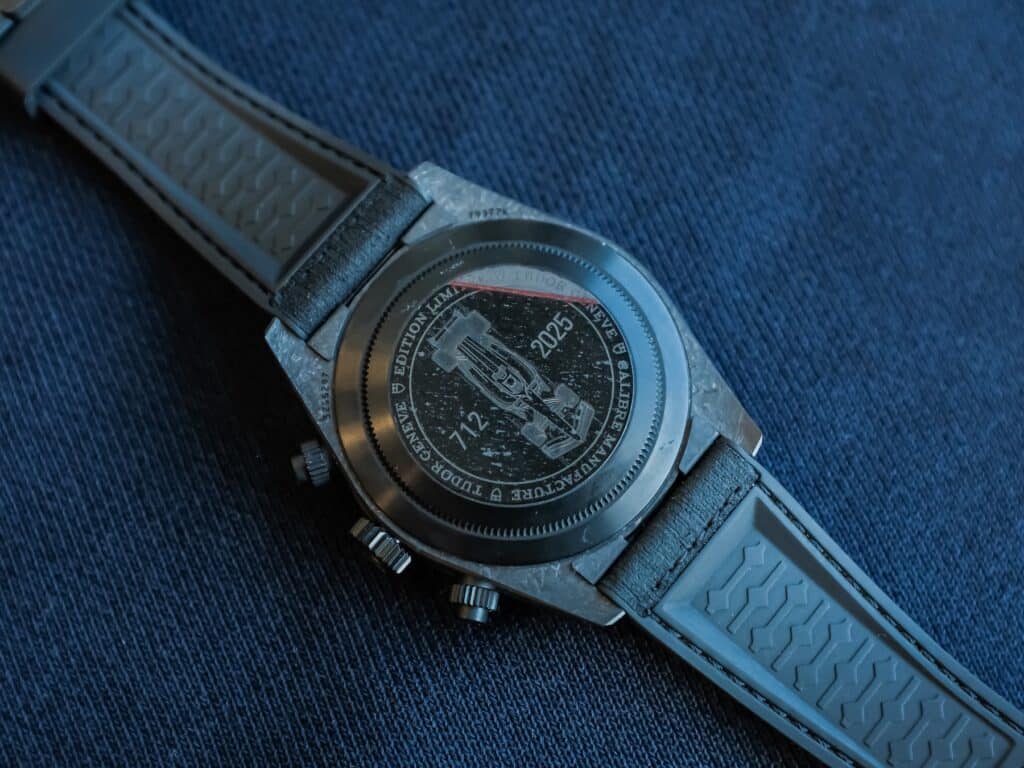
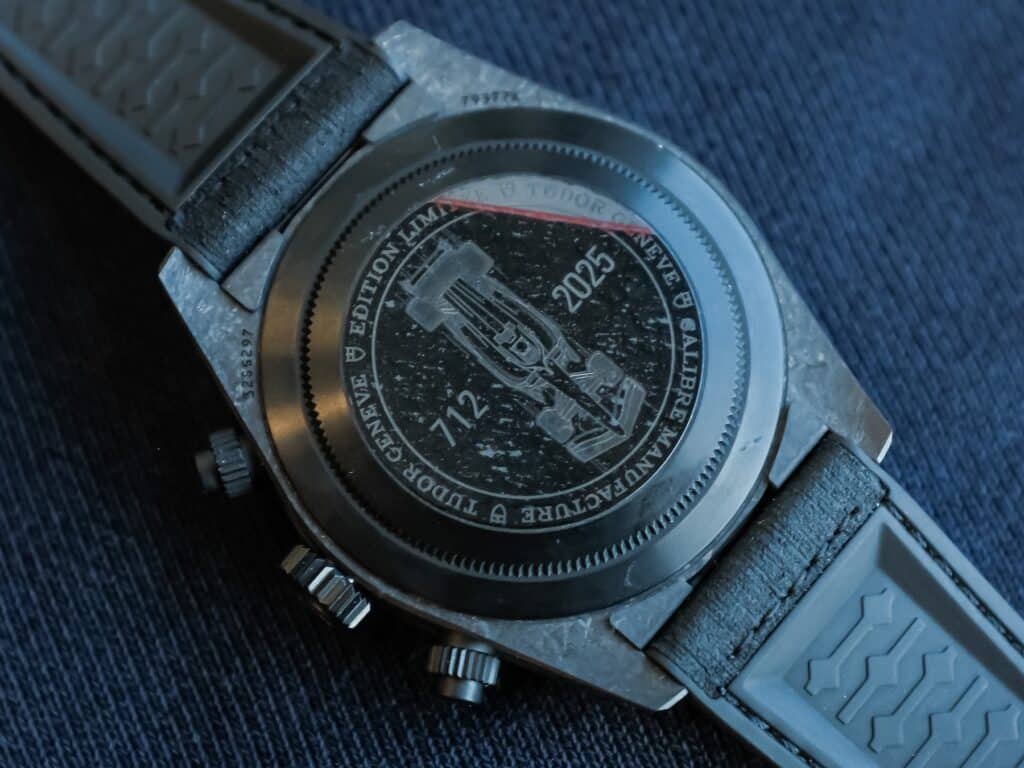
Tudor introduced the Black Bay Chrono “Carbon 25” around the 2025 Miami Grand Prix, drawing on its partnership with the Visa Cash App Racing Bulls Formula 1 team. The connection is fairly obvious once you see the watch. There’s a forged carbon case, a white dial with black registers, and blue accents that carry through to the strap. Tudor also limited production to 2,025 pieces, giving the release a direct connection to the racing season.
I’ve never been particularly drawn to collaborative watches, especially when a racing team or other commercial partnership becomes the main attraction. I tend to lose interest pretty quickly when the branding starts doing most of the work. The Carbon 25 initially gave me that impression, and I wasn’t particularly excited about the prospect of wearing one.

My expectations were also colored by my experience with the standard Black Bay Chrono. I’ve tried that watch on several occasions, and its proportions have always been difficult for me to get along with. So when I saw that Tudor had made a 42mm version in carbon, I figured I already had a pretty good idea of how things would go. I was wrong about a few things.
Forged Carbon Makes a Difference
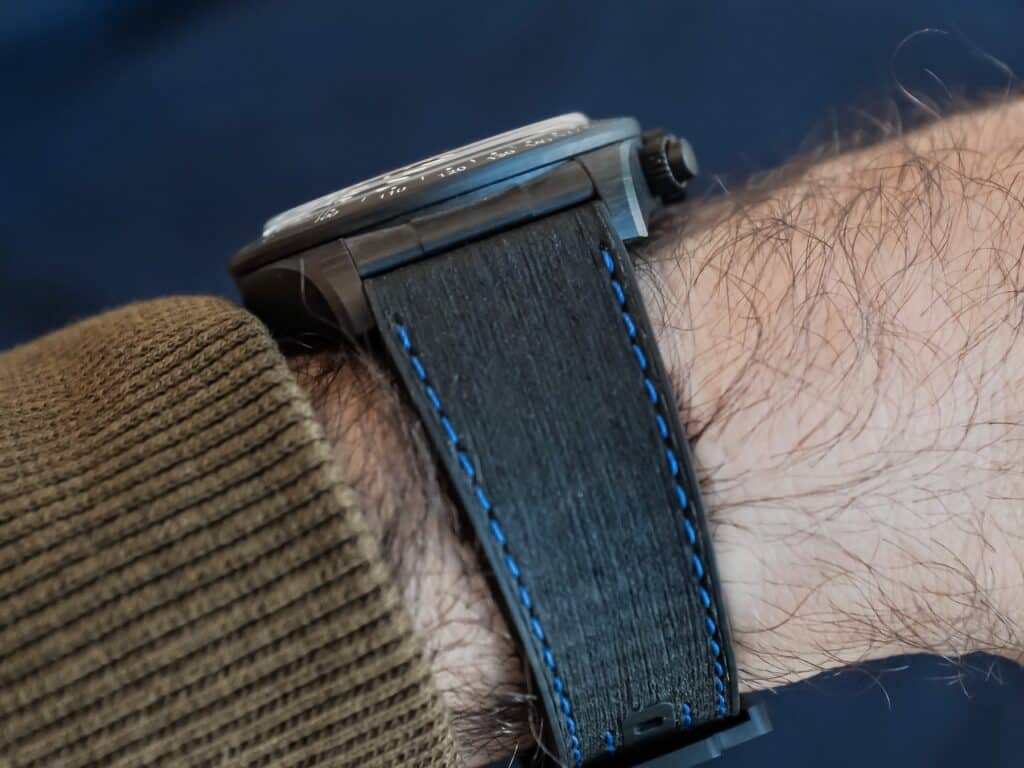
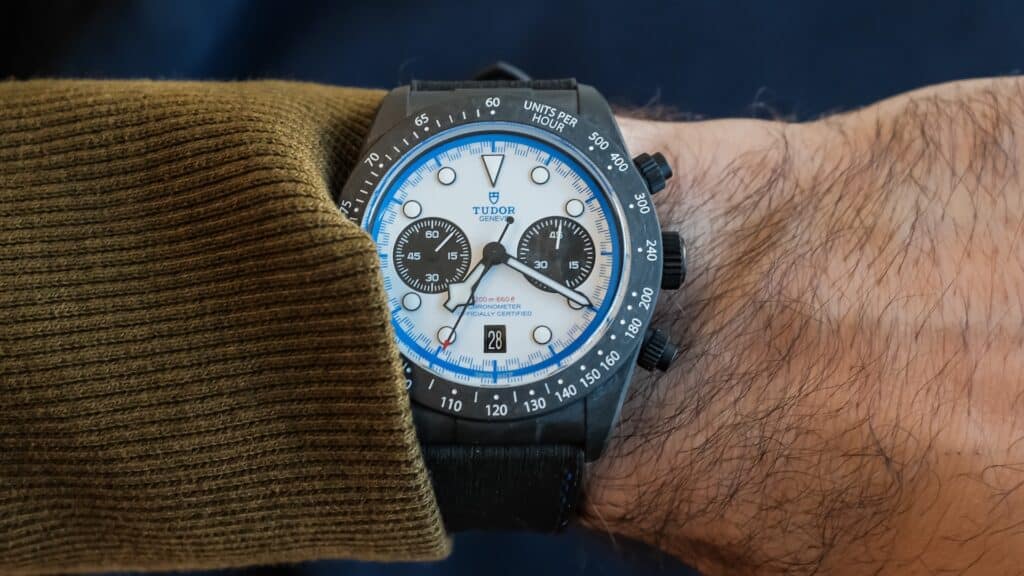
The Carbon 25 measures 42mm across and 14.3mm thick, so there’s still a considerable amount of watch here. The main case and fixed tachymeter bezel are made from forged carbon, with black PVD-treated titanium used for the crown, chronograph pushers, and screw-down caseback. Tudor also fits a double-domed sapphire crystal and maintains the 200 meters of water resistance found in the regular Black Bay Chrono.
My biggest complaint about the steel Black Bay Chrono has always been how cumbersome it feels on my 6.75-inch wrist. I can generally tolerate a larger watch, but the combination of thickness and weight has made that particular model difficult for me to enjoy. I’ve never felt especially comfortable wearing it.
The Carbon 25 was a different experience, largely because of how much lighter it felt. I noticed the reduction in weight almost immediately, and it made the watch considerably more comfortable than I expected. There’s still some visual bulk, and the 14.3mm case height is something I remained aware of while wearing it. But the weight reduction addressed more of my original complaint than I would have guessed.
I also liked the way Tudor handled the forged carbon itself. The material can sometimes look a little chaotic, with large, irregular patterns that draw attention to every surface. Here, the case has a finer, more consistent appearance. Depending on the lighting, I could almost mistake parts of it for ceramic. There’s enough texture to keep things interesting, although I wouldn’t have minded seeing a little more variation in the carbon.
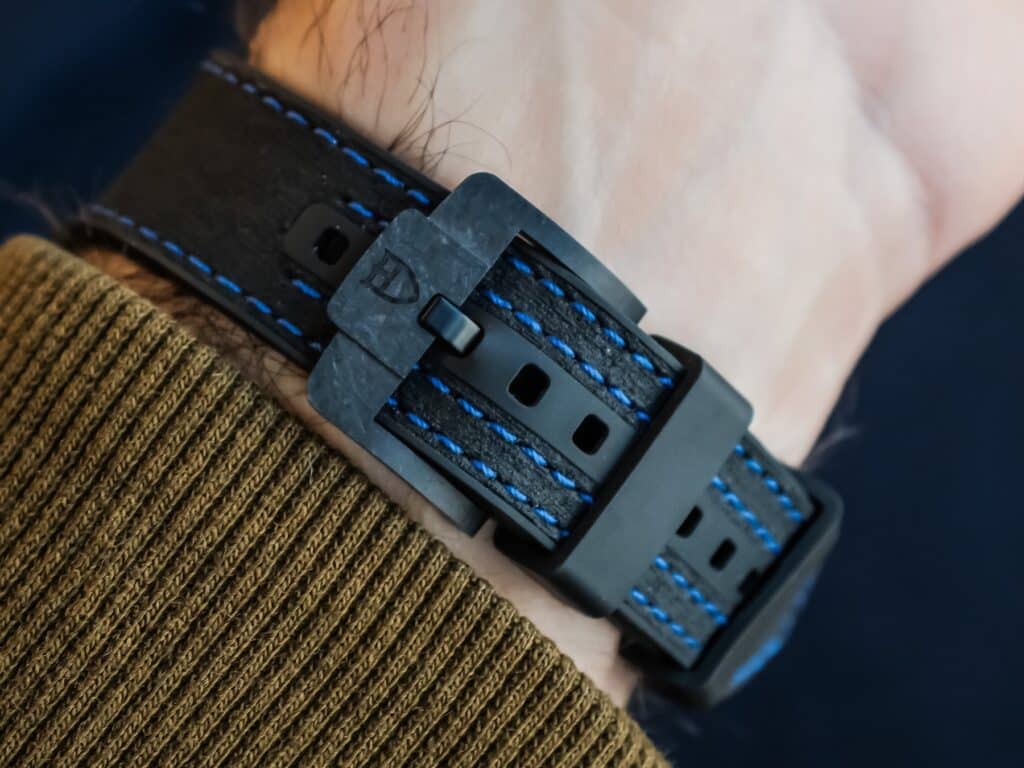
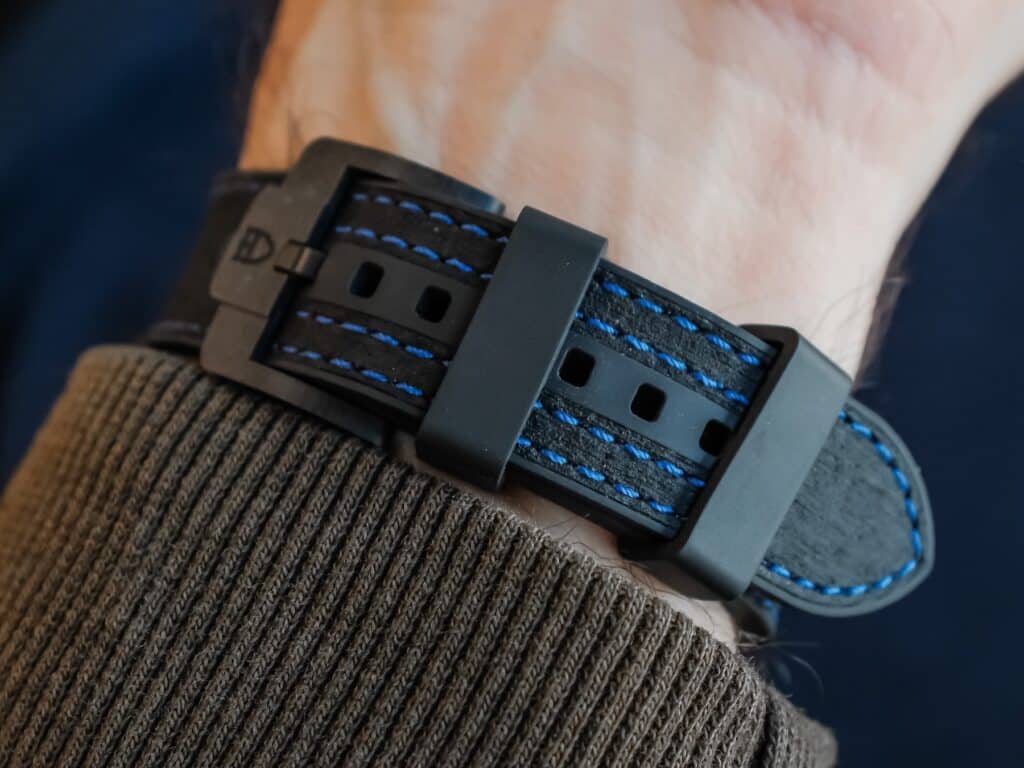
The strap was another pleasant surprise. Tudor uses a leather and rubber hybrid with blue stitching, fitted carbon end links, and a matching carbon tang buckle. It felt comfortable on my wrist and suited the case well. The end links and strap are also attached using separate spring bars, which gives you the option of removing the end links independently. I appreciate that Tudor left some flexibility in the setup, even though I was happy with the way the supplied configuration looked and wore.
The Dial Was Better Than I Expected
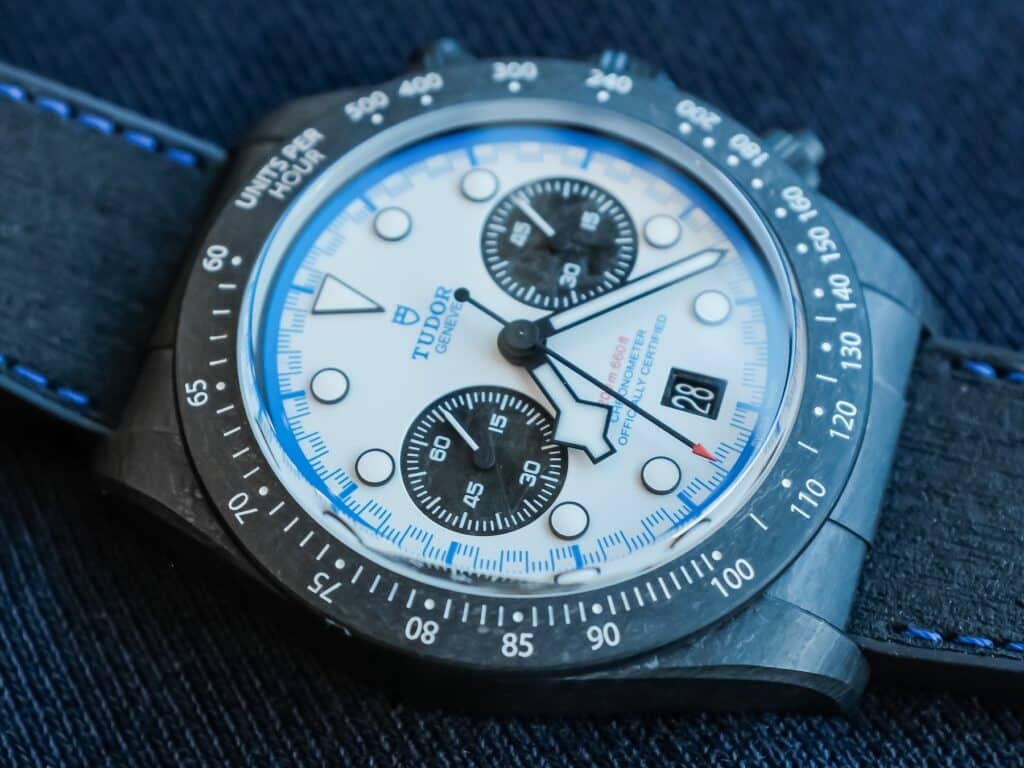
Looking at the Carbon 25 in Tudor’s photographs, I thought the white, black, and blue combination might be a little much. The blue appeared especially prominent, and I wasn’t sure how well the racing colors would translate to something I’d actually want to wear. In person, I liked the dial considerably more.
The white surface has a slight opaline finish that changes with the light. Sometimes it appears almost silver, while direct sunlight brings out a much cleaner white. It’s a fairly simple effect, but I enjoyed seeing how the dial changed throughout the day. The applied luminous markers also become particularly noticeable when moving indoors after spending time outside.
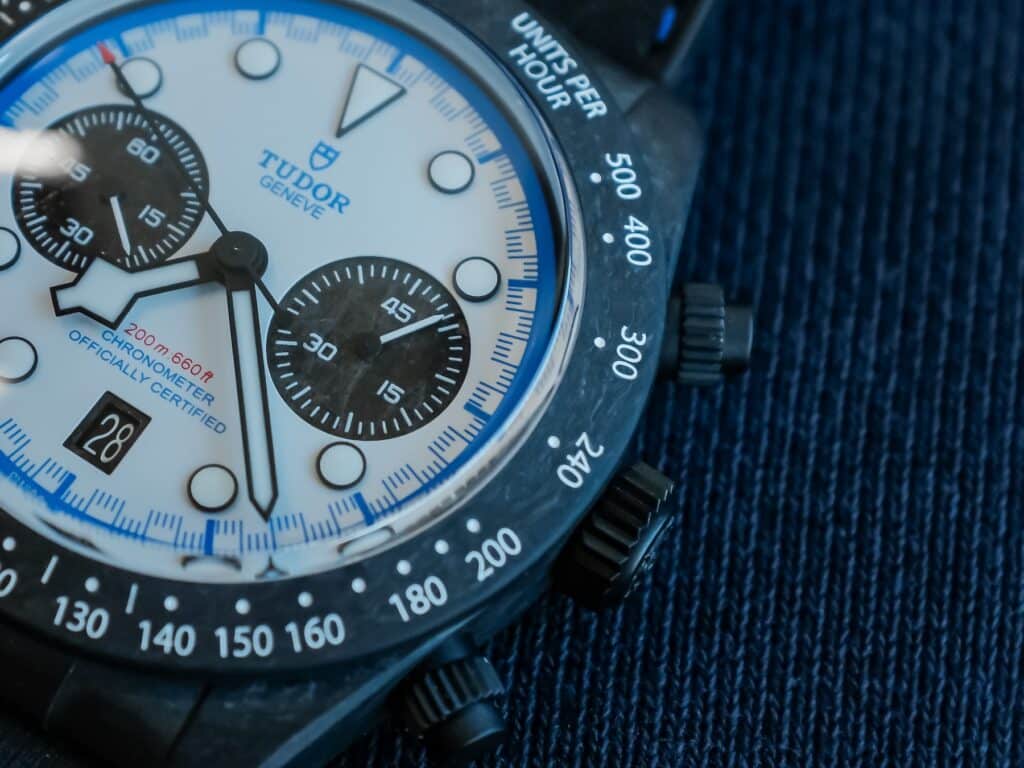
The black sub-dials use forged carbon, and the texture is more pronounced here than on the case. I found myself looking at those registers quite a bit, since the irregular pattern gives them some depth against the relatively smooth white background. Tudor even uses a carbon frame around the date window, which helps the smaller details feel consistent with the rest of the design.

The blue accents were probably my favorite surprise. The color is bright enough to give the dial some personality, although Tudor has kept its use fairly limited. I liked the way it appeared in the logo and dial markings, particularly alongside the darker registers. The matching stitching on the strap also makes more sense once the watch is on the wrist.
I still wouldn’t call this a subtle watch in the traditional sense. The racing connection is there, and the color combination is fairly distinctive. But I found the overall appearance much easier to enjoy than I had expected from the original images.
What’s Up With the MT5813?
The Carbon 25 uses Tudor’s MT5813 automatic chronograph caliber, which is based on the Breitling B01. It features a column-wheel chronograph mechanism, runs at 28,800 vibrations per hour, and provides approximately 70 hours of power reserve. The movement is COSC-certified and includes a 45-minute chronograph counter, running seconds, and a date complication.

I’ve written before about my experiences with movement problems in two Tudor watches I owned, so I tend to approach this subject with a certain amount of caution. I also find the MT5813 interesting because of its relationship to the Breitling B01, especially given how much attention the industry places on movement development and manufacturing arrangements.
During my time with the Carbon 25, the chronograph was genuinely enjoyable to operate. The pushers had a precise, satisfying action, and I liked the feel of starting, stopping, and resetting the mechanism. That tactile experience is a fairly big part of what draws me to mechanical chronographs in the first place.
The 70-hour power reserve is also a practical specification for an automatic chronograph, particularly if the watch spends a couple of days off the wrist. As for reliability, I can only speak to my experience with the sample. I’ve learned enough from previous ownership to reserve judgment on how a movement performs over the longer term.
Wrapping Things Up
I enjoyed the Carbon 25 more than I thought I would. Most of that comes down to the case construction and the way it wears. The reduced weight made a substantial difference on my wrist, and it helped me appreciate a chronograph design I’ve generally struggled with in steel. The dial also looked better in person, particularly the blue accents and the variation in the white finish.
I still have some reservations about the overall package. At 14.3mm thick, it’s a fairly substantial watch, even with the lighter case. The Formula 1 partnership doesn’t hold much personal appeal for me either, and I don’t see myself spending $7,575 on this particular version of the Black Bay Chrono at its time of release. Those preferences were there when I first saw the watch, and spending time with it didn’t change them entirely.

I can appreciate the Carbon 25 on its own terms, though. The strap was comfortable, the chronograph pushers felt excellent, and the carbon construction made a practical difference that I could actually feel. I also found the design considerably more restrained in person than Tudor’s photographs had led me to expect.
My relationship with Tudor is still a complicated one, and I doubt a single review sample was ever going to change that. But I’m glad I finally had the opportunity to spend time with one of the brand’s chronographs. The Carbon 25 gave me a better impression of the Black Bay Chrono platform than I’ve had in the past, even if this particular model remains outside my personal taste.
I want to thank Feldmar Watch Company for making this hands-on look possible. If you’re local or passing through, check out their awesome brick-and-mortar showroom in Los Angeles, California, or shop their online website here.

Co-Founder & Senior Editor
Michael Peñate is an American writer, photographer, and podcaster based in Seattle, Washington. His work typically focuses on the passage of time and the tools we use to connect with that very journey. From aviation to music and travel, his interests span a multitude of disciplines that often intersect with the world of watches – and the obsessive culture behind collecting them.