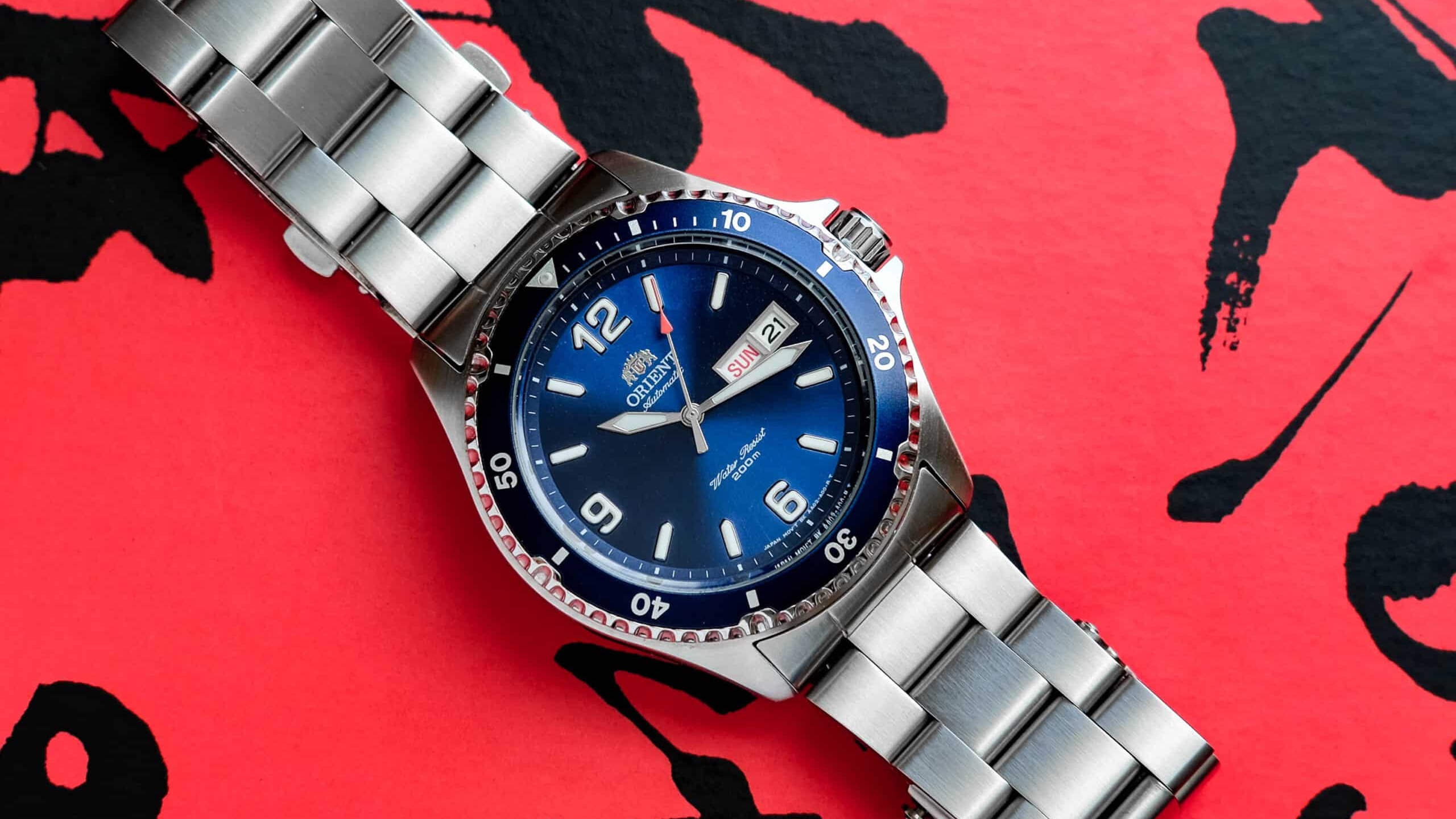
The Casio Duro and Orient Mako II occupy two very different ends of the affordable dive watch market, despite offering many of the same basic features. Both have stainless steel cases, rotating dive bezels, 200 meters of water resistance, and recognizable designs that wouldn’t look particularly out of place alongside considerably more expensive divers. Yet the Duro can be purchased for around $70, while the Mako II costs closer to $220. That’s a significant difference at this end of the market, especially when the cheaper watch has a more accurate movement and offers much of the same everyday functionality. So what exactly are we getting for the extra money?
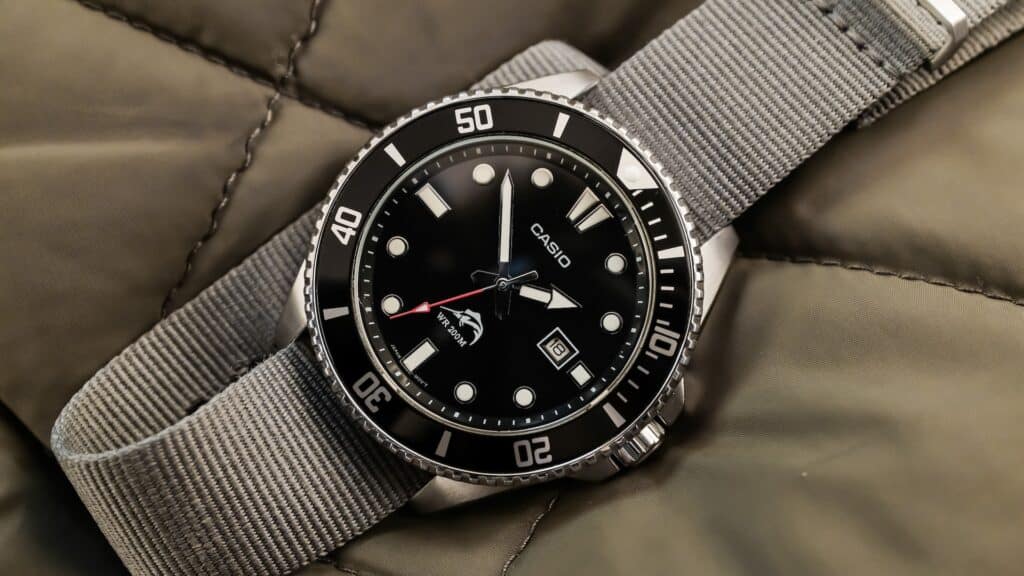
We’ve covered both watches extensively at TBWS, including our hands-on reviews of the blue-dial Orient Mako II FAA02002D9 and Casio Duro MDV106. What makes these watches interesting isn’t simply the familiar quartz-versus-automatic debate. The Orient has some genuinely impressive details in its dial, bracelet, and case construction, while the Casio manages to get certain things right that we’d normally expect from watches costing several times as much. The Mako II is clearly the more elaborate of the two, but whether those improvements make it worth buying over the Duro is a different question entirely.
Overview and Identity
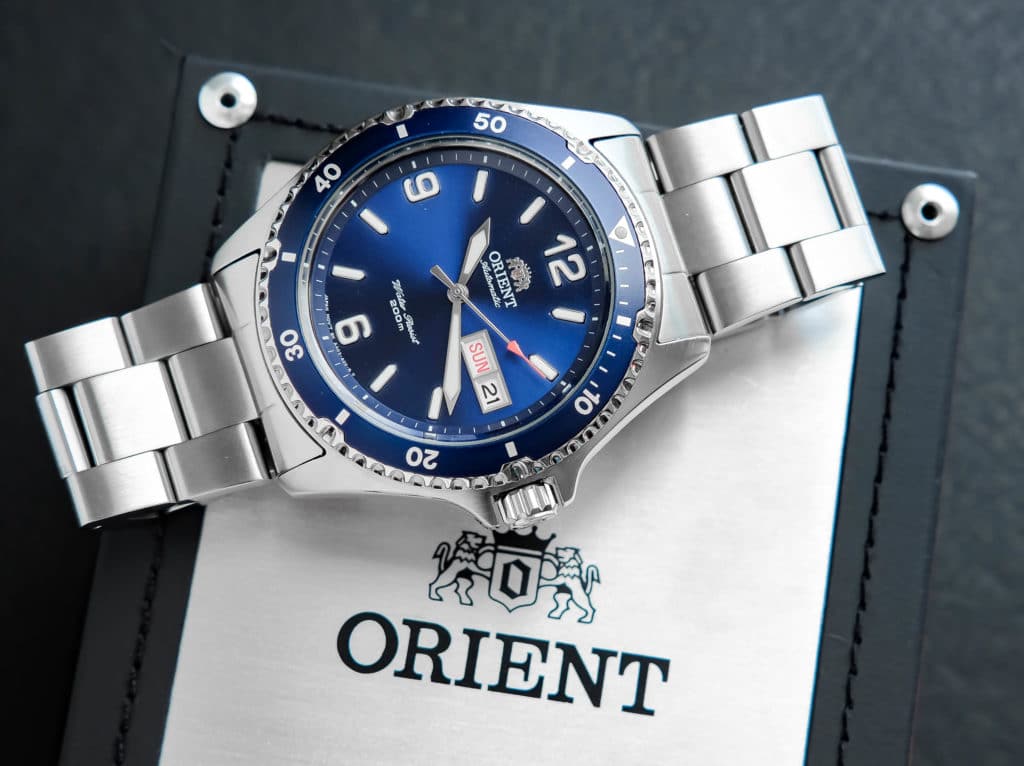
The Orient Mako has been a favorite among affordable automatic watch enthusiasts since the original model appeared in 2004. However, that first generation wasn’t without its frustrations. Its older 46943 movement lacked hacking and manual winding, and the separate button at two o’clock for adjusting the day was both a practical inconvenience and one of the watch’s more recognizable design quirks. The second-generation Mako addressed those issues with the F6922 caliber, integrating the calendar controls into the crown and introducing several other improvements. As we discussed in our original Orient Mako II review, the result was a watch that retained much of the original’s personality while becoming considerably easier to recommend to someone buying their first automatic diver.
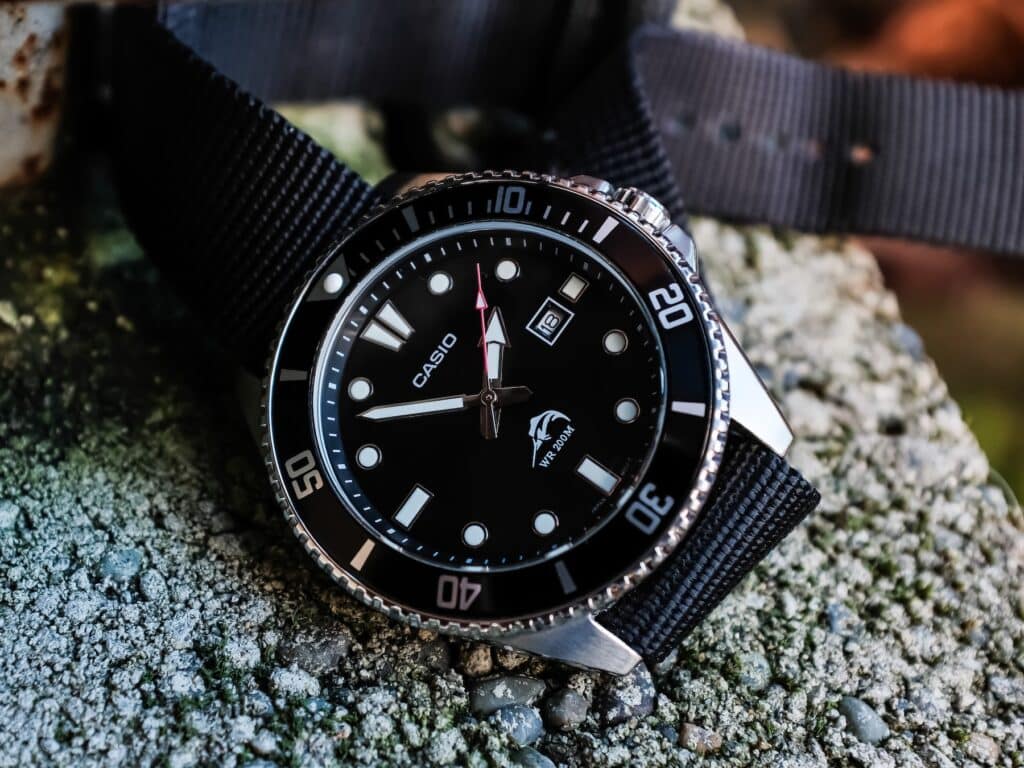
Casio’s Duro has a different relationship with collectors. The MDV106 doesn’t have an especially complicated history, and its quartz movement isn’t likely to inspire the same enthusiasm as an in-house mechanical caliber. Yet it’s developed a remarkably devoted following, including an entire community of owners who appreciate the watch for exactly what it is. In our Casio Duro review, we explored why such an inexpensive watch continues to attract enthusiasts who already own more expensive alternatives. The answer had less to do with specifications than with how naturally the Duro fits into everyday collecting. It’s the kind of watch that doesn’t demand much from its owner, and there’s something appealing about that simplicity.
Dial and Straps/Bracelets
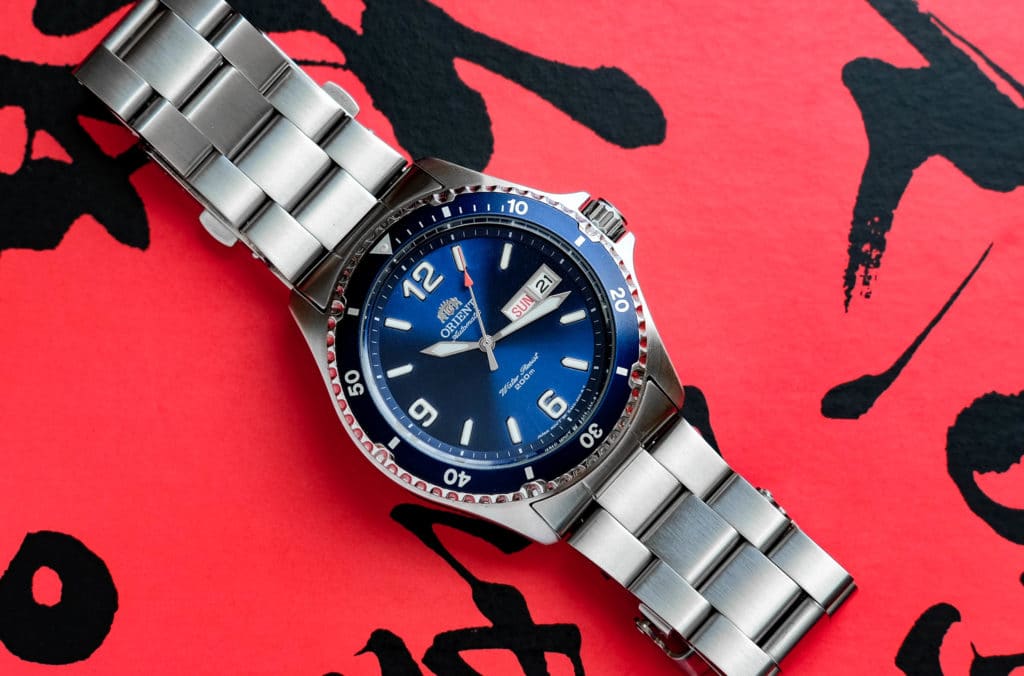
One of the Mako II’s strongest features is its blue sunburst dial, which has considerably more visual depth than we might expect from an automatic diver in this price range. The finish changes character as light moves across its surface, with deeper blue tones providing contrast against the polished surrounds of the applied hour markers. There’s also a raised, beveled chapter ring with clearly defined minute and seconds markings, adding another layer of detail around the dial’s perimeter. Orient carries that polished treatment into the sword-shaped hour and minute hands, the framed day-date window, and the applied logo. The red-tipped seconds hand is a particularly nice touch, introducing a small amount of color without overwhelming what is otherwise a fairly traditional design. It’s one of those dials where the individual elements become more enjoyable the longer we look at them.
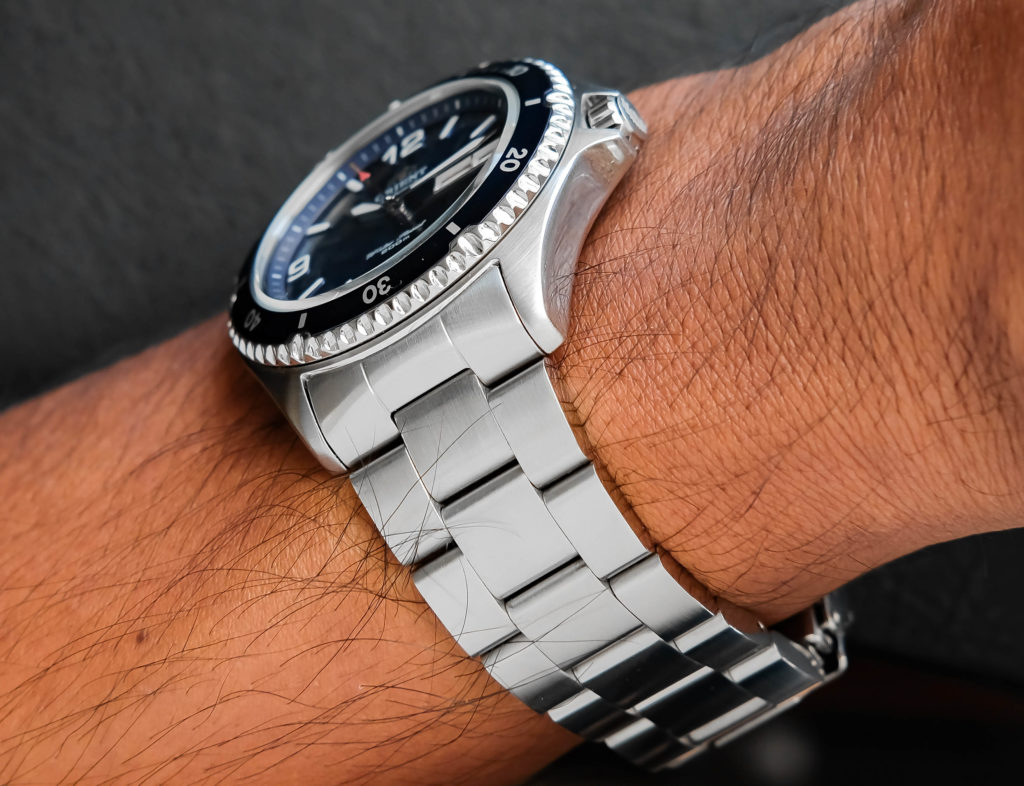
The Mako II’s bracelet also deserves more attention than inexpensive automatic bracelets typically receive. Its Oyster-style links feature brushed upper surfaces and polished sides that complement the finishing of the case, but the way the end links meet the lugs is particularly well executed. The result is a bracelet that feels visually integrated rather than something Orient simply attached to complete the package. The hollow end links reveal where the manufacturer saved money, especially when they’re removed and handled individually, although they don’t significantly compromise the wearing experience. There’s also a double-locking push-button clasp with micro-adjustments, a neatly stamped Orient logo, and a sandblasted inner folding joint. We appreciated that last detail in the original review because it suggests Orient gave some thought to parts of the bracelet most owners will rarely notice. Those little decisions add up.
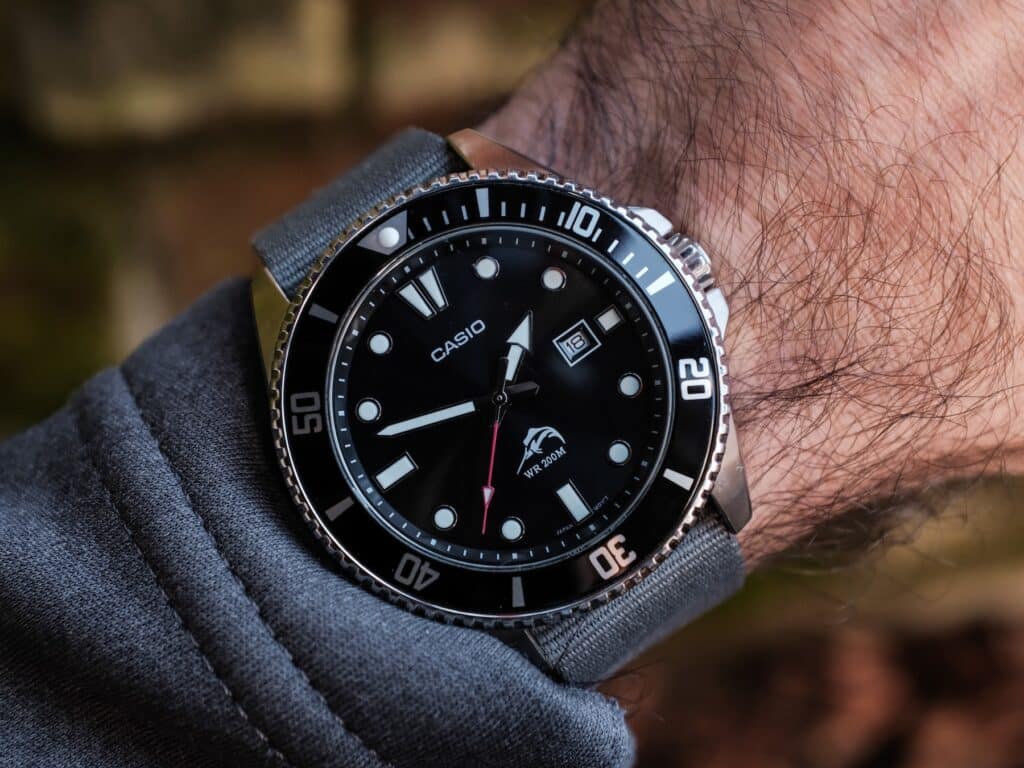
The Duro’s dial is less elaborate, but calling it basic would overlook some worthwhile details. Its black background provides strong contrast against large applied hour markers and arrow-shaped hands, with faceted, polished surfaces that reflect light more effectively than their price might suggest. The framed date window at three o’clock is another example of Casio paying attention to a detail that’s sometimes neglected on more expensive watches. We also examined the seconds-hand alignment, an issue that can become particularly noticeable on quartz watches because the hand advances in individual steps. Our example wasn’t perfectly aligned at every marker, but it performed well enough that the variation didn’t detract significantly from the experience. Then there’s the marlin emblem above six o’clock, a small detail that has become closely associated with the MDV106 and isn’t present on every international Duro variant. It’s easy to understand why collectors have developed an attachment to it.
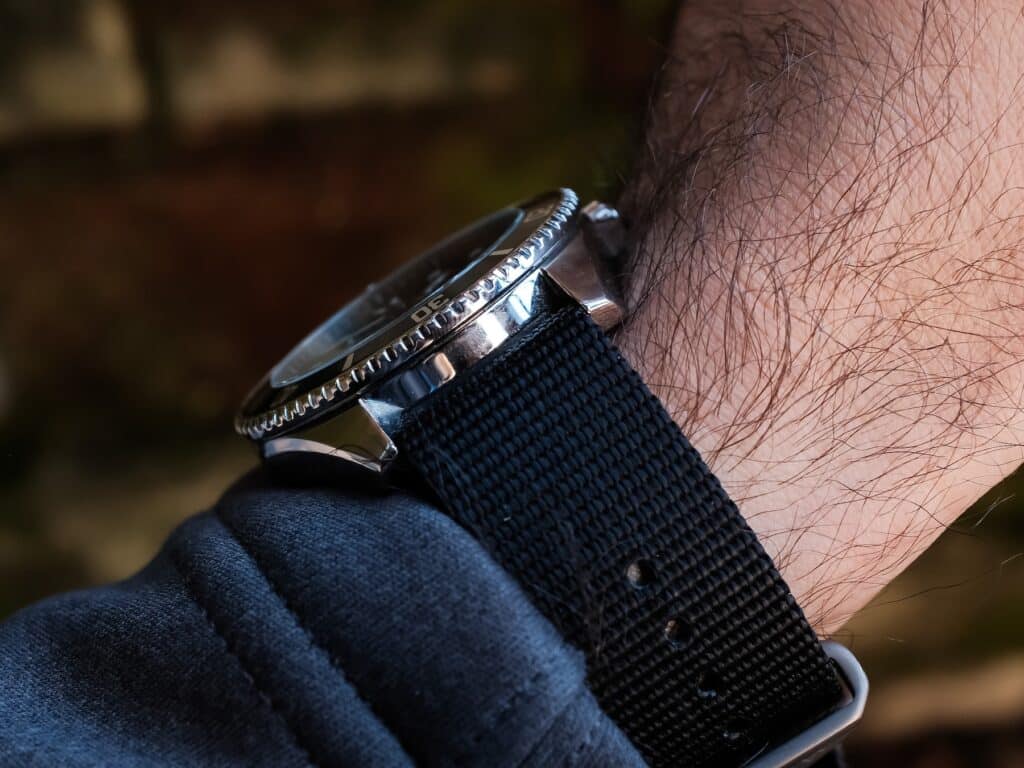
The standard Duro comes on a resin strap, although our review example was worn exclusively with aftermarket options from Toxic NATOs and Prometheus Design Werx. The 22mm lug width gives owners plenty of flexibility, and the case proportions work particularly well with the more utilitarian character of a nylon strap. There’s also a substantial aftermarket for stainless steel bracelets, although we’d be careful about investing too much in accessories when the watch’s greatest advantage is its low initial cost. This is where the Orient provides something meaningful for the additional money. Its factory bracelet is already a good match for the case, complete with finishing and clasp details that help the watch feel more cohesive. The Duro is better suited to someone who enjoys experimenting with different straps, while the Mako II feels like a watch that doesn’t need much attention once it comes out of the box.
Build Quality & Technical Approach
Although both watches follow the familiar formula of an affordable Japanese diver, the differences become more interesting when we examine how their components actually work. Orient has invested in mechanical development and a more elaborate presentation, while Casio has concentrated on straightforward functionality. Neither approach guarantees a better result across every category, particularly when some of the simplest features can have an outsized effect on how much we enjoy wearing a watch.
Movements
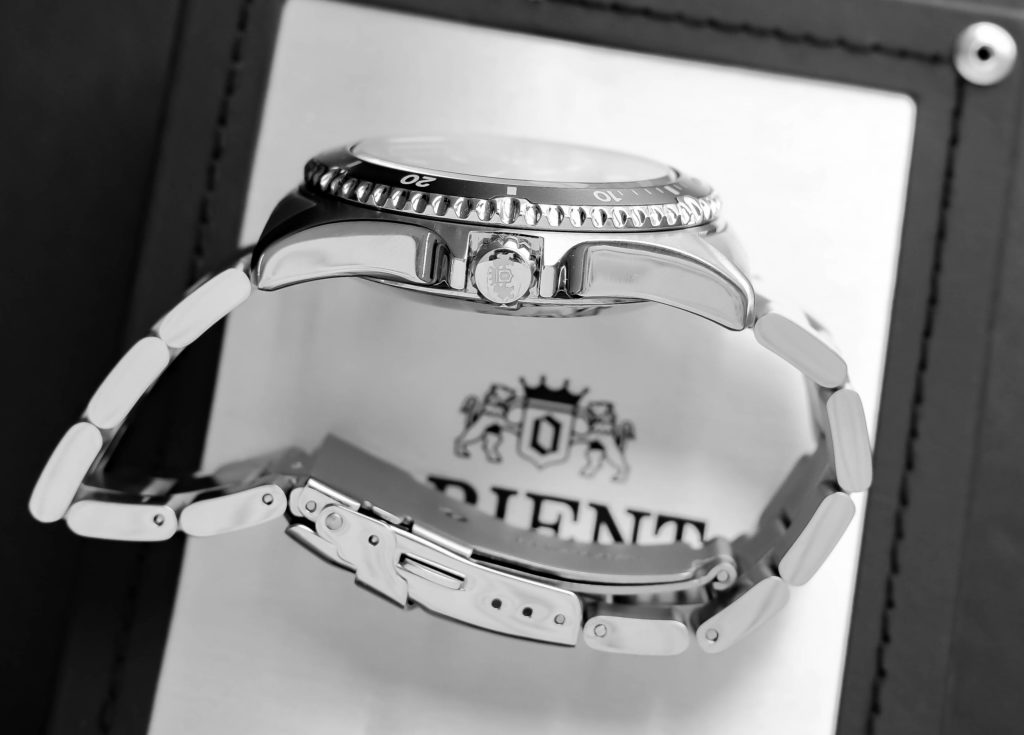
The Mako II’s F6922 automatic caliber is arguably the most important improvement Orient made to the collection. Operating at 21,600 vibrations per hour with 22 jewels and approximately 40 hours of power reserve, it replaced the aging 46943 movement that had powered the original Mako. That older caliber traced its development to technology licensed from Seiko’s 7006 movement, with Orient modifying the design to accommodate a day complication operated through a separate case-mounted button. The F6922 eliminates that arrangement, incorporating the day-date adjustments into the crown while adding hacking seconds and manual winding. We particularly appreciated the winding mechanism during our original review, noting that it had a distinct mechanical resistance rather than the extremely smooth feel found in some competing calibers. It’s a small detail, but one that makes interacting with the watch more memorable.
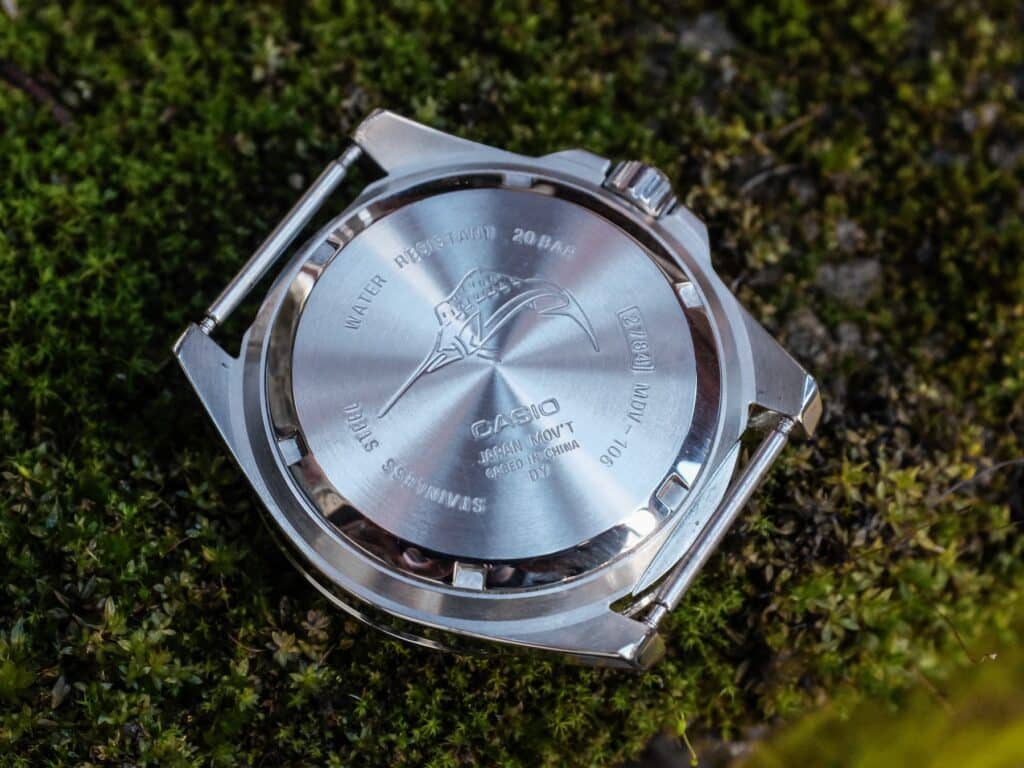
The Casio Duro’s 2784 quartz movement offers a different set of advantages. Rated to approximately ±20 seconds per month, it includes hacking seconds, a quickset date, and an estimated battery life of around three years. It doesn’t have the visual appeal of a sweeping seconds hand or the mechanical interaction that makes the Orient interesting, but that’s not necessarily a weakness. Our experience with the Duro reinforced how its uncomplicated operation encourages regular wear. There was little need to think about setting the watch, maintaining a power reserve, or making adjustments after leaving it unworn for several days. That sort of convenience becomes more valuable as a collection grows, especially when several mechanical watches are competing for wrist time.
What makes the movement comparison especially interesting is that the F6922 addresses many of the inconveniences associated with earlier affordable automatics without eliminating the fundamental advantages of quartz. The Mako II can now be wound through its crown instead of relying entirely on wrist movement to restart it, and the integrated calendar adjustment is considerably more straightforward than the original Mako’s separate day button. We can appreciate those improvements while also recognizing that the Duro will generally keep more accurate time with far less attention. There’s even a small part of us that misses the quirky button on the older Orient, despite agreeing that removing it was the sensible decision. That’s the sort of contradiction that makes collecting mechanical watches interesting. Convenience isn’t always the only thing we’re looking for.
Case Construction, Finishing & Wearability
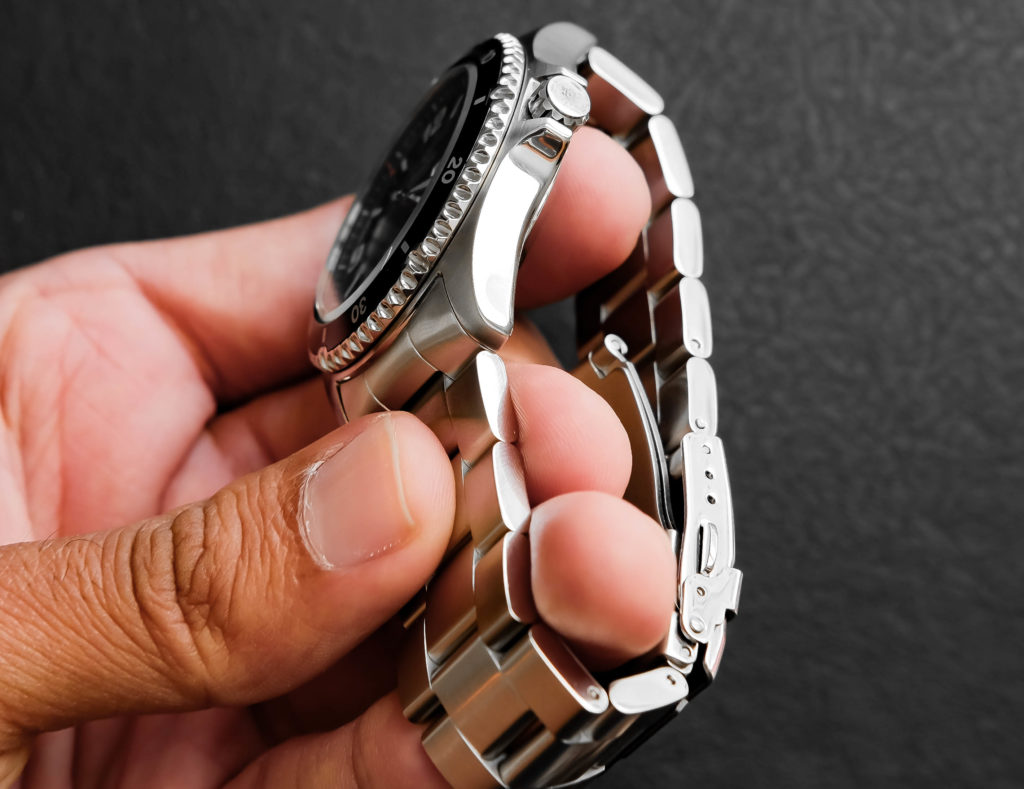
The Orient Mako II measures 41.5mm in diameter, approximately 47mm lug to lug, and 13mm thick, giving it proportions that feel comfortably traditional for a modern diver. However, the case finishing is what makes a stronger impression. Orient combines highly polished sides with matte-brushed lug surfaces, but instead of creating a harsh, sharply defined boundary between the finishes, the transition happens more gradually. It’s a detail we specifically appreciated in the original review because it gives the case a more considered appearance without relying on elaborate geometry. The bracelet also connects naturally with the lugs, reinforcing the impression that the case and bracelet were designed as a complete unit. The Mako II isn’t especially thin, but its relatively short lug-to-lug distance and familiar case shape help make it an approachable everyday watch.
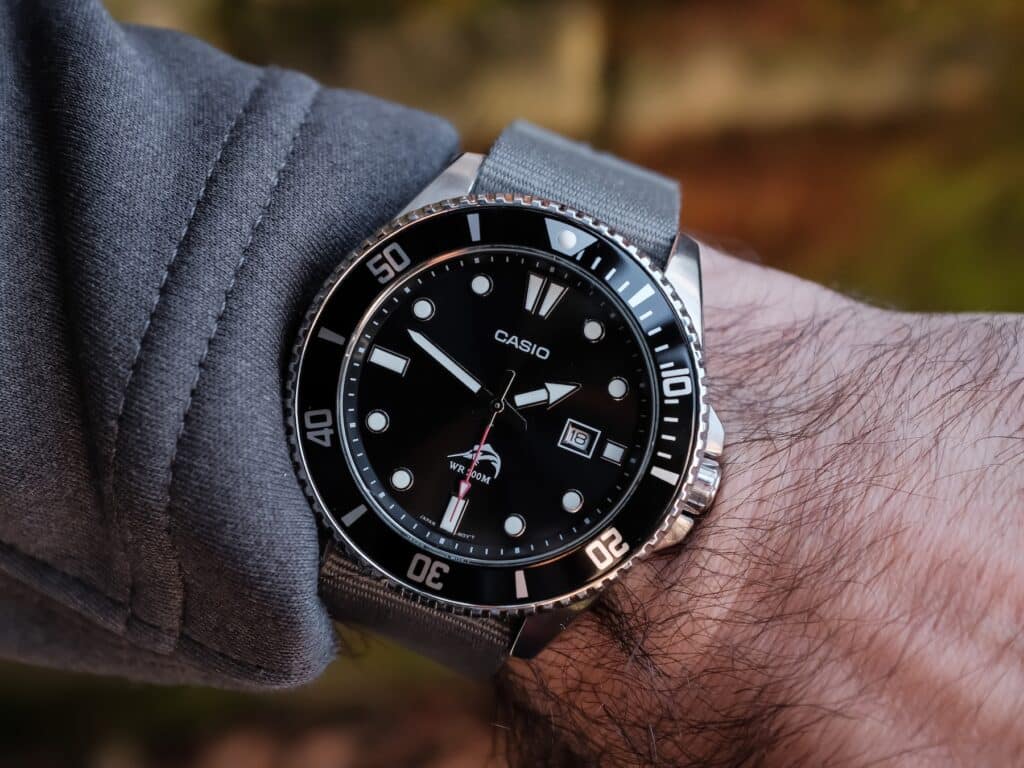
Casio’s Duro measures 44.2mm across, 48.5mm lug to lug, and 12.1mm thick, which makes it considerably wider than the Orient but slightly thinner. Those numbers suggest a much larger wearing experience, although the downward-curving lugs and relatively compact overall length help control its proportions. We initially had reservations about the size, particularly when comparing it with other larger divers we’ve worn, including the Seiko Turtle. Once on the wrist, however, the Duro felt more manageable than its diameter suggested, and the larger case eventually became part of what we appreciated about the design. Casio also uses a combination of brushed upper surfaces, polished sides, and subtle bevels along the lugs to give the case some definition. We still prefer the Orient’s more compact proportions and the way its bracelet integrates with the case, but the Duro doesn’t feel like an oversized watch that was designed without much consideration for comfort.
Crystals and Bezels
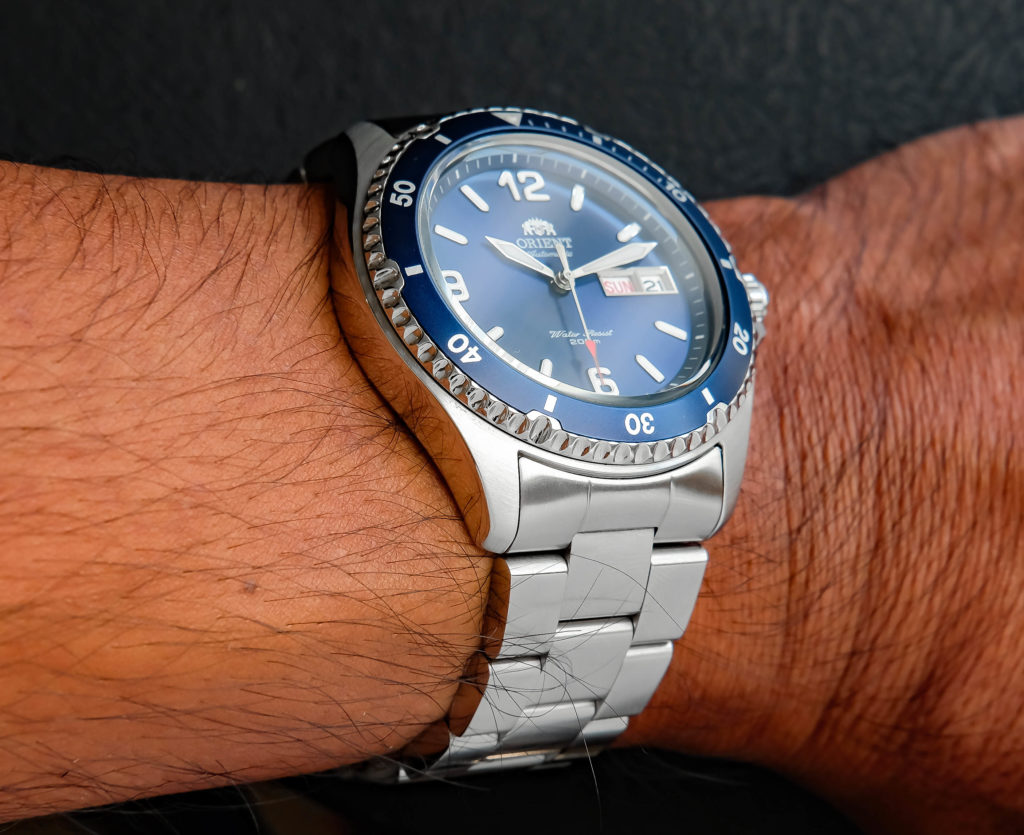
The Mako II FAA02002D9 uses a mineral crystal rather than sapphire, distinguishing it from certain other Mako configurations that offer the more scratch-resistant material. It’s an understandable compromise for an affordable diver, although we’d certainly appreciate sapphire at the Orient’s current price. The updated Mako also features a 120-click unidirectional bezel in place of the original generation’s 60-click arrangement. Unfortunately, the revised design introduced an issue that became apparent during our hands-on review. The highly polished coin edge slopes away from the fingers, making it difficult to establish a secure grip when trying to rotate the bezel. The underlying action feels solid and produces a satisfying click once it moves, but reaching that point can require more effort than we’d prefer. It’s a frustrating detail on a watch where so much of the surrounding construction has been carefully considered.
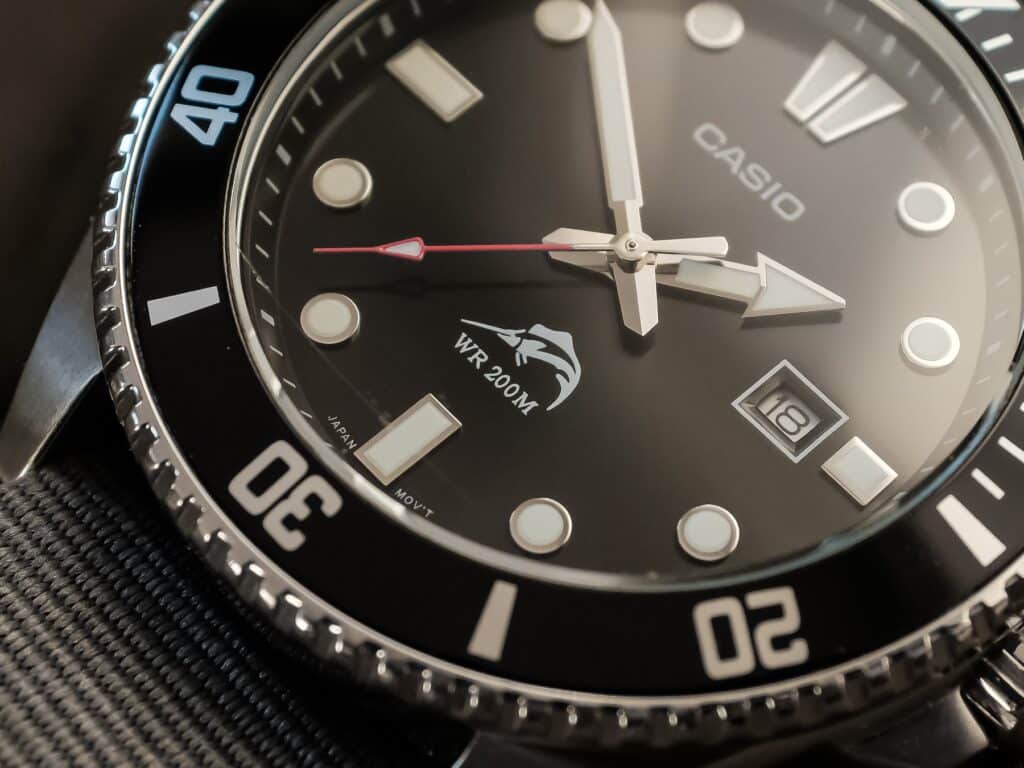
The Duro also features a flat mineral crystal and aluminum bezel insert, but its unidirectional bezel was one of the strongest parts of our review. The action felt firm and controlled, with tactile feedback that compared favorably with watches costing considerably more. Our particular example had already seen some wear, so it’s possible that the mechanism had become smoother through regular use, but the experience was impressive nonetheless. The gripping surface is also easier to operate than the sloping edge on the Mako II. This is one area where we’d give the Casio the advantage without much hesitation. It’s not necessarily better finished overall, but the bezel is a functional component, and we place a fair amount of value on how satisfying those interactions are. Spending three times as much shouldn’t automatically entitle the Orient to a win when Casio has executed that particular detail more convincingly.
Water Resistance & Lume
Both watches offer 200 meters of water resistance, supported by screw-down crowns and casebacks, so there isn’t a meaningful difference in their stated resistance to water. The Mako II’s luminous treatment is adequate for normal use, with material applied to its hands and hour markers, although our original review noted that competing Japanese divers could deliver stronger performance in this area. The watch’s legibility benefits from the contrast between its polished markers and deep blue dial, while the relatively restrained handset makes it easy to distinguish the hour and minute hands. We wouldn’t consider exceptional lume a reason to purchase the Orient, but its overall presentation remains effective in a variety of lighting conditions.
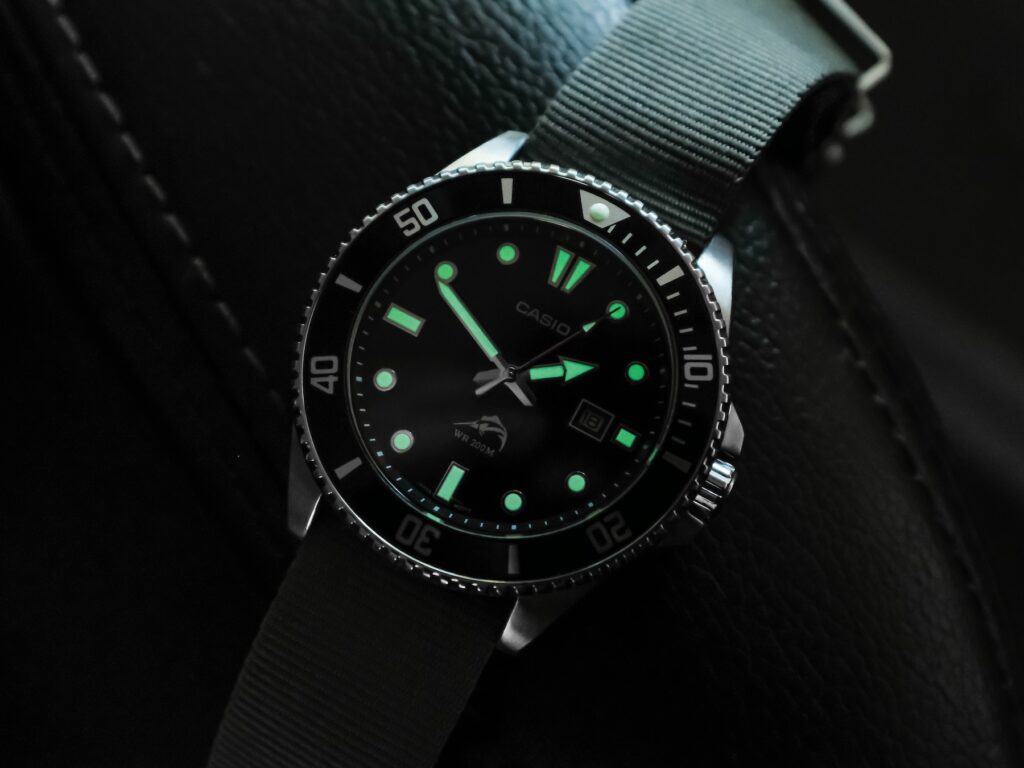
Casio takes a similarly straightforward approach with the Duro, using generously filled luminous markers and hands against a high-contrast black dial. The initial glow is useful, but its longevity leaves something to be desired, particularly if you’re accustomed to the stronger luminous performance found on certain Seiko divers. The Orient has a modest advantage here, although neither watch would be our first recommendation for someone prioritizing nighttime visibility. What stands out more is the fact that the Duro manages to match the Mako II’s stated water resistance while costing considerably less. Assuming the seals are properly maintained, both offer more than enough protection for swimming and ordinary recreational use. There’s very little practical justification for spending more on the Orient if water resistance is the primary concern.
Cost Considerations
The Casio Duro MDV106-1AV currently sells for approximately $70, while the blue-dial Orient Mako II FAA02002D9 is available for around $220. That’s a difference of roughly $150, putting the Orient at a little more than three times the Casio’s price. The $100 mark is an interesting dividing line for affordable dive watches. Below it, we’re generally looking for dependable timekeeping and enough durability to handle everyday wear. Move beyond that threshold, and we start expecting improvements that go beyond basic functionality, whether that’s an automatic movement, better finishing, or a more satisfying bracelet. The Duro already provides 200 meters of water resistance, a stainless steel case, and a rotating bezel that’s actually more enjoyable to operate than the Orient’s. On a purely functional level, it’s difficult to argue that the additional money is necessary.
However, the Mako II makes a better case for itself once we look beyond the basic specifications. Its blue sunburst dial offers considerably more visual interest, the smaller case proportions will suit a wider range of wrists, and the factory bracelet is finished well enough that we wouldn’t feel compelled to replace it. The polished and brushed surfaces also flow together naturally, something that becomes easier to appreciate when handling the watch rather than simply looking at photographs. There are plenty of inexpensive automatic divers with respectable movements but disappointing bracelets or poorly considered cases. Orient has done a good job ensuring that the Mako II doesn’t feel like a collection of unrelated components assembled around an affordable caliber. That cohesion is part of what we’re paying for.
The movement is another legitimate consideration, although we don’t think it should be treated as an automatic justification for the price difference. The F6922 is a meaningful improvement over the original Mako’s older caliber, and the addition of hacking and manual winding makes it considerably more enjoyable to live with. There’s also something satisfying about operating a mechanical movement, particularly one with a distinct winding feel and the sort of design history attached to the Mako collection. But the Duro’s quartz movement is more accurate, requires less attention, and is arguably better suited to someone who just wants an inexpensive, dependable sports watch. We enjoy mechanical watches, but we’re not going to pretend that complexity automatically makes them better at their primary job.
The Duro’s lower price also leaves room for experimentation. Owners can replace the stock resin strap with a NATO, rubber alternative, or aftermarket bracelet without necessarily approaching the cost of the Orient. That flexibility is appealing, particularly when the watch already has such a straightforward design. It also makes the Duro an easy addition to a collection that might otherwise be dominated by more expensive mechanical watches. There are compromises, of course. The case is large, the lume could be better, and the factory strap doesn’t offer the same complete experience as the Mako II’s bracelet. But the Casio doesn’t need to be perfect to make sense at this price. It just needs to be good enough that those shortcomings don’t interfere with why we wanted the watch in the first place.
Long-term ownership complicates the comparison a little further. The Duro will eventually need a battery replacement, while both watches require appropriate attention to their seals if their water resistance is to be maintained. The Mako II avoids batteries but introduces the potential for mechanical servicing, which may not always make economic sense relative to the cost of the watch itself. None of this would prevent us from buying either model, although it’s worth recognizing that an inexpensive automatic isn’t necessarily the least expensive watch to maintain indefinitely. For someone who enjoys the mechanical experience, that’s a reasonable compromise. But if we’re evaluating which watch delivers the strongest combination of functionality, convenience, and price, the Duro makes an exceptionally convincing argument. The Orient offers more character and a more cohesive design, but those qualities need to matter to the person paying for them.
Final Thoughts
The Orient Mako II remains one of the more appealing affordable automatic divers we’ve reviewed, particularly because its strongest qualities extend beyond the movement. The blue sunburst dial has genuine character, the case finishing is more thoughtful than the price might suggest, and the bracelet contributes to a surprisingly cohesive wearing experience. Its F6922 movement also represents a worthwhile improvement over the original Mako, even if removing the separate day-adjustment button sacrificed a little of the older model’s personality. We’d still prefer a bezel that’s easier to grip, and sapphire would be welcome, but neither issue changes our appreciation for what Orient has accomplished.
Casio’s Duro is impressive for a different set of reasons. It offers the same stated water resistance, an accurate quartz movement, and a bezel that feels better than we’d normally expect from such an inexpensive watch. Our hands-on experience also reinforced how well the case proportions work despite the relatively large 44.2mm diameter, particularly when paired with aftermarket straps. The dial isn’t especially elaborate, and the lume could certainly be improved, but the attention Casio paid to details like the applied markers, framed date window, and case finishing helps the watch avoid feeling like a disposable purchase. It’s easy to understand why the Duro has developed such a loyal following.
If we were specifically recommending a first automatic dive watch, we’d lean toward the Mako II. Its movement, bracelet, and more restrained proportions make it a compelling introduction to mechanical watch collecting, and there’s enough character in the design that it should remain enjoyable even as a collection grows. However, someone simply looking for an inexpensive diver to wear regularly, take on vacation, or keep around for activities where a more expensive watch might feel unnecessary would have little reason to overlook the Casio. The Duro doesn’t provide the same mechanical appeal, but it also doesn’t ask buyers to pay for something they may not particularly care about.
For overall value, we’d choose the Casio Duro. At approximately one-third the price of the Mako II, it delivers the same stated water resistance, better timekeeping accuracy, and a bezel we actually preferred using. The Orient is undoubtedly the more interesting watch for someone who appreciates mechanical movements and a more carefully finished design, but those advantages don’t necessarily translate into a better everyday diver. Spending more than $100 on a budget dive watch can absolutely make sense, particularly if the mechanical experience and additional finishing matter to you. But for anyone primarily concerned with getting the most functionality for their money, the Casio Duro proves that crossing that threshold isn’t necessary.

Co-Founder and Senior Editor
Kaz has been collecting watches since 2015, but he’s been fascinated by product design, the Collector’s psychology, and brand marketing his whole life. While sharing the same strong fondness for all things horologically-affordable as Mike (his TBWS partner in crime), Kaz’s collection niche is also focused on vintage Soviet watches as well as watches that feature a unique, but well-designed quirk or visual hook.