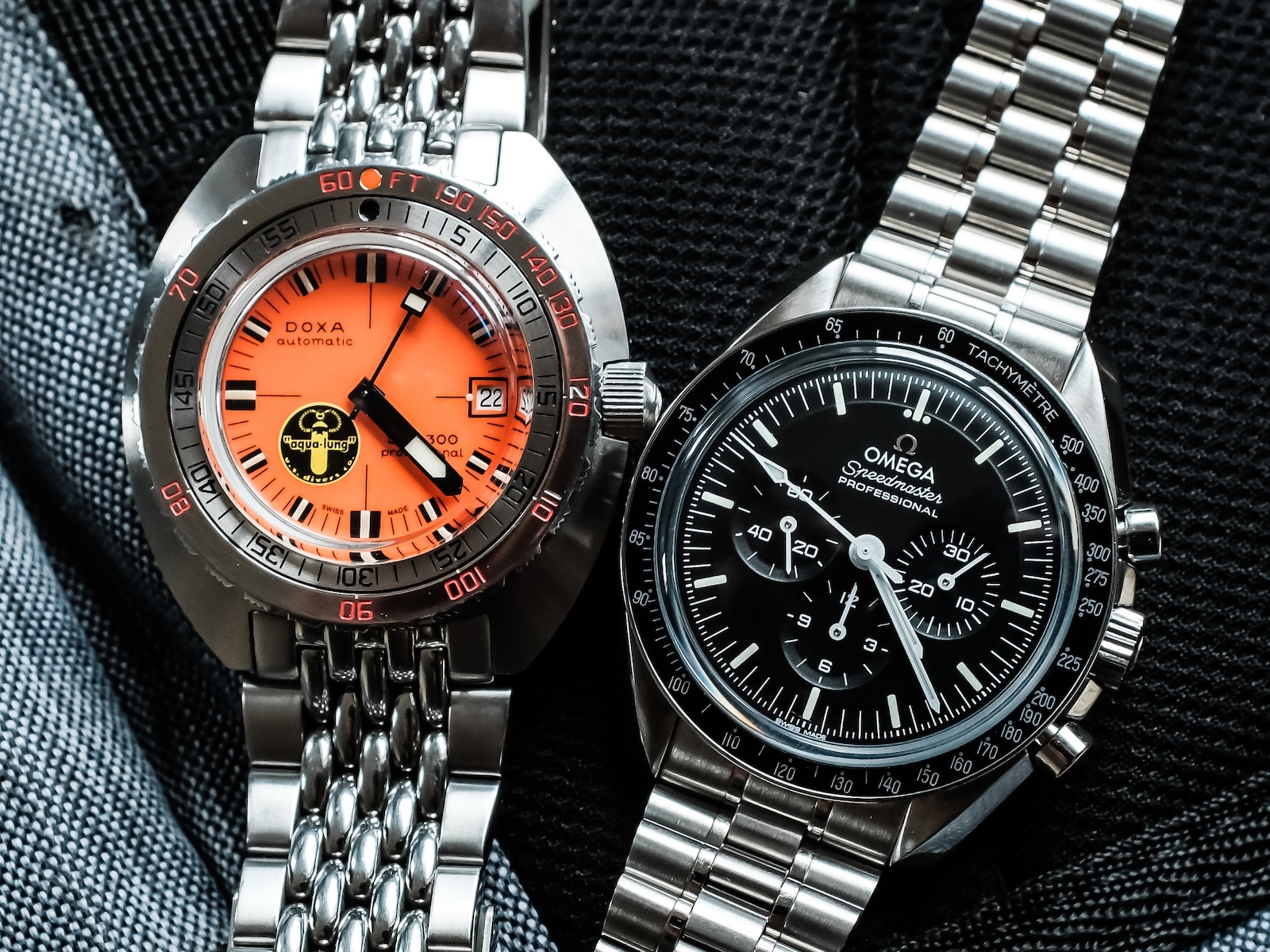
If you’ve spent any real time in this hobby, you’ve played the house-fire game. The place is burning, you can grab two watches on the way out, what do you take? It’s a fun thing to argue about on a podcast until you look down at your own rotation and realize you’ve been answering it for years without meaning to. After more than a decade of buying, flipping, regretting, and occasionally re-buying the exact thing I sold, the two watches that keep ending up on my wrist are an Omega Speedmaster 3861 and a Doxa Sub 300 Aqua Lung. A chronograph and a diver. I think that’s the whole answer, and I want to make the case for why.
The chronograph-and-diver pairing has been a default two-watch collection for as long as people have argued about this stuff, and it isn’t an accident of fashion. It comes down to coverage. One watch handles timing, precision, the moments you actually want to measure something. The other handles abuse, water, and the trips where you can’t be bothered to think about your watch at all. Between the two, there’s almost nothing a normal life throws at you that one of them can’t absorb. The trick is picking two pieces that mean enough to you that the house-fire question stops being hypothetical.
The Chronograph Half
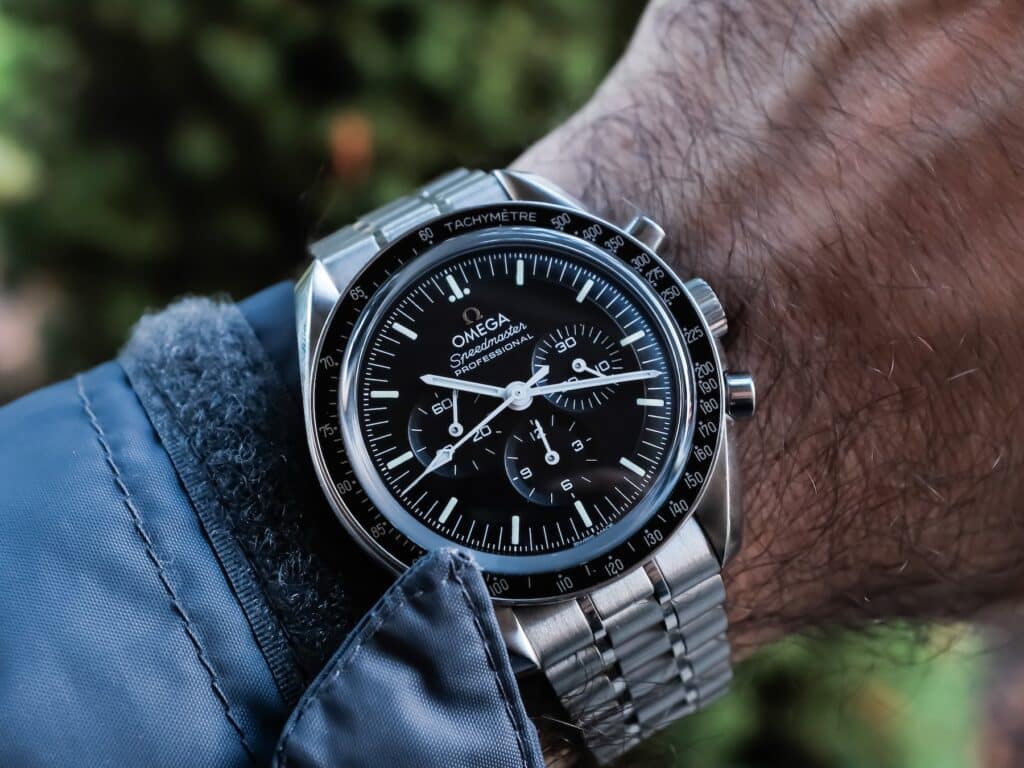
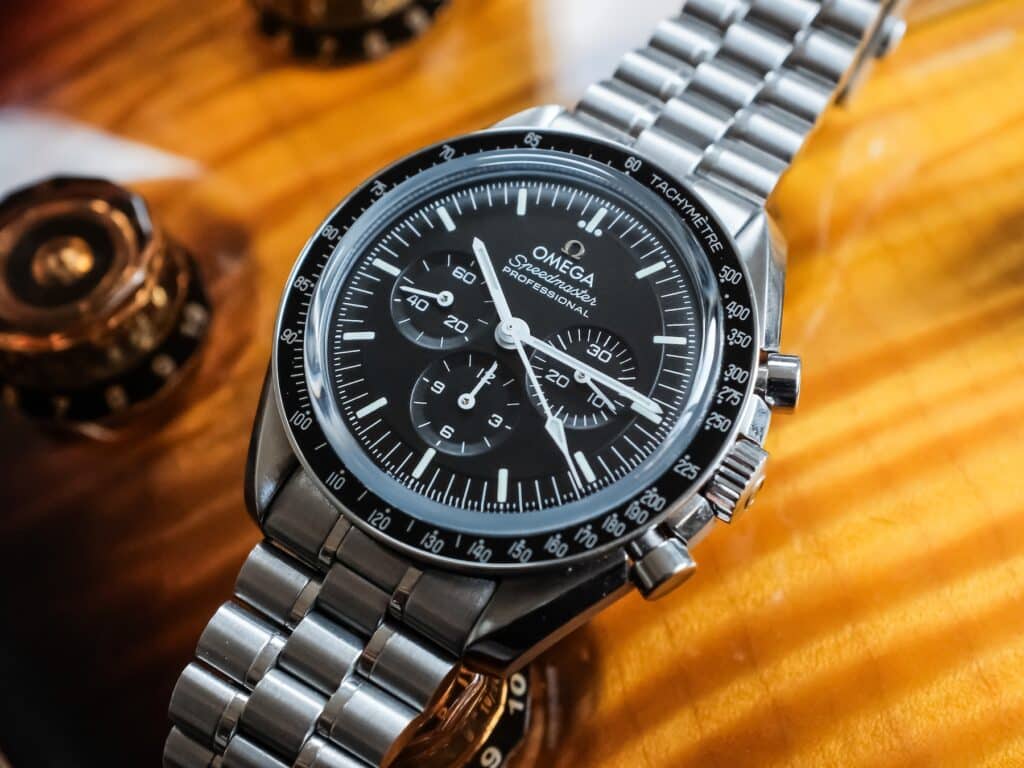
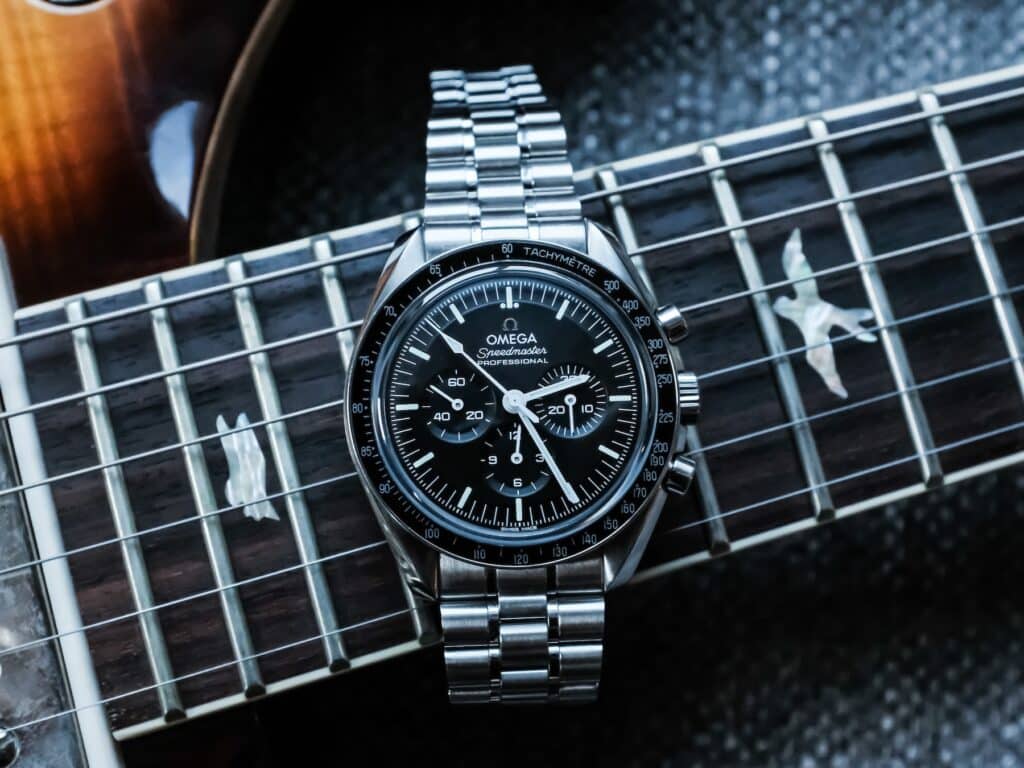
The Speedmaster is the watch I reach for when life has structure (kinda). It’s the timing tool, even if “timing” for me usually means dog walks and pasta water rather than anything that would make Buzz Aldrin proud. It’s almost funny wearing something engineered to survive magnetic fields strong enough to wipe your electronics and then using it to keep dinner from boiling over. But the watch leans dressier than its tool-watch reputation suggests, and that matters in a two-watch setup. It slips under a cuff. It carries you from a meeting to a dinner without looking out of place. When the day has edges, this is the one.
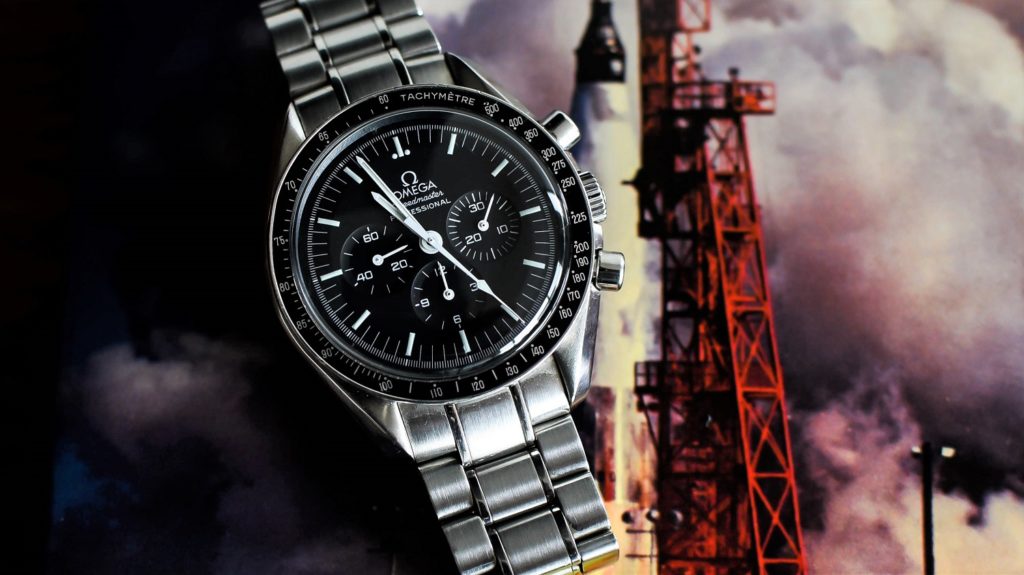
My history with it is part of why it stuck. I bought my first Speedmaster, a hesalite 1861, back in 2017 when my family had just settled into Seattle and I had a new job and that itch to mark the moment with something. I wore it constantly, babied the crystal, and tolerated the old bracelet the way you tolerate a noisy roommate. For years I assumed that was the whole experience, imperfections included. Then Omega released the 3861, and the refinements were too pointed to ignore. The stepped dial came back. The case got trimmed by half a millimeter here and a millimeter there, enough to wear more planted than the 42mm spec implies. And the bracelet, after a lifetime of Speedmasters being called strap monsters, finally tapers and articulates well enough that I don’t feel the urge to swap it.
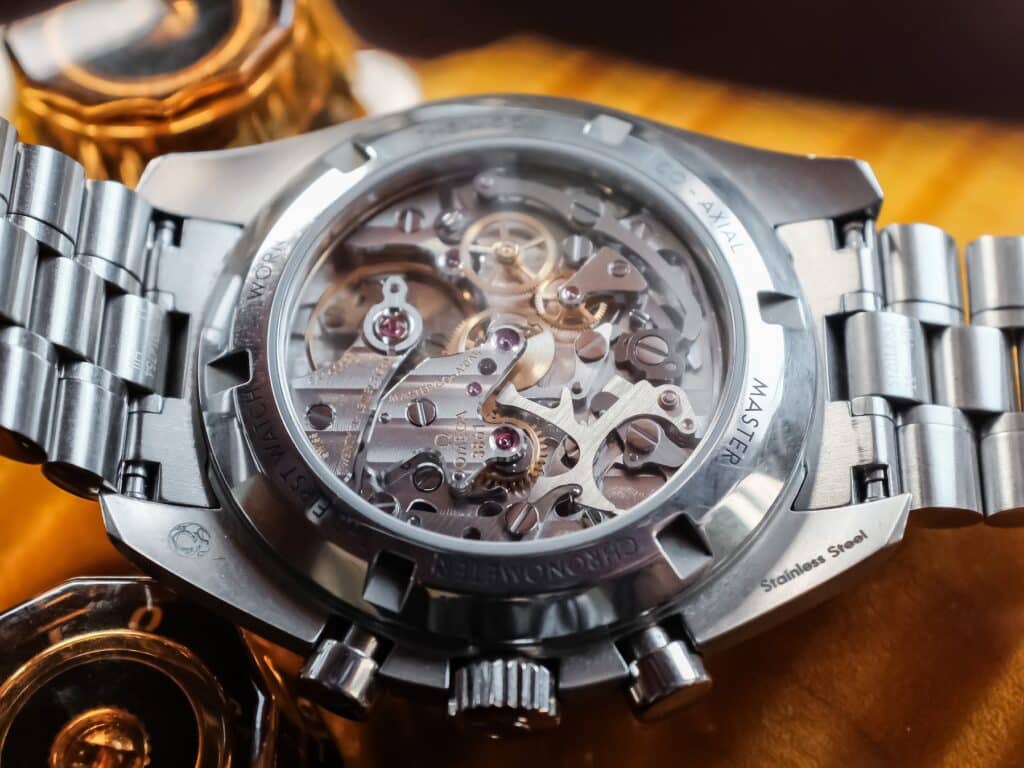
Under the caseback you get the reason the 3861 earns its keep. Omega spent four years turning the old 1861 architecture into a hand-wound, anti-magnetic, Co-Axial chronograph that meets METAS certification, which is a strange thing to do to a watch that built its reputation on resisting change. Mine runs around plus three seconds a week, but the accuracy is almost secondary to how it feels. The winding is smoother than the old caliber. The pushers have a firmer action that makes every start-stop-reset its own small ceremony. A capable, modern movement that still asks you to wind it by hand every morning is exactly the kind of contradiction I want in one of my two watches. It does the deliberate, structured half of life, and it does it with a little ritual built in.
The Diver Half
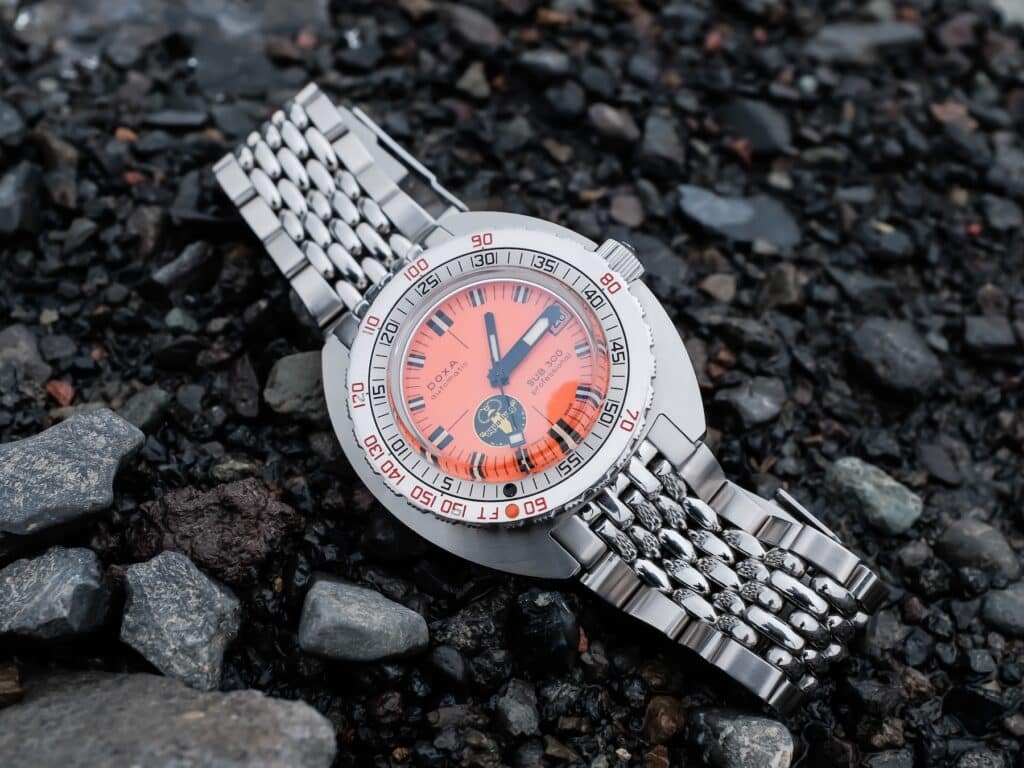
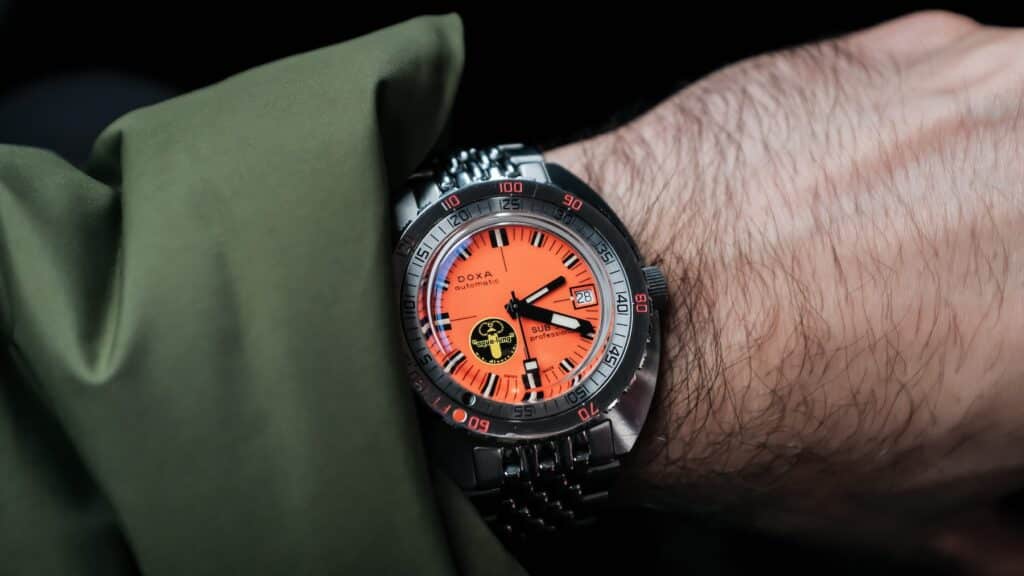
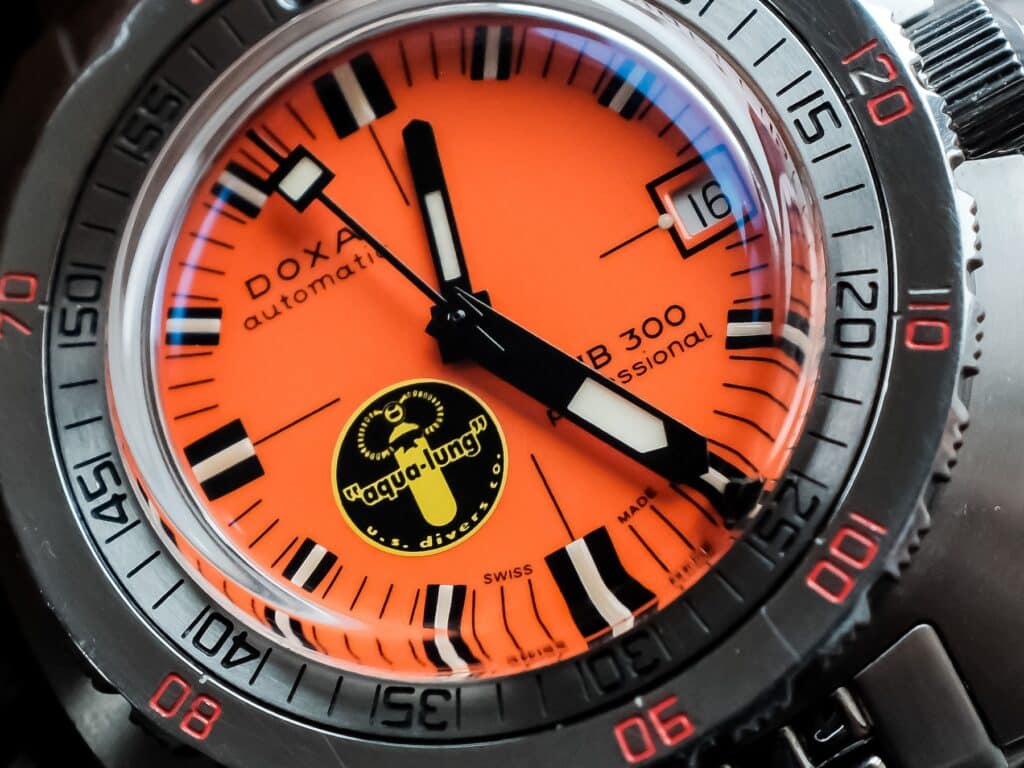
Then there’s the Doxa, which covers everything the Speedmaster doesn’t. Everything with no edges. The Sub 300 is the watch I pack without thinking, the one I’ve dragged across continents and through weather it had no business surviving, and the one I’ve never once worried about. The water resistance has never felt theoretical. It’s handled every swim, dunk, and weather shift I’ve thrown at it, including a few mornings pulled straight out of a backpack in Iceland.
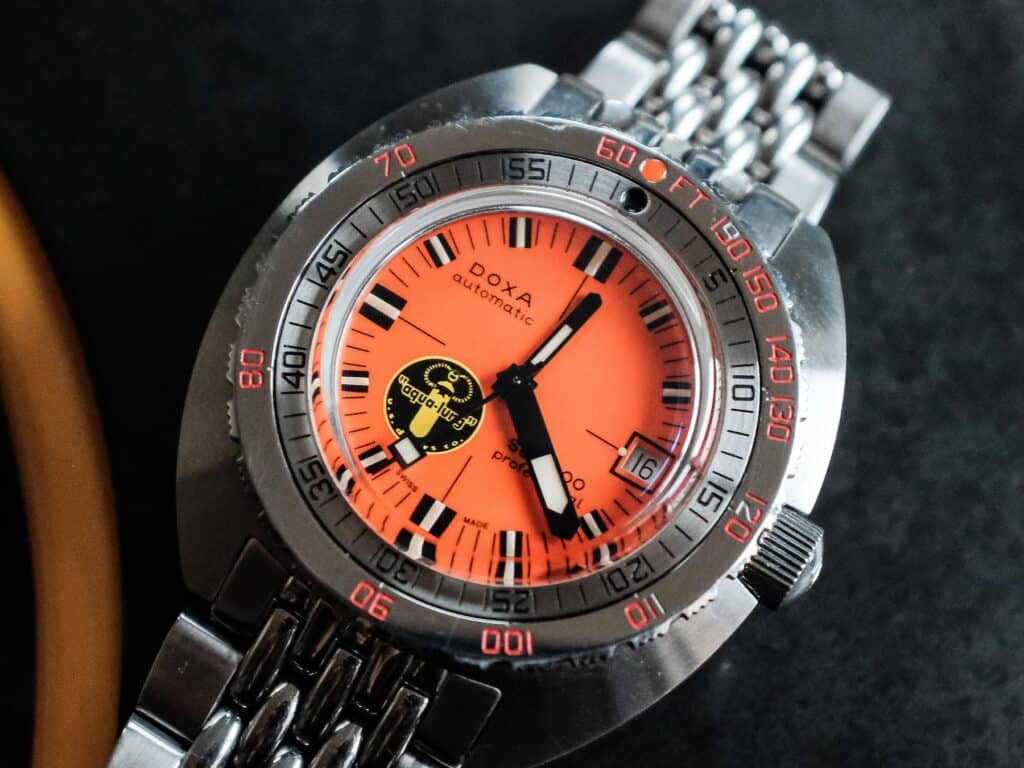
This is also the watch with the most personal weight in my collection. I bought the 2017 “Black Lung” Aqua Lung re-edition after months of talking myself out of it. The $2,190 preorder was no joke at the time, and I hovered over that page, closed the tab, opened it again, dug through old forum threads, and nearly let it go before a TBWS podcast listener nudged me over the line through Instagram. (By the way, dude I forgot your username. Message me if you read this.) It ended up marking my 30th birthday and the purchase of our first home, and it’s been with me through every meaningful shift since.

On the wrist, the cushion case does the heavy lifting. It’s a 42.5mm tonneau-shaped steel case that wears compact thanks to a short lug span and roughly 12mm of thickness, most of which comes from the bubble crystal and the chunky bezel. Bezel action is firm with no backplay, easy to grip even with cold hands, and it carries the old no-decompression scale that I’ll never use and love anyway. Inside is a COSC-certified ETA-2824 that has been so steady over eight years it’s almost boring, which is the highest compliment you can pay a tool-watch movement. The crown still has the same bite it did in 2017. The date still flips without hesitation. If the Speedmaster is the watch I respect, the Doxa is the watch I love, and there’s a real difference between those two feelings.
Why Two Is the Right Number
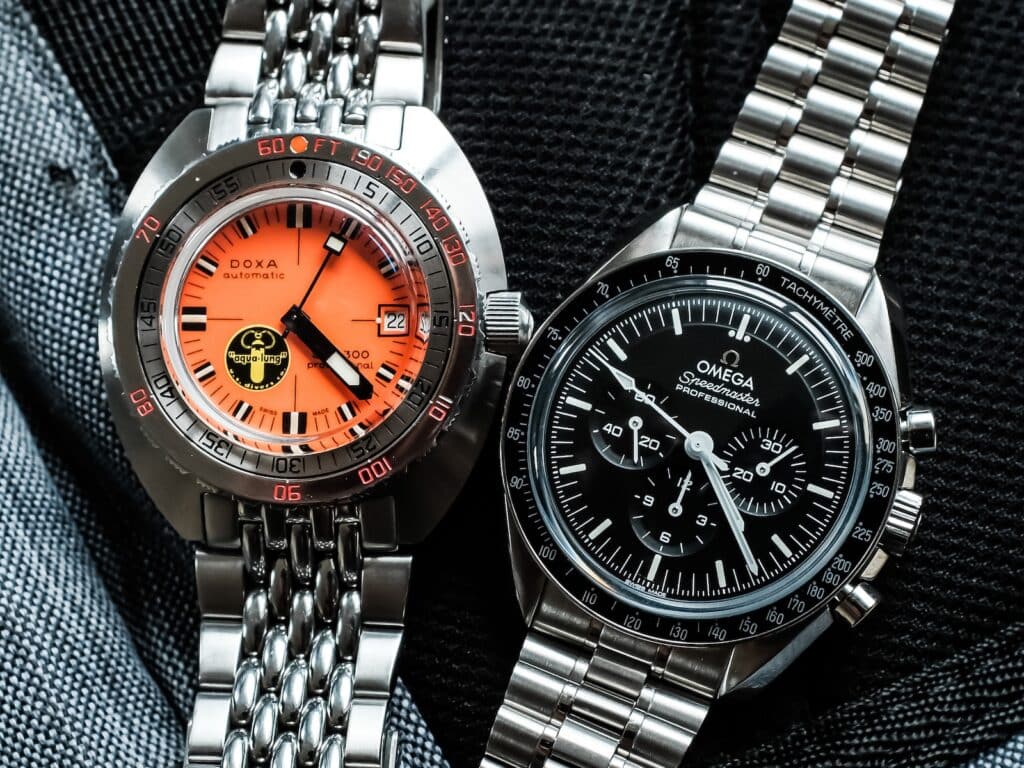
Here’s what makes this pairing work beyond the obvious chrono-plus-diver math. The two watches don’t compete. There’s rarely a morning where I can’t decide, because the day usually decides for me. Structured, precise, buttoned up? Speedmaster. Loose, wet, unpredictable, on a plane? Doxa. They split the calendar so cleanly between them that a third watch would mostly sit in the box feeling left out. That’s the test of a two-watch collection. If you’d actually reach for a third on a regular basis, you don’t have two watches, you have the start of a pile.
They also cover the two emotional registers a collection needs. One is the watch you’d hand to someone to explain why mechanical watches matter at all: the heritage, the movement you can wind, the finish you notice more the longer you look. The other is the watch that’s been part of your actual life long enough that letting it go would feel strange, even though I’ve thought about it. You want both. A collection of only respect watches is sterile. A collection of only love watches has no anchor. Two well-chosen pieces give you the entire spectrum without the storage problem.
I won’t pretend this is the only valid answer. Swap the Speedmaster for a Daytona or a vintage column-wheel chrono and the logic holds. Swap the Doxa for a Submariner or a Fifty Fathoms and you’ve got the same coverage with a different accent. The specific brands matter less than the structure underneath them. A chronograph for the moments you want to measure, a diver for the moments you want to forget you’re wearing a watch at all, both chosen because they mean something to you rather than because a list told you to. Get those two boxes checked honestly and the house-fire question answers itself.
So that’s mine. The Speedmaster that finally stuck after years of cycling through references, and the Doxa that never left. If the place ever does catch fire, at least I won’t have to stand there in the smoke weighing my options.

Co-Founder & Senior Editor
Michael Peñate is an American writer, photographer, and podcaster based in Seattle, Washington. His work typically focuses on the passage of time and the tools we use to connect with that very journey. From aviation to music and travel, his interests span a multitude of disciplines that often intersect with the world of watches – and the obsessive culture behind collecting them.
Great article. I wish I could stop at 2 but as most people reading this article can attest, it kept (keeps, actually) growing. The great thing about the 2 watch collection is those are the watches that your kids will remember you by. It will have the battle scars and lived look that makes it more you. The collection, well, is that. It becomes a “pick one you like” scenario rather than the “pick one that reminds you of Dad/Granpa.
That being said. My two watch would be my Sinn 104 white dial and my Glashutte Original SeaQ. or maybe it would be the Sub. But then there is the IWC Mark XX. D’oh! Can’t forget the Tudor BB 58 GMT ……..
Chad, that tracks. But the point about your kids remembering the watch on your wrist and not the one in the box is really well put. That’s the whole argument for wearing your favorites hard instead of rotating through a dozen. Even if you can’t stick to two.
Uncanny – my go to are a chrono and diver..
That being the Omega Speed master 1863 and a Christopher Ward C60 Trident Pro.
Had them both for a good while and nearly always choose to wear the CW over the Omega, which does get a run out every now and then…!!
Thx..
Hey Kenny. The CW getting more wrist time than the Speedy says a lot about how well Christopher Ward has been executing lately. That’s a great pairing. Thanks for reading.
I’ve just gone through this process.
Last year I had a collection of Tudor Pelagos 39, Tudor BB GMT, Rolex Explorer (which became a GMT Master II 16710), IWC Pilot Chrono 41, Tudor BB Bronze and an Omega Speedmaster Sapphire Sandwich (as well as the odd timex, casio, garmin for sport and a few pocket watches). All gathered over years of careful collecting and building knowledge. the above doesn’t include all the ones that have come and gone. It’s been a fantastic way to spend money!
In the end I didn’t know “why” had these other than they were great and I had become focused on collecting. However, I couldn’t say which ones I truly used. I owned them but I didn’t live with them, there we soo many my kids couldn’t identify the one that matched me. I thought that was quite sad. So the process began, my 18 year son old choose the P39 for his birthday (an awesome piece) and over the past year I’ve slimmed down the collection massively.
It’s now:
The speedy – a true classic
The BB Bronze – my wife loves this on on my colouring the most so it’ll never leave
IWC Mark XX – I was sold on IWC after the pro pilot (it was just a little too thick for daily wear) – and truly classless, I can wear it anywhere with no issues.
So my regular switch is between the IWC and the Speedy (the bronze if for fun when I feel like it). For travelling, it’s the garmin though – I just want it rugged and able to handle anything.
Hey Mike. Sounds like you landed on a rotation that actually means something. The IWC and Speedy pairing covers a lot of ground. Thanks for sharing the journey.
I have more watches than I want to mention, but my two-watch go-tos are both Omegas, a Speedmaster Date (2012, reverse panda, 40 mm) and a Seamaster Planet Ocean (2006, black dial, 42 mm). They are interesting without being overpowering and I don’t have to worry about weather or hard hits (the Speedmaster has 100m water resistance and is an automatic – has been a great travel watch). Most of the other watches are vintage, so during the rainy season they’re tucked away in the box. But my Omegas take several for the team.
That’s a smart two-watch setup, Todd. The Speedmaster Date with 100m is an underrated variant for exactly the reason you mentioned. Having two watches that can handle real life without babying them is the whole point of a working rotation. Solid choices.
This isn’t the best 2 watch collection. Replace the doxa with the Tudor FXD.
Oooof. You’re making this harder. That’s a great pair.