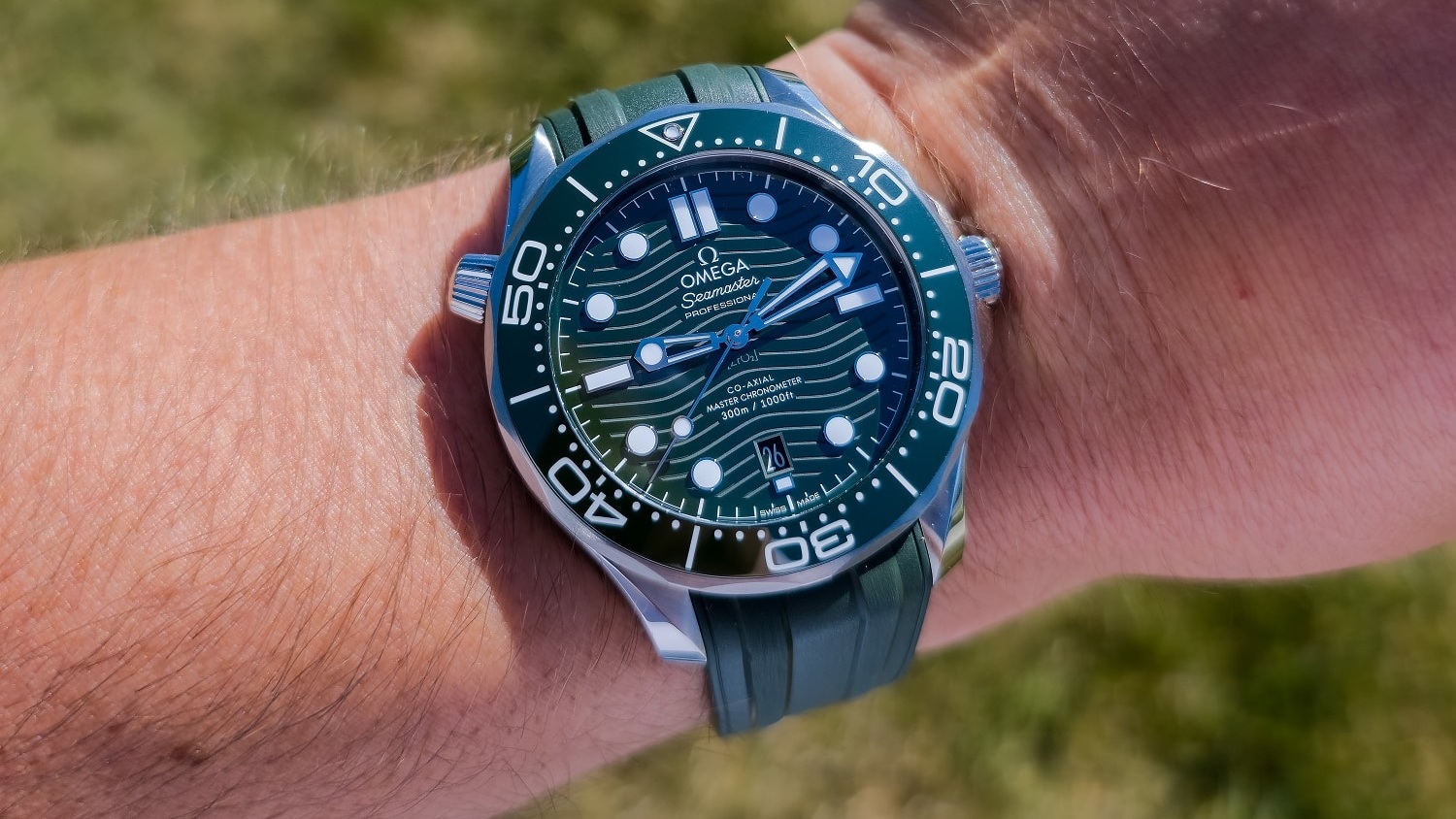
At some point, spending more money on a dive watch stops being about how well it handles water and starts becoming a question of how much we appreciate the finer details. The Omega Seamaster Diver 300M has made a pretty convincing business out of that distinction, combining a recognizable design with sophisticated movement technology and some of the most attractive finishing we’ve encountered on a modern diver. But with prices approaching $6,000 when we originally reviewed it, we’re interested in figuring out how much of that experience we can get for considerably less.
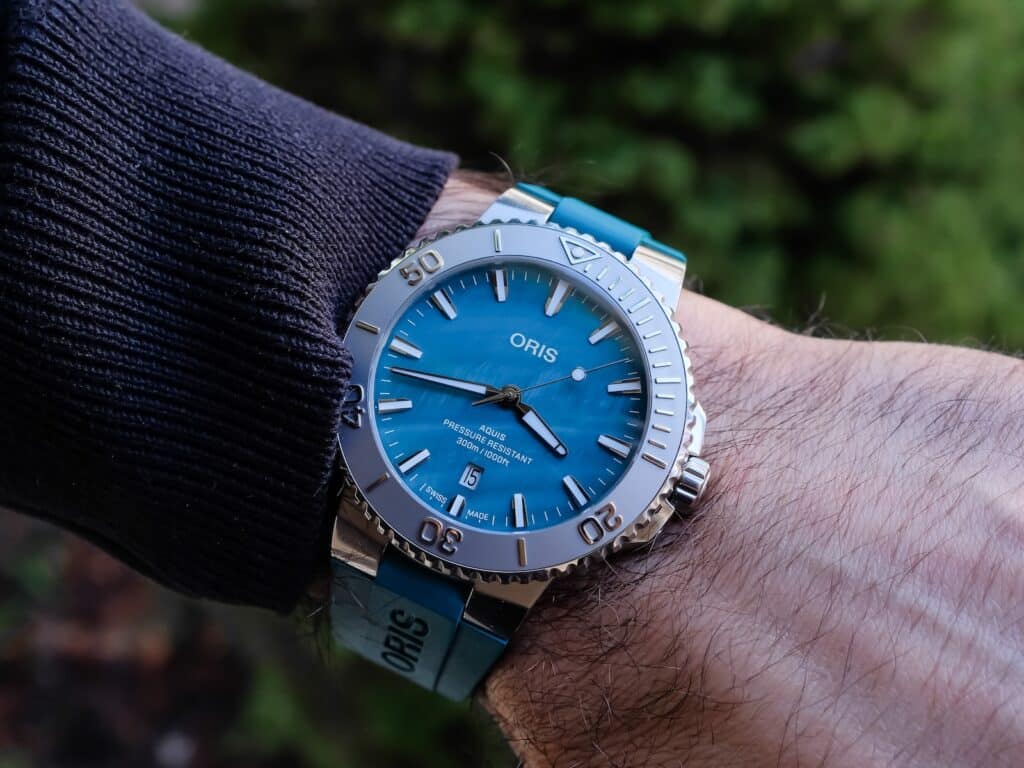
The Oris Aquis New York Harbor Limited Edition II makes that question particularly interesting. At $3,000, it’s hardly inexpensive, but its unusual mother-of-pearl dial, substantial stainless steel case, and excellent rubber strap give it plenty of personality. We’ve reviewed both watches independently, and our experiences revealed some unexpected strengths and frustrations. The Omega impressed us with its engineering and refinement, while the Oris demonstrated that a less expensive Swiss diver can still get certain details right where more prestigious competitors occasionally stumble. So, which would we actually choose?
Overview and Identity
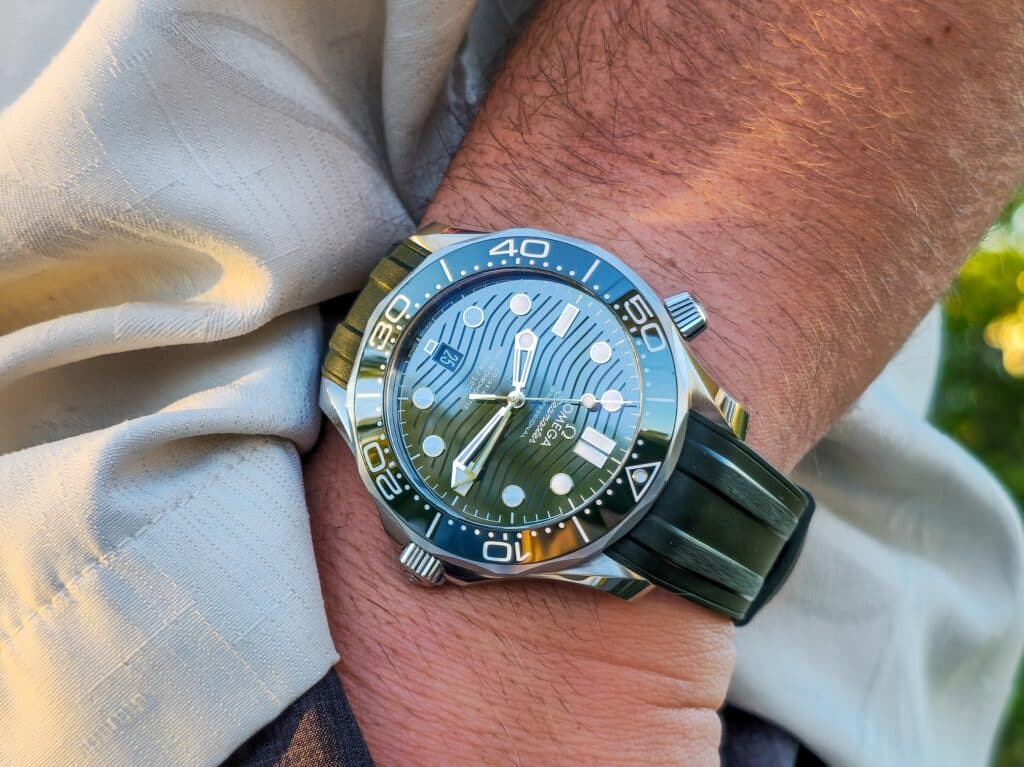
The Omega Seamaster Diver 300M has been one of the brand’s most recognizable dive watches since its introduction in 1993. Its association with James Bond certainly hasn’t hurt, although we’d argue the design has done enough over the years to establish an identity beyond its Hollywood appearances. The wave-pattern dial, skeletonized hands, scalloped bezel, and helium escape valve make it immediately recognizable, even in a category filled with watches that seem determined to borrow from the same handful of established designs. Our hands-on review of the Omega Seamaster Diver 300M focused on the green-dial version with Omega’s Calibre 8800 movement, a configuration that makes a strong argument for the watch’s more decorative qualities.
Oris has approached the dive watch category somewhat differently. As an independent Swiss manufacturer, the brand has developed a recognizable identity around practical mechanical watches that generally occupy a more accessible price category than Omega. The Aquis collection has become one of its most recognizable modern designs, particularly because of its distinctive case geometry, integrated strap arrangements, and willingness to experiment with colors and limited editions. The Aquis New York Harbor Limited Edition II is one of those experiments. Limited to 2,000 pieces, it supports the Billion Oyster Project, an initiative focused on restoring oyster populations in New York Harbor. Oris incorporates that connection through an aqua-green mother-of-pearl dial and an engraved caseback featuring oyster-related details. Our initial reaction to the release was fairly indifferent, but that changed after spending time with the actual watch during our hands-on review. It’s also refreshing to encounter a limited edition with a specific reason for existing beyond another color combination.
Dial and Straps
The Seamaster’s dial is probably one of the first things that draws people toward the watch, and the green version we reviewed makes a particularly strong impression. Omega uses polished ceramic with deeply engraved horizontal waves, creating a surface that changes considerably as light moves across it. Depending on the environment, the green can appear subdued and almost military-inspired or considerably brighter and more saturated. It’s an elaborate treatment, but one that works within the Seamaster’s established design rather than feeling like decoration added for its own sake.

There are some excellent smaller details, too. The date wheel matches the green dial, something we wish more manufacturers would take seriously when experimenting with unusual colors. The printing is exceptionally crisp, and the combination of polished ceramic, recessed waves, and skeletonized hands gives the watch an appearance that feels appropriately expensive. Those hands are more divisive from a practical perspective, since their open construction can make them slightly harder to distinguish against the luminous markers. We wouldn’t call the Seamaster difficult to read in ordinary conditions, but there’s an unmistakable emphasis on visual presentation here.
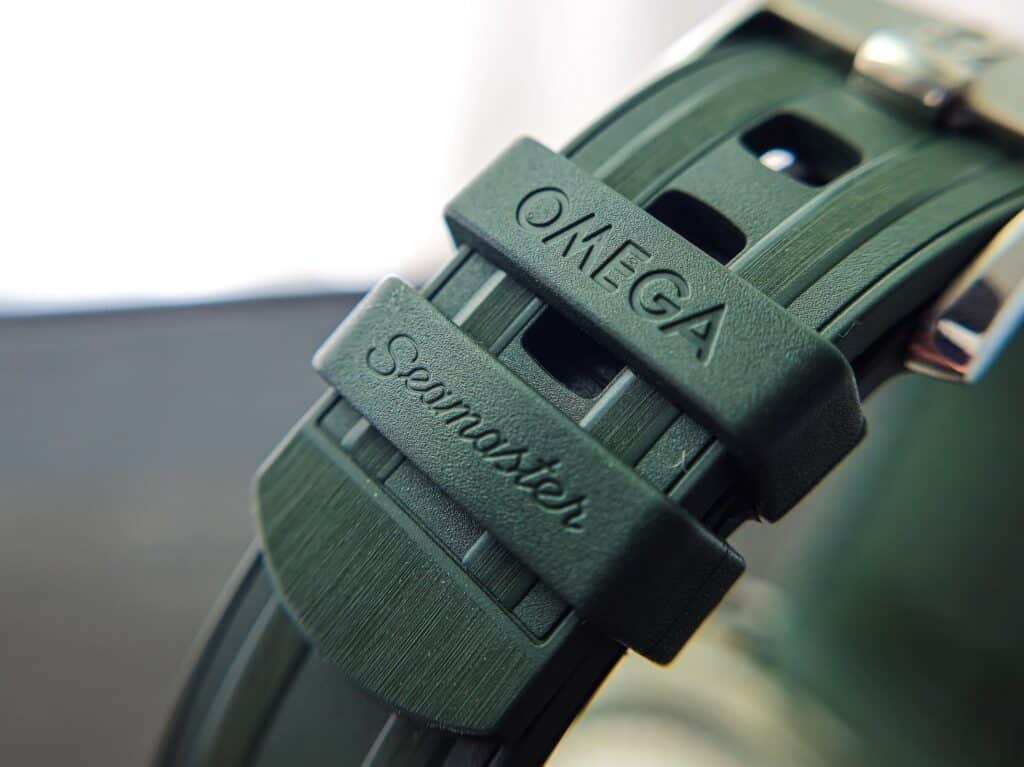
Omega also offers the Seamaster on a stainless steel bracelet, although our team preferred the color-matched rubber strap. The bracelet’s lack of taper and substantial weight weren’t particularly appealing, especially given how comfortable the watch felt on rubber. This is one of those instances where we’d normally recommend buying a watch on the bracelet for versatility and resale considerations, but there’s something about the Seamaster’s rubber configuration that feels particularly well suited to the design.
The rubber itself is soft and nicely finished, with raised central sections and a buckle that receives the same attention to polishing and brushing as the case. We’d prefer slightly closer spacing between the adjustment holes, but the overall package worked extremely well during our review. Omega’s conventional 20mm lug width also leaves plenty of room for experimentation with aftermarket straps, particularly if you’re considering one of the more neutral dial configurations. It’s a welcome bit of versatility on a watch that otherwise has a fairly distinctive personality.

The Oris Aquis New York Harbor II takes an equally unconventional approach to its dial, although the resulting appearance is entirely its own. Rather than relying on engraved ceramic, Oris uses aqua-green mother-of-pearl with an oyster-shell effect. It’s an unusual material for a dive watch, and one that could easily have looked more appropriate on a decorative dress watch. We weren’t particularly enthusiastic when the model was first announced, but that changed considerably once we had the opportunity to handle it.
In brighter conditions, the dial produces shifting green reflections that make the surface appear almost alive. Under softer lighting, it becomes more subdued, with a muted appearance that we found easier to appreciate during regular wear. The changes can be dramatic enough that the watch almost looks like a different model depending on the environment, but our review didn’t identify any meaningful legibility problems. That’s particularly encouraging when a manufacturer decides to experiment with materials that aren’t normally associated with practical dive watches.

The accompanying aqua-green rubber strap was another highlight. Oris uses an integrated arrangement with a folding clasp, and despite some usual reservations about deployant systems, the fit was comfortable and secure once properly adjusted. We also appreciated that the strap avoided adding unnecessary weight to an already substantial watch. Given the dimensions of the Aquis, choosing rubber over a bracelet felt like the right decision for this particular configuration.
Of course, the proprietary strap arrangement does impose some restrictions. The Aquis isn’t the sort of watch where we can casually reach into a drawer of spare straps and expect everything to fit. That’s a disadvantage compared with the Omega, especially for collectors who enjoy changing the appearance of their watches regularly. But when the original strap works this well, we aren’t especially motivated to replace it. Both watches make convincing arguments for rubber, even if Omega provides considerably more flexibility.
Build Quality & Technical Approach
The biggest difference between these watches becomes apparent once we move beyond their appearance. Omega has invested heavily in movement technology and decorative case finishing, while the Oris relies on a comparatively straightforward automatic caliber and concentrates much of its appeal around the case, dial, and controls. That distinction is reflected in the pricing, although our hands-on reviews suggest the more expensive watch doesn’t automatically come out ahead in every area.
Movements:
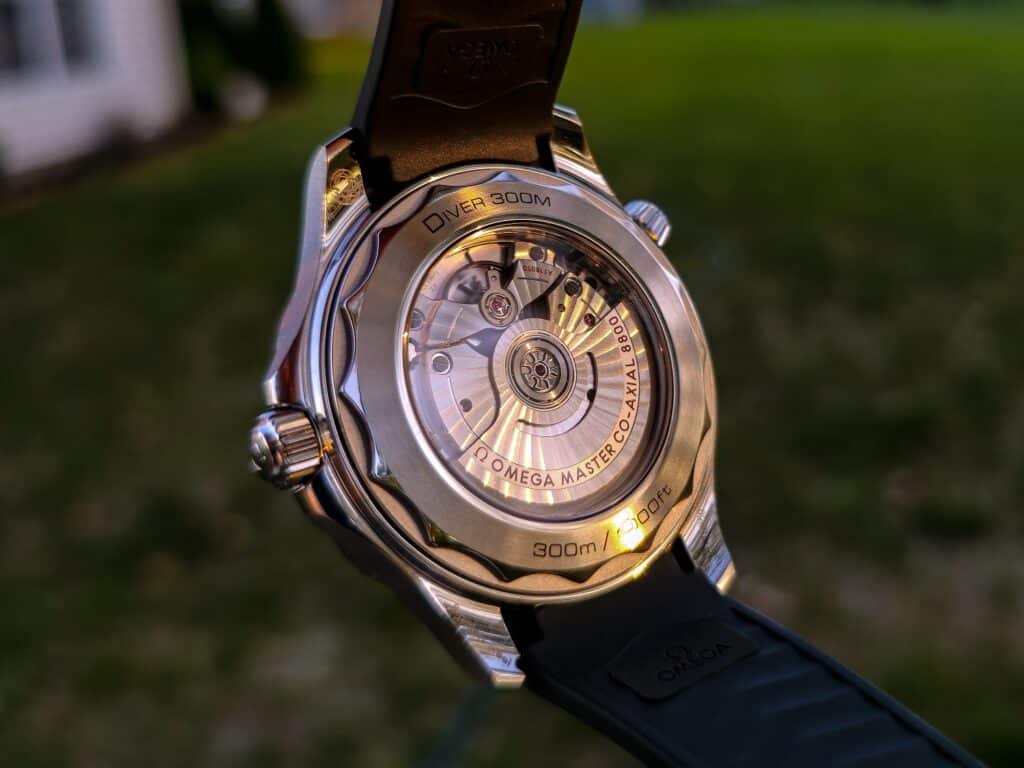
The Omega Seamaster Diver 300M uses the Calibre 8800 Co-Axial Master Chronometer movement, operating at 25,200 vibrations per hour with approximately 55 hours of power reserve. METAS certification includes resistance to magnetic fields reaching 15,000 gauss, while Omega’s Co-Axial escapement is designed to reduce friction within the movement. During our review, the watch was running within approximately one second per day, and the manual winding experience was exceptionally smooth. The movement is also visible through a sapphire exhibition caseback, where Omega’s decorative finishing gives us something worth looking at.

The Oris Aquis New York Harbor II uses the Calibre 733, based on the Sellita SW200-1. It offers approximately 41 hours of power reserve, automatic winding, hacking seconds, and a date complication. Compared with Omega’s movement, it’s a considerably more conventional choice, particularly when Oris has its own Calibre 400 family available. Still, there’s something reassuring about a familiar Swiss automatic that’s widely understood by watchmakers and relatively straightforward to service. Our hands-on experience revealed no unexpected performance issues, although the shorter power reserve is worth considering if you regularly rotate between several watches.
Would we prefer the Omega’s Calibre 8800 over the Oris 733? Absolutely. The additional power reserve, impressive magnetic resistance, and excellent accuracy make it a substantially more sophisticated movement. But does that alone justify spending several thousand dollars more on the Seamaster? Probably not. We appreciate everything Omega has accomplished mechanically, although we’re not convinced most collectors would notice the difference during ordinary wear.
Case Construction, Finishing & Wearability:
The Seamaster measures 42mm in diameter, approximately 49.9mm lug to lug, and 13.9mm thick. Those dimensions initially raised some concerns during our review, particularly given our preference for more restrained case sizes. Fortunately, the watch proved considerably easier to wear than expected. The case sits relatively flat, and the shape of Omega’s twisted lyre lugs helps reduce the impression of bulk. Despite approaching 14mm in thickness, the Seamaster felt noticeably slimmer on the wrist, particularly when paired with its comfortable rubber strap.
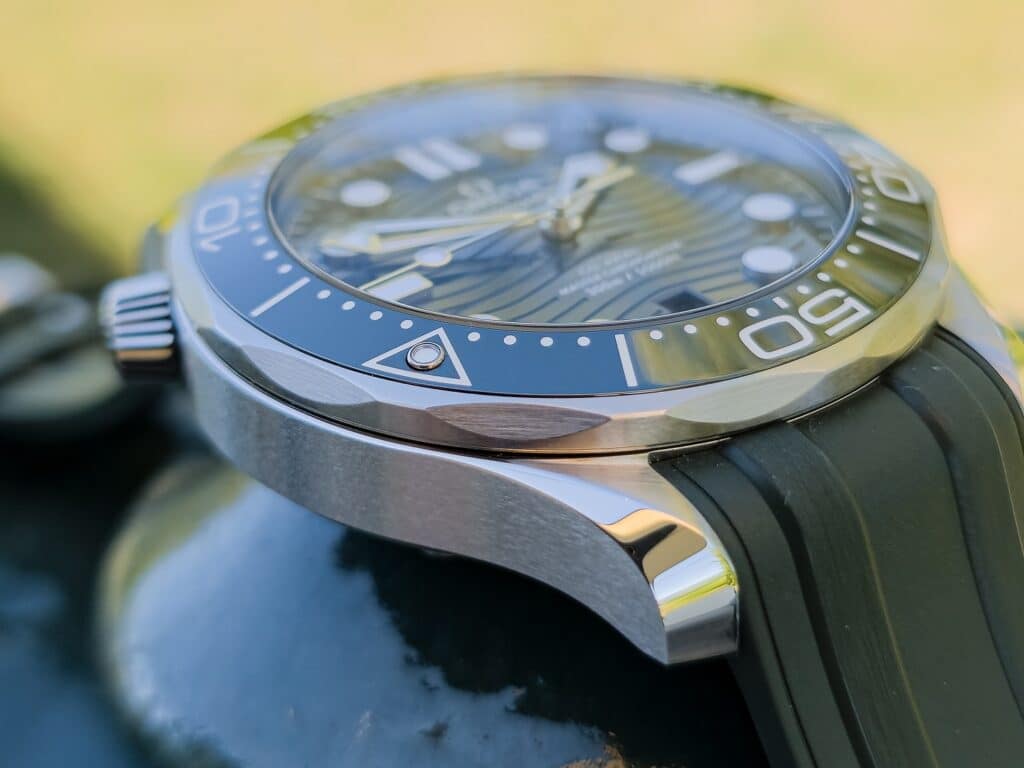
The finishing is where Omega makes its strongest argument for the additional expense. Polished surfaces flow into sharply defined bevels, while finely brushed areas provide enough contrast to keep the case from looking excessively decorative. The transitions are especially attractive around the lugs, where small changes in the surface treatment become noticeable as the watch moves on the wrist. It’s the sort of finishing that becomes more impressive the longer you spend examining it, and we considered the case one of the watch’s greatest strengths.
The Oris is the larger watch, measuring 43.5mm across, roughly 51mm lug to lug, and just over 13mm thick. It’s substantial by almost any reasonable standard, although our experience on a 6.75-inch wrist was surprisingly positive. The case curvature and integrated rubber strap help it sit more securely than its dimensions suggest, and the combination keeps the watch from feeling as cumbersome as we initially expected.
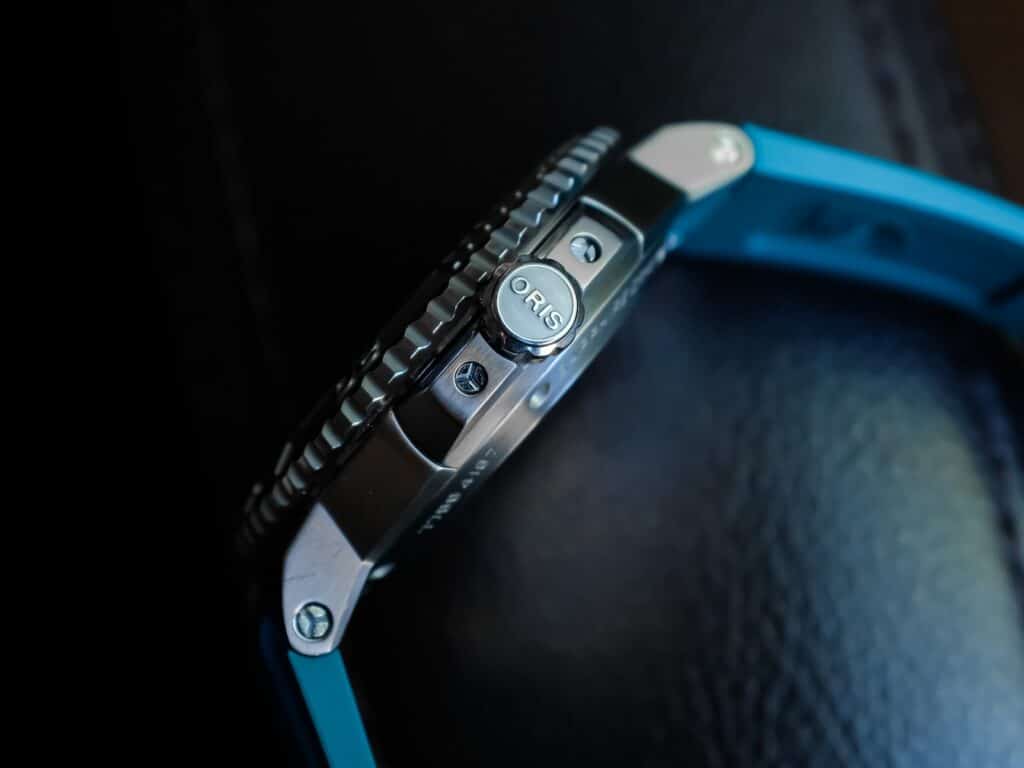
Oris uses predominantly brushed surfaces, with polished edges introducing a little contrast along the sides. It’s an attractive arrangement, although the execution isn’t quite as elaborate as what we encountered with the Omega. We also have to acknowledge that the Aquis remained a little larger than our review team would naturally choose for everyday wear. Both watches manage their dimensions better than expected, but the Seamaster has the more sophisticated finishing and a slightly more accommodating overall profile.
Crystals and Bezels:
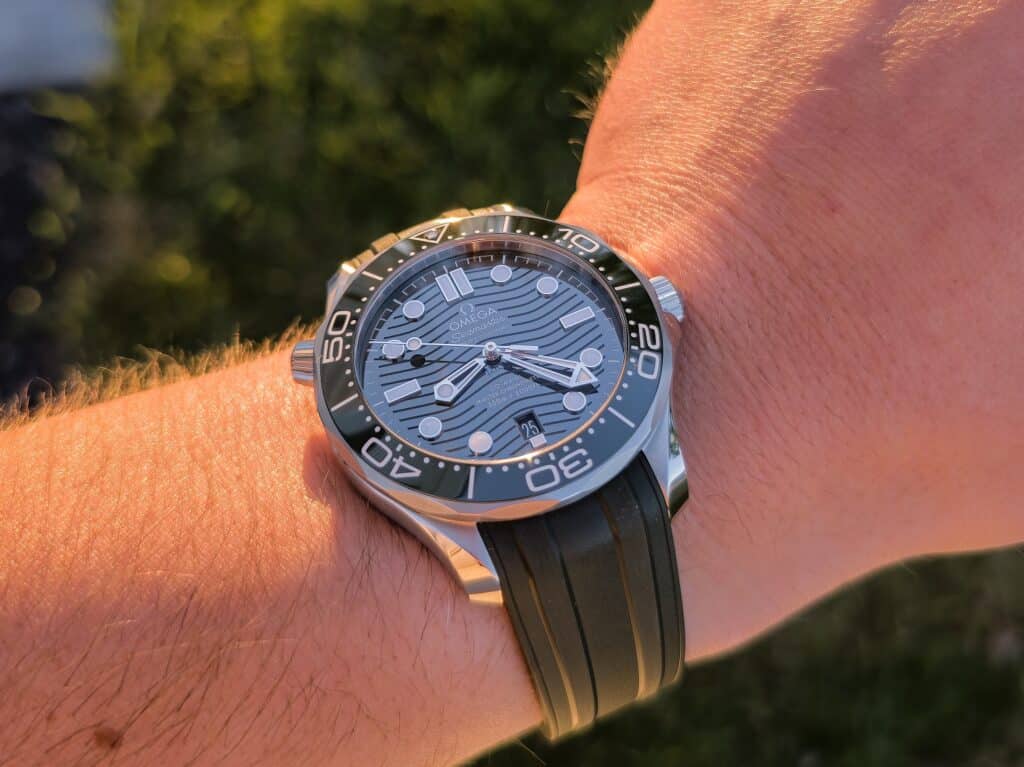
Omega equips the Seamaster with a sapphire crystal featuring exceptionally effective anti-reflective treatment. During our review, the clarity was remarkable, to the point where the crystal could almost disappear under certain lighting conditions. The glossy green ceramic bezel looks equally impressive, complementing the dial’s engraved wave pattern, but actually operating it was less satisfying. Despite its precise 60-click action, the bezel offered relatively little tactile feedback, and the familiar scalloped edge could be difficult to grip. We’d expect a more enjoyable experience from a dive watch at this price, particularly considering how much attention Omega has devoted to nearly every other detail.

The Oris Aquis New York Harbor II also uses a sapphire crystal, although its anti-reflective coating is applied to the inside rather than both surfaces. That’s a practical arrangement for avoiding scratches to an exposed exterior coating, even if Omega’s optical clarity is particularly impressive. Oris pairs the crystal with a stainless steel bezel insert that gives the watch a more industrial appearance. The action, however, was excellent, feeling firm, precise, and deliberate throughout our review. It’s somewhat amusing that the less expensive watch delivered the more satisfying bezel experience, especially when the Seamaster otherwise makes such a convincing argument for superior refinement.
Water Resistance & Lume:
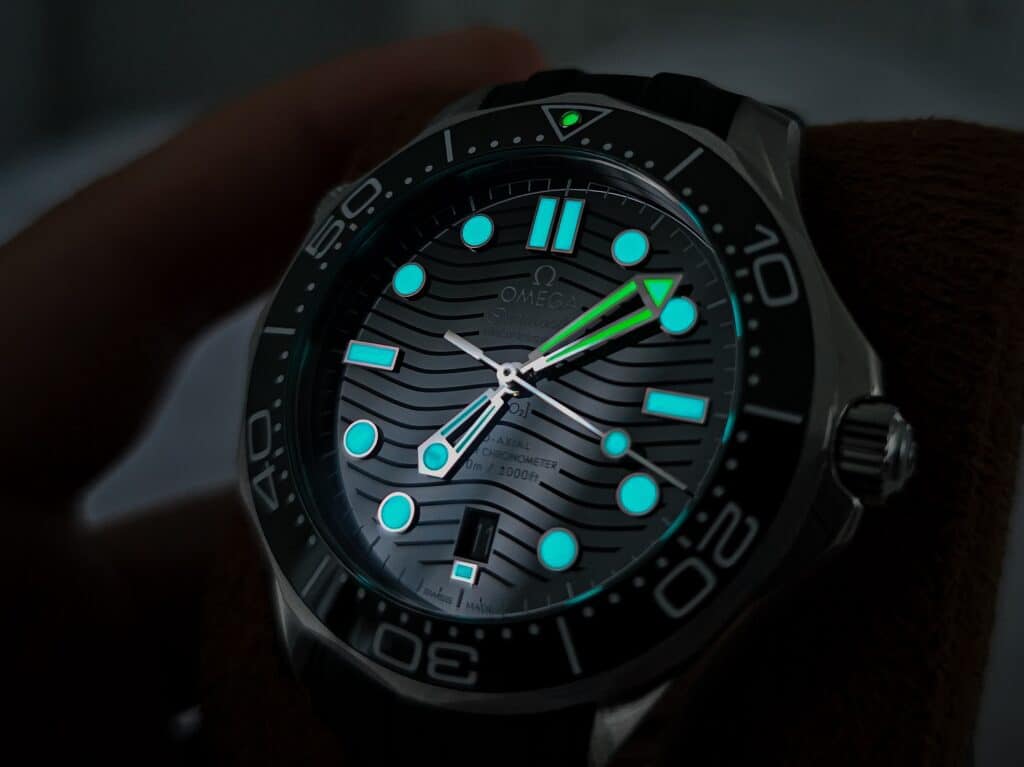
The Omega Seamaster Diver 300M offers 300 meters of water resistance and includes its recognizable helium escape valve at ten o’clock. It’s a feature relatively few owners will ever need, but it has become an unmistakable part of the Seamaster’s design. Omega also uses two colors of lume, with blue appearing on the hour markers and selected hands, while the minute hand and bezel marker glow green. We appreciate how this makes orientation easier in darkness, although our original review found the actual brightness and longevity somewhat disappointing. The luminous treatment remains perfectly usable, but it wasn’t quite as impressive as we expected from a watch with such substantial technical credentials.

The Oris Aquis New York Harbor II also offers 300 meters of water resistance, putting it on equal footing with the Omega in terms of its stated depth rating. Its conventional Aquis dial layout provides a practical foundation beneath the unusual mother-of-pearl treatment, and our review found the watch surprisingly legible despite the dial’s shifting appearance. However, we didn’t document comparable nighttime testing of the Oris’s luminous performance, so we wouldn’t want to declare either watch the outright winner in that respect. What we can say is that both provide more than enough water resistance for ordinary recreational use, with the Omega offering the more extensively documented luminous system.
Cost Considerations
The Omega Seamaster Diver 300M carried a retail price of approximately $5,600 on rubber and $5,900 on the stainless steel bracelet when we originally reviewed it. That’s a significant investment, particularly when the luxury dive watch category includes several established Swiss alternatives at considerably lower prices. The Seamaster provides plenty of justification through its METAS-certified movement, excellent case finishing, ceramic components, and recognizable design, but we’d still encourage buyers to think about how much they personally value those improvements.
There’s also something to be said for how convincingly Omega has established the Seamaster as a luxury watch in its own right. We weren’t particularly enthusiastic about the factory bracelet or bezel operation, yet neither criticism entirely undermined its appeal. The dial and case finishing were impressive enough to make those shortcomings easier to understand, even if we’d expect more satisfying bezel action at this price. That might sound like we’re giving Omega a pass, but the reality is that several of its strongest qualities are difficult to appreciate from specifications alone.
The Oris Aquis New York Harbor II was introduced at $3,000, putting it in a substantially different financial category. It doesn’t offer Omega’s movement technology or the same degree of decorative case finishing, but the quality of the construction, comfortable rubber strap, and unusual mother-of-pearl dial give it a distinct identity. The collaboration with the Billion Oyster Project also adds an element of purpose that makes this limited edition more interesting than a simple color variation.
We wouldn’t automatically describe the Oris as the better value merely because it costs less. The Calibre 733 is a relatively conventional movement for a watch at this price, and the New York Harbor II’s distinctive appearance won’t appeal equally to everyone. Our original review also made it clear that this particular configuration wouldn’t necessarily be the everyday Aquis we’d choose. Still, it delivers some genuinely satisfying details, including its bezel operation and wrist comfort, without requiring buyers to approach the substantially higher pricing associated with the Omega.
For us, the price difference comes down to how much value we place on mechanical sophistication and finishing. The Seamaster offers a more advanced movement, tighter decorative execution, and a recognizable design with decades of history behind it. The Oris delivers much of the everyday enjoyment we’d expect from a well-made Swiss diver for considerably less money. We’re inclined to give Omega the advantage in overall refinement, but we’d have a difficult time telling someone who preferred the Aquis that they were making a poor purchasing decision.
Final Thoughts: Is the Omega Seamaster Worth the Premium Over the Oris Aquis?
For us, the Omega Seamaster Diver 300M is the stronger all-around luxury dive watch. Its excellent case finishing, technically sophisticated movement, and distinctive ceramic dial make a convincing argument for why it occupies a higher position in the market. We certainly have complaints about the bezel and bracelet, but the overall experience impressed our review team enough that we’d still consider it a watch worth aspiring to own.
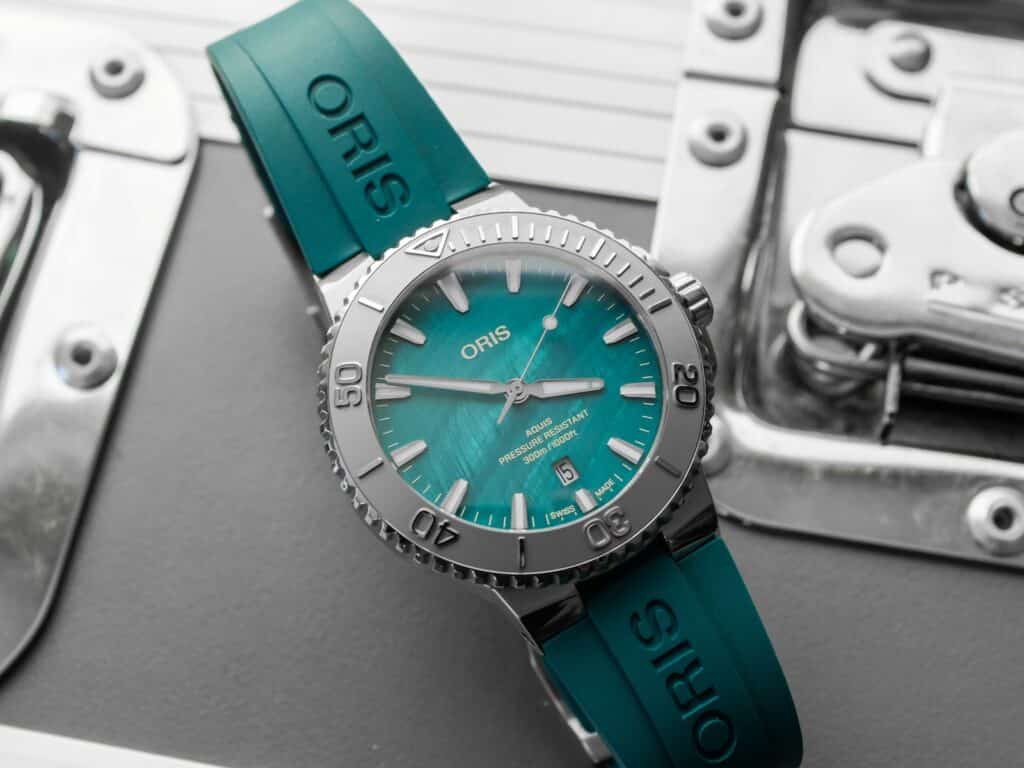
The Oris Aquis New York Harbor II, however, makes the decision more interesting than the price difference might suggest. Its bezel operation was more satisfying, the integrated rubber strap proved exceptionally comfortable, and that unusual mother-of-pearl dial earned our appreciation after initially leaving us rather indifferent. Those are meaningful strengths, particularly when we’re discussing the aspects of a dive watch that we interact with regularly.
We do think the Oris makes more sense for someone who appreciates its particular design and wants something outside the familiar luxury dive watch choices. At the same time, our original review acknowledged that the New York Harbor II’s size and colorful appearance made it a more occasional choice than an everyday companion. The Seamaster’s green ceramic dial isn’t exactly understated either, but its slightly smaller dimensions and more conventional strap options give it an advantage in versatility.
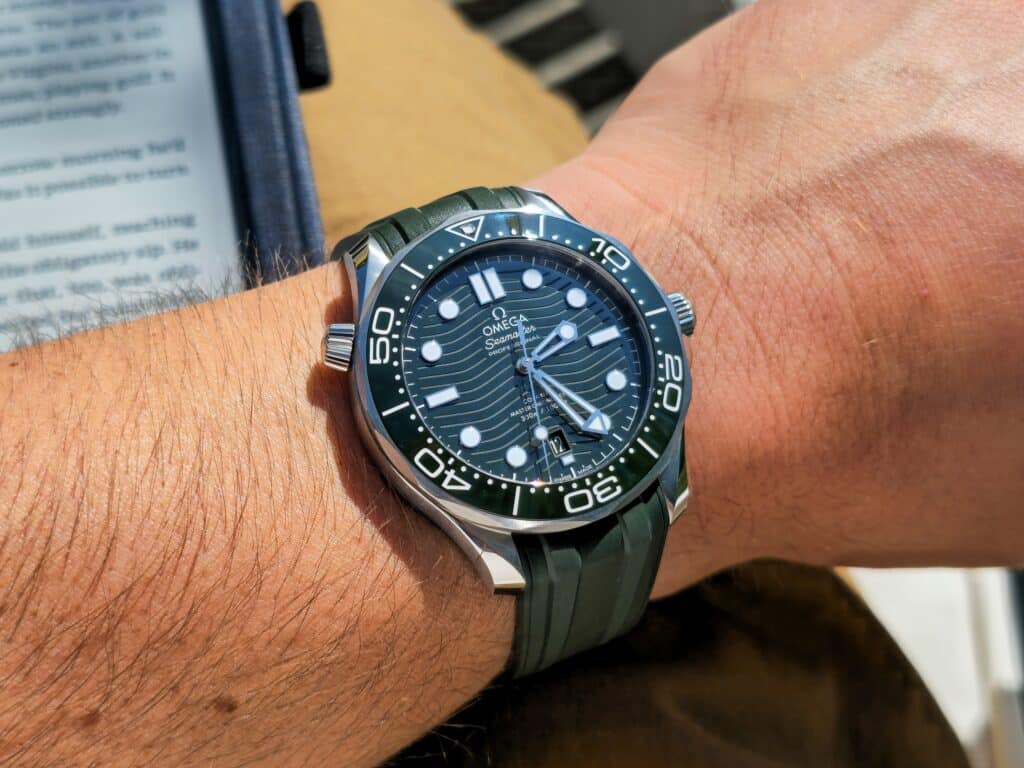
Our verdict: choose the Omega Seamaster Diver 300M if the additional expense is comfortably within reach. Its engineering and finishing provide enough substance to support the premium, although the Oris deserves serious consideration for collectors who value dial character, tactile details, and a lower purchase price. We wouldn’t call the Aquis a lesser watch simply because it costs less, but the Seamaster is the one we’d ultimately choose from these two specific configurations.

Co-Founder and Senior Editor
Kaz has been collecting watches since 2015, but he’s been fascinated by product design, the Collector’s psychology, and brand marketing his whole life. While sharing the same strong fondness for all things horologically-affordable as Mike (his TBWS partner in crime), Kaz’s collection niche is also focused on vintage Soviet watches as well as watches that feature a unique, but well-designed quirk or visual hook.