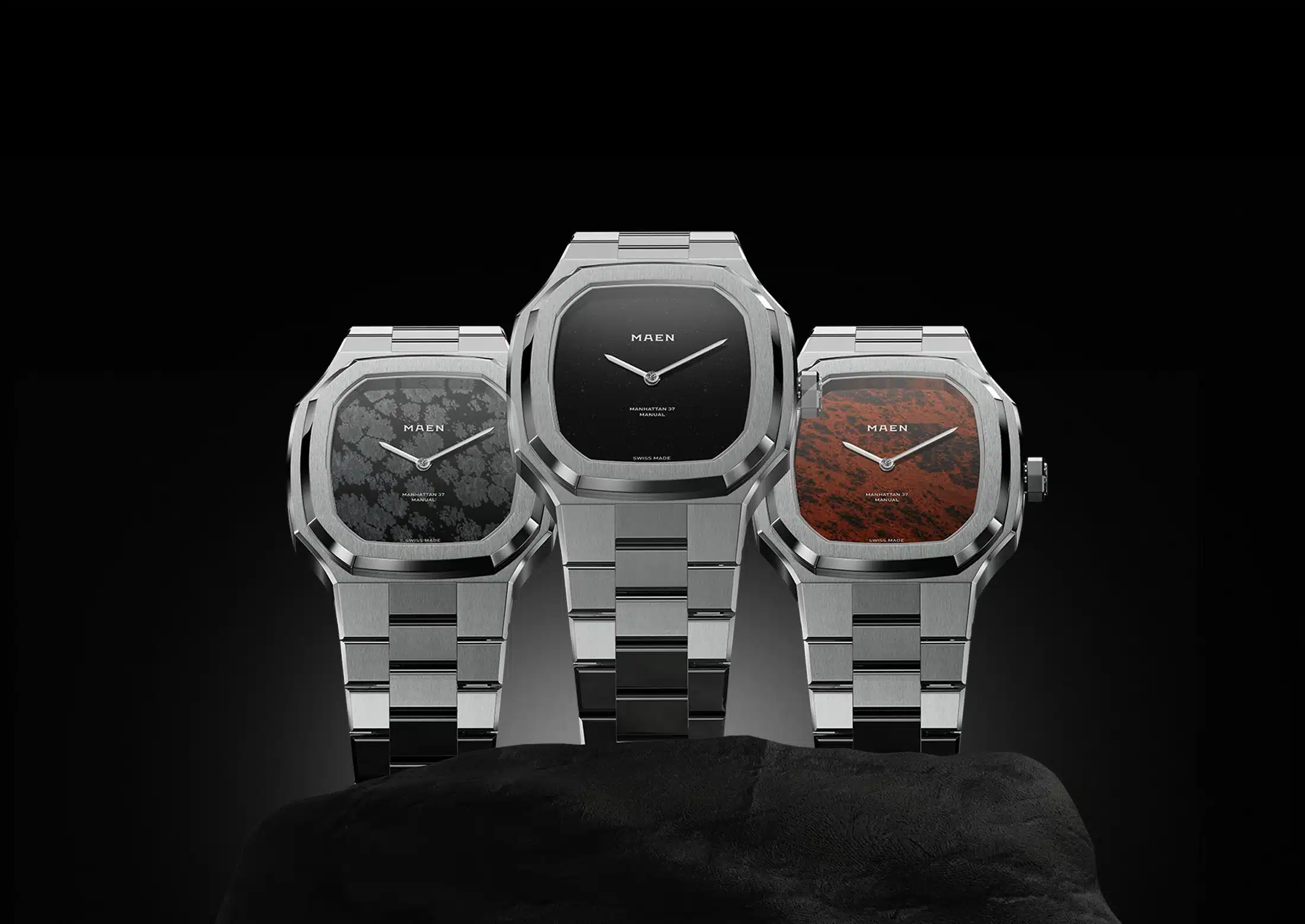
Stone dials used to live on the top shelf. Piaget built much of its 1970s identity on slabs of lapis, tiger’s eye, and onyx, and for decades a natural mineral dial meant a precious-metal case and a price to match. That exclusivity has loosened lately, with hardstone and meteorite turning up on more accessible watches, though usually as limited runs or one-off specials. A smaller brand known for angular integrated sports watches has decided to skip the limited-edition route entirely. Maen has folded three natural stone dials into a standing part of its lineup with the new Manhattan 37 Ultra-Thin Stone Dial collection.
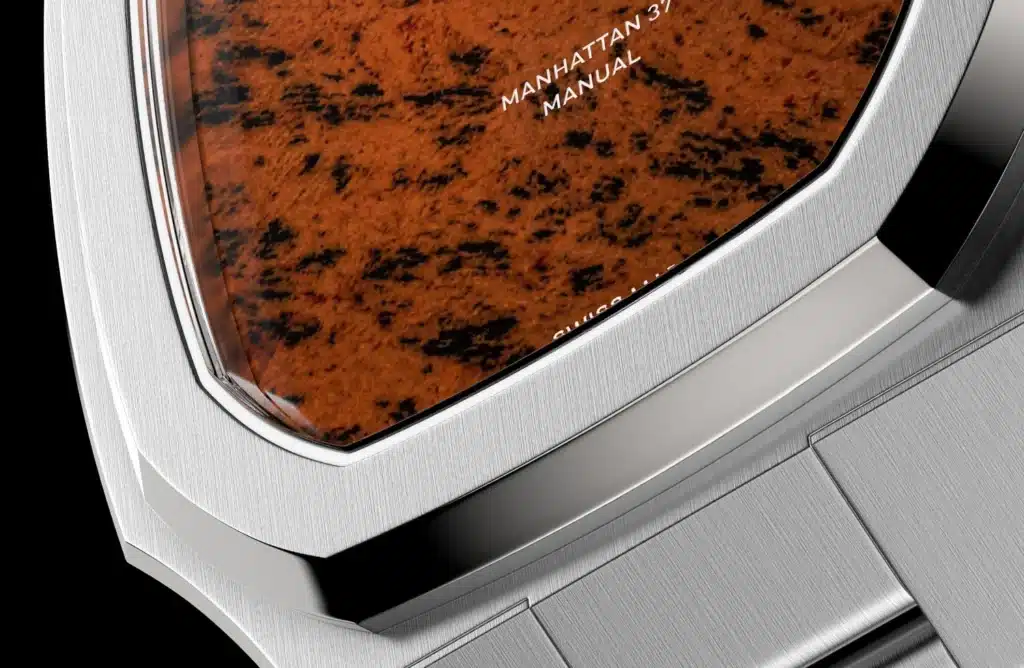
The Manhattan has become Maen’s calling card, built on the faceted case and octagonal bezel language of 1970s integrated sports watches. Last year’s Manhattan 37 Ultra-Thin trimmed the automatic version down to 7.1mm by switching to a hand-wound movement, and that’s the platform this collection builds on. What’s different now is the commitment. Rather than a boutique drop of fifty pieces, these join the permanent collection, and Maen’s US store lists all three at $1,601. For a Swiss-made, hand-wound watch on an integrated bracelet with a real stone dial, that lands in interesting territory.
The three options cover a useful spread. Black Onyx keeps things sober, with a deep, glossy black surface that reads almost like lacquer. Golden Swan brings warmer tones and visible veining, though the name looks more like a trade label than a formal mineral species, and Maen doesn’t spell out its exact composition. Snowflake Obsidian is the one to watch. It’s actual volcanic glass, and the pale flecks scattered across it are natural inclusions, so no two dials come out the same. To let the stone carry the dial, Maen stripped away the applied markers and the small seconds, then fitted a new pencil-style handset for a cleaner read.

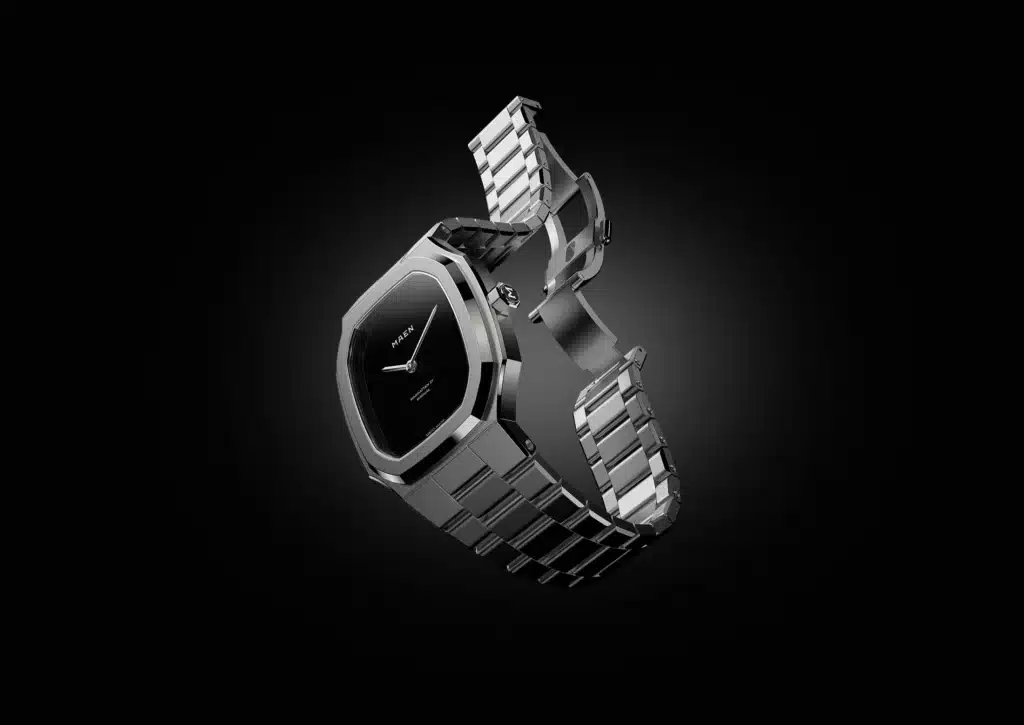
The current Tuscan-dial Manhattan 37 Ultra-Thin uses the small-seconds La Joux-Perret D100, while this collection moves to the D101, the two-hand sibling in the same family. Both are modern takes on the old Peseux 7001, sharing the 21,600 vibrations per hour, the roughly 50-hour reserve, and the 18-jewel layout. So the stone models are true two-handers now, hours and minutes only, with the caliber on show through a sapphire caseback dressed in Côtes de Genève and blued screws.
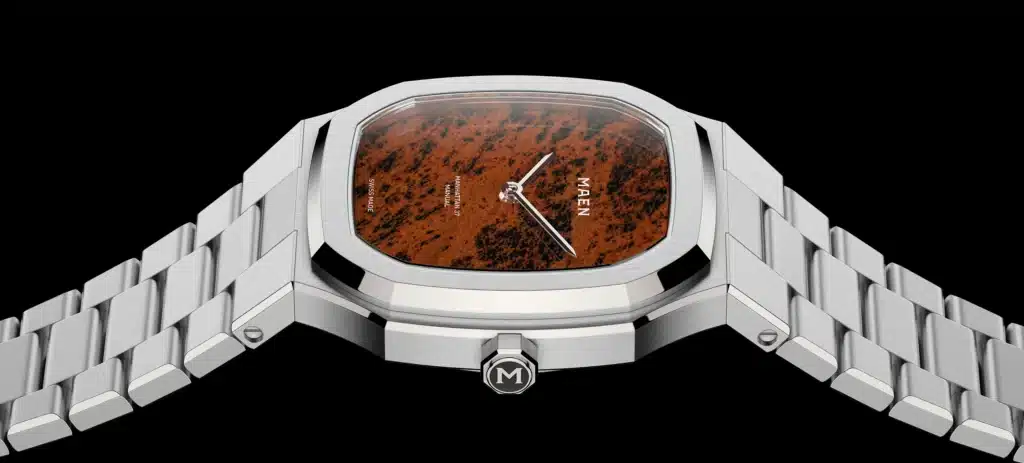
The rest of the package carries over from the Ultra-Thin. You get a 37mm steel case at 7.1mm thick and 47.4mm lug to lug, sapphire front and back, 100m of water resistance, and the integrated bracelet with its concealed butterfly clasp and four-screw caseback mount. It’s a lot of watch to keep consistent, though, and that’s the open question with a permanent stone collection.
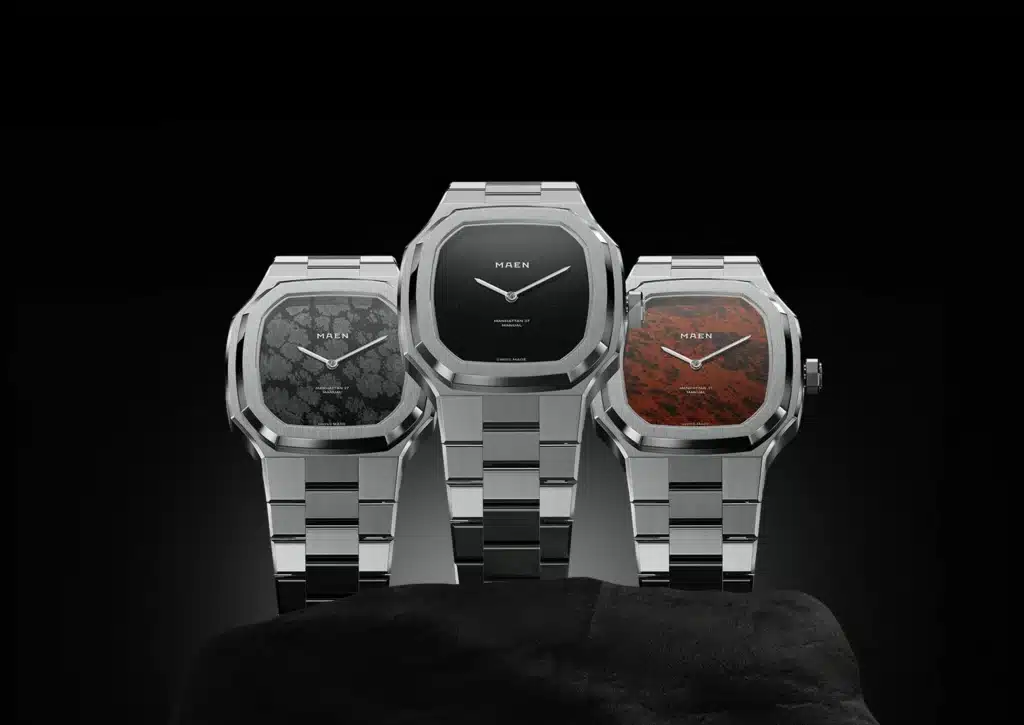
Natural stone is variable by definition, and sourcing the same material at the same quality across a long production run is harder than stamping a textured dial. Pricing for these is $1,601.

Co-Founder & Senior Editor
Michael Peñate is an American writer, photographer, and podcaster based in Seattle, Washington. His work typically focuses on the passage of time and the tools we use to connect with that very journey. From aviation to music and travel, his interests span a multitude of disciplines that often intersect with the world of watches – and the obsessive culture behind collecting them.