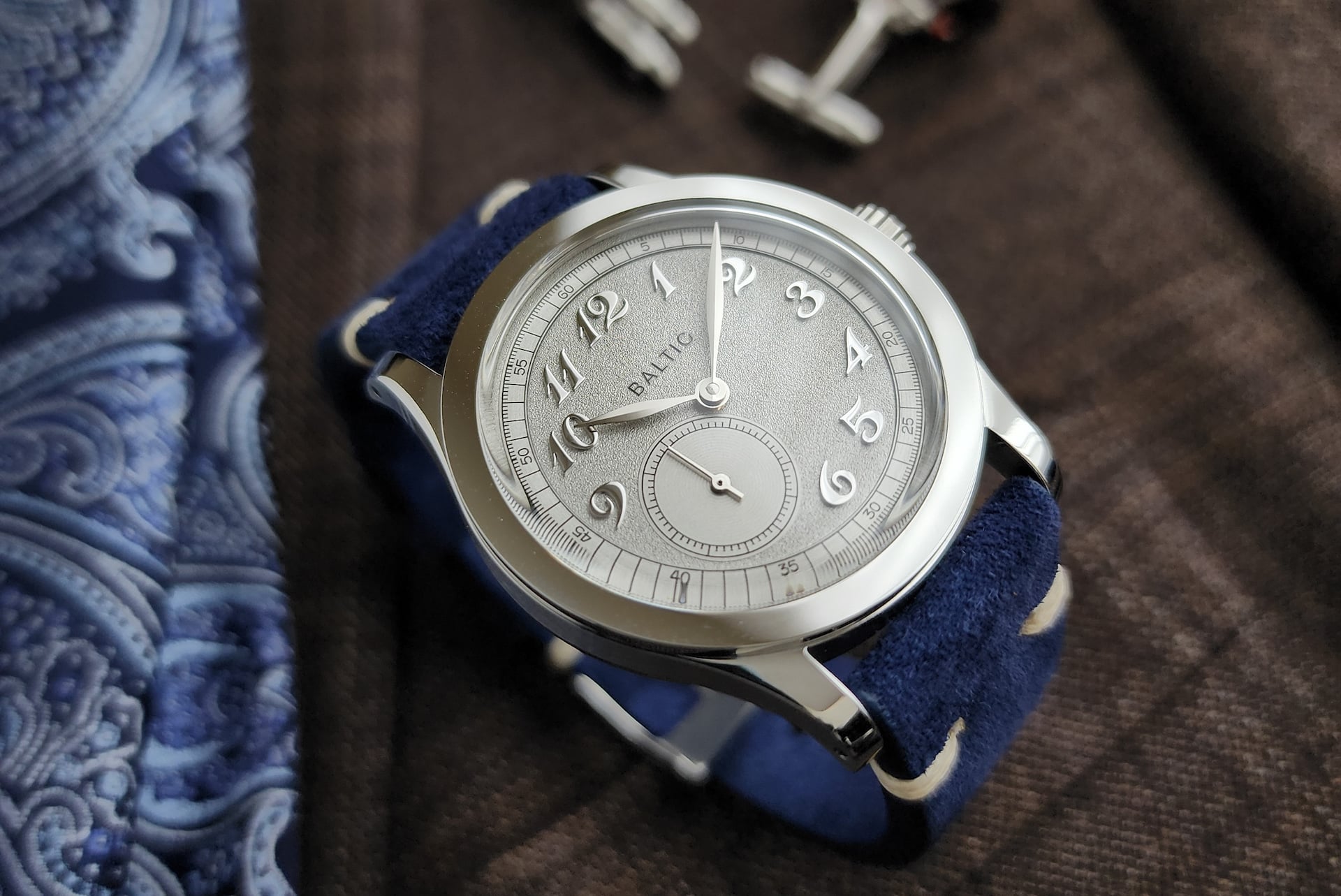
There’s nothing wrong with defaulting to Swiss watches. Most of us who collect watches have done it, especially when we want something familiar, well-established, and easy to place in the larger watch landscape. But after enough time spent wearing French watches, we’ve started to wonder why we treat them as the niche microbrand alternative rather than part of the main conversation. Brands like Baltic, Serica, Yema, and Wolbrook have all given us watches that felt distinctly their own, whether through unusual design choices, a different take on familiar vintage cues, or simply the kind of character that makes you want to keep wearing them. That makes them worth looking at when the usual Swiss options start feeling a little predictable.

At TBWS, we’ve spent more than a decade reviewing watches by doing what matters most to collectors: putting them on our wrists and living with them. That means noticing which designs still work after the initial novelty wears off, which ideas feel clever in practice, and where a watch asks you to accept a compromise. Our French watch reviews have given us plenty of those moments, and they’ve also made one thing clear: these brands aren’t simply offering consolation prizes to someone who wanted a Swiss watch. They have their own mix of design identity, revived heritage, tool-watch credibility, and enthusiast appeal, and for collectors looking beyond the usual Swiss lane, that can be reason enough to take a closer look.
Wolbrook Skindiver “Douglas” Reissue
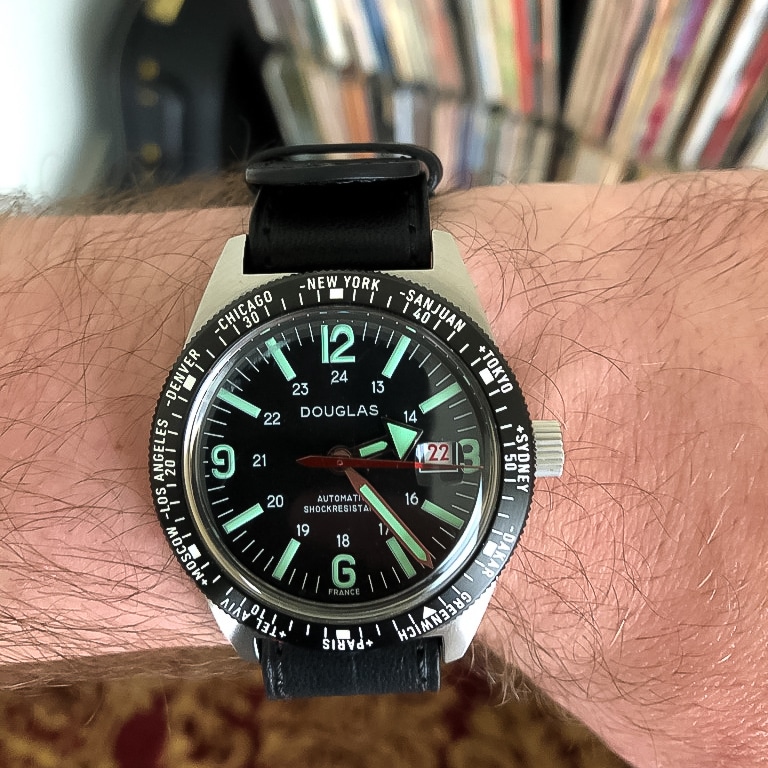
| Price: | $489 – $629 (Check current price) |
| Water Resistance: | 100m |
| Case Dimensions: | 40mm (diameter) x 48mm (lug-to-lug) x 11mm (thickness) |
| Lug Width: | 20mm |
| Movement: | Miyota 8215 automatic |
The Wolbrook Skindiver “Douglas” Reissue is a good reminder that French watches don’t need to imitate Swiss formulas to give a collector something familiar. Yes, the watch arrives with the entertaining possibility that this Wolbrook style may have crossed paths with Neil Armstrong during the space race. We wouldn’t build a buying decision around that story, though. The connection is too murky, and horological mythology has a habit of growing legs. What matters more for this particular Swiss alternative is that Wolbrook has given a vintage skindiver its own personality instead of serving up another familiar-looking dive watch with a different logo.
According to our review team’s insights, the case helps. At 40mm wide, 48mm lug-to-lug, and roughly 11mm thick, the Douglas has the proportions we tend to appreciate on the wrist, not on a product page. The straight lugs keep the case sitting relatively flat, so it doesn’t feel like a chunky metal slab during everyday wear and slips under a cuff without much fuss. It still has enough heft to feel substantial, but that compact footprint makes it more approachable than many contemporary divers. The catch is that anyone used to an actual vintage skindiver will notice the difference immediately. The reissue has more mass and feels less delicate, which is the trade-off for making an old-school design easier to live with.
Then there are the details that make the Douglas feel like a French interpretation rather than just a Swiss substitute. The worldtime bezel gives the watch a little eccentricity, even though it isn’t a true worldtimer and shouldn’t be treated like one. The polished red second hand, roulette date, and cyclops tucked under the crystal add small flashes of personality without pushing the design into costume-watch territory. Meanwhile, the modern construction makes more practical sense for daily ownership: there’s sapphire crystal, a Miyota 8215 automatic movement, and even a quartz version using Seiko’s VH31 sweeping-seconds movement. None of this reinvents watchmaking, but that’s almost the point. Wolbrook takes a vintage formula and updates the bits you’re more likely to appreciate after six months of wearing it.
That also explains who this makes sense for. The Douglas isn’t the choice for someone chasing absolute vintage purity, and the modern upgrades do soften some of the original skindiver character. The worldtime bezel is more a conversation piece than a travel instrument, while the Armstrong connection works better as horological folklore than a historical selling point. But for collectors looking beyond the usual Swiss lane, the Douglas shows what can make a French brand worth the detour: familiar watchmaking ingredients, some genuinely quirky design decisions, and enough individuality that it doesn’t feel like a substitute for something from Switzerland.
Pros
- Compact 40mm proportions and straight lugs keep it planted and comfortable through a full day.
- Sapphire, the Miyota 8215, and the VH31 quartz option make the vintage-inspired design easier to live with.
- At 11mm thick, it has useful presence without the usual modern-diver bulk.
- The red second hand, roulette date, and worldtime bezel keep the dial from feeling generic.
Cons
- The reissue feels heavier and less nimble than a true vintage skindiver.
- The Armstrong connection is entertaining, but too uncertain to treat as meaningful provenance.
- The worldtime bezel is more visual character than a genuinely useful travel function.
- Its modern execution loses some of the raw charm vintage-skindiver purists may want.
Baltic Hermétique Tourer
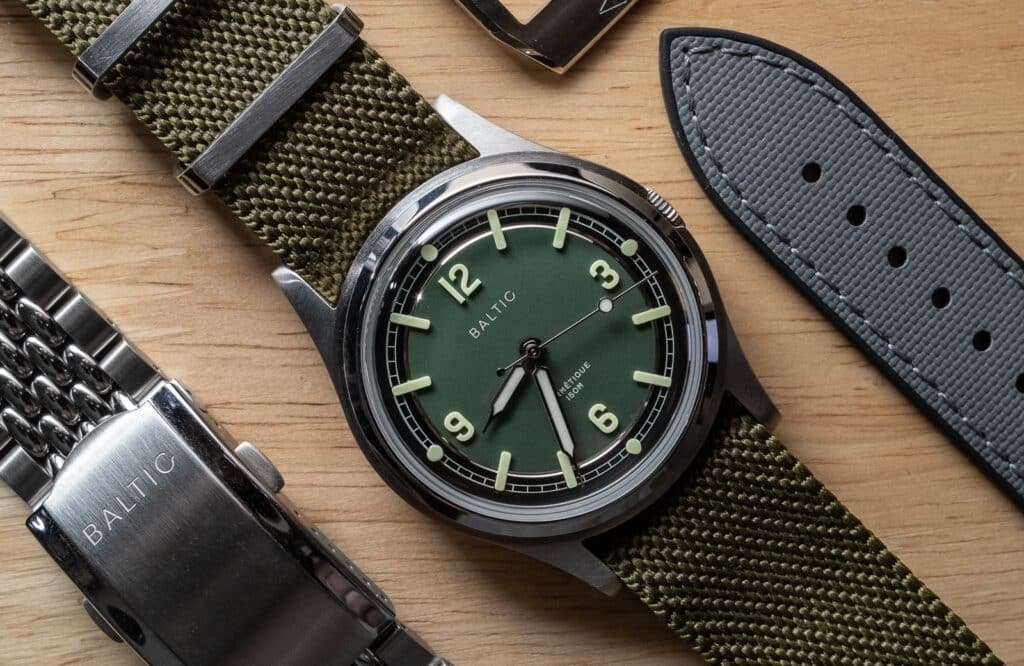
| Price: | $620 – $710 (Check current price) |
| Water Resistance: | 150m |
| Case Dimensions: | 37mm (diameter) x 46mm (lug-to-lug) x 10.8mm (thickness) |
| Lug Width: | 20mm |
| Movement: | Miyota 9039 Automatic |
The Baltic Hermétique Tourer makes a pretty strong case for looking outside the usual Swiss field-watch lane because it doesn’t behave like a conventional field watch at all. We found it sits somewhere between field-watch practicality and dress-watch polish, which sounds like the sort of compromise that could go badly wrong. Instead, the combination works. The 37mm case, 46mm lug-to-lug, and 10.8mm thickness keep it compact and comfortable, while the fully brushed case and narrow polished bezel give it enough visual lift that it never feels like a strictly utilitarian tool. It’s the kind of French design approach that makes you reconsider whether a watch needs to fit neatly into one category in the first place.
The dial is where that balance becomes most obvious. Large C3 X1 Super-LumiNova-filled indices make reading the time almost automatic, with full numerals at the quarters and slim batons elsewhere, and the syringe hands and lollipop second hand keep the layout coherent. The polished ring around the dial adds some depth, and the boxed double-domed sapphire gives it a warmer, slightly more vintage feel. There’s a catch: Baltic uses very little anti-reflective coating, so reflections can show up at certain angles. Still, in low light the lume gives off a steady green glow, and the dial stays legible without needing a minute-long inspection every time you glance down.
Then there’s the stuff we tend to appreciate more after the honeymoon period. The Miyota 9039 is a dependable automatic, and our full review notes that the movement delivered about +3 seconds per day in testing. The watch also gives you meaningful choices in how it wears: beads-of-rice and flat-link bracelets, plus an FKM Tropic strap, all using quick-release spring bars. The bracelets offer plenty of micro-adjustment, although the clasps themselves are quite basic. The flush crown is another deliberate design decision that keeps the case profile very clean and helps preserve the 150m water resistance. However, that same tucked-away position makes manual winding more awkward when you need it.
That’s ultimately why the Hermétique Tourer works so well among French alternatives. It isn’t trying to out-Swiss a Swiss watch with a specification arms race. It offers something harder to quantify: a field-watch foundation with enough polish to cross into dressier territory, while remaining comfortable, legible, and useful. For a collector who wants a daily wearer but finds conventional field watches a little too plain, this is the sort of watch that earns its place through versatility rather than volume. And considering how easily Baltic could have overdone the polished details, the restraint is probably the best part.
Pros
- The 37mm case and 46mm lug-to-lug make for an easy, long-wear fit.
- Strong lume and a clean handset keep the dial highly legible.
- 150m water resistance gives the refined case some real-world utility.
- Quick-release bracelets and FKM strap options make changing the watch’s personality painless.
- The polished bezel and boxed sapphire add character without turning fussy.
Cons
- The nearly flush crown makes hand-winding unnecessarily fiddly.
- Sparse AR coating allows reflections to interfere at certain angles.
- The bracelet clasps feel less refined than the rest of the watch.
- Its polished, dress-adjacent personality may not satisfy anyone wanting a purely utilitarian field watch.
Baltic MR01
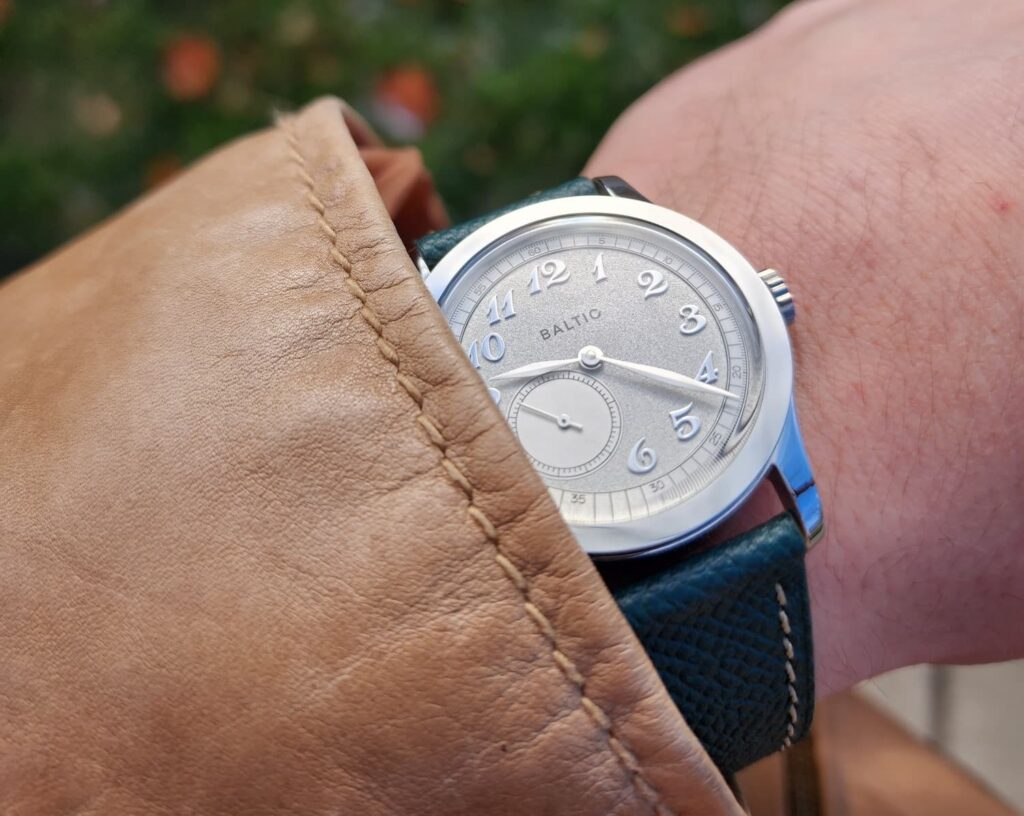
| Price: | $625 – $700 (Check current price) |
| Water Resistance: | 30m |
| Case Dimensions: | 36mm (diameter) x 44mm (lug-to-lug) x 9.9mm (thickness) |
| Lug Width: | 20mm |
| Movement: | Hangzhou 5000a automatic |
The Baltic MR01 makes a convincing case that a French watch doesn’t need Swiss ingredients to deliver the kind of experience collectors associate with dressier, more traditional pieces. Its 36mm case and sub-10mm thickness keep everything compact and restrained, and that restraint does a lot of the work. No oversized case or wall of polished metal tries to announce itself from across the room. On the wrist, it feels more like a watch that rewards closer inspection, which is exactly what we found happening every time we wore it.
Most of that inspection starts with the dial. The fine sand-textured silver surface shifts subtly with the light, while the offset guilloché small-seconds display adds enough visual complexity without turning the dial into a decorative exercise. Polished Breguet numerals pick up softer light nicely, and the domed Hesalite crystal contributes some gentle distortion around the edges that gives the whole thing a warmer, older feel. Sapphire would be tougher and more practical, but it would also remove some of the MR01’s personality. This is one of those cases where the slightly inconvenient choice is also the one we prefer.
Turn it over, and Baltic makes the movement part of the experience rather than something you forget exists. The display caseback exposes the Hangzhou 5000a, with polished bridges, perlage, and gold-tone engraving that give it far more visual interest than we’d expect at this price. During our extended time with the MR01, its 42-hour power reserve and everyday timekeeping never raised concerns. For collectors weighing French brands against the usual Swiss options, that matters: the watch doesn’t need Swiss pedigree either to make the mechanical side interesting.
That said, there are limits, and they’re worth accepting before buying. At 3 ATM, this isn’t a watch for careless sink-side duty, and Hesalite will scratch more readily than sapphire. The Hangzhou movement may also give some buyers pause simply because they’re more comfortable with Swiss or Japanese calibers. But those compromises are part of the package, not hidden behind marketing language. The MR01 works for the collector who wants compact proportions, old-school visual warmth, and a mechanical watch with genuine character, without paying Swiss-brand premiums simply for the name.
Pros
- The 36mm, sub-10mm case gives it genuinely compact, refined proportions.
- The textured dial, guilloché seconds display, and Breguet numerals add depth without visual clutter.
- Hesalite adds a warmer, more vintage-looking character than sapphire would.
- The decorated Hangzhou 5000A makes the movement worth viewing through the display caseback.
Cons
- 3 ATM water resistance makes it poorly suited to casual water exposure.
- Hesalite will show scratches more readily than sapphire.
- Some collectors may hesitate over the Chinese-made movement rather than Swiss or Japanese provenance.
Baltic Aquascaphe
| Price: | $690 – $770 (Check current price) |
| Water Resistance: | 200m |
| Case Dimensions: | 39mm (diameter) x 47mm (lug-to-lug) x 12mm (thickness) |
| Lug Width: | 20mm |
| Movement: | Miyota 9039 (Mechanical Movement) |
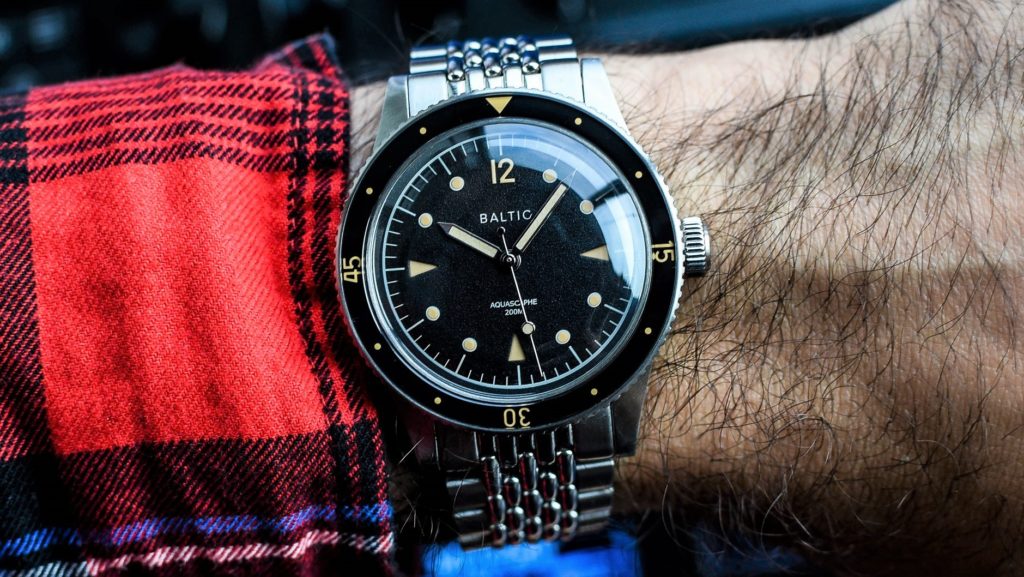
The Baltic Aquascaphe is probably the easiest watch here to explain to someone who normally shops Swiss: take the familiar idea of a compact mechanical diver, strip away the unnecessary bulk, and focus on how it behaves all day. The case comes in at under 40mm, a little over 12mm thick, with a 47mm lug-to-lug, so it has enough presence to feel like a proper diver without turning every doorway into a potential enemy. The mostly brushed finishing helps, too. After enough wrist time, we tend to appreciate a case that can meet a table edge without making us wince.
What makes the Aquascaphe more compelling as a French alternative is how little of its practicality feels bolted on. The beads-of-rice bracelet drapes naturally over the wrist and tapers neatly toward the clasp, while quick-release spring bars let us swap to the included Tropic-style rubber strap without reaching for a toolbox. That becomes pretty useful when the watch gets wet or spends a full day on the wrist. Add 200 meters of water resistance, and the Aquascaphe stays compact without asking us to treat it like a delicate little diver.
The dial is just as disciplined. Its sandwich construction gives the indices some physical depth, while the matte surface, restrained gilt accents, pencil hands, and lollipop second hand keep everything easy to parse at a glance. During our testing period, the BGW9 lume stayed bright and evenly distributed well into the night, which matters once the watch is being used rather than photographed. The sapphire bezel insert is another quietly useful choice, adding scratch resistance where a diver is most likely to collect knocks and marks. None of these touches feel decorative for decoration’s sake; together, they make the watch easier to read and live with.
The Miyota 9039 fits that no-nonsense approach nicely, running at 28,800 vph with around 42 hours of power reserve. The no-date layout also keeps the two-position crown quite straightforward, although that same simplicity means there’s no date when you need one. Our other reservation is aesthetic: the predominantly brushed case leaves little polished contrast for anyone who likes a bit more visual sparkle. But that’s hardly a dealbreaker. For collectors looking beyond Swiss divers, the Aquascaphe makes its argument through execution: compact proportions, useful water resistance, comfortable wearing options, and enough dial character to avoid feeling like a generic tool watch with a French name attached.
Pros
- The sandwich dial and evenly spread BGW9 lume keep it highly legible after dark.
- The compact case wears comfortably without feeling insubstantial.
- The beads-of-rice bracelet and quick-release strap system make long-term wear more flexible.
- 200m water resistance gives it plenty of real-world aquatic capability.
- The sapphire bezel insert adds practical scratch resistance.
Cons
- The no-date layout means less convenience for calendar checks.
- The predominantly brushed finish may feel too restrained for collectors who want more polished contrast.
Serica 5303-2
| Price: | $1,720 – $1,950 (Check current price) |
| Water Resistance: | 300m |
| Case Dimensions: | 39mm (diameter) x 46mm (lug-to-lug) x 12.2mm (thickness) |
| Lug Width: | 20mm |
| Movement: | Soprod Newton (current model has Soprod M100) |
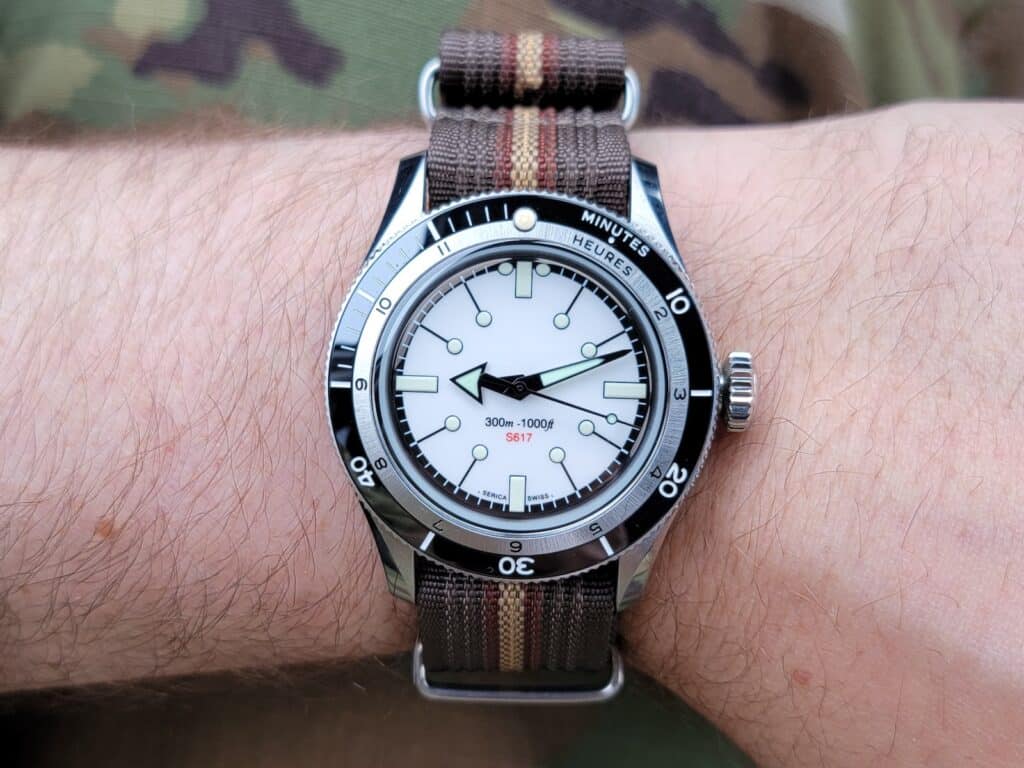
If you usually default to Swiss dive watches because you want something proven but are getting tired of seeing the same basic formula repeated, the Serica 5303-2 is the sort of French alternative that gets interesting quickly. We found that out after spending proper time with it. Rather than polishing up the familiar black-and-blue diver formula, Serica takes the category in its own direction with a 39mm case, 46mm lug-to-lug, 12.2mm thickness, and an enormous 8mm crown that’s easy to grab. The mixed brushing and polished lug chamfers add visual sharpness, but the metallic silver dial does most of the talking. Depending on the light, it can look almost matte white, with geometric markers and deliberately restrained branding making it immediately recognizable without resorting to shouting.
Then there’s the bezel, which looks complicated enough to make us wonder whether Serica had a quiet argument with the concept of simplicity. Fortunately, the complexity earns its keep. The black ceramic outer scale tracks elapsed time, and the steel inner 12-hour scale gives you a second-time-zone reference without adding a GMT hand. After enough time with it, the layout stopped feeling busy, and the crisp 120-click action, with no noticeable play, made the bezel satisfying to operate. Strong lume also keeps the dial legible after dark. The integrated mesh bracelet is less polished, though. The clasp can feel sharp; there’s no safety catch, and the bracelet finishing falls a little short of the case and dial. Thankfully, the standard 20mm lug spacing means you’re not stuck with it.
The movement is another reason the 5303-2 works as a serious alternative rather than a novelty French microbrand watch. Our review example used the earlier Soprod Newton. It remained dependable for everyday use, although we encountered occasional quirks with crown engagement and hacking. Serica has since moved to the revised Soprod M100 in newer examples, addressing those concerns without sanding away the personality that makes the watch worth considering in the first place. That’s the sort of update we like seeing because it reflects how a watch evolves after real-world use rather than pretending the first version was beyond criticism.
That’s where the 5303-2 earns its place in this conversation. It isn’t trying to be the easiest diver to understand, and it certainly won’t disappear into the background. The dual-scale bezel takes some learning, the mesh bracelet has rough edges, and the design asks for a little more attention than a standard diver. But for collectors who already know what competent Swiss divers can do and want something with more personality, the Serica offers a useful reminder: an alternative doesn’t have to be a downgrade.
Pros
- The distinctive silver dial and geometric markers give it a clear identity beyond standard diver designs.
- The dual-scale bezel provides elapsed-time and second-time-zone functionality in one package.
- Crisp bezel clicks, strong lume, and the oversized crown keep the eccentric design practical.
- Compact 39mm proportions make the watch easy to handle without feeling undersized.
- 20mm lug spacing makes replacing the mediocre mesh bracelet straightforward.
Cons
- The bezel layout takes time to read naturally.
- Bracelet finishing doesn’t quite live up to the case and dial.
- The mesh clasp can feel sharp and lacks a safety catch.
Yema Yachtingraf Heritage
| Price: | $1,850 – $2,250 (secondary market/pre-owned) |
| Water Resistance: | 100m |
| Case Dimensions: | 39mm (diameter) x 45.5mm (lug-to-lug) x 15.35mm (thickness) |
| Lug Width: | 19mm |
| Movement: | ETA Valjoux 7753 |
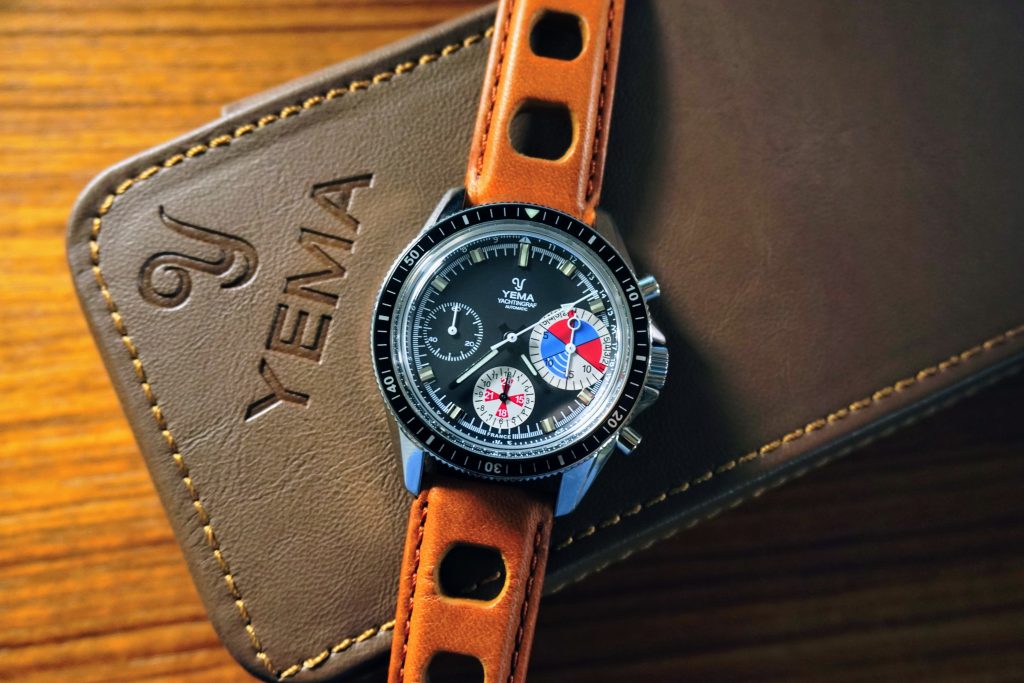
The Yema Yachtingraf is a useful reminder that looking for a Swiss alternative doesn’t mean looking for a simpler watch. This thing is gloriously busy. The colorful regatta-style dial, oversized minute counter, narrow bezel, and compact 39mm case all compete for attention, and the 15mm thickness adds another layer. We needed some wrist time before the layout felt natural, but that learning curve is part of the appeal. The short lugs keep the case from sitting quite as tall as the measurements suggest, though smaller wrists will still notice the height. For collectors bored with chronographs that all seem to have attended the same design seminar, the Yachtingraf at least has the decency to be weird.
The dial is where that character really earns its keep. The oversized minute counter at 3 o’clock gives the display a visual anchor, while the blue, red, and white details reinforce the sailing theme without making the watch feel like a prop from a yacht club gift shop. The domed crystal and slim bezel pull the eye inward, helping bring order to what initially looks like a lot of information. It never becomes perfectly legible, though. The black hands can disappear against the lighter sub-dials in certain conditions, especially in poor light. The friction-fit bidirectional bezel is another vintage-minded decision. It lacks satisfying modern clicks, but stays put during normal timing, while the extra inner markings add period character at the cost of a little more visual clutter.
The Valjoux 7753 movement gives the Yachtingraf a mechanical personality that fits the rest of the package. The pushers have a crisp, satisfying action, and the movement hacks. It ran consistently during our hands-on time. That said, we did catch the chronograph second hand failing to return perfectly to zero on some occasions, and the rotor makes itself known with an audible whirr when the watch is off the wrist. The crown is also awkward to grip because of the tight guards. None of these quirks make the watch unusable, but they do reinforce that this is a recreation of an older idea rather than a vintage-looking case wrapped around thoroughly modern ergonomics. The included leather straps help enormously here, feeling substantial and matching the watch instead of leaving us immediately wondering what strap to buy next.
That mix of charm and compromise is why the Yachtingraf belongs in this discussion. It won’t appeal to anyone who wants a chronograph that’s immediately intuitive, thin, and surgically legible. For collectors who enjoy vintage-inspired complications, sailing-watch character, and designs that leave a little roughness showing around the edges, it offers something the safer Swiss alternatives often don’t: an actual point of view. The price of admission is a thick case, a fussy bezel, and a few mechanical quirks. We’d take that trade more readily here because the quirks are part of what makes the Yachtingraf memorable.
Pros
- The colorful regatta dial and oversized minute counter give the watch genuine personality.
- Crisp chronograph pushers and the Valjoux 7753 make it enjoyable to operate.
- The supplied leather straps suit the watch naturally and feel considered.
- Short lugs help the 39mm case sit more securely than its 15mm thickness implies.
Cons
- The 15mm case can feel top-heavy, especially on smaller wrists.
- Black hands can disappear against the lighter sub-dials in low light.
- The friction-fit bezel lacks the precision of a modern click-stop system.
- Tight crown guards make setting and winding less comfortable.
- Rotor noise and an occasional imperfect chronograph reset add some mechanical roughness.
We’re currently in the process of reviewing more French watch brands so be sure to keep an eye out for future updates to our list here. They all won’t make it, but the ones that do are clearly worth taking note of.

Co-Founder and Senior Editor
Kaz has been collecting watches since 2015, but he’s been fascinated by product design, the Collector’s psychology, and brand marketing his whole life. While sharing the same strong fondness for all things horologically-affordable as Mike (his TBWS partner in crime), Kaz’s collection niche is also focused on vintage Soviet watches as well as watches that feature a unique, but well-designed quirk or visual hook.