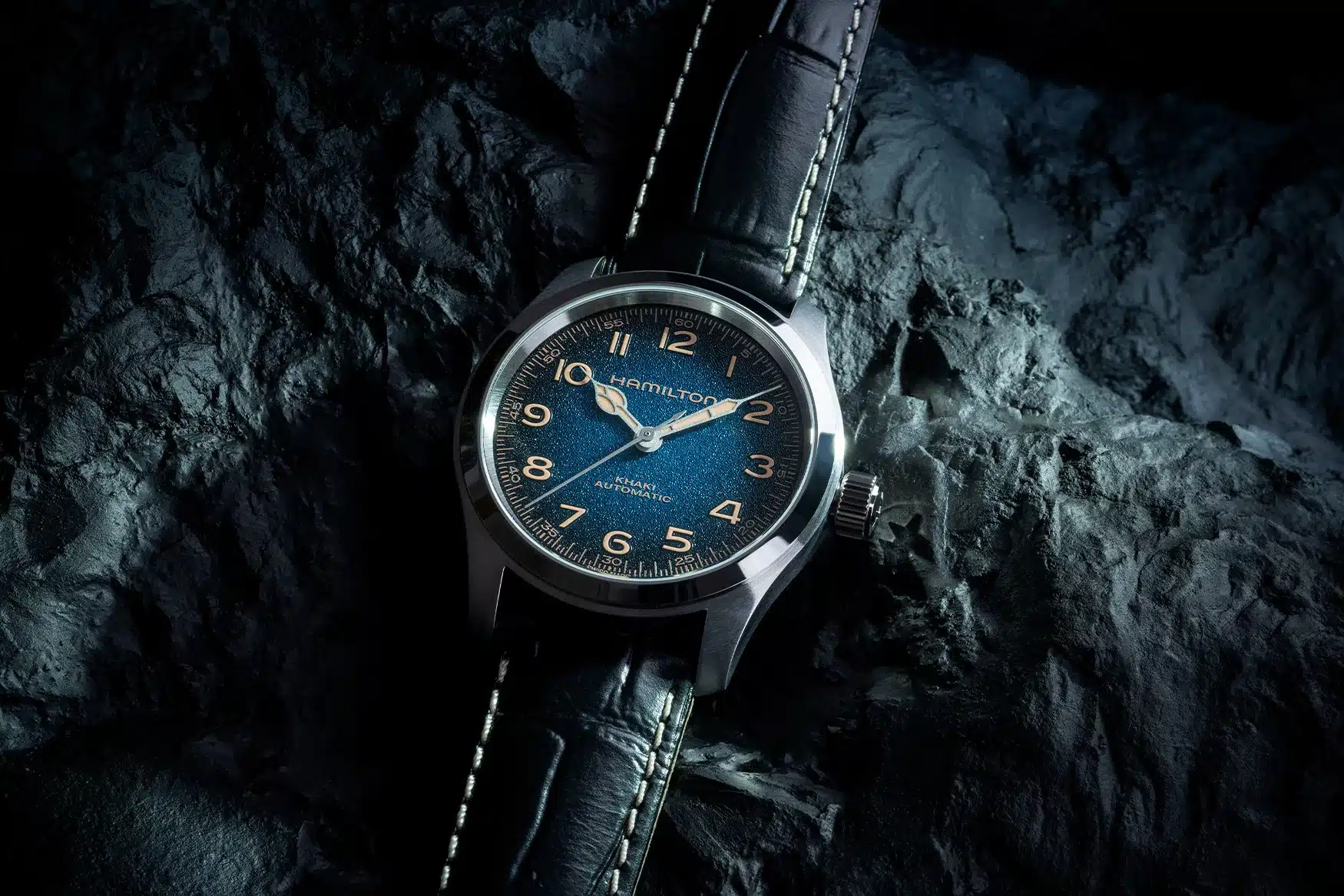
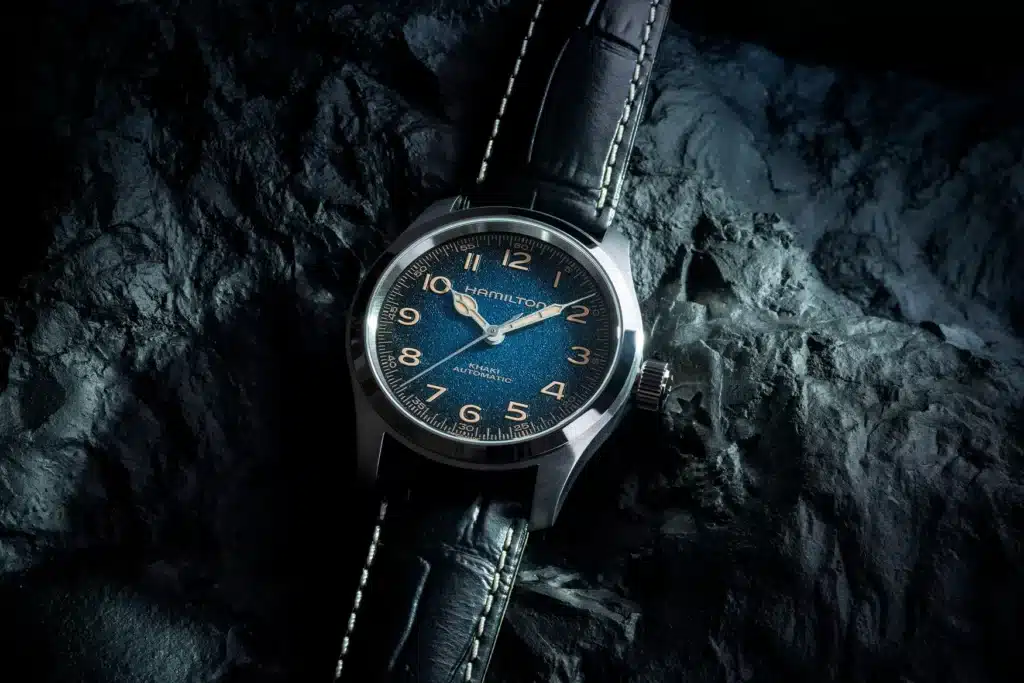
Hamilton has returned to the 38mm Khaki Field Murph with another variation, and this time the familiar Interstellar watch is getting considerably more color. The new Murph pairs the existing 38mm platform with a textured blue dial that darkens toward black at its perimeter. Hamilton says the dial was inspired by the glowing ionized gases surrounding an interstellar comet. If you ask me, that explanation feels secondary to the simpler reality: someone decided the Murph would look good in blue. I think they were probably right.
The Murph has become an interesting little franchise for Hamilton. Its origins remain closely tied to Christopher Nolan’s Interstellar, where the watch becomes central to the relationship between Cooper and his daughter, Murph. Hamilton eventually turned the movie prop into a production 42mm watch, complete with the “Eureka” Morse code detail on the seconds hand. Enthusiast demand for something smaller eventually produced the 38mm version.
That smaller watch has since become a platform of its own, including a white-dial model and now this blue version. My take is that Hamilton still has room to explore here. The Murph has enough recognition beyond the original prop that a carefully managed range of variations makes sense. There’s obviously a point where another dial color becomes another dial color, but I don’t think we’ve reached it yet.
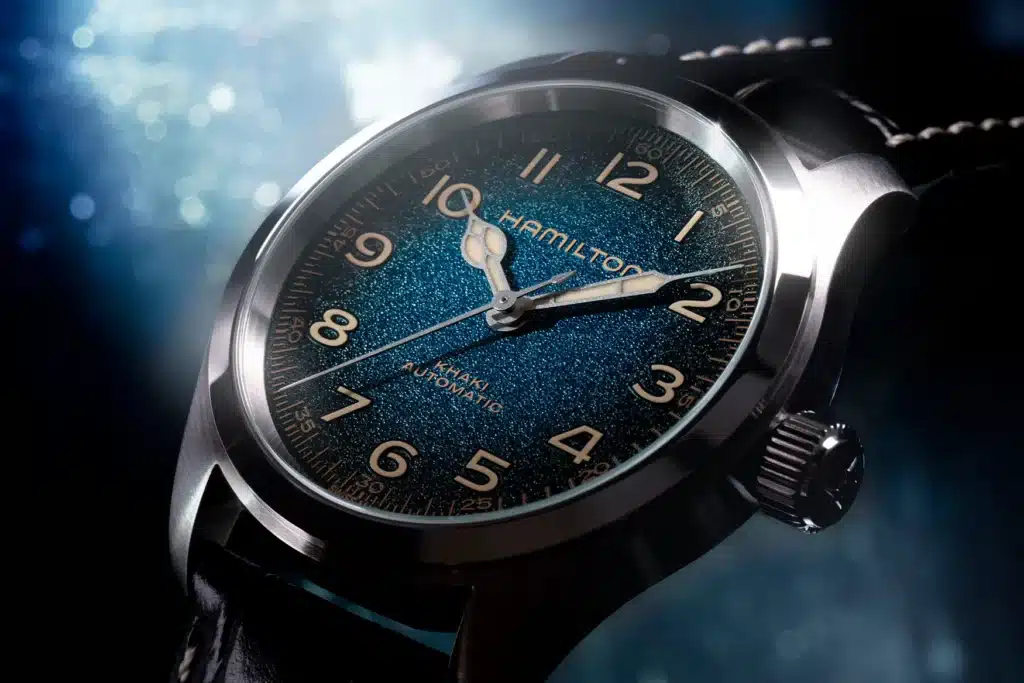
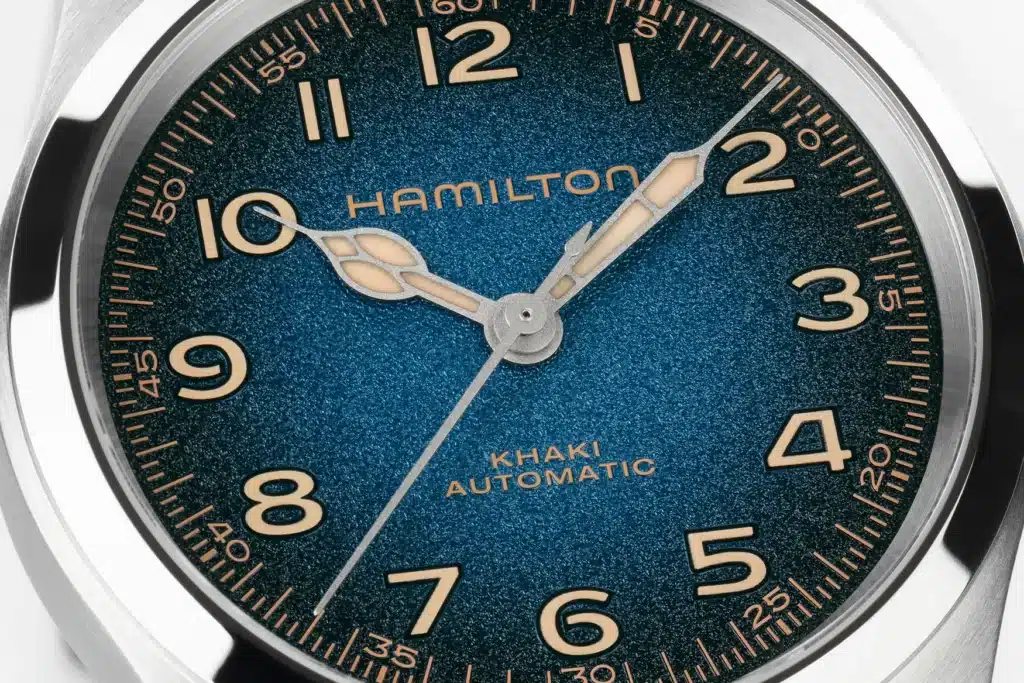
The center starts with a fairly vivid blue before transitioning toward black at the edge, while a pronounced texture gives the surface considerably more visual activity than the original Murph. Hamilton’s comet explanation gives the effect a connection to Interstellar, although I’d rather judge the dial on its own terms. To me, the appeal comes from seeing such an expressive surface inside a watch that’s otherwise remarkably familiar.
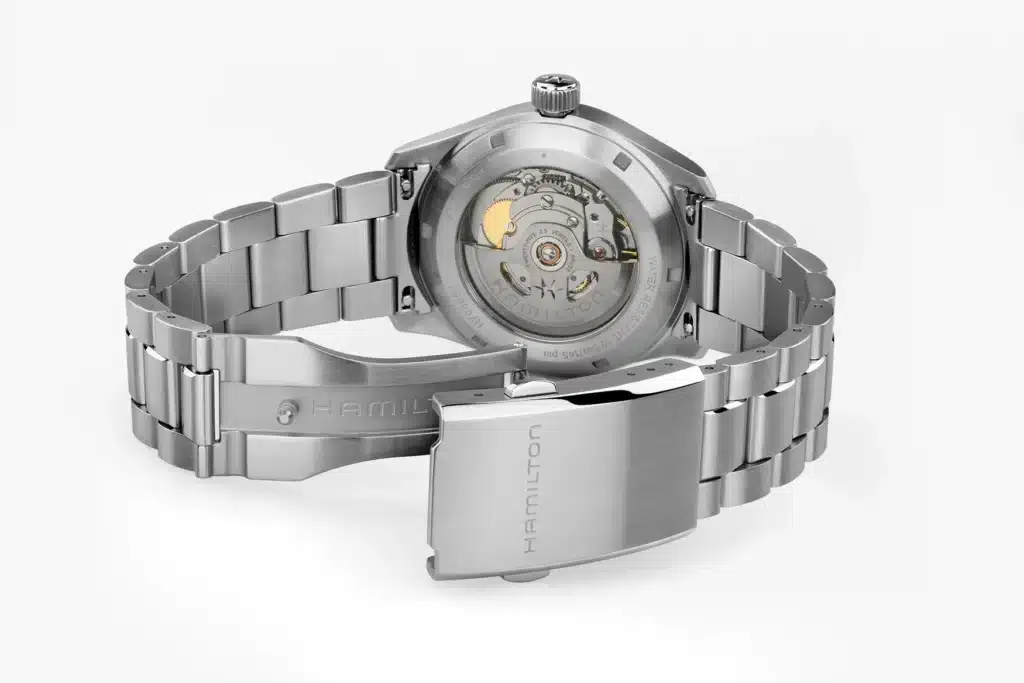
Everything surrounding it remains pretty sensible. The stainless-steel case measures 38mm wide and 11.1mm thick, with 20mm lugs, an anti-reflective sapphire crystal and 100 meters of water resistance. Inside is Hamilton’s H-10 automatic caliber, offering an 80-hour power reserve and a Nivachron balance spring. The movement can also be seen through the exhibition caseback.
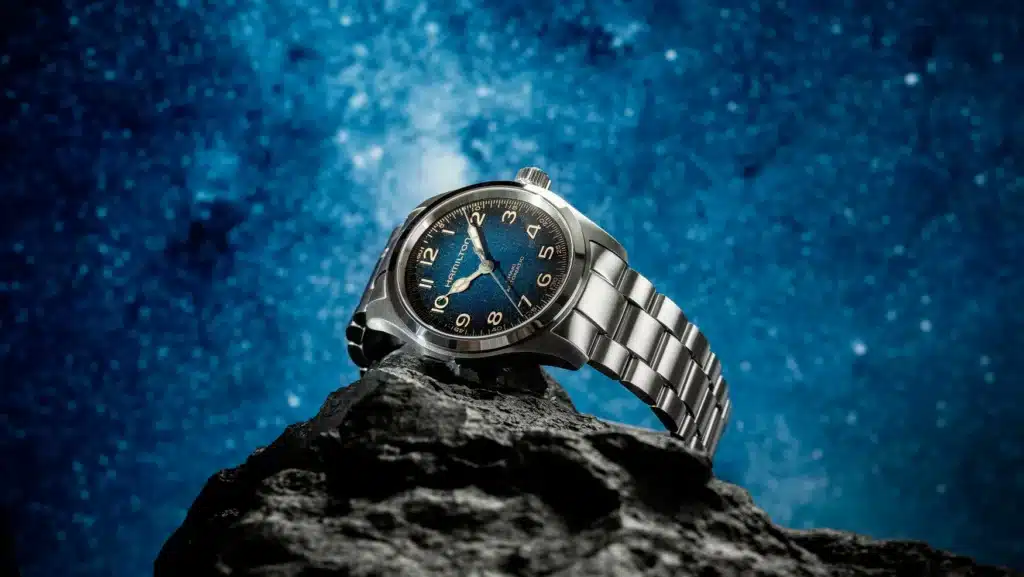
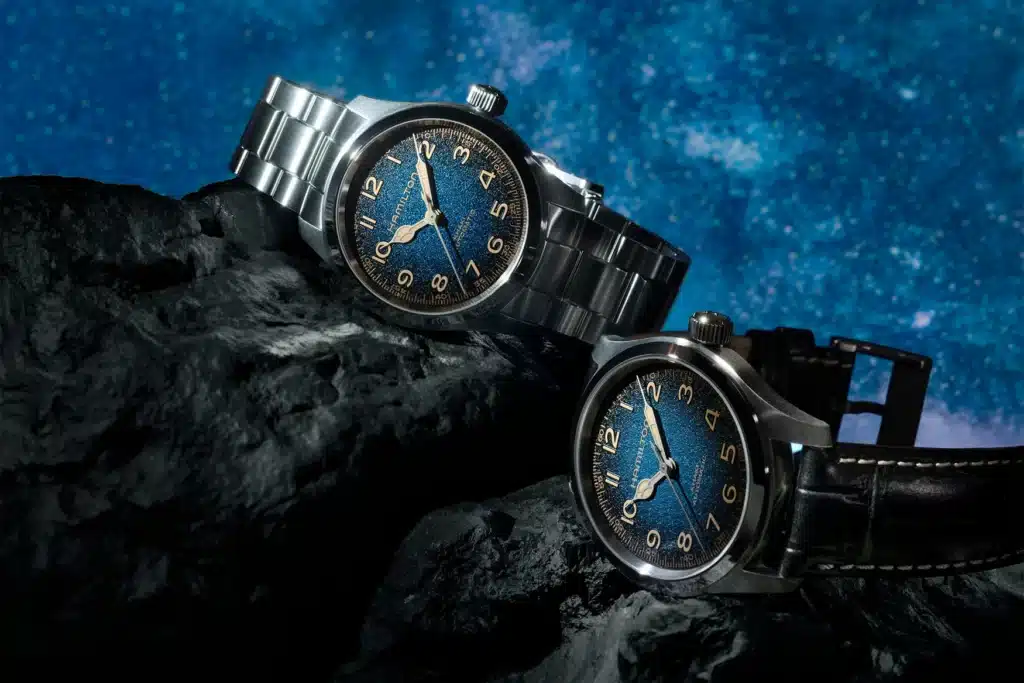
Hamilton offers the watch on black calf leather or a stainless-steel bracelet. I think the bracelet is the more interesting pairing here. Steel gives that blue dial a cooler visual frame and lets this version develop an identity slightly removed from the black-dial Murph and its more obvious movie-prop associations.
Pricing lands at $1,075 for the bracelet version and $995 on leather according to the supplied launch information. At around a thousand dollars, I think the Murph remains reasonably positioned given the established H-10 package, useful dimensions and unusually recognizable design. The curious part is that the dial becomes the primary reason to choose this one.
And that’s probably enough. If you ask me, Hamilton doesn’t need the interstellar-comet explanation to make this release interesting. The blue dial already does that job. The bigger question is how many more directions Hamilton can take the Murph before its very specific identity starts becoming less specific.

Co-Founder & Senior Editor
Michael Peñate is an American writer, photographer, and podcaster based in Seattle, Washington. His work typically focuses on the passage of time and the tools we use to connect with that very journey. From aviation to music and travel, his interests span a multitude of disciplines that often intersect with the world of watches – and the obsessive culture behind collecting them.