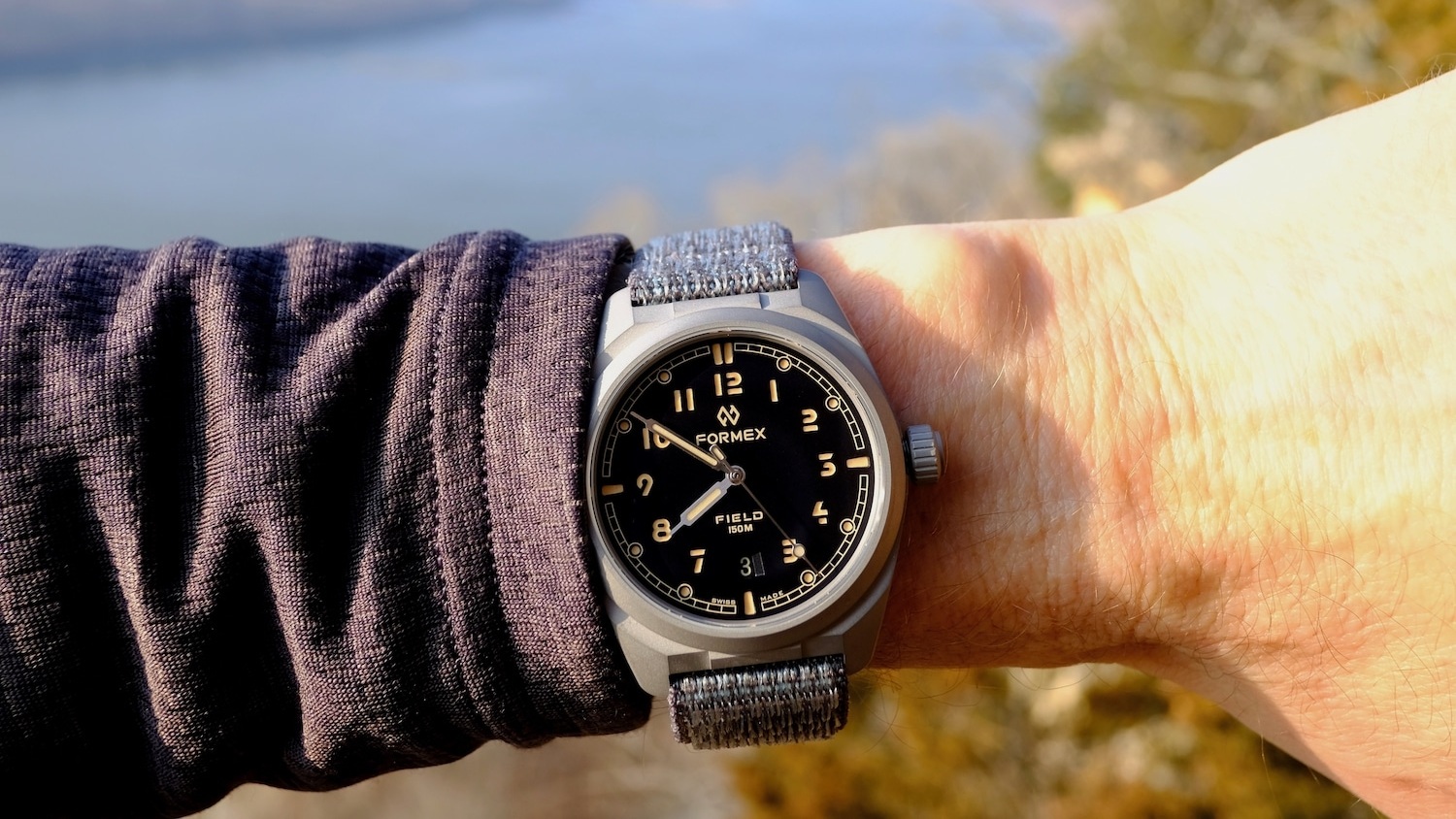
There’s no shortage of field watches that look like they were pulled from a military surplus catalog. Black dials, white numerals, a little faux patina, and just enough historical inspiration to make us wonder whether anyone involved in the design process has actually seen a field watch made after 1975. We enjoy those watches as much as anyone, but we’re also glad some brands have decided to try something else. The Formex Field Automatic and Nodus Sector II Field Titanium are two of the more interesting examples we’ve encountered.
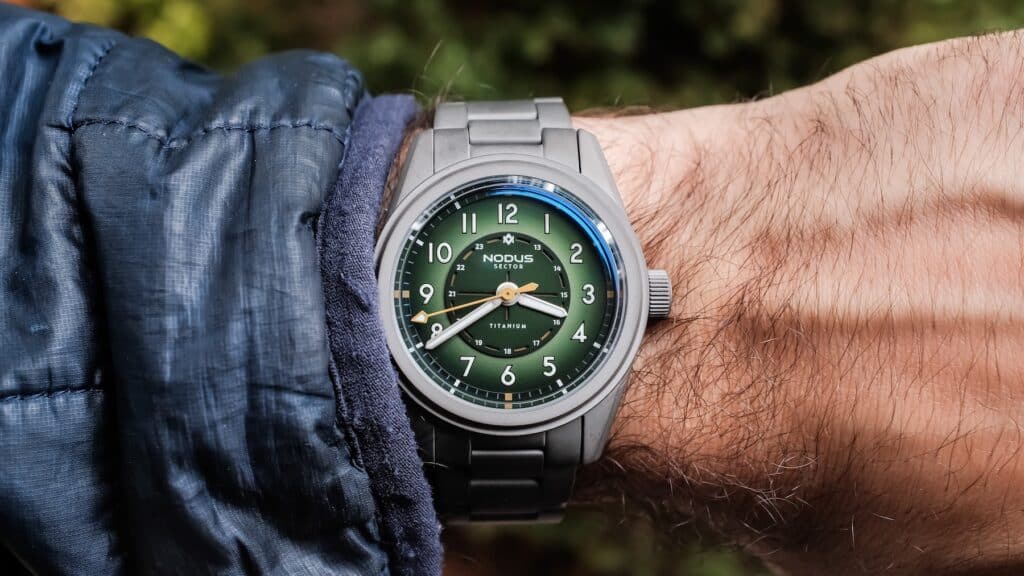
Both use titanium cases, automatic movements, and dial designs that have almost nothing in common with the usual military aesthetic. But there’s a noticeable difference in what each brand considers worth spending money on. Formex gives us a Swiss movement, some genuinely unusual dial construction, and an adjustable strap system. Nodus offers a Japanese movement, a compact case, and a full titanium bracelet with its own adjustable clasp. There’s a legitimate argument for choosing either watch, particularly once we consider how differently they approach the same basic concept.
Overview and Identity
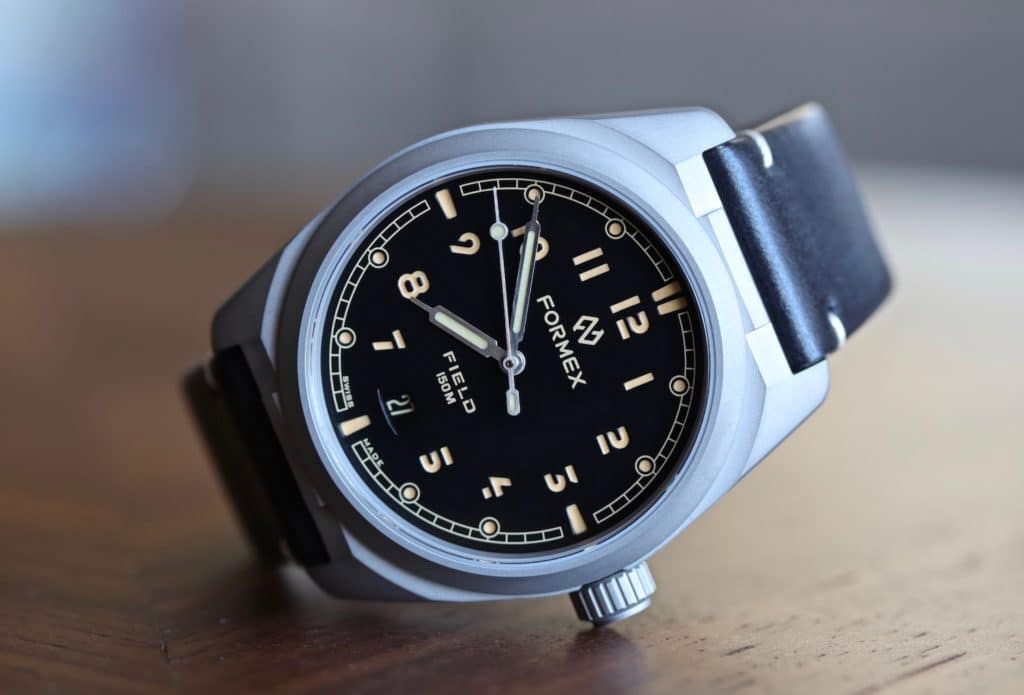
Formex has always struck us as a brand that’s more interested in solving mechanical problems than telling romantic stories about the past. Its watches tend to incorporate some unusual engineering, whether that’s a case suspension system, an adjustable clasp, or something else that makes us wonder why the company couldn’t just leave well enough alone. Most of the time, we’re glad it didn’t. The Field Automatic is a good example that reviewed hands-on. It has a dial that looks almost industrial, complete with recessed numerals and a date display integrated into a decidedly unconventional layout. There’s very little about it that feels like a traditional field watch, apart from the fact that it’s relatively lightweight, easy to read, and comfortable enough to wear outdoors. That’s arguably all the historical inspiration it needs.
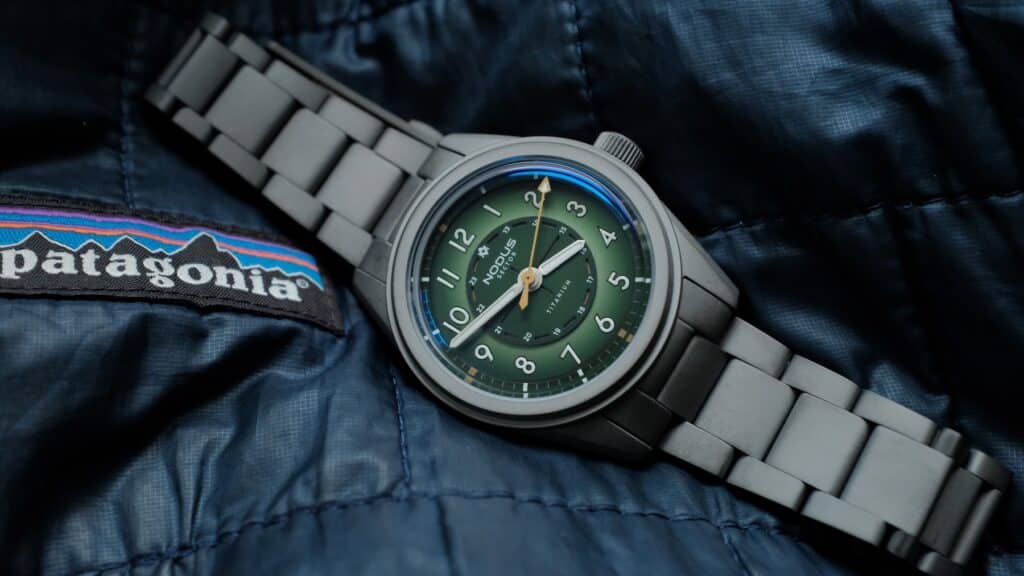
Nodus has a different identity. We’ve spent plenty of time with its dive watches and GMTs, and the Sector collection has become something of a foundation for the brand. Its recognizable case architecture carries across several models, while changes to the bezel, dial, and finishing allow each watch to develop its own personality. The Sector II Field Titanium is an extension of that approach. Nodus didn’t develop an entirely new case just to enter the field-watch category. Instead, we noted in our review that it took a design that was already working, made it in titanium, and built a dial around it that feels considerably more contemporary than most of the competition. The Sequoia dial is a particular standout, with a brighter and more colorful finish than we’re accustomed to seeing on a field watch.
Formex seems determined to prove that even an uncomplicated field watch can benefit from clever engineering. Nodus is less concerned with making a statement about how the watch was constructed and more interested in getting the complete package right.
Dial and Straps/Bracelets: Formex Innovation vs Nodus Everyday Practicality
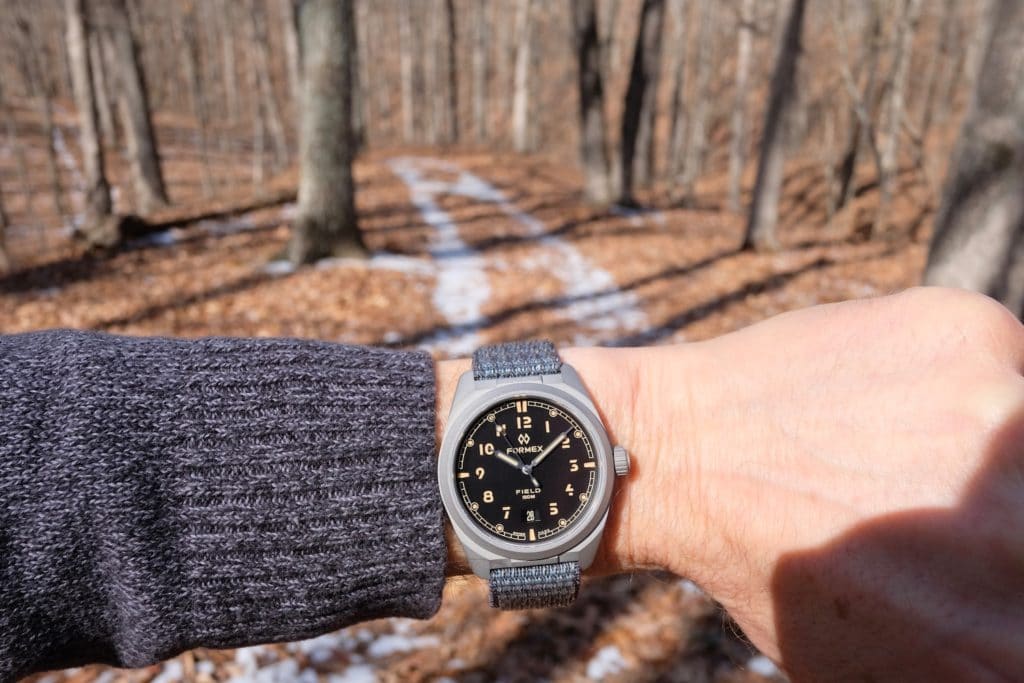
The Formex Field Automatic doesn’t seem particularly concerned with looking like a traditional military watch. Its dial has a decidedly industrial character, with recessed Arabic numerals and an outer section that slopes inward toward the center. The entire design is formed from a single stamped piece, creating the impression of multiple layers without actually stacking separate components. It’s an unusual approach, and one that gives the Formex considerably more personality than the typical black-dial field watch.
The numerals are particularly interesting because portions of them appear partially concealed depending on the viewing angle. We’d normally question whether that’s a good idea on a watch intended to prioritize legibility, but the arrangement is surprisingly easy to read. The syringe-style hands provide enough contrast against the dial, while the recessed date display manages to fit into the design without looking completely out of place. We’d still be curious to see a no-date version, but that’s more a matter of personal preference than a serious complaint about the execution.
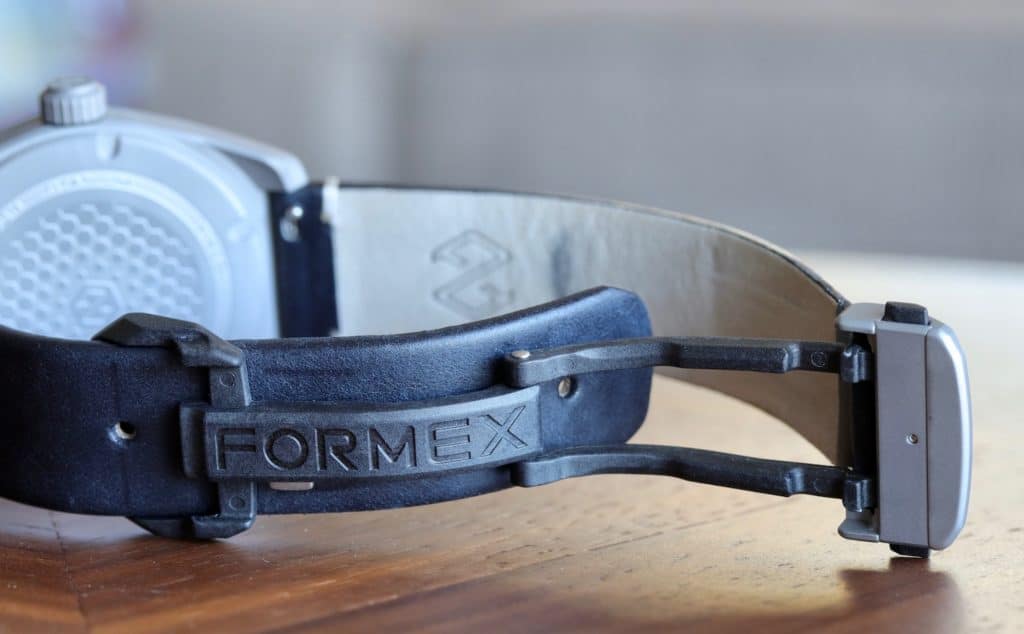
Formex also took an unconventional approach to the strap. The standard nylon option uses a one-piece construction secured with Velcro, allowing small adjustments without relying on traditional buckle holes. It’s comfortable, lightweight, and avoids some of the additional bulk associated with NATO straps. During extended wear, including time spent hiking, the strap proved particularly useful when making small adjustments throughout the day.
The optional leather strap takes things further with a carbon-composite deployant clasp and an integrated fine-adjustment mechanism. It’s arguably more engineering than a straightforward field watch needs, but we appreciate the attention to detail. The adjustment system is genuinely useful, even if the premium leather configuration feels a little less suited to the rugged personality of the watch. We’d probably stick with nylon for outdoor activities, although the deployant clasp is tempting for everyday use.
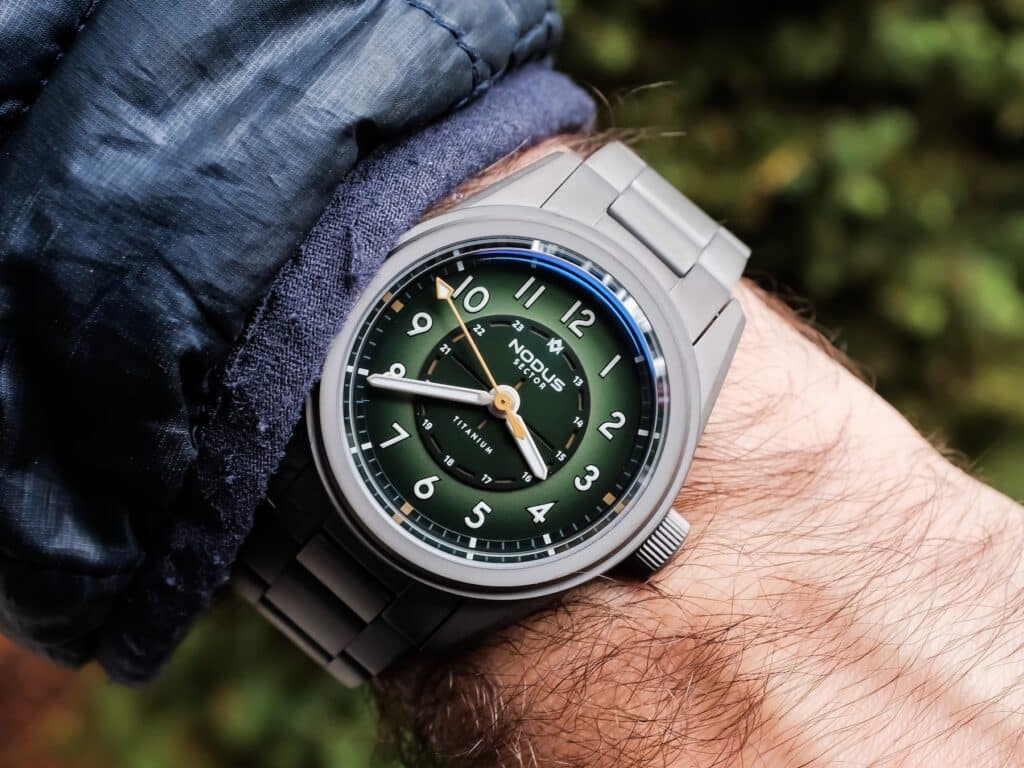
The Nodus Sector II Field Titanium offers a more familiar dial arrangement, although it isn’t exactly a traditional military design either. Its raised center section sits above a recessed numeral ring, while an elevated chapter ring frames the outer minute track. Cutouts in the dial reveal the metallic gradient beneath, creating an almost sandwich-style appearance without making the watch feel unnecessarily complicated. The effect is particularly attractive on the Sequoia green configuration, which has considerably more color than the subdued olive tones we typically associate with field watches.
There’s a lot to like about how Nodus handles the details. The green finish shifts noticeably as the light changes, and the layered construction gives the dial depth without sacrificing readability. We appreciate that the brand didn’t simply add a few military-inspired numerals to an existing Sector dial and call it finished. The design feels consistent with the broader collection, but it has enough personality to stand apart. The Formex might be the more unconventional of the two, but the Nodus feels a little easier to appreciate without having to warm up to its typography.
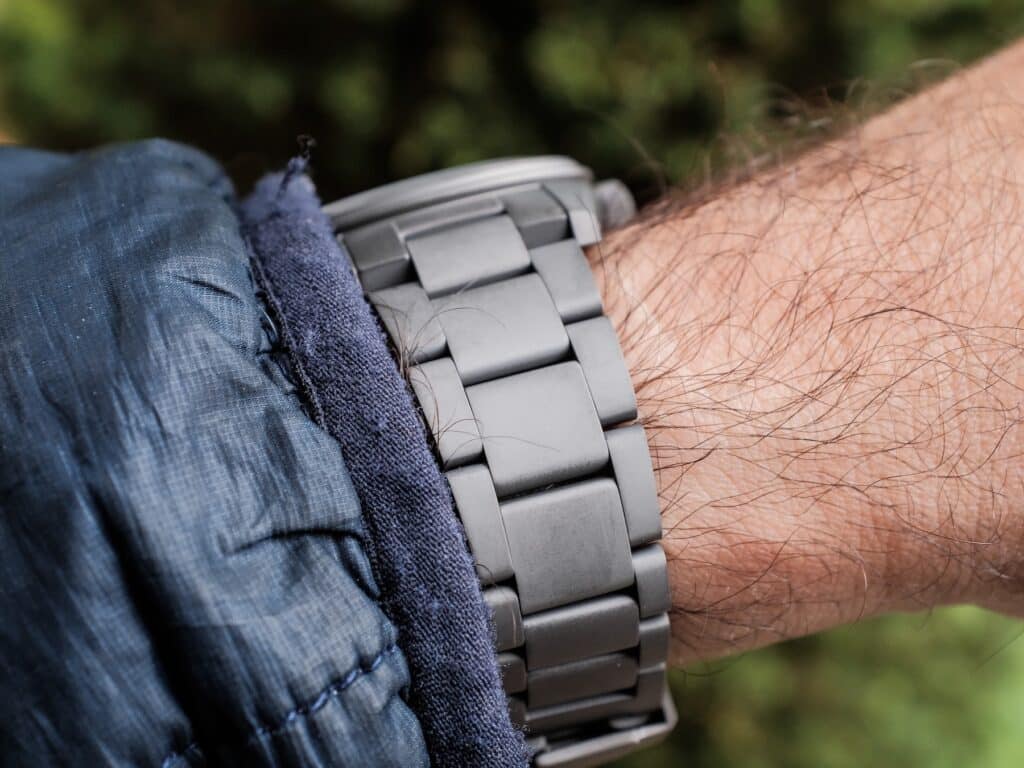
The bracelet is where the Nodus becomes particularly appealing. Its matching Grade 2 titanium construction uses solid links and tapers from 20mm at the lugs to 16mm at the clasp. The fully matte finish matches the case, giving the watch a cohesive appearance that we don’t always encounter on more affordable titanium watches. Just as importantly, the lightweight construction doesn’t come with the loose, rattling feel that can make some titanium bracelets seem cheaper than they actually are.
Nodus also includes its Extension Mechanism, which allows the clasp to be adjusted without tools. It’s a practical feature that makes a noticeable difference when our wrists change size throughout the day, and the bracelet is comfortable enough that we’d have little reason to replace it. Formex deserves credit for its innovative strap hardware, but there’s something particularly satisfying about getting a properly executed titanium bracelet included with the watch. At $625, that gives the Nodus a meaningful advantage for anyone who prefers wearing their field watches on metal.
Build Quality & Technical Approach
It’s easy to get distracted by the Swiss movement in the Formex or the complete titanium package offered by Nodus. Those differences matter, but neither watch should be judged on a single specification. What we’re more interested in is whether the choices made by each brand improve the ownership experience or simply give us more things to discuss while staring at a spec sheet.
Movements:
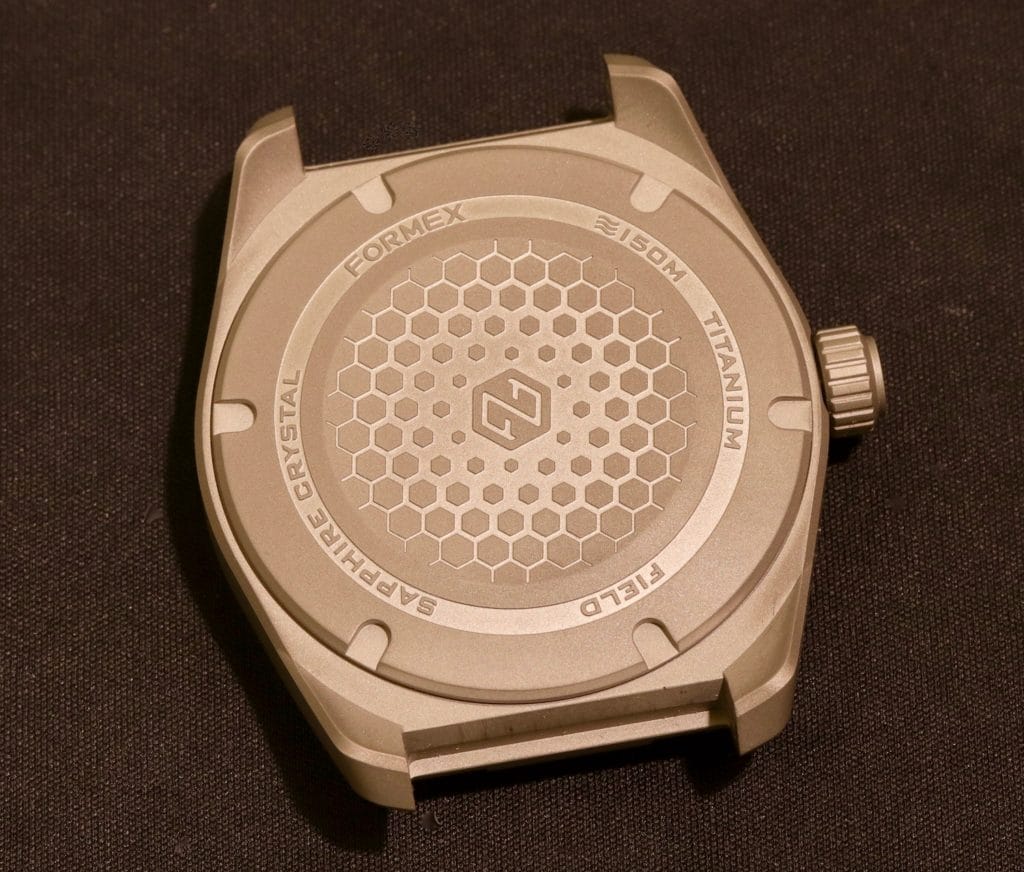
The Formex Field Automatic uses the Sellita SW200-1, a Swiss automatic movement that’s appeared in enough watches to develop a reputation for dependable performance and straightforward servicing. It beats at 28,800 vibrations per hour and offers approximately 38 hours of power reserve. It’s a sensible choice for a watch in this price range, and there’s certainly something appealing about having a Swiss automatic movement in a titanium field watch from a smaller brand.
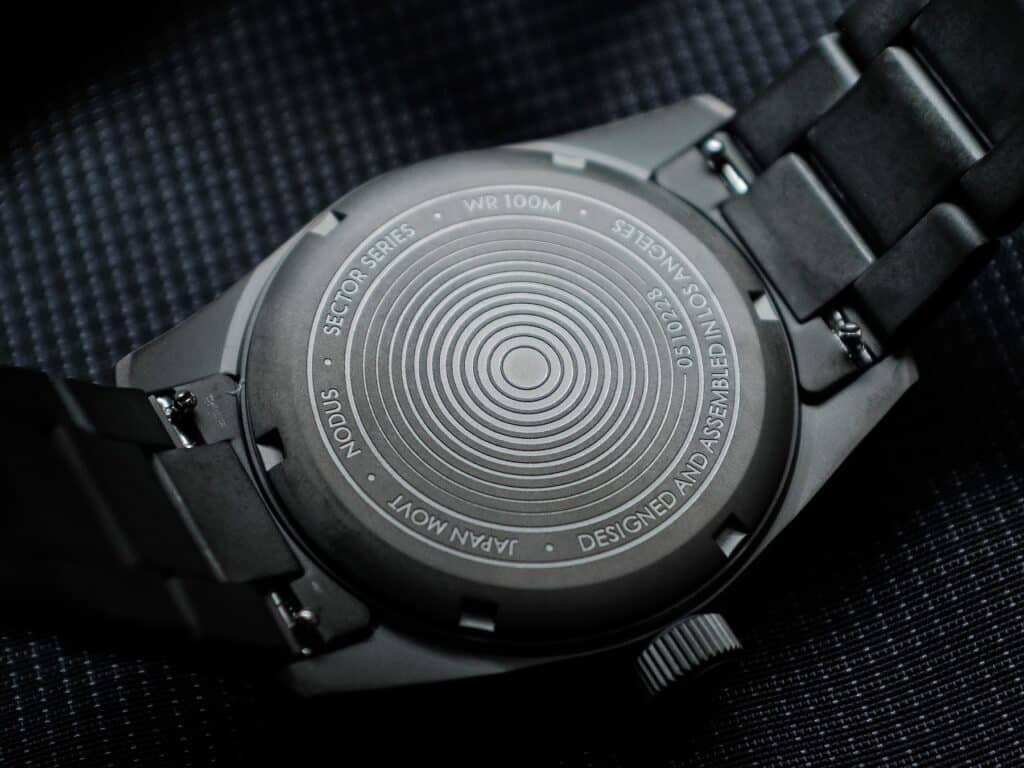
The Nodus uses the Seiko/TMI NH38, a Japanese automatic caliber operating at 21,600 vibrations per hour with approximately 41 hours of power reserve. It’s not nearly as exciting from a collector’s perspective, but that doesn’t mean there’s anything particularly wrong with it. Nodus takes the additional step of regulating the movement in-house to a claimed accuracy of plus or minus ten seconds per day. The NH38 also avoids the unused date-setting position that occasionally appears in affordable watches built around date-equipped movements.
Would we prefer the Sellita over the NH38 in a direct movement comparison? Probably. The smoother seconds-hand sweep, Swiss construction, and higher beat rate make it the more appealing caliber from an enthusiast’s perspective. But would we pay another $170 or more just to have it in a field watch? That’s a harder question.
Case Construction, Finishing & Wearability:
The Formex Field Automatic measures 41mm in diameter, 47mm lug-to-lug, and 10.6mm thick. While 41mm might seem a little large for a field watch, the relatively short lugs and slim case help keep those dimensions in check. The Grade 2 titanium construction also works in its favor, particularly when compared to similarly sized stainless steel watches. Formex finishes the case with a sandblasted texture and applies a surface-hardening treatment to improve scratch resistance. It’s a practical combination that suits the watch’s industrial styling, although there’s very little in the way of decorative finishing for anyone who prefers polished bevels and contrasting surfaces.

Where the Formex really impressed us was its comfort. The thin case sits close to the wrist, and the lightweight titanium construction makes it easy to forget you’re wearing a 41mm watch. That became particularly apparent during extended periods outdoors, where the watch remained comfortable beneath clothing and gloves without catching or getting in the way. We also appreciate that Formex resisted the temptation to make the Field unnecessarily thick. A few extra millimeters might not sound like much on paper, but they can make a noticeable difference when you’re wearing a watch all day.
The Nodus Sector II Field Titanium comes in at 38mm in diameter, 47mm lug-to-lug, and 11.7mm thick. Despite being three millimeters smaller than the Formex, the two watches occupy almost exactly the same length across the wrist. The squared-off lug tips give the Nodus a slightly broader appearance than its diameter might suggest, although the downward curvature helps it sit comfortably against the wrist. We found the proportions particularly well suited to a 6.75-inch wrist, where the case has enough presence without looking oversized. It’s a good reminder that case diameter alone rarely tells the whole story.
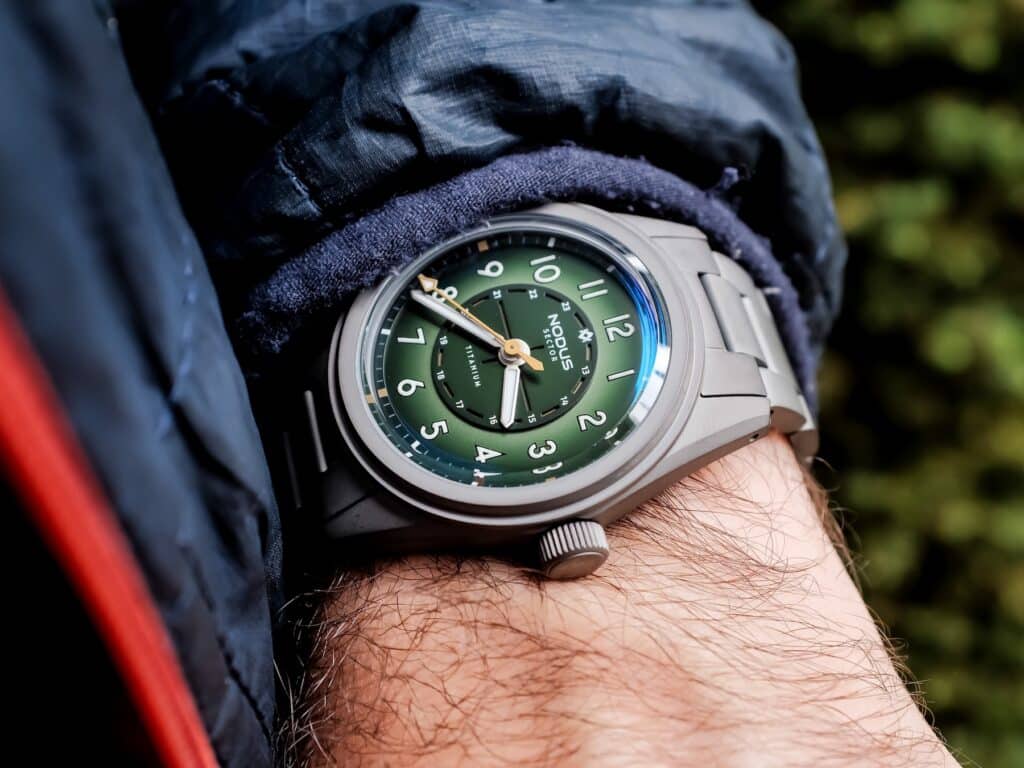
Nodus also uses Grade 2 titanium, with a media-blasted finish that extends across the case and matching bracelet. A scratch-resistant coating provides additional protection, while the absence of polished surfaces gives the watch a consistent, utilitarian appearance. We wouldn’t mind a little more contrast in the finishing, but the matte treatment suits the Sector’s angular case design. At approximately 100 grams before sizing, the Nodus is remarkably light for a watch fitted with a full metal bracelet, and the adjustable clasp makes it easy to find a comfortable fit throughout the day. The Formex is noticeably slimmer and arguably better suited to activities where keeping a watch out of the way is important, but there’s something appealing about getting this level of comfort without having to switch to a nylon strap.
Crystals:
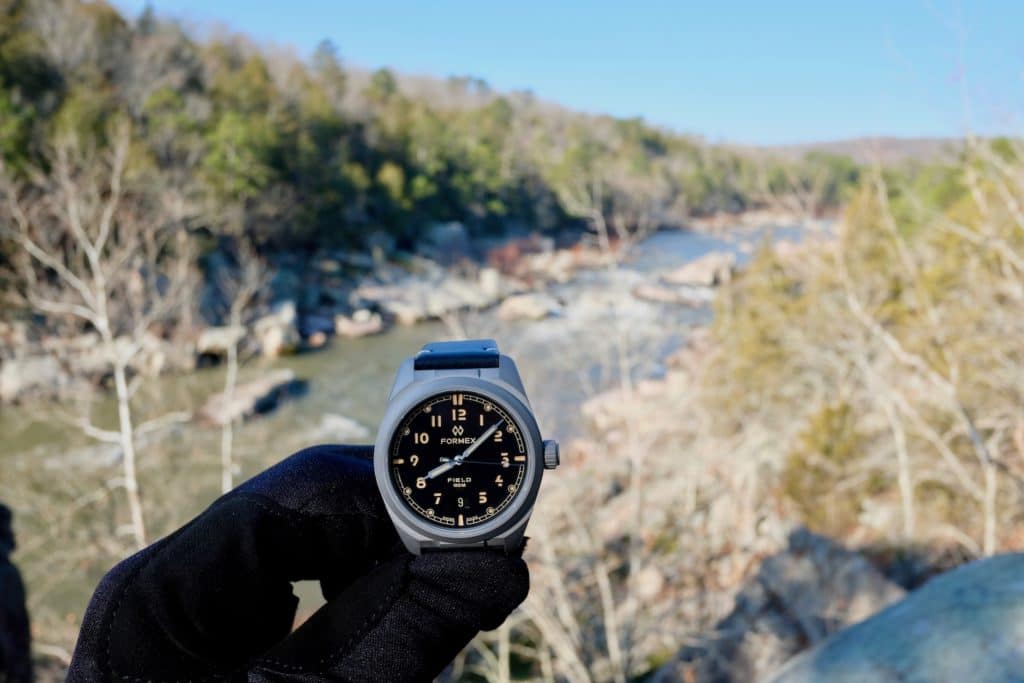
The Formex has a flat sapphire crystal with an anti-reflective coating on the underside. It suits the broader, flatter case design and keeps the unusual dial clearly visible. Considering how much attention Formex has put into the sculpted numerals, we’re glad the crystal doesn’t introduce unnecessary distortion.
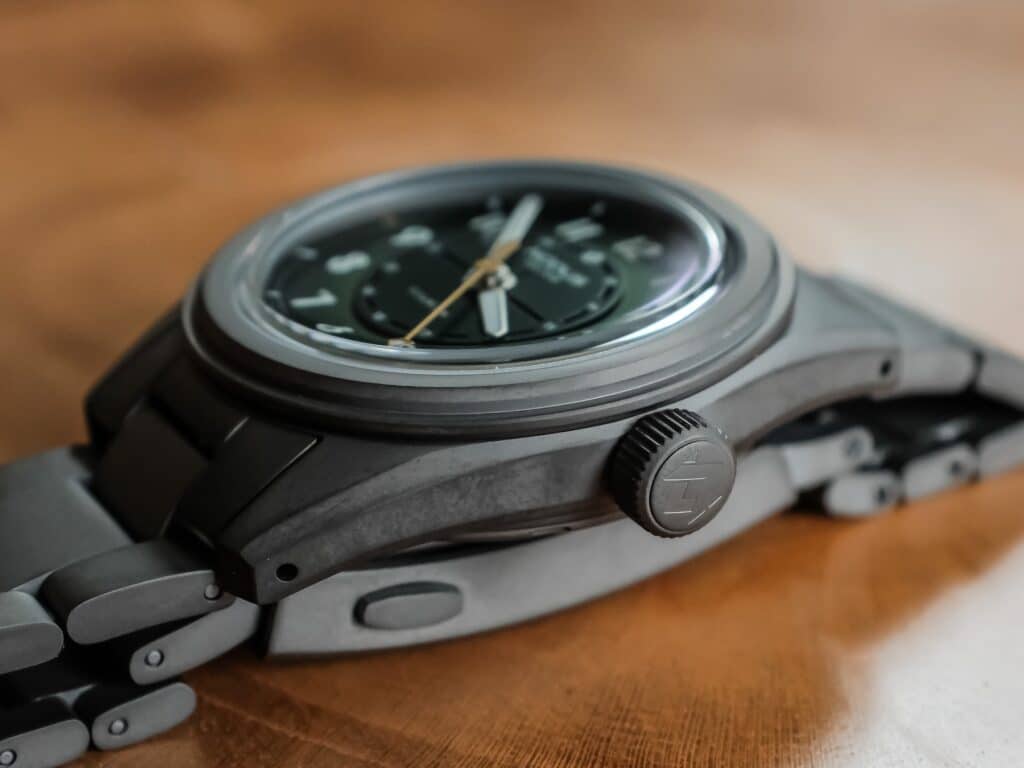
The Nodus uses a box-shaped sapphire crystal integrated into a stepped bezel. There’s a subtle bevel around the edge that continues the shape of the case, along with blue anti-reflective coating beneath the crystal. We like how the Nodus handles this detail. The box-shaped profile gives it a little more character without turning the watch into another attempt at recreating a 1960s military design.
Water Resistance & Lume:
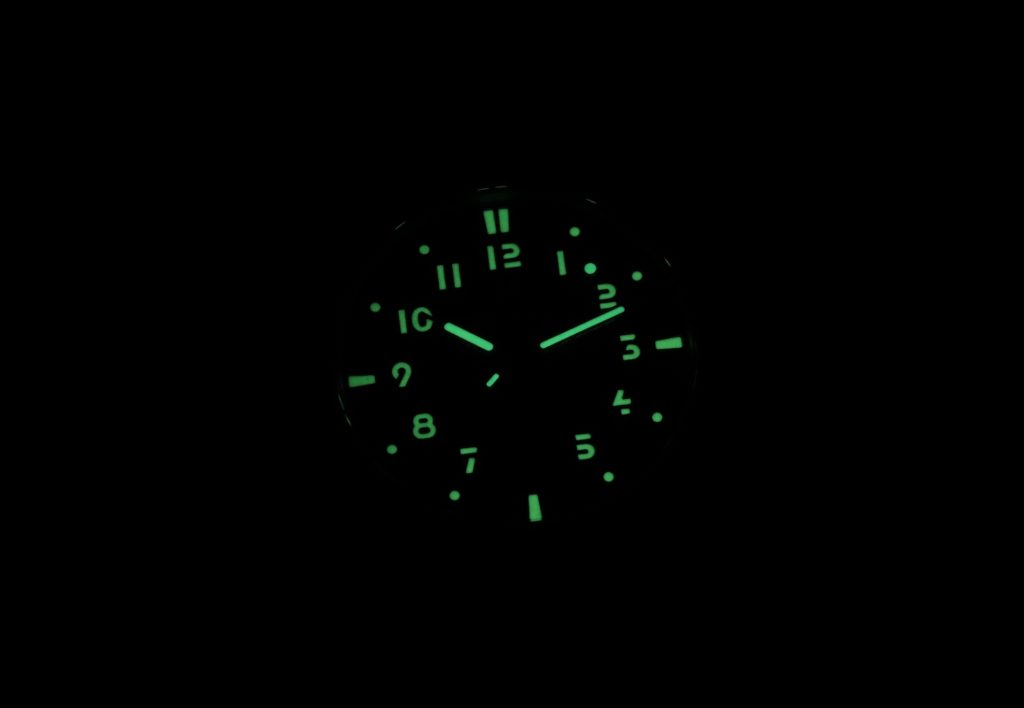
The Formex Field Automatic offers 150 meters of water resistance, which is more than enough for swimming, hiking, and most of the outdoor activities we’d reasonably expect from a field watch. Its screw-down crown provides some additional reassurance, although we’re not convinced the extra 50 meters over the Nodus makes much of a practical difference. Formex also uses Old Radium Super-LumiNova across the hands, numerals, and indices, giving the dial a slightly warmer appearance that complements its industrial styling. The illumination is adequate without being particularly impressive, and we would have liked a little more brightness from a watch that’s otherwise so focused on functionality.
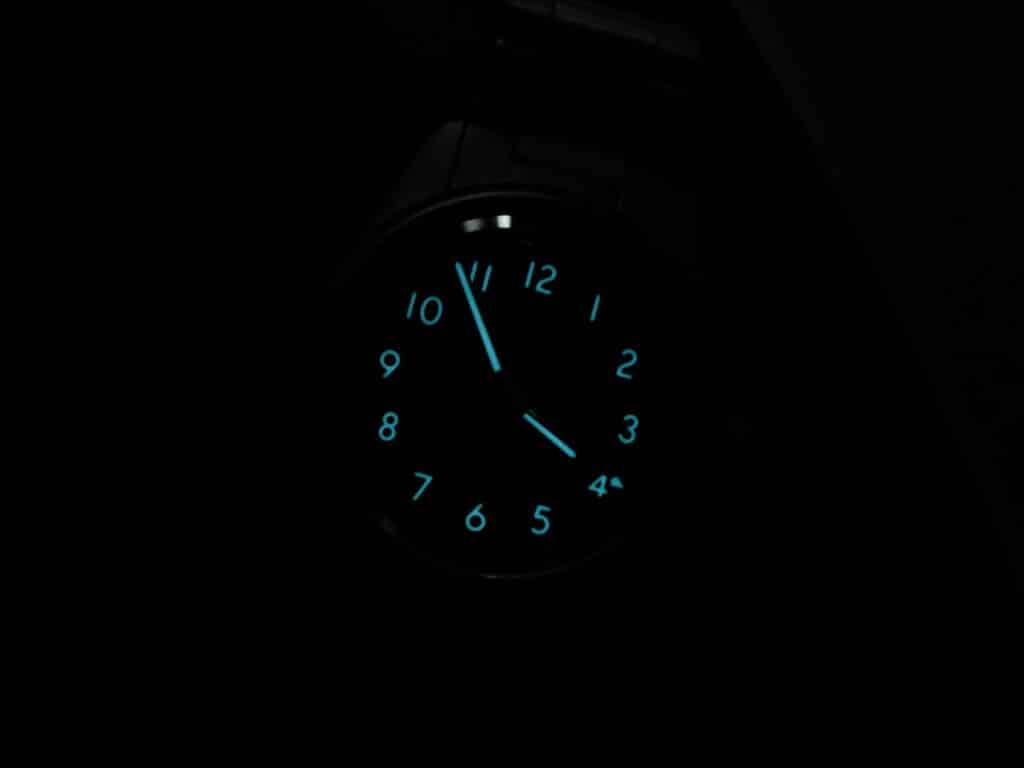
The Nodus Sector II Field Titanium comes with 100 meters of water resistance, courtesy of its screw-down crown and solid caseback. That’s perfectly respectable for a field watch, and we can’t imagine many situations where we’d feel limited by the rating. Where the Nodus makes a stronger impression is its Swiss Super-LumiNova BGW9, which charges quickly and produces a bright blue glow across the dial. It’s noticeably more satisfying in low-light conditions than the Formex, and while we wouldn’t choose a field watch based entirely on its lume, we’re certainly not going to complain when a less expensive watch manages to outperform its competition in that department.
Cost Considerations
The original Formex Field Automatic retailed for $795 on its standard nylon strap or $945 with the optional leather strap and carbon-composite deployant clasp. That’s a substantial investment for a field watch, although the Swiss Sellita movement, hardened titanium case, and unconventional dial help explain the price. There’s also the matter of Formex’s proprietary strap hardware, which offers a level of adjustability we don’t typically encounter at this end of the market. Whether we’d personally spend the extra money on the leather configuration is another question, but the standard nylon version offers most of what makes the watch appealing without approaching the $1,000 mark.
Formex has also introduced a second-generation Field Automatic, with prices starting at CHF 830 and reaching CHF 970 depending on the configuration. The updated model brings a slightly smaller 40mm case, a revised dial, and a Sellita SW200-2 Power+ movement with a 65-hour power reserve. That’s a meaningful improvement over the original movement’s approximately 38 hours, and it makes the higher asking price easier to understand. Still, the Field Automatic has moved further into territory where buyers have plenty of excellent alternatives, including some from considerably more established Swiss brands.
The Nodus Sector II Field Titanium comes in at $625, including its matching titanium bracelet and adjustable clasp. Compared with the original Formex, that’s a savings of $170 against the nylon configuration or $320 against the leather version. The difference is especially appealing when we consider that Nodus includes a bracelet we’d normally expect to pay extra for. The regulated NH38 might not carry the same enthusiast appeal as a Swiss Sellita, but it’s a dependable movement, and the rest of the watch hardly feels like a compromise.
There’s also something to be said for buying a watch that doesn’t immediately send us looking for replacement parts or accessories. The titanium bracelet suits the Sector II particularly well, and the Nodus Extension Mechanism makes it easy to adjust throughout the day. We could certainly experiment with different straps, but we’re not convinced we’d improve the ownership experience by doing so. For a watch priced comfortably below $700, that’s a fairly convincing argument.
Ultimately, the Formex offers the more interesting movement and some genuinely clever engineering, particularly with the newer generation’s extended power reserve. But the Nodus delivers most of the practical qualities we’re looking for in a titanium field watch without asking us to spend considerably more. We’d have a hard time overlooking that price difference, especially when the less expensive option comes with the bracelet we’d actually want to wear.
Final Thoughts: Is the Formex Field Automatic Worth the Premium Over the Nodus Sector II?
For us, the Nodus Sector II Field Titanium is the better everyday field watch. That’s not because the Formex does anything particularly wrong. Its Swiss movement, slim case, and unusual dial give it a personality of its own, and the lightweight construction makes it especially comfortable during outdoor activities.
We also appreciate that Formex is willing to experiment. The company could have produced a perfectly ordinary titanium field watch with a Sellita movement, charged $795, and probably found an audience. Instead, it developed a dial and strap system that are noticeably different from what we’ve become accustomed to seeing in this category. We might not love every design decision, but we’d much rather see that effort than another interchangeable military homage.
The problem for Formex is that the Nodus doesn’t feel like the cheaper alternative. It has a well-proportioned titanium case, a distinctive dial, bright lume, and an adjustable bracelet that we’d have no reason to replace. The NH38 movement isn’t going to excite someone who collects watches specifically for their calibers, but we don’t think it needs to. The Nodus also benefits from the consistency we’ve come to appreciate across the Sector collection. It looks like a Nodus, and that’s increasingly important for a brand trying to establish an identity in a crowded market.
Our pick is the Nodus Sector II Field Titanium. We’d rather have its smaller case, excellent bracelet, and lower price than spend the additional money on a Swiss movement and more elaborate strap system. We’d still happily wear the Formex, especially in its slimmer nylon-strap configuration, but Nodus has put together the watch we’d be more inclined to reach for every day.

Co-Founder and Senior Editor
Kaz has been collecting watches since 2015, but he’s been fascinated by product design, the Collector’s psychology, and brand marketing his whole life. While sharing the same strong fondness for all things horologically-affordable as Mike (his TBWS partner in crime), Kaz’s collection niche is also focused on vintage Soviet watches as well as watches that feature a unique, but well-designed quirk or visual hook.