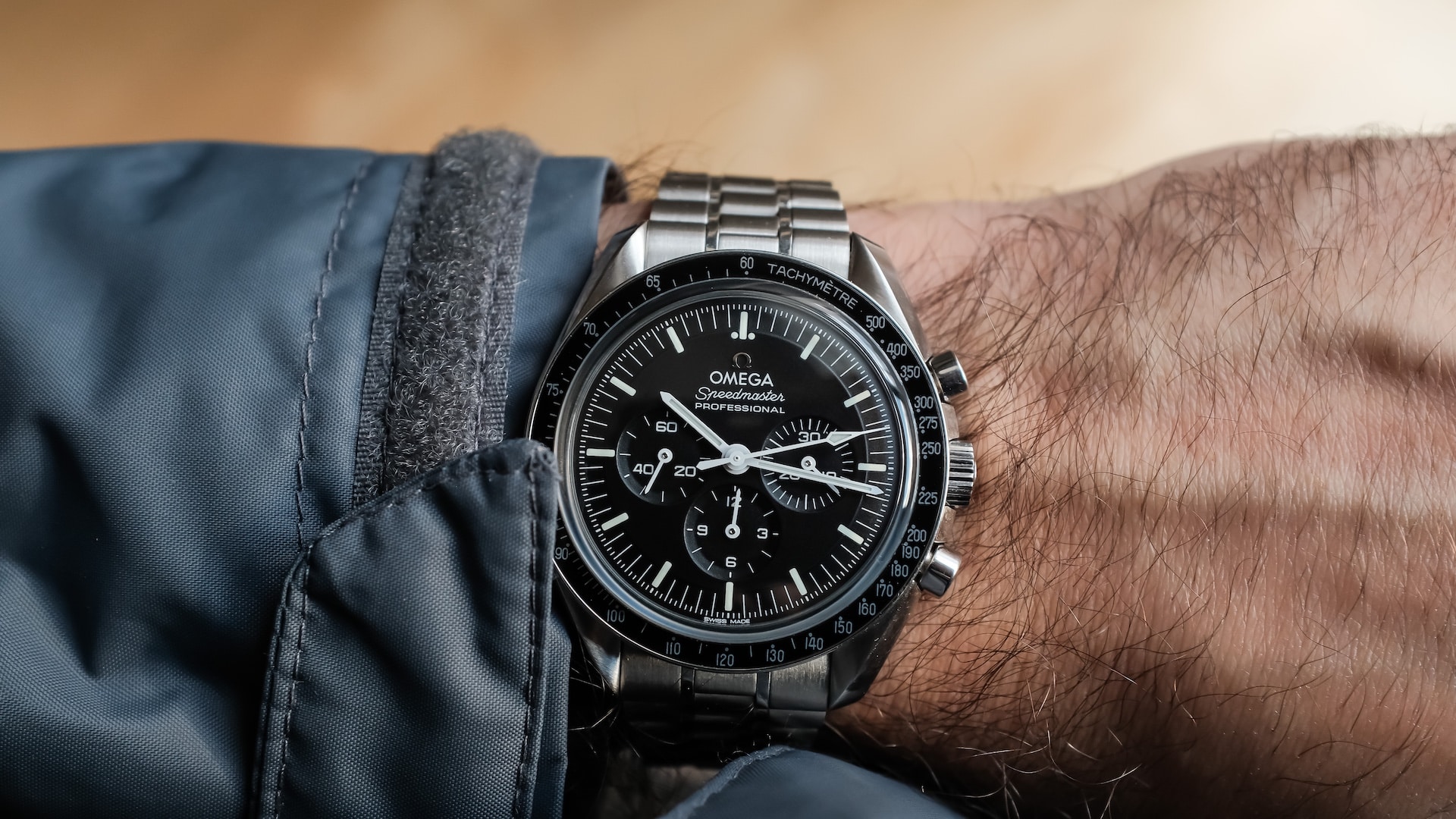
For most of us, the blunt answer is no. No watch collection technically needs an Omega Speedmaster to be complete. But that’s not the same as saying the Speedmaster is overrated. After hands-on testing the modern Omega Speedmaster Professional 3861, the First Omega in Space, and the Speedmaster Reduced, we’ve come away with a different perspective. The real question isn’t whether the Speedmaster deserves its reputation. It’s whether it brings something to your collection that your everyday watches, affordable watches, or favorite chronograph already don’t.
What the Speedmaster Still Nails That Most Icons Only Pretend To
Here’s where the anti-hype argument runs into a wall: the product still backs up a lot of the noise. Not because it went to space, not because it shows up in every “serious collection” thread, and not because someone on Instagram needs to see that twisted-lug silhouette poking out from under a denim jacket. It works because the core experience is still truly good. The layout is clean, the chronograph is easy to read, the case has presence without feeling like a hockey puck, and the act of winding and using it feels mechanical in a way that many modern luxury watches have polished into blandness.
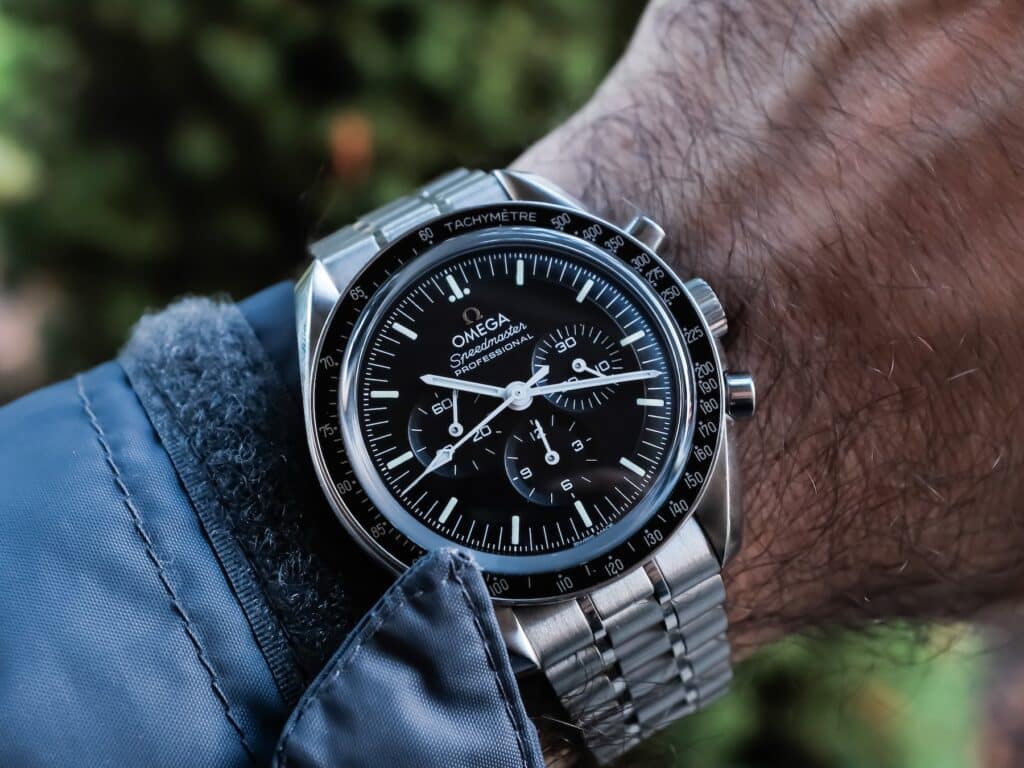
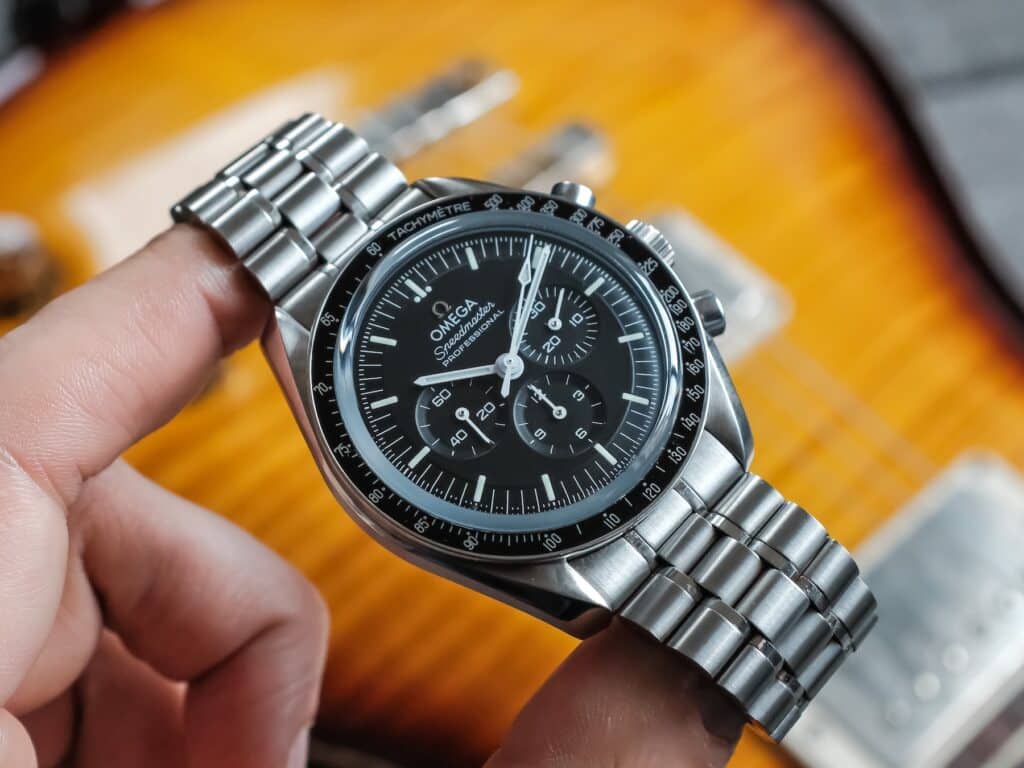
The modern Omega Speedmaster Professional 3861 is the clearest example of this. In our hands-on review, the biggest takeaway was not that Omega reinvented the Moonwatch. It was the fact that Omega sharpened the version people already loved. The stepped dial adds depth without making the watch feel decorative, the returned dot-over-ninety bezel scratches the nerd itch without screaming about it, and the updated case wears more planted than the 42mm spec suggests. That matters on the wrist because the Speedmaster has always lived in that awkward zone where the numbers sound larger than the experience feels. The 3861 gets the balance right. It’s large enough to feel like a proper chronograph, but it doesn’t punish you for wearing it all day. During testing, we also highlighted the bracelet as one of the biggest improvements, especially the taper and redesigned end links, which help the watch sit lower rather than perch on top of the wrist. The movement is where the 3861 makes the strongest case for the Speedmaster as more than a nostalgia purchase.
The old Moonwatch charm is still there, but the newer Master Chronometer movement brings modern reassurance through anti-magnetism, Co-Axial architecture, and around 50 hours of power reserve. In daily use, though, the numbers are not the point. The point is how it feels. The winding is smoother, the pushers have a firmer action, and the whole watch gives you that small mechanical ritual that makes a chronograph satisfying even when you’re only timing coffee, parking meters, or pasta. That’s the Speedmaster doing what it still does better than most watches: making a slightly unnecessary function feel weirdly essential.
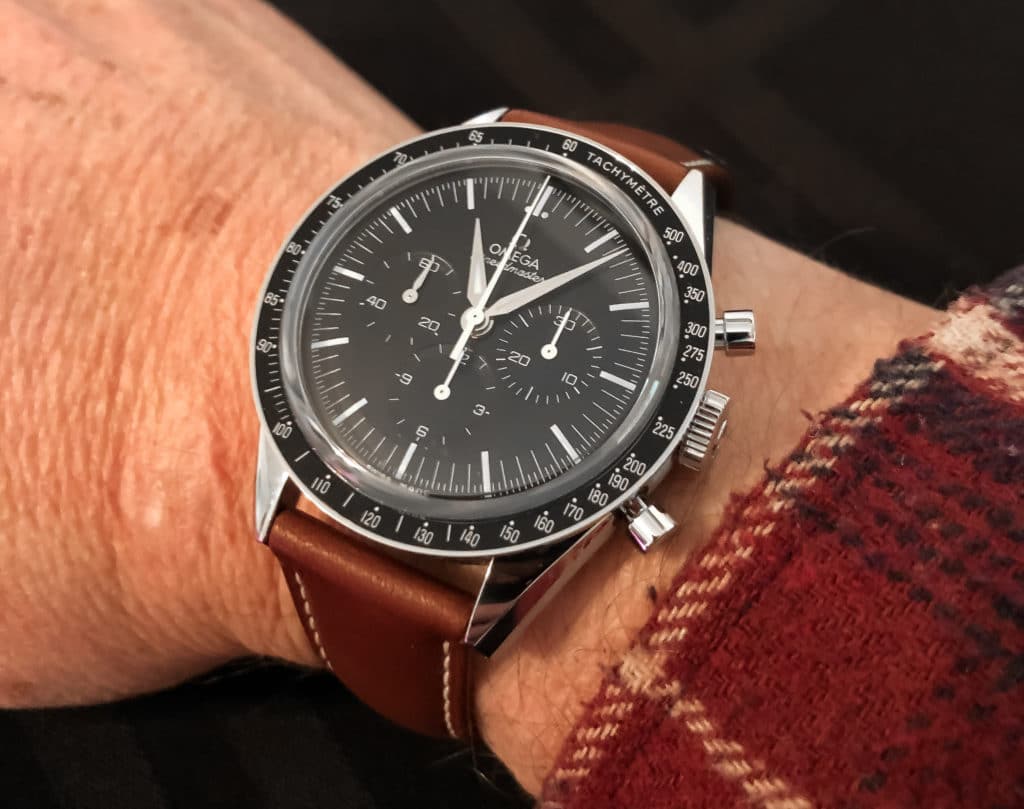
The First Omega in Space proves something else: wanting a Speedmaster does not automatically mean wanting the standard Professional. You’ll see in our review, the 39.7mm case hit a useful middle ground between the 42mm Professional and the smaller Speedmaster Reduced, which helps if you like the Moonwatch idea but don’t love the Professional’s broader stance on the wrist. The straight-lug case also gives it a cleaner, older-school profile, so it reads less like the default Speedmaster and more like a personal pick. That matters for collectors who want the story and the silhouette, but still care about whether the watch feels right after the honeymoon period.
The real benefit is that the FOIS delivers vintage Speedmaster charm without forcing you into vintage-watch anxiety. The box sapphire crystal keeps some of that old chronograph feel while being easier to live with, and the dial adds depth through its slight gloss, recessed subdials, and silver alpha hands. It still gives you the manual-wind chronograph ritual through the caliber 1861, with winding and pusher feel that keeps the experience tactile rather than passive. For the collector who wants a Speedmaster with warmth, manageable proportions, and less “obvious choice” energy, the FOIS makes a strong case.
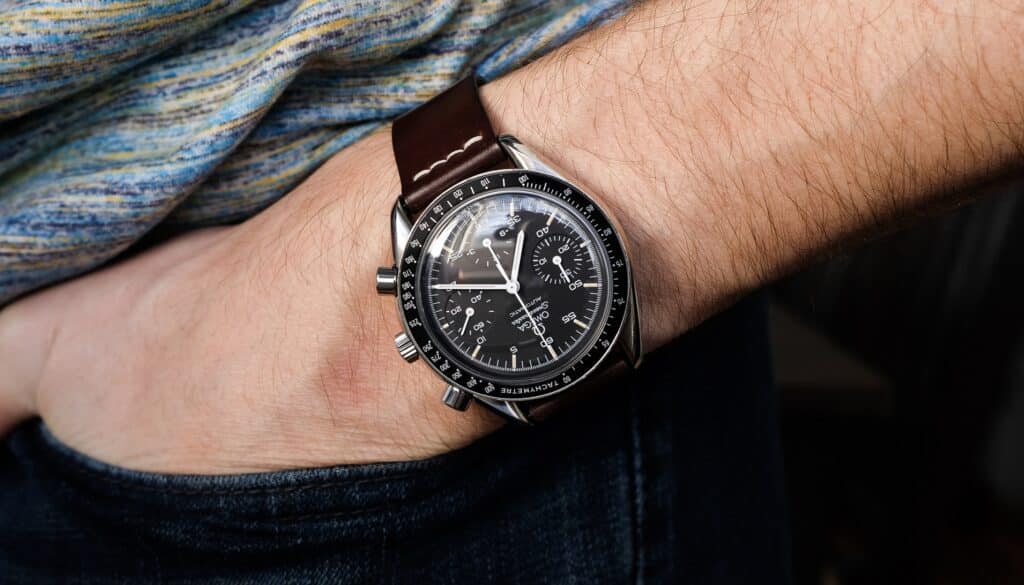
Then there’s the Speedmaster Reduced, which might be the most useful reality check in the whole Speedmaster conversation. In our Reduced vs. Professional comparison, the real win was not that the Reduced looks vaguely like a Moonwatch for less money. It’s the 38mm case and 44mm lug-to-lug that make the whole Speedmaster idea easier to wear for medium and smaller wrists. That matters because the Professional can feel awkward if your wrist is under 7 inches, while the Reduced still gives you the black-dial, white-hand, three-register chronograph look without making the watch feel like it’s trying to win an arm-wrestling match with your forearm.
The other benefit is convenience. The Speedmaster Reduced is automatic, which changes the daily relationship with the watch. You lose the hand-wound ritual of the Professional, but gain something more practical if this is going to be an everyday watch: you can put it on and go. The Reduced family brings variety, availability, and Speedmaster DNA at a friendlier price point, especially through dial variants and different executions that step outside the rigid Moonwatch template. For collectors who want to “earn their Omega wings,” prefer something smaller, or don’t care about winning approval from Moonwatch purists, the Reduced makes a lot of sense.
That is the Speedmaster’s real strength across these three versions. It gives collectors options without losing the thread. The Professional 3861 is the refined modern Moonwatch. The FOIS is the vintage-flavored, slightly dressier route for people who care about wrist feel and proportions. The Reduced is the smaller, more accessible path that still delivers enough of the visual and emotional hit for plenty of collectors. None of these are affordable watches in the usual TBWS sense. But as watches worth the money for the right person, they each make a stronger case than the hype alone would suggest. That said, don’t confuse that with value in the practical sense.
The Speedmaster is excellent, but it is not frictionless. The Professional asks you to accept the price, 50 meters of water resistance, and manual-wind routine. The FOIS gives you warmer proportions, but also vintage-flavored compromises like weaker lume, polished hands that can lose contrast, and a strap that may not match the watch. The Reduced is easier to wear and often more accessible, but you have to shop carefully because service history, parts, and the modular movement matter.
What Our Testing Says You Can Get Instead Of The Speedmaster (Often For Less Money)
Once you step outside the Moonwatch orbit, the chronograph and everyday Omega landscape start to look a lot less predetermined. The Speedmaster becomes one version of the answer. A strong one, sure, but not the only one worth taking seriously.
If You Want The More Practical Omega: Seamaster Diver 300M
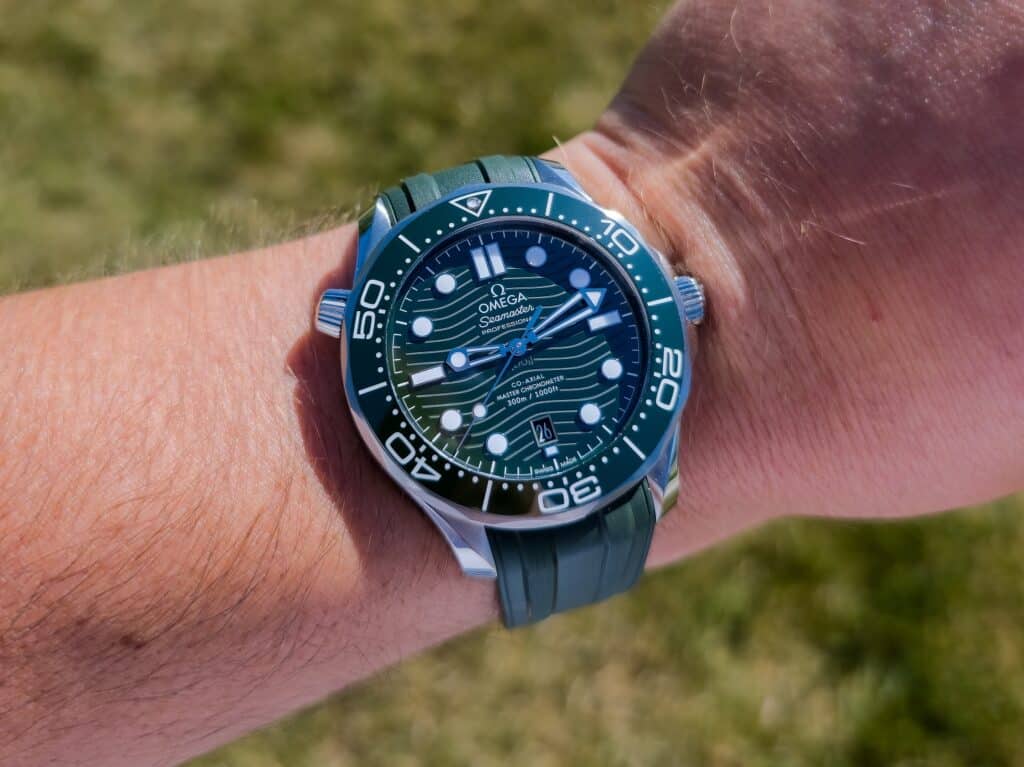
Take the Omega Seamaster Diver 300M. It is not a chronograph, so it won’t replace the Speedmaster if what you want is the timing function and hand-wound ritual. But as an everyday luxury Omega, it may make more sense for a lot of collectors. As noted in our review, the watch brings 300 meters of water resistance, a Co-Axial Master Chronometer movement, serious anti-magnetic resistance, and a case that wears thinner than its nearly 14mm spec suggests. On the rubber strap, it becomes the kind of watch you could wear without thinking too hard about what the day might throw at you. That is the practical counterpoint to the Speedmaster: less romance in the chronograph sense, but more everyday range. The Seamaster also has a different kind of wrist personality. The laser-engraved wave dial, scalloped bezel, skeleton hands, and twisted-lug case give it more visual movement than the Speedmaster’s cleaner instrument layout. In testing, the case finishing and rubber strap were standouts, and the watch had that “wear and forget” quality that matters more after month three than it does in boutique lighting. The bezel action and skeleton hands will not work for everyone. Still, if you want a luxury Omega that feels ready for travel, water, dinner, and daily abuse, the Seamaster starts to look more sensible.
If You Want Omega Without The Obvious Choice Energy: Railmaster
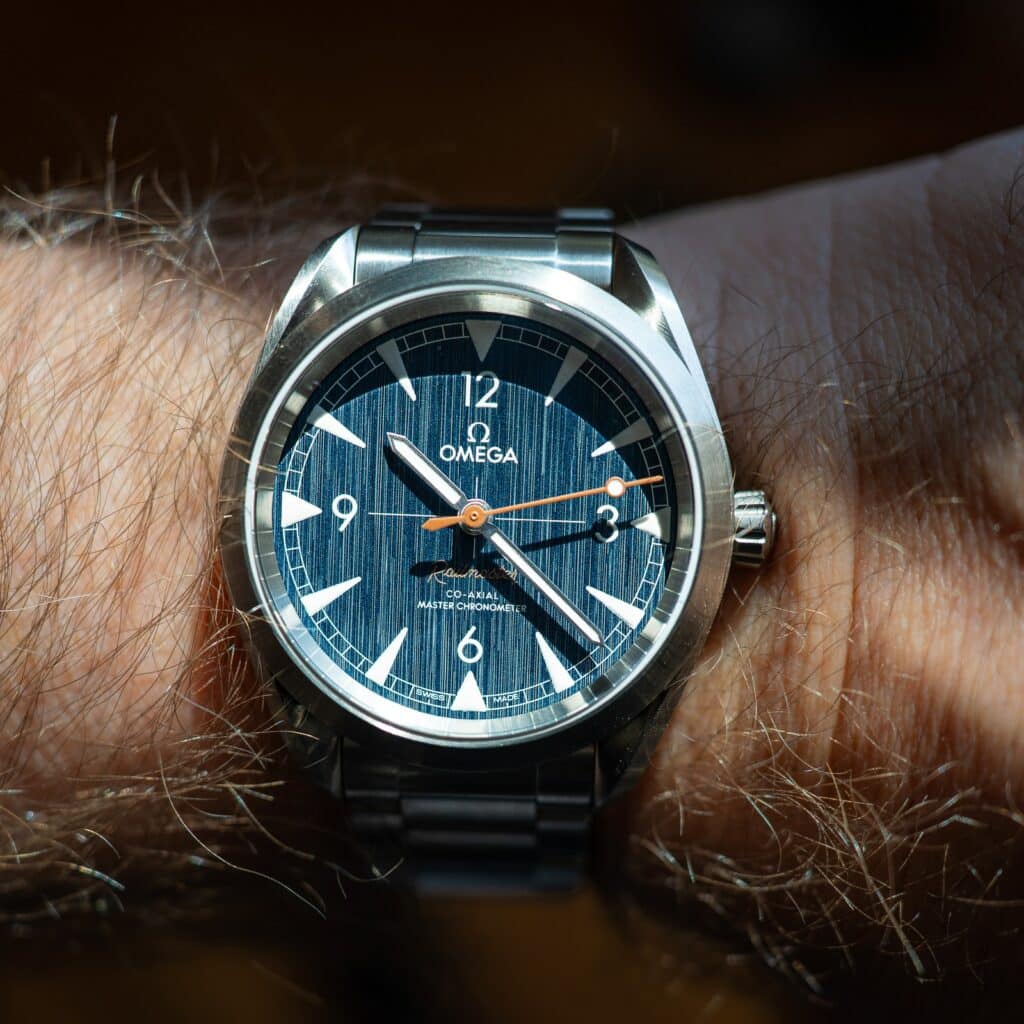
Then there’s the Omega Railmaster, which is the argument against buying the obvious Omega. In our hands-on review, the 40mm case, 46.5mm lug-to-lug, and 12.5mm thickness hit a comfortable middle ground on a 7-inch wrist. The brushed case keeps things utilitarian, but the twisted-lug shape still gives it enough light play to feel like an Omega rather than a dull field watch with a fancy logo. The dial does a lot of the work, too. That vertically brushed “denim” texture shifts between shades of blue, grey, and bronze depending on the light, giving the watch more personality than its quiet layout suggests. The Railmaster’s bigger advantage is how little it asks from you. It is time-only, which sounds like a downgrade until you live with it. No chronograph to fiddle with, no date to correct, no Moonwatch mythology to carry around. You set the time and move on with your day. The Master Chronometer movement in our review performed with excellent accuracy, and the 150 meters of water resistance gives it more daily confidence than the Speedmaster. For collectors who want Omega quality without the familiar Speedmaster script, the Railmaster feels like one of the best value watches hiding in plain sight.
If You Want Space-Watch Credibility For Less: Bulova Lunar Pilot
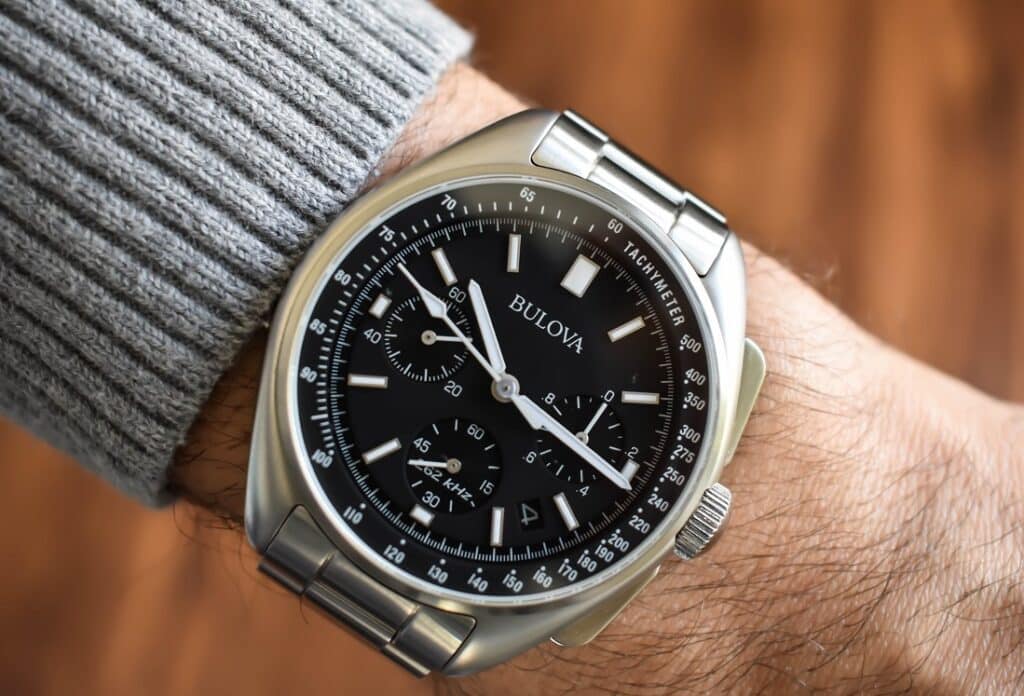
The Bulova Lunar Pilot is the obvious moon-adjacent alternative, and that is not an insult. During testing, the watch delivered the chunky black-dial chronograph charm at a fraction of Speedmaster money, backed by Bulova’s 262kHz high-performance quartz movement. That movement was the real star: accurate to around 10 seconds per year, with a smooth pseudo-sweep running second hand and the kind of grab-and-go reliability mechanical chronographs cannot offer. The case is large at 45mm with a 52mm lug-to-lug, so small-wrist collectors should not pretend this is some stealthy little thing. But on the bracelet, the case architecture gave it a more balanced fit than the numbers suggest. What the Lunar Pilot gives you is permission to stop treating “space watch” as a one-brand conversation. It has real lunar credibility, strong dial legibility, satisfying pushers, and a price that makes the Speedmaster’s emotional premium impossible to ignore. It will not give you the same hand-wound mechanical experience, nor the same finish. But if what you want is a black-dial chronograph with space history, excellent accuracy, and far less ownership anxiety, the Lunar Pilot is harder to dismiss than purists want it to be.
If You Want Vintage Chronograph Flavor Without Speedmaster Money: Nezumi Voiture
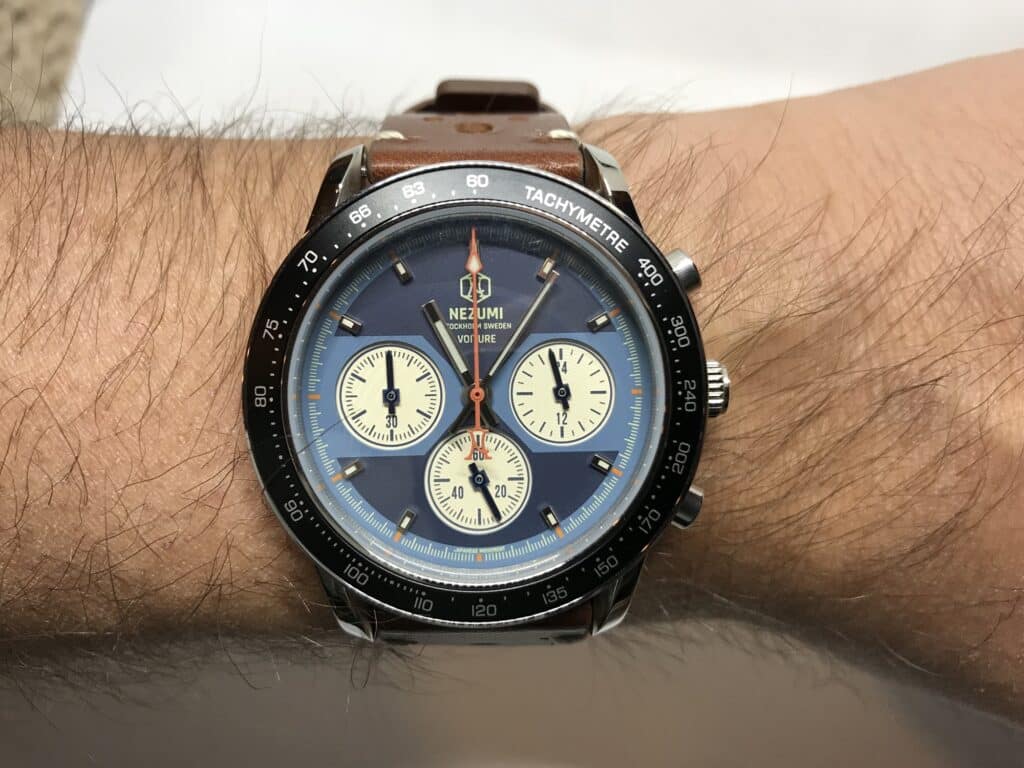
The Nezumi Voiture sits in a different lane. It is not trying to beat the Speedmaster at being the Speedmaster. It borrows from the broader vintage racing chronograph world, including Speedmaster cues, but turns that inspiration into something smaller, cheaper, and more playful. In our review, the 40mm case and 47mm lug-to-lug wore comfortably on a 6.75-inch wrist, while the domed sapphire crystal, curved lugs, and racing-style dial gave it vintage charm without vintage-watch pricing or service drama. The Voiture also shows why microbrand watches can be worth taking seriously when the design is coherent. The Seiko VK63 meca-quartz movement gave the chronograph seconds and minute counter a snappy reset, and the exposed pushers had the kind of tactile pop that makes you use the chronograph for dumb little timing jobs around the house. Legibility is not perfect because the dial has a lot going on, but that is part of the trade. If your attraction to the Speedmaster is more about vintage-inspired chronograph charm than Omega ownership itself, the Voiture gets you into that emotional neighborhood for far less money.
If You Want A Premium Chronograph Without The Moonwatch Story: TAG Heuer Carrera Glassbox
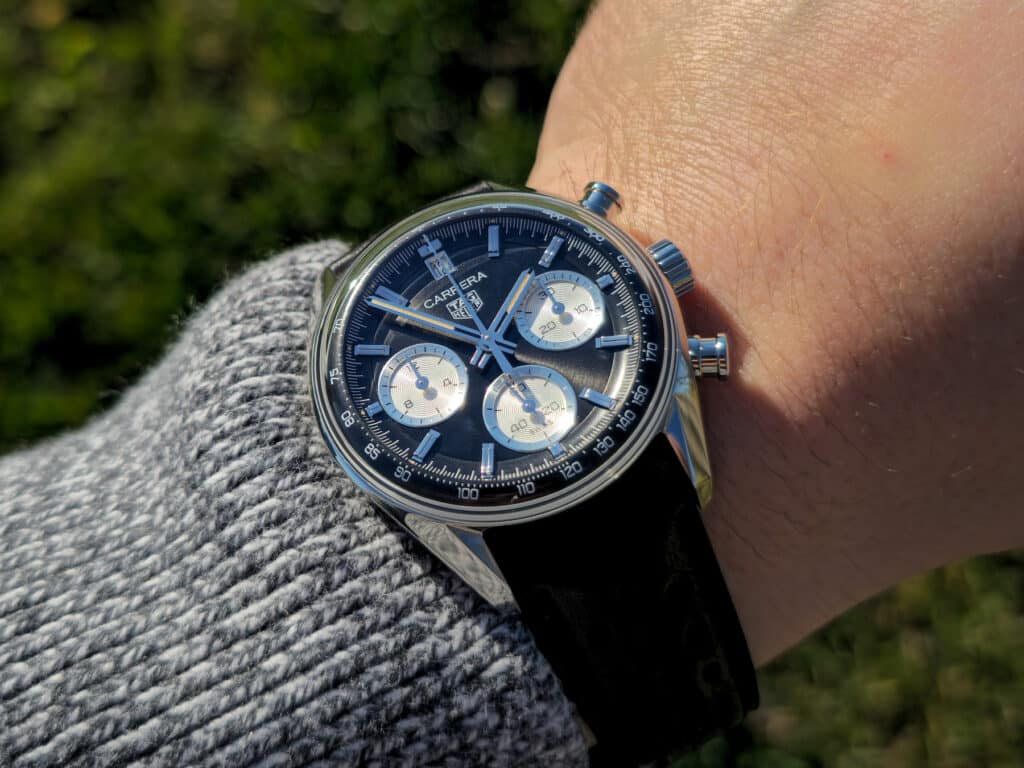
At the premium end, the TAG Heuer Carrera Glassbox 39mm is a more direct chronograph counterpoint. While reviewing the watch, the 39mm case, 46mm lug-to-lug, in-house TH20-00 movement, 80-hour power reserve, and 100 meters of water resistance gave it a strong technical foundation. The movement stood out in particular: automatic, column wheel, vertical clutch, bi-directional winding, and backed by a five-year warranty. That is a very different experience from the Speedmaster’s manual-wind charm—less ritual, more convenience, and a chronograph movement that feels quite modern. The Glassbox also wears with a serious presence. The sapphire crystal wraps over the dial and internal tachymeter scale, giving the watch its own identity, while the pushers and crown feel well integrated into the case. That said, the shortcomings, especially the dial finish, did not meet the standard set by the rest of the package. But as an alternative for someone who wants a historically rooted premium chronograph without buying into the Moonwatch story, the Carrera makes the decision less automatic.
If You Want A Chronograph You’ll Use Without Babying: Christopher Ward C63 Valour
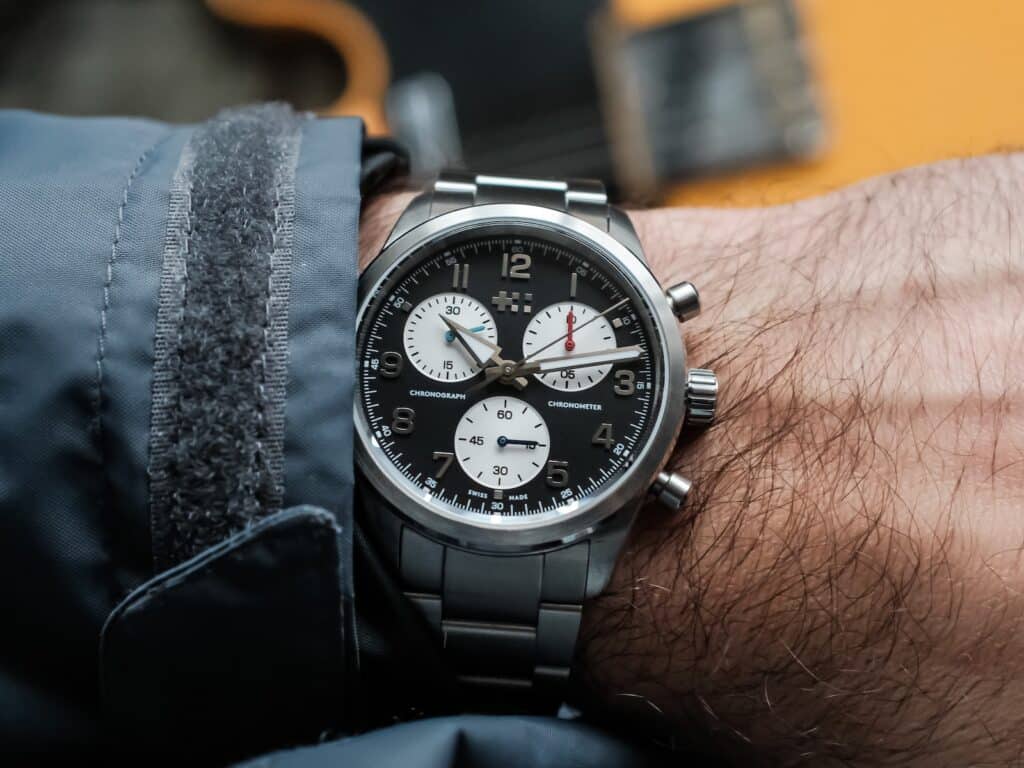
Finally, the we tested brings the question back to what you want from a chronograph. If the appeal is a hand-wound charm and old NASA-adjacent romance, the Valour will not replace it. But if you want a chronograph you can read quickly, wear often, and use without babying, it starts to make sense. In our testing, the 39mm case, 11.55mm thickness, and sub-46mm lug-to-lug made it compact and easy to wear, while the matte reverse-panda dial stayed legible at a glance. The real pitch is practicality, though. The COSC-certified ETA G10.212 AD quartz movement is rated to ±10 seconds per year, the screw-down crown helps deliver 150 meters of water resistance, and the Bader bracelet adds useful everyday touches like quick-release spring bars and on-the-fly adjustment. For collectors who want a chronograph function without the ritual, cost, servicing concerns, or financial self-negotiation attached, the Valour cuts through the romance pretty quickly.
That is the shift we’re getting at. The Speedmaster is still excellent, but it is not competing against weak alternatives. It is surrounded by watches that may be more practical, more affordable, more personal, or better aligned with how you live. If you want the Speedmaster experience, nothing else fully replaces it. But if what you want is an everyday Omega, a moon-adjacent chronograph, a vintage-inspired microbrand watch, or a modern grab-and-go chronograph, our testing says you have real options. And some of them leave a lot more money in your account for straps, servicing, or the next questionable eBay decision.
So, Does Your Collection Really Need a Speedmaster?
No. And the longer you collect, the more obvious that answer gets. A Speedmaster is not a graduation certificate, a seriousness badge, or proof that your watch box has finally become respectable. A collection built around affordable watches, underrated watch brands, microbrands, vintage finds, or strange personal favorites isn’t missing any final ingredient just because it doesn’t include a Moonwatch. If you only want one because the internet keeps treating it like required reading, skip it.
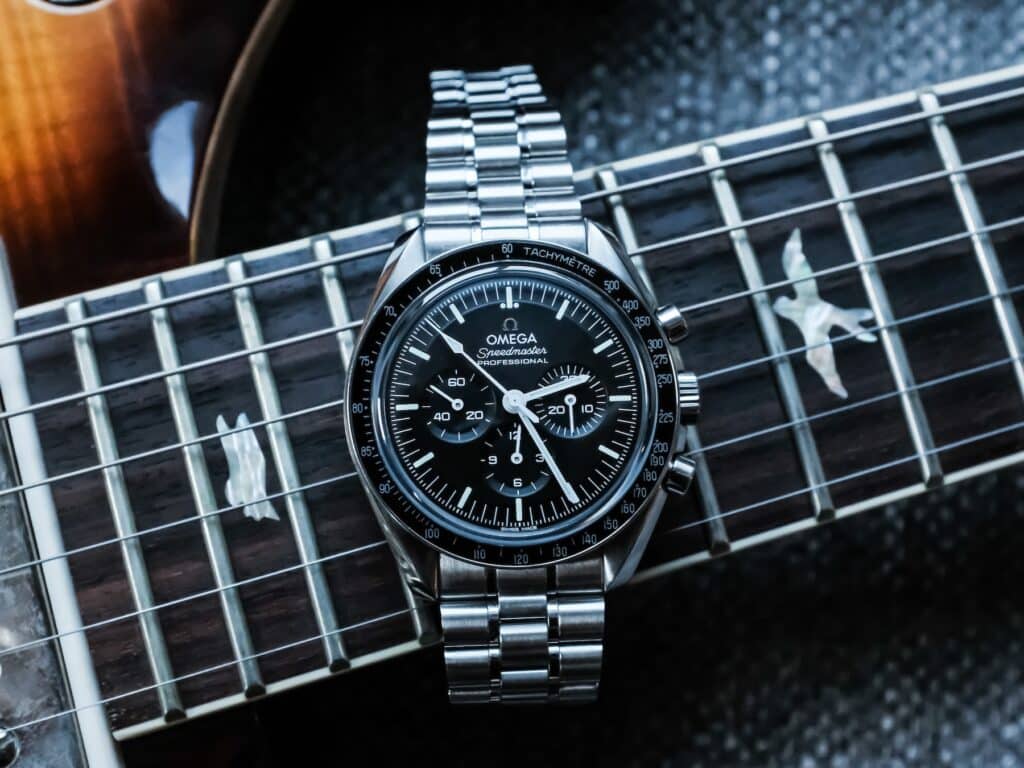
But the Speedmaster is still one of the rare icons that mostly earns attention. It has design restraint, real wrist presence, enough daily flexibility, and a chronograph layout that still feels useful instead of decorative. The hype can be annoying, but the watch underneath it is not hollow. That distinction matters.
So the honest answer is this: your collection does not need a Speedmaster, but it might benefit from one if the watch itself keeps pulling at you after all the rational objections. Buy it only if the design, feel, and ritual mean something to you. Not because a forum, podcast, or collector checklist made it feel inevitable. And if you only want a good chronograph, a practical Omega, or a space-adjacent watch that costs less and feels easier to wear hard, you have better value options. The Speedmaster is still special. It’s just not mandatory.

Co-Founder and Senior Editor
Kaz has been collecting watches since 2015, but he’s been fascinated by product design, the Collector’s psychology, and brand marketing his whole life. While sharing the same strong fondness for all things horologically-affordable as Mike (his TBWS partner in crime), Kaz’s collection niche is also focused on vintage Soviet watches as well as watches that feature a unique, but well-designed quirk or visual hook.
For me, my watch collection is a Speedmaster. I love the thing. I have one of the older ones with the 1963 movement in it. The 3573.50.00. I love it. There are many other options out there, but even if you don’t necessarily need one in your collection, you’ll probably enjoy it
Ben – the 3573.50 with the 1863 movement is a great reference. If you’re going to have a one-watch collection, that’s a solid one to build around. Glad it’s treating you well.
Thanks for writing like a human and not like an ad about this. It’s a multilayered issue about need, want, and just some basic information on the damn tool that it is.
For a well designed, historical bar story telling, mechanical stopwatch you can wear, it really is an amazing machine that is very expensive for a reason. It’s a tool not a toy.
If you need the tool to be tool and a gada watch, get it. If you want it for status, you cant buy status, so have some self reflection before you spend a good amount of money. It’s not exorbitant. Its used market value is about 30% on retail. 30% is usually the retail markup for the item so the store makes money. So it holds its actual value. Not in a watch charts way, but like used car – which it costs as much as. It’s a good common sense watch/purchase/tool. You don’t need it though.
So it goes
Also the 3861 movements biggest difference for me was the 3861 hacks. It rarely gets mentioned as a difference, but it is a huge one for some who may go vintage and not know.
The hacking point on the 3861 is a great catch (love it on my Speedmaster). That’s a big upgrade that gets buried under all the marketing noise about co-axial this and METAS that. Appreciate the thoughtful read.
I’ve owned a Speedmaster for over 25 years, and I still get enjoyment putting it on. I own far too many watches but I still think I could be happy with just the Speedmaster Professional.
I think exactly the same thing any time I put mine on.